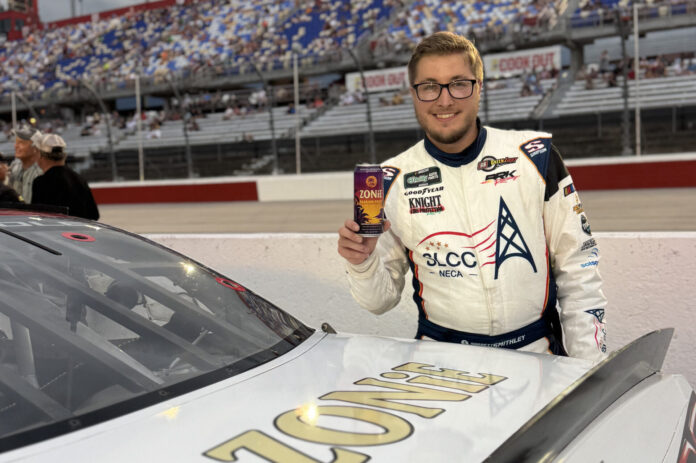
Cole Denton (No. 71 Jan’s Towing Ford) started from the Sioux Chief PowerPEX Pole and dominated Saturday’s ARCA Menards West Tucson 150, scoring his first career series victory in just his third career ARCA Menards West start. At 15 years, 8 months, and 16 days of age, Denton becomes the fourth-youngest winner in series history behind Jesse Love, Todd Gilliland, and Taylor Gray.
Reigning ARCA Menards West champion Trevor Huddleson (No. 50 High Point Racing / Racecar Factory Ford) finished second after spending much of the middle stages of the race outside the top ten conserving tires.
Eric Johnson, Jr. (No. 5 Sherwin-Williams Toyota) finished third, his second consecutive top-three finish at Tucson; he finished second in 2025.
Denton’s Jan’s Racing teammate Robbie Kennealy (No. 1 Jan’s Towing Ford) raced to the front to lead a lap early in the race before dropping back into the field to conserve tires for a late charge to the front. Kennealy’s strategy paid off with a fourth-place finish, his best finish of the season.
Gavin Ray (No. 7 Jerry Pitts Racing Toyota) finished fifth, his best career series finish. Combined with Johnson, Jr.’s third-place finish, Jerry Pitts Racing had two drivers finish in the top five.
Eric Rhead (No. 66 Champ Transport / Turnkey Leasing Chevrolet) finished a career-best sixth after running in the top five in the mid stages of the race.
Hailey Deegan (No. 16 Columbia Bank / Monster Energy Chevrolet) finished sixth, her second sixth-place finish of the year; she also finished sixth in the season opener at Kevin Harvick’s Kern Raceway. It was a busy yet successful weekend for the Deegan family; her father Brian Deegan won the Freedom 500 at Cleetus McFarland’s Freedom Factory in Bradenton, Fla. on Friday night.
Mia Lovell (No. 15 Pine HealthToyota) notched her first career top-ten finish in eighth, as did her Nitro Motorsports teammate Julian DaCosta (No. 25 Austin Canvas and Awning Toyota) in tenth.
Memphis Villareal (No. 72 RBR Engineering Chevrolet) ran as high as second before the second and final caution flag of the night. He faded on the ensuing restart, dropping to ninth at the finish.
Seventy-six year old David Smith (No. 05 Shockwave Marine Suspension Toyota) started last in the 17-car field but quickly raced his way through the field to take the lead before lap 50. He would lead until the first restart of the night, the first time in his career he led laps in an ARCA Menards West race.
Ninety-eight year old NASCAR Hall of Fame inductee Hershel McGriff gave the command to start engines. McGriff is a four-time NASCAR Cup Series winner and the 1986 champion of what is now the ARCA Menards West with 34 career wins. He made his final career start at Tucson Speedway in 2018 at the age of 90.
The next race for the ARCA Menards West is the Bill Schmitt Memorial 173 at Shasta Speedway at 11:00 pm ET / 8:30 pm PT on Saturday, May 2. The race will be streamed live on FloRacing and simulcast on The NASCAR Channel. ARCARacing.com will have live timing & scoring data for all on-track activity.
About ARCA The Automobile Racing Club of America (ARCA), founded in 1953 by John and Mildred Marcum in Toledo, Ohio, and acquired by NASCAR in April 2018, is the leading grassroots stock car sanctioning body in the United States. Bridging the gap between NASCAR’s top three national touring series and weekly and regional tour racing all across the country, the organization to sanctions over 100 races per year in the ARCA Menards Series, ARCA Menards Series East, ARCA Menards Series West, ASA STARS National Tour, ASA CRA Super Series, ASA Midwest Tour, ASA Southern Super Series plus weekly racing at Toledo and Flat Rock Speedways. For more information about ARCA visit , or follow ARCA on Facebook (@ARCARacing) and Twitter (@ARCA_Racing).
About Menards A family-owned and run company started in 1958, Menards is recognized as the retail home center leader of the Midwest with 236 stores in 15 states. Menards is truly a one-stop shop for all of your home improvement needs featuring a full-service lumberyard and everything you need to plan a renovation or build a home, garage, cabin, shed, deck, fence or post frame building. You’ll find a large selection of lumber, roofing, siding, construction blocks, trusses, doors and windows, plus cabinets, appliances, countertops, flooring, lighting, paint, plumbing supplies and more. To complete the job, Menards has quality hand tools, power tools, fasteners, electrical tools plus storage options and supplies for everyone from the weekend warrior to the pro!
Menards has what you need to complete your outdoor projects and keep your yard in tip-top shape including mowers, trimmers, blowers, pressure washers and more, plus a beautiful garden center stocked with plants, shrubs, trees, landscaping tools, grass seed, fertilizer options, outdoor décor and patio furniture. Menards also has everyday essentials like health & beauty products, housewares, pet and wildlife supplies, automotive items and even groceries. And at Christmas, an Enchanted Forest display area with impressive trees, lighting, decorations, ornaments, inflatables and more.
Menards is known for friendly Customer Service and as the place to “Save Big Money” with low prices every day, and sales too! For more information, please visit Menards.com to learn about our store locations, offerings and services.
Jesse Love and the No. 2 Whelen Chevrolet Team Battle Adversity at Bristol Motor Speedway En Route to 12th-Place Finish on Saturday Night
Finish: 12th Start: 12th Points: 3rd
“Tonight was frustrating. Obviously not the finish we wanted or expected from the No. 2 Whelen Chevrolet team. We were racing forward inside the top 10 for portions of the race, but overall fired off tight and struggled with handling the entire race, despite multiple adjustments. We’re going to go back to Welcome, NC, get to the bottom of the issue, reset and head to Kansas next weekend determined to get back to Victory Lane.” -Jesse Love
Austin Hill and the No. 21 Global Industrial Chevrolet Team Encounter Tight-Handling Balance at Bristol Motor Speedway
Finish: 21st Start: 23rd Points: 6th
“What a bummer for our Global Industrial team. I thought we were going to capitalize and make the most of our night to at least get a top-10 finish. The car fired off tight at the start of the race and was definitely too tight to run the bottom. We made the high line work to drive forward, but then something happened to our right rear. The brake would lock up and cause me to wheel hop. Hate it for this No. 21 group.” -Austin Hill
Pruett, Todd and Anderson qualify No. 1 at Lucas Oil NHRA Winternationals
POMONA, Calif. (April 11, 2026) – Top Fuel’s Doug Kalitta continued to rule the Mission #2Fast2Tasty Challenge on Saturday at In-N-Out Pomona Dragstrip, winning the bonus race for a second straight time after beating Maddi Gordon on the final round as part of the 66th annual Lucas Oil NHRA Winternationals.
Matt Hagan (Funny Car) and Dallas Glenn (Pro Stock) won the Mission #2Fast2Tasty Challenge, while Leah Pruett (Top Fuel), J.R. Todd (Funny Car) and Greg Anderson (Pro Stock) all qualified No. 1 at the third of 20 races during the 2026 NHRA Mission Foods Drag Racing Series season.
Kalitta has simply been dominant in the Mission #2Fast2Tasty Challenge the past two years, winning for the seventh time since the start of 2025, with Saturday’s coming after going 3.747-seconds at 333.66 mph in his Mac Tools dragster to hold off the rookie sensation Gordon.
Saturday success has proven beneficial for the Kalitta Motorsports team, as the reigning world champion entered the weekend as the points leader. Already the winningest Top Fuel driver at Pomona, he’ll look to win at the historic track for the eighth time on Sunday.
“I think the fans like racing on Saturday. I think it’s cool just to be able to just try to outrun the people you raced the previous race, and winning these things on Saturday is huge momentum for everybody on our team,” Kalitta said. “Every time we go up there, regardless of what we’re doing with somebody in the other lane, I’m always just trying to get the win light to come on in our lane.
“The car got to about half track, and it was really cool because you can tell that the tires aren’t slipping and it’s hooked up one-to-one. I knew I had a good shot at getting the win. Tomorrow, it’s just one round at a time. Everybody’s tough, first round to fourth round, if you can make it that far.”
Leah Pruett closed out qualifying with a strong run, but her first No. 1 qualifier since 2023 and 16th in her career was clinched on the strength of Friday’s 3.724 at 329.75-mph in her 12,000-horsepower Rinnai Tankless Water Heaters dragster. She’ll get a first-round bye on Sunday to open eliminations and a race after advancing to the final round, Pruett has a great opportunity to pick up her first victory of the season.
“We’re thrilled with where our performance is at and the confidence and momentum is building with this team,” Pruett said. “Yeah, I’m happy. I have my own work to do, but man, we’re moving and grooving and looking forward to eliminations tomorrow.”
Josh Hart, who won in Gainesville, qualified second with a run of 3.733 at 336.15, and Phoenix winner Shawn Langdon took third after going 3.745 at 338.51.
Four-time Funny Car world champion Matt Hagan continued his own success in the Mission #2Fast2Tasty Challenge, knocking off Paul Lee in the final round on Saturday with a run of 3.940 at 329.58 in his 12,000-horsepower Johnson’s Horsepowered Garage Dodge SRT Hellcat.
It’s the first bonus race win of the season for Hagan, who won the overall Mission #2Fast2Tasty trophy last year in Funny Car. He made a pair of solid runs on Saturday, which could again bode well for a Sunday victory.
“It’s a race inside of a race, and I hope I used up all my adrenaline for today,” Hagan said. “It’s cool, what Mission does and to be able to win some money for the crew guys and scoop up the points, it’s exciting. We’ve got a great race car this year, and I’m excited to see what we can do with it. This is one of the little accolades that we get to put up on the shelf, but I think there’s a lot more.
“I’ve been dreaming about getting three trophies: the Mission Challenge, the event trophy and that 1,000th trophy Funny Car trophy, so there’s a lot to be had. That’s wishful thinking, though, because these Funny Cars are super humbling.”
J.R. Todd put himself in a great spot to win the 1,000th Funny Car race in NHRA history, powering to the No. 1 spot for the first time in five years with a run of 3.896 at 335.32 in his 12,000-horsepower DHL Toyota GR Supra. He’ll open eliminations against Blake Alexander, looking for his first win of the season, but the past champion was thrilled with Saturday’s success, finishing with his 15th No. 1 qualifier and first since the 2021 campaign.
“It just shows that the performance of our DHL hot rod, that it’s coming around thanks to Dickie [Venables] and Todd [Smith],” Todd said. “It was awesome to see that 3.89 come up on the scoreboard when I went by, but I’m just happy for the guys; they put in so much hard work back there in the pit area.
“I saw the 1,000th Funny Car winner trophy on the wall up there in Q3. That’d be an awesome accomplishment. There’s been a lot of great Funny Car drivers and it was pretty awesome to see Shawn [Langdon, Top Fuel teammate] get the [1,000th Top Fuel win] last year in Charlotte. So, if we could pull that off and put that trophy next to his at the shop, I think that would make Connie [Kalitta, team owner] really happy. I love coming here. There’s a lot of history at this place and hopefully we can add some more history tomorrow.”
Phoenix winner Ron Capps qualified second after a run of 3.919 at 330.88 and Jordan Vandergriff took third with a 3.925 at 329.99.
In Pro Stock, Dallas Glenn remained undefeated in the Mission #2Fast2Tasty Challenge in 2026, defeating Aaron Stanfield in the final round of the bonus race with a strong run of 6.525 at 208.55 in his RAD Torque Systems Chevrolet Camaro.
Glenn, the reigning world champion, won the specialty event in Phoenix and had no issues on Saturday in Pomona, cruising to two impressive performances to get another bonus victory. A year after winning the world title, Glenn continues to perform at an incredible level, as he also looks to win his second straight race.
“The Mission Challenge brings that race day mentality and gets you ready for Sunday,” Glenn said. “You go out there and get two win lights and that just builds the confidence to know that you can take out anybody when everything’s right. I feel like I’ve got a lot of confidence in the car and I feel like I’m driving good, where I don’t have to think about anything, and you can just go out there and do it, everything clicks and the car runs well.”
Greg Anderson took the No. 1 spot for the second time this season and the 142nd time in his career, improving on Friday’s run with a stellar pass of 6.516 at 209.69 in his HendrickCars.com Camaro. Anderson will open eliminations against Kenny Delco, looking for his first victory of the season and his 17th career win in Pomona.
Eliminations for the 66th annual Lucas Oil NHRA Winternationals begin at 10 a.m. PT on Sunday at In-N-Out Burger Pomona Dragstrip.
POMONA, Calif. — Saturday’s final results from the Mission #2Fast2Tasty NHRA Challenge at the 66th annual Lucas Oil NHRA Winternationals at In-N-Out Pomona Dragstrip.
Top Fuel Challenge — Doug Kalitta, 3.747 seconds, 333.66 mph def. Maddi Gordon, 3.798 seconds, 327.98 mph.
Funny Car Challenge — Matt Hagan, Dodge Charger, 3.940, 329.58 def. Paul Lee, Charger, 4.198, 236.71.
POMONA, Calif. — Final round-by-round results from the Mission #2Fast2Tasty NHRA Challenge at the 66th annual Lucas Oil NHRA Winternationals at In-N-Out Pomona Dragstrip.
FINAL — D. Kalitta, 3.747, 333.66 def. M. Gordon, 3.798, 327.98.
FUNNY CAR CHALLENGE:
ROUND ONE — Matt Hagan, Dodge Charger, 3.997, 325.45 def. Spencer Hyde, Ford Mustang, 8.442, 67.87; Paul Lee, Charger, 4.024, 297.81 def. Ron Capps, Toyota GR Supra, 4.677, 177.53;
FINAL — M. Hagan, 3.940, 329.58 def. P. Lee, 4.198, 236.71.
FINAL — D. Glenn, 6.525, 208.55 def. A. Stanfield, 18.685, 63.74.
CAUTION: This email originated from OUTSIDE of the organization. Do not click links or open attachments unless you recognize the sender and know the content is safe.
POMONA, Calif. — Sunday’s first-round pairings for eliminations for the 66th annual Lucas Oil NHRA
Winternationals at In-N-Out Pomona Dragstrip, the third of 20 events in the NHRA Mission Foods Drag
Racing
Series. Pairings based on results in qualifying, which ended Saturday. DNQs listed below pairings.
Top Fuel — 1. Leah Pruett, 3.724 seconds, 329.75 mph vs. Bye; 2. Josh Hart, 3.733, 336.15 vs. 15. Cameron Ferre, 5.785, 98.91; 3. Shawn Langdon, 3.745, 338.51 vs. 14. Tony Schumacher, 4.618, 152.80; 4. Doug Kalitta, 3.747, 338.34 vs. 13. Ron August, 4.613, 165.92; 5. Shawn Reed, 3.755, 330.31 vs. 12. Clay Millican, 4.022, 236.38; 6. Billy Torrence, 3.774, 334.65 vs. 11. Antron Brown, 3.953, 267.22; 7. Tony Stewart, 3.783, 332.18 vs. 10. Will Smith, 3.870, 324.20; 8. Maddi Gordon, 3.798, 327.98 vs. 9.
Justin Ashley, 3.826, 327.98.
Funny Car — 1. J.R. Todd, Toyota GR Supra, 3.896, 335.32 vs. 16. Blake Alexander, Dodge Charger, 4.143, 316.97; 2. Ron Capps, GR Supra, 3.919, 330.88 vs. 15. Dylan Winefsky, Charger, 4.112, 290.82; 3. Jordan Vandergriff, Chevy Camaro, 3.925, 329.99 vs. 14. Daniel Wilkerson, Ford Mustang, 4.073, 288.70; 4. Matt Hagan, Charger, 3.940, 329.58 vs. 13. Spencer Hyde, Mustang, 4.057, 312.06; 5. Austin Prock, Mustang,
3.967, 323.58 vs. 12. Jason Rupert, Mustang, 4.057, 318.09; 6. Chad Green, Mustang, 3.970, 322.65 vs. 11. Paul Lee, Charger, 4.024, 317.87; 7. Alexis DeJoria, Camaro, 3.979, 328.46 vs. 10. Dave Richards, Mustang, 4.010, 317.27; 8. Jack Beckman, Camaro, 3.984, 325.61 vs. 9. Jim Campbell, Mustang, 3.992, 317.34. Did Not Qualify: 17. Jeff Arend, 4.160, 291.76; 18. Cruz Pedregon, 4.317, 217.04.
Pro Stock — 1. Greg Anderson, Chevy Camaro, 6.516, 209.69 vs. 16. Kenny Delco, Camaro, 6.583, 208.84; 2. Dallas Glenn, Camaro, 6.525, 209.43 vs. 15. Matt Hartford, Camaro, 6.575, 209.98; 3. Dave Connolly, Camaro, 6.536, 210.01 vs. 14. Troy Coughlin Jr., Camaro, 6.572, 209.20; 4. Greg Stanfield, Camaro, 6.541, 209.56 vs. 13. Stephen Bell, Camaro, 6.567, 208.68; 5. Deric Kramer, Camaro, 6.542, 209.65 vs. 12. Jeg Coughlin, Camaro, 6.565, 209.23; 6. Cody Anderson, Camaro, 6.547, 209.43 vs. 11. Erica Enders, Camaro, 6.554, 210.41; 7. Eric Latino, Camaro, 6.550, 209.65 vs. 10. Chris Vang, Camaro, 6.553, 208.33; 8. Aaron Stanfield, Camaro, 6.553, 209.85 vs. 9. Matt Latino, Camaro, 6.553, 209.52. Did Not Qualify: 17. Chris McGaha, 6.586, 209.59; 18. Joey Grose, 6.604, 208.46; 19. Mason McGaha, 6.611, 209.23.
CREWS LEADS TOYOTA WITH STRONG THIRD-PLACE AT BRISTOL, HIS FIRST CAREER SERIES TOP-FIVE FINISH Sawalich and Gray also post Top-10 Results Saturday night
BRISTOL, TENN. (April 11, 2026) – 18-year-old Brent Crew led Toyota with a third-place finish in Saturday’s NASCAR O’Reilly Auto Parts Series race at Bristol Motor Speedway. It is the North Carolina-native’s first career O’Reilly Series top-five finish in his first ever series start at the .55-mile bullring in Tennessee.
William Sawalich, who is coming off his first O’Reilly Series win last week at Rockingham, started on the pole and led 27 laps early in the race, as he posted a seventh-place run, his fourth top-10 of the season. Taylor Gray rounded out the Team Toyota contingent inside the top 10 with a 10th-place run.
TOYOTA RACING Post-Race Recap NASCAR O’Reilly Auto Parts Series (NOAPS) Bristol Motor Speedway Race 9 of 33 – 159.9 miles, 300 laps
TOYOTA FINISHING POSITIONS
1st, Connor Zilisch*
2nd, Kyle Larson*
3rd, BRENT CREWS
4th, Justin Allgaier*
5th, Carson Kvapil
7th, WILLIAM SAWALICH
10th, TAYLOR GRAY
17th, HARRISON BURTON
20th, BRANDON JONES
24th, DEAN THOMPSON
34th, BLAKE LOTHIAN
*non-Toyota driver
TOYOTA QUOTES
BRENT CREWS, No. 19 Mobil 1 Toyota GR Supra, Joe Gibbs Racing
Finishing Position: 3rd
Can you go through the final restart from your view?
“My feelings are heartbroken to be honest with you. But I’m just really grateful to be here, this is a dream of mine to come out here and race in this series, that’s all we wanted to do since we were little kids. Being able to grow up with Connor (Zilisch) and race with him is a full circle moment. Growing up and watching Kyle Larson race every week and racing him a little bit in dirt was cool and kind of trade paint with him there running the top at Bristol in an O’Reilly car in the second highest series is something that’s super cool. Those are the positives and definitely the negatives hurt, I just feel like I could have stayed up there and been flawless we could have been doing donuts with the sword. I’m learning and I’m grateful to be able to drive this super fast Mobil 1 Toyota Supra. To have the chance to be able to go out there and race for wins is where we want to be.”
What did you feel like you did right in the closing laps and where are you kicking yourself?
“What I feel like I did right was going up there and running the top really hard and getting beside the 1 (Connor Zilisch) there in (turns) three and four and have a flawless corner to be able to put it right outside the one and kind of gain leverage on the top. The parts that I’m not going to be able to go to sleep on is going up there and getting loose and running into the fence a few times. I can’t pick a driver who would make me feel worse than losing to other than Connor. As much as we are friends off the track he’s also the biggest competitor. It was really running again Connor and Larson there at the end. Larson is something I’ve raced against and I’ve been racing Connor since right after diapers. It’s pretty cool, I’m happy with our Mobil 1 Toyota GR Super No. 19 team. Great that we finally go to execute a points day, but we are hungry for more and we are looking forward to my first mile and-a-half next week.”
About Toyota
Toyota (NYSE:TM) has been a part of the cultural fabric in North America for nearly 70 years, and is committed to advancing sustainable, next-generation mobility through our Toyota and Lexus brands, plus our more than 1,800 dealerships.
Toyota directly employs nearly 64,000 people in North America who have contributed to the design, engineering, and assembly of nearly 49 million cars and trucks at our 14 manufacturing plants. In spring 2025, Toyota’s plant in North Carolina will begin to manufacture automotive batteries for electrified vehicles. With more electrified vehicles on the road than any other automaker, Toyota currently offers 31 electrified options.
You’ve probably said this in the last month: “If we just had one more truck, this would be easy.” The days are fuller, jobs are heavier, and your machines seem flat out. Yet between the flats, small breakdowns, and extra trips, you’re never really using your fleet at its best. The truth is, most outfits have more capacity sitting in the yard than they think they just haven’t set it up right.
Here’s why most people get this wrong: they jump straight to “buy more gear” instead of tightening how they plan jobs, set up vehicles, and use attachments. Once you make small, smart changes there, your existing trucks and machines start doing more work per hour with less hassle on every job.
Plan Jobs So Your Existing Fleet Works Smarter, Not Harder
If you don’t plan, your best truck and machine get hammered while others sit half idle. One rig racks up all the miles and fixes. Another barely leaves the yard.
Map Work Instead of Reacting
Start with a simple weekly rhythm:
List the jobs and sites on a whiteboard or sheet.
Group jobs by location and type of work.
Decide which vehicle and machine go where before anyone turns a key.
Aim for:
Fewer “oops” runs. One trip should carry the tools, parts, and materials for that cluster of jobs.
Better matching. Don’t send the biggest truck on the lightest work just because it’s parked closest.
Even basic notes help. Write down, for each day:
Which truck went where?
Which loader or skid‑steer worked on which job?
Any time you had to send someone back for something that should’ve been on the first load.
After a couple of weeks, the patterns are obvious:
One pickup makes three to four trips a day, while another sees only one.
A loader is stuck on a site where the tasks could be done with attachments on a smaller machine.
You’re revisiting the same jobs because tools or materials were missing the first time.
The fix is rarely “more machines”. It’s closing these gaps so every trip and machine hour counts.
Tires and Wheels: Stop Letting the Ground Win
If your trucks or machines spend any time off perfect pavement, tire choice and condition matter more than most people admit. Wrong tires show up as the following:
Spinning and slippage in mud, gravel, or soft ground.
Repeated flats and sidewall damage on sites.
Wandering steering and long stops when loaded.
Flats and tire failures aren’t just a nuisance—they can shut a unit down for hours and force job rescheduling. Matching tires to your real mix of road, site, and field work gives you the following:
More grip and less spin on the surfaces you see most.
Longer tire life and fewer on‑site failures, which keeps units earning instead of sitting.
More predictable handling when you’re towing or running fully loaded.
Matching tires to your real mix of road, site, and field work gives you more grip and less spin on the surfaces you see most, along with longer tire life and fewer on-site failures.
If your work is split between highways and rough ground, look at solid all-terrain or off-road patterns and load ratings from a specialist like DiscountedWheelWarehouse. They carry tires built for mixed use, heavy loads, and site abuse, and if you are looking to upgrade your rig’s stance and stability, you can buy 20-inch rims to ensure your wheels match the toughness of the tires you’ve chosen.
Bed Setup: Turn One Trip Into Many
An open bed with tools rolling around is one of the fastest ways to waste time. Every day, you pay in:
Extra trips because the first load wasn’t packed smart.
Lost minutes climbing in and out of the bed to find gear.
Damage to the bed and cargo when things slide, tip, or hit the sides.
A better setup doesn’t have to be fancy.
Bed liners and mats to protect steel and stop loads from sliding.
Racks and dividers to give each tool and material type a “home.”
Tie‑downs and anchor points mean strapping loads low and tight is easier than doing it badly.
Done well, the same truck can:
Carry more usable gear per trip (because it’s stacked and secured instead of dumped).
Keep daily-use tools at the back or on the side so you can reach them in seconds.
Run safer, with less sway and better weight over the axle.
Tie-downs and anchor points mean strapping loads low and tight is easier than doing it badly.
Beyond internal organization, protecting your cargo from the elements and theft is key to job site efficiency. Installing a durable truck hard-shell topper allows you to transform an open bed into a secure, weatherproof mobile workshop, ensuring your tools stay dry and accounted for across multiple job sites.
When done well, the same truck can carry more usable gear per trip (because it’s stacked and secured instead of dumped) and keep daily-use tools at the back or the side where you can reach them in seconds.
Stop Asking One Bucket to Do Every Job
Using one standard bucket for everything means:
Slow, messy filling when you move loose or light materials.
Poor finishes when you’re grading.
People are dragging pallets, brushes, or debris by hand because the bucket isn’t suited to the job.
A small attachment kit can flip that on its head.
Forks/pallet forks: for pallets, lumber, bundled or strapped loads.
Grapples: for brush, scrap, logs, and bulky waste that doesn’t sit nicely.
Different buckets: toothed for digging, smooth for grading, high‑capacity for light bulk material.
Augers: for post-and-pier holes.
Brooms: for cleaning yards or hard surfaces, far faster than hand sweeping.
One skid‑steer or loader, set up with a quick‑attach system and the right end tools, can easily replace the following:
A separate forklift for pallets.
A second machine is used only for cleanup.
A lot of manual labor that chews up your crew’s energy.
Protect Uptime With Light‑Touch Maintenance and Habits
Downtime often comes from small, neglected problems, not “bad luck”. A light but consistent routine is worth more than big, rare teardowns.
Give each key vehicle and machine a two‑minute loop at the start of the day:
Tires: low, damaged, or anything stuck in the tread.
Leaks: fresh spots under engines, gearboxes, or hydraulic lines.
Attachments: missing or loose pins, cracked edges, or bent parts.
Controls: warning lights on start‑up, odd noises, or sluggish steering.
There was a stretch — roughly 2018 through 2023 — when talking to detailers about 3M paint protection film produced the same slightly embarrassed reaction you’d get asking about a once-great band that had stopped touring. The shop would say something diplomatic about how 3M “invented the category” (true — the technology came out of military rotor-blade protection during the Vietnam era, was patented by 3M, got adopted by NASCAR in the 1980s to protect the vinyl sponsor graphics on Cup cars from tire rubber, rock chips, and the plastic splinter hazard that came from bumper-to-bumper contact at speed, and eventually made its way onto civilian cars) and then quietly steer you toward XPEL or STEK. It wasn’t that 3M’s film was bad. It was that the world had moved and 3M hadn’t noticed.
The NASCAR lineage is worth dwelling on for a second, because it’s the closest thing the PPF category has to a real-world accelerated stress test and it’s the part of 3M’s history that most of the current marketing narrative has left on the table. Scotchgard remains — as of today — the only paint protection film officially licensed by NASCAR, and the Scotchgard Pro Series that ends up on Cup cars is tested and rated to survive track conditions at speeds exceeding 180 mph. What that means in practical terms is that a piece of 3M film running on the nose of a race car spends a three-to-four-hour event absorbing direct impact from rubber pellets thrown off tire scrub, thermal cycling between a 160°F track surface and a 90°F pit lane, the occasional direct hit from track debris, and the aerodynamic load of air moving across the paint at well over the speed at which it starts behaving like a solid. That’s a hostile environment — more hostile than anything a consumer car will ever encounter in a lifetime of daily driving — and it’s the whole point of why NASCAR has historically been a useful validation venue for coatings, films, and protective chemistry. If a film can finish a Cup season without peeling at the edges, yellowing under direct sun, or failing under impact, it’s a film that will handle the banal punishment of road salt, bug strikes, and winter gravel without complaining. The racing program isn’t where 3M makes its money on PPF. It’s where 3M proves the product can take a beating no consumer will ever hand it.
Two things have changed the civilian side of the story. The first is Scotchgard Pro Series 200, which is a measurably better film than anything 3M had in market two years ago. The second, less obvious but arguably more important, is that 3M has been quietly tightening its certified installer program into something called the Pro Shop designation, and expanding that network across Canada with new certified locations in Calgary, Edmonton, Vancouver, and a handful of other markets. Taken together, the two moves are the clearest evidence yet that 3M is done ceding the premium PPF market and has decided to fight for it on the terms the market now cares about: product performance and install quality, weighted equally.
If you’ve been in this space for a while, you know how unusual that second part is. For most of the industry’s history, film brands competed on the spec sheet and left installation to whoever bought the film. Installers were treated as a distribution channel, not a quality control layer. The problem is that PPF is not like a tire or a battery — it is probably the single most installation-dependent product in the automotive aftermarket. The same roll of film, in the same weather, on the same vehicle, can produce a beautiful invisible protective layer or a lifting, fish-eyed mess depending entirely on whether the person holding the squeegee knows what they’re doing. Everyone inside the industry has known this for years. Manufacturers have mostly pretended not to.
The Pro Shop program is 3M’s admission that pretending isn’t working. To carry the Pro Shop mark, a shop has to complete hands-on certified training — vehicle prep, stretch discipline (you’re not supposed to pull PPF more than fifteen percent before the adhesive starts marking), edge work, squeegee technique, the tedious business of managing application solution mix ratios and film repositioning — and commit to using 3M’s Pattern and Solutions Center software for pre-cut kits. None of this is glamorous, and none of it is visible to the customer at the point of sale. But it’s where the actual failure modes of PPF live.
The warranty mechanics are the enforcement layer. The full 10-year consumer warranty on Scotchgard Pro Series 200 is only valid when the film is installed by a certified 3M installer. Buy the same material from a gray-market distributor and have it laid down by an uncertified shop, and the paperwork becomes decorative — the film is still 3M, but the warranty isn’t. This isn’t unique to 3M (XPEL, SunTek, and Llumar all run their warranties through certified networks too), but it does mean that in practical terms the Pro Shop designation is the warranty. Everything else is a sticker.
What makes Pro Series 200 worth building a program around is that the film itself finally gives installers something to work with. The big change, and the one that doesn’t photograph well, is the adhesive. 3M engineered a firmer, more repositionable adhesive than previous 3M PPF generations. This sounds like a minor tweak, and if you’re outside the install bay it reads as one. But talk to anyone who has actually wrapped a bumper and you’ll find out it isn’t. Soft, aggressive adhesives feel fast in the first ten seconds — the film grabs, sticks, looks laid — and then punish you for the next four hours when you realize the bottom corner is off by three millimeters and you can’t move it without leaving a mark. The newer adhesive is designed to give installers real working time without sacrificing long-term bond strength, which means fewer lift lines, fewer adhesive marks hiding under the edges, and fewer callbacks. In practical terms it’s the difference between a shop taking two and a half hours on a front bumper and the same shop taking ninety minutes on the same bumper, with a cleaner result.
The other physical change that matters is that Pro Series 200 is available in 72-inch width. This is the kind of detail that only people who have stared at a seam across a truck hood will appreciate. Most previous PPF was 60 inches wide, which sounds like plenty until you put it on a Ram 1500 or a full-size SUV and realize the hood needs a seam down the middle. Seams are the number-one failure point on a full-front wrap — they collect grit, they lift first, and once you’ve seen one you can’t un-see it. A 72-inch roll lets an installer cover most vehicle hoods in a single piece. The visual difference between a seamless hood and a seamed hood is the difference between “protected” and “installed.”
On top of the mechanical improvements, Pro Series 200 runs a hydrophobic topcoat that 3M tuned specifically against the contaminants that actually destroy PPF over time: tree sap, bird droppings, bug remains, road tar, brake dust. These are the things that quietly etch or stain lesser films while the self-healing layer underneath continues to function perfectly. You end up with a film that is technically healing scratches while cosmetically falling apart. A topcoat that resists the real-world chemistry of what actually lands on a front bumper is what separates a film that looks new at year five from one that starts yellowing around year three.
The interesting product decision 3M made was to push Pro Series 200 in two finishes — gloss and matte — and treat matte as a serious product rather than a novelty. Gloss Pro 200 is the conventional clear bra: invisible over standard paint, enhances wet-look depth, pairs cleanly with a ceramic coating on top. That’s the ninety-percent use case. Matte Pro 200 is the interesting one. It does two different jobs depending on the car it goes on. Over a glossy paint, it transforms the finish into a smooth satin — effectively turning an ordinary car into a matte-wrapped car while still protecting the paint underneath. Over a factory matte paint, which is notoriously difficult to maintain (you can’t polish it, wax ruins the finish unevenly, and minor scratches are effectively permanent), it provides a sacrificial layer with the self-healing and stain resistance the raw paint doesn’t have. For owners of matte-finish BMW Individual or AMG vehicles, this is the first product that actually solves the problem those cars were sold with.
The reason all of this matters in a place like Calgary — more than it would matter in, say, San Diego — is that the climate here is genuinely trying to kill your paint every month of the year. Summer hail comes down in chunks that will dent a hood. The winter road salt mix is aggressive enough to pit chrome. The temperature swings from −30°C to +30°C stress the adhesive on anything bonded to your paint. And the UV at altitude accelerates yellowing on cheap films in a way that would take twice as long at sea level. A film that still looks perfect after twelve months in a mild climate may be visibly failing after twelve months in Alberta. Which is why the certified installer designation earns its weight here rather than just being a marketing checkbox.
For readers trying to make sense of the local market, a useful reference is Calgary Paint Protection Film, a 3M certified Pro Shop operating in the city that carries the new Scotchgard Pro Series 200 lineup in both gloss and matte. Their site documents the certification and walks through the practical differences between the finishes, which makes it a reasonable starting point whether you’re shopping for an install or just trying to understand what the Pro Shop mark actually changes. Most shops will not walk a customer through the adhesive engineering or the pattern software integration, because most shops are selling a service, not a product category. The Pro Shops do, because that’s essentially what the certification exists for.
It’s too early to say whether the Pro Shop expansion will shift market share in the numbers that matter — XPEL still dominates the enthusiast conversation, and the independents aren’t going anywhere. But for the first time in years, 3M is competing on both sides of the PPF problem. The film is better, the program behind the film is better, and the gap between a certified install and a hack install is now large enough that the mark on the door actually means something. The clear bra category is one of the few corners of the aftermarket where the customer has almost no way to evaluate quality until two years after the install, when the edges either lift or don’t. Narrowing that uncertainty with a real certification is probably the most useful thing a manufacturer can do for this market, and it’s the thing 3M is now actually doing.
The window tint market has a credibility problem, and it’s mostly the fault of the spec sheet. Walk into any shop in North America and ask what makes one ceramic film better than another, and you’ll get a pile of numbers — 99% UV rejection, 95% infrared rejection, 62% total solar energy rejection, 200+ layers of nanotechnology — that sound impressive and, on closer inspection, mostly mean nothing without the footnotes attached to them. The 99% UV figure is meaningless as a differentiator, because virtually every ceramic film on the market from the last decade clears that bar. The 95% infrared number is often measured over a sliver of the IR spectrum where the film happens to perform well, which is not the same as the film rejecting 95% of actual solar heat. The only metric that genuinely compares films apples-to-apples is TSER — total solar energy rejection, tested across the full spectrum — and most marketing materials bury it because TSER numbers are rarely as flattering as the cherry-picked ones.
This is the context in which 3M has chosen to relaunch the Crystalline line. If you’ve paid attention to automotive window film for more than five minutes, you know the original Crystalline. It’s the film that 3M used to anchor its premium tint identity for years — the one with more than 200 layers of multilayer optical film (MOF) sandwiched thinner than a Post-it note, famously non-metallized (so it doesn’t block cell signal, GPS, or the increasingly fussy electronics in modern cars), and still one of the only products on the market that could hit serious heat rejection at an 88% VLT, meaning you could tint a windshield without making it look tinted at all. Crystalline was a legitimately impressive piece of engineering. It was also starting to look its age, and the industry had noticed.
The engineering pedigree is worth a paragraph of its own, because it’s the part of the Crystalline story that rarely makes it into consumer marketing and probably should. 3M Window Film has been the Official Window Film of NASCAR for more than a decade, and Crystalline specifically is the product the sanctioning body and the teams standardized on. The relationship didn’t start as a marketing deal. Penske Racing tested the film on track in 2011, Greg Biffle raced it at Daytona shortly after, and the reason both teams wanted it had nothing to do with sponsorship dollars — it had to do with the fact that the cockpit of a Cup car is a genuinely dangerous thermal environment. Cabin temperatures during a summer race routinely sit north of 130°F, driver core temperatures climb past 103°F over the course of four hundred laps, and the windshield is the single largest vector for solar load. Teams needed a film that could reject serious heat without a metallized layer that would interfere with in-car radio, telemetry, or the increasingly sensitive dashboard electronics the cars were gaining year over year. Crystalline was the only product on the market that checked both boxes. It’s still the only one that NASCAR has put its name on. That’s not a spec-sheet claim or a marketing partnership retroactively dressed up as an engineering one — it’s a functional requirement that got solved under the most hostile thermal conditions anyone can legally drive in, and it’s probably the single most useful piece of context you can have on how Crystalline actually behaves on a car sitting in a parking lot in August.
Crystalline Blk is 3M’s answer to what comes after that original product, and it’s worth paying attention to for reasons that go beyond the spec sheet.
The product replaces and extends the original Crystalline series with what 3M is describing as “the most advanced” version of the film to date. The multilayer optical construction is still there — 200-plus layers, each optimized to reflect specific wavelengths of infrared energy while passing visible light — but the stack has been retuned, the hard coat has been redesigned, and the color profile has shifted in a way that matters more than it sounds.
Start with the color. The original Crystalline had a subtle but real warmth to it. Depending on the darkness you chose, the film could shift toward a slightly bronze or greenish cast, which was fine on some cars and mildly jarring on others. On a black car with OEM privacy glass in the rear, the Crystalline windshield strip sometimes didn’t quite match the factory glass behind it, and you’d see a faint color break from certain angles. Crystalline Blk resolves this. The new film shifts to a neutral black and grey profile across all tint levels, tuned to align with the OEM glass on modern vehicles. The point isn’t that the old film was ugly — it wasn’t — it’s that modern cars are being designed with increasingly dark, neutral factory glass, and a film that integrates into that look instead of fighting it is a meaningfully better product from an aesthetic standpoint. 3M specifically mentions resale value as part of the pitch, which is the kind of claim you usually ignore but which does apply: a car that looks like it has factory glass rather than aftermarket tint is a different thing to a buyer.
The performance numbers are also up. Crystalline Blk delivers up to 62% TSER (total solar energy rejection, across the full solar spectrum, which is the number that actually matters for how cool your interior feels) and up to 70% IRER — infrared energy rejection measured across the real 780-to-2500-nanometer IR range, not the sliver around 900-1000nm that manufacturers love to quote because films tend to do well there. Both figures are at the top of what non-metallized ceramic film is currently capable of. 99.9% UV is maintained across the lineup, and the product carries the Skin Cancer Foundation Seal of Recommendation (with the standard and legally required disclaimer that 3M hasn’t tested the film’s efficacy in actually preventing skin cancer — the seal is a statement about the UV-blocking chemistry, not a medical claim).
The less-marketed improvement is the new hard coat. Crystalline Blk runs a scratch-resistant hard coat that 3M added specifically to reduce installation-related defects. This is one of those changes that sounds like inside baseball until you’ve watched an installer work a rear windshield and seen how easy it is to mark the film with a fingernail, a squeegee corner, or the edge of a heat gun. Scratched film is the most common install-time failure, and it’s almost always fixed by pulling the panel and doing it again — which eats time, wastes material, and teaches installers to be cautious rather than decisive. A harder coat means installers can work more confidently, and it also means the film holds up better to routine handling after the install — opening a window with a sticky drink in your hand doesn’t leave marks the way it used to.
3M is also quoting up to 25% faster shrinkage during installation with less heat required, which is another installer-facing improvement. Shrinking film to the curvature of a rear windshield is the hardest part of the job, and it’s where a good installer separates from an average one. A film that shrinks faster with less heat means less thermal stress on the film itself, less chance of cooking the defrosters, and — in the hands of a certified installer — a visibly cleaner result on the glass.
Sitting alongside Crystalline Blk in 3M’s current lineup is the Ceramic IR Series, which is the interesting middle-tier product. Ceramic IR uses ceramic nanotechnology rather than the full 200-layer MOF stack, which means it costs less and gets within striking distance of Crystalline on the metrics that matter. 3M rates it at up to 66% total solar energy rejection at certain VLT levels, in a neutral non-metallized construction that — like Crystalline — won’t interfere with GPS, 5G, satellite radio, or any of the other signals modern cars rely on. For customers who can’t quite justify the Crystalline price but want serious heat rejection in a clean, fade-resistant film that will hold its color, Ceramic IR is the honest answer. Both products are backed by 3M’s limited lifetime warranty when installed by a certified installer.
That last qualifier is where the Pro Shop designation becomes unavoidable. 3M has been tightening its certified installer network over the last two years under the Pro Shop mark, and expanding it aggressively across Canada, with new certified locations coming online in Calgary, Edmonton, Vancouver, and several other markets. The warranty on both Crystalline Blk and Ceramic IR — in practical terms — only exists if the film is installed by one of these certified shops. Buy the same film from a gray-market distributor, hand it to an uncertified installer, and you own a piece of material, not a warranty.
This matters more for tint than it does for almost any other automotive product because window film is visible, every day, at a scale no other aftermarket component can match. A bad ceramic coating is invisible. A bad ceramic tint is visible from twenty feet away, in the form of visible seams along the door glass, dust and hair trapped under the film, bubbles forming in the first week, or the infamous purple shift that happens to cheap non-ceramic film after a season or two in the sun. Crystalline Blk is a more capable film than the old Crystalline — the color is better, the hard coat is better, the TSER is up, the IRER is up — but those improvements are worth very little in the hands of an installer who doesn’t know what to do with them. Multilayer optical films are unforgiving. The stack can crease, the layers can delaminate, the edges can lift if the slip solution chemistry isn’t right. The 200-layer nanotechnology is either installed correctly or it’s a very expensive piece of garbage on your rear glass.
The Pro Shop requirement is 3M’s way of closing that loop. Certified installers complete hands-on training on 3M’s specific film chemistry, learn the shrink and slip protocols for Crystalline and Ceramic IR specifically, and work with the Pattern and Solutions Center software for pre-cut templates. None of this is glamorous, and none of it shows up on the receipt. But it’s the difference between a Crystalline Blk install that looks factory and one that looks like tint.
For readers in Alberta sorting through options, a useful starting point is Pro Window Tinting, a Calgary-based 3M certified Pro Shop that carries both the Crystalline Blk launch lineup and the Ceramic IR range. Their site breaks down the VLT options, the warranty structure, and the performance numbers for each film without the usual spec-sheet sleight of hand. It’s the kind of reference that makes sense whether you’re actively shopping or just trying to understand what separates a legitimate ceramic install from everything else on the market.
The broader point, though, is about 3M’s read on the tint market. For most of the last five years, the high end of automotive window film has been a fight between a handful of aggressive independents — the ones who built their brands on spec-sheet maximalism and big social-media presences — and 3M has been the quiet incumbent everyone respected but few shops pushed hard. Crystalline Blk, coupled with the Pro Shop network expansion, is the clearest sign yet that 3M isn’t content to be the respected incumbent anymore. The product is better than what it replaces, the marketing has actual teeth for the first time in a while, and the certification program gives customers a defensible reason to choose a certified shop over the guy with a nicer Instagram feed. Whether that adds up to a shift in market share is a question for 2027. But for the first time since the original Crystalline launch, 3M is making moves that look like they’re aimed at winning the category rather than defending it, and the car buyers who sit on this information early — before every shop has caught up to the new product — are going to be the ones walking around with the best windshield in traffic.
Motorsport has always been associated with speed, precision, and instinct. From the outside, it can look like a sport driven by raw talent and bold decision-making. But behind every overtake, pit stop, and tyre choice lies something far less visible and far more powerful: probability.
Modern racing is no longer just about who is fastest on track. It is about who can best interpret uncertainty, quantify risk, and act within a constantly shifting set of variables. In this environment, success is rarely the result of a single brilliant move. Instead, it emerges from a series of calculated decisions, each grounded in probability.
The Invisible Layer of Every Race
Every race weekend begins long before the lights go out. Teams run thousands of simulations, modelling scenarios that range from tyre degradation patterns to safety car timing, weather changes, and competitor strategies. These simulations do not aim to predict a single outcome. Instead, they map a range of possible futures, each assigned a probability.
For example, a team may determine that there is a 30% chance of a safety car within the first 20 laps, or that an early pit stop increases the likelihood of track position gain under certain conditions. These are not certainties, but weighted possibilities that guide decision-making.
What matters is not eliminating uncertainty, but understanding it.
Decision-Making Under Pressure
Once the race begins, those pre-race models are constantly updated with live data. Tyre wear, lap times, fuel consumption, and competitor behaviour all feed into real-time strategy adjustments. Engineers on the pit wall are not simply reacting; they are recalculating probabilities with every passing lap.
A call to pit early, for instance, is rarely based on instinct alone. It reflects a calculation: the probability of an undercut working versus the risk of traffic, the likelihood of tyre performance drop-off, and the chance of external disruptions such as yellow flags.
Drivers, too, operate within this framework. When attempting an overtake, they are subconsciously evaluating risk versus reward: grip levels, braking distances, opponent behaviour, and race context. The decision is made in seconds, but it is informed by patterns and probabilities built over years of experience.
Structured Risk, Not Guesswork
One of the most common misconceptions about motorsport is that it thrives on risk-taking alone. In reality, it thrives on structured risk.
Teams do not ask, “What is the boldest move?” but rather, “What is the most favourable probability?” This distinction is critical. A risky move is not inherently valuable unless the expected reward justifies the likelihood of failure.
This same principle applies in other environments where outcomes are influenced by probability rather than certainty. Systems that operate within defined rules, measurable variables, and statistical frameworks allow participants to make informed decisions rather than relying on instinct alone. In probability-based platforms such as the Mr Q casino, outcomes are shaped by clearly defined mechanics, odds, return-to-player percentages, and game structures, which, much like racing simulations, create a framework where decisions are made within known parameters rather than pure chance. The emphasis shifts from guessing outcomes to understanding how those outcomes are generated and how risk can be managed over time.
The Role of Expected Value
At the core of these decisions lies the concept of expected value. In simple terms, expected value measures the average outcome of a decision if it were repeated many times.
In racing, this might translate to choosing between two strategies: one that offers a high chance of finishing in a safe position, and another that carries more risk but a higher potential reward. The decision depends on context. A team fighting for a championship may prioritise consistency, while one chasing a breakthrough result may accept greater variance.
Expected value reframes decision-making. It removes the emotional weight of a single outcome and instead focuses on long-term performance across many scenarios.
Adapting to High-Variance Environments
Motorsport is inherently unpredictable. Weather conditions change, mechanical failures occur, and unexpected incidents reshape races in seconds. These variables introduce what analysts call “variance”, the degree to which outcomes can deviate from expectations.
The best teams are not those that avoid variance entirely, but those that manage it effectively.
They build flexible strategies that can adapt to new information. They avoid overcommitting to a single outcome. And perhaps most importantly, they remain disciplined, resisting the temptation to abandon a sound strategy after a short-term setback.
This ability to operate within high-variance environments is what separates consistent performers from occasional winners.
Learning from the System
Image by Tanu on Freepik
The systems used in motorsport are grounded in rigorous analysis and governed by clear regulations, such as those established by Fédération Internationale de l’Automobile, which standardise technical and sporting frameworks across championships. These structures ensure that while outcomes remain uncertain, the environment in which they occur is controlled and measurable.
This balance between structure and uncertainty is what makes probability such a powerful tool. It does not eliminate risk, but it makes risk understandable.
For teams, this means better decisions. For drivers, it means greater confidence. And for observers, it offers a deeper appreciation of what is really happening beneath the surface of the sport.
Beyond the Finish Line
Motorsport provides a clear example of how probability can be applied in high-pressure, real-world environments. It shows that uncertainty is not something to fear or avoid, but something to engage with intelligently.
The lessons extend beyond the track. In any system where outcomes are influenced by multiple variables, the same principles apply: understand the framework, evaluate the probabilities, and make decisions that align with long-term outcomes rather than short-term impulses.
On the surface, racing may appear chaotic. But beneath that chaos lies structure, calculation, and a deep understanding of how probability shapes every moment.
Brent Crews had a stellar run that nearly netted him a first NASCAR O’Reilly Auto Parts Series career victory in the Suburban Propane 300 at Bristol Motor Speedway on Saturday, April 11.
The 18-year-old Crews from Hickory, North Carolina, spent the early portions of the event struggling to gain ground from his 17th-place starting spot despite managing to settle in 14th place when the first stage period concluded on Lap 80. During the early stages of the second stage period, Crews managed to crack the top-10 mark for the first time, which he achieved on Lap 108 after he was locked in a tight three-wide battle with Jesse Love and Carson Kvapil for ninth place. Through a 64-lap green-flag stretch, Crews managed to carve his No. 19 Mobil 1 Toyota Supra entry up to fifth place and accumulate six crucial stage points when the second stage period concluded on Lap 170.
Restarting in 11th place for the event’s third and final stage period with 118 laps remaining, Crews navigated his way back into the top-10 mark during the next lap. He then spent the duration of this period inside the mark and ran as high as fourth place on the track. Then, during a caution period with 27 laps remaining, Crews was one of three competitors, along with Connor Zilisch and Corey Day, who elected to remain on the track with the exact tires used since the start of the final stage period while the rest of the field led by Kyle Larson, who led a race-high 230 laps, elected to pit for fresh tires.
Crews’ late gamble to remain on the track paid off as he briefly challenged Zilisch for the lead. Two laps into challenging Zilisch for the lead, however, Crews got loose and slightly hit the outside wall through the first two turns. He then spent the next two laps fending off Larson and teammate Justin Allgaier to retain second place before another late-race caution with 18 laps remaining stacked up the field.
Like the previous restart, Crews got sideways at the restart’s launch, with the latest one occurring with 11 laps remaining. Nevertheless, he used the preferred outside lane that had the momentum from exiting the turns and navigating through the straightaways to draw alongside Zilisch while bidding for the lead. Crews then managed to maintain a slight advantage over both Zilisch and Larson over the next four laps before he slipped and hit the outside wall for a second time with seven laps remaining.
With the momentum briefly stalled, Crews lost the lead to Zilisch and he was overtaken by Larson in a single lap. He was then unable to reel in both competitors as he settled in third place and ended up 1.291 seconds shy of winning the event.
Nevertheless, Crews racked up his career-best result of third place and his third career top-10 result in his fifth O’Reilly Auto Parts Series career start. Crews’ previous best result was sixth place, which he achieved during his debut race at Circuit of the Americas in late February. Crews’ result was also enough for him to secure one of four Dash 4 Cash qualifying berths for next weekend’s event at Kansas Speedway. There, he will square off against Justin Allgaier, Carson Kvapil and Sheldon Creed for the $100,000 bonus.
Amid Crews’ stellar performance under the lights and in his first O’Reilly performance at Bristol, there were positives and negatives noted for the North Carolina rookie competitor that left him with mixed feelings.
“What I feel like I did right was going up there and running the top really, really hard and getting beside [Zilisch] there in [Turns] 3 and 4,” Crews said on the CW Network. “I had a really flawless 3 and 4 to be able to put [my car] right on the outside of [Zilisch] and kind of gain leverage there on the top.
“The parts that I’m going to not be able to go to sleep on is going up there and getting a little loose and running into the fence a couple times. It’s tough. I learned a lot. I can’t pick a better driver that would make me feel worse than losing to other than Connor [Zilisch].”
The 2026 season marks Crews’ first campaign in the O’Reilly Auto Parts Series division after he spent the previous season campaigning in 10 Craftsman Truck Series events and winning nine events between the ARCA Menards Series and ARCA East and West divisions. He was unable to compete in four of the first nine scheduled O’Reilly events this season between February and March due to age restrictions (Daytona International Speedway, EchoPark Speedway, Las Vegas Motor Speedway and Darlington Raceway).
Despite the age restriction, Crews was able to compete in four events that allowed competitors as young as 17. They included road courses and tracks that were 1.25 miles or shorter. The tracks included Circuit of the Americas, Phoenix Raceway, Martinsville Speedway and Rockingham Speedway. Having turned 18 years of age on March 30, Crews now has the No. 19 Joe Gibbs Racing Toyota entry to himself. His objective is to contend for race victories and accumulate the points needed to make the Chase and contend for the series’ championship.
Photo by Chad Wells for SpeedwayMedia.com.
Currently, Crews is ranked in 18th place in the 2026 driver’s standings. He is 75 points below the top-12 Chase cutline, but has 15 regular-season events remaining on the schedule. This would propel him inside the cutline before the postseason’s commencement.
“I’m happy with what this Mobil 1 Toyota Supra [Joe Gibbs Racing] No. 19 team has accomplished and what we will continue to accomplish,” Crews said. “It’s great that we finally executed a points day, but we’re hungry for more and I’m looking forward to my first mile and a half [track at Kansas Speedway] next week.”
Brent Crews’ 2026 NASCAR O’Reilly Auto Parts Series season continues next weekend at Kansas Speedway for the Kansas Lottery 300. The event is scheduled for next Saturday, April 18, and will air at 7 p.m. ET on the CW Network, MRN Radio, and SiriusXM.
Connor Zilisch spoiled teammate Kyle Larson’s dominant run by snatching a late NASCAR O’Reilly Auto Parts Series victory in the Suburban Propane 300 at Bristol Motor Speedway on Saturday, April 11.
The 19-year-old Zilisch from Charlotte, North Carolina, led three times for 24 of 300-scheduled laps in an event where he started in 15th place and methodically drove his way to the front. As the event transitioned into nighttime racing, Zilisch’s No. 1 entry from JR Motorsports gained fast pace. After recording a total of 11 points from the event’s first two stage periods, Zilisch spent a bulk of the final stage period racing within the top-five mark.
Then, during a late-race caution with 27 laps remaining, Zilisch was among three competitors who opted to remain on the track with the exact tires used before the start of the final stage period, while the rest, led by Larson, pitted. Despite fending off Larson to retain the lead during a late-race restart with 22 laps remaining, Zilisch’s late charge was stalled when a spin by Anthony Alfredo drew another caution and stacked up the field with 18 laps remaining.
In the early portions of an 11-lap dash to the finish, Zilisch was outdueled by Brent Crews, but the former spent the next four laps challenging the latter until Crews hit the backstretch’s outside wall. With the lead back in his possession, Zilisch spent the final laps fending off Larson to capture his first checkered flag of the 2026 NASCAR campaign and his first at the Last Great Coliseum.
With on-track qualifying that determined the starting lineup occurring on Saturday, William Sawalich secured his first O’Reilly pole position of the 2026 season and the third of his career with a pole-winning lap at 122.733 mph in 15.634 seconds. Sheldon Creed started alongside Sawalich on the front row after the former posted his fastest qualifying lap at 122.404 mph in 15.676 seconds.
Before the event, Carson Kvapil dropped to the rear of the field due to an engine change that was made to his No. 9 JR Motorsports Chevrolet Camaro entry. Rajah Caruth also started at the rear of the field due to unapproved adjustments to his No. 32 Jordan Anderson Racing Chevrolet Camaro entry and prevented him from qualifying on the track.
When the green flag waved and the event commenced, pole-sitter William Sawalich launched his No. 18 Soundgear Toyota Supra entry ahead from the outside lane and he quickly transitioned to the inside lane through the first two turns. Just as Sawalich cycled back to the frontstretch and led the first lap over teammates Brandon Jones and Taylor Gray, along with Sheldon Creed, the event’s first caution flew due to Mason Maggio getting loose and spinning in the backstretch.
The beginning of the next restart on the sixth lap featured Sawalich getting pushed by teammate Brandon Jones. This allowed him to fend off Creed from the outside lane to retain the lead through the first two turns and the backstretch. As Sawalich led the next lap, teammate Jones and Creed battled for the runner-up spot before the latter motored ahead of the former to retain the spot. With Sawalich leading at the Lap 10 mark, Creed and Jones followed in pursuit while Kyle Larson was fending off Sam Mayer and Taylor Gray for fourth place.
Through the first 25-scheduled laps, Sawailch was leading by a tenth of a second over a hard-charging Larson while Creed, Jones, Mayer, Gray, Justin Allgaier, Jesse Love, Parker Retzlaff and Brennan Poole were racing in the top 10 ahead of Ryan Sieg, Corey Day, Connor Zilisch, Sammy Smith and Jeb Burton, respectively. Behind, Connor Zilisch trailed in 16th place ahead of Anthony Alfredo, Kyle Sieg, Harrison Burton and Carson Kvapil. Austin Hill and Rajah Caruth were mired in 23rd and 28th, respectively.
Three laps later, Larson used the outside lane through Turns 3 and 4 to overtake Sawalich, who was navigating through lapped traffic over the previous lap, and led for the first time. Larson proceeded to stretch his advantage to half a second by the Lap 30 mark, eight-tenths of a second by the Lap 35 mark and more than a second by the Lap 40 mark. Behind, Creed, who overtook Sawalich for the runner-up spot just past the Lap 30 mark, retained the runner-up spot over Sawalich, Jones and Allgaier while Mayer, Love, Retzlaff, Gray and Ryan Sieg trailed in the top 10, respectively.
At the Lap 50 mark, Larson, who lapped 14 competitors, including Rajah Caruth, extended his lead to two seconds over Creed while Sawalich, Jones and Allgaier trailed in the top-five mark by under five seconds. Larson proceeded to grow his advantage to five seconds by Lap 60 before the caution returned two laps later. The latest caution was for Austin Green dropping off the pace and being unable to steer his entry from the top to the bottom of the track to pit.
When pit road became accessible, nearly the entire lead lap led by Larson pitted for service, while the rest led by Ryan Sieg, Anthony Alfredo and Jeremy Clements remained on the track. Following the pit stops, Larson exited pit road first ahead of Jones, Sawalich, Creed and Allgaier.
As the event restarted on Lap 70, Ryan Sieg, who restarted on the outside lane, managed to fend off and motor ahead of Clements through the first two turns as Clements nearly got loose entering the backstretch. With Clements losing a bevy of spots while trying to regain pace, Larson battled Alfredo for the runner-up spot as Sieg led the next lap. Sieg continued to lead just past the Lap 75 mark while Larson started to reel in Sieg from the runner-up spot. Behind, Creed, Jones and Allgaier overtook Alfredo to move into the top five while Clements dropped to 18th place. Soon after, Larson dueled with Ryan Sieg for the lead on Lap 80 before the former used the four fresh tires to reassume the lead.
When the first stage period concluded on Lap 85, Larson captured his third O’Reilly stage victory of the 2026 season. Creed navigated his way into the runner-up spot while Ryan Sieg fended off Allgaier to claim third place. Jones, Sawalich, Zilisch, Love, Mayer and Corey Day were in the top 10, respectively. By then, 30 of 38 starters were on the lead lap.
Under the event’s first stage break period, some led by Ryan Sieg and including Alfredo, Clements, Caruth, Kyle Sieg, Josh Bilicki, Blaine Perkins, JJ Yeley, Lavar Scott, Logan Bearden, Gray Gaulding, Patrick Staropoli and Harrison Burton pitted their respective entries while the rest led by Larson remained on the track.
The second stage period started on Lap 97 as teammates Larson and Allgaier occupied the front row. At the start, Larson launched his No. 88 HendrickCars.com Chevrolet Camaro entry ahead from the outside lane and he led through the first two turns and the backstretch. Larson led the next lap and Creed motored his way into the runner-up spot while Jones battled and overtook Allgaier for third place. Larson’s lead stood at three-tenths of a second at the Lap 100 mark while Creed, Jones, Allgaier and Zilisch followed suit in the top five, respectively.
Following another caution that flew on Lap 101 due to both Logan Bearden and Garrett Smithley spinning from the rear of the field through Turns 3 and 4, the next restart on Lap 107 featured Larson gaining another strong launch from the outside lane and quickly leading the next lap while a three-wide action between Brent Crews, Jesse Love and Carson Kvapil within the top-10 mark ensued. Amid the on-track actions within the field, Larson led by four-tenths of a second over Creed just past the Lap 110 mark while Allgaier, Jones and Zilisch followed suit in the top five over Sawalich, Mayer, Crews, Day and Austin Hill, respectively.
On Lap 125, Larson stabilized his lead to nine-tenths of a second over Creed while Allgaier, Zilisch, Crews, Jones, Sawalich, Mayer, Day and Kvapil were racing in the top 10 over Austin Hill, Love, Jeb Burton, Ryan Sieg, Retzlaff, Gray, Dean Thompson, Sammy Smith, Brennan Poole and Caruth, respectively. Larson proceeded to grow his lead to nearly two seconds by Lap 135 and by exactly two seconds on Lap 140 while Creed continued to trail in the runner-up spot. Meanwhile, Zilisch trailed by more than two seconds in third place while teammate Allgaier and Crews remained in the top five.
At the halfway mark on Lap 150, Larson extended his advantage to more than three seconds over Creed while Zilisch only trailed Creed by a tenth of a second in a bid for the runner-up spot. With teammate Allgaier and Crews remaining in the top five, Jones, Sawalich, Mayer, Day and Kvapil occupied top-10 spots. They were followed by Love, Austin Hill, Jeb Burton, Ryan Sieg, and Retzlaff with 23 of 38 starters on the lead lap.
When the second stage period concluded on Lap 170, Larson cruised to his second O’Reilly stage victory of the event as his lead stood to more than three seconds. Creed, Allgaier, Zilisch and Crews settled in the top five while Sawalich, Jones, Mayer, Day and Kvapil completed the top 10. By then, 20 of 38 starters were on the lead lap.
During the event’s second stage break period, the lead lap field led by Larson pitted for service. Following the pit stops, Larson retained the lead by exiting pit road first ahead of teammates Allgaier and Zilisch, while Creed and Sawalich followed suit, respectively.
With 118 laps remaining, the final stage period commenced as teammates Larson and Zilisch occupied the front row. At the start, Larson rocketed ahead from the outside lane and led through the first two turns while teammate Allgaier zipped past Zilisch for the runner-up spot. As Larson led the next lap, Allgaier retained second place while Creed and Zilisch dueled for third place in front of Sawalich. With the field also fanning out, bumping and jostling for late spots, Larson led by six-tenths of a second with less than 110 laps remaining.
Then with 106 laps remaining, the caution returned due to Mason Maggio blowing up and leaving a thick trail of smoke and oil, starting from the backstretch as Maggio nursed his No. 91 SI Yachts Chevrolet Camaro entry below the apron and behind the pit wall. Maggio’s entry then erupted in flames and thick smoke while parked, though he managed to exit his entry.
With the amount of smoke and oil that erupted and was left on the racing surface, the event was placed in a red flag period for three minutes and five seconds. Once the track was cleaned, the red flag was lifted. The field led by Larson proceeded at a cautious pace. During the caution period, some, including Clements, Blaine Perkins and Josh Bilicki, pitted while the rest, led by Larson, remained on the track.
As the field restarted with 99 laps remaining, Larson fended off teammate Allgaier and Sawalich to lead for a full cycle and the following lap. While Larson led, Allgaier battled Sawalich to retain both the runner-up spot and the lead for the Dash 4 Cash bonus. They were trailed by Creed, Zilisch, Crews, Mayer and Kvapil, with Zilisch moving up into third place with less than 95 laps remaining. As Sawalich was fending off Creed and Crews for fourth place, Larson led teammate Allgaier by seven-tenths of a second with 90 laps remaining.
Down to the final 75 laps of the event, Larson was leading by more than a second over teammate Zilisch while teammate Allgaier, who was overtaken by Zilisch two laps earlier, was trailing the latter by within four-tenths of a second. Despite being scored in third place, Allgaier was in position to claim the first Dash 4 Cash bonus by two spots over fifth-place Sawalich, while Jones and Caruth, two other Dash 4 Cash competitors, were mired in 13th and 16th, respectively.
Fifteen laps later, Larson stabilized his lead to nine-tenths of a second over teammate Zilisch while Creed occupied third place over Allgaier and Crews. Meanwhile, Kvapil was up into sixth place over Sawalich, Mayer, Ryan Sieg and Day while Sammy Smith, Gray, Love, Retzlaff, Jones and Caruth occupied the top-16 spots, respectively. With 21 competitors scored on the lead lap, Larson added two seconds to his advantage over the next 20 laps.
Then, with 31 laps remaining, the caution flew when Love turned the lapped competitor of Gray Gaulding for a full spin through the frontstretch. During this latest caution period, a majority of the field led by Larson pitted while the rest, which included Zilisch, Crews and Corey Day, remained on the track, with Zilisch cycling to the lead.
The start of the next restart, with 22 laps remaining, featured Zilisch motoring ahead through the first two turns while Crews, who restarted behind Zilisch and was bumped in the rear by an accordion effect that included Larson, navigated his way into the runner-up spot. As Day struggled to launch while leading the inside lane, Larson, who restarted as the third competitor in line from the outside lane, quickly bolted his way into third place. During the next lap, however, Larson was locked into a battle with teammate Allgaier for third place and pinned on the inside lane. Nevertheless, both tracked down and battled Crews for the runner-up spot while Zilisch maintained the lead with 20 laps remaining.
The caution then returned two laps later due to Anthony Alfredo spinning in the frontstretch. Before Alfredo’s incident, Jones was tapped sideways by Sammy Smith into Mayer through the backstretch, causing a bevy of competitors to scatter. In addition, Crews used the outside lane and the momentum from the turns to the straightaways to fend off Larson and Allgaier, which also allowed Zilisch to initially drive away.
For the next restart with 11 laps remaining, teammates Zilisch and Larson shared the front row. At the start, both dueled against one another through the first two turns until Zilisch used the outside lane to motor ahead and move in front of Larson through the backstretch. Behind, Crews, who got sideways at the restart’s launch, used the outside lane to draw alongside Zilisch through the frontstretch during the next lap. Amid Zilisch’s slide job attempts through the turns and straightaways while racing the inside lane, Crews had the preferred outside lane to gain the upper hand and lead the next three laps. Meanwhile, Larson settled in behind both Zilisch and Crews.
Then with seven laps remaining, Crews got slightly loose and hit the backstretch’s outside wall. This allowed Zilisch, who spent the previous three laps trying to use the inside lane to regain the lead, to do so. With Zilisch leading, Larson also took advantage by sliding up in front of Crews through Turns 3 and 4. Larson then spent the next four laps trying to reel in Zilisch. Despite keeping Zilisch close through the front windshield, Zilisch fended off Larson’s attempts to lead. Larson then got loose while racing up towards the outside wall in Turns 3 and 4. This allowed Zilisch to increase his advantage from two-tenths of a second to seven-tenths of a second.
When the white flag waved and the final lap started, Zilisch remained in the lead by eight-tenths of a second over Larson. With Larson unable to use his fresher tires to reel in Zilisch for a final circuit around Bristol, Zilisch was able to motor the No. 1 Roto-Rooter Chevrolet Camaro entry back to the frontstretch for the overall victory by seven-tenths of a second.
With the victory, Zilisch collected his 12th O’Reilly Auto Parts Series career win, his first since he won at the Charlotte Motor Speedway Road Course (Roval) in October 2025 and his first driving the No. 1 Chevrolet entry for JR Motorsports, the same organization with which Zilisch won 10 races and finished in the runner-up spot to the 2025 championship battle. Zilisch’s Bristol victory marked the first-ever O’Reilly win for the 2014 Cup Series championship-winning crew chief, Rodney Childers. It also marked the first victory for JR Motorsports’ No. 1 entry since Sam Mayer won at the Royal in October 2024.
Zilisch’s O’Reilly victory at Bristol was a confidence booster for the driver who is currently campaigning as a full-time rookie in the Cup Series division with Trackhouse Racing, but is ranked in 33rd place in the standings with an average-finishing result of 26.0.
Photo by Andrew Boyd for SpeedwayMedia.com.
“That was awesome,” Zilisch said on the frontstretch on the CW Network. “It’s been a tough past few weeks for me in the Cup Series, and feels good to come back down here and into the O’Reilly Series and remember that I can still do it. It’s tough. You finish in the back every week and you forget who you are, but this feels good. We played strategy. Rodney [Childers] made a great call to keep us out. The tires weren’t wearing much all night. We were able to get our Roto-Rooter Chevrolet in the track position that it needed to go out and win the race. Really cool to be able to race against Kyle [Larson] and learn from him. He’s so talented and such a fast racecar driver. It’s good to be back with [JR Motorsports] and back in Victory Lane.”
As Zilisch celebrated a race victory, teammate Justin Allgaier was also left victorious on pit road. By finishing in fourth place, Allgaier captured the first $100,000 bonus from the O’Reilly Auto Parts Series’ Dash 4 Cash program as he outdueled seventh-place finisher William Sawalich, 14th-place finisher Rajah Caruth and 19th-place finisher Brandon Jones on the track at Bristol. Allgaier’s achievement marked the eighth time he claimed the series’ program’s bonus. He will next square off against Brent Crews, teammate Carson Kvapil and Sheldon Creed for the second Dash 4 Cash bonus next Saturday at Kansas Speedway.
Photo by Chad Wells for SpeedwayMedia.com.
“[Crew chief] Andrew Overstreet and this whole No. 7 team did a great job,” Allgaier said. “Our Carolina Carports Chevy was good. It wasn’t maybe as good as we needed it to be to go try to win the race. Pit stops were on point all night. We executed everything well. It was a great points day for us and obviously, huge thanks to O’Reilly Auto Parts for keeping this Dash 4 Cash program going.
“It means a lot,” he continued. “This is a big deal to these race teams to be able to help make our programs better and keep these things running up and on the road. It’s disappointing to run fourth, but at the same time, to have the points that we did, to lock our way into next week for the Dash 4 Cash, those are all really big positives for us. I’m proud of the effort. Just wish you could have been a little bit better.
Meanwhile, Larson, who led a race-high 230 laps, settled in the runner-up spot in his third O’Reilly event with JR Motorsports and of the 2026 season. Despite having a dominant run spoiled in the closing laps, Larson was left pleased with the strong run. His next O’Reilly start in the JR Motorsports’ No. 88 entry is at Texas Motor Speedway on May 2.
“I needed Connor to run the bottom like one more corner, maybe, and I could have got control to his outside,” Larson said. “He moved up at the right time. I tried to move around a little bit for a lap and a half behind him and it was just not gonna work. Needed him to make a mistake, but I made the mistake behind him, not that it probably would have mattered anyways. I had fun. Obviously, I wish I would have got the win, but all in all, it was another fun Bristol race and got to work through traffic a lot. Connor kept me really honest that last run, too, so I had to pick through it really good. Congrats to him and the No. 1 team. That was fun, and hopefully, the fans enjoyed it.”
Brent Crews, who was within reach of achieving his first O’Reilly career victory, settled in a career-best third place ahead of Allgaier while Carson Kvapil rallied from starting at the rear of the field to finish in fifth place. Sheldon Creed, William Sawalich, Corey Day, Parker Retzlaff, and Taylor Gray completed the top 10 in the final running order.
There were 13 lead changes for seven different leaders. The event featured eight cautions for 59 laps. In addition, 21 of 38 starters finished on the lead lap.
Following the ninth event of the 2026 NASCAR O’Reilly Auto Parts Series season, Justin Allgaier leads the standings by 130 points over Sheldon Creed, 146 over Jesse Love, 166 over Corey Day and 170 over Carson Kvapil.
Results:
Connor Zilisch, 24 laps led
Kyle Larson, 230 laps led, Stages 1 & 2 winner
Brent Crews, three laps led
Justin Allgaier
Carson Kvapil
Sheldon Creed
William Sawalich, 27 laps led
Corey Day
Parker Retzlaff
Taylor Gray
Ryan Sieg, 13 laps led
Jesse Love
Sammy Smith
Rajah Caruth
Jeremy Clements, one lap led
Jeb Burton
Harrison Burton
Brennan Poole
Brandon Jones, two laps led
Sam Mayer
Austin Hill
Blaine Perkins, one lap down
Josh Bilicki, one lap down
Dean Thompson, two laps down
Kyle Sieg, two laps down
JJ Yeley, two laps down
Patrick Staropoli, two laps down
Gray Gaulding, two laps down
Josh Williams, three laps down
Ryan Ellis, three laps down
Joey Gase, three laps down
Lavar Scott, five laps down
Logan Bearden, five laps down
Blake Lothian, five laps down
Austin Green, 10 laps down
Anthony Alfredo, 13 laps down
Mason Maggio – OUT, Engine
Garrett Smithley – OUT, Suspension
Next on the 2026 NASCAR O’Reilly Auto Parts Series schedule is Kansas Speedway in Kansas City, Kansas, for the Kansas Lottery 300. The event is scheduled for next Saturday, April 18, and will air at 7 p.m. ET on the CW Network, MRN Radio and SiriusXM.