Formula 1 is set to welcome back two popular circuits when Portimão and Istanbul Park return to the calendar in 2027. Both venues have already created memorable moments during their previous Formula 1 appearances. Their return also brings two very different circuits back into a championship that continues to expand worldwide.
The Portuguese and Turkish Grands Prix will add further variety to the 2027 season. Portimão will return for two seasons under a new agreement, while Istanbul Park has secured a five-year deal running from 2027 until 2031.
Portimão Makes a Welcome Return
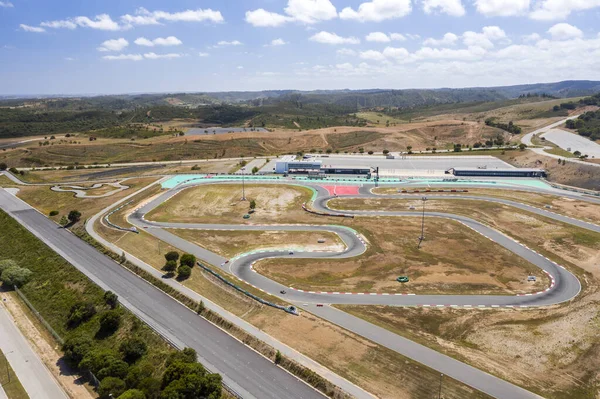
The Autódromo Internacional do Algarve, better known as Portimão, will return to Formula 1 in 2027 after last hosting a Grand Prix in 2021. The circuit first appeared on the F1 calendar during the unusual 2020 season. It was brought into the championship after several races were canceled because of the COVID-19 pandemic.
The Portuguese GP quickly became a popular track among drivers and fans, partly due to its unusual layout, which features dramatic elevation changes not found at other tracks. The circuit spans 4.6 kilometers, with plenty of interesting sections that take the cars up steep inclines and over sharp drops.
The circuit also provides plenty of demanding corners, with the final section leading towards the long start and finish straight. Cars can become light over several crests, creating additional challenges for drivers when they are pushing at high speed.
Portimão has already produced some memorable Formula 1 moments. Lewis Hamilton won the inaugural Portuguese Grand Prix at the circuit in 2020. Max Verstappen then finished second at the venue during both of the first two Portuguese Grands Prix held there.
The return of Portimão also gives Formula 1 another traditional European-style circuit. The modern calendar contains many street circuits and purpose-built venues with different characteristics. Portimão offers a more natural racing environment, with plenty of elevation changes and fast corners.
Formula 1 has agreed to race in Portugal during both 2027 and 2028. The agreement provides the country with an opportunity to establish Portimão as a regular part of the modern championship.
Istanbul Park Returns to Formula 1
Turkey will also return to the Formula 1 calendar in 2027, with Istanbul Park securing a new five-year agreement. The Turkish Grand Prix will therefore remain on the calendar from 2027 through to 2031.
Istanbul Park first joined Formula 1 in 2005 and quickly developed a strong reputation among drivers. The circuit is approximately 5.33 kilometers long and features several major elevation changes. Its most famous feature is Turn 8, which has become one of the most recognizable corners in modern Formula 1.
Turn 8 is a long, fast left-hander containing several apexes. Drivers need to maintain a high level of commitment while managing the car through the entire corner. The section places significant demands on both the driver and the tires.
The circuit contains a long straight, with several slower corners where drivers must prioritize track position and braking over pure speed. This combination creates plenty of opportunities for overtaking, as well as a challenging job for the teams, who must find a suitable balance between straight-line speed and cornering abilities.
The last time Istanbul Park hosted Formula 1 was during the 2020 and 2021 seasons, with the 2020 race being the track where Lewis Hamilton secured his seventh World Championship. Whilst also being iconic in its structure and layout, the fact that this circuit, where Lewis Hamilton tied Schumacher’s long-standing record, has only added to the track’s allure.
Two Very Different Challenges
Although Portimão and Istanbul Park are both returning European venues, they provide very different challenges for modern Formula 1 cars. Portimão is known for its dramatic elevation changes and flowing layout. Istanbul Park is recognized for its fast corners, long straights and particularly demanding Turn 8.
Their inclusion should therefore provide teams with another useful test of their cars. Modern Formula 1 cars need to perform well across many different types of circuits. A car that performs strongly on one track can sometimes struggle when the demands change significantly.
The two returning venues could also create more opportunities for unpredictable races. Both circuits have already shown that conditions can significantly influence the outcome. Tyre management, weather and track temperature could all become important factors when the races return, giving fans plenty to consider when assessing the likely outcome and following areas such as sports betting bonuses around major F1 events.
A Stronger European Calendar
The return of these circuits represents another change in the direction of Formula 1’s calendar. The championship has continued adding new races while also trying to retain venues with established histories.
Portimão and Istanbul Park provide something that newer venues cannot immediately replicate. Both circuits already have a connection with Formula 1 fans and have produced memorable races in recent years.
Turkey’s new agreement will keep Istanbul Park on the calendar for five seasons, giving the event a longer-term future within the championship. Portugal’s agreement currently covers two seasons, with the possibility of further involvement depending on future calendar plans.
The return of both venues should be welcomed by fans who enjoyed their previous appearances. Their layouts offer a strong contrast to several modern circuits and should give teams another test of their cars.
As Formula 1 continues to grow around the world, keeping established circuits in the championship remains important. Portimão and Istanbul Park now have another opportunity to become regular fixtures and create a new generation of memorable Formula 1 moments.
The 2026 NASCAR Chase is underway, and the first race has already changed the picture. Christopher Bell’s Southern 500 win at Darlington moved him to second in the standings, just 12 points behind Denny Hamlin with nine races left. Every result now adds fresh information about form and track performance, with championship pressure climbing each weekend.
Bell’s Darlington Win Changed the Form Book
Bell arrived at Darlington without a victory in 33 races, but that number hid a much stronger season than the headline suggested. He had already finished runner-up seven times during 2026, so the pace was there even before the win finally arrived.
At the Southern 500, Bell started 11th, led 46 of the 367 laps and won Stage 2 before taking the checkered flag. The result ended the drought and gave him his first Southern 500 victory.
That is a useful reminder when you are reading NASCAR form. A zero in the win column can hide a driver who has spent months running near the front, and one race can suddenly turn strong underlying numbers into a result everyone notices.
The Chase Keeps Repricing the Championship
Darlington also changed the championship calculation immediately. Bell jumped to second in the standings and closed to within 12 points of Hamlin, with nine races still to run.
The 2026 Chase has 16 drivers competing across 10 races, so every result feeds directly into the next weekend rather than disappearing into a reset. Bell’s Darlington victory came in the opening Chase race, which made the standings move straight away.
That gives anyone following the championship a fresh set of numbers every Sunday night. The question is never simply who won last week; it is what that result tells you before the next green flag.
Race Markets Put a Price on Those Judgments
Race betting takes those judgments and turns them into prices. A fan may think one driver has better intermediate-track form, another has stronger recent finishes or a third has gained something from qualifying. A peer-to-peer market lets traders act on those views against other participants rather than simply taking a fixed price.
ProphetX gives NASCAR fans several ways to approach a market, from taking the available price to posting their own odds and waiting for another trader to match them. New users can also qualify for the current Trade $50, Get $75 promotion, and the full list of offer terms and eligibility details is laid out on the Covers guide.
Quick Trade is for immediate execution, while limit-style orders let you name the price youare willing to accept and wait for another trader. Liquidity also becomes part of the equation because a price is only useful when someone is willing to take the other side.
Race Data Gives Fans More Than a Driver’s Name
NASCAR teams already work with a huge amount of information before race day arrives. Practice runs and qualifying tell part of the story, and historical results add another layer when the series returns to a track with similar demands.
Telemetry has made that analysis far more detailed, with teams using real-time performance data alongside earlier race information to make decisions during a weekend.
That same information helps you read a race with more context. A driver sitting sixth in the standings may still have a stronger case at a particular circuit because the track suits his recent pace, and qualifying can either strengthen that view or send you back to the numbers.
A Market Price Is an Opinion, Not an Answer
Prediction-market prices are useful because they show what traders collectively think at a given moment. Event contracts are tied to a specific outcome, and many are structured around yes-or-no results with prices that reflect the market’s estimated probability.
A contract priced at 70 cents, for example, represents a market assessment of roughly 70%. Traders can also buy or sell before settlement, so prices can move as new information arrives.
NASCAR gives those markets plenty to react to. Practice pace can change a view of a driver, qualifying can move it again and a mechanical problem can undo the whole argument before the race reaches halfway. The price is useful information, but it remains an opinion expressed through trading.
The Next Track Changes the Question Again
The Chase now moves through a very different mix of venues, with Bristol, Kansas and Las Vegas followed by the Charlotte Roval. Phoenix comes next, then Talladega, Martinsville and the Homestead-Miami finale.
That variety keeps changing what deserves your attention. Intermediate-track form carries more weight at Kansas than it does at Talladega, and a road-course result tells you something different from a short-track afternoon. The useful part is doing the homework before looking at the price, because NASCAR keeps giving you new information every weekend.
Watching NASCAR at home can be as simple as turning on the TV and sitting down for a few hours.
But it can also feel like a proper occasion.
Race day has enough built-in energy to deserve more than a half-empty snack bowl and everyone staring at separate screens. With a little preparation, the living room or kitchen can become the center of an afternoon that feels more like an event than just another broadcast.
You do not need elaborate decorations or a huge guest list. The best setup is usually the one that makes the day easier, more comfortable, and a little more memorable.
Make the Main Room Feel Like Race-Day Space
The room where everyone gathers does most of the work, so start there.
You want enough seating that nobody spends the afternoon constantly moving chairs around, a clear view of the screen, and surfaces where drinks and food can actually be placed without balancing everything on laps.
The room itself can help set the mood too. A kitchen or open-plan entertaining space with some personality feels far more inviting than a room that only comes alive when the television is on. Design touches such as Painted Paper can add visual interest to the kitchen area and make it feel more like a place where people naturally want to gather before, during, and after the race.
That matters because race day rarely stays confined to one sofa. People drift toward the kitchen for food, stand up during commercial breaks, and move around while still trying to keep one eye on the action.
If those spaces flow together comfortably, the whole afternoon feels much easier.
Get the Screen and Sound Right Before Everyone Arrives
A race can be surprisingly difficult to follow if the screen is too small for the room or the sound is fighting with conversation.
Test everything before guests arrive.
Make sure the television is positioned where people can see it without turning their heads awkwardly. If sunlight hits the screen during the afternoon, close blinds or adjust the room before the race starts rather than discovering the problem once the action is underway.
Sound matters just as much.
You want commentary and engine noise to remain clear, but not so loud that nobody can talk. If your television struggles with dialogue, a soundbar can make the broadcast much easier to follow without simply increasing the volume.
Wi-Fi or streaming connections should also be checked early if you are not watching through traditional television service.
Nobody wants to spend the opening laps reconnecting an app while everyone else asks whether the race has already started.
Build the Food Around Eating Without Missing the Action
Race-day food works best when it does not require too much attention.
This is not the afternoon for dishes that need constant reheating, complicated plating, or everyone sitting formally around a dining table at the same time.
Go for food people can grab easily.
Sliders, wings, tacos, nachos, pizza, sandwiches, dips, fries, and small snack plates all work well because people can eat while still following the race.
It helps to put most of the food out before the start, then keep anything that needs to stay hot ready for later.
You can also split the menu into stages. Snacks come out first, the main food appears partway through, and something sweet can be saved for later.
That stops everyone from eating everything in the first twenty minutes and gives the day a little more rhythm.
Drinks should be just as easy. Keep water and soft drinks somewhere obvious so people are not constantly opening cupboards or asking where everything is.
Give People Something to Follow Beyond the Leader
A long race becomes more enjoyable when everyone has something personal to pay attention to.
That could be a favorite driver, a manufacturer, a prediction about who finishes in the top five, or a simple race-day game where everyone chooses a driver before the start.
This works particularly well when some guests follow NASCAR closely and others do not.
Newer viewers may not know every rule, team, or strategy, but they can still enjoy watching a driver they picked climb through the field.
Keep it simple.
You do not need complicated scorecards or a serious competition. A whiteboard with predictions, a few friendly guesses about the winner, or even a small prize for the closest prediction is enough.
The point is to give everyone a reason to pay attention when the race settles into a quieter stretch.
That can turn passive watching into something much more social.
Plan for the Natural Breaks in the Day
Watching a race at home does not mean everyone has to remain seated for the entire event.
People will get up. They will refill drinks, talk in the kitchen, check their phones, and move around.
Build that into the day instead of fighting it.
Commercial breaks and quieter sections of the race are natural moments for food, conversation, or stepping outside for a few minutes.
If you are hosting, resist the urge to constantly serve people. Put snacks and drinks somewhere accessible and let everyone help themselves.
That way, you get to watch the race too.
It also helps to have another area where people can sit or talk without completely leaving the event. An open kitchen, nearby dining area, or patio can work well as long as guests can return quickly when something important happens.
The whole setup should feel relaxed enough that nobody worries about missing thirty seconds while getting another drink.
Add Just Enough Race-Day Detail
There is a difference between creating an atmosphere and turning your home into a themed party store.
You usually only need a few touches.
Driver colors, a checkered pattern on napkins or serving pieces, a small board with everyone’s predictions, or a few racing-related decorations can make the event feel intentional without overwhelming the room.
The food can carry some of the theme too.
You might name a few dishes after drivers, create a simple snack station, or use small labels if you enjoy that kind of detail.
Music before the race can also help. Put something energetic on while everyone arrives, then switch over once coverage begins.
The best details are the ones that make guests notice you planned the day without making the setup feel forced.
After all, the race is still the main event.
Let the Finish Be the Moment Everyone Stays For
The best race-day gatherings build naturally toward the final laps.
That is when people start paying closer attention, conversations quiet down, and even casual viewers suddenly want to know who is going to win.
Try to avoid scheduling anything that pulls people away near the end.
Have food already served, keep drinks easy to reach, and let the room settle into the final stretch.
If the race has been unpredictable, that last part of the day may become the moment everyone remembers.
And that is really the point of turning NASCAR at home into an event.
You do not need a complicated party plan. You need a room that works, food that is easy to eat, a comfortable setup, and a few small touches that give everyone a reason to stay engaged.
Do that, and race day stops feeling like something that happens on television.
It starts feeling like something everyone came over to be part of.
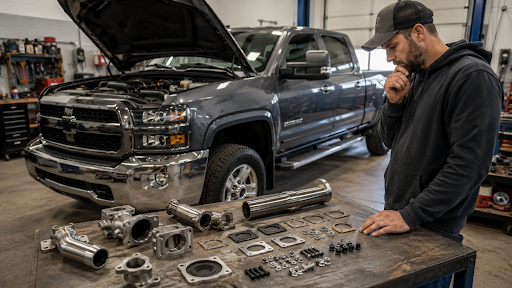
The right EGR delete kit is built for your exact engine and year, machined from billet aluminum or stainless steel, and sealed with MLS gaskets. Price is not the deciding factor. Fit and materials are.
But “right” depends on your situation. A kit that makes sense on a farm truck in Texas could be the wrong buy for a daily driver in California. Your answer changes with how you use the truck, the laws in your state, and your budget. And that budget has to cover a tuner at $400 to $800 on top of the kit.
The mistake most buyers make is shopping by brand and price before checking fitment. There is no universal EGR delete kit. The ones that claim to fit all years are the ones that leak.
This guide breaks the choice into four steps, from whether a delete even makes sense to spotting quality before you pay. By the end, you’ll know exactly what to order and what to avoid.
Step 1: Decide If a Delete Makes Sense for Your Truck
The EGR system sends a little exhaust back into the intake to lower combustion temperature and cut emissions. On paper it works. In practice, soot packs into the intake and the cooler, and over 100,000 miles that buildup chokes your airflow. On some trucks the cooler cracks, lets coolant into the engine, and turns a repair into a head gasket failure. The 6.0 Powerstroke is the famous example.
An EGR delete kit stops that cycle by pulling the valve and cooler out of the system. The intake stays clean, exhaust temps drop when you tow, and owners report better throttle response and sometimes 1 to 3 extra miles per gallon.
But a delete is not a free pass. It’s illegal on a truck that sees public roads, and it can void your powertrain warranty.
So ask what you actually need. A daily driver in an emissions-testing state? A delete is the wrong move. An off-road truck, farm truck, or weekend tow rig? The trade-offs look better. And if your only problem is a stuck valve or a small coolant leak, fix that first. Many owners delete to fix what was really a clogged valve, a bad sensor, or a boost leak. Those are cheap fixes.
Step 2: Check Your State’s Rules Before You Order
The Clean Air Act makes it illegal to remove any emissions control device from a vehicle driven on public roads. That covers the EGR, the DPF, and the SCR. Most kits are sold for off-road use only, and that label is not a formality.
Enforcement against individuals is rare, but it happens. California is the strictest, and owners there have been fined for block-off plates. Colorado and New York test too, and a deleted truck will not pass. Most farm states are more relaxed. Texas, Wyoming, and much of the Midwest still pass deleted trucks, since the test, if there is one, is just an OBD scan.
Two more things. Warranty: one scan at the dealer and they’ll see the EGR is gone, which gives them a clean reason to deny powertrain claims. Resale: some diesel buyers want a deleted truck, but a dealership trade-in is the opposite.
Check your state’s rules before you spend a dollar, and keep your factory parts in a box. Reversing a delete is work, but it’s easier when you still have the original hardware.
Step 3: Match the Kit to Your Exact Truck
Every engine family has a different EGR layout, and it changes again between years. A kit for a Ram won’t work on a Ford. A kit for a 2011 won’t bolt onto a 2019.
Start With the Engine and Model Year
Write down your exact engine and model year before you open a shopping tab. Ford owners deal with the 6.0 (2003 to 2007), the 6.4 (2008 to 2010), or the 6.7 (2011 and up). Ram owners have a 5.9 Cummins (2003 to 2007) or a 6.7 Cummins (2010 and up). Chevy and GMC owners have the LBZ or LMM (2006 to 2010), the LML (2011 to 2016), or the L5P (2017 and up). The VIN sticker on the driver’s door gives the year, and the engine code is on the engine. If a listing doesn’t match your year, move on.
Watch the Cooler Type on the 6.0 Powerstroke
If you own a 6.0 Powerstroke, one extra detail matters. Early trucks (2003 to early 2004) use a round EGR cooler. Trucks from late 2004 through 2007 use a square one. They’re shaped and plumbed differently. Order the wrong style and the kit won’t sit right, which means coolant leaks. Check your cooler style before you buy.
Skip Kits That Claim “Fits All Years”
There is no universal EGR delete kit. The systems changed too much over the years. A kit that claims to fit everything is usually a set of generic plates that fit nothing well. People who buy them end up with exhaust leaks, missing brackets, and a job that has to be redone. Buy the kit built for your exact platform and year.
Step 4: Compare Kit Quality Before You Pay
Run these four checks on anything you’re about to buy. Keep this in mind first: a good kit is only half the job. You’ll also need a tuner, because the computer still expects the EGR to be there. A proper delete tune runs $400 to $800, and without it you’ll get check engine lights and possibly limp mode. Budget for that before you commit.
Check the Material
Look for CNC-machined billet aluminum or 304 stainless steel. Both hold their shape under heat and seal against the manifold. Stamped steel is the cheap stuff. It looks fine in the box, then warps from heat cycles and leaks boost. Owners report leaks within 20,000 miles.
Check the Gaskets and Hardware
A leak at the block-off plate is the most common failure on a cheap kit. Multi-layer steel gaskets, the MLS type, handle boost pressure. Fiber gaskets blow out. Hardware matters too. Grade 8 bolts with locking washers stay tight through heat cycles. And you want new bolts in the box, because factory EGR bolts are usually corroded and snap when you reuse them.
Check What’s in the Box
The EGR cooler is tied into the cooling system. When it comes off, those coolant lines need somewhere to go. A complete kit includes the reroute parts, gaskets, bolts, and sensor plugs. Some even link to a walkthrough video. If the listing is vague about what’s included, ask. You don’t want to find out mid-install that you’re missing a piece.
Check the Warranty and Support
A company that sells quality parts backs them up. Look for a real warranty and a way to reach a human. Then check the forums. Search your truck model and the brand name together, and read what owners say after a year of driving. Product reviews are filtered. Forum threads are not.
Final Thoughts
Here’s the short version. Decide whether a delete fits your situation. Check your state’s law before you order. Buy a kit made for your exact engine and year. Judge quality by the material, gaskets, included parts, and support. And plan for the tuner, because it’s not optional.
A delete done right is a solid upgrade on a truck that stays off the road. A delete done wrong costs more than the repair you were trying to avoid. If you’re not sure the problem is really the EGR, spend $50 on a diagnosis before you spend $500 on parts. And whatever you decide, keep the factory parts.
Ready to order? Start your search at xkvracing and compare the kits available for your engine and year.
Race weekend is rarely just about the race. From practice and qualifying to the hours before the green flag, there can be a surprising amount of time between the moments everyone came to watch.
That downtime is part of the experience. It gives you time to explore the area, catch up with friends, try something different, and build some anticipation before attention returns to the track.
Whether you are following a major race from home or making a full weekend of it with friends, a little planning can turn those quieter hours into some of the best parts of the weekend.
Give Everyone Something to Do Between Sessions
Motorsport schedules naturally come with gaps. Rather than spending every break checking the clock until the next session begins, have a few activities ready that people can join without much planning.
For a race weekend at home, that could mean setting up another competitive activity alongside the television. A putting challenge, racing game, darts, or simulator can keep the group entertained without taking attention away from the main event.
Golf fans can take this further with equipment from Indoor Golf Outlet, creating an indoor setup where a few practice shots or a closest-to-the-pin competition can fill the gap between track sessions.
The best activities are easy to start and stop. Nobody wants to be halfway through something complicated when qualifying suddenly returns to the screen.
Explore Beyond the Circuit
If you have traveled for a race, it can be tempting to spend the entire weekend around the circuit. That makes sense when the schedule is packed, but longer gaps can be a good opportunity to see more of the destination.
Look at what is reasonably close rather than attempting an ambitious sightseeing itinerary.
A good lunch, a walk through the city center, a local attraction, or a scenic drive can provide a welcome change from grandstands and crowds. If the race is held somewhere you have never visited before, ignoring everything outside the circuit can feel like a missed opportunity.
Just leave plenty of time to get back. Race-weekend traffic can make a short journey considerably longer than it appears on a map.
Plan What You Will Wear Beyond the Grandstand
Race-day clothing is usually dictated by practical concerns: weather, walking, comfort, and hours spent outdoors. The rest of the weekend may involve very different plans.
A Friday or Saturday evening might include a restaurant reservation, hotel bar, sponsor event, or simply a nicer night out with friends. Packing one outfit that works away from the circuit saves you from trying to make race-day clothes cover every situation.
For men who prefer a closer cut through the shoulders, chest, and arms, the ability to buy athletic fit dress shirts online provides an easy way to prepare for those smarter parts of the weekend without moving away from a more fitted silhouette.
A race trip does not require a large wardrobe. Comfortable track clothing and one versatile evening option will cover most situations.
Make Food Part of the Weekend
Track food has its place, but an entire weekend of grabbing whatever is closest can become repetitive quickly.
If you are traveling, reserve at least one meal somewhere you actually want to try. Popular race weekends can make restaurants much busier than normal, so waiting until Saturday evening to choose somewhere may leave you with limited options.
At home, the same idea can turn the event into more of an occasion.
Instead of putting out snacks and forgetting about food until the race ends, plan something around the schedule. Serve lunch before the start, cook outside between sessions, or choose food connected to the race destination.
The meal becomes another part of the weekend rather than an interruption between sessions.
Turn Predictions Into a Friendly Competition
Qualifying gives everyone just enough information to become confident about what will happen in the race, and just enough uncertainty for those predictions to go completely wrong.
Use that.
Before the race starts, have everyone predict a few outcomes. Pick the winner, podium, fastest lap, first retirement, or biggest mover through the field. Keep score across the season if the same group regularly watches together.
You do not need prizes. The arguments afterward are usually entertaining enough.
Predictions also give casual viewers something specific to follow. Someone who does not know every driver or technical detail can still become invested once their chosen driver starts climbing through the field.
Protect Some Time to Simply Switch Off
A full race weekend can become surprisingly tiring, especially when travel, crowds, early starts, and evening plans are added to the motorsport schedule.
You do not have to fill every available hour.
If qualifying finishes in the afternoon and dinner is not until later, returning to the hotel for a couple of quiet hours may be more enjoyable than forcing another activity into the gap. The same applies at home. There is nothing wrong with stepping away from the coverage for a while rather than watching every minute of analysis.
Saving some energy for the main race can make the entire weekend feel better paced.
The anticipation is part of the fun. You do not need to eliminate every quiet moment.
Make Race Morning Feel Different
By the time race day arrives, the weekend should feel as though it is building toward something.
Give the morning its own rhythm. Have breakfast somewhere good, take a walk before heading to the circuit, or meet the rest of your group at a planned time rather than rushing separately toward the venue.
If you are watching from home, get practical jobs out of the way early. Prepare food, arrange seating, check the start time, and invite everyone over with enough time to settle in before the build-up begins.
Then stop planning.
Once the green flag approaches, the waiting is over. The best race weekends use everything around the main event, the food, competition, destination, friends, and downtime, to make the race itself feel even bigger when it finally begins.
Race teams obsess over horsepower, aerodynamics, and tire compounds, and rightly so — those are the numbers that show up on a stopwatch and decide qualifying order. What gets far less attention is the material science quietly working inside components that have nothing to do with the engine map or the wing angle, but everything to do with whether a car actually survives a full race distance under conditions that would destroy standard parts within a few laps. A car that’s fastest on a single qualifying lap and a car that’s fastest across four hundred racing miles are frequently solving two very different engineering problems.
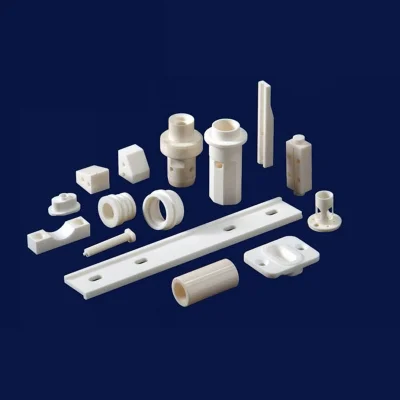
A meaningful share of that engineering comes down to advanced technical ceramics — materials like zirconia, alumina, and silicon carbide, engineered for extreme heat, wear, and electrical stress in ways ordinary metals simply can’t match. Manufacturers working with precision ceramic components supply exactly this kind of material to industries where failure isn’t an option, and motorsport is one of the more demanding proving grounds for that engineering anywhere outside of aerospace, precisely because it combines extreme heat, constant vibration, and repeated mechanical stress into a single, unforgiving operating environment.
Brakes That Have to Survive Repeated Abuse
Braking in a race car generates temperatures that can climb well past 700°C under hard, repeated use — a corner-entry braking zone at a high-speed oval or road course puts a brake system through thermal cycling that a street car will never come close to experiencing in its entire lifespan. Silicon carbide shows up directly in this application, valued for hardness approaching diamond, thermal conductivity comparable to aluminum, and the ability to hold dimensional stability under sustained, repeated heat cycling that would warp or fade a standard cast-iron rotor over the course of a single stint. Consistent pedal feel late in a long green-flag run, when a driver is braking from top speed lap after lap without a caution to let the system cool, often traces directly back to whether the brake package was engineered with materials built for exactly this kind of punishment.
Bearings Under Extreme RPM
Every rotating component in a race car — wheel hubs, differential internals, high-revving engine internals — puts real stress on bearings, and that stress only gets worse as RPM climbs. Standard steel bearings generate more friction-based heat at high RPM, which changes clearance tolerances mid-race and creates the kind of gradual performance drift that shows up as a car losing pace late in a run for no obvious reason. This is where the broader precision ceramic products line becomes relevant to race engineering — ceramic and hybrid ceramic bearings run cooler, weigh less, and hold tighter tolerances under sustained high-RPM load than steel equivalents, which is exactly why they’ve become common in the highest tiers of motorsport where every fraction of reliability and every ounce of rotating mass matters.
Sensors Tuning the Engine in Real Time
Modern race engines lean heavily on real-time sensor data to stay within legal and optimal operating windows, and one of the more important sensors doing that work is built from zirconia. Oxygen sensors use a zirconia element to measure exhaust gas composition continuously, feeding that data back to the engine control unit so fueling can be adjusted lap by lap in response to changing track temperature, fuel load, and engine wear. Zirconia is used here specifically because it survives sustained exhaust-level heat without losing measurement accuracy over a full race distance — a requirement that rules out most other materials outright, and one that becomes even more critical in series where fuel strategy and engine efficiency directly affect pit stop windows and finishing position.
Why Teams Invest in Materials Nobody Sees
None of this shows up in a broadcast graphic or a post-race interview, and that’s exactly the point. Race engineers don’t get credit for the components fans never think about, but a car that holds its brake performance, bearing tolerances, and sensor accuracy consistently across a full race distance is frequently winning on exactly this kind of invisible reliability rather than on raw power alone. The teams that understand this tend to be the ones consistently finishing races that others don’t, precisely because they’ve engineered out the failure points competitors haven’t thought to address — often years before those weak points ever show up as a visible on-track problem.
The Takeaway
Next time a broadcast highlights a car’s horsepower figure or straight-line speed, it’s worth remembering that surviving a full race distance at that level of performance depends just as much on materials most fans will never hear mentioned. Advanced ceramics are one of the clearest examples of engineering that never gets the spotlight, yet consistently decides which cars actually make it to the checkered flag intact.
Small sign-up offers can be useful, though the headline amount tells only part of the story. For Australian players, a free $10 sign up bonus pokies Australia promotion becomes easier to assess once its wagering multiplier, withdrawal cap, expiry window, and eligible games are read together. Ten dollars with flexible terms may carry greater practical value than a larger credit tied to a lengthy set of conditions. The sensible comparison starts with how the offer works after registration, not with the brightest number on the page. Casino promotions do enjoy dressing for the occasion. The maths underneath usually wears plainer clothes.
Start With the Usable Credit
A small bonus may arrive as cash credit, spins or a mixture of both. Cash credit gives the player a visible balance, while spins attach a fixed stake and selected games. The useful question is how much freedom the offer provides during the promotional session.
A free $10 sign up bonus pokies Australia deal with ten $1 spins feels different from twenty 50-cent spins. The total headline value matches, yet the session length, game choice and pace change. The exact format deserves a quick look before any comparison continues.
Put the Main Terms Side by Side
The clearest method is a compact comparison.
Term
Offer A
Offer B
Why it matters
Promotional credit
$10
$15
Sets the starting amount
Wagering
20x
35x
Changes the turnover target
Maximum cashout
$50
$40
Defines the withdrawal ceiling
Expiry
7 days
48 hours
Shapes the playing schedule
Eligible games
40 titles
12 titles
Affects choice and contribution
Offer A asks for $200 in turnover, while Offer B asks for $525. That calculation says far more than the five-dollar gap between their headlines.
Check Eligibility Before Counting Value
Australian promotional pages commonly set conditions around age, location, account status and identity checks. A player gains a cleaner comparison by confirming four points:
The offer applies to a newly registered account.
The stated region includes the player’s location.
Verification documents can be supplied promptly.
The claim code or activation step is completed correctly.
This closed checklist keeps the comparison grounded in offers that can genuinely be used. It also saves the peculiar ritual of mentally spending credit that never reached the account.
Look at the Route to Withdrawal
The practical value appears when promotional winnings move into a withdrawable balance. A free $10 sign up bonus pokies Australia offer may require wagering on selected pokies, observe a maximum bet rule and set a cashout ceiling. Payment method rules can also matter, particularly when deposits and withdrawals use matching channels.
Reading the withdrawal section early makes the offer easier to plan. The strongest small promotion is often the one with a clear completion path, a comfortable expiry period and a cashout cap that suits the original credit.
Use a Simple Value Test
Three questions settle most comparisons. How much turnover is required? How much can become withdrawable? How much time is available? A modest free $10 sign up bonus pokies Australia offer with a 15x multiplier, a seven-day window and a $60 cap can present a tidy proposition.
The headline credit is a starting label, not the final verdict. Real value comes from the relationship between credit, terms and practical use.
FAQ
Is a Larger Sign-Up Amount Always Better?
The stronger offer is the one whose wagering, expiry and cashout terms suit the player’s planned session, even when its headline credit is smaller.
How Is the Wagering Target Calculated?
Multiply the promotional amount by the stated wagering figure. A $10 credit at 20x creates a $200 turnover target.
Do Free Spins Count as a Ten-Dollar Bonus?
They can carry a stated total value, though their stake size, eligible games and treatment of winnings define their practical worth.
Which Term Deserves Attention First?
Wagering gives the fastest view of the work attached to the bonus, followed by expiry and maximum cashout.
An expiry period turns a pokies promotion into a scheduling exercise. An Australian player using a free $50 pokies no deposit sign up bonus Australia offer may face separate deadlines for claiming the promotion, using allocated spins, and completing wagering on resulting credit. Recording each deadline before play begins makes the offer easier to manage and removes the need for a hurried final session. The practical aim is to match the promotion with time that already exists in the week. A bonus timer is a clock, not a motivational speaker, despite the enthusiasm of some countdown graphics.
Identify Every Deadline
Terms may contain three distinct time limits:
The period for claiming the offer;
The period for using free spins or bonus credit;
The period for completing wagering on promotional winnings.
Write all three in local Australian time and note the exact hour when one is provided. “Three days” can mean a rolling 72-hour period rather than the end of the third calendar day.
Begin With the Final Deadline
Work backwards from the wagering expiry. If the offer provides seven days, reserve the last day as a buffer rather than the main playing session. The earlier days can hold short, planned blocks.
A free $50 pokies no deposit sign-up bonus Australia promotion with a $1,000 turnover target could be divided across five sessions of $200 in eligible bets. The account counter should confirm how much progress each session records.
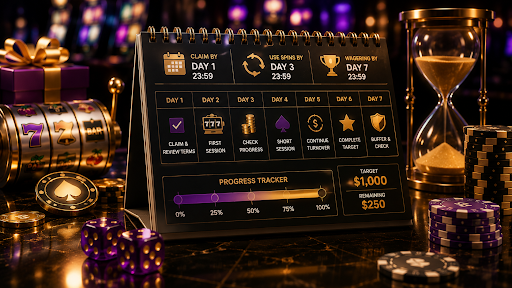
Build a Simple Calendar
A seven-day offer can be mapped as follows, with the final day reserved for administration rather than play.
Day
Planned action
Check afterward
Day 1
Claim, verify, and review terms
Bonus appears correctly
Day 2
First measured session
Wagering counter updates
Day 3
Second session
Expiry remains recorded
Day 4
Rest or short session
Balance and time reviewed
Day 5
Continue planned turnover
Remaining target calculated
Day 6
Complete or approach target
Cash conversion status checked
Day 7
Buffer for administration
Withdrawal details prepared
Match Stakes to Available Time
Lower stakes create more spins for the same turnover, while higher qualifying stakes move through the target more quickly. The suitable level remains within the player’s planned budget and below the promotional maximum.
Keep Eligible Games Ready
Before the first session, identify several eligible pokies with the stated contribution rate. This avoids spending time searching while the promotional clock runs. Switching among approved titles can keep the session varied without disturbing wagering progress.
A free $50 pokies no deposit sign-up bonus Australia offer may restrict spins to selected games and then allow broader choice for wagering the resulting credit. Treat those as two separate stages.
Use Reminders With Useful Labels
A reminder titled “bonus” says very little. Better labels include “use remaining spins by 8 pm” or “check wagering target before Friday session.” Specific wording gives the notification a clear action.
The most useful closed checklist is short:
Deadline recorded.
Eligible games identified.
Maximum stake noted.
Remaining wagering checked.
Final-day buffer protected.
Finish With Time for Conversion
Once wagering completes, the account may need time to convert eligible promotional funds into cash and complete verification. Finishing ahead of expiry gives room to review the balance calmly.
The free $50 pokies no deposit sign up bonus Australia promotion has served its purpose when it fits the player’s schedule, not when the schedule is rearranged around the promotion.
FAQ
When Does an Expiry Period Usually Begin?
It may begin at registration, activation, or crediting, so the exact starting event should be identified in the terms.
Should All Spins Be Used in One Session?
Several shorter sessions can work when the spin-use deadline allows them and progress remains easy to track.
Why Keep the Final Day as a Buffer?
It provides time for balance conversion, verification messages, or a final administrative check.
How Can Wagering Progress Be Estimated?
Subtract the completed qualifying turnover from the total target and divide the remainder across the planned sessions.
Does the Same Expiry Apply to Spins and Winnings?
Some offers use separate periods, making it important to record each deadline individually.
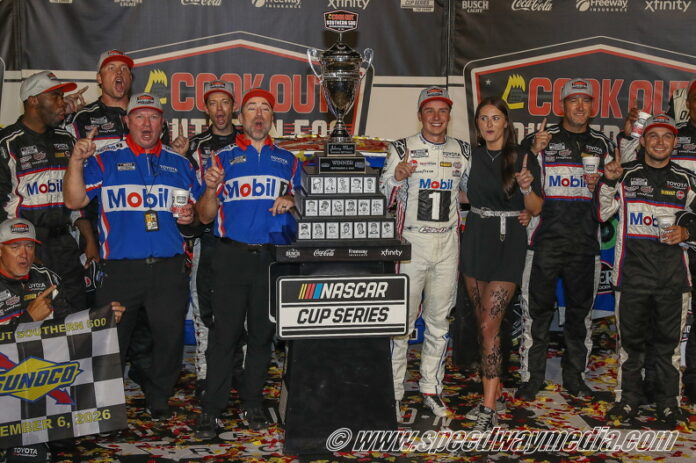
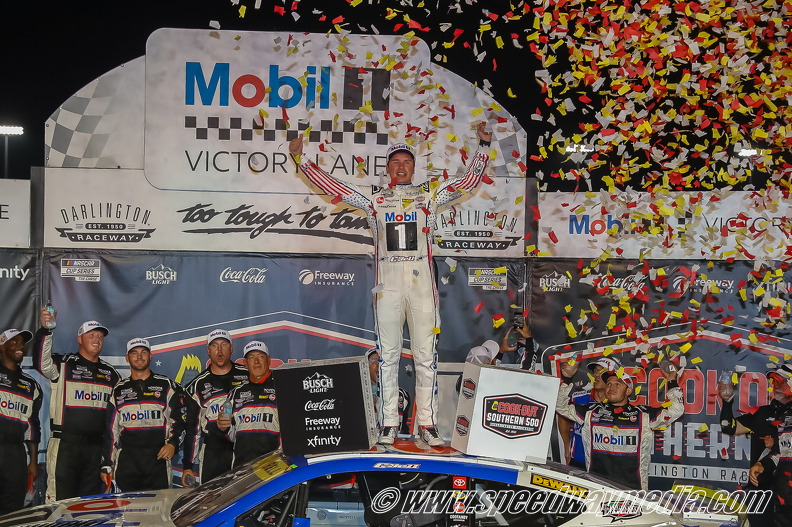
Christopher Bell erased his 33-race winless drought on a high note and struck first in the first Chase event of the 2026 Cup Series season by winning the Cook Out Southern 500 at Darlington Raceway on Sunday, September 6.
The 2024 Coca-Cola 600 champion from Norman, Oklahoma, led four times for 46 of 367-scheduled laps in an event where he started in 11th place and raced competitively towards the front by notching a fourth-place result when the first stage period concluded. Throughout the second stage period, Bell continued his methodical march forward and smoothly navigated two cycles of green-flag pit stops to win the stage.
Despite enduring a slow pit service during the second stage’s break period and restarting outside the top-10 mark prior to the final stage period, Bell navigated his way back inside and was racing in second place when a late caution with 52 laps remaining flew. Bell’s pit crew delivered during the caution’s pit services by enabling Bell to beat the field off of pit road first, though the latter was overtaken by teammate Chase Briscoe following a one-lap duel during a restart with 37 laps remaining.
Following another caution that flew with 33 laps remaining due to a light cycle of on-track sprinkles, a brief red flag delay, and the decision to pit or not to pit when the event resumed, Bell was among many who pitted while a handful of Chasers led by Kyle Larson elected to gamble by remaining on the track with worn tires. With Larson managing to maintain momentum during a 24-lap shootout, Bell used his fresh tires to motor up to the runner-up spot, reel in and overtake Larson with 12 laps remaining. From there, Bell beat teammate Ty Gibbs to achieve his first elusive Cup victory of the 2026 season and commence the pursuit of his first championship with a victory in the illustrious Southern 500 event in Darlington, South Carolina.
The event’s starting lineup was determined through a qualifying metric formula after inclement weather and a lightning hold canceled the event’s practice and qualifying sessions. As a result, Chaser Tyler Reddick was awarded the pole position, and Chaser Daniel Suarez was awarded a front-row starting spot.
When the green flag waved and the event commenced, Chasers Denny Hamlin and Daniel Suarez dueled for the lead through the first two turns until Suarez, who launched from the inside lane, gained the first advantage by muscling his No. 7 Freeway Insurance Chevrolet Camaro ZL1 entry at the front entering the backstretch. With the clean air working to his favor, Suarez cycled back to the frontstretch and led the first lap.
Suarez proceeded to lead the next two laps despite having a hard-charging Denny Hamlin reel in, even to the point where Suarez slid up to cut off Hamlin’s momentum from the outside lane entering the front stretch. By the third lap, Hamlin executed a crossover move beneath Suarez, and he motored his No. 11 Sport Clips Toyota Camry XSE entry out in front. Hamlin proceeded to extend his advantage by a second over Reddick by the fifth lap while Suarez, Ryan Preece, Austin Cindric, Michael McDowell, Chase Briscoe, Ricky Stenhouse Jr., Alex Bowman and Austin Dillon, respectively.
Through the first 10-scheduled laps, Hamlin stabilized his early advantage by more than a second over Reddick while Suarez, Preece, Cindric, McDowell, Briscoe, Bell, Stenhouse and Bowman trailed in the top 10, respectively. By then, seven of 16 Chasers were racing in the top 10 on the track (Hamlin, Reddick, Suarez, Preece, Cindric, Briscoe and Bell) while the remaining Chasers that include Joey Logano, Bubba Wallace, William Byron, Chase Elliott, Ty Gibbs, Ryan Blaney, Carson Hocevar, Kyle Larson and Chris Buescher were mired in 11th, 13th, 17th, 18th, 20th, 21st, 23rd, 25th and 30th, respectively.
Ten laps later, Hamlin continued to lead by eight-tenths of a second over Reddick while Preece, Cindric and Bell trailed in the top five, respectively. Behind, McDowell was the highest-running Chaser in sixth place ahead of teammate Suarez, Briscoe, Bowman and Logano while Wallace, Byron and Elliott trailed in 12th, 13th and 15th, respectively. Meanwhile, Blaney was mired in 18th place, and Hocevar navigated his way into 22nd place behind Gibbs while Larson and Buescher were the two-lowest-running Chasers in 24th and 26th, respectively. Amid the battles around Darlington between Chasers and non-Chasers, Hamlin led the next eight laps until Reddick, who reeled in Hamlin, motored his No. 45 Chumba Casino Toyota Camry XSE entry out in front with a pass through Turns 3 and 4.
When a scheduled competition caution flew on Lap 35, Reddick retained the lead over Hamlin while Preece, Cindric, Bell, McDowell, Briscoe, Logano, Keselowski and Bowman were scored in the top 10, respectively. By then, Chasers Wallace, Byron, Blaney, Elliott, Gibbs, Suarez, Hocevar, Buescher and Larson trailed in 11th, 12th, 14th, 15th, 16th, 17th, 20th, 23rd and 24th, respectively. During the competition caution, the entire field, led by Reddick, pitted for a first round of pit service. Following the pit stops, Reddick retained the lead after he edged Hamlin off of pit road by a nose while Preece, Briscoe, Cindric, Bell, Wallace, Brad Keselowski, McDowell and Bowman followed suit, respectively.
As the event restarted on Lap 40, Reddick used the outside lane to fend off Hamlin through the first two turns. As the field jostled for spots through the backstretch, Reddick cycled back to the frontstretch and led the following lap while Hamlin retained the runner-up spot in front of Preece, Briscoe, Bell and Cindric, respectively, while Wallace, Keselowski, McDowell, Byron and Blaney pursued, respectively.
On Lap 44, Hamlin reassumed the lead following an overtake on Reddick through the frontstretch. By the following lap, the top-seven spots were occupied by Chase contenders while Larson was the lowest-running Chaser in 24th place. A few laps later, the top-eight spots were occupied by Chasers as Blaney moved into eighth place while Gibbs, Byron, and Elliott were mired in the top-15 mark. Behind, Hocevar, Logano, Buescher and Suarez trailed in the top-20 mark as Reddick was being challenged by Briscoe for the runner-up spot. Meanwhile, Hamlin led by eight-tenths of a second at the Lap 50 mark.
Through the Lap 60 mark, Hamlin was leading Chasers Reddick, Briscoe, Bell, Preece, Wallace, Cindric and Blaney, respectively, while Keselowski and McDowell were the two-highest non-Chasers who rounded out the top-10 mark on the track. Behind, Chasers Byron, Gibbs, Elliott, Hocevar, Logano, Buescher, Suarez and Larson trailed in 11th, 12th, 15th, 17th, 18th, 19th, 20th and 22nd, respectively, as Hamlin’s lead grew up to a second by Lap 65.
On Lap 70, the event’s first cycle of green-flag pit stops commenced as Chasers Bell, Blaney, Cindric, and Logano, along with non-Chaser Riley Herbst, pitted their respective entries. The leader, Hamlin, along with Reddick, Briscoe, Preece, Byron, Bowman, Buescher, Zane Smith, Austin Dillon, Ty Dillon, Connor Zilisch, Ty Gibbs, Erik Jones, AJ Allmendinger pitted during the next two laps, with Hamlin managing to beat and motor away from Reddick off of pit road following their pit stops. As more names pitted, Chasers Wallace, Elliott, Hocevar, Larson, and Suarez were among a handful who had yet to pit, with Wallace leading at the Lap 75 mark. Wallace then pitted during the next lap, though he nearly missed the commitment line area to enter pit road, before Elliott, who cycled to a brief lead, pitted a lap later along with teammate Larson. By the time Chasers and teammates Hocevar and Suarez pitted on Lap 78, Hamlin cycled back to the lead over Chasers Reddick, Bell, Briscoe, Blaney, Preece, Cindric, Byron, Wallace, Gibbs and Logano, respectively.
At the Lap 90 mark, Hamlin maintained his lead by half a second over Reddick while Bell, Briscoe, Blaney, Wallace, Preece, Cindric, Byron and Gibbs, all of whom were in the Chase, occupied the top-10 spots on the track. Meanwhile, Josh Berry was the highest-running non-Chaser in 11th place ahead of Logano, Bowman, McDowell and Elliott, while Buescher, Larson and Hocevar were mired from 17th to 19th, respectively. Meanwhile, Suarez was the lowest-running Chaser in 27th place behind Austin Hill.
Three laps later, Reddick overtook Hamlin to reclaim the lead. As Reddick reeled in on both Austin Dillon and Cole Custer to lap the latter two, Bell and Briscoe started to reel in on Hamlin for the runner-up spot while Wallace, who had fresher tires than the top-four competitors, muscled his No. 23 Xfinity Toyota Camry XSE entry up to fifth place. During the Lap 97 mark, Wallace overtook Briscoe for fourth place before he reeled in and overtook Bell for third place on Lap 99. With Wallace setting his sights on his co-owner Hamlin for the runner-up spot, which he claimed on Lap 104, teammate Reddick motored away with the lead by more than a second.
Then just past the Lap 105 mark, the caution flew when Hocevar tapped Keselowski into the outside wall through Turns 3 and 4 before the latter spun just entering the frontstretch. Keselowski’s incident concluded the first stage period as Reddick was awarded his second Cup stage victory of the 2026 season while Chasers Wallace, Hamlin, Bell, Blaney, Briscoe, Preece, Cindric, Byron and Gibbs were scored in the top 10, respectively, with all also notching the event’s first round of stage points. Meanwhile, Elliott, Larson, Logano, Buescher, Hocevar and Suarez, all of whom were unable to record a first round of stage points as Chasers, were mired in 12th, 13th, 14th, 17th, 18th and 25th, respectively.
Under the event’s first stage break period, the field led by Reddick returned to pit road for service. Following the pit stops, Reddick utilized his first pit stall by beating teammate Wallace off of pit road first, while Hamlin, Bell, Blaney, Briscoe, Preece, Cindric, Byron and Elliott followed suit, respectively. Following the pit stops, Preece returned to pit road to have his wheels inspected and tightened.
The second stage period started on Lap 113 as Reddick and Hamlin occupied the front row. At the start, Reddick launched ahead of the field from the outside lane to retain the lead, and teammate Wallace outdueled Hamlin for the runner-up spot through the first two turns. As the field jostled for spots through the backstretch, Blaney battled and overtook Hamlin for third place as Reddick led the next lap. While Byron, Bell, Elliott, Briscoe, Logano, Cindric, Larson and Gibbs trailed from fifth to 12th on the track, respectively, Blaney and Hamlin battled for third place, with the latter reclaiming the spot on Lap 116. Behind, Briscoe overtook Elliott for seventh place while Larson, Logano, Cindric and Gibbs battled for ninth place. At the front, Reddick maintained his lead by as high as three-tenths of a second over Wallace, and the former slightly grew the advantage up to half a second just past the Lap 120 mark.
By Lap 135, Reddick grew his lead up to one-and-a-half seconds over Wallace and by nearly four seconds over Hamlin while Blaney, Bell, Briscoe, Byron, Larson, Berry, Elliott, Logano, Cindric and Gibbs were racing in the top-13 mark, respectively. Behind Buescher and Hocevar were mired in 15th and 19th, respectively, while Preece and Suarez were the two lowest-running Chasers in 25th and 27th, respectively. Reddick proceeded to lead by more than one-and-a-half seconds over Wallace on Lap 140.
On Lap 143, Logano pitted under green as teammate Blaney outdueled Hamlin for third place. With Reddick leading by more than a second and a half over teammate Wallace by Lap 145, Keselowski spun by himself just shy of the commitment cone entrance while he was trying to enter pit road, but he managed to steer his entry on pit road without drawing a caution. By Lap 147, Chasers Briscoe and Buescher also pitted before Byron, Cindric, Gibbs and Elliott followed suit during the next two laps.
Runner-up Wallace then pitted on Lap 150 along with Preece before the leader Reddick, Bell and Hocevar pitted during the next lap. The leaders Blaney and Hamlin pitted on Lap 152 as the latter managed to beat the former off of pit road first. Back on the track and with pit stops still ensuing, Wallace, who pitted a lap later than Reddick, overtook Reddick on the track as Briscoe reeled in from behind. Once Larson pitted from the lead on Lap 154, Wallace cycled as the overall race leader as he had 10 Chasers racing behind him in the leaderboard.
On Lap 160, Wallace maintained the lead by four-tenths of a second over Reddick while Briscoe, Bell, Blaney, Byron, Cindric, Hamlin and Logano pursued in the top-nine spots, respectively. With Berry being the highest non-Chaser in 10th place, Elliott, Gibbs and Larson trailed from 11th to 13th, respectively, while Hocevar, Preece and Buescher were scored in 17th, 21st and 23rd, respectively. Meanwhile, Suarez was mired the second competitor scored a lap down in 26th place behind Austin Dillon. With Buescher also getting lapped and Suarez navigating his way to be the first competitor scored a lap down in 24th place, Wallace continued to lead by two-tenths of a second over Reddick on Lap 170, up to four-tenths of a second on Lap 175 and up to eight-tenths of a second on Lap 180.
At the halfway marks between Lap 183 and 184, 23 of 38 starters were scored on the lead lap, minus Chasers Suarez and Buescher, as Wallace maintained the lead by half a second over Reddick while Briscoe, Bell, Blaney, Hamlin and Larson trailed in the top-seven mark, respectively. Including Byron and Cindric in ninth and 10th, respectively, all but one spot in the top-10 mark on the track were occupied by Chasers, as Berry was the highest-running non-Chaser in eighth place, while Elliott, Logano, Gibbs, Hocevar and Preece were mired in 11th, 12th, 14th, 15th and 21st, respectively.
On Lap 186, another cycle of green flag pit stops commenced as the leader Wallace, along with Briscoe, Buescher, Austin Dillon, Alex Bowman and Keselowski, pitted their respective entries. Reddick, who assumed the lead during the previous lap, pitted a lap later along with Blaney, Logano, Gibbs, Erik Jones, Zane Smith, Corey Heim, Riley Herbst and Noah Gragson. During the pit stops, Reddick endured a slow pit service to have his left-front wheel secured as more names that included Preece, Berry, Byron, Cindric, Allmendinger, Austin Hill and Elliott pitted by Lap 190. Bell, who cycled to a brief lead, pitted by Lap 191 along with Hamlin, Hocevar, John Hunter Nemechek and Stenhouse before Larson pitted from the lead on Lap 193. Once McDowell also pitted, Briscoe cycled his No. 19 Bass Pro Shops Toyota Camry XSE entry to the lead on Lap 194 over Wallace. Meanwhile, Reddick had fallen to eighth place as Blaney, Bell, Berry, Hamlin and Byron all cycled from third to seventh, respectively.
Through the Lap 200 mark, Briscoe was leading by nearly two seconds over Wallace while Bell, Blaney and Hamlin all trailed in the top-five mark, respectively, with Hamlin trailing by 11 seconds. Meanwhile, Berry was up into sixth place ahead of Chasers Byron, Larson, Reddick, Cindric, Elliott, Gibbs and Logano while Hocevar, Preece, Suarez and Buescher were mired in 15th, 21st, 24th and 27th, respectively.
On Lap 208, Bell overtook Wallace for the runner-up spot while the leader, Briscoe, radioed about entering a fuel conservation mode due to possibly not having enough fuel to complete the second stage period. Over the next two laps, Bell trailed teammate Briscoe by more than a second before the former reduced the deficit down to half a second during the following five laps. Bell then used a slide job move to overtake Briscoe to assume the lead during the following lap, Lap 216, while Wallace trailed in third place by nearly two seconds. Behind, Larson was in fourth place ahead of Hamlin and Blaney while Reddick was mired in ninth place. With the lead to his advantage, Bell grew his lead up to two seconds on Lap 220.
When the second stage period concluded on Lap 230, Bell cruised to his fifth Cup stage victory of the 2026 season as he led by more than a second. Larson motored his way up to second place ahead of Hamlin, Briscoe and Wallace while Blaney, Berry, Byron, Reddick and Cindric were scored in the top 10, respectively. By then, nine of 16 Chasers notched a second round of stage points (Bell, Larson, Hamlin, Briscoe, Wallace, Blaney, Byron, Reddick and Cindric) while the remaining Chasers that included Gibbs, Elliott, Logano, Hocevar, Preece, Suarez and Buescher were mired in 11th, 12th, 13th, 15th, 20th, 21st and 30th, with Preece managing to achieve the free pass by being the first competitor a lap down. In addition, 19 of 38 starters were scored on the lead lap.
During the event’s second stage break period, Briscoe made an early pit stop after he ran out of fuel. Once pit road became accessible for the field, the field, led by Bell, pitted, and Larson emerged off pit road first ahead of Wallace, Blaney, Byron, Reddick, Cindric, Gibbs, Berry, Elliott, and Logano, respectively.
With 130 laps remaining, the third and final stage period commenced as Larson and Blaney occupied the front row in front of Wallace, Byron, Gibbs, Blaney and the field. At the start, Larson motored his No. 5 HendrickCars.com Chevrolet Camaro ZL1 entry away from the field that fanned out from the backstretch and the frontstretch. As Larson led the next lap, Wallace maintained the runner-up spot in front of Reddick and Gibbs while Blaney dropped to fifth place in front of Byron, Berry, Cindric, Logano, Bell, Elliott and Hocevar, respectively. While Briscoe was mired in 19th place, Hamlin dropped off the pace after he got bumped by McDowell, which caused Hamlin to hit the outside wall entering the frontstretch with 127 laps remaining. Amid the incident, Hamlin, who remained on the track and reported a toe link damage to his entry, continued to plummet as he was down in 20th place with 125 laps remaining.
With 120 laps remaining, Larson was leading by one-and-a-half seconds over Wallace while Reddick, Gibbs, Berry, Blaney, Byron, Cindric, Bell and Logano were in the top 10, respectively. Behind, Hocevar was racing in 11th place, and Elliott was in 14th place while Briscoe was mired in 17th place. Meanwhile, Hamlin was scored the final competitor on the lead lap in 20th place while trailing the lead by 20 seconds and Preece was the next-to-last competitor in 19th place while Suarez was the first competitor a lap down in 21st place. As Buescher was the 10th competitor a lap down in 30th place, Larson extended his advantage up to two seconds with 115 laps remaining while Reddick reeled in teammate Wallace for the runner-up spot.
Down to the final 100 laps, Larson extended his lead to more than three seconds over Wallace as the latter battled to fend off Reddick while Gibbs, Berry, Bell, Byron, Blaney, Cindric, Logano, Hocevar, Bowman, Briscoe, Erik Jones and Elliott trailed in the top 15, respectively. As Reddick, Gibbs and Berry all overtook Wallace during the next lap for second through fourth, Hamlin, who was lapped by Larson two laps earlier, was mired in 20th place ahead of Suarez, and Preece was the next-to-last competitor scored on the lead lap in 18th place while Buescher was the 11th competitor scored a lap down in 30th place.
With 92 laps remaining, Buescher pitted before Suarez pitted a lap later, during which Larson was leading by more than three seconds over Reddick, Gibbs, Berry and Bell while Wallace dropped to sixth place. Hamlin then pitted a lap later before Briscoe pitted from the top-10 mark with 90 laps remaining. More names that included Byron, Preece, Reddick, Gibbs, Wallace and Logano pitted over the next two laps before Larson pitted from the lead with 88 laps remaining. Bell, Blaney and Cindric also pitted with Larson. Amid the pit stops, Larson managed to blend back on the track ahead of Reddick.
Then, with 85 laps remaining, the caution flew as Zane Smith spun through the frontstretch, which was due to McDowell making contact with Smith as Smith was nearly pinned in between both McDowell and Ross Chastain. The caution occurred as Chasers Hocevar and Elliott pitted while Todd Gilliland, who has yet to pit, was leading. During the caution period, Gilliland pitted while Larson cycled back as the leader.
The next restart with 78 laps remaining featured Larson motoring away from Berry and the field through the first two turns as Reddick followed suit in second place. As the field jostled for late spots, Larson led the next lap, and he proceeded to lead with 70 laps remaining over Reddick while Bell, Berry, Briscoe, Gibbs, Blaney, Cindric, Hocevar and Byron followed suit in the top 10 ahead of Logano, Elliott, Wallace, Preece and Gilliland, respectively.
As the event reached its final 60-lap mark, Larson was leading by more than a second over Bell while Reddick was fending off Briscoe for third place. Behind, Berry, the highest-running non-Chaser in fifth place, had nine Chasers (Gibbs, Blaney, Cindric, Byron, Logano, Hocevar, Elliott, Wallace and Preece) following suit as Suarez was scored the first competitor a lap down in 19th place. Meanwhile, Hamlin was mired the fifth competitor a lap down in 23rd place, while Buescher was the 10th competitor a lap down in 28th place.
Eight laps later, the caution flew when Byron, who was racing in ninth place, got loose exiting the backstretch and spun entering Turns 3 and 4 from below the track and in a cloud of smoke. Byron’s incident occurred in front of Logano and Elliott as Byron, who lost a lap in the process, pitted his No. 24 Valvoline Chevrolet Camaro ZL1 entry. Mired within Byron’s misfortune allowed Suarez to receive the free pass and cycle back on the lead lap.
During the latest caution period, the lead lap field 17 led by Larson pitted, and Bell emerged off of pit road first in front of Briscoe, Larson, Reddick, Gibbs, Berry, Cindric, Wallace, Elliott and Hocevar, respectively. As the field was set to restart with 48 laps remaining, Byron limped his entry back to pit road after smoke billowed out of his entry, which terminated his event and waved off the restart for the next handful of laps.
Following an extensive caution due to reports of light sprinkles falling on the track, the event restarted with 37 laps remaining. At the start, teammates Bell and Briscoe fiercely dueled for the lead through the first two turns in front of teammate Gibbs, Larson, Reddick and the field. Both Bell and Briscoe remained dead even during the next lap as Gibbs reeled in on the latter two. Briscoe, however, wasted no time motoring ahead of Bell and maintaining the lead just before the caution returned with 33 laps remaining due to light sprinkles falling around Darlington for a second time.
During the latest caution for the light on-track precipitation, the field led by Briscoe was directed to pit road, and the event was placed in a red flag period for seven minutes and 39 seconds. Once the red flag was lifted and the field returned to the track under a cautious pace, mixed pit strategies ensued as Chasers Larson, along with Cindric, Logano and Preece, stayed out while the rest, led by Briscoe, pitted for fresh tires and fuel. During the pit stops, Briscoe beat Bell off of pit road first.
For the next restart with 24 laps remaining, Larson motored ahead while the field behind fanned out through the first two turns. One of those competitors who fanned out was Briscoe as he tried to launch a bold challenge to the front on his four fresh tires, but he was up to only seventh through the backstretch as Logano maintained the runner-up spot in front of Bell, Cindric, Gibbs and Reddick. By the next lap, Larson was leading by two-tenths of a second over Logano while Bell reeled in Logano for the runner-up spot on his four fresh tires. Bell, Gibbs, and Briscoe all overtook Logano for second through fourth on the track during the next two laps, and Gibbs started to challenge Bell for the runner-up spot while Larson maintained the lead by two-tenths of a second with 20 laps remaining.
As the laps dwindled, Bell started to reel in on Larson. After remaining within two-tenths of a second behind Larson while trying to find an opportunity to reel in and pounce on Larson with fresher tires, Bell seized an opportunity to get to Larson’s left rear through the first two turns and motor his No. 20 Mobil 1 Toyota Camry XSE entry past Larson to lead with 12 laps remaining. Bell proceeded to lead by two-tenths of a second on Larson with 10 laps remaining before Gibbs overtook Larson for the runner-up spot three laps later. With the laps dwindling, Larson was overtaken by Reddick and Blaney on the track. In addition, Briscoe was mired in sixth place in front of Berry while Bell maintained a steady advantage over Gibbs.
When the white flag waved and the final lap started, Bell remained in the lead by nine-tenths of a second over Gibbs. With Bell not missing his mark and Gibbs unable to reel in, the former cycled back to the frontstretch victorious and for his first elusive checkered flag of the 2026 Cup Series season by a second over Gibbs.
With the victory, Bell, who finished in the runner-up spot seven times prior to his first Darlington victory in a Cup car, achieved his 14th career win in the NASCAR Cup Series division, his second crown-jewel victory (he won the Coca-Cola 600 in 2024) and his first since he won the Bristol Night Race in September 2025. He also recorded the 10th overall Southern 500 victory for Joe Gibbs Racing, the organization’s second in a row in recent years and the 10th for Toyota.
Bell, who entered this year’s Chase in the sixth seed with 2,050 points, gained four spots in the standings with his Southern 500 victory and he is ranked in second place in the Chase standings. With only a 12-point advantage behind teammate Denny Hamlin, Bell has nine Chase events remaining to extend his momentum and be in contention for his first Cup Series championship prior to this year’s finale at Homestead-Miami Speedway in November.
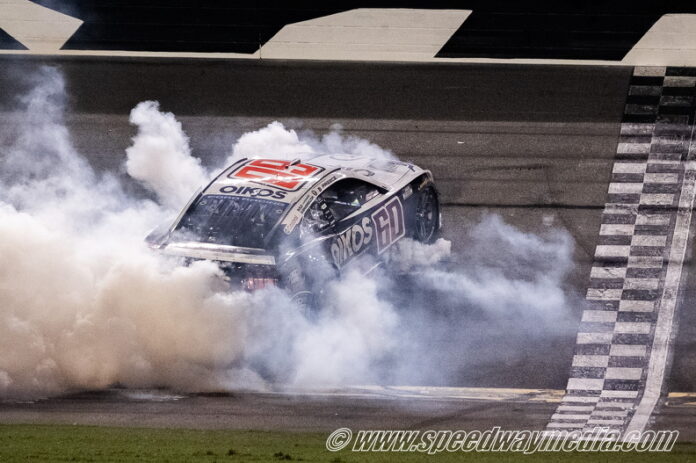
Photo by John Knittel for SpeedwayMedia.com.
“It’s been too damn long!” Bell exclaimed on the frontstretch on USA Network. “Oh my gosh, man. I’m just so, so proud of all of these guys on this No. 20 car. All the mechanics, all the pit crew members. They deserve it more than anyone. It’s been a long time coming. Darlington has been one that I’ve always wanted to win since I got into this sport. This is the ultimate driver’s track.”
“I knew that we’d be able to win [here at Darlington], no matter what,” Bell added. “I knew that we’d be able to win it. We can win any week. It just hasn’t happened yet. Whenever I was sitting in the infield care center at Michigan [in June], I thought my season was over. I thought I was gonna be out a couple of weeks. I wasn’t gonna be able to make the Chase. We’re still in it, baby!”
Ty Gibbs, who rallied from starting in 28th place, settled in second place for his 11th top-five result of the 2026 season while Tyler Reddick, who led 74 laps, finished in third place for a second consecutive event. Ryan Blaney finished in fourth place while Kyle Larson, who led a race-high 99 laps, settled in fifth place following his late gamble.
“I think it’s just goes back to where we started,” Gibbs, who is ranked in fourth place in the Chase standings, said. “[NASCAR] had a pretty squirrelly metric they went off of, and we started 28th, unfortunately. It ranked in the fourth seed. Hopefully, we can fix that for next time. I felt like the Monster Energy Toyota Camry was great. Yeah, I don’t know. I’m glad Christopher won. I’m happy for him and the No. 20 team. We just missed it a little bit and had some issues happen the whole day, but appreciate all the effort from everybody on my team that helped us have a great deal.”
“I was actually surprised that [Bell, Briscoe and Gibbs] pitted in front of me and then, I was surprised that not more stayed out with me,” Larson, who stood by his stance of not pitting and is ranked in seventh place, said. “I thought there might be two or four more that might stay out, and I really thought that could help me at least get some laps where I can manage my tires, but Bell got to second so fast. I was just straight into defense and not able to run the lines that I ultimately wanted to to take care of my tires. Either way, it would have been hard to hold them off, but I ended up holding them off longer than I thought I could. Really happy, though, with the day. Much better than we’ve been at Darlington the last couple of times. My car was not good the first run, but we got it better, and it really allowed me to run the lanes that I like to run here to manage my tires. Great start to the Chase. We only gained six points to the lead, but it’s better than losing six.”
Chase Briscoe, who led 30 laps and was attempting to become the second competitor to win three consecutive Southern 500 events, settled in sixth place while Josh Berry capped off a strong run as the highest-finishing non-Chasers in seventh place. Chasers Bubba Wallace, Joey Logano and Ryan Preece filled out the remaining top-10 spots on the track.
Notably, the remaining Chasers, including Carson Hocevar, Austin Cindric, Chase Elliott, Denny Hamlin, Chris Buescher, Daniel Suarez and William Byron, finished 11th, 13th, 14th, 18th, 20th, 21st and 37th, respectively. Despite settling in 18th place following his late-race incident with McDowell that damaged his entry and toe link, Hamlin remains atop the Chase standings and looks ahead to the remainder of the Chase and the pursuit of his first championship.
“Sometimes, you don’t get cut a break, and that’s the way it goes,” Hamlin said. “We’re still leading. We’ve got to just go to the next racetrack and execute at a high level. It starts in practice. We’ll do our best to execute a much better day next week.”
The 2026 Cup Series’ Chase opener generated 29 lead changes for 12 different leaders, and six cautions for 44 laps. In addition, 25 of 38 starters finished on the lead lap.
Race Results:
Christopher Bell, 46 laps led, Stage 2 winner
Ty Gibbs
Tyler Reddick, 74 laps led, Stage 1 winner
Ryan Blaney, one lap led
Kyle Larson, 99 laps led
Chase Briscoe, 30 laps led
Josh Berry
Bubba Wallace, 38 laps led
Joey Logano
Ryan Preece
Carson Hocevar, two laps led
Alex Bowman
Austin Cindric
Chase Elliott, one lap led
Erik Jones
Todd Gilliland, five laps led
Michael McDowell
Denny Hamlin, 68 laps led
Corey Heim
Chris Buescher
Daniel Suarez, two laps led
AJ Allmendinger
Brad Keselowski
John Hunter Nemechek
Zane Smith
Shane van Gisbergen, one lap down, one lap led
Ross Chastain, one lap down
Austin Hill, one lap down
Austin Dillon, one lap down
Riley Herbst, one lap down
Ty Dillon, one lap down
Noah Gragson, one lap down
Cole Custer, one lap down
Connor Zilisch, two laps down
Ricky Stenhouse Jr., four laps down
Cody Ware, four laps down
William Byron – OUT, Engine
Chad Finchum – OUT, Suspension
*Bold indicates Chase Drivers
Following the first Chase event of the 2026 NASCAR Cup Series season, Denny Hamlin maintains the lead in the standings by 12 points over teammate Christopher Bell. The rest of the 16-car Chase field is displayed below, with the points advantage indicating their deficit to points leader Hamlin.
Chase Standings:
Denny Hamlin
Christopher Bell -12
Ryan Blaney -16
Tyler Reddick -24
Chase Briscoe -37
Ty Gibbs -39
Kyle Larson -49
Chase Elliott -72
Joey Logano -72
Bubba Wallace -81
Chris Buescher -88
Carson Hocevar -89
Daniel Suarez -94
Austin Cindric -102
Ryan Preece -104
William Byron -114
With the 2026 NASCAR Cup Series Chase officially underway, the next event on the schedule is World Wide Technology Raceway in Madison, Illinois, for the Enjoy Illinois 300. The event is scheduled for next Sunday, September 13, at 3 p.m. ET on USA Network, MRN Radio, SiriusXM, and HBO Max.
RICK WARE RACING Cook Out Southern 500 Date: Sept. 6, 2026 Event: Cook Out Southern 500 (Round 27 of 36) Series: NASCAR Cup Series Location: Darlington (S.C.) Raceway (1.366-mile oval) Format: 367 laps, broken into three stages (115 laps/115 laps/137 laps) Race Winner: Christopher Bell of Joe Gibbs Racing (Toyota) Stage 1 Winner: Tyler Reddick of 23XI Racing (Toyota) Stage 2 Winner: Christopher Bell of Joe Gibbs Racing (Toyota)
RWR Finish:
● Cody Ware (Started 37th, Finished 36th / Running, completed 363 of 367 laps)
RWR Points:
● Cody Ware (35th with 202 points)
RWR Notes:
● Ware’s coolsuit stopped working roughly 30 laps into the Cook Out Southern 500, making an already hot outing in one of NASCAR’s longest races even hotter. He soldiered through the entirety of the 4-hour and 3-minute affair, delivering a gritty performance at the track aptly described as “Too Tough To Tame.”
Race Notes:
● Christopher Bell won the Cook Out Southern 500 to score his 14th career NASCAR Cup Series victory, his first of the season and his first at Darlington. His margin over second-place Ty Gibbs was 1.038 seconds.
● There were six caution periods for a total of 44 laps.
● Twenty-five of the 38 drivers in the race finished on the lead lap.
● Denny Hamlin leaves Darlington as the championship leader with a 12-point advantage over second-place Bell.
Sound Bites:
“It was definitely the hardest day in a racecar I’ve ever had. My team fights really hard, and as much as there were times when I wanted to call it quits today, I hung in there for my team. We were just trying to play a game of survival. It got to a point where I could barely talk, let alone try to give good feedback to my crew chief, but I thought we managed what we had. Thankfully, we were at least able to finish the Southern 500. Not the night we wanted, but those guys don’t ever give up on me, and I’m not gonna give up on them.” – Cody Ware, driver of the No. 51 ApexFX Chevrolet
Next Up:
The next event on the NASCAR Cup Series schedule is the Enjoy Illinois 300 on Sunday, Sept. 13, at World Wide Technology Raceway in Madison, Illinois. The second race in the 10-race Chase starts at 3 p.m. EDT with live coverage provided by USA Network and SiriusXM NASCAR Radio.