Home Blog Page 5588

Remembering Jason Leffler

Photo Credit: Getty Images

Late Wednesday night, we received the tragic news that Jason Leffler was killed in a Sprint Car crash in Swedesboro, New Jersey. He was 37 years old and leaves behind a five year old son named Charlie Dean. When I heard the news, I couldn’t bear to believe it just like the rest of you. The racing community is a family and always comes together in times like this. Jason Leffler and #LEFturn were trending worldwide as drivers and fans alike took to Twitter to mourn the loss of a good man who like so many others, was taken much too soon.

Leffler was a real grassroots racer who loved to play in the dirt and he did so better than most. In 1997, he became a USAC National Midget champion and went on to win 3 consecutive titles in that division. It was the first time since 1962 that a driver won three midget titles in succession and no one has done it since. In 1998, he won the USAC Silver Crown championship joining NASCAR legends Tony Stewart and Jeff Gordon as champions of that series. Some of his major short track victories include the 1997 Hut Hundred, the 1999 Copper Classic and two Turkey Night Grand Prix’s. His success in USAC caught the attention of Joe Gibbs Racing who put him in a Nationwide car for select races in 1999. He ran his first full Nationwide season in 2000 finishing 20th in points. He also made his one and only start in the Indianapolis 500 that year placing 17th.

In 2001, he moved to the Cup ranks with Chip Ganassi and struggled to find success although he did win a pole and post a top 10 at Homestead; the only pole of his Cup career. In 2002, he went to the Camping World Truck Series (CWTS) and put in a solid effort earning 4th place in the standings. Jason was inducted into the National Midget Auto Racing Hall of Fame in 2003. After an impressive season in the CWTS, he began to jump around running part-time schedules in all three national touring divisions of NASCAR. Nashville Superspeedway in 2004 was the site of Leffler’s first Nationwide victory when he held off Martin Truex Jr. and Clint Bowyer in the closing stages of the event.

Joe Gibbs Racing signed Jason to drive their newly formed Cup team with sponsorship from FedEx in 2005. With pressure from a big time sponsor like FedEx to perform, Gibbs decided to replace him mid-season with Denny Hamlin. In 2006, he went back to the Nationwide (NNS) ranks with a full-time ride courtesy of Todd Braun. He continued to run full-time in NNS until 2011 with his best season being 2007. He finished 3rd in points and won what would be his final NASCAR race in thrilling fashion that year. He battled fiercely with David Reutimann and Greg Biffle in the closing laps trading paint and rubbing fenders as he tried desperately to hold on. He refused to lose and after David passed him, he came right back at him and muscled his way by. After running Biffle up the track with three to go, he put the pedal to the floor and drove off taking the checkered flag. That was also Toyota’s first win in the Nationwide series. Kyle Busch put him in a truck for a handful of races in 2012 and Jason finished top 10 in six of his ten starts with a best result of 4th. His last flash of greatness in NASCAR came in the July NNS Daytona event back in 2011 when he drove from outside the top 10 with just one lap remaining to finish a very close 2nd to Joey Logano.
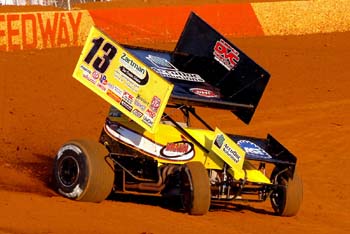
Jason Leffler Sprint Car

He made his final Cup start a Pocono last weekend before a Sprint Car race at Bridgeport Speedway. While running 2nd in the dirt race, he lost control and flipped into the wall. Jason was killed on impact and the racing world is still stunned by this unfathomable loss. It’s been a long time since we’ve lost an active NASCAR driver like this and the mood is somber as we all reluctantly gear up for a weekend of racing at Michigan International Speedway. Leffler will be remembered as an aggressive driver who never gave an inch and fought tooth and nail for every position. After getting into it with Sorenson once, Reed said to Leffler, “if you had lifted, we both would have made it through there.” Jason simply replied, “I don’t lift.” Just one of the many examples of what kind of competitor Leffler was. Panther Racing owner John Barnes was quoted saying, ” Jason was a small man with a huge right foot.”

Jason was a devoted single father who adored his son and had an unshakable passion for going fast. His determination to win was incorruptible and even through all the hardships, he pushed on, he persevered,  he refused to give up. This phenomenal talent could push a car to the absolute limit, teetering on the edge of disaster with no fear or trepidation of what could happen should something go wrong. His tenacity behind the wheel was awe-inspiring and his goofy, yet friendly personality will be remembered with smiles and with tears. We lost more than just a racer on that track, we lost a great man and a little boy lost his father.

The unwavering bravery and determination of racers never ceases to amaze as they look death in the eye every time they drive and losses like Leffler’s are never in vain. As legendary racer Bruce McLaren who also perished behind the wheel once put it; ” To do something well is so worthwhile that to die trying to do it better cannot be foolhardy. It would be a waste of life to do nothing with one’s ability, for I feel that life is measured in achievement, not in years alone.”

Well said Bruce. Death in racing is unavoidable and the wounds left in its wake sometimes never heel. We bury the fallen with tears, embrace the ones who escape death’s firm and final grip with relief and race on because that’s what racers do. Rest in peace Jason Leffler and let us all take comfort in the fact that you’re racing with angels now.


“Last night we lost a real racer (in) Jason Leffler” -Mario Andretti

“Jason Leffler was a great racer and an even better friend….We raced together a lot, and our career paths were very similar. He loved racing, especially open-wheel racing, and that’s a passion we both share. To not have him around to talk about whatever race one of us had just run, or were going to run, will be hard.” -Tony Stewart

“He died doing what he loved. He was a real racer, and he will be missed.” -Ryan Newman

“Can’t stop thinking about Jason Leffler…Very sad night. What a great guy we lost tonight. Rest in Peace Jason.” -Kasey Kahne

“Hate bein reminded of whatta dangerous sport racing is. Lost a good buddy 2nite” -Shane Hmiel

BREAKING NEWS: Jason Leffler Killed in Sprint Car Crash

SWEDESBORO, N.J., June 12 – Jason Leffler, who has driven in all three of NASCAR’s touring series, died as the result of a crash at the Bridgeport Speedway while competing in a 410 Sprint car event.

NASCAR, in a statement said, “NASCAR extends its thoughts, prayers and deepest sympathies to the family of Jason Leffler who passed away earlier this evening. For more than a decade, Jason was a fierce competitor in our sport and he will be missed.”

Reports indicated that Leffler was running in second place during a qualifying heat race when his car flipped several times down the front straight.

The track cancelled all further events for the evening after the crash as State Police arrived.


OSCAAR Modifieds News & Notes – June 12, 2013

Photo Credit: OSCAAR PR

NASCAR BTS: Mike Houston’s Journey From Bouncer to Pit Crew Coach

Some of the most important members on any race team are the pit crew members, especially those that go over the wall every Sunday. This week’s NASCAR Behind the Scenes spotlights one of those vital players, Mike Houston, front tire changer and pit crew coach for the No. 78 Furniture Row race team.

“What I do is I’m the pit crew coach and the front tire carrier,” Houston said. “I try to coordinate how we do pit stops, coaching each individual position as well as carrying front tires.”

“I’ve performed every position over the pit wall in the Cup Series, but for most of my career, I have been a tire carrier.”

Since Houston grew up in the heart of racing country, Concord, North Carolina, one would assume that he was involved with racing from his childhood on. But Houston took another very interesting route to end up with his career in NASCAR.

“I grew up in Concord and I never watched NASCAR,” Houston said. “I was involved in other sports, mainly football.”

“When I got out of college, I was bouncing at a night club in Charlotte and I was a professional wrestler at the same time,” Houston continued. “We had a Christmas party for one of the race teams at our night club.”

“I met one of the crew chiefs there and this was just at the very beginning stages of when they were having athletes come into the sport to do the pit crew,” Houston said. “So, we started talking and he asked me to come to the shop and see if I could do it.”

“I was kind of bored one day and decided to go over there,” Houston continued. “So, I just happened to be at the right place at the right time.”

“It doesn’t happen that way anymore.”

In addition to being a collegiate athlete, Houston was also a professional wrestler. His first wrestling name was ‘Minister of Pain’ but then he changed it to ‘Mike Mayhem.’

Houston shared that there are definitely similarities in the other sports in which he has participated, from football to wrestling, to NASCAR. But there are elements of racing that are also quite unique.

“I think that the hand/eye coordination you develop in football really translates into racing,” Houston said. “The physical fitness, training and dedication to the little details that make a difference definitely cross over.”

“It’s also the same rush going over the wall as playing football,” Houston continued. “Usually in racing, you don’t want to get the rush until the pit stop is over.”

“You want to maintain your composure while you are performing and then, if you have a good stop, you can celebrate the moment,” Houston said. “I’ve been doing it for so long while that the pre-butterflies before a pit stop don’t happen anymore.”

“But you do get excited and pumped up when you have a good stop and when you’re running up front,” Houston continued. “It’s along the same lines as sacking a quarterback late in the fourth quarter.”

“It’s also like getting a crowd pumped up before a wrestling match.”

“What is different is that the mind set and the approach in racing is quite different from other sports,” Houston said. “You can’t intimidate a race car.”

“Really it is more about competing against yourself.”

Houston has had many challenges on pit road but his most memorable moment came as a member of a championship pit crew team with five time champ Jimmie Johnson.

“I would say the best moment in my pit crew career was in 2010,” Houston said. “I was on Jeff Gordon’s crew and we did the swap with the 48.”

“To be able to go to that car and be a part of winning that championship as a pit crew member was one of the better moments.”

While there are highs in racing, like those championship moments, Houston acknowledged that there are also downsides, especially the danger they face every time they go over the wall.

“I think that a lot of things that happen are out of your control on pit road,” Houston said. “I tell the guys that when they go over the wall you can’t have the mindset that a car is going to hit you or that you will have a problem.”

“If you’re thinking of those things, you’re taking your mind off the job you have to perform,” Houston continued. “I do always tell the guys though to keep their eyes down pit road.”

Given the physical presence of Houston, whose nickname is ironically ‘Tiny’, fitness and working out would seem a requirement. Yet while Houston and his pit crew do hit the gym, they also mix it up with some other exercises that just might surprise race fans.

“We work out four times a week and practice four times a week as well,” Houston said. “We dedicate one day, Thursdays, where we do yoga.”

“It makes sense because you want to be as limber as possible,” Houston continued. “A lot of the positions are bending, squatting and getting down on your knees, so those motions of keeping your core strong are helpful.”

“Not to say that any of us are good at it, but we still do it,” Houston said. “You really can tell a difference from the guys who have never done it before because in six weeks the progression they have with their flexibility is incredible.”

“We will also throw in some aquatics and meet up at the Y and exercise in the water,” Houston continued. “We do a lot of low impact because we jump over the wall with a 75 pound tire in our hand and all that weight, whether a fuel can, tire or jack, you are putting all that pressure on your joints.”

“So, a lot of this stuff helps the beating and banging we do on the weekends on our bodies.”

Houston also acknowledged that exercising for endurance is critical for his crew’s over the wall work.

“We don’t really do a lot of lifting weights, but include more of the cardio and things like that to get the heart rate up,” Houston said. “We have one of the longest seasons in the sport and you have to be able to last.”

“For football, you want to be bigger, stronger, faster but we want to be limber, have injury prevention and to prolong the career as long as possible,” Houston continued. “We do a little heavy lifting, but that is more in the off-season.”

“Otherwise, we do more cross fit training or things that help endurance.”

All of this training has in large part contributed to the faster pit stops, moving from 14 seconds on average down to 12 and even 11 seconds for some teams. But Houston advised that it is not always the fitness that gets it done more quickly on pit road.

“When I first got into the sport, nobody thought you would see a 13 second pit stop and I’ve seen the threshold go from 14 seconds, to 13, to 12 to 11,” Houston said. “One of the biggest factors is that the equipment and the engineering on the pit guns have improved.”

“That is a huge advantage that a lot of the bigger teams have right now,” Houston continued. “They’re developing pit guns that allow them to have their changers hit the lug nuts faster and the equipment keeps up with them.”

“Your big teams put money into this kind of development so they have a slight advantage.”

For Houston, there are other vital elements in addition to the new equipment and physical fitness that improve the performance of his pit crew team members. One element is the coaching and mentoring aspect and the other is their relationship with their driver.

“My style of coaching can be tough or encouraging,” Houston said. “It depends on the situation.”

“Usually during race situations, I try to keep calm and not blow a gasket because if you do that, you’re not really helping at that moment,” Houston continued. “If a guy made a mistake, he is already feeling bad because when you make a mistake, the whole team suffers.”

“At that particular time, I try to become more encouraging and positive,” Houston continued. “But in practice but if the guy is making the same mistake over and over, then you’ve got to get up in his grille and say ‘get it together.’

“The drivers that seek out and get to know the guys on their pit crew, it does make a difference,” Houston said. “I think it makes more of a difference on the pit crew side because they believe that their driver cares.”

“That was one thing at Hendrick with Jeff Gordon and Jimmie Johnson,” Houston continued. “We’d play paint ball together or have an outing.”

“We’d do things as a group with the driver involved,” Houston said. “That type of stuff goes a long way.”

Other than the fact that he was a bouncer and wrestler, what else would fans be most surprised to know about Mike Houston, aka ‘Tiny’?

“I always get told that I look unapproachable and that the first impression, with my bald head and goatee make me unapproachable,” Houston said. “My appearance may give a different impression than what I really am.”

“I’m really kind of a teddy bear underneath.”