Home Blog Page 58

Lone Star Racing Secures a Trio of Top Finishes with its Pair of Mercedes-AMG GT3 Entries at COTA SRO America

  • Marc Austin and Jason Golan Lead and Finish Second in the Am Division in Their GT World Challenge America Powered by AWS Debut in Sunday’s Three-Hour Race in the No. 11 Mad Joker by Lone Star Racing Mercedes-AMG GT3
  • Dan Knox Scores a Pair of GT America Sixth-Place Finishes in the No. 80 Lone Star Racing Mercedes-AMG GT3

AUSTIN, Texas (April 28, 2026) – Lone Star Racing’s first major event with a pair of Mercedes-AMG GT3 entries on the team’s “home track” at Circuit of The Americas (COTA) produced a trio of top race finishes and a visit to victory lane in Sunday’s featured three-hour GT World Challenge America powered by AWS this weekend.

“Everybody at Lone Star Racing did a great job all weekend with our first two-car Mercedes-AMG GT3 effort at Circuit of The Americas,” said Lone Star Racing Team Manager and Technical Director AJ Petersen. “The team in total executed very well, both driving and running the two cars with no penalties, and it was great support for our drivers and car owners. We had fans, family and friends from all over Texas supporting us all weekend, and we gave them some good results and put both cars back on the trailers in basically the same condition as when we arrived. It was a great weekend of ‘Lone Star’ racing from start to finish.”

The debuting Austin-based duo of Marc Austin and Jason Golan led their class and battled to the finish in their first GT World Challenge America race in the Am division, which is generally for gentlemen or Bronze rated drivers. They waged a competitive two-car battle with a team that includes former Rolex 24 At Daytona overall winner Oswaldo Negri Jr.

Austin and Golan proved up to the challenge, passing for the lead at mid-race and staying in touch with their friendly rivals for the entire three hours. A late spin when Austin ran over the debris from a competitor that returned to the track after going off course took the No. 11 out of winning contention, but he quickly recovered and kept the pressure on until the finish. Austin crossed the finish line for runner-up honors just 11 seconds behind the winners.

“It was a lot of fun, and we just did our best to be as fast as we could and stay out of trouble,” Austin said. “In that first stint, Jason and our Am competition had a really good battle. It was a good race, we had a good time, and the Mercedes-AMG GT3 came through as always. It was really exciting to see our car lead the race. We’re shooting to try to run more races this year, and hopefully maybe pick up another one of these in GT World Challenge, because this is what we want to run. Our car is in good shape after this race. She’s ready to go!”

Moving up to GT World Challenge America in the Am class in the No. 11 Mad Joker by Lone Star Racing Mercedes-AMG GT3, Austin and Golan first ran together in SRO America with a competitive run in a Lone Star Racing Mercedes-AMG GT4 in the Pirelli GT4 America three-hour race on the SRO America COTA weekend in 2025.

“Sometimes racing is about keeping it clean and knowing who you’re racing,” Golan said. “We are competing in a gentlemen class in a series that is more or less intended for that, so we watch out for and take care of each other out there. We all know each other, we’re all friends off the track, so it has to be a legitimate pass for it to count, because at the end of the day we’re out of there having a good time. We are competing with people we generally love seeing, which is probably one of the best things about racing. It starts with your own team, and Dan Knox is incredible, a great owner, and Lone Star Racing is one of my favorite teams to run with. Obviously, Marc is a great driver. I actually met him while we were racing one time, and after the race, he came up to me, and he said, ‘buddy, that was the best racing I’ve ever done. You left me room, and I left your room.’ And that’s how we became friends. He is a great teammate, Lone Star Racing has great coaches, great mechanics, and everybody knows so much about the Mercedes-AMG GT cars. The Mercedes-AMG GT3 and GT4 are some of the best cars out there.”

Lone Star Racing and team owner and winning driver Dan Knox returned to the GT America powered by AWS series for the first time in over a year at COTA and battled in the front half of the field all weekend in the No. 80 Lone Star Racing Mercedes-AMG GT3. Knox secured sixth place finishes in each of the weekend’s 40-minute sprint races on Saturday and Sunday that had competitive fields of 15 total GT3 “SRO3” entries.

“The competition is really better since the last time we raced here in GT America, which is good to see,” Knox said. “The series has gotten better. It was a great race weekend but unfortunately we just missed the setup. We didn’t have enough time testing with these tires on the car, but it was great for about the first 20 to 30 minutes. Then they started falling off really hard, and we probably would have had better results at the end, but I still enjoyed it. It was good to get back in the Mercedes-AMG GT3 in SRO. I think everybody at Lone Star Racing did really well. The guys worked hard. They got everything going, but we just need that little bit more time with these tires and a setup for my purposes, but the guys did a great job. I am happy with the results with Lone Star Racing having two cars here, and I think SRO has been very happy to see us here back in the paddock again. We will see where it goes for the rest of the season.”

Next up for Lone Star Racing is Round 3 of the 2026 IMSA Michelin Endurance Cup with the No. 80 Lone Star Racing Mercedes-AMG GT3 at Watkins Glen International, June 25 -28.

About Lone Star Racing: Based at Motorsport Ranch within the greater Dallas-Fort Worth area in Cresson, Texas, Lone Star Racing is competing in the No. 80 Lone Star Racing Mercedes-AMG GT3 in the 2026 IMSA Michelin Endurance Cup in the GTD class, in addition to other top sports car racing series. Lone Star Racing and its team members have won races across North America spanning sprint and endurance racing formats. The crew has worked together on many different teams and various types of cars, developing a strong bond and proven capability that gives them a competitive and winning advantage. Lone Star Racing competes with the support of primary partner ACS Manufacturing, Inc. (www.ACSManufacturing.com). Look for Lone Star Racing and team owner/driver Dan Knox on Facebook and follow the team on YouTube at Lone Star Racing, on Twitter and Instagram @LSRTeam and on the official team web site at www.LoneStarRacingTeam.com.

More Than Just Track Safety: Staying Safe in the Stands at the Next Big Race

Photo by depositphotos at https://depositphotos.com/

Race day hits differently.

The engines roar. The smell of fuel hangs in the air. Fans pack the stands, jerseys on, drinks in hand, eyes locked on the track. Whether it’s a local speedway in California or a major motorsport event, the energy is electric.

But here’s something most fans don’t think about until it happens.

The real danger isn’t always on the track.

It’s under your feet.

The Hidden Hazards in Plain Sight

Let’s talk about what race venues don’t advertise.

Because while teams obsess over tire pressure and track conditions, the walkways, stairs, and concession areas don’t always get the same level of attention.

And that’s where problems start.

Think about it:

  • Spilled drinks near concession stands
  • Oil or grease tracked in from pit areas
  • Uneven pavement in older stadium sections
  • Dim lighting in stairwells or parking lots
  • Trash or debris left behind after a big crowd surge

Individually, these seem minor.

Together? They create a perfect setup for a slip and fall.

And in a packed venue, it only takes one second.

One missed step. One slick surface.

Game over.

Why These Accidents Happen More Than You Think

Here’s the reality.

Large venues are high-traffic environments. Thousands of people moving at once. Constant food and beverage activity. Limited turnaround time for cleanup.

Even well-managed facilities can fall behind.

And when they do, hazards build up quickly.

Now add distractions.

You’re checking your phone. Watching the race replay on a screen. Carrying food. Talking to friends.

You’re not scanning the ground every second.

No one is.

That’s why these incidents aren’t rare—they’re predictable.

Premises Liability: What It Actually Means

Most people assume a fall is just “bad luck.”

But legally? It’s not that simple.

Property owners—whether it’s a race venue, stadium, or local business—have what’s called a duty of care.

That means they’re responsible for:

  • Keeping walkways safe
  • Addressing hazards in a timely manner
  • Warning visitors about dangerous conditions

If they fail to do that, and someone gets hurt, they can be held accountable.

This falls under premises liability.

It’s not about blaming—it’s about responsibility.

If a hazard was preventable and ignored, that’s not on you.

The “It Won’t Happen to Me” Mindset

Here’s where most fans get caught off guard.

You’re careful. You’re aware. You’ve been to events like this before.

But accidents don’t require carelessness.

They require opportunity.

A wet step in a crowded stairwell. A slick patch near the drink station. A poorly lit path back to your car.

These are environmental risks—not personal failures.

And when they’re not handled properly, injuries follow.

Local Knowledge Matters More Than You Think

Let’s bring this closer to home.

Whether you’re at a local track in Fresno or just grabbing dinner after the race, the same rules apply.

Property owners are responsible for maintaining safe conditions.

And if something goes wrong, having local expertise matters.

If you ever find yourself dealing with an injury caused by unsafe conditions, speaking with professionals like Fresno slip and fall lawyers can help you understand your options and what steps to take next.

Because navigating these situations isn’t always straightforward.

And timing matters.

What To Do Immediately After a Fall

This is where things get practical.

If you—or someone you’re with—experiences a fall at a venue, your next steps can make a big difference.

1. Pause and Assess

Don’t rush to stand up right away.

Take a moment. Check for pain, dizziness, or disorientation.

Adrenaline can mask symptoms.

2. Document the Scene

This is huge.

Use your phone to capture:

  • The exact area where you fell
  • Any visible hazards (liquid, debris, uneven surfaces)
  • Lighting conditions
  • Nearby signage (or lack of it)

Conditions can change quickly—especially in busy venues.

3. Get Witness Information

If someone saw what happened, ask for their name and contact details.

Even a quick note can help later.

4. Report It

Notify venue staff immediately.

Make sure an incident report is created.

And ask for a copy if possible.

5. Don’t Downplay It

This one’s important.

It’s easy to say, “I’m fine.”

But if something feels off—even slightly—take it seriously.

What feels minor now may not stay that way.

Pro Tip: Stay One Step Ahead

You can’t control everything at a race venue.

But you can stay a little more aware.

Quick Safety Checklist for Race Day

  • Watch high-traffic areas near concessions
  • Use handrails on stairs—even if you don’t think you need them
  • Be cautious in dimly lit sections
  • Wear shoes with good grip (yes, it matters)
  • Slow down in crowded walkways

Simple habits. Big impact.

Why This Matters for Fans

Motorsports are all about precision, performance, and control.

But once you leave the track and enter the stands, control shifts.

You’re relying on the venue to do its part.

And most of the time, they do.

But when they don’t?

You need to know where you stand.

Final Thoughts: Enjoy the Race—But Stay Grounded

Race day should be about excitement.

The engines. The competition. The experience.

Not unexpected injuries.

No confusion about what to do next.

Staying safe doesn’t take away from the moment—it protects it.

Because at the end of the day, the goal is simple:

Enjoy the race. Walk out safely. And make it home without incident.

That’s a win worth protecting.

The Forensic Fender Bender: Why Rushing to the Body Shop Can Total Your Injury Claim

The impact doesn’t always look like much.

Modern bumpers flex. Absorb. Rebound. You step out after a hit—maybe on the 5, maybe in stop-and-go on the 405—and all you see is a scuffed cover and a cracked clip. No airbags. No shattered glass. Easy fix, right?

Not even close.

Under that plastic? The story is different. Energy transfer. Load paths. Maybe a tweaked rail. Maybe a compromised crush zone. And here’s the part most drivers don’t realize—insurance adjusters are counting on you to erase that story as fast as possible.


The Surface-Level Trap

Let’s call it what it is.

“Buff and paint” is the insurance company’s favorite outcome.

It’s quick. It’s cheap. It makes the car look normal again. And once it looks normal, the narrative shifts.

Low damage. Low force. Low payout.

But cosmetic repair doesn’t mean structural integrity. Not even close. A bumper cover is just a shell. Behind it sits the reinforcement bar, the energy absorber, mounting brackets, sensors, and sometimes the first hint of frame involvement.

If you rush to fix the visible damage, you’re doing two things:

  1. Removing physical evidence
  2. Simplifying the insurer’s argument

And they will use that.


The Physics of the Claim

Cars don’t lie.

Metal moves. Components deform. Energy leaves a footprint.

In collision forensics, we’re not guessing—we’re reading data written into the structure of the vehicle.

A “minor” rear-end hit can generate significant G-forces, especially in modern traffic conditions where speeds fluctuate and stopping distances collapse. That force has to go somewhere.

It travels through:

  • The bumper system
  • The rear body panel
  • The frame rails
  • The suspension mounting points

Even a few millimeters of rail deviation can indicate meaningful force transfer.

And that matters.

Because in a claim, structural damage correlates with impact severity. Impact severity supports the plausibility of injury. It’s not about exaggeration—it’s about physics.

But if that structure gets corrected before it’s documented?

You lose the data.


Timing Is Everything

Here’s the hard truth.

The first 24–72 hours after a collision are when most drivers make their biggest mistake.

They authorize repairs too early.

Why? Because they want the problem gone. The car fixed. Life back on track.

Understandable. But risky.

Before any wrench turns, you need:

  • A full visual record (photos, video, angles, close-ups)
  • A professional inspection—not just a drive-by estimate
  • Documentation of alignment, panel gaps, and mounting points

And yes—separate from the vehicle, you should get yourself evaluated as well. Not for litigation. For baseline documentation. Because symptoms can lag. Always have.

Once repairs start, the original condition is gone.

And with it, your strongest piece of evidence.


Choosing an Advocate, Not Just a Shop

There’s a difference between a repair vendor and a strategic partner.

Most shops focus on throughput. Fix it. Bill it. Move on.

Specialized auto collision repair shops recognize that their job isn’t just about the repair—it’s about the documentation.

That’s a different mindset.

They look at:

  • Pre-repair measurements
  • Structural mapping
  • Component displacement
  • Hidden damage potential

They don’t just ask, “What needs fixing?”

They ask, “What needs proving?”

And that distinction can make or break a claim.


The CORE Process: Where the Real Story Emerges

In the industry, thorough operations follow a structured workflow. Call it CORE. Not branding—process.

Three phases. Each one matters.

Initial Estimate

This is the surface read.

Visible damage. Obvious repairs. Basic cost projection.

It’s what most insurance appraisals stop at.

And it’s incomplete.


Supplemental Estimate

This is where the car gets opened up.

Panels come off. Components are exposed. Fasteners tell stories.

Hidden damage appears.

  • Crushed absorbers
  • Bent brackets
  • Shifted reinforcements

This phase often changes the entire scope of the repair—and the understanding of the impact.


Additional Supplemental

Now we go deeper.

Undercarriage. Suspension geometry. Secondary load paths.

This is where subtle damage shows up—damage that doesn’t scream, but still matters.

And this is also where many quick-repair operations stop short. Time is money. They move on.

But from a forensic standpoint?

This phase is gold.


The Undercarriage Problem Nobody Talks About

Most drivers never see the underside of their vehicle.

Out of sight. Out of mind.

But in a collision, especially anything with vertical load or sudden deceleration, the undercarriage can reveal:

  • Contact points from bottoming out
  • Exhaust system displacement
  • Subframe shifts

It’s not flashy damage. It’s not visible in a parking lot.

But it contributes to the total picture of force.

Ignore it, and you’re missing part of the equation.


Zero Out-of-Pocket: More Than a Slogan

You’ll hear the phrase.

“Zero Out-of-Pocket.”

Sounds like marketing. It’s actually strategy—when done right.

A properly documented repair, following the full CORE process, builds a case that the insurer can’t easily undercut.

Every supplemental adds justification.

Every documented component adds weight.

The goal isn’t just to fix the car—it’s to ensure the repair reflects the true extent of damage so the driver isn’t left covering gaps.

Because gaps happen when things are missed.

And things get missed when repairs are rushed.


Insurance Companies Know the Game

Let’s not pretend otherwise.

Insurers have seen every scenario.

They know that once a vehicle is repaired—especially cosmetically—the argument becomes easier.

“No significant damage.”
“Low-speed impact.”
“Unlikely to cause major issues.”

It’s a script.

And it works—when the evidence is gone.


Final Lap: The Right Pit-Stop Matters

After a crash, everyone wants speed.

Get it fixed. Get moving. Get back to normal.

But the smartest move isn’t the fastest one.

It’s the most deliberate.

Your vehicle, in its damaged state, is a record of what happened. A physical log of force, direction, and severity.

Treat it that way.

The right pit-stop after a collision doesn’t just restore paint and panels. It preserves data. It documents reality. It protects your position.

Because once that evidence is gone?

You don’t get a second lap.

From Garage to Office: Streamlining the Paperwork That Keeps Race Teams Running

Race teams live and die by the clock.

Every second on the track is critical… but every second at the HQ counts too. Fact is, most race teams spend more time on administration than they do in the pits. Sponsorship contracts, driver agreements, transport permits, notarizing a power of attorney… it all piles up quickly, and a single missing signature can spell disaster for a team over a whole weekend.

Here’s the good news:

Administration is the easiest aspect of the racing operation to improve. With the proper systems, teams can end their paper wars and get back to doing what they love — racing.

Inside this guide:

  1. Why Race Teams Drown In Paperwork
  2. The Documents Every Team Has To Manage
  3. How To Streamline The Workflow From Garage To Office
  4. The Power Of Going Digital With Notarization

Why Race Teams Drown In Paperwork

Race teams have a unique problem.

You’re not just running a business, you’re running a small business, a logistics company, an engineering shop, a marketing agency… all at once. There’s simply more paper coming off the printer on the desk than the typical small business owner’s.

A typical race weekend involves:

  • Driver and crew contracts — agreements that often need notarized signatures.
  • Sponsorship deals — legal contracts with deadlines that don’t move.
  • Parts and supplier invoices — dozens of them per event.
  • Travel and transport documents — especially when crossing state or country lines.
  • Insurance and liability waivers — non-negotiable for safety and legal cover.

And here’s the kicker…

The majority of teams are still keeping track of all of this in paper folders and email chains with a printer that is out of toner when it matters most, right before a big race. More than 1.25 billion documents are notarized in the United States every year, and a good portion of those belong to race teams. Race teams these days are taking advantage of a trusted online notary to get the large documents, such as power of attorney notarization, done quickly.

Sound familiar?

The Documents Every Team Has To Manage

You must know what you are streamlining before you can streamline it. Race teams are inundated with four categories of paperwork. Each one has deadlines, signatures and headaches.

This is the heaviest category and one that results in the most delays. It consists of items such as sponsorship contracts, driver representation agreements, and more importantly — power of attorney notarization. Power of attorney documents are of particular importance to race teams because they allow a team principal or manager to sign for an owner, driver, or sponsor if they are unable to be present in person.

That’s huge for racing.

Why? Because the team owner is often in a different city than the team, the driver is frequently on the road and the sponsor is probably thousands of kilometres away. The ability to secure an effective notarized POA in place remotely allows a team to keep on rolling without having to fly someone across the country every time a contract requires a signature. Remote notarization has become so important for distributed teams like race crews because telecommuting has increased by 500% since 2020.

Operational Documents

These are the day-to-day pieces of paperwork:

Mind-numbing. Absolutely. But jump one and the driver might get stuck at the gate.

Financial Documents

Race teams are a high volume cash business. Teams need squeaky clean documentation for sponsorship payments, prize money, supplier invoices and tax filings. Get this wrong and it’s not just a missed race at stake — we’re talking audits and penalties.

Compliance & Safety Documents

Every sanctioning body has its own forms and requirements. You will find this in NASCAR, IndyCar, F1, and club level racing… no excuses for non-compliance.

How To Streamline The Workflow From Garage To Office

Now for the fun part… cleaning up the mess. The good news is that you do not need to tear the whole system down. Just a few minor tweaks can save hours every week.

Centralise Everything

The first step is consolidating all of the documents into one place. Most teams have paperwork strewn all over:

  • Email inboxes
  • Filing cabinets in the workshop
  • Folders on the team principal’s laptop
  • Random USB sticks

This is a disaster waiting to happen.

Store all files in one online folder. This could be a shared folder on Google Drive, Dropbox, or a company team document sharing solution. All team members can access the information they need, at any time, from anywhere.

Standardise Your Templates

If you’re writing every contract from scratch, you’re wasting hours.

Create templates for:

  • Driver agreements
  • Sponsor contracts
  • Crew employment letters
  • Travel authorisation forms
  • Liability waivers

Once they are built, you just plug in the names and dates. Easy.

Set A Document Calendar

This is something most teams don’t do, but it’s a game-changer.

Create a calendar that tracks when every significant document is due, requires renewal, or requires a signature. Sponsorship contracts, for example, tend to renew annually, insurance policies expire, and driver contracts must be signed within a specific time frame. Missing any of these is bad news. A simple calendar solves the problem.

The Power Of Going Digital With Notarization

Digitizing your notarization workflow is the most impactful upgrade the majority of race teams can make. The market size for online notary services was valued at USD 1.2 billion in 2024 and is estimated to reach USD 3.5 billion by 2033, signifying how quickly businesses are shifting away from physical notarization.

Think about what this means for race teams:

  • A Daytona driver could literally sign a contract in real-time with a Charlotte based team.
  • A European sponsor can close a deal with a US team without the need for anyone to travel.
  • A team principal may sign a POA from the airport on the way to the next race.

That’s the power of moving away from the old way of doing things.

But there is a catch…

Not all documents are eligible for online notarization in all states. Some states still require in-person notarization for certain documents. Be sure to check the state’s laws before relying on online notarization for an important document.

Crossing The Finish Line

Race teams that win on the track, are usually the ones organised off the track. The admin side of racing isn’t glamorous… but it’s the glue that holds the whole thing together.

To recap:

  • Centralise all of the documents in one cloud-based folder
  • Build templates for the documents used most often
  • Set a document calendar to track deadlines and renewals
  • Use online notarization for power of attorney and other key signatures

Make these changes and you’ll clear several hours per week. Time that can be spent doing what matters most — designing faster cars and winning races.

FloRacing, The NASCAR Channel to Stream “ARCA Night in America” ARCA Menards East, West Doubleheader at Nashville and Shasta on May 2

TEMPERANCE, Mich. – (April 14, 2026) – A unique, same-day doubleheader for the ARCA Menards Series East and West will be shared with fans nationwide as FloRacing and the NASCAR Channel combine for ARCA Night in America presented by Menards.

ARCA Night in America presented by Menards will start with ARCA Menards Series East Cook Out Music City 150 at the historic Nashville Fairgrounds Speedway at 9 p.m. ET/6 p.m. PT. The ARCA Menards Series West Bill Schmitt 173 will follow with the green flag expected at 11:30 p.m. ET / 8:30 p.m. PT.

Charles Krall, the voice of the ARCA Menards Series East and West, will call the action for both races. He will be joined by veteran MRN Radio and track public address announcer Nathan Prouty. They will be joined by ASA STARS National Tour announcer Jonathan Ramos on pit road at Nashville and veteran West Coast announcer Steven Blakesley patrolling the pits at Shasta.

“This is going to be one of the marquee nights of racing for the ARCA Menards Series platform all season long,” said ARCA president Ron Drager. “Our two regional tours, the ARCA Menards Series East and West, have both started the 2026 season with excellent fields of race cars and some really thrilling races, and it’s going to be a big deal to have them both in action on the same night.”

“The ARCA Menards East and West have both delivered really strong audiences on both FloRacing and the NASCAR Channel in 2026,” said Dan Barker, Senior Managing Director, Content Strategy and Distribution for NASCAR. “The East race at Hickory saw its largest viewership in over 10 years, and Rockingham was similarly strong. The ARCA Menards platform has a tremendously loyal audience, and we look forward to giving everyone a great night of racing on both sides of the country.”

On track activity at Nashville will begin with practice at noon ET/11 a.m. CT, followed by Sioux Chief PowerPEX Pole Qualifying at 5 p.m. ET/4 p.m. CT. The Cook Out Music City 150 will follow at 9 p.m. ET/8 p.m. CT.

Activity will begin at Shasta with practice at 6:30 p.m. ET/3:30 p.m. PT followed by Sioux Chief PowerPEX Pole Qualifying at 8:20 p.m. ET/5:20 p.m. PT. The race will follow with the estimated green flag time of 11:30 p.m. ET/8:30 p.m. PT.

Both races will be streamed live on FloRacing and simulcast on the NASCAR Channel. Live timing and scoring data will be available on ARCARacing.com. For up-to-the-minute updates, follow @ARCA_Racing on X (formerly Twitter).

Tickets for the ARCA Menards Series East Music City 150 at Nashville Fairgrounds Speedway are available at TrackEnterprises.com. Ticket information for the ARCA Menards West Bill Schmitt 173 is available at ShastaSpeedway.com.

About ARCA
The Automobile Racing Club of America (ARCA), founded in 1953 by John and Mildred Marcum in Toledo, Ohio, and acquired by NASCAR in April 2018, is the leading grassroots stock car sanctioning body in the United States. Bridging the gap between NASCAR’s top three national touring series and weekly and regional tour racing all across the country, the organization sanctions over 100 races per year in the ARCA Menards Series, ARCA Menards Series East, ARCA Menards Series West, ASA STARS National Tour, ASA CRA Super Series, ASA Midwest Tour, ASA Southern Super Series plus weekly racing at Toledo and Flat Rock Speedways. For more information about ARCA visit www.arcaracing.com, or follow ARCA on Facebook (@ARCARacing) and Twitter (@ARCA_Racing).

About Menards
A family-owned and run company started in 1958, Menards is recognized as the retail home center leader of the Midwest with 236 stores in 15 states. Menards is truly a one-stop shop for all of your home improvement needs featuring a full-service lumberyard and everything you need to plan a renovation or build a home, garage, cabin, shed, deck, fence or post frame building. You’ll find a large selection of lumber, roofing, siding, construction blocks, trusses, doors and windows, plus cabinets, appliances, countertops, flooring, lighting, paint, plumbing supplies and more. To complete the job, Menards has quality hand tools, power tools, fasteners, electrical tools plus storage options and supplies for everyone from the weekend warrior to the pro!

Menards has what you need to complete your outdoor projects and keep your yard in tip-top shape including mowers, trimmers, blowers, pressure washers and more, plus a beautiful garden center stocked with plants, shrubs, trees, landscaping tools, grass seed, fertilizer options, outdoor décor and patio furniture. Menards also has everyday essentials like health & beauty products, housewares, pet and wildlife supplies, automotive items and even groceries. And at Christmas, an Enchanted Forest display area with impressive trees, lighting, decorations, ornaments, inflatables and more.
Menards is known for friendly Customer Service and as the place to “Save Big Money” with low prices every day, and sales too! For more information, please visit Menards.com to learn about our store locations, offerings and services.

Jim Dunn Racing – Georgia Advance for the NHRA Southern Nationals

Jeff Arend
Solid Start/True Brand Funny Car Driver for Jim Dunn Racing
NHRA Southern Nationals
May 1-3 | Adel, Georgia

Event Overview

Friday, May 1 (Nitro Qualifying, streamed live on NHRA.TV)

Nitro qualifying session (Q1): 3 p.m. EDT
Nitro qualifying session (Q2): 5:30 p.m. EDT

Saturday, May 2 (Nitro Qualifying & Mission #2Fast2Tasty Challenge, streamed live on NHRA.TV)

Nitro qualifying session (Q3) / Mission #2Fast2Tasty Challenge – Semifinals: 12:30 p.m. EDT
Nitro qualifying session (Q4) / Mission #2Fast2Tasty Challenge – Finals: 3 p.m. EDT

Sunday, May 3 (Nitro Eliminations, streamed live on NHRA.TV)

Round 1: 11 a.m. EDT
Round 2: 1:30 p.m. EDT
Semifinals: 3 p.m. EDT
Finals: 4:25 p.m. EDT

TV coverage on FS1

Saturday, May 2: Qualifying show, recapping all of Friday’s action (9:30 p.m. EDT)
Sunday, May 3: Qualifying show, recapping all of Saturday’s action (1 p.m. EDT)
Sunday, May 3: Finals show (7 p.m. EDT)

Notes of Interest

The NHRA Southern Nationals is the fifth event on the NHRA Mission Foods Drag Racing Series’ 20-race calendar in 2026. Jim Dunn Racing brings its one full-time entry in Funny Car for Jeff Arend. A native of Canada, Arend moved to Southern California in 1997.

As the NHRA celebrates its landmark 75th season in 2026, Jim Dunn Racing is celebrating 76 years of success in drag racing. Jim started drag racing when he was 15 years old and at 91 years old, he plans to keep going as long as he can. In 2024, Jim received the NHRA Lifetime Achievement Award. He has won some of the sport’s most significant races and has provided driving opportunities for some of the biggest names in the sport.

Coming into Georgia, Arend is 19th in the Funny Car standings, 336 points behind leader Ron Capps.

Solid Start/True Brand the primary partner of Arend this weekend in Georgia. They are a women-owned, family-operated automotive additives manufacturer based in Lakeland, Florida. Founded in 2010 and built upon an automotive additives legacy dating back to 1976, the company produces a full line of performance-driven products designed to enhance engine performance and extend equipment life. Known for innovation, quality, and purpose-driven partnerships, Solid Start/True Brand proudly supports initiatives that strengthen families and communities nationwide.

True Brand is honored to partner with the National Breast Cancer Foundation (NBCF) to raise awareness and drive impact in the fight against breast cancer. NBCF is a leading nonprofit organization dedicated to helping women now through early detection, education, and support services. Founded in 1991 by breast cancer survivor Janelle Hail, NBCF provides free, life-saving breast cancer screenings and educational resources to women in need, empowering individuals and families with hope, knowledge, and access to care year-round.

Arend piloted the Jim Dunn Racing Funny Car at the NHRA’s previous event, the 4-Wide Nationals in Charlotte. Prior to that, Arend last drove for Jim Dunn Racing in the 2013 and 2014 seasons and he has raced only sporadically in the NHRA Mission Foods Drag Racing Series. In his Funny Car career, Arend has four wins and five runner-up finishes to his credit. His last win came in July, 2012, when he beat Courtney Force in the final of the Route 66 Nationals at Chicago. He also has started twice from the No. 1 qualifying position.

The NHRA Southern Nationals will mark Arend’s 254th career Funny Car appearance, and his first overall Funny Car appearance at South Georgia Motorsports Park.

The historic Southern Nationals return to a new location during the NHRA’s milestone 75th anniversary campaign. It marks the first of four visits to new facilities for the NHRA in 2026. The festivities kick off from 6-8 p.m. ET on Thursday, April 30 with a “Rev & Rally” race weekend preparty and fanfest from Visit Valdosta at the Rainwater Conference Center.

Jeff Arend, Driver of the Jim Dunn Racing Solid Start/True Brand Funny Car

Last weekend’s 4-Wide Nationals in Charlotte marked your return to the Jim Dunn Racing Funny Car. What advantage is there racing back-to-back weekends, so you’re able to continue developing consistency in the car?

“It’s real important to stay sharp and racing back-to-back weekends helps keep up both the driving and tuning progress for the team. When I drove the Jim Dunn Racing Mooneyes Funny Car at Pomona, it was two years since I last made a pass in a ‘Big Show’ Funny Car. Let me tell you, when you first hit the throttle, it’s shocking how violent it is compared to a Nostalgia Funny Car. Overall, I would give the team an A+ for the Charlotte 4-Wide race. We changed a lot of stuff to make the car more consistent, easier to tune and to be easier on parts. Now that we have a few runs to look at, I think we can continue to improve with the goal of getting back in the three-second zone by Chicago. Again, it’s a huge honor to drive for Big Jim and if you saw the excitement on his face and the whole team’s faces, it was worth it! After the first round of eliminations in Charlotte, Big Jim was loading the run onto the computer and he stopped for a second and said it’s been a while since he had to go to the E1 (round one of eliminations) page! The plan is to get him some E2, E3, and E4 runs to enter.”

Ty Gibbs Takes His Family’s Winning Ways to Texas

Straightforward Approach Is Delivering for JGR and Interstate Batteries

HUNTERSVILLE, N.C. (April 28, 2026) – Ty Gibbs uses few words to describe his driving style and what he likes in his No. 54 Toyota Camry XSE, but his results in 2026 speak volumes.

In the 10 NASCAR Cup Series races run this season, the 23-year-old has finished among the top-10 seven times, a mark highlighted by his breakthrough victory April 12 at Bristol (Tenn.) Motor Speedway.

Asked about the achievement in his post-win press conference, Gibbs said, “It feels good. It’s an honor to win with my family.”

Gibbs drives for Joe Gibbs Racing (JGR), the team his grandfather debuted 35 years ago in the Daytona 500.

Joe Gibbs, then the head coach of the NFL’s Washington franchise, with two of his three Super Bowl titles already in hand, had successfully pitched Interstate Batteries CEO Norm Miller on backing his nascent Cup Series team with driver Dale Jarrett. They debuted together in the 1991 Daytona 500 and promptly won The Great American Race a year later. It was the first of JGR’s 229 Cup Series victories, the most recent being Ty Gibbs’ Bristol triumph.

“This is our future. This is what we want to do as a family. We love it,” said Joe Gibbs after Ty’s win at Bristol.

JGR’s past and present sport the iconic bright green hue of Dallas-based Interstate Batteries, the leading replacement battery brand in the United States. Sunday at Texas Motor Speedway in Fort Worth, Ty Gibbs will carry the tenured colors of Interstate Batteries on his No. 54 Toyota in the Würth 400.

“Interstate Batteries has been a part of my family’s team since the very beginning,” Ty Gibbs said. “I’ve grown up with them. It’s cool to have such a long-standing partnership with them and to be able to carry on their legacy in NASCAR.”

JGR has nine Cup Series wins at Texas, and on three of those occasions, it has been a green Interstate Batteries machine in victory lane, all at the hands of Kyle Busch – April 2013, April 2016 and April 2018.

A 10th Texas win, and the 230th Cup win for JGR, are in Ty Gibbs’ purview as he chases his second career victory.

“We’ve got a great team with a lot of experience,” Ty Gibbs said. “Having the right people around you, it means a lot and it makes a big difference.”

Racing and winning at JGR is a family affair. Ty’s mother, Heather, is a co-owner of the team, and his cousins, Jackson, Miller and Jason, are all present within JGR. Jackson is a tire changer on the pit crew, Miller works in the marketing department and is also part of the team’s pit crew development program, and Jason recently joined the social media team.

“Coach started all of this with Interstate Batteries, and the same drive and determination he had then, he has today,” Ty Gibbs said. “He’s at the shop early and is there late, and his commitment to this place and this sport shows.

“Coach is after it. My mother is after it. My cousins are after it. We’re all chasing one goal – winning.”

Ty Gibbs’ path to a Texas victory begins at 11:30 a.m. CDT/12:30 p.m. EDT on Saturday when he climbs into his No. 54 Interstate Batteries Toyota for practice, followed by qualifying at 12:40 p.m. CDT/1:40 p.m. EDT. Prime Video and SiriusXM NASCAR Radio will provide live coverage of both. Sunday’s Würth 400 goes green at 2:30 p.m. CDT/3:30 p.m. EDT with live, flag-to-flag coverage delivered by FS1 and SiriusXM NASCAR Radio.

About Joe Gibbs Racing:

Joe Gibbs Racing (JGR) is one of the premier organizations in NASCAR with four NASCAR Cup Series teams, four NASCAR O’Reilly Auto Parts Series teams, an ARCA Menards Series team, and a driver development program. JGR is based in Huntersville, North Carolina, and owned by 2020 NASCAR Hall of Fame inductee Joe Gibbs, who also earned his place in the Pro Football Hall of Fame and was named as one of the NFL’s top-10 coaches of all-time with a winning career that included three Super Bowl Championships as head coach of the Washington franchise. JGR has competed in NASCAR since 1992, capturing more than 400 wins over that span. No team has more combined wins across the sport’s three national series in the history of NASCAR. In addition, JGR has won five Cup Series championships along with four O’Reilly Auto Parts Series driver championships and seven O’Reilly Auto Parts Series owners’ championships. The organization also has captured four Daytona 500 titles, considered to be NASCAR’s premier event.

About Interstate Batteries:

For more than 70 years, Interstate Batteries® has powered people down roads, trails and waterways and businesses to succeed. Best known for its starting, lighting and ignition (SLI) batteries, this product has been under car hoods since 1952, each one backed by the company’s service, quality and value. Interstate All Battery Center® provides portable power in both retail and commercial markets. Headquartered in Dallas, Texas, Interstate Batteries is an industry leader in recycling efforts, as well as a global leader in safe lead handling practices. Guided by a set of common values, the company’s purpose is to glorify God and enrich lives while delivering the most trustworthy source of power to the world. For more information, visit www.InterstateBatteries.com.

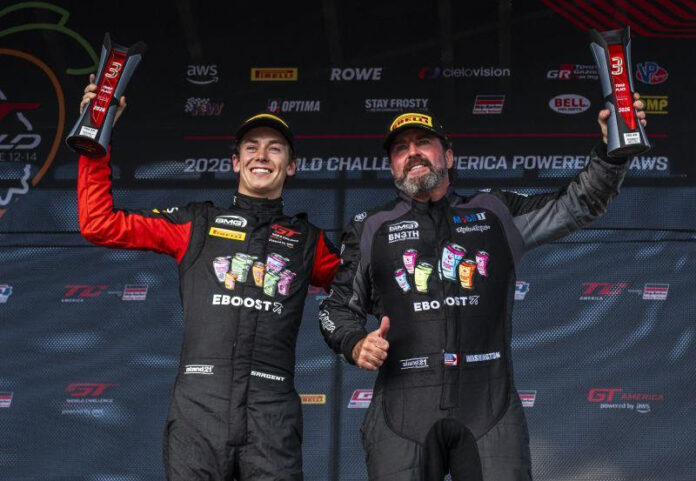
GMG Racing Fastest Again but Settles for Fourth Place at GT World Challenge America in Texas

  • Kyle Washington and Tom Sargent On Pace All Weekend in GT World Challenge America Pro-Am in the No. 32 GMG Racing Porsche 911 GT3 R Evo but Early Safety Car Issue Thwarts Bid for Second-Straight Series Win
  • Washington Scores Second GT America P2 Finish of the Season Sunday to Stay in Early-Season Title Contention in the Sister No. 32 GMG Racing Porsche 911 GT3 R Evo

AUSTIN, Texas (April 27, 2026) – GMG Racing and team drivers Kyle Washington and Tom Sargent were once again the pacesetters in the No. 32 GMG Racing Porsche 911 GT3 R Evo in Sunday’s three-hour SRO GT World Challenge America powered by AWS race at Circuit of The Americas (COTA) but settled for a fourth-place Pro-Am finish after being caught out in an early safety car period. The race was immediately slowed by back-to-back full-course cautions, the second of which saw the teams that went on to fill the Pro-Am podium a little under three hours later all manage to pit before the safety car took to the track.

Starting driver Washington was one of several competitors across all three competing GT World Challenge classes that missed out on a chance to pit with the early leaders. Remarkably, the remaining two hours and 40 minutes of the race were clean and green all the way, and Washington and Sargent came up just short in making up the nearly one minute gap to the leaders.

“It is definitely what everybody calls ‘one of those racing things,’ but no one expected the last two hours plus of the race to go entirely green,” said GMG Racing Founder and Principal James Sofronas. “We tried to get in the pits with the others during that caution but paid the price the entire race. Still, Kyle never quit pushing and Tom showed again he is the fastest guy in the series and why he has already won four races this year in Porsches around the world. Fourth is still good points, and the championship battle is all on now, but this was a tough one to take. We will shift the focus to Sebring two weeks from now and get back on the top step of the podium.”

Sargent set the fastest race lap of 2:04.138 in his flat-out an attempt to close the gap.

“When you’re doing a championship, winning is amazing but every race is just maximizing, even maximizing your bad days,” Sargent said. “For us, it shouldn’t have been a bad day, but because of the timing of the safety car, it ended up being a bad day. So, we made the most of it and got back to P4. I don’t know how many seconds we regained, 40 or 50 seconds in a pretty short period of time, really quick. The guys did a good job on the strategy, we did the best we could, but it just wasn’t our day today. I expected a few more safety cars, considering how hot and greasy it was, but that’s just the way it is.”

Meanwhile, Washington has moved into the championship conversation in not only GT World Challenge but the GT America powered by AWS sprint race series as well for the second straight year. Washington finished second in Sunday’s final 40-minute GT America sprint of the weekend for his second GT America race runner-up showing of the short season to date. Memo Gidley has opened up a large gap on the field with an undefeated four race win streak, but GMG Racing and Washington are in the best position to pounce if the former series champion falters.

Washington returns to Rounds 5 and 6 of the GT America championship at Sebring in two weeks, a track on which he scored a GT America race victory last year.

Up next for SRO America is indeed the full weekend of competition at Sebring International Raceway, May 8 – 10, where both GT America and the third GT World Challenge America three-hour race of the weekend highlight the full weekend schedule.

About GMG Racing: Founded in 2001, GMG Racing quickly established itself as North America’s premier performance tuning facility. What began as a small 1,200 sq. ft. shop, maintaining two race cars, has grown into a state-of-the-art performance tuning, racing and service facility relocated last year to The Thermal Club and a 28,000 sq. ft. trackside motorsports facility. The staff, attention to detail and passion are what make GMG the choice of professionals and enthusiasts worldwide. GMG, in its early years, was located directly across the street from Porsche Motorsport North America (PMNA). This close proximity allowed GMG to build a strong relationship with the legendary racing brand which has helped the company support its customers to the highest level possible. We have since won several Championships, not only with Porsche, but with Audi, Lamborghini, Aston Martin and McLaren. From club racing to Sebring, Daytona, Spa, Montreal, COTA and The Thermal Club, GMG can take you as far as you want to go. More information can be found at www.gmgracing.com.

The Fast Lane of Liquidity: Why ‘Time to Sell’ is the Most Critical Metric in the 2026 Auto Market

In the high-octane world of professional motorsports, championships are rarely won solely by the raw, unbridled top speed of the machine; they are frequently decided by the meticulous choreography of the pit stop. A fraction of a second lost while changing tires or refueling can erase laps of hard-fought, on-track gains. Today, as we navigate the uniquely volatile and rapidly shifting economic currents of 2026, the automotive resale market has adopted this exact principle. For the modern vehicle owner, the traditional metrics of horsepower, torque, and lateral grip have been temporarily eclipsed by a new, far more crucial performance indicator: exit velocity. The speed at which you can liquidate a depreciating asset and free up tied capital is no longer just a matter of Sunday convenience – it has become a foundational pillar of smart, modern personal finance.

The Shift to the Digital Sprint

The transition from agonizing “analog” sales methods – plagued by unreliable tire-kickers, endless digital classified ads, and frustratingly unanswered phone calls – to a modern “digital sprint” has fundamentally altered how enthusiasts manage their automotive portfolios. Rather than enduring a protracted, weeks-long ordeal, savvy sellers are now exclusively turning to professional car buyers who provide a market-ready offer and a seamless transition of ownership. When you need a professional tool for quick deal closures, the most efficient route is to bypass the retail friction entirely. By utilizing TopCashForCars.ca, owners can tap into a premier service that buys these cars for cash on the spot, ensuring that capital is liberated instantly and without the bureaucratic delays that have historically plagued the used car market.

The Hidden Cost of Stagnation

To truly understand why this rapid liquidity is so vital, one must examine the hidden calculus of a stagnant asset. A vehicle sitting idle in a driveway, waiting for the elusive “perfect” private buyer, is not in a state of financial suspension; it is actively bleeding capital. Every passing week extracts a silent, compounding toll on your wallet. First, there are the unavoidable fixed carrying costs: the insurance premiums that must be maintained, the ongoing registration fees, and the physical degradation that inevitably comes with disuse.

More insidious, however, is the relentless curve of market depreciation. In 2026, where automotive technology iterations occur at an unprecedented clip – with new EV architectures and hybrid powertrains dominating the headlines – and market sentiments shift on a dime, the value of a used vehicle can drop substantially within a single financial quarter. We are no longer in the post-pandemic anomaly of appreciating used cars. Today, the longer the asset remains unsold, the more aggressively it cannibalizes the owner’s net return.

Dead Capital and Opportunity Cost

Beyond the quantifiable drain of depreciation lies an even larger economic specter: the opportunity cost. In the financial world, capital trapped in a parked, depreciating asset is colloquially known as “dead capital.” For the automotive enthusiast, this is particularly painful. That locked equity represents the necessary down payment on a highly anticipated 2027 model, the modification budget for a weekend track weapon, or simply liquid cash that could be yielding significant returns in a high-interest savings account or a diversified stock portfolio. The true, holistic cost of a slow sale is measured not just in dollars lost to depreciation, but in the experiences, upgrades, and investments deferred because the necessary capital was held hostage to an inefficient, outdated market mechanism.

Time is Premium Currency in the GTA

Nowhere is this friction felt more acutely than in hyper-dense economic hubs where time is the ultimate premium currency. Consider the unique ecosystem of the Greater Toronto Area (GTA). In a sprawling metropolis characterized by relentless motion, heavy traffic congestion, and highly demanding professional schedules, time is arguably the most expensive resource at a resident’s disposal. The traditional private sale demands that an owner sacrifice their precious weekends orchestrating viewings in Mississauga, coordinating nerve-wracking test drives in Etobicoke, or negotiating with uncommitted, low-balling prospects across town. It is an exhausting, soul-draining process that inherently treats the seller’s time as worthless.

In stark contrast to this antiquated model, the modern direct-buyout framework operates on a radically different, highly efficient philosophy: “one meeting, one deal.” This streamlined approach recognizes that for busy professionals and enthusiasts in the GTA, avoiding a month of logistical headaches, traffic jams, and no-shows is a massive financial and emotional victory. The digital sprint reclaims your weekend and respects your time as the premium asset it is.

The Transactional Sprint

This paradigm shift has given rise to the concept of the “transactional sprint.” Much like a highly tuned racing team stripping a chassis of unnecessary weight to improve their lap times, modern car owners are ruthlessly eliminating the friction from their transaction processes. The goal is no longer to squeeze every hypothetical last dollar out of an exhaustive private sale—a victory that is almost always Pyrrhic once carrying costs and the hourly value of one’s own time are factored into the equation. Instead, the primary objective is to maximize the net return by minimizing the time-to-sale. By engaging with specialized liquidity providers, owners can essentially hit a financial reset button, instantaneously converting steel, rubber, and glass back into liquid, highly deployable capital.

For the true automotive enthusiast, this unprecedented speed of transaction is nothing short of transformative. It changes the very nature of car ownership from a long-term, potentially burdensome commitment into a fluid, dynamic, and highly enjoyable hobby. When you know, with absolute certainty, that you can reliably achieve exit velocity at a moment’s notice, the lingering anxiety of buying into a niche platform or experimenting with a radically new driving experience completely vanishes. The automotive market becomes a playground rather than a financial trap. You buy the car, you enjoy the drive to its fullest, and when the horizon calls with a new project or a shifting life priority, you execute a flawless pit stop. You hand over the keys, take the cash, and accelerate effortlessly into your next venture without missing a single beat.

Conclusion: Momentum is Everything

Ultimately, as we observe the matured economic landscape of 2026, the traditional adages of the automotive market have been fundamentally rewritten. “Buy low, sell high” remains a valid theoretical concept, but it has been permanently appended with an undeniable, real-world caveat: “and sell fast.” In the fast lane of modern liquidity, momentum is everything. Those who recognize the hidden costs of stagnation and embrace the digital sprint will find themselves consistently ahead of the curve, their capital always working efficiently, and their garages always ready for the next great drive.

Ensuring Justice Prevails: Unveiling the Role of a Car Accident Attorney

Car accidents can suddenly turn the normal course of a person’s life upside down. The aftermath may involve physical injuries, psychological trauma, and economic hardships for the injured party and their family. Recognizing one’s legal rights is a fundamental aspect of the healing process after an auto accident. Many people do not realize that having a lawyer can change the outcome of their case, especially when there is a disagreement over who is at fault and how much damage has been done.

When facing serious consequences after a crash, seeking guidance from a skilled car accident death lawyer in Decatur can help clarify the legal process and protect your interests. Early legal involvement often ensures that evidence is preserved and that communication with insurance companies is handled with care. This approach reduces the chances of missteps that could affect compensation.

Investigating Accident Circumstances Thoroughly

One of the main roles of an auto accident lawyer is to do a thorough investigation. This means reviewing police records, reviewing health reports, gathering witness accounts, and sometimes even working with experts who conduct accident simulations. Every bit of the material helps put together the chain of events and identify the responsible party.

Besides that, lawyers evaluate factors such as the condition of the road, the vehicle’s upkeep, and the driver’s behavior. These are the factors that can influence the attribution of fault. When a case is well supported by facts, it gives a much better position in settlement talks or in court, as it leaves no stone unturned regarding the incident.

Navigating Insurance Claims And Negotiations

It can be quite a struggle to handle insurance companies, especially when they try to get away with the minimum payouts. A car accident lawyer is the one who stands in for you in such talks, making sure that the claims are put forward in a truthful and fair manner. They are familiar with the strategies that insurers employ and thus can be a step ahead in safeguarding the client’s rights.

Attorneys also determine the total amount of losses, including hospital bills, lost wages, and ongoing treatment costs. In this way, they ensure that the award covers the real consequences of the injury. Being so well-prepared often results in settlements being reached on favorable terms and quickly, without going through the whole litigation process.

Supporting Families In Fatal Accident Cases

When a person’s death is involved, the legal procedure gets very intricate and emotionally challenging. The bereaved families usually file a lawsuit for wrongful death to hold the responsible party and get monetary support for their loss. A lawyer is there to assist family members throughout the process, inform them of their rights, and handle the legal formalities.

These types of litigation require clear evidence of monetary and psychological damages. The lawyers try to convey the impact of the loss on the family to gain their attention and have their voices acknowledged during the proceedings. The help provided can be very essential while the family members are trying to manage grief.

Since every car accident circumstance is different, a personalized legal approach is essential. Lawyers examine the specifics of the case to determine the best course of action. Be it settlement negotiations or trial preparation, the ultimate aim remains to secure a reasonable outcome based on the facts of the case.

Legal professionals continue to update clients on progress and potential outcomes, so they can make decisions with peace of mind. Such openness builds confidence between the two parties and, at the same time, keeps people engaged in their cases.

In moments when justice feels uncertain, having reliable legal support can make a meaningful difference. Working with a firm like Wrongful Death Krause Law Firm allows individuals and families to pursue accountability while focusing on rebuilding their lives after an accident.