
U.S Army will end sponsorship with Stewart-Hass Racing
[media-credit id=43 align=”alignright” width=”300″] [/media-credit]The U.S Army will not continue its sponsorship with Stewart-Haas Racing (SHR) in the No.39 car driven by Ryan Newman in 2013, ending a 10 year relationship.
“The U.S. Army has been a great partner of Stewart-Haas Racing since the team’s inception.” said Brett Frood, executive vice president of SHR.
According to Stewart-Hass racing on Tuesday, the decision was made because of “a reallocation of [the Army’s] marketing budget that will not include a presence in NASCAR.”
Earlier this year, the House Appropriations Committee adopted an amendment that would prohibit the military from sponsorship of sports events, a sum estimated at more than $135 million per year, with the majority going to NASCAR-related sponsorships.
“The U.S. Army has worked with Stewart-Haas Racing in a mutually beneficial and highly successful relationship for the past four seasons.” said John Myers, Army marketing director. “And they’ve performed superbly as our partner on and off the track. The same can be said of other members of the NASCAR Sprint Cup Series family we have sponsored during the past 10 seasons.”
At one point the U.S Air Force, National Guard, Navy and Coast Guard all had full season sponsorship’s with a NASCAR team.
SHR officials say they are now “actively pursuing” another brand for sponsorship.
“We remain very proud of our representation of the U.S. Army and its brave soldiers who are 100 percent committed to our country. We will continue to activate on behalf of the U.S. Army for the rest of 2012, while also growing our other dynamic partnerships at Stewart-Haas Racing for the future.” said John Myers, Director, Marketing Support Element, Army Marketing and Research Group.


Coke Zero 400 Review: Daytona Knows Drama
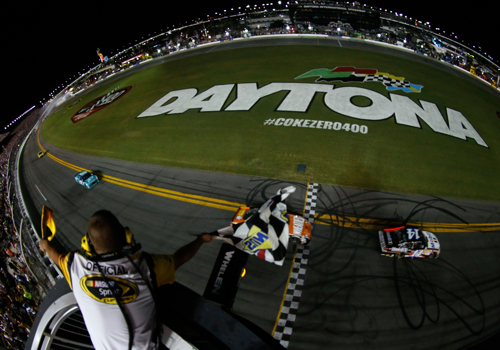
NASCAR announced 90 minutes before the start of the Coke Zero 400 on Saturday that driver AJ Allmendinger would be temporarily suspended from competition after failing a drug test taken at Kentucky Speedway last weekend. The Penske Racing organization scrambled to find a replacement driver; the team flew in Penske’s Nationwide driver Sam Hornish Jr. from Charlotte, NC to Florida to fill the ride. Hornish arrived with police escort in Daytona just in time for pre-race ceremonies to begin.
“You know it’s a disappointment at this particular time, but we’re going to wait and see what the second test results are before we make any comment or decisions. I don’t think it’s fair to him,” team owner Roger Penske said Sunday before the IndyCar race in Toronto. Penske was vacationing in Europe and was traveling to Toronto when the news was released.
[media-credit name=”Credit: Chris Graythen/Getty Images” align=”alignright” width=”311″]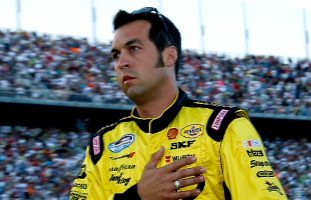 [/media-credit]The fate of Allmendinger rests with the results from his “B” drug test sample. He has 72 hours from the time he was notified of testing positive on Saturday to request his “B” sample be tested. If the sample comes back positive, Allmendinger will be subject to being suspended from NASCAR indefinitely.
Allmendinger’s will remain suspended for the upcoming Cup race at New Hampshire and Hornish will continue to pilot the No. 22 Pennzoil Dodge until the results of the “B” sample are released.
Penske Racing hired the former Red Bull driver in late December after the team parted ways with Kurt Busch at the end of the 2011 season. Allmendinger was 23rd in the Sprint Cup Series standings heading into Daytona, where he won the Rolex 24 Hours of Daytona sports car race in January.
Allmendinger is the most well-known driver suspended from NASCAR for a failed drug test since Jeremy Mayfield in 2009. Mayfield has fought NASCAR over the test for many years and has not raced a NASCAR event since. If Allmendinger’s “B” test does come back positive, he may have the opportunity to go through NASCAR’s drug rehabilitation program and return to competition in the future.
Roush Duo Comes Up Short
Matt Kenseth won the pole for the Coke Zero 400 and with the help of Roush Fenway Racing teammate, Greg Biffle, led the first 41 laps of the race. The No. 17 was trying to accomplish something that no driver has done since 1982 – win both Sprint Cup races at Daytona in the same year.
The duo was a force to be reckoned with all throughout the race, despite Biffle being penalized and sent to the rear of the field for making a pit stop while pit road was closed under caution. The RFR teammates were able to reconnect and rebound to take over the lead once again.
With half a lap remaining in the Coke Zero 400, Kenseth remained in the lead with Biffle following closely. The No. 17 Ford was passed by Tony Stewart after Kenseth slowed down to reconnect with his teammate on the back straightaway. The No. 16 was involved in a multi-car wreck that unfolded coming to the checkered flag, resulting in a disappointing 21st place finish for Biffle. Kenseth finished in third position, with Jeff Burton passing him for second on the final lap.
“I guess you need to be happy when you finish that good, but also when you have restrictor plate cars that fast, that doesn’t happen very often and sure want to figure out how to win with so the last two I feel like you always second-guess your moves, but I feel like we had one of the fastest cars all three races this year really”, Kenseth said in the media center after the race.
“Happy to get third but on the other hand, I am incredibly disappointed. My team kind of deserved to be down there holding the hardware and I kind of let them down. But overall, we had a really fast car, we had a pretty good race, made our way back to the front after the pit road thing and were in contention, just didn’t get it done that last lap.”
Kenseth remains the point’s leader with 25 points over Dale Earnhardt Jr., who finished 15th after being involved in the crash on the final lap. Biffle was able to gain one position in standings, moving him to third position.
Point’s Battle Heats Up
[media-credit name=”Credit: Tom Pennington/Getty Images” align=”alignleft” width=”285″] [/media-credit]Tony Stewart scored his 18th overall victory at DIS, second-most all-time to Dale Earnhardt. This is the No. 14 team’s third win of the season and has propelled him in Cup standings. The Stewart Haas driver and team owner gained four position’s in points with his win Saturday night and is now in 5th position, 84 points out of the lead. The three-time series champion looks to be on another championship run heading into New Hampshire, a track where he has three previous wins.
Clint Bowyer has fallen three positions to 10th place in standings after a 29th place finish in the Coke Zero 400. After riding in the back of the pack for most of the night, Bowyer looked to be heading to the front in the final laps of the race. His potentially good night came to a halt with eight laps to go after being involved in a multi-car accident, ending his night. The No. 15 5-Hour Energy Toyota is now 104 points behind the leader, just three points behind 9th place of Brad Keselowski.
The Michael Waltrip racing team has high hopes heading to Loudon, where Bowyer has won twice; including his first Cup series victory in 2007, where he started on the pole and led 222 of 300 laps.
The Wild Card battle – the two positions in the Chase given to the two drivers with the most victories ranked 11th to 20th in points – is heating up between some of the sport’s most popular contenders. The battle is as close as it’s ever been after top-five runs by Joey Logano and Ryan Newman at Daytona. A seventh-place finish for Kasey Kahne has increased the intensity of the wild-card hunt; with only eight races remaining until the Chase, anything can happen!
NOTES FROM THE NASCAR NATION: SADLY, IT’S AGAIN TIME TO PRAISE NASCAR FOR THEIR SUBSTANCE ABUSE POLICY

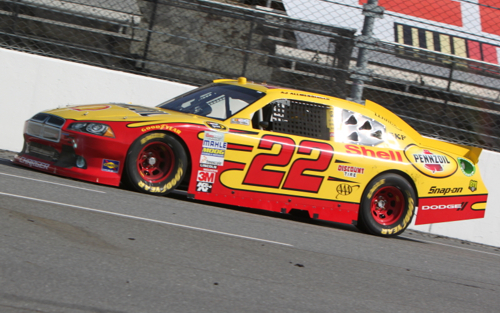 Last Saturday’s announcement that said NASCAR Sprint Cup Series driver A J Allmendinger has been “temporarily suspended” by officials for a violation of their substance abuse policy was, in a word, stunning. This announcement was one of those rare times when NASCAR officials, competitors, the media and the fans were all rendered speechless at the same time.
Allmendinger began this racing season by landing one of the most prestigious rides in Sprint Cup Racing: the #22 Roger Penske Racing Shell Penzoil Dodge. The arrangement was on a one year, let’s wait and see what happens, basis. Allmendinger openly referred to the ride as the opportunity of a life time and even said it was his “best last chance to make it in NASCAR racing.” It just didn’t seem possible that this opportunity would be upset by the element of substance abuse. It’s still hard to imagine that this happened.
However, despite the sad circumstances, it’s still prudent to once again praise NASCAR officials for creating and enforcing one of the most strict substance policies in organized professional sports. The potential for collateral damage, that comes with an impaired driver behind the wheel of a high performance race car, is simply too great.
During the 2007 racing season it became apparent that the element of substance abuse had made its way to NASCAR racing. That was the year when a young driver’s heroin use created a downward spiral in his quality of life. The driver eventually admitted that he was using the drug prior to the start of races. That’s when NASCAR decided it was time to spring into action and take this situation to task before it spread any further. They had the full endorsement of the drivers, from all three of NASCAR’s touring series, who made it clear they absolutely didn’t want to share the race track with an impaired colleague.
By the beginning of the 2008 season, the toughest substance abuse policy in professional sports was now in place. During each NASCAR racing weekend officials makes a random selection of 15 team members and orders them to submit a urine sample to its Medical Review Officer. These samples are equally divided into two containers and labeled “sample A” and “sample B.” Sample A is immediately tested first. It generally takes three to five days before the final test results are in. If sample A results indicates a violation of the substance abuse policy, the team member is automatically placed on temporary suspension.
Sample B is part of NASCAR’s check and balance system for their substance abuse policy. It’s a second test that could either confirm or possibly even refute the results of the first test. During the next phase of the policy, the NASCAR team member has a period of 72 hours to officially request the testing of sample B. If NASCAR does not receive a request for a sample B test within the time allotment, or if the test is conducted and also produces a positive result, then the team member is automatically place on indefinite suspension.
Once the suspension become indefinite, then it’s a long and arduous road the team member has to travel before a return to NASCAR will be granted. However, the substance abuse policy does have a benevolent clause that is often referred to as “the road to recovery.” If the team member is willing to successfully complete an approved rehabilitation program then his reinstatement to NASCAR racing is possible.
According to reports, A J Allmendinger was randomly selected for drug testing during the NASCAR weekend at the Kentucky Speedway held June 28th through the 30th. Other reports state that NASCAR was informed that Allmendinger’s sample A test was positive on Saturday approximately four hours prior to the start of the Daytona race. It’s presumed that a meeting was called followed by the preparation of an official statement and then Penske Racing was informed their driver was now on temporary suspension.
That official statement was read to the media by Steve O’Donnell, NASCAR Senior Vice President of Racing Operations, who said: “driver A J Allmendinger has been temporarily suspended from NASCAR competition based upon notification of a positive “A” test NASCAR received from the Medical Review Officer as stated in section 19-11B (6,7) of the NASCAR Substance Abuse Policy. Pursuant to the rule book, Allmendinger has the opportunity to request within the next 72 hours that his “B” sample be tested. NASCAR will follow its policies and procedures set forth in the rule book in dealing with this matter.”
In a very appropriate gesture, O’Donnell made it very clear that NASCAR would not be making any further public statements at this time and would not be taking any questions from the media regarding this matter.
Not long after NASCAR’s stunning announcement, a prepared statement from Penske Racing was issued that said: “NASCAR notified Penske Racing this afternoon that A J Allmendinger was administered a drug test earlier this week, and those results tested positive. NASCAR has a strict drug testing program that Penske Racing fully supports. Penske Racing will work with NASCAR through this process and its next steps. Sam Hornish Jr will drive the #22 car in Saturday’s Coke Zero 400.”
Placing Sam Hornish Jr in the Penske #22 Dodge for the Daytona race was a logical choice. He has been driving for Roger Penske for many years now both in the Indy Racing League and NASCAR. He has multiple Sprint Cup starts for the team at Daytona and this year has been driving the Penske Dodge in the NASCAR Nationwide Series. However, there was one little problem regarding Hornish driving in this Sprint Cup race: he wasn’t exactly at Daytona when all of these developments occurred.
After driving his Penske Dodge to a very respectable tenth place finish in Friday night’s Daytona Nationwide Series race, Hornish flew home to North Carolina. He later said he spent some quality time at a lake with his family on Saturday morning and then reported for duty at his second job Saturday afternoon. That would be his co hosting job on “The Speed Report”, the very popular live racing program aired each weekend on the SPEED Channel. It was later reported that Hornish was actually on the set, during a live segment, when the frantic call from Penske Racing arrived.
Roger Penske wasn’t exactly in Daytona when all of this happened either. He had elected to spend the weekend with his Indy Racing League teams in Toronto-Canada. He very calmly began handling any and all details of a tough situation over his cell phone. There’s a reason why they call him “The Captain.”
It was reported that when Penske Racing received the news regarding Allmendinger’s suspension, they had a limited amount of time to handle the replacement driver situation before the race started. The Penske Racing organization deserves a standing ovation for handling the sequence of events that soon followed. First, Hornish was told to run home, pack his racing uniform and shoes and proceed to the Concord-North Carolina airport. A private jet, owned by Penske that was used to fly the race teams to Daytona, was immediately dispatched to North Carolina to pick up Hornish.
Next the team was given orders to start prepping the car for Hornish. That process included switching the driver’s seat to one more suitable for Hornish’s height and frame. The process also included adjusting the height of the transmission shifter, steering column, the seat belts and even the height of the pedals on the floorboard.
With a genuine concern that Hornish might not make it to Daytona in time, Penske arranged for Nationwide Series driver, and ironically also a SPEED Channel television personality, to be their back up driver for the back up driver. This was ironic because Wallace had already been named as the back up driver for Kevin Harvick in case he had to fly home to North Carolina to witness the birth of his first child. It turned out that his wife delivered a very healthy baby son the following day. Wallace was observed standing in front of the Penske Racing garage stall wearing Kevin Havick’s fire suit while holding A J Allmendinger’s helmet. He was also overheard to say “all this is uncomfortable for everybody.”
Meanwhile Hornish, dressed for racing, arrived at Daytona and, with the help of a pre arranged police escort, made a high speed run to the race track. He got there just in time to climb inside of the Penske Dodge and receive the command to start his engine. Due to the driver change Hornish had to start at the rear of the field but made quick work of developing race rhythm and advancing his position. Unfortunately a blown tire, on lap 82, found him spinning onto the backstretch which led to a 33d place finish.
To no real surprise, the media covering the Indy Racing League event in Toronto was more than interested in the Allmendinger story and went looking for Roger Penske. In a comment made to “USA Today”, he said: “you know it’s a disappointment at this particular time, but we’re going to wait and see what the second test results are before we make any comments or decisions. I don’t it’s fair to him. I think as you look at sports, things happen like this. It’s unfortunate, but I really don’t want to make a statement pro or con right now. I’m counting on another test, (the “B” sample test), being proper for him within 72 hours, and at that point we’ll make a decision.”
Needless to say, at this point there are more questions than answers to this sad story and it’s virtually guaranteed this will be the top racing story in the days ahead while we all wait for the results of the second test.
Still, it’s important that we continue to praise NASCAR for recognizing this problem area over five years ago and creating a substance abuse policy and procedure that should be emulated by other professional sports all over the world.
