

NOTES FROM THE NASCAR NATION: CRUNCHING THE IRISH HILLS NUMBERS
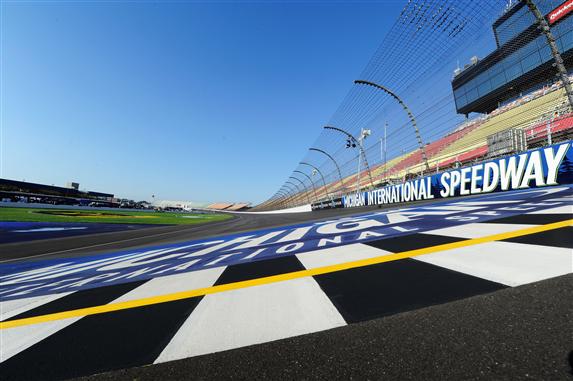
[media-credit name=”John Harrelson/Getty Images for NASCAR” align=”alignright” width=”300″] [/media-credit]The NASCAR Sprint Cup Series will be at the beautiful Irish Hills of Michigan for Sunday’s running of the Quicken Loans 400. There are two elements, one brand new and one that’s traditional, that’s involved here which will make this race very interesting.
The brand new element is the brand new pavement on the Michigan International Raceway. It took 22,000 tons of asphalt to repave the speedway’s two mile oval. No one was exactly sure what to expect from the new surface and that’s why NASCAR set up a test session on Thursday. The result of that test was speed, and plenty of it. Seven teams turned laps in excess of 200 MPH. That suggests that the new surface is cured and race ready. A two day Goodyear Tire test, held back on April 3d and 4th, saw speeds hit as high as 210 MPH. With rubber being laid on the track, from the ARCA and NASCAR Nationwide Series events, this weekend it’s likely the speeds will be a little slower on Sunday but the Quicken Loans 400 is still going to be a very fast race.
The more traditional element to a Michigan race is the all important bragging rights that comes with winning there. America’s big three automakers are located just down the freeway and their representatives will be in full force cheering for their teams. The Michigan International Raceway has often been referred to Ford country. That’s because two of NASCAR’s most iconic Ford teams, the Wood Brothers and Roush Fenway Racing, have 11 wins each there. However, let’s not rule out the possibility that a Toyota team may be planning to upstage a Detroit based victory party.
THE LAS VEGAS BREAKDOWN
To determine which driver is going to be the first to see checkers at Michigan, we once again turn to those number crunching professionals at the Las Vegas based World Sports Exchange, (WSE).
The WSE, once again, has five time champion Jimmie Johnson on top of their rankings, at 7 to 1 odds, despite the fact that he’s still seeking his first win at Michigan, only has three top five finishes along with an average finish ratio, (AFR), of 15.1. However, Michigan is part of NASCAR’s list of intermediate tracks. That’s an area where Johnson shines. He has 40 wins on this style of track. Also bear in mind that this driver and team has been red hot over the past month.
At 8 to 1 odds is Matt Kenseth, the series championship points leader, who is part of that powerful Roush Fenway Ford brigade. He’s also a driver with some very impressive Michigan numbers that includes two wins, 11 top fives, 16 top tens and a very good 9.5 AFR. This is a rock solid wager.
At 9 to 1 you will find the duo of Kyle Busch and Carl Edwards. After engine woes foiled his efforts during the last two races, Busch now finds himself 12th in the standings and 103 points out of first. He collected his first win at Michigan last August and, along the way, has collected three top fives, five top tens but has a 15.5 AFR. If everything is fine under the hood of his car, he could turn out to be one of the Toyota drivers who upstages a potential Detroit victory party.
Carl Edwards’ 2012 season has been an up and down affair so far that finds him 11th in the standings, 100 points away. However, this is another Roush Fenway Ford driver who also has outstanding numbers at Michigan that includes two wins, nine top fives, 12 top tens and a series leading 8.2 AFR. This could be the break out race for Edwards.
The WSE has the pair of Jeff Gordon and Tony Stewart ranked at 10 to 1 to win Michigan. Gordon’s frequent run of bad luck this year has him 22nd in the standings and a whopping 187 points out of first. His only hope for making the Chase is to earn a wild card berth and that’s going to require at least two wins between now and late September. However, Michigan is a great place for Gordon to launch a comeback. He has two wins there along with 18 top fives, 24 top tens and a healthy 11.4 AFR.
Tony Stewart, 8th in the points at minus 75, is a previous Michigan winner who has 10 top fives, 18 top tens and a healthy 11.5 AFR. It’s summer time and we need to bear in mind that Stewart has a tendency to get hotter than the temperature this time of the year.
Turning now to the middle tier of the WSE Michigan ratings, Greg Biffle, the third of the Roush Fenway Ford drivers, is ranked at 11 to 1. After leading the points standings the majority of the season, Biffle suffered a setback at Pocono last week and fell to third, 16 points away from the top. He’s a solid wager to win Michigan based on his numbers there which includes two wins, seven top fives, ten top tens and a healthy 12.8 AFR.
At 12 to 1 odds you will find a quartet of Michigan hopefuls featuring Kasey Kahne, Brad Keselowski, Kevin Harvick and Denny Hamlin. Kahne, like his Hendrick Motorsports team mate Jeff Gordon, may have to rely on a wild card berth to make the Chase. He’s currently 16th in the standings and 143 away. He already has one, of the two wins, he’ll need for a wild card berth and he could pick up another win this Sunday at Michigan. He’s a former winner there with six top fives, seven top tens and a 15.4 AFR.
Brad Keselowski, now 10th in the standings 97 points away, once again has virtually no numbers at Michigan other than a single top five and top ten finish and a 22.6 AFR. However, we’ve seen these numbers at different tracks all season long and he’s already won two races this year. He’s actually a very good long shot wager.
Kevin Harvick, 6th in the standings and 53 away, is a previous Michigan winner with 3 top fives, seven top tens and a 15.0 AFR. Here’s another driver that should not be completely looked over this Sunday.
Denny Hamlin, 4th and 19 points from the top, appears to be an outstanding long shot wager at 12 to 1. He’s a two time winner at Michigan, the defending race champion, he has five top fives and 7 top tens along with a healthy 12.1 AFR.
Here’s another long shot possibility worthy of consideration: Dale Earnhardt Jr at 14 to 1 odds. You’re going to hear a lot, this weekend, about how this driver’s win less streak is now at 143 races and his last win was at Michigan four years ago. However, you can’t overlook the fact that his team is having a very good 2012 so far. He’s second in the standings, only ten points from the top, and he’s collected a series high 11 top ten finishes this year. You have to consider the possibility that this could be the weekend the Junior Nation has been waiting for.
Looking at the WSE lower tier for the Michigan race, Mark Martin, at 24 to 1, literally leaps off of the page. He’s a five time winner at Michigan with 18 top fives, 31 top tens and a 13.3 AFR. Critics will automatically point out that these stats were created with a different team many years ago and that’s true. However, Martin’s performance, in his Michael Waltrip Racing Toyota, last weekend at Pocono was strong and he came very close to winning the race. There’s also the fact that he led one of last Thursday’s Michigan test sessions after topping the speed chart at 201 plus MPH. Those two factors says put him on your long shot list.
At 30 to 1 is a trio of drivers led by two time race winner Ryan Newman along with Martin Truex Jr and Clint Bowyer. They’re followed by last week’s Pocono winner Joey Logano at 40 to 1. The trio of Kurt Busch, Marcos Ambrose and Jeff Burton closes the WSE list at 50 to 1 odds. If you do not see the name of your favorite driver listed, that means they are automatically rated at 15 to 1.
Now for the disclaimer: NASCAR wants us to remind you that these numbers should be viewed for informational and entertainment purposes. They neither encourage nor condone the placing of wagers on their events.
THE RACE BREAKDOWN
The Quicken Loans 400 is 200 laps/400 miles around the Michigan International Raceway’s two mile, D shaped, oval.
The race has 45 entries vying for the 43 starting positions.
Ten of those entries are on the go or go home list meaning they do not have a guaranteed starting berth because they are currently outside of the top 35 in NASCAR’s owner’s points. These teams will have to rely on qualifying speed to make the race.
The Michigan International Raceway has 18 degrees of banking in the turns. The front stretch, measuring 3,600 feet, has 12 degrees of banking while the backstretch, 2,242 feet, is banked five degrees. The track is 73 feet wide.
The pit road is 50 feet wide. Pit road speed is 45 MPH.
The track was opened in 1968 and currently has seating for 84,000 fans.
The track qualifying record, 194.232 MPH, was set by Ryan Newman in June of 2005. Based on results from Thursday’s test, expect to see that record shattered.
The First NASCAR Sprint Cup race was held in June of 1969 and was won by Cale Yarborough. 85 Cup races has been held there since that first one that has sent 34 different winners to victory lane. David Pearson leads the win list with nine.
16 races at Michigan have been won from the pole position. 46 have been won from the top four positions while 66 have been won from the top ten. Only six races have been won from starting positions outside of the top 20.
The weather calls for sunny skies on Saturday with highs in the upper 80’s. However a storm front could land in the area on race day Sunday. The forecast calls for partly cloudy conditions with a 40% chance of thunderstorms through Sunday night with a 30% chance of rain on Monday. If needed, the speedway has fleet of eight jet dryers with the drying time estimated to be approximately two hours.
The Quicken Loans 400 will be broadcast live by the TNT Network beginning at 12 pm eastern time. The race re broadcast will be aired on Wednesday, 12 pm eastern, on SPEED.