Mason Massey (No. 19 Brunt Chevrolet) scored an improbable victory in Saturday’s ARCA Menards Series West Portland 112 at Portland International Raceway. Massey took the white flag in fourth position but moved to second when the top two, leader Sam Corry (No. 25 Valvetronic Designs Toyota) and Ethan Tovo (No. 70 Nitro Motorsports Toyota) made contact into turn five and momentarily slipped off the track into the grass, and then he slipped past then-leader Kyle Steckly (No. 53 Auto Parts Centres Chevrolet) in the final corner when Steckly dipped his left side tires off into the grass.
It was Massey’s second ARCA Menards West victory of the season, along with his win in the season opener at Kevin Harvick’s Kern Raceway, and the 102nd all-time for Bill McAnally Racing.
Steckly, in his ARCA Menards West debut, held on to finish second just 0.423 seconds behind Massey.
Hailie Deegan (No. 16 Columbia Bank Chevrolet) took advantage of a chaotic final three laps to notch her first top-five finish of the season and first since she finished fourth in the 2019 season finale at Phoenix Raceway.
Tovo scored the Sioux Chief PowerPEX Pole Award with a lap of 75.974 seconds / 93.206 miles per hour but took the green flag from the tail of the field for an unapproved adjustment in impound after qualifying. He made quick work of the field and was in the top ten inside of the first dozen laps. Despite the late-race contact, he finished in fourth.
Eric Johnson, Jr. (No. 5 Pacific Office Automation / Sherwin-Williams Toyota) finished fifth, his third top-five finish of the season and second consecutive top-five on a road course; he finished third at Sonoma Raceway in June.
Jeff Anton (No. 44 Deerpark Recycling / Squid Decals Chevrolet) finished sixth, which combined with an eighth-place finish at Sonoma and a tenth-place finish in the ARCA Menards Series race at Lime Rock Park give him three consecutive ARCA Menards Series platform road course top-ten finishes.
Robbie Kennealy (No. 1 Jan’s Towing Ford) recovered from a turn one, lap one spin and being a lap down to finish seventh. His teammate Cole Denton (No. 71 Jan’s Towing Ford) was involved in a late-race incident and dropped from the top five to 16th at the finish.
Trevor Huddleston (No. 50 High Point Racing / Racecar Factory Ford) finished 13th, his first finish outside of the top ten in 2026.
Kyle Keller (No. 4 Battle Born / Keller Racing Engines Toyota) had just passed for second position when mechanical issues struck, leaving him 23rd at the finish.
Corry dropped to 15th at the finish when he was forced off the track in the final corner of the final lap.
Four different drivers – Massey, Steckly, Tovo, and Corry – held the lead at one point on the final lap.
Sixteen drivers finished on the lead lap, including Bobby Hillis, Jr. (No. 27 First Impression Press Chevrolet), who earned just the fourth lead lap finish in a career that spans 105 previous starts dating back to 2001.
Massey’s winning average speed was 67.037 miles per hour; the time of race was 1 hour, 40 minutes, 21 seconds.
There were 6 cautions for a total of 16 laps.
The next race for the ARCA Menards Series West is the NAPA Auto Parts 150 at All American Speedway on Saturday, September 5. The race, set to begin at 10:30 pm ET / 7:30 pm PT, will be streamed live on FloRacing. ARCARacing.com will have live timing & scoring data throughout all on-track activity and live race audio. Follow @ARCA_Racing on X (formerly Twitter) for up-to-the-minute updates.
About ARCA The Automobile Racing Club of America (ARCA), founded in 1953 by John and Mildred Marcum in Toledo, Ohio, and acquired by NASCAR in April 2018, is the leading grassroots stock car sanctioning body in the United States. Bridging the gap between NASCAR’s top three national touring series and weekly and regional tour racing all across the country, the organization to sanctions over 100 races per year in the ARCA Menards Series, ARCA Menards Series East, ARCA Menards Series West, ASA STARS National Tour, ASA CRA Super Series, ASA Midwest Tour, ASA Southern Super Series plus weekly racing at Toledo and Flat Rock Speedways. For more information about ARCA visit , or follow ARCA on Facebook (@ARCARacing) and Twitter (@ARCA_Racing).
About Menards A family-owned and run company started in 1958, Menards is recognized as the retail home center leader of the Midwest with 236 stores in 15 states. Menards is truly a one-stop shop for all of your home improvement needs featuring a full-service lumberyard and everything you need to plan a renovation or build a home, garage, cabin, shed, deck, fence or post frame building. You’ll find a large selection of lumber, roofing, siding, construction blocks, trusses, doors and windows, plus cabinets, appliances, countertops, flooring, lighting, paint, plumbing supplies and more. To complete the job, Menards has quality hand tools, power tools, fasteners, electrical tools plus storage options and supplies for everyone from the weekend warrior to the pro!
Menards has what you need to complete your outdoor projects and keep your yard in tip-top shape including mowers, trimmers, blowers, pressure washers and more, plus a beautiful garden center stocked with plants, shrubs, trees, landscaping tools, grass seed, fertilizer options, outdoor décor and patio furniture. Menards also has everyday essentials like health & beauty products, housewares, pet and wildlife supplies, automotive items and even groceries. And at Christmas, an Enchanted Forest display area with impressive trees, lighting, decorations, ornaments, inflatables and more.
Menards is known for friendly Customer Service and as the place to “Save Big Money” with low prices every day, and sales too! For more information, please visit Menards.com to learn about our store locations, offerings and services.
18-Year-Old Racer Navigates Live Pit Stops and Green-White-Checkered at Iowa
Date: Aug. 8, 2026 Event: HyVee Perks 250 Series: NASCAR O’Reilly Auto Parts Series Location: Iowa Speedway in Newton (.875-mile oval) Length: 250 laps, broken into three stages (60 laps/60 laps/130 laps) Start/Finish: 20th/15th (Running, completed 260 of 260 laps) Note: Race extended 10 laps past its scheduled 250-lap distance due to a green-white-checkered finish.
Overview:
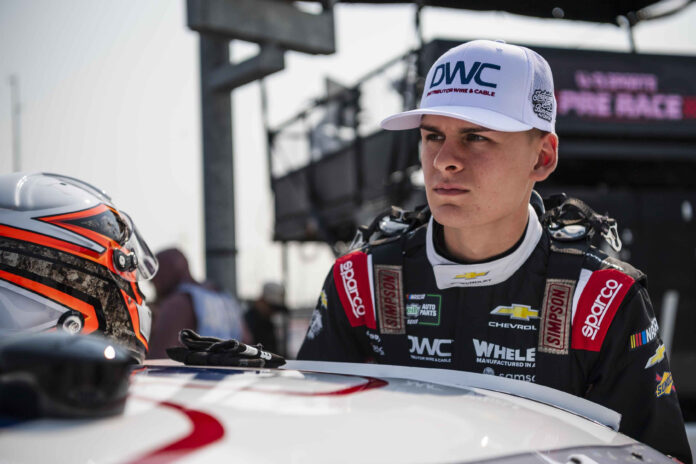
Carson Brown finished 15th in his NASCAR O’Reilly Auto Parts Series debut Saturday at Iowa Speedway in Newton. It was a respectable result for the 18-year-old from New London, North Carolina, as Brown competed in a deep 37-car field and experienced a first – live pit stops – before delivering a scrappy drive in an elbows-out green-white-checkered finish.
Brown started 20th and ran among the top-20 through the first stage. Navigating a live pit stop for the first time put him 29th for the Stage 2 restart, but Brown methodically worked his way forward, rising to 26th by lap 75 and then ending the stage 23rd. The final stage saw Brown quickly enter the top-25, and he was holding steady in 18th toward the end of the race when another car’s spin set up a green-white-checkered finish.
Shortly after the green flag waved, a bevy of drivers were collected in a multicar accident in turn one, including Brown and his No. 32 Distributor Wire & Cable Chevrolet for Jordan Anderson Racing Bommarito Autosport. A composed Brown brought his car to pit road for service during the caution period and he rejoined the field in 26th. When the green flag waved for the final time on lap 259, Brown placed his No. 32 machine firmly on the inside lane of the .875-mile oval. He successfully defended his position on the restart and swept underneath a host of other drivers on the final lap to secure 15th when the checkered flag fell.
Carson Brown, driver of the No. 32 Distributor Wire & Cable Chevrolet for Jordan Anderson Racing Bommarito Autosport:
“Live pit stops were definitely interesting, and just feeling out the restarts in the O’Reilly Series was a lot different from what I’m used to. It definitely got a little more hectic than what I wanted it to on that last green-white-checkered, but it was a lot of fun. I think I made it from 26th to 15th in a green-white-checkered. I just tried to recover from my mistakes early and get this thing back where it needed to be after we got in that wreck with only a few to go.
“I felt good out on the racetrack. I think the biggest issue was just the pit stops, getting down pit road, just making sure nothing would happen there. Some of the restart stuff involved a lot of dirty air, and just trying to figure that piece out was a new experience, but I felt like the last stage I really started to be able to move around and get really comfortable overall. I felt like everything just came alive. The car came alive. I felt like I was the best I was all day, and I just tried to make something happen at the end.
“That green-white-checkered was challenging, but we came in and got some colder tires with pumped-up air pressure and just made something happen. I felt like we were able to move around. I jumped all the way to the bottom, we were four-wide, three-wide, just bouncing off each other and, man, for a debut, this one was pretty fun.”
Notes:
● Brown qualified 20th for the HyVee Perks 250 with a time of 24.309 seconds at 129.582 mph.
● Carson Kvapil won the HyVee Perks 250 to score his second career O’Reilly Series victory, his second of the season and his first at Iowa. His margin over second-place Rajah Caruth was .343 of a second.
● There were 12 caution periods for a total of 72 laps.
● Twenty-five of the 37 drivers in the race finished on the lead lap.
Next Up:
Brown returns to his Late Model roots for the Aug. 22 zMAX CARS Tour event at Anderson Motor Speedway in Williamston, South Carolina, where he will drive the No. 5 Chevrolet in the Late Model Stock feature for Lee Pulliam Performance. Following that race, it’s a quick turn to Springfield, Illinois, for the Aug. 23 Calypso 100 ARCA Menards Series race at the Illinois State Fairgrounds. Brown will drive the No. 28 Chevrolet for Pinnacle Racing Group in what will be his 13th career ARCA start, but first on dirt. On Aug. 26, Brown is back in a Super Late Model on the ASA STARS National Tour, driving the No. 81 Chevrolet for Anthony Campi Racing. He leads the ASA STARS National Tour championship standings by an impressive 130 points thanks to four wins and two second-place finishes through six races. Across NASCAR, ARCA, ASA, the CARS Tour and select Late Model races, Brown is scheduled to compete in more than 50 pavement races in 2026.
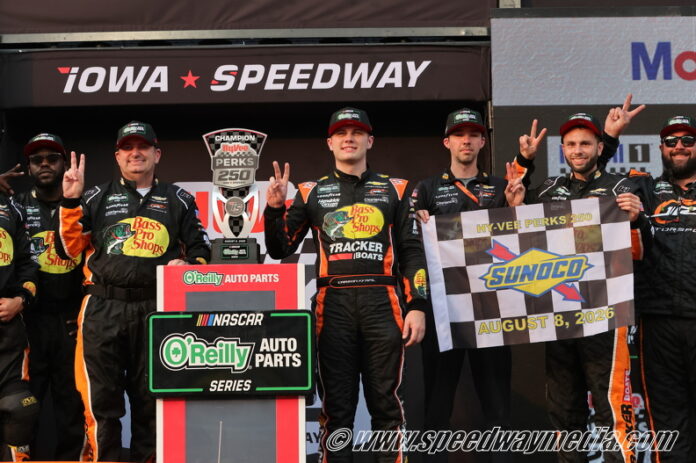
Carson Kvapil capitalized through two overtime shootouts to double down as a two-time race winner in the NASCAR O’Reilly Auto Parts Series division, with his latest victory occurring in the HyVee Perks 250 at Iowa Speedway on Saturday, August 8.
The 2021 CARS Super Late Model Tour champion from Mooresville, North Carolina, led the final nine of 260 over-scheduled laps in an event where he qualified in third place, notched four stage points in the first stage period and navigated his way through a war of on-track attrition with multiple cautions and late pit strategies ensuing throughout the final stage period.
Kvapil was initially trailing teammate Ross Chastain for the lead with five laps remaining when a late caution stacked up the field for an overtime shootout. Kvapil capitalized on the first overtime shootout by overtaking Chastain for the lead before a multi-car wreck that involved teammate Justin Allgaier sent the event into a second overtime shootout. For the latest shootout, Kvapil motored away from the field and fended off teammate Rajah Caruth to notch his second consecutive victory in the O’Reilly division within a three-week span.
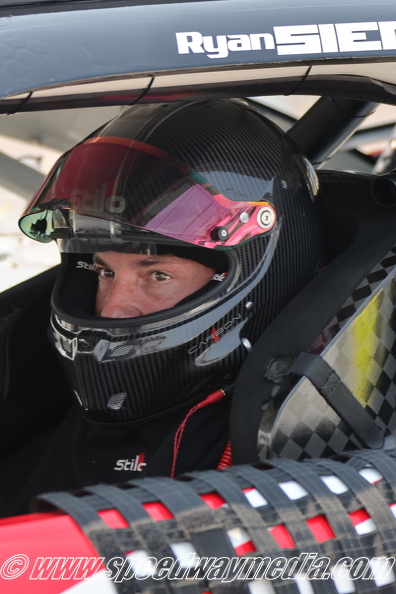
With on-track qualifying that determined the starting lineup occurring on Saturday, Ryan Sieg achieved his first career pole position with a pole-winning lap at 131.436 mph in 23.966 seconds. Ross Chastain qualified in second place with a lap at 131.086 mph in 24.030 seconds.
When the green flag waved and the event commenced, pole-sitter Ryan Sieg, who elected to start on the outside lane, wasted no time bolting away from Ross Chastain and the field through the frontstretch. Entering the first turn, Rajah Caruth, who qualified in fourth place, briefly snapped and went up the track. This caused Caruth to slip out of the top-five mark on the opening lap as Carson Kvapil, Sheldon Creed, Justin Allgaier and Sammy Smith moved up ahead of Caruth through the backstretch. Amid the early battles within the field, Sieg led the first lap over Chastain.
Through the Lap 10 mark, Ryan Sieg stretched his early advantage to more than a second over Chastain as Allgaier, Kvapil and Creed trailed by as far back as nearly four seconds on the track. Behind, Sammy Smith occupied sixth place ahead of Jesse Love, Caruth, Corey Day and Brandon Jones as Sieg continued to stretch his advantage to more than two seconds by Lap 20.
On Lap 26, the event’s first caution flew when Nathan Byrd spun in Turn 4. During the event’s first caution period, some, including Nick Sanchez, Blaine Perkins, Jeremy Clements, Mason Maggio and Joey Gase, pitted their respective entries while the rest, led by Ryan Sieg, remained on the track.
The start of the next restart on Lap 33 featured Ryan Sieg gaining another strong launch from the outside lane as he motored away from Chastain, Allgaier and the field entering the first turn. As Sieg led the next lap, Allgaier and Chastain were locked in a tight battle for the runner-up spot that included Creed, Kvapil, Sammy Smith and Sam Mayer.
Then prior to the Lap 35 mark, Love dropped off the pace through the backstretch due to his entry having issues staying in fourth gear. As he continued to limp his No. 2 Whelen Chevrolet Camaro entry around the track, he then spun sideways between Turns 3 and 4 before he drove through pit road and to his pit lane without drawing a caution. Despite returning to the track, Love was penalized for speeding on pit road. He eventually took his entry to the garage to have a transmission changed. Amid Love’s issues, Ryan Sieg maintained the lead.
When the first stage period concluded on Lap 60, Ryan Sieg cruised to his first O’Reilly stage victory of the 2026 season. Allgaier settled in second ahead of Creed, Chastain and Sammy Smith while Mayer, Kvapil, Brandon Jones, Day and William Sawalich were scored in the top 10, respectively.
Under the event’s first stage break period, the field led by Ryan Sieg pitted. Following the pit stops, Creed exited pit road first ahead of Allgaier, Sammy Smith, Kvapil, Jones and Mayer while Sieg dropped to seventh place ahead of Day, Sawalich and Taylor Gray. During the pit stops, Brent Crews made a second trip to pit road due to missing his pit stall during the first pit cycle.
The second stage period started on Lap 70 as Creed and Sammy Smith occupied the front row. At the start, the latter two dueled for the lead through the first two turns until Creed used the outside lane to motor ahead through the backstretch. As Mayer executed a three-wide move beneath Jones and Kvapil to challenge for fourth place, the field fanned out as Creed led the next lap.
Following a caution that flew on Lap 75 due to Kyle Sieg spinning through the first two turns, the next restart on Lap 80 featured Creed motoring away from the field entering the first two turns. As Mayer tried to execute a three-wide move beneath Sammy Smith and Allgaier for the runner-up spot, Allgaier acquired the spot. As Allgaier reeled in on Creed for the lead, Creed led the next lap. Amid Allgaier’s challenge for the lead, Creed proceeded to lead by the Lap 90 mark while Sammy Smith, Ryan Sieg, Mayer, Austin Hill, Day, Sawalich, Brent Crews and Chastain were scored in the top 10, respectively.
Then on Lap 101, Allgaier overtook Creed for the lead through the second turn. Allgaier proceeded to lead by seven-tenths of a second by the Lap 105 mark before the latter’s lead increased to more than a second by the Laps 110 and 115 marks.
When the second stage period concluded on Lap 120, Allgaier cruised to his eighth O’Reilly stage victory of the 2026 season. Creed followed suit in second place by more than two seconds ahead of Sammy Smith, Ryan Sieg and Mayer while Day, Crews, Sawalich, Austin Hill and Rajah Caruth were scored in the top 10, respectively.
During the event’s second stage break period, the field led by Allgaier returned to pit road for service. Following the pit stops, Allgaier retained the lead by exiting pit road first while Creed, Sammy Smith, Mayer, Day, Ryan Sieg, Sawalich, Hill, Crews and Caruth followed suit, respectively.
With 121 laps remaining, the final stage period commenced as Allgaier and Creed occupied the front row. At the start, Allgaier fended off Creed by a fender for a full lap as the former led the next lap while Sammy Smith, Mayer, Day and Ryan Sieg followed suit, respectively. While Day slipped out of the top-10 mark as he slid up the track and tapped Sawalich, Allgaier maintained the lead by nearly eight-tenths of a second over Creed with 110 laps remaining.
Then with 101 laps remaining, the caution returned when Anthony Alfredo spun off of the fourth turn. During this caution period, select names like Brandon Jones and Kyle Sieg pitted their respective entries. As the field restarted with 95 laps remaining, Allgaier maintained the lead for the next three laps before the caution flew due to Sawalich spinning in the second turn after he got hit by Patrick Staropoli.
For the next restart with 85 laps remaining, Allgaier, who was among the select few competitors who did not pit during the previous caution, maintained the lead over Mayer and the stacked field for a full cycle. Shortly after, the caution returned due to Cody Ware wrecking in the first turn after he got hit by Love. Allgaier then barely fended off Mayer for a full lap during the next restart with 77 laps remaining before a spin by Lavar Scott stacked the field with the caution flying.
With 71 laps remaining, Allgaier and Mayer dueled at the next restart’s launch, with Allgaier maintaining the advantage from the outside lane. Allgaier continued to maintain his advantage over the next three laps before a spin by Mason Maggio through the frontstretch drew the event’s ninth caution period. During this caution period, Allgaier and Mayer pitted as Jeb Burton cycled to the lead.
When the event restarted with 62 laps remaining, Jeb Burton maintained a steady lead over Chastain and Kvapil for half a lap before the latter two went beneath Burton through Turns 3 and 4. This caused Burton to drop to fourth as Kvapil also briefly went up the track and settled in front of Burton with the runner-up spot. As Ryan Sieg came to play and battled both Kvapil and Burton for second place, Chastain motored away to lead the next lap. Chastain led the next four laps under green flag conditions before the caution flew when Day wrecked hard against the Turn 1 wall following contact with Sammy Smith.
For the next restart that flew with 50 laps remaining, Chastain and Ryan Sieg dueled for the top spot in front of Hill, Kvapil and the field for a full lap as Chastain barely led the next lap from the outside lane. With Chastain just managing to clear and motor ahead of Sieg through the first two turns, the former retained the lead with 40 laps remaining. Chastain led by three-tenths of a second over Sieg and four-tenths of a second over Kvapil with 30 laps remaining before Chastain’s lead grew to more than a second with 20 laps remaining. By then, Kvapil assumed the runner-up spot from Sieg as Chastain led his teammate by eight-tenths of a second with 10 laps remaining.
Then, with five laps remaining, Jeb Burton, who had dropped to 19th place, spun in the second turn. By then, Chastain was leading by half a second over Kvapil while Allgaier had carved his way up to third place ahead of Ryan Sieg and Creed. Burton’s incident sent the event into overtime
The start of the first overtime attempt did not last long as the front-runners stumbled through the frontstretch and the field fanned out as Kvapil stormed beneath Chastain to take the lead. Seconds later, Crews slipped up the track, made contact with Ryan Sieg and ran into the side of Allgaier. This caused the latter trio to wreck against the first turn’s outside wall as Mayer also spun while being clipped by Sammy Smith in the process. More names like Carson Brown, Patrick Staropoli and Joey Gase wrecked against the wall while Kvapil, Chastain, Hill, Caruth, Creed, Sawalich and the rest of the field escaped the carnage.
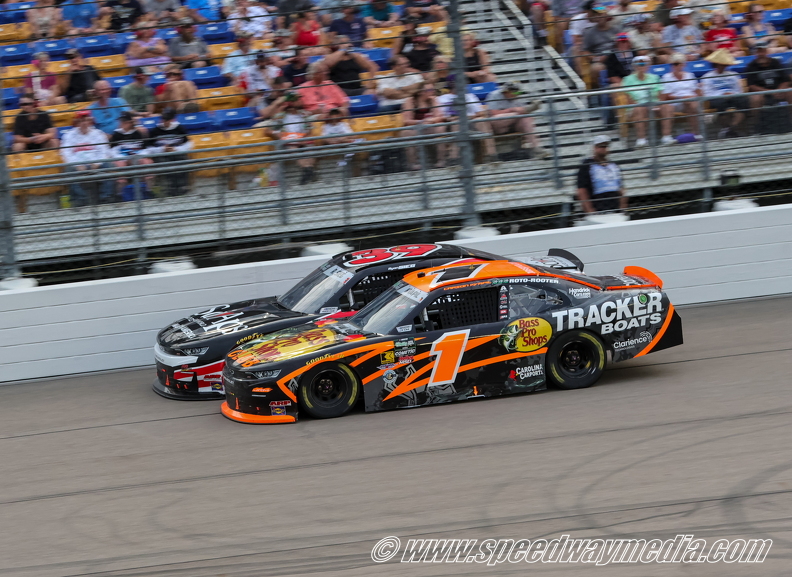
The start of the second overtime attempt featured Kvapil gaining an advantage from the outside lane as he motored his No. 1 Bass Pro Shops Chevrolet Camaro entry ahead entering the first turn. Behind, Caruth motored his No. 88 HendrickCars.com Chevrolet Camaro entry into second place as Hill made slight contact with Chastain, which caused the latter two to briefly lose their momentum. With Hill dropping towards the top-10 mark, Sawalich battled Chastain for third place while Kvapil led Caruth through the backstretch.
When the white flag waved and the final lap started, Kvapil remained in the lead by three-tenths of a second over teammate Caruth. With Caruth unable to reel in on Kvapil’s rear bumper for a final circuit, Kvapil smoothly navigated his way back to the frontstretch and claimed the checkered flag by three-tenths of a second.
With the victory, Kvapil became the ninth competitor to achieve his first two career victories in the O’Reilly Auto Parts Series division in back-to-back events. He also became the 16th competitor to win an O’Reilly event at Iowa Speedway and the 139th competitor overall to achieve multiple victories in the O’Reilly division. Kvapil’s Iowa victory marks the 20th victory for the Chevrolet manufacturer, the 15th for JR Motorsports and the fourth for JR Motorsports’ No. 1 team led by crew chief Rodney Childress in the 2026 campaign.
Photo by Ron Olds for SpeedwayMedia.com.
“I knew we had a really fast car,” Kvapil said on the CW Network. “I knew [Allgaier] was on fresher tires, so that was really my biggest concern there. I think [Chastain] probably had it, that yellow didn’t come out there at the end. I thought we were fast running them down, but we just didn’t have enough there to fill the gap, but [crew chief] Rodney [Childers] and everyone at Bass Pro Shops, Clarience Technologies with Hendrick Motors under the hood brought a really fast race car. Unlike our first few stages, we were really able to run down the leaders there at the end and it just all worked out. We got that restart we needed, and we got the win.”
Teammate Rajah Caruth followed suit to notch a career-best runner-up result in his 45th O’Reilly career start. As a result, Caruth, who is ranked in 14th place in the driver’s standings, is scored 15 points below the top-12 cutline looking ahead to this year’s regular-season finale event at Daytona International Speedway on August 28 that will determine this year’s O’Reilly Chase field.
“We were chasing the balance all day,” Caruth said. “The restarts kind of worked out for us. I was trying to just be the closest to the front because you never know how they’ll shake out. Sometimes, it works out. Sometimes, it doesn’t, and it worked out for us today. I probably wanted a little more and wouldn’t have gone up finishing second, but I guess you can’t complain too bad. A lot to work on still and got to go plate racing in a couple of weeks.”
William Sawalich settled in third place and moved to 11th place in the standings as he is a single point above the cutline to make his first O’Reilly Chase. Ross Chastain and Sheldon Creed, both of whom led a combined 99 laps, finished in the top five, respectively.
Nick Sanchez, Taylor Gray, Dean Thompson, Harrison Burton and Brennan Poole completed the top 10, respectively, on the track. Notably, Justin Allgaier, who led a race-high 83 laps, ended up in 24th place. In addition, pole-sitter Ryan Sieg, who led 65 laps, fell back to 33rd place as he was unable to finish following his first overtime accident.
Meanwhile, Sammy Smith clinched a Chase berth despite finishing in 17th place at Iowa. Parker Retzlaff, Sam Mayer, William Sawalich and Brent Crews currently occupy the remaining four vacant spots to the Chase with a single regular-season event remaining on the schedule.
This event featured seven lead changes for seven different leaders, and 12 cautions for 72 laps. In addition, 25 of 37 starters finished on the lead lap.
Following the 23rd event of the 2026 NASCAR O’Reilly Auto Parts Series season, Justin Allgaier leads the regular-season standings by 238 points over teammate Carson Kvapil, 266 over Sheldon Creed, 299 over Jesse Love and 321 over Corey Day.
Results:
Carson Kvapil, nine laps led
Rajah Caruth
William Sawalich
Ross Chastain, 63 laps led
Sheldon Creed, 36 laps led
Nick Sanchez
Taylor Gray
Dean Thompson
Harrison Burton
Brennan Poole
Austin Hill
Kyle Sieg
Parker Retzlaff
Brandon Jones
Carson Brown
Brent Crews
Sammy Smith
Patrick Staropoli
Anthony Alfredo
Blaine Perkins
Sam Mayer, one lap led
Joey Gase
Ryan Ellis
Justin Allgaier, 83 laps led, Stage 2 winner
Nathan Byrd
Derek Lemke, one lap down
Jeb Burton, one lap down, three laps led
Lavar Scott, one lap down
Garrett Smithley, two laps down
Jeremy Clements, three laps down
Josh Bilicki, three laps down
Tyler Tomassi, four laps down
Ryan Sieg – OUT, Accident, 65 laps led, Stage 1 winner
Mason Maggio – OUT, Suspension
Jesse Love, 60 laps down
Corey Day – OUT, Accident
Carson Ware – OUT, Accident
Next on the 2026 NASCAR O’Reilly Auto Parts Series schedule is the Wawa 250 at Daytona International Speedway in Daytona Beach, Florida, which will also cap off this year’s regular-season stretch and determine the 12-car Chase field. The event is scheduled to occur on August 28 and air at 7:30 p.m. ET on the CW Network, MRN Radio and SiriusXM.
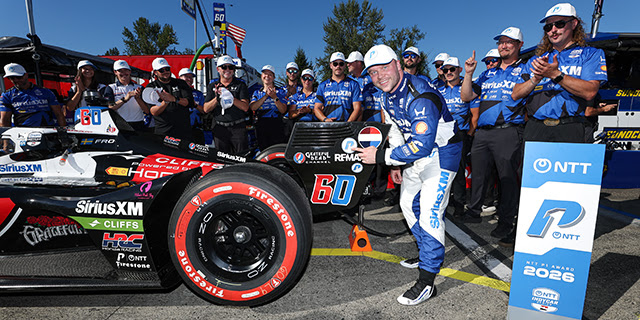
PORTLAND, Ore. (Saturday, Aug. 8, 2026) – Felix Rosenqvist wants to add another win for Meyer Shank Racing w/Curb Agajanian before he leaves the team at the end of this season.
He’ll have one of his best chances to achieve that goal after winning the NTT P1 Award for the OnlyBulls Grand Prix of Portland on Saturday at Portland International Raceway.
Rosenqvist, who won the Indianapolis 500 presented by Gainbridge in May, earned his second pole of the season and eighth of his career in the No. 60 SiriusXM Honda sporting a colorful livery this weekend saluting legendary rock band the Grateful Dead. His best lap was 58.4828 seconds, completed with three seconds remaining in a taut Firestone Fast Six session.
That was enough to edge series leader and four-time NTT INDYCAR SERIES champion Alex Palou, who will join Rosenqvist on the front row Sunday after his best lap of 58.5012 in the No. 10 DHL Chip Ganassi Racing Honda.
“It’s a phenomenal team effort,” Rosenqvist said. “We just kept tuning on it. I think we started off a little bit behind yesterday and really didn’t do anything magical. We just tried to focus on execution and putting all the corners together.”
The Swede is leaving MSR – a team that has two career victories, both in the Indy 500 – after this season for Arrow McLaren, where he will join six-time series champion and team newcomer Scott Dixon and team veteran Pato O’Ward.
Palou, aiming for a record-tying fourth straight championship, just missed earning his seventh pole of the season when Rosenqvist ended his final lap on the 12-turn, 1.964-mile road course.
“I had too much lunch today, man,” Palou said with a smile when asked where he could have found more speed on his best lap. “It’s so close. It hurts when it’s that close. But happy for Felix, happy for a Honda 1-2 there. Let’s see what kind of car we have for the race.”
The 110-lap race starts at 4 p.m. ET Sunday on FOX, FOX Deportes. FOX One and INDYCAR Radio powered by OnlyBulls.
Will Power moved to Andretti Global this season after winning this race in 2024 and 2025, the last two of his 16 full-time seasons with Team Penske, but he showed why this is one of his favorite tracks by qualifying third at 58.5130 in the No. 26 TWG AI Honda.
Power’s teammate Marcus Ericsson celebrated his contract renewal this week with Andretti Global for 2027 by qualifying fourth at 58.6729 in the No. 28 Delaware Life Honda.
Rinus VeeKay continued his strong season by producing the quickest lap by a Chevrolet-powered driver, ending up fifth at 58.7701 in the No. 76 Juncos Hollinger Racing Chevy. Kyffin Simpson will join VeeKay in the third row of the starting grid after qualifying sixth at 59.0841 in the No. 8 Sunoco Chip Ganassi Racing Honda, his first appearance this season in the Firestone Fast Six.
Honda-powered drivers dominated qualifying, leading all three rounds in the knockout format and grabbing 10 of the first 12 qualifying spots.
Besides VeeKay, the only Bowtie driver who qualified in the top 12 is championship contender David Malukas, who qualified ninth at 58.8690 in the No. 12 Verizon Team Penske Chevrolet. But Malukas will start six places back from that position as a penalty for an unapproved engine change at the previous round at Nashville Superspeedway, adding to his challenge Sunday.
Palou leads second-place Malukas by 83 points – a gap of more than a race – with six races remaining. A clean, steady race could expand that gap because Malukas and third-place Kyle Kirkwood are starting behind the reigning series champion, with PIR’s tight first-corner chicane sometimes inducing chaos and carnage toward the middle and back of the starting grid.
Kirkwood qualified seventh at 58.8303 in the No. 27 Sam’s Club Honda of Andretti Global, missing a spot in the Firestone Fast Six by .0352 of a second.
Christian Lundgaard has scored more points on natural road courses like PIR than any driver this season, but he struggled with various mechanical problems and didn’t make it out the first round. He qualified 25th at 59.5423 in the No. 7 Arrow McLaren Chevrolet.
SAWALICH SCORES THIRD STRAIGHT TOP-FIVE FINISH AT IOWA Sam Hunt Racing puts both Supras in the top-10 for the first time this season
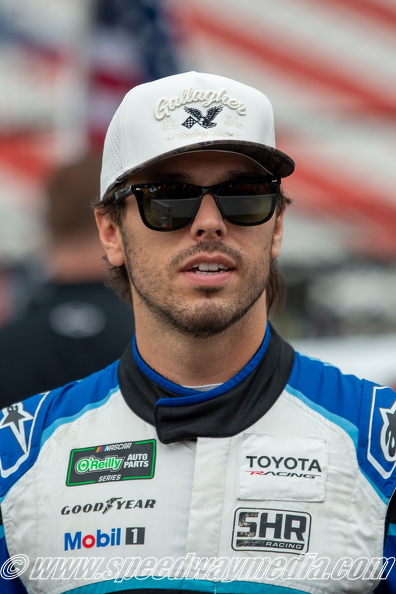
NEWTON, Iowa (August 8, 2026) – William Sawalich battled back through the field after getting spun and led Toyota with a third-place finish at Iowa Speedway on Saturday evening. Taylor Gray (seventh) put a second Joe Gibbs Racing Supra in the top-10.
Sawalich, Gray and Brent Crews go into the final race of the regular season – Daytona International Speedway – separated by one point for the final two Chase positions.
Sam Hunt Racing had the best day of 2026 as both Dean Thompson (eighth) and Harrison Burton (ninth) put their Supras in the top-10. It is the fourth time in team history that they have put two Supras in the top-10 finishers (2023 Darlington-1, 2024 Road America, 2025 Bristol-1).
TOYOTA RACING Post-Race Recap NASCAR O’Reilly Auto Parts Series (NOAPS) Iowa Speedway Race 23 of 33 – 218.75 miles, 250 laps
TOYOTA FINISHING POSITIONS
1st, Carson Kvapil* 2nd, Rajah Caruth* 3rd, WILLIAM SAWALICH 4th, Ross Chastain* 5th, Sheldon Creed* 7th, TAYLOR GRAY 8th, DEAN THOMPSON 9th, HARRISON BURTON 14th, BRANDON JONES 16th, BRENT CREWS 32nd, TYLER TOMASSI *non-Toyota driver
TOYOTA QUOTES
WILLIAM SAWALICH, No. 18 SoundGear Toyota GR Supra, Joe Gibbs Racing
Finishing Position: 3rd
What is the emotion with the chance that you have to make the Chase going into Daytona?
“We knew coming in that we still had a chance even if the day didn’t go our way. We were top-10 in stage one and stage two, so we got a little bit of points there, and then finished it off in third. Just picked good lanes on restarts. We put ourselves in the position there and did what we had to do there at the end with our SoundGear Supra because every point matters.”
TAYLOR GRAY, No. 54 Operation 300 Toyota GR Supra, Joe Gibbs Racing
Finishing Position: 7th
Solid top-10 run. How was the race today?
“We struggled really all day from practice, and qualifying and the race. We struggled with balance really, but proud of everyone at Joe Gibbs Racing, TOYOTA RACING – everyone worked really hard all day and fought really hard to come out and have a decent finish. Obviously not what we wanted stage wise, getting no stage points, and going into Daytona kind of backed into a corner, but it could have been a lot worse. We will have to keep our heads down, keep rolling and keep working.”
DEAN THOMPSON, No. 26 Thompson Pipe Group Toyota GR Supra, Sam Hunt Racing
Finishing Position: 8th
Double top-10 for Sam Hunt Racing, and another solid run for you, Dean.
“Really happy with the result for our Thompson Pipe Group Toyota team. We struggled here last year, but we worked hard in the offseason and these past few weeks, just trying to build a better race car to bring here. We just missed it last year. Everyone knows that Sam Hunt (Racing) is good here because of how Corey (Heim) performed that one year. This is where we should race at this race track, and I’m just happy that we ended up here.”
HARRISON BURTON, No. 24 AIRBOX Toyota GR Supra, Sam Hunt Racing
Finishing Position: 9th
Progressively moving the right way, and another solid top-10 finish.
“Yeah, I thought our race team brought Dean (Thompson) and I both very similar cars and it seemed like run to run, Dean would be better or I would be better – especially stage two, I thought I hit our best run, and kind of struggled from there. I thought our stage three we did a good job of making do of what we had and not giving up. That is the main thing in these races, as you saw. It is such a crazy finish to these things, a lot of times, you just have to keep yourself in it. Proud of our whole AIRBOX Toyota team. Proud of Dean. I thought we worked together well the last few weeks, and it is starting to show.”
About Toyota
Toyota (NYSE:TM) has been a part of the cultural fabric in North America for nearly 70 years, and is committed to advancing sustainable, next-generation mobility through our Toyota and Lexus brands, plus our more than 1,800 dealerships.
Toyota directly employs nearly 64,000 people in North America who have contributed to the design, engineering, and assembly of over 50 million cars and trucks at our 14 manufacturing plants. In 2025, Toyota’s plant in North Carolina began to assemble automotive batteries for electrified vehicles.
Portland, OR- Grand Prix of Portland in Portland OR (Photo by Travis Hinkle | IMS Photo)
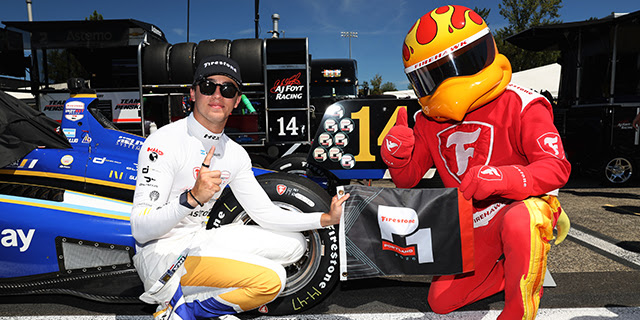
PORTLAND, Ore. (Saturday, Aug. 8, 2026) – Alessandro de Tullio’s march toward an INDY NXT by Firestone season record continued Saturday – by a tiny margin.
De Tullio earned his eighth pole this season – one shy of tying the all-time record for the INDYCAR development series – in the No. 14 AJ Foyt Racing entry, holding off Andretti Global’s Lochie Hughes by .0033 of a second to earn the top starting spot for the Grand Prix of Portland. It was the fourth-closest duel for the pole on a road or street circuit in series history.
“Unreal,” de Tullio said. “This season has been, in terms of speed, amazing. I just can’t thank this team enough for giving me a great car. Every weekend, we’re always there, always fast. We’re constantly on the front row.”
Series rookie De Tullio, from Miami, has started first or second in 12 of the 14 races this season. He is trying to break the series record of nine poles set in 2018 by current NTT INDYCAR SERIES star Pato O’Ward.
De Tullio’s pole-winning lap of 1 minute, 2.2006 seconds came in the first qualifying group. He was forced to sit and watch half of the field try to topple his time, with series veteran Hughes falling just short at 1:02.2039 in the No. 26 Andretti Global entry on the 12-turn, 1.964-mile road course.
Max Taylor will start third after his best lap of 1:02.2347 in the No. 28 Susan G. Komen car of Andretti Global. Championship contender Tymek Kucharczyk, who led practice Saturday morning, will join Taylor on the second row after his lap of 1:02.2268 in the No. 71 HMD Motorsports entry.
Jacob Abel, making his first series start since 2024, qualified fifth at 1:02.3116 in the No. 48 Abel Motorsports machine. Abel’s teammate Myles Rowe rounded out the third row at 1:02.3408 in the No. 99 Abel Motorsports with Force Indy car.
Kucharczyk, 25 points behind series leader Nikita Johnson, is the only one of the three main title contenders starting near the front. Johnson qualified ninth at 1:02.4178 in the No. 21 Cape Motorsports Powered by ECR car. Fellow rookie Enzo Fittipaldi, one point behind Johnson in second, will start 12th after his best lap of 1:02.5727 in the No. 67 HMD Motorsports car.
The 35-lap race starts at 2 p.m. ET Sunday (FS1, FOX One, INDYCAR Radio powered by OnlyBulls).
While the title fight rages, De Tullio will try to convert his Saturday speed into Sunday success, a rarity this season. He has just one victory – in March at Barber Motorsports Park – despite starting on the front row 12 times this season. He is seventh in the standings.
“It’s a little bit hard, as well, considering the speed we have and where we are in points and things that go on, it’s a little bit difficult to think about that,” de Tullio said. “But the important thing is we are there, we have the pace. On this side of things, it’s been a great season.”
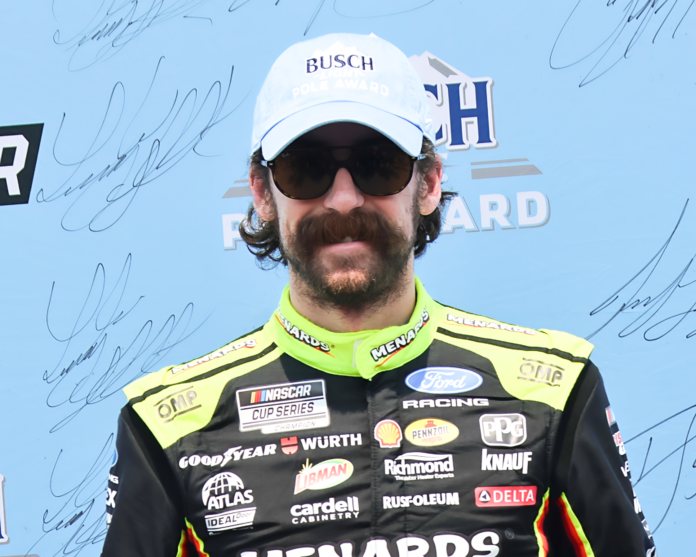
Ryan Blaney sped to his third Busch Light Pole Award of the 2026 NASCAR Cup Series season for the Iowa Corn 350 at Iowa Speedway on Saturday August 8.
The event’s starting lineup was determined through an on-track qualifying session that consisted of a single-car, two-lap qualifying format. During the session, each of the 36 competitors vying for 36 starting spots cycled around Iowa twice to post the fastest lap amongst one another. The competitor who posted the fastest lap was awarded the pole position.
During the session, Blaney, who was the fifth-fastest competitor during Saturday’s practice session, utilized his two-lap qualifying session to post his fastest lap at 134.191 mph in 23.474 seconds. Blaney’s lap was enough for the 2023 Cup Series champion from High Point, North Carolina, to secure his third pole position of this season.
With the pole, Blaney, who is wearing a Kyle Busch tribute helmet for this weekend’s event, recorded his 15th Cup Series career pole for his 401st series start, his fourth on a short track venue, his first at Iowa and his first since EchoPark Speedway in July. The qualifying result left Blaney pleased with the handling of his No. 12 Team Penske Ford entry as he strives to contend for his second victory in Newton, Iowa.
“[A] Really, really cool day,” Blaney said. “[I] Appreciate the really fast car. The No. 12 Menards Pennington Ford Mustang was fast in practice. I was able to lay down a good lap and honestly, my first lap wasn’t what I wanted. Fortunately, we had enough grip, kind of car came in, changed my line up a little bit for the second one to run a little bit faster and hang on for the pole…It’s gonna be a tough one tomorrow. This track changes a lot. It’s gonna be pretty warm. It’s a long day, long race, so really important to try to keep up with it, but it’s nice to start off strong and hopefully, we can continue that for tomorow.”
Blaney will share the front row with Kyle Larson, the latter of whom was the 19th-fastest competitor in practice. Larson rebounded by posting the second-fastest lap at 134.088 mph in 23.492 seconds. Joey Logano, who also posted his fastest lap at 134.088 mph in 23.492 seconds, will start in third place ahead of Brad Keselowski and Tyler Reddick in the top-five mark, respectively. Keselowski managed to post a blistering lap during his first of two qualifying laps before he wrecked into the Turn 1 wall.
Ty Gibbs, Austin Dillon, Connor Zilisch, Ross Chastain and Erik Jones, the latter of whom was the fastest in practice, completed the top-10 starting grid, respectively. Notably, Chase Elliott, who spun in practice, will start in 32nd place while Denny Hamlin, the points leader, will start in 29th place. William Byron, the defending Cup Iowa winner, will start in 19th place.
With 39 competitors vying for 39 starting spots, all made the main event.
Iowa – Qualifying Position, Best Speed, Best Time:
Ryan Blaney, 134.191 mph, 23.474 seconds.
Kyle Larson, 134.088 mph, 23.492 seconds
Joey Logano, 134.088 mph, 23.492 seconds
Brad Keselowski, 134.025 mph, 23.503 seconds
Tyler Reddick, 133.911 mph, 23.523 seconds
Ty Gibbs, 133.786 mph, 23.545 seconds
Austin Dillon, 133.786 mph, 23.545 seconds
Connor Zilisch, 133.758 mph, 23.550 seconds
Ross Chastain, 133.667 mph, 23.566 seconds
Erik Jones, 133.503 mph, 23.595 seconds
Michael McDowell, 133.486 mph, 23.598 seconds
Austin Cindric, 133.480 mph, 23.599 seconds
Josh Berry, 133.463 mph, 23.602 seconds
Zane Smith, 133.378 mph, 23.617 seconds
Noah Gragson, 133.333 mph, 23.625 seconds
Ricky Stenhouse Jr., 133.232 mph, 23.643 seconds
Todd Gilliland, 133.175 mph, 23.653 seconds
Carson Hocevar, 133.164 mph, 23.655 seconds
William Byron, 133.125 mph, 23.662 seconds
Chase Briscoe, 133.119 mph, 23.663 seconds
John Hunter Nemechek, 133.119 mph, 23.663 seconds
Christopher Bell, 133.057 mph, 23.674 seconds
Shane van Gisbergen, 133.012 mph, 23.682 seconds
Austin Hill, 132.984 mph, 23.687 seconds
AJ Allmendinger, 132.906 mph, 23.701 seconds
Bubba Wallace, 132.861 mph, 23.709 seconds
Chris Buescher, 132.811 mph, 23.718 seconds
Riley Herbst, 132.749 mph, 23.729 seconds
Denny Hamlin, 132.565 mph, 23.762 seconds
Alex Bowman, 132.481 mph, 23.777 seconds
Ty Dillon, 132.342 mph, 23.802 seconds
Chase Elliott, 132.247 mph, 23.819 seconds
Daniel Suarez, 132.087 mph, 23.848 seconds
Cody Ware, 131.965 mph, 23.870 seconds
Ryan Preece, 131.447 mph, 23.964 seconds
Cole Custer, 131.228 mph, 24.004 seconds
The 2026 Iowa Corn 350 at Iowa Speedway is scheduled to occur on Sunday, August 9, at 3:30 p.m. ET on USA Network, MRN Radio, SiriusXM and HBO MAX.
Ryan Sieg achieved his first NASCAR O’Reilly Auto Parts Series pole position of his career for the 2026 HyVee Perks 250 at Iowa Speedway in Newton, Iowa, on Saturday, August 8.
The event’s starting lineup was determined through an on-track qualifying session that consisted of a single-car, two-lap qualifying format. During the session, each of the 37 competitors vying for 37 starting spots cycled around Iowa Speedway twice to post the fastest lap amongst one another. The competitor who posted the single fastest lap was awarded the pole position.
During the session, Sieg, who was the third-fastest competitor during Saturday’s practice session, utilized his two-lap qualifying session to clock in his fastest lap at 131.436 mph in 23.966 seconds. The lap was enough for the 39-year-old Sieg and driver of the No. 39 RSS Racing Chevrolet entry from Tucker, Georgia, to nab his first career pole in the O’Reilly division and for his 423rd start in the series.
Prior to his first career pole at Iowa, Sieg’s previous-best starting spots were a pair of third-place spots at Talladega Superspeedway in June 2020 and Nashville Superspeedway in June 2024. Sieg, whose best result in the O’Reilly Series is five runner-up results, remains in pursuit of his first victory in the series. He is also 74 points below the top-12 cutline to be in contention for this year’s Chase with two regular-season events remaining on the schedule, starting with Saturday night’s event at Iowa.
Sieg will share the front row with Ross Chastain, the latter of whom is making his 10th O’Reilly start of this season and fifth with JR Motorsports. Chastain clocked in his fastest lap at 131.086 mph in 24.030 seconds.
Carson Kvapil, who is coming off his first O’Reilly career victory at Indianapolis Motor Speedway two weeks ago, qualified in third place with a lap at 131.021 mph in 24.042 seconds. Teammates Rajah Caruth and Justin Allgaier will start in the top five, respectively.
Sheldon Creed, Jeremy Clements, Corey Day, Sammy Smith and Parker Retzlaff completed the top-10 starting grid, respectively.
With 37 competitors vying for 37 starting spots, all made the main event.
Iowa – Qualifying Position, Best Speed, Best Time:
Ryan Sieg, 131.436 mph, 23.966 seconds
Ross Chastain, 131.086 mph, 24.030 seconds
Carson Kvapil, 131.021 mph, 24.042 seconds
Rajah Caruth, 130.983 mph, 24.049 seconds
Justin Allgaier, 130.955 mph, 24.054 seconds
Sheldon Creed, 130.950 mph, 24.055 seconds
Jeremy Clements, 130.695 mph, 24.102 seconds
Corey Day, 130.467 mph, 24.144 seconds
Sammy Smith, 130.467 mph, 24.144 seconds
Parker Retzlaff, 130.467 mph, 24.144 seconds
Jesse Love, 130.451 mph, 24.147 seconds
Jeb Burton, 130.192 mph, 24.195 seconds
Taylor Gray, 130.176 mph, 24.198 seconds
Nick Sanchez, 130.128 mph, 24.207 seconds
Brandon Jones, 129.940 mph, 24.242 seconds
Harrison Burton, 129.811 mph, 24.266 seconds
William Sawalich, 129.768 mph, 24.274 seconds
Brent Crews, 129.646 mph, 24.297 seconds
Anthony Alfredo, 129.592 mph, 24.307 seconds
Carson Brown, 129.582 mph, 24.309 seconds
Kyle Sieg, 129.582 mph, 24.309 seconds
Patrick Satropoli, 129.475 mph, 24.329 seconds
Sam Mayer, 129.470 mph, 24.330 seconds
Lavar Scott, 128.993 mph, 24.420 seconds
Blaine Perkins, 128.829 mph, 24.451 seconds
Brennan Poole, 128.824 mph, 24.452 seconds
Dean Thompson, 128.792 mph, 24.458 seconds
Austin Hill, 128.571 mph, 24.500 seconds
Mason Maggio, 128.346 mph, 24.543 seconds
Derek Lemke, 128.263 mph, 24.559 seconds
Nathan Byrd, 127.479 mph, 24.710 seconds
Ryan Ellis, 127.407 mph, 24.724 seconds
Garrett Smith, Owner Points
Joey Gase, Owner Points
Josh Bilicki, Owner Points
Tyler Tomassi, Owner Points
Carson Ware, Owner Points
The 2026 HyVee Perks 250 at Iowa Speedway is scheduled to occur on Saturday, August 8, at 5 p.m. ET on the CW Network, MRN Radio and SiriusXM.
NASCAR CUP SERIES IOWA SPEEDWAY TEAM CHEVY DRIVER QUOTES AUGUST 8, 2026
Carson Hocevar, driver of the No. 77 Spire Motorsports Chevrolet, met with the media in advance of the NASCAR Cup Series practice and qualifying session at Iowa Speedway.
Media Availability Quotes:
Do you allow yourself this year to realistically entertain the possibility of winning the championship, or do you just kind of go, hey we’re ahead of schedule and the most we make of this is fine by me?
“Yeah, I mean I think for us, I think it’s an advantage for us that all the Chase races this year are good tracks for us, you know, statistically some of our best, so that’s an advantage. Obviously the Toyota’s are super-fast. Some of these guys that are super good that are obviously favorites, sometimes they take themselves out of it by just trying to get a little bit more, so you want to be next in line if it somehow gets given to you or they have trouble in front of us. Whether it’s three Toyota’s or (Ryan) Blaney, you want to be next in line so you can somewhat maybe take advantage of it.
We’re just going to just try and click off as many good races as we can and see where it shakes out. I don’t think any of us are changing anything differently going — okay, now we can win a championship or we can do this or that. It’s like sprint car or dirt racing with the Spire car… they hadn’t won anything, and all of a sudden, they win two-in-a-row. You just get hot at the right times and you can take advantage of it. We’re hoping that guys cool off and we get hot at the right time. You never know.”
What do you think about having Daytona as the cut-off? You’re really secure in where you’re at in your space, but what are your thoughts about that being kind of a wild card? “Yeah, I don’t know. I think it’s great. You know, that 25-point bonus can swing it pretty good for anybody that I’m sure is on the cut. Or even too, just the battle up front, I think it’s 29 points from fifth to 10th. Four stage points here and there, if it’s within 25, a guy can go 10th to almost fifth with one win at Daytona.
So yeah, I don’t know. You know, I think it’s probably just entertaining for the viewer. For me, for how good we are at the superspeedway’s, I kind of wish it was just the first one of the Chase. But yeah, from a fan perspective, I’m sure they enjoy it.”
The first time you got in a Cup car, just the magnitude of being in a Cup car at that track, how different is it when you’re one of the Cup drivers and you’re lining up at Daytona? “
“Yeah, especially for the DAYTONA 500. The 500 is a little different just because it’s always such a cluster of people throughout the day. I just enjoy Daytona because it sets itself apart. I think everybody wants to win there, especially the 500. But even too, the fall race is always a big deal.”
I was walking through the garage this morning and looking at where the Hendrick Motorsports haulers are compared to Spire Motorsports after you leapfrogged the Hendrick drivers at Indianapolis. Obviously, you noticed that. Is it weird? It’s your alliance partner and you’re out-running all of their cars. What’s the dynamic there?
“Yeah, it’s great for us (at Spire Motorsports). I think we’ve all noticed it and taken pride in it. Jeff (Dickerson) and Mr. Hendrick are super close. I think it’s probably the first time Jeff can probably rag on Mr. H a little bit, so I’m sure Jeff, knowing him, is soaking all that up not knowing how long this hauler parade might last.
Yeah, it’s just great for us. But also too, Mr. H, Hendrick Motorsports, the Hendrick engine shop, they like seeing us run really well. The pit crew takes a lot of pride in being good because they’re not on the house cars, per se. The engine shop enjoys it, and I know Mr. H does it because he likes to see seven cars, rather than just four, have a shot. I know they look at it, per se, like a seven-car deal because of the close alliance. They just get more shots to, hopefully, win races because they have Hendrick engines in them, Hendrick pit crews and people he employees are on those cars. Jeff is like a son to him.”
In Indianapolis, you mentioned that you were behind the eight ball the whole season. You felt like you could have been fifth already, and then, you jumped up to fifth after the last race. Do you feel as though you earned it just from last race or can you hold it?
“Yeah, I feel like we can hold it here. You know, I feel like we’ve been fast everywhere. I think our finishes are higher than our average running position, which is kind of always a telltale sign of maximizing our days. So yeah, I’ve enjoyed it. I still think we have a long way to go to our ceiling here, so that makes me exciting that we’re as fast as we are. I feel like there’s still a long ways to go on our progression here.”
Last year, you mentioned to us numerous times about getting to group two of qualifying. And this year, we’ve seen an over seven position increase on average of just your starting position. Do you contribute that increase as the biggest contributor to what your success has been this year?
“Yeah, I mean, when you’re higher in points, the average for sure helps. And when we finish as good as we have this year, that also helps. It just makes life a lot easier for you. You know, I remember we blew up at Charlotte, but then we finished second at Nashville from 28th. I think we were good enough that day, but we needed maybe three seconds to catch (Ryan) Blaney to maybe win that race. You think about your whole day of like, maybe that three seconds could have been attributed if we didn’t start 28th.
So yeah, it just all adds up. You can just see it being up front. It’s tough to pass in theses races, so for us when we’re up front, have better pit stalls and everything, it just makes life a lot easier when we can have smooth, up front days and get a lot of points that people don’t really see. Our season has been kind of built on stage points that just kind of add up.”
As someone that had a lot of success here last year, how excited are you for the announcement of next season’s Fourth of July race and how pumped are you to get back to Iowa around this time next year?
“Yeah, it’s great. I think this place already sells out, but hopefully the Fourth of July weekend just adds a little bit of excitement to it. Selfishly, I’m hoping they can somehow change the sprint car race so we can go watch that too during the weekend. I enjoy that while we’re here.
But yeah, I’m excited. The fireworks will be cool over all the cornfields here. Hopefully there’s a cornfield here where I can sneak off and light off some fireworks of my own.”
It’s a crowd that sells out all the time these last couple years. How does that get you and the rest of the racers in the garage juiced up for a race like this out in the Midwest, the pride of the Midwest, that is?
“Yeah, I mean, I obviously enjoy the crowd perspective. When it’s full, loud or really anything that just really moves the energy up is always fun for me. So yeah, it just kind of gives this race another kind of fresh element to it with a date change like that. Hopefully, it just gets them even more excited.”
You’ve been really quick in qualifying the last few races. How do you think that can translate over to Sunday? And also, do you think you’ll be able to keep that qualifying hot streak up?
“I mean, I hope so. We ran good here (at Iowa Speedway) last year. It seems like we’ve been faster just kind of everywhere we’ve gone lately, from year to year. So yeah, hopefully it just trends up. We were good last year and okay the year before, so hopefully we can kind of excel and keep that going again.”
The stage procedure was announced earlier this week. What are your thoughts on that?
“I think it’s good. It’s similar to short-track, late model racing, so I like it. I think it will probably change the game some. It will probably allow for crew chiefs to makes mistakes, maybe flip the field or just catch people off guard. But ultimately, just make the race not predictable and hopefully it just allows for mistakes on the box. I feel like mistakes from either the box or the car tends to kind of always make the racing better.
So yeah, it’s good. I think it’s an improvement. It’s less caution laps, which is good. I found out on X, so I was glad I was looking at my phone that day.”
About General Motors
General Motors (NYSE:GM) is driving the future of transportation, leveraging advanced technology to build safer, smarter, and lower emission cars, trucks, and SUVs. GM’s Buick, Cadillac, Chevrolet, and GMC brands offer a broad portfolio of innovative gasoline-powered vehicles and the industry’s widest range of EVs, as we move to an all-electric future.
GM Motorsports, including the Cadillac Formula 1® Team develops and proves advanced technologies in the most demanding environments, accelerating innovation in performance, safety, efficiency, and electrification for its production vehicles. Cadillac Racing is one of the leading manufacturers in the IMSA and FIA World Endurance Championships (WEC). Chevrolet competes in single seaters in the US IndyCar series, and in NASCAR with multiple team partners and drivers. Corvette customer teams compete in GT series across the globe including IMSA and WEC. Learn more at GM.com.
Dean Thompson will be driving for Haas Factory Team for the 2027 NASCAR O’Reilly Auto Parts Series season.
Thompson’s 2027 plans, which was announced at Iowa Speedway on August 8, comes as the 24-year-old native of Anaheim, California, is currently campaigning in his second full-time season in the O’Reilly division with Sam Hunt Racing. It also means that Haas Factory Team will be expanding to field three full-time entries next season while Thompson Pipe Group and MCM Transportation will primarily sponsor Thompson.
Thompson has notched a pair of top-10 results, including his highest-finishing result of sixth place at Talladega Superspeedway in mid-April, and he holds an average-finishing result of 20.2 through 22-scheduled events in this year’s O’Reilly division. He is also ranked in 18th place in the driver’s standings with 11 events remaining on this year’s schedule.
“I’m thrilled to join Haas Factory Team as the next step in my NASCAR journey,” Thompson said. “I am looking forward to competing for wins and a championship with support from MCM Transportation and Thompson Pipe Group.”
Thompson made his O’Reilly debut at Talladega in early October 2024, where he finished in 20th place while driving his current ride, the No. 26 Toyota Supra entry, for Sam Hunt Racing. After spending the years 2022 to 2024 racing on a full-time basis in the Craftsman Truck Series division with Niece Motorsports and TRICON Garage, respectively, the Californian moved up to a full-time O’Reilly campaign with Sam Hunt in 2025.
This past season, Thompson notched his highest-finishing result of fifth place at Charlotte Motor Speedway in May along with a total of eight top-10 results and an average-finishing result of 17.9 before he finished in 16th place in the standings. He has accumulated a total of 10 top-10 results, 19 laps led and an average-finishing result of 19.1 through 57 current starts in the O’Reilly division as he continues his pursuit of his first series’ victory.
Haas Factory Team is currently in its second season under its current name and as a two-car team in the O’Reilly division, fielding Chevrolet entries for Sheldon Creed and Sam Mayer. Creed, who recorded his first career victory at EchoPark Speedway this past February, is currently ranked in fourth place in the 2026 standings. Mayer, who notched the organization’s first victory under its current name a year ago at Iowa, is ranked in 10th place.
Haas Factory Team’s full driver lineup of its three-car operation, including number/crew chief assignments, remains to be determined ahead of the 2027 season.
“We’re excited to welcome Dean to Haas Factory Team, Joe Custer, President of Haas Factory Team, said. “He has shown strong progression throughout his time in the O’Reilly Auto Parts Series and we believe he will compete at the highest level. Along with our growing affiliate program, the addition of a third full-time entry continues to strengthen our organization.”
With his 2027 plans set, Dean Thompson’s 2026 NASCAR O’Reilly Auto Parts Series season resumes this Saturday, August 8, at Iowa Speedway in Newton, Iowa, for the HyVee Perks 250. The event’s broadcast time is slated to commence at 5 p.m. ET on the CW Network, MRN Radio and SiriusXM.