There is a specific, sinking frustration known only to the sim racer who upgrades in the wrong order. You finally pull the trigger on a high-torque Direct Drive (DD) wheelbase, eager to feel the limit of adhesion in Assetto Corsa EVO. You hit the first high-load apex, the motor kicks in to communicate the car’s scrub— and your entire cockpit groans. The wheel deck twists, the pedal plate flexes under braking, and the high-fidelity detail you paid for is swallowed by a vibrating frame.
Most beginners invest in the “heart” (the wheel) while ignoring the “skeleton” (the rig). As we head into 2026, with titles like Project Motor Racing and F1 25 demanding more from our hardware than ever, the truth is counter-intuitive: your expensive wheel is currently lying to you because your foundation is weak. This is the year we stop shopping for gadgets and start building platforms.
The Foundation is the True Performance Multiplier
In the 2026 landscape, the torque arms race has settled into clear tiers: Small DDs (the <10Nm category like the 5Nm Moza R5 or 8Nm Fanatec GT DD Pro) and Large DDs (the 12Nm to 25Nm+ heavy hitters like the Simucube 2 Pro or Asetek Invicta). If you are planning to move past that 10Nm threshold, a tubular steel rig is a dead-end.
Rigidity isn’t just about material; it’s about design. Tubular rigs often look “finished,” but they are structurally static. When you apply 15Nm of torque or 100kg of force to a load-cell brake, tubular frames expose “torque leak.” This isn’t just a loss of immersion; it’s a lap-time killer. As the experts at SimXPro state:
“If your wheel deck twists… you don’t just lose immersion. You lose repeatability and consistency is where confidence (and speed) comes from.”
For a professional-grade experience, you need to transition to 8020 Aluminium Profile. Rigs like the SimXPro R80 GT serve as the baseline, while the GT-RS and the flagship XT120 provide the zero-flex environment required for high-torque systems. Without a rigid frame, your wheelbase is just a very expensive vibrator.
The Rise of the “Architect” and the Virtual Builder
We’ve moved past buying “products” and into the era of “architecting platforms.” Serious racers no longer guess if a shifter will fit; they use tools to stress-test their ergonomics before a single bolt is turned.
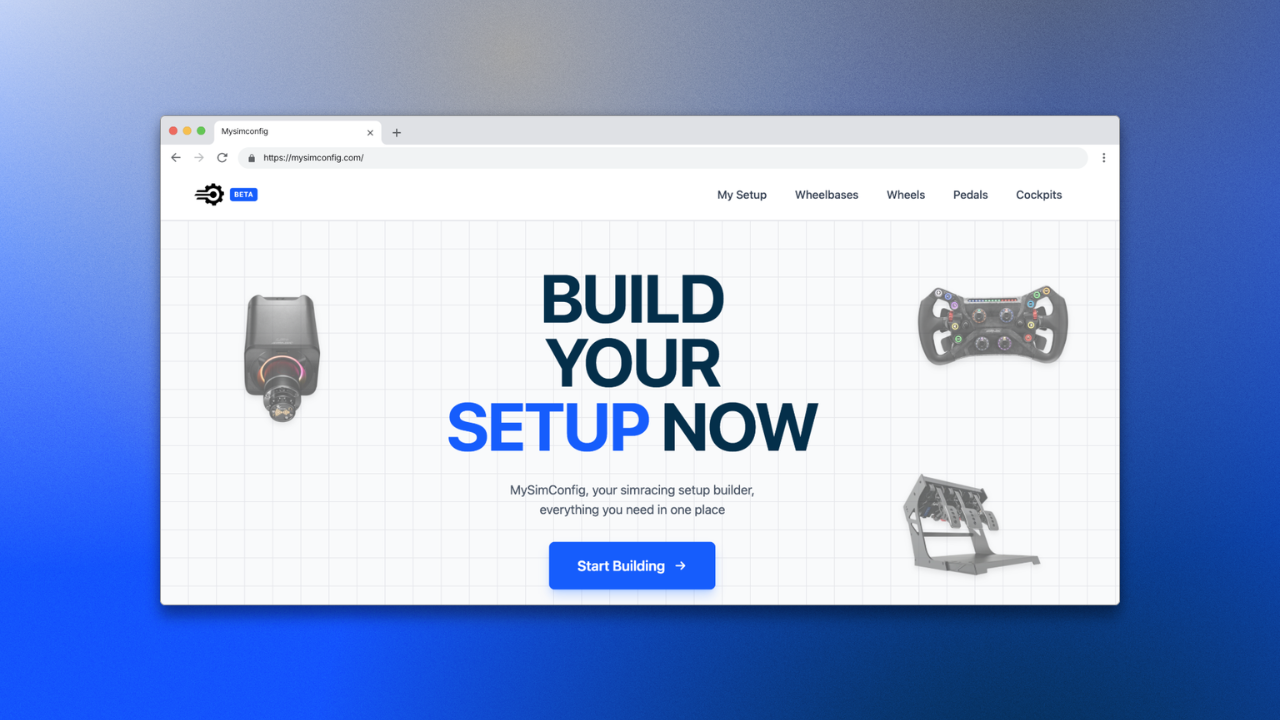
Leading this shift is mysimconfig.com, the definitive reference for rig builders. Using these tools allows you to treat your rig as an insurance policy. This tool allows you to confirm the compatibility of your base, wheelbase and cockpits, which has never been possible before. The platform is improving weekly and is promising enough to deserve some attention.
Lap Times Live in Your Feet, Not Your Hands
If you have a $1,000 upgrade budget, putting $800 into a new wheel and $200 into pedals is a mathematical failure. Steering is where you find the apex; braking is where you find the trophy.
The biological reality of racing comes down to how humans process data:
- Potentiometer/Hall Effect Pedals: These measure distance. Under the adrenaline of a last-lap lunge, the human brain is terrible at repeating a 14.5mm pedal travel. It’s a guessing game.
- Load Cell/Hydraulic Pedals: These measure pressure. Our brains possess incredible “muscle memory” for force.
A $500 load-cell pedal set on a rock-solid SimXPro XT120 will make you faster than a $1,500 Simucube on a wobbly desk every single time. Consistency in trail-braking requires a pedal that doesn’t move and a brain that remembers the squeeze, not the reach.
The 2026 Compatibility “Tax” is Real
The current market is a minefield of proprietary “ecosystem traps.” Brands like Fanatec and Moza often design their hardware to “force” you into their shifters, wheels, and handbrakes. This is the “Compatibility Tax.”
- The Console Hurdle: If you’re on PS5 or Xbox, you’re taxed by licensing. While tools like Drivehub exist to “force” cross-brand compatibility, we veterans call it “black magic”—it’s a hurdle that can break with any firmware update.
- The PC Freedom: The only way to truly escape the tax is the PC. On a PC, you have the “Direct Drive or Bust” freedom to mix a Simucube 2 Pro (25Nm) with Heusinkveld Ultimate+ pedals and a Thrustmaster shifter. Everything communicates via independent USB drivers. If you want to buy once and cry once, the PC is the only platform that allows for a truly best-in-class, modular architecture.
Immersion is a Multi-Sensory “Living” Document
In 2026, immersion is no longer just about the number of pixels on your screen. It is a multi-sensory experience that bridges the gap between sight and touch. We are seeing a massive shift toward tactile feedback, such as the Next Level Racing HF8 haptic pad, which translates engine RPM and tire slip directly into your seat.
While the debate between Triple Screens and VR (like the PSVR2 or Meta Quest 3) still rages, the common denominator is the desire for spatial awareness. However, hardware alone won’t solve the “lust” for more.