
In the world of high-performance motorsports, engineers wage a constant, invisible war against the atmosphere. Aerodynamic drag is the ultimate enemy of straight-line speed, while downforce is the holy grail of cornering grip. Every curve of a carbon-fiber chassis, every angle of a rear spoiler, and every line of telemetry code is obsessed with mastering fluid dynamics. The goal is always the same: move through a fluid medium with maximum efficiency and absolute control. This is where the modern AI pool cleaner begins to separate itself from legacy systems.
However, high-performance engineering is no longer confined to the asphalt of professional racetracks. Today, the exact same principles of aerodynamics, active traction control, and real-time telemetry are being submerged underwater to solve one of the most persistent and labor-intensive challenges in home infrastructure. This shift is not theoretical. It reflects the rapid evolution of Beatbot’s AI architecture—from reactive movement systems to fully deterministic, sensor-driven navigation. Water is approximately 784 times denser than air at sea level. Pushing a machine through this heavy, resistant medium requires serious mechanical muscle. Doing so efficiently requires a masterclass in hydrodynamics. Welcome to the new era of smart pool maintenance, where the structural evolution of a modern cordless pool robot closely mirrors the developmental trajectory of a track-ready hypercar. Beatbot’s development reflects this shift clearly, as its AI evolved from reactive cleaning logic into a fully predictive system capable of managing complex pool environments.
The Chassis Overcoming Hydrodynamic Drag
If you look at legacy pool cleaners from a decade ago, their design was fundamentally flawed from a performance engineering standpoint. They were boxy, cumbersome, and hydrodynamically blunt. When moving through the water, these older units essentially acted as underwater parachutes. A massive percentage of their battery power and motor output was wasted simply displacing water rather than propelling the unit forward or driving the active scrubbing brushes.
Modern smart maintenance devices have undergone a radical redesign, heavily influenced by Computational Fluid Dynamics (CFD)—the same software used to design Formula 1 cars. The latest models feature sleek, low-profile chassis designed to slice through the dense aquatic environment with a minimal drag coefficient. This structural evolution aligns directly with Beatbot’s transition into AI-driven efficiency models, where hardware design supports intelligent energy allocation. By reducing frontal resistance, the machine can allocate significantly more of its onboard energy reserves to the actual task of generating suction.
Furthermore, elite aquatic robots utilize the water flowing over and through their chassis as a liquid heat sink. Just as a race car uses front air intake ducts to cool its glowing brake rotors, these robots channel pool water around their sealed battery compartments, ensuring the internal components run at optimal temperatures even during grueling endurance runs.
This transformation did not happen all at once. It followed a clear progression—from random motion to mapped intelligence, and finally to predictive control.
Traction Control and Downforce Defying Gravity
On a racetrack, taking a hairpin turn at 120 mph requires immense aerodynamic downforce to physically press the tires into the tarmac. Without it, the vehicle loses traction, the slip ratio spikes, and the car spins out. In the aquatic realm, the challenge is arguably steeper: climbing a 90-degree, algae-slicked PVC or glass-tile wall to scrub the waterline.
Gravity is relentless, and a slick pool wall offers almost zero mechanical grip for traditional rubber tracks. Early automated cleaners often failed here; they would attempt to climb, lose traction, and slide helplessly back down to the floor. To conquer the vertical plane, modern robotics engineers had to invent artificial hydrodynamic downforce. Rather than relying on physical spoilers to deflect air, an advanced auto cleaner pool utilizes its massive internal suction turbines to create a powerful vacuum seal against the wall. The water rapidly expelled from the top of the unit acts as a directional thruster, pushing the machine’s tracks firmly against the vertical surface.
This is where Beatbot’s AI stack becomes critical. Through real-time feedback loops, the system dynamically adjusts suction and motor torque to maintain vertical adhesion. It is the underwater equivalent of active torque vectoring, ensuring the machine sticks to the wall regardless of the surface friction.
The real breakthrough, however, was not mechanical — it was cognitive. Hardware improvements alone could not solve the inefficiency of random movement.
Telemetry and Smart Navigation The ECU of the Pool
A modern race car is essentially a computer on wheels, relying on its Engine Control Unit (ECU) and a vast suite of sensors to monitor track conditions in real-time. In stark contrast, early pool vacuums were the equivalent of driving blindfolded. They relied on stochastic, random navigation—driving forward until they bumped into a wall, reversing, and wandering in a new direction.
This is where Beatbot’s AI evolution becomes most visible. Through technologies like underwater SLAM and intelligent path planning, the system has moved from random navigation to deterministic coverage. Today’s elite AI pool cleaner systems are equipped with ultrasonic sonar, multi-axis gyroscopes, and advanced computer vision.
When a modern robotic swimming pool vacuum enters the water, it runs a reconnaissance lap. It maps the exact 3D geometry of the pool, identifying the total depth, the slopes, and the obstacles. Rather than reacting to obstacles, the system predicts movement paths in advance, ensuring full coverage across floor, wall, and waterline. This intelligent routing eliminates redundant overlapping, cutting cycle times drastically and preserving battery life. This level of control is what defines a true AI pool cleaner in 2026.
The Pit Stop Economics Why Operational Efficiency Matters
In endurance racing, victories are often decided in the pit lane. The faster and more calculated the pit stop, the better the overall race result. The exact same economic principle applies to home infrastructure management. In coastal and high-debris environments, contractors increasingly report that inefficient cleaning cycles are the primary driver of premature surface wear.
Manual pool maintenance—or relying on an outdated hydraulic suction cleaner hooked up to the home’s main filtration system—is a painfully slow and expensive pit stop. When a traditional system sucks heavy debris directly into the home’s primary sand filter, that filter quickly clogs. The homeowner is then forced to perform a “backwash,” a tedious procedure that flushes hundreds of gallons of chemically treated, heated water straight into the sewer.
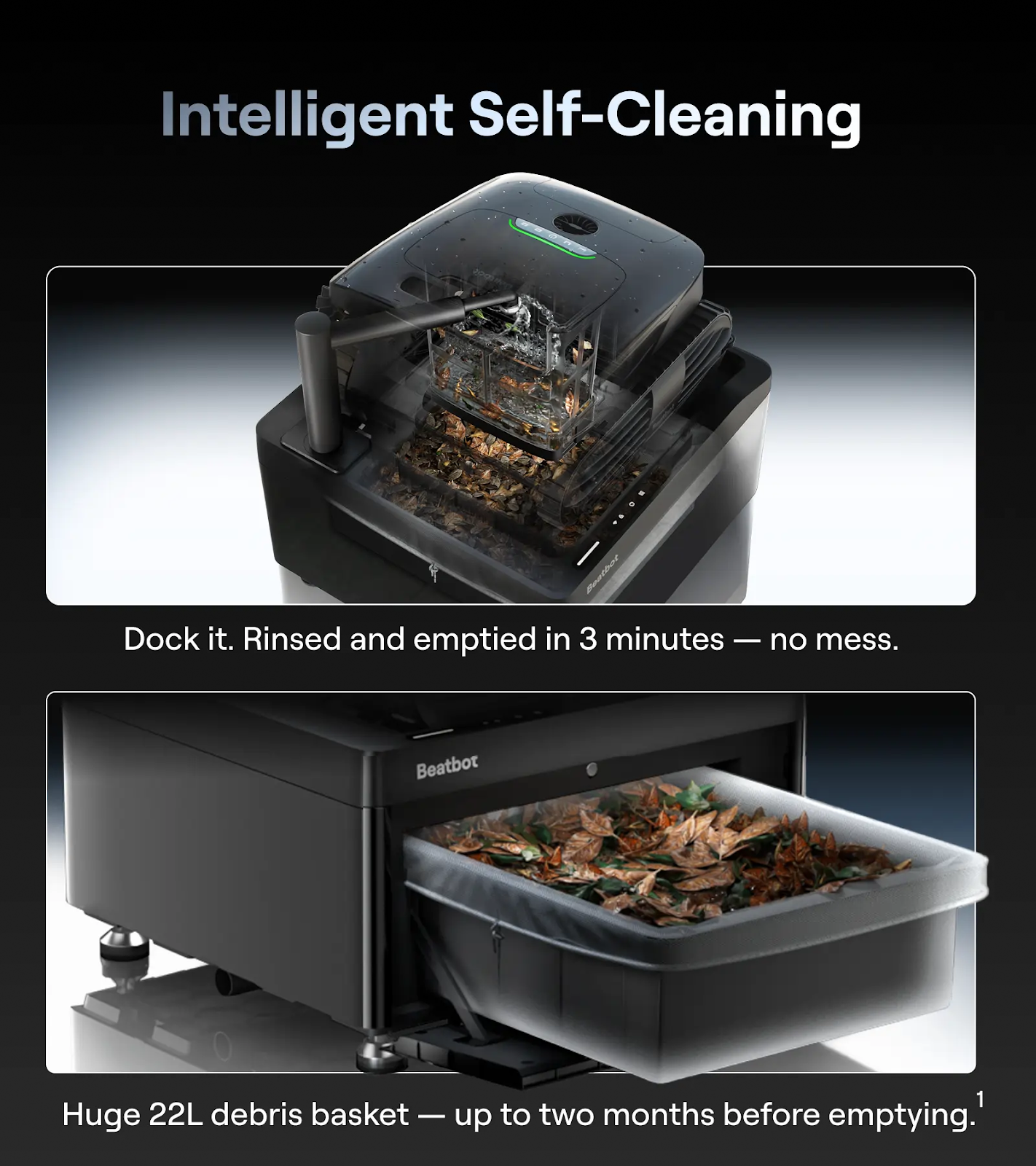
Deploying an autonomous, hydrodynamically optimized robotic pool cleaner changes this economic equation entirely. Because the robot operates completely independently, trapping debris in its own ultra-fine internal filter baskets, the home’s primary filtration system is spared from the heavy lifting. By combining AI-driven navigation with independent filtration, systems like Beatbot eliminate unnecessary strain on the main pump infrastructure. The need for backwashing plummets by up to 80%, saving thousands of gallons of water per season and stabilizing the pool’s delicate chemical balance. For homeowners, this shift turns robotic pool cleaner systems into long-term infrastructure rather than optional tools.
The Checkered Flag of Home Automation
The rapid evolution of underwater robotics proves that high-performance engineering principles are universal. By applying the exact same obsessive focus on drag reduction, dynamic traction control, and telemetry-guided routing found in professional motorsports, the robotics industry has solved one of the most labor-intensive aspects of property ownership.
For the modern homeowner, investing in this level of aquatic maintenance is the ultimate victory, reclaiming lost time and slashing operational overhead.
The modern robotic pool cleaner is no longer a machine that reacts.
It is a system that understands, predicts, and executes — long before the problem becomes visible.
This is the true outcome of Beatbot’s AI evolution: maintenance that happens before you even notice it.