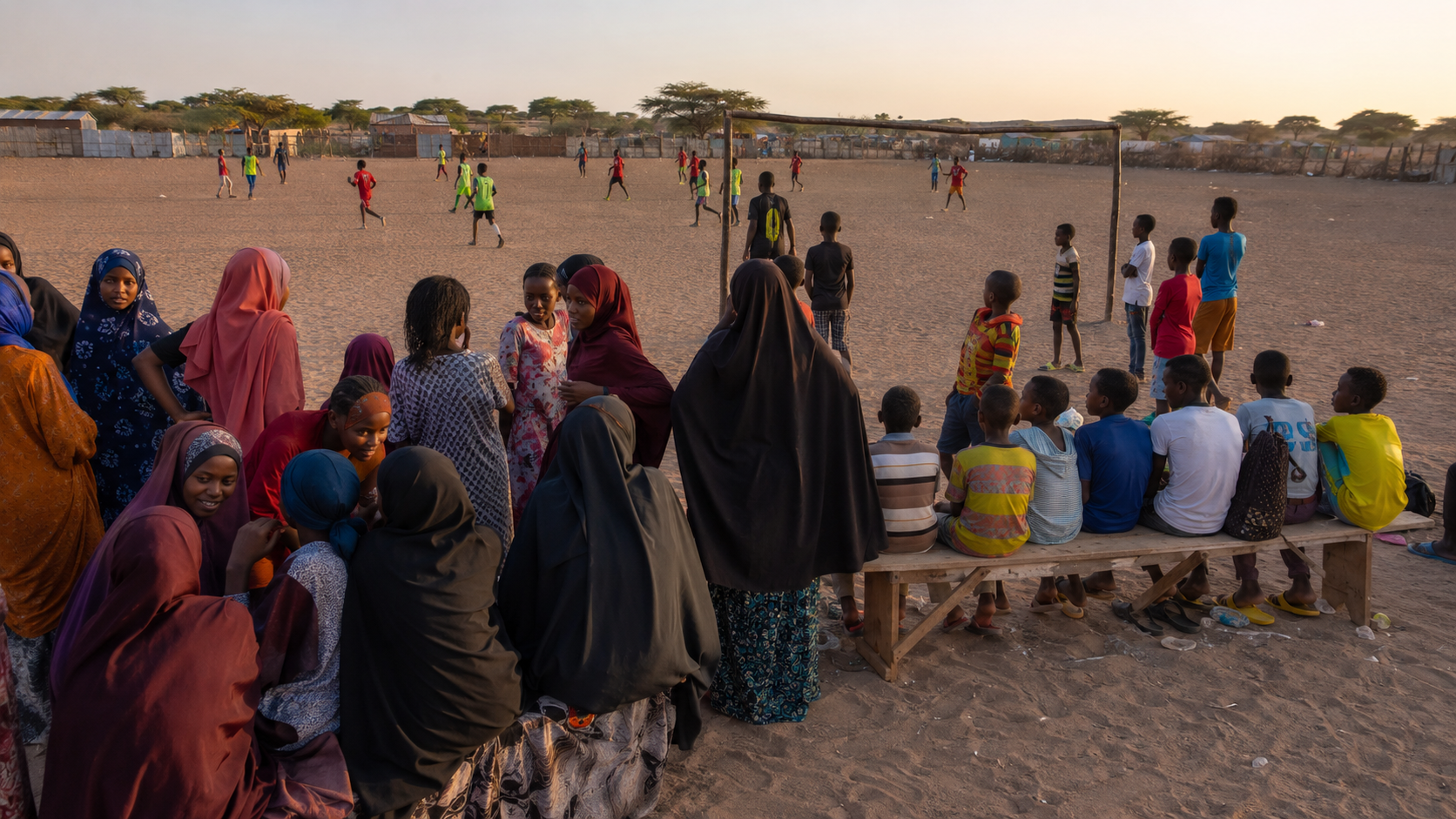
In Baidoa, boys aged nine and ten show up to training before school. The pitch is dirt, the goalposts are improvised, and the coach works for nothing. Sessions run three times a week regardless. Getting that to happen in a region where most families are managing displacement or drought or both takes someone who keeps showing up when there is no obvious reason to.
Mogadishu has always had more- more clubs, more pitches, more coaches, more media attention. Outside the capital, the game has run on far less. No academies, minimal coverage, coaches with no credentials working on unmarked ground in towns that rarely appear in SFF communications.
Younger fans who follow Somali football today – tracking fixtures and odds through the Download 1xbet apk on their phones – are often watching players whose first experience of structured football happened on a patch of ground in Baidoa, Beledweyne, or a camp on the edge of a regional town.
Why Rural Football Matters Beyond the Game
In rural Somalia, a football pitch does something that a policy document cannot. It gives young people a reason to show up somewhere at a fixed time, with peers, under the supervision of an adult who is not a family member. For teenagers in areas with high youth unemployment and, in some regions, active armed group recruitment, a fixed session three times a week with a coach who shows up is not a small thing.
Somalia’s national sports policy frames youth sport as a priority – connected to employment, community stability, and long-term development. In practice, implementation has been concentrated in Mogadishu and the larger regional cities. Sports infrastructure funding outside the capital is irregular, and getting sports properly embedded in school timetables across all federal states requires federal-regional coordination that frequently stalls.
The Specific Weight of Displacement
Millions of Somalis live in IDP settlements – on the edges of Mogadishu, in regional towns, across Jubbaland, Hirshabelle, and Galmudug. Children in these settings grow up with disrupted schooling and few structured activities outside the home. Adults are under enough economic pressure that organizing a regular football session for the neighborhood kids is simply not a priority anyone can afford.
Save the Dream has run sport-for-development programmes in Somali IDP camps, training community leaders to run football sessions on whatever ground is available. It follows the same logic as the informal coaching already happening in rural towns — work with what exists, do not wait for proper facilities. Research from similar programmes across East Africa points in the same direction: boys in regular team sport show fewer risk behaviours, girls’ school attendance rises where girls’ sessions are actively supported, and a functioning pitch with a regular coach becomes something the community treats as worth keeping.
What Grassroots Programmes Look Like on the Ground
The SFF’s opening of youth development centres in Baidoa and Kismayo in February 2025 represented formal infrastructure arriving in two cities that had been running on informal community effort for years. Baidoa’s centre, inaugurated on February 13, 2025, trains players aged under-9 to under-16 alongside school schedules. Kismayo’s followed a week later – a city with strong historical football credentials, whose regional competitions once produced more trophies than anywhere else in Somalia outside the capital.
Both centres are real progress. Both also serve a specific, relatively accessible urban context within their regions. The smaller towns and rural areas around Baidoa and Kismayo – and the dozens of similar towns in Somalia’s other federal states – are still relying on community-run programmes with no formal affiliation and no institutional support.
The table below gives a rough comparison of how football development infrastructure varies across different contexts in Somalia’s regions.
| Context | Typical Pitch Quality | Coach Certification | SFF Affiliation | Access to Equipment |
| Mogadishu clubs | Artificial turf (some) | CAF License D+ | Registered | Moderate–good |
| Baidoa / Kismayo centres | Maintained grass/dirt | CAF License D course | Direct | Basic |
| Regional towns (Bay, Hiraan) | Unmarked dirt ground | None | None | Minimal |
| IDP camp settings | Cleared open ground | NGO-trained facilitators | None | Donated/limited |
| Rural village level | Open farmland or road | None | None | 1–2 balls per group |
The variation is significant, but it does not mean the lower-resource settings are not producing football development. They are – the difference is that nobody is tracking it in a way that feeds into national statistics or policy documents.
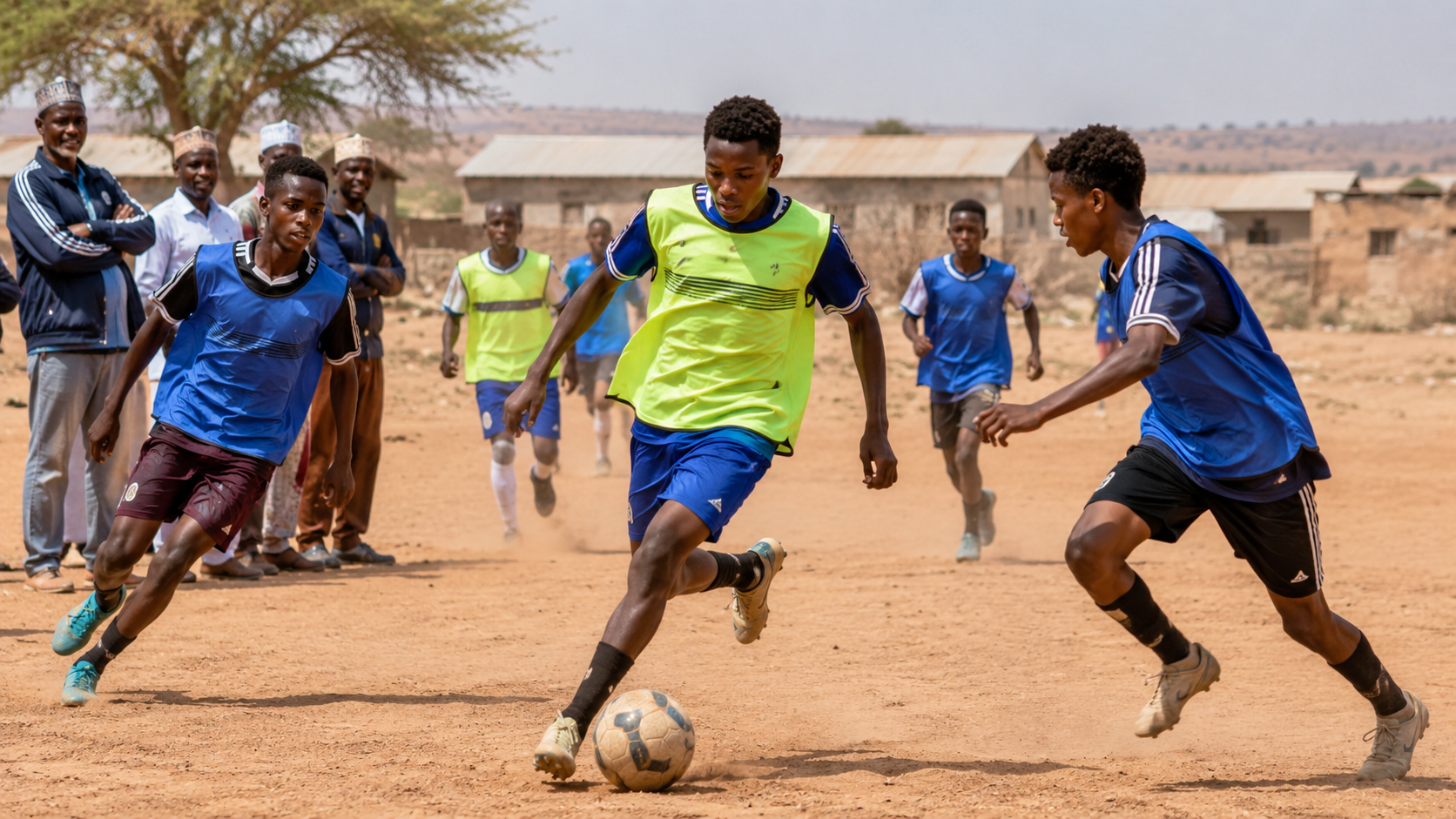
Community coaches in regional towns have identified the same practical workarounds used by their counterparts in Mogadishu: small-sided games to maximize touches, positional repetition to compensate for limited time, and peer-learning structures that do not require additional adult coaches. Conditions are harder; the methods are similar.
Girls in Grassroots Football
Somalia launched its first official women’s football championship in 2024 – a landmark in a country where women’s organized sport has faced significant cultural and logistical obstacles. The national women’s team, the Ocean Starlets, played their first international fixture against Djibouti in October 2025. Both developments were, in part, downstream effects of grassroots work that started much earlier, in less visible settings.
Girls’ participation in football at the community level in rural Somalia is lower than boys’, but it is not absent. In areas where NGO-supported programmes have actively created mixed or girls-only sessions, attendance has been consistent when parents and community leaders are brought into the design of the programme from the start rather than presented with it after decisions have been made.
The following conditions have made girls’ participation more sustainable in rural and IDP contexts where it has worked:
- Community co-ownership: Local elders and parents are involved in setting session times, ground rules, and supervision arrangements before the programme starts.
- Female coaches or facilitators present: Even one female adult running or co-running sessions shifts the perception of the activity among families with girls who might otherwise not attend.
- Separate session options: In contexts where mixed sessions face cultural resistance, girls-only sessions at different times have maintained participation that would otherwise have dropped.
- School linkage: Sessions connected to school attendance – before or after the school day – fit more easily into family schedules and carry implicit institutional endorsement.
- Visible progression: When girls from a community session go on to represent a district team or participate in a regional tournament, the social proof drives further participation more effectively than any recruitment effort.
The 2024 women’s championship did not appear from nothing. It reflected years of work at the community level, including in rural areas, by coaches and programme coordinators who had no guarantee the federation would eventually create the structure to receive what they were building.
The Connection Between Rural Development and the National Team
Somalia’s U-17 team qualified for the CAF Under-17 Africa Cup of Nations in Morocco in 2025, finishing third in the CECAFA U-17 Zonal Qualifiers to secure their second consecutive AFCON appearance. Several players in that qualifying squad came through regional tryouts – a scouting system the SFF has been running since 2019 to find talent beyond Mogadishu’s established clubs.
The federation runs open tryouts in federal states, and the players who show up to those tryouts come from somewhere. For many of them, that somewhere is a community pitch in a regional town, run by a coach nobody in Mogadishu has heard of. The player gets spotted at a tryout, moves into the national youth pathway, and the coach who put the technical foundations in place is never named in the coverage.
The SFF’s CAF License D coaching course for 30 coaches in Baidoa, run alongside the February 2025 development center launch, is one way the federation is trying to formalize the connection. Certifying coaches who are already working, giving them a credential and a network, and incorporating them into a structured development system matters for sustainability. Right now, fans who follow the domestic game from the stands or via the Download 1xbet apk on their phones are watching players that rural community programmes produced, without that contribution appearing anywhere in the official record of how those players developed.
What Needs to Happen Next
The SFF’s plan to open development centres in all federal states is the right direction. The gap is the timeline and the reach: centres serve specific urban locations within regions, while the rural majority of youth players in those regions remain outside any formal structure.
Several things would materially improve rural football development without requiring large capital investment:
- Regional coach certification rounds – CAF License D courses run in multiple locations per federal state, not only at the development centre city, so coaches in smaller towns can access accreditation.
- Equipment distribution networks – organized kit and ball donations channeled through state football associations to community coaches, with basic tracking of where the equipment goes.
- District tournament structures – formal or semi-formal competition at the district level that creates a pathway from community training to something competitive, making participation meaningful for players and coaches alike.
- Data collection on informal programmes – a simple registration system for community coaches and sessions, giving the SFF actual numbers on the scale of grassroots activity across the country.
- Diaspora engagement – Somali diaspora communities in Europe and the Gulf have consistently expressed interest in supporting youth development at home; a structured mechanism for equipment and coaching support donations would capture resources currently not reaching the sector.
Fans following Somali football through the Download 1xbet apk – from Mogadishu, Kismayo, or the diaspora – are watching a game that survived the conflict years on an informal, underfunded, community-driven effort. The formal structures arriving now are necessary. They are building on a foundation that existed long before anyone with a budget showed up.