Not only is esports entertaining, but it has also become a global phenomenon. Professional esports players have multi-million dollar sponsorship deals, work with personal trainers, psychologists, and coaches, and play in arenas packed to the brim. These matches garner millions of views online, and every victory comes with intense strategy, hard work, and unshakable nerves. It’s not children playing around for fun; it’s a career, rigorous, demanding, but truly mesmerizing. Matched bets are as common as they are for boxing and football. There are superstars, main events, massive narratives, and even controversies.
Training and Timetable
The daily play-to-earn routine of an esports player is not to be viewed as idle time or mindless ‘play’; instead, it mirrors the rigorous “training” schedule of elite athletes. Each day, esports athletes undertake 6 to 10 hours of scrimmages, tactical reviews, skills training, hand-eye coordination drills, specific wrist and eye fatigue, and general fitness exercises. Some teams employ nutritionists and sleep coaches to provide more specialized care. Fans track the game statistics and develop customized strategies on the melbet registration. Matches are constantly replayed, so pros can learn their weaknesses and strategize for future encounters. Most professional esports players have blazingly fast reaction times of 150–200 milliseconds, on par with race car drivers.
Top-ranked teams often share boot camp residences where they train, achieving complete focus. It’s all about full focus on their goals. They practice under tournament-like stress, recreate game-day pressure, and thoroughly review every match, just like traditional sports teams. These competitors must perfect their performance, as even a single incorrect motion could lead to losses worth thousands of dollars. The players require precision skill and physiological composure while navigating this “game.”
Promising Job Opportunities
These jobs are not just limited to competing in tournaments. The pro gaming ecosystem is vast and full of well-paid opportunities. The different job roles include:
- Professional Players: Competing and emerging victorious in mega tournaments like The International or Worlds. For instance, there is a Dota 2 team known as OG. They won approximately $15 million from a single event.
- Streamers and Content Creators: Streaming platforms like Twitch and YouTube allow users to post videos. This is how many ex-pros and skilled gamers make more than $100k yearly.
- Analysts and Coaches: Esports teams like to have strategists, trainers, and talent scouts on their payroll.
- Event Organizers and Casters: Major tournaments need people to run the show, including commentators, tech teams, producers, and anyone involved in the video montage editing for the matches that are subsequently projected.
A report by Goldman Sachs reveals that esports are poised to surpass $2000 million in revenue by 2026. With such lucrative opportunities available, the esports ecosystem is evolving, and players have the potential to build long-term careers.
What You Need To Succeed In Esports
Accomplishing anything requires effort; in this case, it entails devotion, self-control, and quick decision-making under pressure. Time is not on your side. There is no difference between winning and losing, measured in milliseconds. Players react out of instinct and train on autopilot. Games require cerebral engagement; they are not hand-based activities. Team expectations, public scrutiny, and high-pressure matches broadcast to millions fuel the fire. Betting fans means the mental toll triples. Staying mentally sharp during a “shout-cast” for hours while giving commands to teammates, regulating one’s feelings on a tight leash, and the mental strain from holding back emotions is a norm and reality for professionals.
Mental endurance and focus
If your mind physically burns out midway through a match, winning a tournament will be nearly impossible. Professional players must concentrate for long hours and train their minds like a marathon runner. Concentration needs to be solid for 8–12 hours. Blink is too long, and the match is gone. A single wrong click in Dota 2 or CS:GO can be a $500k loss. That is more than just concentration. That is peak pressure management.
This is why the best teams have psychologists onboard—not because the players are emotionally softer, but because their mental stress is unyielding. Trying to click “calmly” amidst global audiences, flashing lights, and screaming fans is mental warfare. The good news is that the best athletes don’t cringe at this. They have mastered the ability to think through the pandemonium strategically.
Teamwork and Communication
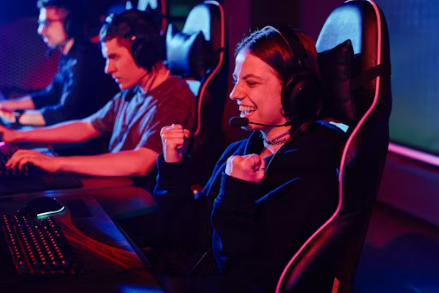
Esports are never a one-person show. While the best individual players might be exceptional, their teams ultimately come on top. It requires time, trust, and a lot of synergy to create that “perfect” blend that runs like a well-oiled machine, and the most outstanding teams truly exhibit such traits. Hence, elite teams focus on hybrid communication training and honing their key skills. As far as team play goes, essential factors include:
- “In-game” team communication: Every command or phrase has to be succinct, sent, and responded to within a split second. There is no room for ambiguity in this setting.
- Role awareness: Team members know their designated roles, timing, and secondary strategies.
- Mentality Control: Problems must be reframed as challenges. Do not blame fellow teammates, rage, or even quiver your lips.
- Non-verbal cue reads: They can tell what teammates intend to do without uttering a word.
Jobs and wages are based on these skills. Clean team communication boosts absolute hyperspace performance in games that rely heavily on precision timing.
Worldwide Acknowledgment and Popularity
Esports celebrities have transcended being mere names on the internet and are now global icons. Their streams attract millions, and they populate billboards. Faker is regarded as a Messi in South Korea, and s1mple draws crowds to European stadiums. These athletes perform more than just esports. They change the odds for betting, attract giant sponsors, and fill arenas. Fame in esports is a phenomenon in itself.
| Player | Game | Twitch Followers | Highest Prize Won |
| Faker | League of Legends | 4.2M+ | $1.5M+ (Multiple titles) |
| s1mple | CS:GO | 3.6M+ | $1M+ (Major winner) |
| Bugha | Fortnite | 1.3M+ | $3M (World Cup 2019) |
| TenZ | Valorant | 1.4M+ | $250K+ (VCT Champions) |
These numbers are significant. Corporations spend millions of dollars to market their brands by sponsoring them. Fame in esports adds to the business venture.
Industry Infrastructure
A vast system runs behind the games. It includes gamers, their coaches, lawyers, managers, agents, and a whole health staff. Football clubs are now matched with the newly built training facilities. There are contracts, trade deals, and performance bonuses. With corporate teams like Team Liquid and G2, pro teams run like corporations.
Global productions have replaced “events.” The stadiums of Katowice are always filled for the Intel Extreme Masters, while The International boasts of streaming in over 20 languages. Betting companies employ dedicated odds analysts for esports. Every part is engineered for relentless performance. Along with it, esports is no longer a hobby but a billion-dollar industry.
Esports in Education
We are now watching our school systems adapt and evolve in real time. In the US, 170 colleges have varsity-level esports, while schools worldwide offer scholarships for esports management or game strategy.
South Korea and China, among others, are in charge of government-sponsored programs to aid youth in their future careers as esports professionals. It’s not all play, though, as the professionals cover game design, psychology, coding, game theory, and broadcasting. Betting pros are even analyzing match stats like football analysts. The classroom is changing, and esports is leading every charge.
Extended Career Options
Professional esports careers are not bound to a singular path, as many individuals transition into roles such as media personalities, coaches, or analysts. Others start their teams, develop video games, or work as strategists in betting companies. The ability to function in a team, make real-time decisions, and manage pressure are all skills that shift the person’s career into a new dimension.