Around 40,000 people die in car accidents across the U.S., as per data from the National Highway Traffic Safety Administration (NHTSA), with scores more injured. However, not all deaths and injuries occur within the first 24 hours or days after the mishap. In some cases, injuries and even deaths manifest long after. (1)
Legal experts in tort or personal injury law refer to this delay as the “injury gap,” and it can be a thorn in any car accident injury claim. As soon as the adrenaline and endorphins from the crash wear off, a victim may start to feel pain that hadn’t been there. And because they didn’t feel any pain that time, they tend not to seek medical treatment.
This gives the other party more leverage to protect them from liability, reducing the victim’s financial compensation. Learn how a car accident, no matter how bad, can be life-changing in a bad way when not acted on quickly.
Your Body’s Reaction to a Crash
Medical experts say the human body has a way to protect itself from threats, a response also known as the fight-or-flight response. In this situation, the brain signals the adrenal glands to start pumping adrenaline into the bloodstream.
According to the Endocrine Society, adrenaline (also known to the medical community as epinephrine) forces blood vessels to redirect blood flow toward the muscles. This allows a person to escape danger, even with a serious injury. Other effects include an increase in strength and performance, heightened awareness, and enhanced pain tolerance.
The group notes that these effects typically last only an hour after the stress subsides. At that point, the person may begin to feel the pain from their injuries. In some cases, excess adrenaline may remain in the bloodstream even after the danger has long passed. This risks a host of health conditions, from insomnia to internal organ damage.
And while being able to feel less pain is helpful in a dangerous situation, it isn’t anywhere else. Pain is your body’s way of signaling you that there’s something wrong, whether it’s a flesh wound or a fracture. This is how certain injuries like traumatic brain injury turn deadly, as the lack of a painful sensation lulls them into a false sense of safety.
Long-Term Repercussions
A car crash victim’s suffering doesn’t necessarily end once the adrenaline rush subsides. The accident can leave them mentally scarred, affecting their ability to enjoy their lives to the fullest. For instance, the victim can still be in a state of psychological shock (not to be confused with hypovolemic shock caused by severe blood loss).
But, how long can shock last? Medical experts say it depends on the person, ranging from a few days to several years. Knowing the symptoms is crucial not just for seeking appropriate post-crash care but also for compensation for the pain and suffering.
Under the Diagnostic and Statistical Manual of Mental Disorders (DSM-5), shock that lasts for three days to one month can evolve into acute stress disorder (ASD) if the auto accident victim shows at least nine of the following symptoms: (2)
- Recurring memories of the car accident
- Having nightmares of the car accident
- Flashbacks as if the crash is happening now
- Stress response to anything that reminds the victim of the accident
- Struggling to feel positive emotions (e.g., happiness, satisfaction)
- Reality-altering sensations (e.g., being in a daze, time slowing)
- Unable to remember essential details related to the accident
- Avoiding memories or feelings related to the incident
- Avoiding reminders related to the incident (e.g., driving or riding a car)
- Difficulty getting enough sleep
- Sudden outbursts toward people or objects
- Staying alert even when there’s no imminent threat
- Difficulty concentrating on completing tasks
- Exaggerated reactions to loud or sudden noises
Also, according to DSM-5, ASD can become post-traumatic stress disorder (PTSD) if the symptoms persist for more than a month. It’s more common than you might think, with a study published last March stating that 30% of all road traffic accidents in North America involve victims who develop this mental disorder. (3)(4)
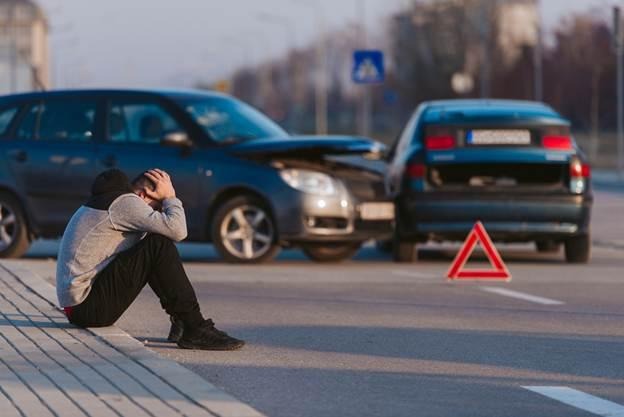
ASD may be no joke, but PTSD is nothing to laugh about. If you’ve read about war veterans suffering from PTSD, you should know that this condition rarely goes away entirely and on its own. As much as a person doesn’t want to remember the trauma, they can’t help but do so because the environment keeps triggering it.
As a result, the constant triggers disrupt their routines. A car accident victim is reluctant to go outside for groceries or medicine, fearing they may be involved in another crash. Work is also disrupted, whether in the office or while working from home, resulting in absences and lost wages. All this makes treatment of physical and emotional distress difficult.
The effects of PTSD worsen if the victim becomes disabled as a result of the car accident. Besides the pain that comes with it, the disability serves as a reminder of the horrendous incident. It can lead to further emotional distress, such as anxiety, depression, and panic attacks, which add to the victim’s pain and suffering.
Seek Help After a Car Accident
Regardless of the accident or injury severity, it’s important to seek help immediately after a car accident. Seek medical care for your injuries at a hospital, after which talk to a personal injury law firm to explore your options for compensating your medical bills and other costs.
References
1. “NHTSA Estimates 39,345 Traffic Fatalities in 2024,” Sources: https://www.nhtsa.gov/press-releases/nhtsa-estimates-39345-traffic-fatalities-2024
2. “Table 3.30 DSM-IV to DSM-5 Acute Stress Disorder Comparison,” Source: https://www.ncbi.nlm.nih.gov/books/NBK519704/table/ch3.t30/
3. “Exhibit 1.3-4DSM-5 Diagnostic Criteria for PTSD,” Source: https://www.ncbi.nlm.nih.gov/books/NBK207191/box/part1_ch3.box16/
4. “Post-traumatic stress disorder among road traffic accident survivors: A systematic review and meta-analysis,” Source: https://www.sciencedirect.com/science/article/pii/S2590198225000533