Despite its Challenges, EchoPark is Always Circled on Cody Ware’s Calendar
MOORESVILLE, N.C. (July 6, 2026) – An echo is the repetition of audio caused by sound waves bouncing off a surface and returning to the listener. At EchoPark Speedway, however, it’s the reverberation of cars bouncing off walls and each other that often sends them back to the garage.
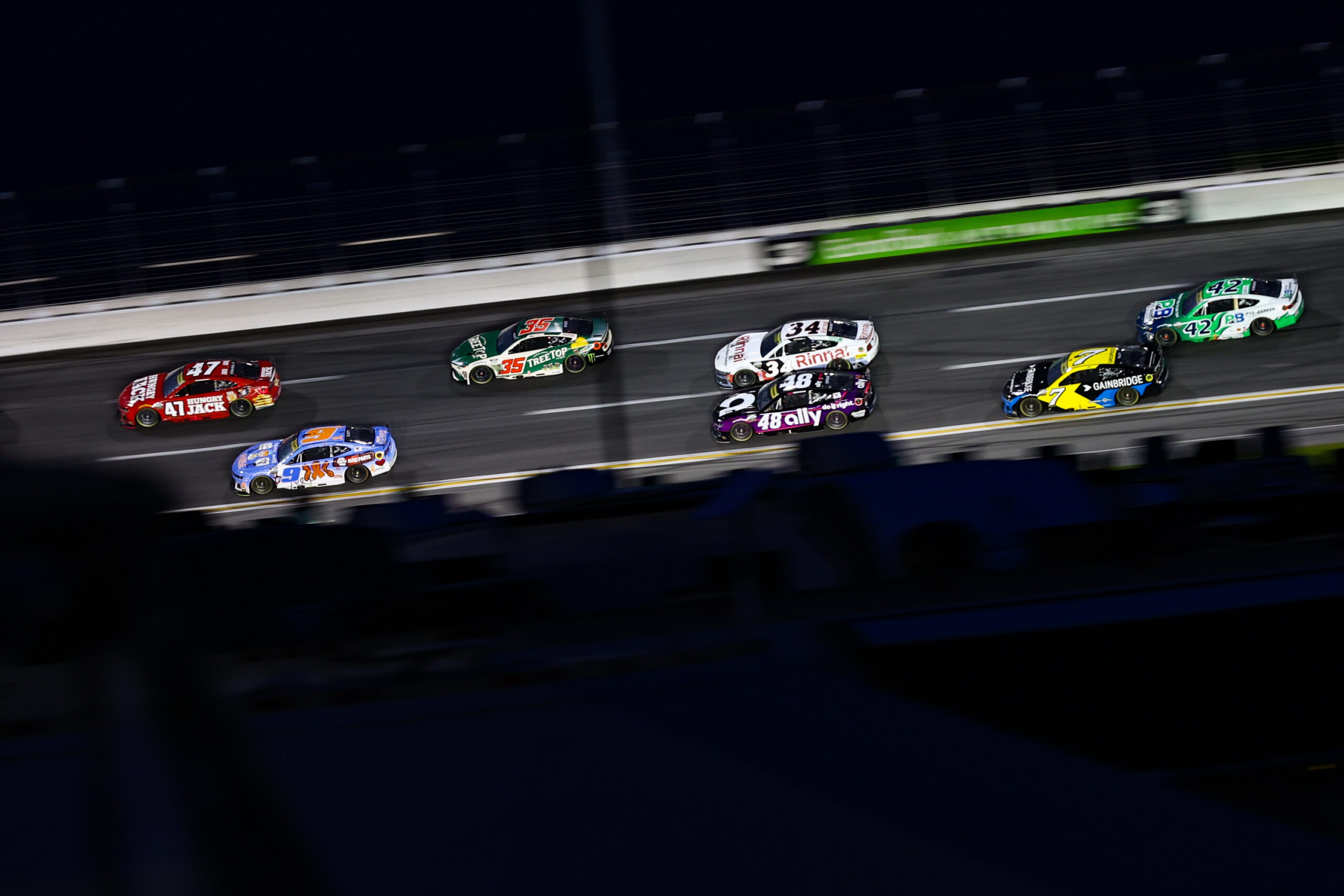
It’s an apt comparison as the 1.54-mile oval located just south of Atlanta in the rural town of Hampton, Georgia, averages 9.4 caution periods and 57 caution laps per race. In fact, in the last two races at EchoPark Speedway, high-water marks have been established with 10 caution periods apiece and a significant jump in caution laps. Last July’s Quaker State 400 totaled 68 caution laps and this year’s Autotrader 400 in February totaled 67 caution laps.
The attrition rate is high due to the layout of EchoPark Speedway and its style of racing.
The track features corners banked at 28 degrees and a relatively narrow, 40-foot-wide racing surface. Drivers can go wide open in qualifying where it’s just them on the track in a race against the clock, but on Sunday when all 38 cars are on track at the same time, drivers have to work the throttle more, as the pack seemingly becomes a living, breathing organism, expanding and contracting. More often than not, this ebb and flow catches drivers out and, in turn, multiple drivers get caught up.
“Superspeedway racing is always a game of mental chess. It tests your reaction times, how you process information, how well you make decisions in the heat of the moment, and it all comes with a healthy dose of stress, but the stress is amped up to a hundred at Atlanta,” said Cody Ware, driver of the No. 51 Rocket Doctor Chevrolet for Rick Ware Racing.
“The time you have to make decisions is pretty much zero. You’re relying on instincts and your spotter. To be able to run well and have a good finish at Atlanta is a testament to your subconscious. Reaction time, judgment, decision-making – it all gets pushed to its absolute limit at Atlanta.”
Drivers typically run with a handling package that frees up their racecar. It enhances speed, but also puts drivers on a knife edge of control.
“You’re always freer than you really want to be, but you really have to be with the way the aero works,” Ware said. “Between the draft and the dirty air and drag that comes with it, you’ve got to have a free racecar to keep going wide open, or almost wide open. It puts you on a knife’s edge, but you make a lot of speed that way. You find a way of getting comfortable being uncomfortable at Atlanta.”
Exacerbating the style of racing featured at EchoPark Speedway is its tight confines. At a mile-and-a-half, the oval is certainly bigger than the kind of half-mile short tracks typically associated with tight confines, but when turning laps at nearly 180 mph, closing rates are quicker and sightlines are diminished. It’s the same style of racing seen at Daytona (Fla.) International Speedway and Talladega (Ala.) Superspeedway, but without Daytona’s extra 1.5 miles or Talladega’s additional 1.66 miles.
“At Daytona and Talladega when we’re in the middle of the corner, the whole track is wide, and when you’re in the banking, you can see a good bit through the corner. Even when you’re in the draft, even when someone’s bumper is right in your windshield, you can still see pretty well,” Ware said.
“But at Atlanta, the tight radius of the corners means you can only see three or four car lengths ahead. So, all the information about what’s happening way ahead of you needs to be portrayed to you really well, precisely and quickly by your spotter.
“You’ve got to have a good, close relationship with your spotter. Brent Wentz, my spotter, knows what I need to hear and he delivers what I need to know quickly and efficiently. It’s important, because I need to digest what he’s telling me and make judgments based off something I may not even see yet. That does happen to an extent at Daytona and Talladega, but nothing like what it is at Atlanta.”
This makes competing at EchoPark Speedway a taxing experience, both physically and mentally.
“One of the biggest things is, honestly, just remembering to breathe,” Ware said. “You feel like you’re on a qualifying lap every lap, and so the G-forces just push you down into the seat. And with the downforce, steering feels a little bit heavier, so your forearms get more of a workout at Atlanta.
“Keeping yourself loose, remembering to hydrate, staying calm – all basic things – but at Atlanta, they’re massively important. When you keep your mind fresh, you keep your body fresh, all the way through to the finish.”
Even with these challenges, EchoPark Speedway is a venue that’s always circled on Ware’s calendar.
“It’s definitely a driver’s track, and superspeedways have been good to us over the last few years,” Ware said. “It’s in the driver’s hands to try to make it through all the wrecks, be there at the end and extract the best finish possible.”
Ware’s race to the finish begins Saturday at 4:30 p.m. EDT with qualifying. That will determine his starting spot in Sunday’s Quaker State 400. The 260-lap race goes green at 7 p.m. with live coverage on TNT and SiriusXM NASCAR Radio.
About Rick Ware Racing:
Rick Ware has been a motorsports mainstay for more than 40 years. It began at age 6 when the third-generation racer began his driving career and has since spanned four wheels and two wheels on both asphalt and dirt. Competing in the SCCA Trans Am Series and other road-racing divisions led Ware to NASCAR in the early 1980s, where he finished third in his NASCAR debut – the 1983 Warner W. Hodgdon 300 NASCAR Grand American race at Riverside (Calif.) International Raceway. In 1995, Rick Ware Racing was formed, and with wife Lisa by his side, Ware transitioned out of the driver’s seat and into fulltime team ownership. He has since built his eponymous organization into an entity that competes full-time in the elite NASCAR Cup Series while simultaneously campaigning winning teams in the Top Fuel class of the NHRA Mission Foods Drag Racing Series, Progressive American Flat Track (AFT), FIM World Supercross Championship (WSX) and zMAX CARS Tour.