Home Blog Page 1673

Famous Letters by Princess Diana to Friends Show Love of Family

Photo by Simon Hurry on Unsplash

One of the images presented of Diana, Princess of Wales, is that she was always alone. It’s easy to see how she was cast in that role in her final years, even if the details weren’t completely accurate. She was certainly removed from her former husband since he showed he had other social, familial, and romantic priorities. As a divorced royal, she had fewer social privileges and obligations since she was the mother of future royalty. Since she was a public figure of interest, she also stayed in the public eye, whether she liked it or not.

She still had her sons, she had her charities, and she had several friends who she confided in. Of course, she still had to be careful about what she did and who she interacted with in public. But not everyone knew she was quite good at correspondence with friends, some who were also in the public eye and even some longtime colleagues who preferred their privacy assisted her in taking her mind off the day-to-day spotlight and all of the challenges that came with going against the grain of the monarchy.

Her famous letters are able to give a better insight into her life and her views of the world. Like her public persona, Diana in her letters came across as bright, even funny, but also felt stressed about the pressures put upon her, even after she was officially divorced from the royal family.

Over the years, more of her famous letters have turned up. Some of her friends may have passed away, and their family/heirs decided to put their letters up for auction. Other friends have decided to put their letters into the public domain so people can learn more about what she was really like.

The letters also offer interesting insight into different points of her life, from significant moments to more routine moments where she relished some of the calm around her.

Some interesting famous letters were shared between her and longtime friend Roger Bramble. These included things like Christmas cards or routine items like how her day was or her reaction to an unflattering biography of her life that was recently published.

Letters to and from another friend, Cyril Dickman, not only share what’s on her mind, but what’s happening to those around her, specifically what her sons were getting up to at school.

Cyril Dickman was a longtime steward at Buckingham Palace, and also a longtime confidante of Princess Diana, even after she fell out of royal favor.   

For instance, in the late 1980s and early 1990s, she would write to him about how her two boys were doing at boarding school. William, for instance, was always a good student, but Harry did have more of a habit of getting into trouble, even at a young age.

At the same time, she said William always did what he could to look out for his little brother, especially when they were at school together in their younger days. This included hugs when needed.

Most Reliable Gasoline Engines

As a rule, the most survivable engines are usually not the most advanced in design, without superchargers and other technical frills. Although there are some exceptions. We have based our rating on our experience and the recommendations of servicemen. One more thing. Do not be surprised if some of our listed engines cannot be met on modern cars; in fact, it takes time to compile complete statistics, but there are plenty of them available on the secondary market.

VW 1.6 MPI EA 211

Let’s change the ten from the VW 1.6 MPI EA 211 motor. This unit was designed as a simple and unpretentious engine for inexpensive models of concern. Our compatriots are familiar with it from the Polo model, which has been produced in Kaluga since 2010. We cannot say that the engine has turned out perfect in terms of reliability, although it has generally proven quite durable and reliable. True, at first had to put up with oil consumption – the consumption of liquid lubricant sometimes reached up to 500 grams per 1000 km of run. After the change of the piston group design, the consumption decreased noticeably. At the same time, instead of the chain, there was a belt in the timing belt drive. It is believed that since 2015, the engine has eliminated most of its issues. However, oil consumption in some copies still remains, as well as oil and coolant leakage through the gaskets. The motor is available in two power variants: 90 and 110 horsepower. Its service life is 250,000 to 300,000 km.

Opel 1.8 Z18XER

The Opel 1.8-liter Z18XER series four was installed not only in the Vectra, Astra, and Insignia, but also in related GM models. By design, the engine is quite simple – distributed injection, no hydro-compensator valves. Only the variable valve timing system can be called from technical novelties. Maybe that is why it is able to run 300,000 km, and often even more before overhaul. Telling the truth, before it it is necessary to change the timing belt, valve cover gaskets, heat exchanger, and crankshaft oil seals. However, it is not very expensive. In addition, the engine is good and maintainable, and the parts are inexpensive. More info by link https://yurovskiy.info/

Hyundai/Kia 1.6 G4FC

This engine has been installed in Solaris and Rio since 2010. In the second generation of these models, the unit received a second Phase Shifter on the exhaust shafts. The engine is based on an aluminum block and cylinder head, with the timing drive being a metal chain that has a lifespan of at least 150,000 km. The valve slack is mechanically adjusted every 40,000 km. The weak points include the catalyst, which can fail even after 50-70,000 km. The main thing is to recognize the malfunction in a timely manner and take appropriate measures. Otherwise, the ceramic particles from the destroyed catalytic converter enter the pistons and damage the engine. If high-quality fuel and oil are used, the engine can last up to 350,000 km; however, before reaching this milestone, it will be necessary to replace almost all gaskets and seals.

Nissan HR16DE

The 16-valve engine from Nissan has its pedigree dating back to the 1990s, when it was installed on many models of the company. During this time, the engine has managed to get rid of its childhood diseases and, to date, has shown itself at its best. It is endowed with sharp traction on topsides and perfectly pulls from idle rpm. For a small-capacity C-class, it is sufficient even for drivers with racing ambitions, within reason, certainly. The engine likes high revolutions, but it sinks in daily traffic jams. If driving for a long time at low revolutions, jostling in car queues, piston rings can wear down. Therefore, from time to time, it is necessary to burn out the engine, having rushed along the highway at revolutions above average. As for the rest, the engine is exemplary reliable. Even a timing chain will have to be updated only after 250,000 km. The engine’s lifetime reaches 350 thousand km.

Mitsubishi 2.0 4B11.

This motor has been in production since 2005. It has been put in many models, particularly in Outlander and tenth Lancer. The engine is all aluminum, with cast-iron liners pressed into the block, a 16-valve head, and hydro-compensators in the valve train. The variable valve timing system is available in two versions: only on the intake valves or on both shafts, and the timing mechanism is a chain.

The reliability of this “four” is largely due to the simplicity of design, without new-fangled, but capricious frills. The quality of the assemblage and metal is quite decent. The engine arrives at the repair area primarily due to the natural wear of the cylinder-piston group. And it can happen to 300-400 thousand km. Additionally, it has a repair size, and original parts can be purchased separately.

Mazda 2.0 Skyactive-G

Gasoline “four” from Mazda in our rating is rather an exception than a rule. The engine is simply stuffed with innovative technologies – except that there is no turbocharger. Of the technical delicacies we should mention direct injection, the system of phase change in the timing chain mechanism on both shafts, came from the motorsport exhaust manifold, working under the scheme 4-2-1, as well as a record for modern gasoline engines compression ratio 14:1. In addition, the engine simultaneously works on the Atkinson cycle and Otto, which allows for high power (150-168 hp and 208 Nm) and environmental friendliness with a record low fuel consumption (4.9 l/100 km according to the manufacturer).

But the most important thing is that the Skyak four turned out to be extremely reliable. However, the flip side of the medal is its insistence on the quality of fuel and oil. At the same time, it is necessary to constantly monitor the level of liquid lubrication. Since the “Skyactive” motors are generous in oil consumption, their deficiency can lead to a breakdown.

The engine of this series has been in production since 2011, and to date, there have been no significant issues; those that have arisen have been promptly addressed. Some machines with this engine have run more than 250,000 km, and are still in operation. However, the maintainability of the engine is not the highest, and with spare parts can be difficult.

Renault 1.6 K4M

The Renault K4M engine has been part of its family tree since the 1990s and has undergone minimal changes since then. And the modern trimmings – twin-shaft timing and hydrocompressors in the valve train. The cylinder block is made of cast iron, and the piston group is time-tested and not prone to oil consumption. The engine has excellent low-end traction and a fairly modest fuel appetite and is indifferent to slight overheating. With the use of quality consumables and the timely replacement of key components, such as the timing belt with rollers and the coolant pump, the engine demonstrates remarkable reliability.

True, the masters call the engine snotty – after 150,000 km, the valve cover gaskets, oil seals, and seals of crankshaft and camshafts start leaking. The engine electronics occasionally malfunction – specifically, the sensors, blocks, and ignition coils malfunction. And that’s, perhaps, all. After an overhaul, the K4M can easily run up to 400,000 km. And the cost for parts and work will be very modest.

Subaru 2.0 FB20.

The FB20 engine replaced the legendary EJ20 for its reliability back in 2010. All shortcomings of the predecessor were taken into account during the development of the new engine, including lightweight pistons, asymmetric connecting rods, and a redesigned cooling system. The engine is even more durable due to the use of timing chain instead of timing belt, and cast iron bushings are pressed into the aluminum engine cylinder block. But it was not without problems. The first copies had a defective cylinder block, which led to a sharp increase in oil consumption. But since 2013, this defect has been eliminated. Although it is recommended to carry a can of oil with you.

In general, the engine has proven to be as conditional as the EJ20. Although it is inferior to it in maintainability. Also FB20 like quality fuel and oil, as well as regular maintenance with an interval of 10,000 km, and better often. Spare parts are expensive, and there are few quality “non-original” parts on the market. But the engine life is approaching 400,000 km.

Toyota 2.0 3ZR-FAE.

This power unit from Toyota has inherited durability and reliability from its predecessor AZ series. At the same time, it got rid of the problems of thread weakness of the block. At the same time it became technically more advanced, slightly more powerful and more economical. The engine is for the first time equipped with the Valvematic system, which smoothly varies the height of the valve lift, appeared hydro-compensators and a system of dual variable valve timing on the intake and exhaust shafts (Dual VVT-i). It was the weak link. After 100-130 000 km mileage the phase change clutches were failing. Replacement, however, does not strike much on money – repair will cost about 25,000 rubles.

In general, the cost of original spare parts for Toyota is cheaper than most competitors, and the repair price is the lowest among the Japanese classmates. Engine life is about 350,000 – 400,000 km.

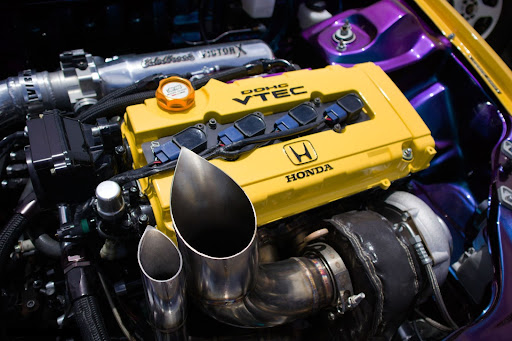
Honda 2.0 R20A

Another Japanese engine Honda R20A has settled in the troika of leaders. It is reliable and quite simple in design, and it is still installed in some models of the company. It can be found in the past generations of Accord and CR-V of the last three generations. It has been available since 2005. The engine has good traction throughout the range and especially a powerful kick after 3,000 rpm. It is noteworthy that the engine “4” quickly accelerates up to 7000 rpm – the motorcycle experience in construction of automobile power units affects. The engine is fully “aluminum”, with a single camshaft that drives a 155 horsepower chain, which is quite decent for that time. The i-VTEC system is responsible for phase adjustment. There are no hydro-compensators – it is necessary to adjust them every 45,000 km, although in fact the operation is required much more seldom – after 80-120 thousand km.

The engine resource is 350,000-450,000 km. The quality of parts manufacturing is higher than that of competitors. Here is just the repair dimensions for the engine are not initially provided. Parts for Honda engines are not cheap, so the overhaul is one of the most expensive among the “Japanese”.


What to do if the car battery is dead

1. “Light a cigarette” from a donor

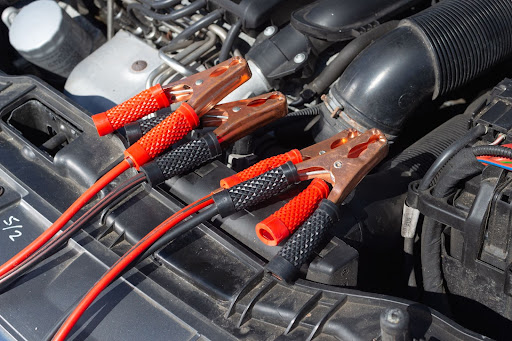
The most reliable way to revive a car with a dead battery is to use the energy of a functioning car. For this purpose, it is necessary to place the second car side by side (directly “bumper-to-bumper”), open the hoods, and connect the batteries of both cars with wires. Make no mistake! 

The correct procedure is: 

  • Turn off the donor’s engine and turn off the ignition.
  • Connect the red wire first to the positive terminal of the donor, then to the discharged battery.
  • Connect one end of the black wire to the “mass” of your car (for example, to the engine cylinder block or body) and the other end to the negative terminal of the donor.
  • You can start the car. After starting, you must disconnect the wires strictly in the reverse order – this order will reduce the chance of a short circuit if the wires are handled carelessly.
  • If the battery is dead on the road, “light from a donor” is the most reliable way. 
  • Push or tow.

Both options are only suitable for cars with manual transmission and are based on the principle of turning the engine from the wheels. All you need is a second serviceable car and a strong rope, but two adults are enough to accelerate. Source https://rentalyagupo.com/

The procedure is as follows: 

  • Connect the two cars with a tow rope, turn on the ignition, squeeze the clutch and engage the third gear without releasing the clutch.
  • The towing driver should pull the rope, smoothly move off and accelerate the cars to a speed of about 20 km/h.
  • The driver of the towed vehicle must release the clutch smoothly and, if successful, signal the master to stop.
  • Approximately the same rules apply for helpers, but the speed will be lower, so several attempts may be necessary.

3. Use a rope or rope

A front- or rear-wheel drive car with a manual transmission can be started in another exotic way, relying on the strength of one person. You need a long flat rope and a jack.

ARTICLES November 22, 2021

How to prepare your car for winter: 8 tips for drivers

ARTICLES February 22, 2018

Airing and blowing: how to drive in severe frosts

You need to fix the car with the parking brake, lift it with a jack on the side of one of the two drive wheels and turn the wheels out to the side.

Wrap a rope around the wheel so that by pulling the rope towards yourself you make the wheel rotate counterclockwise.

Put the car in third gear, switch on the ignition and try to spin the wheel with the rope.

If the engine can be started, the wheel will rotate on its own, and you will need to immediately engage the neutral gear. The axle differential will transmit all torque to the wheel hanging in the air, which prevents spontaneous movement. 4.

Use a battery charger or booster

Start-chargers come in a variety of types, from large industrial to compact pocket-sized boosters. The most powerful variants are connected to the mains, but can also work completely autonomously. It is enough to connect the device terminals to the battery, turn on the ignition and start the engine.

The pocket booster works the same way as a spare battery for a cell phone, and you need to charge it in advance. Such a device produces a high current, but for a long time its charge is not enough, so it can help only in cases where the car is serviceable, and to start the engine is not enough at all. In addition, boosters can not always help with starting large-volume engines and diesels. Using it is just as simple: you need to connect the “crocodiles” booster to the battery terminals, turn on the ignition and start the engine.

In case the battery runs out, it’s a good idea to have a pocket booster with you 

5. Use a powerful battery charger

Remember the huge garage battery chargers? Such a unit can help, but there is one nuance: it will not be able to charge the battery quickly, but in a relatively short time it can transfer enough energy for a successful start.

The main thing to do is to set the charger to a high current of up to 10% of the battery capacity. For example, a 55 amp-hour battery should be charged with a current of 5.5 amps. Under these conditions, the vehicle battery will be charged in just 15 minutes.

Important: Charge the battery by disconnecting it from the vehicle’s onboard power system. In addition, this method of charging negatively affects the life of the battery.

6. Using the battery from a screwdriver

There are also more non-standard ways to start the motor. For example, if the battery of a screwdriver or other tool has a voltage greater than 12 volts, it can also be used to help.

The way to proceed is as follows: 

Connect wires to the battery terminals or make an adapter for standard wires from improvised materials.

Large starting current such battery is not able to provide, but for a few minutes, it can slightly replenish the charge of the car battery.

After 15-20 minutes try to start the engine. 

In a critical situation to recharge the battery will help the battery screwdriver or other power tools 

7. Warming the battery with water

Have you heard the advice, that the battery should be warmed up with a short light of headlights before start-up? Well, this is nothing more than a baize. But it is possible to warm the battery at home – it gives a noticeable effect in the cold season.

It is necessary to take off battery, take it home, and put it in the bathtub or deep basin which should be filled with hot water up to the level of the top cover of the battery. In 15 minutes the battery will be warm, and after half an hour of warming, even a nearly discharged battery will be able to give enough current to start the engine.

8. Use alcohol

The most exotic way to revive a dead battery involves the use of alcohol-containing liquids. These are poured into the battery banks and cause a chemical reaction. This method does not work with maintenance-free batteries.

It is best to use dry wine with a low alcohol concentration and no sugar. Stronger alcohol will have to be diluted. Thirty ml of wine is poured into each battery pack. The chemical reaction will lower the internal resistance of the battery, the battery voltage will become higher, and the motorist will have a chance to start the engine. Alas, after this procedure, the battery will have to be thrown away.

How does a dragster work?

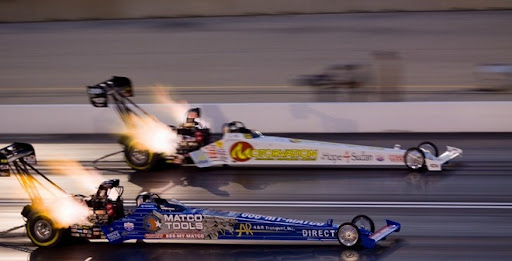
The green light, highlighting a small row of amber lights around the track, signifies the moment when a pair of dragsters starts. And so the two incredibly powerful, unusually elongated cars launch, leaving the flames behind them, with frantic acceleration. And there’s a good chance that one of them could take off with the slightest mistake in the aerodynamics calculation. And the 10,000 horsepower contributes to that perfectly. Acceleration to a hundred in less than half a second loads a dragster pilot up to 4G.

The distance at which dragsters start varies depending on the particular series of races. Most often it is 1,000 feet (304.8 m), but in different types of races it can be up to 800 meters.

The main factor that sets Top Fuel dragsters apart from other race cars is that they are considered the fastest and most powerful cars on the planet. In fact, just one of the eight cylinders in the engine produces about 1,000 horsepower – as much as a Formula One car produces in the entire engine. Use our source

All dragsters achieve tremendous power from engines of about 6.5 to 8.2 liters of displacement. Moreover, the maximum displacement set by the drag race organizers is 8.2 liters. No surprise there, is there?! But the superchargers and a special type of fuel make them capable of developing about 8,000 horsepower. However, according to some estimates, the power still reaches all 10,000 horsepower – and there are good reasons for such discrepancies and inaccuracies. The fact is that dragster engines cannot be measured with a dynamometer, a device that evaluates the power and torque of a car. Thus, the amount of power Top Fuel dragsters have is calculated using mathematical equations that can leave room for debate.

The engine before the dragster race

Dragster engines use, of course, not gasoline, not methane, and certainly not diesel. They need nitromethane, a special kind of fuel that gives off a lot of energy when burning – much more than gasoline. What’s more, the concentration and composition of the fuel is made specifically for drag racing. It’s a complex balance that requires fine-tuning and the car itself. And all this effort just to get racers going at previously unheard of speeds and acceleration as fast as possible through the damn quarter mile!

The people who build dragster engines – engineers, mechanics, and amateur drag racers all over the world – eventually came to the conclusion that a nitromethane mixture was the best fuel for these particular types of engines. Nitromethane is a dangerous volatile substance that is often used for pesticides, pharmaceuticals, heavy cleaning solvents, and even rocket fuel. Anyway, the Germans in the 1930s and the Americans in the 1940s independently discovered that nitromethane could also be used in racing cars. The results of such findings were often lamentable – racers were often killed by exploding race cars. But engineers didn’t stop and continued to do experiments on the use of nitromethane in internal combustion engines.

Exploding dragster engine

Nitromethane is very dangerous. If the dragster engine is not running properly, and the unburned fuel is not completely burned in the engine during the first combustion cycle, it can explode with force strong enough to rupture the cylinder head or engine block. Nitromethane can also explode from a little heat or shaking. This is one explanation for why dragsters have a lot of flame coming out the back of their exhaust pipes – unburned fuel heats up as it comes out through the exhaust system and ignites when it comes into contact with the atmosphere.

An engine that runs on nitromethane tends to have much less compression than a gasoline engine (which at first glance is counterintuitive). But the explanation for this is that, unlike gasoline, nitromethane itself contains oxygen, so the engine doesn’t need as much air for the combustion cycle, allowing it to run at lower compression. However, the engine and its components are under such tremendous pressure that all connections must be carefully checked on a regular basis.

Currently, Top Fuel dragsters run on a mixture that is 90 percent nitromethane and 10 percent methanol. Methanol helps suppress detonation, which makes the fuel more stable.

Nitromethane can also be mixed with a third substance other than methanol to help increase its energy potential, but this tactic is banned by most race organizers. In part, such a ban is worthwhile because other fuel mixtures are more dangerous.

But there is no cooling system for dragster engines at all. The engine simply does not have time to heat up to destructive temperatures in a short period of time. The absence of a cooling jacket inside the engine block provides a significant increase in its durability.

The dragster cars start and reach 100 kilometers per hour in less than half a second, and 160 kilometers per hour in less than a second. This makes them the fastest accelerating cars in the world, as well as the fastest in principle. Power from the engine reaches the wheels in a fraction of a second — about 15 fractions of a second, to be exact. At launch, dragster drivers endure a load similar to astronauts during the launch of a spaceship. And almost as quickly they have to stop. After crossing the finish line, the driver presses a button that deploys two parachutes behind the car, and the intense wind resistance slows the car with minimal risk of additional mechanical damage.

Drag racing spectators are advised to wear hearing protection when watching a dragster race. The noise made by the engines can even destroy weak eardrums when they are close to a dragster running at maximum speed.

Dragsters are essentially considered the loudest race cars, in part because of the way the engine is mounted. If that engine were at least under the hood, as in a regular car, at least there would be some insulation to muffle the sound. But alas, cars don’t even have mufflers.

One drag race organizer, the NHRA, once let a team of seismologists stand on the starting line to measure seismic activity levels, just as if they were measuring an earthquake. The measurements produced two machines that produced activity rated at 2.3 on the Richter scale. This is equivalent to a minor earthquake, which many people feel.

As for the sonic power of dragsters, experts estimate that these cars can produce a roar of over 150 decibels, a level that can cause physical damage to the eardrum. By comparison, a typical rock concert generates about 100-120 decibels.

To date, there is no sign of drag racing’s popularity declining anytime soon. In fact, within just the last few years, the cars themselves have become even more powerful.

Even more about the engines of dragsters – they live about 3 minutes, after which a whole reconstruction awaits them – very much – from spark plugs to gaskets are changed.

And finally, the most interesting facts about dragsters, which are hard to believe at once.

At maximum load, the dragster’s engine consumes more than 5 liters of nitromethane per second. By comparison, a huge Boeing consumes about the same amount.

The spark plugs in dragster engines are disposable. Moreover, they do not live to the end of a 3-minute race. First the engine warms up, then it lapping takes place, and at this time the plugs are far from being worn out. At the end of the 3-minute race, in the last 5 seconds from the start to the moment of crossing the finish line, the plugs are already killed in the first half of the race, and the ignition is due to compression.

The tires of the dragster’s driving wheels usually increase in diameter to the end of the race by 15-25% due to heat and wear. The tires, by the way, are disposable, as well as the plugs.

The power of a standard V8 engine from some sports car isn’t enough to even turn the dragster’s engine.

The dragster will reach a speed of 450 km/hour faster than you will read this fact.

On average, one dragster run costs its team about $5,000.

The dragster doesn’t have a gearbox, and a four- to five-speed clutch transfers torque from the engine to the wheels.

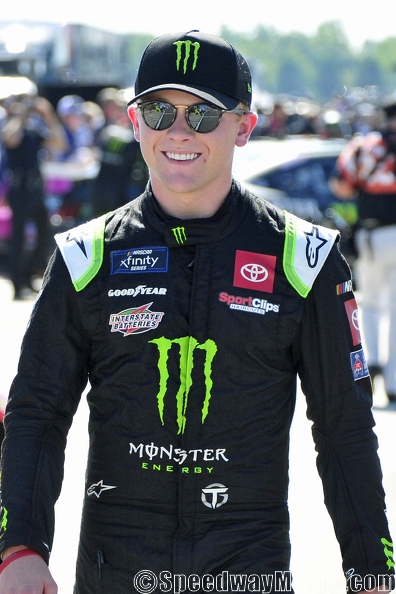
Herbst retained by Stewart-Haas Racing for 2023 Xfinity Series season

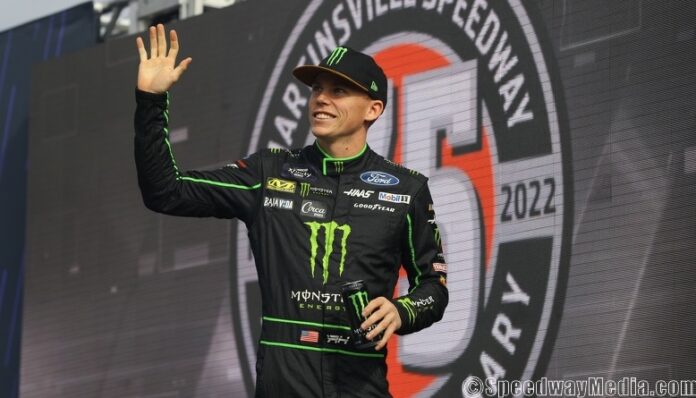
Photo by John Knittel for SpeedwayMedia.com.

Stewart-Haas Racing took to social media to announce that Riley Herbst will be retaining his role as a full-time NASCAR Xfinity Series competitor for the organization and in the No. 98 Ford Mustang sponsored by Monster Energy for the upcoming racing season.

The 23-year-old Herbst from Las Vegas, Nevada, is coming off his second full-time campaign with SHR and third overall in the Xfinity circuit, where he achieved a pole at Nashville Superspeedway in June, a career-high eight top-five results and 20 top-10 results, 12 laps led and a career-best average-finishing result of 13.0 throughout the 33-race schedule. He also qualified for the 2022 Xfinity Series Playoffs, where he was eliminated from title contention following the Round of 12 before he went on to finish in a career-best 10th place in the final championship standings.

After achieving his first ARCA Menards Series career victory at Pocono Raceway in 2017 while competing for Joe Gibbs Racing, Herbst made his Xfinity Series debut during the following season at Iowa Speedway, where he piloted JGR’s No. 18 Toyota Camry to a sixth-place result. He then campaigned in nine Xfinity events in 2019, where he recorded three top-10 results, before competing on a full-time basis in JGR’s No. 18 Toyota Supra for the 2020 Xfinity season. He proceeded to finish 12th in the final standings, where he also recorded two runner-up results, 17 top-10 results, an average-finishing result of 16.0 and made the Xfinity Playoffs.

Herbst moved to Stewart-Haas Racing to drive the No. 98 Ford Mustang in 2021. He concluded the season with an 11th-place result in the final standings after recording his first career pole at Charlotte Motor Speedway in May along with a total of five top-five results, 13 top-10 results, a career-high 57 laps led, an average-finishing result of 17.1 and a second consecutive berth to the Xfinity Playoffs. 

Through a total of 109 career starts in the Xfinity circuit, Herbst has achieved two poles, 17 top-five results, 54 top-10 results, 85 laps led and an average-finishing result of 15.4 as he continues to pursue his first victory across NASCAR’s top three national touring series.

https://twitter.com/StewartHaasRcng/status/1592608378710204416?ref_src=twsrc%5Egoogle%7Ctwcamp%5Eserp%7Ctwgr%5Etweet

With his plans for next season set, Herbst will return to action at Daytona International Speedway on February 18, which will mark the start of the 2023 Xfinity Series season. The event’s coverage is scheduled to occur at 5 p.m. ET on FS1.

New Motorsports Hall of Fame of America Exhibit Honors Racers who have Served in the Armed Forces

  • Nearly One-Third of MSHFA Inductees are Military Veterans, Far Above the National Average
  • Most Speak about how their Military Service Shaped them for Excellence in Motorsports
  • Exhibit includes racing legends Hurley Haywood (MSHFA Class of 2005), Bud Moore (MSHFA Class of 2013), Ed Pink (MSHFA Class of 2012), Everett Brashear (MSHFA Class of 2016), Ray Harroun (MSHFA Class of 2000), Chickie Hirashima and nearly 90 others
  • Haywood Featured Guest at Official Ribbon Cutting to Open New Exhibit This Thursday, November 17 at Noon EST at the MSHFA

DAYTONA BEACH, Florida (November 15, 2022) — The Motorsports Hall of Fame of America (MSHFA) unveils its newest exhibit this week – They Wore Two Helmets: Racing’s War Heroes – recognizing racing legends who donned a uniform for their country. In addition to honoring their service, They Wore Two Helmets explores the connections racers across disciplines and decades felt between their military experiences and their later success in motorsports. From technical skills forged in the military, to teamwork, to risk management, to split-second decision-making and the willpower to persevere through the most trying circumstances, there is no shortage of compelling lessons these heroes of horsepower carried over from the service to the track.

They Wore Two Helmets includes original military and racing uniforms, period photographs, dog tags and other personal artifacts from some of motorsports’ most accomplished names. The exhibit will also feature a Roll of Honor numbering 90 MSHFA inductees known to have served, from power boat great Bernie Little (MSHFA Class of 1994), to AMA flat track legend Bart Markel (MSHFA Class of 1999), to aviation inductee and wartime hero Jimmy Doolittle (MSHFA Class of 1989). Here are a few of the stories They Wore Two Helmets will highlight:

NASCAR great Bud Moore (MSHFA Class of 2013) served as a machine gunner with the 90th Infantry Division in 10 months of combat, including the D-Day landings and the Battle of the Bulge. His exemplary service earned him two Bronze Stars for heroism and five Purple Hearts, exceptional even among his generation. But like countless other GIs, the war left less obvious scars on Moore. He never returned to his past battlegrounds, saying he “left too many friends…over there.” Still, he felt the trials and tribulations of service taught him discipline and how to compete in adverse conditions. And compete he did, garnering over 60 wins and two NASCAR Cup Series championships as a car owner as well as an SCCA Trans-Am title.

Born in Glendale, California to immigrant parents, Takeo “Chickie” Hirashima began making a name for himself as riding mechanic for open-wheel great Rex Mays (MSHFA Class of 1995). That all changed when Executive Order 9066 was issued in 1942, imprisoning 120,000 people of Japanese ancestry. Two-thirds of them were U.S. citizens. After a year at Manzanar internment camp, Hirashima was drafted and assigned to the 522nd Field Artillery of the 442nd Regimental Combat Team. This majority Japanese American unit became the most decorated of its size in U.S. history. Hirashima went on to become an Indy legend after the war, working on six 500-winning teams. Reminiscing about her “Uncle Tak,” niece Carolyn Cook perhaps said it best. He lived his life like the 442nd’s iconic motto: Go For Broke.

A 2005 MSHFA Sports Cars inductee, Hurley Haywood received his draft notice for Vietnam within months of his professional racing debut at Watkins Glen. For the next 13 months, Haywood was based with the 164th Aviation Group in the dangerous Mekong Delta. Looking back on how his service prepared him for later success, Haywood told us “When you’re stuck in a foxhole with…bullets flying around you…you tend to grow up in a big hurry,” a perspective that gave him an advantage on track over sometimes more reckless peers. Combined with the strict race-day regimen of teammate and fellow veteran Peter Gregg (MSHFA Class of 2000), it’s small wonder Haywood went on to become America’s most accomplished endurance driver.

These connections remain with the current generation of racers like Jesse Iwuji. Graduating from the U.S. Naval Academy in Annapolis in 2010, Iwuji made two deployments to the Middle East as a surface warfare officer with MCM Crew Exultant and aboard the landing ship USS Comstock. When asked about connections between the military and racing, Iwuji felt the command structure and teamwork of the Navy ideally prepared him for working with his crews on the Camping World Truck and Xfinity circuits. He continues to make waves in the sport, serving as a racing ambassador for wounded veterans and founding Jesse Iwuji Motorsports with NFL legend Emmitt Smith in 2021.

Haywood will be the featured guest at the official ribbon-cutting ceremony that formally opens the new display this Thursday, November 17 at Noon EST. Other guests scheduled to attend include Jake Johansson, a retired U.S. Navy Captain with 35 years of military service who was elected last week to the Volusia County Council At-Large seat, and a contingent of Air Force ROTC students from nearby Embry-Riddle Aeronautical University. In his military career, Johansson commanded a combat squadron in Iraq and a Naval base in Norfolk, Virginia, home to one of the largest military populations in the world.

Other featured stories in the new exhibit include drag racer Ed Pink (Class of 2012), who carried an M1 rifle in Korea before trading it for a wrench and becoming an engineering legend, AMA great Everett Brashear, who enlisted in the Navy just past his 17th birthday and served in the Pacific Theater in World War II and inaugural Indy 500 champion Ray Harroun (Class of 2000), whose Navy service in the 1898 Spanish-American War predated widespread motor racing in the U.S.

Fans can see the new exhibit at the MSHFA Museum, which is housed in Daytona International Speedway’s Ticket & Tours Building located in front of the famed 2.5-mile DIS tri-oval. Access to the MSFHA museum is included with every Daytona International Speedway tour, which run throughout each day, or as a museum-only ticket. The museum is open daily 10-5 nearly year-round except major holidays. It is visited by more than 100,000 guests each year from every state in America and countries all over the world. A digital exhibit will also be available on the updated MSHFA website, due to launch in the near future.

For more information or to discuss sponsorships and donations, visit the MSHFA at www.mshf.com or contact MSHFA President George Levy at (248) 895-1704 or glevy@mshf.com. For museum tickets call 1-800-PIT-SHOP.

The Motorsports Hall of Fame of America is on Facebook at www.facebook.com/MotorsportsHOF/ and Instagram and Twitter at @MotorsportsHOF.

About the Motorsports Hall of Fame of America: The MSHFA is the only hall that honors all American motorsports: cars, motorcycles, airplanes, off road and powerboats. Its mission is to celebrate and instill the American motorsports values of leadership, creativity, originality, teamwork and spirit of competition. Founded by Larry G. Ciancio and Ronald A. Watson, it held its first induction in 1989. Watson spent the next 30 years tirelessly building it into the nation’s premier such hall until his passing in 2019. The original museum in Novi, Mich., relocated to Daytona Beach, Fla., in 2016 and greets more than 100,000 guests a year. MSHFA is operated by the nonprofit Motorsports Museum and Hall of Fame of America Foundation, Inc.

Ty Gibbs elevated to full-time Cup Series ride with Joe Gibbs Racing in 2023

Photo by Jeff Clemons for SpeedwayMedia.com.

Ten days after capping off an eventful 2022 campaign with his first NASCAR Xfinity Series championship, Ty Gibbs’ racing career is set to ascend to a new level. On Tuesday, November 15, Joe Gibbs Racing announced that the 20-year-old Gibbs from Charlotte, North Carolina, will be graduating to the NASCAR Cup Series on a full-time basis while replacing two-time Cup champion Kyle Busch in the team’s fourth and final vacant seat for the upcoming racing season.

Gibbs, a grandson to team owner Joe Gibbs, will be piloting the No. 54 Toyota Camry TRD Pro, the same number he piloted to the 2022 Xfinity Series title along with 11 Xfinity career victories between 2021 and 2022. This means that the No. 18, which has been sported by JGR in the Cup circuit for the past 31 years, will not be sported by a JGR entry in NASCAR’s premier series for the 2023 season.

The announcement comes as Gibbs is coming off his competitive season to date, where he campaigned in the Xfinity Series on a full-time basis for the first time. Throughout the 33-race schedule, he achieved seven victories along with five poles, 16 top-five results, 23 top-10 results, 990 laps led and an average-finishing result of 9.2. Amid his share of run-ins and controversies both on and off the track, including some that involved his JGR Xfinity teammates, he defied the odds by capturing this year’s Xfinity title by winning the finale at Phoenix Raceway in early November while squaring off head-to-head against a trio of JR Motorsports’ competitors (Justin Allgaier, Josh Berry and Noah Gragson). Gibbs’ championship celebration, however, was quickly overshadowed with tragedy when his father and co-owner of Joe Gibbs Racing, Coy, died at age 49 overnight and hours after the title.

Prior to this past season’s Xfinity championship-winning season, Gibbs excelled in his inaugural start in the Xfinity circuit in February 2021 when he scored his first career victory at the Daytona International Speedway Road Course. He went on to win at Charlotte Motor Speedway in May, Watkins Glen International in August and at Kansas Speedway in October while making 18 starts throughout the 33-race schedule. Throughout his part-time campaign in the Xfinity Series, he also captured the 2021 ARCA Menards Series championship.

Through a total of 51 career starts in the Xfinity Series, Gibbs has achieved 11 victories, six poles, 25 top-five results, 33 top-10 results, 1,234 laps led and an average-finishing result of 9.5.

Amid his on-track success in the Xfinity circuit, Gibbs is not a stranger to the Cup Series. In mid-July, he made his first appearance in NASCAR’s premier series as an interim competitor for 23XI Racing at Pocono Raceway when the 2004 Cup Series champion Kurt Busch was sidelined due to suffering concussion-like symptoms after wrecking the day prior to race day. With Busch being sidelined for the remainder of the 2022 season and eventually from full-time competition, Gibbs ended up competing in the following 14 Cup events while also vying for the Xfinity title. Throughout his 15-race campaign in the Cup circuit, his best on-track result was a 10th-place run at Michigan International Speedway in August followed by a 13th-place run at Daytona International Speedway three races later. His average-finishing result during his part-time Cup campaign was 22.9.

Gibbs’ entrance to the Cup Series on a full-time basis comes two months after Kyle Busch, who won two Cup Series championships and 56 races throughout a 15-year run with Joe Gibbs Racing, revealed that he will be departing JGR to drive for Richard Childress Racing for the upcoming Cup season. The departure of Busch from JGR comes after a season-long turmoil with the team struggling to find a sponsor and financial stability for Busch after his initial primary partner, Mars Inc., terminated its partnership with the team and NASCAR following the 2022 season.

Gibbs is not the only one moving up to the Cup Series for next season. Chris Gayle, who led Gibbs’ to this past season’s Xfinity Series title, will also be moving up and continue to work as his crew chief. The 2023 season will mark Gayle’s return as a crew chief in NASCAR’s premier series since 2020, where he worked with Erik Jones.

In 142 appearances as a Cup crew chief, Gayle has achieved two victories between 2018 and 2019. In addition to the 2022 Xfinity title, he has also achieved 37 victories as an Xfinity crew chief.

With his plans for the upcoming season officially set, Gibbs’ first full-time campaign in the NASCAR Cup Series will commence at the Los Angeles Memorial Coliseum for the Busch Light Clash, which will occur on February 5 at 8 p.m. ET on FOX. He will then make his first Cup points start for JGR in the 65th running of the Daytona 500 at Daytona International Speedway on February 19 at 2:30 p.m. ET on FOX.

Rebel Rock Racing Grows IMSA Program with VP Racing Challenge Campaign

SRO VIR 2022

Targeting Michelin Pilot Challenge GS title, enters VP Racing Challenge in final run for Camaro GT4.R

DAYTONA BEACH, FL (15 November 2022) – Rebel Rock Racing will expand its involvement in IMSA competition in 2023, widening its focus to compete full-time in two championships. In addition to fielding the No. 71 Urban Grid Chevrolet Camaro GT4.R in a bid for the title in its fifth full season in the Michelin Pilot Challenge (MPC), Rebel Rock will prepare a similar Camaro for the debut season of the VP Racing SportsCar Challenge.

Robin Liddell and Frank DePew will again co-drive in the 10-race Michelin Pilot Challenge. DePew will also pilot a Camaro in the new VP Racing Challenge, which consists of a pair of 45-minute sprints on six different weekends. Both series open the 2023 campaign at Daytona International Speedway.

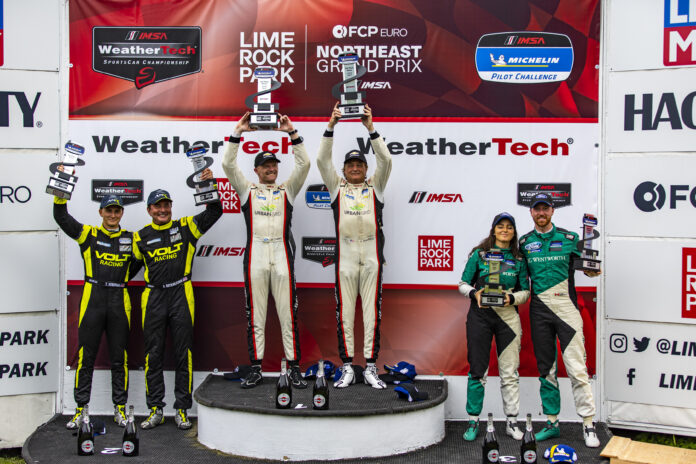
The two drivers have five victories over the past four MPC seasons. They won at Canadian Tire Motorsport Park and Road America in 2019, then won at Road Atlanta in 2020; Sebring International Raceway in 2021; and at Lime Rock in the recently completed campaign. Rebel Rock managed to finish a team-best fifth in the 2022 GS standings – with its sights now set on the title for 2023.

“We’re really focusing on running for the IPC championship,” DePew said. “That means keeping our nose clean as much as possible. We’ve been testing to improve our reliability, and I’m working on improving my driving. We’ve been able to contend at every track; we’ve just messed up a little bit here and there, which hurt us.”

DePew has cut back his busy work schedule to enable him to spend more time concentrating on his race craft.

“I’ve slowed down a bit at work, so I’m going to have more time,” DePew said. “Additionally, I’m going to compete in the VP Challenge. We’ll be bringing two identical Camaros to the track – one set up for each race – and that’s really going to help me. Up until now, I’ve had very limited track time prior to races, and we haven’t had much opportunity to test. I’m also working on getting in better shape to be ready for the season. One thing that’s interesting is the different mindset from being the starting driver in an endurance race – where you need to preserve the car – and running in sprint races.”

The team will also be looking for a strong farewell for its Camaro.

“It will be the last year of homologation for the GT4.R,” Liddell said. “In the bigger picture, it’s the end of an era. A number of us on the team – myself included – have raced Camaros from Day 1 of the modern era. In 2010 we debuted the [Rolex Series] GT car along with the RS car, and we’re been running them ever since with a couple of gaps. We’ve won a lot of races, with the Z-28, SS, ZL1-GT4, all the different models. With no plans for GM to build a GT4 car for the foreseeable future, we have longevity with the car and our people, and if we put everything together and stay consistent for next year, I think there’s every possibility that we can win the championship.”

Liddell is also looking forward to running the second car in the new series.

“This will give Frank a lot of additional seat time which will help to build his confidence in the car,” Liddell said. “Our focus is still on the Michelin Pilot Challenge, but the VP Challenge will help Frank continue to grow as a driver. Adding to our existing program will be tricky as in reality it will require an additional team of guys to make it work, but nonetheless it’s achievable and the timing just feels right.

“If we can win on our good days, and finish in the top 10 on our very worst days, there’s no reason why we can’t challenge for the championship.”

The VP Challenge format will be a pair of 45-minute races following two 30-minute practices and 15-minute qualifying, featuring Silver- or Bronze-rated drivers in the GT4 and LMP3 categories. The season opens Jan. 20-22 during the Roar Before the Rolex 24, and will race at Sebring during the WEC Prologue on March 11-12, followed by running in the MPC weekends at Canadian Tire Motorsport Park, Lime Rock Park, Virginia International Raceway and Michelin Raceway Road Atlanta.

The Michelin Pilot Challenge opens on Friday, Jan. 27, on the eve of the 61st Rolex 24 At Daytona.

Additional updates via:

http://rebelrockracing.co
https://twitter.com/rebelrockracing
https://www.instagram.com/rebelrockracing/

Chevrolet wins NHRA Manufacturers Cup for 27th time

Drivers of the Chevrolet Camaro SS, COPO Camaro contribute to season success

DETROIT (Nov. 15, 2022) – Chevrolet has been recognized as the top manufacturer in the National Hot Rod Association (NHRA) for the record-extending 27th time.

The award was presented Nov. 14 during the NHRA Awards Ceremony in Temecula, California.

It is the sixth consecutive year and eighth time in the past 10 seasons that Chevrolet has won the award presented to the automobile manufacturer whose current-year models earn the most points for qualifying and category victories at NHRA Camping World Drag Racing Series national and NHRA Lucas Oil Drag Racing Series regional and divisional events.

Points are awarded to entries in Funny Car, Pro Stock, Super Stock and Stock Eliminator classes, plus the Constant Aviation NHRA Factory Stock Showdown series.

Points accumulated by Chevrolet Camaro SS and Chevrolet COPO Camaro drivers in the professional and Sportsman classes were more than triple the closest manufacturer.

Chevrolet first earned the award in 1966, and no other manufacturer has won it more times. GM brands Oldsmobile and Pontiac combined to win 24 titles between 1971 and 2006.

“I’m so proud of the hard work by the Chevrolet teams that delivered valuable points toward the Manufacturers Championship again this year,” said Jim Campbell, Chevrolet U.S. vice president, Performance and Motorsports. “Thanks to the owners, drivers and crews in the professional classes and Sportsman classes for another year of high-performance results every time they showed up at the track.”

Erica Enders earned her fifth NHRA Pro Stock world championship — all with Chevrolet — by driving the Melling Performance/Elite Motorsports Chevrolet Camaro SS to a career-best 10 victories and three runner-up finishes in the 19 races.

“I remember when Erica won her first race at Route 66 Raceway in July of 2012,” Campbell said. “We had the opportunity to celebrate that milestone win at SEMA later that year. Since that first one, she’s added 42 more wins and five championships. She’s an inspiration to so many drag racing fans.”

Chevrolet has amassed 18 Pro Stock driver championships and 366 victories, including 247 with the Camaro nameplate.

Aaron Stanfield, Dallas Glenn, Troy Coughlin Jr. and Greg Anderson also visited the winner’s circle as competitors won every race driving a Chevrolet Camaro SS. Anderson, who has driven a GM product to five Pro Stock championships, became the second driver in the professional classes to reach 100 wins and won the season finale for No. 101. John Force with 155 Funny Car victories is the all-time leader.

Chevrolet Camaro SS Pro Stock driver Camrie Caruso was voted the NHRA Rookie of the Year. It is the second year in a row in which a Chevrolet driver has received the award and third time in the past four years. Dallas Glenn of KB Racing won in ’21 and Austin Prock of John Force Racing won in ‘19.

David Barton of Reading, Pennsylvania, driving the Saw Mill Auto Chevrolet COPO Camaro, claimed the Constant Aviation NHRA Factory Stock Showdown series title for the second time. Drivers of the COPO Camaro won five of the eight races, including three by Barton and one each by two-time champion Aaron Stanfield and Len Lottig. Chevrolet has won the past three championships.

“It’s been an incredible season with driver championships in Top Fuel, Pro Stock and the Factory Stock Showdown combined with winning the Manufacturers Cup,” Campbell said.

Funny Car drivers Robert Hight and John Force made important points contributions to the Manufacturers Cup championship. Hight, driving the Automobile Club of Southern California Chevrolet Camaro SS, amassed a career-high eight victories and six top qualifier honors. Sixteen-time Funny Car champion Force, driving the PEAK Antifreeze and Coolant Chevrolet Camaro SS, won the four-wide race at Charlotte.

Additionally, national event Stock Eliminator wins were recorded by Leo Glasbrenner (Pomona1, Phoenix, Las Vegas2), Jeff Strickland (Gainesville), Ryan McClanahan (Las Vegas1), Darren Poole-Adams (Charlotte1, Bristol) and Tyler Cassil (Topeka).

The Top Fuel class does not contribute points to the Manufacturers Cup standings, but Brittany Force and Austin Prock produced multiple highlights during the season in their Chevrolet dragsters.

Force won the Top Fuel championship for the second time. She recorded five victories, 10 No. 1 qualifiers and set the national event speed record of 338.91 mph in the season finale at Pomona. Prock, returning to full-season competition for the first time since his rookie of the year campaign in 2019, won two races and earned his initial Top Fuel No. 1 qualifier honor at Dallas.

The 2023 NHRA Camping World Drag Racing Series season begins March 10-12 with the 54th Gatornationals at Gainesville Raceway in Florida. FOX will telecast eliminations live at noon ET Sunday, March 12.

About Chevrolet

Founded in 1911 in Detroit, Chevrolet is now one of the world’s largest car brands, available in nearly 80 countries with nearly 2.7 million cars and trucks sold in 2021. Chevrolet models include electric and fuel-efficient vehicles that feature engaging performance, design that makes the heart beat, passive and active safety features and easy-to-use technology, all at a value. More information on Chevrolet models can be found at www.chevrolet.com.

Artisan Red Premium: New Special Body Color Developed by Mazda

-New color developed with Mazda’s proprietary Takuminuri painting technology-

HIROSHIMA, Japan, Nov 15, 2022 – (JCN Newswire) – Mazda Motor Corporation has applied its proprietary painting technology Takuminuri(1) to develop a new special color Artisan Red Premium. This color will be introduced as a premium highlight for vehicles in our current lineups as well as forthcoming releases in our Large Product group.

Mazda believes color to be a crucial element of what gives form to a vehicle; thus, we are focusing our efforts on developing colors that accentuate a dynamic and delicate expression in line with the Kodo – Soul of Motion – design theme. Artisan Red Premium, the fourth Takuminuri color, was developed to extend the range of how the world views red, one of the colors symbolizing Mazda, as a culmination of the Takuminuri evolution to mark the 10th year since the first color Soul Red Premium was released.

Artisan Red Premium conveys the connotation of a red color created by skilled artisans. This extraordinary red produced by Mazda designers, engineers and other artisans manifests a mature outlook that is more refined and sophisticated than previous special colors. The concept underlying design was to create the red found in a mature wine made with unsurpassed craftsmanship. Artisan Red Premium accentuates the strength and beauty of form that takes shape as highlights hit by light portray a fine-grained transparent red shining brightly and dominant shade produces a profound depth and richness, rendering high contrast.

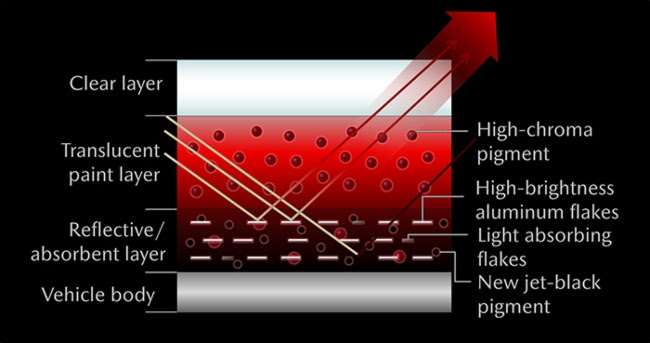
Also, similar to Soul Red Crystal(2), Artisan Red Premium is comprised of three layers: a clear layer, translucent paint layer, and a reflective/absorptive layer. It combines an outstanding aesthetic appearance with a reduced environmental footprint. For the translucent paint layer, a high-chroma pigment is employed that people perceive to be the reddest of reds, a pigment also used for the Soul Red Crystal. For the reflective/absorptive layer, we applied a technology that more smoothly aligns aluminum flakes at regular intervals. This was also leveraged for the third Takuminuri color Rhodium White Premium. In addition, we improved on the jet-black pigment, which renders shade in the second color Machine Gray. This combination of technologies developed over a period of 10 years conveys brightness in highlights produced by strong reflection and the richness of shades created as light is soundly absorbed so as to achieve a balance between transparency and a mature profoundness.

In the belief that “color is an element of form,” Mazda will continue to pursue new color expressions and painting technologies to enhance the attractiveness of our products, aiming to be a company that shares a special bond with its customers.

(1) Takuminuri, which translates as “Artisan coloring,” is Mazda’s painting technology that reproduces a precise, high-quality paint finish as if applied by the hands of a skilled craftsman along the automobile mass production line.
(2) Soul Red Crystal is a further refinement of Soul Red Premium and a special paint color developed with the Takuminuri painting technology.