
Home Blog Page 19

Quick Pit Work, Pace Help Palou Run Away to Win at Long Beach

LONG BEACH, Calif. (Sunday, April 19, 2026) – Alex Palou got the break he needed and fast work from his Chip Ganassi Racing pit crew, and then he ran away with a victory Sunday in the Acura Grand Prix of Long Beach.

Palou earned his third victory in five races this season, the 22nd victory of his career and his first win at prestigious Long Beach in the No. 10 OpenAI Chip Ganassi Racing Honda, beating the No. 60 SiriusXM/Acura Honda of NTT P1 Award winner Felix Rosenqvist to the finish by 3.9663 seconds. Palou also took the series lead by 17 points over Kyle Kirkwood as he aims for his fifth series championship and series record-tying fourth in a row.

“It’s huge,” Palou said. “Super proud of everybody’s job but especially this crew. Incredible to finally win here at Long Beach.”

Six-time NTT INDYCAR SERIES champion Scott Dixon rounded out the podium with his best result of the season in the No. 9 PNC Chip Ganassi Racing Honda, as CGR produced two of the top three finishers.

Kirkwood finished fourth in the No. 27 JM Bullion / Gold.com Honda of Andretti Global, with Pato O’Ward placing fifth in the No. 5 Arrow McLaren Chevrolet.

Pole sitter Rosenqvist controlled the race from the green flag. He led the first 31 laps, with Palou climbing from his third starting spot to second by passing O’Ward on Lap 2. Rosenqvist and Palou pitted for the first time in tandem at the end of Lap 31, with the MSR crew helping Rosenqvist win the race out of the pits after both drivers started their second fuel stint with their mandatory second set of Firestone alternate tires.

Rosenqvist had built a three-second lead over Palou, who admitted he struggled a bit on the softer Firestone alternate tire. But Palou got the break he needed on Lap 57 when a large piece of debris was spotted on track, triggering the only caution period of the 90-lap race.

The entire field pitted on Lap 59, led by Rosenqvist and Palou as a showdown loomed between the MSR and CGR crews. Rosenqvist and Palou each took four primary Firestone tires and fuel on their last stop, but Palou escaped his pit box ahead of Rosenqvist to take the lead for the first time. CGR serviced Palou’s car in 7.3 seconds on the final stop, while MSR needed 8.4 seconds for Rosenqvist’s stop.

Palou rocketed away from the field on the restart on Lap 61. It was checkout time, as he never trailed from that point.

“The OpenAI car was super, super fast, but it was that yellow, that pit stop with all the pressure that these boys were able to do it and execute it perfectly,” Palou said. “From there, it was just managing the tires. We didn’t know how the primaries were going to be.”

The primary tire suited Palou just fine. The Spaniard expanded his lead to 2.4 seconds on Lap 68, with the gap mushrooming to 5.5 seconds with 12 laps remaining. Palou played it safe during the final two trips around the 11-turn, 1.968-mile temporary street circuit, but Rosenqvist never got close. Still, the Swede, who led a race-high 51 laps, earned his first podium finish since placing second in June 2025 at Road America.

“A little bit of a bittersweet race,” Rosenqvist said. “I lost a little bit on the stop. Alex is obviously going to be 10 out of 10 almost every stop, so I don’t think it was necessarily that our one was slow, but they probably had a great one, as well. That’s how it goes.

“At the end of the day, we’ve got to celebrate this one. P2, plus the points and podium – that’s where I want to be.”

The next race is the Sonsio Grand Prix on Saturday, May 9, kicking off the Month of May at Indianapolis Motor Speedway on the facility’s 14-turn, 2.439-mile road course.

TEAM CHEVY INDYCAR SUNDAY RACE REPORT – Grand Prix Of Long Beach

CHEVROLET IN THE NTT INDYCAR SERIES
Grand Prix Of Long Beach
1.968-mile, 11 turn, Long Beach street circuit
Long Beach California
Sunday Race Report
April 19, 2026

Long Beach, California (April 19, 2026) – Pato O’Ward in the No. 5 Arrow McLaren Chevrolet was the best of the Chevrolet-powered drivers, finishing in fifth place on the Streets of Long Beach. O’Ward was joined in the top ten by sixth-place Scott McLaughlin in the No. 3 AAA Travel Team Penske Chevrolet, seventh-place David Malukas in the No. 12 Verizon Team Penske Chevrolet and ninth-place Alexander Rossi in the No. 20 ECR Liquid Science Orange Chevrolet.

  • The fifth-place finish was the fourth of the season for O’Ward and 52nd (all of them with Team Chevy) in his career, which moves the 26-year-old into a tie for 33rd all-time with Alexander Rossi and Tony Bettenhausen.
  • Nolan Siegel, the driver of the No. 6 SmartStop Arrow McLaren Chevrolet, was the biggest mover of the race, finishing 12th after starting 25th. Alexander Rossi in the No. 20 ECR Liquid Science Orange Chevrolet was also a significant mover, finishing 9th after starting 18th.
  • Josef Newgarden, who was one of a half-dozen drivers to utilize a three-stop strategy in the No. 2 Astemo Team Penske Chevrolet, set the quickest lap of the race, with a 68.8328-second lap of the 1.968-mile, 11-turn Long Beach street circuit. Chevrolet-powered Rinus VeeKay in the No. 76 Juncos Hollinger Chevrolet, Christian Lundgaard in the No. 7 VELO Arrow McLaren Chevrolet and David Malukas in the No. 12 Verizon Team Penske Chevrolet had the second through fourth fastest laps.
  • Newgarden also made the most on-track passes, getting by 11 drivers.
  • Chevrolet-powered drivers David Malukas, Pato O’Ward, Christian Lundgaard, Josef Newgarden and McLaughlin are third through seventh in the NTT INDYCAR SERIES championship standings.

Grand Prix Of Long Beach Race Results

Up Next

The NTT INDYCAR SERIES heads home to the Circle City of Indianapolis, Indiana, to spend the “Month of May” at the iconic Indianapolis Motor Speedway. Action at ‘The Brickyard’ begins with a series open test at the historic 2.5-mile oval on Tuesday and Wednesday April 28th and 29th. The action then moves to the 2.439-mile, 14-turn Indianapolis Motor Speedway road course on Saturday, May 9th, before returning to the oval and the “Greatest Spectacle In Racing”, the 110th Indianapolis 500 presented by Gainbridge on May 24th. The open test will be available to stream on the series’ YouTube channel, with both races airing on FOX.

What they’re saying – Grand Prix Of Long Beach

Pato O’Ward, No. 5 Arrow McLaren Chevrolet finished 5th:

“We don’t have enough right now to take it to the guys that are charging forward in the championship. It was just another weekend to close out a top five, but we need to start fighting for podiums and wins. Thankfully, our favorite is coming up, which is the Indy 500, right after the Indy Road Course. That’s really our main focal point, and I’m going to really try to maximize that. Right now, we just need to keep working and try to make it better to minimize damage in the first part of the season to see if we can recover toward the end to find something – because we’re missing it.”

Scott McLaughlin, No. 3 AAA Travel Team Penske Chevrolet finished 6th:

“We just needed a solid finish today. With everything we have dealt with over the last three weeks, a top five finish was the goal. To finish just outside of that gives us some momentum heading into the month of May, for sure. The AAA Travel Chevy was very fast today, but we stuck to our two-stop strategy and were in fuel save for a while.

“I’m so appreciative of the guys on this team. They have my back when I put them in tough situations and all I want to do is give my all for them.”

David Malukas, No. 12 Verizon Team Penske Chevrolet finished 7th:

“That was going to be a fantastic day. We had a fantastic Verizon Chevy. Really good fuel saving. We were destroying these Hondas. We were going to jump Kyle (Kirkwood) on this last pit stop and be on for a podium finish. It was going to be a great day, unfortunately on the last pit stop, we had a slight issue with the pit stop. We had a little mistake with the airjack. These things happen and we go forward. This team is incredible. Everybody here is working their butt offs and giving 110%. We’re working and trying to find something new every day and it’s showing. We’re having great momentum. P3 in the championship even with this mistake and P7 in the race. It’s only up from here.”

Alexander Rossi, No. 20 ECR Liquid Science Orange Chevrolet finished 9th:

“We had a pretty good recovery today from very disappointing qualifying. It’s been a strange weekend. Through all phases of the weekend, the car balance has been really good. Why, we miss performance in qualifying is still a mystery, but we knew that the car would be good in the race, and it was. The ECR Liquid Science team did a great job in pit lane and we were able to get a Top 10 out of it.”

Nolan Siegel, No. 6 SmartStop Arrow McLaren Chevrolet finished 12th:

“It was finally a day that went our way with the No. 6 SmartStop Arrow McLaren Chevrolet crew. It was what we needed, and I’m very proud of the group. It’s been a tough weekend up until now to be honest. That says a lot about the whole group and our performance today with what happened yesterday. I’m excited about what this means for the rest of the year. There were plenty of days where I’ve felt that we were strong but just hadn’t maximized what we had, and this feels good. On weekends as a whole where we qualify well and have a good Sunday, we’ll be back racing up front.”

Rinus VeeKay, No. 76 Juncos Hollinger Chevrolet finished 13th:

“Finally, a better starting spot for the race here. Bit of a tough race. We chose to go for the three-stop. I think we nailed that pretty well, until really at the worst time, the yellow came out, which at that time, it was in the window for everybody to, to stop, so we had to go as well. Lost all our track position that that we built up through the yellow. Dropped back to, I think, 20th. Really good pit stop by the guys and, kind of damage control there in the end. So finished thirteenth, started twelfth. Still trying to find lady luck, but I think we are moving forward as a team. We are progressing, and, I think, coming to the month of May, we are in a good position to score some great points.”

Josef Newgarden, No. 2 Astemo Team Penske Chevrolet finished 14th:

“Just tough day. It was going really well. Going really well. We were going to try and make a three-stop work when pretty much the whole field wasn’t. And, basically, first stint was incredible. The No. 2 Astemo Chevy was on rails, but made a mistake, on the second stint – technically, our third stint when passing Armstrong in turn one lit up the inside of the left front. So, I tried but had a massive vibration. I thought the tire was going to blow up. I can’t believe it held. Then we were just trying to nurse the thing to the next pit stop. Got lucky with the yellow and was able to pit but had a bad plug. Not a big deal. Kaiden (Bradley) is so fast.

I mean, he is like rock star on the fueling. So, I’d already kind of ruined our day and then lost a little couple spots there. And we went back to 21st and then clawed our way back to fourteenth. So started fourteenth, finished fourteenth. And I think the good news is that the car was stupid quick. Like, stupid quick. So really encouraged by that.”

Christian Rasmussen, No. 21 ECR Liquid Science Arctic Freeze Chevrolet finished 15th:

Santino Ferrucci, No. 14 Homes For Our Troops Chevrolet finished 18th:

“Just overall, a rough weekend. But the car’s in one piece and we’re gonna roll it back up on the trailer. It was just really tough to drive, hard to find a balance. Moving on to Indy GP and the month of May.”

Christian Lundgaard, No. 7 VELO Arrow McLaren Chevrolet finished 20th:

“Not the weekend we wanted in Long Beach. It was a long day, plagued by some tire pressure issues and a puncture midway through the race. We will regroup ahead of the Indy GP and strategize how we maximize a full weekend. We have yet to do that, but it’s close.”

Caio Collet, No. 4 Combitrans Amazonia Chevrolet finished 22nd:

“I think we are on for our top 12 there if it wasn’t for the penalty in the pit. So I have to look again and see what exactly happened if it was my mistake, or I just pushed too hard on the pit in. I don’t know. We’ll see what happened exactly on data, why we had a penalty, but I think regardless, we were looking quite good for a top 12, maybe top 10 there. It’s really frustrating, but we’ll move on.”

Regarding the A.J. Foyt Racing crewman: outside rear tire changer Ryan Marzec has been treated and released – nothing broken he was back at the truck and will head back to Indy on the charter. They only put an ace bandage on both feet to keep swelling down.

Sting Ray Robb, No. 77 Juncos Hollinger – Goodheart Chevrolet finished 23rd:

“That was going to be a fantastic day. We had a fantastic Verizon Chevy. Really good fuel saving. We were destroying these Hondas. We were going to jump Kyle (Kirkwood) on this last pit stop and be on for a podium finish. It was going to be a great day, unfortunately on the last pit stop, we had a slight issue with the pit stop. We had a little mistake with the airjack. These things happen and we go forward. This team is incredible. Everybody here is working their butt offs and giving 110%. We’re working and trying to find something new every day and it’s showing. We’re having great momentum. P3 in the championship even with this mistake and P7 in the race. It’s only up from here.”

Mario Andretti in the Chevrolet-powered Newman Haas Racing Lola on the way to win at Long Beach in 1987 (Photo from Penske Entertainment)

Chevrolet History on the Streets of Long Beach

Wins – 12

2022 – Josef Newgarden – Team Penske

2016 – Simon Pagenaud – Team Penske

2015 – Scott Dixon – Chip Ganassi Racing

2014 – Mike Conway – ECR

2012 – Will Power – Team Penske

1993 – Paul Tracy – Team Penske

1992 – Danny Sullivan – Galles Racing

1991 – Al Unser Jr.. – Galles Racing

1990 – Al Unser Jr. – Galles Racing

1989 – Al Unser Jr. – Galles Racing

1988 – Al Unser Jr. – Galles Racing

1987 – Mario Andretti – Newman Haas Racing

Poles – 10

2021 – Josef Newgarden – Team Penske

2017 – Helio Castroneves – Team Penske

2016 – Helio Castroneves – Team Penske

2015 – Helio Castroneves – Team Penske

2012 – Ryan Briscoe – Team Penske

1991 – Michael Andretti – Newman Haas Racing

1990 – Al Unser Jr. – Galles Racing

1989 – Al Unser Jr. – Galles Racing

1988 – Danny Sullivan – Team Penske

1987 – Mario Andretti – Newman Haas Racing

Chevrolet Podiums: 32

Driver Podiums: Josef Newgarden (4), Al Unser Jr. (4), Emerson Fittipaldi (3), Will Power (3), Bob Rahal (3), Helio Castroneves (2), Scott Dixon (2), Danny Sullivan (2), Mario Andretti (1), Michael Andretti (1), Eddie Cheever (1), Mike Conway (1), James Hinchcliffe (1), Christian Lundgaard (1), Juan Montoya (1), Simon Pagenaud (1), Paul Tracy (1)

Team Podiums: Team Penske (15), Galles Racing (6), Chip Ganassi Racing (3), Newman Haas Racing (2), Rahal Hogan Racing (2), Andretti Global (1), Arrow McLaren (1), ECR (1), Patrick Racing (1)

Chevrolet Laps Led: 996

Driver Laps Led: Al Unser Jr. (395), Mario Andretti (108), Josef Newgarden (106), Paul Tracy (81), Helio Castroneves (78), Scott Dixon (68), Will Power (42), Simon Pagenaud (28), Christian Lundgaard (26), Danny Sullivan (24), Sting Ray Robb (12), Michael Andretti (5), Ryan Briscoe (5), Ryan Hunter-Reay (5), Augustin Canapino (3), Mike Conway (3), Charlie Kimball (3), Sebastian Saavedra (3), Sebastien Bourdais (1),

Team Laps Led: Galles Racing (402), Team Penske (357), Newman Haas Racing (113), Chip Ganassi Racing (71), Arrow McLaren (26), Juncos Hollinger Racing (15), Andretti Global (5), KV Racing Technology (4), ECR (3)

Manufacturer History on the Streets Of Long Beach

Wins (with competition)

16 – Honda (2026, 2024, 2023, 2021, 2019, 2018, 2017, 2013, 2002, 2001, 2000, 1999, 1998, 1997, 1996)

12 – Chevrolet (2022, 2016, 2015, 2014, 2012, 1993, 1992, 1991, 1990, 1989, 1988, 1987)

3 – Cosworth (1986, 1985, 1984)

1 – Ilmor (1994)

1 – Mercedes (1995)

Poles (with competition)

14- Honda (2026, 2025, 2024, 2023, 2022, 2019, 2018, 2014, 2013, 2001, 2000, 1999, 1997, 1996)

10 – Chevrolet (2021, 2017, 2016, 2015, 2012, 1991, 1990, 1989, 1988, 1987)

5 – Ford (2002, 1998, 1995, 1993, 1992)

3 – Cosworth (1986, 1985, 1984)

1 – Ilmor (1994)

Historical Chevrolet in the INDYCAR SERIES information

  • INDYCAR SERIES Manufacturer Championships (since 1979)
  • Chevrolet-Powered Wins in the Twin-Turbo 2.2L V6 Era (2012-present)
  • Chevrolet-Powered Wins – All-Time

About General Motors

General Motors (NYSE:GM) is driving the future of transportation, leveraging advanced technology to build safer, smarter, and lower emission cars, trucks, and SUVs. GM’s Buick, Cadillac, Chevrolet, and GMC brands offer a broad portfolio of innovative gasoline-powered vehicles and the industry’s widest range of EVs, as we move to an all-electric future.

GM Motorsports, including the Cadillac Formula 1® Team develops and proves advanced technologies in the most demanding environments, accelerating innovation in performance, safety, efficiency, and electrification for its production vehicles. Cadillac Racing is one of the leading manufacturers in the IMSA and FIA World Endurance Championships (WEC). Chevrolet competes in single seaters in the US INDYCAR series, and in NASCAR with multiple team partners and drivers. Corvette customer teams compete in GT series across the globe including IMSA and WEC. Learn more at GM.com.

Spire Motorsports AdventHealth 400 Race Report

Daniel Suárez – Driver, No. 7 Spire Motorsports Chevrolet Camaro ZL1

START: 8TH

FINISH: 19TH

POINTS: 16TH

Daniel Suárez, driver of the No. 7 NationsGuard Chevrolet Camaro ZL1 for Spire Motorsports, battled communication issues for much of the race but overcame the adversity to finish 19th in Sunday’s Advent Health 400 at Kansas Speedway. He earned his seventh top-20 finish of the season through nine races.

Suárez started eighth, but reported early on that he was struggling to hear his spotter and crew chief throughout Stage 1 due to radio issues. On Lap 37, crew chief Ryan Sparks called him to pit road for a scheduled green-flag stop and the 34-year-old driver rejoined the field in 16th. Suárez went on to finish Stage 1 in 18th, and received a new radio during the stage break before lining up 20th for Stage 2.

As the second stage got underway, Suárez continued to deal with communication challenges and briefly went a lap down before returning to the lead lap as the second round of green-flag pit cycles played out. Later he again fell a lap down on Lap 157, but was the first car one lap down at the conclusion of Stage 2 and was awarded the free pass.

Suárez brought the NationsGuard Chevy to pit road for additional adjustments and rejoined the field in 20th to begin the Final Stage. With 60 laps remaining, the Monterrey, Mexico native reported a lack of overall grip and pitted on Lap 223 for fresh tires and cycled out in the 20th position, one lap down. A caution flag waved with two laps remaining, sending the race into NASCAR Overtime and allowing Suárez to take the wavearound to rejoin the lead lap. Despite the setbacks, Suárez managed his equipment and continued to fight, ultimately securing a 19th-place result following a green-white-checkered finish.

Daniel’s Post-Race Comments
“Definitely a challenging race for us. Not being able to communicate clearly for a good part of the day made things really difficult, especially with how important adjustments are here. We lost some track position because of that, but the No. 7 NationsGuard Chevy team did a great job staying focused and never giving up. Once we got the radio situation a bit better, we were able to settle in and just try to make the most of it. It’s not the finish we’re looking for, but we kept fighting, and that’s something to build on.”

Michael McDowell – Driver, No. 71 Spire Motorsports Chevrolet Camaro ZL1

START: 18TH

FINISH: 34TH

POINTS: 19TH

Kansas Speedway proved to be a struggle for the driver of the No. 71 Delaware Life/Triad Partners Chevrolet Camaro ZL1, Michael McDowell, who earned a result of 34th in Sunday’s AdventHealth 400.

After qualifying 18th for the 400-mile contest, McDowell settled into his race pace to find himself just outside of the top 15 early in the 80-lap opening stage. During the run, the Cup Series veteran’s balance trended loose and caused him to lose valuable track position prior to a full service pit stop on lap 39. McDowell cycled out 22nd and battled hard throughout the final laps of the stage, but lost his spot on the lead lap with three-to-go to be credited with a finish of 23rd at the conclusion of Stage 1.

Following pit stops during the stage break, the Delaware Life driver lined up 24th for the start of Stage 2, but contined to battle loose handling prior to the second round of green-flag pit stops. Crew chief Travis Peterson elected to run long to regain track position, and eventually pitted from 25th. The balance woes continued through the remainder of Stage 2, causing McDowell to lose additional laps to the leaders following a long caution-free run.. After finishing Stage 2 in 35th, the No. 71 team elected to take the wavearound, placing the team only two laps down going into the Final Stage.

The Spire Motorsports crew ran deep into the final stage before visiting pit road for a scheduled stop with just over 50 laps remaining on the day. A caution with just two laps remaining gave McDowell another lap back via the wavearound, placing him three laps behind the leaders. Unfortunately, long green-flag runs earlier in the race ultimately resulted in a finish of 34th.

Michael’s Post-Race Comments
“A tough day for us here in Kansas. We got behind early and those long green-flag runs really made the bed for us. We couldn’t get the cautions we needed to get back in the game, but showed good pace as an organization. So, we will take a look at what didn’t go our way today. Regardless, thankful for the opportunity to race and for the support of everyone at Delaware Life and Triad Partners.”

Carson Hocevar – Driver, No. 77 Spire Motorsports Chevrolet Camaro ZL1

START: 6TH

FINISH: 13TH

POINTS: 12TH

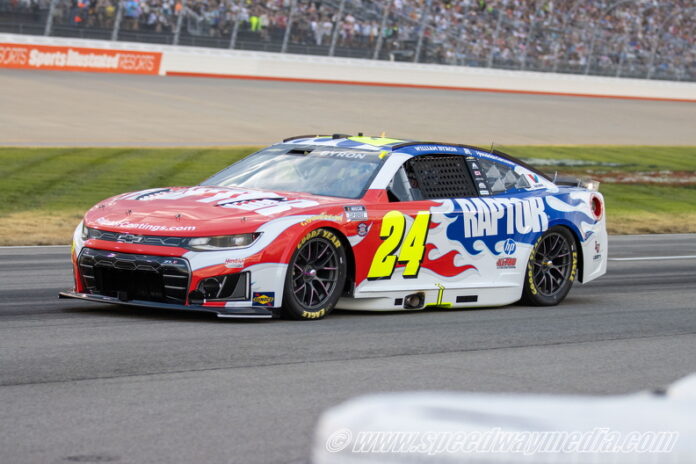
Carson Hocevar, driver of the No. 77 Chili’s Ride The ‘Dente Chevrolet Camaro ZL1, appeared to be destined for a top-10 result in Sunday’s NASCAR Cup Series race at Kansas Speedway until a late-race caution forced overtime. He was ultimately credited with a 13th-place finish.

Hocevar qualified sixth, a career-best at the Kansas City, Kan., facility, and quickly raced to fourth. As green-flag pit stops commenced for the first time on the day, the No. 77 team elected to run long in order to have a tire advantage over their competitors later in the run. After inheriting the lead and pacing the field for three circuits, veteran crew chief Luke Lambert called his driver to pit road on Lap 40. During the four-tire change, a broken pit gun hindered the stop, causing the Portage, Mich., native to slip to 18th. Despite the unfortunate circumstances, Hocevar drove inside the top 10 with two laps remaining in the 80-lap stage, and took the green-and-white checkered flag in eighth.

A second pit road miscue during the ensuing stage break resulted in the 2024 NASCAR Cup Series Rookie of the Year starting Stage 2 in 18th. The team once again ran long during the green-flag pit-stop cycle, leading an additional three laps, and utilized the slightly fresher rubber to reach the 10th position at the conclusion of Stage 2 on Lap 165. The relentless effort throughout the day gained the team a total of four stage points to aid in their pursuit of a spot in The Chase.

The No. 77 Chili’s crew clocked a fast four-tire stop during the stage break, allowing the 23-year-old driver to restart ninth. Hocevar maintained the top-10 track position and appeared destined for an eighth-place finish, until a caution on Lap 265 forced NASCAR Overtime. The No. 77 team hit pit road for four fresh tires, restarting in 16th. Hocevar ultimately took the checkered flag in 13th.

Carson’s Post-Race Comments
“Really good effort from this No. 77 team today. We had to battle through some adversity, but the speed of our Chili’s Chevrolet really showed. We didn’t get the finish we wanted, or really deserved, but some stage points made it a decent points day, overall.”

Up Next…
The NASCAR Cup Series heads to Talladega (Ala.) Superspeedway on Sunday, April 26. The Jack Link’s 500 will be televised live on FOX at 3 p.m. Eastern Daylight Time (EDT).

The 10th of 36 points-paying races on the Cup Series calendar will be broadcast live on the Motor Racing Network and SiriusXM NASCAR Radio Channel 90.

To stay up-to-date on all the latest news and exclusive content, follow Spire Motorsports on Facebook, X and Instagram, and visit Spire-Motorsports.com.
About Spire Motorsports …
Spire Motorsports fields full-time entries in the NASCAR Cup Series, NASCAR CRAFTSMAN Truck Series and Interstate Batteries High Limit Racing.

The team, co-owned by longtime NASCAR industry executive Jeff Dickerson and TWG Motorsports CEO Dan Towriss, earned its inaugural NASCAR Cup Series victory in its first full season of competition when Justin Haley took the checkered flag in the Coke Zero Sugar 400 at Daytona (Fla.) International Speedway on July 7, 2019. Less than three years later, William Byron drove Spire Motorsports’ No. 7 Chevrolet Silverado to its inaugural NASCAR CRAFTSMAN Truck Series win on April 7, 2022, at Martinsville (Va.) Speedway. The team’s most recent win came on Feb. 21, 2026, when Kyle Busch took the checkered flag in the Fr8 Racing 208 at Atlanta Motor Speedway.

In 2026, Spire Motorsports will campaign the Nos. 7, 71 and 77 Chevrolet Camaro ZL1s in the NASCAR Cup Series and the Nos. 7 and 77 Chevrolet Silverado RSTs in the NASCAR CRAFTSMAN Truck Series. The Mooresville, N.C., organization will also field the No. 77 410 sprint car in Interstate Batteries High Limit Racing competition.

Why a Good Electric Dirt Bike Is About More Than Just Power

For many people, the first thing that stands out about this category is speed and torque. A strong launch, quick response, and immediate acceleration can make a bike feel impressive within the first few seconds. That first reaction is understandable because power is one of the most visible parts of the riding experience. But after the initial excitement passes, riders usually begin to notice that long-term satisfaction depends on more than raw output alone.

A well-designed electric dirt bike should feel predictable, stable, and manageable across different situations. It should not only be exciting in a straight line, but also remain composed when the ground changes, when the rider needs to slow down quickly, or when traction is less than perfect. That is why experienced riders often pay attention to overall balance instead of focusing only on peak numbers.

Control Is What Turns Power Into Real Performance

High output sounds attractive on paper, but usable performance depends on how that power is delivered. If the throttle feels too abrupt, the bike may become tiring on loose surfaces or technical sections. If the response is too delayed, it may feel disconnected and harder to place accurately on uneven terrain. Smooth and controllable delivery often matters more than aggressive output that is difficult to manage.

This is especially true in off-road riding, where terrain changes constantly. A rider may move from hard-packed ground to gravel, from shallow ruts to small climbs, or from open space into tighter turns within a short distance. In those situations, the best bikes are not simply the ones with the highest numbers. They are the ones that help the rider stay confident and make consistent decisions.

Suspension and Chassis Matter More Than Many Buyers Expect

When buyers first compare models, motor power and battery size often get the most attention. However, the way a bike handles bumps, holds a line, and absorbs repeated impacts has a major effect on real-world enjoyment. A bike that feels unsettled over broken ground can quickly become tiring, even if it has strong acceleration.

Suspension quality influences traction, comfort, and control at the same time. If the front and rear feel too harsh, the rider may struggle to maintain stability through rough patches. If the setup feels too soft or vague, confidence can drop when speed increases. The frame, wheel size, weight distribution, and geometry all work together with the suspension to determine whether a bike feels planted or nervous.

Battery Performance Is About Consistency, Not Just Range Claims

Battery capacity is often discussed in terms of how far a bike can go, but range figures do not tell the full story. Real riding conditions are rarely steady. Hills, rider weight, tire choice, surface resistance, and throttle habits all influence how efficiently energy is used. A bike that looks strong in a simple specification list may behave very differently during actual off-road riding.

Consistency matters just as much as maximum distance. Riders want predictable performance throughout the ride, not a bike that feels strong early on and noticeably weaker later. Charging convenience, battery durability, and how well the system manages power under load are all practical factors that shape ownership. Over time, these details often matter more than a headline range number.

Rider Fit and Comfort Shape Confidence Over Time

A bike may look exciting online, but it still has to fit the person riding it. Handlebar position, seat height, stand-over height, peg placement, and the relationship between body posture and control all influence confidence. When the fit feels natural, riders usually respond more smoothly and tire less quickly. When the fit feels awkward, even a capable bike can become less enjoyable.

Comfort is not only about soft contact points. It also includes how the bike behaves over time. Repeated vibration, poor balance at lower speeds, or tiring steering effort can reduce enjoyment on longer outings. Riders who plan to spend more time off-road should think carefully about how the bike feels during sustained use rather than judging it only from first impressions.

Buying Decisions Should Start With Riding Needs, Not Hype

When people browse electric dirt bikes for sale, it is easy to get drawn toward the biggest numbers, the boldest claims, or the most aggressive styling. But the best choice usually depends on where and how the bike will actually be used. A rider spending time on open private land may value one type of setup, while someone riding mixed terrain may need something more balanced and versatile.

It helps to begin with practical questions. How technical is the terrain? How often will the bike be used? Is the rider focused on recreational fun, skill development, or a mix of both? Will the riding involve longer sessions or shorter bursts? These questions often reveal more than a simple comparison chart. A bike that matches real needs generally delivers a better ownership experience than one chosen mainly for headline appeal.

The Best Bikes Feel Complete, Not One-Dimensional

This is why many experienced riders eventually shift the way they compare bikes. They still care about torque, speed, and power, but they also pay closer attention to handling, response, battery behavior, and rider comfort. The category has matured enough that buyers no longer need to think in simple terms of “more power equals better bike.” In practice, a more complete machine often creates more lasting value.

That broader perspective also helps explain why brands such as qronge are often judged not only by visible specifications, but by how well the bike performs as a whole. Riders increasingly care about whether the machine feels trustworthy across real terrain, not just whether it sounds powerful in a product description. In the long run, that kind of usable and balanced performance is what makes a bike worth returning to again and again.

Best Tools: Top Parts Inventory Management Software

Photo by depositphotos at https://depositphotos.com/

The availability of spare parts may seem unimportant in terms of maintenance, but it is probably the deciding factor that determines whether business operations will run smoothly or experience disruptions. The lack of spare parts makes it impossible to conduct repairs, causing delays in the business operation process and putting employees under stress. Companies need to have an effective inventory management system to avoid such problems.

The first step for organizations is to identify the best spare parts inventory management system. By adopting the top parts inventory management software, the organization will have access to efficient inventory management services.

Why Parts Inventory Matters More Than Ever

Even the slightest delay will have an impact when there is high demand for something. In situations where components are not available, workers will be forced to stop working and either rearrange their schedules or seek out alternative components. This will result in higher expenses and decreased efficiency.

Good inventory management will help ensure that the proper components are available at the appropriate time. This will aid in improving repair times and minimizing downtime. It will also improve organization across different locations.

Real-Time Inventory Visibility

Real-time tracking is one of the essential characteristics of advanced inventory management systems. It is crucial to have knowledge about available components, their locations, and usage rates.

Real-time information helps employees prevent excessive stock and deficiencies in supplies. It allows managers to take appropriate actions before the shortage affects work.

It is no longer necessary to guess the number of items or manually count them.

Automated Reordering and Stock Control

The manual system of managing stock may lead to failure to identify the appropriate time for reordering or having extra inventory. The automated system addresses this challenge by ensuring that there is an appropriate threshold level for ordering the next stock.

This guarantees the availability of key spare parts without holding excessive inventory. It minimizes the workload of maintenance teams.

Stock control in an automated system provides better supply chain management.

Integration with Maintenance Workflows

The system of parts inventory must not remain independent. The best system will have the direct integration of parts inventory with the maintenance process and work order processing.

As soon as the work order is generated, the system can produce a list of all the spare parts required for repairing equipment. It also helps in checking the availability of such parts in real-time without any delay.

This helps in better planning of repair activities.

Multi-Location Inventory Management

When an organization is running multiple locations, inventory control becomes a difficult task. The parts might be kept at various locations, so keeping track of inventory would become problematic.

The inventory control software makes everything easier because it shows all the places where the parts are kept. The staff can move them wherever they are required.

It prevents duplication and optimizes resource utilization.

Vendor and Supplier Management

A consistent supply of goods is a requirement for inventory levels to remain constant. The inventory system will help companies deal better with their suppliers.

Teams will be able to track delivery timelines, pricing, and delivery accuracy. It will become easier to identify the best suppliers.

Proper handling of suppliers will result in faster restocking.

Data and Usage Insights

There is an interesting history behind each unit utilized for maintaining the plant. Usage patterns reveal valuable insights into what components are important, which units break down most often, and what increases expenses.

The computer system for inventory management compiles all the data and analyzes it to develop projections. Predictive planning can be achieved for both inventories and budgets.

This data is also critical to maintenance because it ensures that required spare parts are always accessible.

Mobile Access for Field Teams

Technicians often need to check parts availability while working in the field. They can use mobile connectivity to check their inventory, order parts, and update usage.

This helps avoid unnecessary delays and improves communication between technicians and the inventory department. This also helps keep record accuracy without needing any extra paperwork.

Mobile capabilities make adoption easy.

Supporting Compliance and Accountability

Tracing parts usage is important in regulated industries. The inventory system will keep track of parts usage and where they come from.

These make compliance easy to achieve. The process of documentation helps in achieving accountability since it traces how the organization uses its resources.

Compliance is an integral part of the business operations.

Conclusion

Parts inventory management is no longer a background task—it is a critical function that directly impacts uptime and efficiency. With the appropriate tools in place, there will be enough visibility, control, and integration to ensure that processes are carried out efficiently.

Inventory systems for spare parts have revolutionized how businesses operate their maintenance departments, from tracking in real time and automatic ordering to analytical capabilities and mobile functionality.

Enterprises that require sophisticated maintenance will benefit significantly by using some of the best inventory software for parts.

How to Defend Yourself When You’re Unfairly Blamed for a Motorbike Accident in Atlanta

A motorbike crash in Atlanta can turn into a fault dispute within hours. In Georgia, blame matters because the state uses modified comparative negligence, which means your recovery can be reduced by your share of fault, and you cannot recover damages if you are 50 percent or more responsible. That makes early evidence, accurate reporting, and careful communication especially important when another driver, an insurer, or even a police report points the finger at you.

Start With The Fault Rules

Georgia does not automatically treat a motorcyclist as the cause of a wreck, even when an insurer acts that way. If the facts are disputed, you might seek advice from a motorbike accident lawyer in Atlanta, who can help you understand how Georgia’s fault rule works before you give a recorded statement or accept an insurer’s version of events.

Under O.C.G.A. § 51-12-33, fault can be divided among the people involved, and damages are reduced in proportion to your share. If you are found 49 percent at fault, you may still recover part of your losses, but at 50 percent or more, recovery is barred under Georgia law.

Preserve The Evidence Early

Your first line of defense is the record created at the scene and in the days right after the crash. Take photographs of the vehicles, the road surface, skid marks, debris, weather conditions, helmet damage, and any visible injuries, and get the names and contact details of witnesses before they disappear.

In Atlanta, a police report can influence how insurers evaluate the case, but it does not make fault final. You can also obtain the crash report through the Atlanta Police Department records process or Georgia’s crash report system, then compare it against your photos, witness accounts, medical records, and repair estimates for errors or missing details.

Be Careful With Statements And Reports

Georgia law requires drivers to report a crash involving injury, death, or apparent property damage of $500 or more to law enforcement under O.C.G.A. § 40-6-273. When you speak with police, keep your account factual and specific, and avoid guesses about speed, distance, or what another driver “must have” intended.

The same caution applies when an insurance adjuster calls. You generally must report the crash to your insurer under your policy, but you do not have to speculate, exaggerate, or adopt wording that makes the crash sound like your fault when the facts are still being sorted out.

Address Motorcycle Specific Issues

Motorcyclists are often blamed through assumptions about speed, lane changes, or visibility rather than direct proof. Georgia law requires riders and passengers to wear protective headgear, and eye protection is required unless the motorcycle has a windshield, under O.C.G.A. § 40-6-315, but a gear issue does not automatically prove you caused the collision.

That distinction matters because negligence turns on evidence tied to the crash itself. A driver who turned left across your path, changed lanes without seeing you, followed too closely, or opened a door into traffic may still bear most or all of the fault even if the insurer tries to focus on the motorcycle first.

Challenge Fault With Objective Proof

If a report or claim form unfairly blames you, the most effective response is usually a factual one supported by documents. Surveillance video, dashcam footage, 911 records, event data from vehicles, phone records, and scene measurements can all help show where each vehicle was and whether another driver violated traffic rules.

Medical records can matter too, especially when they match the mechanics of the crash. Treatment notes, ambulance records, and photographs taken soon after the wreck can support your timeline and show that your account fits the physical evidence better than the version used to assign blame.

Watch The Deadlines And Damages

A fault dispute should not distract you from Georgia’s filing deadlines. In general, personal injury claims arising from a vehicle crash must be filed within two years under O.C.G.A. § 9-3-33, while claims for damage to personal property usually carry a four-year deadline under O.C.G.A. § 9-3-32.

Those time limits can have exceptions, including cases involving minors, certain criminal prosecutions connected to the incident, or claims against government entities that require ante litem notice on a shorter schedule. If a city vehicle, county vehicle, or state agency may be involved, the notice rules can change the timeline long before the ordinary statute of limitations expires.

Building A Clear Record From Day One

Defending yourself after an unfair accusation in an Atlanta motorbike accident starts with creating a clear record before assumptions harden into a claim decision. Protect your rights after a motorcycle accident begins with treating Georgia’s fault rules as a matter of evidence, since your account should be backed by photos, witness statements, official reports, medical records, and a timeline that matches the facts. When you focus on facts instead of arguments, you place yourself in a stronger position to challenge blame that does not belong to you.

What to Do When a Car Crash Disrupts Your Health, Finances, and Daily Life in The Villages

A car crash can change your week in a matter of seconds. In The Villages, where daily driving may involve roundabouts, golf cart traffic, and trips across Lake, Sumter, and Marion Counties, the first issues are usually medical care, insurance, transportation, and missed work. Florida law sets out specific rules on reporting, no-fault benefits, fault-based claims, and filing deadlines, so the steps you take early can affect both your health and any later claim.

Get Medical Care And Preserve The Basics

Your first job is medical, even if your symptoms seem minor at the scene. Florida’s no-fault system generally requires you to get initial services and care within 14 days to seek Personal Injury Protection benefits. Delayed treatment can also make it harder to show that your injuries were caused by the crash rather than something else. Even a same-day urgent care or emergency room visit can create an early record of pain, dizziness, stiffness, or other symptoms.

According to The Villages car accident lawyer, photos of vehicle damage, visible injuries, road conditions, and traffic signs can help later when insurers dispute how the crash happened or how serious the impact was. If there are witnesses nearby, ask for their names and contact information before they leave. You should also note the time, location, weather, and direction each vehicle was traveling while the details are still fresh.

Make Sure The Crash Is Properly Reported

Florida requires a long-form crash report when law enforcement investigates a crash involving death, injury, complaints of pain, a hit-and-run violation, a vehicle needing a wrecker, or a commercial motor vehicle. When a law enforcement report is not required, the driver still must submit a written report to the state within 10 days.

That report matters because insurers often rely on it during the early claim stage. Florida crash reports are generally confidential for 60 days after filing, though parties involved, insurers, and certain others can get access sooner, and reports are available through the state crash portal for a statutory fee.

Understand How Florida No Fault Coverage Works

Florida drivers generally turn first to their own PIP coverage after a crash, regardless of who caused it. The statute provides up to 80 percent of reasonable medical expenses and 60 percent of lost income, subject to policy limits and other conditions.

PIP does not pay every loss, and it does not automatically cover pain and suffering. If your injury meets Florida’s threshold for a tort claim, such as a significant and permanent loss of an important bodily function, a permanent injury within a reasonable degree of medical probability, significant and permanent scarring or disfigurement, or death, you may pursue noneconomic damages from the at-fault party.

Track The Financial Impact Early

A crash claim is often built from ordinary records. Keep bills, prescriptions, mileage to treatment, repair estimates, rental car costs, proof of missed work, and any notice from your health insurer, auto insurer, Medicare, or other payers.

It also helps to keep a short timeline of your symptoms and limitations. A dated record of canceled appointments, sleep disruption, household help, and missed activities can clarify how the crash affected your daily life without turning your case into speculation.

Be Careful With Insurance Statements And Settlements

Report the crash to your insurer promptly and review your policy’s deadlines and coverage sections. In this stage, common mistakes to avoid include guessing about injuries, agreeing to a recorded statement too soon, or describing your recovery before you have your medical records in hand when the other driver’s insurer calls.

Early settlement offers can close out claims before the full medical picture is known. Once you sign a release, reopening the matter is usually difficult, so it makes sense to compare the offer against current bills, likely future care, wage loss, property damage, and any reimbursement claims from other payers.

Know The Fault Rules And Filing Deadlines

Florida now applies modified comparative negligence in most negligence cases. If you are found more than 50 percent at fault for your own harm, you may not recover damages, and smaller percentages of fault reduce recovery proportionally.

The general deadline for a negligence action in Florida is two years, and wrongful death actions also carry a two-year limitations period. These dates can be affected by unusual facts, and claims against state or local government bodies follow separate notice rules and damages limits, including written notice requirements under Florida’s sovereign immunity statute.

Watch For Government Vehicle Issues And Other Exceptions

If the crash involved a county vehicle, city vehicle, sheriff’s office unit, or another government actor, the process changes. Florida law generally requires written notice to the agency, and for many state-related claims also to the Department of Financial Services, within three years, with shorter timing for wrongful death notice and statutory caps that can limit payment without further legislative action.

Other complications can affect timing and proof, including commercial vehicles, rental cars, rideshare involvement, or later disputes over whether treatment was related to the crash. Those cases often turn on contracts, policy language, and medical documentation rather than the police report alone.

Rebuilding Daily Life After The Crash

A crash can interrupt your health care, income, transportation, and routine all at once. The most useful response is usually straightforward: get medical care, document what happened, report the crash properly, track every expense and missed obligation, and pay close attention to Florida’s insurance rules, filing deadlines, and notice requirements when a government vehicle is involved.

Editorial: Why the ‘Big 4’ Model is Losing Its Grip on Australia’s Mid-Market

Photo by depositphotos at https://depositphotos.com/

For decades, the “Big 4” and global consulting firms have shaped the Australian corporate imagination. If a problem was complex or high-stakes, the default response was simple: engage a global brand. It was seen as the safest option, the consulting equivalent of “nobody ever got fired for buying IBM.”

That perception is beginning to shift.

Across Australia’s mid-market, particularly within infrastructure, utilities, not-for-profit, and regulated service sectors, the traditional model is no longer being accepted at face value. This is not driven by sudden dissatisfaction, but by a more gradual and considered realization: the luster of the global consulting model is fading.

Recent scrutiny across the consulting industry has accelerated this shift. High-profile governance failures, including those examined through Australian Senate inquiries into consulting practices, alongside broader global commentary from publications such as the Australian Financial Review and Financial Times, have highlighted concerns around conflicts of interest, independence, and accountability in large advisory firms.

At the same time, the increasing use of AI in consulting delivery, while valuable, has raised additional questions about authorship, quality assurance, and the depth of insight behind advisory outputs. These developments are not isolated issues; they are contributing to a broader reassessment of trust. Organizations are beginning to ask a more fundamental question: What are we actually buying when we engage a global firm?

The Brand vs Delivery Reality

While the brand carries weight, the day-to-day reality of many engagements is less visible. Large firms operate on a leveraged delivery model. While senior leaders shape the engagement and provide oversight, much of the execution is delivered by smaller, often junior teams operating behind the brand. This is not a flaw in itself, it is a structural feature of the model.

However, for mid-market organizations, this can create a disconnect between perceived expertise and delivered experience, strategic intent and operational understanding, and accountability at the top and delivery on the ground. As noted in industry commentary across outlets such as the AFR, clients are becoming increasingly aware of this dynamic — and are placing greater scrutiny on who is actually doing the work.

The Implementation Gap

The traditional consulting model has long been built on this structure: senior leaders secure the work, and layered teams deliver it. In highly standardized environments, this model can be effective. But in the Australian mid-market, where organizations operate with leaner teams, tighter margins, and greater exposure to operational risk, it often struggles to translate into outcomes.

What these organizations need is not just strategy, but operational readiness. They require advisors who understand that transformation does not succeed at the point of recommendation, but at the point of adoption, where systems, people, and processes must function together under real-world conditions.

This is particularly evident in areas such as compliance systems and governance frameworks, where the difference between a documented framework and a functioning system can determine whether an organization remains compliant under scrutiny. A Project Management Office (PMO), for example, is not a collection of templates. It is a governance mechanism that must hold under pressure, whether that is a construction program, a service rollout, or a regulatory response. Without that grounding, even well-designed strategies struggle to translate into outcomes.

The ‘Right-Sized’ Governance Challenge

Another tension lies in the application of governance frameworks. Global consulting models are typically designed for large-scale enterprises. When these frameworks are applied to mid-market organizations without adjustment, they can introduce unnecessary complexity, cost, and administrative burden.

This is not simply inefficient; it can actively undermine performance. Mid-market organizations succeed because of their agility. Overly complex governance structures can slow decision-making, diffuse accountability, and create systems that exist more for compliance than for function. Effective transformation requires balance: enterprise-grade discipline where it matters, combined with operational simplicity and clarity where it counts. This is where a focus on right-sized governance becomes critical, ensuring that compliance frameworks support the organization, rather than constrain it.

Trust, Presence, and Accountability

Perhaps the most significant shift, however, is occurring at a more fundamental level: trust. In an environment of increasing regulatory scrutiny and stakeholder accountability, organizations are no longer just purchasing expertise. They are seeking judgment, accountability, and presence.

The questions being asked are changing: Who is actually delivering the work? Who stands behind the recommendations? Who remains engaged when complexity increases? The traditional model built on brand assurance is being tested against these expectations.

In contrast, practitioner-led advisory models operate differently. The individuals who shape the work are typically the same individuals who deliver it. This creates stronger continuity, clearer accountability, and closer alignment with operational realities. Firms like Integris Group Services have become emblematic of this shift, positioning themselves as the “practitioner” alternative for firms that prioritize execution over brand recognition.

The Rise of the Practitioner Model

This is contributing to the rise of a practitioner-led approach to consulting. Rather than large, layered teams, organizations are increasingly engaging experienced operators, individuals who have led transformations, managed risk, and delivered outcomes within comparable environments.

This does not mean abandoning structure or rigor. It means applying them with greater precision. The focus shifts from producing recommendations to embedding systems, and from delivering frameworks to enabling capability. The definition of the “safe choice” is evolving. It is no longer defined by brand alone, but by the ability to translate complexity into practical systems, the willingness to remain engaged beyond the point of advice, and the consistency of delivery from the people clients actually work with.

A Market in Transition

This is not a rejection of the global consulting model. Large firms continue to play an important role in large-scale, highly complex engagements. However, within Australia’s mid-market, expectations have changed. Organizations are becoming more discerning, asking more informed questions, and placing greater value on clarity over complexity, delivery over presentation, and accountability over brand.

The result is not disruption, but evolution. The consulting market is not being replaced; it is being redefined. And in that shift, the firms that will succeed are those that can align strategy with execution, and advice with accountability, not just in principle, but in practice.

How to organize a road trip in Saint Barths

One of the best ways to travel and explore the island of Saint Barthélemy is by organising a road trip. From scenic hillside views to secluded beaches, driving offers the freedom to move beyond the usual tourist spots. Keep reading to learn ways you can plan your road trip to enjoy a smooth, unforgettable and flexible island adventure.

Road Tripping in Saint Barths

Among many ways to explore and experience a destination, a road trip sits at the top. It offers flexibility, freedom and a deeper connection with the locals and surroundings. In a beautiful place like Saint Barthélemy, where hillside viewpoints and scenic coastal roads are part of the charm, opting to rent a car in St Barths can make all the difference. Many tourists, especially those who value time on the road, prefer this convenient option because it helps them avoid crowded transport, move at their own pace and reach destinations that are deemed inaccessible by public transport. This trend is increasingly becoming popular as visitors rely on local rental services to enjoy a seamless road trip adventure.

A great road trip essential includes the destination, reliability, comfort and the ability to move without limitations. Islands like Saint Barths are home to many beautiful sceneries, including panoramic viewpoints, hidden beaches and quiet coves that can’t be fully explored without a car. A rental vehicle guarantees you these hidden spots while allowing you to enjoy the island‘s natural beauty on your schedule. Additionally, choose a reliable rental provider to add peace of mind, which, in turn, helps you focus on your road trip experience instead of logistics. More travellers are prioritising independence and convenience by choosing a popular and practical option (renting a car).

Factors to Consider when Planning a St Barthélemy Road Trip

Transportation choice and timing play a significant role in how your overall road trip experience in St Barths will be. A little yet thoughtful planning goes a long way, from choosing a suitable car to deciding on the seasons to visit, in ensuring an enjoyable and smooth journey around the island.

Picking the Right Car

The island is known for its sharp turns, narrow roads and steep hills, making it vital to choose the appropriate vehicle. For ease of navigation and parking, choose a compact car, especially when planning to visit busy or tourist-packed areas. On the other hand, choose an SUV if you are planning to explore elevated or more rugged regions or seeking extra comfort. They offer a smooth driving experience and stability even on rough roads. Work with a rental service provider who offers various cars to suit specific roads and comfort needs, ensuring an enjoyable and safer trip.

Best Time for a Road Trip on the island

The weather in Saint Barths is warm and tropical year-round. The time you visit will determine both convenience and comfort. December to April (peak season) offers lively energy and sunny skies, but is packed with many visitors and higher demand for services. Off-season months offer a more laid-back atmosphere, quieter roads and easier access to attractions.

Final Thoughts

A road trip to St Barths is all about convenience, comfort and flexibility. With a suitable car and the right timing, you can enjoy what the island offers at your own pace. Car rental makes the experience more enjoyable and smoother, allowing you to appreciate everything on the island.

Isee hair Wear and Go Wigs vs Crochet Human Hair: A Complete Guide

In the modern beauty world, finding a hairstyle that is both stylish and convenient is essential.  Wear-and-go wigs and crochet human hair are two well-liked solutions that can meet these requirements. Both offer a natural appearance and help protect your real hair, but they differ in installation, maintenance, and flexibility.

What Are Wear and Go Wigs?

Wear and go wigs are designed for instant use with little to no effort.  These wigs come pre-styled, pre-cut, and often pre-plucked, meaning they are ready to wear straight out of the box.  Additionally, the majority of wear-and-go wigs don’t require adhesive to be secured. They can be straight, curly, body wave, or deep wave and are typically crafted from human hair or high-quality fibers. With wear and go wigs, you can achieve a polished, salon-quality look in just a few minutes.

 Benefits of Wear and Go Wigs

Wear and go wigs are highly popular because of their convenience.  Some key benefits include:

  • Quick installation: Ready in minutes
  • Beginner-friendly: No professional skills needed
  • Protective styling: Shields your natural hair from heat and damage

Adaptable looks that are simple to change. They are perfect for busy individuals who want a fast and effortless hair solution.

What Is Crochet Human Hair?

Crochet human hair is a technique where human hair extensions are installed using a crochet needle.  The first step is to braid your hair into cornrows. Then, the extensions are looped through the braids to create a full, voluminous hairstyle.

Because the hair used is human hair, it offers a natural look and can be styled with heat tools or dyed.  Crochet styles are often used for curly, wavy, or textured looks and can last for several weeks.

Benefits of Crochet Human Hair

Crochet human hair offers long-lasting and natural results.  Some of its advantages include:

  • Long-lasting style: Can stay in place for weeks
  • Natural appearance: Blends well with your real hair
  • Low daily maintenance: No need to install daily
  • Styling flexibility: Can be curled, straightened, or colored

This option is ideal for those who prefer a semi-permanent hairstyle.

Key Differences Between Wear and Go Wigs and Crochet Human Hair

The main difference between these two options lies in installation and wear.  Wear and go wigs are temporary and can be put on or removed at any time.  This makes them the perfect solution for people who like to change their hairstyle more frequently.

Crochet human hair, on the other hand, requires a more detailed installation process but provides long-lasting results.  Once installed, it can be worn continuously for weeks.

Another difference is maintenance.  Wear and go wigs need to be removed, cleaned, and stored properly, while crochet styles require scalp care and occasional maintenance to keep them fresh.

Which One Should You Choose?

Choosing between wear and go wigs and crochet human hair depends on your lifestyle.  If you want flexibility and quick styling, wear and go wigs are the best option.  They are ideal for beginners and anyone with a busy schedule.

If you prefer a long-lasting style that doesn’t require daily effort, crochet human hair is a great choice.  It’s perfect for people who want a consistent look for an extended period.

Care and Maintenance Tips

For both styles, proper care is important.   Proper maintenance will help extend the life of your style.

Conclusion

Both wear and go wigs and crochet human hair offer stylish and practical solutions for modern hair needs.  Whether you prefer quick versatility or long-lasting wear, each option has its own benefits.  By understanding their differences, you can confidently choose the style that best fits your routine and enhances your overall look.