Home Blog Page 36

How to Add Apple CarPlay to Your McLaren or Ferrari — Without Cutting a Single Wire

Photo by depositphotos at https://depositphotos.com/

Driving a McLaren or Ferrari offers pure adrenaline. However, those stylish infotainment systems from the early 2010s lack modern essentials like Apple CarPlay. Picture yourself racing through corners with smooth navigation, hands-free calling, and Spotify integration, all while keeping your factory dashboard intact.

You don’t need a complete stereo replacement or dangerous wiring modifications. Plug-and-play modules allow you to easily retrofit wireless Apple CarPlay into your supercar. This guide covers the steps for both McLaren and Ferrari models, ensuring your vehicle’s warranty remains valid and its Italian (or British) engineering stays pristine.

Why Supercar Owners Love Apple CarPlay Retrofits?

Supercars like McLarens and Ferraris prioritize performance over gadgets. That’s why models before 2020 often lack built-in CarPlay support. You end up fumbling with your phone or settling for clunky Bluetooth audio.

Enter plug-and-play solutions. These compact modules slip into your existing setup, mirroring your iPhone’s interface on the OEM screen. No dashboard tears, no voided warranties, just instant access to Maps, Messages, and more.

The result? Safer drives with Siri voice commands and split-screen views for music and navigation. Plus, it’s reversible if you ever sell. For high-rev enthusiasts, this is the tech upgrade that doesn’t compromise soul.

Selecting the Perfect Plug-and-Play Module

Not all CarPlay kits are created equal. Look for ones certified for your specific model, McLaren 570S, Ferrari California, you name it. Key features? Wireless connectivity, Android Auto compatibility, and full steering wheel control retention.

Ferrari fans, check out the Ferrari CarPlay Module. Designed for 458s, 488s, and F12s, it supports high-res displays and integrates flawlessly with your Prancing Horse’s electronics.

Budget tip: Expect $500–$1,000, depending on wireless perks. Always verify compatibility with your VIN for a hassle-free fit.

Tools and Prep: What You’ll Need?

Before starting, gather basics: a trim removal tool set, a Phillips screwdriver, and zip ties for cable management. No soldering irons here; this is DIY-friendly.

Park in a well-lit garage. Disconnect the battery for safety (negative terminal first). Download your module’s app for setup, and most pairs via Bluetooth in seconds.

Pro tip: Watch model-specific YouTube installs for visuals. Channels like KKS Supercar demo McLaren swaps in under 30 minutes.

Time estimate? 45–90 minutes total. Patience pays off when you’re preserving that carbon-fiber glovebox.

Step-by-Step: Adding CarPlay to Your McLaren

McLarens boast minimalist interiors, so access is straightforward. Start with the 570S or 720S; similar processes apply across the lineup.

  1. Accessing the Head Unit

Pop the center console trim using plastic pry tools. Gently lift from the edges to avoid scratches. Locate the head unit behind the screen; it’s a black box with ribbon cables.

Unplug the factory harness carefully. Label connectors with tape if needed. This step takes 5 minutes max.

  1. Installing the Module

Slide the McLaren CarPlay Module into place. It mates directly to the OEM ports, no adapters required. Secure with the provided clips.

Reconnect everything in reverse order. The module’s LED should blink green on power-up, signaling readiness.

  1. Testing and Syncing

Reconnect the battery. Fire up the ignition, and your screen should boot to the familiar McLaren interface with a new CarPlay menu.

Pair your iPhone via USB or wirelessly. Test Maps routing to your next track day. Steering controls? They handle volume and track skips perfectly.

If glitches occur, reset via the module’s hidden button. Boom, your McLaren’s now a connected beast.

Step-by-Step: Retrofitting CarPlay in Your Ferrari

Ferraris add a touch of drama with their gated shifters and leather-wrapped dashes. But fear not, the install mirrors McLaren’s simplicity for models like the 458 or Roma.

  • Removing Interior Panels

Begin at the glovebox for FF or California access. Unscrew the lower dash panel. For 488s, tilt the screen forward after releasing the side clips.

Expose the infotainment module; it’s tucked right of the center stack. Disconnect antennas and power leads methodically.

  • Plugging in the Ferrari Module

Align the Ferrari CarPlay Module with factory connectors. Push until it clicks, plug-and-play magic at work. Route any extra cables under the carpet for tidiness.

  • Activation and Fine-Tuning

Power on. The module auto-detects and overlays CarPlay on your native display. Connect your phone; Siri greets you with that Italian flair.

Navigate a quick route, Waze or Apple Maps render crisply on the 7-inch screen. Audio? Crystal-clear through Bose or stock speakers.

Customization apps let you tweak icons or add widgets. Your Ferrari’s now as smart as it is fast.

Wireless vs. Wired: Which CarPlay Setup Wins?

Most modern modules offer both options. Wireless shines for cable-free cockpits, ideal for McLaren’s aero-focused cabins.

Wired setups? They’re rock-solid for long hauls, drawing power directly from the USB port. Ferrari owners might prefer wireless to match the brand’s wireless charging vibes.

Battery drain? Negligible, modules sip power only when active. Choose based on your daily drive: urban zips favor wireless freedom.

Top Benefits of a Seamless CarPlay Upgrade

Safety first. Voice-activated controls mean eyes on the road, not your phone. In a 200-mph Ferrari, that’s non-negotiable.

Entertainment elevates every mile. Stream podcasts on twisty backroads or queue playlists for redline roars in your McLaren.

Resale value? A CarPlay-equipped supercar appeals to tech-savvy buyers. It’s a $1,000 investment yielding thousands in appeal.

Eco-bonus: Less phone fiddling means fewer distractions and smoother traffic flow. Your upgrade helps the planet, one lap at a time.

Common Pitfalls and Quick Fixes

Glitches happen. If CarPlay won’t launch, check iOS compatibility; iPhone 12 or newer required.

Screen flicker? Ensure firm connections; loose harnesses are culprits. For McLarens, update firmware via the module’s USB port.

Ferrari-specific: Harmon Kardon audio might need a quick equalizer reset post-install. Forums like Ferrari Chat have threads galore.


Why That “Lucky” Ritual Matters: The Strange Psychology Behind Online Gaming Superstitions

Photo by depositphotos at https://depositphotos.com/

Do you have a favorite controller you only use for big boss fights? A lucky t-shirt you wear during competitive matches? Or maybe a specific way you have to click the mouse before starting a new round? If so, you’re not alone. For as long as humans have faced uncertain outcomes, we’ve developed rituals and superstitions to try and tip the scales in our favor. But in the digital age of online gaming, where every outcome is governed by complex algorithms and random number generators (RNGs), these behaviors seem particularly irrational. After all, a line of code can’t be influenced by your lucky socks.

And yet, this behavior isn’t a rare quirk; it’s incredibly prevalent in the world of online gaming. Whether someone is preparing for a high-stakes esports match or settling in for a casual session at an online Casino Spin, you’ll find players engaging in personal rituals they swear by. The fascinating question isn’t if these superstitions work—they don’t change the game’s code—but why our brains are so compelled to create and follow them. The answer lies deep within the complex and fascinating workings of human psychology.

The Illusion of Control in a World of Randomness

One of the most powerful drivers behind superstition is a psychological principle known as the “illusion of control.” Our brains have evolved to seek cause and effect, and we are fundamentally uncomfortable with the idea that some things are entirely beyond our control. When faced with randomness, we instinctively search for a way to exert some influence, however small.

Online games, especially those involving luck, are perfect breeding grounds for this phenomenon. The outcome of a digital card draw or a loot box drop is completely random, but our minds resist this fact. By performing a small ritual—like tapping the screen in a certain pattern or chanting a silly phrase—we create a sense of agency. This action gives us the feeling that we are participating in the outcome rather than just passively waiting for it. This illusion of control doesn’t change the odds, but it does something arguably more important: it reduces anxiety and makes the experience of uncertainty more tolerable.

Our Brains Are Hardwired to Find Patterns

Another piece of the puzzle is our brain’s incredible, and sometimes overactive, ability to detect patterns. We are pattern-seeking machines, a trait that has helped us survive by learning to connect events, like associating dark clouds with rain. However, this same mechanism can lead us to see patterns where none exist, a tendency known as apophenia.

Think about a time you were on a “hot streak” in a game. Perhaps you won three rounds in a row right after you switched your character’s outfit. Your pattern-seeking brain immediately forges a connection: “The new outfit caused the wins.” In reality, the two events are completely coincidental, but the mental link has been made. From that point on, that outfit becomes a “lucky” charm. Your brain has created a cause-and-effect narrative to explain random clustering of positive results, reinforcing the superstitious behavior for the future.

How Superstitions Can Actually Improve Performance

So, if these rituals don’t affect the game’s code and are based on faulty pattern recognition, are they completely useless? Surprisingly, no. While a superstition can’t directly influence the game, it can have a very real and measurable impact on the player. The true power of a lucky charm isn’t magical—it’s psychological. It works as a kind of placebo, boosting a player’s mindset, which in turn can lead to better performance.

This mental boost manifests in several ways that can give a player a genuine edge, especially in games that require skill, focus, and quick decision-making. Thinking you have luck on your side can become a self-fulfilling prophecy.

Here are a few of the tangible psychological benefits:

  • Reduced Anxiety: Engaging in a familiar ritual can be calming, lowering stress levels and allowing a player to think more clearly under pressure.
  • Increased Self-Efficacy and Confidence: Believing you have an “edge” can boost your confidence. This heightened self-belief often leads to bolder, more decisive actions in the game.
  • Enhanced Focus: A pre-game ritual can act as a mental trigger, signaling to your brain that it’s time to switch off distractions and concentrate fully on the task at hand.
  • Greater Persistence: After a loss, a superstition can help a player rationalize the outcome (“my luck ran out”) and encourage them to try again, fostering resilience instead of defeat.

These benefits show that even if the luck isn’t real, the confidence and focus it inspires are, and in a competitive environment, that can make all the difference.

Embrace Your Inner Superstition

In the end, the psychology of gaming superstitions reveals a fascinating truth about the human mind. We are creatures who crave control, search for meaning in randomness, and perform at our best when we feel confident. While your lucky ritual won’t ever change the algorithm, it can fundamentally change you—your mindset, your focus, and your enjoyment of the game.

So, the next time you find yourself putting on that lucky headset or tapping your keyboard a certain way, you don’t have to feel silly. You’re not trying to hack the system; you’re simply hacking your own brain. You’re engaging in a powerful psychological tool that humans have used for millennia to face the unknown with a little more confidence. And in the unpredictable world of online gaming, a little confidence can go a long way.

2025 Casino Sponsorships Driving Motorsports Revenue

Sponsorship Investment Racing Growth

The roar of engines now echoes with the chime of slot machines. Casino sponsorships inject vital funds into motorsports teams and events. These partnerships create unique fan engagement opportunities. For instance, KA Gaming slots integrate racing themes into their games. This synergy attracts new audiences to both industries. Teams gain financial stability for technological advancements. The collaboration reshapes modern racing culture.

Key Facts

  1. Casino sponsorships contributed over $350 million to Formula 1 teams in 2023.
  2. A single major slot game partnership boosted a NASCAR team’s R&D budget by 40% in 2024.
  3. Motorsport events with casino sponsors saw a 28% increase in viewership among 25-34 year olds.
  4. The global market for branded racing slots will reach $1.2 billion by 2025.
  5. Teams with casino partners reported a 15% faster car development cycle.
  6. Fan participation in linked bonus promotions grew by 300% from 2022 to 2024.

Financial Engines Behind the Speed

Casino sponsorships provide teams with unprecedented financial power. This influx directly funds aerodynamic research and engine development. Teams can now afford advanced simulation technology. These tools shave crucial milliseconds off lap times. The financial stability also allows for aggressive talent acquisition. Top drivers and engineers command high salaries. Sponsorship deals make these signings possible. Every dollar translates directly into a competitive advantage on the track.

Jackpot Wins for Fan Engagement

Modern sponsorships extend far beyond track-side logos. They create interactive fan experiences through digital platforms. Fans can now earn exclusive rewards and access. Special promotions often include behind-the-scenes content. Some teams offer virtual garage tours to engaged supporters. This deepens fan loyalty and expands the sport’s reach. The interactive element keeps audiences engaged between races. It transforms passive viewers into active participants.

The Future of Racing Sponsorships

The partnership model continues evolving rapidly. We expect further integration of gaming elements into race weekends. Virtual reality experiences will likely become standard by 2025. These innovations will blur lines between physical and digital racing. Teams are already exploring blockchain-based fan tokens. Such developments could revolutionize how fans interact with their favorite sports. The potential for growth in this sector remains enormous.

Casino sponsorships have fundamentally altered motorsports economics. They provide crucial funding while expanding audience reach. This symbiotic relationship benefits all parties involved. Teams gain resources, fans get enhanced experiences, and sponsors reach engaged demographics. The future of racing will undoubtedly feature even deeper integration between these high-stakes worlds.

Betting Brands Drive Racing’s Digital Revolution

Casino partnerships now fuel motorsports’ technological transformation. They fund advanced simulation software development. Teams utilize these tools for driver training programs. Engineers refine vehicle setups with precision data analytics. This tech integration creates faster, safer race cars. It also builds stronger fan connections through virtual experiences.

Sponsors invest heavily in interactive fan platforms. These systems offer real-time betting during live events. Viewers predict race outcomes and driver performances. Such features increase audience engagement significantly. They also generate valuable consumer behavior insights. Teams then tailor their marketing strategies accordingly.

Digital partnerships are reshaping racing’s economic landscape. Teams access unprecedented financial resources for innovation. Sponsors gain direct consumer interaction channels. This synergy pushes motorsports into new technological frontiers. The relationship will continue evolving racing’s digital future.

Gravel, Pierce, Williamson Secure 2025 World of Outlaws Titles at The Dirt Track Charlotte

David Gravel (World of Outlaws NOS Energy Drink Sprint Cars) (middle), Bobby Pierce (World of Outlaws Real American Beer Late Models) (left) and Mat Williamson (Super DIRTcar Series) (right) capped the 2025 season with World of Outlaws championships. (CMS/HHP photo)
  • Championship glory capped the 2025 World of Outlaws season as David Gravel (World of Outlaws NOS Energy Drink Sprint Cars), Bobby Pierce (World of Outlaws Real American Beer Late Models) and Mat Williamson (Super DIRTcar Big-Block Modifieds) each clinched titles during Saturday’s World Finals finale
  • Closing out the season, Michael Kofoid (World of Outlaws NOS Energy Drink Sprint Car), Jonathan Davenport (World of Outlaws Real American Beer Late Models) and Mat Williamson (Super DIRTcar Series) also claimed Saturday night checkers
  • As America’s Home for Racing event season winds down, guests can purchase advance tickets to the 16th annual Speedway Christmas presented by Atrium Health, open nightly from Nov. 21 to Jan. 4. Get all the details, grab tickets and learn more at www.charlottemotorspeedway.com

CONCORD, N.C., (Nov. 9, 2025) – Four nights of fierce racing and fireworks came to a close Saturday as the 2025 World of Outlaws World Finals brought the dirt-racing season to a thrilling conclusion at The Dirt Track at Charlotte.

When the dust settled, three champions stood tall as David Gravel (World of Outlaws NOS Energy Drink Sprint Car), Bobby Pierce (World of Outlaws Real American Beer Late Models) and Mat Williamson (Super DIRTcar Big-Block Modifieds) each clinched 2025 championships in a dirt-slinging derby.

The season’s closing features also saw Michael Kofoid (World of Outlaws NOS Energy Drink Sprint Car), Jonathan Davenport (World of Outlaws Real American Beer Late Models) and Mat Williamson (Super DIRTcar Big-Block Modifieds) charge to victory, finishing out the year in thrilling fashion.

GRAVEL GOES BACK-TO-BACK; KOFOID FINDS TRIUMPH

The 2025 World of Outlaws NOS Energy Drink Sprint Car Series season finale delivered fireworks on and off the track, as David Gravel capped off a dominant year by clinching his second consecutive series championship, while Michael Kofoid rose to the occasion for a hard-fought World Finals victory.

Gravel, who entered the night with the title already secured, there was no sign of the champ taking it easy. When the green flag dropped, chaos erupted — an opening-lap red flag reset the field before weather delays added to the drama. Each time the cars came back to life, Gravel rocketed out front, building nearly a two-second lead and leaving the field in his dust.

As the laps clicked off, Kofoid climbed fast. By Lap 12, the young California driver had the No. 2 spot in his sights. Then, in a stunning twist, the season champ’s night came undone as Gravel made contact with the Turn 2 wall on Lap 15, bringing out a red flag and ending his bid for one final win.

With an open door for a new face to shine, on the ensuing restart, Kofoid and Rico Abreu went wheel-to-wheel, swapping sliders before Kofoid ripped the top side to take command. Despite one final caution, Kofoid held steady and raced away to claim an emotional season-finale victory at The Dirt Track at Charlotte.

“It’s not easy winning at Charlotte. It’s not easy having speed in Charlotte and to do it in front of a packed house and all the Toyota people, it’s really cool,” Kofoid said in Victory Lane

While the feature didn’t end the way Gravel hoped, the champion’s season stats told the story — 18 victories, 364 laps led and 31 Quick Time Awards — securing his back-to-back title and solidifying his place among the series’ elite.

“I’m ready to put that big trophy above my head — that’s when it really sinks in, with the fireworks going off,” Gravel said. “What a season. I’m just really proud of my guys. We were so consistent all year, and to hit 100 Outlaw wins is just so cool.”

PIERCE POWERS TO SECOND STRAIGHT TITLE; DAVENPORT DOUBLES DOWN

“Smooth Operator” Bobby Pierce continued his reign atop the World of Outlaws Real American Beer Late Model Series, officially clinching his second straight championship on Thursday night. With an 11-win season, Pierce not only secured back-to-back titles but also surpassed Jimmy Owens to claim the most World of Outlaws Late Model wins at Charlotte, solidifying his place at the top of the series and in track history.

The Oakwood, Illinois native had the championship essentially locked up all weekend, allowing him to focus on smart, calculated racing while leaning on his family, who play a key role in his team—most notably his dad and crew chief, who helped shape him into the champion he is today.

“It feels just awesome… I can’t thank my team enough and everybody that supports me,” Pierce said. “Whether it’s sponsors, fans, my family or crew friends, it’s a long season and we got’er done.”

While Pierce rallied mid-pack, the final World of Outlaws Real American Beer Late Model Feature Race delivered a thrilling showdown. Hudson O’Neal started on the pole, but it was the No. 49 of Jonathan Davenport who shot out first, grabbing the lead as soon as the green flag dropped. Davenport set the pace for 29 laps until O’Neal powered through to take over the top spot.

The two went back and forth through heavy lap traffic, trading the lead and matching each other move for move. With six laps to go, Davenport made the pass for good, pulling back ahead and holding off O’Neal to finish the job. A hard-fought battle to the end, Davenport secured back-to-back wins at The Dirt Track at Charlotte in a caution-free, 50-lap thriller.

“MONEY” MAT CASHES IN

In the Super DIRTcar Series Big Block Modified finale, “Money” Mat Williamson took top honors, taking the checkered flag in Saturday night’s feature and securing the 2025 Super DIRTcar Series championship – his third career title.

Williamson, who sealed the deal on his 2025 series titles during Friday night’s feature, started deep in the pack at sixth in Saturday’s race but wasted no time taking advantage of six cautions and a smooth slide job through Lap 27 to pass “Kid Rocket” Alex Yankowski for the checkered flag.

It was only fitting that Williamson and Yankowski – who battled for series standings leader all season long – would duke it out for the final win of the season. Yankowski claimed the lead on Lap 18 after sneaking by race leader Felix Roy, who found the back bumper of Louden Reimert, calling for the third caution of the night. Roy rejoined at the rear while Yankowski and Tim Fuller took over in first and second.

By Lap 23, Williamson had worked his way up to third with each caution, sliding past Fuller to find himself staring into the bumper of Yankowski – the same rival who had been on his heels the last half of the season. In a story Yankowski has seen play out before, starting the season on top of the leaderboard before Williamson took the reins in July, Williamson passed Yankowski with thirteen laps remaining in the feature to earn his fifth win at the Dirt Track at Charlotte.

“I really did (want this win), this is such a cool event, there are so many great fans here, they weathered a lightning delay, two features that were full of yellows just a lot, to be able to put a show on here at the end was what I wanted to do for these fans and thankfully we could get it done,” Williamson said.

The 2025 World Finals closed out another memorable season of dirt racing at The Dirt Track at Charlotte. Fans can mark their calendars for next year’s premier dirt spectacle, as the 2026 World of Outlaws World Finals return Nov. 4–7.

TICKETS:

With another World Finals in the books, America’s Home for Racing now turns its attention to Speedway Christmas presented by Atrium Health, open nightly Nov. 21 – Jan. 4 (closed Christmas Eve). Tickets are sold per vehicle, with weekday prices starting at just $46. Season Passes and Express Lane Passes are also available online. Plan your visit, view the full schedule and purchase tickets at www.charlottemotorspeedway.com

MORE INFO:

Fans can connect with Charlotte Motor Speedway and get the latest news by following on X and Instagram or becoming a Facebook fan. Keep up with all the

Cadillac’s cross-series communication

Aitken, Taylor turn laps in Cadillac Hertz Team JOTA Hypercars at WEC Rookie Test

SAKHIR, Bahrain (November 9, 2025) – Cadillac Racing drivers Jack Aitken and Ricky Taylor sampled Cadillac Hertz Team JOTA Hypercars today during the FIA World Endurance Championship (WEC) Rookie Test.

While they are veterans in IMSA WeatherTech SportsCar Championship Grand Touring Prototype (GTP) competition, the two sessions on the 3.36-mile (5.412km), 15-turn Bahrain International Circuit provided opportunities to further understand differences in the racecars, learn about team operations and continue to develop cross-series lines of communication in Cadillac Racing’s “one team” approach.

“It’s nice to be a rookie again,” joked Aitken, who co-drove to two victories and placed second in the GTP Drivers’ Championship in the recently completed nine-race season.

The WEC Hypercars share the same LMDh platform – Dallara chassis and Cadillac purpose-built 5.5-liter DOHC V8 engine – as the GTP racecars they drive in IMSA, with technical differences.

Both drove Cadillac Racing Hypercars for their respective IMSA teams – Aitken with Action Express Racing and Taylor with Wayne Taylor Racing – in the 24 Hours of Le Mans in June. Aitken set the Hypercar circuit qualifying lap record of 3 minutes, 22.742 seconds in Hyperpole 1. Taylor also drove a Cadillac Hertz Team JOTA car in July at the Goodwood Festival of Speed Hill Climb.

Cadillac Hertz Team JOTA was the revelation of the 2025 WEC campaign as the first year works team delivered Cadillac’s maiden victory in the global series, three pole starts – including the 24 Hours of Le Mans to be the first American manufacturer since 1967 to accomplish the feat – and three front row qualifying lockouts.

Cadillac placed fourth in the Manufacturers’ Championship in its third year of WEC competition and moves into the eight-race 2026 season with optimism built on a strong foundation of resilience and potential.

“This season has been a remarkable journey with JOTA. We’ve had so many learnings that we’ve taken away from the full season here,” Cadillac Racing program manager Keely Bosn said. “We’re happy with the overall performance we’ve seen from the team. The collaboration and communication have been so strong that going into the next season we’re extremely excited to continue our partnership with JOTA.”

2025 milestones

  • First WEC victory (July at Brazil by No. 12 Cadillac Hertz Team JOTA V-Series.R)
  • First 24 Hours of Le Mans pole and first of three 1-2 qualifying during season
  • First Le Mans pole for an American manufacturer since 1967
  • 50th race (WEC/IMSA) for the Cadillac V-Series.R at WEC finale at Bahrain

Other notables

  • 1-2 start and finish in Brazil
  • No. 12 Cadillac Hertz Team JOTA V-Series.R the only Hypercar to score points in all eight WEC races
  • No. 12 Cadillac Hertz Team JOTA V-Series.R qualified in top 10 in seven of eight WEC races
  • Earl Bamber, Alex Lynn complete third full WEC season with Cadillac Racing

“A season of some massive highs with the front row lockout at Le Mans and the first and second in Brazil,” JOTA Sport founder and director Sam Hignett said. “And great testament to Cadillac and to the team for the 12 to be the only Hypercar to score points in every race, so that’s something we should be really proud of. Good first year, good foundation to move forward on.”

The 2026 season begins March 28 at the Lusail International Circuit in Qatar with a 10-hour race.

Aitken and Taylor were recently confirmed as returning to their teams for the 2026 IMSA season. They are scheduled to participate in an IMSA-sanctioned test November 14-15 at Daytona International Speedway in preparation for the season-opening Rolex 24 At Daytona in January.

What they’re saying

Jack Aitken (29 laps morning session, 49 afternoon): “Probably the most interesting thigs is seeing a different philosophy of working. I think whenever you embed yourself with a new team from the one you’re familiar with you always see a slightly different style of race communication or the planning or execution. So, sampling that today was quite interesting. I think less of a difference with the car itself. There actually is a lot of crossover similarity and I felt familiar straight away in the car. On that side, we worked more on detail than anything major. We do these crossovers to learn as much as you can, but you have to be careful not to cherry pick too many things because everyone has their style and their way of working and it’s sometimes difficult to pick and choose bits of that and make it gel. Having said that, it was good to see how JOTA does things. It was a nice experience.”

Ricky Taylor (35 laps morning session, 54 afternoon): “I think any time you can drive the car is positive and you’re going to learn things, especially coming to join this team with the same car. We’re used to speaking that common GM language – how GM sets up the systems and controls and how our team interprets it and then how another team treats the same tools. And it’s interesting for me. I have notes to take back from the weekend and the team was really great to work with and it’s always really nice to be with them. In terms of experience and exposure, I think it’s nice to get a new perspective. This track is really strange. As much as everybody told me how weird it was going to be, it meets those expectations. We don’t really have a track like this in America, so taking bits of how the car behaves is kind of hard to translate. It’s not something completely different from what I’m used to. They have maybe a different way of working, different processes, so that’s nice to experience.”

General Motors (NYSE:GM) is driving the future of transportation, leveraging advanced technology to build safer, smarter, and lower emission cars, trucks, and SUVs. GM’s Buick, Cadillac, Chevrolet, and GMC brands offer a broad portfolio of innovative gasoline-powered vehicles and the industry’s widest range of EVs, as we move to an all-electric future. Learn more at GM.com.

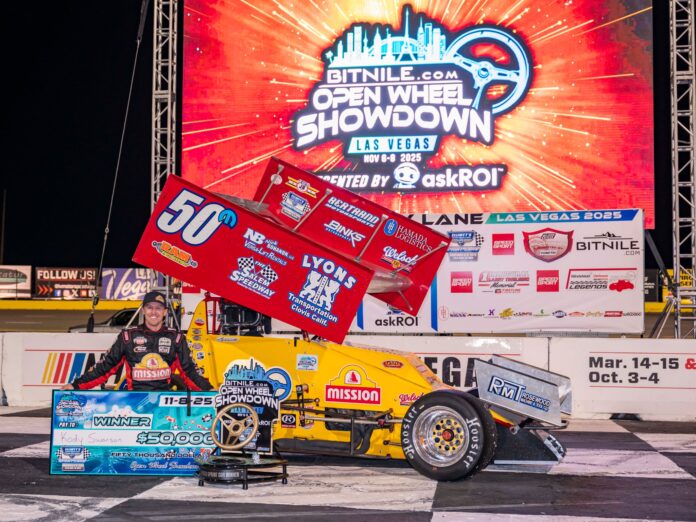
KODY SWANSON WINS BACK-TO-BACK BITNILE OPEN WHEEL SHOWDOWNS

LAS VEGAS, NV (November 8, 2025) – Kody Swanson of Kingsburg, California used high side magic to take his second consecutive $50,000 jackpot, winning Saturday’s 100-lap feature at the BITNILE Open Wheel Showdown presented by askROI. The victory in the Elliott’s Custom Trailers & Carts Winged Sprint Cars came at the Bullring at Las Vegas Motor Speedway in the third annual event.

British Columbia’s Jeff Montgomery led the 26-car field to green alongside fast-time qualifier Jake Trainor of Medway, Mass. Idaho’s Mike Murgoitio used lapped traffic to dive underneath both Swanson and two-time event runner-up Bobby Santos to move into second. Santos then bounced off of Swanson in the third turn to spark a chain reaction of spins for a caution flag on lap 36.

Swanson roared around the high side of Murgoitio to retake second, then tracked down Montgomery. Montgomery led Swanson by less than a car length into the lap 50 halfway break with Murgoitio in third.

The high side continued to benefit Swanson on a restart. He raced to the outside of Montgomery and the duo staged a thrilling duel. Swanson eventually seized the lead on lap 63 and never relinquished it. Murgoitio drove to second followed by a hard-charging Santos who advanced back to third. 2023 winner Aaron Willison and Washington’s Evan Margeson rounded out the top-five.

“I knew there’s a lot of good cars here. Mike was real good and so was Bobby. I know we’re all racing hard there real early so I hate how that went (with Bobby). Appreciate racing with so many great people and the opportunity to drive this 50m for Dick Meyers and everybody on this RAM Engineering team. Man what a special group to be a part of.”

“This is a special event and I know a lot of people work hard to do it and I’m so grateful Davey (Hamilton, Jr.) got the ball rolling for us.”

Indiana’s Kevin Newton led just the final two laps to take the inaugural Larry Trigueiro Memorial for Super Modifieds, driving Warren Buddell’s famed Pink Lady No. 98 to the coveted win. Colorado’s Kyle Ray dominated all practice sessions and time trials during the Firstline Systems-sponsored event. Ray drove into the lead on lap nine of the feature, but tangled with a lapped car on lap 12. Ray was sent spinning into the turn two wall and eliminated from the event. He was uninjured.

The incident thrust Colorado’s Rich Castor into the lead with Newton in pursuit. Newton dove underneath Castor on the backstretch for the decisive pass to lead lap 29. Newton scored the $5,000 win. Castor settled for second followed by Canadian Jimmy White, Washington’s Randy Anderson, and Davey Hamilton, Sr.

Kyle Tellstrom of Ukiah, California won his inaugural appearance in the BITNILE Open Wheel Showdown, earning the $7,500 prize in the Klotz Synthetics Modifieds. The 75-lap feature saw Tellstrom maintaining a slight lead over Arizona’s Dylan Cappello. Cappello finished second while Jaron Giannini represented home turf in third. Northern California driver Cameron Austin and Colorado’s Nathan Gasser were the balance of the top-five. Defending winner Aaron McMorran recovered from an early incident to finish eighth.

INEX Legends and Bandoleros debuted at the Open Wheel Showdown with two action packed main events. 2025 INEX Legends Nationals Young Lions feature winner Ben Morabito from New York State held off a three-wide challenge to take the 30-lap feature win. The victory in the Windshield Defense Legends paid $1,500. 2025 Pro Nationals feature winner Brenden Ruzbarsky and fellow California Jeremy Doss gave Morabito all he could handle on the final restart. Mike Alcaro of Fredon, New Jersey finished fourth. NASCAR Cup Series champion Kyle Busch outperformed his son Brexton in the feature by finishing fifth.

A green-white-checkered finish led to a thrilling victory in the INEX Bandoleros main event. Idaho’s Jhett Phipps knifed underneath Las Vegas’ Caitlin Ford to take the lead in turn four and eventually the coveted victory. Utah’s Cru Bowen, Las Vegas’ Malcom Mancias, and Jaxon Muhler of Brighton, Colorado rounded out the top-five.

About the Open Wheel Showdown:
The Open Wheel Showdown is the premier pavement open wheel event in the country, attracting top drivers and teams from across the country to compete for record-breaking purses and national attention.

Kaden Honeycutt Wins Krush 250 at South Boston Speedway; Earns Second Straight Win at South Boston Speedway

Photo Courtesy Joe Chandler/South Boston Speedway

By Joe Chandler
Director, Public Relations
South Boston Speedway

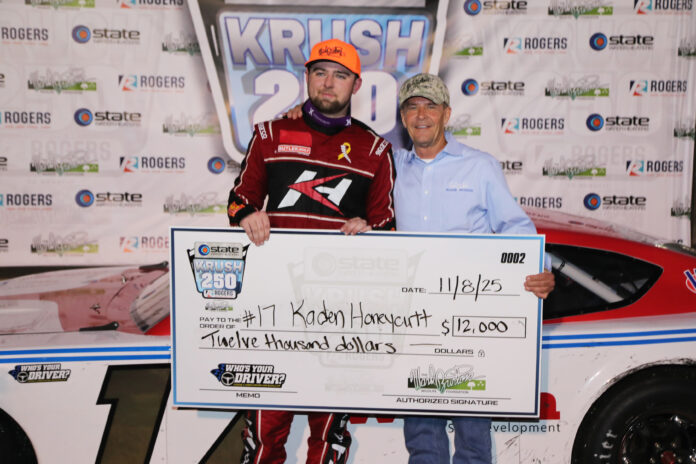
SOUTH BOSTON, VA……Kaden Honeycutt is the King of the Krush.

The Aledo, Texas native took the lead from Bobby McCarty of Madison, North Carolina on the opening lap of the second attempt at a green-white-checker finish and held off McCarty by .508-second to win Saturday’s State Water Heaters Krush 250 presented by Rogers Heating and Cooling Late Model Stock Car Division race at South Boston Speedway.

Honeycutt earned $12,000 for the victory in the showcase event which was a fund-raising event for the Ward Burton Wildlife Foundation, a 501(c)3 non-profit conservation and outreach organization. In addition, he banked a $1,000 award from Jerry Epps Landscaping for being leader at the race’s second stage break, which came at lap 175, bringing his total winnings to $13,000.

This is the second year in a row that Honeycutt has won this event. He topped the field last season when the race was held at Orange County Speedway. This was also Honeycutt’s second straight win at South Boston Speedway. He won the 125 lap ZMAX CARS Tour Late Model Stock Car race in September.
“It’s amazing,” Honeycutt said of winning the race.

“Jeb and Ward (Burton) and everyone that puts this race on is really, really good at what they do. They promoted it extremely well. and had a great crowd tonight. It’s an amazing race in front of a crowd like this.”

McCarty, who started sixth, clawed his way into second place with about 60 laps to go. From that point it was a battle between Honeycutt and McCarty. McCarty surged by Honeycutt to take the lead with nine laps left in regulation, but a caution flag for an incident in the third turn sent the race into overtime.

The race was restarted on lap 252 with Honeycutt leading, but another incident shortly after the restart resulted in another caution flag. Honeycutt got a great restart on the second attempt at a green-white-checker finish, took the lead on lap 264, and held off McCarty to take the win.

“I definitely couldn’t have gotten a better restart than that,” Honeycutt remarked. “We raced really hard into (turns) one and two, barely hit each other, barely tapped, and went into the third turn. I think he got into the speedy dry and got tight.

“I appreciate him racing me really clean,” Honeycutt added. “He’s a class-act guy. I love Bobby to death.”

The runner-up finish to Honeycutt was a big disappointment for McCarty, who, like Honeycutt, drove a stellar race.

“We had a really good car,” McCarty noted. “I’m proud of what we did. We can hold our heads high. We played everything right, did everything right, and still finished second. I couldn’t have drawn this race up any better. I put all of the pieces in the right place, did everything right, passed everybody the right way. I don’t have to make excuses for finishing second.”

Parker Eatmon of Wilson, North Carolina finished a close third, just .7-second behind Honeycutt. He raced

“We had a good for third. overall day,” Eatmon remarked. “I think we were a third-place car. We tried to make something happen there at the end but couldn’t quite get the car to turn and had to settle for third.”

Jeb Burton of South Boston, Virginia finished fourth and Blake Stallings of Danville, Virginia rounded out the top five finishers. Finishing sixth through tenth were Doug Barnes of Forest Hill, Maryland, Deac MCCaskill of Raleigh, North Carolina, Andrew Grady of Knightdale, North Carolina, Aiden King of Troutman, North Carolina and Lane Woods of Vinton, Virginia.

There were six lead changes among six drivers with Honeycutt leading twice for a total of 112 laps.

Barnes led once for 62 laps and earned a $1,000 award from J.E. Burton Construction Company for winning the first of the race’s three stages. Jacob Borst of Elon, North Carolina led once for 35 laps, McCarty and Stacy Puryear of South Boston, Virginia both led once for 22 laps. Jeb Burton started on the pole and led the first seven laps. Jessica Cann of Madison, North Carolina won the race’s Hard Charger Award. She started 25th and finished 12th.

Twenty-eight cars started the race which was slowed by nine cautions and two red flags.

Next Event At South Boston Speedway

The Jeffrey Earnhardt Racing Experience is coming to South Boston Speedway on Saturday, November 15 and will be held from 10 a.m. until 4 p.m.

Those that have wondered what it is like to drive a racecar at South Boston Speedway or take a ride-along in a racecar at South Boston Speedway have that opportunity. No experience is necessary.

To book your experience call the Jeffrey Earnhardt Racing Experience at 1-336-628-7223. You can also book your experience by going to the website at jeffreyearnhardtracingexperience.com and clicking on the BOOK tab.

Additional information, prices, and details about this event can be obtained by directly contacting the Jeffrey Earnhardt Racing Experience by phone or online at their website.

This is not a racing event. South Boston Speedway is not responsible for booking any of the driving or ride-along experiences.

Fans and competitors can find the latest news and updates from South Boston Speedway on the speedway’s website, www.southbostonspeedway.com, by calling the speedway office. Follow us on Facebook, Twitter (@SoBoSpeedway57) and Instagram (@SoBoSpeedway57)

Simplify Your Tax Season With Quality Envelopes

Image by Matthias Schild from Pixabay

Tax season demands optimal efficiency, with preparations generating substantial amounts of paper, necessitating the timely and secure mailing of confidential client documentation. Based on the generic office envelope, work hours are lost, the potential for human error is increased, and confidential data is exposed. High-risk business demands trusted processes. Cheap supplies actively get in the way of the primary business of compliance and client trust.

It is time for an operational upgrade. Specialty tax document envelopes ensure high-volume mailing is secure. Quality supplies make the entire tax return process simple and convenient. These envelopes remove friction. 

Below are five ways high-quality envelopes help you streamline tax compliance.

1. Compliance-Specific Sizing and Design

One-size-fits-all envelopes never work so well with business tax forms. Tax return envelopes must be exactly the correct size to fit neatly and professionally. These envelopes are made to fit standard sizes of tax forms, such as 9 x 12 inches for larger returns or W-2s and 1099s that are smaller in size.

This perfect fit eliminates the need for extra folding. It is time-saving and prevents documents from becoming wrinkled or damaged during transit. This precise engineering allows for fast, seamless insertion every time. It keeps the documents professional on arrival.

This category also includes customization, a wonderful simplification tool. By printing the company logo, return address, and custom “confidential” or “tax compliance” message directly onto the envelope, the practice simplifies brand identification. It gets mail to stand out in a stack immediately, reinforcing professionalism before the client even opens what’s inside.

2. Security Tinting and Interior Patterns

Every tax document contains extremely sensitive financial and personal data. Having that information protected is prudent. Also, it is a mandatory compliance requirement for professional practice. Failure to do so could attract severe penalties.

White standard envelopes are transparent. Under light, the information contained in documents is easily visible to anyone. Such openness is a massive risk for identity theft and liability for the company. Businesses need an instant, physical means of protection against unauthorized use at every point of delivery.

Security tinting is a dense, intricate pattern stamped on the entire interior surface of the envelope. This tint effectively scrambles the readability of the contents, making them impossible to read, even when held against strong light. This valuable feature immediately makes legal and ethical obligation to secure client privacy in the mail easier.

3. Tamper-Evident and Secure Closures

The best physical protection against the external environment for documents is a good seal. Can a professional practice safely count on a moisture-activated seal to stay secure while in transit? That old-fashioned seal has been known to give way under duress or humidity.

New tax envelopes contain more advanced self-sealing technology. A pressure-sensitive strip of adhesive replaces the unreliable moisture seal. The user simply removes the protective liner and presses the flap down firmly to create an instant, durable, permanent seal. This is considerably faster and more reliable than before.

These closings are normally tamper-evident. If someone attempts to open the envelope by opening the flap, the paper or the adhesive will tear clearly or disclose a hidden “VOID” message. This feature makes it simple to confirm for the client. They know that the document has not been tampered with after it departed the office.

4. Double-Window Alignment

Manual addressing is one of the biggest time-wasters and a common source of costly errors in any high-volume mailing operation. Why must staff spend valuable hours penning or printing out hundreds of individual labels? This time-intensive repetitive task can be automated.

High-quality envelopes contain double windows in precise, standardized locations. These locations are designed to sit atop pre-printed addresses on tax returns or output reports from common tax software programs. Upon paper insertion, the recipient’s address becomes visible through one window, and the firm’s return address shows through the other window.

This alignment simplifies the entire bulk mail process. It eliminates extra labels, substantially reduces machines’ short-acking it, and allows machine-stuffing. This feature provides a dramatic efficiency boost on peak weeks.

5. Heavier Paper Weight

Simplifying paper quality is necessary. Professionals must consider how often a flimsy, weak envelope becomes torn, folded, or bent on transit to the customer. Such damage requires costly, time-consuming resends.

Professional tax envelopes typically use a heavier-weight paper stock, like 24-pound or heavier. Heavy-duty construction provides better resilience than standard 20-pound paper. Important legal documents need guaranteed protection against external wear.

The better material is easier to ensure delivery and condition. The business sends less replacement mail, experiences fewer customer complaints regarding damage to the mail, and provides a more professional image. The better feel enforces a commitment to customer service.

Summing Up

The tax document processing season rush is complex and demanding. Every firm processes a massive volume, with zero tolerance for error. Postal supply enhancement makes envelopes more than a basic pouch, but a vital functional device. These abilities directly benefit the firm’s security, regulatory, and productivity plans. Businesses can’t afford delays due to human error or cheap supplies. Investing in quality can completely streamline the tax season process.

Livestream Coverage Returns for the HSR Daytona Classic 24 Hour Presented by Mission Foods on Sunday

  • HSR Partners with Greenlight Television for Final Round Programming of the 11th Running of the HSR Classic Daytona 24, Sunday, November 9
  • Veteran British Broadcaster Andrew Marriott and Emerging On-Air Media Talent Jonathan Grace Co-Host More Than Six Hours of Morning and Early Afternoon Sunday Coverage Live from Daytona International Speedway

DAYTONA BEACH, Florida (November 8, 2025) – For the third-consecutive year, Historic Sportscar Racing (HSR) provides livestream coverage of this weekend’s HSR Classic Daytona 24 Hour presented by Mission Foods. The fourth and final rounds of the 11th running of HSR’s oldest and longest HSR Classic Endurance Championship powered by Mission Foods race will be streamed in more than six hours of coverage tomorrow, Sunday, November 9.

Live from Daytona International Speedway (DIS), programming begins at 7:45 a.m. EST on Sunday and continues straight through the final checkered flag of the weekend just before 2 p.m. EST that afternoon.

Anchor coverage of the livestream is available on the HSR and IMSA YouTube Channels and on RACER.com and RACER+ beginning Sunday at 7:45 a.m. EST. Additional distributions in the U.S. and around the world include:

  • Mtsprt1 – USA+
  • Goodwood TV – Worldwide
  • REVTV – Canada
  • Sport1/Sport2 – Ukraine, Moldova, Latvia, Lithuania and Estonia
  • Ant+1 – Greece
  • TapMad – Pakistan & Bangladesh
  • Parc Fermé – Italy
  • Sev7nSports and BandSports – Brazil

The on-air talent team for the Classic 24 livestream features veteran sports car racing broadcaster and frequent HSR commentator Andrew Marriott, who has previously been part of the Classic 24 at-track announcing team. A new and soon to familiar addition to the Classic 24 crew is motorsports journalist and emerging online talent Jonathan Grace in his first appearance at an HSR Classic Endurance Championship presented by Mission Foods event.

The HSR Daytona Classic 24 Hour featuring seven period-correct Run Groups – A through G – competing in succession for a full 24 hours on the legendary DIS 3.56-mile road course. Each Run Group – with Groups C and D competing together – runs four times throughout the 24 hours with the individual segments clocking in just under one hour in length to allow time to grid and run the pace laps for the next race as the previous group exits the track.

The entirety of the fourth and final rounds for all Run Groups fills Sunday’s livestream schedule. The HSR Classic 24 Hour programming also features an unprecedented lineup of in-race feature segments providing a closer look at some of the HSR competitors and personalities in attendance.

About HSR: An International Motor Sports Association (IMSA) property, Historic Sportscar Racing (HSR) was formed in the mid-1970s with an event at Road Atlanta. There was one goal then and it remains true today: to celebrate the racing cars from the past. As a “time machine” of sights and sounds, HSR provides a venue for competitors and spectators alike to share in the wonderful history and excitement created by the cars that competed at race tracks around the world. HSR currently sanctions eight vintage and historic racing events at some of the world’s most renowned race tracks, including Daytona International Speedway, Michelin Raceway Road Atlanta, Sebring International Raceway and more. The complete schedule and full event information can be found on HSR’s website at www.HSRRace.com. Look for the HSR Channel on YouTube and follow HSR on Facebook at www.Facebook.com/HSRrace/, on Twitter X @HSR_race and on Instagram @HistoricSportscarRacing.

Why Split-Second Decisions Define Road Safety in Motorbike Racing

Image by John Stelios from Pixabay

Motorbike racing is one of the most thrilling and technically demanding sports in the world. Riders reach extreme speeds, lean into turns with precision measured in millimeters, and navigate unpredictable environments where every movement matters. Behind the excitement lies an ever-present truth: road safety and split-second decision-making determine not only victory but survival. 

A moment’s hesitation or misjudgment can mean the difference between finishing a race and facing a devastating crash. Understanding how professional riders, safety teams, and organizers manage these risks sheds light on the intricate balance between skill, speed, and safety in motorbike racing.

The Crucial Role of Reflexes and Mental Preparation

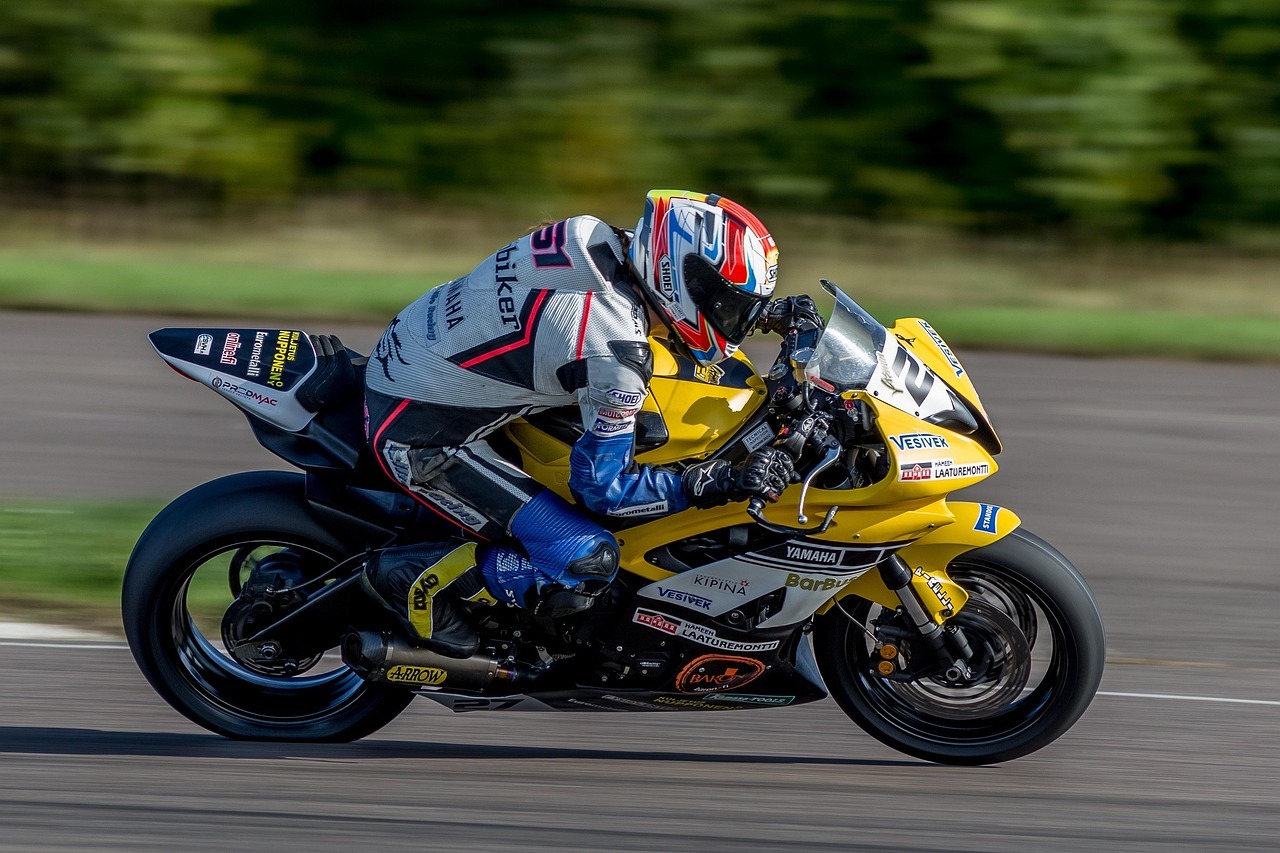
Racing at over 180 miles per hour leaves no room for error. Riders must make rapid calculations, reacting instantly to changes in terrain, weather, or the behavior of other competitors. A delayed reaction by even half a second can result in a loss of control or collision. For this reason, elite racers train not only their bodies but their minds, developing reaction speed, situational awareness, and focus under extreme pressure. Mental clarity and emotional control are equally vital. The ability to remain calm during high-speed maneuvers helps riders make rational choices in chaotic moments. 

For example, knowing when to brake hard, when to lean, or when to let go of the throttle can prevent dangerous chain reactions on the track. When incidents do occur, the consequences can be severe, and having access to expert legal guidance, such as the motorbike accident legal team at Ramsey Law or another law firm, ensures victims understand their rights and can recover compensation for damages. Professionals who handle motorbike-specific cases are familiar with the complexities of high-speed collisions, racing regulations, and insurance disputes that often arise from such incidents.

How Physics and Precision Shape Safety

Every turn, acceleration, and braking point in motorbike racing is governed by physics. Understanding traction, balance, and momentum is fundamental to preventing crashes. Riders rely on the delicate interplay between tire grip and body positioning to maintain control. Leaning into a curve isn’t just a stylistic maneuver; it shifts the bike’s center of gravity and maximizes tire contact with the track.

However, when conditions change suddenly, such as when rain begins or oil spills on the track, riders must adapt instantly. These micro-adjustments are often subconscious, driven by hours of muscle memory and data analysis. Racing engineers use telemetry, real-time data tracking, to measure every movement, helping riders understand where they can safely push limits and where they must hold back.

The Role of Race Tracks and Regulations

Track design plays a major part in promoting road safety in motorbike racing. Modern circuits include wide runoff areas, gravel traps, and advanced barriers to dissipate energy during accidents. Sharp corners are engineered with calculated banking angles, helping riders maintain control at high speeds.

Governing bodies such as the Fédération Internationale de Motocyclisme (FIM) continually refine safety standards. Regulations cover everything from track conditions to tire specifications and protective gear requirements. Strict enforcement ensures that every element of racing, human and mechanical, operates within defined safety margins.

Confidence Versus Caution

Perhaps the most fascinating aspect of road safety in motorbike racing is the psychological balance riders maintain between confidence and caution. Winning requires pushing boundaries, but survival depends on knowing where those boundaries lie. Riders who are too aggressive risk losing traction or oversteering, while those who hesitate lose competitive advantage.

Experience teaches professionals to trust instinct while staying analytical. Many racers describe a mental “flow state” during competition, a heightened focus where time seems to slow down. In this state, they perceive and react to dangers almost automatically, an ability honed through thousands of hours of practice.

Lessons for Everyday Riders

While most people will never race professionally, the lessons from the sport apply directly to street motorcycling. Riders can reduce accident risk by adopting habits rooted in professional training:

  • Situational Awareness: Constantly scanning for potential hazards, cars changing lanes, uneven pavement, or pedestrians, allows for faster, safer decisions.
  • Defensive Riding: Anticipating the actions of others, rather than reacting to them, mirrors a racer’s predictive mindset on the track.
  • Proper Gear: Helmets, gloves, reinforced jackets, and boots dramatically reduce injury severity, even in low-speed accidents.
  • Bike Maintenance: Regular inspection of brakes, tires, and suspension ensures that the machine responds predictably under pressure.
  • Mental Readiness: Fatigue, distraction, or overconfidence can impair judgment. Maintaining focus and emotional control is as critical for commuters as it is for champions.

These principles remind every motorcyclist that safety begins with awareness and discipline. Split-second reactions may save lives, but preparation makes those reactions possible.

The Evolving Future of Racing Safety

Advancements in technology continue to reshape how motorbike racing addresses safety. Artificial intelligence and data modeling now predict potential crash zones and recommend adjustments to both bikes and tracks. Drones monitor live races, providing additional perspectives for safety marshals and emergency teams.

Augmented reality (AR) training systems are revolutionizing rider education. By simulating real track conditions and potential hazards, racers can practice decision-making without physical risk. As this technology becomes more accessible, even amateur riders will benefit from safer, more immersive learning experiences.

motorcycle
pixabay.com

For spectators, racing represents courage and speed. For professionals, it is a discipline where every millisecond counts and where safety is the ultimate achievement. Whether on the track or the street, riders and enthusiasts alike can learn from this balance of power, preparation, and respect for risk.