

Nothing happens quietly in a city like Las Vegas. It built its reputation on spectacle — neon strips, casino floors, headline acts, and the kind of excess that draws people in from every corner of the world. So when motorsports started making a serious claim on the city, it shouldn’t have come as a surprise to anyone. High speeds and high stakes have always made a natural pairing here.
That connection between Vegas entertainment and racing runs deeper than it might seem at first glance. Race fans who come for a weekend often find themselves swept up in everything the city offers, long after the checkered flag drops. Many tap into the gaming culture that made Vegas famous — and those who want to keep that energy going remotely can visit The Online Casino for slots, live dealer tables, and card games that carry the same buzz the Strip is known for.
Both activities offer excitement, adrenaline rushes, and a very special feeling of waiting impatiently for results. So, let’s take a look at how Vegas expanded its entertainment focus and what it offers to motorsports fans.
Two Very Different Circuits
Las Vegas actually hosts two distinct racing environments, and it’s worth understanding what separates them:
- Las Vegas Motor Speedway: A traditional 1.5-mile oval built for speed. NASCAR Cup, Xfinity, and other series run here. The track sits north of the city with large camping areas and a proper infield. Capacity is around 80,000.
- The Las Vegas Street Circuit: A 3.8-mile temporary layout that cuts through the Strip. Built specifically for Formula 1, it goes up and comes down each year. Hospitality options sit inside some of the city’s biggest hotel casinos.
The crowds at each event don’t overlap as much as you might expect. LVMS regulars tend to be committed NASCAR fans who return year after year. The F1 audience skews more international and includes a lot of first-time racing attendees who came at least partly for the Vegas experience itself.
From Dirt Track to Major Venue
Las Vegas Motor Speedway didn’t start out as the 80,000-seat facility it is today. The original track complex on the site dates back to the early 1970s, but it took decades of development — and serious investment after Speedway Motorsports acquired it in 1999 — to shape it into a destination-level venue.
The 1.5-mile tri-oval opened in 1996 and quickly attracted top-tier competition. NASCAR arrived the same year, and the Pennzoil 400 became a fixture from 1998. For a long stretch, LVMS quietly established itself as one of the more reliable stops on the calendar — wide, fast, smooth asphalt, and a track that rewards both strategy and raw horsepower. Drivers tend to like it. Big runs are possible, but the wall stays close enough to keep things honest.
The speedway sits about 15 miles north of the Strip, which means it operates somewhat independently from the tourist corridor. That actually works in its favor — LVMS has its own identity as a racing venue rather than just a backdrop for a photo opportunity.
What the F1 Return Changed
Formula 1 had raced in Las Vegas before, back in 1981 and 1982, on a temporary circuit inside Caesars Palace. Those events weren’t particularly loved — the layout was slow, the racing dull, and the whole thing felt like an afterthought. The city and the sport moved on.
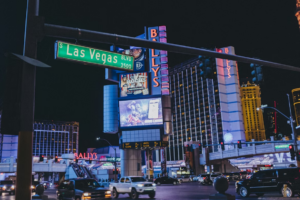
The 2023 return was a different story. F1 built a street circuit along Las Vegas Boulevard, past casinos and hotels. The race runs at night, under artificial light, with landmark buildings visible in the background. Whatever anyone thought of the event’s logistics in its first year, the visual case for the location was hard to dispute.
That race sparked real debate about whether Formula 1 was prioritizing glamour over substance. But it also pulled a wave of new fans toward the sport in the United States. As this analysis of the NASCAR vs. F1 ratings rivalry shows, the two series were competing for overlapping American audiences in ways that hadn’t happened before — and Vegas sat at the center of that push.
Why Vegas Works for Racing
Other cities have tried blending entertainment culture with motorsports — Miami, Austin, and Monaco all make their own version of that pitch. Vegas does it at a different scale because the infrastructure was already there before racing showed up.
The hotels can absorb 150,000 visitors without breaking a sweat. Restaurants stay open past 3 a.m. The city runs on late nights and big spending, and nobody bats an eye at a crowd that’s there to watch fast cars and then wander into a casino for four hours afterward. For race promoters and sponsors, that financial ecosystem is genuinely hard to replicate anywhere else.
A race in Vegas sells an entire trip. That model made Formula 1’s investment in the street circuit easier to justify, and it explains why NASCAR’s rounds consistently draw strong numbers. The same things that make Vegas function as an entertainment destination — scale, energy, round-the-clock activity — turn out to be exactly what major race weekends need.