
Gearbox bearings are important components in a gearbox. Without them, cars and other automotive systems cannot run smoothly. So, what are gearbox bearings? I am sure many of you will ask this question if you are not familiar with cars or gearboxes.
I understand this, so in this guide, I will explain gearbox bearings for automotive applications in detail. This includes their meaning, the difference between gearbox bearings and transmission bearings, gearbox bearing functions, the types of bearings used in gearboxes, and more.
After understanding gearbox bearings, if you want to buy them, you can contact BKZ Industry by submitting the form or sending an email to sales@bkzindustry.com. BKZ Industry is a bearing manufacturer with 2 factories, ISO 9001 certification, and 15 years of bearing manufacturing experience. It can provide the gearbox bearings you need.
Part 1. What Are Gearbox Bearings?
So let’s explain what gearbox bearings are. To understand gearbox bearings, you first need to understand what a gearbox is and its structure in a car or other automotive system. In automotive applications, the gearbox usually refers to the gearbox or transmission assembly. It can include the gearbox housing, input shaft, output shaft, clutches, gears, bearings, synchronizers, lubrication system, seals, and, in some designs, a differential or center differential.
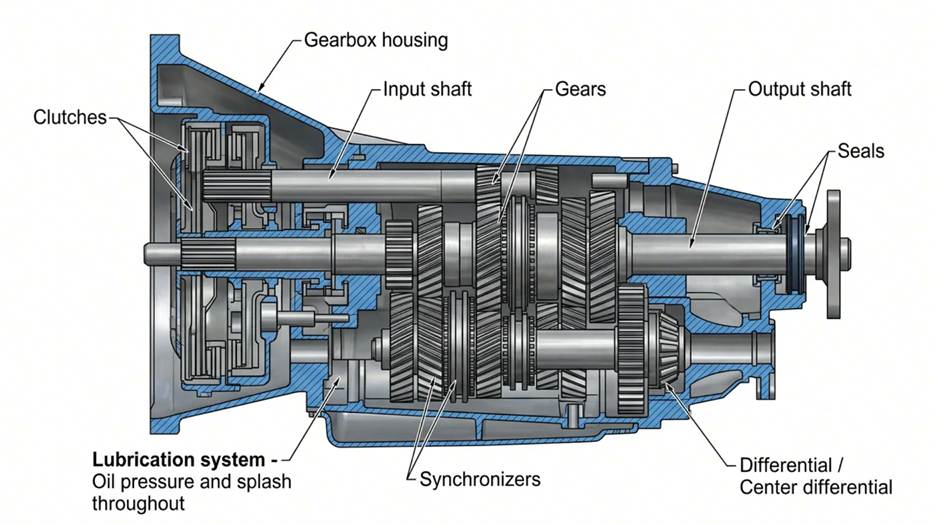
So when we talk about gearbox bearings, they do not refer to one single type of bearing. They refer to different bearings used in different positions inside the gearbox or transmission assembly. Common examples include input shaft bearings, output shaft bearings, countershaft or layshaft bearings, gear shaft bearings, needle roller bearings for gears, clutch bearing / clutch-related bearing, differential bearings, pinion shaft bearings, and idler gear bearings, depending on the gearbox design.
Part 2. Gearbox Bearings vs Transmission Bearings: Are They the Same?
Now, you have a general idea of what gearbox bearings are. But when searching for gearbox bearings, you may also see another term: transmission bearings. So, are gearbox bearings and transmission bearings the same thing?
The answer is: they are closely related, but they are not always exactly the same.
In automotive applications, when the gearbox refers to the transmission assembly, and this assembly includes gear sets, shafts, bearings, synchronizers, clutches, lubrication system, seals, and a differential or center differential, you can use gearbox bearings and transmission bearings in a similar way.
However, if we look at the meaning more strictly, transmission bearings usually have a broader meaning.
Gearbox bearings usually refer to the bearings used in the gearbox section or gearbox assembly. They support rotating parts such as the input shaft, output shaft, countershaft, gear shaft, clutches, idler gears, pinion shaft, and differential assembly.
Transmission bearings can cover a wider range. They may include the gearbox bearings mentioned above, but they may also refer to bearings used in the final drive section or other rotating parts of the whole transmission system.
So, gearbox bearings can be considered one important group of transmission bearings. In simple words, gearbox bearings can be transmission bearings in automotive applications, but not all transmission bearings are limited to the gearbox section.
Part 3. Gearbox Bearing Functions
After understanding gearbox bearings, you may want to know their major functions. Here are the main ones:
- Supporting the Shafts: Gearbox bearings support rotating shafts, such as the input shaft, output shaft, countershaft, gear shaft, and pinion shaft.
- Reducing Friction: They reduce friction between rotating and stationary parts, helping the gearbox run more smoothly.
- Keeping Gear Alignment: Bearings help keep shafts and gears in the correct position, so the gears can mesh properly.
- Carrying Radial and Axial Loads: Gearbox bearings carry loads from gear rotation, torque transmission, and axial forces created by some gear designs.
- Reducing Noise and Vibration: Good bearings help reduce abnormal noise, vibration, and unstable shaft movement inside the gearbox.
- Improving Power Transmission Efficiency: By reducing friction and keeping rotating parts stable, bearings help the gearbox transfer power more efficiently.
- Protecting Gears and Internal Parts: Proper bearing support can reduce uneven wear and help protect gears, shafts, seals, and other gearbox components.
Part 4. Types of Bearings Used in Gearboxes
So, what types of bearings are used in automotive gearboxes? Gearboxes can use different bearing types depending on the shaft position, gear load, speed, available space, lubrication condition, and axial force. When the gearbox assembly includes the clutch system and differential area, the bearing types can be even more diverse.
Deep Groove Ball Bearings: Mainly used at the ends of the input shaft and output shaft. They support high-speed rotation and carry radial loads with limited axial load capacity.
Tapered Roller Bearings: Mainly used on the pinion shaft, differential assembly, and heavy-load shaft positions. They handle combined radial and axial loads.
Cylindrical Roller Bearings: Mainly used on the countershaft, gear shaft, and other heavy radial load positions. They provide stronger radial support than ball bearings.
Needle Roller Bearings: Mainly used inside gears, idler gears, and gear-to-shaft rotating positions. They save space while carrying high radial loads.
Angular Contact Ball Bearings: Mainly used where high speed and axial load support are both required. They may appear on some input shafts, output shafts, or precision gearbox designs.
Clutch Release Bearings: Used in the clutch system, usually between the clutch fork or actuator and the pressure plate. If the gearbox assembly includes the clutch system, they are a related gearbox bearing type.
Needle Roller Cage Assemblies: Mainly used inside idler gears, free gears, and compact gear support positions. They guide needle rollers and allow gears to rotate smoothly around the shaft.
Bronze Bushings: Not rolling bearings, but sometimes used as sliding supports. They may appear in low-speed support points, selector mechanisms, idler gear supports, or older gearbox designs.
Part 5. What are the Symptoms of a Bad Gearbox Bearing?
There are many signs of a bad gearbox bearing. Some symptoms are easy to notice, such as noise, vibration, or oil leakage. Other problems may require inspection by an experienced mechanic or gearbox engineer.
The table below can help you understand the common symptoms and what they may mean.
| Symptom | What It May Mean |
| Unusual noise from the gearbox | Worn, damaged, or poorly lubricated bearings may create whining, grinding, humming, or rumbling noise. |
| Noise changes with vehicle speed | If the sound becomes louder as vehicle speed increases, the bearing on the shaft or gear support position may be worn. |
| Vibration during driving | Damaged gearbox bearings can cause unstable shaft rotation and transfer vibration to the gearbox or vehicle body. |
| Difficulty shifting gears | Excessive bearing wear may affect shaft alignment, making gear shifting rough, stiff, or difficult. |
| Gear slipping or poor engagement | Severe bearing wear can cause gear misalignment and affect proper gear engagement. |
| Gearbox overheating | Poor lubrication, high friction, or bearing damage can increase the operating temperature inside the gearbox. |
| Metal particles in gearbox oil | Bearing wear, peeling, or surface damage may produce metal debris in the lubricant. |
| Oil leakage around the gearbox | Worn bearings may cause shaft movement, which can damage seals and lead to oil leakage. |
| Burning smell | Overheated gearbox oil or excessive friction inside the gearbox may create a burnt smell. |
| Complete gearbox failure | If the damaged bearing is not repaired in time, it may damage gears, shafts, seals, and the gearbox housing. |
If these signs appear, the gearbox should be checked as soon as possible.
Part 6. Can You Replace Gearbox Bearings?
When you notice the signs above, you may want to know whether gearbox bearings can be replaced. The answer is yes. Gearbox bearings can be replaced, but it is not a simple repair job.
Replacing gearbox bearings usually requires gearbox removal, housing disassembly, bearing inspection, correct bearing matching, shaft checking, and proper installation. If the bearing is installed incorrectly, it may cause noise, overheating, poor gear alignment, short service life, or early gearbox failure.
So, gearbox bearing replacement is usually handled by experienced mechanics, gearbox repair companies, or engineers who understand gearbox structure and bearing installation.
Part 7. How to Replace Gearbox Bearings?
This guide is only for mechanics, repair technicians, or engineers with experience in gearbox bearing replacement. The exact process may vary depending on the gearbox type, vehicle model, and bearing position.
| Step | What to Do |
| 1. Diagnose the problem | Check gearbox noise, vibration, oil condition, leakage, shifting problems, and possible bearing play. |
| 2. Remove the gearbox | Disconnect the related parts and remove the gearbox from the vehicle or machine. |
| 3. Disassemble the gearbox housing | Open the gearbox carefully and keep gears, shafts, spacers, washers, and other parts in the correct order. |
| 4. Identify the damaged bearing | Find the worn, noisy, loose, cracked, overheated, or contaminated bearing. |
| 5. Check related parts | Inspect the shaft, gear teeth, bearing seat, housing bore, seals, and lubrication passages. |
| 6. Remove the old bearing | Use proper pullers, presses, or heating methods. Avoid damaging the shaft, housing, or gear parts. |
| 7. Match the correct new bearing | Confirm the bearing number, inner diameter, outer diameter, width, clearance, cage type, seal type, and load requirement. |
| 8. Install the new bearing | Press the bearing correctly on the right ring. Do not apply force through the rolling elements. |
| 9. Reassemble and lubricate | Rebuild the gearbox with correct bearing fit, preload or clearance, seals, fasteners, and lubricant. |
| 10. Test the gearbox | Check rotation, noise, vibration, temperature, leakage, and gear shifting after assembly. |
Final Words
Now, you have a clear understanding of gearbox bearings, including where they are used, what types are common, what symptoms appear when they fail, and how replacement is usually handled.
If you need to buy gearbox bearings for repair, wholesale, OEM production, or industrial supply, you can contact BKZ Industry. We can help you match the required bearing number, size, and application details for your gearbox bearing needs.