The best way to get a young rider into motorsports is to start small and start in the backyard — on a manageable gas mini bike they can learn on long before they ever see a track. When choosing that first machine, the three things that matter most are a durable frame, available replacement parts, and a clear upgrade path, not the lowest price tag. Get those right, and one bike can carry a rider from their first ride through years of real riding.
This mirrors how grassroots motorsports has always worked. Organizations like the American Motorcyclist Association point new families toward supervised, low-pressure riding on small machines before competition ever enters the picture. Skills compound: a rider who spends a season or two learning throttle control and balance in the yard shows up to their first track already understanding how a machine behaves.
Why start with a gas mini bike at all? For an older child moving up from an electric ride-on toy,a gas mini bike is the first real machine — it has a pull-start, a clutch or centrifugal drive, a fuel system, and the feedback of an actual engine. That is the experience that builds genuine riding skill, and it is the reason so many lifelong riders point back to a small gas bike as where it started.
That reframes the buying question away from price. A first gas mini bike that gets ridden hard, holds up, and can be repaired and upgraded is the economical choice over the long run — even at a higher upfront cost. The expensive bike is the one that cracks a frame, can’t get parts, and gets scrapped after a single season.
A few things separate a real first machine from a throwaway:
Frame and build. A welded steel frame that doesn’t flex or creak under a growing rider is the foundation, and the best predictor of whether a bike survives years of backyard use. Thin, flexing tube is the first thing to fail.
Parts and fixability. A first machine should be one a parent or teen can maintain with basic tools — and, critically, one whose replacement parts you can actually buy. A brand that sells the bike but not the parts is telling you how long they expect it to last. Chains, throttles, brake pads, and air filters are wear items; you want them in stock, not discontinued.
Controls a new rider can manage. A disc brake, an easy pull-start, and a manageable power band matter more than top speed. Safety-minded controls are what let a beginner build confidence instead of getting overwhelmed, and they are what give a parent the confidence to hand the bike over in the first place.
An upgrade path. The best entry machines are platforms, not dead ends. Many backyard mini bikes in this class accept a Predator 212 engine swap, turning the same bike into a long-running build project — which is why mini bikes now pull in adult riders and builders, not just kids.
FRP Moto is built around this exact lane. ItsGMB100 is a 99cc, 4-stroke gas mini bike with a welded steel frame, a rear disc brake, a listed 28 mph top speed, and a 220 lb load rating — positioned for teens and adults rather than as a sealed kids’ toy. For younger, supervised first-timers, FRP Moto’s smaller MB40 sits a step below.
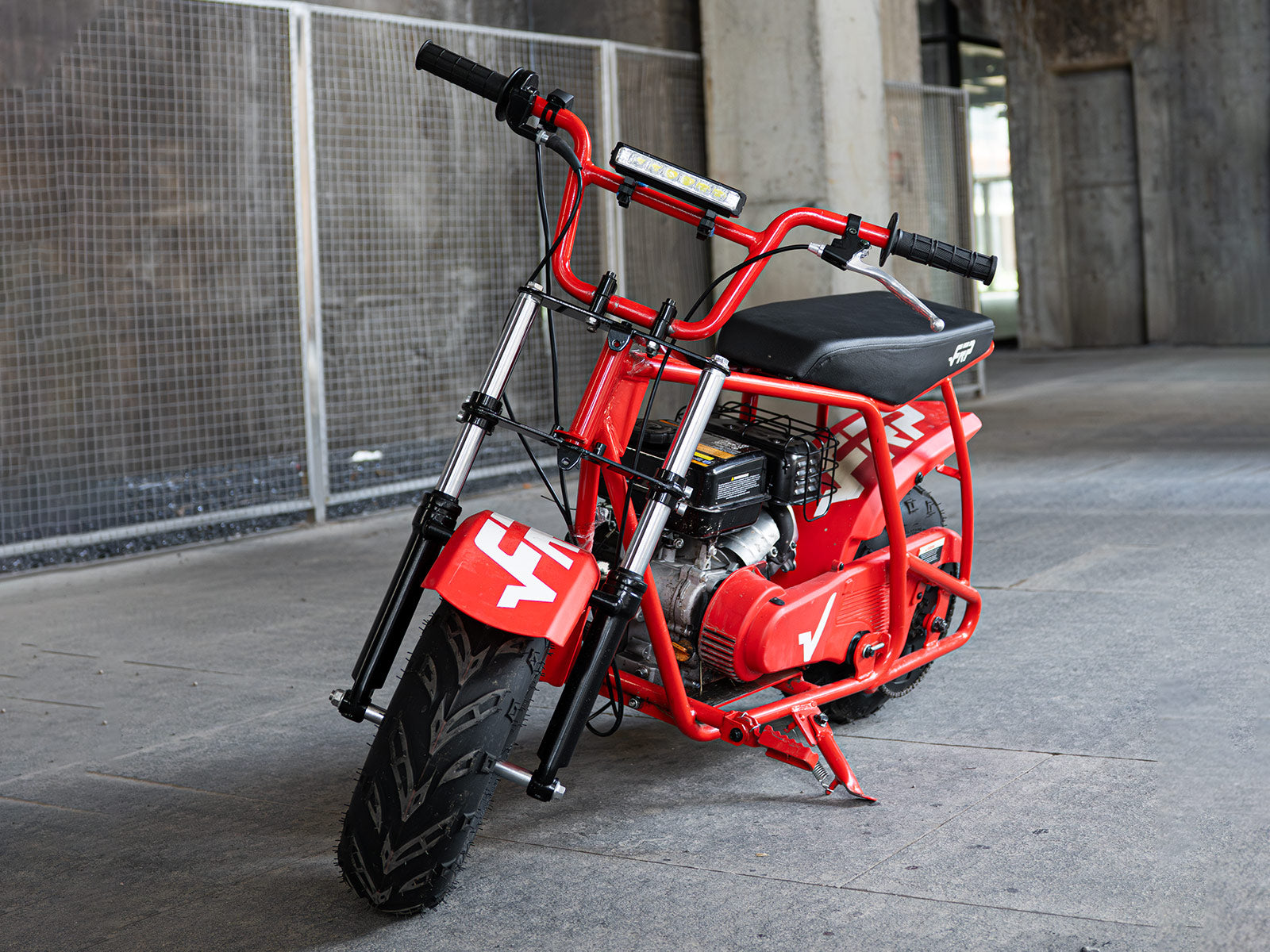
Safety boundaries matter as much as specs. The GMB100’s adjustable governor screw lets a parent limit speed during early practice, then open it up as the rider’s skill grows, and the disc brake gives a new rider real stopping control. Like any gas mini bike, it’s built for backyard, trail, and private-property riding — not for public roads — and a helmet plus adult supervision for young riders are non-negotiable.
Ownership is the part new buyers underestimate. A four-stroke engine like the GMB100’s runs on straight gasoline with no oil mixing, and routine care comes down to checking the chain tension, the air filter, the brake, and the oil. None of that requires a mechanic, which is the point: a first machine should be one a family can actually keep running, season after season, without specialist help.
What ties FRP Moto’s line together is the journey it’s designed for. A young rider starts easy and learns control. They grow into real style and speed as confidence builds. Families lean on the durable construction and replacement-parts support to keep the bike alive. And eventually a teen or adult builder upgrades the same platform — a Predator 212 swap included — instead of starting over. That is the difference between a one-season toy and a machine a rider keeps.
That upgrade path is also why mini bikes have pulled in a second audience entirely. Adult riders return to them for the same backyard fun they remember, and builders treat a solid steel-framed mini bike as a project base — swapping engines, brakes, and sprockets, and tuning a bike that is genuinely theirs. A starter machine that doubles as a builder’s platform earns its keep twice.
Owners tend to describe the steel build as sturdy and free of the flex common on disposable machines, and FRP Moto publishes its owner reviews, warranty, and return policies openly. That transparency, plus the parts support, is what separates a first bike worth keeping from a one-season purchase.
None of this turns a backyard mini bike into a race bike — and it isn’t meant to. Track competition has its own purpose-built machines and sanctioning rules. The point is that the road to them almost always starts lower down, on something a kid can ride in the yard and a builder can keep improving for years.
Common questions from new families
What’s a good first gas mini bike for kids? Look for a manageable engine, a disc brake, and an adjustable speed governor so a beginner can build confidence safely. The FRP Moto GMB100 (99cc, about 28 mph, governor-limited) fits riders moving up from electric ride-ons; the smaller MB40 suits younger, supervised first-timers.
Can adults ride it? Yes. The GMB100 carries up to 220 lb, which is why many adult riders and builders use it as a starter-to-upgrade platform rather than a kids-only toy.
Can you ride it on the road? No. Gas mini bikes like these are made for private property, backyards, and off-road use only — not public streets. Always check local rules, wear a helmet, and supervise young riders.
How long will it last? With basic chain, brake, and air-filter maintenance and available replacement parts, a steel-framed gas mini bike can serve a rider for years — and the right platform can be upgraded rather than replaced as that rider grows.
So when you weigh a beginner gas mini bike, look past the price tag. Check the frame, confirm parts are available, and make sure the platform can grow with the rider. Get those three right and you buy once instead of twice — giving a future racer the same backyard beginning that nearly every rider points back to.