Home Blog Page 1261

Junk Car Sales in California: Understanding the Process

Is your driveway home to an aging, non-operational vehicle? This comprehensive guide highlights the avenues available for your old car in California! Discover straightforward steps to convert that stationary steel into cash, consider revamping it, or perhaps let it serve a noble cause through donation. Here’s a simplistic, clear roadmap to extracting the maximum potential from your old ride, California-style!

Prepping Your Car for its Next Phase

If restoring your car to its glory days is off the table due to high costs or extensive damage, then transforming it into cash might just be your golden ticket. In the land of sun and surf, initiatives like “cash for cars” are not just popular; they’re part of the Californian lifestyle. Programs like cash for cars in California invite residents to exchange their rusty rides for greenbacks, offering a convenient, no-fuss method to bid farewell to your old car while padding your wallet. While selling parts individually is an option, local junkyards have the expertise and equipment to dismantle and repurpose every bit of your vehicle efficiently.

Assessing Your Vehicle’s Value in The Golden State

Before sailing down the selling stream or opting for repairs, it’s crucial to understand your car’s current market value. A repair job might sometimes make sense if it doesn’t significantly overshadow the car’s worth. Recognizing its value also positions you to negotiate a fair deal, whether dealing with a local Californian junkyard or considering a charitable donation.

Assembling Your Golden State Paper Trail

Embarking on the selling journey requires some paperwork. This is an important step if you want to make some cash for your old car because it ensures that you have the legal right to sell it and protects you from any future liability.

Essential documents include details like the vehicle identification number (VIN), mileage, and overall condition. In the heart of California, you will need the car’s title to initiate a legitimate sale. If it’s gone AWOL, understanding how to procure a duplicate is key.

Navigating Car Insurance in California

Even a stationary vehicle in California might need its insurance maintained until it changes hands. This could be a state-mandated requirement or something stipulated by your auto loan provider. Ensuring you’re compliant with Californian law and your financial agreements is paramount.

Scrapping Your Car

Decided to part ways with your vehicle for scrap? Time to engage with a licensed Californian junkyard. Do your due diligence with customer reviews and obtain multiple quotes to ensure a fair transaction. Once settled, it’s time to empty your car of personal belongings, remove its license plates, and secure your payment before relinquishing the title!

Donating Your Ride

Donating your vehicle is a Californian act of kindness! Numerous charities within the state will repurpose your contribution to benefit those in need, plus there’s the perk of a tax deduction for you. It’s a heartfelt way to extend the legacy of your vehicle while supporting a worthy cause.

Reviving Your Californian Cruiser

In instances where your vehicle is declared “junk” or “salvage,” remember, it’s not the end of its road! Californians love a good comeback story, and reviving your car might be a viable option, especially if repair costs don’t drastically outweigh its value. However, remember that a revived car may not fetch the price of its never-junked counterparts, and restoration requires investment. A consultation with a skilled mechanic could clarify whether this route is worth the time and resources.

Final Thoughts: Understanding Your Car’s Value is Golden

In the end, comprehending the true value and potential of your old car is the key to unlocking its future, whether that’s a revival, metamorphosis into scrap, or a benevolent donation. Even in its silent, stationary state, your car holds value, possibly as a treasure trove of parts for others or as a vehicle of hope via charity. In the diverse landscape of California, your trusty four-wheeled companion might not be ready to ride the waves or cruise the scenic routes anymore. Still, it’s primed for a new journey, continuing its narrative in ways you might not have imagined. So, explore each avenue with the spirit of California in your heart, ensuring every potential path is thoughtfully considered, and every opportunity respectfully embraced.

Increasing Tax Benefits from Gifts to Charities

Photo by Towfiqu barbhuiya on Unsplash

As a freelancer or 1099 worker, it may be difficult to keep track of your tax deductions and ensure that you’re taking full advantage of the tax savings that are available. But one way you might be able to lower your tax obligation is by making charitable donations. In addition to feeling good about helping a cause or giving back to your community, you might be able to lessen your tax obligation.

Charitable donations are eligible for tax breaks

The IRS has the authority to deduct the value of a taxpayer’s charitable gifts from their taxable income, thus reducing their tax obligation. To claim a charitable gift deduction, the above requirements must be met:

A recognized organization must be a charity: The IRS maintains a list of certified organizations to which charitable donations are eligible for tax deductions. These include nonprofits, temples, educational institutions, and government agencies.

A gift must be provided within the tax year. Only contributions made in the most recent tax year are eligible for a deduction. A monetary or valuable present must be given. Tax deductions are limited to donations of money or property. They cannot be claimed for donated time or services.

It is necessary to itemize a taxpayer’s deductions: To claim a charitable contribution deduction, the taxpayer must itemize their deductions on their tax return rather than taking the standard deduction.

The taxpayer is obliged to keep documents to substantiate the deduction. To do so, the taxpayer must keep records of their charitable contributions, such as receipts, bank statements, or letters they have sent to charities.

Maximization of tax benefits associated with charity donations

Understanding how to maximize the tax advantages of your charitable contributions is essential because they may be a fantastic way to help a cause you care about. Considering the following suggestions will help.

Plan out your donations: Despite the temptation, it can be best for your tax situation to spread your presents over the year. Giving consistently over the course of the year may help you avoid having a big tax bill when it comes time to file your tax return.

Donating a valuable item: Valued stocks, mutual funds, or other assets might be donated to a worthy organization rather than sold. By doing this, you may deduct the assets’ fair market value at the time of the donation and keep the appreciation free of capital gains tax.

Observe a donor-advised fund: When you give money or other assets to a donor-advised fund, you immediately receive a tax benefit. This sort of charitable giving account allows you to do both. Consequently, future funding proposals for the organizations you support might be made.

Donate to an established charity: As mentioned previously, tax benefits are only allowed for donations to registered charities. Research the charity before giving to ensure its reputable.

Keeping meticulous records 

You must have supporting paperwork to be eligible for a tax deduction for charitable contributions. To demonstrate your deduction, save all receipts, bank records, and communication from the charity.

Making charitable contributions while organizing your taxes

Your overall tax preparation strategy may include a large amount of charitable giving. By planning your donations over the year and considering other tax-saving strategies, like making contributions to a retirement account or taking advantage of business deductions, you may be able to reduce your tax bill and keep more of your hard-earned money.

The fact that tax rules are frequently changed makes it imperative to stay informed of any changes that can have an effect on your tax situation. Making sure you’re using all available tax-saving strategies and adhering to the tax rules may be made easier by working with a tax specialist. Additionally, make sure to explore different planned giving options for making larger gift donations. By referring to Kindsight’s guide to planned giving for nonprofits, for instance, you can learn about various strategies such as bequests, charitable trusts, and gift annuities. These can support your cause while also providing potential tax advantages, making it a win-win for both donors and nonprofits.

Remarks at the end:

Giving to charity not only makes you feel good about supporting your community, but it may also enable you to save as much money as possible on taxes. Knowing the requirements for claiming a charitable gift deduction and following the recommendations for maximizing your tax savings can help you make the most of your charitable donation and perhaps lower your tax obligation.

Maintain detailed records of your charitable contributions and arrange your gifts throughout the year to avoid any last-minute surprises when submitting your tax return. By incorporating charitable giving into your overall tax planning strategy, you may be able to lower your tax obligation and support important causes.

It must always be remembered that charitable donations shouldn’t only be made for tax benefits. Supporting causes that align with your values and improve your community is essential. You can benefit from a tax cut while feeling good about the difference you’re making.

In conclusion, taxpayers, particularly independent contractors, benefit from maximizing tax savings through charitable donations. By carefully considering your donations, maintaining meticulous records, and comprehending the regulations for claiming a deduction, you may be able to lower your tax obligation while still supporting organizations that are dear to you. Keep track of any changes to the tax code that might affect your charitable giving or refund, and always seek the advice of a tax professional for your unique situation.

New Car Financing Options: Which One Is Right for You: Tips for Successful Financing

Photo by Antoni Shkraba

Every car buyer’s journey is as unique as their fingerprint, and securing financing for a new cars finance is a pivotal part of this adventure. The landscape of new car financing options is vast and can be intimidating. In this exclusive guide, we won’t just discuss your financing options; we’ll help you personalize your journey. We will explore various financing avenues and provide you with the tools to make an informed decision that aligns with your unique needs and preferences.

Understanding the New Car Financing Ecosystem

Before we delve into the financing options, it’s vital to understand the dynamic world of new car financing.

New car financing offers several key considerations:

Loan or Lease: The primary fork in the road is whether to secure a loan for full ownership or opt for a lease that provides flexibility.

Interest Rates: The interest rate, often represented as an Annual Percentage Rate (APR), will influence the cost of borrowing. Your credit score plays a pivotal role in determining this rate.

Down Payment: The initial payment made at the start of the financing journey can affect the monthly payments and loan term.

Loan Term: The duration of your financing term can vary. A shorter term may lead to higher monthly payments but lower overall interest costs, while longer terms could offer the opposite.

Now, let’s embark on the exploration of financing options tailored just for you.

Option 1: Tailored Traditional Auto Loans

How It Works: Traditional auto loans entail borrowing a predetermined sum to purchase your vehicle. Subsequently, you make monthly payments, combining both the principal and interest, until the loan is fully repaid.

Your Unique Path: Traditional auto loans offer flexibility and ideal for those who want full ownership at the end of the journey. Your credit score is important for securing favorable terms, and the loan can be personalized to match your budget.

Option 2: The Versatile Car Lease

How It Works: Leasing a new car allows you to pay for the vehicle’s depreciation during the lease term, resulting in lower monthly payments. Leases typically span two to three years, giving you the opportunity to explore a new ride regularly.

Your Unique Path: Leasing is perfect for those who prefer to drive the latest models and enjoy lower monthly payments. It comes with mileage restrictions and doesn’t grant ownership at the end. Good credit can open doors to favorable leasing terms.

Option 3: The Manufacturer’s Personal Touch

How It Works: Many car manufacturers offer financing programs through their network of affiliated lenders. These programs often feature special offers like zero-percent APR or low-interest rates.

Your Unique Path: Manufacturer financing can be an enticing option if you qualify for special offers and wish to associate your new car with its maker. These opportunities might necessitate excellent credit.

Option 4: The Local Touch – Credit Union or Bank Loans

How It Works: Credit unions and banks are reliable sources for auto loans. They can offer competitive rates and a personalized touch.

Your Unique Path: If you prefer a more intimate and personalized experience, credit union or bank loans can be a perfect match. Your credit score still matters for the interest rate, and these loans often come with competitive terms.

Option 5: Dealer Financing: Where You Call the Shots

How It Works: Dealerships collaborate with various lenders and can offer financing options directly. They are your guides in finding the loan or lease that harmonizes with your budget.

Your Unique Path: Dealer financing combines convenience with a one-stop shopping experience. It’s crucial to negotiate the terms and compare offers from various dealerships to ensure you receive the best deal.

Bespoke Tips for Your Successful Financing Journey

Having explored the financing options, let’s equip you with personalized tips to steer your journey towards a successful financing experience:

1. Know Your Financial Fingerprint: Your credit score is your financial fingerprint. Acquire your credit report, and if needed, make improvements before beginning your financing quest.

2. Design a Personalized Budget Blueprint: Your personalized budget blueprint should factor in not just the monthly payments but also the comprehensive cost of ownership, including insurance, fuel, and maintenance.

3. Craft Your Interest Rate Strategy: Investigate and compare interest rates from various lenders. Even a slightly lower interest rate can lead to substantial long-term savings.

4. Decipher the Terms Like a Pro: Invest time in deciphering the terms and conditions of the financing agreement. A clear understanding of the interest rate, loan term, and any additional fees is critical.

5. Negotiate the Best Starting Point: Ensure you negotiate the car’s purchase price before discussing financing. The starting point significantly impacts your financing journey.

6. Optimize the Down Payment and Trade-In: A substantial down payment can minimize the amount you need to finance, leading to more manageable monthly payments. Trade-ins can also be an asset in offsetting the new car’s cost.

7. Stay Vigilant of Extended Loan Terms: While extended loan terms offer lower monthly payments, they typically come with elevated overall interest costs. Strike a balance between a manageable monthly payment and a reasonable loan term.

8. Navigate the Ocean of Add-Ons: Dealerships may present add-ons like extended warranties or service packages. Scrutinize these extras and evaluate if they align with your personalized budget.

9. Immersion in the Fine Print: Before signing any documents, immerse yourself in the entire financing agreement. Ensure complete comfort with the terms and gain insight into penalties and fees for early repayment.

Conclusion: Your Unique Journey

Securing new car financing is not just about acquiring a vehicle; it’s about embarking on a personalized journey. With a clear understanding of your financing options and these bespoke tips, you can curate a financing experience that resonates with your unique preferences, needs, and budget. Remember, your car is an extension of yourself, and your financing journey is an opportunity to craft a story as unique as the road ahead.

The Benefits of Run-Flat Tires Explained

The majority of individuals only consider their car tires when they become flat. However, because to developments in tire technology, flat tires are no longer as problematic as they previously were. Run flat tires, a wonderful development in the automotive sector, provide a number of advantages that can improve drivers’ safety, convenience, and peace of mind. We will delve into the realm of run-flat tires in this post and examine the different benefits they offer.

Understanding Run-Flat Tires

Run-flat tires have been around for a while, but their design and application have changed throughout time. To improve vehicle safety and lessen the annoyance of flat tires, the concept of a tire that could safely continue operating after a puncture first emerged. Let’s examine the development of run-flat tires over time:

Innovations Made in the 1950s Through 1970s

Run-flat tires were first developed using strengthened sidewalls and unique designs that allowed cars to keep moving even when one of their tires was flat. However, these earlier models had drawbacks and weren’t as efficient as today’s run-flat tires. They were largely utilized for military and specific commercial uses, and they only had a limited range at a slower speed.

Modernization in the 21st Century

Run-flat tires became more practical and available for a larger range of cars as tire technology continued to progress. Run-flat tires are now more dependable and durable because to manufacturers’ use of better materials and construction methods in their creation. These more recent run-flat tires provided safer, longer-lasting, and more comfortable rides.

How Run-Flat Tires Work

Run-flat tires have strengthened sidewalls that offer stability even if the tire loses air pressure as a result of a puncture. Usually, this reinforcement is comprised of hard plastic or stiff rubber. The sidewalls support the weight of the vehicle after a puncture, keeping the tire’s form and enabling continued use. Run-flat tire design’s essential components include:

Self-Supporting Design

The self-supporting style of run-flat tires is the most popular. These tires have strengthened sidewalls that can carry the weight of the car for a short distance. After a puncture, this design enables drivers to go at a slower speed to a local repair facility or a safe spot.

Support Ring Systems

Some run-flat tires incorporate a support ring system to improve stability, such as the Michelin PAX System. The inner of the tire contains a ring that aids in weight distribution and preserves tire integrity even in the event of a puncture.

Run-Flat Tire Advantages

Now that we have a better understanding of the history and mechanics of run-flat tires, let’s revisit their advantages:

Enhanced Safety

  • Greater safety is one of the main benefits of run-flat tires. Traditional tires may become challenging to control in the event of a quick decrease of tire pressure brought on by a puncture, creating a hazardous situation. On the other hand, run-flat tires enable you to keep better control of your car in such conditions. You and your passengers can stay safe thanks to this extra control.
  • Additionally, avoiding having to stop on a busy highway or in a remote location to repair a flat tire lessens your exposure to dangers from oncoming vehicles and potential criminal activity. Run-flat tires give drivers an extra measure of security in a variety of circumstances.

Convenience

  • Run-flat tires provide the utmost in convenience. There is no need to struggle with a spare tire on the side of the road or wait for a tow vehicle. With run-flat tires, you can continue driving after a tire puncture at a slower speed (usually up to 50 miles at roughly 50 mph) to your destination or a nearby service facility. In an emergency, this convenience might really come in handy and help you save valuable time.
  • Think about the comfort it would bring to know that you wouldn’t be late for a crucial meeting or left stranded on the way to a family event because of a flat tire. Such situations are eliminated by the use of run-flat tires.

Space and Weight Savings

  • Your car’s weight and fuel economy may suffer if you carry a spare tire, jack, and other tire-changing equipment. Run-flat tires do away with the requirement for a spare tire, freeing up room in your trunk and lowering the weight of your car as a whole. Weight loss can increase your car’s efficiency and driving enjoyment by improving handling and fuel economy.

Cost-Efficiency

  • The space saved by not having a spare tire can be especially valuable for cars with little storage, such as sports cars or compact sedans. With run-flat tires, you may increase your storage capacity without compromising safety.
  • Although run-flat tires may cost more up front than conventional tires, they may end up saving money over time. You won’t need to spend money on a spare tire, a jack, and other necessary items if you have run-flat tires. Additionally, you can prevent the hassle of getting stuck in distant locations, which may necessitate expensive rescue services, as well as towing costs.
  • Furthermore, you won’t have to miss work or other important commitments because of a flat tire thanks to the simplicity of continuing your route to a nearby repair center. Run-flat tires may end up saving many drivers money in the long run due to the convenience, safety, and peace of mind they bring.

Peace of Mind

  • Run-flat tires give drivers a priceless sense of security. No matter the time of day or the place, knowing that you may continue driving to a safe spot after a tire puncture can significantly reduce tension and worry for drivers. The knowledge that you will arrive at your destination without experiencing tire problems is reassuring whether you are on a lengthy road trip, traveling to work, or conducting errands around town.
  • Run-flat tires also lessen the possibility of becoming stranded in adverse weather, such as intense rain, snow, or heat. You won’t need to wait for help in hazardous situations or fight to change a tire in difficult environments.

Some Drawbacks to Consider

Run-flat tires provide a lot of benefits, but they also have some disadvantages. Before selecting a choice, the following factors must be taken into account:

  • Ride Comfort: Due to their strengthened sidewalls, run-flat tires have the potential to offer a stiffer ride than regular tires. However, many motorists consider the comfort differences to be negligible, particularly when using premium run-flat tire vehicles.
  • Limited Repairability: While some run-flat tires might be able to be repaired in certain circumstances, not all tire shops are qualified to do so. When it comes to run-flats, replacement can happen more frequently than repair.
  • Limited Range: Run-flat tires have a restricted range at slower speeds following a puncture. It might not be possible to drive to a repair shop if you don’t discover the flat tire right away. Tire checkups should be done often.
  • Cost: As was already said, run-flat tires often cost more up front than conventional tires. For many drivers, the increased convenience and safety may outweigh the additional cost.

Conclusion

In summary, run-flat tires have a number of advantages that can greatly improve the driving experience. They offer enhanced safety, comfort, weight and space savings, cost effectiveness, and peace of mind. Run-flat tires are an appealing option for individuals who value safety and wish to reduce the inconveniences of flat tires because of these benefits.

Although there are some disadvantages to take into account, for many drivers the advantages of run-flat tires exceed the disadvantages. It’s important to assess the advantages and disadvantages based on your individual driving preferences and habits, as with any vehicle selection. In the end, run-flat tires can be a smart purchase because they give you the convenience and peace of mind that come with contemporary tire technology.

Ride into the Future with Electric Motorcycle and Electric Bike

Electric bicycles, also known as electric bike or Electric motorcycle, are gaining popularity worldwide. In this paper, we will introduce the production process of electric bicycles in detail, taking the United States as an example, from raw material selection and manufacturing process to the concept of environmentally friendly production.

Raw Material Selection

Battery technology: One of the core components of an electric bicycle is the battery. In the U.S., manufacturers of e-bikes usually choose lithium-ion batteries because of their high energy density, low self-discharge rate, no memory effect, and other advantages. At the same time, the battery management system needs to be highly intelligent to ensure the safety and performance of the battery.

Frame material: The frame material of the e-bike mainly adopts aluminum alloy, carbon fiber, and other lightweight and high-strength materials. These materials have excellent anti-vibration properties, which can effectively absorb the vibration during riding and improve the comfort of riding.

Manufacturing process

Assembly process: The assembly of e-bikes requires delicate operation and strict quality management. In the U.S., manufacturers usually use automated production lines to ensure the accuracy and efficiency of the assembly process. The assembly process includes installing the main components, such as the motor, controller, battery, etc., as well as debugging and testing the performance of the whole bike.

Quality control: The quality control of e-bikes is carried out throughout the entire production process. Manufacturers will conduct strict quality checks to ensure that each component meets the required standards. Meanwhile, the finished vehicle also needs to undergo road tests to ensure its performance and safety in actual use.

Concept of environmentally friendly production

Waste disposal: The production process of e-bikes will produce some waste, such as discarded parts, packaging materials, and so on. In the U.S., manufacturers will strictly abide by environmental regulations, classify and treat waste, recycle and reuse as much as possible, and reduce the impact on the environment.

Energy utilization efficiency: The production process of e-bikes requires a certain amount of energy consumption. In order to improve the efficiency of energy utilization, manufacturers in the U.S. will adopt advanced energy-saving technologies and equipment, such as the use of solar energy, ground source heat pumps, and other renewable energy sources, to reduce the dependence on traditional energy sources.

R&D and Design
The R&D and design of e-bikes is an important part of the production process. In the U.S., manufacturers invest a lot of resources and energy in R&D and design to meet consumer demand for performance, safety, comfort and appearance. At the same time, designers also need to consider the sustainability and environmental friendliness of e-bikes to minimize the impact on the environment.

Production and Sales Segment
After the production is completed, the sales of Electric bike is also a key link. In the U.S., manufacturers will sell through a variety of channels, such as brick-and-mortar stores and e-commerce platforms. At the same time, after-sales service also needs to be guaranteed to ensure the consumer’s purchasing experience and rights.

Regulations and Standards
In the U.S., the production of e-bikes also needs to comply with relevant regulations and standards. Manufacturers need to understand and comply with the relevant safety standards, environmental standards, etc., to ensure product legality and compliance.

Summary
The production process of e-bikes is a comprehensive process that needs to take into account a number of aspects, including the selection of raw materials, manufacturing processes, environmentally friendly production concepts, R&D and design, production and sales processes, and regulations and standards. In the U.S., manufacturers will focus on controlling each step of the process to improve the quality and performance of e-bikes to meet consumer needs. Meanwhile, environmental protection and sustainability are also important factors to be considered in the production process to minimize the impact on the environment. Overall, the production process of e-bikes requires rigor and fine-tuning to ensure the quality and safety of the product.

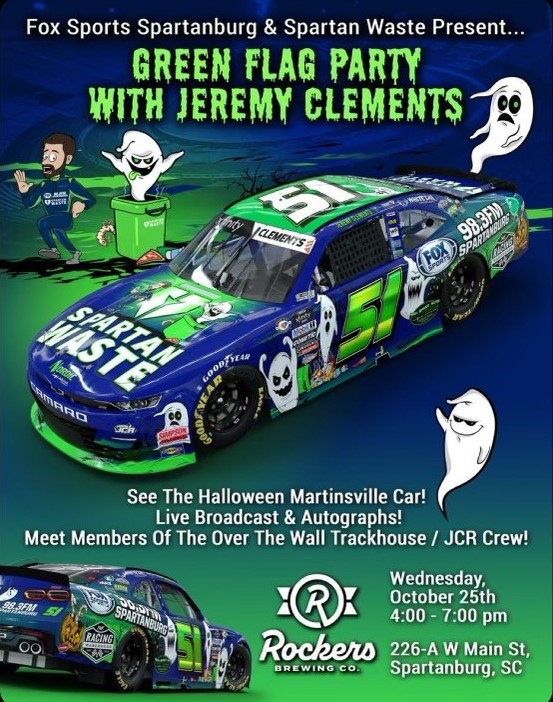
The Boo Crew is back as Spartan Waste and Fox Sports Spartanburg return to Jeremy Clements Racing at Martinsville

Spartanburg, SC – Jeremy Clements Racing is ready to haunt down the competition as the Xfinity Series enters the penultimate race of 2023 at Martinsville Speedway with Halloween just a scare away. JCR will attack the Half Mile of Mayhem with a Ghostly livery from primary partners Spartan Waste and Fox Sports Spartanburg entering All Hallows’ Eve weekend.

Also reappearing as associate sponsors will be High Speed Auto and The Racing Warehouse. The Dead On Tools 250 will take place on Saturday, October 28th at 3:30 pm EST on the USA Network.

“Man, it looks like we have started a pretty great tradition! This will be the third consecutive year that the Spartan and Fox crew have partnered with us for the Fall race at Martinsville,” said Clements. “It is always a fun weekend when these guys are on board and even better is that it is also my favorite time of the year, Halloween. We look to have a good run for them and finish these last two races on a high note, ” Clements went on to say.

Additionally, Fox Sports Spartanburg and Spartan Waste will be holding a Green Flag Meet and Greet Party at Rockers Brewing Co. on Wednesday, October 25th from 4:00 – 7:00 EST in Spartanburg.

Also joining Spartan Waste and Fox Sports Spartanburg as associate sponsors will be Whitetail Smokeless, E3 Spark Plugs, Elite Towing & Recovery, Matman Designs, Dynamic Paintware, Nordic Logistics, People of the Woods, Mechanix Wear, Wix Filters, Carolina Driveline, Cometic and ZMAX.

RACE PREVIEW

Track: Martinsville Raceway
Date: Saturday, October 28th, 2023
Broadcast Information: TV: 3:30 pm EST on USA

FAST FACTS:

Best Start 11th – 2021
Best Finish 9th – 2021
7th career start at Martinsville

JCR TEAM

Crew Chief: Mark Setzer
Manufacturer: Chevrolet
Engine: Clements Racing Engines

ABOUT SPARTAN WASTE

Spartan Waste is a locally owned trash collection company that services communities throughout the upstate of South Carolina. Friendly, professional and dependable, we take pride in the work we do, the customers we serve, and, in the place, we call home. Keep it Clean. For more information visit spartan-waste.com.

ABOUT FOX SPORTS SPARTANBURG 1400

Spartanburg Sports are on Fox Sports 1400 / 98.3 Spartanburg. Home to the Spartanburg Vikings, Gamecock Baseball, and of course Open Mic Daily with Hauser and Clary. Fox Sports 1400 Spartanburg will feature: The Dan Patrick 9 am-noon The Herd with Colin Cowherd 12-3 pm Open Mic Daily 3-6 pm SportsTalk with Phil Kornblut 6-8 pm On Saturdays: The Saturday Sports Report 7-10 am, Start Your Engines 10 am-12 pm. To listen live check out www.spartanburgsportsradio.com.

Unlock Prime Inventory: EpiCar’s Dealer Registration Now Available

North Miami Beach, Florida, October 6, 2023 — EpiCar is thrilled to launch a new platform that resolves dealers’ inventory shortage dilemma. If you’re in the automotive business, this is your opportunity to become part of a revolutionary platform that’s changing the way dealerships source and acquire vehicles.

Solving Dealership Challenges

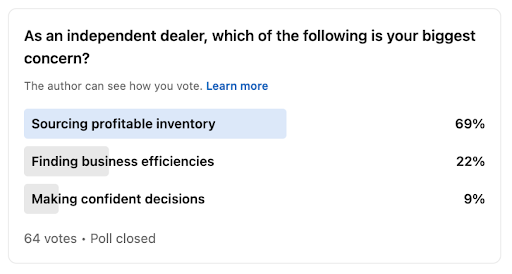
EpiCar’s journey began with comprehensive dealer surveys and in-depth interviews to identify the most pressing issues in the industry. The overwhelming consensus was that “sourcing profitable inventory” posed a significant challenge:

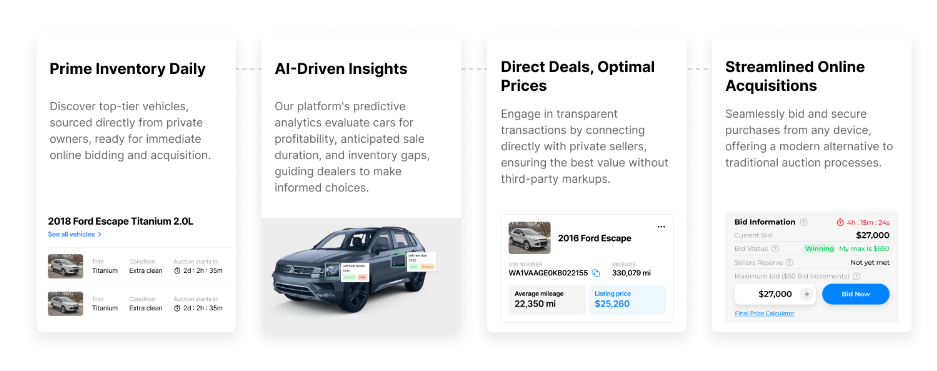
EpiCar addresses this by connecting dealers directly with vehicles sourced from private owners, ready for immediate bidding and acquisition. The predictive analytics empower dealers to evaluate vehicles for profitability, sale duration, and inventory gaps.

With EpiCar, dealers can:

  • Discover top-tier vehicles, sourced directly from private owners, ready for immediate online bidding and acquisition.
  • Utilize advanced predictive analytics and AI-evaluated vehicle condition reports for precise evaluations on profitability, sale duration, and inventory gaps, aiding informed decision-making.
  • Engage in transparent transactions by connecting directly with private sellers, ensuring the best value without third-party markups.
  • Seamlessly bid and secure purchases from any device, offering a modern alternative to traditional auction processes.

Unlock Exclusive Dealer Plans for Your Success

EpiCar offers tailored plans designed to match your unique interests. Get priority notifications on listings that align with your criteria, ensuring you stay ahead of the competition.

The Exclusive Dealer Plans provide customization options to meet your specific needs. Whether you’re focused on luxury sedans in New York or rugged trucks in Texas, the platform adapts to your preferences. With priority notifications, you gain a competitive edge by being the first to bid on prime listings.

Special Offer for Dealers

Register for FREE today and claim a 25-mile radius around your dealership. This exclusive zone ensures you receive priority on all offers within it. By acting now, you secure a 6-month competitive edge, as the first to receive and respond to offers for cars within your secured zone.

Join EpiCar today and experience a new era of efficiency, profitability, and convenience in the automotive industry. Together, we’re driving success.

For more information, please visit EpiCar.

Budweiser Racing: Kevin Harvick Homestead Advance

KEVIN HARVICK
Homestead Advance
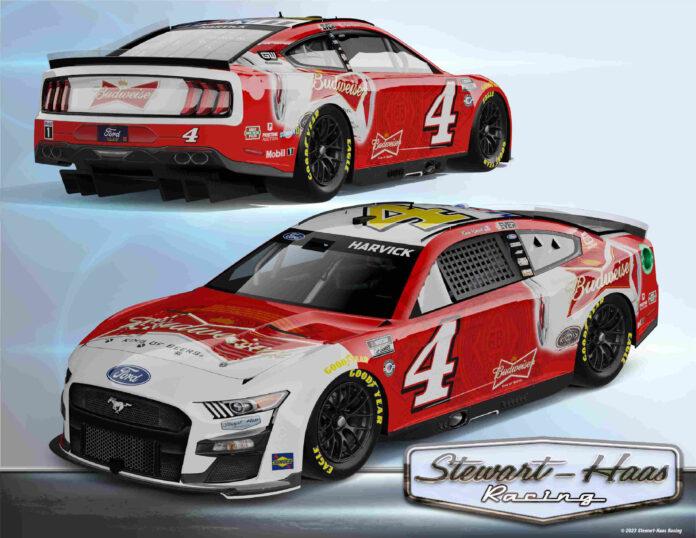
No. 4 Budweiser Ford Mustang for Stewart-Haas Racing

Event Overview

● Event: 4EVER 400 presented by Mobil 1 (Round 34 of 36)
● Time/Date: 2:30 p.m. EDT on Sunday, Oct. 22
● Location: Homestead-Miami Speedway
● Layout: 1.5-mile oval
● Laps/Miles: 267 laps/400.5 miles
● Stage Lengths: Stage 1: 80 laps / Stage 2: 85 laps / Final Stage: 102 laps
● TV/Radio: NBC / PRN / SiriusXM NASCAR Radio

Notes of Interest

● With 2023 being Kevin Harvick’s final season as a NASCAR Cup Series driver, “The Closer” has enjoyed a number of heartfelt tributes to his illustrious career. Sunday’s NASCAR Cup Series race at Homestead-Miami Speedway will serve as another tribute, and it will leave everyone seeing red. Budweiser, the brand Harvick took to the 2014 NASCAR Cup Series championship when he clinched the title at Homestead by winning the race, will be back on his racecar for the 4EVER 400 presented by Mobil 1. The eye-catching red Budweiser paint scheme that Harvick drove to victory on Nov. 16, 2014 will be back at Homestead as Budweiser, Busch Light and Stewart-Haas Racing came together to surprise Harvick with the throwback Budweiser paint scheme and firesuit for his final race at the South Florida oval. Harvick has been an Anheuser-Busch partner since 2011, with Budweiser serving as a sponsor before Busch Light took the wheel in 2016. “Kevin Harvick has been an iconic Anheuser-Busch partner and cornerstone of our sports portfolio since we first started working together in 2011,” said Matt Davis, Vice-President of Partnerships at Anheuser-Busch. “Through our partnership with Kevin, we have been able to connect with 21+ NASCAR fans across the country, giving them unparalleled access to the sport. This surprise paint scheme is just another way we are celebrating Kevin, his loyal fans and his storied career on the track.” This special moment with Harvick is the latest program in Anheuser-Busch’s long-standing commitment to NASCAR. With driver partnerships, key event sponsorships and investments in the sport, Anheuser-Busch has proudly supported and elevated NASCAR through Budweiser and Busch Light for more than 40 years.

● Harvick has made 22 career NASCAR Cup Series starts at Homestead and only recorded one victory, but it was his most memorable win. When Harvick crossed the stripe first in the 2014 Ford EcoBoost 400 by a half-second margin over second-place Ryan Newman, he became the 2014 NASCAR Cup Series champion. Harvick led four times for 54 laps in that race – second only to Jeff Gordon’s 161 laps led – to take his fifth win of the season and the 28th of his career. With 60 career Cup Series wins – 37 of which have come with Stewart-Haas Racing – Harvick is 10th on the all-time Cup Series win list.

● In 14 of the last 15 NASCAR Cup Series races at Homestead, Harvick has finished among the top-10. And in seven of his last nine starts at the 1.5-mile oval, Harvick has finished among the top-five. A lone 26th-place finish at Homestead in 2020 is his only result outside of the top-10 in the last 15 years. To see the last time Harvick had finished outside the top-10 at Homestead meant going all the way back to the 2007 Ford 400 when George W. Bush was president and Harvick finished 19th. All but five of the 43 drivers in that race have officially retired from fulltime racing in the NASCAR Cup Series and nine have been inducted into the NASCAR Hall of Fame – Dale Jarrett (Class of 2014), Bill Elliott (Class of 2015), Mark Martin (Class of 2017), Jeff Gordon (Class of 2019), Bobby Labonte (Class of 2020), Tony Stewart (Class of 2020), Dale Earnhardt Jr. (Class of 2021), Matt Kenseth (Class of 2023) and Jimmie Johnson (Class of 2024).

● Of the 5,880 laps available to Harvick in his 22 career NASCAR Cup Series starts at Homestead, he has completed all but two of those laps. He has led 414 laps and scored 12 top-fives and 19 top-10s to earn an average Homestead finish of 7.3. When it comes to top-fives and top-10s, no other driver is even close to Harvick. His closest competitor in top-fives at Homestead is Martin Truex Jr., with seven, which ties Truex with Jeff Gordon, the retired, four-time Cup Series champion. The Cup Series drivers closest to Harvick in top-10s at Homestead are Truex and Denny Hamlin with 12 apiece. They still need one more top-10 to tie the driver with the second-most top-10s at Homestead – Gordon, who has 13.

● Homestead is considered an intermediate racetrack, which has proven to be the bread and butter of Harvick’s NASCAR Cup Series success. Of his 60 career NASCAR Cup Series wins, 24 have come at intermediate tracks, and those tracks include Homestead (one win), Las Vegas Motor Speedway (two wins), Atlanta Motor Speedway (three wins), Kansas Speedway in Kansas City (three wins), Charlotte (N.C.) Motor Speedway (three wins), Texas Motor Speedway in Fort Worth (three wins), Michigan International Speedway in Brooklyn (six wins), Auto Club Speedway in Fontana, California (one win) and Chicagoland Speedway in Joliet, Illinois (two wins).

Kevin Harvick, Driver No. 4 Budweiser Ford Mustang for Stewart-Haas Racing

What was your greatest race?

“I think the single best race has to be Homestead of 2014, just with the way everything went and the great call and the race at the end and everything that happened with coming to Stewart-Haas Racing that first year. All the adversity that we had at the beginning of the year, how fast the cars were, and then putting it all together in one day to win the championship, I think that single race is probably the one that I would circle just because of everything that happened and everything that it summarized and wound up, ultimately, with a championship at the end.”

Talk about that day, and the nerves and the preparation.

“If I could just show up and run the race and hang out with my team and do all the things that I want to do, it would’ve been fantastic. From the time I got off the driver intro stage and got in the car, once I got in the car it was fine. But the rest of it, I had to talk to myself throughout the day because it’s all stuff that you’d rather not do but you really have no choice, so you try to check the box and get to the point of actually doing what you actually like to do which, of course, is driving the car. From that standpoint, I knew what I was getting into. Tony (Stewart) kind of sat me down after we won Phoenix – actually he sat DeLana down – and said, ‘This is what he needs to do. This is what needs to happen this week. This is how it’s going to go. He’s going to be miserable all the way up until he gets into the racecar because he’s going to have to do stuff all week that he doesn’t want to do, so you just have to know that you’re getting into that and manage it.’ I just checked all the boxes and got in the car and it all worked out.”

How did you feel in that moment when it all came together to win the championship?

“It was not our best year. I think we had the fastest cars, but we had a lot of failures and a lot of situations that didn’t work out our way. And with the points structure and the way that the playoffs work, we were able to win our way to the championship and it overrode all of our flaws because of the way the system is designed. The system is not designed to have the best year, anymore. You don’t win championships like Earnhardt used to win them by having the best complete season. For us, we didn’t have a truck, we didn’t have a nut, we didn’t have a bolt, we didn’t have a racecar. We put everything together, from hiring a driver, to hiring Rodney Childers to be the crew chief, to him hiring the car chief, all the way through everything that we did. We didn’t have a sponsor, we didn’t have anything. So to be able to put all that together and allow that to grow throughout 2014, because we knew we were fast, we just had to figure out how to get to the end of the race in order to put ourselves in a position to win, and by the time we got to the second half of the year, we had most of those bugs worked out. So we got to the playoffs and, really, all the things that didn’t work out in the playoffs were overshadowed by fast cars. You used to look back at the 48 team (of seven-time champion Jimmie Johnson) and think, man, those guys are the luckiest people on earth. No, they just had the best cars, and they had the best team and drivers and crew chiefs and situations to overcome all those flaws and mistakes or whatever they were. And that’s really where we were. In the end, we won Phoenix and we won Homestead, and we won Charlotte and put ourselves in a position to win the championship. Really, 2015 and 2020 were probably our best years and we didn’t win the championship. And that’s really the system that we’re in. It’s not about having the best year, it’s about winning and being successful at the right time.”

How did you prepare yourself for that championship weekend at Homestead in 2014?

“I think that’s where most people go wrong, is they try to do something different in all these big moments. The big moments require the calmest minds, and if you try to make more out of it than is actually there, in the end it’s just another race, and you know going in the things that you need to prepare for. You need to prepare differently for the week leading into the racetrack because there are just going to be a lot of things that you just don’t want to do. You don’t want to go to the press conference, you don’t want to go to the dinners, you don’t want to go do all the things that come with all the work of qualifying for the Championship 4, and you’re going to have to do more media sessions on the weekend. You have to mentally prepare yourself to have a week that is just unorthodox compared to what you’ve done in the past. But overthinking the car stuff is detrimental to the result of your weekend. Whether it’s the crew chief or the driver or the pit crew guys, it’s just another race. You just have to prepare yourself for the things that are outside the box from a media standpoint and all the other obligations that come with that championship week. Other than that, it’s just another race.”

What are your expectations now when you race at Homestead?

“You better run the wall. That’s just going to be part of it. It’s the best way around Homestead. But I think as you look at this car, it’s a little more durable than what we’ve had with the old car as far as rubbing the wall and things like that, so you can be a little bit more aggressive with putting the car where it needs to be on the racetrack – at least I can in my thought process. I’m sure I’ll do something that won’t be right, but I think you have to be comfortable running up there.”

A lot of drivers call Homestead their favorite track. They like its layout, its banking and what they’re able to do with their racecar through the track’s corners. Are you one of those drivers who is pro-Homestead?

“I am. Homestead is a great racetrack because it’s just so different than all the other mile-and-a-half racetracks that we go to. It’s just got unique entries and exits to the corners that were designed for the flat track that it started as. The way that the asphalt has aged, the fast line is going to be right up against the wall, and to be able to carry that momentum through the corners as the tires wear out.”

It’s appropriate that Homestead is part of the home stretch of your driving career. How do you feel as this season winds to a close?

“This is it, man. It’s what a well-laid plan does – it gives you a peace of mind. I’m not joking. It really has been a great, well-laid-out plan. We said, ‘Hey, here’s what we’re going to do’ and we laid it out starting last November, we developed logos, we talked to racetracks, we made it very public before we got started and it’s allowed us to just go race. I think they prepared me well of knowing that there was going to be extra work, and it has been a lot work, but it’s been right. And I think that was the main goal, to make it right for the fans and the sponsors and the team and everybody involved. And for me, it’s really allowed me to just relax and let my guard down and really just be a part of it and enjoy it. When we go to these racetracks and hear stories and they hand you gifts or whatever it is, it’s a celebration and, fortunately, we’ve got something to celebrate with all the things that we’ve been fortunate to do throughout the years. And I don’t have to worry about talking about it anymore because it is what it is. I’ve been in the fortunate position to be able to go out on my own terms.”

Could a young Kevin Harvick imagine that in 2023 he would have a race named in his honor?

“I think that’s what’s great about being where I’m at. I think having those relationships with a lot of the other drivers and having the respect of the other competitors in the garage is hard to come by. In the beginning, I didn’t really care. I didn’t care what they thought, and I really wanted them to not like me, more than anything. I wanted them to think about me all the time, when I was in front of them, when I was behind, when I walked into the room I wanted them to think I was going to say something, do something. I think as we’ve gone through the years, and this is a whole, different generation of guys – some of them have been here for a while – but it’s been very enjoyable to get to know a lot of them, and be able to have some of them come to you and ask questions and learn what you did right and what you did wrong, whatever the case may be. You become more of a mentor than you do trying to cut their throat on a weekly basis. That part has been fun, and when you look back and you see a group of 15 guys sitting at driver intros, or at an appearance or playing a baseball game, the camaraderie definitely needs to be a little bit more tight-knit in our group, and I think that’s happened over the last couple of years for reasons that probably none of us wanted to be involved in from a safety standpoint. But it’s evolved into many of the drivers having a better relationship with each other and talking amongst the group probably more than we have in the last 10, 12 or 15 years.”

What’s the best advice that you’ve received from drivers who have retired recently that you’ve taken to heart?

“For me, probably the best piece of advice came from Mark Martin, and it was just to make sure that when you’re done, you’re done, that you’re out of that competitive mindset, you don’t want to go back and forth and back and forth, and just make sure that you’ve had enough of that competitive fulfillment. You being fulfilled from the competition side is very important, being able to watch it and not have your name or number on top of that scoreboard in order to be happy with not seeing that. And I think Joe Girardi (former manager of the New York Yankees) probably was the other one, just to make sure you take that jersey off when you want to take it off. That was great advice, and I think when you look at that, when you take it off when you’re ready and not having them take it off for you by being there too long is important. This year could’ve gone a number of different ways, but we’ve been competitive and done the things that we need to do with where everything is at, and being able to do this last year and let everyone celebrate something that you kind of are a little bit embarrassed to say, sometimes, because I’ve always felt like it was bragging when you talk about how many times you’ve won, or how many times you’ve been fortunate to be successful. But being able to let your guard down and do that right has not only been great for everybody around, but for myself, included, because I would tell you that most of the year has been for everybody else, but it’s been very fulfilling to be able to hear all the stories, and it’s been much different as we’ve gone through the season. To start the season, I would say it was for everybody else, but to end the season, I would tell you that everybody made you feel good.”

No. 4 Budweiser Team Roster

Primary Team Members

Driver: Kevin Harvick

Hometown: Bakersfield, California

Crew Chief: Rodney Childers

Hometown: Mooresville, North Carolina

Car Chief: Robert “Cheddar” Smith

Hometown: Whitewater, Wisconsin

Engineer: Stephen Doran

Hometown: Butler, Pennsylvania

Engineer: Dax Gerringer

Hometown: Gibsonville, North Carolina

Spotter: Tim Fedewa

Hometown: Holt, Michigan

Over-The-Wall Members

Front Tire Changer: Daniel Coffey

Hometown: Granite Falls, North Carolina

Rear Tire Changer: Daniel Smith

Hometown: Concord, North Carolina

Tire Carrier: Jeremy Howard

Hometown: Delhart, Texas

Jack Man: Brandon Banks

Hometown: High Point, North Carolina

Fuel Man: Evan Marchal

Hometown: Westfield, Indiana

Road Crew Members

Mechanic: Tyler Trosper

Hometown: Mooresville, North Carolina

Mechanic: Nick DeFazio

Hometown: Orange, California

Tire Specialist: Jamie Turski

Hometown: Trumbull, Connecticut

Engine Tuner: Robert Brandt

Hometown: Mobile, Alabama

Transporter Co-Driver: Rick Hodges

Hometown: Raleigh, North Carolina

Transporter Co-Driver: Stephen Mitchell

Hometown: Woodville, Ohio

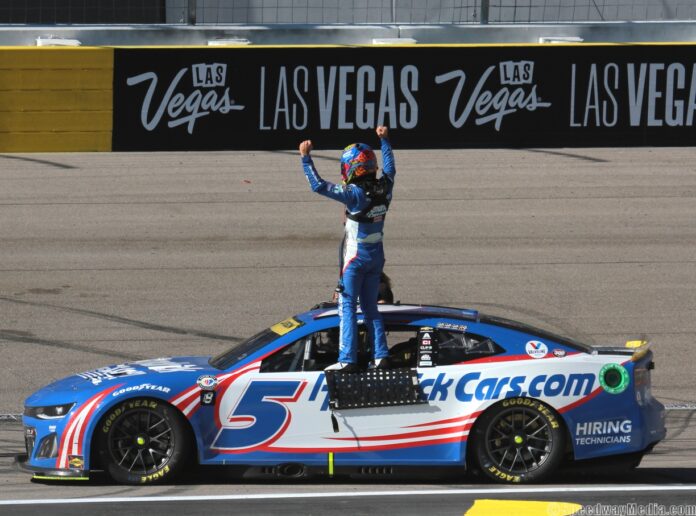
NASCAR Top-10 Power Rankings: Las Vegas

Photo by Ron Olds for SpeedwayMedia.com

Note: The quotes in this article are fictional.

1. Kyle Larson: Larson won Stage 1 and held off Christopher Bell down the stretch to win the South Point 400 at Las Vegas.

“I am so thrilled,” Larson said, “that I want to shout my excitement over the airwaves. But I’ve been strongly advised against doing anything out over the airwaves.”

2. William Byron: Byron finished sixth at Las Vegas and is 11 points above the playoff cut line.

“This championship may come down to two Hendrick Motorsports drivers,” Byron said. “And neither is named ‘Chase Elliott.’ I know saying that won’t win me any ‘most popular’ contests, but I’ll vote for that.”

3. Christopher Bell: Bell finished second at Las Vegas, as he was unable to get by Kyle Larson in the closing laps.

“I was so close,” Bell said. “But Larson made all the right moves to keep me at bay. But I have to forget it and move forward. Like Larson, I’m going to ‘block’ this out of my mind.”

4. Denny Hamlin: Hamlin finished ninth in the South Point 400.

“It’s ‘crunch time,'” Hamlin said. “In most cases, ‘crunch time’ means Ross Chastain is somewhere in your vicinity. Not in this case.”

5. Tyler Reddick: Reddick finished seventh at Las Vegas, one of four Toyotas in the top 10.

“When you’re driving a car co-owned by Michael Jordan,” Reddick said, “it feels like the greatest basketball player is in the car with you. In Las Vegas, it feels like the greatest basketball player is in the car with you, and there’s a lot of money riding not with you, but on you.”

6. Martin Truex Jr.: Truex finished eight at Las Vegas.

“I feel like I regained my mojo,” Truex said. “When you can do that without the aid of some gas station bathroom snake oil tincture, then you have truly regained it.”

7. Chris Buescher: Buescher finished 10th in the South Point 400.

“Thanks to Ryan Blaney’s disqualification,” Buescher said, “I’m not bringing up the ‘South Point’ of the championship standings.”

8. Kyle Busch: Busch finished third in the South Point 400.

“My car featured the Morgan & Morgan Law Firm as primary sponsor,” Busch said. “They are a personal injury law firm, but if you need them to pull some strings to keep you out of a Mexican prison, then they can do that too. But only if your name is Kyle Busch.”

9. Ross Chastain: Chastain finished fifth at Las Vegas.

“Too little,” Chastain said, “too late. I’m out of the championship hunt, but that doesn’t mean I can’t have another ‘Martinsville Moment’ and keep Denny Hamlin out of the championship round. To me, that’s like winning the Cup championship.”

10. Ryan Blaney: Blaney finished sixth at Las Vegas, but was later disqualified after failing post-race inspection.

“This really puts a dent in my championship hopes,” Blaney said. “Actually, it puts a dent, four flat tires, and an engine failure in my championship hopes.”

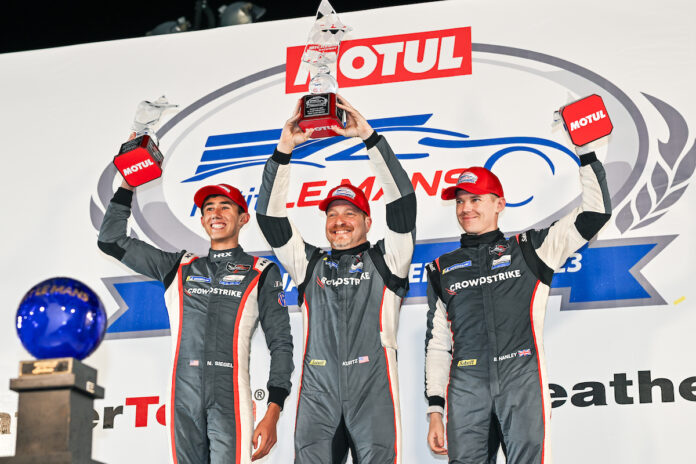
CrowdStrike Racing by APR Takes Petit Le Mans LMP2 Win

  • George Kurtz, Ben Hanley, Nolan Siegel drive No. 04 CrowdStrike ORECA-Gibson to season’s second IMSA win
  • Kurtz earns an automatic entry to the 2024 24 Hours of Le Mans
  • CrowdStrike Racing by APR takes IMSA Michelin Endurance Cup Championship
  • CrowdStrike Racing by APR confirmed for full 2024 IMSA LMP2 season

BRASELTON, Ga. (October 16, 2023) – CrowdStrike Racing by Algarve Pro Racing (APR) closed its season in the IMSA WeatherTech SportsCar Championship with an LMP2 class victory in the 10-hour Petit Le Mans at Michelin Raceway Road Atlanta.

It was the second IMSA win for drivers George Kurtz, Ben Hanley and Nolan Siegel in the No. 04 CrowdStrike ORECA 07-Gibson prototype. Saturday’s winning LMP2 trio combined to lead a race-high 165 of 390 laps.

With the win at Road Atlanta, Kurtz was also able to take home the IMSA Jim Trueman Award, given to the leading Bronze driver in the LMP2 class. With the award, Kurtz earns an automatic entry to compete in the 2024 24 Hours of Le Mans. Kurtz and APR will look to repeat their podium performance after winning the LMP2 Pro-Am class at Le Mans this year, the first time the team raced together at the French classic.

Saturday’s victory capped a highly successful season for CrowdStrike Racing. In addition to Petit Le Mans, last weekend, Kurtz won the Fanatec GT World Challenge America title in the Pro-Am category with a class win at the Intercontinental GT Challenge’s Indianapolis Eight Hours. Additionally, the CrowdStrike Racing by APR program also won in LMP2 at the Six Hours of The Glen in June.

CrowdStrike Racing by APR will soon begin preparations for the 2024 IMSA WeatherTech SportsCar Championship season. The team will open the season with the Rolex 24 At Daytona on January 27-28 from Daytona International Speedway.

For more information, visit CrowdStrikeRacing.com. Follow #CrowdStrikeRacing on Facebook, X and Instagram for updates.

Driver quotes after Petit Le Mans

George Kurtz (#04 CrowdStrike Racing by APR ORECA 07-Gibson LMP2):

“We’ve been on an incredible journey in the first year of this program. Credit to CrowdStrike Racing, Algarve Pro Racing, Ben (Hanley) and Nolan (Siegel). Everybody did a fantastic job and executed flawlessly. To come out on top at Motul Petit Le Mans is a huge win for our new team. Although we initially set out to do the Michelin Endurance Cup rounds, we eventually decided to go for it and aim for the Trueman Award and the 24 Hours of Le Mans entry. The team was focused and worked hard this season, making these accomplishments even more gratifying.”

Ben Hanley (#04 CrowdStrike Racing by APR ORECA 07-Gibson LMP2): “Petit Le Mans was an awesome race. The whole CrowdStrike Racing by APR team did a great job to give us a package that was capable of winning, and a car I could place whenever I needed through traffic, which always makes life a lot easier around here at Michelin Raceway Road Atlanta. Congratulations to my teammates George (Kurtz) and Nolan (Siegel), who drove brilliantly to achieve what is a fantastic result for the entire team.”

Nolan Siegel (#04 CrowdStrike Racing by APR ORECA 07-Gibson LMP2): “This is my first IMSA Petit Le Mans win and I couldn’t be happier. In fact, I’ve loved all of the endurance races I’ve done this year in 2023. It has been super enjoyable. I’ve loved competing in the IMSA WeatherTech SportsCar Championship, and the whole experience has been even better because I’ve done it with CrowdStrike Racing by APR, George (Kurtz) and Ben (Hanley). We’ve had a lot of success but, beyond that, it’s a great environment full of great people, and I hope to have more opportunities to race with them.”

About CrowdStrike

CrowdStrike (Nasdaq: CRWD), a global cybersecurity leader, has redefined modern security with the world’s most advanced cloud-native platform for protecting critical areas of enterprise risk — endpoints and cloud workloads, identity and data.

Powered by the CrowdStrike Security Cloud and world-class AI, the CrowdStrike Falcon® platform leverages real-time indicators of attack, threat intelligence, evolving adversary tradecraft and enriched telemetry from across the enterprise to deliver hyper-accurate detections, automated protection and remediation, elite threat hunting and prioritized observability of vulnerabilities. Purpose-built in the cloud with a single lightweight-agent architecture, the Falcon platform delivers rapid and scalable deployment, superior protection and performance, reduced complexity and immediate time-to-value.

CrowdStrike: We stop breaches.

Learn more: https://www.crowdstrike.com/

Follow us: Blog | X | LinkedIn | Facebook | Instagram