Home Blog Page 1717

RFK Weekly Advance | Las Vegas II

Roush Fenway Keselowski Weekly Advance | Las Vegas

The NASCAR Cup Series schedule heads west to Las Vegas Motor Speedway for the second time this season. Jack Roush has seven wins all-time there in the Cup Series, third-most among 1.5-mile tracks, with 16 wins overall in Vegas.

NASCAR Cup Series Race at Las Vegas

Sunday, Oct. 16 | 2:30 p.m. ET

NBC, PRN, SiriusXM Channel 90

Brad Keselowski, No. 6 King’s Hawaiian Ford Mustang
Chris Buescher, No. 17 Castrol Ford Mustang

Early JACKpot

RFK hit the Vegas jackpot right off the bat, winning the inaugural Cup event at Las Vegas in 1998. Mark Martin led 82 laps in the victory that served as a banner day for RFK.

Inaugural Sweep

RFK placed all five of its Cup entries inside the top 10 of that inaugural Las Vegas Cup race in 1998, including three inside the top five, four inside the top six, one in the winners circle and the runner up (6 – 1st, 99 – 2nd, 26 – 4th, 16 – 6th and 97 – 10th).

Continued Success

RFK won the first three Cup races at LVMS from ‘98-’00, with Jeff Burton winning back-to-back events in ’99 and ’00. RFK also took three of the first nine Xfinity Series events at LVMS.

Victory Lane at Vegas

In addition to the first three Cup races at LVMS, RFK again found the winners’ circle in 2003 and 2004 at the 1.5-mile track with Matt Kenseth. Carl Edwards took the checkered flag at the 2008 and 2011 events to give RFK seven Cup wins at Las Vegas with four different drivers.

Back to Back at Vegas

RFK has won back-to-back Cup races at LVMS on two separate occasions in ’99-’00 and ’03-04’ and once in the Xfinity Series in ‘99 and ‘00.

Across the Board at Vegas

All in all, RFK has tallied 16 total NASCAR wins, while turning 39,000+ laps in NASCAR action at LVMS for 58,000+ miles, while leading over 2,600 laps at the track in NASCAR’s top three divisions. At the same time the organization has finished inside the top 10 in 48 percent of its 184 NASCAR starts at LVMS.

RFK Las Vegas Wins

1998 Martin Cup

1999 Burton Cup

2000 Burton Cup

2003 Kenseth Cup

2004 Kenseth Cup

2008 Edwards Cup

2011 Edwards Cup

1999 Martin NXS

2000 Burton NXS

2002 Burton NXS

2005 Martin NXS

2009 Biffle NXS

2012 Stenhouse NXS

1997 Ruttman NCWTS

1999 Biffle NCWTS

2007 Kvapil NCWTS

Toyota Racing – Weekly Preview – 10.12.22

This Week in Motorsports: October 11-17, 2022

· NCS/NXS: Las Vegas Motor Speedway – October 15-16
· NHRA: Texas Motorplex (Ennis, Texas) – October 16

PLANO, Texas (October 12, 2022) – The Round of 8 kicks off at Las Vegas Motor Speedway for both the NASCAR Cup Series and NASCAR Xfinity Series, while the NHRA continues their Countdown in Texas.

NASCAR National Series – NCS | NXS

Bell has momentum heading to Vegas… Christopher Bell proved to be clutch in Charlotte with a late-race pass on Kevin Harvick to score his second win of the season and advance to the Round of 8 for the first time in his career. Bell scored his first of a series-leading four poles this season at Las Vegas Motor Speedway in the spring and earned a top-10 finish. The Oklahoma-native is looking for his first win at Las Vegas but has runner-up finishes at the track in both the NASCAR Xfinity Series and NASCAR Truck Series.

Hamlin plans on securing fourth straight Championship 4 spot… Denny Hamlin advanced to the Round of 8 for the fourth straight season and looks for his fourth consecutive Championship 4 berth. Hamlin led 31 laps earlier this season in Las Vegas before suffering mechanical woes. He is the reigning winner of this race – his first win at Las Vegas Motor Speedway during the Playoffs last year.

Gibbs continues strong performance… Ty Gibbs had another strong road course finish at Charlotte with a runner-up finish. Gibbs looks to lock in his spot in the Championship 4 with a season sweep in Las Vegas this season. He took the lead on the final restart to earn his first victory of the year in March.

Jones looking for career-best points finish… Brandon Jones had a clutch performance to move from outside of the Playoffs to the final eight with a stage win and top-10 finish at the Charlotte road course. Jones has never won at Las Vegas, but has multiple top-five finishes there including a third place run one season ago.

Back-to-back for Bayne… Trevor Bayne returns to the Joe Gibbs Racing No. 18 GR Supra for back-to- back races to close his part-time schedule this season. Bayne has four top-five finishes and five top-10’s in seven races this season. He has multiple top-five finishes at Las Vegas and Homestead-Miami Speedway. Toyota development driver Sammy Smith closes the season in the No. 18 Toyota GR Supra at Martinsville and Phoenix.

Nemechek back for SHR… John Hunter Nemechek is in the No. 26 for Sam Hunt Racing (SHR) this weekend in Las Vegas – his 11th Xfinity Series start this season and eighth for SHR. He ran the spring race for the team and scored a top-15 finish. Nemechek has two top-fives, and three top-10 finishes this season for SHR.

NHRA – Top Fuel | Funny Car

Toyota recently dominant in Top Fuel events… Antron Brown and Steve Torrence have helped Toyota win five of the last six Top Fuel events. Brown has won at Topeka, Indianapolis and Charlotte, while the reigning Top Fuel champion earned victories at Brainerd and St. Louis, in addition to the All-Star win in Indianapolis.

Tight Top Fuel standings… Justin Ashley leads the point standings for the third consecutive event, but the standings are very tight with seven drivers within 88 points of the championship lead. Ashley has a 14-point advantage over Torrence, with Brown in fifth – 43 points out and Doug Kalitta in seventh, just over four rounds out of the lead.

Todd looking for 300… J.R. Todd is closing in on a milestone – 300 round wins. The 2018 NHRA champion currently sits at 299 round wins coming into this weekend. Todd previously won at Texas Motorplex in 2008 while in the Top Fuel class.

Stay Connected

https://www.toyota.com/racing @ToyotaRacing.com @ToyotaRacing

facebook.com/ToyotaRacing Camera With Flash on Apple iOS 11.3 ToyotaRacingMedia.com

About Toyota

Toyota (NYSE:TM) has been a part of the cultural fabric in North America for more than 60 years, and is committed to advancing sustainable, next-generation mobility through our Toyota and Lexus brands, plus our more than 1,800 dealerships.

Toyota directly employs more than 48,000 people in North America who have contributed to the design, engineering, and assembly of nearly 43 million cars and trucks at our 13 manufacturing plants. By 2025, Toyota’s 14th plant in North Carolina will begin to manufacture automotive batteries for electrified vehicles. With the more electrified vehicles on the road than any other automaker, more than a quarter of the company’s 2021 North American sales were electrified.

Through the Start Your Impossible campaign, Toyota highlights the way it partners with community, civic, academic and governmental organizations to address our society’s most pressing mobility challenges. We believe that when people are free to move, anything is possible. For more information about Toyota, visit www.ToyotaNewsroom.com.

Code 3 Associates Racing: Chase Briscoe Las Vegas Advance

CHASE BRISCOE
Las Vegas Advance
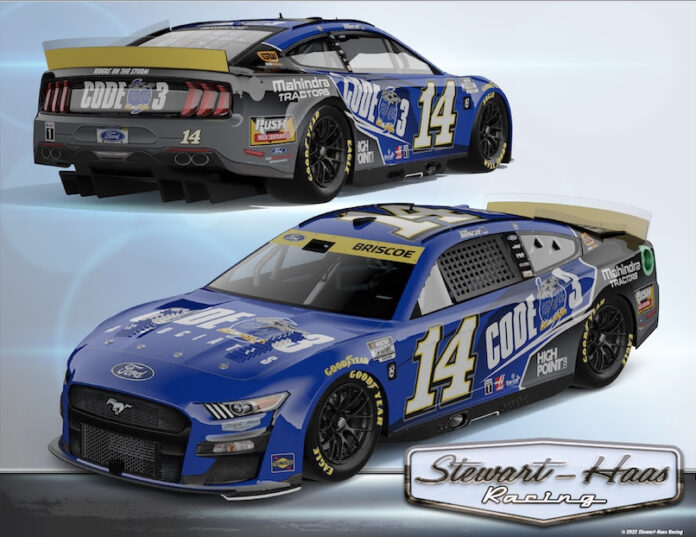
No. 14 Code 3 Associates Ford Mustang for Stewart-Haas Racing

Event Overview

● Event: South Point 400 (Round 33 of 36)
● Time/Date: 2:30 p.m. EDT on Sunday, Oct. 16
● Location: Las Vegas Motor Speedway
● Layout: 1.5-mile oval
● Laps/Miles: 267 laps / 400.5 miles
● Stage Lengths: Stage 1: 80 laps / Stage 2: 85 laps / Final Stage: 102 laps
● TV/Radio: NBC / PRN / SiriusXM NASCAR Radio

Notes of Interest

● The NASCAR Cup Series rolls into Las Vegas Motor Speedway for the seventh playoff race and first in the Round of 8. Chase Briscoe, driver of the No. 14 Code 3 Associates Ford Mustang for Stewart-Haas Racing (SHR), begins the round eighth in the reset playoff standings, nine points below the top-four cut off, after an exhilarating ninth-place finish last Sunday at the Charlotte (N.C.) Motor Speedway Roval. It was his third straight top-10 finish and seventh of the season.

● Briscoe started Sunday’s Bank of America Roval 400 17th and drove up through the field to finish seventh in the first stage and eighth in the second. He began the third stage deep in the field after pitting and was riding just outside the top-10 when he was spun by the No. 3 of Austin Dillon entering the backstretch chicane on lap 107. A caution shortly after allowed Briscoe to pit, and he restarted 27th on lap 110. Over the final lap, Briscoe powered along the 17-turn, 2.280-mile road course to race into 12th before reaching turn two of the oval. While battling for position with the final spot in the Round of 8 at stake, Briscoe drove deep into the backstretch chicane, outbraking the three cars in front of him to advance to ninth. He held his position as he entered turns three and four of the oval and to the checkered flag to keep his championship hopes alive.

● Briscoe has a best finish of 14th in three Cup Series starts at Las Vegas. Last March, he started fourth, finished the first stage eighth, and was running inside the top-10 before an accident on lap 135 relegated him to a 35th-place finish. The following week, he rebounded in a big way by earning his first Cup Series victory on the mile oval at Phoenix Raceway.

● In 2020, Briscoe earned his first Xfinity Series win of the season at Las Vegas in March and returned in September to complete the sweep. He also made one NASCAR Camping World Truck Series start there in 2017, which resulted in a third-place finish.

● Joining Briscoe and the No. 14 team at Las Vegas will be longtime SHR partner Code 3 Associates, which has been a hero to animals for more than 30 years. If disaster strikes, Code 3 will deploy its Animal Rescue Team to help in emergencies like hurricanes, fires and floods.

● Code 3 teams are currently deployed in Florida in response to Hurricane Ian, where they have been working to move animals to higher ground or dry land and provide necessary food and water as flood waters subside. They also assist agencies with rescuing pets and finding temporary shelter. Recent updates from Florida include:

● Increased livestock rescues as teams have saved goats from a flooded barn, provided fresh hay and veterinary care to horses trapped by flood waters, opened a fence to allow cattle to move to dry land and grass, tended to chickens, and rescued several pigs.

● A team is working with Desoto Animal Control to break down and temporarily relocate animals to pet-friendly Red Cross shelter locations.

● Code 3 teams also traveled by Blackhawk helicopter to assess the needs of animals on Sanibel, Pine, and Captiva islands, which were cut off from the mainland.

Chase Briscoe, Driver of the No. 14 Code 3 Associates Ford Mustang for Stewart-Haas Racing:

Las Vegas has been a good track for you in the past. Does that give this next round a more exciting start?

“I love going to Las Vegas. It’s always been one of my favorite tracks. We were pretty good there earlier this year, and we’ve only gotten better on the mile-and-a-half tracks, so I’m excited to get there and see how things go. This round definitely plays more into my strengths and we’re coming into it with a lot of momentum. We’ve gotten so much better at places like Las Vegas and we had a really good test at Homestead a few weeks ago. Martinsville isn’t a place where I’ve been great in the past but we’ve been really good on the flat, short tracks, so I think we’d be OK if we had to race our way in there.”

A lot of people have doubted your ability to continue advancing through the playoffs. How do you handle the outside noise?

“I enjoy being the underdog and handle it much better when people do doubt us. I know we’re capable, our team knows we’re capable and it really doesn’t matter what other people think. I like not having that pressure, so that’s fine if it continues. We’re going to show up each race and do what we need to do. Even if we’re down, we’re not out and we’ve shown that these last few weeks, so we’ll keep it up and make our way to Phoenix.”

No. 14 Code 3 Associates Team Roster

Primary Team Members

Driver: Chase Briscoe
Hometown: Mitchell, Indiana

Crew Chief: John Klausmeier
Hometown: Perry Hall, Maryland

Car Chief: J.D. Frey
Hometown: Ferndale, California

Engineer: Mike Cook
Hometown: Annapolis, Maryland

Engineer: Marc Hendricksen
Hometown: Clinton, New Jersey

Spotter: Joey Campbell
Hometown: Berlin, Connecticut

Over-The-Wall Members

Front Tire Changer: Shayne Pipala
Hometown: Frankfort Square, Illinois

Rear Tire Changer: Dakota Ratcliff
Hometown: Nashville, Tennessee

Tire Carrier: Jon Bernal
Hometown: Shelby, North Carolina

Jack Man: Dylan Moser
Hometown: Monroe, North Carolina

Fuel Man: Corey Coppola
Hometown: Bluefield, West Virginia

Road Crew Members

Underneath Mechanic: Stephen Gonzalez
Hometown: Mooresville, North Carolina

Interior Mechanic: Trevor Adams
Hometown: Naples, Florida

Tire Specialist: Keith Eads
Hometown: Arlington, Virginia

Shock Specialist: Brian Holshouser
Hometown: Charlotte, North Carolina

Engine Tuner: Jon Phillips
Hometown: Jefferson City, Missouri

Transporter Co-Driver: Todd Cable
Hometown: Shelby, North Carolina

Transporter Co-Driver: Rob Fink
Hometown: Mocksville, North Carolina

Fly & Form Concrete Structures Inc. back with JCR for Homestead

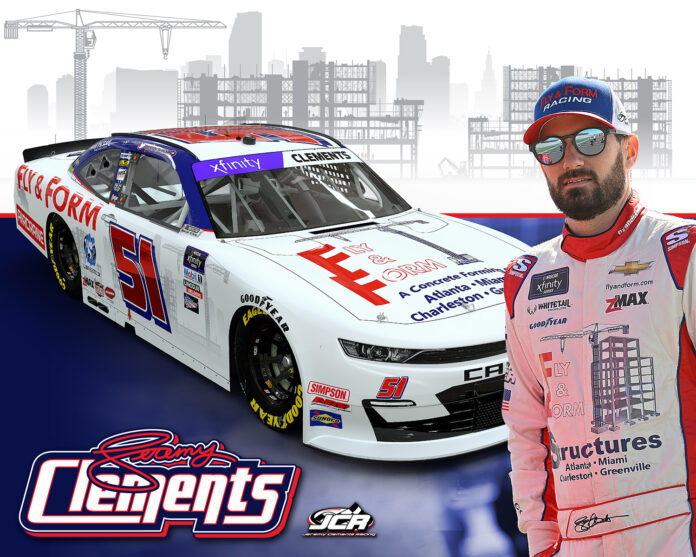
Spartanburg, SC – Jeremy Clements Racing is grateful to have Fly & Form Concrete Structures return for their final race of 2022. The JCR #51 Chevrolet will be trimmed out in the mainstay Red, White and Blue colors of Fly & Form for the Contender Boats 300 at Homestead – Miami Speedway, Saturday October 22nd. Plus, we are excited to welcome “America’s Preferred Lift Experts” AIRCRANE as a new associate sponsor in their debut into the NASCAR Xfinity Series.

“We so are thankful to have Fly & Form back on the car for Homestead. Earlier in the year when they were on the car at Atlanta and Pocono, we got caught up in wrecks that ended our day way too soon in both races. So, we are definitely looking forward to this race to try and duplicate that Top 10 finish we had at Homestead last year with Ray Stevens and his Fly & Form Team.” Clements said.

Joining Fly and Form as associate sponsors will be: AIRCANE, My Sea Cin, All South Electric, E3 Spark Plugs, Whitetail Smokeless, Chalew Performance, ELITE Towing & Recovery LLC, Upstate Body & Towing, Mechanix Wear, Wix Filters, Carolina Driveline, Cometic and ZMAX

RACE PREVIEW

Track: Homestead – Miami
Best Start: 4th – 2020
Best Finish: 9th – 2021
Race: Contenders Boat 300
Date: Saturday, October 22nd
Broadcast Information – TV: 4:30 pm EST on USA

JCR TEAM

Crew Chief: Mark Setzer
Manufacturer: Chevrolet
Engine: Clements Racing Engines

ABOUT FLY & FORM CONCRETE STRUCTURES
Fly & Form Concrete Structures has been a partner of JCR since 2018 and has offices in Atlanta, Charleston, Greenville, Miami, Nashville, and Fort Myers. Fly & Form is an industry leader as a concrete Subcontractor. They specialize in concrete formwork, modified frames and complete turnkey concrete frames on High – Rise multi-story concrete buildings throughout the Southeast. Hotels, Condominiums, Office Buildings, and Parking Decks are among some of the structures they specialize in. If you see a Tower Crane on a building in the Southeast, there’s a good chance it’s another Fly & Form Structures Project! Check out their portfolio at FlyandForm.Com

ABOUT AIRCANE
Aircrane Inc is the preferred Arial Crane Specialists across the entire eastern United States. We specialize in delivery of hard-to-reach rooftop equipment from high-rise signage to HVAC equipment. We currently lift anything 4400 lbs. and below and place with extreme precision. We provide Safe, Efficient and Effective solutions to your lifting needs. Visit us at Aircrane.com. Can you S.E.E it?

World Premiere of the New All-Electric Lexus UX 300e

Lexus UX 300e (Prototype)

The diverse powertrain line-up of the Lexus UX series welcomes an updated Battery EV model with enhanced electric range and further refinement

  • Evolution of the brand’s first Battery EV (BEV) model, based on the electrification vision “Lexus Electrified”
  • Newly developed battery pack increases cruising range by over 40% to 450 km
  • Ever more refined and confidence-inspiring performance though focus on core vehicle dynamics
  • Expanded active safety functions and equipment enhancements including the latest multimedia system

TOKYO, Oct 12, 2022 – (JCN Newswire) – Lexus announces the global debut of the new UX 300e, a significant evolution of the brand’s first production BEV model. The updated UX 300e joins the new UX 200/250h announced earlier this year, with deliveries scheduled to begin in spring 2023.

Since the 2005 launch of the RX 400h, the world’s first hybrid SUV, Lexus has been a pioneer of electrification in the luxury market. Based on the electrification vision “Lexus Electrified” announced in 2019, Lexus aims to meet the diverse needs of global customers through a broad range of electrified vehicles, from HEVs to PHEVs and BEVs. Using electrification technology to significantly enhance fundamental vehicle performance, Lexus continues to refine the timeless joy of the automobile, through hallmark precision and sophistication. In 2020, Lexus launched UX 300e as the brand’s first production BEV model. In 2022, this was followed by the introduction of the Lexus RZ, a dedicated BEV model. As of the end of August 2022, cumulative sales of Lexus electrified vehicles stand at approximately 2.3 million units, as the brand accelerates their development and adoption to contribute to the realization of a carbon-neutral society.

In addition to its maneuverable body size and unique “UX” urban compact crossover design, the UX 300e is highly regarded by customers seeking a distinctly quiet and refined BEV driving experience. The enhancements announced for the UX 300e are based on the relentless pursuit of perfection under an “Always On” philosophy. Enhancements unique to the BEV powertrain include a newly developed battery pack with capacity increased from 54.4 kWh to 72.8 kWh, resulting in a cruising range of 450 km–over 40% longer than the current model. The UX 300e also inherits the further refinements made to the dynamic precision of the UX series for confidence-inspiring performance, along with the expanded functionality of active safety technologies, and the evolution of advanced features through the latest multimedia system.

The updated UX 300e underwent rigorous testing and evaluation at Toyota Technical Center Shimoyama. The low center of gravity created by the under-floor placement of the BEV battery pack gives the UX 300e a natural performance advantage, as do standard rear Performance Dampers. For even more refined dynamics, body rigidity was strengthened with the addition of 20 spot welding points, and the Electric Power Steering (EPS) and shock absorbers were optimally tuned for the all-electric model.

When it comes to advanced technology, functionality of the “Lexus Safety System +” active safety technology was expanded with the aim of providing a safer and more secure driving experience. In addition, the latest multimedia system brings a larger, higher resolution touch panel display, the form and switch layout of the instrument panel and console area have been optimized, and two new Type-C USB connectors have been added to the front of the console for improved usability when charging devices.

Lexus International Chief Engineer Mitsuteru Emoto
“As Lexus’ first BEV model and a core part of the UX family, the UX 300e embraces the continual performance development and evolution of advanced technology applied to the UX 200/250h announced earlier this year, while enhancing the attributes unique to an all-electric vehicle. Most notably, based on an “Always On” philosophy we significantly extended the cruising range to further enrich the lifestyles of our customers. As a leading light for “Lexus Electrified,” the refinement of UX 300e is a key step on the path towards a carbon-neutral society.”

For more informtion, visit https://global.toyota/en/newsroom/lexus/38065672.html.

6 Hacks That Help You Replace Headlights

It is hard to find another car part as versatile as headlights. First and foremost, they are a safety feature that allows you to see ahead of the car in the darkness and poor visibility or informs other drivers and pedestrians of your approach. But it is also the easiest thing to upgrade or modify and instantly achieve a different look for your vehicle. 

However, as amazing as they are, all headlights have the same drawback. They don’t last forever and can lose efficiency over time due to improper installation, harsh conditions and wear. And when the time comes to replace old bulbs, some car owners prefer to do this by themselves. 

Usually, it is a straightforward process that doesn’t require any special equipment and techniques. Yet, there are some things you should keep in mind if you decide to try replacing your headlights without professional assistance.

Find Out What Bulbs Fit Your Car

Naturally, the first thing you need is a pair of replacement automotive bulbs. You can find new headlights with better light output and a different color temperature to meet your requirements. It’s possible to even switch to a different type of bulb altogether. But there is a catch. 

Every car is designed to be compatible with a certain bulb size and sometimes bulb type. Sometimes these specifications vary from one year or trim level to another, making things more complicated. So you must always check the specs before looking for new headlights.

There are many different ways to learn this information. The most obvious source is your car’s manual. It is also the most reliable one, but not the most convenient. The best option that can help you save time is using a reliable car bulb finder to filter out your options. It will not only give you the necessary specs but also provide information on bulb types that can easily go into your car’s headlights without additional work.

Replace Both Headlights In One Go

Some bulb types are more durable than others and stay efficient longer, but they eventually grow dimmer and illuminate less and less road. This change is usually gradual and hard to notice. Your eyes grow accustomed to it. And people don’t swap such headlights for quite some time unless they get really bad and tire their eyes at night. In this case, the steps are obvious — all headlight bulbs must be replaced. 

It is not the same with burning out, though. Headlights rarely burn out at the same time. There is usually one bulb that suddenly won’t light up or lose most of its power while the other one works just fine. Automotive bulbs are not cheap and some car owners try to save some money by only replacing one bulb.

“It’s not a rule, but changing both headlights simultaneously has more benefits,” says Ben Collins, the content editor of the LightningLab project. “This is a good way to make sure the old bulb doesn’t blow out next week.” Your old headlights might just be nearing their end and burning out one after another. So even if the other bulb still seems okay, there is no way of telling how much it has already deteriorated from the inside.

Look For Signs of Close Burnout

There are some common signs shared by all types of car light bulbs, like flickering, dimming, and change of color. Whenever you face these problems, start with troubleshooting the reason. If the wiring is fine and other potential causes are all eliminated, then your bulbs have reached the end of their service life and it is time to look for a replacement. 

LED headlights are the most durable partially because they don’t need to use a filament to produce light. The filament itself is a fragile part that makes popular classics like halogen bulbs burn out sooner than any other automotive bulb type. There is a special tell-tale sign for halogen and HID headlights that indicates near burnout. 

For this, you might have to remove your bulbs to look closely at them for any dark buildup inside. It resembles soot, but it is actually a  deposit of tungsten that evaporates from the filament when it burns. It covers the bulb, reducing light output and it also shows that the filament has significantly deteriorated.

Always Wear Glover

A pair of rubber gloves is your best friend in changing headlights. When you replace bulbs with bare hands, the oil from your skin sticks to the surface. Washing is not enough to get them really clean and dry since your skin produces it all the time. So, protect the glass and metal parts from that oil.

When it sticks to the glass, it creates a small patch that heats more because the oil traps heat very well. It makes the temperature distribution uneven and can cause premature burnout. And you would also benefit from not getting oil and sweat on the connectors to prevent early corrosion that kills bulbs even faster. 

How To Remove Stuck Headlight Bulbs?

Corrosion is not only deadly to your headlights, but it is also a huge headache when you replace seized bulbs. If your bulbs start to fail and you have trouble removing them from sockets, it means they most likely fell victim to oxidation. Check the assemblies for any signs of damage later and seal them well when you are done. 

Patience is the key in this situation. Any anti-rust solutions can cause more trouble than good if they get past the socket and onto some other vulnerable parts. So don’t twist too hard and be careful with the glass. Go slow and steady and it will loosen up.

Use Dielectric Grease

If you want to protect your headlight bulbs from oxidation, carefully apply a small amount of dielectric grease or bulb grease on the connectors. These products are made of various materials, and they all serve some very specific purposes. But we recommend looking for products that do not harden over time and in the cold. 

Bottom Line

A lot depends on how you approach this process. If you want your new headlights to serve you longer and illuminate the road efficiently as long as possible, take care while installing them and think ahead.

Written by Charles Farrell

What is ECU Remapping and What Are the Benefits?

ECU remapping is a process where we modify the software that runs on your car’s Engine Control Unit. This will change how your engine behaves, giving you more power, better fuel economy, and more torque. In this blog post, we’ll explain what ECU remapping is and some of the benefits you can expect from the process.

What is ECU Remapping?

ECU remapping is the process of modifying the software that runs on your car’s Engine Control Unit. By reprogramming the ECU, we can change how your engine behaves. This will give you more power, better fuel economy, and more torque.

The process of reprogramming the ECU is also known as “chipping” because we replace the chip inside the unit with a new one with our custom software.

How Does ECU Remapping Work?

Before understanding the benefits of ECU remapping, let’s first understand how it works.

As mentioned earlier, ECU remapping involves changing the software on your car’s Engine Control Unit. The software controls ignition timing, fuel delivery, and boost pressure (if your car has a turbocharged engine).

The manufacturer sets all of these parameters to comply with emissions regulations and ensure your car runs reliably for years to come. However, these settings are often quite conservative and don’t allow your engine to reach its full potential.

That’s where ECU remapping comes in. You can liberate hidden power and torque by tweaking these settings while staying within emissions regulations. Of course, every car is different, so there’s no “one-size-fits-all” approach to remapping an ECU – each vehicle needs to be individually calibrated to get the best results.           

Benefits of ECU Remapping

Now that you know what ECU remapping is and how it works, let’s take a look at some of the benefits you can expect from the process:

More Power: One of the most popular reasons for getting an ECU tune is for increased power output. By changing the settings on your car’s ECU, we can often add 20-30% more horsepower and torque without making any mechanical changes to your engine. And since we can tailor the tune to your driving style, you’ll never even notice any difference in day-to-day driving – until you put your foot down that is!

Better Fuel Economy: Although adding more power often comes at the expense of fuel economy, this doesn’t have to be the case with an ECU tune. We can improve your fuel economy by making minor adjustments to things like ignition timing and boost pressure (on turbocharged engines) by up to 15%. So, if you’re looking for a way to save money at the pump, an ECU tune could be just what you need.

Enhanced Driving Experience: Besides more power and better fuel economy, an ECU tune can enhance your driving experience by giving you quicker acceleration, smoother power delivery, and increased throttle response. You might not think these things are essential, but once you experience them, you’ll never want to return!

How to care for a car that’s been remapped

Once your car has been remapped, you can do a few things to maintain the improvements. First, avoid making sudden, extreme changes in speed or acceleration. This puts unnecessary strain on the engine and can cause the map to become inaccurate. Second, monitor your engine temperature gauge and ensure it doesn’t get too hot. If it starts to rise, ease off the accelerator and take a break. Overheating can damage the engine and undo the improvements made by the remap. Finally, have your car serviced regularly and ensure all the parts are in good condition. This will help to prevent any problems that could impact the performance of your car. By following these simple tips, you can keep your car running smoothly and enjoy the benefits of a remap for years.

What to do if you experience problems with your car post-remap

A car remap is a simple way to enhance your vehicle’s performance, and Remapping Lancashire provides expert services to help you achieve optimal results. However, as with any modification, there is always the chance of problems occurring. If you experience any issues with your car after having it remapped, you should first contact the company that carried out the work. They will be able to diagnose the problem and, if necessary, rectify it. If the problem persists, you may need to take your car to a specialist garage.

In some cases, it may even be necessary to revert to the original engine map. While this can be frustrating, it is essential to remember that most problems can be resolved with the help of a professional. With that in mind, don’t hesitate to seek help if you encounter any difficulties after having your car remapped.

How often should you have your car serviced if it’s been remapped

If you’ve had your car remapped, you might wonder how often you should have it serviced. The answer isn’t always black and white, but there are a few general guidelines you can follow. First, it’s important to remember that a remap is a significant alteration to your car’s engine. As such, it’s essential to have the remap checked and adjusted, if necessary, at least once a year. Additionally, having your car serviced more frequently is a good idea if you’re using it for high-performance driving, such as racing or drag racing. In these cases, it’s best to consult a professional to determine the optimal service schedule for your car. Following these general guidelines can help ensure that your car stays in top condition after a remap.

Overall, an ECU tune can provide many benefits for your car. An ECU tune is an excellent option if you’re looking for more power and better fuel economy. An ECU tune can also enhance your driving experience by giving you quicker acceleration, smoother power delivery, and increased throttle response. If you’re considering remapping your car, check out ECUFLASH for your tuning needs.

Maintaining Racing Cars: Tips You Should Not Miss

Deep down inside, everyone with a passion for driving wants to hit the racing tracks. But how many thrill seekers are actually aware of the basics? 

Maintenance of your car beforehand is almost as important, if not more, as your skills on the road. This is especially true if you frequently take your vehicle to the tracks. Remember that racing cars require different maintenance procedures than standard vehicles. 

It is recommended to follow a weekly routine procedure to sustain your car to avoid accidents on the track. The following ten tips are just the guidance you need to kick-start your own racing car care routine. 

Keep Your Vehicle Spotless: Inside and Out

The best way to keep your vehicle spotless and looking brand new involves getting it detailed from time to time. And irrespective of whether you are looking for auto detailing in Canton, Seattle, or anywhere else, you will find a plethora of affordable options all over. But this can be expensive, so you also need to have a maintenance plan to make sure your car is in top-notch condition. 

The first step towards developing the ideal maintenance plan is ensuring that your vehicle is thoroughly clean inside and outside. 

Check the frame of your car to ensure no damage. It is important because the outer layer shields the driver and other components. The grime accumulates inside nozzles and has to be removed. The torque tube must be regularly cleaned and re-greased when holding the back in place during acceleration and braking.

A weekly inspection is advised for people with a weekly racing schedule. Timely preventative measures and visits to the mechanic can help you avoid accidents on the tracks.

Monitor the State of Your Wheels and Tires

The tires and wheels are perhaps a car’s most crucial parts when on the road. People often face difficulty in differentiating between the two. While the words are sometimes interchangeable, they are not quite the same. In fact, the tire is made of rubber and is secured to the metal rim of the wheel.

You can find gear for your vehicle at clubracersgarage.com, where they also offer a wide range of affordable racing gear and accessories. Regularly checking the state of your tires is crucial to avoid accidents while racing. Look out for punctures, tears, uneven wear, or any other signs that may indicate the need for replacement.

Wheels

Wheels need to be inspected for cracks and bends regularly. The individual behind the wheel could sustain serious injuries due to multiple components being compromised by a damaged wheel. 

Tires

Check for punctures or any debris stuck within the tires’ treads. Spare tires need to be stored deep within your garage in cool, dark places away from sunlight and other heat sources. 

Manage Your Car’s Oil Intake and Fuel Lines

Oil consumption of a car depends on several factors, such as the engine’s mechanism, the owner’s driving style, and external environmental conditions. 

Oil Intake

Lubrication of the engine in a racing car is crucial. Frequently changing the car’s fuel ensures no impurities, such as soot deposits and small component wear particles. Contamination of the oil with such materials will cause the engine lubrication to degrade and hamper its performance on the road. 

Fuel Lines

Fuel lines that transfer motor oil within the vehicle need to be monitored for any leakages. Use a flashlight to move along the line of the pipe, and if you notice areas with a buildup of dust and road grime, as well as areas with damp stains, chances are you have discovered a leak. 

Check the Car’s Engine Frequently

A car’s engine needs timely fuel replacement for smooth running. The oil lubricates and protects the engine’s moving components, keeping it cool and clean. The oil gauge on your dashboard will indicate the amount of oil in your vehicle. The engine could seize and stop working if there isn’t enough of it.

If the car’s engine light blinks, it means the battery is faulty. A defective or undercharged battery won’t supply the proper amount of power to the car’s processor. A multimeter voltage reader can help detect abnormalities in automotive batteries. It will show a reading of 12.6 volts or above when the battery is fully charged and between 13.7 and 14.7 volts while the engine is running. 

Keep Your Ear Out for Knocking Noise and Increased Exhaust

Knocking Noise

Engine bearings help the moving engine parts to operate. You can use high-precision mechanical engineering components, like TIMKEN bearings, that will outperform the competitors for impressive reliability and durability. If you hear a banging noise from under the hood, it is a faulty engine bearing that changes speed with engine RPMs. An engine bearing may seize when a car travels at such high speed, causing the engine to sustain severe damage.

Increased Exhaust

It is essential to notice the exhaust emitting from the tapline of your vehicle. Different hues of smoke indicate multiple issues. Burning oil is indicated through blue smoke, while black smoke is a sign of overusing fuel. 

Schedule a maintenance appointment with your trusted mechanic before heading down to the racetrack, should these problems arise. 

Inspect The Other Essential Fluids

Although engine oil is arguably the most vital fluid for a car, there are several others that you should routinely check. 

Coolant 

Combustion and friction increase inside the engine during the chase of a race. Coolant or antifreeze absorbs heat and transfers it to the radiator for dissipation. Inspecting the correct coolant level after every 50,000 miles should suffice. 

Brake Fluid

Brakes are the most important components in a classic or a racing car. Brake fluid directly connects the pedals to the brakes by operating a hydraulic system. If there is any trouble with the pedals, the first thing to do is to check the fluid, which can be contaminated by water.

Clean Up the Shock Absorbers Regularly

Shock Absorbers in a racing car should be cleaned as often as possible. Remove them slowly from the car for a thorough inspection. Dirt and grit often cause damage to the shaft and divider of the absorbers, so maintaining routine cleanups will help sustain the seals. 

Every vehicle’s shocks have bump stoppers that easily move up and down. Without spraying directly at the seals, use traffic film remover, liquid soap, or water to wet the shock absorber’s body, and gently rub it dry with a clean cloth. 

Inspect carefully for cracks or dents on the body for any impairment. A faulty shock will not run smoothly and create difficulties for the driver. This is due to the different responses from the opposite shocks. 

Your car needs to have a shock absorber that best fits its mechanism. Ranging from Bilstein Shock Absorbers to Monroe Shock Absorbers, the options are limitless. 

Maintain and Protect the Chassis of Your Car

The chassis in a car is the equivalent of a human skeleton. Naturally, its responsibility is to secure the car’s frame from underneath. For increased safety and longevity, give the undercarriage a thorough inspection at least once a month. 

The driveline parts and chassis of your car are always moving. The components in a chassis require a variety of lubricants. Without constant re-greasing, the vehicle’s inner systems, such as the front wheel drive or the driveshaft, will run dry and precipitately fail. 

It is suggested that your car’s chassis should be lubricated at least once every six months. Primitive care and precautions will prevent the collapse of expensive parts and keep you from getting stuck on the racecourse.

Examine the Suspension

Your car’s suspension system plays a pivotal role in the safety of your vehicle and you. It helps you with smoother handling to ensure safe driving while aiding automotive systems and components like brakes, wheels, tires, axles, differentials, and more. 

Wheel Alignment

Wheel alignment ensures stable steering, control, and handling of your vehicle, subsequently preventing breakage in the tire and its surrounding parts. If you notice the car moving to one side, shaking of the steering wheel, or excessive tire damage, it is due to the wheel alignment. 

Tire Pressure

The suspension shocks, springs, and other components take massive hits if the air pressure in the tires is not optimum. Check through all four tires and maintain the recommended tire pressure across all. This will benefit your racing car’s overall suspension system.

Maintain Optimum Braking System

Race cars mostly use ceramic or carbon brakes to withstand the ultrahigh temperatures generated from constant breaking on the racetracks. 

It is recommended to have the brake and brake pads checked once or twice a year. Although some brake pads can last up to 100,000 miles, they typically last between 30,000 and 70,000 miles. A high squealing or clicking noise indicates that it is time to change your braking pad. 

Frequently check your braking fluid to avoid contamination and smooth administration of the pedals. Notice any signs such as unprovoked noise, delay in halting the vehicle, brake pedal shaking when pressed, etc. This, along with other indicators will point to a faulty braking system.

While on the track, slow down your car before pushing the brake and avoid harsh braking altogether. 

Final Thoughts

Driving a racing car is exciting and releases adrenaline. The driver should only focus on the road and the thrill of the ride once the vehicle is in motion. To ensure a smooth drive, have your maintenance routine in check before the race.

Inspect your suspension and braking systems as recommended. Check each component individually, starting from the chassis, the car’s frame, the shock absorbers, and the engine. Maintaining the fluids running through your vehicle and greasing the motors is crucial for avoiding any sudden seizure. 

Maintenance focuses more on preserving your car’s condition with primitive techniques than repairing it later. You will be prepared to fasten your seatbelt, shift into gear, and drift to the finish line since everything will already be set. 

Buying YouTube Subscribers: Is it Worth It or Not?

Photo by Christian Wiediger on Unsplash

If you’re serious about making it as a YouTuber, then you need to start thinking about ways to grow your channel. One of the best ways to do that is by buying YouTube subscribers. When you have more subscribers, you’ll be more likely to show up in YouTube’s search algorithm, which means you’ll get more views, more watch time, and more opportunities to make money from your channel.

But that’s not all! There are plenty of other benefits that come with buying YouTube subscribers. In this blog post, we’ll explore some of the top benefits so that you can decide if it’s right for your channel.

Check out the benefits:

Increased Visibility in YouTube’s Search Algorithm

As we mentioned before, one of the major benefits of buying YouTube subscribers is that it will help you show up more often in YouTube’s search algorithm. That’s because YouTube favors channels with a high number of subscribers when ranking videos in its search results. So, if you want people who are searching for videos like yours to actually find your channel, then you need to make sure you have a good number of subscribers. 

Better Engagement with Your Viewers 

Having a lot of subscribers also gives you the opportunity to better engage with your viewers. For example, if you run a giveaway on your channel, you’re more likely to get a lot of entries if you have a lot of subscribers. And if you’re trying to promote a new product or service through your channel, having a large number of subscribers makes it more likely that people will see and click on your promotional videos. 

More Credibility and Authority 

Let’s face it: most people judge a book by its cover (or, in this case, a YouTube channel by its subscriber count). Having a high number of subscribers makes your channel look more credible and authoritative, which can encourage people who wouldn’t normally watch your videos to give them a chance. In other words, buying YouTube subscribers can help you reach an entirely new audience that you wouldn’t have had access to otherwise. 

Why You Shouldn’t Buy YouTube Subscribers 

In today’s social media-obsessed world, it’s easy to get caught up in the numbers game. How many likes did my post get? How many followers do I have? What’s my Klout score? It can be tempting to try and boost those numbers by any means necessary, including buying YouTube subscribers. But is it worth it?

Here’s why you shouldn’t buy YouTube subscribers.

YouTube Is About Quality, Not Quantity 

When it comes to YouTube, quantity does not equal quality. In fact, if you have a lot of subscribers but your videos don’t get many views or get ranked highly in YouTube’s search results, that’s a red flag that something is off.

For example, if you have 10,000 subscribers but your videos only get an average of 100 views each, YouTube will likely see that as an indication that your content isn’t very good. On the other hand, if you have 1,000 subscribers and your videos regularly get 1,000+ views each, that’s a much better indication of the quality of your content. 

Buying Subscribers Can Get You Banned 

Another reason why you shouldn’t buy YouTube subscribers is that it goes against YouTube’s terms of service. If YouTube detects that you’ve bought subscribers, they will take action against your account, which could include banning you from the platform entirely. Is it worth risking your entire account just to inflate your subscriber count? We don’t think so. 

It’s Better To Focus On Engagement 

A final reason to avoid buying YouTube subscribers is that it’s much better to focus on engagement instead. Engagement metrics like comments, likes, and shares are a much better indicator of the quality of your content than subscriber count.

Additionally, engagement is something that you can actually influence through things like promoting your videos on other channels and social media platforms, responding to comments left on your videos, and creating video thumbnails and titles that grab attention and make people want to watch. 

The key fact to consider:

It’s much better to focus on creating great content and promoting it in order to organically grow your subscriber base and increase engagement metrics like comments and views. Trust us—it’ll be worth it in the long run!

But, When it comes down to it, buying YouTube subscribers is really not worth it if you do not know the tactics to purchase and utilize it safely. Not only does it go against YouTube’s terms of service, but it also doesn’t necessarily equate to quality or engagement.

When is it time to buy YouTube subscribers?

1. When you want to increase your channel’s visibility and reach.

2. When you want to improve your channel’s ranking in search results.

3. When you want to increase your channel’s watch time.

4. When you want to improve your channel’s engagement metrics.

5. When you want to make your channel look more popular.

6. When you want to attract more organic viewers and subscribers.

7. When you want to jumpstart your channel’s growth.

8. When you want to improve your chances of being featured on the platform’s homepage or in other promotional spaces.

Tips to know if it’s the right time to buy youtube subscribers

If you’re thinking about buying YouTube subscribers, there are a few things you should keep in mind.

  • First, it’s important to make sure that your channel is active and engaging. A large number of subscribers won’t do you any good if they’re not watching your videos or interacting with your content.
  • Secondly, it’s important to consider the overall quality of your channel. If you have a small channel with low-quality content, buying subscribers might not be the best way to grow your audience. However, if you have a well-established channel with high-quality content, buying subscribers can help you reach a wider audience and attract new viewers.
  • Finally, it’s important to set a budget and stick to it. There are a lot of scams out there, and it’s easy to spend too much money on something that doesn’t deliver results. By keeping these tips in mind, you can be sure that you’re making the best decision for your channel.

Conclusion: 

If you’re looking for ways to grow your YouTube channel, then buying YouTube subscribers is definitely something you should consider doing. It can help increase your visibility in YouTube’s search algorithm, improve engagement with your viewers, and make your channel look more credible and authoritative. So what are you waiting for? Start growing your channel today!

NASCAR: A peak into the past and future

Photo by Sean Gardner/Getty Images.

The National Association for Stock Car Auto Racing, established in 1984, has seen quite a few highs and lows. The premier racing fast-paced sport is one of the most popular closed-wheeled races in the world. The Cup Series is at its peak with 40+drivers and over 30 races owing to a good deal of drama, excitement, and jitters amongst the fans, drivers, teams, and owners. The command, “Start your engines”, has been cheering up fans across the globe for more than 70 years.

NASCAR’s history goes back to the Prohibition area when possession, production, transportation, and sale of alcohol were banned. People who made a living from alcohol fast-tracked in modified cars to boost their speed. They competed on dirty country roads at more than 120 mph, which eventually gave birth to stock car racing. 

NASCAR is an incredible sport that can get your adrenaline rushed every time the car hits the track. Race car aficionados, cheering spectators, and the driver’s determination can create a burst of zest like the jazzsports signup bonus.

Let’s walk you through the past with some fact-findings.

  • NASCAR was founded by William Henry Getty France, an amateur stock car driver and service station owner. With strong backing from a huge fanbase and some crazy sponsorship deals, making NASCAR is what it is today.
  • Despite an average weight of 3,400 pounds, a NASCAR vehicle can speed up to 200 mph.
  • It took almost 36 years for NASCAR to host the first-ever All-Star Race. The inaugural event was held in 1985 at the Charlotte Motor Speedway.
  • NASCAR officials changed the format to a 135-lap and 3-segment structure in 1987.
  • Jimmie Johnson won seven NASCAR Cup Series titles and in 2013, he joined Dale Earnhardt and Richard Petty in the Hall of Fame as the series championship leaders. 
  • Although the sport is male-dominated, Sara Williams Christian was the first woman driver in NASCAR history and Danica Patrick was the first woman to win a NASCAR Cup Series pole in 2013.
  • One of the darkest moments in NASCAR history was the death of the seven-time champion Dale Earnhardt in 2001.
  • The first NASCAR opened in 1950 at Darlington Raceway in South Carolina.
  • In 2004, NASCAR began its first season under the banner of Nextel with a new format to determine the series champion.
  • In 2017, NASCAR introduced a new three-stage format of racing across all national series racing.
  • NASCAR announced the acquisition of the Automobile Racing Club of America in 2018.
  • Jim France inherited the role of NASCAR chairman and CEO in 2018.

Future anticipation:

  • NASCAR is looking to set up its own electric racing series for which a demonstration race will be held in Los Angeles in 2023.
  • Besides the long and eventful history, the enthusiastic sport unveiled its next-generation racecar in North Carolina.
  • Kyle Larson is a big favorite to win the NASCAR Cup 2022, with the tough competition with his teammate Chase Elliot.
  • With an addition of the Chicago street course in 2023, the American road course is expected to slide off the NASCAR Cup Series schedule.
  • Chase Elliot, Austin Cindric, and Ty Gibss look like the future faces of the sport.
  • NASCAR Chairman France has high remarks on the future.

Despite a decrease in popularity and a significant concern, the future looks blazingly bright.