The automotive industry has experienced a remarkable transformation over the past decade. Beyond improvements in electrification, autonomous driving, and connectivity, manufacturers are placing greater emphasis on vehicle appearance and user experience. Lighting has become one of the most recognizable elements of modern vehicle design, influencing everything from brand identity to cabin comfort.
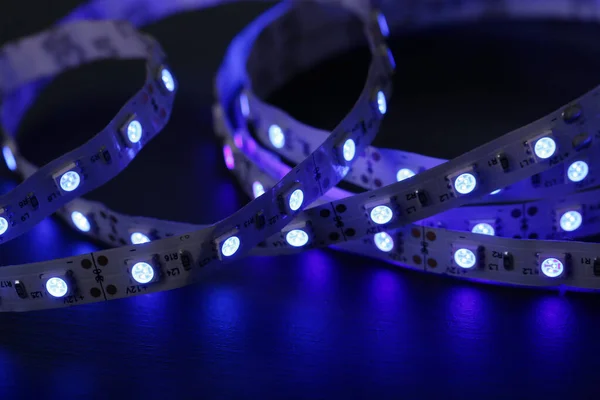
From ambient interior lighting and illuminated dashboards to decorative trim and customized commercial vehicles, LED strip technology is now integrated into a wide variety of automotive applications.
As vehicle manufacturers, aftermarket brands, and automotive accessory companies seek greater product differentiation, working with an experienced LED strip OEM manufacturer has become an important part of developing customized lighting solutions that meet both design and performance requirements.
Lighting Has Become Part of Automotive Identity
Modern vehicles are instantly recognizable by their lighting signatures.
Automakers invest significant resources in creating distinctive daytime running lights, tail light patterns, and interior ambient lighting that reinforce brand identity.
This design philosophy has also influenced the aftermarket industry.
Car modification shops and automotive accessory brands increasingly use LED strip systems for:
Dashboard accents
Door panels
Center consoles
Footwell lighting
Trunk illumination
Display vehicles
Commercial fleet customization
Rather than serving only a functional purpose, lighting has become an integral element of vehicle design.
Why OEM Customization Matters
Automotive projects rarely use one-size-fits-all solutions.
Different vehicle platforms require unique dimensions, voltage configurations, connectors, colors, and installation methods.
An OEM manufacturing approach allows brands to develop products that match their own specifications instead of adapting generic solutions.
Customization may include:
PCB width and length
Connector types
Color temperature
RGB or RGBW configuration
Waterproof protection
Packaging and branding
Private labeling
For distributors and automotive brands, this flexibility creates opportunities to develop exclusive product lines while maintaining consistent quality.
A professional LED strip OEM manufacturer can support product development from concept through mass production, reducing the complexity of launching customized automotive lighting solutions.
Interior Ambient Lighting Continues to Grow
One of the fastest-growing automotive lighting segments is interior ambient lighting.
Consumers increasingly expect vehicles to provide a comfortable and personalized driving environment.
Subtle LED lighting integrated into the cabin can improve perceived quality while creating a more enjoyable experience during nighttime driving.
Typical applications include:
Dashboard trim
Door handles
Cup holders
Storage compartments
Seat surrounds
Console edges
RGB and RGBW LED strips are particularly popular because they allow drivers to select colors that match personal preferences or vehicle settings.
Some luxury vehicles even synchronize interior lighting with driving modes, entertainment systems, or navigation events.
This trend has inspired many aftermarket brands to introduce customizable lighting kits designed for easy installation.
Voltage Stability Is Essential in Automotive Applications
Engine start-up, charging cycles, and accessory loads can all influence system voltage.
Stable LED performance therefore depends on careful product design and component selection.
Many automotive lighting products utilize low-voltage DC systems that provide safe and efficient operation.
For longer decorative lighting installations inside vans, recreational vehicles, or commercial transport applications, 24V solutions are increasingly common because they help maintain consistent brightness across extended runs.
Reliable voltage performance contributes to a more professional appearance while reducing the likelihood of uneven illumination.
For automotive brands, consistent lighting quality directly influences customer perception of product value.
Waterproof Protection for Exterior Installations
Not all automotive LED strips remain inside the vehicle.
Many applications involve exposure to rain, dust, road debris, and temperature changes.
Examples include:
Grille lighting
Truck body accents
Trailer lighting
Off-road vehicle accessories
Commercial transport signage
These environments require lighting systems that can withstand challenging conditions.
IP65-rated LED strips are often selected for installations exposed to rain and water spray, while more demanding applications may require IP68 protection for enhanced environmental resistance.
Choosing the appropriate protection level helps extend product lifespan while reducing maintenance requirements.
For businesses developing automotive accessories, selecting suitable waterproof performance is just as important as selecting brightness or color options.
Reliability Influences Brand Reputation
Automotive products are expected to operate reliably for years under demanding conditions.
These conditions make manufacturing quality particularly important.
Factors such as PCB construction, solder quality, thermal management, and material selection all contribute to long-term reliability.
An experienced LED strip OEM manufacturer typically implements standardized quality control processes to improve consistency across production batches.
For automotive brands selling products under their own labels, dependable manufacturing helps reduce warranty claims and strengthen customer confidence.
Supporting Innovation Through Flexible Manufacturing
The automotive market evolves rapidly.
New vehicle models, changing design trends, and emerging technologies create continuous demand for innovative lighting solutions.
OEM manufacturing provides the flexibility needed to respond quickly to these market changes.
Companies can develop products tailored to:
Electric vehicles
Luxury interiors
Commercial fleets
Recreational vehicles
Smart automotive accessories
Customized aftermarket projects
This adaptability allows brands to differentiate themselves while maintaining greater control over product design and performance.
Instead of competing solely on price, businesses can compete through innovation and specialized solutions.
Driving the Future of Automotive Lighting
Automotive lighting has moved far beyond basic visibility. Today, it enhances design, strengthens brand identity, improves user experience, and creates new opportunities for product innovation.
As demand for customized lighting solutions continues to grow, collaboration with a reliable cob led strip factory enables automotive brands, distributors, and accessory companies to develop products that meet evolving market expectations. By combining flexible customization, dependable manufacturing, and application-focused design, OEM partnerships help transform simple LED strips into integral components of the modern driving experience.
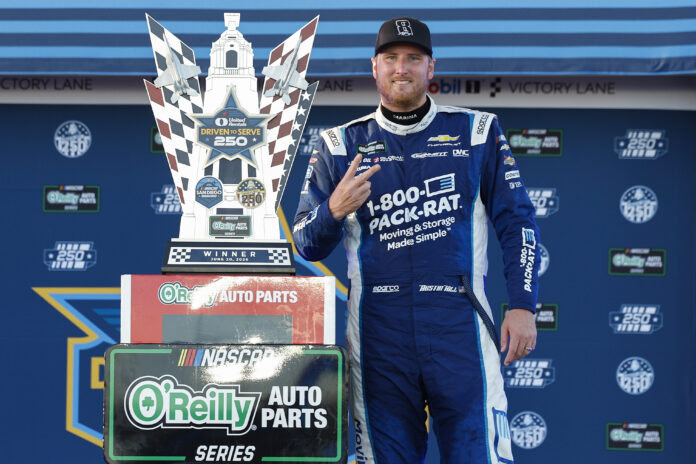
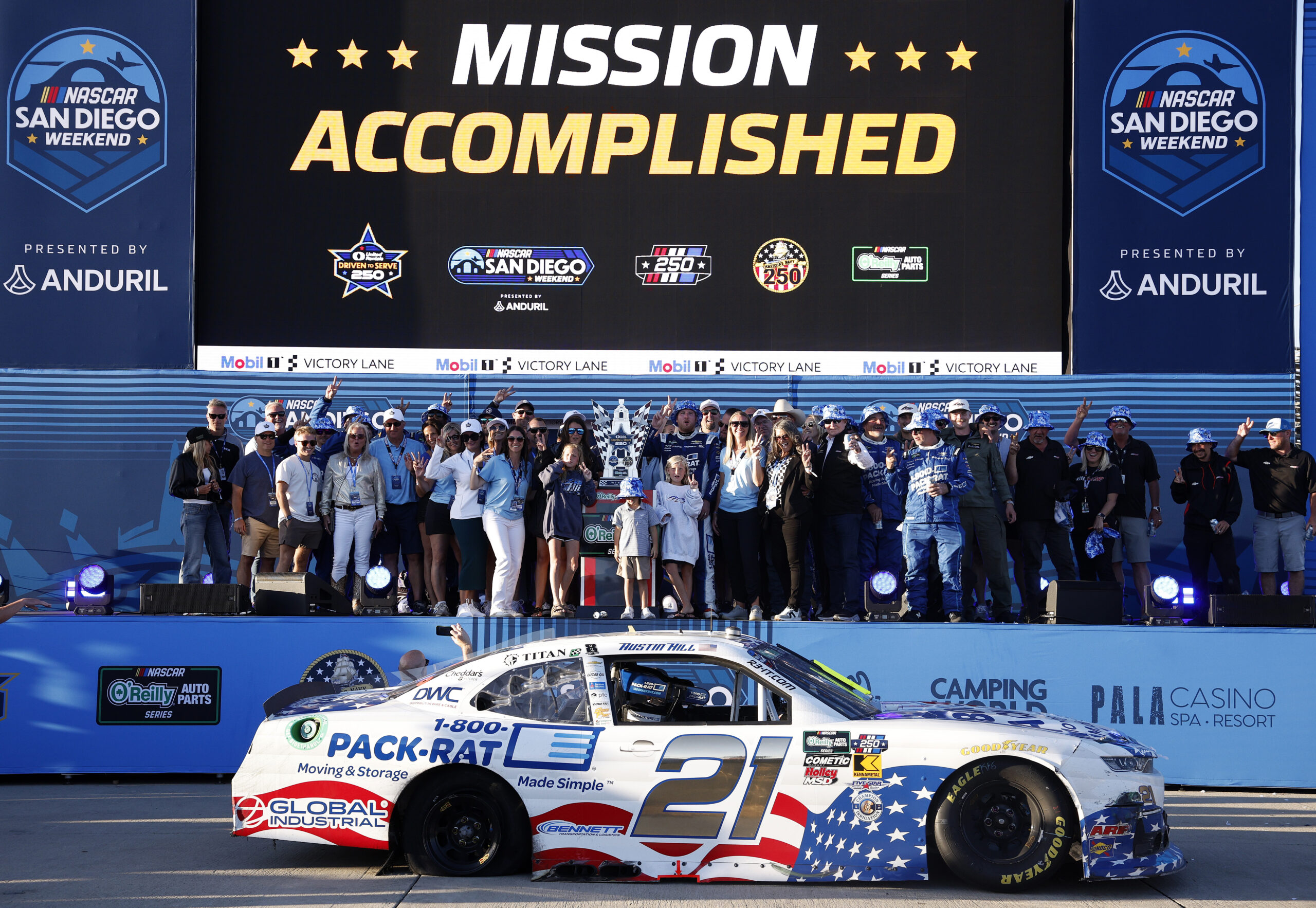
SAN DIEGO, CALIFORNIA - JUNE 20: Austin Hill, driver of the #21 1-800-PACK-RAT Chevrolet, wears a "8" hat, a tribute to the late Kyle Busch in victory lane after winning the NASCAR O'Reilly Auto Parts Series United Rentals Driven to Serve 250 at Naval Base Coronado on June 20, 2026 in San Diego, California. (Photo by Sean Gardner/Getty Images).
Austin Hill prevailed through a series of on-track chaos and bumped his way past Taylor Gray on the final lap to win the inaugural United Rentals Driven to Serve 250 at San Diego’s Naval Base Coronado on Saturday, June 20.
The 32-year-old Hill from Winston, Georgia, led twice for 13 of 60-scheduled laps in an event where he qualified in fourth place and took advantage of pole-sitter Brent Crews opting to strategically pit under green to capture the first stage victory. Despite barely scrubbing the first turn’s wall on the opening lap and getting shuffled within the pack by pitting before the second stage’s start, Hill rallied to finish in eighth place when the second stage period concluded.
Then in the early laps of the third and final stage period, Hill sustained damage to his entry after being one of 25 competitors involved in a huge multi-car wreck in the first turn. Despite the damage, Hill proceeded to race his way into the top-five mark, and he navigated through two additional late-race cautions while remaining in the top five. After Taylor Gray sent the leader, Carson Kvapil, for a spin with three laps remaining, Hill, who was in third place, spent the next two laps reeling in Gray before he made contact and overtook Gray on the final lap through the third turn. By building a reasonable gap from Gray through the remaining turns, Hill cycled back and emerged victorious for the first time on a road course venue.
With on-track qualifying that determined the starting lineup occurring on Saturday, rookie Brent Crews notched his first O’Reilly career pole position with a pole-winning lap at 91.143 mph in 134.294 seconds. Parker Retzlaff qualified in second place with a lap of 91.033 mph in 134.456 seconds.
Before the event, Justin Allgaier and Andrew Patterson dropped to the rear of the field due to unapproved adjustments that were made to their respective entries. Corey Day and Brandon Jones also dropped to the rear of the field in backup cars. Lastly, Jesse Love, who started at the rear of the field due to an inspection penalty involving two lugnuts not being within specific requirements, was also forced to serve a drive-through penalty through pit road after taking the green flag with the field.
When the green flag waved and the event commenced, pole-sitter Brent Crews launched his No. 19 Mobil 1 Toyota Supra entry ahead of the field entering the first turn before he continued to lead through a sharp left-hand turn into Turn 2. As the field smoothly navigated through the course’s 16 turns for the first time, including a chicane that was near the final straightaway to the start/finish line, Crews led the first lap just as the event’s first caution flew due to fluid coming out of Corey Day’s entry. Day’s incident occurred after a manhole cover went through his entry’s front grille and center punched his radiator.
Following Day’s incident, which resulted in Day’s entry being taken behind the wall for repairs and to have a new radiator installed, the field went through the next four laps under an extensive caution period before the event was red flagged for 18 minutes and 34 seconds to have the manhole cover area repaired. Once the red flag lifted and the field led by Crews proceeded under a cautious pace, select names like Justin Allgaier, Brandon Jones and Andrew Patterson pitted their respective entries. In addition, Day, who was able to return to the track but was pinned four laps behind the field, was allowed to pass the field four times to cycle back on the lead lap. During Day’s trial run to cycle back on the lead lap, he nearly collided head-on into a safety truck that was driving the opposite direction of Day in the second turn.
Following an extensive caution period, the event returned to green flag racing on the ninth lap. At the next restart, Crews barely fended off Retzlaff to motor ahead with the lead through the first turn. As the field behind fanned out and jostled for early spots, Crews led the next lap as he was eight-tenths of a second ahead of Retzlaff while Austin Hill, Sam Mayer, Anthony Alfredo, Carson Kvapil, Sammy Smith, Austin Green, Sheldon Creed and Taylor Gray were scored in the top 10, respectively. Meanwhile, Jesse Love served his drive-through penalty through pit road, and he joined Day in being mired at the rear of the field.
On Lap 12, Crews, who had a piece of debris on his grille that was causing the temperatures of his entry to increase, pitted from the lead along with Preston Pardus, Blaine Perkins and Ryan Sieg. Day also pitted, but was penalized for speeding on pit road. Amid the pit stops, Austin Hill, who cycled to the lead, retained the lead over the next three laps.
When the first stage period concluded on Lap 15, Austin Hill claimed his fifth O’Reilly stage victory of the 2026 season. Retzlaff settled in second ahead of Mayer, Alfredo, Kvapil, Sammy Smith, Creed, Austin Green, Gray and Sawalich, respectively. By then, all 37 starters were scored on the lead lap while Crews, Love and Day were mired in 28th, 35th and 37th, respectively,
Under the event’s first stage break period, split pit strategies ensued as some led by the runner-up Retzlaff and including Mayer, Alfredo, Creed, Gray and William Sawalich pitted. Meanwhile, the rest, led by Hill and including Crews, Kvapil, Sammy Smith, Green, Harrison Burton, Jeb Burton, Rajah Caruth, Brandon Jones, Andrew Patterson, Blaine Perkins and Preston Pardus remained on the track.
The second stage period started on Lap 17 as Hill and Kvapil occupied the front row. At the start, Hill motored ahead of Kvapil, Sammy Smith and Austin Green while the rest of the competition behind fanned out and both bumped and jostled for spots. Amid the on-track action around the 16-turn course, including a bold save by Andrew Patterson after he got tagged by Taylor Gray in between Turns 14 and 15, Hill led the next lap.
Through the Lap 20 mark, Hill extended his advantage to more than two seconds over Kvapil while Crews, who restarted in ninth place, was up to third place ahead of Green and Mayer, the latter of whom had pitted during the first stage’s break period. Behind, Harrison Burton was in sixth ahead of Sammy Smith, who dropped from third after he got hit in the rear by Green and spun in Turn 9. Smith then pitted during the next lap after he spun for a second time, this time in Turn 12 after being bumped by Sheldon Creed.
Within the Lap 22 mark, the caution flew due to Lavar Scott stalling on the course. Scott’s incident occurred not long after both Justin Allgaier and Baltazar Leguizamon spun amid contact with one another in Turn 13. In addition, Rajah Caruth and Jeb Burton had pitted while Hill maintained the lead over Crews, Kvapil, Mayer and Green. During this caution period, a majority of the field led by Hill pitted while the rest led by Gray remained on the track.
As the event restarted on Lap 25, Gray and Retzlaff dueled for the lead through the first four turns before Gray received the upper advantage to motor the No. 54 Columbia Bank Toyota Supra entry ahead. With a variety of on-track actions ensuing within the field, Allgaier spun in Turn 9 as Gray led the next lap. Teammate Rajah Caruth then spun in Turn 6 on Lap 27 after he wheel-hopped and slipped sideways in his No. 88 HendrickCars.com Chevrolet Camaro entry. Amid the on-track incidents and actions that did not draw any cautions, Gray maintained a steady lead over Retzlaff.
When the second stage period concluded on Lap 30, Gray outdueled Retzlaff amid Retzlaff’s overtake for the lead during the previous lap to capture his second O’Reilly stage victory of the 2026 season. Retzlaff settled in second ahead of Alfredo, Day and Mayer while Crews, Kvapil, Hill, Sammy Smith and Sawalich were scored in the top 10, respectively. By then, 34 of 37 starters were scored on the lead lap, with Allgaier mired in 34th, Caruth in 26th and Love in 11th ahead of Creed, Green, Clements and Jeb Burton.
With 28 laps remaining, the final stage period commenced as Gray and Retzlaff occupied the front row. At the start, Retzlaff dueled with Gray through the first four turns before he motored his No. 99 SA Recycling Chevrolet Camaro entry into the lead. Not long after, Day drew a caution after he spun due to contact from Dean Thompson in the fifth turn.
The next restart with 26 laps remaining did not last long as a heavy multi-car wreck erupted in the first turn. The carnage started when Mayer, who was racing in fourth place, hit the right-side inside wall, ricocheted across the track into the path of Alfredo, and slammed into the left-side wall, which damaged the wall he hit. Both Mayer and Alfredo then ricocheted to the right and ignited a 25-car wreck that involved front-runners Hill, Crews, Sammy Smith, Love and Creed. The carnage, which knocked Mayer, Anthony Alfredo and Sawalich out of contention, placed the event in a second red flag session for 43 minutes and 10 seconds to have the wall repaired and the carnage cleared.
During the recent red flag period, a fan was caught leaping beyond the guardrails and the catchfence to speak with Creed on the course. Despite the fan’s effort in leaping back behind the catchfence and the guardrails, he was charged for his actions.
When the red flag lifted and the event restarted with 24 laps remaining, Retzlaff assumed the lead from Gray. Retzlaff led the next two laps before Kvapil, who assumed second from Gray a lap prior, assumed the lead in Turn 4. Kvapil proceeded to lead by one-and-a-half seconds over Retzlaff with 20 laps remaining while Gray pitted under green from third place. Gray’s pit stop moved Creed, Sammy Smith and Hill up a spot each in the top-five mark while Labbe, Jeb Burton, Staropoli, Ryan Sieg and Caruth were in the top 10, respectively.
Then with 20 laps remaining, the caution returned due to a tire barrier at the chicane being moved on the track from its positioned stance. The barrier shifted due to being hit by Josh Williams as he was spinning. During the caution, the field pitted except for Retzlaff, as he ran out of fuel on the track while running in the runner-up position under a cautious pace.
During the next restart with 17 laps remaining, Gray motored ahead of Blaine Perkins to retain the lead through the first two turns. Gray led the next lap ahead of Hill and Kvapil while Perkins and Sammy Smith were racing in the top five ahead of Green, Creed, Harrison Burton, Caruth and Staropoli, respectively. As Gray led the next lap, Kvapil began to stalk and reel in Gray for the lead. He then seized an opportunity in Turn 9 with 14 laps remaining, and he capitalized on it as Kvapil moved his No. 1 Bass Pro Shops Chevrolet Camaro entry back into the lead. As Kvapil maintained a steady lead over Gray, Hill trailed by more than a second in third while Sammy Smith and Creed were in the top five.
With 10 laps remaining, the caution flew due to debris on the course. The debris came off Jesse Iwuji’s entry, particularly the left-front fender area, just past the second turn area after Iwuji had gone off the course and stalled his damaged entry. At the time of caution, Kvapil had extended his lead to more than a second over Gray. Hill, Creed, Sammy Smith, Love, Day, Harrison Burton, Staropoli and Perkins followed, completing the top 10.
The next restart with eight laps remaining featured Kvapil gaining a strong launch to motor ahead of Gray and lead through the first two turns. Behind, Brandon Jones spun in the third turn after contact from Green. Alex Labbe also experienced issues, including getting stalled in the tire barriers. But the event remained under green as Kvapil stretched his late lead to more than a second over Gray during the next lap.
Down to the final five laps, Kvapil continued to lead by more than a second over Gray while Hill, Creed and Love trailed in the top five by two, three and four seconds, respectively. Behind, Retzlaff rallied his way up to sixth place in front of Day, Green, Sammy Smith and Staropoli. Amid Kvapil’s lead, Gray narrowed his deficit over the next two laps before he got alongside Kvapil in Turn 9. Both competitors remained dead even and made contact before Gray ran into the side of Kvapil and sent the latter spinning into the tire barriers. Despite Kvapil’s swift reaction to fire his entry away while pointed straight, he lost his momentum and dropped to fourth. Meanwhile, Gray assumed the lead, but he had Hill slowly reeling in.
When the white flag waved and the final lap started, Gray retained the lead with two laps remaining by four-tenths of a second over Hill. Behind, Creed trailed by more than a second in third while Kvapil trailed by more than three seconds in fourth. Then, after reeling in Gray, Hill made a move beneath Gray and made contact with Gray in Turn 3. This moved Hill into the lead over Gray. He proceeded to build a reasonable advantage over both Gray and Creed for the course’s remaining turns. With both Gray and Creed unable to reel him in, Hill was able to cycle his No. 21 1-800-PACK-RAT Chevrolet Camaro entry back to the finish line and claim the checkered flag by more than a second over the latter two.
With the victory, Hill notched his 16th career win in the NASCAR O’Reilly Auto Parts Series division, his first on a street course venue, his second of the 2026 season and his first since he won this year’s season-opening event at Daytona International Speedway. Hill’s San Diego victory was also the 16th of this season for the Chevrolet manufacturer and the second for Richard Childress Racing.
During Hill’s post-race celebrations on the track, he took a moment to perform a victorious burnout around a large No. 8 logo to salute the late two-time NASCAR Cup Series champion Kyle Busch, a competitor whom Hill is filling in over in the Cup division at Richard Childress Racing.
SAN DIEGO, CALIFORNIA – JUNE 20: Austin Hill, driver of the #21 1-800-PACK-RAT Chevrolet, crew and family celebrate in victory lane after winning the NASCAR O’Reilly Auto Parts Series United Rentals Driven to Serve 250 at Naval Base Coronado on June 20, 2026 in San Diego, California. (Photo by Sean Gardner/Getty Images)
“[The win]’s extremely special,” Hill said on the CW Network. “Just to finally check that box of getting a road course win. We’ve been so close so many times. Our 1-800-PACK-RAT Chevrolet was extremely fast. I was just looking for something those last few laps. I’m not gonna lie. I started talking to this guy [points to the No. 8 Kyle Busch hat] a little bit down the straightaways. I’m like, ‘Man, Kyle, if you’re here, give me something, right?’ Let me find another gear. For whatever reason, the car started to come to life. [Gray and Kvapil] got together and when there was blood in the water behind [Gray], I knew it was gonna be tough to get around him, but it was gonna be a battle. When I got clear of him, I was very surprised to see how much of a gap I got on him.”
Like Hill, both he and team owner Richard Childress fought tears of joy as they celebrated the team’s first NASCAR victory following the loss of Busch.
“It’s great to win here,” Childress said. “We all got Kyle in our hearts. You may not show it on the outside, but you do here [in the heart].”
Taylor Gray, who led 16 laps compared to Hill’s 13, settled in second place for his second top-two result of this season. Carson Kvapil, who was in position of achieving his first O’Reilly career victory before his spin amid contact from Gray, settled in fourth place for his fifth top-five result this season. After the event, both competitors had a post-race conversation on pit road following their late-race contact.
“That’s what it boils down to,” Gray said. “[Kvapil] was racing me tight like he should. I wheel-hopped underneath him. I hate it for [JR Motorsports], but unfortunately, it’s kind of just the way it is.”
“It’s really hard to make peace with that,” Kvapil said. “That one really hurts, but [Gray] was probably better than me right at the end there. Honestly, it is hard racing, right? I know it’s tight through [Turn 12] and it’s easy to wheel-hop. That’s what [Gray] said is what happened, but we’ve had a little bit of a past this year. Yeah, it sucks. When you are racing for the win like that, you got to put everything out on the racetrack. I’m sure that’s what he was doing, and I was too. It’s just, [I] hate being on the wrong end of it, for sure.”
Sheldon Creed notched his ninth top-five result with a third-place finish. Sammy Smith rallied to finish in fifth place for his sixth top-five result of this season. Jesse Love, Parker Retzlaff, Austin Green, Harrison Burton and Corey Day completed the top 10 in the final running order. Notably, Jeremy Clements, who became the new all-time O’Reilly Auto Parts Series starts competitor with 548 starts, settled in 15th place.
There were 10 lead changes for five different leaders. The event featured eight cautions for 17 laps. In addition, 25 of 37 starters finished on the lead lap.
Following the 18th event of the 2026 NASCAR O’Reilly Auto Parts Series season, Justin Allgaier, despite finishing in 32nd place at San Diego due to an engine issue, continues to lead the standings. He has 224 points over Jesse Love, 238 over Corey Day, 240 over Sheldon Creed and 256 over Austin Hill.
Results:
Austin Hill, 13 laps led, Stage 1 winner
Taylor Gray, 16 laps led, Stage 2 winner
Sheldon Creed
Carson Kvapil, 15 laps led
Sammy Smith
Jesse Love
Parker Retzlaff, five laps led
Austin Green
Harrison Burton
Corey Day
Ryan Sieg
Brandon Jones
Blaine Perkins
Andrew Patterson
Jeremy Clements
Josh Bilicki
Jeb Burton
Preston Pardus
Brad Perez
Patrick Staropoli
Dawson Cram
Rajah Caruth
Joey Gase
Brennan Poole
Jesse Iwuji
Leland Honeyman Jr., one lap down
Alex Labbe – OUT, Electrical
Dean Thompson, eight laps down
Lavar Scott, 12 laps down
Ryan Ellis, 13 laps down
Brent Crews – OUT, Engine, 11 laps led
Justin Allgaier – OUT, Engine
Baltazar Leguizamon – OUT, Engine
Sam Mayer – OUT, Accident
Anthony Alfredo – OUT, Accident
William Sawalich – OUT, Accident
Kyle Sieg – OUT, Engine
Next on the 2026 NASCAR O’Reilly Auto Parts Series schedule is the series’ return to Sonoma Raceway in Sonoma, California, for the Pit Boss/FoodMaxx 250. The event will occur on Saturday, June 27, and will air at 5:30 p.m. ET on the CW Network, PRN Radio and SiriusXM.
ELKHART LAKE, Wis. (Saturday, June 20, 2026) – The pole streak lives for Alex Palou.
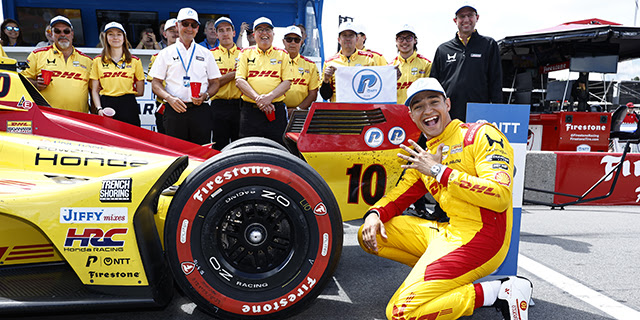
Series leader and four-time NTT INDYCAR SERIES champion Palou earned his fifth consecutive NTT P1 Award this season, grabbing the top starting spot Saturday for the XPEL Grand Prix at Road America Presented by AMR with a best lap of 1 minute, 43.6615 seconds in the No. 10 DHL Chip Ganassi Racing Honda. The pole was Palou’s sixth in 10 races this season and the 18th of his illustrious career.
Fellow Chip Ganassi Racing legend Alex Zanardi, a two-time INDYCAR SERIES champion, was the last driver to win five straight poles. He captured the last four poles of the 1996 season and opened the 1997 season with two more consecutive poles.
“It’s incredible, five in a row this year,” Palou said. “This team, man. This team and everyone on it is giving me the best car, all the power we needed. We suffered quite a lot there in Q2. Couldn’t really get the lap we wanted, but the car was super rapid.”
David Malukas continued his strong first season at Team Penske by qualifying second at 1:43.9542 in the No. 12 Verizon Team Penske Chevrolet.
Marcus Armstrong will start third – tying a career best – despite fighting the flu all weekend after his best lap of 1:44.0225 in the No. 66 Meyer Shank Racing w/Curb Agajanian Honda. His teammate, Felix Rosenqvist, will join him on the second row in the fourth position after his lap of 1:44.0502 in the team’s No. 60 Honda.
Marcus Ericsson continued his solid rebound season after his first two subpar years with Andretti Global, qualifying fifth at 1:44.1737 in the No. 28 Delaware Life Honda. Scott McLaughlin rounded out the third row at 1:44.8242 in the No. 3 XPEL Team Penske Chevrolet, as MSR and Penske each put two cars in the Firestone Fast Six.
Palou entered this event with four victories in nine starts this season and a 49-point lead over second-place Kyle Kirkwood of Andretti Global in the standings. Kirkwood qualified 18th in the No. 27 Sam’s Club Honda in a weekend full of struggles, as 15th is the best position he has managed at the end of any of the three sessions on the 14-turn, 4.014-mile road course.
Spanish driver Palou led his qualifying group in the first round but slipped to fourth, .3901 of a second behind leader Malukas, in the Fast 12 round. But Palou and CGR regrouped for the Firestone Fast Six and laid down their quickest time on their penultimate lap, also producing a time quick enough for pole on their final circuit for good measure.
If the pole streak doesn’t send enough shivers up the spines of his rivals, Palou is starting from the front Sunday at one of his best tracks. He is aiming for a series-record fourth career win at the longest circuit on the INDYCAR SERIES schedule and is the reigning winner of this event.
Live coverage of the 55-lap race starts at 2 p.m. ET (FOX, FOX Deportes), with a 30-minute warmup session preceding at 11 a.m. (FS1). FOX One and INDYCAR Radio powered by OnlyBulls also will cover both sessions live.
The warmup session may be crucial due to a lack of day-to-day consensus on whether the Firestone Firehawk primary or alternate tire is preferred.
“Tomorrow is going to be tough,” Palou said. “It’s going to be a long, long race for everyone. I don’t really know what tire is best. It seems like everyone was unhappy with the alternates yesterday, and then suddenly today, they are so much faster. I think it’s going be very interesting in terms of strategy and stuff.
“Obviously, we’re starting from the best spot and hope we can keep it there.”
Shane van Gisbergen will lead the field to the start of the NASCAR Cup Series’ inaugural running of the Anduril 250 at San Diego’s Naval Base Coronado from pole position, the latter of which he achieved on Saturday, June 20.
The event’s starting lineup was determined through a group qualifying session, where the field of 39 competitors was split into two qualifying groups. Each group was given 20 minutes to post the fastest lap. The competitor who posted the fastest lap between the groups would be awarded the pole position.
Van Gisbergen, who was the eighth-fastest competitor during Friday’s practice session, qualified in the first group. During the group session, he clocked in his fastest lap at 90.809 mph in 134.788 seconds. The lap was enough for the three-time Supercars champion from Auckland, New Zealand, to notch his second Busch Light Pole Award of the 2026 season and to become the first pole winner for the Cup Series’ first-ever street course event around San Diego’s Naval Air Station North Island.
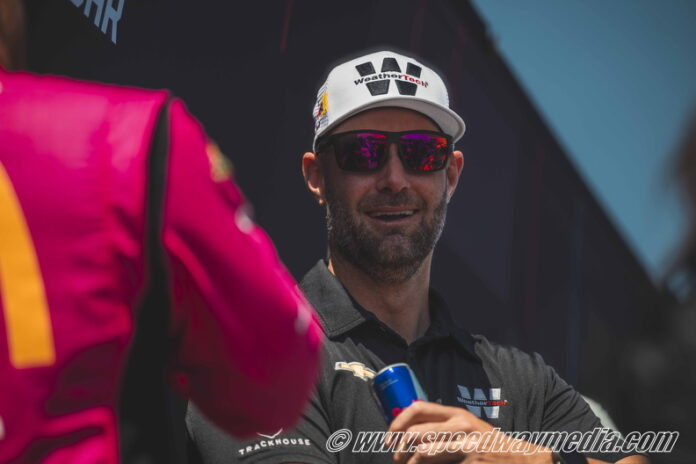
With the pole, van Gisbergen notched his sixth Cup Series career pole, all of which have occurred across six distinct street/road course venues. He also achieved the third pole of the 2026 season for the Chevrolet nameplate and the second for Trackhouse Racing. After winning in his five previous starts from pole position, van Gisbergen will strive to extend his streak to six events and flex his street/road course dominance with a San Diego Naval Base Coronado victory added to his rich victorious list.
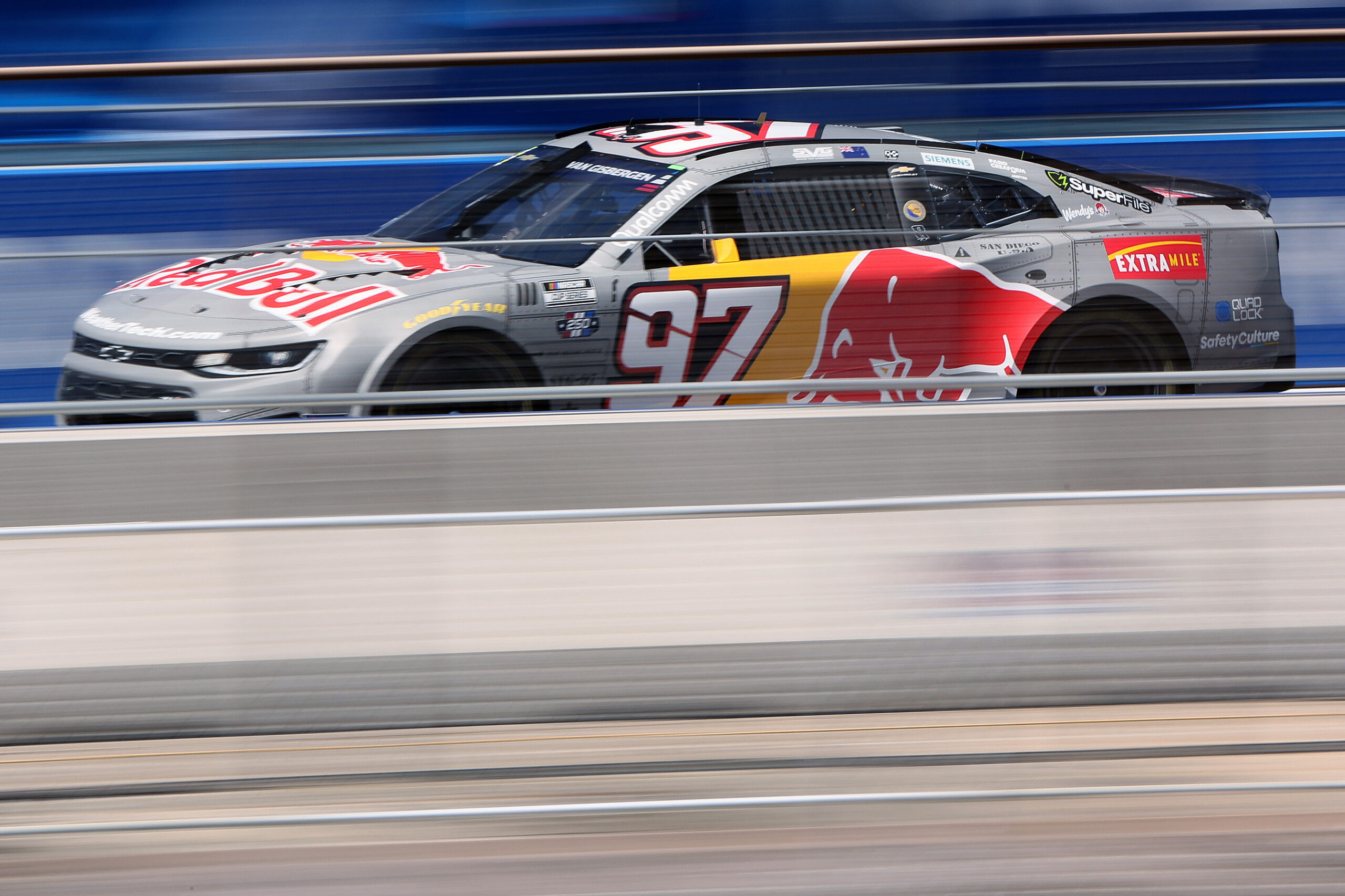
SAN DIEGO, CALIFORNIA – JUNE 19: Shane Van Gisbergen, driver of the #97 Red Bull Chevrolet, drives during practice for the NASCAR Cup Series Anduril 250 at Naval Base Coronado on June 19, 2026 in San Diego, California. (Photo by James Gilbert/Getty Images)
“[I’m] A little bit [surprised that I won the pole],” van Gisbergen said. “I thought the track would be better and I thought people would execute a bit better. As I said, it’s just so difficult. There’s three or four corners you’re seeing for the first time of the day and it’s on your heater. Amazing. I guess, Red Bull Chevy’s really good. Thank you to Trackhouse [Racing] for doing a great job from yesterday. Just need to get the driver better. The tire wear yesterday was insane for everyone. You can see all the marbles still in the pits from everyone. That’s what it’s gonna be about tomorrow. There’s gonna be a lot of carnage, a lot of tire gambling. Hopefully, we can make the calls right.”
Van Gisbergen will share the front row with Carson Hocevar, the latter of whom qualified on the front row for a third time in 2026. Hocevar posted the second-fastest lap in qualifying at 90.704 mph in 134.944 seconds.
Ryan Blaney, Zane Smith and Todd Gilliland will start in the top five, respectively. Daniel Suarez, Ryan Preece, rookie Connor Zilisch, Michael McDowell and Austin Hill completed the top-10 starting grid, respectively. In contrast, Kyle Larson, who was the fastest competitor during Friday’s practice session, will start 14th.
Notably, Kevin Magnussen, who is making his Cup Series debut in Trackhouse Racing’s Project 91 entry, will start 21st. In addition, points leader Tyler Reddick and Denny Hamlin, the latter of whom is striving to win for a fourth consecutive event, will start 17th and 26th, respectively. Jimmie Johnson, who is making his second and final Cup start of the 2026 season, will start 36th ahead of Christopher Bell. Bell will have Brent Crews as a standby competitor while the former continues to recover from a fractured left wrist injury.
With 39 competitors vying for 39 starting spots, all made the main event.
San Diego – Qualifying Position, Best Speed, Best Time:
Shane van Gisbergen, 90.809 mph, 134.788 seconds
Carson Hocevar, 90.704 mph, 134.944 seconds
Ryan Blaney, 90.634 mph, 135.048 seconds
Zane Smith, 90.405 mph, 135.391 seconds
Todd Gilliland, 90.402 mph, 135.395 seconds
Daniel Suarez, 90.377 mph, 135.433 seconds
Ryan Preece, 90.343 mph, 135.483 seconds
Connor Zilisch, 90.077 ph, 135.883 seconds
Michael McDowell, 90.048 mph, 135.928 seconds
Austin Hill, 90.027 mph, 135.959 seconds
Ty Gibbs, 89.901 mph, 136.150 seconds
Bubba Wallace, 89.789 mph, 136.319 seconds
Corey Heim, 89.785 mph, 136.325 seconds
Kyle Larson, 89.766 mph, 136.355 seconds
AJ Allmendinger, 89.646 mph, 136.537 seconds
Chris Buescher, 89.584 mph, 136.631 seconds
Tyler Reddick, 89.562 mph, 136.665 seconds
Austin Dillon, 89.385 mph, 136.936 seconds
Joey Logano, 89.314 mph, 137.045 seconds
Alex Bowman, 89.298 mph, 137.069 seconds
Kevin Magnussen, 89.167 mph, 137.271 seconds
Chase Briscoe, 89.158 mph, 137.285 seconds
Ross Chastain, 89.100 mph, 137.374 seconds
Riley Herbst, 88.820 mph, 137.807 seconds
Cole Custer, 88.801 mph, 137.837 seconds
Denny Hamlin, 88.777 mph, 137.874 seconds
William Byron, 88.713 mph, 137.973 seconds
John Hunter Nemechek, 88.629 mph, 138.104 seconds
Brad Keselowski, 88.621 mph, 138.116 seconds
Chase Elliott, 88.616 mph, 138.124 seconds
Austin Cindric, 88.124 mph, 138.895 seconds
Noah Gragson, 87.978 mph, 139.126 seconds
Ricky Stenhouse Jr., 87.898 mph, 139.253 seconds
Ty Dillon, 87.606 mph, 139.717 seconds
Josh Berry, 87.484 mph, 139.912 seconds
Jimmie Johnson, 85.980 mph, 142.358 seconds
Christopher Bell, 85.214 mph, 143.639 seconds
Erik Jones, 71.441 mph, 171.329 seconds
Cody Ware, 59.492 mph, 205.743 seconds
The inaugural Anduril 250 at San Diego’s Naval Base Coronado is scheduled to occur on Sunday, June 21, at 4 p.m. ET on Prime Video, MRN Radio, SiriusXM, and HBO MAX.
Brent Crews picked up his first NASCAR O’Reilly Auto Parts Series career pole position for the inaugural United Rentals Driven to Serve 250 at San Diego’s Naval Base Coronado in San Diego, California, on Saturday, June 20.
The event’s starting lineup was determined through a group qualifying session. The field of 37 competitors was split into two qualifying groups. Each group was allotted 20 minutes to post the fastest lap. The competitor who posted the fastest lap between the groups would be awarded the pole position.
Crews, who was the second-fastest competitor during Friday’s practice session, qualified in the second group. He posted his fastest lap at 91.143 mph in 134.294 seconds, which was enough for the 18-year-old native of Hickory, North Carolina, to claim the top-starting spot for Saturday’s inaugural street course event around San Diego’s Naval Air Station North Island.
With the pole, Crews became the 218th competitor overall to win a pole position in the O’Reilly Auto Parts Series division and the 37th to do so driving for Joe Gibbs Racing. He also joins Corey Day as a first-time pole winner of the 2026 O’Reilly season. Crews, who missed four of the first six events this season due to age restrictions, is coming off back-to-back runner-up results at Nashville Superspeedway and Pocono Raceway, respectively. With a total of six top-five results and nine top-10 results through 13 starts, Crews is three points above the top-12 cutline to make this year’s Chase as he also continues the pursuit of his first O’Reilly race victory in his rookie campaign.
Crews will share the front row with Parker Retzlaff, the latter of whom achieved his first front row starting spot of the 2026 season and his first driving for Viking Motorsports. Retzlaff’s lap was at 91.033 mph in 134.456 seconds.
Anthony Alfredo, Austin Hill and Carson Kvapil will start in the top five, respectively. Sam Mayer, Sheldon Creed, Austin Green, William Sawalich and Sammy Smith complete the top-10 starting lineup, respectively. Green was the fastest competitor during Friday’s practice session and the fastest qualifier from the first group on Saturday.
Notables that include Taylor Gray, points leader Justin Allgaier, Rajah Caruth and Corey Day will start 11th, 16th, 21st and 31st, respectively. Also of note, Jeremy Clements will surpass Kenny Wallace for the most starts in the O’Reilly Auto Parts Series division all time at 548, will start 27th.
Lastly, Jesse Love was the lone competitor who was not allowed to post a qualifying lap due to lug nuts found on his entry that did not meet minimum size specifications during the event’s pre-race technical procedure. As a result, Love, who will start at the tail end of the field in 37th place, will serve a drive-through penalty after taking the green flag at San Diego on Saturday and lose pit selection for next weekend’s event at Sonoma Raceway.
With 37 competitors vying for 37 starting spots, all made the main event.
San Diego – Qualifying Position, Best Speed, Best Time:
Brent Crews, 91,143 mph, 134.294 seconds
Parker Retzlaff, 91.033 mph, 134.456 seconds
Anthony Alfredo, 90.981 mph, 134.533 seconds
Austin Hill, 90.967 mph, 134.555 seconds
Carson Kvapil, 90.916 mph, 134.630 seconds
Sam Mayer, 90.815 mph, 134.779 seconds
Sheldon Creed, 90.661 mph, 135.009 seconds
Austin Green, 90.587 mph, 135.118 seconds
William Sawalich, 90.322 mph, 135.515 seconds
Sammy Smith, 90.233 mph, 135.649 seconds
Taylor Gray, 90.179 ph, 135.730 seconds
Alex Labbe, 89.657 mph, 136.520 seconds
Preston Pardus, 89.643 mph, 136.541 seconds
Lavar Scott, 89.451 mph, 136.834 seconds
Harrison Burton, 89.363 mph, 136.969 seconds
Justin Allgaier, 89.325 mph, 137.027 seconds
Josh Bilicki, 89.210 mph, 137.205 seconds
Brennan Poole, 89.093 mph, 137.384 seconds
Ryan Ellis, 88.955 mph, 137.597 seconds
Blaine Perkins, 88.937 mph, 137.626 seconds
Rajah Caruth, 88.813 mph, 137.817 seconds
Jeb Burton, 88.664 mph, 138.050 seconds
Dean Thompson, 88.391 mph, 138.476 seconds
Ryan Sieg, 88.361 mph, 138.523 seconds
Leland Honeyman Jr., 88.259 mph, 138.683 seconds
Brad Perez, 88.052 mph, 139.008 seconds
Jeremy Clements, 87.992 mph, 139.104 seconds
Patrick Staropoli, 87.741 mph, 139.502 seconds
Kyle Sieg, 87.729 mph, 139.520 seconds
Andrew Patterson, 87.720 mph, 139.535 seconds
Corey Day, 87.379 mph, 140.080 seconds
Baltazar Leguizamon, 86.617 mph, 141.311 seconds
Brandon Jones, 85.983 mph, 142.354 seconds
Dawson Cram, 84.434 mph, 144.965 seconds
Jesse Iwuji, 83.933 mph, 145.831 seconds
Joey Gase, 83.628 mph, 146.363 seconds
Jesse Love, 0.000 mph, 0.000 seconds
The inaugural United Rentals Driven to Serve 250 at San Diego’s Naval Base Coronado is scheduled to occur on Saturday, June 20, at 5 p.m. ET on the CW Network, MRN Radio and SiriusXM.
Ford Racing Notes and Quotes NASCAR Cup Series Anduril 250 Qualifying — Naval Base Coronado Saturday, June 20, 2026
Ford Qualifying Results:
3rd – Ryan Blaney
4th – Zane Smith
5th – Todd Gilliland
7th – Ryan Preece
16th – Chris Buescher
19th – Joey Logano
29th – Brad Keselowski
31st – Austin Cindric
32nd – Noah Gragson
35th – Josh Berry
RYAN BLANEY, No. 12 Wurth Ford Mustang Dark Horse – DID YOU SURPRISE YOURSELF WITH THAT LAP? “Yeah, a little bit. I’ve said it before, I feel like I’m an average road racer. I don’t think I excel at this stuff very much. I’ve worked really hard to try to get better, and I thought we had an OK day yesterday. Coming into today, you really get one lap because the tires were so bad and it’s the only lap we’re gonna make today and you just hope you hit it right and pick up the multiple seconds that we were running yesterday. I had a good lap. I didn’t know I had it until the final last little chicane and that kind of bums me out a little bit, but, overall, a really good effort by the 12 boys. They worked on it overnight, so I’m looking forward to tomorrow. It’s gonna be a heck of a race. Tire degradation is massive, so it’s who can manage rears better. It’s just a cool event. It’s cool to be out here. I appreciate the Wurth group being on the car, Ford Racing, it should be a fun day tomorrow.” WHAT KIND OF RACING WILL WE SEE TOMORROW? “Your guess is as good as mine. I’ll be racking through it tonight just talking with Jonathan tonight on what do we think the best way to go about things are, and then you plan as much as you can but sometimes you’re gonna have to audible in the race and understand where you’re at and what you want to do, and then see what the tire wear is like tomorrow. So, that’s the fun part about these new things. This whole weekend has been super cool to be here on the base. I appreciate them having us. The fans have been amazing the whole weekend and it should be a great day tomorrow for sure. As far as racing goes, I don’t know. Manage rear tires and don’t hit any concrete. I hope I can do those two things and we might have a shot.”
ZANE SMITH, No. 38 Hard Rock Casino Tejon/Hard Rock Cafe Ford Mustang Dark Horse – “There are certainly a lot of positives. The 34 team unloaded really strong yesterday and, fortunately, this is why you have teammates. I was able to get as close as I think we could to them overnight and that felt great to be able to do. I watched Todd a lot yesterday and I feel just more comparable. We slide in the same spots. We get tight in the same spots. It’s good. Now we can truthfully balance things off of each other and hopefully have a good day tomorrow.”
TODD GILLILAND, No. 34 Grillo’s Pickles Ford Mustang Dark Horse – “There is always some sort of battle between teammates, but that’s how it goes. It was a solid lap for us. You always want more, but we’ll just keep working on it. That sometimes is all you can do and that should give us a solid starting spot for tomorrow. We can work from there.”
RYAN PREECE, No. 60 Ralph’s/Scott 1000 Ford Mustang Dark Horse – “Honestly, I felt yesterday we had a really good Ford Mustang Dark Horse and today they made good adjustments and good decisions. I felt like I actually blew turn 13 and kind of missed it really bad and we still ended up seventh, so we’ll take it. It’s a good day with a good starting spot.”
JOEY LOGANO, No. 22 Shell/Pennzoil Ford Mustang Dark Horse – HOW DO YOU VIEW THIS RACE AS FAR AS BEING AN OPPORTUNITY? “You have to be realistic about it. It’s a challenge. It’s gonna be hard, but also being realistic it’s hard for everybody, not just for me and my team. Everybody out there has got quite the challenge ahead of them. We have to obviously look at risks probably a little differently than some, just depending on where you’re at, but that’s no different than any other racetrack.” IS IT A BALANCE BETWEEN BEING CONSERVATIVE AND AGGRESSIVE? “Yeah, you don’t want to be too conservative and be slow. You’ve got to take risks to go fast and we need to go pretty quick. We can’t just limp around and hope everybody wrecks. I’ve done that before and nobody wrecks, now I think a lot will, but I do think it’ll be somewhat of a survival race, but it may be a lot like Chicago was, where a lot of times you had to have some kind of pace to be competitive and keep yourself up towards the front. Strategy will be a big piece tomorrow and I don’t think anyone knows exactly how to play it yet.”
AUSTIN CINDRIC, No. 2 Menards/Cardell Cabinetry Ford Mustang Dark Horse – BASED ON WHAT YOU HAVE SEEN, HOW DO YOU THINK THE RACE WILL PLAY OUT TOMORROW? “I think if it’s anything like practice, I mean tire wear is gonna be high. They obviously added another set of tires for the race. This reminds me a lot of when we were at the Roval in the playoffs last year with the tires just kind of falling apart and not laying down rubber, so it’ll be interesting to see if that continues because otherwise it’s gonna be a lot of shorter runs with that kind of tire wear.” DOES THAT NEGATE FLIPPING STAGES? “There’s still no replacement for track position. I would say from my experience when you’re off strategy on older tires, you want a lot of people to do it with you and you want all of those people to be behind you, so I don’t feel like it’s very straightforward one way or the other. Predicting cautions, how is that gonna fall? If there’s anything, I don’t think fuel is ever gonna be a concern for anybody tomorrow.”
Elkhart Lake, WI - during the Grand Prix at Road America Elkhart Lake, WI(Photo by Travis Hinkle | IMS Photo)
ELKHART LAKE, Wis. (Saturday, June 20, 2026) – This was more than just a victory for Lochie Hughes. It may have saved his season.
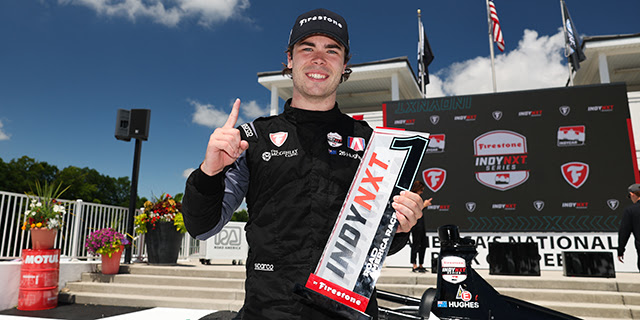
Hughes earned his first INDY NXT by Firestone victory of 2026 and reinserted himself into the championship hunt by winning the first race of the Grand Prix at Road America doubleheader Saturday on the 14-turn, 4.014-mile road course.
Australian Hughes, driving the No. 26 Andretti Global entry, crossed the finish line .7827 of a second ahead of teammate Josh Pierson in the No. 29 Starchive Andretti car. It was the 100th victory for Andretti Global in INDY NXT competition. Pole sitter Alessandro de Tullio finished third in the No. 14 AJ Foyt Racing machine.
“Just so happy right now,” Hughes said. “It’s possibly been the worst season of my life so far. That was great. I know my name is Lochie, but I feel a bit more like Rocky right now because I’ve been taking some punches this year.”
Hughes was the top returning driver to the INDYCAR development series this season after finishing third as a rookie with Andretti Global, with two victories. He has struggled in 2026, entering this event seventh in the standings with a best result of second in the opening race of the Indianapolis road course doubleheader in May.
“So, yeah, relieved,” Hughes said. “We’ve been trying all year, but I guess losers try their best, and winners go home with the prom queen. We got the prom queen.”
Rookie Jack Beeton produced a career-best finish of fourth in the No. 45 HMD Motorsports car, with Matteo Nannini putting two Cape Motorsports Powered by ECR entries in the top five in the team’s No. 20 car.
Hughes climbed to fifth in the standings with his third career victory, 55 points behind leader Nikita Johnson, who finished sixth in the No. 21 Cape Motorsports Powered by ECR entry.
The start of the 20-lap race was choppy, with eight of the first 10 laps run under caution due to three separate incidents.
Hughes was running second behind de Tullio on a restart at the end of Lap 8 when he swung to the outside in Turn 1 on Lap 9 and powered to a lead he would not surrender. Hughes got a big jump on the last of four restarts on Lap 11 and never was threatened, maintaining a gap between seven- and nine-tenths of a second until the checkered flag.
Pierson drove around the outside of de Tullio in Canada Corner on the final lap to claim second. That tied his best career finish and continued the upswing that started with his third-place finish June 7 on the World Wide Technology Raceway oval.
Race 2, an 18-lap event, is set for noon ET Sunday (FS1, FOX One, INDYCAR Radio powered by OnlyBulls). De Tullio again will start from pole with just 55 points separating the top five drivers.
Johnson leads second-place Tymek Kucharczyk – who salvaged an eighth-place finish after starting 14th in the No. 71 HMD Motorsports car – by 10 points. Enzo Fittipaldi is third, 23 points behind Johnson after a season-low finish of 22nd in the No. 67 HMD Motorsports machine due to damage from contact on the first lap.
Andretti Global’s Max Taylor, who finished 12th in the No. 28 Susan G. Komen car, is fourth, 38 points behind Johnson.
TOYOTA RACING – Jimmie Johnson NASCAR Cup Series Quotes
SAN DIEGO (June 20, 2026) – LEGACY MOTOR CLUB driver/owner Jimmie Johnson was made available to the media on Saturday prior to the NASCAR Cup Series race from Naval Base Coronado in San Diego.
JIMMIE JOHNSON, No. 84 CARVANA Toyota Camry XSE, LEGACY MOTOR CLUB
What has this experience been like being able to come home and compete so close to El Cajon?
“It’s mind blowing, to see the support. I came out a month ago for some advance media and literally the town was buzzing. People that didn’t recognize me, but I had my team gear on engaged in conversation with me on it. It really has been neat to see in the community and seeing the traffic coming in here this morning, what’s happened here on base and the relationship with the Navy and all the branches that NASCAR and how we represent them every weekend. I think it’s just a great collaboration and certainly hope we come back.”
Is the plan still this race this weekend and the Daytona 500, or are there any other Cup races you have in mind?
“No, just this one and the Daytona 500. I’m not against running trucks some more, had so much fun yesterday and then I’m looking at a few other different championships to dabble in next year, kind of going back to my roots with some off-road racing and trucks. I guess I like trucks. But trying to find a good balance of events I can run. First and foremost, take off those bucket list events I want to do, and then two, with Legacy’s vision and how hospitality experiential and other platforms can make sense.”
What would make you feel good about this event tomorrow and the Daytona 500 from a drivers standpoint?
“I had my hands full yesterday, so I hope I don’t hit anything. Honestly it’s so tough with the new car and the platform and how sharp you need to be in the vehicle day in and day out. And even the way it correlates with the SIM, which is damn near impossible to figure out. There are just little subtleties that you need to understand from the real car to pull through in the simulator. And just finding those little elements week after week and if you don’t do this on a regular basis, it’s just tough. But with all that complaining out of the way, I just want to have fun, this is really just about having fun. Of course when I put a helmet on, I want to do the best that I can, but being home and experience all of this is a top priority.”
What have you seen over the course of time with the reception for NASCAR here in San Diego and how it has changed from years ago until now?
“All the tracks that were here when I was growing are all gone, so be able to be able to bring this temporary street circuit and have it here, it’s a unique opportunity that I never saw coming. I think that it’s really wise for NASCAR to do this. There are so many pockets of race fans around the country that they can’t get close to NASCAR. The amount of race fans here and the racing culture that’s here in the San Diego area is deep. All my off-road friends are here and have never been to a Cup race. This is really going to do well for the racing world.”
With LEGACY MOTOR CLUB doing well, what are your thoughts on your teams strong performance over the past month or so?
“I guess time will tell, as we are maturing as a company as we made the decision that we were going to forge our own path and develop our infrastructure it’s been a more difficult journey than I personally was aware of, but we are getting there. I think we’ve had some incredible people really leading as we continue to bring in more talent and refining our structure and process on the competition side, the speed in the cars and most importantly the consistency. Erik (Jones) finished second last year once or twice. We’ve had some high spots, but the following week we’ll be in the 20’s again. And so to see our cars together and kind of marching up the running order I think speaks to the growth of the company.”
Have you had a chance to sit down and reflect about what has changed in the last 25 years?
“I feel like going into the Hall of Fame induction, I finally in the right head space. The further I get away from my full-time driving the more I’m letting in. You are just wired at a young age to always look forward and chase the next opportunity. And for me, I try not to live too much I the lows or the highs, I just try to stay steady and look forward. And the Hall of Fame induction really started this process of reflecting and it has nothing to do with being 50, getting old and doing what my Dad did or what my parents have done. I’m really letting it in now and enjoying it. Being here and competing at this event and feeling the home vibes is a part of it and the 500 will be the same thing.”
What drivers out there today do you think have potential?
“The first driver that came to mind is Ryan Blaney, but he’s obviously well established. I remember being on track with him early on the moments he took risks versus the moments he knew to ride were pretty smart. It’s one thing to go fast and everyone that gets to the Cup level has plenty of speed, but there’s more strategic thinking, team leadership. There are a lot of layers that are required to separate yourself an with Blaney I saw that early. And through everyone at Hendrick, we were pursuing him pretty hard, but Penske was a step ahead of us and had my locked down. So, we didn’t get that chance. But in today’s world, I see a lot of talent, the one difficult thing is knowing how you are going to perform in the Cup car. The truck Series and O’Reilly Series, the platforms of the vehicle and how you generate speed is so different than the Cup car. And when you look at it, I think the O’Reilly driver moving to Cup the shortest time frame to win is 70 races. I think the average is closer to 100. And so it just makes it that much more difficult to know who’s going to stand out. I look at Connor Zillisch, where he is on his journey, Jesse Love, there’s a lot of talent.”
Can you talk about the level of respect in NASCAR right now. It is too late to change how guys race each other now?
“I don’t know, I feel like it’s more of a generational element. I assume there is a point in time where the generation behaves differently. But when I came in it was the era of pointing people by, and I got my butt chewed by numerous guys even in the Busch Series, that I raced them too hard. And I was like, really? I’m here to race. But as time went on, I realized that when I was going forward and had a chance to pass them, they could make life really tough on me and if you were respectful of one another and just work together. That’s completely out the window now. I think stage racing and all of these other elements where the car performance and air disadvantage, you can defend a lot more and it’s kind of created this culture. But I wear two hats with my ownership hat. I want the sport to be vibrant and healthy and chaos brings eyeballs. So I’m kind of torn. But yesterday I just couldn’t believe the disrespect that everybody had from the jump. I mean, just gouging each other nonstop and I was up at the front racing away and we were pointing each other by and I was like, this is old school Cup, this makes sense. The way the fuel cycle worked out I entered mid pack and I look around and I saw these trucks all twisted up, and I thought had had hit the wall, and I guess maybe some did, but it was all from bashing into one another on the track. And then I got turned around twice, just last second lunges into areas that nobody should have been. So, it is what it is. When I look at my Instagram feed or my twitter feed and see the local short tracks and behavior there, man it’s just wild. So we’ll see where it goes.”
How does it feel to be here on a US Navy base?
“It’s such an other for us to do this with the significance of 250 years here on an active base. I know there have been plenty of challenges on both sides due to conflicts and such, but to feel the reception from everyone on base. I know our sport and our fans are happy to be here. Both my grandparents served and they are resting over there in Rosecrans and looking at everything that’s taking place. My brother-in-law served as well, and to have the family ties to the Navy and then this being my hometown it just means the world to me and I know the sport recognizes this moment as well.”
Do you think any of your IndyCar road course experience will help you here?
“Without a doubt. All the reps in sportscar and IndyCar, there’ little things you can take away. They are very different worlds, so braking technique and mid speed and high-speed corners are much different worlds. But there’s always something that you can hang onto and apply.”
How has your trip down memory lane been while you’ve been back here in San Diego?
“There was nothing like going home. It’s been awhile. The Fontana race made it easy to come home and we had a dealership here in the area. It’s been quite a bit, it’s probably been eight or 10 years since I’ve been back home. And I didn’t make it all the way back to see much here at home. To be back here in the area and see everything, the memories just come flooding back, so it’s been great.”
How much time did you spend on Coronado growing up?
“I’ve been here a few times but Mission Beach and Pacific beach were childhood stops where our parents would drive us down interstate eight and we would go to the water and screw around. When I got my license there’s a little two-lane highway that runs straight to Del Mar and I tried surfing and so I would get up early morning and rip out there and get worked over in the sets of waves and then get back to school. This area, there are a variety of memories that I truly enjoy. My mom’s father was on a aircraft carrier, so I remember being really little and coming over here. There were some other carriers that were parked and we would walk the boardwalk and look at them and you’d talk about them. So those memories have come back.
What it like exiting turn 2 and staring straight at an aircraft carrier?
To make the corner and there’s a 73 on it, and then you see the people standing on it. I was looking at it yesterday and seeing how many people were on it watching. From what I understand the TV book was up inside of the viewing deck up there somewhere. So, I did think about all those details yesterday.
Where would you put this event with the excitement compared to some of the sporting events you went to here growing up?
“For me this is one of our majors this year. I hope it continues to stay on the calendar. I also know that NASCAR knows how important it is for our sport to be in Southern California. With Fontana being closed, I would assume it was very important for them to have a presence and with Chicago being able to put on a show there and I would even say the Clash that was held at the Coliseum, there’s been a lot of findings that have given them confidence to take the show on the road. And Chicago and its success have carried over to San Diego. I’m not sure what other markets we can penetrate, because we do have fans all over the country, but really bring it close to them and create a festival out of it, such a big scene. It’s just good for everybody.”
As a team owner and having a seat to fill, what qualities are you looking for in a driver?
“I think on the competition side it’s really about the right kind of confidence and really connecting with your people and being the nucleus of the team. You need enough confidence to show up with your chest out and get the job done. At the same time, you have to be humble when you make mistakes. Most importantly internally the cars are all the same, we all have the same bits and really more than ever it’s about the people. Every team has different challenges that it has to work through, but the driver has to be the glue that holds it all together and I think it’s more important today than ever. That’s 1 or 1a, and the second piece of that is the strategic thinking that’s needed. You can’t go through the field in Cup like you can in Trucks or O’Reilly in good equipment, it’s all the same stuff. If you are able to think ahead and not drive off the nose of your car, setting up a pass might take 10 or 15 laps and you’ve got to wait for that one mistake, so it’s not about speed it’s about strategic thinking and being a team leader.”
What is the fine line with creating big events versus the cost of something like this?
“I think there’s a measured way to go about it. Marquee events and major markets, our sport has done that. You don’t have to serve caviar at Martinsville, if you’re going to have a event at Martinsville you want to have the best damn hot dogs, which they already do, but meet the moment where it is and not get outside of it. That’s a neat thing our sport has, the cultural diversity in our sport is better than ever. We race in all these different markets across the country. Having to measure step, that step above general admission and just having a smart offering that shows an elevated element to make it feel special is what needs to happen as opposed to just showing up and flipping on the lights and they are going to come, no they are not going to come. You look at what the ticket costs and how much traffic you got to fight and what a ticket costs and the time ask of our sport, you have to be competitive from a dollar standpoint. I think we have to invest a little to have it returned.”
With events like San Diego, the Coliseum, Chicago Street race, what can NASCAR do next?
“I think more of the same. I have an opinion that year one is a home run, year two is still quite strong and the third year might lose a little interest just by watching the Clash. I kind of sense that’s vibe. So we don’t need to blow our schedule apart, but a few of these events maybe it’s a two or three year run and move it somewhere else. It doesn’t mean you never need to come back, but meet the fans where they are is a great approach.”
Where have you seen the shift in the performance of LEGACY MOTOR CLUB?
“It’s shifted internally for sure. The performance window is so small with this car. If you are outside of it, you kind of run mid-pack, but when you run outside of it you find the sweet spot and that’s when you can move forward and you can pass and show strength. And it’s so tough to find this tiny, tiny, window and we are getting a lot better at finding that window.”
A lot of guys came in yesterday and said that there’s a lot more practice they could use, will running the truck race and the extra 50 laps yesterday help you tomorrow?
“The world we live in now, you build everything off the sim. And the way we created speed in the sim did not apply to the track here. We needed way more than 50 mins to get things dialed in. Wish we had more on track time, it’s the same for everyone, we just didn’t do our job at the shop and have backed out of all of that and have moved in a different direction. So today the qualifying session for our three cars, we are searching for sure. As far as the track and knowing my points and where grip is and where all the bad bumps are, I feel very in tune with the racetrack itself, but conceptually and the way the rules work and the time you have to work on the cars, we are on our back for sure.”
About Toyota
Toyota (NYSE:TM) has been a part of the cultural fabric in North America for nearly 70 years, and is committed to advancing sustainable, next-generation mobility through our Toyota and Lexus brands, plus our more than 1,800 dealerships.
Toyota directly employs nearly 64,000 people in North America who have contributed to the design, engineering, and assembly of over 50 million cars and trucks at our 14 manufacturing plants. In 2025, Toyota’s plant in North Carolina began to assemble automotive batteries for electrified vehicles.
Ford Racing Notes and Quotes NASCAR Cup Series Ford Proud To Honor Saturday, June 20, 2026
Earlier this week, Ford and NASCAR collaborated on an event aboard the USS Midway in downtown San Diego, where they announced the inaugural Proud to Honor Veterans Day Classic. This event, which will take place on Nov. 11, will honor all six military branches and feature Ford Racing drivers competing in Mustang Dark Horse Rs. In addition, Zac Brown Band and other notable acts will perform with proceeds from the event going to support military families, continuing a Ford tradition that dates back to when the company was formed in 1903.
Nick Ford, Director of Corporate Strategy, Ford Motor Company, participated in the event along with Tim Clark, NASCAR Executive Vice President and Chief Brand Officer. Below are some of their comments regarding this new event.
NICK FORD, Director of Corporate Strategy, Ford Motor Company:
HOW DID THIS IDEA COME ABOUT? “First of all, supporting the military is core to who we are as a company and as a family company it’s core to our values. We’ve done it throughout our 123-year existence in a lot of different ways, whether that’s all throughout history with the Arsenal of Democracy, hiring disabled veterans throughout the decades, or showing up in times of crisis like COVID. Just a few months ago, we were named by Time Magazine the Most Iconic Company in America in a survey of over 10,000 Americans, and I think a big part of that is because we were recognized for the ways we show up for the military community. That manifests itself in a lot of different ways for our business, but it’s hugely aligned with who we are as a company and the values that our company and my family hold. So we thought about this summer trying to find a creative and different way to authentically show our support for the military. We thought about another really exciting aspect of our business in Ford Racing and how we could bridge those two worlds, and we reached out to our great longstanding partner in NASCAR and came up with this awesome idea. This will be the first-ever Proud to Honor Veterans Day Classic. It will be a military tribute race honoring all six branches of the military, sort of like the Army-Navy Game, but now we’re throwing all six into the mix on the racetrack, so it’ll be an awesome event on Veterans Day.”
IS THE GOAL TO RAISE A CERTAIN AMOUNT OF MONEY? “More to come on the details, but it will directly benefit a lot of our great military service organizations. We’ve got some great partners in Blue Star Families, Disabled American Veterans, TAPS, Team Rubicon, so it’s a military tribute race that honors all six branches of the military. We’re going to have our NASCAR drivers there driving our Mustang Dark Horse Rs. It will be on Veterans Day. Zac Brown Band is going to be performing. It’s going to be a heck of an event and it will all be in support of our great partners.”
HOW DO YOU FEEL NASCAR DOES IN TERMS OF HONORING PATRIOTISM AND THE MILITARY? “I think incredibly well. There are probably no two brands in this country that represent what America and our military stand for more than Ford and NASCAR. We’ve got such a close decades long partnership with NASCAR and we’re so aligned in our values in supporting the military community. I think they do it authentically week in and week out, and that’s going to show up especially this weekend for what’s going to be an incredible event in Coronado.”
WHAT IS THE GOAL FOR THIS EVENT? “I certainly hope this becomes an annual event. We’re focused on getting the first one right, but we have great faith in our collaboration and our partnership with NASCAR, and I think as evidenced by the event they’re gonna put on this weekend at Coronado, they know how to do great events. So, we have a lot of faith in them to have a killer event on Veterans Day.”
TIM CLARK, Executive Vice President and Chief Brand Officer, NASCAR:
HOW RECEPTIVE WAS NASCAR TO THIS AND THEN IN WAYS YOU CAN CONTRIBUTE? “In terms of being receptive, I think I may have said yes before Nick finished the question. It’s a great idea and I think there are so many similarities between the two organizations. Ford Motor Company, Ford Racing and NASCAR are so symbolic of American culture and American spirit and always being supportive of the military. Just to have an event like this that is so unique and such a great showcase of the cars and the venues and the drivers, it was a very easy yes for us to be involved. We’ve got some work to do over the next couple of months to pull the details together, but the framework of a really great event is in place and we’re excited to be a part of it.”
HOW DID THIS IDEA START? “This is very much a Ford idea. I said earlier there are no-brainers and then there’s this level of no-brainer. There are parallels to the Army-Navy Game. There are parallels to what Macy’s has done with Thanksgiving Day. There are a lot of parallels here, but I think there are 100 reasons, if not more, that we were excited to work with Ford on this. One of them is that we have such a long season it’s difficult to do a race that is equal parts entertainment, fun and competition, and I think this is a great way to showcase the drivers and showcase the cars.”
YOU ARE A FORMER MILITARY MEMBER. DOES THIS RESONATE AS SOMETHING SPECIAL TO YOU? “It does. It’s a big part of my upbringing. I’m a third generation. I’m an army veteran. One of the reasons I appreciate working at NASCAR is it’s a league and a company that obviously supports the military. I know Ford does as well, so when I was lucky enough to be on the receiving end of this, it was like if I’m checking the personal and the professional box, then you can consider both of them checked.”
Ford Racing Notes and Quotes NASCAR Craftsman Truck Series Navy 250 — Naval Base Coronado Friday, June 19, 2026
FORD F-150 AND LAYNE RIGGS CONTINUE HOT STREAK; WIN INAUGURAL NAVY 250 ON NAVAL BASE CORONADO
Layne Riggs won today’s Navy 250 on Naval Base Coronado, marking his ninth career victory.
This is Ford Racing’s fifth win of the season and fourth for Riggs, who won at St. Petersburg, Charlotte and Nashville. Chandler Smith won the season-opener in Daytona.
It’s also the third win in the last four races for Riggs, whose four wins this year is a career best.
In addition, Riggs moved into second-place on Ford’s all-time NCTS wins list with nine and trails only the late Greg Biffle, who had 16 career series victories.
Ford Racing has now won 134 all-time NCTS races while this is the 20th for Front Row Motorsports.
LAYNE RIGGS, No. 34 Mattermost Ford F-150 – VICTORY LANE INTERVIEW: “Layne van Riggsbergen came to play today, man. I got my second street course win. We’re undefeated in street courses. Much respect, Shane. I wish I could be as good as you one day, but I’m gonna take all my glory here in the Truck Series. Thank you to everybody. I don’t even know what happened at the end. Sparks flying. People wrecking. Staying the throttle. I was running out of fuel the entire last lap. It was like St. Pete all over again. A great job with Reif there. I faked left to scare him and he missed the corner. I wasn’t really gonna dive it in there and it worked for me. I hate that Chandler got taken out there and the 11. They definitely had it won. They beat us on strategy. We just didn’t have the tires and when we stayed out because we could make it to the end on fuel the tires prevailed. What a crazy race today with the strategy and everything else. It’s an amazing, historic win. We’ve got Mattermost on the truck this weekend. Thank you to everybody at Ford Racing. Joey Hand, you’re the man. We’re 2-for-2 on street courses. This is awesome. What a historic event, so thank you to everybody that is involved. Hopefully, we put on a great race for all the fans that have never seen NASTRUCKS before.”
HOW SPECIAL IS THIS GROUP OF GUYS ON YOUR TEAM? “It’s great. We’ve worked so hard. We were close last year and this year we’re just really hitting our stride. I mean, until the last lap when the 38 and the 11 wrecked I was gonna finish fourth or fifth and it just fell in our lap, which I feel like things rarely fall in our lap in a good way. It’s usually on a bad note, so we’re using our luck up now. We’ve got to keep it paced through the season to make sure we have just enough for those last few races.”
Ford Finishing Results:
1st – Layne Riggs 5th – Ty Majeski 8th – Ben Rhodes 15th – Cole Butcher 17th – Austin Varco 20th – Frankie Muniz 22nd – Chandler Smith 27th – Jackson Lee 32nd – Jake Garcia
CHANDLER SMITH, No. 38 Hard Rock Casino Tejon/Hard Rock Cafe Ford F-150 – WHAT HAPPENED IN OVERTIME? “The 11 overshot the corner. I drove it off in there really deep and when I lifted I noticed that he kind of surged, so I was like, ‘He’s not gonna make the corner,’ so I backed it up to try to get a good shape to get a good exit and cross him back. When I did it was too far left and when he ricocheted it off the wall, there I was. It wasn’t in the Lord’s Will for today, truthfully. That’s the part that to a point is difficult to accept. It stings right now knowing how awesome of a Hard Rock Ford F-150 we had today. That thing was a rocket ship. It was so good. Lights out, especially after the first quarter of the race we were ridiculously good. Knowing how cool this event is and we’re probably not ever gonna come back to it – all of those things kind of sting and that’s when it’s gonna sting a little more.”
HOW MUCH CAN YOU SAY THIS COULD HAVE BEEN DIFFERENTLY AS OPPOSED TO THIS IS JUST A HIGH SPEED STREET COURSE INCIDENT? “The only thing I truthfully could have done is backed it up even more to make sure I was more further right, but then you risk if he does make it, well then I’m not gonna have a big enough run to cross him back over. At the end of the day, I do truly believe it wasn’t in God’s Will for me to win the race today and something was gonna happen, whether Kaden junks us or something else happens progressively throughout the entire lap there.”
DO YOU JUST ACCEPT THIS IS A STREET COURSE AND THESE ARE THE THINGS THAT HAPPEN? “No, not really. We’re in the top three series of NASCAR, so no, but you needed to damper your expectations for some situations I suppose, I guess, but I don’t know.”
DO YOU PUT THIS UNDER THE RACING DEAL CATEGORY OR SHOULD WE TALK TO KADEN ABOUT IT? “Kaden is a good race car driver. I think he really is. I don’t think he meant to do that intentionally. Emotions get high. There’s a win on the line. I get all that, but at what point do you draw the line in the sand when you know you’re gonna wreck yourself doing it, like with the new points format and all that, that stuff ain’t worth it and I just think he’s a smarter race car driver than that, truthfully.”
TY MAJESKI, No. 88 SPAM/Menards Ford F-150 – “I’m just glad to get on a plane and go home, I guess. This track is unique. It was challenging for us today. I really thought the race was pretty clean for most of it and then at the end sometimes these road courses get like that. Guys up front. Guys on different strategies. Guys up front who aren’t normally up front with different fuel and tires. There was a lot of parity in the race today and we didn’t have the best truck. I didn’t really do the best job either because I made some mistakes. I was just kind of on a knife edge all day long, but a solid run for our Menards Ford F-150 with Spam on the hood. We’ll take a top five and head to Lime Rock.”
BEN RHODES, No. 99 Campers Inn Ford F-150 – “This is pretty much the definition of survival. I don’t know how it could get any closer. We’ve got rubs on all four tires it seems like. I think the housing is bent. I think something on the left-front is bent and we still had a chance to potentially get a top five. It’s a survival day. It’s built Ford tough. Our Campers Inn RV had good pace, but just circumstances having to start in the back, the damage early on and going to the back again, I think we passed more people than anybody today, which shows why we picked up so much damage. I hate that. We need to start up front and just run up front and our days would be a lot easier.” WHAT ABOUT THIS EVENT OVERALL? “This place has been unbelievable. The turnout has been great. Everybody has been super kind and very welcoming for us to be here. It’s been a thriller. I hope we do some more one-off events like this in the future.”