Home Blog Page 652

Inaugural Class of Trans Am Hall of Fame Announced

18 Trans Am Legends from Past and Present Compose 2025 Inductees

CHARLOTTE (February 5, 2025) — On February 21, 2025, the inaugural class of the Trans Am Hall of Fame will be inducted during a celebratory dinner at Sebring International Raceway, where the series made its debut in 1966. 18 legendary drivers and team owners will be among the first inductees into the Trans Am Hall of Fame, which was announced in November to honor the longest-running professional road racing series in North America.

The Trans Am Series, originally named the Trans-American Sedan Championship, debuted on March 25, 1966 with its inaugural race at Sebring, and has excited audiences for nearly 60 years with its combination of powerful American muscle cars and elite GT cars from around the world.

Members of the new Trans Am Hall of Fame will range from the series’ earliest winners and champions to influential figures who have shaped modern motorsports, as well as groundbreaking competitors still competing in the Trans Am Series presented by Pirelli.

“I could not be more thrilled about the inaugural class of the Trans Am Hall of Fame,” said Tony Parella, founder of Parella Motorsports Holdings. “On the night of the induction ceremony, the room is going to be filled with so many of the most influential people in the history of the Trans Am Series and motorsports as a whole. It will be my absolute privilege to honor them for their contributions to the series.”

Below is the inaugural class of the Trans Am Hall of Fame, in alphabetical order:

John Clagett

Former President John Clagett acted as a caretaker for the Trans Am Series for nearly 40 years, beginning his tenure with the series when he served as the Vice President of SCCA Pro Racing from 1984-2000. He was named Executive Director of the series from 2003-2006, at a time that was particularly challenging for road racing in North America. In 2009, he fought alongside Hall of Fame inductee Greg Pickett to bring the series back from dormancy, and was named President of Trans Am Race Company, LLC. Since then, the series has experienced exponential growth in competition, entries and fans under his watch. He secured a landmark title partnership with Pirelli, and sponsorship of the wildly successful TA2 class with the CUBE 3 Architecture TA2 Series.

Wally Dallenbach Jr.

Known for his exceptional driving skills and charismatic personality, Wally Dallenbach Jr. made an impression in his debut season, earning the 1984 Rookie of the Year honors. Impressing legendary team owner (and fellow Hall of Fame inductee) Jack Roush and the Ford Motor Company, Dallenbach Jr. was brought into the Roush Mercury stable in 1985, where he captured five victories and the championship, edging teammate Willy T. Ribbs. At 22 years old, he became what was then the youngest-ever Trans Am champion. He followed that up with another title the following season, winning the championship by a huge margin while racing a Chevrolet Camaro. Dallenbach Jr. would go on to excel in the GT categories in IMSA, winning the Daytona 24 Hours in 1985, 1991, 1992 and 1993, and the Sebring 12 Hours in 1985, 1988 and 1989. He continues to race in the Trans Am Series today.

Mark Donahue (Inducted Posthumously)

Mark Donahue was the driver to beat in Trans Am for four seasons, although the record books don’t fully represent Donahue’s greatness as the series only awarded manufacturer championships until 1972. Beginning his career in the series in 1967 driving for fellow inductee Roger Penske, he scored three victories that year. The following season he amassed 10 wins, including a victory in the Trans Am class in the 12 Hours of Sebring alongside Craig Fisher, securing Penske and Chevrolet the 1968 title. Chevrolet took the championship again on the strength of Donohue’s six victories in 1969. Earning three victories in 1970, Donohue brought Penske and new manufacturer AMC the championship in 1971 with seven wins. His record of 29 victories wouldn’t be broken for more than 30 years, and applying the points retrospectively, he would have taken the driver’s championship three times in four seasons.

Chris Dyson

The son of sports car racer and team owner Rob Dyson, three-time Trans Am TA class champion Chris Dyson has enjoyed more than two decades of success in road course racing. Dyson began his career in the American Le Mans Series in 2001, where he earned two titles. The talented and passionate driver made forays into sprint car racing and NASCAR, but found his home in the Trans Am Series in 2018. Dyson finished top three in the points in his first three seasons of TA competition, and finally earned the coveted championship in 2021. He began a dynasty in the class, winning titles again in both 2022 and 2023. Dyson currently sits fourth on the all-time TA win list with 26 National Championship victories, and continues to race today in pursuit of wins and his fourth championship.

Ron Fellows

A 20-time winner in the Trans Am Series, Ron Fellows is often considered the greatest Trans Am driver to never win a championship. His first victory appropriately came at Canadian Tire Motorsports Park in 1989 while driving for fellow Hall of Famer Jack Roush. With three victories in 1992, Fellows finished second in points, and he was a runner up again in 1994 after four wins. He earned his third-consecutive second-place finish in the points in 1995 with five victories, and fell short of the title again in 1996 despite four wins. Following his Trans Am career, Fellows went on to race in sports cars, earning class wins at Le Mans, Sebring and Daytona, while also capturing an American Le Mans Series championship. The Ontario, Canada native is also beloved for saving the track where he scored his first Trans Am victory, then known as Mosport.

George Follmer

Renowned for his versatility, George Follmer is the only driver in history to win both the Trans Am and Can-Am championships in the same year. Follmer began his career racing for Bud Moore from 1969-1971, earning four victories. In 1972, he took the checkered flag four times, earning the series’ first-ever driver championship in the Over 2.5-Liter class, while scoring AMC its second-consecutive manufacturers’ title. That same season, he filled in for an injured Mark Donohue in Penske Racing’s Can-Am program, scoring five wins and the title. Follmer went on to race in Formula 1, Can-Am and NASCAR before returning to Trans Am, capturing his second championship in 1976.

Ernie Francis Jr.

A prodigious talent, Ernie Francis Jr. won his first Trans Am GT class championship in 2014 at the age of 16, making him the youngest Trans Am champion at the time. He went on to win the GT title two more times and become the winningest driver in the class with 23 victories. In 2017, he moved into the TA class, winning the title four years in a row, and capturing wins in 24 points-paying races. At just 22 years old, Francis Jr.’s name was already in the Trans Am record books, holding the most combined National Championship wins and being the first driver to claim four-consecutive Trans Am TA class titles. Francis Jr. has since gone on to race in INDYNXT. At just 27 years old, Francis Jr. could continue to break records for years to come.

Paul Gentilozzi

Paul Gentilozzi has been a powerful force in the Trans Am Series as both a driver and a team owner. First joining the Trans Am Series in 1987, he earned his first victory in 1988. A constant presence on the racetrack, it wasn’t until 1998 that Gentilozzi really hit his stride, tallying seven wins and his first Trans Am title. He backed it up the following season, winning the championship on the strength of six victories. In 2001, he won the title after piloting to Victory Lane eight times, and repeated the feat again in 2004. His fifth and final title was earned in 2006, and he holds the record of the winningest driver in Trans Am’s TA class with 31 victories. His team, 3GT Racing (formerly Rocketsports Racing), has remained a constant contender for wins and titles since Gentilozzi stepped back as a driver, and most recently captured the TA championship with Paul Menard behind the wheel. His contributions to Trans Am racing extend beyond the track, as he played a pivotal role in promoting and developing the series, ensuring its continued growth and success. Gentilozzi’s legacy in Trans Am is characterized by his dedication, passion, and unwavering pursuit of excellence.

Dan Gurney (Inducted Posthumously)

Dan Gurney was a legendary figure in the world of motorsports, renowned for his versatility and innovation both on and off the track. His illustrious career spanned various racing disciplines, including Formula 1, INDYCAR, NASCAR, sports car racing, and of course, Trans Am. Gurney is perhaps best known for his pioneering efforts in designing and constructing racecars, founding All American Racers and introducing the Gurney flap, an aerodynamic device that revolutionized racing car design. Gurney scored a Trans Am victory driving Bud Moore’s Mercury Cougar at Green Valley Raceway in 1967.

Parnelli Jones (Inducted Posthumously)

1963 Indianapolis 500 winner Parnelli Jones entered the Trans Am Series near the end of his illustrious racing career, which included numerous wins in NASCAR, USAC Stock Cars, ARCA and what is now INDYCAR. Driving in the Trans Am Series from 1967 until 1971, Jones scored seven wins in only 29 races in the series. His best seasons were behind the wheel of Bud Moore Engineering’s Ford Mustang, scoring two victories in 1969, and five wins in 1970, which allowed Ford to capture the manufacturers’ crown.

Tommy Kendall

After winning three-consecutive IMSA GT championships, Tommy Kendall was recruited by Chevrolet to market the Baretta in the Trans Am Series. With six victories in 1990, Kendall scored his first of four titles in the series. His next three championships were scored consecutively in 1995, 1996 and 1997, in the latter of which he scored a stunning 11-consecutive victories. Kendall ended his career with a total of 28 wins, putting him third on the all-time win list for the TA class.

Roger Penske

While the name Roger Penske may make many think of the team owner’s success in NASCAR or INDYCAR, he once found great success in the Trans Am Series with his team, then known as Penske Racing. In 1967, the organization earned its first-ever major race win in the new Chevrolet Camaro with Hall of Famer Mark Donohue behind the wheel at Marlboro Motor Raceway. The team would earn two more victories that season, and followed that up with 10 wins in 1968 to earn Chevrolet the manufacturers’ championship. Chevy earned the title again the following year on the strength of six wins from Donohue and two from Ronnie Bucknum. Penske made the switch to the AMC Javelin in 1970 after being recruited by the manufacturer, and by just the fifth event in the new marque, Donohue was in Victory Lane. In 1971, the title went to AMC, with Donohue racking up seven victories for Roger Penske.

Greg Pickett

Between the Trans Am National Championship and Western Championship, Greg Pickett has won a race in each of the last six decades. Earning his first victory in a Chevrolet Corvette in the 1978 season opener at Sonoma Raceway, Pickett went on to earn three more wins that year, taking the Category II title. He continued to race in the National Championship until 2020, racking up 17 victories in the 1970s, 1980s, 1990s and 2000s. In 2017, he joined the Western Championship and resumed his winning streak, to date capturing 13 victories in the 2010s and 2020s, as well as TA championships in 2017 and 2020. Pickett currently sits third on the all-time race start chart, racing in his 200th event last season.

Scott Pruett

Scott Pruett has found success in a variety of sports car, stock car and open wheel series, winning in some of the world’s most prestigious events like the 24 Hours of Le Mans and the Rolex 24 at Daytona. For the remarkably determined and diversely skilled driver, the Trans Am Series was no exception, recording 22 wins and three championships in three different decades. Pruett won his first title in 1987, piloting a Merkur XR4Ti to seven wins. He earned his second Trans Am title in 1994 with three victories, but it would be nearly a decade later when he would win his third championship in his career-best season while driving Paul Gentilozzi’s Jaguar XKR to eight wins.

Willy T. Ribbs

One of the most versatile and groundbreaking drivers of his era, Willy T. Ribbs started his career in Trans Am with a bang, winning five races and finishing second in the point standings while driving a DeAtley Chevrolet Camaro. In 1984, he joined fellow Hall of Famer Jack Roush’s super team, piloting his Mercury Capri to four wins. His best season came in 1985, when he won seven points-paying races and earned one win in the Pacesetter Challenge at Sonoma Raceway, but fell just short of the title. Ribbs raced part time in the series until 1992, then returned for a final season in the series in 2000. In total, he tallied 17 points-paying victories over the course of his career. Outside of Trans Am, Ribbs is known for being the first African American to test a Formula 1 car and to compete in the Indianapolis 500.

Jack Roush

After forming Jack Roush Performance Engineering and providing parts and engines for dragsters, oval-track racers and Hillclimb cars, Jack Roush answered the call from Ford Motor Company to bring his talents to the Trans Am Series. Ford’s brands went from being winless in 1983 to the Roush Racing Protofab Mercury Capris winning 11 times in 1984 with drivers Tom Gloy and fellow inductees Greg Pickett and Willy T. Ribbs, while also taking the top-three spots in the standings and giving Mercury the manufacturers’ crown. The following season, Hall of Famer Wally Dallenbach Jr. and Ribbs tallied 12 victories, and in 1986, Roush’s Mercury Capri and Merkur XR4Ti won the manufacturers’ title. Fellow inductee Scott Pruett won the driver championship and manufacturers’ title for Roush in 1987, and Dorsey Schroeder won the 1989 championship in a Roush Ford Mustang. Roush sent Ford to the manufacturers’ title in 1994, 1996 and 1997, while Tommy Kendall won the driver championship with Roush in 1995, 1996 and 1997.

Amy Ruman

Amy Ruman is a groundbreaker in the Trans Am Series, becoming the first woman to win a Trans Am race and the first woman to win a Trans Am Championship. The daughter of Trans Am racer Bob Ruman, Ruman broke the glass ceiling with her first victory in the series at Road Atlanta in 2011. Embarking on her first full-time season in 2012, she finished second in points on the strength of two victories. She finished fourth and third in the points the following two years, before experiencing an absolute breakout season in 2015, driving to Victory Lane in eight of 12 races and earning her first TA crown. She did it once again the following year, earning three victories to score back-to-back championships. Ruman continues to race in the Trans Am Series today, and has finished in the top five in points for the last 15 seasons.

Bob Tullius

Quite literally one of the first winners in Trans Am history, Bob Tullius drove to victory in the Trans Am Series’ inaugural event, winning the Over 2-Liter class alongside teammate Tony Adamowicz in a four-hour event at Sebring International Raceway. The same duo won again in a 12 Hour event at Marlboro Motor Raceway, and Tullius then drove to victory in the 1967 season opener at Daytona International Speedway. Tullius is perhaps best remembered as one of America’s finest representatives of British cars. In 1977, he scored six wins in the Jaguar XJ-S to win the TA championship, and went back to back to win the championship in 1978 with seven victories. The following year, he won three events in the Triumph TR9, and the last of his 21 victories came in 1981.

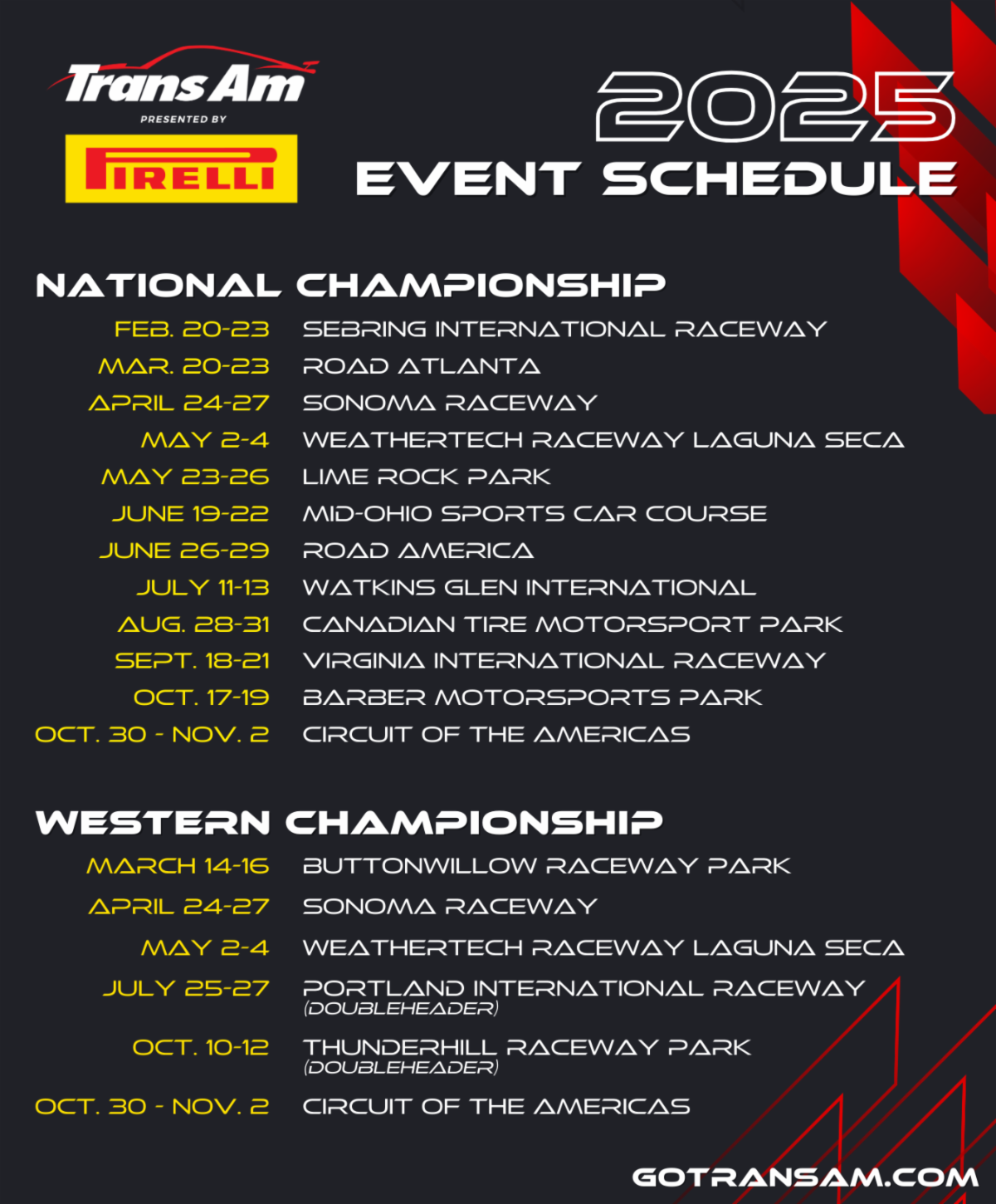
The Trans Am Series presented by Pirelli will kick off the 2025 season with the Sebring SpeedTour at Sebring International Raceway, February 20-23. The series will be joined by Historic Trans Am, which also competes that weekend with iconic and significant vehicles from the series’ history, many of which were driven or owned by members of the inaugural class.
event schedule

Zack Mitchell and Coltman Farms Racing planning ambitious 2025 schedule

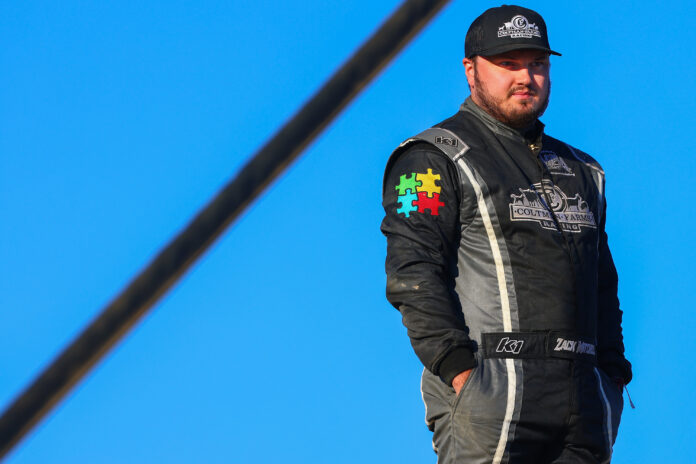
MAYSVILLE, Ga. (Feb. 5, 2025) – Zack Mitchell and Coltman Farms Racing are set to embark upon an ambitious 2025 season that includes a championship pursuit and several marquee events.

Mitchell, who joined Coltman Farms Racing late in the 2024 season, will chase the Hunt the Front Super Dirt Series championship in addition to competing in several regional and national events.

“We’re planning on doing a lot of racing this year,” said Mitchell. “We’re focused on the Hunt the Front championship this year, but we’re going to go the extra mile and compete in as many big events as we can. We’re also going to hit several of the big national events when our schedule allows for it.

“The entire Coltman Farms Racing team is excited to hit the ground running this year. Our goal is to win a championship and as many races as we can.”

Mitchell contested the full Hunt the Front schedule in 2024, winning three times and finishing the year ranked fourth in the standings. Two of his three wins came late in the year after joining Coltman Farms Racing, a sign that bigger things could be in store for 2025.

“Zack exhibits all the characteristics of a what we want in a hero and driver on and off the track,” said Coltman Farms Racing owner Brett Coltman. “Although we are focused on winning the Hunt the Front championship, we are also equally focused on competing in national races and Crown Jewels. I feel Zack and our team can be competitive at any track in the country.”

Mitchell and Coltman Farms Racing will kick off their busy season this week at Georgia’s Screven Motor Speedway during Winter Freeze XV before heading to Florida to join teammate Tanner English to compete in the World of Outlaws Late Model Series events during the DIRTcar Nationals at Florida’s Volusia Speedway Park.

The team also plans to compete in several Southern Nationals Series events and all the major events at Ohio’s Eldora Speedway. The opening race of the Hunt the Front Super Dirt Series season is scheduled for March 8 at Tennessee’s I-75 Raceway.

“I’ve never been part of a team like Coltman Farms Racing,” said Mitchell, who recently became a father for the first time. “Brett Coltman has built his race team like a family. I’m thrilled to drive for him and I’m excited to go chase a championship and score some wins for this team.

“I think the possibilities are endless. We showed a lot of speed at the end of the year and we have worked hard during the off season to make sure we carry the same momentum into 2025.”

About Coltman Farms Racing

Coltman Farms Racing is a dirt Super Late Model team owned by Brett Coltman that operates house cars for drivers Tanner English and Zack Mitchell. He also sponsors several drivers, including Ricky Thornton Jr., Brandon Overton, Max Blair, Carson Ferguson, Payton Freeman, Sam Seawright, Benji Hicks and Donald McIntosh, among others. Coltman Farms Racing is also heavily involved in grassroots racing, serving as the title and presenting sponsor of several regional and national touring series as well as many of motorsports broadcasts.

About McCallister Precision Marketing

McCallister Precision Marketing (MPM) focuses on assisting up-and-coming race car drivers with career advancement and promotion. McCallister Precision Marketing helps drivers build confidence in front of and behind the camera, giving them the tools they need to advance to the next level. The company also provides companies with a strategic plan for their sales, marketing and promotional needs. We believe in building positive relationships with our clients so that we may provide them with the most professional, yet personal guidance they need, in order to achieve their racing goals. Our clients include race car drivers, race team owners, companies and racing series’. We also work closely with charities and charity events. For more information on McCallister Precision Marketing, visit www.MarketWithMPM.com.

INTERSTATE RACEWAY RETURNS TO NHRA MEMBER TRACK FAMILY IN DIVISION 5

GLYNDON, Minn. (Feb. 5, 2025) – NHRA officials are pleased to announce that Interstate Raceway is back with the NHRA Member Track Network as part of the NHRA’s West Central Division (Division 5).

Located in Glyndon, Minn., just east of Fargo, N.D., the longtime raceway is under new ownership, as the Rolie Racing Team – a group that includes Kyle and Chuck Rolie – have purchased the facility, starting an exciting new chapter in the track’s history, one that spans more than six decades. In a short time, the Rolie family has been hard at work to bring the track back to life and is set for an exciting 2025 season.

The addition of Interstate Raceway also marks the seventh track to join the NHRA Member Track Network this off-season, adding to the more than 100 NHRA member tracks.

“We are pleased to announce the first and oldest drag strip in the state of Minnesota is being officially reopened under the new race management of Rolie Racing,” Interstate Raceway operator Kyle Rolie said. “The NHRA has been a tremendous help in teaching these green horns the rope. We have been absorbing everything there is to know about drag racing and we look forward to taking on this great responsibility and opportunity head on, especially with the incredible support of my newfound team.”

Interstate Raceway will be eligible to offer racers in the area a variety of NHRA-sanctioned racing opportunities in the future, including the NHRA Summit Racing Series, the NHRA Summit Racing Jr. Drag Racing League, NHRA Street Legal, NHRA Jr. Street and more. Additionally, the track will have the chance to host NHRA specialty events like the NHRA Summit King of the Track and more.

The Rolie family, which has a long history in drag racing, is determined on returning Interstate Raceway to a standout facility in the local racing community, partnering with NHRA to grow the grassroots racing community in the area. By rejoining NHRA’s Division 5 also gives racers another track to compete at in the growing West Central Division.

“We are very excited to bring NHRA Drag Racing back to the Fargo area after a two-year hiatus,” NHRA West Central Division Director Nick Duty said. “Interstate Raceway has been a staple of that community for more than 60 years and I think Kyle, Chuck and the entire Rolie Racing Team are going to do a great job taking the reins of the historic facility. I can’t wait to see what they are able to do in 2025 and beyond.”

For more information about Interstate Raceway, please visit https://interstateraceway.com. For more information on NHRA, including the 2025 schedule, visit www.NHRA.com.


About NHRA

NHRA is the primary sanctioning body for the sport of drag racing in the United States. NHRA presents 20 national events featuring the NHRA Mission Foods Drag Racing Series and NHRA Lucas Oil Drag Racing Series, as well as the Congruity NHRA Pro Mod Drag Racing Series, NHRA Flexjet Factory Stock Showdown™, NHRA Holley EFI Factory X and Johnson’s Horsepowered Garage NHRA Mountain Motor Pro Stock at select national events. NHRA provides competition opportunities for drivers of all levels in the NHRA Summit Racing Series and NHRA Street Legal™. NHRA also offers the NHRA Jr. Street® program for teens and the Summit Racing Jr. Drag Racing League® for youth ages 5 to 17. With more than 100 Member Tracks, NHRA allows racers to compete at a variety of locations nationally and internationally. NHRA’s Youth and Education Services® (YES) Program reaches over 30,000 students annually to ignite their interest in automotive and racing related careers. NHRA’s streaming service, NHRA.tv®, allows fans to view all NHRA national events as well as exclusive features of the sport. In addition, NHRA owns and operates three racing facilities: Gainesville Raceway in Florida; Lucas Oil Indianapolis Raceway Park; and In-N-Out Burger Pomona Dragstrip in Southern California. For more information, log on to www.NHRA.com, or visit the official NHRA pages on Facebook, Instagram, Twitter, and YouTube.

Aaron Donnelly Gets Early Jump on 2025 Late Model Season With Hettinger Racing

25-Year-Old Racer To Drive No. 71 Chevrolet in 125-Lap ‘Icebreaker’ Saturday at Florence Motor Speedway Ahead of Full zMAX CARS Tour Schedule

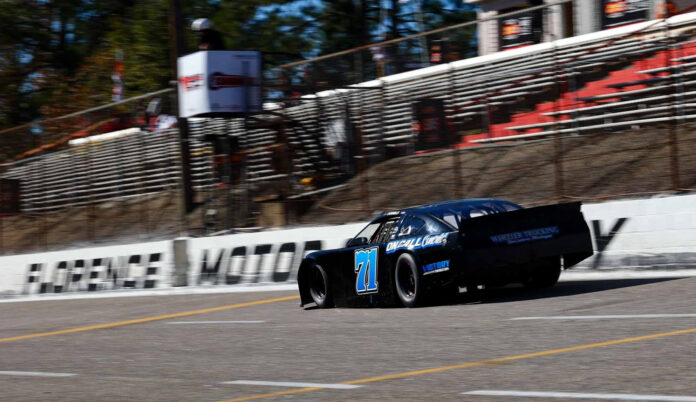
MOORESVILLE, N.C. (Feb. 5, 2025) – Aaron Donnelly embarks on his most aggressive racing season yet when he climbs behind the wheel of the No. 71 Chevrolet for Hettinger Racing this Saturday at Florence Motor Speedway in Timmonsville, South Carolina.

The 25-year-old from Stafford, Virginia, is getting an early start on a robust year of Late Model racing beginning with The Icebreaker, a 125-lap race around the historic .4-mile Florence oval that will be streamed live on Ultra Broadcasting.

Donnelly will run the full zMAX CARS Tour schedule with Hettinger Racing, and The Icebreaker serves as a tune-up for his season-long run in the CARS Tour Late Model Stock division.

“I’m definitely ready to get back in a racecar and I’m really looking forward to this year with Hettinger Racing,” said Donnelly, a Late Model regular at South Boston (Va.) Speedway. “Our last race together was the Thanksgiving Classic in December at Southern National. We had a decent run, started 16th and finished top-10. We had good communication and I want to build on that this weekend at Florence so we’re where we need to be when the CARS Tour season starts.”

Hettinger Racing is no stranger to the Late Model ranks. It is owned by second-generation racer Chris Hettinger, a longtime and winning Late Model team owner from Dryden, Michigan. Hettinger began his racing career in the driver’s seat, winning in Midgets and Late Models before becoming a fulltime team owner.

Under one roof, Hettinger Racing provides three crucial steps on the racing ladder, and it begins with the CARS Tour. From there, drivers can advance to the ARCA Menards Series and NASCAR Craftsman Truck Series, all with Hettinger Racing.

“Late Model racing is extremely competitive. Teams come prepared with good equipment, drivers are aggressive, and the fields are deep. The Icebreaker at Florence will give everyone a good taste of that. The CARS Tour opener is in three weeks, so the season is coming up fast. We want to be ready,” Hettinger said.

The 15-race CARS Tour schedule begins March 1 at New River All American Speedway in Jacksonville, North Carolina. It, along with other high-profile Late Model races, specifically the June 28 Thunder Road Harley-Davidson 200 at South Boston Speedway, the July 19 Hampton Heat at Larry King Law’s Langley Speedway in Hampton, Virginia, the Sept. 27 ValleyStar Credit Union 300 at Martinsville (Va.) Speedway, and the Nov. 22 South Carolina 400 at Florence, are all on the docket for Donnelly and Hettinger Racing.

“Aaron has raced with us a couple of times before, but this year marks our first full season together,” Hettinger said. “He’s got a lot of talent and we’re all looking forward to seeing what we can accomplish this year. His feedback in the races we ran with him last year was really good, and to be able to have that all season long will allow us to get better each and every race.”

The CARS Tour is widely considered the nation’s premier Late Model touring series. The experience garnered on the short tracks of the CARS Tour allows drivers to make the next jump to ARCA, where they tackle superspeedways, road courses and dirt tracks in stock cars that once raced in the NASCAR Cup Series. That background serves as preparation for the NASCAR Craftsman Truck Series, which features a stock car chassis with a pickup truck body. It is NASCAR’s third-highest division, behind only the NASCAR Xfinity Series and the NASCAR Cup Series. Every current NASCAR Cup Series driver has matriculated through the NASCAR Craftsman Truck Series.

“Our goal is to take the success that a driver achieves with us on the CARS Tour and replicate it as they move up to ARCA and Trucks,” Hettinger said. “By having one culture across three series, we provide familiarity and consistency. It helps drivers flatten the learning curve so they can focus on their race craft and, ultimately, win.”

Practice for The Icebreaker begins at 10 a.m. EST on Saturday with qualifying getting underway at 12:30 p.m. Florence’s full slate of feature racing begins at 2:30 p.m., headlined by Late Model Stock class.

How Rideshare Accidents Are Different from Regular Car Accidents

Uber and Lyft have revolutionized transportation. These ridesharing apps have made commuting convenient and improved accessibility. However, the unique legal and insurance considerations involved in rideshare vehicle accidents are significantly more complicated than regular car accidents. It is crucial to understand these differences for anyone involved in such an incident. The best rideshare accident lawyers can provide the best guidance in making these cases more manageable.

Insurance Coverage and Liability

Insurance coverage is the primary distinction between rideshare and regular car accidents. Rideshare companies do provide insurance; however, they are of varying degrees and are dependent on the driver’s activity at the time of the accident.

Rideshare Driver Status

  • Offline: The driver should be logged into the rideshare app; otherwise, personal auto insurance applies.
  • Logged In but No Passenger: The driver is online and waiting for a ride request. In such cases, the rideshare company covers only limited liability, and it can go up to $50,000 per person for injuries.
  • En Route or with Passengers: The rideshare company’s liability in the case when the driver has accepted a ride request or has passengers in the car is higher and can go up to $1 million.

There is a difference in liability in the case of personal auto insurance and rideshare drivers. The layered insurance structure is a major difference. In personal auto insurance, the at-fault driver’s auto insurance covers reimbursement.

Determining Fault

Determination of liability in rideshare accidents is complex compared to regular car accidents due to the involvement of multiple parties, including:

  • The driver of the rideshare
  • Opposite party’s driver
  • Rideshare company, if the fault lies in hiring or app malfunction is proven

A skilled attorney can look into the accident thoroughly, determine fault, and establish insurance coverage.

Legal Protections for Passengers

Passengers are in a much better position to claim compensation when compared to drivers of a rideshare vehicle. As passengers are rarely at fault, it allows them to pursue claims against the rideshare driver, the driver on the opposite side, or the rideshare company’s insurance provider.

It is challenging to obtain a claim, as the insurance policies can be complex, and the possibility of dispute is high among parties. This is where enlisting the help of the best rideshare accident lawyers helps protect the rights and efficient handling of the reimbursement.

Challenges with Rideshare Companies

Rideshare companies often classify the drivers as freelancers or contractors rather than employees. This absolves them from any kind of liability. These provisions complicate the legal claims. The rideshare companies are legally required to maintain robust insurance policies that cover accidents involving their drivers. The policies act as a safety net for accident victims. However, disputes over coverage can also arise.

Differences in Claim Processes

A major difference lies in the claim process between rideshare and regular car accidents. To file a claim for a rideshare accident involves:

  • Present claims to the rideshare company’s insurer
  • Fulfilling reporting specifications as set by the rideshare company
  • Dealing with potential delays due to disputes over driver status

It’s a time-consuming and complicated process, especially in the case of multiple insurance policies. The process can be streamlined by legal professionals, who are skilled and knowledgeable about all the requirements.

Potential for Higher Compensation

Compensation in rideshare accidents is high. Therefore, the disbursement of compensation for victims is high. It is especially so in the case of severe injuries or extensive property damage. To obtain full compensation, a skilled attorney with significant experience in handling claims and negotiation is required.

Conclusion

Rideshare accidents are different from regular car accidents. Navigating the complex process of insurance structures, liability determinations, and the claims process requires good skills and an understanding of how rideshare companies operate and the legal provisions in place for victims. Therefore, with the support of skilled legal professionals, victims can bring the offending parties to law as well as secure compensation.

Betting on Speed: How NASCAR Fans Are Wagering on Race Day Outcomes

In recent years, sports betting has become more widespread in NASCAR. As gambling laws have relaxed in certain U.S. states, sportsbooks have added motorsports to their offerings, drawing more fans. Motorsports has embraced the trend by partnering with legal betting operators, including wagering insights in broadcasts and digital content.

Mobile betting apps have helped fuel this trend, with fans placing bets in real-time as the races run. Numerous platforms have streamlined interfaces so you can quickly navigate between various betting options. For instance, through the Betway app download, users can log onto motorsports markets including outright race winners, driver head-to-head matchups, and in-race prop betting. This improved accessibility has also resulted in increased motorsports betting excitement on race day.

A significant part of NASCAR’s expanding relationship with betting is the multiple wagering possibilities provided by its structured race format. In contrast to other sports with a continuous stream of gameplay, NASCAR races have stages with scheduled cautions and pit stops that affect results. This makes the sport particularly appealing for live betting, as odds can change significantly with race results, tire strategies, or weather changes.

Additionally, official NASCAR partnerships with betting operators have provided motorsports wagering credibility. This collaboration has improved bet choices, educational material for new bettors, and real-time race data being incorporated into betting platforms. More states are legalizing sports betting, and NASCAR remains a significant player in the industry.

Understanding Race Day Odds 

Motorsports betting is somewhat different than stick-and-ball because of the variables involved. When setting race day odds, oddsmakers consider driver performance, track history, team strategies, and weather. The racing betting odds are usually presented as fractional or moneyline odds like other sports.

For instance, a + 800 driver means USD 100 would return USD 800 when the driver wins. Betting favorites – generally champions or drivers with proven records – will have reduced odds, while longshots are more risky but provide greater potential rewards.

Beyond outright winners, odds are set on alternative markets, such as top five and top ten finishes, giving bettors extra options for less risky bets. Additionally, live betting – placing a bet during the race – is becoming increasingly popular, with fans responding to race developments at that moment.

Another essential facet of race day odds is the track characteristics. The races are on superspeedways, road courses, short tracks, and intermediate ovals. Each track has its challenges, and some drivers do much better on particular tracks. For instance, superspeedway races at Talladega or Daytona are more unpredictable and filled with underdogs and crashes, while short tracks favor experienced veterans with good handling ability.

Race odds also reflect team dynamics. Some teams like Hendrick Motorsports and Joe Gibbs Racing run consistently good races, making their drivers more appealing to betting options. Alternatively, mid-tier teams generally have greater odds than top teams and draw value bettors in search of value bets.

As NASCAR and motorsports betting continues to grow, sportsbooks have added more markets for seasoned and casual bettors. The most common and popular would be the following betting markets:

Outright Winner: the most straightforward and most common bet is on which driver will win a race. Odds are heavily influenced by current form and historical performance.

Head-to-Head matchups: some prefer to bet on a complete field of drivers instead of particular Matchups between drivers.

The objective: predict which of the two finishes much higher in the standings.

Stage Winners NASCAR races are split into stages and sportsbooks offer odds that one driver will win in every segment. This enables multiple betting possibilities on one race.

Podium Finishes (Top 3, Top 5, Top 10): These wagers give you a safer alternative to outright winner bets by enabling bettors to predict that a driver will finish within a designated range.

Prop Bets: These include wagers on particular racing outcomes, like the number of lead changes, the very first company to finish, or if there will be a caution flag in a particular lap segment.

Futures Betting: Bettors can place long-term bets on events like who will win the series title, which driver will earn the most pole positions, or which company will win the most races in a season.

Legal sports betting and its mainstream acceptance have boosted motorsports engagement at the track and with at-home fans. More sportsbooks are adding motorsports to their offerings, technology is improving live betting, and fans can be more involved than ever before in the action besides watching the race.

Motorsports betting is expected to grow in the years to come as more American states legalize internet sports gambling. With sportsbooks offering more details and statistics and live betting, motorsports wagering has become a part of the fan experience. Although betting always involves risk, responsible wagering can inject extra intensity into a sport that many sports bettors find appealing.

Unlock the Secrets of Pusoy Dos: Outsmart Your Opponents!

Have you ever wondered how some players seem to always win at Pusoy Dos? It’s not just luck – it’s about outsmarting your opponents! This exciting Filipino card game is more than just a fun pastime; it’s a thrilling battle of wits. And guess what? We’re here to show you how to come out on top every time!

Imagine being able to read your opponents’ minds, predict their moves, and always stay one step ahead. Sounds amazing, right? Well, that’s exactly what you can learn in this guide! We’ll take you through the ins and outs of the Pusoy Dos strategy, from beginner tips to advanced psychological tactics.

Getting Started: The Basics of Pusoy Dos

First things first – let’s talk about how the game works. Pusoy Dos is played with a standard 52-card deck, and each player gets 13 cards. Your goal? Be the first to get rid of all your cards by playing valid combinations. Easy, right? But here’s the twist: in Pusoy Dos, 2 are the highest cards, followed by Aces, then Kings, and so on down to 3.

The game is all about playing smart combinations:

  • Singles: Just one card
  • Pairs: Two cards of the same rank
  • Triples: Three cards of the same rank
  • Straights: Five cards in sequence (they don’t have to be the same suit)

Sounds simple enough, but the real challenge comes in outthinking your opponents. That’s where the psychology comes in!

Reading Your Opponents: The Key to Victory

The true masters of Pusoy Dos don’t just play their cards – they play their opponents too. Here’s how you can start reading the table like a pro:

  1. Watch for patterns: Does your friend always lead with high cards? Does your uncle save his best for last? Knowing these patterns can help you predict their moves.
  2. Look for tells: Just like in poker, Pusoy Dos players have ‘tells’ – little signs that give away their hand. Maybe they tap their fingers when they’re bluffing, or smile slightly when they have good cards.
  3. Pay attention to timing: A quick play might mean confidence, while hesitation could signal a weak hand.

The Art of the Bluff: Make Them Believe

Bluffing isn’t just for poker! In Pusoy Dos, a well-timed bluff can turn the tide of the game. Here’s how to bluff like a pro:

  1. Act confident: Even if your hand is weak, play it like it’s the best hand ever. Your confidence can make opponents second-guess themselves.
  2. Mix it up: Don’t always bluff – or always play straight. Keep your opponents guessing by changing your strategy.

Staying Cool Under Pressure

Ever noticed how some players seem to crumble when the stakes are high? Don’t let that be you! Here are some tips to keep your cool:

  1. Take deep breaths: It sounds simple, but it works. Deep breathing can help calm your nerves and clear your mind.
  2. Focus on the present: Don’t dwell on past mistakes or worry about future rounds. Stay in the moment and focus on the current hand.
  3. Have a ritual: Maybe it’s shuffling your cards a certain way, or taking a sip of water before each round. A small ritual can help center you and keep you focused.

Adapting to Different Players

Every Pusoy Dos player is unique, and the key to winning is adapting your strategy to each opponent. Here’s a quick guide:

  • Aggressive players: Stay calm and let them make mistakes. They’ll often overplay their hand, giving you the chance to swoop in.
  • Cautious players: Push them out of their comfort zone. Make bold plays to force them into difficult decisions.
  • Experienced players: Mix up your strategy. These players will be looking for patterns, so keep them guessing.

Practice Makes Perfect: Honing Your Skills

Like any skill, getting better at Pusoy Dos takes practice. Here are some ways to improve:

  1. Play online: Platforms like GameZone offer free Pusoy Dos games where you can practice against players from around the world.
  2. Analyze your games: After each game, think about what worked and what didn’t. Learn from your mistakes and your successes.
  3. Watch the pros: Look for videos of professional Pusoy Dos players. Pay attention to their strategies and see how you can apply them to your own game.

The Social Side of Pusoy Dos

One of the best things about Pusoy Dos is how it brings people together. It’s a staple at Filipino family gatherings, and for good reason! As you play, you’re not just competing – you’re bonding, laughing, and creating memories.

Use the social aspect of the game to your advantage:

  • Engage in friendly banter to distract your opponents
  • Pay attention to conversations for clues about other players’ hands
  • Build alliances (but be ready to break them when the time is right!)

Advanced Tactics: Taking Your Game to the Next Level

Ready to play like a true Pusoy Dos master? Try these advanced strategies:

  1. Control the pace: Sometimes playing slowly can throw off your opponents. Other times, a quick pace can force mistakes.
  2. Set traps: Play a seemingly weak hand to lure your opponents into a false sense of security, then surprise them with a powerful combination.
  3. Use psychology: Make your opponents think you have a certain hand, then play something completely different.
Taking Your Game to the Next Level

Conclusion: Your Journey to Pusoy Dos Mastery

Pusoy Dos is more than just a card game – it’s a thrilling test of strategy, psychology, and skill. By understanding the basics, reading your opponents, mastering the art of the bluff, and keeping your cool under pressure, you can dramatically improve your game.

Remember, every hand is an opportunity to learn and grow as a player. Whether you’re enjoying a casual game with family and friends or competing in online tournaments, these strategies will give you the edge you need to come out on top.

So, are you ready to become a Pusoy Dos champion? Gather your friends, log onto GameZone, or find an online match. It’s time to put your new skills to the test! Who knows? You might just surprise yourself with how good you can be.

Get ready to outsmart, outplay, and outlast your opponents. The world of Pusoy Dos is waiting for you – and now, you have the tools to conquer it. Good luck, and may the best strategist win!

Comcast Renews Partnership with NASCAR, Extends Xfinity Series Title Sponsorship

New “Xfinity Fastest Lap” Feature to Impact Competition Across All Three NASCAR Series

DAYTONA BEACH, Fla. (February 4, 2025) — NASCAR and Comcast today announced the renewal of their decade-long partnership, with Comcast continuing its role as both a Premier Partner of the NASCAR Cup Series and title sponsor of the Xfinity Series. The Comcast and NASCAR relationship began in 2014 and the collaboration between the two companies has significantly contributed to the sport’s growth and fan engagement. The Premier Partnership has been renewed for multiple years with the Xfinity Series title sponsorship being extended for one year.

New to the sport starting in 2025, race fans can look forward to the “Xfinity Fastest Lap,” a program that awards one race point to the eligible driver and owner with the fastest single lap in each race, adding extra intensity and strategy to the competition. This new feature will be part of all three national series — NASCAR Cup Series™, NASCAR Xfinity Series™ and NASCAR CRAFTSMAN Truck Series™ — enhancing the competitive landscape and fan experience.

“We’re not just entering year 11 of our partnership. We’re embarking on year one of a renewed relationship with NASCAR filled with fresh energy and exciting opportunities to enhance the competition on the track in a way that has never been done before, and continue to connect with fans in new and engaging ways,” said Matt Lederer, Vice President of Brand Partnership & Engagement at Comcast.

Comcast is expanding its NASCAR partnership to include more of its connectivity and entertainment brands – Xfinity Mobile and Xumo. Xfinity Mobile is joining the partnership as an Official Wireless Partner of NASCAR. Xumo, Comcast’s and Charter’s streaming platform joint venture, will become an Official Video and Streaming Partner of NASCAR, with plans to offer its customers immersive viewing experiences and unique content.

“NASCAR is incredibly appreciative of Comcast’s continued partnership and their commitment to innovation and fan engagement within our sport,” said Michelle Byron, Executive Vice President and Chief Partnership and Licensing Officer at NASCAR. “Their contributions over the past decade, from enhancing the fan experience to supporting community initiatives, have been invaluable. We look forward to building on the success of our partnership during the 2025 season and beyond.”

Comcast’s commitment to NASCAR extends beyond the track and is woven into its activations. From the title sponsorship of the Xfinity 500 to the Comcast Community Champion of the Year program, which recognizes individuals within the NASCAR community who demonstrate exceptional dedication to philanthropic endeavors, Comcast has consistently championed the sport and its values. This program underscores Comcast’s commitment to social responsibility and its alignment with NASCAR’s values of community engagement.

This renewed partnership ensures that Comcast and NASCAR will continue to deliver thrilling racing action and engaging fan experiences for years to come.

About Comcast Corporation

Comcast Corporation (Nasdaq: CMCSA) is a global media and technology company. From the connectivity and platforms we provide, to the content and experiences we create, our businesses reach hundreds of millions of customers, viewers, and guests worldwide. We deliver world-class broadband, wireless, and video through Xfinity, Comcast Business, and Sky; produce, distribute, and stream leading entertainment, sports, and news through brands including NBC, Telemundo, Universal, Peacock, and Sky; and bring incredible theme parks and attractions to life through Universal Destinations & Experiences. Visit www.comcastcorporation.com for more information.

About NASCAR

The National Association for Stock Car Auto Racing (NASCAR) is the sanctioning body for the No. 1 form of motorsports in the United States and owner of 14 of the nation’s major motorsports entertainment facilities. NASCAR sanctions races in three national series (NASCAR Cup Series™, NASCAR Xfinity Series™, and NASCAR CRAFTSMAN Truck Series™), four international series (NASCAR Brasil Series, NASCAR Canada Series, NASCAR Euro Series, NASCAR Mexico Series), four regional series (ARCA Menards Series, ARCA Menards Series East & West and the NASCAR Whelen Modified Tour) and a local grassroots series (NASCAR Advance Auto Parts Weekly Series). The International Motor Sports Association™ (IMSA®) governs the IMSA WeatherTech SportsCar Championship™, the premier U.S. sports car series. NASCAR also owns Motor Racing Network, Racing Electronics, and ONE DAYTONA. Based in Daytona Beach, Florida, with offices in five cities across North America, NASCAR sanctions more than 1,200 races annually in 11 countries and more than 30 U.S. states.

For more information visit www.NASCAR.com and www.IMSA.com, and follow NASCAR on Instagram, YouTube, TikTok, X and Facebook.

Roush Yates CEO Doug Yates Prepping for 2025 Daytona 500

Ford Performance Notes and Quotes
NASCAR Cup Series
Daytona 500 Media Availability | Tuesday, February 4, 2025

Doug Yates, CEO of Roush Yates Engines, is on the verge of a couple milestones as we enter the 2025 NASCAR season. First, the organization is sitting on 199 all-time NASCAR Cup Series poles (points and non-points events) going into next week’s Daytona 500 and 198 all-time series victories (points races only). The organization has been in existence since 2004 when Robert Yates and Jack Roush merged their engine operations and promptly won a championship with Kurt Busch. Yates spent time today talking about the organization’s success and what lies ahead in Daytona.

DOUG YATES, CEO, Roush Yates Engines – HOW DOES IT FEEL TO START THE SEASON KNOWING YOU HAVE SOME MILESTONES RIGHT IN FRONT OF YOU? “It’s a great feeling. I’m looking forward to those milestone wins, but it really goes back to my dad, Robert Yates, and Jack Roush believing in putting Roush Yates together in 2004, our very first season together, and with the backing of Ford Motor Company – Edsel and Bill Ford and their team – gave us the opportunity to be in this position, so I’m very thankful of that. That 2004 season was a very special season, showing up at Daytona and sitting on the front row for the Daytona 500 with Greg Biffle and Jack Roush and Elliott Sadler and my dad. Winning the championship with Kurt Busch later that year and now 21 year later we’re here talking about 200 wins and getting ready to go back down to Daytona and have another shot at winning another Daytona 500. If we do so, that would be our 11th Daytona 500 for Ford Motor Company and that’s always the goal. Winning The Great American Race is something really special and thinking back to that 1992 season when Davey Allison and our 28 Texaco car is where it all started.”

YOU WILL HAVE THE 01 AND 66 AS OPEN CARS. IS THAT IT? “That’s it.”

SO IS THERE ANYTHING THEY CAN DO FOR QUALIFYING OR THAT YOU CAN DO FOR THEM? “Obviously, we’ve been in communication with those guys. Their ask is, ‘What can we do? How can we go down there?’ We’ll prepare as always and make sure we put the best lap down that we can on Wednesday night. They’ll probably have to race their way in on Thursday, but Speedweeks will be a little bit different this year from that respect, kind of back to where it used to be where those guys have to battle to get in the race, but I feel like we have a good shot and hopefully we can. We have 12 full-time teams. Hopefully, we can add those guys and have 14 in the 500.”

IS THERE ANYTHING SIGNIFICANT AS FAR AS RULES THAT WILL IMPACT YOU IN THE ENGINE DEPARTMENT THIS YEAR? “I think it’s business as usual this year for the engines. Looking ahead, there are gonna be some engine rule changes to try to be more cost efficient, but this year the engines are the same – 18 long block seels. If you have a race-winning engine ahead of the playoffs, it will have to be inspected before the playoffs start. That’s probably one of the rules that will be changed, but pretty much very similar to last year on the engine rules.”

HOW DID YOUR DAD CONVEY THE IMPORTANCE OF THE DAYTONA 500 TO YOU? “I started working with my dad when he was at Junior Johnson’s in 1971-72. As a kid, I would go there. Our house was on the same road as the shop. Junior and Flossie’s house was right next to the race shop, so we would go down there and work at night. He would come home for dinner and I would go down there and spend time with him and hang out with him, but probably where it really hit me how important the Daytona 500 is was when Bobby Allison won that race in 1982 and seeing what that meant to my dad and our family was really important, and then we spent all kinds of time working together, whether it was me being there on Saturday or full-time when my dad had us on the engine shop in 1985. Driving to the racetrack and all we talked about was winning at Daytona and how special it is and how much we were willing to work. That 1992 win, the ‘91 winner – Texaco actually sent us to Hawaii as a family vacation. We went for a seven day trip and about three days in my dad and I looked at each other and said, ‘We’ve got to get home and start working on Daytona.’ So we went to my mom and sister. I think they’re still probably salty over that decision, but we came home and for about two and a half months straight we took the clocks off the wall and worked seven days a week to win that race with Davey and Larry McReynolds and our team. That really ignited that fire and it still burns pretty hot today.”

HOW OLD WERE YOU WHEN YOU WOULD GO DOWN WITH HIM TO JUNIOR’S? “Five years old. Maybe four, five, six, seven we were up there. We lived there for four years, from 1971-75 and I’ll go back – elementary school. The cool part was going down there and hanging out with him and then seeing Junior come by later in the night patting my dad on the back. He’d say, ‘Hey, boy. We’re gonna win this race. You’re doing a great job.’ He was a good motivator, and then on Saturday morning we got together at Flossie’s house and she would cook country ham biscuits for us, so my dream as a kid was to own a race shop and have my house right next to it. That’s what I knew. That’s how I grew up, but it started young and through the years just working with my dad. He would drive the truck home and drove the tractor trailer sometimes and he would bring it to the house when we lived off Central Avenue here in Charlotte, and leave it there and I would drive with him back to the shop and we were on to the racetrack. It was a full immersion and it was just really cool being around him. He’s my hero and being able to spend time with him was really one of the best parts about NASCAR, but it started pretty young.”

DID YOU START WORKING FOR HIM IN HIGH SCHOOL? “Yeah. Actually, my senior year in high school my dad had his own engine shop down at the race track and we did General Motors teams at the time. We worked three months straight, seven days a week. It was actually motivating to go to college and try to get a degree and do something different, but at that time my dad had that shop. He was doing engines for Rick Hendrick for the 5 car and Gary Nelson was there, so Rick offered him a job to come work at his engine shop there and about the time Lee Morse and Ford Motor Company called and said, ‘Hey, we want you to come and run Ranier-Lundy. Waddell is gonna leave and do something different,’ so my dad had a decision to make. He met with Lee out at the airport and met with their team and decided that was the route he wanted to go and it turned out to be a great decision and gave him the opportunity as an engine builder and team manager that when Harry and JT decided they wanted to get out of it and were gonna put the team up for sale – my dad, the son of a Baptist preacher and humble beginnings, didn’t have a whole lot, but he did have his house paid for and he was thinking about it. That’s when Davey Allison went to my dad and said, ‘Robert, you can do this. I’m behind you.’ He shook his hand and said, ‘As long as you have this team, I’ll be your driver.’ My dad went home and told my mom he was buying a team, or asked her. I’m not sure how it went, but maybe their stories are different, but they sold their house and moved into an apartment and bought the team Oct. 10, 1988. I was in college and my mom called and said, ‘Hey, when you graduate will you come back and work for the family business?’ And when I graduated in May of 1990, I came back and that’s where it all started. Back then, we owned six race cars, three engines and maybe 12 people working there, and now with NASCAR’s leadership and this great sport we’re all blessed to be part of, it’s a huge industry and employees a lot of people and you can have a real career in this sport. Back then, we made it to the next year and did pretty well, and today we’re all really blessed to be part of this deal.”

HAS THE EXPANSION BY RFK AND FRONT ROW CHANGED ANYTHING ON YOUR END? “That’s a great question. I’m really proud of RFK and Brad Keselowski and Steve Newmark and what they’re doing carrying on Jack Roush’s legacy and team, and the next step for them was to add another car. So, to be able to put that together and pull that off, I talked to Brad last weekend and he’s excited about that team and the resources that it will bring. If you’re gonna compete at the highest level in this sport, you need to get to that three-car program, so they did that, along with Bob Jenkins and Jerry Freeze and Front Row Motorsports adding to their team. We’re excited for those guys. Bowman Gray was a great event, but it was also practice for us to get back in the routine and get going by communicating with our teams and starting to do that this week and really get in the swing of things. We’re excited about both of those teams expanding. We were really nervous about the Stewart-Haas deal because we weren’t sure what that was gonna mean for us and our business. Losing four Cup cars is a major change for an engine business, but to add two of those back with Haas Factory Team and Cole Custer and Joe Custer keeping their team intact, and for Front Row to bring in Noah Gragson and their team, or however you want to look at that, but them adding a third car was an OK outcome for us. We’re carrying on building that. Now it’s really getting down to the racing and working with those guys and trying to give them what they need to be successful with those three-car teams.”

WHAT DID YOU THINK OF THE NASCAR MACH-E AND HOW IMPORTANT IS IT FOR FORD TO BE A LEADER IN THE ELECTRIFICATION SPACE? “How cool was that event? I mean, wow. That was awesome and I applaud Jim Farley, Mark Rushbrook, Bill Ford, his son, Will, and Edsel Ford and their team. What they’re doing with racing and the racing programs right now is really strong, and I think that they’re trying to look at all aspects of it. Congrats to them and their team for winning at Daytona with the GT3. Entering Formula 1 next year is a huge step in the partnership with Red Bull, and the electrification piece is just another aspect. I think they’re working really hard to just build out their entire racing portfolio, whether that’s NASCAR V8’s or street car versions or the hybrid technology with Formula 1 or full electric, so I think it’s a good time for Ford Performance and they’re making some really awesome cars. The Mustang, GTD. The Ford Bronco is incredible. The Ford family was founded on racing. Henry Ford on Oct. 10, 1901 won a race in beating the best racer in the world, so it all is still going on today and the Ford family is still behind it, so I think it just shows their commitment to racing and they’re doing some really cool things.”

HOW HAS BUILDING ENGINES FOR THE DAYTONA 500 CHANGED OVER THE YEARS TO WHAT IT IS NOW? “It’s changed a lot, to be honest with you. Engine building in general has changed a lot. Through the years, back when I started it was single car teams. Every single team, if you can imagine this, built their own engines and there were less rules, less restrictive, and there were a lot of areas that you could work on that weren’t in the rule book today. The rule book for the engine guys has come a long ways based on all of that innovation that happened through the years, but when I started my very first project out of school was to work on Daytona, to work on plate engines, and back then nobody really worked on them. So, my dad gave me a contact with Paul ‘Scooter’ Brothers at Comp Cams. He said, ‘Call this guy and you guys work on plate engines. Get this college kid out of our way and let us do our thing,’ and we sat on the pole for the Daytona 500 in 1991 with Davey Allison on my very first project, which was very cool. And back then, not only just the iterations. We didn’t have the test facilities we have today. You could work on all kinds of creative things. The carburetors were kind of wide-open. Getting more air flow through the carburetors was a big deal. Back in the day, they had an intake manifold with a device down the center of it that would magically float up and create like 20 more horsepower. I’ll never forget one Friday night we’re downtown testing on our single dyno and we had put this insert in the manifold, tack welded it in there. I made a dyno pull, I always ran the dyno, that’s what I loved to do was run the dyno and test, and this engine picked up 20 horsepower. So a 400 horsepower engine had picked up 20. What in the world? How did that happen? So we shut if off. Went in there and checked everything. It looked OK. Ran it again and up 20 again. We shut it off and went in there and the center of the manifold, that insert, that tack weld came loose and it came up to the center of the restrictor plate. It was like, ‘Oh, boy. Now what do we do? We’ve got to figure out how to do this.’ So that was an example of something you would go to the track with and have an advantage. I mean, when we went to Daytona in 1996 we had a special carburetor that there was no rules against it, but we had offset some things. It flowed a lot more air and made seven more horsepower. Dale Jarrett and Ernie Irvan were our drivers. My dad would not let us run those carburetors until Saturday afternoon, so we showed up and we qualified third of fourth, something like that. We ran the Clash and I’m sitting there this young kid, ‘Dad, we’ve got to run this thing. We’re gonna win this race.’ He said, ‘It’s not time yet.’ I’m like, ‘Oh, man.’ So we kept going. We got to Saturday morning and he was still, ‘No.’ Every practice he was still no and then Saturday afternoon we went up in the trailer and these carburetors were up in the lounge. Back then we had cabinets up in the lounge and he said, ‘Boys, it’s time.’ And I said, ‘Oh, man.’ So we put them on and we were gone, and so that night I didn’t sleep five minutes thinking about how we were gonna get through tech with this carburetor. Steve Allen tuned the 88 car and I was the tuner on the 28 car and so I waited and waited and drug my feet to go through tech, and he had already gone through. I said, ‘How did it go?’ He says, ‘We got caught.’ I’m like, ‘You’re kidding me.’ He says, ‘Yes, I am kidding you.’ So, I went through and got through and, sure enough, about 40 laps into the race or something like that we had the ignition box go out on the 28, so we were done. The 88 goes on to beat Dale Earnhardt in the very first race for the Ford Quality Care No. 88. That was the very first outing for that car and that team and it was a great start to what ultimately ended up in a championship run, but back then you would never load the trailer until you had an advantage, so you would work, work, work, work and just finally at the last minute you would load the trailer and go. Today, these engines and teams are prepared well in advance because you can’t do that for 12 teams or 14 teams with the scale that Roush Yates has or Hendrick or Toyota. But it was a lot of fun and it was a lot of creativity and I really enjoyed it, and I just cherish being a part and sharing some of those stories. I’ll say this. We never cheated. We never did anything outside. If it wasn’t in the rule book, we did it or tried it, but if it was, we didn’t do it and I’m proud of that as well.”

YOUR MOM MUST HAVE BEEN A SAINT BECAUSE WHEN SHE WAS ASKED TO MOVE OR SUPPORT YOUR FAMILY, SHE DID IT. “Yeah, no doubt. My mom has been fantastic. Growing up, I was my mom’s son and then I got handed off to my dad for my adult life, but she was very supportive and even to the end of my dad’s deal, he would talk about without her allowing him to do what he did, he would not be the man he was or accomplished the things that he accomplished.”

WITH THE EXTRA PRACTICE AT DAYTONA ON WEDNESDAY MORNING, DOES THAT IMPACT ANYTHING YOU TELL YOUR TEAMS ON HOW MANY MILES THEY CAN GO? DOES IT CHANGE ANYTHING YOU DO? “That’s a great question. We talked about it. John Probst asked us as an engine builder group in one of our monthly meetings, do we have issues with that. Is that gonna be OK? At Daytona, that will be one engine for the entire week, of course, and that engine will see about 900 miles, so it’s still well within the limits of the engine. It’ll actually probably get everything broken in and make sure nobody has any issues. I don’t envision anybody doing drafting laps, so I think from exposure of how many laps, I don’t think it’s gonna be that many. We’re not that concerned. It’s probably more like what we used to be. We’re gonna change valve springs after the 150 race anyway for the 500 to have fresh valve springs on it for the race, so I think from our end it’s probably different, but probably more the same as it used to be.”

DOES THE CHANGE IN THE COURSE AT COTA CHANGE ANYTHING? “We’re working through that. As you know, everybody has access to simulators, so our teams are running laps. When they go to the simulator they have different power curves they can select that kind of helps us to find how we set up the engine with the intake manifold and the exhaust system and cam timing and the things we can change, so we’re still working through what COTA looks like, what a best lap run COTA looks like from the engine torque curve, but we will definitely be making changes and adjusting in preparation for that event.”

WHEN BEFORE THAT EVENT DO YOU HAVE TO KNOW? “Today, we need about six weeks notice, so we’re gonna need those answers pretty soon. I don’t know how many weeks out we are, but we’re talking about it now. We’re a little late on that, but we have a meeting on Monday afternoon to look ahead with the production and development department and say, ‘Hey, what events are coming up? Here’s when we need those decisions and what are those decisions?’ And then from there we can start building the components, prepping those components and intake manifolds and getting the calibrations, make sure we have all that stuff ready when the engines go across the dyno and get signed off.”

Dome Motorsport For the Junaid Family Foundation (JFF) Joins SRO Pirelli GT4 America for 2025

New Mercedes-AMG GT4 Team Formed for SRO Pirelli GT4 America Competition

DENVER, Colorado (February 4, 2025) – Dome Motorsport announced today its 2025 debut in the SRO Pirelli GT4 America series with the newly formed team debuting at least one Mercedes-AMG GT4 for the opening round at Sonoma Raceway on March 28 – 30. Team Principal Eddie Killeen has founded Dome Motorsport to achieve his goal of competing among the deep talent in the SRO Series paddock.

Looking forward to the competition and racing environment that SRO Pirelli GT4 America provides, Killeen has built his racing resume competing mostly in Canada, with experience in Porsche GT3 Cup Canada, TCR in the Sports Car Championship Canada and most recently, GT4 in a limited number of events in the IMSA VP Challenge series in 2024.

“I’ve wanted to assemble a group of people who could facilitate my goals as a driver and team principal, and also create awareness toward a wonderful charitable organization that is dear to me, the Junaid Family Foundation,” Killeen said.

Junaid Family Foundation (JFF) seeks to create lasting change in four program areas: Healthcare and Development; Education and Society; Equity and Diversity; and Civic Engagement. Giving across all four program areas is focused on changing communities for the better with the aim of forever. JFF believes in the power sporting events bring to a community.

“Sports and competition are a universal language that builds camaraderie, breaks gender stereotypes and promotes inclusivity,” Ansir Junaid, Chairman of JFF, said. “More importantly, sports creates the means to health and well being, and we believe that this is critical to social welfare.”

Managing the Dome Motorsport operation will be experienced motorsports management and technical professional Kelly Brown.

“Our primary focus for the upcoming season is to develop a strong program comprised of experienced individuals with the like mind of having fun and achieving success, and Kelly is at the center of this effort as we establish a platform where race car drivers can achieve their motorsport objectives.” Killeen said.

Brown’s career has been vast as both a Team Manager and Car Chief for numerous race winning programs across IMSA, SRO and Lamborghini Super Trofeo.

“I’m honored that Eddie has entrusted me in helping to build this program and develop a top-notch environment to help him and others develop,” Brown said. “The team is locked in and we look forward to showcasing our experience in a great series like SRO Pirelli GT4 America.”

Dome Motorsport for JFF will field a Mercedes AMG GT4 in the Pro-Am category and has a second AMG GT4 available for SRO competition. The team expects to announce its driver lineup in the coming days.

The team email contact for additional information and possible competition opportunities with Dome Motorsport is domemotorsport37@gmail.com.

About The Junaid Family Foundation: Founded in 2021, the Junaid Family Foundation supports programs that define brighter futures for vulnerable populations. JFF strives to make a difference by supporting programming that falls into one or more of the following categories: healthcare and development, education and society, equity and diversity, and civic engagement, specifically funding programs supported by a clear need, an evidence-based solution, and program measurement that drives sustainable change. The Junaid Family Foundation works both locally in Cleveland, Ohio and internationally in Pakistan. JFF seeks to transform generational poverty and sow seeds of future prosperity. Stay updated on JFF’s work through its website and LinkedIn.