Home Blog Page 67

Can a Vehicle’s Maintenance History Affect a Car Accident Investigation

Every car carries a record that drivers rarely think about until something goes wrong. Service visits, repair bills, and inspection reports quietly build a history that says a lot about the vehicle’s condition over time. After a collision, investigators often look beyond broken glass and damaged metal because the story may have started much earlier. 

Speaking with an experienced car accident lawyer may also help people understand why these records sometimes become part of a larger investigation. A vehicle’s past can offer useful clues, and those clues deserve a closer look before any conclusions are reached.

Looking Beyond the Collision Itself

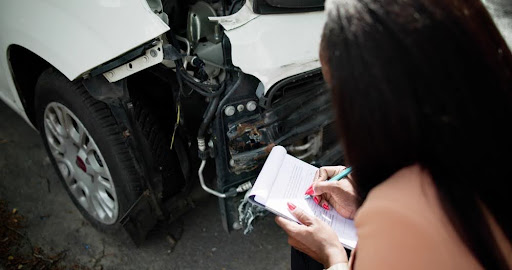
A damaged vehicle shows what happened after the impact, but it does not always explain why the collision happened. This is one reason investigators often examine the condition of the vehicle before the accident. They want to know whether the car was properly maintained and whether any mechanical problem may have influenced the events on the road.

This review does not mean a maintenance issue caused the crash. Instead, it helps investigators understand whether the vehicle was working as expected. Looking at the vehicle’s condition alongside the crash scene creates a clearer picture than relying on visible damage alone. Every detail becomes part of a larger timeline that helps explain what happened before, during, and after the collision.

Maintenance Records Can Fill the Missing Gaps

Maintenance records tell the story of how a vehicle has been cared for over the years. They can show whether routine servicing was completed on time and whether important repairs were handled before the accident occurred. These documents often provide helpful background that cannot be seen by simply looking at the damaged vehicle.

Records That Show Ongoing Vehicle Care

Several types of records may help explain a vehicle’s history:

  • Routine service records
  • Brake inspections and replacements
  • Tire replacement history
  • Repair invoices
  • Manufacturer recall repairs

These records help create a timeline of the vehicle’s condition and show whether regular maintenance was part of its ownership.

Records That May Prompt a Closer Review

Some records may also lead investigators to ask additional questions. Delayed repairs, repeated complaints about the same mechanical issue, missed maintenance appointments, or unfinished recall work do not automatically explain an accident. However, they may encourage investigators to examine whether those issues affected the vehicle before the collision. Every record becomes another piece of information that helps complete the overall picture.

Vehicle Condition Is Only One Piece of the Investigation

A vehicle’s maintenance history is important, but it is never reviewed by itself. Investigators compare these records with many other sources of information before reaching an understanding of the accident. Each source helps confirm or explain what another source may suggest.

Police reports describe the crash scene and the people involved. Photographs show vehicle damage, road conditions, and traffic signs. Witness statements provide different views of the collision. Vehicle inspections may identify mechanical conditions after the accident. Together, these details create a more complete explanation than any single record could provide.

This careful approach helps investigators avoid making assumptions. Looking at every available source allows them to understand how different pieces of evidence connect instead of depending on one document or one opinion.

Good Documentation Creates a Clearer Timeline

Keeping maintenance records organized may seem like a small task, but those records can become very helpful later. They show the sequence of inspections, repairs, and routine servicing throughout the life of the vehicle. A complete record often makes it easier to understand the condition of the car before the collision occurred.

Well-organized documents also reduce confusion. Instead of relying on memory, investigators can review written records that explain what work was completed and when it was performed. This creates a timeline that supports a careful and accurate review of the vehicle’s history.

Someone speaking with an experienced car accident lawyer may also learn that maintenance records are simply one part of a much larger investigation. They provide useful background, but they work best alongside other evidence collected after the accident.

Final Thoughts

A vehicle’s maintenance history does not answer every question after a car accident, but it can add valuable context to the investigation. Service records, repair documents, and inspection reports help explain how the vehicle was cared for before the collision and whether its condition deserves closer attention. These records are reviewed together with photographs, police reports, witness statements, and vehicle inspections to build a complete understanding of the accident. 

Every investigation depends on looking at the full picture instead of one single detail. Careful documentation and thoughtful review help create a clearer explanation of what may have contributed to the events on the road.

The Most Overlooked Losses That Can Increase Car Accident Compensation

Every accident leaves behind more than a damaged vehicle. Bills begin to arrive, work routines change, and daily life often becomes harder in ways that are easy to overlook at first. Many people focus only on the obvious costs and miss several losses that continue growing long after the crash. That is one reason why understanding car accident compensation requires looking beyond repair estimates and emergency medical bills. A complete picture often includes expenses and setbacks that do not appear immediately but still have a lasting effect.

The true cost of a serious collision is usually much bigger than expected. Some losses appear weeks later, while others slowly affect work, family responsibilities, and long-term recovery. Knowing what these overlooked damages are and how they should be documented can help people present a more complete claim instead of leaving important losses behind.

Overlooked Losses That May Increase Compensation

Many people think compensation only covers hospital bills and vehicle repairs. In reality, several additional losses may also become part of a claim if they are properly documented.

Future Medical Care

Some injuries require treatment long after the accident. Physical therapy, follow-up appointments, prescription medication, rehabilitation, or additional procedures may continue for months. These future medical costs can become a significant part of the overall claim.

Reduced Earning Ability

Missing a few days of work is only one part of the financial impact. Serious injuries may reduce a person’s ability to perform the same job or work the same number of hours. If the injury affects future income, that loss may also deserve careful consideration.

Personal Property Damage

Items inside the vehicle are often forgotten during the claims process. Damaged laptops, mobile phones, glasses, work equipment, child safety seats, or other personal belongings may also represent financial losses connected to the accident.

Ongoing Physical Pain

Physical discomfort sometimes continues long after visible injuries begin healing. Limited movement, chronic pain, and reduced physical ability may affect normal daily activities for an extended period.

Emotional Challenges

A serious crash can also affect emotional well-being. Anxiety while driving, difficulty sleeping, or emotional stress may become part of the overall impact of the accident depending on the circumstances.

How to Include These Losses in Your Claim

Identifying overlooked damages is only the first step. Supporting them with clear records often makes the claim stronger.

  • Keep every medical bill, receipt, and prescription record.
  • Save invoices for damaged personal belongings inside the vehicle.
  • Maintain records of missed work and reduced income.
  • Keep a journal describing pain levels, treatment progress, and daily limitations.
  • Attend all recommended medical appointments and follow treatment plans.
  • Organize photographs, repair estimates, and other documents connected to the accident.

Well-organized records often provide a clearer picture of how the accident affected every part of daily life instead of focusing on only the immediate expenses.

Factors That May Affect the Final Compensation Amount

Several factors influence how a claim is evaluated. Understanding these elements helps explain why compensation amounts often differ from one case to another.

Severity of the Injuries

More serious personal injuries generally require longer treatment and greater financial resources. Recovery time, permanent limitations, and future medical needs often become important parts of the overall evaluation.

Quality of Documentation

Medical records, receipts, employment records, repair estimates, photographs, and witness statements all help support the claimed losses. Strong documentation usually creates a more complete understanding of the damages.

Recovery Timeline

Some injuries improve quickly, while others require months of treatment. A longer recovery period may increase medical costs, lost income, and other accident-related expenses that become part of the overall claim.

Financial Impact

The overall financial effect goes beyond hospital bills. Ongoing therapy, transportation costs, household assistance, and other accident-related expenses may also influence the value of the claim if properly documented.

Looking at the Full Picture Matters

Every accident creates visible and hidden losses. Looking only at repair costs or emergency treatment may leave important damages out of the claim. Future medical care, reduced earning ability, damaged personal belongings, and ongoing physical or emotional challenges can all contribute to a more complete understanding of the accident’s impact. Taking time to document every loss carefully helps ensure that car accident compensation reflects not only the immediate expenses but also the lasting effects the collision continues to have on everyday life.

Why Automotive Spaces Need Smarter Equipment Zones

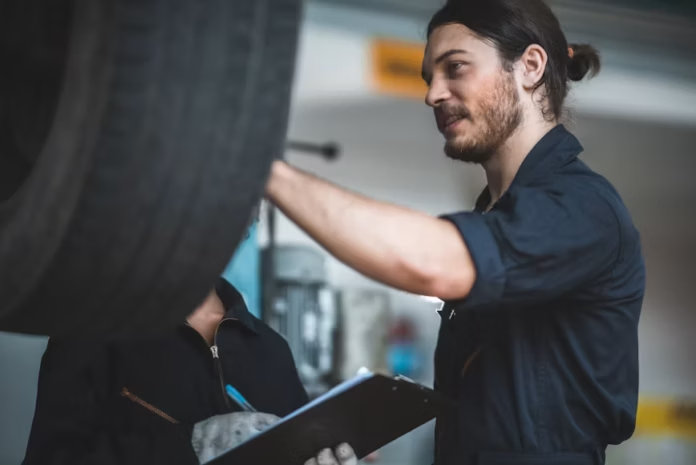
Photo by depositphotos at https://depositphotos.com/

An automotive workspace must accommodate vehicle movement, diagnostic work, component repairs, cleaning and equipment storage, often within a limited footprint. Treating the entire workshop as one general work area creates unnecessary movement and makes tools harder to control. Smarter equipment zones divide the space according to specific tasks, placing the right tools, safety measures and storage close to where each activity occurs.

Different Tasks Require Different Conditions

Automotive work is not a single process. Mechanical repairs may involve heavy tools and contaminated components, while electrical diagnostics require clean surfaces and sensitive instruments. Cleaning work introduces liquids or chemicals that should be kept away from electronics and open vehicle systems.

Equipment zones separate these conditions without disrupting the overall workflow. A diagnostics zone can remain clean and dry, while a fabrication or repair zone can provide the clearance, extraction and protective equipment required for heavier work. Such separation reduces cross-contamination and gives each task a more suitable working environment.

Planning each area also becomes easier when equipment is considered by function rather than as one large inventory. Product ranges available from specialist suppliers, including Mektronics automotive tools and workshop equipment, illustrate how diagnostic, cleaning, electrical and precision tools can be grouped around distinct workshop activities.

Shorter Tool Routes Save Working Time

Time is lost whenever technicians repeatedly walk across the workshop to collect instruments, accessories or consumables. The delay may appear minor, but it accumulates across multiple vehicles and technicians during a working day.

Smarter zones use point-of-use storage, meaning frequently needed equipment is positioned where it is most likely to be used. Test leads stay near the diagnostic station, cleaning supplies remain near the preparation area, and shared tools occupy an accessible central zone. Shorter tool routes allow technicians to maintain concentration and complete each stage with fewer interruptions.

Clear Boundaries Reduce Safety Risks

Automotive spaces contain moving vehicles, electrical systems, chemicals, hot equipment and trailing cables. When unrelated activities overlap, workers can encounter hazards that are difficult to anticipate or control.

Defined zones establish where equipment may be operated, stored and connected. A hot-work zone, for instance, can provide suitable ventilation, fire protection and clearance from flammable products. Battery testing can take place away from ignition sources, while mobile equipment can be returned to marked positions that do not obstruct walkways. Visible boundaries make safe procedures part of the physical layout.

Sensitive Equipment Needs Controlled Storage

Modern automotive diagnostics rely on multimeters, scan tools, oscilloscopes and inspection cameras. These instruments can produce unreliable readings or suffer damage when exposed to moisture, dust, impact or careless handling.

A dedicated electronics zone provides clean storage, stable benches and controlled access. It can also include electrostatic discharge protection for work involving exposed circuits and electronic modules. Keeping precision instruments together simplifies calibration tracking, accessory control and pre-use inspection, helping technicians confirm that equipment is ready before testing begins.

Defined Zones Improve Shared Workflows

Workshops often rely on tools shared between several technicians or service bays. Without assigned locations, equipment can migrate around the premises, leaving the next user unsure whether it is unavailable, misplaced or undergoing repair.

Equipment zones create a consistent system for issuing and returning shared items. Labels, marked storage positions and shadow boards show where each tool belongs and whether anything is missing. A predictable layout also helps new technicians become familiar with the workshop more quickly and supports consistent procedures across shifts.

Zoning Makes Limited Space More Productive

More equipment does not automatically create a more capable workshop. Poor placement can consume floor space, restrict access to vehicles and force technicians to move equipment before beginning work.

Smarter zoning matches storage to frequency of use, size and mobility. Wall systems can hold smaller tools, mobile stations can serve several bays, and fixed machines can occupy areas with the required power, ventilation and operating clearance. Every section of the workshop then has a defined purpose rather than becoming overflow storage.

Designing the Space Around the Work

Automotive spaces need smarter equipment zones because different tasks, tools and risks cannot be managed effectively within an unstructured layout. Purpose-built areas reduce travel time, protect precision instruments, strengthen safety controls and keep shared equipment accountable. When the workshop is organised around actual work processes, its equipment becomes easier to access, maintain and use correctly.

How Emergency Mobile Tyre Services Keep Businesses Moving

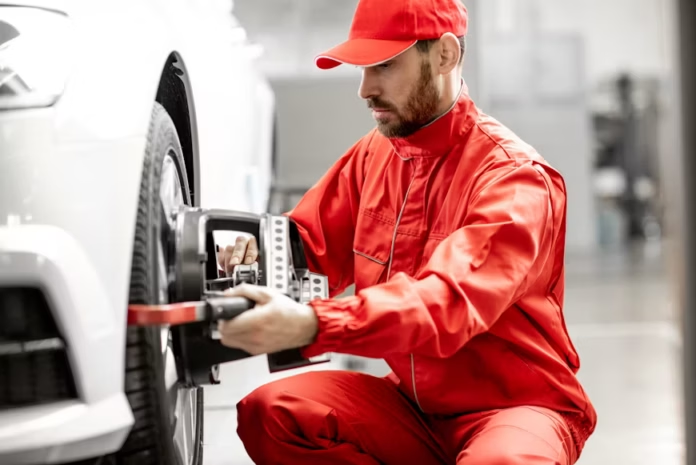
For businesses that rely on vehicles every day, an unexpected tyre problem can quickly disrupt operations. Whether it’s a delivery van, company car, or commercial vehicle, a flat tyre or blowout can lead to missed deadlines, delayed deliveries, and increased operating costs. Emergency mobile tyre fitting services provide a fast and convenient solution by bringing professional tyre repairs and replacements directly to the vehicle’s location.

Why Fast Tyre Assistance Matters

Time is money for businesses. Every minute a vehicle is off the road can affect productivity, customer satisfaction, and revenue.

Emergency mobile tyre services help businesses by:

  • Reducing vehicle downtime
  • Avoiding costly towing services
  • Keeping drivers on schedule
  • Minimising business interruptions

Quick roadside assistance ensures vehicles return to service as soon as possible.

Common Tyre Emergencies Businesses Face

Commercial vehicles travel long distances and often carry heavy loads, making tyre problems more likely.

Common emergencies include:

  • Flat tyres
  • Punctures
  • Tyre blowouts
  • Sidewall damage
  • Slow air leaks
  • Damaged valves

Professional mobile tyre technicians can diagnose the issue and provide an on-site repair or replacement where possible.

Benefits of Emergency Mobile Tyre Services

Minimise Downtime

Rather than waiting for a recovery truck or visiting a garage, mobile tyre technicians travel directly to the breakdown location. This helps businesses get vehicles back on the road quickly.

Improve Driver Safety

Changing a tyre on a busy road or motorway can be dangerous. Emergency mobile tyre services allow trained professionals to carry out the work safely using the correct equipment.

Support Business Continuity

For delivery companies, contractors, service engineers, and fleet operators, keeping vehicles operational is essential. Fast tyre assistance helps businesses maintain schedules and meet customer commitments.

Available 24/7

Tyre problems don’t always happen during business hours. Many emergency mobile tyre services operate around the clock, providing assistance during evenings, weekends, and public holidays.

Industries That Benefit Most

Emergency mobile tyre services are valuable for businesses that depend on reliable transportation, including:

  • Delivery and courier companies
  • Logistics and transport providers
  • Tradespeople and contractors
  • Taxi and private hire operators
  • Sales representatives
  • Fleet management companies

Having immediate tyre support helps these businesses avoid unnecessary delays and lost productivity.

Preventing Unexpected Tyre Problems

While emergency assistance is essential, routine tyre maintenance helps reduce the risk of breakdowns.

Businesses should:

  • Check tyre pressure regularly.
  • Inspect tyres for cuts and damage.
  • Monitor tread depth.
  • Rotate tyres at recommended intervals.
  • Schedule wheel alignment when needed.
  • Replace worn tyres before they become unsafe.

Combining preventive maintenance with emergency support creates a more reliable fleet.

Choosing the Right Emergency Mobile Tyre Service

When selecting a provider, businesses should look for:

  • 24/7 emergency availability
  • Fast response times
  • Mobile tyre repair and replacement
  • Experienced technicians
  • Coverage across major roads and motorways
  • Transparent pricing
  • Support for cars, vans, and commercial vehicles

A dependable provider ensures help is available whenever tyre problems occur.

FAQs

1. What is an emergency mobile tyre service?

An emergency mobile tyre service provides on-site tyre repair or replacement wherever your vehicle has broken down, whether at home, work, or on the roadside.

2. Can mobile tyre services repair all punctures?

Not all punctures can be repaired. Damage to the sidewall or severe tyre damage usually requires a full tyre replacement.

3. Are emergency mobile tyre services available 24/7?

Many providers offer 24-hour emergency tyre assistance, including evenings, weekends, and public holidays.

4. Which businesses benefit from emergency mobile tyre services?

Delivery companies, logistics firms, tradespeople, taxi operators, fleet managers, and any business that relies on company vehicles can benefit from fast roadside tyre assistance.

5. How can businesses reduce tyre-related breakdowns?

Regular tyre pressure checks, routine inspections, wheel alignment, tyre rotations, and replacing worn tyres on time can significantly reduce the risk of unexpected breakdowns.

How Mobile Tyre Fitting Makes EV Ownership Easier

Electric vehicles (EVs) are transforming the way people drive, offering lower running costs, quieter journeys, and reduced emissions. However, when it comes to tyre maintenance, EV owners have unique requirements. Mobile tyre fitting makes looking after an electric vehicle far more convenient by providing professional tyre services at your home, workplace, or roadside without the need to visit a garage.

Why EV Tyres Need Extra Care

Electric vehicles are generally heavier than petrol or diesel cars because of their battery packs. They also deliver instant torque, which places extra stress on the tyres during acceleration. As a result, EV tyres can wear faster if they are not properly maintained.

Many electric vehicles use specially designed tyres with stronger construction, lower rolling resistance, and improved noise reduction. These features help maximise driving range, provide better grip, and deliver a quieter driving experience.

The Convenience of Mobile Tyre Fitting

Instead of driving to a tyre centre and waiting for an appointment, a mobile tyre technician comes directly to your chosen location. Whether you’re at home, at work, or stranded on the roadside, the service allows you to have your tyres repaired or replaced without disrupting your day.

Mobile tyre fitting saves time, reduces inconvenience, and allows you to continue your schedule while trained professionals complete the work.

Professional Installation for Electric Vehicles

Electric vehicles require careful handling during tyre replacement. Professional mobile tyre technicians use the correct lifting points, specialist equipment, and manufacturer-approved fitting procedures to protect the vehicle.

The service typically includes tyre removal, fitting the new tyre, wheel balancing, tyre pressure checks, and tightening the wheel nuts to the correct torque specification. This ensures the vehicle remains safe, efficient, and comfortable to drive.

Emergency Tyre Assistance When You Need It

Tyre damage can happen unexpectedly, whether from a puncture, road debris, or a blowout. Mobile tyre fitting services can provide emergency assistance at your location, helping you avoid the need for vehicle recovery or towing.

Quick roadside tyre replacement gets you back on the road faster while reducing stress and unnecessary delays.

Helps Improve EV Performance

Correctly fitted and balanced tyres have a significant impact on an electric vehicle’s performance. Proper tyre maintenance improves handling, extends tyre life, enhances ride comfort, and helps maximise battery efficiency by reducing rolling resistance.

Keeping your tyres in excellent condition also contributes to safer braking and better overall driving performance.

Simple Tyre Maintenance Tips for EV Owners

To extend tyre life and maintain vehicle efficiency, you should regularly check tyre pressure, inspect tyres for cuts or uneven wear, monitor tread depth, rotate tyres according to the manufacturer’s recommendations, and replace worn tyres before they become unsafe.

These simple maintenance habits help improve safety, reduce long-term running costs, and keep your electric vehicle performing at its best.

Choosing the Right Mobile Tyre Fitting Service

When choosing a mobile tyre fitting provider, look for a company with experience servicing electric vehicles. A reliable provider should offer professional wheel balancing, emergency roadside assistance, high-quality tyre brands, flexible appointment times, and transparent pricing.

Selecting an experienced mobile tyre fitting service ensures your EV receives the correct tyres and expert installation whenever you need it.

FAQs

1. Can mobile tyre fitting be used for electric vehicles?

Yes. Professional mobile tyre fitting services are fully equipped to repair and replace tyres on most electric vehicle models.

2. Do electric vehicles require special tyres?

Many EVs use tyres designed for heavier loads, lower rolling resistance, and quieter operation to improve efficiency and performance.

3. Can a mobile technician balance EV wheels?

Yes. Most mobile tyre fitting services include professional wheel balancing as part of the tyre replacement process.

4. Is mobile tyre fitting available for emergency breakdowns?

Many providers offer emergency mobile tyre services, helping EV owners with punctures, blowouts, and damaged tyres at the roadside.

5. How often should EV tyres be checked?

Tyre pressure and condition should be checked at least once a month and before long journeys to maintain safety, efficiency, and tyre life.

North Wilkesboro Is Back, And So Is North Carolina’s Betting Money

Thirty years. That’s how long it’s been since North Wilkesboro Speedway hosted a NASCAR Cup Series race that actually counted for something. Jeff Gordon won the last one, in September 1996, holding off Dale Earnhardt in a race that closed out the track’s original 47-year run. Then the track’s owners took its two Cup dates and handed them to Texas Motor Speedway and New Hampshire Motor Speedway, and North Wilkesboro just sat there. Weeds grew through the asphalt. Grandstands rusted. For a while, rumor even had it that a Prohibition-era moonshine cave sat hidden somewhere under the frontstretch. Fans never fully let it go, though, and neither did the state. North Carolina put renovation money behind the track in 2021, Speedway Motorsports reopened it in 2022, and three years of All-Star races slowly built the case for something more permanent. The points were finally back. The fans filling those grandstands were sitting in the middle of one of the fastest-growing sports betting markets in the country, and that side of the story is moving just as fast as the cars.

A Market That Blew Past Its Own Math

State fiscal researchers figured legal sports betting would need three years to hit $6.6 billion in wagers after North Carolina legalized it in 2023. Bettors got there in one fiscal year. Lawmakers noticed. This summer, they raised the tax on licensed sportsbooks from 18 percent to 23 percent, a change signed off by Governor Josh Stein as part of the new state budget, with annual tax revenue now projected to clear $200 million. A chunk of that money already funds problem gambling programs and athletic departments at 13 UNC system schools, so every bet placed this weekend technically has a small ripple effect well beyond the sportsbook. For context, drivers just across the border in South Carolina still can’t legally place a mobile sports bet at all. Whatever anyone expected from North Carolina’s market three years ago, the numbers walked right past it.

Seven Books, One Loaded Weekend

Seven sportsbooks currently hold licenses in North Carolina, including bet365, Caesars, DraftKings, Fanatics, FanDuel, theScore Bet, and BetMGM, and a weekend like this is exactly when they compete hardest for new signups. NASCAR bettors aren’t just picking a winner, either. Stage winners, top-five finishers, head-to-head driver matchups, and manufacturer props all get plenty of action once a Cup weekend like this rolls around, so the operator with the sharpest odds and the friendliest new-account offer actually matters. Anyone shopping around before the green flag drops can compare current BetMGM promo codes with what other operators are running, since welcome offers shift constantly around marquee race weekends. Worth five minutes of comparing before locking anything in, especially with a points race this rare on the schedule.

Why This Track, Why Now

North Wilkesboro isn’t just an old track getting a ceremonial nod. Richard Petty won 15 races on this 0.625-mile oval, more than he won anywhere else in his career, and names like Earnhardt, Waltrip, Yarborough and Gordon all have wins here too. Part of what makes the track unique is baked into its layout: the frontstretch runs slightly downhill and the backstretch slightly uphill, an accident of the builder running short on money back in 1947 that gave the place its distinctive character. The Cup Series used the revived track for All-Star races the past few seasons, treating it as a test lab before committing to a real points date, and Sunday marks the first time those points actually count since 1996. Richard Childress and Rusty Wallace are both on-site for the pre-race driver introductions, a nod to just how much history NASCAR is leaning on for this comeback.

A Weekend Worth Watching, On And Off The Track

North Wilkesboro’s return is proof NASCAR still trusts its own history enough to bring a track back from the dead after 26 years of neglect. North Carolina, meanwhile, has become a state where betting slips move almost as fast as the cars, with regulators still adjusting the rules as the money keeps climbing. Neither comeback happened by accident, and neither one looks like it’s slowing down anytime soon.

A Star Is Born: Part-Timer Heim Makes History With Brickyard 400 Win

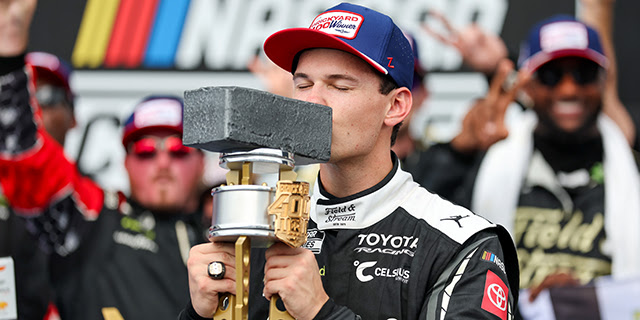
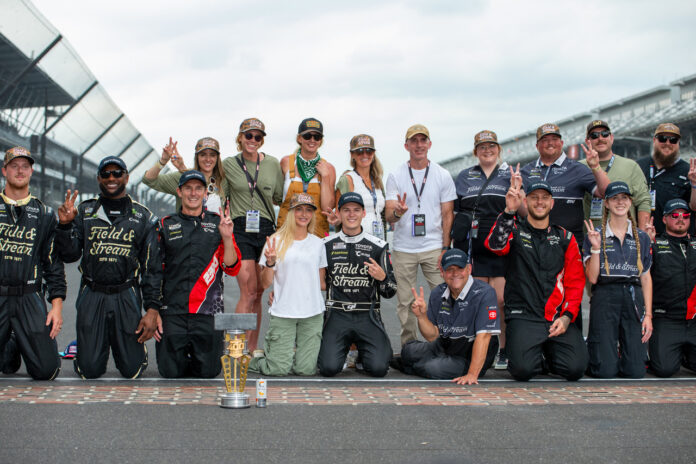
INDIANAPOLIS (Sunday, July 26, 2026) – Corey Heim stepped into Indianapolis Motor Speedway for the first time Friday. Two days later, he was celebrating on Victory Podium after an impressive drive to victory Sunday in the Brickyard 400 presented by PPG.

Part-time NASCAR Cup Series driver Heim, from Marietta, Georgia, took the lead in the No. 67 Field & Stream Toyota of 23XI Racing on a frantic restart on Lap 127 and held off Christopher Bell over the final 34 laps for victory in his first Brickyard start. This was just his 15th career Cup Series race.

A star is born.

“This is a dream come true, winning at the Brickyard,” Heim said. “That was unbelievable. Caught a break early with the pit cycle and just executed all day. Made no mistakes, my pit crew and my team.”

Heim, 24, won the 2025 NASCAR Craftsman Truck Series championship and is running a partial Cup Series season with 23XI Racing before joining the team full time in 2027. He became the first part-time driver to win this crown jewel NASCAR event and the second-youngest driver to win this race behind Jeff Gordon, who was 23 when he captured the inaugural Cup Series race at IMS in 1994. Gordon is the only other driver to win the Brickyard in his first start in the race.

This also was the second consecutive Brickyard victory for the 23XI team, co-owned by basketball icon Michael Jordan and Cup Series star Denny Hamlin. Bubba Wallace won last year for 23XI.

Bell finished second today in the No. 20 Rheem Toyota of Joe Gibbs Racing, .287 of a second behind Heim. Three-time Cup Series champion Joey Logano was third in the No. 22 Shell Pennzoil Ford of Team Penske.

Indiana native Chase Briscoe placed fourth in the No. 19 Mobil 1 Toyota of Joe Gibbs Racing, and Denny Hamlin placed three Joe Gibbs Racing cars in the top five in the No. 11 National Debt Relief Toyota.

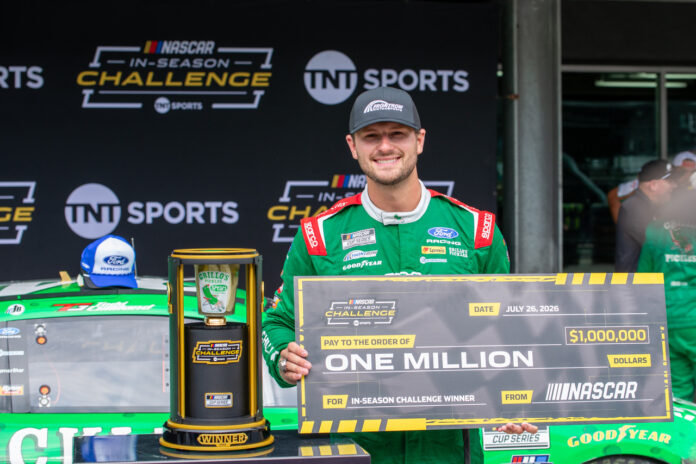
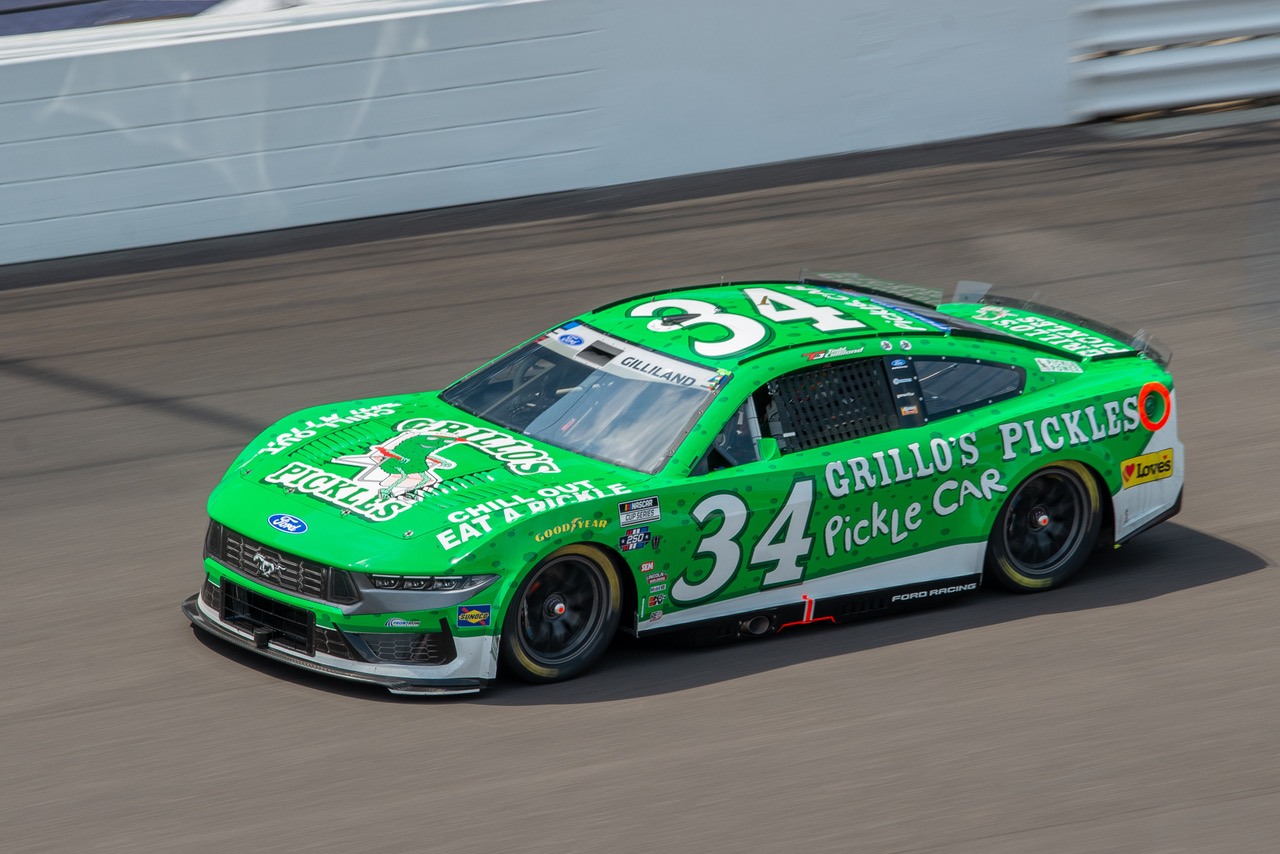
Todd Gilliland earned a $1 million bonus for winning the NASCAR In-Season Challenge. He placed 24th in the No. 34 Grillo’s Pickles Ford of Front Row Motorsports, edging the No. 12 Menards/Delta Ford of fellow Challenge finalist Ryan Blaney of Team Penske, who finished 26th.

The pivotal point of the 160-lap race came on the final restart on Lap 127. Hamlin led the field to the green flag on the inside line, with teammates Bell and Briscoe right behind. Heim started second, on the outside line with Logano behind him.

But the JGR line on the inside lane was scattered, with Hamlin, Bell and Briscoe not aligned nose-to-tail to possibly bump-draft and keep Hamlin out front. Meanwhile, Logano pushed Heim ahead of Hamlin on the outside in Turn 1.

Hamlin nearly edged even with Heim in Turn 2, but Heim slammed the door shut and kept a lead he would never surrender.

“It’s a fight to win the race, and when you’re clear by an inch, you’re going to take that inch,” Hamlin said. “It’s really more on us and the 20 (Bell) and the 19 (Briscoe) to just not orchestrate the good pushes there.

“I thought the 20 was obviously onboard with giving us the push. It was just way too early, before the restart zone. I can’t go until you get to the restart zone. He said that Briscoe was on him way, way early or laying back, one of the two. That’s how you lose them. These restarts, when everyone kind of knows when you’re going to go, it’s about the pushes. That’s how I got the lead from the 67 (Heim) on the restart before.”

But once he got out front, it was far from a Sunday stroll to victory for Heim, who also won earlier this season in the street race at San Diego.

Bell stayed within three- to four-tenths of a second of Heim for the next 30 laps. He pulled to within .164 of a second with two laps to go, pouring on pressure, but Heim padded that gap to .364 of a second with one lap to go and held on to a loose-handling race car on the final trip around the 2.5-mile oval to win.

“That was a damn handful,” Heim said. “I was hanging on for dear life once the shade went down and the pace picked up. My car got really loose. I had never really been in a lot of clean air throughout the day, so that was the hardest I’ve ever fought in my life to just make sure I focused on exits and kept them in dirty air. I’m pretty out of breath. That was a workout.”

Said Bell: “I didn’t think I was going to be able to get there at all. My guys were telling me he was going loose, and I knew that was going really be my only opportunity, was a mistake by him.

“I knew that 35 laps was a very long run. Man, I just needed one bobble. If he would have had one bobble, I was going to be able to get there. But he did a great job. He showed excellent mental toughness and put together 35 good laps.”

Heim, who started seventh, led four times for 58 laps, both race highs.

Pole sitter Carson Hocevar led the first 31 laps in the No. 77 Ziegler Auto Group Chevrolet of Spire Motorsports before making his first pit stop. But he never led thereafter and finished ninth.

Heim inherited the lead on Lap 41 by running long on the first pit cycle before Ty Gibbs took the top spot on Lap 45 in the No. 54 SAIA Freight + Logistics Toyota of Joe Gibbs Racing. Gibbs stayed there – also winning the first stage at the end of Lap 60 — until pitting on Lap 74, with Heim taking over the lead from Laps 75-91.

Ross Chastain won the second stage, which ended on Lap 100, in the No. 1 Busch Light Chevrolet of Trackhouse Racing. By that point, Heim had climbed back to fifth and jumped to third when leader Chastain and second-place Gilliland pitted on Lap 101.

Nearly the entire field pitted for their final stops on Lap 115 during a caution, and Heim’s earlier pit strategy paid dividends. His previous stop was on Lap 93, later than most of his rivals, so he needed less fuel and a shorter stop, giving him the lead as the field approached the restart on Lap 120.

Hamlin passed Heim on the outside of Turn 1 on that restart, but another caution flew almost immediately when John Hunter Nemechek’s No. 42 Pye-Barker Fire & Safety Toyota nudged Blaney into the Turn 3 wall. That set up the fateful final restart on Lap 127 where Heim took the lead for keeps.

KALITTA, TODD & ANDERSON RACE TO WINS AT MUCKLESHOOT CASINO RESORT NHRA NORTHWEST NATIONALS

  • Kalitta rolls to second straight TF win
  • Todd gets first FC win of 2026
  • Anderson goes back in PS points lead

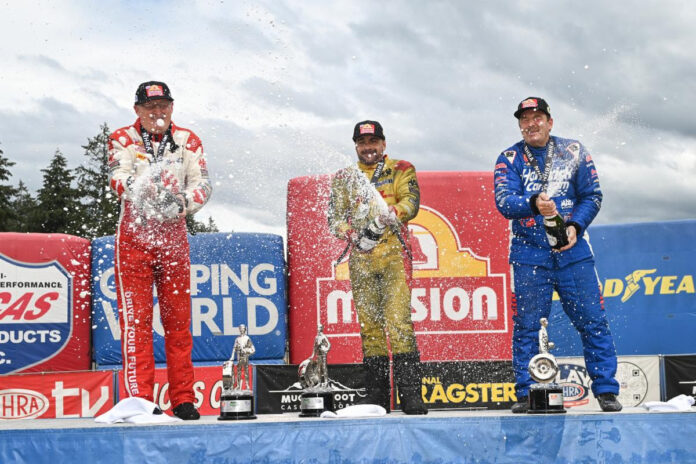
SEATTLE (July 26, 2026) – Funny Car’s J.R. Todd won for the first time in 2026 on Sunday at Pacific Raceways to finish off a Kalitta Motorsports nitro sweep with teammate Doug Kalitta, defeating back-to-back world champion Austin Prock in the final round of the 37th annual Muckleshoot Casino Resort NHRA Northwest Nationals.

Greg Anderson (Pro Stock) also won the 12th of 20 races during the 2026 NHRA Mission Foods Drag Racing Series season.

Todd snapped a 23-race winless streak when Prock went red in the final round, as the past world champion went 3.941-seconds at 334.90 mph in his 12,000-horsepower DHL Toyota GR Supra. It is Todd’s 23rd career victory and first since early 2025, and also his first Funny Car victory in Seattle.

Todd, who qualified No. 1, had a huge points day when it came to the regular season championship, defeating Jeff Arend, Jordan Vandergriff and Matt Hagan to reach the final round. Prock left early by .005, handing the victory to Todd, who had enjoyed a terrific season but had yet to win an NHRA 75th anniversary Diamond Wally.

That changed on Sunday and Todd is now right in the mix, moving to third in points after his impressive performance at Pacific Raceways.

“Dickie [Venables] and Todd [Smith, crew chiefs] did a really good job of racing smart today, not throwing down every run, just racing the conditions on the track,” Todd said. “I thought for sure we were in trouble there in the semis. I missed the Tree, which you can’t do against Matt Hagan because they’ll make you pay for it, and then I hit the gas and the thing is just out of control, but the win light came on. In the final, I saw Austin out front, and I was like ‘You’ve got to be kidding me.’ I thought that I was late and then the win light is on our side. It’s crazy, but I’m just so happy for my guys because they’ve been working their butts off.

“It’s definitely a big weight off our shoulders. I feel like we let a couple slip through the cracks there earlier in the year. Then we struggled the summer with some clutch disc issues. Now, I think that we’re getting back to where we need to be.”

Prock, the defending event winner, advanced to the final round for the second time this season and the 34th time in his career after getting round wins against Daniel Wilkerson, Dave Richards and Jack Beckman. Ron Capps, who lost in the first round for the second straight race, stayed in the points lead, but it’s now just 37 points over Jack Beckman and only 42 against Seattle winner Todd.

Top Fuel’s Doug Kalitta ensured a Kalitta Motorsports nitro sweep for just the second time ever, going a whopping 3.677 at 338.43 in his 12,000-horsepower Mac Tools dragster to slip past Leah Pruett’s 3.689 at 333.49.

A week after winning in Sonoma, Kalitta rolled to a second straight win, making three runs in the 3.60s on Sunday in Seattle. After qualifying third, he went 3.669 – the quickest run of the weekend – 3.690 and 3.726 to reach the finals, defeating Shawn Reed, Jasmine Salinas and Antron Brown in the process.

He led wire-to-wire against Pruett to capture his third victory of the season and the 62nd in his career. It’s also Kalitta’s second win in Seattle, 12 years after his first. More importantly, the reigning world champion has gotten hot at the ideal time for a second straight year, closing in on teammate Shawn Langdon. He’s now just five points outside of the lead in the race for the regular season title.

“Getting this double, I’m just so happy for Connie (Kalitta),” Kalitta said. “He’s given us everything we need, and obviously all the crew chiefs, everybody’s pulling together trying to help one another, and today’s a good result of that. I’m just real proud of our whole effort. I tell you, Connie’s had my back for years.

“Alan [Johnson, crew chief] has got the car dialed in. I feel very fortunate he’s working on my car. It took us a little bit to get it going this season. We obviously made a lot of changes and it’s coming together, and when you get down towards the end of the year, Alan’s got a lot of championships. This is really the time of the year he really focuses on and he always seems to be able to pull it off, so it’s going to be exciting.”

Pruett made her third final-round appearance in 2026 and the 28th in her career after defeating Will Smith, Justin Ashley and No. 1 qualifier Josh Hart.

In Pro Stock, Greg Anderson broke out of a recent slump in a major way on Sunday at Pacific Raceways, taking down Greg Stanfield in the final round after Stanfield went red. Anderson went 6.508 at 211.00 in his HendrickCars.com Chevrolet Camaro, avenging a recent stretch that included back-to-back first-round losses.

That wasn’t the case in Seattle, as Anderson moved back into the points lead, winning for the third time in 2026 and the 115th time in his career. After qualifying second, Anderson drove past Stephen Bell, Matt Latino and then longtime rival Erica Enders to reach the final round.

Stanfield, who won last weekend in Sonoma, went red by .008 to hand the victory to Anderson. It gives the six-time world champion four victories at Pacific Raceways and this was an important one after a rough two-race stretch. That now seems to be long gone as Anderson got back on the winning track – and at an ideal point in the season.

“I certainly didn’t have a lot of confidence when I came here today. We ran a lot better this weekend,” Anderson said. “My car was definitely better, but I could see, as everybody could see, Dallas Glenn had the car to beat, so to get by Dallas and everybody else out here, like Greg Stanfield, who’s on a roll, is really great.

“It’s just a cool class right now. The rest of the year is going to be cool. It’s going to be a real dogfight. I just feel fortunate to be part of it. I’m still alive. I apparently, somehow, took the [points] lead from Dallas today, so that’s pretty damn cool, and it just shows what can happen in this class.”

Stanfield was denied a second straight win, but advanced to the final round for the 30th time in his career after defeating his son, Aaron, Cody Anderson and defending event winner Dallas Glenn. Anderson’s points lead over reigning world champion is just eight points with two races left in the regular season.

The NHRA Mission Food Drag Racing Series returns to action Aug. 20-23 with the 44th annual NHRA Brainerd Nationals at Brainerd International Raceway in Brainerd, Minn.

KENT, Wash. — Final finish order (1-16) at the 37th annual Muckleshoot Casino Resort NHRA Northwest Nationals at Pacific Raceways. The race is the 12th of 20 events in the NHRA Mission Foods Drag Racing Series.

TOP FUEL:

  1. Doug Kalitta; 2. Leah Pruett; 3. Josh Hart; 4. Antron Brown; 5. Billy Torrence; 6. Justin

Ashley; 7. Tony Stewart; 8. Jasmine Salinas; 9. Shawn Reed; 10. Maddi Gordon; 11. Shawn Langdon; 12. Will Smith; 13. Tony Schumacher; 14. Clay Millican; 15. Krista Baldwin.

FUNNY CAR:

  1. J.R. Todd; 2. Austin Prock; 3. Jack Beckman; 4. Matt Hagan; 5. Jordan Vandergriff; 6. Paul Lee; 7. Cruz Pedregon; 8. Dave Richards; 9. Blake Alexander; 10. Tim Gibbons; 11. Jeff Arend; 12. Spencer Hyde; 13. Ron Capps; 14. Daniel Wilkerson; 15. Alexis DeJoria; 16. Chad Green.

PRO STOCK:

  1. Greg Anderson; 2. Greg Stanfield; 3. Dallas Glenn; 4. Erica Enders; 5. Cody Anderson; 6. Troy Coughlin Jr.; 7. Jeg Coughlin; 8. Matt Latino; 9. Matt Hartford; 10. Kenny Delco; 11. Eric Latino; 12. Aaron Stanfield; 13. Stephen Bell; 14. Chris Vang; 15. Mason McGaha; 16. Shane Tucker.

KENT, Wash. — Sunday’s final results from the 37th annual Muckleshoot Casino Resort NHRA Northwest Nationals at Pacific Raceways. The race is the 12th of 20 in the NHRA Mission Foods Drag Racing Series:

Top Fuel — Doug Kalitta, 3.677 seconds, 338.43 mph def. Leah Pruett, 3.689 seconds, 333.49 mph.

Funny Car — J.R. Todd, Toyota GR Supra, 3.941, 334.90 def. Austin Prock, Ford Mustang, Foul – Red Light.

Pro Stock — Greg Anderson, Chevy Camaro, 6.508, 211.00 def. Greg Stanfield, Camaro, Foul – Red Light.

Top Alcohol Dragster — Shawn Cowie, 5.207, 277.72 def. Joey Severance, 5.276, 272.34.

Top Alcohol Funny Car — Doug Gordon, Chevy Camaro, 5.420, 267.75 def. Brian Hough, Camaro, Broke.

Competition Eliminator — Ryan Warter, Pontiac Sunfire, 8.501, 153.53 def. Dustin Lee, Dragster, 7.056, 187.70.

Super Stock — Ty Gaynor, Chevy Cobalt, 9.150, 141.59 def. Brad Burton, Pontiac Firebird, 9.359, 136.34.

Stock Eliminator — Gary Gandee, Ford Mustang, 14.108, 91.64 def. Brad Burton, Pontiac Firebird, 10.663, 115.07.

Super Comp — Paul Nero, Dragster, 8.875, 180.67 def. Zach Meziere, Dragster, 8.874, 167.66.

Super Gas — Cooper Chun, Roadster, 9.889, 144.07 def. Steve Lowe, Pontiac Firebird, 9.876, 167.43.

Super Street — Dana Glenn, Truck, 10.938, 125.80 def. Dustin Ward, Dodge Dart, 10.955, 121.56.

Top Sportsman — Bryan Warr, Chevy Camaro, 6.758, 198.76 def. David Cook, Ford Mustang, 6.752, 200.95.

Top Dragster — Ty Gaynor, Dragster, 7.203, 170.45 def. Don Sefton, Dragster, 6.975, 187.18.

Junior Dragster Shootout — Zach Standeven, Mike Bos, 8.188, 73.30 def. Jaxson Gonzales, Halfscale, 9.005, 72.18.

KENT, Wash. — Final round-by-round results from the 37th annual Muckleshoot Casino Resort NHRA Northwest Nationals at Pacific Raceways, the 12th of 20 events in the NHRA Mission Foods Drag Racing Series:

TOP FUEL:

ROUND ONE — Antron Brown, 3.714, 333.08 def. Tony Schumacher, 4.530, 168.09; Jasmine Salinas, 3.759, 333.66 def. Clay Millican, 5.420, 131.43; Josh Hart, 3.670, 336.15 was unopposed; Billy Torrence, 3.720, 335.48 def. Krista Baldwin, 6.140, 106.87; Doug Kalitta, 3.669, 335.82 def. Shawn Reed, 3.694, 331.12; Justin Ashley, 3.732, 334.07 def. Shawn Langdon, 4.259, 190.16; Leah Pruett, 4.403, 261.07 def. Will Smith, 4.444, 307.51; Tony Stewart, 3.707, 334.73 def. Maddi Gordon, 3.727, 333.49;

QUARTERFINALS — Pruett, 3.692, 330.80 def. Ashley, 3.806, 307.58; Brown, 3.725, 329.99 def. Torrence, 3.745, 332.84; Hart, 3.834, 324.12 def. Stewart, 4.617, 178.52; Kalitta, 3.690, 332.75 def. Salinas, 4.987, 138.37;

SEMIFINALS — Pruett, 3.717, 332.51 def. Hart, 3.777, 331.61; Kalitta, 3.726, 334.57 def. Brown, 5.897, 109.57;

FINAL — Kalitta, 3.677, 338.43 def. Pruett, 3.689, 333.49.

FUNNY CAR:

ROUND ONE — Paul Lee, Dodge Charger, 3.938, 324.36 def. Chad Green, Ford Mustang, 10.346, 84.81; Austin Prock, Mustang, 4.899, 269.46 def. Daniel Wilkerson, Mustang, 6.936, 120.01; Jack Beckman, Chevy Camaro, 3.858, 333.49 def. Tim Gibbons, Charger, 4.019, 307.02; J.R. Todd, Toyota GR Supra, 3.906, 335.82 def. Jeff Arend, Charger, 4.019, 316.75; Dave Richards, Mustang, 4.540, 269.89 def. Alexis DeJoria, Camaro, 7.125, 90.01; Matt Hagan, Charger, 3.936, 326.00 def. Blake Alexander, Charger, 3.946, 326.00; Cruz Pedregon, Charger, 3.914, 330.63 def. Ron Capps, GR Supra, 5.812, 124.81; Jordan Vandergriff, Camaro, 3.913, 327.19 def. Spencer Hyde, Mustang, 4.397, 220.30;

QUARTERFINALS — Prock, 4.065, 270.48 def. Richards, 6.726, 95.23; Hagan, 3.930, 322.19 def. Lee, 4.002, 323.58; Beckman, 3.899, 330.72 def. Pedregon, 4.134, 255.15; Todd, 3.939, 334.40 def. Vandergriff, 3.981, 319.29;

SEMIFINALS — Todd, 3.913, 335.32 def. Hagan, 3.929, 324.98; Prock, 3.937, 327.66 def. Beckman, 3.918, 325.92;

FINAL — Todd, 3.941, 334.90 def. Prock, Foul – Red Light.

PRO STOCK:

ROUND ONE — Troy Coughlin Jr., Chevy Camaro, 6.520, 210.87 def. Kenny Delco, Camaro, 6.500, 209.23; Matt Latino, Camaro, 6.487, 210.08 def. Chris Vang, Camaro, 17.152, 49.71; Erica Enders, Camaro, 6.503, 210.28 def. Eric Latino, Camaro, 6.503, 210.31; Cody Anderson, Camaro, 6.500, 210.24 def. Shane Tucker, Camaro, Broke; Jeg Coughlin, Camaro, 6.500, 210.28 def. Matt Hartford, Camaro, 6.478, 211.46; Dallas Glenn, Camaro, 6.468, 210.93 def. Mason McGaha, Camaro, 20.709, 67.91; Greg Anderson, Camaro, 6.472, 210.05 def. Stephen Bell, Camaro, 6.514, 210.47; Greg Stanfield, Camaro, 6.486, 211.73 def. Aaron Stanfield, Camaro, 6.513, 211.20;

QUARTERFINALS — Enders, 11.001, 83.56 def. Coughlin, Foul – Red Light; G. Stanfield, 6.497, 210.60 def. C. Anderson, 6.505, 210.21; G. Anderson, 6.507, 209.98 def. M. Latino, 17.091, 47.07; Glenn, 6.485, 211.36 def. Coughlin Jr., Foul – Red Light;

SEMIFINALS — G. Anderson, 6.594, 209.95 def. Enders, 12.870, 66.89; G. Stanfield, 6.508, 211.03 def. Glenn, 6.514, 210.73;

FINAL — G. Anderson, 6.508, 211.00 def. G. Stanfield, Foul – Red Light.

KENT, Wash. — Point standings (top 10) following the 37th annual Muckleshoot Casino Resort NHRA Northwest Nationals at Pacific Raceways, the 12th of 20 events in the NHRA Mission Foods Drag Racing Series –

Top Fuel

  1. Shawn Langdon, 1,107; 2. Doug Kalitta, 1,102; 3. Leah Pruett, 898; 4. Antron Brown, 755; 5. Tony Stewart, 700; 6. Maddi Gordon, 681; 7. Josh Hart, 673; 8. Billy Torrence, 618; 9. Justin Ashley, 535; 10. Clay Millican, 489.

Funny Car

  1. Ron Capps, 884; 2. Jack Beckman, 847; 3. J.R. Todd, 842; 4. Jordan Vandergriff, 830; 5. Matt Hagan, 820; 6. Chad Green, 703; 7. Austin Prock, 687; 8. Alexis DeJoria, 685; 9. Spencer Hyde, 578; 10. Daniel Wilkerson, 577.

Pro Stock

  1. Greg Anderson, 1,020; 2. Dallas Glenn, 1,012; 3. Greg Stanfield, 862; 4. Matt Hartford, 804; 5. Erica Enders, 695; 6. (tie) Matt Latino, 681; Aaron Stanfield, 681; 8. Jeg Coughlin, 598; 9. Troy Coughlin Jr., 543; 10. Eric Latino, 498.
Corey Heim wins the Brickyard 400 for his second Cup career victory

Photo by Adam Lovelace for SpeedwayMedia.com.

Corey Heim reigned supreme for a second time in his brief NASCAR Cup Series career by etching his name as a Brickyard 400 champion, a feat in which he achieved at Indianapolis Motor Speedway (IMS) on Sunday, July 26.

The reigning Craftsman Truck Series champion from Marietta, Georgia, led four times for a race-high 58 of 160-scheduled laps in an event mired with various pit strategies and late on-track battles towards the front. Heim, who qualified in seventh place for his first Brickyard 400 career start, spent the opening laps racing within the top-10 mark and navigated through an early round of green-flag pit stop strategies and a one-lap shootout to conclude the first stage period by settling in the runner-up spot.

During the second stage period, Heim, who restarted alongside Ty Gibbs on the front row and was outdueled by the latter, proceeded to lead 17 laps as another cycle of pit stops ensued, in which Heim waited until Lap 91 to pit. As the pit stops from the field cycled through, Heim also cycled through to settle in fifth place at the second stage’s conclusion.

Heim then spent the first two restarts of the third and final stage period being outdueled by Toyota teammates Ty Gibbs and Denny Hamlin, the latter of which, with 41 laps remaining, resulted in Heim nearly getting turned by Joey Logano entering the first turn. Then during the final restart with 34 laps remaining, Heim capitalized by receiving a strong push from Logano to fend off Hamlin and assume the lead through the first two turns. Amid loose conditions, Heim then spent the event’s remainder fending off Christopher Bell and Logano through every turn and straightaway to notch his first crown jewel victory in NASCAR’s premier series and notch another win as a part-time competitor for 23XI Racing.

With on-track qualifying that determined the starting lineup occurring on Saturday, July 25, Carson Hocevar notched his second pole position of the 2026 season and the third of his career with a pole-winning lap at 186.598 mph in 48.232 seconds. Teammate Daniel Suarez qualified in second place with a lap at 186.382 mph in 48.288 seconds.

When the green flag waved and the event commenced, pole-sitter Carson Hocevar, who elected to start on the inside lane, bolted his No. 77 Zeigler Chevrolet Camaro ZL1 entry ahead of teammate Daniel Suarez and the field through the first turn. As Hocevar led for a full circuit around Indianapolis Motor Speedway, a bevy of on-track action ensued as the field fanned out through the backstretch. Amid the early battles, Hocevar led the first lap by seven-tenths of a second over Suarez while Tyler Reddick, Denny Hamlin, Ty Gibbs and the rest of the field followed suit.

Over the next four laps, Hocevar stretched his early advantage to as high as two-and-a-half seconds over Suarez while Reddick, Hamlin, Gibbs, Corey Heim and Kyle Larson trailed by as far back as five seconds, respectively. Meanwhile, Michael McDowell, AJ Allmendinger and Alex Bowman occupied the remaining top-10 spots ahead of Cole Custer, Ryan Blaney, Chase Briscoe, Chris Buescher and William Byron while Erik Jones, John Hunter Nemechek, Brad Keselowski, Riley Herbst and Austin Dillon were racing in the top 20, respectively. Meanwhile, Bubba Wallace, the reigning Brickyard 400 winner, was mired in 29th place. Chase Elliott was racing in 25th place ahead of Shane van Gisbergen, and Christopher Bell occupied 22nd place ahead of Joey Logano. In addition, Todd Gilliland, who was battling Blaney for the $1 million bonus for the In-Season Challenge title, was racing in 34th place while Hocevar continued to lead the event by more than two seconds at the Lap 10 mark.

Through the Lap 15 mark and with the field scattered, Hocevar stabilized his advantage to two-and-a-half seconds over Suarez, with third-place Reddick and fourth-place Hamlin both trailing by three seconds. Behind, fifth-place Ty Gibbs trailed by five seconds, and both Heim and Larson, both of whom raced in sixth and seventh, respectively, trailed the lead by six seconds while McDowell, Allmendinger and Bowman all continued to race in the top 10.

By Lap 18, Austin Dillon, who had been slowly dropping towards the rear after starting in 20th place, made a pit stop to have a flat tire on his No. 3 BREZTRI Chevrolet Camaro ZL1 entry addressed under green, which cost him a lap. Amid Dillon’s early issues, Hocevar retained the lead by more than two seconds by Lap 20 before Elliott, who was mired within the top-25 mark, pitted his two laps later under green. With Ty Dillon also pitting, Hocevar had his advantage over Suarez shrink to six-tenths of a second at the Lap 25 mark.

On Lap 26, Chase Briscoe, who was racing in 14th place, pitted under green. Hendrick Motorsports’ Byron and Larson pitted their respective Chevrolet entries over the next two laps. Of all the competitors who pitted early, Larson was the only competitor who managed to blend back on the racetrack ahead of Hocevar and remain on the lead lap. As Ty Gibbs and Ricky Stenhouse Jr. pitted their respective entries, Hocevar continued to lead by half a second over Hocevar on Lap 30 before more names like Michael McDowell and Allmendinger pitted during the next lap.

The leader, Hocevar, then pitted under green on Lap 32 as Suarez was being challenged by Reddick and Hamlin for the lead, with the trio trying to also navigate around the lapped competitor of Byron. Suarez then pitted during the next lap and surrendered his brief lead to Hamlin. Prior to Suarez’s pit service, he locked up his front tires to have his racing pace reduced and avoid the penalty of driving through pit road for a second time due to speeding.

Just past the Lap 35 mark, Hamlin, who has yet to pit, was leading by half a second over Tyler Reddick, Corey Heim, Bowman and Cole Custer while Blaney, Buescher, Erik Jones, John Hunter Nemechek and Brad Keselowski occupied the top-10 mark, respectively. As more names that included Noah Gragson and Keselowski pitted, a bevy of names that included Cole Custer, Alex Bowman, Chris Buescher, Ross Chastain and Connor Zilisch all pitted nearing the No. 39 mark. Hamlin then surrendered the lead on Lap 40 to pit under green before Todd Gilliland, Reddick, Blaney, Bell, Ryan Preece, Bubba Wallace, Logano, Erik Jones and Zane Smith pitted their respective entries. By then, the top-four competitors that included Heim, John Hunter Nemechek, Josh Berry and Austin Cindric were leading the field while Larson, the first competitor to cycle through following the green flag pit stops, was in fifth place ahead of Gibbs, Hocevar and Suarez.

As Nemechek, Berry and Cindric pitted by Lap 43, Heim pitted from the lead during the next lap. Then just as Larson was about to cycle to the lead in his No. 5 HendrickCars.com Chevrolet Camaro ZL1 entry, his event came to an abrupt end on Lap 44 when he blew a left-rear tire and wrecked backward against the Turn 3 outside wall. Larson’s incident allowed Gibbs to cycle through as the leader while Hocevar, Heim, Suarez and McDowell were scored in the top five, respectively.

During a one-lap shootout to conclude the first stage period, Gibbs fended off the field for a full cycle to notch his fifth Cup stage victory of the 2026 season on lap 50. Heim settled in second place ahead of McDowell, Hocevar and Byron while Hamlin, Suarez, Briscoe, Buescher and Reddick were scored in the top 10, respectively. By then, 34 of 39 starters were scored on the lead lap. During this stage break period, Briscoe, Chastain, Preece, Gilliland, Austin Dillon and Byron pitted while the rest led by Gibbs remained on the track.

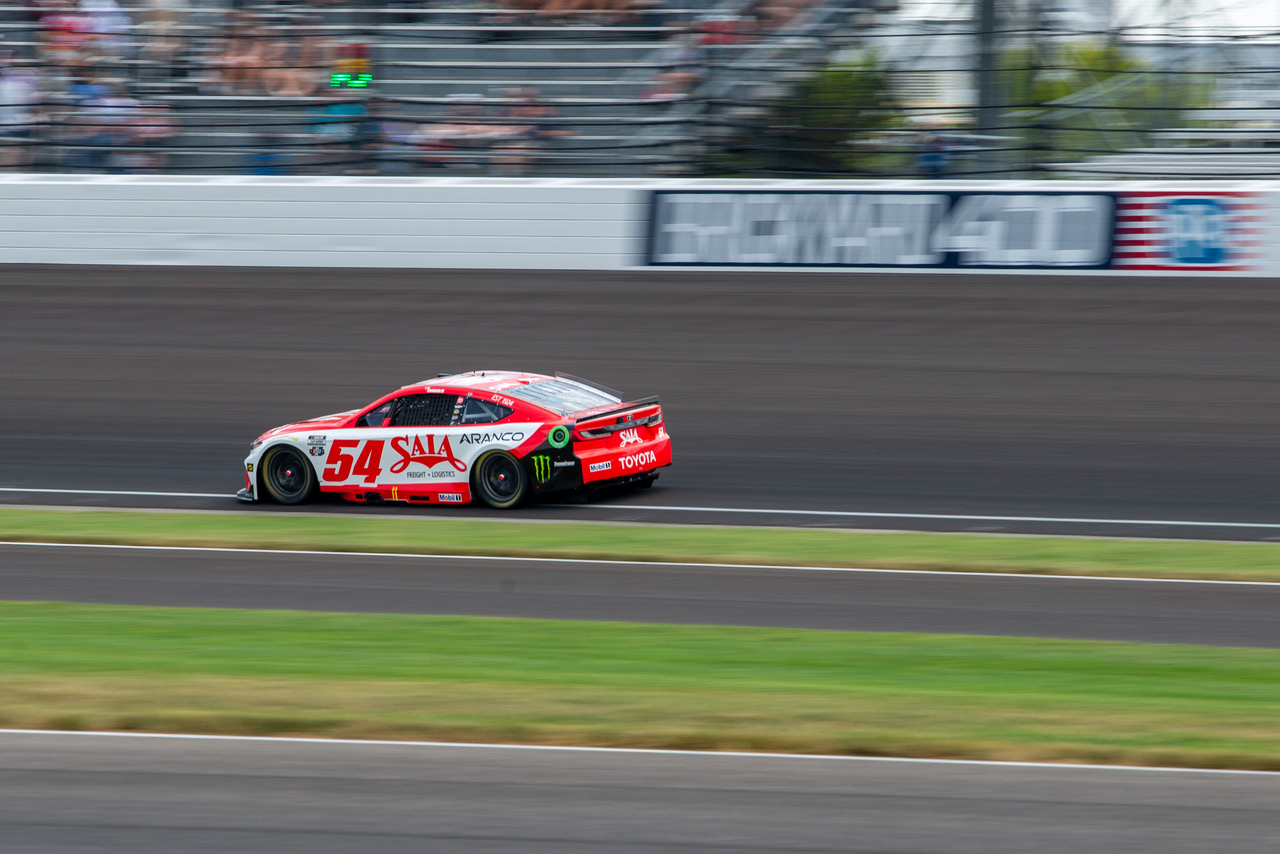
No. 54
Photo by Adam Lovelace for SpeedwayMedia.com.

The second stage period started on Lap 55 as Gibbs and Heim occupied the front row. At the start, Gibbs motored his No. 54 SAIA Toyota Camry XSE entry ahead with the lead from the inside lane as McDowell overtook Heim to assume the runner-up spot through the first turn. As the field fanned out through the backstretch before navigating through the third turn, all competitors kept their entries racing straight for a full cycle as Gibbs led the next lap. With a bevy of on-track battles and shuffling ensuing within the midfield region, the front-runners scattered while racing in single-line formation as Gibbs stretched his lead to two seconds at the Lap 60 mark. Meanwhile, Elliott limped his No. 9 NAPA Chevrolet Camaro ZL1 entry to pit road with a flat right-rear tire after he made contact with Ricky Stenhouse Jr. through the backstretch. The incident and damage were enough to terminate Elliott’s hopes of achieving his first Brickyard 400 victory as he nursed his entry to the garage for repairs.

Through the Lap 70 mark, Gibbs extended his lead to more than three seconds over both McDowell and Heim while Hocevar and Hamlin trailed by four seconds inside of the top-five mark. Behind, Buescher and Reddick trailed by more than five seconds in sixth and seventh, respectively, while both Cole Custer and Brad Keselowski were mired more than six seconds behind while racing in eighth and ninth, respectively. Suarez occupied 10th place in front of Bowman, Logano, Blaney, Nemechek, Bell, Zane Smith, Berry, Erik Jones, Riley Herbst and Bubba Wallace before Suarez strategically pitted under green three laps later. Teammate McDowell pitted from the runner-up spot a lap later before Gibbs surrendered the lead to pit another lap later.

At the event’s halfway mark on Lap 80, Heim, who cycled to the lead after Gibbs pitted, continued to lead by less than three seconds over Hocevar while Hamlin, Buescher, Reddick, Custer, Keselowski, Bowman, Logano and Blaney trailed in the top 10 ahead of Nemechek, Bell, Zane Smith, Berry, Herbst, Wallace, Allmendinger, Connor Zilisch, Shane van Gisbergen and William Byron, respectively. By then, 30 of 39 starters were scored on the lead lap, with Gibbs managing to remain on the lead lap following his pit stops, while McDowell, Erik Jones, Suarez and Ty Dillon, all of whom pitted, were mired a lap down.

By Lap 82, Hocevar and Buescher pitted from the front of the field under green. Following their pit stops, the latter two competitors were lapped by Heim, who has yet to pit, while Connor Zilisch had pitted a lap earlier. Hamlin then pitted from the runner-up spot on Lap 84 and he managed to blend ahead of Heim to remain on the lead lap while Heim was trying to fend off Hocevar to keep the latter a lap behind.

Then, as more names that included Keselowski, Bowman, Herbst, Byron, Allmendinger, Casey Mears, Custer, Reddick, Zane Smith, Logano, Blaney, Bell, Wallace, van Gisbergen and Stenhouse pitted just past the Lap 90 mark, Heim surrendered the lead to pit on Lap 91. During Heim’s entrance to pit road, Hocevar, who was mired behind Heim and unable to un-lap himself, briefly pulled alongside Heim and gave him an obscene gesture for being raced competitively by rival Heim before motoring ahead to cycle back on the lead lap. Heim’s pit stop allowed Nemechek, who was among selected competitors who have yet to pit, to cycle to the lead while Heim, who had a slow pit service, was quickly overtaken by Gibbs and Hamlin on the track. Berry, Cindric and Gragson pitted over the next handful of laps, along with Briscoe and Austin Dillon, while Preece, who had yet to pit, led. By then, Gibbs, Hamlin and Heim cycled up from fourth to sixth on the track, respectively.

Then on Lap 96, the caution flew when Daniel Dye spun and wrecked his No. 78 Champion Container Corporation Chevrolet Camaro ZL1 entry backward in Turn 3. At the moment of the caution, Preece had just pitted while Chastain and Gilliland, both of whom have yet to pit, occupied the top-two spots. This caution period concluded the second stage period that was scheduled to conclude on Lap 100. As a result, Chastain was awarded his fourth Cup stage victory of the 2026 season. Gilliland settled in second ahead of Gibbs, Hamlin and Heim while Hocevar, Preece, McDowell, Erik Jones and Suarez were scored in the top 10, respectively. By then, 32 of 39 starters were scored on the lead lap. During the event’s second stage break period, the leaders Chastain and Gilliland pitted along with Allmendinger, Chastain, Ty Dillon, Zilisch and Austin Hill while the rest led by Gibbs remained on the track, with Gibbs cycling back as the leader.

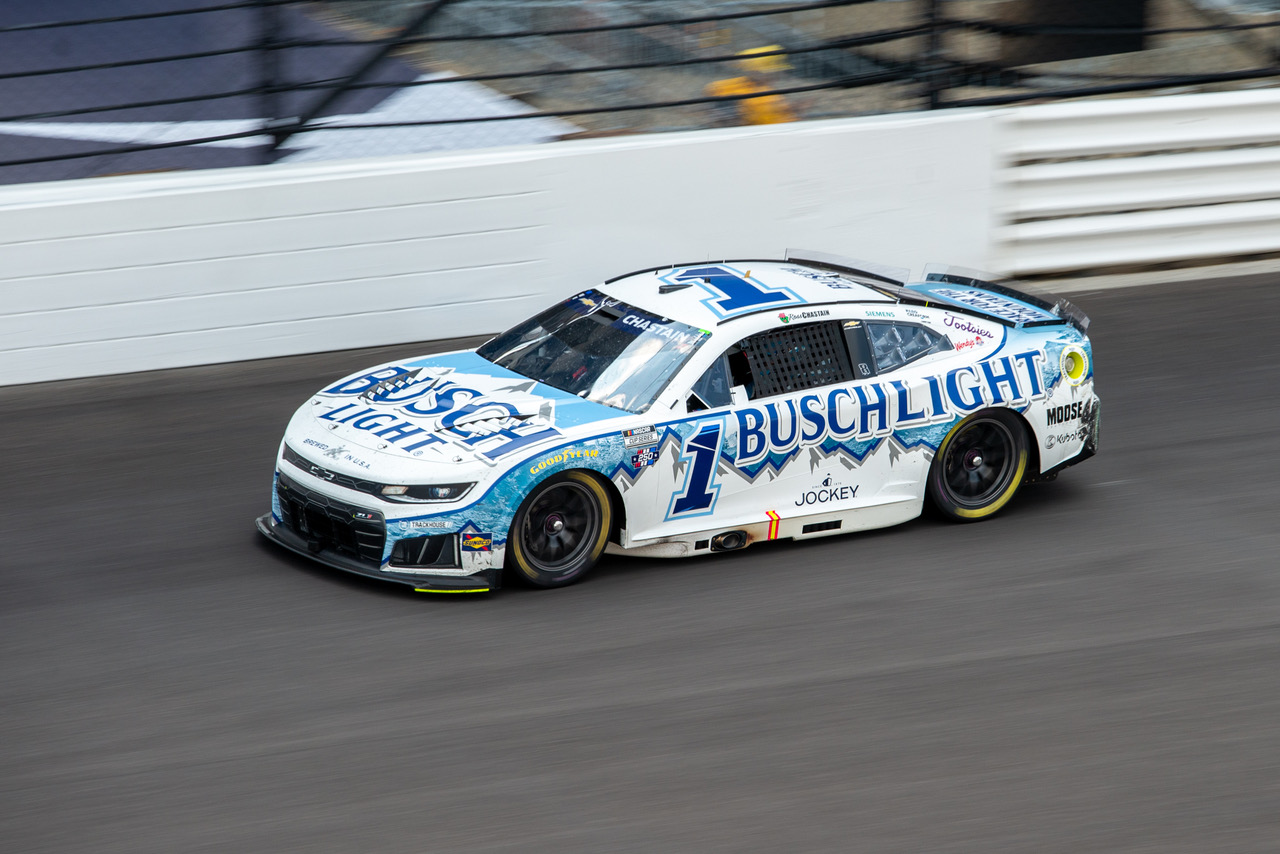
No. 1
Photo by Adam Lovelace for SpeedwayMedia.com.

With 56 laps remaining, the final stage period commenced as Gibbs and Heim occupied the front row in front of Hamlin, Preece, Hocevar, Jones and the field. At the start, Gibbs motored ahead of the field from the inside lane for a second consecutive restart while Hamlin and Heim battled dead even for the runner-up spot through the first two turns. As Hamlin grabbed the runner-up spot, Heim fended ff Hocevar to retain third place. Amid the battles within the field, Gibbs led the next lap. The field scattered as most raced in single-line formation over the following four laps as Gibbs led a hard-charging Hamlin by four-tenths of a second with 50 laps remaining. Behind, Heim, Hocevar and Preece were in the top five ahead of McDowell, Jones, Suarez, Buescher and Keselowski, respectively.

During a caution that flew with 46 laps remaining due to debris on the track, the entire field led by Gibbs pitted for service with the fuel window to reach the event’s scheduled distance remaining tight amongst the field, including the leaders. Following the pit stops and with mixed pit strategies ensuing, Heim, who pitted for two fresh tires, beat Hamlin off of pit road first to assume the lead. Logano, Bell, Briscoe, Reddick, Keselowski, Buescher, Preece and Bowman all followed suit by either opting for a two-tire pit service or fuel only while Hocevar, who pitted for fours tires, was mired back in 12th place. In addition, Gibbs exited pit road in 14th place. Amid the pit stops, Wallace overshot his pit box and ran over three of his pit crew members, which cost him a bevy of spots.

The next restart with 41 laps remaining featured Heim and Hamlin on the front row, where Hamlin, who had teammate Bell behind him, gained the upper hand and drove his No. 11 National Debt Relief Toyota Camry XSE entry ahead with the lead while Heim briefly had his momentum stalled to fend off a left-handed move by Logano amid brief contact. Reddick and Keselowski then briefly made contact entering the second turn while battling for seventh place. This caused the field to fan out and stack up through the backstretch while jostling for spots.

Then as the full-fledged field continued to stack up, the caution returned when Nemechek made contact and sent Blaney’s No. 12 Menards Ford Mustang Dark Horse entry for a spin as the latter two made contact with the outside wall in Turn 3. As the field scattered, Austin Hill turned Allmendinger while Herbst spun while getting by Casey Mears in the process, while the rest, including Gilliland, dodged the carnage. Amid the carnage, Hamlin was scored the leader ahead of Heim, Bell, Logano and Briscoe while Reddick, Keselowski, Preece, Berry and Hocevar were scored in the top 10. In addition, Blaney, whose damage to his entry was primarily on the right-front area, managed to continue.

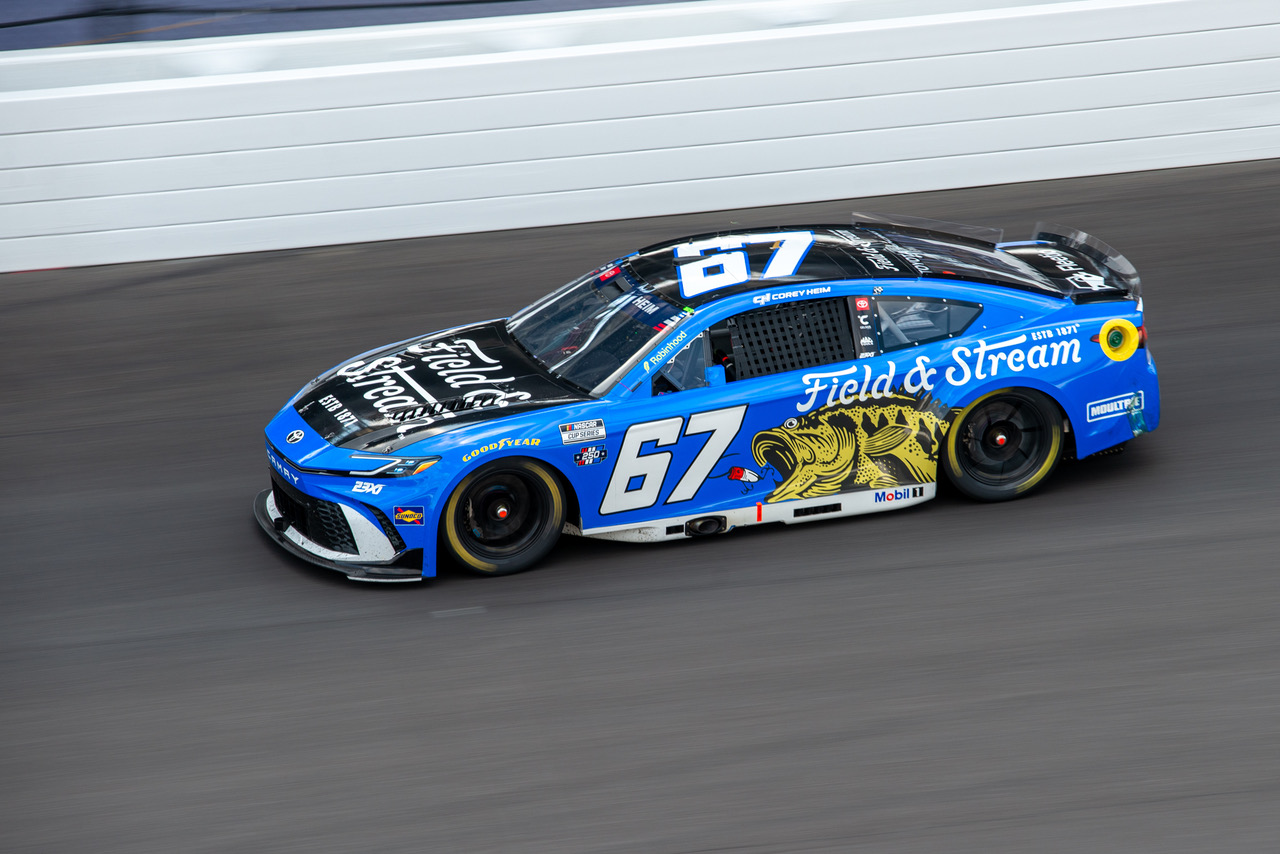
For the next restart with 34 laps remaining, Heim capitalized on a push from Logano on the outside lane to motor the No. 67 Field & Stream Toyota Camry XSE entry ahead of Hamlin, who did not receive a push from teammate Bell from behind, with the lead through the first turn. As Hamlin tried to make a move beneath Heim, the latter blocked and stalled Hamlin’s momentum, which allowed Heim to retain the lead through the second turn and entering the backstretch. As Heim led, Bell overtook Hamlin for the runner-up spot while Hamlin fended off Logano amid a side-by-side battle before they entered the third turn. As the field fanned out while jostling for late spots, Heim led the next lap over Bell and Logano while Briscoe overtook Hamlin for fourth place. Over the next three laps, the field scattered and settled in single-line formation as Heim retained the lead by seven-tenths of a second over Bell while Logano, Briscoe, Hamlin, Keselowski, Berry, Preece, Reddick and Buescher followed suit in the top 10, respectively.

Down to the final 25 laps of the event, Heim’s lead stood at four-tenths of a second over a hard-charging Bell while Logano trailed in third place by two seconds. Behind Logano, Briscoe and Hamlin trailed by within a second of Logano while Keselowski, Berry, Preece, Reddick and Buescher continued to race in the top-10 mark ahead of Hocevar, Gibbs, Custer, Cindric, Zane Smith, van Gisbergen, Suarez, McDowell, Bowman and Stenhouse, respectively. Meanwhile, Gilliland was leading the In-Season Challenge by racing in 24th place and being three spots ahead of Blaney, with Allmendinger and Wallace being mired in between the In-Season Challenge finalists.

Five laps later, Heim, who was battling loose conditions, managed to stabilize his lead to two-tenths of a second over Bell, and Logano continued to occupy third place while trailing the lead by less than two seconds. Behind, Briscoe occupied fourth place by two-tenths of a second over Hamlin as Keselowski, Berry, Preece, Reddick and Buescher settled in the top 10. Meanwhile, Gilliland retained 24th place and was two spots ahead of Blaney and Logano, who were notching fast lap times compared to the two leaders and started to reel in on both Heim and Bell. As the event reached its final 15-lap mark, Logano trailed the lead by only a second while Heim continued to lead by three-tenths of a second over Bell.

With 14 laps remaining, the top-three competitors of Heim, Bell and Logano were racing within nine-tenths of a second of one another as Logano continued to methodically reel in the two leaders in his No. 22 Shell/Pennzoil Ford Mustang Dark Horse entry. Amid Logano’s late charge, he continued to trail the lead by eight-tenths of a second, but he was within four-tenths of a second behind Bell while the leader Heim remained ahead of Bell by four-tenths of a second during the final 10-lap mark.

As the laps dwindled, Gilliland, who was in 24th, remained ahead of Blaney, who was 26th and mired behind Allmendinger on the track, for the $1 million bonus for the In-Season Challenge. In addition, Briscoe and Hamlin trailed the lead by more than six seconds and Logano was behind by seven-tenths of a second in third place. Meanwhile, Heim kept the lead by three-tenths of a second over Bell’s No. 20 Rheem Toyota Camry XSE entry.

When the white flag waved and the final lap started, Heim, who fended off a brief move by Bell from the outside lane entering the first turn as Bell tried to execute a pass to the right side of Heim with a strong reel, but lost his momentum, remained in the lead by three-tenths of a second over Bell while Logano trailed in third place. With the latter two unable to reel in the deficit, Heim navigated his way through IMS smoothly for a final time before he streaked back to the frontstretch and won by two-tenths of a second.

With the victory, Heim became the 145th competitor overall to achieve multiple NASCAR Cup Series wins and the first to notch first two career victories within 15 starts since AJ Foyt between 1964-65. The Georgian also became the 21st competitor overall to win a Cup event at Indianapolis Motor Speedway and the first to record a second Cup career victory in the Brickyard 400 since Jeff Gordon achieved the previous feat during the inaugural event in 1994.

As added bonuses, Heim recorded the 16th Cup Series career victory and a second consecutive Brickyard 400 win for 23XI Racing, with the organization’s No. 67 Toyota team led by veteran crew chief Robert ‘Bootie’ Barker achieving a second win with Heim through eight starts. Heim’s remaining Cup starts of this season with the No. 67 team are at Daytona International Speedway (August 29), Darlington Raceway for the Southern 500 (September 6), Charlotte Motor Speedway (October 11) and the season-finale event at Homestead-Miami Speedway (November 8) before he goes full-time Cup racing with 23XI Racing in 2027.

No. 67
Photo by Adam Lovelace for SpeedwayMedia.com.

“That was a damn handful,” Heim said on the frontstretch on TNT Sports. “I was hanging on for dear life once the shade went down and the pace picked up. My car got really loose and I’d never really been in a lot of clean air throughout the day. That was the hardest I’ve ever fought in my life to just make sure I focused on exits and kept [Bell and Logano] in dirty air.”

“I’m pretty out of breath,” Heim added. “That was a workout, but this is a dream come true. Winning at the Brickyard. That is unbelievable. [I] Caught a break early with the pit cycle and just executed all day. Made no mistakes. My pit crew and my team, 23XI [Racing], did a fantastic job of my Field of Stream Camry. First race [with Field of Stream], first win, so hopefully, we can keep it going.”

Christopher Bell, whose previous best result in the Brickyard 400 was fourth, settled in second place while Joey Logano, who made his 15th Brickyard start, settled in third place while coming up nine-tenths of a second shy of winning the event for the first time ever.

“Honestly, I didn’t think I’d be able to get there at all,” Bell said. “My guys were telling me [Heim] was going loose, and I knew that was going to be my only opportunity was going to be a mistake from him. I just needed one bobble. If he would have had one bobble, I was going to be able to get there. He did a great job. He showed excellent mental toughness and put together 35 really good laps, and I didn’t have the opportunity. This is a good second place. We’ve had a lot of bad second-place finishes, but this one is a good one.”

“We’ve been so close to winning here for years now, and it’s great,” Logano added. “You want to be up front at a crown jewel event. We just got there too late. We had good momentum coming into the weekend. I’m proud of the team giving me good race cars. On the last run, we were the winning car. We just have to get there. Just too hard to do it. Just get stuck in the dirty air. Started too far back and scratched and clawed all day to finally have a chance at the end. You’ve got to be on the front row for the final restart at Indy and wasn’t able to be there…Still feel like you have to make the move.”

Teammates Chase Briscoe and Denny Hamlin settled in fourth and fifth in the final running order after trailing the lead by five and six seconds, respectively. Brad Keselowski, Josh Berry, Ryan Preece, Carson Hocevar and Tyler Reddick completed the top 10 in the final running order. Notably, Todd Gilliland achieved the 2026 In-Season Challenge title after finishing in 24th place and being two spots ahead of his final opponent, Ryan Blaney. In addition, Ty Gibbs clinched a Chase berth by finishing in 12th place while Bubba Wallace, the reigning Brickyard 400 winner, settled in 28th place.

The 2026 Brickyard 400 featured 15 lead changes for 11 different leaders, and five cautions for 27 laps. In addition, 31 of 39 starters finished on the lead lap.

Following the 22nd event of the 2026 NASCAR Cup Series season, Denny Hamlin continues to lead the regular-season standings by 84 points over Tyler Reddick, 120 over Ryan Blaney, 135 over Ty Gibbs and 248 over Carson Hocevar.

Results:

  1. Corey Heim, 58 laps led
  2. Christopher Bell
  3. Joey Logano
  4. Chase Briscoe, one lap led
  5. Denny Hamlin, 14 laps led
  6. Brad Keselowski
  7. Josh Berry, one lap led
  8. Ryan Preece, one lap led
  9. Carson Hocevar, 31 laps led
  10. Tyler Reddick, one lap led
  11. Chris Buescher
  12. Ty Gibbs, 46 laps led, Stage 1 winner
  13. Cole Custer
  14. Austin Cindric
  15. Zane Smith
  16. Shane van Gisbergen
  17. Daniel Suarez, one lap led
  18. Michael McDowell
  19. Alex Bowman
  20. Ricky Stenhouse Jr.
  21. William Byron
  22. Noah Gragson
  23. Ross Chastain, five laps led, Stage 2 winner
  24. Todd Gilliland
  25. AJ Allmendinger
  26. Ryan Blaney
  27. Erik Jones
  28. Bubba Wallace
  29. Austin Dillon
  30. Ty Dillon
  31. Cody Ware
  32. John Hunter Nemechek, two laps down, one lap led
  33. Austin Hill – OUT, Accident
  34. Connor Zilisch – OUT, Accident
  35. Casey Mears – OUT, Accident
  36. Riley Herbst – OUT, Accident
  37. Chase Elliott- 41 laps down
  38. Daniel Dye – OUT, Accident
  39. Kyle Larson – OUT, Accident

The NASCAR Cup Series’ teams and competitors enter an off-weekend period before returning to action on August 9 at Iowa Speedway in Newton, Iowa, for the Iowa Corn 350. The event’s broadcast time is scheduled to commence at 3:30 p.m. ET on USA Network, MRN Radio, SiriusXM and HBO MAX.

Todd Gilliland wins the 2026 NASCAR In-Season Challenge

Photo by Adam Lovelace for SpeedwayMedia.com.

Corey Heim achieved the main spotlight of the 2026 Brickyard 400 at Indianapolis Motor Speedway by winning the event on Sunday, July 26. Meanwhile, Todd Gilliland celebrated a victory of his own as he claimed fame for winning the NASCAR Cup Series’ second annual In-Season Challenge through a late bizarre turn of on-track circumstances and good fortune working in his favor.

The two-time ARCA Menards Series West champion from Sherrills Ford, North Carolina, entered this year’s In-Season Challenge tournament in the 25th seed as he squared off against Daniel Suarez during the tournament’s first round at Sonoma Raceway on June 28. 

During the inaugural In-Season Challenge a year ago, Gilliland had his hopes of achieving the $1 million prize eliminated following the tournament’s first event at EchoPark Speedway. This year at Sonoma, Gilliland was mired with a pair of on-track run-ins with 23XI Racing’s Bubba Wallace and Riley Herbst that shuffled him back to 29th place in the final running order. Nevertheless, he outdueled Suarez by two spots to transfer through the second round at Chicagoland Speedway (July 4).

At Chicagoland, Gilliland finished in 16th place, but finished ahead of his next opponent, Carson Hocevar, by six spots to transfer to the third In-Season Challenge round as a contestant at EchoPark Speedway (July 12). During the latest round, Gilliland secured a 19th-place run and finished ahead of his third opponent, Alex Bowman, by three spots to be one of four finalists squaring off for two final spots during the tournament’s penultimate round at North Wilkesboro Speedway (July 19).

At North Wilkesboro, Gilliland achieved good fortune when his fourth opponent, Chase Elliott, was mired out of the lead lap category when a Lap 182 multi-car accident pinned multiple competitors in deficits and out of lead lap categories, far from recovering. Despite ending up a lap down, Gilliland finished in eighth place and outdueled Elliott by nine spots to transfer to the tournament’s final round at Indianapolis, where he squared off against Ryan Blaney, the 2023 Cup Series champion, as Blaney outdueled Josh Berry, Shane van Gisbergen, William Byron and Christopher Bell to clinch his finals berth.

When the green flag of the 2026 Brickyard 400 waved, Blaney, who started in 13th place, received the early upper hand and methodically navigated his way through early green flag pit stop strategies and a one-lap shootout to conclude the first stage period by settling in 14th place. Meanwhile, Gilliland, who qualified in 36th place, was mired in 33rd place. The second stage period generated a different outcome as Gilliland, who remained on the track and did not pit under green with most of the field, settled in second place while Blaney settled in 14th place. Gilliland would then pit during the second stage’s break period, and it cycled Blaney ahead of Gilliland when the final stage period commenced with 56 laps remaining. 

Then during a restart with 41 laps remaining, the battle for the In-Season Challenge tournament took a major turn when Blaney, who was mired in a stacked group inside of the top-15 mark, was bumped and turned by John Hunter Nemechek entering Turn 3. This sent Blaney for a 360 spin amid contact with Nemechek as both competitors hit the outside wall. As Blaney continued despite sustaining minor right-front fender damage, Gilliland barely dodged the carnage, including a spinning AJ Allmendinger, to overtake Blaney on the track. 

For the start of the event’s final restart with 34 laps remaining, Gilliland was tasked with remaining ahead of Blaney as the former was scored in 22nd place while Blaney was mired in 31st place. Blaney spent the event’s remainder managing to climb his way up to 26th place on the leaderboard, but his late charge was not enough as Gilliland crossed the finish line in 24th place in his 166th career start and wrapped up the In-Season Challenge. 

With his accomplishment, Gilliland, who is in his fifth full-time season competing as a full-time NASCAR Cup Series competitor, joins Ty Gibbs as recipients of the In-Season Challenge’s $1 million bonus. He also achieved his 18th top-25 result through 22-scheduled events at a venue in which he achieved two sixth-place results over the previous two seasons. Gilliland’s In-Season Challenge title also occurred nine days after he signed a contract extension to continue to drive Front Row Motorsports’ No. 34 Ford entry for the 2027 season.

No. 34
Photo by Adam Lovelace for SpeedwayMedia.com.

As Gilliland celebrated his title, he also took a moment to applaud the intensity and hard work generated by his No. 34 Front Row Motorsports team led by crew chief Chris Lawson that led the entire group to the In-Season Challenge title and generate glimpses of competitiveness on the track.

“I think for me, the coolest thing has been seeing all my [No. 34] guys, the intensity ramping up over the first week,” Gilliland said on TNT Sports. “It’s tough. You look up at the top of this mountain of beating five rounds of these great drivers, and it seems almost impossible. Then you start clicking off one, two, and then, they start to really dig it in. They push themselves to a new level, so I think that’s really cool for all of them. To see that, it was cool for me to see.”

While Gilliland was left pleased, he now shifts his focus to capping off the 2026 season on a positive note while maintaining the competitiveness both on and off the track. The North Carolinian remains in 23rd place in the driver standings with his 24th-place result at Indianapolis and is 112 points behind the top-16 cutline to be Chase eligible with four regular-season events remaining on this year’s schedule. Through 166 starts, Gilliland also continues the pursuit of his first victory in NASCAR’s premier series.

“Hopefully, we can keep this intensity up. I think we always found just a little bit more on all of ourselves. Really pumped to take Front Row Motorsports through five rounds of great drivers is really, really cool.”

With the 2026 In-Season Challenge title wrapped up, Todd Gilliland’s 2026 NASCAR Cup Series season resumes on August 9 at Iowa Speedway in Newton, Iowa, for the Iowa Corn 350. The event’s broadcast time is slated to commence at 3:30 p.m. ET on USA Network, MRN Radio, SiriusXM and HBO MAX.