Trout fishing enthusiasts often find themselves at a crossroads when deciding between Dry Fly Hooks and wet fly hooks. While both types of hooks have their unique merits, the choice significantly affects trout catch rates. Understanding the nuances of each hook type can be as critical as using a Value Stream Mapping Tool in optimizing a business process. This article delves into the specific characteristics that distinguish Dry Fly Hooks from wet fly hooks, evaluates their effectiveness in trout fishing, and guides you in selecting the ideal option for your angling success.
Dry Fly Hooks and Their Unique Characteristics
Dry Fly Hooks are designed to mimic the appearance of adult insects floating on the water’s surface. The hooks are typically crafted to be lightweight, allowing the fly to stay afloat and present naturally. This design is akin to an Agile Project Management Framework, where flexibility and adaptability are key. A distinctive feature of Dry Fly Hooks is their ability to engage trout that are actively feeding on the surface. According to recent fishing reports, anglers using Dry Fly Hooks can experience catch rates as high as 50% during peak hatches, making them a popular choice among fly fishers.
The Dry Fly Hooks available from specialized vendors offer a standard design optimized for buoyancy and presentation. Their structure ensures that the fly lands gently on the water, enticing even the most cautious trout. This is similar to employing a Stakeholder Engagement Platform to ensure smooth communication and interaction in a business setting.
For more insights into dry fly fishing techniques, check out this Field & Stream article.
Wet Fly Hooks and Their Advantages for Trout Fishing
Wet fly hooks, on the other hand, are submerged beneath the water’s surface to imitate insects in their nymph or larval stages. They are designed with a heavier body, allowing them to sink effectively. This approach is similar to using a Risk Mitigation Matrix, in which comprehensive planning and execution are essential. Wet fly hooks are particularly effective when trout are feeding below the surface, giving anglers an edge in varied water conditions.
Research indicates that wet fly hooks can increase catch rates by up to 30% in streams and rivers with high underwater insect activity. Their versatility is comparable to a Workflow Automation Engine, streamlining processes and enhancing efficiency. By adapting to trout’s feeding behavior, wet fly hooks can deliver consistent results across different fishing environments.
For a deeper understanding of wet fly fishing strategies, visit this Outdoor Life guide.
Comparing Trout Catch Rates Between Dry and Wet Fly Hooks
The debate over which hook type yields better trout catch rates often depends on environmental factors and personal preference. In conditions where trout are actively rising to the surface, Dry Fly Hooks have been shown to capture up to 60% of the catch. Conversely, when trout are less visible on the surface, wet fly hooks can achieve a 40% higher success rate. This comparison resembles the use of a Key Performance Indicator (KPI) Dashboard to track and analyze performance metrics in a business scenario.
Ultimately, the choice between dry and wet fly hooks should be guided by situational awareness and an understanding of trout behavior. Adapting to changing conditions is as critical in fishing as following a Change Management Procedure in business operations.
Choosing the Right Fly Hook for Optimal Trout Fishing Success
Selecting the appropriate fly hook involves a careful assessment of multiple factors, including water conditions, trout feeding patterns, and personal fishing style. Dry Fly Hooks are ideal for calm waters with visible trout activity on the surface, while wet fly hooks excel in turbulent or deeper waters. This decision-making process is akin to using Business Process Modeling Notation (BPMN) to map out and improve workflow efficiencies.
Anglers should also consider seasonal variations and local trout behavior, much like using a Compliance Audit Checklist to ensure regulatory compliance in business. By tailoring your hook selection to the specific conditions and requirements, you can maximize your chances of a successful trout fishing expedition.
Conclusion
Understanding the strengths and applications of both dry and wet fly hooks is essential for optimizing trout catch rates. Like a well-implemented Resource Allocation Software that enhances operational efficiency, choosing the right hook type can significantly impact your fishing success. For anglers committed to refining their techniques, leveraging the characteristics of each hook type will lead to more rewarding fishing experiences.
Jesse Love and the No. 2 Whelen Chevrolet Team Lead Laps at Watkins Glen International Before Heart-Breaking Last Lap Pass Results in Runner-Up Finish
Finish: 2nd Start: 8th Points: 3rd
“There’s a hundred small mistakes that let him [Connor Zilisch] get close to our Whelen Chevrolet and at the end of the day, the glaring piece of it is I had a bad corner. It was definitely challenging, but, you know good experience for me. I’ve never saved fuel before on a road course. All I want to do is beat Connor here, right? We’re best friends and we’ve caused each other a lot of pain. I didn’t execute when I needed to, and I think the reason I’m so quiet is I’m just embarrassed. As a driver, you can’t make those mistakes, and it was such a bad mistake, it’s just embarrassing. So, I know that I’ll learn from this and be better because of it, but I let down a lot of people, including myself, most importantly, and you know, maybe it’s probably a good idea for me to feel this pain right now.” -Jesse Love
Top-Five Day for Austin Hill and the No. 21 Bennett Transportation & Logistics Chevrolet Team Spoiled on Last Lap at Watkins Glen International
Finish: 11th Start: 9th Points: 7th
“I was short shifting, running half throttle, lifting early for the brake zones, doing everything that I felt like I needed to do to be able to make it to the end on fuel. I’m kind of scratching my head right now, of what was the reason we ran out as early as we did. It was super early in the lap in Turn 3, up the esses. It ran out, then came back to life, and then it ran out again exiting the carousel. Without any of the strategy that went on, we had a solid day. I thought we had a top-five car. We probably weren’t going to win the race, but we were at least going to have a solid day. It’s just frustrating for our Bennett Transportation & Logistics Chevrolet team, and everybody at RCR and ECR to have a solid top-five going today and get it stripped away by running out of fuel.” -Austin Hill
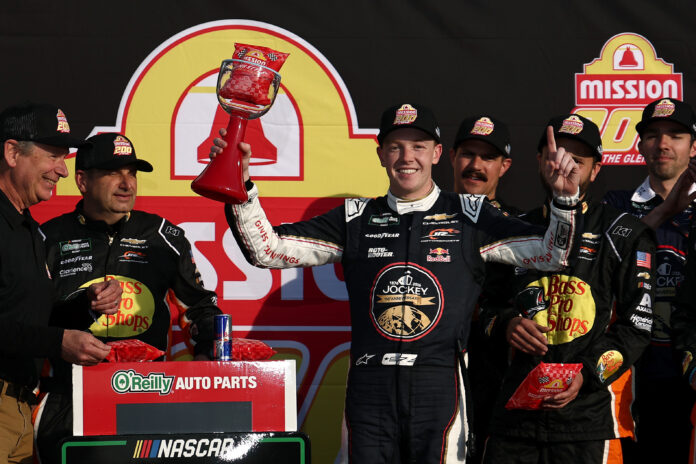
WATKINS GLEN, NEW YORK - MAY 09: Connor Zilisch, driver of the #1 Jockey 150 Years Chevrolet, celebrates in victory lane after winning the NASCAR O'Reilly Auto Parts Series Mission 200 at The Glen at Watkins Glen International on May 09, 2026 in Watkins Glen, New York. (Photo by Chris Graythen/Getty Images).
Connor Zilisch remains undefeated in the NASCAR O’Reilly Auto Parts Series at Watkins Glen International for a third consecutive year. His latest victory occurred on Saturday, May 9, after executing a final lap overtake on Jesse Love on the final turn to win a wild conclusion to the Mission 200.
The 19-year-old Zilisch from Charlotte, North Carolina, led five times for 20 of 82 scheduled laps. He bolted his way from starting in 17th place and raced upfront during the majority of the event. After strategically pitting before the first stage’s conclusion to cycle to the lead for the first time at the start of the second stage period, Zilisch swapped the lead with teammate Shane van Gisbergen during two restarts before the former prevailed to win the second stage.
Then, despite getting hit by van Gisbergen while pitting during the second stage’s break period and restarting within the top-15 mark to start the third and final stage period, Zilisch remained in contention until he strategically pitted under green with 26 laps remaining. While marching his way back to the front, he spent the event’s remainder reeling in on Jesse Love as Love was trying to stretch his low-fuel tank to win over Zilisch. During the final corner on the final lap, however, Love locked up his tires and went wide. This allowed Zilisch to overtake him and steal the victory amid a thrilling finish.
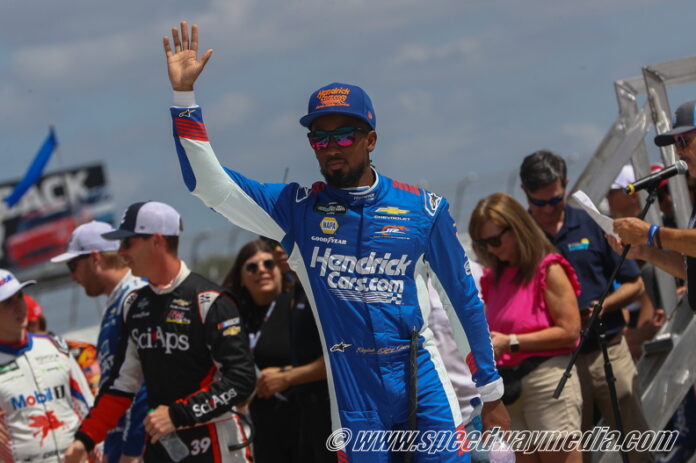
On-track qualifying, scheduled for early Saturday, was canceled due to rain. As a result, the event’s starting lineup was determined through a qualifying metric formula from the NASCAR rule book. From the formula, Rajah Caruth, who returns as the driver of the No. 88 HendrickCars.com Chevrolet Camaro entry that won last weekend at Texas Motor Speedway while being piloted by Kyle Larson, was awarded the pole position. He shared the front row with teammate Justin Allgaier.
Before the event, Sheldon Creed started at the rear of the field due to having his No. 00 Haas Factory Team Chevrolet Camaro entry repaired from damage sustained from a practice accident entering the Esses. Dean Thompson and Matt Wilson also dropped to the rear of the field due to respective changes of transmission and power steering/brakes made to their entries.
When the green flag waved and the event commenced, teammates Rajah Caruth and Justin Allgaier dueled for the lead through the frontstretch until Caruth locked his front tires entering the first turn. As a result, he went wide entering the first turn and forced Allgaier up and off the racing zone in the first turn. Amid the chaos, Sam Mayer snuck by both and assumed the lead through the Esses, the Back Straight and the Inner Loop “Bus Stop” Chicane. As the field behind jostled early for spots, Mayer proceeded to lead the remaining turns before he returned to the frontstretch and led the first lap over Allgaier, Brent Crews, Caruth and Brandon Jones, who followed suit, respectively.
Mayer retained the lead over the next two laps before Crews overtook him on the third lap when Mayer went wide in the first turn. With the lead in his possession, Crews extended his lead to a second during the fourth lap and he was scored as the leader by one-and-a-half seconds over Mayer at the fifth lap mark. Meanwhile, Allgaier trailed in third place by more than two seconds and teammate Connor Zilisch, who started 17th, bolted his way up to fourth place while Jesse Love was up in fifth place over Caruth, Shane van Gisbergen, Brandon Jones, Parker Retzlaff and Austin Hill, respectively. Meanwhile, Jeb Burton lost a lap to the leaders after he limped around the track slowly with a flat left-front tire while Patrick Staropoli blew an engine in Turn 11.
Through the first 10 scheduled laps, Crews continued to lead by three-and-a-half seconds over Mayer while Zilisch outdueled teammate Allgaier for third place. While Love retained fifth place, van Gisbergen was up to sixth place over Caruth, Jones, Retzlaff and Hill, while William Sawalich, Taylor Gray, Sammy Smith, Jeremy Clements, Ryan Sieg, Anthony Alfredo, Brennan Poole, Ross Chastain, Corey Day and Lavar Scott trailed in the top 20, respectively.
Just past Lap 15, Sawalich dropped off the pace due to a mechanical issue. As Sawalich plummeted below the leaderboard while trying to limp his entry to pit road, where he retired from competition, the event remained under green as Crews maintained a comfortable lead. Two laps later, teammates Zilisch and van Gisbergen, along with Gray, Sammy Smith, Poole and Carson Kvapil strategically pitted under green. The latter six were the only competitors to pit prior to pit road becoming inaccessible to the field to mark the conclusion of the first stage period, which occurred on Lap 18. At this time, Crews was leading by more than nine seconds over Mayer.
When the first stage period concluded on Lap 20, Crews cruised to his first O’Reilly career stage victory. Mayer trailed in second place by nine seconds while Allgaier, Love, Jones, Austin Hill, Caruth, Retzlaff, Ross Chastain and Ryan Sieg, all of whom trailed Crews by double digits, were scored in the top 10, respectively. By then, 27 of 38 starters were scored on the lead lap while Zilisch and van Gisbergen, both of whom pitted a few laps ago, carved their way up to 18th and 19th, respectively.
Under the event’s first stage break period, a majority of the field led by Crews pitted while the rest led by Zilisch, van Gisbergen, Taylor Gray and Sammy Smith, all of whom short-pitted before the first stage’s conclusion, remained on the track.
The second stage period started on Lap 24 as Zilisch and van Gisbergen occupied the front row. At the start, both dueled for the lead through the frontstretch and they remained side-by-side entering the Esses until Zilisch motored ahead by the time the field reached the Back Straight. As the field behind jostled for spots, Zilisch retained the lead for a full lap as he led the next lap over van Gisbergen while Smith, Love and Crews pursued in the top five, respectively.
On Lap 25, the caution returned when Lavar Scott spun in the first turn while Jeremy Clements, woh slid sideways as he approached Scott, plowed into the tire barriers. As the event restarted three laps later, van Gisbergen dueled with Zilisch through the frontstretch before he used the preferred inside lane in the first turn to move ahead of Zilisch with the lead. Van Gisbergen maintained the lead for barely a full lap, where he led the next one, before Zilisch dueled and reassumed the lead entering the first turn.
During the Lap 33 mark, the caution returned when Lavar Scott was involved in a second incident of the event, with his latest occurrence being the driver spinning entering the frontstretch while trying to get beneath Will Rodgers. As a result, he then rear-ended his entry into the outside wall and knocked his rear bumper cover off. During this caution period, Caruth, Harrison Burton, Carson Kvapil, Blaine Perkins, Glen Reen and Kyle Sieg pitted while the rest, led by Zilisch, remained on the track.
With four laps remaining in the second stage period, the event restarted under green. At the start, Zilisch fended off van Gisbergen through the frontstretch and the first turn to retain the lead. While Zilisch muscled ahead, Crews overtook van Gisbergen for the runner-up spot as he tried to reel in Zilisch for the lead. With van Gisbergen, Allgaier and Love trailing in the top five, Zilisch led the next lap.
When the second stage period concluded on Lap 40, Zilisch, who had retained the lead since the previous restart, captured the stage victory over Crews. Van Gisbergen, Allgaier, Love, Gray, Hill, Mayer, Sammy Smith and Jones were scored in the top 10, respectively, while 32 of 38 starters were scored on the lead lap.
During the event’s second stage break period, some led by Zilisch and van Gisbergen pitted while the rest led by Crews and including Love, Hill, Jones, Retzlaff, Day, Caruth, Harrison Burton, Carson Kvapil, Blaine Perkins, Kyle Sieg and Preston Pardus remained on the track. During the pit stops, van Gisbergen hit the right side of Zilisch’s entry while trying to exit his pit stall. The collision forced van Gisbergen to return to pit road for repairs while Zilisch, who was the first competitor to exit pit road, restarted within the top-15 mark.
With 38 laps remaining, the final stage period commenced as Crews and Love occupied the front row. At the start, Crews motored away from the field through the frontstretch and he retained the lead through the first turn before he navigated his way through the Esses, the Back Straight and the Bus Stop with a steady advantage. While Hill navigated his way into the runner-up spot, teammate Love settled in third in front of Day, Jones and Retzlaff as Crews led the next lap.
Then, with 36 laps remaining, the caution returned when Sheldon Creed got knocked off the racing groove by Allgaier through the Bus Stop and briefly launched in the air after the front splitter of his entry dug through the grass. During this caution period, a majority of the field led by Crews remained on the track while some, including Austin Hill, Chastain, Retzlaff, Gray Love, Perkins, Austin Green and Ryan Ellis pitted.
The next restart with 32 laps remaining featured Crews rocketing away from Day, teammate Jones and the field through the frontstretch and the first turn before he pulled away by a large advantage through the Esses. Crews easily led the next lap ahead of Jones while Harrison Burton, Zilisch and Day trailed in the top five. As the event reached its final 30-lap mark, Crews, who was racing on fumes in terms of fuel mileage, extended his advantage to more than a second over Jones while Zilisch, Harrison Burton, Day, Caruth, Allgaier, Kvapil, Mayer and van Gisbergen were in the top 10.
With 26 laps remaining, Crews surrendered the lead to pit under green, though he endured a slow pit service and had a fire briefly spark while trying to get his car loaded with fuel. During his pit stops, Harrison Burton and Poole also pitted with Crews while Zilisch cycled to a two-second lead over Jones, moments before Zilisch and Jones pitted a lap later. This allowed van Gisbergen to lead by one-and-a-half seconds over Caruth with 25 laps remaining while Allgaier, Kvapil and Anthony Alfredo were in the top five.
With 23 laps remaining and as the top of fuel concerns continued to loom amongst the field, teammates Allgaier and Sammy Smith pitted under green with 23 laps remaining before van Gisbergen pitted from the lead. Caruth cycled to the lead before he pitted with 18 laps remaining. This allowed Love to cycle to the lead. As the latter led, Zilisch was mired in 12th while Crews was in 14th.
Down to the final 10 laps of the event, Love, who was racing on fumes with fuel, maintained the lead by more than three seconds over teammate Hill while Zilisch, who navigated up to third place but was posting faster lap times than Love, trailed by six-and-a-half seconds. Behind, Gray and Chastain were in the top five while Crews, who trailed Zilisch by eight seconds, was mired in sixth place.
Three laps later, Zilisch battled and overtook Hill for second place. By then, both trailed Love by more than three seconds. As Love approached lapped traffic, he maintained the lead by more than two seconds over a hard-charging Zilisch with five laps remaining. Meanwhile, Zilisch, who ran over the curbs thought the Bus Stop and nearly got loose, slightly damaged the right side of his front splitter through the grass. Amid the incident, Zilisch remained within striking distance of Love through every turn and straightaway as the laps dwindled.
When the white flag waved and the final lap started, Love remained in the lead by six-tenths of a second over Zilisch, who initially trailed Love by more than a second. Through the frontstretch, the first turn and the Esses, Zilisch had Love within his sight. After navigating through the Back Straight, he reeled in and nearly got close to Love’s rear bumper through the Bus Stop, but Love remained in defensive mode as he maintained the lead leading up to the final two turns.
Then, before the final turn, Love locked up the front tires as Zilisch reeled in close to Love’s rear bumper. This allowed Zilisch to get beneath Love and overtake him without making contact, entering the frontstretch. With Love unable to regain momentum, Zilisch motored away and claimed the checkered flag by two-tenths of a second over Love.
With the victory, Zilisch, who finished in the runner-up spot during Friday’s Craftsman Truck Series event at The Glen, collected his 13th O’Reilly Auto Parts Series career victory and his second to a part-time campaign in 2026 with JR Motorsports and the No. 1 Chevrolet team led by crew chief Rodney Childers. In addition, Zilisch became the first competitor to win at The Glen in the O’Reilly division for three consecutive years since Marcos Ambrose achieved the previous feat between 2008 and 2010.
Zilisch’s O’Reilly victory in 2026 was a redemptive moment for the North Carolina native amid a difficult Cup Series campaign, where. The victory was also redemptive as he exited through the top roof hatch to celebrate in Victory Lane. A year ago, he fell while standing alongside his window cell to celebrate in Victory Lane a year ago and broke his collarbone.
“That was [me] driving as hard as I could for all 30 of those laps,” Zilisch said in Victory Lane on the CW Network. “Just trying to make up that gap. I wasn’t gonna move Jesse in the last corner there, but he got in deep. I was able to get by. It’s so cool to come back and get my third win at Watkins Glen in a row with [JR Motorsports]. Cool to get it with [crew chief] Rodney [Childers]. It’s my third different crew chief here. It really means a lot to get another one here and get out of the car safely and make it onto the ground without trying to kill myself.”
Meanwhile, Love was left devastated on pit road after having a first victory of this season evaporate amid a final lap lockup.
“What a good mental challenge for me,” Love said. “All I want to do is beat Connor here. We’re best friends and we’ve caused each other a lot of pain. I didn’t execute when I needed to. I think the reason I’m so quiet is I’m just embarrassed. As a driver, you can’t make those mistakes. It was such a bad mistake. It’s just embarrassing. I know that I’ll learn from this and be better because of it, but I let down a lot of people, including myself, most importantly. Maybe it’s probably a good idea for me to feel this pain right now.”
Taylor Gray finished in third place while Ross Chastain and Brandon Jones finished in the top five. Brent Crews, who led a race-high 32 laps, settled in sixth place while Parker Retzlaff, Shane van Gisbergen, Austin Green and Justin Allgaier completed the top 10 in the final running order.
There were 13 lead changes for six different leaders. The event featured five cautions for 13 laps. In addition, 25 of 38 starters finished on the lead lap.
Following the 13th event of the 2026 NASCAR O’Reilly Auto Parts Series season, Justin Allgaier continues to lead the standings by 155 points over Sheldon Creed, 161 over Jesse Love, 207 over Brandon Jones and 218 over Corey Day.
Results:
Connor Zilisch, 20 laps led, Stage 2 winner
Jesse Love, 18 laps led
Taylor Gray
Ross Chastain
Brandon Jones
Brent Crews, 32 laps led, Stage 1 winner
Parker Retzlaff
Shane van Gisbergen, seven laps led
Austin Green
Justin Allgaier
Austin Hill
Rajah Caruth, two laps led
Sam Mayer, three laps led
Carson Kvapil
Corey Day
Sammy Smith
Harrison Burton
Brennan Poole
Alex Labbe
Will Rodgers
Preston Pardus
Josh Bilicki
Ryan Sieg
Anthony Alfredo
Jeb Burton
Blaine Perkins – OUT, Out of Fuel
Lavar Scott – OUT, Out of Fuel
Alex Guenette, one lap down
Sheldon Creed, one lap down
Glen Reen, one lap down
Kyle Sieg, one lap down
Derek White, four laps down
Jeremy Clements, eight laps down
Ryan Ellis – OUT, Suspension
Dean Thompson – OUT, Transmission
William Sawalich – OUT, Engine
Matt Wilson – OUT, Accident
Patrick Staropoli – OUT Engine
Next on the 2026 NASCAR O’Reilly Auto Parts Series schedule is the BetRivers 200 at Dover Motor Speedway in Dover, Delaware. The event is scheduled to occur next Saturday, May 16, and air at 4 p.m. ET on the CW Network, PRN and SiriusXM.
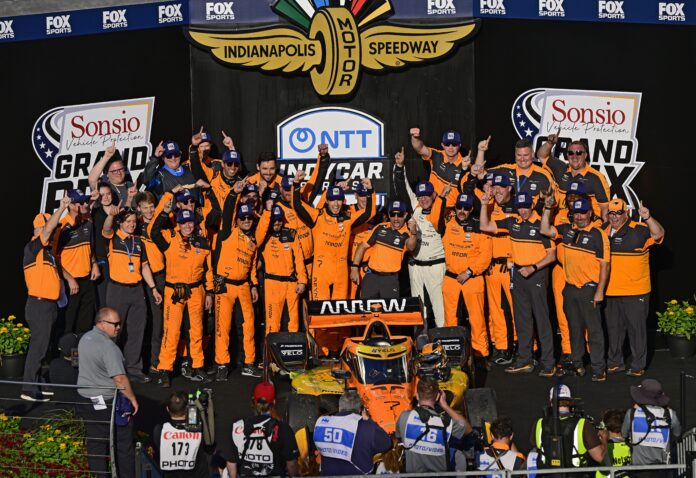
INDIANAPOLIS - MAY 9: Christian Lundgaard, driver of the #7 Arrow McLaren Velo Chevrolet, celebrates in victory lane after winning the NTT IndyCar Series Sonsio Grand Prix at the Indianapolis Motor Speedway on May 9, 2026, in Indianapolis. Photo: Walt Kuhn/Penske Entertainment
INDIANAPOLIS — It looked different to Christian Lundgaard inside the car than it did on TV.
“You know, at the end of the day, I’ve been now watching it on the TV screen probably 50 times, but it doesn’t look the same way as what it felt,” he said.
He thought he had maybe one or two chances to pass David Malukas, after the undercut failed to cycle him ahead of Malukas with 20 laps to go.
“I struggled a lot on out laps,” he said. “He seemed to be a little better than I was.”
Romain Grosjean was ahead and slowed down Malukas just enough for him to set up a pass on the outside through Turn 2 through Turn 4. At which point, he went full send, damn the torpedos and pressed the attack.
With a bold pass in the Turns 5 and 6 kink on the backstretch at the Indianapolis Motor Speedway, Lundgaard overtook Malukas for the race lead with 18 laps to go and took the checkered flag in the Sonsio Grand Prix.
“It feels awesome right now, and I’m sure I will probably realize tomorrow what really happened today,” he said. “It really wasn’t what I expected waking up this morning. Obviously with qualifying getting pushed to this morning and racing the same day, it’s not really a traditional IndyCar weekend.”
It’s his second career victory in his 74th NTT INDYCAR SERIES start and first of the 2026 season.
David Malukas led a race high 27 laps on his way to a runner-up finish and Graham Rahal rounded out the podium.
“Honestly, I mean it was a good move,” Malukas said. “It was fair play. You know, looking back, I keep seeing this replay just playing over and over again be, which is fantastic. You get to just watch it happen over and over.
“It was a fair play. Looking back, I thought, man, I could have been a lot more aggressive, but in the end there’s an art to knowing when you’ve lost the spot. I ended up just giving out and, look, the thing is, I could have pushed him a little bit wider and then not complete the pass, but we could have had contact, something could have happened, we could have lost a lot of pace and now Rahal is coming in.
“The thing is, if he’s not going to get me that lap, he’s going to get me the next one or the other one after that. He had push-to-pass. We were running out. It was just a matter of attrition. I thought, he’s got it. I might as well do the same move.”
Scott Dixon rebounded from a Lap 1 wreck to finish sixth. Louis Foster, Dennis Hauger, Kyle Kirkwood and Nolan Siegel round out the top-10.
Christian Lundgaard makes gutsy kink pass to win at the Brickyard
Race summary
Palou led the field to green at 4:59 p.m. Just as the field came up to speed, Rinus VeeKay slammed into the back of another car and destroyed his front wing. Entering Turn 1, Felix Rosenqvist locked up and turned Pato O’Ward. Newgarden got into Dixon and turned him. Then he and Caio Collet rammed into Rosenqvist. For the avoidable contact, race control assessed Rosenqvist a drive-through penalty.
Back to green on Lap 6, race control handed Scott McLaughlin a three-place penalty for blocking Foster. Aside from that, and a piece of debris laying in Turn 9 that came off Malukas’ car, the field settled into a green flag rhythm. Also, another piece of debris fell onto the track in Turn 7. During all this, multiple cars ducked onto pit road to switch onto Firestone reds. A local caution flew on Lap 21 when Alexander Rossi’s car stalled on track on the start/finish line. Only after he exited the car and hopped over the pit wall did the full course caution fly. During the caution, Palou and Kirkwood pitted and handed the lead to Will Power.
Back to green on Lap 27, caution flew for a multi-car incident in Turn 13. Sting Ray Robb locked up and hit O’Ward. Simpson turned inwards to avoid the spinning O’Ward. Rosenqvist clipped him and got airborne briefly. During the caution, Power pitted from the lead and Malukas took over the race lead.
Back to green on Lap 33, Palou kicked off a cycle of green flag stops on Lap 38 and took a set of Firestone reds. Kirkwood responded the following lap by pitting from seventh. His crew had trouble with the right-front tire and Palou cycled out ahead of him. Malukas pitted from the lead on Lap 47. Lundgaard pitted from the lead on Lap 48 and Power cycled back to the lead.
O’Ward kicked off the final cycle of pit stops on Lap 57. Power pitted from the lead on Lap 58. He locked up exiting pit lane and drove outside the blend line area. Thus race control handed him a drive-through penalty for improper pit exit. As the pit cycle played out, Lundgaard cut down the lead to Malukas. On Lap 65, Lundgaard undercut him by pitting on Lap 65. Malukas pit from the lead with 20 laps to go and cycled out ahead of Lundgaard.
With 18 laps to go, Lundgaard pulled to Malukas’ outside and passed him through the backstretch kink to take the race lead and drove on to victory.
Christian Lundgaard makes gutsy kink pass to win at the Brickyard
Nuts and bolts
The race lasted one hour, 55 minutes and 42 seconds, at an average speed of 107.536 mph. There were six lead changes among four different drivers and three cautions for 12 laps.
Palou leaves with a 27-point lead over Kirkwood.
The NTT INDYCAR Series returns to action, May 24, for the Indianapolis 500.
GRAY LEADS THREE TOYOTAS IN THE TOP-SIX AT WATKINS GLEN Crews scores first stage win, leads the most laps
WATKINS GLEN, NY (May 9, 2026) – Taylor Gray saved just enough gas and crossed the finish line in third to lead Toyota in the NASCAR O’Reilly Auto Parts Series race at Watkins Glen International on Saturday. The Kansas-winner moved back inside the top-10 in points with his top-five run.
Brandon Jones finished fifth, his career-best at Watkins Glen. It is his fourth consecutive top-10 finish, and moved him up to a season-best fourth in points.
Toyota Development Driver Brent Crews was impressive throughout the race as he won his first career stage and led a race-high 32 laps before a vibration in the final laps caused his pace to slow down. He was able to hold on to finish sixth – his fifth consecutive top-six finish. Despite missing four races before turning 18 in March, Crews has now moved inside the Chase field as he sits 11th overall.
TOYOTA RACING Post-Race Recap NASCAR O’Reilly Auto Parts Series (NOAPS) Watkins Glen International Race 13 of 33 – 200.9 miles, 82 laps
TOYOTA FINISHING POSITIONS
1st, Connor Zilisch* 2nd, Jesse Love* 3rd, TAYLOR GRAY 4th, Ross Chastain* 5th, BRANDON JONES 6th, BRENT CREWS 17th, HARRISON BURTON 30th, GLEN REEN 35th, DEAN THOMPSON 36th, WILLIAM SAWALICH *non-Toyota driver
TOYOTA QUOTES
TAYLOR GRAY, No. 54 Operation 300 Toyota GR Supra, Joe Gibbs Racing
Finishing Position: 3rd
What were the challenges of saving fuel at the end?
“First of all, super proud of everyone at Joe Gibbs Racing, and thank you to TOYOTA RACING, Operation 300 and M-Experiment. It was challenging at times. I was just trying to execute my job inside the car, saving fuel and lifting early, shorting my shifts up to make it to the end. Really proud of Jason Ratcliff (crew chief) for that strategy call. Really good strategy. I felt like straight up we were a fifth-to-seventh place car, but obviously really proud of everyone on the 54 team to be able to score a better finish.”
BRANDON JONES, No. 20 Menards/Pelonis Toyota GR Supra, Joe Gibbs Racing
Finishing Position: 5th
Top-five at Watkins Glen. Can you talk about your race?
“Honestly, I’m going to give a lot of that credit to Sam McAuley (crew chief), because that strategy to pit when we did and then to have enough fuel. It is hit or miss, but every once in a while, you get a green flag run, and you get so spread out, and the tire grip got really low there at the end. There wasn’t – from my perspective – so many people saving. Typically, when you have races like that, you know it is going to go green there at the end because people aren’t wanting to be aggressive with each other, so we just maximized our day, really. That’s what I wanted to do. We got stage points in both stages, a really good finish – a career-best here. Thanks to everyone at Pelonis. I think this is their last race of the year, but we had a bunch of them, Menards and Toyota as always. A lot of momentum. We are going into a great track in Dover for us. We are continuing to get better, and our road course stuff is a work a progress for us, but I’m liking what I’m seeing.”
BRENT CREWS, No. 19 WIX Filters Toyota GR Supra, Joe Gibbs Racing
Finishing Position: 6th
Stellar points day, but I know that last stage didn’t go the way you wanted it to. Can you talk about the day as a whole and that last stage?
“The car was great all day. It was cool to have WIX Filters on our Supra. First time having them aboard, the colors looked great out there. I felt like I had an amazing car all day. We were the one to beat. We were better than the 1 (Connor Zilisch) for sure. Just there at the end – that last stop, it was a little slow, then the motor shut off, and I was trying to get it back running. It was shooting flames and all of that stuff, but after that I had a super, super bad vibration. One of the worst ones I’ve ever had – not sure what that was, but really, really slowed down our pace there at the end. Not sure what it was. I know they will look it over and figure out what the issue was and fix it for next time.”
About Toyota
Toyota (NYSE:TM) has been a part of the cultural fabric in North America for nearly 70 years, and is committed to advancing sustainable, next-generation mobility through our Toyota and Lexus brands, plus our more than 1,800 dealerships.
Toyota directly employs nearly 64,000 people in North America who have contributed to the design, engineering, and assembly of over 50 million cars and trucks at our 14 manufacturing plants. In 2025, Toyota’s plant in North Carolina began to assemble automotive batteries for electrified vehicles.
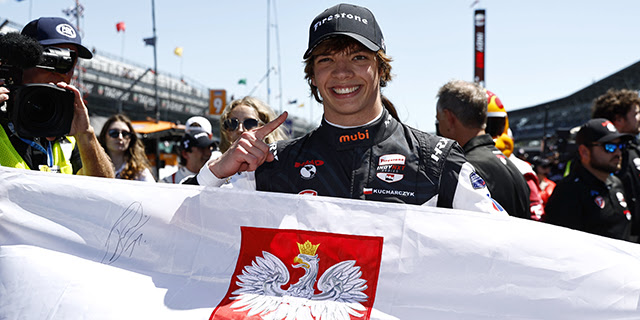
INDIANAPOLIS (Saturday, May 9, 2026) – Tymek Kucharczyk was Mr. Consistency for the first five races of the INDY NXT by Firestone season. But now he’s a winner.
Series rookie Kucharczyk, the first Polish driver to compete in the INDYCAR development series, earned his first career victory by holding off Max Taylor to win Race 2 of the Indianapolis Grand Prix doubleheader Saturday on the Indianapolis Motor Speedway road course.
“What a special day,” Kucharczyk said. “To do it here, coming back to November in my first test in an INDY NXT car, now a winner here at Indy, it’s spectacular. I’m so grateful to my sponsors, to my team. It was a tough race. It was really, really hard to hold Max behind me. He was pushing me for the whole race.”
Kucharczyk was the only driver to record a top-five finish in the first five races this season, but his best was third place, three times. He finished fourth in Race 1 of this doubleheader in mixed conditions Friday.
But Kucharczyk climbed from fifth to the lead after the first two turns on the 14-turn, 2.439-mile circuit, leading all 30 laps in the No. 71 HMD Motorsports car. He took the checkered flag .6273 of a second ahead of Taylor in the No. 28 Susan G. Komen machine of Andretti Global after a taut, race-long duel in the caution-free race.
Enzo Fittipaldi, who won Race 1 Friday, prevailed in an exciting three-way fight over the last 10 laps of the race for the final podium spot in the No. 67 HMD Motorsports machine. Lochie Hughes placed fourth in the No. 26 Andretti Global car, with Alessandro de Tullio rounding out the top five in the No. 14 AJ Foyt Racing entry.
Series leader Nikita Johnson placed sixth in the No. 21 Cape Motorsports Powered by ECR car. Kucharczyk climbed to second in the standings with his win, 11 points behind Johnson.
There were two main flashpoints in the race, which took place under sunny skies in a contrast to the wet conditions at the finish Friday.
The first came at the green flag. Taylor started from pole and went side by side with Josh Pierson’s No. 29 Starchive Andretti entry of Andretti Global, with both cars going wide. Kucharczyk snuck through the opening for the lead, with Taylor clinging to second.
Kucharczyk maintained a gap of six- to seven-tenths of a second for the next 16 laps before the second main incident of the race. Kucharczyk locked his right front wheel braking for Turn 1 on Lap 17, creating a large flat spot on his Firestone Firehawk tire.
“Other than the lockup that I made midway through the race, it was a pretty flawless execution,” Kucharczyk said. “I don’t think we had probably the fastest car on the grid today, but the first lap helped me massively. Max was pushing really hard, so I had to save the Push to Pass at the end, as well. It’s all good. I made it happen, so super, super grateful.”
Taylor pulled to within .4807 of a second on Lap 23, and it appeared the flat spot on his tire may have started to sap speed from Kucharczyk. But the Pole managed his tires and saved enough Push to Pass engine boost to increase the gap to .7830 of a second on Lap 25. He maintained a steady gap to the checkered flag.
“That was everything,” Taylor said of his effort. “I thought we were going to catch him. I messed up on the start, I think. So, something to look over. But still good points, decent points this weekend, and a lot to take away and a lot to improve on if we want to win this championship.”
Taylor is third in the standings, three points behind Kucharczyk and 14 behind Johnson.
The next INDY NXT by Firestone race is the Detroit Grand Prix on Sunday, May 31 on the streets of Detroit.
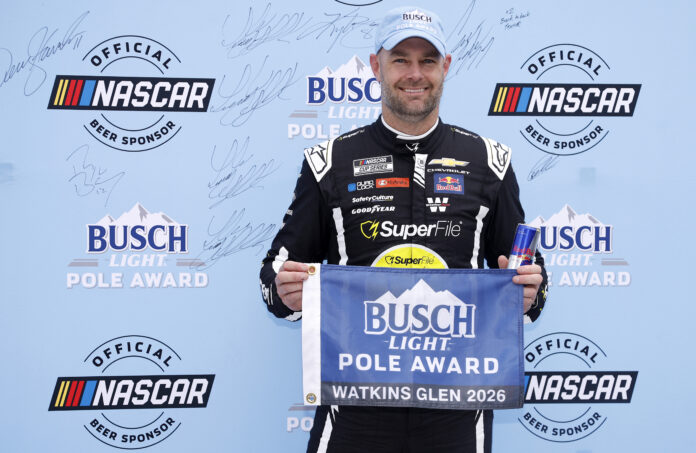
WATKINS GLEN, NEW YORK - MAY 09: Shane Van Gisbergen, driver of the #97 Superfile Chevrolet, poses for photos after winning the pole award during qualifying for the NASCAR Cup Series Go Bowling at The Glen at Watkins Glen International on May 09, 2026 in Watkins Glen, New York. (Photo by Sean Gardner/Getty Images).
Shane van Gisbergen flexed his road-course muscles in a big way by notching his first Busch Light Pole Award of the 2026 NASCAR Cup Series season for the Go Bowling at The Glen (Watkins Glen International) on Saturday, May 9.
The event’s qualifying format at Watkins Glen International consisted of a single session. In this session, the field of 38 is given 35 minutes to post the fastest qualifying lap and all competitors qualify simultaneously. At the conclusion of both group sessions, the fastest competitor was awarded the pole position.
Van Gisbergen, was the 11th-fastest competitor in practice earlier on Saturday, and during the qualifying session, he posted his best lap at 123.937 mph in 71.165 seconds. Van Gisbergen’s lap was enough for the three-time Supercars champion from Auckland, New Zealand, to secure the pole position over Michael McDowell.
With the pole, van Gisbergen notched his fifth Cup Series career pole position, all of which have occurred on five distinct road/street course venues. In addition to securing his first Cup pole at The Glen, he also recorded his first pole since Sonoma Raceway in July 2025 and the third pole of the 2026 season for Chevrolet, along with the first for Trackhouse Racing.
Van Gisbergen, who is currently campaigning in his sophomore season in the Cup Series division, is currently ranked in 19th place in the 2026 driver’s standings and he trails the top-16 cutline to be in Chase contention by 27 points. Having scored two top-10 results and an average-finishing result of 21.0 through 11 Cup events in 2026, van Gisbergen will strive to contend for his first victory of this season and reignite his road course magic after winning five times in 2025. After finishing in third place during Friday’s Craftsman Truck Series event at The Glen, van Gisbergen is also competing in Saturday’s O’Reilly Auto Parts Series event at The Glen with JR Motorsports as he strives to sweep both the O’Reilly and Cup main events.
“The [No. 97] guys did a good job tuning [the car] what I needed for the one lap,” van Gisbergen, who is striving for rear tire grip for Sunday’s main event, said. “The Superfile Chevy was really good, but all Trackhouse [Racing] cars in the top five as well. We got some good cars here this weekend and hopefully, we can capitalize on that tomorrow.”
Van Gisbergen will share the front row with Michael McDowell, the latter of whom clocked in his fastest lap at 123.488 mph in 71.424 seconds. Sunday’s Cup event at The Glen will mark McDowell’s first time starting on the front row in 2026.
Austin Cindric (fastest during Saturday’s practice), Ross Chastain and rookie Connor Zilisch, the latter two are teammates with van Gisbergen at Trackhouse Racing, will start in the top five, respectively. Joey Logano, Ryan Blaney, Christopher Bell, Chase Briscoe and Ty Gibbs completed the top-10 starting grid, respectively.
With 38 competitors vying for 38 starting spots, all made the main event.
Watkins Glen – Qualifying Position, Best Speed, Best Time:
Shane van Gisbergen, 123.937 mph, 71.165 seconds
Michael McDowell, 123.488 mph, 71.424 seconds
Austin Cindric, 123.452 mph, 71.445 seconds
Ross Chastain, 123.445 mph, 71.449 seconds
Connor Zilisch, 123.386 mph, 71.483 seconds
Joey Logano, 123.319 mph, 71.522 seconds
Ryan Blaney, 123.317 mph, 71.523 seconds
Christopher Bell, 123.215 mph, 71.582 seconds
Chase Briscoe, 123.214 mph, 71.583 seconds
Ty Gibbs, 123.159 mph, 71.615 seconds
Carson Hocevar, 123.150 mph, 71.620 seconds
AJ Allmendinger, 123.092 mph, 71.654 seconds
William Byron, 123.074 mph, 71.664 seconds
Chris Buescher, 123.067 mph, 71.668 seconds
Tyler Reddick, 123.014 mph, 71.699 seconds
Daniel Suarez, 122.973 mph, 71.723 seconds
John Hunter Nemechek, 122.946 mph, 71.739 seconds
Bubba Wallace, 122.918 mph, 71.755 seconds
Cole Custer, 122.761 mph, 71.847 seconds
Denny Hamlin, 122.749 mph, 71.854 seconds
Kyle Busch, 122.687 mph, 71.890 seconds
Todd Gilliland, 122.600 mph, 71.941 seconds
Kyle Larson, 122.566 mph, 71.961 seconds
Erik Jones, 122.548 mph, 71.972 seconds
Austin Dillon, 122.502 mph, 71.999 seconds
Brad Keselowski, 122.398 mph, 72.060 seconds
Chase Elliott, 122.386 mph, 72.067 seconds
Alex Bowman, 122.339 mph, 72.095 seconds
Ricky Stenhouse Jr., 122.293 mph, 72.122 seconds
Ryan Preece, 122.289 mph, 72.124 seconds
Ty Dillon, 122.249 mph, 72.148 seconds
Riley Herbst, 122.059 mph, 72.260 seconds
Zane Smith, 122.052 mph, 72.264 seconds
Josh Berry, 121.464 mph, 72.614 seconds
Noah Gragson, 121.426 mph, 72.637 seconds
Cody Ware, 120.493 mph, 73.199 seconds
Josh Bilicki, 119.044 mph, 74.090 seconds
Katherine Legge, 115.299 mph, 76.497 seconds
The 2026 Go Bowling at The Glen is scheduled for Sunday, May 10, and will air at 3 p.m. ET on FS1, MRN Radio, SiriusXM and HBO MAX.
Ford Racing Notes and Quotes NASCAR Cup Series Go Bowling at The Glen Media Availability – Watkins Glen International Saturday, May 9, 2026
Ford Racing drivers Chris Buescher and Ryan Preece stopped by the Watkins Glen International infield media center this morning to talk about tomorrow’s scheduled NASCAR Cup Series race. Returning to the site of his 2024 victory, Buescher enters his 11th career Cup start at Watkins Glen, while Preece marks his sixth start at the track.
CHRIS BUESCHER, No. 17 BuildSubmarines.com Ford Mustang Dark Horse – AS A PAST WINNER, WHAT DOES IT TAKE TO BE SUCCESSFUL HERE AND UNDER THESE CONDITIONS? “Sorry, I was watching them make laps in the wet. It’s not been raining for ‘how many’ hours now, and there’s a little bit of a dry groove rolling in. It’s so cold. Usually, it would be completely dry all the way around it, and you wouldn’t be chasing the moisture on the straightaways. There is a handful of dry racetrack, and speeds are definitely picking up. I think that the weather looks okay for the rest of our day, where we’ll have a pretty normal practice and qualifying. I’m excited to get on track. This is my favorite road course that we come to. I’ve loved this place for a very long time. I’m excited to be back. We got to come up here the other week, talking about this weekend, and looking forward to it. The weather was kind of like this, and we all kind of joked that surely it would turn around. It hasn’t done it quite yet, but Sunday looks like it’s straightening out pretty decently. I just want to say how thankful we are to all the fans that have come out, and braved the weather and conditions. I’m sure a lot of people parked where they could and not where they wanted to be. I appreciate everyone sticking that out with us, because I think we’re going to have some great racing this weekend. I certainly hope that we don’t have to mess with wet conditions. I don’t really enjoy that. Talking with Brad [Keselowski], we’ve had experiences in wet conditions through the years, and he always brings up Montreal from 2009. I bring up COTA (Circuit of The Americas). Probably the dumbest thing that I’ve ever done in a racecar was run down the backstretch at COTA at 140 – 150 miles-per-hour (mph) with absolutely zero vision… and we drove Crown Vics (Ford Crown Victoria) around Talladega this year at 160 mph. I think that says something. I think this is all my round-about way of saying that I don’t enjoy rain racing, but we are excited to have a little bit of a challenge with the conditions. It’s damp without being wet, and I think that’s the kind of idea we strive for. We’re okay racing in damp conditions and can adapt. But when there’s standing water with a 13/14-inch wide tire –I think the rain tires are even wider – it’s just going to hydroplane. I know everyone has had that happen on the road, and it’s not comfortable. It’s less so with triple-digit speed numbers.”
HOW WILL THE COOLER CONDITIONS AFFECT THE RACING? “We had a tire here last year that had some significant fall-off at the very tail-end of a run. It’s the same tire for this go-around. It was a lot more, but we also have horsepower. Is it enough to offset it? Maybe. I don’t have that answer yet. We’ve wondered if it would just flatline because of the extra power or if the temperature is significant enough to hold long-run speed in the tire for longer. I suspect that might be the case because that is a significant temperature change, especially if the sun isn’t out. If we don’t get the solar radiation from the racetrack, then the track stays that much cooler. You’ll be looking at it not falling off as much, even with the extra horsepower. Nine-hundered horsepower might make it fall off in this cold weather… 1,100? Now, we’re going somewhere…”
IS SHANE VAN GISBERGEN (SVG) STILL THE STANDARD FOR ROAD COURSE RACES IN NASCAR? “SVG has come into the NASCAR world and has instantly shown to be an exceptional talent. Very specifically, we’ve seen it with road races right from the get-go. That’s been a benchmark for the entire garage. There have been a handful of racetracks, and Watkins Glen is one that I feel like everyone has run so much over the years. We’re all closer here. But, we’ve been to new racetracks and we realized that we had some work to do. I’ll stray a bit here… I was probably 13 or 14 years old racing Legends cars. We were traveling a lot outside of Texas because we got comfortable. We could win every week in Texas. We needed to move around, be in front of different people and experience new racetracks. I swear every time zone east that we went to, they were two-tenths faster. It made us realize that we had work to do, and what we thought was good enough, wasn’t. That’s the long-winded way of saying that we still have work to do. Everyone has been studying and playing catch up, and we have put a tremendous amount of work into our road race program. All three teams at RFK being able to dive in, share data on all of us to figure out what works on these racetracks. Watkins Glen is a completely different road course than anywhere else we go to. In the sense that we’ve been able to win a race here, we’ve been able to run really well the last handful of times and cover different strategies which we talk about in-house a little more. If we’re going to have stages being flipped, then we don’t want all three cars on the exact same plan in case there is an untimely caution that either none of us will benefit from or all of us will. Ultimately, you like to cover all your bases. I always feel comfortable coming into Watkins Glen. I’ve been fast here since the first Cup race. We were really decent with Front Row [Motorsports] back then. Crazier things have happened, but finding more neutrals into the Bus Stop did not go well in my inaugural race here. It’s been a good track for us, and we’ll have a legitimate chance to win here with our race cars this weekend.”
WHAT ARE YOUR THOUGHTS ABOUT EXTENDING THIS RACE FROM 90 TO 100 LAPS, AND HOW WILL A LONGER STAGE 2 INFLUENCE STRATEGY? “We went to Talladega with a massive overhaul of stages, and we’ve seen a bunch of different strategies – three, four different strategies play out. It changed that side of the race pretty significantly. While the end product may not have been what we ultimately all wanted, the strategy side of things made everybody think and try something new. Is 10 laps enough in the stages to stir things up here? Maybe. Probably not to that extent, but it will at least encourage everybody to take a step back, look at it, and maybe see some varying strategies from those willing to take chances for what we don’t have data for yet. Maybe that makes some more movement through the field. As long as we come out on the good side of that, I’ll be happy about it.”
RYAN PREECE, No. 60 Mohawk Northeast Inc. Ford Mustang Dark Horse – WHAT’S YOUR REACTION TO THE PENALTY THIS WEEK? “Honestly, I’m a bit surprised. I’m thankful that NASCAR has an appeals process, so I feel like I can be heard and let that process play out.”
WAS THERE A CONVERSATION WITH NASCAR, EXPLAINING ITS POSITION AND YOURS? “I was on my mower, mowing my lawn at about 4:30 p.m. in an area that does not have great signal. I just saw that I had a missed call, so when I made the call back, I found out that I had a penalty. At that point, I’m thankful for RFK, for Chip [Bowers] and everyone there for their support. I’m thankful for having Chris and Brad [Keselowski] as teammates and for them being the great teammates that they are. I’m excited to go through the appeals process. At least I can feel like I can go through it and share my side.”
DID YOU REACH OUT TO TY GIBBS? “There is nothing right now, until after an appeals process.”
WILL YOU BE MORE HESITANT ON THE RADIO MOVING FORWARD IF YOU DO NOT WIN THE APPEAL? “At the beginning of the season, we were encouraged to be ourselves. I’m not going to change being myself, but what I can say is that I’m excited for the appeals process, and I look forward to going through that.”
HOW WILL THE COOLER CONDITIONS AFFECT THE RACING? “I echo Chris in that regard. We might be surprised having that little bit of extra horsepower. It might create a little bit more tire heat, which will make them a little bit more of a handful. I just think there are a lot of unanswered questions at this point. I like the direction for what we’re trying to do – create fall-off. If we can keep creeping up on that to where tire fall-off beats fuel load in the racecar, then you’re going to see a lot more strategy play out. My focus this week, preparing for Watkins Glen, is keeping up with this guy (Buescher), because he’s a road course ringer himself. I’ve enjoyed studying what he does in an RFK car and being what we strive to be. Hopefully, that’s trying to put one of these cars in victory lane this weekend, and make Jack Roush and everyone at the RFK Racing company proud.”
HOW SIGNIFICANT, FINANCIALLY, IS THIS PENALTY TO YOU? “I’m feeling pretty good about the appeals process and not having to deal with that. But, that is a substantial amount of money.”
WHAT ARE YOUR THOUGHTS ABOUT EXTENDING THIS RACE FROM 90 TO 100 LAPS, AND HOW WILL A LONGER STAGE 2 INFLUENCE STRATEGY? “To me, that last stage is longer. It kind of breaks up when you’re pitting and when you’re not pitting. If you look at last year’s race, even at like Lap 85 you started to see people hit this peak and really fall. Having that extra 10 laps is only going to magnify that. If you choose to short pit, try to make time by not having traffic to get clean air, it’s a risk. The risk is that you’ll have to go that much extra on tires and potentially have that peak fall off when it happens. I’m happy because it’s more important to make the tires fall off than fuel. A lot of us pit and can make it on fuel. It’d be nice to start having to pit because the hard tires are going to continue falling off, and we need to come in for a set. I’ve liked the direction that Goodyear has been going in over the past year-and-a-half, hearing us race car drivers. I think the fans see the product there. I feel pretty good about it.”
WHAT HAVE YOU LEARNED FROM CHRIS BUESCHER TO HELP GUIDE YOU THROUGH ROAD COURSE RACES? “Well, when people kick your butt on road courses, it kind of forces you to be better. I have no problem going to work, thinking I’m not good enough. Actually, I enjoy that. When you look around for road racing, I look at SVG, AJ Allmandinger – I look at Chris. Then we go to intermediates. There are certain drivers that things just suit their styles. My short track racing background suits the road racing style, but from a speed perspective, there’s a lot of things I can do better as a racer, and I continue to try to do better. The goal for me here this weekend is qualifying in the Top-15, Top-10. It’s a big goal, but I feel like we can, which is going to give us options going into the race. Once we get racing, I feel really good about my racecraft and what we do there. I enjoy the challenge. I’m not scared of a challenge. I look forward to Watkins Glen, because this is a racetrack that I haven’t been racing all my life, but I grew up playing it on videogames. So, I feel like I got a lot of laps around here. I’m just trying to be better.”
Rajah Caruth has been awarded the pole position for the NASCAR O’Reilly Auto Parts Series’ Mission 200 at The Glen (Watkins Glen International) on Saturday, May 9.
The event’s starting lineup was initially going to be determined through an on-track qualifying session that would split the field of 38 into two-timed qualifying groups, and the competitor who posted the fastest lap between the two groups would be awarded the pole position.
Saturday’s qualifying session was canceled, however, due to rain and the course being hampered by wet conditions. As a result, the lineup was determined through a qualifying metric formula from the NASCAR rulebook. The formula evaluated competitors’ results from the most recent O’Reilly Auto Parts Series event and the current owner’s standings.
This resulted in Caruth being awarded the pole position as his entry, the No. 88 HendrickCars.com Chevrolet Camaro entry from JR Motorsports, is coming off a victory last weekend at Texas Motor Speedway despite the entry being piloted by Kyle Larson. The No. 88 entry is ranked in second place in the 2026 owner’s standings.
For Saturday’s main event at The Glen, Caruth will start on the front row for an O’Reilly event for a second time this season. He previously started in second place and on the front row alongside teammate Justin Allgaier at Martinsville Speedway in mid-March after that event was also determined through a qualifying metric formula.
Caruth is currently ranked in 15th place in the 2026 driver’s standings as he is navigating his first full-time O’Reilly season of competition between JR Motorsports’ No. 88 Chevrolet entry and Jordan Anderson Racing’s No. 32 Chevrolet entry. He has made 34 previous starts in the O’Reilly division as he continues the pursuit of his first victory.
Speaking of Allgaier, Caruth will share the front row with the latter. Allgaier, who is leading the O’Reilly standings in both the driver’s and owner’s standings. is coming off a runner-up result from last Saturday’s event at Texas.
Sheldon Creed, rookie Brent Crews (the fastest during Saturday’s practice session) and Sam Mayer will start in the top five, respectively. Parker Retzlaff, Brandon Jones, Jesse Love, Austin Hill and Sammy Smith will start in the top 10, respectively.
With 38 competitors vying for 38 starting spots, all made the main event.
Watkins Glen – Starting lineup:
Rajah Caruth
Justin Allgaier
Sheldon Creed
Brent Crews
Sam Mayer
Parker Retzlaff
Brandon Jones
Jesse Love
Austin Hill
Sammy Smith
Jeremy Clements
Shane van Gisbergen
Ryan Sieg
William Sawalich
Anthony Alfredo
Dean Thompson
Connor Zilisch
Brennan Poole
Patrick Staropoli
Lavar Scott
Alex Guenette
Harrison Burton
Jeb Burton
Blaine Perkins
Taylor Gray
Josh Bilicki
Corey Day
Ryan Ellis
Ross Chastain
Alex Labbe
Derek White
Glen Reen
Kyle Sieg
Carson Kvapil
Austin Green
Will Rodgers
Matt Wilson
Preston Pardus
The 2026 Mission 200 at The Glen is scheduled to occur on Saturday, May 9, and air at 4 p.m. ET on the CW Network, MRN Radio and SiriusXM.
INDIANAPOLIS – Alex Palou remains undefeated leading up to this year’s Sonsio Grand Prix at the Indianapolis Motor Speedway (IMS) Road Course as he secured the NTT P1 Award for the event on Saturday, May 9.
The event’s starting lineup was determined through an on-track qualifying session. It was postponed to Saturday after heavy rain canceled the session o Friday, May 8.
The qualifying session was divided into three segments. The first segment split the field of 25 competitors into two groups. Each group had 10 minutes to post a qualifying lap. At the conclusion of the first qualifying session, the six fastest competitors from each group transferred to a second session.
During the first session, Kyle Kirkwood, Scott Dixon, Pato O’Ward, Graham Rahal, Josef Newgarden and Caio Collet transferred to the second round from the first group. Alex Palou, David Malukas, Felix Rosenqvist, Louis Foster, Romain Grosjean and Christian Lundgaard transferred from the second group.
Meanwhile, the following drivers did not transfer to the second round. They included Alexander Rossi, Marcus Ericsson, Santino Ferrucci, Nolan Siegel, Scott McLaughlin, Mick Schumacher, Christian Rasmussen, Marcus Armstrong, Rinus VeeKay, Kyffin Simpson, Sting Ray Robb, Dennis Hauger and Will Powe. These drivers started 13th through 25th, respectively.
The second segment featured the 12 competitors who transferred from the first round. Each driverhad 10 minutes to post a qualifying lap simultaneously. Only the six fastest competitors transferred to the third and final round (“Firestone Fast 6”). During this session, Palou, O’Ward, Lundgaard, Rosenqvist, Foster and Malukas transferred to the Firestone Fast 6 rounds. Rahal, Dixon, Krikwood, Newgarden, Grosjean and Collet did not. The latter six started seventh through 12th, respectively.
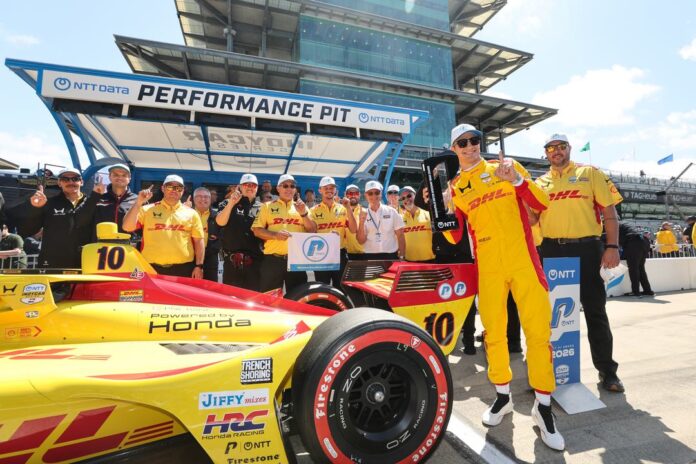
The Firestone Fast 6 session featured the final six qualifiers who transferred from the second round with only six minutes to post a qualifying lap simultaneously. The competitor who posted the fastest lap was awarded the pole position. During this session, Palou drove his No. 10 DHL/Chip Ganassi Racing Dallara-Honda entry to a pole-winning lap at 125.886 in 1:09.7487 with seconds remaining in the final session.
With the pole, Palou, the reigning NTT INDYCAR SERIES champion who was the fastest competitor during the event’s two practice sessions on Friday and maintained pace from Friday’s cool, slick conditions to Saturday’s warm conditions, became the first competitor to win the pole position on the IMS Road Course for three consecutive years. He also achieved his second pole of the 2026 INDYCAR season and his first since Barber Motorsports Park in mid-March and the 14th of his career.
With the pole secured, Palou, the current championship points leader, will attempt to become the first-ever competitor to win at the IMS Road Course for a fourth consecutive time as he has won this event over the previous three seasons.
“It’s tough to get the car in good windows like these guys have been doing,” Palou said on FS1. “It’s a lot of work that everybody’s putting behind at Chip Ganassi Racing. Very happy to get that No. 10 [Honda] on the pole once again here. It feels really, really good. The car was amazing. I think not everybody was running on the new alternates [tires]. I know we’re gonna be on a small disadvantage on the race, but still happy that we start on the front row. We’ll see if we can win with that No. 10 [Honda].”
Palou will share the front row with Pato O’Ward, the latter of whom posted the second-fastest lap at 124.906 mph in 1:10.2962 in his No. 5 Arrow McLaren Dallara-Chevrolet entry. O’Ward, who started on the pole at the IMS Road Course in 2021, secured his eighth front row start for the event. Having finished in the runner-up spot to Palou in the Sonsio Grand Prix a year ago, O’Ward will strive for both his first victory in the event and his first of the 2026 season.
Felix Rosenqvist, Christian Lundgaard, David Malukas and Louis Foster, all of whom transferred to the Firestone Fast 6, will start from third to sixth, respectively.
Qualifying position, Best time, Best speed:
Alex Palou, 1:09.7487, 125.886 mph
Pato O’Ward, 1:10.2962, 124.906 mph
Felix Rosenqvist, 1:10.4548, 124.625 mph
Christian Lundgaard, 1:10.4751, 124.589 mph
David Malukas, 1:10.5660, 124.428 mph
Louis Foster, 1:10.9404, 123.772 mph
Graham Rahal, 1:10.4042, 124.714 mph
Scott Dixon, 1:10.4142, 124.696 mph
Kyle Kirkwood, 1:10.4189, 124.688 mph
Josef Newgarden, 1:10.4938, 124.556 mph
Romain Grosjean, 1:10.4981, 124.548 mph
Caio Collet, 1:10.6299, 124.316 mph
Alexander Rossi, 1:10.7736, 124.063 mph
Marcus Ericsson, 1:10.3765, 124.763 mph
Santino Ferrucci, 1:10.8113, 123.997 mph
Nolan Siegel, 1:10.4288, 124.671 mph
Scott McLaughlin, 1:10.8281, 123.968 mph
Mick Schumacher, 1:10.4487, 124.635 mph
Christian Rasmussen, 1:10.8877, 123.864 mph
Marcus Armstrong, 1:10.4742, 124.590 mph
Rinus VeeKay, 1:11.0611, 123.561 mph
Kyffin Simpson, 1:10.4751, 124.589 mph
Sting Ray Robb, 1:11.2029, 123.315 mph
Dennis Hauger, 1:10.5163, 124.516 mph
Will Power, 1:10.5701, 124.421 mph
The 2026 Sonsio Grand Prix at the Indianapolis Motor Speedway Road Course is scheduled to occur on Saturday, May 9, and air at 4:30 p.m. ET on FOX.