Home Blog Page 9

Spire Motorsports Allegiance 200 Race Advance

  • In seven NASCAR CRAFTSMAN Truck Series starts at Nashville (Tenn.) Superspeedway, Spire Motorsports has earned one win and three top five finishes. Rajah Caruth took the checkered flag in last year’s Rackley Roofing 200 after leading 61 laps.
  • The Allegiance 200 will be televised live on FS1 Friday, May 29 beginning at 8 p.m. Eastern Daylight Time (EDT). The 11th of 25 points-paying races on the 2026 NASCAR CRAFTSMAN Truck Series schedule will be broadcast live on the NASCAR Racing Network and SiriusXM NASCAR Radio Channel 90.

Rajah Caruth – Driver, No. 7 Spire Motorsports Chevrolet Silverado RST

  • Rajah Caruth will race Spire Motorsports’ No. 7 HENDRICKCARS.COM Chevrolet Silverado RST in Friday’s Allegiance 200 at Nashville Superspeedway.
  • HENDRICKCARS.COM is the online home for everything Hendrick Automotive Group. Visitors can shop more than 30,000 new or pre-owned vehicles, locate centers for service and collision repair, receive a value to sell or trade their car, chat online with customer service, discover career opportunities, learn more about vehicle protection programs, and explore how the company gives back to the community.
  • Caruth will pull double duty this weekend, where he’ll also race Jordan Anderson Racing’s No. 32 HENDRICKCARS.COM Chevrolet Camaro in Saturday’s NASCAR O’Reilly Auto Parts Series’ Sports Illustrated Resorts 250.
  • Caruth competes full time in the NASCAR O’Reilly Auto Parts Series and splits his driving duties between JR Motorsports and Jordan Anderson Racing. Over the first 15 races of the 2026 season, he has logged one pole, one top five, five top 10s and sits 13th in points.
  • The 23-year-old driver will make his fourth CRAFTSMAN Truck Series start at the 1.33-mile concrete oval. Last season, Caruth held off a hard-charging Corey Heim and Layne Riggs to earn his second-career CRAFTSMAN Truck Series victory. After hitting pit road for the final time in the third position, the No. 71 pit crew nailed the stop, putting their driver out front to start the Final Stage where he led the final 51 laps en route to the win.
  • Prior to the victory, the Winston-Salem (N.C) State University graduate qualified fifth and finished fourth in the 2024 event at Nashville. In his first visit to the facility in 2023, Caruth led his first lap in a NASCAR national series race on Lap 36, only to immediately report fuel pick-up issues and drop outside the top 20. He ultimately fell 32 laps down as the team addressed the issue.
  • In 75 CRAFTSMAN Truck Series starts, the Washington, D.C., native has racked up two poles, two wins, 10 top fives, 29 top 10s and paced the field for 259 laps.
  • Caruth will be at the controls of Spire Manufacturing chassis SMT-089 Friday night. This is the same Spire Motorsports-prepared Chevy Silverado Carson Hocevar drove to Victory Lane last May at Kansas Speedway. Most recently, Kyle Busch raced this truck to a runner-up finish at Texas Motor Speedway.

Rajah Caruth Quote
How does it feel to return to Spire Motorsports and drive the No. 7 truck?
“I’m happy to be back in the building at Spire and see a lot of familiar faces. I wish it were under better circumstances but it’s still a privilege to be behind the wheel of the No. 7 Silverado. I hope we can continue to honor Kyle Busch with a winning effort this weekend.”

You won at Nashville last season and have run up front in all three starts. Why is it in your wheelhouse?
“To be honest, I’m not too sure. It is a great mix of speed like an intermediate track, and corners that share similarities to some short tracks across the country. I personally love the concrete tracks and expect Nashville is going to put on a great show.”

Atop the No. 7 Box – Crew Chief Brian Pattie

  • Brian Pattie is the crew chief of Spire Motorsports No. 7 Chevrolet Silverado RST, an entry that will see a host of all-star caliber drivers behind the wheel across the 2026 season.
  • Through the season’s first 10 races, the No. 7 team sits third in the division’s owner points standings on the strength of two wins, four top-five and six top-10 finishes.
  • Pattie has called three NASCAR CRAFTSMAN Truck Series races at Nashville Superspeedway, highlighted by a runner-up finish last season with Corey Day. He adds a pair of Cup Series races at the venue, where he secured a sixth-place finish in 2021 with driver Ricky Stenhouse.
  • The 51-year-old is familiar with Nashville’s Victory Lane after leading Reed Sorenson to a dominant first-career Xfinity Series victory in the March 2005 Pepsi 300. Sorenson qualified on the pole, led 197 of the event’s 225 laps, lapped up to the eighth position and managed a whopping 14.417 second margin of victory.
  • The 24-year industry veteran spent 14 seasons in NASCAR’s premier division. As a crew chief, he has amassed six wins in Cup Series competition, 11 in the O’Reilly Auto Parts Series and nine in the CRAFTSMAN Truck Series. He stands as one of 11 crew chiefs to win races across all three of NASCAR’s national touring series.

Jesse Love – Driver, No. 77 Spire Motorsports Chevrolet Silverado RST

  • Jesse Love will pilot Spire Motorsports’ No. 77 Delaware Life Chevrolet Silverado RST in Friday’s Flote 200 at Nashville Superspeedway. Love is the defending NASCAR O’Reilly Auto Parts Series Champion and full-time driver of Richard Childress Racing’s No. 2 Whelen Chevrolet.
  • Delaware Life is an insurance and annuity company that empowers financial professionals with a wide array of customizable solutions. A subsidiary of Group 1001 Insurance Holdings LLC, Delaware Life focuses on delivering a seamless experience for advisors. The company understands how important it is to find the right fit for every client, every situation and every individual need. Delaware Life is passionate about equipping advisors with annuities that give their customers peace of mind and a successful future, allowing them to plan, with confidence, for whatever’s next.
  • The 150-lap event will mark Love’s fourth CRAFTSMAN Truck Series start and first with Spire Motorsports. In three previous starts, he has recorded one top-five (Phoenix ’23) and one top-10 finish (Gateway ’23).
  • Love will pull double duty at Nashville this weekend, where he’ll also race the No. 2 Chevrolet for Richard Childress Racing in Saturday’s NASCAR O’Reilly Auto Parts Series’ Sports Illustrated Resorts 250. He is currently second in the division’s championship point standings and boasts six top-five and 10 top-10 finishes over the first 15 races of the 2026 campaign. Last weekend at Charlotte Motor Speedway, Love started 17th and raced his way to a spirited runner-up finish.
  • The Menlo Park, Calif., native has made a pair of O’Reilly Auto Parts Series starts at Nashville Superspeedway, where he finished third in 2024 and eighth last season.
  • Love will drive Spire Manufacturing chassis SMT-092 Friday evening in its third start. This is the same truck Carson Hocevar drove to Victory Lane earlier this season at Texas Motor Speedway.

Jesse Love Quote
You’ve only made three Truck Series starts, but already have a top-five and two top-10 finishes. What are your expectations heading into Nashville?
“I’ve ran well in the trucks and the couple of races that I did run, I came pretty close to winning. I’m not really sure why I adapt well to it, but I think it’s probably because it’s kind of similar to ARCA that I got to run a good bit of when I was younger so for whatever reason, when I do get to run a truck, it comes somewhat naturally to me. It seems like Spire Motorsports and everybody involved on the 77 team does a really good job and always executes good weekends, building fast Chevrolet Silverados. I’m looking forward to being in that position and it’s always a lot of fun watching, seeing, and learning from how they run the truck races. Being in a Spire truck is a winning situation. I’m just excited to get out there. I’m not really big on setting expectations but obviously, I’m going to the racetrack with the mindset that I’m going to try to win the race and bring a trophy home to Spire Motorsports. That’s the plan. That’s how I’ll prepare for it but as a driver, you know you always want to go there with the most confidence so I’m looking forward to getting out there and exploring, feeling new things, working with new people and a new team. I’m super grateful for Spire Motorsports, Jeff Dickerson, Dan Towriss and everybody at Delaware Life for making this happen. I really appreciate Richard Childress Racing for allowing me to do this and continue to work on my craft. Without RCR, opportunities like this wouldn’t be possible either.”

Atop the No. 77 Box – Crew Chief Chad Walter

  • Chad Walter is the Crew Chief of Spire Motorsports’ No. 77 Delaware Life Chevrolet Silverado RST, an entry that will see multiple all-star caliber drivers behind the wheel throughout the 2026 season.
  • Walter has called four CRAFTSMAN Truck Series races at Nashville Superspeedway, highlighted by a fourth-place finish in 2024 with Rajah Caruth at the controls.
  • In nine NASCAR O’Reilly Auto Parts Series events atop the box at Nashville, the Cornell (N.Y.) University graduate has collected two top fives and four top 10s, including a Kennametal Pole Award.
  • Between NASCAR’s O’Reilly Auto Parts Series and CRAFTSMAN Truck Series, the Albion, N.Y. native has racked up seven wins, 52 top fives and 142 top 10s.

About Spire Motorsports …
Spire Motorsports fields full-time entries in the NASCAR Cup Series, NASCAR CRAFTSMAN Truck Series and Interstate Batteries High Limit Racing.

The team, co-owned by longtime NASCAR industry executive Jeff Dickerson and TWG Motorsports CEO Dan Towriss earned its inaugural NASCAR Cup Series victory in its first full season of competition when Justin Haley took the checkered flag in the Coke Zero Sugar 400 at Daytona (Fla.) International Speedway July 7, 2019. Less than three years later, William Byron drove Spire Motorsports’ No. 7 Chevrolet Silverado its first NASCAR CRAFTSMAN Truck Series win April 7, 2022, at Martinsville (Va.) Speedway. The team’s most recent victory came May 24, 2026, when Daniel Suárez won the NASCAR Cup Series’ Coca-Cola 600 at Charlotte (N.C.) Motor Speedway.

In 2026, Spire Motorsports campaigns the Nos. 7, 71 and 77 Chevrolet Camaro ZL1s in the NASCAR Cup Series and the Nos. 7 and 77 Chevrolet Silverado RSTs in the NASCAR CRAFTSMAN Truck Series. The Mooresville, N.C., organization also fields the No. 77 410 sprint car in Interstate Batteries High Limit Racing competition.

Spire Motorsports Nashville NASCAR Cup Series Race Advance

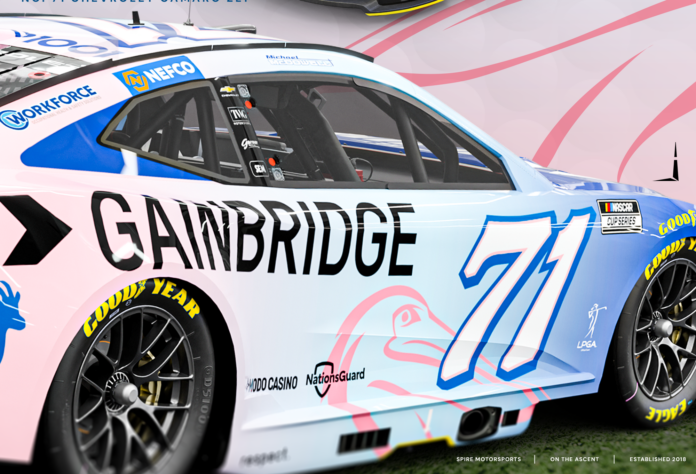
  • In 12 previous NASCAR Cup Series starts at Nashville (Tenn.) Superspeedway, Spire Motorsports has two top-five finishes with a best result of second earned twice by Zane Smith (2024) and Carson Hocevar (2025). Spire Motorsports fields the Nos. 7, 71 and 77 Chevrolet ZL1s in the Cup Series for Daniel Suárez, Michael McDowell and Hocevar, respectively.
  • The 300-lap Cup Series event will be televised live on Prime Video Sunday, May 31 beginning at 7 p.m. Eastern Daylight Time (EDT). The 14th of 36 points-paying races on the NASCAR Cup Series schedule will also be broadcast live on the Performance Racing Network and SiriusXM NASCAR Radio Channel 90.

Daniel Suárez – Driver, No. 7 Spire Motorsports Chevrolet Camaro ZL1

  • Daniel Suárez will pilot Spire Motorsports’ No. 7 Freeway Insurance Chevrolet ZL1 in Sunday’s NASCAR Cup Series race at Nashville Superspeedway.
  • Freeway Insurance was established in 1987, Freeway Insurance is one of the largest and fastest-growing personal lines insurance brokers in the United States, offering coverage through a “click, call, or come in” approach that connects customers nationwide. The company continually researches, grows, and diversifies its product offerings to stay responsive to the evolving insurance market. Freeway provides a wide range of options—from basic to premium coverage—in auto, truck, commercial vehicle, homeowners, renters, small business, motorcycle, recreational vehicle, fire, and flood insurance. In 2008, Freeway Insurance became part of Confie, the nation’s leading personal lines insurance distribution company. Customers can access Freeway Insurance through neighborhood offices, online at www.freeway.com, or by calling (800) 300-0227.
  • The Monterrey, Mexico native has made five NASCAR Cup Series starts at Nashville, earning one top-10 and four top-20 finishes while leading one lap at the 1.33-mile, D-shaped oval. He holds an average starting position of 14.4 and an average finish of 20.0, with his best result at “Music City” coming in 2021 when he finished seventh. He has completed 100 percent of the laps contested at Nashville over those five starts (1531/1531). Last season, Suárez started 32nd and finished 16th.
  • Last week at Charlotte, Suárez earned his third-career NASCAR Cup Series victory, and first since joining Spire Motorsports, in Sunday’s Coca-Cola 600. NASCAR officials called the race after 373 of 400 laps due to persistent rain. The team also jumped to 10th in the series’ championship point standings, gaining four positions.
  • The three-time NASCAR Cup Series winner, is a veteran of 336 Cup Series starts and has notched three wins, 26 top fives and 78 top-10s in NASCAR’s premier division. Suarez has led 925 laps and earned three poles since 2017.
  • Out of Suárez’s 336 Cup Series starts, 162 have come on intermediate tracks. Over those races, he earned wins at Charlotte (2026) and Atlanta (2024), 12 top-five and 40 top-10 finishes while leading 405 laps. This season, at venues generally considered intermediate-style tracks, Suárez finished fifth at Atlanta, 30th at Phoenix, 18th at Las Vegas, seventh at Darlington, sixth at Texas and first at Charlotte.

Daniel Suárez Quote
Coming off the Coca-Cola 600 victory, you’ll roll off last in Saturday’s qualifying session for Sunday’s race. What’s your mindset heading into Nashville?
“I really enjoyed one of my favorite races of the year with my family, friends, partners and team, but now it’s time to turn the page and focus on Nashville. Qualifying is so important there, and we want to put together the best lap possible on Saturday. We’re working hard to bring another fast race car this weekend and hopefully put ourselves in position to fight for another win. The momentum and confidence we gained from Charlotte means a lot to our whole group, and we want to keep building on that. It would also be really cool to win the Gibson guitar trophy. I’d love to have that sitting in my garage right next to the Coca-Cola fridge.”

Atop the No. 7 Box – Crew Chief Ryan Sparks

  • Ryan Sparks is the Crew Chief of Spire Motorsports No. 7 Chevrolet Camaro in the NASCAR Cup Series.
  • Sparks has called 215 NASCAR Cup Series races since making his debut atop the pit box in 2020, recording one victory, six top-five and 14 top-10 finishes. Sparks earned his first career NASCAR Cup Series win with driver Daniel Suárez in Sunday’s Coca-Cola 600, which was shortened due to weather. The race-winning call came on the final pit stop, when Sparks opted for two right-side tires on the No. 7 car — a strategy that ultimately secured the victory.
  • In total, the newly minted Cup Series winning Crew Chief, has called five races at Nashville since 2021, with his best result coming that same year when he finished 15th. Across 103 starts on intermediate-style tracks, he has recorded one win, three top-five and six top-10 finishes.
  • Sparks joined Spire Motorsports in 2021, where he served as both Crew Chief and Competition Director, leading the organization’s competitive and technical efforts. In 2026, Sparks serves in a singular role as crew chief for Daniel Suárez.
  • Sparks brings more than a decade of experience across all three national series, highlighted by 13 seasons at Richard Childress Racing and contributions to title-winning campaigns in the NASCAR CRAFTSMAN Truck Series (2011) and O’Reilly Auto Parts Series (2013).

Michael McDowell – Driver, No. 71 Spire Motorsports Chevrolet Camaro ZL1

  • Michael McDowell will pilot Spire Motorsports’ No. 71 Garner Trucking Chevrolet ZL1 in this weekend’s NASCAR Cup Series race at Nashville Superspeedway.
  • Garner Trucking, the Official Transportation Partner of Spire Motorsports since 2023, will be featured as the primary sponsor aboard McDowell’s No. 71 Chevrolet Camaro ZL1 for two races in 2026, beginning this weekend. The Garner livery will return to the primary position aboard McDowell’s No. 71 machine next weekend at Michigan International Speedway and include additional branding from Alvys and 419 Black Swamp Bucks at both races. Garner Trucking provides Spire Motorsports with the semi tractors the team utilizes to transport its equipment to NASCAR races across the country and has been named a Best Fleets to Drive For ® carrier for 10-straight years – a national recognition voted on by the company’s professional drivers. The family-owned and -operated business was started in 1960 by Vern and Jean Garner. Headquartered in Findlay, Ohio, Garner Trucking is highly regarded in the industry for its excellent safety record and on-time delivery performance. Garner is now owned and operated by second generation daughter Sherri Garner Brumbaugh.
  • In five previous NASCAR Cup Series starts at the suburban Nashville oval, McDowell has earned one top-15 and two top-20 results. The 19-year Cup Series veteran earned a series/venue-best 13th-place finish in the 2022 300-lap event. The Glendale Ariz., native has logged a 19.2 average start and a 22.6 average finish at the 1.333-mile Tennessee oval, highlighted by a qualifying effort of eighth in last season’s 400 miler.
  • The father-of-five started 14th and led 31 laps at the series’ 2024 visit to the D-shaped concrete oval but was forced to retire early with a drivetrain issue and settle for a 35th-place finish.
  • McDowell has made four NASCAR O’Reilly Auto Parts Series starts at Nashville Superspeedway between 2009–2010 and earned venue-best eighth-place finish in the division’s June 2009 visit.
  • Last weekend at Charlotte Motor Speedway, McDowell finished 14th in an event that saw his Spire Motorsports’ stablemate Daniel Suarez take the checkered flag in Sunday’s rain shortened Coca-Cola 600.
  • Through the first 13 races of the 2026 campaign, the 2021 Daytona 500 Champion owns an average starting position of 16.5, a 19.5 average finish, including two top-five and three top-10 finishes and currently sits 20th in the Cup Series’ championship point standings.
  • Over his last three races, the two-time Cup Series winner has earned one top-five and a trio of top-15 finishes, including a runner-up effort at Watkins Glen (N.Y.) International. He finished eighth in the NASCAR All-Star Race at Dover Motor Speedway and 14th last weekend at Charlotte.
  • McDowell started from the pole position at the venue’s 2007 ARCA Menards Series race where he led 33 laps before an engine failure ended his day just three laps from the checkered flag.

Michael McDowell Quote
The 71 is building momentum, how do you feel heading to Nashville?
“Nashville is a track I’ve always enjoyed. I’ve had the chance to race there quite a bit over the years in the ARCA and O’Reilly Auto Parts Series, and when I first got to the Cup Series, it was also a place where we did a lot of testing. It’s a unique track because it kind of blends characteristics of a short track and an intermediate, which makes it a lot of fun from the driver’s seat. In these cars, you’re shifting a lot and managing different opportunities throughout the race, so it keeps you engaged. It’s a place where I feel like we’ve had strong speed, even if the results don’t necessarily reflect that. We’ve had some tough breaks there with incidents and mechanical issues, including last year, but overall, it’s a track where I feel like we’ve shown good pace and had solid potential. With the speed our Spire Motorsports organization has been bringing to the track and the momentum we have been building over the last few weeks, I’m ready to get to Nashville.”

Atop the No. 71 Box – Crew Chief Travis Peterson

  • Following the birth of his daughter Sophie that kept him from his crew chief duties at the NASCAR All-Star Race, Crew Chief Travis Peterson returned to pit road last weekend at Charlotte and led McDowell to a 14th-place finish at the Coca-Cola 600.
  • The West Bend, Wis., native is a mechanical engineering graduate of the William States Lee College of Engineering at the University of North Carolina at Charlotte.
  • The 35-year-old has called 125 races in NASCAR’s premier series, securing eight poles, one win, nine top fives and 26 top 10s.

Carson Hocevar – Driver, No. 77 Spire Motorsports Chevrolet Camaro ZL1

  • Carson Hocevar will race Spire Motorsports’ No. 77 Chili’s Ride the ‘DenteTM Chevrolet Camaro ZL1 in Sunday’s 400-mile race at Nashville Superspeedway, his third start on the 1.33-mile concrete oval in NASCAR’s premier division.
  • It’s time to Ride the ‘DenteTM … Again’te! Hocevar’s black, white and red Chili’s® Grill & Bar design returns this weekend, a livery featuring pepper vines crawling across the top and sides, a homage to Chili’s founder Larry Lavine and the fashion sense he displayed in the early days of the 50-year-old restaurant brand.
  • Through 13 races, Hocevar sits ninth in points, just five markers out of eighth. His one win, three top fives, five top 10s, 356 points scored, average starting position of 11.2 and 15.2 average finish are all career highs through the first 13 points-paying races of the 2026 season. The team’s average starting and finishing positions have each improved by nearly eight spots compared to this point in 2025.
  • Last season, the 23-year-old driver started 26th and rallied to score a venue-best runner-up finish at Nashville. Hocevar raced inside the top five for most of the evening and reached the second position over the final 102 circuits before falling just short of what would have been his first career victory. He finished 16th in 2024.
  • In three CRAFTSMAN Truck Series starts at the suburban Music City oval, Hocevar owns one win, two top fives and two top 10s. He secured his second of six CRAFTSMAN Truck Series victories at Nashville in 2023 when he inherited the lead on Lap 110 and survived a restart on old tires with just three laps remaining to secure the victory.
  • One day after his CRAFTSMAN Truck Series victory at Nashville, Hocevar made a rare O’Reilly Auto Parts Series appearance for Spire Motorsports. He qualified eighth, and despite spending the entire day in the top 10, was swept up in an incident during a Lap-53 restart, dealing day-ending damage to his No. 77 Camaro.
  • The 2024 NASCAR Cup Series Rookie of the Year registered his first-career victory last month at Talladega (Ala.) Superspeedway. He survived a late-race restart with three laps remaining with help from his Chevrolet teammates and took the checkered flag. He became the 13th driver to earn their inaugural series victory at Talladega, and registered Spire Motorsports’ first win since the 2019 Coke Zero Sugar 400 at Daytona (Fla.) International Speedway with driver Justin Haley.
  • In last Sunday’s Coca-Cola 600 at Charlotte Motor Speedway, the Portage, Mich., native started 23rd and raced just outside of the top 10 near the halfway point. Unfortunately, an equipment issue during a green-flag pit stop pinned the team one lap down. They were unable to return to the lead lap the remainder of the evening and were credited with a 23rd-place finish.
  • Hi, welcome to Chili’s! A proud leader in the casual dining industry and the flagship brand of Dallas-based Brinker International, Inc. (NYSE: EAT), Chili’s was named Ad Age’s 2025 Brand of the Year. Founded in 1975, Chili’s is known for serving Big Mouth Burgers®, Crispy Chicken Crispers®, and sizzling fajitas, while hand-shaking more margaritas than any other restaurant brand in the United States.
  • Chili’s operates 1,600 restaurants in 29 countries and two territories with over 70,000 team members. With a purpose to make everyone feel special, Chiliheads take food, drink and service seriously – but not themselves. Chili’s was a proud winner at the 2025 MenuMasters Awards for Best New Menu Item for Nashville Hot Mozz, the breakout addition to the social media-famous Triple Dipper. For more than 20 years, Chili’s has been a proud supporter of St. Jude Children’s Research Hospital and has raised more than $120 million for the organization through generous guest and team member donations. Find more information at  chilis.com, follow on  X or  Instagram, like on  Facebook, or join Chili’s on  TikTok.

Carson Hocevar Quotes
Nashville has been good to you in the past. It is also very unique compared to anything else on the schedule. Why is that?
“What makes it unique is it looks like a mile and a half but doesn’t race like one, per se. You have to slow down for the corner way more than you’d think and downshift, all while knowing there isn’t much banking there to support you. The size is very deceiving for how tight the corners are.”

Nashville marks Chili’s final race as primary sponsor for the year. What will you take away from this season with them?
“I love having Chili’s on our car, and we had a really fun year. They were on the car when I got my first win at Talladega, then we backed it up with a truck win together at Texas a week later. They have truly come up with one of the most iconic car and suit designs in the garage, and that is obviously reflected by the fan reaction. Thank you to the entire Chili’s team for everything they do for us.”

Atop the No. 77 Box – Crew Chief Luke Lambert

  • Crew chief Luke Lambert is in his third season at Spire Motorsports and fourth with driver Carson Hocevar. The duo has logged one win, two pole awards, six top-five and 20 top-10 finishes in 93 races together.
  • The 16-year veteran crew chief has called four NASCAR Cup Series races at Nashville Superspeedway, highlighted by Hocevar’s runner-up result last season.

About Spire Motorsports …
Spire Motorsports fields full-time entries in the NASCAR Cup Series, NASCAR CRAFTSMAN Truck Series and Interstate Batteries High Limit Racing.
The team, co-owned by longtime NASCAR industry executive Jeff Dickerson and TWG Motorsports CEO Dan Towriss, earned its inaugural NASCAR Cup Series victory in its first full season of competition when Justin Haley took the checkered flag in the Coke Zero Sugar 400 at Daytona (Fla.) International Speedway July 7, 2019. Less than three years later, William Byron drove Spire Motorsports’ No. 7 Chevrolet Silverado its first NASCAR CRAFTSMAN Truck Series win April 7, 2022, at Martinsville (Va.) Speedway. The team’s most recent victory came May 24, 2026, when Daniel Suárez won the NASCAR Cup Series Series’ Coca-Cola 600 at Charlotte (N.C.) Motor Speedway.

In 2026, Spire Motorsports campaigns the Nos. 7, 71 and 77 Chevrolet Camaro ZL1s in the NASCAR Cup Series and the Nos. 7 and 77 Chevrolet Silverado RSTs in the NASCAR CRAFTSMAN Truck Series. The Mooresville, N.C., organization also fields the No. 77 410 sprint car in Interstate Batteries High Limit Racing competition.

MOPAR AND DODGE NAMED TITLE AND POWERED BY SPONSORS OF NHRA’S COUNTDOWN RACE IN LAS VEGAS

LAS VEGAS (May 26, 2026) – NHRA officials announced today that Mopar and Dodge have been named the title and powered by sponsors of the annual fall race at The Strip at Las Vegas Motor Speedway.

The 26th annual NHRA Las Vegas Nationals event again serves as the penultimate event of the 20-race season during NHRA’s 75th anniversary campaign. The Mopar NHRA Las Vegas Nationals powered by Dodge takes place Oct. 29-Nov. 1 at the standout facility in Las Vegas and plays a pivotal role in the Countdown to the Championship playoffs.

It’s the fifth of six races in NHRA’s postseason, which means plenty of intrigue, excitement and intensity at one of the biggest and most important races on the NHRA Mission Foods Drag Racing Series tour.

“The NHRA Las Vegas Nationals has always been a standout race for the series, and Mopar and Dodge are proud to help continue the tradition as title and powered‑by sponsors,” said Darren Bradshaw, senior vice president of Mopar North America. “This race embodies the performance standards and competitive spirit that define our brands and we are thrilled to be part of the experience. From the pits to our interactive displays, we’re bringing the kind of presence that reminds everyone why performance is in our DNA.”

Mopar and Dodge continue to be heavily involved in the NHRA ranks, serving as a partner for Tony Stewart Racing and their star Top Fuel and Funny Car drivers, Matt Hagan and Leah Pruett, as well as racing legend Tony Stewart.

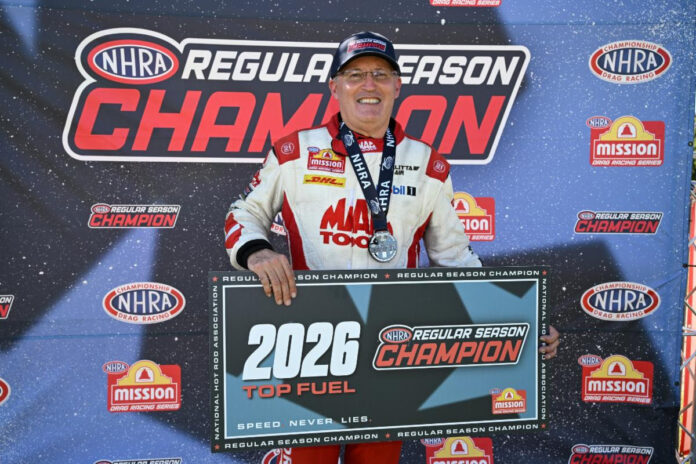
Pruett has impressed in her return to the Top Fuel ranks, while Hagan, the defending event winner in Las Vegas, is a four-time world champion and once again in the title hunt in 2026. Stewart, who won the regular-season championship a year ago, already has one Top Fuel win this season.

Mopar and Dodge will continue to have a strong presence in the midway at Las Vegas with an interactive fan display.

“It’s exciting to have Mopar and Dodge as the sponsors for such a huge race in our Countdown to the Championship,” said Brad Gerber, NHRA vice president and chief development officer. “This race always plays a huge role in the championship chase and you can feel the energy at the track all weekend. Having amazing brands like Mopar and Dodge sponsor two of our Countdown to the Championship races, including the event at Martin, Michigan, in September, only raises the excitement level and we’re proud to have their support for what will be another incredible event in Vegas.”

Brittany Force (Top Fuel), Hagan (Funny Car), Dallas Glenn (Pro Stock) and Gaige Herrera (Pro Stock Motorcycle) each won the fall race in Las Vegas last year. This season’s race will be broadcast on FS1, including eliminations on Sunday, Nov. 1.

Pro Stock’s Erica Enders has dominated The Strip at Las Vegas Motor Speedway over the years, as her 10 wins at the fan-favorite facility are the most in NHRA history. Tony Schumacher’s eight wins are the most in Top Fuel, with reigning champ Antron Brown right behind with six. Ron Capps’ and Hagan’s six victories in Funny Car is tied for the most at the track with John Force and Robert Hight. Reigning Pro Stock world champ Greg Anderson has eight wins at the standout facility.

The Mopar NHRA Las Vegas Nationals powered by Dodge will also feature thrilling competition in the NHRA Lucas Oil Drag Racing Series, which includes some of the sport’s top drivers, and the Summit Racing Series presented by Hoosier E.T. Finals, where world champions will be crowned. The event also serves as the season finale in the JBS Equipment NHRA Pro Mod Drag Racing Series presented by Elite Motorsports.

To purchase tickets to the Mopar NHRA Las Vegas Nationals powered by Dodge at The Strip at Las Vegas Motor Speedway, please call 800-644-4444 or visit www.lvms.com. For more information about NHRA, visit www.NHRA.com. For more information on the Dodge brand, visit Dodge.com.

Mopar

Mopar is the global name for Stellantis genuine parts and authentic accessories.

A simple combination of the words MOtor and PARts, Mopar offers exceptional service, parts and customer-care. Born in 1937 as the name of a line of antifreeze products, Mopar has evolved over more than 88 years to represent both complete vehicle care and authentic performance for owners and enthusiasts worldwide.

Mopar made its mark in the 1960s during the muscle-car era with performance parts to enhance speed and handling for both on-road and racing use. Later, Mopar expanded to include technical service and customer support, and today integrates service, parts and customer-care operations in order to enhance customer and dealer support worldwide.

Dodge

For 112 years, the Dodge brand has carried on the spirit of brothers John and Horace Dodge. Today, that legacy roars louder than ever in the next-generation lineup of Dodge, America’s performance brand.

The next-gen Dodge Charger multi-energy lineup features:

the SIXPACK-powered standard-output (S.O.) 420-horsepower Dodge Charger R/T with standard all-wheel drive and the highest entry-level horsepower of any muscle car
the 550-horsepower Dodge Charger Scat Pack, powered by the 3.0L Twin Turbo SIXPACK high-output (H.O.) engine — the most powerful Hurricane engine in production
the world’s quickest and most powerful muscle car in the all-electric 670-horsepower Dodge Charger Daytona Scat Pack

Every Charger comes standard with all-wheel drive and offers two-door coupe or four-door sedan configurations — because with performance comes choice.

The Dodge lineup is also fueled by the fastest American gas-powered SUV ever, the 710-horsepower Dodge Durango SRT Hellcat, powered by the legendary supercharged HEMI V-8 engine, now available in all 50 states. The new Durango SRT Hellcat Jailbreak breaks free from convention with the three-row SUV, unlocking more than 13 million potential customization combinations. The 360-horsepower 5.7-liter Durango GT HEMI AWD remains the most affordable AWD V-8 in the industry.

The purchase of a SIXPACK-powered Charger Scat Pack, Charger Daytona Scat Pack or Durango SRT Hellcat model includes one day of performance driving instruction at Radford Racing School, the official Dodge//SRT high-performance driving school.

About Mission Foods

MISSION®, owned by GRUMA, S.A.B. de C.V., is the world’s leading brand for tortillas and wraps. MISSION® is also globally renowned for flatbreads, dips, salsas and Mexican food products. With presence in over 112 countries, MISSION® products are suited to the lifestyles and the local tastes of each country. With innovation and customer needs in mind, MISSION® focuses on the highest quality, authentic flavors, and providing healthy options that families and friends can enjoy together. For more information, please visit https://www.missionfoods.com/

About NHRA

NHRA is the primary sanctioning body for the sport of drag racing in the United States. NHRA presents 20 national events featuring the NHRA Mission Foods Drag Racing Series and NHRA Lucas Oil Drag Racing Series, as well as the JBS Equipment NHRA Pro Mod Drag Racing Series presented by Elite Motorsports and NHRA Flexjet Factory Stock Showdown™ at select national events. NHRA provides competition opportunities for drivers of all levels in the NHRA Summit Racing Series and NHRA Street Legal™. NHRA also offers the NHRA Jr. Street® program for teens and the Summit Racing Jr. Drag Racing League® for youth ages 5 to 17. With more than 100 Member Tracks, NHRA allows racers to compete at a variety of locations nationally and internationally. NHRA’s Youth and Education Services® (YES) Program reaches over 30,000 students annually to ignite their interest in automotive and racing related careers. NHRA’s streaming service, NHRA.tv®, allows fans to view all NHRA national events as well as exclusive features of the sport. In addition, NHRA owns and operates three racing facilities: Gainesville Raceway in Florida; Lucas Oil Indianapolis Raceway Park; and In-N-Out Burger Pomona Dragstrip in Southern California. For more information, log on to www.NHRA.com, or visit the official NHRA pages on Facebook, Instagram, Twitter, and YouTube.

Who Covers Your Costs After a Crash With an Uninsured Driver?

Photo by Compagnons on Unsplash

Car accidents involving uninsured drivers can turn an already stressful moment into a financial mess you never saw coming. One minute you’re dealing with the shock of the impact, and the next you’re facing medical bills, repair estimates, and lost time from work with no clear path forward.

Millions of drivers run into this exact problem every year, often discovering too late that the other driver can’t pay a dime. This article breaks down how those costs get covered and what you can do to protect yourself.

Understanding Uninsured Motorist Coverage

Uninsured motorist coverage exists to keep you from paying out of pocket when the other driver can’t. It usually applies to injuries, repairs, and other losses linked to the accident, offering financial protection at a time when the costs can escalate quickly. Many drivers don’t realize how much their policy can do until they need it, often discovering its value only after facing unexpected expenses.

Here are a few examples of what it typically helps with:

  • Medical treatment costs
  • Lost wages after an injury
  • Repair or replacement of your vehicle

How Claims Get Processed After a Crash

When you file a UM or UIM claim, your insurer essentially fills the financial gap left by the uninsured driver. This process can take time because the insurer reviews evidence, damage estimates, and medical documents to verify the claim. That can feel frustrating when you’re trying to recover.

In situations where the back and forth becomes overwhelming, some people consider support from professionals familiar with uninsured crashes. That’s where no insurance accident attorneys can play a role by helping clarify what’s covered and guiding you through the next steps. 

Common Issues You Might Face

UM and UIM claims don’t always go smoothly, and it’s important to know what challenges might pop up. When your insurer questions repair costs or delays a payout, it can add unnecessary stress, especially if you’re already dealing with injuries, emotional trauma, or missed work. Knowing what to expect makes it easier to respond and prevents the process from feeling overwhelming during an already difficult time.

Here are common problems drivers report:

  • Disputes over repair values
  • Slow communication from adjusters
  • Requests for repeated documentation

When Coverage Isn’t Enough

Even with UM or UIM coverage, some drivers still face gaps when damages exceed their policy limits. This can happen after severe crashes, where medical care or long-term repairs become more expensive than expected.

In these situations, drivers sometimes look into additional options like collision coverage, personal injury protection, or payment plans through medical providers. Exploring these alternatives can ease the financial strain and give you more flexibility while you recover and manage the aftermath of the accident.

Staying Protected Moving Forward

Dealing with an uninsured driver is frustrating, but understanding your own policy puts you ahead. Review your UM and UIM limits regularly to ensure they match your needs. Many drivers don’t notice gaps until an accident forces them into tough financial decisions.

Being proactive also gives you confidence if something unexpected happens on the road. Solid coverage, clear expectations, and awareness of your options can make the aftermath far less stressful. If you ever need support, especially in uninsured motorist cases, professional guidance from the right team can make a real difference.

Why This Coverage Matters When Things Get Complicated

Your uninsured motorist coverage is your financial backup when another driver leaves you with the fallout, and knowing how it works helps you stay in control. It’s a tool that brings clarity and stability during an already stressful experience.

If you’re navigating the aftermath of an uninsured driver crash and want guidance that fits your situation, the team at DM Injury Law is ready to help. Reach out anytime for support and take your next steps with confidence.

When a Fast Car Meets a Bad Moment: Understanding Accident Liability

Ever had that split second where everything goes wrong on the road?

One driver speeds just a bit. Someone else misjudges and taps their brakes. Suddenly two cars collide in an instant nobody wanted. These accidents happen daily, and the faster you drive, the worse damage you’ll do.

Here’s the scary part…

Speed contributed to 29% of traffic deaths in 2023. This isn’t an insignificant amount. Combining a heavy vehicle with excessive speed and what could be a “fender bender” ends up causing injuries that impact you for years.

The good news?

Whiplash happens, but you have rights you can count on. Whiplash is one of the most common injuries caused by these types of wrecks, and Minnesota law allows you to seek compensation when someone else is to blame. If you’re dealing with neck pain after an accident and want to know how a whiplash injury claim works, read on. 

This guide explains how to seek financial compensation for medical bills, lost income, and pain and suffering after a car accident. Proving fault can be difficult, however. Do you need a car accident lawyer in Minneapolis? Many people choose to hire one to take care of their claim for them.

Time to break it all down…

What You’ll Walk Away With:

  • Why Speed Makes Everything Worse
  • What Whiplash Really Is
  • How a Whiplash Injury Claim Works
  • Who’s Actually At Fault?
  • Mistakes That Can Wreck Your Claim

Speed Makes Everything Worse: The Physics Don’t Lie

Here’s something most drivers forget…

Speed isn’t only how you’ll crash. Speed also dictates how badly you’ll crash. The faster you go, the more kinetic energy your vehicle has. When two cars collide, that kinetic energy needs to go somewhere. Typically, it transfers to the passengers within.

Think about it like this:

A fender bender at 5 miles per hour is annoying. That same accident at 40 miles per hour can send you to the hospital. Speed amplifies how hard a crash feels.

That’s why rear-ender collisions are both so frequent and so deadly. They account for nearly 29% of vehicular accidents, and many are caused by excessive speed.

What Whiplash Really Is (And Why It’s So Sneaky)

So what actually happens to a body in one of these crashes?

If you’re rear-ended in a car, your head jolts forward then snaps backward — forcefully. This jerking motion forces your neck muscles and ligaments beyond their usual stretch. That’s called whiplash.

And here’s the part that catches people off guard…

Whiplash is deceptive. Someone can get into an accident feeling perfectly normal. Two days later they wake up and can barely move their neck. Adrenaline masks the initial pain. When it appears, the injury has already occurred.

Wait, there’s more. You don’t even need to be hit fast. Research reveals most whiplash injuries occur at under 12 miles per hour. So even slow little nicks can cause serious long-term suffering.

Common whiplash symptoms include:

  • Neck pain and stiffness
  • Headaches that start at the base of the skull
  • Dizziness or blurred vision
  • Tingling or numbness in the arms and shoulders
  • Trouble sleeping and fatigue

Don’t ignore these. If left untreated whiplash can become chronic pain for years to come.

How a Whiplash Injury Claim Actually Works

Now to the important part — getting compensated.

A whiplash injury claim is the method an injured victim uses to request that the negligent driver (and their insurance provider) compensate them for the damages they incurred. There are a few main elements that typically must be established in order to prevail in a claim:

  1. The other driver was careless (negligent) — they were speeding or tailgating.
  2. That their negligence caused the crash — there must be causation.
  3. The reason for the injury was the crash — whiplash was caused by the accident.
  4. Real losses happened — medical bills, missed work, and pain all count.

Sounds simple, right? It’s not always.

Insurance companies battle whiplash claims vigorously. The reason is that whiplash is considered an “invisible” injury. There is no broken bone to see on an X-ray. Thus, adjusters will try to argue that the injury didn’t occur, or that someone is exaggerating. That is why having hard evidence is your strongest ally.

Who’s Actually At Fault? Understanding Liability

Here’s where things get interesting…

Liability simply refers to “who is legally at fault.” In the majority of rear-end collisions, the person who struck your vehicle is considered liable. After all, they should have enough distance to stop behind your car. When they collide with your vehicle, they are typically at fault.

But it’s not always black and white.

Other times both drivers are partially at fault. Perhaps one driver was speeding and the other driver had a burned out tail light. Many states have a system where your recovery is reduced by your percentage of fault. So if you are 20% at fault, you may only be able to recover 80% of your damages.

It’s for this reason that an accident report is so crucial. Police reports, witness statements and vehicle speeds can greatly alter your case.

Mistakes That Can Wreck Your Whiplash Injury Claim

Here’s how to save yourself a serious headache…

Claimants destroy their own whiplash injury claim by making these mistakes far too often. Avoid these pitfalls:

  • Skipping the doctor. No medical record means no proof of an injury.
  • Delaying treatment. You lose your place in line if you wait too long to get treated. Insurance likes to have a reason to deny you.
  • Posting on social media. Someone could take a picture of you smiling and claim that you’re okay.
  • Accepting the first offer. That first number will almost always be a low offer.
  • Providing a recorded statement too soon. One offhand remark can hurt you.

Accidents like these are traumatic, and it is easy to make mistakes when you are frazzled and injured. Take a breath. Write down everything. Seek proper assistance.

Putting It All Together

A fast car and a bad moment can change a life in seconds.

When you hear that over 40,000 people were killed on US roads last year, it’s easy to fear for your life every time you get behind the wheel. But what about injuries that don’t make the news, like whiplash? Those can rack up thousands of dollars in expenses too.

Here’s what to remember:

  • Speed makes crashes far more dangerous
  • Whiplash is serious, even at low speeds
  • A whiplash injury claim can cover bills, lost wages, and pain
  • Liability usually falls on the careless driver
  • Don’t hand insurance an easy excuse to deny you

You did not cause the accident. You shouldn’t have to pay for it. See a doctor, keep your paperwork in order and let an experienced advocate fight for you to receive maximum benefits.

Striking the Right Chord in Music City: When NASCAR is in Nashville, Cody Ware Drives and Plays With Feel

(HHP/Jacy Norgaard)

MOORESVILLE, N.C. (May 26, 2026) – When playing his Dean Z custom guitar or Gibson Les Paul Classic, Cody Ware plays with feel. When wheeling his No. 51 Jacob Construction Chevrolet, the 30-year-old racer drives with feel, too.

It’s an approach that’s especially appropriate this weekend as the NASCAR Cup Series heads to the Music City suburb of Lebanon, Tennessee, for Sunday night’s Cracker Barrel 400 at Nashville Superspeedway.

Whether it’s shredding on a six-string or driving a 3,400-pound racecar at 160 mph around Nashville’s concrete-clad 1.33-mile oval, finding the right feel is the fastest way to success. Ware is an avid guitarist who uses music to offset the cacophony of rumbling V8 engines that each produce 750 horsepower.

“Music is almost as big a part of my life as racing,” Ware said. “It’s therapeutic. When you’re playing, it kind of takes you into your own little world. It’s a great way to unwind.”

When you compete in the longest season in all of professional sports, finding a way to unwind is important. Nashville marks the 14th points-paying race on the Cup Series schedule, but it’s actually the 16th race of the year when including the preseason Clash Feb. 4 at Bowman Gray Stadium in Winston-Salem, North Carolina, and the non-points NASCAR All-Star Race May 17 at Dover (Del.) Motor Speedway. After Nashville, 22 races still remain.

“Thirty-eight race weekends isn’t easy, but that’s why not everyone’s out here doing it,” Ware said. “I’ve got a great family and a great support system, and all of us just love racing. We’re committed to it, so we just make it happen.”

Ware and his Cup Series counterparts are coming off the longest race on the schedule – the Coca-Cola 600 last Sunday at Charlotte (N.C.) Motor Speedway. After 400 laps around the 1.5-mile oval, Ware finished 28th. Now, he visits a Nashville track that is .17 of a mile shorter than Charlotte with 100 fewer laps.

“Nashville is a little bit of a hybrid racetrack,” Ware said. “It’s not quite an intermediate-style track like Charlotte, but it’s also not like the two other concrete tracks – Bristol and Dover.”

Bristol (Tenn.) Motor Speedway and Dover Motor Speedway are high-banked behemoths. The .533-mile Bristol oval has corners banked between 24 and 28 degrees, and the 1-mile Dover oval has corners banked at 24 degrees. Nashville, on the other hand, has just 14 degrees of banking, and its added length provides much more room in the corners, allowing drivers to try different lanes to find the fastest line around the track.

“Nashville is a lot more forgiving,” Ware said. “It’s a very wide racetrack, not quite as fast as a full-blown mile-and-a-half, and it’s a little bit shorter, so the speeds aren’t quite as high. But because it’s a little bit bigger, you kind of get sucked into the feeling of it being a mile-and-a-half, so overdriving the corners is very easy.

“You think you can drive a lot deeper into the corners than you really can, so it’s almost about reeling yourself in as a driver and being patient, and remembering that it’s about getting speed off the corner versus getting speed going into the corners.

“So, you have to have the entry patience of a short track with the discipline of an intermediate track, where you have to be consistent with your inputs, both with steering and your right foot. It’s a game of patience with smoothness in your steering, your throttle inputs and your braking inputs. The driver who looks the least out of control is typically the fastest there. It’s all about smoothness and consistency at Nashville.”

It is the same kind of smoothness and consistency heard in the guitar riffs and ballads that greet visitors from the moment they land at Nashville International Airport through their walks along Lower Broadway’s Honky Tonk Highway.

“I appreciate and respect the blood, sweat and tears that musicians put into their craft, just like we do as racers,” Ware said. “That being said, I grew up on heavy metal and rock-and-roll. Megadeth, Metallica, Led Zeppelin and Iron Maiden are on my playlist.

“I’ve been playing on and off for almost 20 years now. It’s kind of my hidden hobby. I play a lot of electric stuff, and I do a little bit of acoustic, but I’ve still got some work to do there. I don’t show off too much. I’ve probably only posted about it a few times, but it’s definitely a fun way to relax and unwind.”

With Sunday’s Coca-Cola 600 in the rearview mirror – a race that took nearly five hours to complete – and a few new chords strummed on his guitars, Ware is refreshed and ready for Nashville.

Practice begins Saturday at 3:30 p.m. CDT/4:30 p.m. EDT, followed by qualifying at 4:40 p.m. CDT/5:40 p.m. EDT. The 300-lap race goes green on Sunday at 6 p.m. CDT/7 p.m. EDT. All of the action will be broadcast live by Prime Video and SiriusXM NASCAR Radio.

About Rick Ware Racing:

Rick Ware has been a motorsports mainstay for more than 40 years. It began at age 6 when the third-generation racer began his driving career and has since spanned four wheels and two wheels on both asphalt and dirt. Competing in the SCCA Trans Am Series and other road-racing divisions led Ware to NASCAR in the early 1980s, where he finished third in his NASCAR debut – the 1983 Warner W. Hodgdon 300 NASCAR Grand American race at Riverside (Calif.) International Raceway. More than a decade later, injuries would force Ware out of the driver’s seat and into full-time team ownership. In 1995, Rick Ware Racing was formed, and with his wife Lisa by his side, Ware has since built his eponymous organization into an entity that competes full-time in the elite NASCAR Cup Series while simultaneously campaigning successful teams in the Top Fuel class of the NHRA Mission Foods Drag Racing Series, Progressive American Flat Track, FIM World Supercross Championship (WSX) and zMAX CARS Tour.

Simple Rules for Safe Following Distance That Every Driver Should Know

Safe following distance is the amount of space a driver should keep between their vehicle and the one ahead to stop safely without causing a collision. Getting it wrong is one of the most common causes of rear-end crashes on roads across the country.

How is your following distance determined? It depends on several factors, including speed, road conditions, vehicle type, and reaction time. The standard rule most driving instructors teach is the three-second rule, which gives drivers a practical and easy-to-apply benchmark in normal conditions.

The following distance is not just a driving tip. In many states, it is a legal requirement, and failing to maintain adequate space can establish fault in a collision.

The Three-Second Rule Explained

The three-second rule is the most widely recommended method for calculating safe following distance. It is simple, does not require any equipment, and works at most highway and city speeds.

How to Apply It

Pick a fixed point on the road ahead, such as a sign or a tree. When the vehicle in front passes that point, count slowly to three. If your vehicle reaches the same point before you finish counting, you are following too closely.

Three seconds gives most drivers enough time to perceive a hazard, react, and begin braking before reaching the vehicle ahead. At higher speeds, that gap should increase to four or five seconds to account for the longer stopping distance required.

When Three Seconds Is Not Enough

The three-second rule works well under ideal conditions. But road and weather conditions change constantly, and the following distance must adjust with them.

Conditions That Require More Space

  • Wet or icy roads significantly increase stopping distance.
  • Driving at night reduces visibility and reaction time.
  • Towing a trailer or driving a heavy vehicle extends braking distance.
  • Following a large truck or bus blocks sightlines and requires an extra buffer.
  • Driving in heavy traffic increases the chance of sudden stops ahead.

A good rule of thumb is to double the gap in rain and triple it on ice or snow. These are not arbitrary suggestions. Physics determines stopping distance, and no amount of driving skill changes how long it takes for a vehicle to slow from highway speed on a slick surface.

Most states have laws that require drivers to maintain a reasonable and prudent following distance. The language varies, but the intent is the same across the country.

What the Law Generally Says

California Vehicle Code Section 21703 states that a driver shall not follow another vehicle more closely than is reasonable and prudent. Similar statutes exist in nearly every state. These laws do not specify an exact number of feet or seconds, which means courts interpret reasonableness based on the circumstances at the time of the crash.

When a rear-end collision occurs, the trailing driver is typically presumed to be at fault. That presumption exists because maintaining adequate following distance is the trailing driver’s legal responsibility. Overcoming that presumption requires showing that the lead driver made a sudden or unpredictable move.

Following Distance vs. Stopping Distance

These two terms are related but not the same. Understanding the difference matters both for safe driving and for legal purposes after a crash.

Short-Term Safety vs. Long-Term Habit

The following distance is the gap a driver consciously maintains while traveling. Stopping distance is the total distance a vehicle travels from the moment the driver perceives a hazard to the moment the vehicle comes to a complete stop. Stopping distance includes both reaction distance and braking distance.

At 60 miles per hour, the average stopping distance is around 180 feet. A driver following at two seconds behind a vehicle at that speed is already cutting the margin dangerously thin. Building the habit of maintaining proper following distance reduces the chance of a collision even when something unexpected happens ahead.

Key Takeaways

  • A safe following distance is the space needed to stop without hitting the vehicle ahead.
  • The three-second rule is the standard benchmark under normal driving conditions.
  • Rain, ice, heavy vehicles, and night driving all require increased following distance.
  • Most state laws require a reasonable and prudent following distance without defining an exact measurement.
  • Rear-end collision fault typically falls on the trailing driver who failed to maintain adequate space.
  • Stopping distance at 60 mph averages around 180 feet, including reaction and braking time.
  • The following distance is both a safety habit and a legal standard with real consequences in a crash.

What You Need to Know About License Reinstatement After a DUI

Getting your license back after a DUI is not automatic. Once the suspension period ends, there is still a list of conditions you have to meet before you can legally drive again, and missing even one of them can extend the process or land you in further legal trouble. 

The good news is that for most first-time offenders, reinstatement is achievable. The bad news is that it takes time, paperwork, money, and, in most cases, some form of program completion.

What you’ll need to do for your license reinstatement really depends on your state, the situation surrounding your arrest, and whether this is your first DUI or not.  

What Does the Reinstatement Process Actually Involve?

Here is what that process generally looks like across most states.

Serving the Full Suspension Period

Before anything else, you have to wait. Most states will not allow you to apply for reinstatement until the full suspension period has run its course. 

How long that takes depends on your blood alcohol level at the time of arrest, whether anyone was injured, and whether you have prior DUI convictions on your record.  

Completing a Required DUI Program

Nearly every state requires DUI offenders to complete some form of alcohol education or treatment program before the DMV will reinstate driving privileges. What that looks like varies. Some states require a few hours of alcohol safety education. 

Others mandate a full substance abuse evaluation followed by counseling sessions or a rehabilitation program. The more serious the offense, especially for repeat DUIs, the more intensive the requirement tends to be. 

Paying All Required Fees and Fines

This sounds simple, but it stops people more often than it should. Most states require a reinstatement fee to be paid directly to the DMV before your license is restored. 

On top of that, any outstanding court fines, bail fees, or other financial obligations tied to the DUI have to be cleared. If there are unpaid balances sitting on your record, the DMV will not process reinstatement, full stop.

Filing an SR-22

An SR-22 is a certificate your insurance company files with the state on your behalf, confirming that you carry the minimum required liability coverage. After a DUI, most states require this filing before you can get back on the road. 

You will need to contact your insurance provider and ask them to file it, and be aware that your premiums will almost certainly go up as a result of the DUI on your record.

If you switch insurance providers or let your coverage lapse while the SR-22 requirement is still in effect, the insurer is required to notify the state. That notification can trigger a new suspension. 

What Happens If You Drive Before You Are Reinstated?

Driving on a suspended license is a separate criminal offense in most states. It can result in additional fines, extended suspension, and, in some states, jail time. It can also reset the reinstatement process entirely. 

If you are pulled over and your license is still under suspension, the consequences compound fast. A restricted license, if you qualify for one, is the only legal way to drive during a suspension period. 

Do You Need an Attorney for This Process?

You are not legally required to hire an attorney to handle reinstatement, but having one makes a real difference. The requirements across agencies do not always communicate smoothly, deadlines are easy to miss, and one wrong step can push the timeline back significantly. 

An attorney who handles DUI cases knows what the DMV and the court each need, in what order, and can catch problems before they become delays. 

Key Takeaways

  • Reinstatement after a DUI requires completing multiple steps in the right order. 
  • Most states require completion of an alcohol education or treatment program before the DMV will restore driving privileges.
  • An SR-22 certificate must be filed by your insurance company with the state before reinstatement.
  • All fines and reinstatement fees usually need to be fully paid before anything moves forward.
  • Getting caught behind the wheel before reinstatement is a criminal offense in most states.
  • It can extend your suspension and add jail time on top of everything else.
  • A DUI attorney knows what both the court and the DMV need and in what order; that alone can save you weeks of back-and-forth.

Can You Fight a Speeding Camera Ticket After a Crash?

Drivers in Alabama can challenge speeding camera tickets after a crash if evidence shows the accident affected the situation or the citation contains errors. State law also allows motorists to dispute unclear images, inaccurate evidence, or improper automated enforcement procedures. 

Alabama is a southeastern U.S. state bordered by Tennessee, Georgia, Florida, and Mississippi, with access to the Gulf of Mexico coastline. The state is home to major cities like Birmingham, Montgomery, Mobile, and Huntsville, each with its own traffic enforcement practices and municipal regulations. Alabama’s roadways include heavily traveled interstates such as I-65, I-20, and I-10, where traffic congestion and accidents can sometimes contribute to disputed speeding allegations.

Alabama cities using automated enforcement may follow local ordinances and posting requirements before issuing violations. Some municipalities require warning signs near cameras and mailed notices within a specific timeframe. Drivers researching Alabama speed cameras often discover that camera tickets can be successfully disputed.

Check the Ticket for Errors

Start by reviewing every detail on the citation. Small mistakes can weaken the credibility of the ticket and support your defense. Look closely at the following information:

  • License plate number
  • Vehicle make or model
  • Date and time
  • Camera location
  • Recorded speed

If the camera captured the wrong vehicle or listed inaccurate information, the court may question the reliability of the entire violation. Alabama courts generally expect traffic evidence to be clear and accurate before imposing penalties.

Request the Full Camera Evidence

You should request all available records related to the ticket. This may include photos, video footage, calibration records, maintenance logs, and operator certifications.

A blurry image or malfunctioning device may create reasonable doubt. Some Alabama municipalities also require camera systems to meet local approval standards before enforcement begins. If the equipment was not properly maintained, the citation may become easier to challenge.

Explain How the Crash Affected the Situation

After a collision, traffic patterns can change within seconds. A driver may react suddenly to avoid additional impact or debris. Camera systems usually capture only a brief moment, which means the full emergency may not appear in the recorded image or video.

Argue the Driver or Vehicle Was Not Clearly Identifiable

Some speeding camera tickets are tied to the registered owner rather than the actual driver. However, unclear evidence may still create problems for the enforcement agency. You may have a defense if:

  • The plate number was partially unreadable
  • Another person was driving
  • The image quality was poor
  • The vehicle color or model did not match

In some jurisdictions, Alabama law specifically states that a notice should not be issued if the license plate image is not sufficiently clear to reliably identify the vehicle owner.

Automated enforcement systems may comply with local laws. That includes rules about signage, public notice, placement, and timing.

Some Alabama municipalities require signs warning drivers about automated speed enforcement within a certain distance of the device. Public awareness campaigns before cameras become active. Missing signs or improper placement may support a legal challenge.

Contest the Ticket Properly and On Time

Drivers should respond before the deadline listed on the notice. Missing the hearing date or filing deadline can reduce available options. To strengthen your case:

  • Gather photos and crash documents
  • Request all camera evidence early
  • Organize witness statements clearly
  • Bring repair records or insurance reports
  • Present your explanation calmly during the hearing

Even if dismissal does not happen, some courts may reduce the fine or allow a non-moving violation resolution.

Key Takeaways

  • Speeding camera tickets in Alabama can sometimes be challenged successfully.
  • Errors in the citation may weaken the case against the driver.
  • Camera maintenance records and calibration logs can matter in court.
  • Crash-related emergencies may explain unusual driving behavior.
  • Unclear license plate images can create identification defenses.
  • Alabama municipalities using cameras may follow local legal requirements.
  • Filing the dispute on time improves the chance of a better outcome.

A Practical Guide to Shipping a Car When You’re Relocating for Work

A job move usually comes with a tight timeline.

You have a start date, maybe a temporary apartment lined up, and a checklist that grows by the hour.

Driving your car across the country sounds simple until you factor in the fuel, the hotels, the wear on your vehicle, and the days you can’t afford to lose.

Hiring an auto transport company like roadrunnerautotransport.com solves that, but only if you set it up properly and avoid the rookie mistakes that cost people money and time.

Book Earlier Than You Think You Need To

The first thing to sort out is the booking window.

Carriers don’t run on Uber-style availability.

Most legitimate companies need somewhere between seven and ten days of lead time to assign your vehicle to a truck already heading in your direction.

Last-minute requests do get filled, but you’ll pay more, and the pickup window stretches.

If you already know your start date, lock the shipment in as soon as the offer letter is signed.

Open or Enclosed Transport

Open versus enclosed is the next call.

Open carriers are the standard nine-car haulers you see on the freeway, cheaper, faster to book, and perfectly fine for a daily driver.

Enclosed transport costs roughly 40 to 60% more, but it’s the right choice for a low-clearance sports car, a classic, or anything with fresh paint you’d rather not pelt with road debris.

For most work relocations involving a normal sedan or SUV, open is the sensible pick.

What Actually Drives the Price

Pricing moves with distance, vehicle size, and season.

A coast-to-coast move for a midsize sedan typically runs in the $1,200 to $1,600 range during normal months.

Summer raises that.

Snowbird routes in January and February push prices up, too, since trucks heading from the Midwest to Florida fill up fast.

A short regional hop, Chicago to Atlanta, for example, lands closer to $700 to $900.

If a quote comes in dramatically lower than the rest, that’s a flag, not a deal.

Underpriced loads sit on the dispatch board for days because no driver will take them.

Door-to-Door Versus Terminal

Door-to-door is what most people want and what most carriers offer by default.

The driver meets you as close to your address as a 75-foot truck can legally and safely get.

In the suburbs, that’s usually your driveway or the end of the street.

In a dense city, expect to meet in a nearby parking lot or wide commercial street.

Terminal-to-terminal exists but rarely makes sense for a work move, since you’d be coordinating dropoff and pickup at warehouses in two unfamiliar cities.

Brokers Versus Carriers

The broker question trips up a lot of first-timers.

A carrier owns the trucks.

A broker arranges loads with carriers across the country.

Almost every nationwide auto transport service you’ll find online is technically a broker, and that’s not a bad thing.

Brokers have access to a much larger pool of trucks, which is why they can quote routes a single-fleet carrier couldn’t touch.

What matters is that they’re licensed, bonded, and verifiable through the FMCSA.

The Inspection Most People Rush

Inspection at pickup is the part most people skim through.

Don’t.

The driver will fill out a Bill of Lading documenting any existing scratches, dings, or wheel curb rash.

Walk around the car with them, take your own time-stamped photos from every angle, and check that the mileage is recorded.

If something happens in transit, that paperwork is your evidence.

Without it, you’re arguing from memory against a professional logistics operator.

Insurance Gaps Worth Knowing

Your insurance situation needs a quick check before pickup.

The carrier holds cargo insurance; federal law requires it, but coverage limits and deductibles vary.

Ask for the certificate of insurance and read the deductible carefully.

Your personal auto policy usually doesn’t cover the vehicle while it’s strapped to a transport truck, so don’t assume there’s a backup.

If you’re shipping something high-value, top-up coverage through the broker is cheap and worth it.

Prepping the Vehicle

A few practical prep steps save real headaches.

  • Wash the car so that pre-existing damage shows clearly in inspection photos
  • Leave roughly a quarter tank of gas, enough for loading and unloading without adding unnecessary weight
  • Remove toll transponders and EZ-Pass so you don’t rack up charges across three states
  • Take personal items out, since carriers aren’t insured for them, and DOT inspections can flag stuffed vehicles

Delivery Day

Delivery on the other end mirrors pickup.

Inspect the car in daylight if at all possible.

Check the panels you didn’t think to look at the first time: the roof, the underside if you can see it, the front bumper.

Sign the Bill of Lading only after you’re satisfied.

If you spot damage, note it on the document before the driver pulls away.

Once you sign clean and the truck leaves, your claim becomes much harder to win.

Timing It With the Rest of Your Move

Coordinating the shipment with the rest of your relocation is the last piece.

Transit times run roughly 1 to 3 days for regional moves, 5 to 7 days for coast-to-coast, with weather and driver hours occasionally adding a day.

Build that buffer into your plan.

If you’re flying to the new city before the car arrives, line up a rental or rideshare for the gap.

Trying to land the same day as the truck is a coordination trap, since carriers give windows, not appointments, and a four-hour spread can easily turn into a different morning altogether.

A relocation already stretches your time and attention thin.

Shipping the car should be the part of the move you stop thinking about once it’s booked, not the part that wakes you up at 2 a.m.

Get the timing right, document everything at pickup, and the rest tends to take care of itself.