Race cars are often judged by engine power, aerodynamics, tires, and driver skill. Yet performance also depends on many small components that measure movement, control spacing, protect electronics, and manage airflow. When these parts are thin, detailed, or frequently revised, photochemical etching provides a practical way to manufacture them without the cutting force used in conventional machining.
Why Racing Places More Pressure on Components
Race cars operate under conditions that are far more demanding than normal road use. Components must handle vibration, repeated braking, high temperatures, rapid acceleration, and long periods of high load.
Space is also limited. Sensors, data loggers, control units, wiring, cooling hardware, and mechanical assemblies must fit around the chassis, powertrain, suspension, and driver.
A small dimensional error may affect sensor alignment, electrical contact, airflow, or mechanical spacing. A burr or distorted edge can also interfere with assembly.
These details may not increase horsepower directly, but they can support consistency, reliability, and accurate vehicle data.
Precision Parts Used in Race Cars
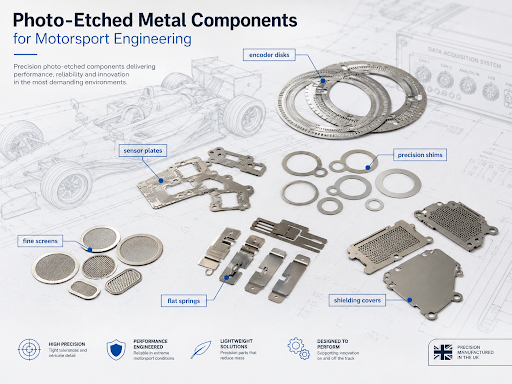
Encoder Disks and Sensor Plates
Modern race cars collect large amounts of data. Teams monitor wheel speed, engine speed, suspension movement, throttle position, steering input, temperature, and pressure.
Encoder disks and sensor plates may contain repeated slots, coded patterns, or small apertures. Their spacing and geometry must remain consistent so the sensing system can produce reliable feedback.
Photochemical etching can form many fine openings at the same time. A cutting tool does not need to move from one slot to the next, making the process useful for thin parts with repeated patterns.
Shims and Spacers
Precision shims and spacers control gaps, alignment, and assembly height. They may be used around sensor mounts, suspension components, control modules, gear assemblies, and other mechanical interfaces.
A shim often looks simple, but its thickness and profile can affect how parts sit together. Etching is useful when the component is thin and includes internal openings, tabs, or a complex outer shape.
Screens and Airflow Components
Race cars need controlled airflow for cooling, ventilation, and component protection. Fine metal screens may protect ducts, sensor openings, fluid systems, or electronic enclosures from debris.
Etching can create repeated holes, slots, or mesh patterns across one metal sheet. This allows engineers to adjust open area, pattern shape, and outer geometry for a specific installation.
Contacts, Springs, and Clips
Electrical systems may use grounding contacts, connector parts, retaining clips, and flat springs. These parts often include narrow sections, contact points, small holes, and later forming operations.
The flat profile can be etched first and then bent, plated, cleaned, or heat-treated when required.
Protecting Race Car Electronics
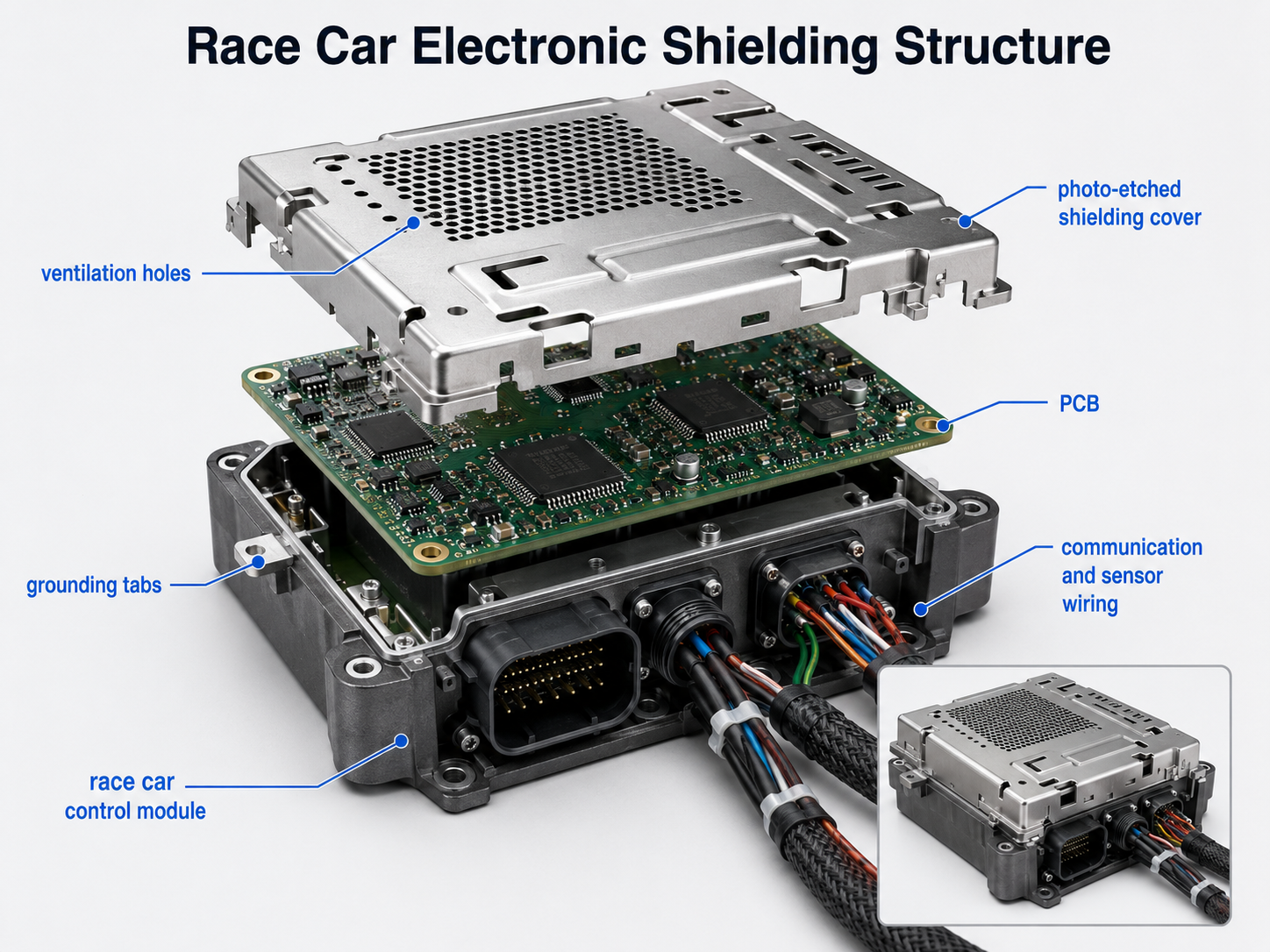
Data systems, communication equipment, control modules, sensors, motors, and power electronics may operate close together inside the vehicle. This creates a risk of electromagnetic interference.
EMI shielding can help isolate sensitive circuits or contain noise near its source. A photo-etched shielding blank may include ventilation holes, mounting tabs, contact features, identification marks, and half-etched bend lines.
The final result depends on more than the metal cover. Grounding, seams, openings, material selection, and assembly quality must all be considered together.
How Photochemical Etching Works
Photochemical etching, also called photo etching or photochemical machining, removes selected areas from a metal sheet through a controlled chemical process.
The sheet is cleaned and coated with a light-sensitive photoresist. Digital artwork transfers the part pattern through ultraviolet exposure. After development, an etchant removes the unprotected metal. The parts are then stripped, cleaned, and inspected.
Because the process does not use a cutting tool, it avoids direct mechanical pressure on the sheet. It can also create holes, slots, outer profiles, tabs, identification marks, and fold lines in one flat pattern.
Digital tooling makes revisions easier. Engineers can change a hole pattern, tab position, mesh layout, or outer profile without building a new hard die for every version.
Why Etching Fits Motorsport Development
Race programs often change components during testing. A sensor opening may need to move. A screen may require a different airflow pattern. A shield may need another contact tab. A spacer may need a revised profile.
Photochemical etching supports these changes through digital artwork. Multiple design versions may also be arranged on one sheet when their material and processing requirements are compatible.
The process is especially useful for thin, flat parts with detailed features. It can support prototypes, validation builds, limited racing programs, replacement parts, and selected repeat-production needs.
When Other Manufacturing Methods Are Better
Etching is not the right process for every race car component. Thick three-dimensional parts may be better suited to CNC machining. Large structural parts may require forming, welding, forging, or conventional sheet-metal fabrication.
Simple parts produced in very high volumes may justify stamping tools. Some thicker flat components may be more economical to laser cut.
The best choice depends on material, thickness, geometry, tolerance, production volume, secondary operations, and total cost.
What Motorsport Teams Should Define
Before requesting a quote, teams should provide the material grade, thickness, drawing, critical dimensions, tolerances, quantities, and expected operating conditions.
They should also define flatness, hole and slot patterns, forming, plating, heat treatment, cleaning, inspection, and packaging requirements. Clear drawing revision control is important when several versions are tested during a racing season.
A qualified metal etching supplier should review how the geometry, material, inspection plan, and later forming or finishing steps work together.
Performance Is Built from Details
Race car performance does not come from one component alone. It comes from the way power, aerodynamics, sensing, cooling, electronics, and mechanical systems work together.
Encoder disks, sensor plates, shims, screens, contacts, springs, and shielding covers are small, but they can support more accurate data, more consistent assembly, and more reliable operation.
Photochemical etching gives motorsport teams another way to produce detailed thin-metal parts with flexible digital tooling. When matched to the right component, it can support faster design changes and better control of the small details that matter on the track.