The auto transport industry primarily consists of two types of companies: Auto shipping carriers and brokers, with a total of 25,603 registered carriers, out of which only 7,858 are brokers; the rest are carriers. Understanding the difference between them is crucial when shipping your vehicle to ensure you get the service you need at the right price.
What is the difference between a broker and a carrier in auto transport?
Carriers are the companies that actually move your car. They own the trailers and hire the drivers, or they’re the drivers.
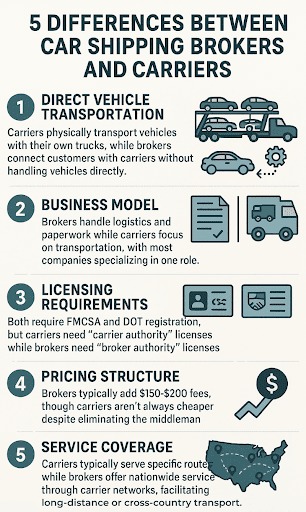
Brokers? They’re like matchmakers. They connect you to carriers but don’t touch your vehicle. If you want direct control, work with a car hauler company (carrier). Some more key differences include:
Business Model
Brokers handle the legwork: finding carriers, negotiating prices, and managing paperwork. Carriers focus on driving.
Some companies do both, but most stick to their lane. Brokers don’t own trucks, so they’re not haulers.
Licensing Requirements
Always check licenses. Legit licensed car shippers will show proof up front.
- Both need FMCSA and DOT registration.
- Carriers have “carrier authority” licenses.
- Brokers have “broker authority” licenses.
Pricing Structure
Brokers mark up prices, but carriers aren’t always cheaper. Compare quotes.
| Brokers | Carriers | |
|---|---|---|
| Average Fee | Add $150-$200 fee | No middleman fee |
| Price Consistency | Varies by carrier | May match broker rates |
Service Coverage
Most car hauler companies stick to specific routes (like the East Coast or Midwest). Brokers use networks to offer nationwide auto transport.
Need a car moved from Maine to Arizona? Brokers can arrange that. Carriers? They’ll likely hand it off to another hauler mid-route.
How to Hire Auto Shipping Carriers Not Brokers? 5 Steps
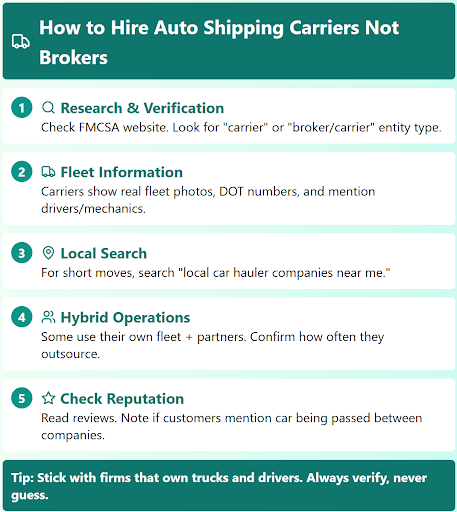
1. Research and Verification
First, check the FMCSA website. Search the company’s name to see its “Entity Type.” Legit licensed car shippers will show “carrier” or “broker/carrier.” Brokers can’t hide here. If they’re shady about their status, walk away. If they’re shady about their status, walk away. Before booking, verify that the carrier maintains active commercial truck insurance suited to its hauling operation, along with cargo coverage for the vehicles it transports

2. Look for Fleet Information
Real auto shipping carriers proudly show their fleet details on their website and social media. Car hauler companies that own their vehicles will tell you.
| What to Look For | Carriers | Brokers |
|---|---|---|
| Fleet Photos | Real photos of their trucks | Generic or stock images |
| DOT Numbers | Displayed on website/trucks | May only have MC number |
| Staff | Mentions drivers/mechanics | Only sales/support staff |
3. Local Search for Shorter Distances
Need a short move? Search “local car hauler companies near me.” Smaller companies often handle regional routes themselves. Brokers rarely bother with short hauls—they make more on long-distance jobs.
4. Check for Hybrid Operations
Hybrids work if you need nationwide auto transport, but confirm how often they outsource. Some “carriers” broker 90% of jobs.
| Broker/Carrier Hybrid | Pure Carrier |
|---|---|
| Owns some trucks + uses partners | Only uses their own fleet |
| Good for nationwide flexibility | Better for direct control |
5. Review Their Reputation:
Read reviews on Google, BBB, BirdEye, and TransportReviews. See whether customers mention if their car was passed between companies mid-route. Visit Easy Auto Ship For More Information.
Final tip: Stick with car hauler firms that own trucks and drivers. For nationwide moves, hybrids can work—just vet them hard. Never guess. Always verify.
Where Do Car Hauler Companies or Brokers Hire Carriers?
Brokers post jobs on industry load boards there, and licensed car shippers claim them. These platforms let carriers grab jobs nationwide, from Miami to Seattle.
DAT or Central Dispatch are the most popular load boards. But it’s not just apps. Established brokers work with the same companies for years and build trust.
- Direct relationships matter too. Some carriers stick with 2-3 brokers who feed them steady work. No marketing needed—just repeat business.
- Specialized networks exist for niche jobs. Moving luxury cars? Hauling EVs? Certain carriers only work with dealers or manufacturers. They’re like the VIP section of vehicle transport services.
Owner-operators are solo drivers who own their rigs. They’ll team up with brokers for consistent gigs. Need a hauler for a Chicago-to-Dallas route? Brokers know who’s driving that path weekly. For nationwide auto transport, hybrids shine. They mix their own trucks with partner fleets.
But watch out—some auto shipping carriers outsource most jobs. Always ask: “Will YOUR truck move my car?”
The Problem With Carriers – No Route Flexibility or Nationwide Auto Transport
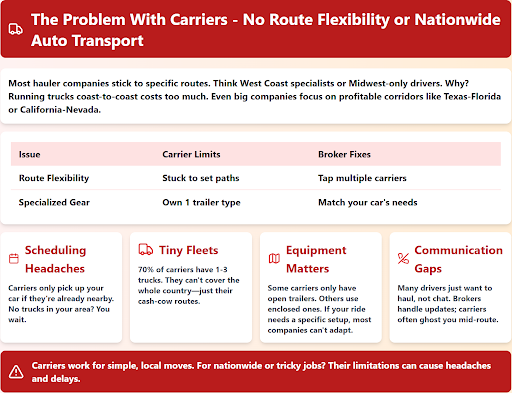
Most hauler companies stick to specific routes. Think West Coast specialists or Midwest-only drivers. Why? Running trucks coast-to-coast costs too much.
| Issue | Carrier Limits | Broker Fixes |
|---|---|---|
| Route Flexibility | Stuck to set paths | Tap multiple carriers |
| Specialized Gear | Own 1 trailer type | Match your car’s needs |
Even big companies focus on profitable corridors like Texas-Florida or California-Nevada. Need a car shipped from Vermont to New Mexico? Good luck finding a direct hauler.
- Scheduling headaches: Carriers only pick up your car if they’re already nearby. No trucks in your area? You wait.
- Tiny fleets: 70% of carriers have 1-3 trucks. They can’t cover the whole country—just their cash-cow routes.
- Equipment matters too: Some carriers only have open trailers. Others use enclosed ones for luxury cars. If your ride needs a specific setup, most companies can’t adapt.
- Communication’s another headache. Many drivers just want to haul, not chat. Brokers handle updates; carriers often ghost you mid-route.
Carriers work for simple, local moves. For nationwide or tricky jobs? Their gaps will frustrate you. Always ask: “Can you actually DO this route?”
Should You Use an Auto Broker’s Vehicle Transport Services?
Sometimes using a broker makes more sense than going direct. Here’s when a middleman might be worth it.
When Time is Limited
Brokers find trucks faster with their nationwide networks. They call multiple hauler companies at once. You’d spend days doing what they do in hours.
For Long-Distance or Cross-Country Transport
Finding direct carriers for cross-country trips is tough. Few hauler companies drive coast-to-coast regularly. Brokers connect regional carriers for complete routes.
| Transport Type | Direct Carrier Availability | Broker Advantage |
|---|---|---|
| Local (under 300 miles) | Good | Minimal |
| Regional (300-1000 miles) | Limited | Good |
| Nationwide (1000+ miles) | Very Limited | Excellent |
When You Want Additional Protection
Brokers offer extra layers of security. They verify credentials. They provide their own insurance. They have offices you can visit.
For Convenience and Time Savings
Brokers handle all the research and calls. They check carrier safety records such as RMIS and vet them. They coordinate pickup and delivery. You make one call instead of twenty.
For Special Vehicle Types or Unusual Routes
Got an exotic car? Need transport to remote areas? Brokers know which carriers handle special cases. They find specialized equipment when needed.