MOORESVILLE, N.C. (March 12, 2026) – The Las Vegas Strip is full of characters. Elvis impersonators, Pokémon creatures, superheroes and seemingly everyone in between. It’s no surprise that Las Vegas Motor Speedway, just 15 miles north of the Strip up Interstate 15, has plenty of character, too.
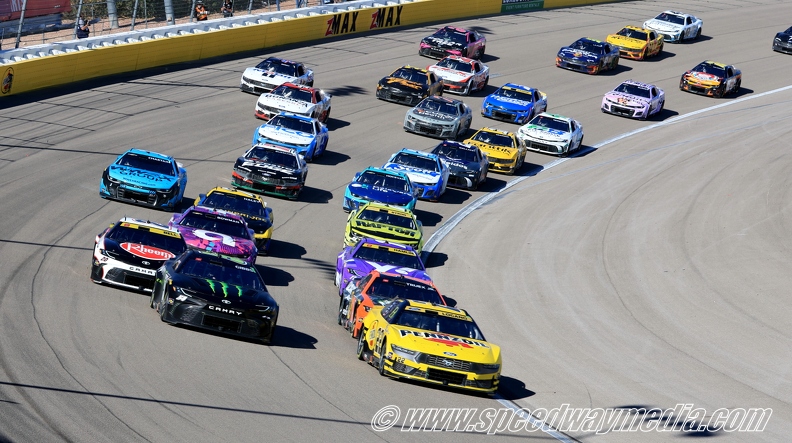
The 1.5-mile oval, site of Sunday’s Pennzoil 400 NASCAR Cup Series race, is a fast, sweeping racetrack. Drivers lap its D-shaped layout in under 30 seconds at average speeds approaching 185 mph. With its corners banked at 20 degrees, two- and three-wide racing is common, and its aged asphalt provides enough grip for drivers to search different lines in an effort to find more speed.
For Cody Ware, driver of the No. 51 Yeego Chevrolet for Rick Ware Racing (RWR), the track is like the city – a destination venue.
“Vegas is one of my favorite tracks to go to on the schedule. It’s got a lot of character,” Ware said. “Being out in the desert, it can be a little bit dusty, and you have some pretty significant bumps, especially over in the corners. You have to be very cognizant of your corner entry and the line you’re taking, because if you hit those bumps in turns one and two just the wrong way, it could end your day pretty quickly.
“And with the different lines you can run, you can find ways to make the car work for you even if your car isn’t exactly where you want it. If you don’t have a good handle on your car, there’s about a lane-and-a-half you can use in turns one and two. But if your car is handling well, you can take those bumps aggressively. That opens up a lot of racing opportunities from the bottom of the racetrack all the way to the wall.”
Getting a good handling racecar means finding an equilibrium between mechanical balance and aero balance.
“You have to have a lot of aero grip and a lot of downforce built into the car to make sure you can run aggressively, especially as tire degradation goes on during the run. That, and just compliance and platform control over the bumps in (turns) one and two,” Ware said.
“Those bumps get worse every year, so to be able to have a car that can drive through those bumps and charge into the corner is a big key to not only qualifying well, but maintaining really good long-run speed.”
Finding that long-run speed serves both an immediate need and a long-term need.
Las Vegas is considered an intermediate-style oval, which is the bread-and-butter of the Cup Series calendar. Ovals from 1.3 miles to 2 miles comprise 30 percent of the races. With Las Vegas being the first intermediate oval of the season, it serves as a litmus test for teams to measure themselves and prepare for the next 1.5-mile oval on the schedule – April 19 at Kansas Speedway in Kansas City.
“We start the year with three straight wild-card races, where seemingly anything can happen,” Ware said. “Last week at Phoenix was probably the first race where you go in feeling like you control your destiny a little more. Vegas will give us a gauge of where our performance is relative to the rest of the field, and once we get this Vegas race underneath us, we’re going to have a better idea, directionally, of the places where we can work to make our cars better.”
A switch to Chevrolet and a technical alliance with Richard Childress Racing (RCR) ahead of the 2026 season has given Ware added confidence heading into this bellwether track.
“Our new alliance with Chevrolet and RCR, and all the effort and hard work that’s been put in over the offseason, are going to pay dividends,” Ware said.
“I did a little bit of work in the static rig at RCR for Vegas, and with the new Camaro body, I feel like we’ve got a lot of downforce and not a whole lot of drag in the car. So, it’s a pretty downforce-heavy trim for Vegas, and that might hurt a little bit of our qualifying speed, but from what I’ve felt and seen so far, I think we’ve got a pretty good baseline going into Vegas.”
That baseline meets the racing line on Saturday at 11:30 a.m. PDT/2:30 p.m. EDT for a one-hour practice before qualifying at 12:40 p.m. PDT/3:40 p.m. EDT. Prime Video and SiriusXM NASCAR Radio will provide live coverage of both. Sunday’s Pennzoil 400 goes green at 1 p.m. PDT/4 p.m. EDT with live, flag-to-flag coverage delivered by FS1 and SiriusXM NASCAR Radio.
About Rick Ware Racing:
Rick Ware has been a motorsports mainstay for more than 40 years. It began at age 6 when the third-generation racer began his driving career and has since spanned four wheels and two wheels on both asphalt and dirt. Competing in the SCCA Trans Am Series and other road-racing divisions led Ware to NASCAR in the early 1980s, where he finished third in his NASCAR debut – the 1983 Warner W. Hodgdon 300 NASCAR Grand American race at Riverside (Calif.) International Raceway. In 1995, Rick Ware Racing was formed, and with wife Lisa by his side, Ware transitioned out of the driver’s seat and into fulltime team ownership. He has since built his eponymous organization into an entity that competes full-time in the elite NASCAR Cup Series while simultaneously campaigning winning teams in the Top Fuel class of the NHRA Mission Foods Drag Racing Series, Progressive American Flat Track (AFT), FIM World Supercross Championship (WSX) and zMAX CARS Tour.