
Late autumn on a mixed crop and livestock farm means racing against weather to bale a final cutting of hay. Two seasons ago, we fitted a set of cheap but bright LED floodlights to the tractor that runs our large square baler. The lights were powerful, but within 20 minutes of switching them on, the baler’s control terminal blanked out and the knotter cycle started missing. After two days of chasing wiring faults that did not exist, the local dealer traced the problem to conducted electromagnetic interference spilling from the work lights straight into the tractor’s CAN bus. That experience fundamentally shifted how I evaluate any lighting purchase, and it is what led me to look closely at 12v led work lights that are designed from the PCB upward to meet EMC CISPR25 Class 4 limits.
Why Electromagnetic Compatibility Is No Longer Optional in Modern Equipment
Every tractor, combine, sprayer, and telehandler built in the last decade relies heavily on CAN bus networks to coordinate engine, transmission, hydraulic, and implement functions. When you bolt on an aggressively priced LED light bar that has no internal filtering, the switching noise from its DC-DC converter can travel back through the power wiring and corrupt the low-voltage data signals that keep safety-critical systems functioning. In Europe, CISPR25 Class 4 has become a de facto requirement for aftermarket lighting fitted to vehicles operating near sensitive receivers. In North America, fleet managers are starting to write it into their procurement specs after experiencing costly intermittent faults that dealers cannot reproduce in the shop. The reality is that a CISPR25-compliant light costs more to design and manufacture, but the alternative can cost a harvest or a shift.
What Class 4 Actually Means for a Work Light Installation
CISPR25 defines radiated and conducted emission limits across a range of frequency bands. Class 4 is the strictest tier within that standard and covers components mounted in the immediate vicinity of radio antennas and onboard communication modules. In practical terms, a light certified to Class 4 has been engineered with filtering components, shielded internal cabling, and circuit board layout optimized to suppress electromagnetic noise. When I installed Tough Lighting’s rectangular 48W units on the same tractor that had previously tripped the baler’s CAN bus, the data link stayed stable across a full eight-hour night shift. The radio reception remained crystal clear on both AM and FM bands regardless of whether the lights were on or off.
How I Evaluated the Real-World Performance on a Mixed-Vehicle Fleet
The Test Platform and Conditions
My evaluation covered three vehicle types that represent common agricultural use cases: a 12V utility tractor used for loader work and baling, a 24V self-propelled sprayer, and a pickup truck that handles service calls. All testing was done during late fall and early winter when temperatures ranged from -10°C to +5°C, with frequent wet conditions that tested sealing integrity. The lighting units were mounted using the factory brackets and wired according to the included diagram, with no additional filtering or ferrite cores added.
Beam Quality and Usable Light Distribution
The combination beam pattern on the rectangular work lights produced a bright central reach that made fence lines clearly visible at around 80 meters, while the wide flood component lit the area directly in front of the machine well enough to spot obstacles during low-speed turns. Color temperature is in the 6000K range, which delivers strong contrast for identifying rocks and debris in a field but may feel stark during prolonged operation. The beam cutoff is cleaner than on many aftermarket flood lights I have used, and there is less wasted light bleeding upward, which reduces glare for other operators working nearby.
Durability Under Vibration and Moisture Exposure
The housing uses a die-cast aluminum body with a polycarbonate lens bonded in a way that, in the units I disassembled, left no obvious gap for moisture ingress. After two weeks of continuous use on a diesel tractor that vibrates heavily at idle, the brackets held tight and the internal electronics showed no sign of intermittent contact. One unit was deliberately subjected to a high-pressure wash at close range and continued to function without internal fogging, which suggests the sealing is adequate for routine agricultural cleaning practices.
A Sourcing Workflow That Suits Fleet Workshops, Not Just Large Dealers
Step 1: Establish Your Voltage and Application Details
Confirm Whether Your Fleet Operates on 12V or 24V Systems
The manufacturer offers both 12V and 24V variants across the work light range. Knowing which voltage your machines use is the first filter, because a 12V light wired into a 24V circuit will fail almost instantly. Light trucks, utility tractors, and most agricultural equipment run on 12V, while larger mining trucks, construction plant, and some self-propelled sprayers operate on 24V electrical architectures. Clarifying this upfront saves time in the specification phase.
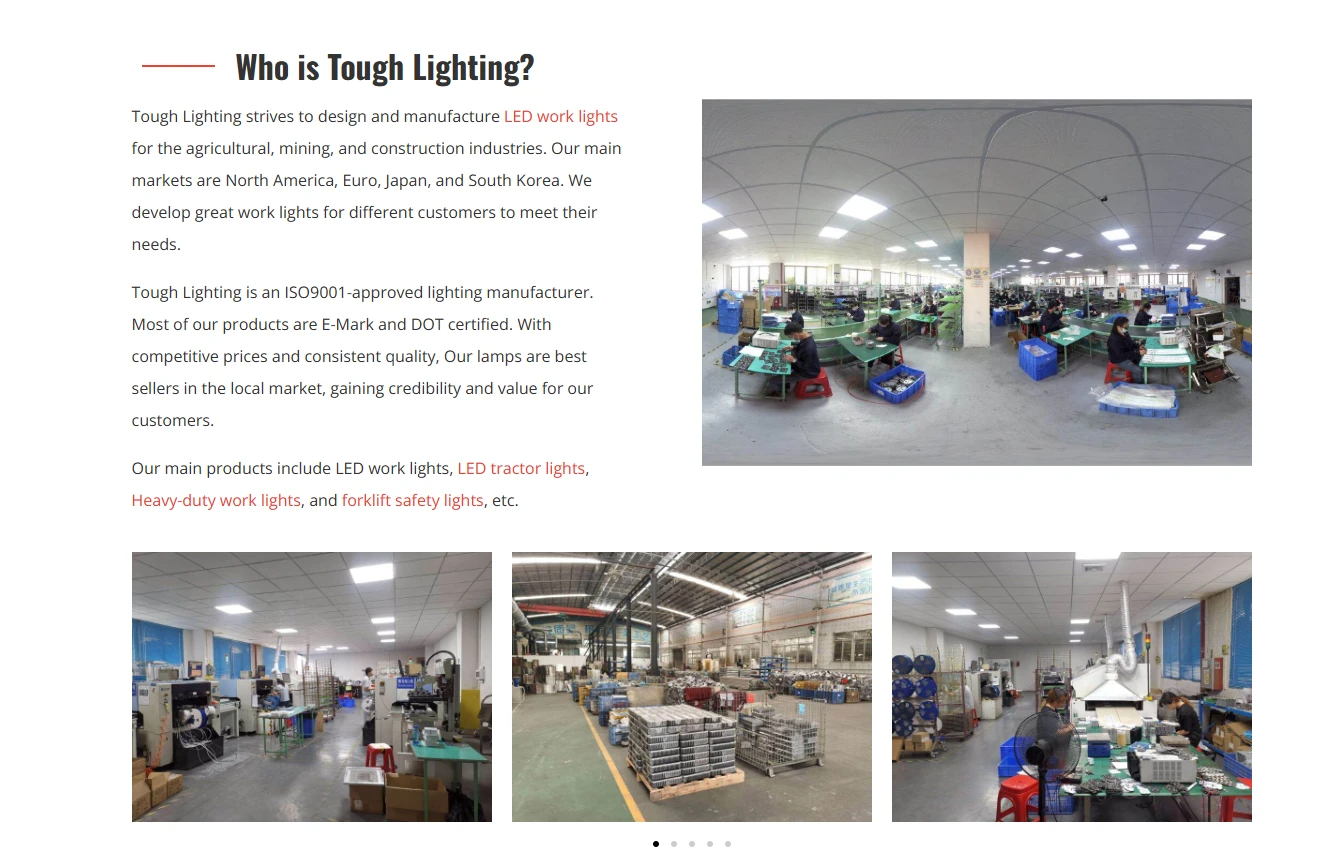
Define the Mounting Location and Beam Pattern Preference
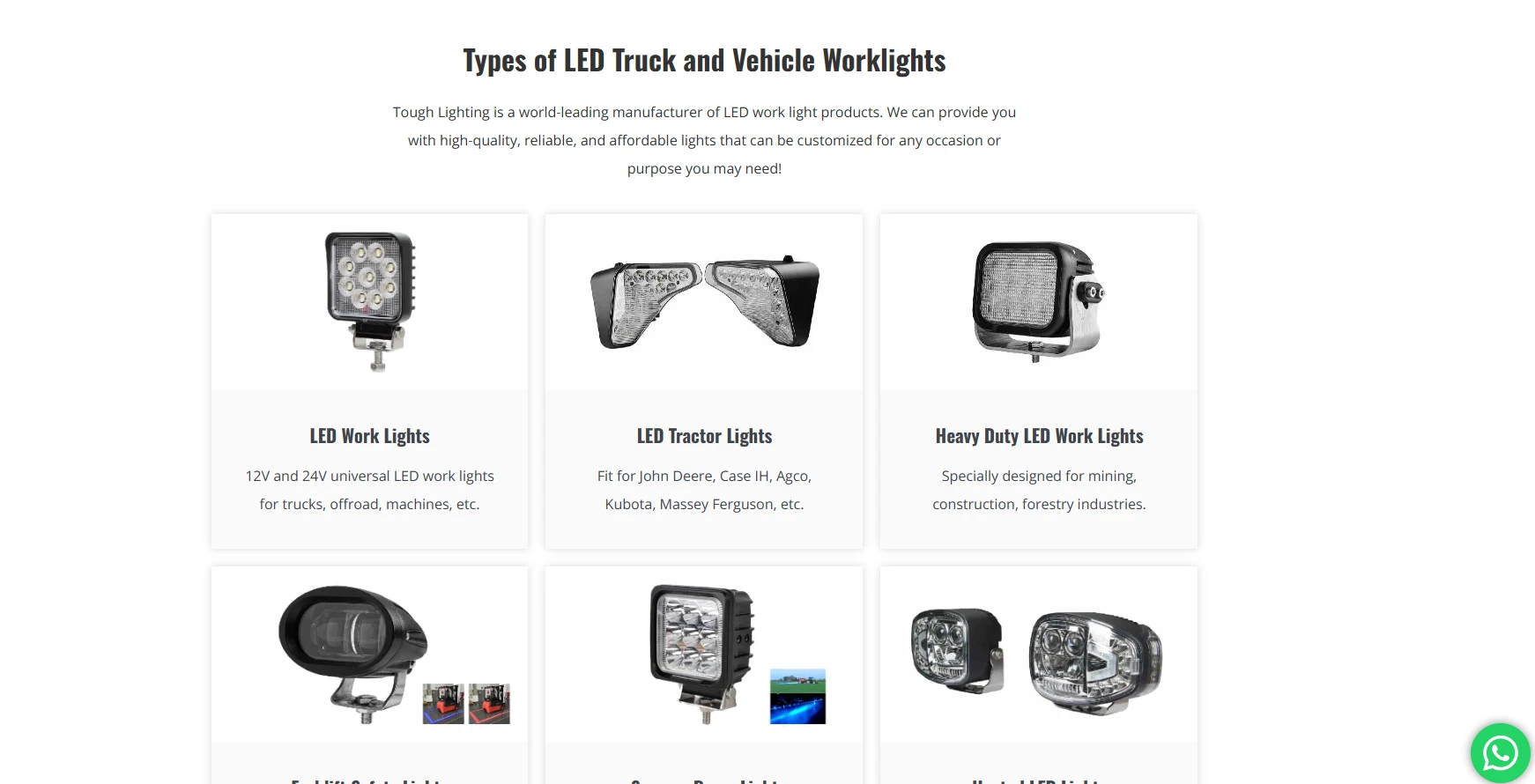
The catalog includes round, rectangular, and square form factors designed for different mounting positions. Round lights tend to suit bumper and grille mounts. Rectangular lights fit well on roll bars, roof racks, and side rails. Beam pattern options cover spot, flood, and combination distributions. Identifying where the light will be mounted and what coverage pattern the operator needs helps the supplier recommend a housing shape and wattage that match the application.
Step 2: Initiate a Dialogue and Evaluate a Physical Sample
Contact the Supplier Through the Preferred Channel
The sales team can be reached by email, WhatsApp, or web form. In my experience, WhatsApp generated responses during China business hours within a few hours, which is helpful when coordinating across time zones. The contact email listed on the site is info@toughlighting.com, and a direct phone number is available. Providing context about the type of machinery, operating environment, rough annual volume, and any customization intent leads to a more focused initial response.
Test a Free Sample on Your Own Equipment
The supplier provides free samples for evaluation before any purchase commitment, and the sample I received was a production-grade unit rather than a stripped-down demonstrator. This allows a fleet maintenance team to test physical fit, electrical compatibility, and beam quality on the exact make and model of equipment that will use the lights. Testing for radio interference and CAN bus stability during real operation is far more informative than reading a specification sheet.
Step 3: Review the Quotation, Lead Time, and Warranty Protection
Confirm Pricing, Production Window, and Logistics
Once the requirements are defined, the supplier will issue a quotation that includes unit pricing, estimated production lead time, and shipping terms. Standard catalog lights ship in 7 to 9 working days after order confirmation. Large-volume orders or custom units may require 12 to 21 working days. The quotation will state whether pricing is FOB or includes freight, which is important for budgeting total landed cost.
Understand the Replacement Process Under the 3-Year Warranty
All work lights carry a 3-year warranty that covers free replacement of any defective product. During the inquiry stage, ask for the specific warranty claim procedure, including what documentation or photos are needed to validate a claim. Having this process clear before deploying lights across a fleet helps maintenance teams act quickly when an issue arises.
Why the 12-Volt Lineup Makes Sense for Mixed-Agricultural Fleets
The vast majority of light trucks, tractors, and self-propelled harvesters in agricultural use run on 12V electrical systems, and the 12 volt led work lights variants I tested matched the voltage range and load characteristics of standard alternators without triggering any warning lights or voltage drop issues. The lower-power models in the 18W to 36W range can be wired into existing work light circuits without upgrading fuses or relays, which reduces installation time and cost. For operators who run mixed fleets with a handful of 24V machines, the supplier also offers 24V versions, and the consistency of beam pattern and color temperature across both voltage families means a fleet can maintain a uniform lighting appearance.
A Clear-Headed Look at EMC-Compliant LED Work Lights
| Aspect | Typical Budget Import | Tough Lighting |
| EMC certification | None or unverified | CISPR25 Class 4 across most models |
| Risk of CAN bus interference | High; documented field failures | Low; filtering designed into PCB |
| Sample availability | Rare; often paid | Free production-grade samples |
| Minimum order for standard lights | Usually 200+ units | No minimum |
| Customization depth | Logo printing in some cases | Full OEM/ODM with engineering support |
| Warranty enforcement | Difficult to claim | 3-year free replacement; clear process |
| Lead time for stock units | Varies; often weeks | 7 to 9 working days |
The Limits You Should Acknowledge Before Switching Suppliers
No supplier fits every operation, and I want to be direct about the friction points. First, shipping from the factory in Foshan means transit time and customs clearance are the buyer’s responsibility, so if a light fails during a critical operation window and you need a same-day replacement, a local distributor will still have an edge. Second, the 6000K color temperature, while excellent for object contrast, can cause eye fatigue during all-night harvest shifts; some operators may prefer a warmer 5000K option, which this catalog does not currently offer. Third, customized lights require a 300-unit minimum order, which puts bespoke designs out of reach for very small operations. Fourth, while the EMC compliance is verified at the design level, the final installation quality and wiring routing on a machine still influence how much noise reaches the vehicle’s modules; a poorly executed install can undermine the benefit of a well-designed light.
Where This Fits in a Practical Fleet Lighting Strategy
From the perspective of someone who has spent too many hours chasing electrical ghosts introduced by aftermarket accessories, a work light that starts with electromagnetic cleanliness as a design requirement rather than an afterthought is worth serious consideration. The factory-direct model asks the buyer to take on logistics coordination, but in return it removes artificial volume barriers and lets you test the product on your own machines before committing. The 3-year warranty provides a reasonable window to see how the lights hold up across multiple seasons. For fleet managers who value uptime and want to stop diagnosing phantom CAN bus faults, starting the procurement conversation with a CISPR25 requirement may be the single most productive specification change you make this year.