Historically, competition is an important part of daily life in a lot of Asian societies. Which is natural, since huge populations create an environment where getting your piece of cake calls for doubling the effort. In modern Japan, it mostly manifests as playful regional feuds, historical samurai competitions, and a popular storytelling trope that emphasizes mutual respect and self-improvement. That’s the energy they bring into sports as well.
The Japanese have entered 2026 with a league system that has become far more international and competitive than its 1990s version, contributing to the fanbase and online betting opportunities.
Since its launch in 1993 (10 clubs at the time), the professional game has expanded into a three-tier structure and developed a strong reputation for producing technically gifted players who later often move to Europe.
Over the course of history, the Japan Professional FL has gradually earned trust and respect from fans and other professionals. After a Melbet registration, staying updated on teams’ information gets easier, but statistics merely reflect results – not the way up there.
True identities are molded by rivalries, charity work, personal records, and, of course, scandals. So what exactly do we know about sportsmen who came from the Land of the Rising Sun?
Setting the Pace
The modern J.League has several established powers:
- Kawasaki Frontale
- Yokohama F. Marinos
- Urawa Red Diamonds
- Kashima Antlers
All of them have played major roles in shaping the competition, with the latter particularly important. They won the inaugural Japan Professional FL title in 1993 and have collected more J1 championships than any other club.
Urawa offers a very different picture. The huge fan base makes matches at Saitama Stadium some of the most intense occasions in Japanese football. The Reds have also become one of Asia’s most successful teams, winning the AFC Elite multiple times.
Yokohama F. Marinos are one of the originals and have maintained a strong connection with attacking football. Their rivalry with nearby Kawasaki Frontale is especially famous, since both have competed for major domestic honors.
Nippon Stars That Shine Domestically and Worldwide
Of course, the major factor in the league’s appeal in 2026 is its players. Their success has changed the game, earning various opportunities for the country. A domestic career can now be part of a longer route toward major European competitions.
So let’s put names to achievements in our personal Top 10:
1. Hidetoshi Nakata
Played for Perugia, Roma, Parma, Bologna, and Fiorentina in Serie A and won the Scudetto with Roma in 2001.
2. Keisuke Honda
One of Japan’s most recognizable footballers of the 2010s. Was in CSKA Moscow, AC Milan, and several clubs around the world. Scored in three consecutive World Cups, in 2010, 2014, and 2018.
3. Shunsuke Nakamura
Famous for his exceptional free kicks and technique. He became a Celtic legend, won the Scottish Premier League three times, and was named the 2007 PFA Scotland Player of the Year.
4. Kazuyoshi Miura
Known as King Kazu, he began his career in the 1980s and continued into his 50s.
5. Makoto Hasebe
A long-serving Japan captain who spent most of his European career in Germany. He played for Wolfsburg, Nürnberg, and Eintracht Frankfurt, winning the Bundesliga with Wolfsburg in 2009.
6. Shinji Kagawa
One of Japan’s most successful modern players. He won two Bundesliga titles with Borussia Dortmund and later won the Premier League while playing for Manchester United.
7. Yuto Nagatomo
A hugely recognizable full-back who spent many years at Inter Milan. He won the Coppa Italia, FIFA Club World Cup, and Supercoppa Italiana with Inter.
8. Takumi Minamino
A product of Cerezo Osaka who established himself in Europe (Salzburg, Liverpool, and Monaco).
9. Takefusa Kubo
One of the biggest current stars. Known as Take Kubo, he developed in Barcelona’s youth system and later became highly important for Real Sociedad and Japan.
10. Kaoru Mitoma
Recognized internationally, he amazes with his dribbling and attacking style, which made him a standout at Brighton after moving from Kawasaki Frontale.
The Power of Competition
Japanese football has several locally legendary rivalries, such as Gamba Osaka VS Cerezo Osaka or Urawa VS Kashima Antlers. One of the most interesting aspects of those is that they often develop through repeated competition rather than centuries-old hostility. The J.League itself is relatively young, so clubs have spent the last three decades creating their own traditions.
Sure, there’s always a touch of negative emotion when it comes to competitiveness, but local culture teaches us to look at it from a different angle. Even in Japanese storytelling — ranging from classic folklore to modern anime and manga — rivals are rarely pure villains.
To show what, we’ve even compiled a watch-list, containing some of the most popular sports-related stories that illustrate this approach:
- Haikyuu!! 🏐
- Blue Lock ⚽
- Slam Dunk 🏀
- Kuroko’s Basketball 🏀
- Captain Tsubasa ⚽
- Ace of Diamond ⚾
- Hajime no Ippo 🥊
Nippon Today
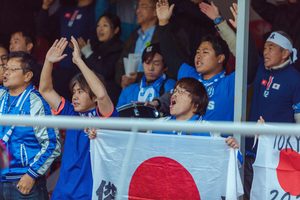
The J.League is now part of a much larger football ecosystem. Japanese sportsmen regularly move abroad, foreign players continue to arrive, and Asian competitions give domestic clubs additional opportunities to test themselves.
It also has a strong youth-development culture. Managers invest heavily in academies, which means many J1 members have spent years improving their local sports.
Japan’s rise on the international stage has been closely connected to the development of domestic football. The country has reached the knockout stage of several recent World Cups, while more Japanese participants than ever have established careers in Europe’s top teams.
In 2026, the J.League therefore sits at an interesting point. Its traditional clubs and rivalries remain central to its identity, but the competition is increasingly connected to the global football market.
The most exciting question is what comes next. Japan has already shown that it can develop players capable of succeeding abroad. Meanwhile, we are staying tuned for more.