Action-Packed Season Starts with Three Straight Races
Barber Motorsports Park Returns to April Date
All NTT INDYCAR SERIES Races Again To Air on FOX
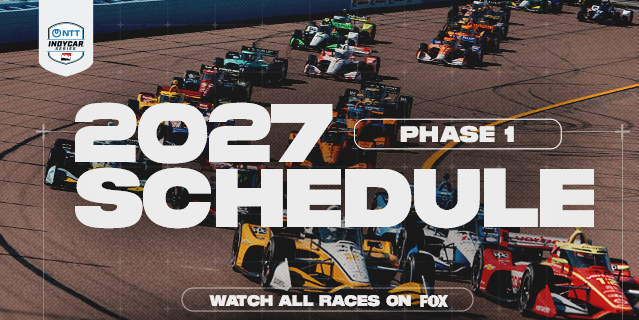
INDIANAPOLIS (Wednesday, Aug. 12, 2026) – INDYCAR has announced the return of a supercharged set of races to kick off the 2027 NTT INDYCAR SERIES season as part of “Phase One” of next year’s overall schedule. The spring event lineup includes another adrenaline-fueled launch with three straight weekends at:
- Streets of St. Petersburg, Sunday, March 7
- Phoenix Raceway, Saturday, March 13
- Streets of Arlington, Sunday, March 21
INDYCAR announced the dates and locations for the first eight races of the 2027 NTT INDYCAR SERIES season as Phase One of the schedule unveiling.
For the third consecutive season, all NTT INDYCAR SERIES races will be broadcast on FOX, with three additional appearances scheduled during the two days of qualifying for the Indianapolis 500 presented by Gainbridge and coverage of Miller Lite Carb Day at Indianapolis Motor Speedway. The NTT INDYCAR SERIES is once again the only premier motorsport series in North America with all races broadcast on network television.
During the current NTT INDYCAR SERIES season, viewership is up 16% from the previous season, creating the highest viewership of the championship since 2008.
“It has been another remarkable year of growth through our powerful partnership with FOX Sports, and we look forward to focusing on even greater opportunities through the 2027 NTT INDYCAR SERIES schedule,” Penske Entertainment Corp. President and CEO Mark Miles said. “We are pleased to confirm Phase One of next year’s championship alongside another accelerated start with races in St. Petersburg, Phoenix and Arlington. 2026 has been proof of concept that our sport is fueled by an expanding presence across marquee events and destinations, and we look forward to carrying that momentum into 2027.”
2027 will mark the second consecutive year – and just the fifth time in the 118-year history of the INDYCAR SERIES – that a season begins on three consecutive weekends.
The Sunday, March 7 race on the Streets of St. Petersburg, Florida, will be the 17th time the championship will open in the Sunshine City. Following the season debut at the Firestone Grand Prix of St. Petersburg, the NTT INDYCAR SERIES returns for another joint showcase weekend with NASCAR in partnership with FOX Sports at Phoenix Raceway. The Saturday, March 13 race will be the 66th time the INDYCAR SERIES has raced on the historic 1-mile desert oval. The 2026 race featured 565 on-track passes – the most on record for the INDYCAR SERIES at Phoenix Raceway.
A week later, the NTT INDYCAR SERIES returns to the 14-turn, 2.73-mile Streets of Arlington circuit for the second Java House Grand Prix of Arlington. The tentpole event unites three championship organizations: INDYCAR, the Dallas Cowboys and REV Entertainment, the official events partner of the Texas Rangers. The sold-out inaugural race featured the season’s fastest trap speed on a street circuit at 192.298 mph by Kyle Kirkwood before being won by the Andretti Global driver.
“The start to this year’s 2026 season was action-packed, and it’s gratifying to know the stage is set for a return to that frantic pace in 2027,” INDYCAR President J. Douglas Boles said. “St. Pete has become an ideal host to begin our season, and the reaction to the series’ return to historic Phoenix Raceway made our partnership with NASCAR and FOX all the more special. To finish that stretch with a marquee event on the Streets of Arlington will be a fitting way to lead into another heated season-long battle for the NTT INDYCAR SERIES championship.”
The spring portion of the 2027 NTT INDYCAR SERIES schedule continues Sunday, April 4 on the series’ first natural terrain road course of the season and a return to the “Augusta National” of racetracks at Barber Motorsports Park in Birmingham, Alabama. It is the 17th INDYCAR weekend at the picturesque, dynamic and physically demanding track.
Two weeks later, the season returns to the palm tree-lined Streets of Long Beach for the iconic Acura Grand Prix of Long Beach on Sunday, April 18. The legendary event set a modern-day record with over 200,000 in attendance in 2026. The 2027 edition will extend the longest-running street circuit event on the calendar, as this will be the 43rd time the INDYCAR SERIES has raced on the sunny Southern California streets.
Another thrilling Month of May at Indianapolis Motor Speedway follows the Streets of Long Beach and begins on the challenging road course for the Sonsio Grand Prix, Saturday, May 15. It is the 13th time the 2.439-mile circuit has set the stage for the month’s remaining events.
Attention then turns toward the famed 2.5-mile oval the following week leading to PPG Presents Armed Forces Qualifying Weekend on Saturday-Sunday, May 22-23. A week later, the 111th Running of the Indianapolis 500 presented by Gainbridge is set for Sunday, May 30. The 2026 edition of “The Greatest Spectacle in Racing” featured a race-record 70 lead changes and the closest finish in race history when Felix Rosenqvist of Meyer Shank Racing w/Curb Agajanian edged David Malukas of Team Penske by just .0233 of a second.
The 2027 NTT INDYCAR SERIES schedule continues with the traditional post-May visit to the Streets of Detroit for the Chevrolet Detroit Grand Prix presented by Lear on Sunday, June 6. The 2026 race, won by Alex Palou of Chip Ganassi Racing, featured the most on-track passes on a street circuit this season.
2027 NTT INDYCAR SERIES Open Tests
For the second year, the 2027 NTT INDYCAR SERIES season calendar will begin with the Unser INDYCAR Open Test on Tuesday-Wednesday, Feb. 23-24 at Phoenix Raceway. The two-day test will not only prepare all teams for the season ahead but also the series’ race at the desert oval the following month. Additional details of the test, named in honor of the Unser family and their accomplishments at their home track, will be announced at a later date.
In preparation for the 111th Running of the Indianapolis 500 presented by Gainbridge, the Indy 500 Open Test is set for Tuesday-Wednesday, May 4-5 at Indianapolis Motor Speedway – between NTT INDYCAR SERIES races on the Streets of Long Beach and the IMS road course. The two-day test allows additional track time for all teams, including rookies looking to complete the Rookie Orientation Program. Testing hours will be shared later.
Phase Two of the NTT INDYCAR SERIES schedule, featuring the remaining 2027 race dates, will be released in the coming weeks. Tune-in times for next season’s events will be announced at a later date. The 2027 schedule for INDY NXT by Firestone, INDYCAR’s developmental series, also will be announced at a later date.
2027 NTT INDYCAR SERIES SCHEDULE – PHASE ONE
| Date | Venue | Television |
| Sunday, March 7 | Streets of St. Petersburg | FOX |
| Saturday, March 13 | Phoenix Raceway | FOX |
| Sunday, March 21 | Streets of Arlington | FOX |
| Sunday, April 4 | Barber Motorsports Park | FOX |
| Sunday, April 18 | Streets of Long Beach | FOX |
| Saturday, May 15 | Indianapolis Motor Speedway Road Course | FOX |
| Sunday, May 30 | The 111th Indianapolis 500 | FOX |
| Sunday, June 6 | Streets of Detroit | FOX |
The next NTT INDYCAR SERIES race is the Ontario Honda Dealers Indy at Markham, round 14 of the 2026 championship, Sunday, Aug. 16. Coverage begins at noon ET on FOX and FOX One. Audio coverage is available via INDYCAR Radio powered by OnlyBulls on SiriusXM channel 218 and the INDYCAR App powered by NTT DATA.