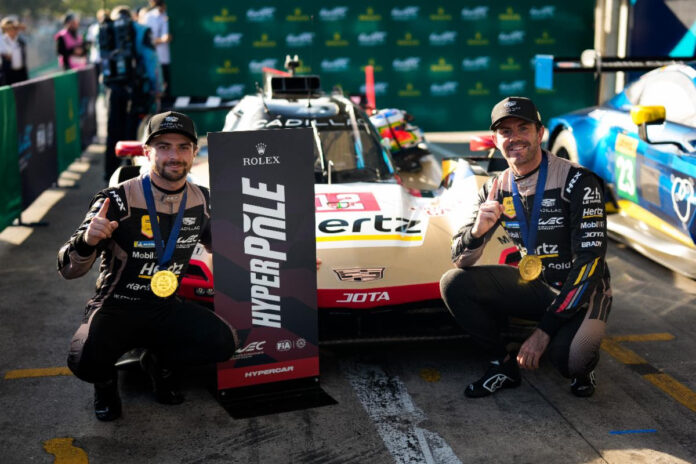
Two Joe Gibbs Racing Toyota GR Supra’s Finish Inside the Top 10 Saturday night
HAMPTON, Ga. (July 11, 2026) – William Sawalich rallied from the middle of the pack to lead Team Toyota with a fourth-place finish in Saturday night’s NASCAR O’Reilly Auto Parts Series race at EchoPark Speedway near Atlanta.
Sawalich’s Joe Gibbs Racing teammate Brandon Jones also mounted a strong comeback, overcoming early race damage and surviving a string of late cautions to finish seventh. The result marked Jones’ 12th top-10 finish of the season.
TOYOTA RACING Post-Race Recap NASCAR O’Reilly Auto Parts Series (NOAPS) EchoPark Speedway near Atlanta Race 21 of 33 – 250 miles, 163 laps
TOYOTA FINISHING POSITIONS
1st, Justin Allgaier* 2nd, Carson Kvapil* 3rd, Parker Retzlaff* 4th, WILLIAM SAWALICH 5th, Anthony Alfredo* 7th, BRANDON JONES 14th, DEAN THOMPSON 24th, BRENT CREWS 33rd, TAYLOR GRAY 34th, HARRISON BURTON *non-Toyota driver
TOYOTA QUOTES
WILLIAM SAWALICH, No. 18 SoundGear Toyota GR Supra, Joe Gibbs Racing
Finishing Position: 4th
How were you able rally to bring home a top-five finish?
“We had a good run there at the finish, our SoundGear GR Supra was pretty good there when it cooled off. We weren’t great through stage 1 and 2 and still needed some work on it. Stage 3 once it cooled off the car came to us just some total grip is what we needed. We were a little bit off everywhere, we were able to suck up good but our cornering wasn’t great, that’s where we lost a lot of time in (turns) 3 and 4. I was able to capitalize on everything that happened there at the end, got some damage but it wasn’t bad enough to ruin our night.”
TAYLOR GRAY, No. 54 Operation 300 Toyota GR Supra, Joe Gibbs Racing
Finishing Position: 33rd
What happened there to put you out of the race?
“Obviously super disappointing. Felt like we struggled all day long trying to get the balance right. We were super loose all day long. I felt like right before we got involved there, I felt like we got to the point where we were going to be ok and be able to fight for a top 10, I felt like. I can’t thank everyone at Joe Gibbs Racing and Toyota Racing enough. We are fighters, we fought all day long to get the car better and felt like we were going to be able to fight there at the end, not sure if it was going to be for the win, but for a top 10 and get a ok points day, so unfortunately it’s not our reality. Just got to take this off week and focus forward hard on Indy.”
What’s the level of concern in the points standings with three to go in the regular season?
“I’m the biggest Sheldon Creed fan on the planet right now, I hope he goes and wins another one here. It’s tough, I know at the end of the day we have to go and execute and win races, that comes with a lot of points. We have some good tracks coming up for us. We just got to focus hard on upcoming races here and put this one behind us.”
About Toyota
Toyota (NYSE:TM) has been a part of the cultural fabric in North America for nearly 70 years, and is committed to advancing sustainable, next-generation mobility through our Toyota and Lexus brands, plus our more than 1,800 dealerships.
Toyota directly employs nearly 64,000 people in North America who have contributed to the design, engineering, and assembly of over 50 million cars and trucks at our 14 manufacturing plants. In 2025, Toyota’s plant in North Carolina began to assemble automotive batteries for electrified vehicles.
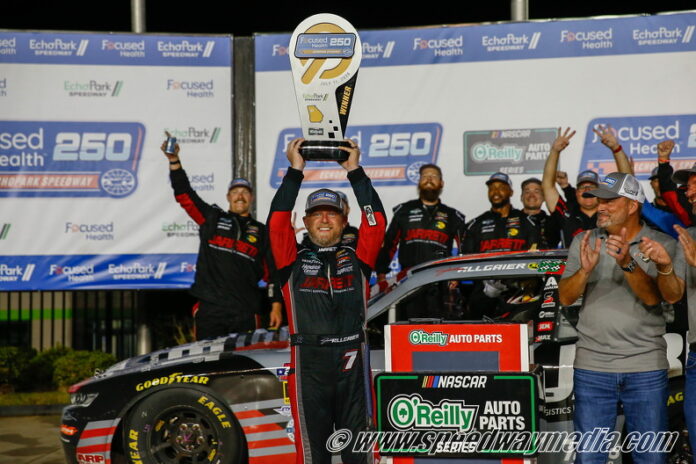
Justin Allgaier emerged victorious amid a wild and chaotic conclusion to the 2026 Focused Health 250 at EchoPark Speedway in Hampton, Georgia, on Saturday, July 11.
The 2024 NASCAR O’Reilly Auto Parts Series champion from Riverton, Illinois, led four times for 15 of 172 overscheduled laps in an event where he qualified 16th and used both the draft and on-track teamwork with his JR Motorsports teammates to battle at the front. After settling in eighth place following the first stage period, Allgaier managed to edge teammate Sammy Smith amid a pack breakup to win the second stage period.
As the third stage period was mired in a multitude of caution periods, late-race carnage, and four red-flag periods to clear up a series of crashes and oil spills, Allgaier continued to race towards the front and keep his entry intact and pointed straight. Despite triggering a quick caution period when he sent Jeremy Clements spinning during a first overtime attempt, he rallied by pushing Nick Sanchez and Brennan Poole out in front of teammate Carson Kvapil at the start of the second overtime attempt. Then, when both Sanchez and Poole wrecked at the start of the final lap, the seas parted for Allgaier to storm ahead, as the latter fended off Parker Retzlaff and Kvapil to notch an unprecedented sixth victory of the 2026 campaign.
With on-track qualifying that determined the starting lineup occurring on Saturday, Sam Mayer won the pole position with a lap at 173.554 mph in 31.944 seconds. Carson Kvapil qualified in second place with a lap at 173.369 mph in 31.978 seconds. Prior to the event, the following names, including Blaine Perkins, Jordan Anderson, and Nick Leitz, dropped to the rear of the field due to unapproved adjustments that were made to their respective entries. Prior to the green flag dropping, Jeb Burton had his entry taken behind the wall due to a mechanical issue.
When the green flag waved and the event commenced, pole-sitter Sam Mayer and Carson Kvapil battled dead even in front of two stacked lanes for a full circuit. With both competitors remaining dead even as they cycled back to the frontstretch, Kvapil, who was leading the outside lane, led the first lap by a hair over Mayer. During the second lap, the event’s first caution flew due to Joey Gase laying down fluid on the frontstretch. At the time of the caution, Mayer managed to motor ahead of Kvapil, Jesse Love and the field to emerge as the leader.
Following an extensive caution period to have the track cleaned from the oil, the event restarted on the 13th lap as Mayer and Jesse Love occupied the front row in front of Kvapil, Sammy Smith, William Sawalich and Sheldon Creed. At the start, both Mayer and Love dueled in front of the field until Mayer received the upper hand from the outside lane as he was being pushed by Kvapil through the backstretch. Mayer led the next lap as the field cycled back to the frontstretch, and he maintained the top spot over the next two laps while most of the front-runners behind lined up in single-line formation towards the outside lane while following Mayer’s draft.
Through the Lap 20 mark, Mayer was leading ahead of Kvapil, Love, Sammy Smith and Sawalich while Rajah Caruth, Creed, Justin Allgaier, Brandon Jones and Nick Sanchez followed suit in the top 10, respectively. A lap later, the event’s second caution flew when Leland Honeyman Jr. spun just off of Turn 4. During this caution period, some including Brent Crews, Ryan Sieg, Josh Bilicki, Harrison Burton, Jordan Anderson, Blaine Perkins and Lavar Scott pitted while the rest led by Mayer remained on the track.
As the event restarted on Lap 26, Mayer and Sammy Smith dueled for the lead through the first two turns until Kvapil pushed Mayer clear of the field through the backstretch. This allowed Mayer to have both lanes to his control and lead the next lap while Kvapil and Smith dueled for the runner-up spot in front of Love, Caruth, Sheldon Creed, William Sawalich, Brandon Jones, Justin Allgaier, Jeremy Clements and Nick Sanchez. For the next three laps, a majority of the front-runners lined back up in single-line formation towards the outside lane and behind Mayer’s draft as Mayer retained the top spot by a tenth of a second on Lap 30.
At the Lap 35 mark, Kvapil used a bold move to get beneath Mayer through the first two turns a lap prior and emerge as the leader while Love, Sammy Smith, Caruth and Clements followed suit, respectively. A lap later, Mayer hit the frontstretch’s outside wall and cut down his right-front tire after he got loose. This allowed Kvapil to cycle as the leader while Mayer dropped off the pace. Behind, Love moved into second place as Clements, who made bold moves on the inside lane through the turns, was up into third place. Soon after, Clements, who kept making moves from the inside lane, struggled to get back in formation and dropped to seventh. Meanwhile, Kvapil retained the lead over Love, Sammy Smith, Creed and Caruth by Lap 40.
When the first stage period concluded on Lap 45, Kvapil fended off the field to capture his second O’Reilly stage victory of the 2026 season. Teammate Sammy Smith emerged in the runner-up spot ahead of Love, Caruth and Creed while Clements, Corey Day, Allgaier, Sawalich and Dean Thompson were scored in the top 10, respectively. Meanwhile, Jones spun through Turn 4 while he went up the track and got loose while reeling in on teammate Sawalich as Jones then got hit by Austin Hill. By then, 33 of 38 starters were scored on the lead lap while Mayer was pinned the third competitor a lap down in 36th place.
Photo by Logan Allen for SpeedwayMedia.com.
Under the event’s first stage break period, a majority of the field led by Kvapil pitted while the rest led by Crews and including Ryan Ellis, Harrison Burton remained on the track. Following the pit stops, Ryan Sieg exited pit road first, and he was followed by Sammy Smith, Caruth, Love, Day, Creed and Kvapil.
The second stage period started on Lap 53 as Crews and Harrison Burton occupied the front row in front of Ryan Sieg, Caruth, Sammy Smith and Day. At the start, Ryan Sieg was quickly shuffled out of the draft as he dropped towards the rear of the field through the first two turns. Meanwhile, Harrison Burton motored ahead, and he led the next lap over Crews and Caruth while Sammy Smith and the rest of the field followed pursuit in close-quarters racing. Crews would then lose a handful of spots as Smith, Love, Creed and Day motored their way to the front.
By Lap 56, Smith cycled to the lead after he made a move beneath Burton and slid up towards the outside lane seconds after. Soon after, Love, Caruth, Day and Allgaier followed suit after all overtook Burton while Creed, Kvapil and Sawalich tried to reel in on the latter for spots. Amid the battles, Smith used the draft to retain the lead by Lap 60 while Patrick Staropoli, who spun through the apron of Turns 3 and 4 and blended back on the racing surface from pit road to the frontstretch, managed to proceed without drawing a caution.
Just past the Lap 65 mark, Sammy Smith continued to lead ahead of teammates Allgaier and Caruth while Kvapil was using the inside lane to try and motor ahead of Creed. During the 67th lap, Kvapil navigated his way into fourth place over Creed while Clements challenged Creed from the inside lane for fifth place. With Clements having no drafting help and advantage entering the straightaways, Creed motored ahead with help from Day while Clements filed back in line behind Day. As Day, Creed and Clements continued to battle for fifth place, Smith maintained the lead in front of teammates Allgaier, Caruth and Kvapil at the Lap 70 mark.
Through the Lap 75 mark and with the front-runners breaking up in small packs, Smith maintained the lead ahead of teammates Allgaier, Caruth and Kvapil, respectively, while Day was up into fifth place. Trailing by one-and-a-half seconds in sixth place was Creed as he had Clements pushing him while Love, Parker Retzlaff and Sawalich were scored in the top 10 ahead of Sanchez, Austin Hill, Crews, Harrison Burton and Jake Finch, respectively. Meanwhile, Anthony Alfredo, Brandon Jones, Taylor Gray, Dean Thompson and Jordan Anderson were racing in the top 20, respectively, as Smith remained in the lead at the event’s halfway mark on Lap 80.
When the second stage period concluded on Lap 90, Justin Allgaier edged teammate Sammy Smith by 0.003 seconds to claim his seventh O’Reilly stage victory of the 2026 season. Smith settled in second ahead of teammates Caruth and Kvapil, both of whom trailed by more than a second, while Day, Clements, Love, Retzlaff, Creed and Austin Hill were scored in the top 10, respectively. By then, 29 of 38 starters were scored on the lead lap. During the event’s second stage break period, the field led by Allgaier pitted for service. Following the pit stops, Allgaier exited pit road ahead of teammates Smith, Caruth and Kvapil, respectively, while Love, Hill, Creed, Crews, Sawalich and Jones followed suit.
Photo by Logan Allen for SpeedwayMedia.com.
With 65 laps remaining, the final stage period commenced as teammates Allgaier and Caruth occupied the front row in front of their other two teammates, Smith and Kvapil. At the start, Allgaier briefly motored ahead from the outside lane before Caruth fought back from the inside lane through the first two turns. Meanwhile, Richard Childress Racing’s Jesse Love and Austin Hill, along with Nick Sanchez, started to ignite a third drafting lane towards the outside lane. As the field fanned out and started to stack up through three tight lanes, Caruth led the next lap while Allgaier, who was pinned in the middle lane, lost his grasp of the lead with no drafting help. Caruth and Creed then swapped the lead until the caution returned with 63 laps remaining due to Harrison Burton losing an engine and having smoke billow out from his entry.
During the next restart with 54 laps remaining, Caruth and Creed dueled against one another for a full circuit as the field behind fanned out, with every competitor racing within the front pack starting to dice and utilize any drafting advantage to get to the front. As Creed emerged ahead of Caruth while Austin Hill started to navigate his way to the front, the caution returned with 52 laps remaining when Jones, who was racing within the top-10 mark, washed up the track through Turns 3 and 4 and briefly lost momentum. This caused a mini stack-up that involved Alfredo and Thompson while Gray, who also tried to check up, was hit in the rear by Day. This resulted in Gray getting sideways and quickly ricocheting into the outside wall as he got hit hard again by Day, which left the latter two with wrecked race cars and out of contention. The incident placed the event in a red flag period for eight minutes and 11 seconds due to the oil on the track.
When the red flag lifted and the event restarted with 45 laps remaining, Creed and Caruth dueled in front of Crews, Kvapil and the field for a full lap. Creed and Caruth remained dead even during the next lap before the caution returned due to Clements spinning in Turn 2. The event was then placed in a second red flag period, this time for five minutes and 19 seconds, due to having oil on the track cleared, with the oil coming from Mayer’s damaged entry when Mayer ran into the rear of Mason Maggio during the latest restart.
For the following restart that commenced with 36 laps remaining, Creed maintained the lead for two cycles before Caruth made a move to Creed’s outside to motor ahead with the lead. Amid Sammy Smith’s three-wide challenge from the frontstretch, Caruth had the upper hand to storm ahead along with teammates Kvapil and Allgaier. Caruth continued to lead until the caution was displayed with 31 laps remaining due to Glen Reen spinning in Turn 4.
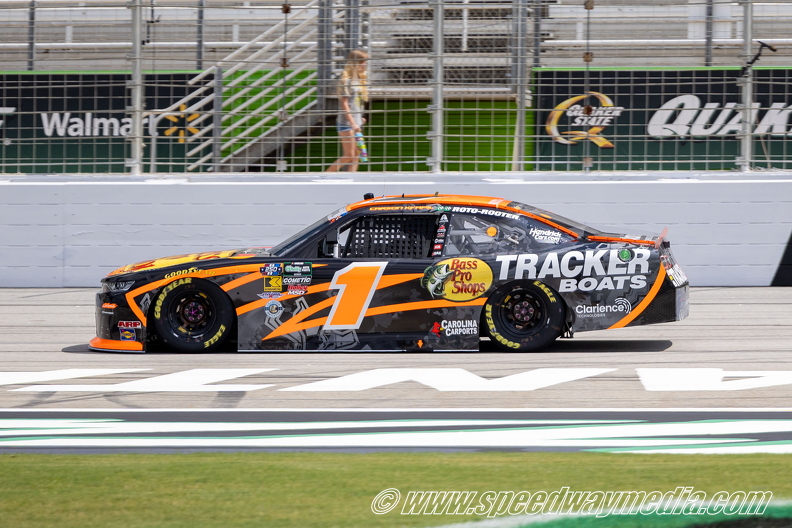
As the event restarted with 26 laps remaining, Allgaier was pushed ahead of teammate Caruth by Hill from the inside lane through the first two turns until Caruth fought back as he had drafting help from teammate Kvapil from the outside lane. With the field stacked up in two-wide formation, Caruth led the next lap by a hair over Allgaier. Behind the leaders, a tight three-wide action occurred as Smith split Sanchez and Creed in the middle for fifth place while Love and Finch were also involved. For the next lap, the caution returned when Jake Finch, who was racing within the top-10 mark, got loose and hit the outside wall in Turn 4, which damaged the right side of his No. 9 Caroline Carports Chevrolet Camaro entry and ended his late strong charge at the front.
The next restart with 19 laps remaining pitted Hill against Caruth on the front row as Hill used a push from Kvapil that allowed both to motor ahead and slide in front of Caruth through the first two turns. Exiting the backstretch, Caruth then darted to the inside lane, drew alongside Kvapil and challenged him for the runner-up spot. While Hill led the next lap, Kvapil made a move beneath Hill entering the first two turns in a late challenge for the lead. Seconds later, the caution flew due to Finch spinning for a second time, with his latest incident occurring to the inside of Turn 2 when he blew a left-rear tire. Based on the previous scoring loop, Hill was ruled the leader over Kvapil, Allgaier, Caruth and Sanchez.
For the following restart with 13 laps remaining, Allgaier, who restarted beneath Hill on the front row, had teammates Caruth and Smith push him ahead of Hill while Kvapil was pushing Hill. Hill was then pinned in the middle lane as Kvapil darted to his right. As the field cycled back to the frontstretch, Hill was scored in fifth place and pushing Caruth amid the tight three-wide formation he was pinned from within the middle as Allgaier led the next lap ahead of teammates Caruth, Kvapil and Smith. Seconds later, the caution returned when Jordan Anderson, who tried to make a bold four-wide move beneath Creed, Love and Crews while battling for seventh place, barely clipped the apron and slipped up the track into the side of Creed in the first turn. This ricocheted into Love and Crews as all four competitors, along with Retzlaff, Sawalich, Jones, Leland Honeyman Jr., Thompson and Nick Leitz, piled into the carnage. This latest carnage placed the event in a third red flag period for eight minutes and nine seconds.
During a seven-lap dash to the finish, Allgaier and Kvapil had teammates Caruth and Smith pushing them, respectively, until Kvapil motored ahead from the outside lane with a push from Smith. Smith then darted to the left of Kvapil, and both dueled in front of the pack for the next lap that involved Allgaier and a hard-charging Austin Hill. Allgaier then nearly slipped in front of Hill and lost touch with the lead as both Kvapil and Smith continued to duel in front of Hill.
Then with four laps remaining, a tight three-wide battle for the lead ensued as Kvapil, Smith and Hill were dead even against one another for the lead. As Nick Sanchez reeled in to give Hill a boost from the inside lane, Hill got aero-loose in front of Sanchez entering the third turn. This caused Hill to make contact with Smith as both Smith and Caruth hit the outside wall while Hill spun and was hit by Ryan Ellis. This latest incident in the fourth turn not only placed the event in a fourth red flag period for eight minutes and a second, but it also sent the event into overtime. At the time of the incident, Kvapil was leading ahead of Sanchez, Ryan Sieg, Clements, Alfredo and Allgaier.
The event’s first overtime attempt did not last long when Clements, who was restarting behind Sanchez on the second inside row, got turned by Allgaier amid a stack-up and wrecked with Lavar Scott. The event’s second overtime attempt cycled through for a full lap despite a wild start that commenced when Ryan Sieg was shoved out of line, and he dropped off the pace due to running out of fuel. With Kvapil having no drafting help from the outside lane, Sanchez was pushed clear out in front by Brennan Poole and Allgaier until Poole made a move beneath Sanchez and stormed to the lead through the backstretch.
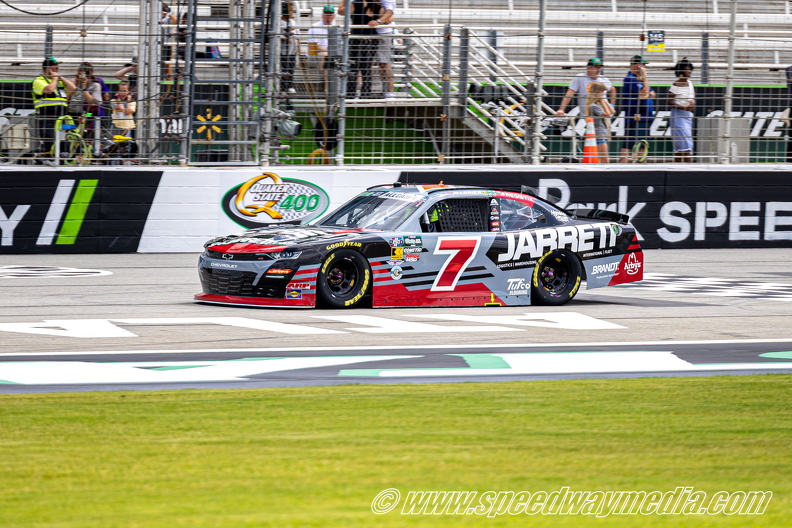
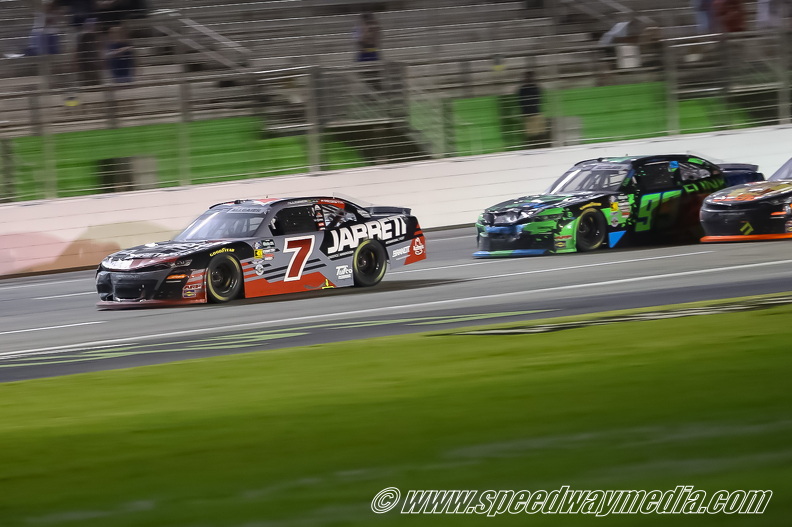
When the white flag waved and the final lap started, Poole remained in the lead despite having Sanchez reeling in from the outside lane as Sanchez was being pushed by Kvapil. Then, entering the first turn, Sanchez, who darted to the left to get beneath Poole, was turned by Kvapil into Poole as the latter two wrecked against the outside wall and lost their momentum. The event, however, remained under green flag conditions as Allgaier, who had sparks flying beneath his damaged No. 7 Jarrett Logistics Chevrolet Camaro entry, muscled through with the lead ahead of Retzlaff, Kvapil, Sawalich and Alfredo. With both Alfredo and Kvapil not gaining enough of a draft from one another and the scattered pack to reel in Allgaier, the latter maintained the lead for a final circuit before he cycled back to the frontstretch and claimed the checkered flag by a tenth of a second.
With the victory, Allgaier notched his unprecedented sixth NASCAR O’Reilly Auto Parts Series career win of the 2026 season, his second at Atlanta’s EchoPark Speedway and the 34th of his career. Allgaier, who became the sixth competitor to win an O’Reilly event on Atlanta’s current reconfigured racing surface, also recorded the 18th victory of the 2026 season for the Chevrolet manufacturer and the 13th for JR Motorsports.
As an added bonus, Allgaier, who increased his lead in the points standings to 240, secured the 2026 O’Reilly Auto Parts Series Regular Season Championship with three regular-season events remaining until the Chase commences in early September during Labor Day weekend. This marks Allgaier’s second regular-season title in the series after he achieved his first in 2018.
Photo by John Knittel for SpeedwayMedia.com.
“[I’m] So proud of everybody at JR Motorsports,” Allgaier said on the frontstretch on CW Network. “We had five great Chevrolets today. I knew at the end, there was gonna be some guys close on fuel. You just never give up. [Crew chief] Andrew Overstreet, this whole No. 7 team, Eddie D’Hondt, spotter, they talk over and over again about not giving up, and that’s what this team’s all about. I didn’t know what was gonna happen at the end of the race there, and it came down to one. It’s been a rough week. We’ve had all kinds of stuff going this week. This [win] makes it a little sweeter.”
Carson Kvapil, who led 29 laps compared to Allgaier’s 15, edged Parker Retzlaff to finish a career-best runner-up for a fifth time in his O’Reilly career. William Sawalich and Anthony Alfredo finished in the top five. Garrett Smithley, Brandon Jones, Kyle Sieg, Rajah Caruth and Jeremy Clements completed the top 10 in the final running order, respectively.
Notably, Ryan Sieg ended up in 18th place while Brennan Poole and Nick Sanchez settled in 17th and 19th following their last-lap incident. Sammy Smith, who led a race-high 34 laps, finished in 18th place while Austin Hill, who was unable to continue following his late multi-car wreck, was scored in 22nd place. Jesse Love, who was eliminated from a multi-car accident with nearly 10 laps remaining and was ranked in 26th place in the final running order, was confirmed to have secured an O’Reilly Chase berth in 2026 along with Allgaier.
This event featured 19 lead changes for 11 different leaders, and generated 13 for 76 laps. In addition, 18 of 38 starters finished on the lead lap.
After Atlanta, Justin Allgaier leads the series standings by 240 over Jesse Love, 273 over Sheldon Creed, 277 over Corey Day, and 284 over Carson Kvapil.
Results:
Justin Allgaier, 15 laps led, Stage 2 winner
Carson Kvapil, 29 laps led, Stage 1 winner
Parker Retzlaff
William Sawalich
Anthony Alfredo
Garrett Smithley
Brandon Jones
Kyle Sieg
Rajah Caruth, 18 laps led
Jeremy Clements
Mason Maggio
Josh Bilicki
Patrick Staropoli
Dean Thompson
Glen Reen
Ryan Sieg
Brennan Poole, one lap led
Sammy Smith, 34 laps led
Nick Sanchez, one lap down
Blaine Perkins, one lap down
Lavar Scott, three laps down
Austin Hill – OUT, Accident, seven laps led
Ryan Ellis – OUT, Accident, one lap led
Brent Crews – OUT, Accident, five laps led
Sheldon Creed – OUT, Accident, 27 laps led
Jesse Love – OUT, Accident
Jordan Anderson – OUT, Accident
Leland Honeyman Jr. – OUT, Accident
Nick Leitz – OUT, Accident
Jake Finch – OUT, Accident
Sam Mayer – OUT, Accident, 33 laps led
Corey Day – OUT, Accident
Taylor Gray – OUT, Accident
Harrison Burton – OUT, Engine, two laps led
Logan Bearden – OUT, Fuel Pump
Carson Ware – OUT, Suspension
Joey Gase – OUT, Engine
Jeb Burton – OUT, Brakes
Next on the 2026 NASCAR O’Reilly Auto Parts Series schedule is Indianapolis Motor Speedway in Speedway, Indiana, for the Pennzoil 250. The event is scheduled to occur on July 25 and air at 4 p.m. ET on the CW Network, the Indianapolis Motor Speedway Radio Network, and SiriusXM.
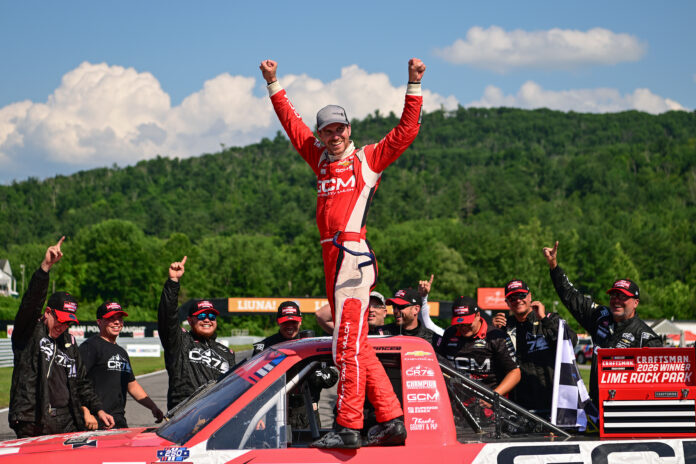
LAKEVILLE, CONNECTICUT - JULY 11: Grant Enfinger, driver of the #9 Grant County Mulch Chevrolet, celebrates after winning the NASCAR Craftsman Truck Series LiUNA 150 at Lime Rock Park on July 11, 2026 in Lakeville, Connecticut. (Photo by Jaiden Tripi/Getty Images).
Grant Enfinger made a triumphant return to Victory Lane in the NASCAR Craftsman Truck Series by outlasting the competition through a three-lap shootout and winning the second annual LiUNA 150 at Lime Rock Park in Lakeville, Connecticut, on Saturday, July 11.
The former Truck Series regular-season champion and ARCA Menards Series champion from Fairhope, Alabama, led twice for five of 100-scheduled laps in an event where he started in 12th place, accumulated a combined 10 stage points at the conclusion of the event’s first two stage periods and navigated his way through a series of late carnage to work his way to the front.
Despite being outdueled by Giovanni Ruggerio during a late-race restart with 14 laps remaining, Enfinger capitalized on the final one with three laps remaining to retain the top spot for the event’s remainder. Following a late challenge by Landen Lewis, Enfinger did not slip up and had enough to achieve his first checkered flag in 40 races and gain momentum towards his Chase hopes.
With on-track qualifying that determined the starting lineup occurring on Saturday, Layne Riggs secured his first Truck pole position of the 2026 season with a pole-winning lap at 99.115 mph in 53.683 seconds. Connor Mosack started alongside Riggs on the front row with a lap at 99.014 mph in 53.738 seconds. Prior to the event, Ben Rhodes and Colin Braun dropped to the rear of the field due to unapproved adjustments to their respective entries.
When the green flag waved and the event commenced, pole-sitter Layne Riggs muscled his No. 34 Wheelhouse Racing School Ford F-150 entry ahead of Connor Mosack and the field as he led through the first four sets of turns while the rest of the field behind jostled and scrambled early for spots. Within the battles, Kaden Honeycutt battled and overtook Mosack for the runner-up spot. Meanwhile, Riggs, who retained the lead through the course’s remaining three turns, led the first lap while Thomas Annunziata, Landen Lewis and Ty Majeski trailed in the top six, respectively.
Over the next four laps, Riggs stabilized his early advantage to seven-tenths of a second over Honeycutt, the latter of whom was the fastest competitor on the course, while third-place Mosack trailed by more than a second. As Annunziata and Lewis occupied the remaining top-five spots, Majeski, Giovanni Ruggerio, Danie Hemric, Jake Garcia and Chandler Smith trailed in the top-10 mark while Grant Enfinger, Andres Perez De Lara, Tyler Ankrum, Parker Kligerman, Ben Maier, Christian Eckes, Stewart Friesen, Dawson Sutton, Tanner Gray and Corey LaJoie were mired in the top 20, respectively.
Through the Lap 10 mark, Riggs continued to lead by six-tenths of a second over Honeycutt while Mosack, Lewis and Annunziata remained in the top-five mark ahead of Majeski, Ruggiero, Hemric, Garcia and Smith. Meanwhile, Ben Rhodes and Colin Braun, both of whom started at the rear of the field due to unapproved adjustments that were made to their respective entires, were up in 23rd and 27th, respectively, while Louis Foster, an NTT IndyCar Series competitor for Rahal Letterman Lanigan Racing who is making his first NASCAR national touring series career start, was mired in 22nd place in front of Rhodes. In addition, Graham Doyle, a sportscar competitor who is driving the No. 5 Toyota entry for TRICON Garage, was racing towards the rear of the field in 32nd place.
By Lap 15, Riggs maintained a steady lead of four-tenths of a second over Honeycutt as Honeycutt reeled in the leader through every turn and small straightaways. Amid Honeycutt’s challenges, Riggs slightly built his lead back up to eight-tenths of a second on Lap 20. Behind, Mosack trailed the lead by nearly four seconds in third place, and he had Lewis slowly reeling in from behind in fourth place. In addition, Annunziata retained fifth place by three seconds over Majeski, with Majeski and the rest of the field trailing by double digits. Meanwhile, Riggs stretched his lead to nearly two seconds over Honeycutt by Lap 25.
When the first stage period concluded on Lap 30, Riggs, who was mired in lapped traffic, captured his sixth Truck stage victory of the 2026 season. Honeycutt followed suit in second ahead of Lewis, Mosack and Annunziata, while Majeski, Ruggiero, Hemric, Grant Enfiger and Perez De Lara were scored in the top 10, respectively. By then, 25 of 33 competitors were scored on the lead lap while Mini Tyrrell, Kris Wright, Jackson Lee, Brenden Queen, Frankie Muniz, Graham Doyle, Wesley Slimp and Josh Reaume were lapped by Riggs.
Under the event’s first stage break period, the entire field led by Riggs pitted non-competitively and retained their respective running positions as they entered pit road. During the break, all teams were given three minutes to make services to their respective trucks.
The second stage period started on Lap 35 as Riggs and Honeycutt occupied the front row. At the start, Honeycutt challenged Riggs in a side-by-side duel through the main straightaway, but Riggs used the preferred inside lane to motor ahead of Honeycutt and retain the lead. With a variety of on-track battles ensuing within the field, Riggs also maintained a steady lead through the course’s six turns as he led the next lap. Over the following four laps, Lewis trailed by nearly two seconds in third place while Annunziata and Mosack occupied the remaining top-five spots over Majeski, Ruggiero, Enfinger, Hemric and Chandler Smith. At the front, Riggs held a lead that was only a tenth of a second ahead of Honeycutt.
On Lap 44, a caution flew due to Majeski wheel-hopping, getting loose and hitting the curb in the first turn before he went off the course and wrecked his No. 88 Menards Ford F-150 entry into the tire barriers. The incident occurred as he was racing in sixth place. At the time of caution, Riggs was leading by four-tenths of a second over Honeycutt. During this caution period, select names like Chandler Smith, Cole Butcher, Stewart Friesen and Mini Tyrrell pitted while the rest led by Riggs remained on the track.
The next restart on Lap 50 did not last long when Landen Lewis, who restarted on the second row and tried to dart to the right behind Riggs, was turned by Mosack when Lewis briefly stepped out of the gas due to being blocked by Riggs and left an opening in between himself and Annunziata. The contact between Lewis and Mosack as Lewis, who was checked up Riggs and tried to turn back to the left, was turned into the right side of Annunziata. Lewis was then sent spinning through the frontstretch’s grass while Mosack, who kept his entry straight despite making additional contact with Lewis’ spinning entry, sustained rear-end damage after he was rear-ended by Ben Rhodes. At the moment of caution, Honeycutt managed to emerge ahead of Riggs. During the caution period, Ruggiero, who carved his way up to fourth place, strategically pitted along with Eckes.
During a three-lap shootout to conclude the second stage period, Honeycutt and Riggs dueled for the lead entering the first turn. The latter two remained dead even before Honeycutt managed to motor ahead through the fourth Right Hander turn. As a variety of on-track battles ensued with dirt getting kicked up the course and several competitors bumping against one another for spots, Honeycutt retained the lead for the next lap.
At the conclusion of the second stage period on Lap 60, Honeycutt captured his second Truck stage victory of the 2026 season. Riggs settled in second ahead of Enfinger, Hemric and Perez De Lara while Ankrum, Kligerman, Garcia, Tanner Gray and Cole Butcher ended up in the top 10, respectively. By then, 24 of 33 starters were scored on the lead lap. During the second stage break, some like Cole Butcher, Ruggiero, Friesen, Corey LaJoie and Colin Braun remained on the track while the rest led by Honeycutt pitted non-competitively.
With 36 laps remaining, the final stage period commenced as Butcher and Friesen occupied the front row. At the start, the field fanned out and jumbled up as both Butcher and Friesen dueled for the lead through the first four turns until Butcher muscled ahead with the lead. As the field continued to bump and jostle for spots while Kris Wright got turned and wrecked in the guardrails through the No Name Straight, Friesen assumed the lead through the frontstretch during the next lap when Butcher dropped off the pace. The caution flew seconds later due to debris on the course and coming off of Wright’s wrecked entry. At the time of caution, Butcher, who fell off the pace due to a spotter communication, was ruled the leader from NASCAR’s timing and scoring.
During the latest caution period that was extended due to fluid left all over the course, the event was then placed in a red flag period for seven minutes and 52 seconds to have the fluid cleaned up. When the red flag lifted and the event restarted with 26 laps remaining, Butcher, who was being pushed by Ruggiero entering the first turn, tagged Friesen and sent the latter for a spin through the first turn. Friesen’s incident generated more chaos within the pack as more competitors, including Riggs and Honeycutt, all spun. Amid the chaos, Ruggiero emerged with the lead ahead of Annunziata while Butcher, Lewis and Enfinger were in the top five. Ruggiero proceeded to lead the next three laps ahead of his hard-charging teammate, Annunziata, while Lewis carved his way into third place ahead of Enfinger and Butcher. Meanwhile, Friesen, Honeycutt and Riggs were mired in 17th, 19th and 20th.
With 22 laps remaining, the caution returned due to Chandler Smith, who was multiple laps down due to a rear gear issue, stopping on the course in Turn 4. During the caution period, runner-up Annunziata retired from competition and pulled his entry off the course just near the pit road entrance due to his entry erupting in flames. Annunziata, who managed to escape his blazing entry under his own power, would be transported to a nearby medical facility for further evaluation.
Following an extensive caution period, the event restarted with 14 laps remaining as Ruggerio and Enfinger occupied the front row in front of Lewis and Garcia. At the start, Ruggiero dueled with Enfinger through the first turn until the former managed to motor ahead of the latter. As Ruggiero led through the next three sets of turns, Enfinger retained the runner-up spot over Lewis and Garcia while Braun navigated his way into the top-five mark. Ruggiero led the next lap amid a variety of on-track battles, bumps and late jostling of spots ensuing within the field. During the late on-track actions, Tanner Gray sent Braun spinning from fifth place in the sixth turn as Butcher also got sideways and nearly collided into Braun’s entry. Meanwhile, Honeycutt navigated his way back into the top-10 mark as Ruggiero retained the lead by eight-tenths of a second with 10 laps remaining.
Seconds later, the caution returned due to LaJoie, who was dropping oil, coming to a stop just off the course in the third left-hander turn area. The incident occurred after Dawson Sutton and Wesley Slimp went off the course just past the second turn as they appeared to slip from LaJoie’s oil trail. By then, Ruggiero was scored the leader over Enfinger, Lewis, Garcia, Kligerman and Tanner Gray while Honeycutt was up into seventh place. During the caution period, some including Mosack, Butcher, Braun, Sutton and Slimp pitted.
As the event restarted with three laps remaining, the field fanned out as Enfinger motored ahead of Ruggiero while Ruggiero briefly lost momentum while trying to block Lewis entering the first turn. As Lewis assumed the runner-up spot, Kligerman and Honeycutt battled Ruggiero for third place and Louis Foster spun in the second turn while Enfinger maintained a steady lead for a full lap. During the next lap, Honeycutt bumped teammate Ruggiero for a spin after the latter forced the former off the course in between Turns 2 and 3. Amid the contact, Honeycutt moved into third place while Kligerman and Eckes trailed behind.
When the white flag waved and the final lap started, Enfinger remained in the lead by three-tenths of a second over a hard-charging Lewis. While Lewis primarily remained dead-square behind Enfinger while challenging the latter for his first career victory, Enfinger did not slip through the course’s seven turns for a final circuit as he cycled back to the frontstretch and claimed the checkered flag by four-tenths of a second over Lewis.
With the victory, Enfinger notched his 13th career win in the NASCAR Craftsman Truck Series division, his first ever on a road course event and his first since winning at Homestead-Miami Speedway in October 2024 (40 races ago). He also recorded the third career victory for CR7 Motorsports and the fourth for the Chevrolet manufacturer through 14 events in 2026.
Prior to the Lime Rock Park victory, Enfinger was five points below the top-10 mark in the championship standings. After the Lime Rock Park victory, he jumped two spots in the standings to ninth place and is 42 points above the cutline with four regular-season events remaining before the series’ Chase commences.
“I mean, honestly, [crew chief] Derek’s [Smith] given us great road course trucks all year long and sadly enough, this has been our best opportunity to win,” Enfinger said on the frontstretch on FS1. “It’s a road course, but we’ve had issues in all three of them. This time, we had our issues at practice and broke a shock. [The team] did an amazing job just getting us out there to qualify. We missed something with some suspension components a bit, but Derek did a good job for the race. I feel like we had some things play on our hand. I don’t think we could’ve beat [Honeycutt] and [Riggs] straight up.”
“I’d seen what happened in the ARCA race,” Enfinger added. “I didn’t want to line up third and push my way to the win. I know that’s common these days. I prayed about it, thought about, but I wanted to win straight up on the outside. Proud of that. A lot went into that decision. I didn’t want to go in there and purposely root him out of that way to win. We beat them on the launch, and I think we had a better [truck].”
Landen Lewis, the reigning CARS Late Model Stock Tour champion from Ocean Isle Beach, North Carolina, notched a career-best runner-up result in his seventh Truck start. Kaden Honeycutt rallied to finish third, while Parker Kligerman and Christian Eckes finished in the top five.
Daniel Hemric, Andres Perez De Lara, Tanner Gray, Stewart Friesen and Colin Braun completed the top 10 in the final running order. Notably, Giovanni Ruggerio fell back to 20th place, while Louis Foster finished 21st in his NASCAR debut. In addition, Layne Riggs ended up as the first competitor a lap down in 23rd place.
This event featured nine lead changes among six different leaders and seven cautions over 39 laps. In addition, 22 of 33 starters finished on the lead lap.
Following the 14th event of the 2026 NASCAR Craftsman Truck Series season, Layne Riggs leads the standings by 44 points over Kaden Honeycutt, 154 over Chandler Smith, 155 over Christian Eckes and 164 over Giovanni Ruggiero. Riggs and Honeycutt are also the first two competitors to be guaranteed Chase berths this season.
Results:
Grant Enfinger, five laps led
Landen Lewis
Kaden Honeycutt
Parker Kligerman, 14 laps led
Christian Eckes
Daniel Hemric
Andres Perez De Lara
Tanner Gray
Stewart Friesen, one lap led
Colin Braun
Cole Butcher, 11 laps led
Brenden Queen
Jackson Lee
Justin Haley
Dawson Sutton
Wesley Slimp
Kris Wright
Connor Mosack
Graham Doyle
Giovanni Ruggiero, 21 laps led
Louis Foster
Jake Garcia
Layne Riggs, one lap down, 48 laps led, Stage 1 winner
Mini Tyrrell, one lap down
Tyler Ankrum, two laps down
Frankie Muniz, two laps down
Josh Reaume, two laps down
Corey LaJoie – OUT, Engine
Thomas Annunziata – OUT, Engine
Chandler Smith – OUT, Driveshaft
Ben Rhodes – OUT, Accident
Ty Majeski – OUT, Accident
Ben Maier – OUT, Electrical
Next on the 2026 NASCAR Craftsman Truck Series schedule is the Faith Fest 250 at North Wilkesboro Speedway in North Wilkesboro, North Carolina. The event is scheduled to occur next Saturday, July 18, and air at 12:30 p.m. ET on FS1, the NASCAR Racing Network and SiriusXM.
HAMPTON, Ga. (July 11, 2026) – Joe Gibbs Racing drivers Denny Hamlin and Christopher Bell were made available to the media on Saturday prior to the NASCAR Cup Series race from EchoPark Speedway near Atlanta. Hamlin and Bell and facing off Sunday night in the In-Season Challenge.
DENNY HAMLIN, No. 11 Sport Clips Haircuts Toyota Camry XSE, Joe Gibbs Racing
CHRISTOPHER BELL, No. 20 Rheem Toyota Camry XSE, Joe Gibbs Racing
How do you plan on beating each other tomorrow?
HAMLIN: “I certainly feel like we will probably be the underdog against Christopher, he’s got some pretty strong track record here. We were basically just saying whoever doesn’t wreck, that’s pretty much what it’s going to come down to is who is going to get swept up in they likely didn’t cause.”
BELL: “I’m not sure what is more exciting or less exciting that Atlanta was the first race of this deal. I’m happy to be alive and made it a lot further than last year, that’s for sure.”
Christopher, it looks like you have nothing on your wrist. What is the update there?
BELL: “I’m gaining on it. I do have a wrap around my wrist, but nothing in the palm of my hand, so I guess that’s awesome. I’m really close for sure, I’m optimistic that North Wilkesboro next week will be close if not 100% or right there at it. I’m still planning on putting a cast on it tomorrow for the race just in case something happens. I will be in a cast tomorrow, but hopefully this wrap or nothing at Wilkesboro.”
Is the sting of not winning last week subsided for you at all?
BELL: “I still haven’t won yet, but I know we are going to win at some point and we are going to keep putting ourselves in position. I’m fine and we’re going to keep doing what we are doing and put ourselves in position.
What makes Riley Herbst so likeable?
HAMLIN: “I just think he’s someone for everyone. He just kind of stays in the middle of the road and when it comes to opinions he just kind of sits back and listens to stuff. What I like about him really is how humble he is as a person. I really admire his work ethic, he doesn’t let tough weeks drag him down, he’s right back to work on Monday. I know him more professionally than I do personally, but that’s what I like about him is his ability to not get down, especially after the year that he had it’s easy to lose confidence. If anything, it was a good self-reflection for him to just go work on where he needed to improve, and he did that.”
Were you surprised at NASCAR’s decision not to penalize drivers this week?
HAMLIN: “I can see where it can be mixed messaging, but I just found it interesting that if they didn’t consider an intentional wreck, why are they insisting that it stops if it was a accident then it would just be organic. If you are ruling that it’s not intentional, but saying it has to stop then you are saying they had the choice to wreck each other. I got a little confused on that one.”
Since you won the most recent All-Star race at North Wilkesboro, how confident are you going back?
BELL: “It’s certainly one we had circled, and especially after my injury at Michigan, we knew it was six week out and it was the race I was looking forward to this summer and I’m very excited about being healthy and getting back to what really I think our strength is. Going into 2026 I would have said short tracks are our bread and butter, but it seems like it’s kind of flipped to intermediates. It’s one I’m very excited for, it races really, really good and I think you can run all the way from the white line and the wall and everywhere in between. With us never having a full field race there, I think we don’t really know what to expect. I love those kind of races where there’s no books on it and everyone is learning on the fly.”
With the history of Indianapolis, what would winning either race mean to you?
HAMLIN: “I’ve just been so close there that it certainly makes me hungry going there. But it’s a track anywhere we are going over 150 mph in speed that’s where our cars have excelled this year. I feel very optimistic about it. It’s such an execution kind of weekend. It starts with practice and all the way through. It’s tough because if you don’t qualify well there your odds really dramatically sink of your opportunity to win the race unless there’s some weird cautions and fuel mileage and that stuff, which there has been. So, I wish you could control your fate a little bit more, but it’s still prestigious no matter what and it would certainly mean a ton to me.”
Going to North Wilkesboro next week for the first points race in 30 years. Where do you think Dale Earnhardt Jr’ contributions have been to push getting a points race there?
HAMLIN: “He has such a huge influence in our sport, probably the most I would say. And even over current drivers, he’s still the most popular within our sport, certainly the most influential. When he went on a journey to revive the racetrack it just seems like he made it happen. There were several steps along the way that also helped. There was COVID money and stuff that factored into it, but Marcus (Smith, CEO Speedway Motorsports) and that group getting together, it feels like a full time Cup Series track when you go there. The atmosphere is fantastic, it’s great for our sport. It’s like Martinsville, one of those grassroots tracks that’s definitely part our history and needs to be part of our future as well.”
The next speedway race is going to be in Daytona in August. What changes do you expect for that race?
HAMLIN: “There’s definitely going to be a change. And it definitely going to be in the right direction, I just don’t know how much. You are trying to play with the parts and pieces that you have right now to make it better, but from the numbers I’ve seen of what It’s going to do to the car when it pulls out of line it roughly cuts that into two thirds from what it is currently. So I think that’s going to make the drivers feel like they have a fighting opportunity when the get in the middle of the pack to go start that third line and not just shove the person in front of them, go make your own line. Those numbers are encouraging from my standpoint. Certainly it’s going to create a little more space within the cars from what I see. That also allows you to get back in line when you do make a move. Will it be a total gamechanger back to 1995? Absolutely not, but I think it gets us more in a direction of where we were seven to 10 years ago.”
About Toyota
Toyota (NYSE:TM) has been a part of the cultural fabric in North America for nearly 70 years, and is committed to advancing sustainable, next-generation mobility through our Toyota and Lexus brands, plus our more than 1,800 dealerships.
Toyota directly employs nearly 64,000 people in North America who have contributed to the design, engineering, and assembly of over 50 million cars and trucks at our 14 manufacturing plants. In 2025, Toyota’s plant in North Carolina began to assemble automotive batteries for electrified vehicles.
NCTS RACE RECAP: LIME ROCK PARK Event: LiUNA! 150 (100 laps / 147.8 miles) Round: 14 of 25 (Regular Season) Track: Lime Rock Park Location: Lakeville, CT Date & Time: Saturday, June 11 | 1:00 PM ET
No. 45 J.F. Electric Chevrolet Silverado RST Driver: Landen Lewis | Crew Chief: Phil Gould
Key Takeaway: Landen Lewis and the J.F. Electric team rallied back from adversity yet again for the second road course race in a row at Lime Rock. Qualifying in sixth-place, Lewis rose to third in the opening stage. While battling for the race lead on a restart in stage two, Lewis was spun off the nose of another competitor and had to fall to the back of the pack. A great strategy call by Phil Gould to flip the stage gave the No. 45 team its track position back entering the final stint, and Lewis held serve in the top-five despite the body damage. Lewis was in position to contend for the race win after keeping his nose clean, racing hard on the final restart of the afternoon. He finished the race as the runner-up, achieving his career-best finish.
Landen Lewis’ Post-Race Thoughts: Interviewer: What a job by the driver with limited starts in this CRAFTSMAN Truck Series. I thought fourth-place in San Diego was pretty impressive, but Landen, the right side of your truck is all caved in and you brought it home second for your career-best finish. How would you describe just the day but also that last restart trying to get past Grant Enfinger?
“Today was just a solid day all around for our guys, Niece Motorsports, J.F. Electric, DQS, and everyone that just is a part of this. I wouldn’t be here without them, so first and foremost, I just want to thank Phil (Gould) and Cody (Efaw) and all those guys for busting their butt for me. Yeah, I don’t know what happened on the restart, I just need to go back and look to see what actually happened. But overall, it was a very solid day for us. We just need a little bit more, but we’ll go back to the shop and regroup and come back a little stronger.”
Interviewer: You showed the nose a little bit to Grant (Enfinger) on the final lap. If you could go back and do it again, was there an opportunity or were you not close enough?
“I probably would have waited. I showed my nose a little too soon, but at the end of the day, I didn’t want to win it by wrecking him or doing anything I didn’t need to do. I wanted to do it cleanly, and hats off to them. They did a great job, but we were just one spot short. Onto the next one.”
About J.F. Electric: J.F. Electric is an electrical contractor that provides engineering expertise, backed by construction and installation know-how in a diverse range of service offerings, from utilities and commercial projects, to industrial and telecommunications customers. When having a long family history in an industry, a company not only builds on its knowledge and experience, it takes pride in cultivating a solid understanding of client needs, all the while nurturing strong relationships with its employees. Evolving through five generations of the Fowler family, J.F. Electric has matured into a well-managed and thoughtfully diversified electrical contractor which is poised to continue its growth and expansion into the future.
No. 44 DQS Solutions & Staffing Chevrolet Silverado RST Driver: Andrés Perez de Lara | Crew Chief: Wally Rogers
Key Takeaway: Andrés Pérez de Lara and the DQS Solutions & Staffing team had a solid outing in Lime Rock. Rolling off from 14th-place in qualifying, the No. 44 entered the top-10 and picked up a point in stage one. After making adjustments during the caution break, the sophomore driver was able to climb to fifth in stage two. Pérez de Lara maintained his track position to nab his second top-10 finish of the season, crossing the line scored in seventh-place and tying his season-best result.
Andrés Pérez de Lara’s Post-Race Thoughts: “It was a solid day overall for the No. 44 team. I feel like the stage points made our day way better, and I think our speed was pretty high all race long. We got unlucky there with a lot of guys pitting and flipping the stage, so we battled uphill from there. I’m happy to finally have a good day and finish in the top-10. Just super thankful to all my guys for their hard work, Niece Motorsports, DQS Solutions & Staffing, Acceptance Insurance, J.F. Electric, and all of our partners for their support.”
About DQS Solutions & Staffing: Guided by a mission to achieve excellence and adaptability, DQS partners with clients to create custom solutions that address unique business challenges. Recognized as Michigan’s fastest-growing company and #22 in the nation on the Inc. 5000 list, DQS drives industry growth while giving back through its nonprofit, Foundation for Pops, and partnerships like the River Rouge School District.
No. 42 Executive Chevrolet Chevrolet Silverado RST Driver: Ben Maier | Crew Chief: Landon Polinski
Key Takeaway: Ben Maier and the Executive Chevrolet team had a sudden end to a promising day in Lime Rock. Maier started the 100-lap race in 15th-place, but had good pace in the opening stage. Nearly missing out on stage points, he settled for 12th in the first stage. Under caution, however, the No. 42 lost fuel pressure and was forced to go behind the wall. Diagnosed to be a wiring issue, Maier was sidelined after losing gear fan functionality. The team was credited with a disappointing 33rd-place finish.
Ben Maier’s Post-Race Thoughts: “We were really fast today and I hate I couldn’t finish the race. We weren’t the greatest in qualifying, but I think I could have gotten a little more out of it. We were just a lot better on the long run. In the race, we had a lot of speed. I think we passed five drivers or so, and were faster than most of the guys in front of me. It looked like we were on track for a really good finish, but we had our wiring harness in the middle of the truck fall down and short circuited or something. That fried a bunch of wires, and I don’t know if it caught on fire or not, but it started smoking on the inside and I lost fuel pressure. It really sucks; I wish we could have gotten a better result, but we were really fast and there’s nothing we could really do about it. Huge thanks to Executive Chevrolet for jumping onboard this week and to all my No. 42 guys at Niece Motorsports. I had a lot of fun today despite the finish.”
About Executive Chevrolet: Executive Chevrolet is a community where team members and clients share a passion for driving. The dealership’s commitment to exceptional client service has made it a trusted destination for drivers throughout Wallingford, Hamden, and Cheshire, Connecticut.
About Niece Motorsports: Niece Motorsports is a professional auto racing team that has competed in the NASCAR CRAFTSMAN Truck Series since 2016. The team is owned by Josh Morris of DQS Solutions and Staffing and the Fowler Family of J.F. Electric and Utilitra, and was founded by United States Marine Corps Veteran Al Niece. At its 80,000 sq. ft. headquarters in Salisbury, NC, Niece Motorsports is a full-service race vehicle build shop as well as a customizable fabrication shop for any manufacturing needs.
Follow the Team: To keep up to date with the latest team news, visit niecemotorsports.com or connect on Facebook and Instagram (@NieceMotorsports) as well as X (@NieceMotorsport).
Ford Racing Notes and Quotes NASCAR Cup Series Quaker State 400 Qualifying — EchoPark Speedway Saturday, July 11, 2026
BLANEY EXTENDS FORD POLE-WINNING STREAK AT ECHOPARK SPEEDWAY
Ford Racing ran its streak of NASCAR Cup Series poles at EchoPark Speedway to seven after Ryan Blaney took the top spot this evening. It also continues a streak that has seen the Blue Oval sweep the front row in each of those qualifying sessions. Team Penske has led the way during this stretch as all three drivers – Joey Logano, Ryan Blaney and Austin Cindric – have qualified in the top 10 for each race. The organization has also had at least one driver start on the front row in each of the last seven events. Here’s a list of Ford’s qualifying success since 2023.
FORD POLE STREAK AT ECHOPARK
Ford has won the last seven NASCAR Cup Series poles at AMS (Joey Logano twice, Aric Almirola, Michael McDowell twice, and Ryan Blaney twice).
Ford has swept the front row in seven straight AMS qualifying sessions: Blaney/Logano (2026-2), Logano/Berry (2025-2), Blaney/Cindric (2025-1), McDowell/Blaney (2024-2), McDowell/Logano (2024-1), Almirola/Blaney (2023-2), Logano/Cindric (2023-1).
Team Penske has had at least one driver start on the front row in each of the last six races (Blaney and Logano, 2026-2; Logano, 2025-2; Blaney and Cindric, 2025-1; Blaney, 2024-2; Logano, 2024-1; Blaney, 2023-2; Logano and Cindric, 2023-1)
Ford Qualifying Results:
1st – Ryan Blaney 2nd – Joey Logano 8th – Austin Cindric 10th – Brad Keselowski 13th – Chris Buescher 17th – Josh Berry 19th – Ryan Preece 21st – Todd Gilliland 34th – Zane Smith 36th – Noah Gragson 38th – Chad Finchum
RYAN BLANEY, No. 12 BodyArmor Flash I.V. Ford Mustang Dark Horse – POLE-WINNING PRESS CONFERENCE
IS THERE ANYTHING YOU CAN TAKE AWAY FROM TODAY THAT WE CAN PULL INTO TOMORROW TO PAINT THE PICTURE? “I’ve got nothing for you. It changes a lot in the draft and stuff like that tomorrow. Whether you’re leading or not it changes a ton – the bumps and just how your car handles. It’s just nice to have a good day. Honestly, every single other person on this 12 group other than me should be sitting up here because they’re the reason we won the pole today. They did a good job of building a fast car, but there’s not much you can take away from today to apply to tomorrow.”
THE CHAMPIONSHIP LEADERS DIDN’T QUALIFY WELL. IS IT A CASE WHERE ONCE THE RACE STARTS IT DOESN’T MATTER THAT MUCH? “I feel like we’ve seen that. I feel like they normally don’t qualify great at these speedways with just the build of their race car. Usually, that means they can probably be aggressive in the draft and get in the middle and get to the top and things like that, so I’m sure we’re gonna see them up there. You look at the spring race here and the Toyotas were really fast when it came race time. They handled really, really good, so it’s all about how you balance it out and hopefully our balance in the race is good enough to be able to either maintain the lead or, if we do get shuffled back, to be able to go forward. You don’t really know that until the race starts and you just hope you’ve planned to build your setup around handling pretty decent. Hopefully, we’ve done that as well. Hopefully, we have the best of both worlds.”
WHAT IS YOUR SECRET SAUCE FOR BEING THE ONLY FORD WITH ALL THE TOYOTAS AND CHEVYS? “We already have another one starting outside of me, so that part is good to have a Penske front row. I think the Fords always do a pretty good job of working together trying to find each other. I know we try to do the best job that we can and between myself, Austin and Joey and Josh Berry trying to find each other and trying to work well with each other. And then we work good with the other Fords as well, so hopefully we’ll be able to get organized at some point, but it’s nice that Joey and I are starting up there in the front. We’ll try to organize the start of the race the best we can to figure out what’s the best way to get together quick, but it’s nice to have some friends around.”
DID YOU HAVE ANY DOUBTS OF GETTING BACK TO THE FRONT ROW AFTER CINDRIC’S RUN? “No, I didn’t see his lap. I knew what I ran the first round. I didn’t even know what Joey ran the second round. They didn’t tell me. I was just hoping we would run about the same. Sometimes you see that. It’s kind of weird. Sometimes you see you’re a little bit off from your first run and some of that has to do with does the wind kind of do some funky stuff? Did you get your water temp cooled down enough? All of that stuff I don’t really have a good answer of why you sometimes see a shift with what happened with the 2 in speed, but I was just hoping we ran the same time and I actually think we picked up a little bit, so we were fortunate there.”
HOW WORRIED ARE YOU ABOUT A GREEN FLAG PIT STOP TOMORROW? “We practiced it after qualifying, like after my lap the second round I did a pit road, I did a hot pit road entry and then you run your lights through the corner and then you back it down. That’s really our one shot at it and then it changes in the draft. As you’re going way faster you kind of have to adjust your brake markers, so I’d rather have it this way than the other way. If the pit entry was off of four, it would be really sketchy. That’s why it’s there, and we’ve seen a couple incidents getting on to pit road, but I hope everyone has had enough reps with it now to where it’s a little bit more less chaotic I guess you could say. More or less chaotic is probably not a phrase, but a little bit less chaotic I think than past.”
DID YOU HEAR ABOUT THE CHRIS BUESCHER BILLBOARD? “No. They’ve got billboards? That’s cool.”
IT’S A CONTINUING PRANK BETWEEN PREECE AND BUESCHER. THAT USED TO HAPPEN A LOT YEARS AGO WITH JOKES ON EACH OTHER BUT WE DON’T HEAR A LOT ABOUT THAT ANYMORE. IS IT STILL AROUND? “I think it’s just everyone is a little different in their ways. That’s a pretty good one with the billboard stuff. That’s funny. Taking ads out for his teammate. That’s good. I don’t know. It’s more kind of just if I prank someone I don’t really put it on social media or anything like that. I’m just not that way, but I don’t know. I haven’t really done much pranking here. You may have sparked a fire in me now. I might have to start doing it to Darrell or Chase or someone I’m good friend with – or maybe someone I don’t like. That would be fun.”
BULLPEN QUESTION: WHAT LEVEL OF TIRE WEAR IS TO BE EXPECTED AS THIS SURFACE CONTINUES TO EVOLVE? “It gets slicker and slicker every time we come back. Which is good because I think that what makes this place [EchoPark] have a lot of character. The first year we came here in 2022 when [EchoPark] was brand new pavement it was really gripped up, now you’re actually having to think about handling in the racecar. Which has become a huge emphasis in meeting through the week is ‘ok how trimmed out do we want to be, do we want to go the trimmed route or the downforce route, what’s the weather going to be like that day’ that adds this factor so you got your hands full and someone just spun out in qualifying which you see every now and then and you just never know. I think it puts on a great race, I know the fans really enjoy this place, gosh it’s exhausting as a driver mentally to run around this place during the race, but it puts on a heck of a race”
AUSTIN CINDRIC, No. 2 Menards/Quaker State Ford Mustang Dark Horse – IS THERE ANYTHING DIFFERENT IN YOUR APPROACH TO ECHOPARK THIS TIME AROUND? “Yes and no, I think for us we’ve obviously had fast cars in races past. This track continually changes and evolves with age but also as people understand the unique style this track provides. I think there is a constant evolution in the drivers and a constant evolution in the conditions of your racing. So I think the first two stages is a warning phase for a lot of folks, but the track goes through a big transition as well. It’s [EchoPark] a pretty dynamic racetrack and that’ll be exciting.”
BRAD KESELOWSKI, No. 6 BuildSubmarines.com Ford Mustang Dark Horse – IS THERE ANYTHING YOU CAN TAKE AWAY FROM TODAY VERSUS LAST YEAR AT THIS RACE OR FEBRUARY? “Yeah, it’s a lot hotter than February. Outside of that, it’s really windy with a whole bunch of fronts blowing in and out. Those dynamics make a difference in how the cars race and what you see. I don’t know if you can necessarily see them on camera if you’re watching the race on TV, but they do matter. So I expect the race to be more difficult than the spring race with respect to side-by-side and so forth with the car sliding around.”
JOEY LOGANO, No. 22 Hunt Brothers Pizza Ford Mustang Dark Horse – “It’s a good starting spot, but I always say it’s just a starting spot. We’ve got a lot of racing to do between now and the end of this thing. The good news is the Hunt Brothers Pizza Mustang is fast and that speed you usually see in qualifying will show up in the race, so it’s nice to have a fast car. You can manipulate the field a little bit and make some moves work that you typically can’t. I’m proud to see the speed that is there. The handling seemed to be fine in qualifying, but obviously in the pack you’re going faster tomorrow, so it might be a little bit different. Hopefully, we’ve got some handling built in it. I assume we will and we’ll go racing and see if we can win one.” DO YOU FEEL THIS IS A PLACE YOU CAN GET BACK ON THE LOGANO TRACK? “Yes and no. I mean, yes from a speed perspective and execution I feel like our team can handle these speedway really well, but with that said it’s a speedway. I think everyone remembers what happened here last fall, so there’s no guarantee you’ll see the end of it. Hopefully, if you’re up towards the front you have a good enough car that even if you were to take points and set yourself back – if one of those scenarios happens – you still can get your way back up there, hopefully, with a good handling car, too. Like I said the speed is there and that’s half the battle. We know we have that.”
TODD GILLILAND, No. 34 Ruedebusch Development & Construction Ford Mustang Dark Horse – THOUGHTS ABOUT ADVANCING TO THE NEXT ROUND OF THE “IN-SEASON CHALLENGE? “Now that we’re at this point with only eight drivers we’re starting to look at it and starting to pay attention to it. It’s definitely cool to see my team paying attention to it. You know it gives us a little bit of a battle to go after, it’s not like we’re competing for wins week in and week out – it’s where we want to be, but we’re not there yet – so, yeah, I think it’s really cool to see my team push that little bit harder — that they got in there to give it their all, and it’s working out so far.” WHAT LEVEL OF TIRE WEAR IS TO BE EXPECTED AS THIS SURFACE CONTINUES TO EVOLVE? I think it’s going to be very interesting over the next couple years, even the next five or 10 years. I do think there is still a little bit of handling that the teams can put into the car, and right now it’s just an extreme balance of ‘you know how much drag to take off versus obviously you want to race really well’, that when the big money comes out. So, I think you’ll continue to see cars drive better as the track ages, and you’ll almost see racing like this for the next five years, but we saw the old surface here at Atlanta it will probably eventually get back to that you would assume. It’s just going to wear out little by little to where there is going to be a point where it’s always going to see super fast and super high-banked, but you might even see a little more gaping in the cars which I don’t think will be a bad thing, I think it’ll be really cool when it gets to that point.”
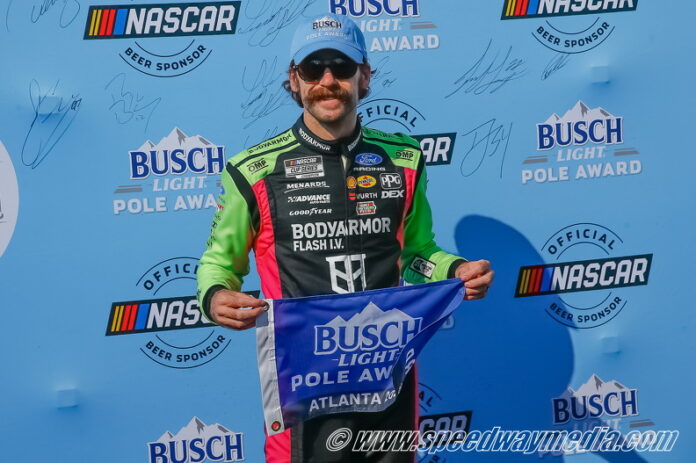
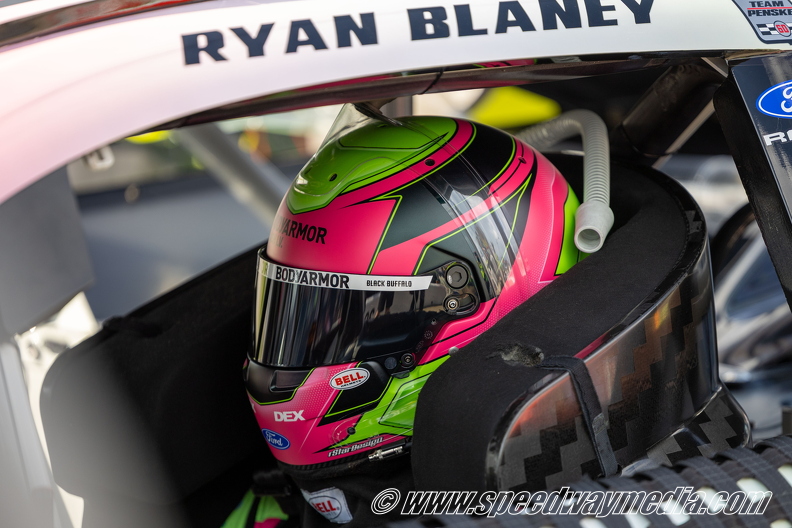
Ryan Blaney sped to the Busch Light Pole Award for the 2026 Quaker State 400 at EchoPark Speedway in Hampton, Georgia, on Saturday, July 11.
The event’s starting lineup was determined through a two-round qualifying session. The first session featured 38 competitors battling for 38 starting spots, cycling once around the track to post the fastest lap. At the conclusion of the first session, the top-10 fastest qualifiers transferred to the second and final round, where they contested for the pole position.
During the session, Blaney was the fastest qualifier following the first qualifying session with a lap at 179.796 mph in 30.835 seconds. After being one of 10 competitors to transfer to the final qualifying round, he doubled down with another fast lap at 179.912 mph in 30.815 seconds. Blaney’s lap was enough for the 2023 Cup Series champion to qualify with the top-starting spot for Sunday’s main event.
With the pole, Blaney notched his 14th NASCAR Cup Series pole for his 398th career start, his second at Atlanta’s EchoPark Speedway, his second of the 2026 season and first since Bristol Motor Speedway in early April. He also recorded the third Cup pole of this season for Team Penske and for Ford.
After achieving his first goal of qualifying on pole position, Blaney, who is ranked in third place in the 2026 Cup Series standings, shifts his focus on managing his No. 12 BODYARMOR/Team Penske Ford Mustang Dark Horse entry for Sunday night’s main event that would enable him to contend for his second overall victory at the venue and first since the venue was reconfigured prior to the start of the 2022 season.
Photo by Logan Allen for SpeedwayMedia.com.
“Yeah, that’s always the big debate: how’s [the car] going to react tomorrow in the race, in traffic as the track changes, and as you get laps on the tires, all that stuff,” Blaney said. “You hope you have a decent handle on, but the goal for today was to try and qualify the best we could, and we were able to do that. So, I appreciate everyone on this No. 12 car for bringing me a fast car. It’s great to have a Team Penske front row. That part is great, and I’m look forward tomorrow to see what we have in the draft. Hopefully, we can hang in there and contend for the win.”
Blaney will share the front row with teammate Joey Logano, the latter of whom posted the second-fastest qualifying lap between the first two rounds. Logano’s latest lap that netted him the runner-up starting spot was at 179.702 mph in 30.851 seconds. Kyle Larson, Austin Dillon and Daniel Suarez qualified in the top five, respectively. Alex Bowman, Chase Elliott, Austin Cindric, Ross Chastain and Brad Keselowski, all of whom transferred to the second and final qualifying round along with the top-five qualifiers, completed the top-10 starting grid.
With 38 competitors vying for 38 starting spots, all made the main event.
EchoPark Speedway – Qualifying Position, Best Speed, Best Time:
Ryan Blaney, 179.912 mph, 30.815 seconds
Joey Logano, 179.702 mph, 30.851 seconds
Kyle Larson, 179.406 mph, 30.902 seconds
Austin Dillon, 179.394 mph, 30.904 seconds
Daniel Suarez, 179.359 mph, 30.910 seconds
Alex Bowman, 179.226 mph, 30.933 seconds
Chase Elliott, 179.203 mph, 30.937 seconds
Austin Cindric, 179.191 mph, 30.939 seconds
Ross Chastain, 178.977 mph, 30.976 seconds
Brad Keselowski, 178.729 mph, 31.019 seconds.
Erik Jones, 178.683 mph, 31.027 seconds
Shane van Gisbergen, 178.660 mph, 31.031 seconds
Chris Buescher, 178.465 mph, 31.065 seconds
Carson Hocevar, 178.413 mph, 31.074 seconds
Ricky Stenhouse Jr., 178.378 mph, 31.080 seconds
Ty Dillon, 178.361 mph, 31.083 seconds
Josh Berry, 178.292 mph, 31.095 seconds
Michael McDowell, 178.264 mph, 31.100 seconds
Ryan Preece, 178.212 mph, 31.109 seconds
Chase Briscoe, 178.195 mph, 31.112 seconds
Todd Gilliland, 178.155 mph, 31.119 seconds
Bubba Wallace, 178.098 mph, 31.129 seconds
Ty Gibbs, 177.983 mph, 31.149 seconds
John Hunter Nemechek, 177.829 mph, 31.176 seconds
Connor Zilisch, 177.698 mph, 31.199 seconds
William Byron, 177.664 mph, 31.205 seconds
AJ Allmendinger, 177.624 mph, 31.212 seconds
Denny Hamlin, 177.363 mph, 31.258 seconds
Riley Herbst, 177.306 mph, 31.268 seconds
Austin Hill, 177.215 mph, 31.284 seconds
Tyler Reddick, 177.091 mph, 31.306 seconds
Christopher Bell, 177.017 mph, 31.319 seconds
Cole Custer, 176.995 mph, 31.323 seconds
Zane Smith, 176.949 mph, 31.331 seconds
Cody Ware, 176.476 mph, 31.415 seconds
Noah Gragson, 176.207 mph, 31.463 seconds
BJ McLeod, 174.653 mph, 31.743 seconds
Cody Ware, 0.000 mph, 0.000 seconds
The 2026 Quaker State 400 at EchoPark Speedway is scheduled for Sunday, July 12, at 7 p.m. ET on TNT Sports, PRN Radio, and SiriusXM.
NASCAR CUP SERIES ECHOPARK SPEEDWAY TEAM CHEVY DRIVER QUOTES JULY 11, 2026
Chase Elliott, driver of the No. 9 Hendrick Motorsports Chevrolet, met with the media in advance of the NASCAR Cup Series qualifying session at EchoPark Speedway. The Dawsonville, Georgia, native returns to his home track as the defending winner of the track’s summer race.
Media Availability Quotes:
Elliott on this weekend’s In-Season Challenge Match-Up Against Chase Briscoe:
“Collectively as a team, if we go do our jobs, you’re going to take care of the In-Season Challenge, as well. That’s where my mind is at, which is trying to survive the carnage that I’m sure is inbound for all of us tomorrow night. Hopefully we’ll be rolling there at the end and have a shot.”
Reflecting back on last summer’s race here at EchoPark Speedway, how different is the day versus the night race here? Also, how big was that win for you last year, in terms of changing the direction of how your team’s season move forward into the playoffs?
“Yeah, it was definitely a big win. Anytime you can win at your home track, it’s just always a really big deal. It just feels a little different. It’s not like I’m trying any harder… I try hard every week. It’s not like I’m necessarily doing anything different, but I do think to cross that bridge and to kind of check that box, it had a little different feel to it. I have a lot of pride being from here and sharing a home state with a lot of the people that are going to be sitting up in the crowd tomorrow night, which I think is really cool. The home wins are really neat. I don’t know how much it really changed the course or direction of our season with how different this race is and it kind of being a speedway-style race, but it was a great night and one I’ll never forget, for sure. It was special for a lot of reasons, so hopefully we can run that back.”
With six races remaining in the regular season, it seems like your team is hitting your stride at the right time. Is that the sense that you have, and if so, what is it that’s led your team to that point?
“Yeah, I think for us, it’s just staying straight in the direction that the race is meant to be going. I think I crashed or was spun out for about two months, from Charlotte on, it seemed like. So, I think for us, it’s just about putting together solid races; executing good days and trying to minimize mistakes. I feel like there’s been a lot of mistakes from me personally throughout that timespan. So, yeah, just piecing that all together and trying to get back to doing what we do well. For us, there’s been pace at different points in time, so it’s just about putting that together at the right time.”
Last year, you won with the ‘Desi9n to Drive’ car and know that was extra special at your home track. This year, you have two people here – Max and Noelle – who designed your car for this weekend. Are they going to be here at the track, and how excited are they to see the car out there on the track?
“Yeah, they’re super pumped. What a great way to celebrate nine years last year. I know I talk about it a lot, but really couldn’t have had that story end any better, honestly. There were enough bad races for our ‘Desi9n to Drive’ car that we hopefully earned one or two more good ones.
But yeah, they’re super pumped. Both Max and Noelle have a lot of energy. We had an event last night and they were pumped up. It will be cool to see them here tomorrow. Max has a little bit of racing experience. Noelle, not so much. But I think it will be fun to see them both in this environment; under the lights and with all the things that this race brings now with just the energy and the excitement around it. Currently in Atlanta, the energy is pretty high for people around here, so I’m excited for them to experience that first-hand and see their ideas and imagination out there on the track.”
What does the ‘Desi9n to Drive’ program mean to you personally and for the foundation to be able to this for these kids?
“At the end of the day, it’s really all about Children’s Healthcare of Atlanta. Everything is for them and just trying to make a difference for the folks that work there, the patients there and the families that go through different challenging times that they would never imagine having to deal with. At the end of the day, you’re trying to make a difference in that collectively and their network of hospitals, but then more directly, just trying to have a positive impact. If it’s just one more positive day for those kids or gives them an experience they might not otherwise have at a race or event like this, in my view, it’s a win, as well. Really proud of where it’s come and the journey it’s been on, and for NAPA bringing it to the next level to make it what it is today. It’s been an honor for me to be a part of it.”
Looking ahead to next weekend, you’re going to be running all four races at North Wilkesboro. Overall, what do you like about North Wilkesboro? For the Truck race in particular, does that carry any more extra weight or is it extra special because you’re filling in for Kyle Busch?
“I’m super excited about it for a lot of different reasons. I don’t get to run late model races a lot. There’s just really not a lot of mid-week shows that work out for us with how our schedule is. It’s not like the dirt world where they race a lot of mid-week shows, so I’m excited about that. I appreciate Dale (Earnhardt Jr.) asking me to drive his late model stock, as well. That’s not a car that I’ve really had a lot of experience racing, in general. But both that race and the Truck race, as well, they were meant to be for Kyle (Busch). I think Dale was going to get him to drive that late model stock, as well, so it will definitely be special for that reason. I would love to go and get a win in honor of him, his career and the friend he was to me over the years. I don’t know how my name got drawn, asked or what it was, but I appreciate them thinking of me and letting me have that honor to go run those races.”
Do you feel more comfortable heading to the Brickyard in the O’Reilly car after running last weekend at Chicagoland?
“Not really, honestly. I think Indianapolis is so different. My understanding is with the high downforce, draggy, drafting vibe that they had going there last year (in the O’Reilly race), I think it’s totally different than what we had last weekend at Chicagoland. I don’t really know what to expect for that. I would look at Chicagoland as being more normal to those races, compared to what I see on TV a lot. I had a lot of fun with it. I thought Mardy (Lindley) and the entire No. 88 team did a great job. They were well-prepared and had me up to speed the best they could outside of the car. They gave me the time to get up to speed once we got out there on the track and showed me a lot of respect in that regard, so I really appreciate them and look forward to working with that group again. It’s a really good group of people and they’re well-buttoned up. You can’t ask for much more, so hopefully we can try to better it by a spot in Indy.”
About General Motors
General Motors (NYSE:GM) is driving the future of transportation, leveraging advanced technology to build safer, smarter, and lower emission cars, trucks, and SUVs. GM’s Buick, Cadillac, Chevrolet, and GMC brands offer a broad portfolio of innovative gasoline-powered vehicles and the industry’s widest range of EVs, as we move to an all-electric future.
GM Motorsports, including the Cadillac Formula 1® Team develops and proves advanced technologies in the most demanding environments, accelerating innovation in performance, safety, efficiency, and electrification for its production vehicles. Cadillac Racing is one of the leading manufacturers in the IMSA and FIA World Endurance Championships (WEC). Chevrolet competes in single seaters in the US IndyCar series, and in NASCAR with multiple team partners and drivers. Corvette customer teams compete in GT series across the globe including IMSA and WEC. Learn more at GM.com.
Ford Racing Notes and Quotes NASCAR Cup Series Quaker State 400 Media Availability — EchoPark Speedway Saturday, July 11, 2026
Christopher Buescher, driver of the No. 17 Kroger/Heinz Ketchup/Artesano Brioche Ford Mustang Dark Horse, is currently seventh in the NASCAR Cup Series point standings. He stopped by the EchoPark Speedway infield media center before qualifying to talk about this weekend’s race.
CHRISTOPHER BUESCHER, No. 17 Kroger/Heinz Ketchup/Artesano Brioche Ford Mustang Dark Horse – HOW DOES IT FEEL TO BE ON YOUR VERY OWN BILLBOARD? “I am realizing there was some reality to Ryan’s post and I’m not gonna lie, that guy uses a lot of ChatGTP and I just knew that he was faking this one, and a lot of people online pointed out that the trees didn’t have leaves on them, or it was the same photo for both, and I realized those were just renderings as to what they would really look like because we have seen time and time again that this actually happened. Scott Graves was driving down this morning and confirmed it in our group chat that there are billboards, so I guess I’ve made it at this point. My face is on a billboard. Either we’ve done something really well or if you’ve been hurt in a motorcycle accident, I’ve got you. I don’t know (laughing). It’s something. Ryan is back to shenanigans, which is fine because I’m currently in the process as well and I look forward to unveiling that before too terribly long. We’re gonna keep having fun with it. I do realize that everybody here at EchoPark Speedway had a role in this, so we will have to figure out how to return that favor somewhere along the way, but that was something.”
YOU ARE SUPPOSED TO BE CHRISTOPHER BUESCHER THIS WEEKEND AFTER LOSING THE BRACKET BATTLE WITH CHRISTOPHER BELL, RIGHT? “So your question was why am I holding 64 ounces of ketchup in my hand? Obviously, we’ve got the Heinz Ketchup Ford Mustang this week. It’s a pretty awesome-looking ride and we figure we’re just gonna pour everybody a little shot on the way out of here, so I hope you all are ready. The other question you kind of skated over there. We were sitting on the stage last week and I was sitting next to C Bell, I’m just gonna shorten his all the way, and he’s sitting there and we’re talking like, ‘What are we gonna do? What’s it gonna be?’ And I’m like, ‘You know what? We’ll just make it to where whoever wins this thing, just tell the other one where they need to shut their first name off at.’ He said, ‘Yeah. I like that. We’ll do it.’ And I’m sitting here thinking, ‘There’s one stopping point that’s not acceptable for either of us’ and that was after the t and we agreed on that. But he was nice to me. He let me have my full legal birth name back, so we’re Christopher for the weekend on that side, but I was gonna be way more mean than that. I was thinking just Ch, or Chri. I didn’t know exactly where I was gonna end. Christoph seemed pretty good. There were so many ways he could have gotten at me, so, yeah, I’m appreciative of the full name.”
DOES THE PAYBACK FOR THE SHENANIGANS GET INCREASED WITH HIM USING THAT PHOTO? “I guess that’s kind of leading into something that honestly had nothing to do with him pranking me, but I’m equally embarrassed about, so that was just straight up due to our friends at Kroger and Minute Rice, but to be seen on that front. Ironically, I did have that same haircut when I was a kid, but it just wasn’t that red. From that side of it, it’s OK, but I think he’s just jealous I got the Minute Rice ride this year and he didn’t, so that’s why he used that photo. I don’t know where that one came from. Apparently, he was asking around trying to get baby photos of me and things of that nature, but I’ve got enough friends around here that they didn’t release those. It’s not too out of hand yet. I did not see him spending this much currency to get this accomplished and it makes me realize I may have cheaped out on my next project a little bit, so I’ll have a couple weeks to do a little spending, but I promise it’s going to be equally as much fun if not just a little bit more rewarding on a psychological level.”
THIS WILL BE THE FIRST SUMMER RACE WITH THAT NEW TIRE SETUP FROM FEBRUARY. DO YOU KNOW WHAT TO EXPECT YET WITH HOW THAT’S GOING TO REACT TO DIFFERENCES IN TRACK AND AMBIENT TEMPERATURE? “To be honest with you, I never really have figured out what to expect when we come to Atlanta yet. It seems like it changes so much in between our races by itself. Weather conditions are so significantly different this go around. I don’t have a good answer for you. Qualifying is not a good read on it because it’s a single lap and everybody is locked down and nothing drives great in qualifying, but you can deal with it for a lap by yourself. Really, we get into the race and it remains to be seen. Obviously, going into the night we’ve had some good night races here that it seems like the handling kind of comes to you for the entire field. The track seems to widen out as we get into our race, whether it is day or night, it takes a little bit longer to work in that third groove here. I don’t know if it’s just dirty at first or needs to get rubber in it. There’s enough handling here that it’s not like a Daytona or Talladega where you can just find a clean way forward. It has to come in, so, no, I don’t have the answers for sure. There’s a lot to figure out as we go into tomorrow and, really, the O’Reilly race isn’t a great read for our race either here. The cars are just too different at this point, I believe, to get that feel. So, there are more questions than answers.’
YOU WERE AT NORTH WILKESBORO SEVEN YEARS AGO AS PART OF THE CLEAN UP. DID YOU EVER FATHOM THAT IT WOULD BE BACK IN ITS CURRENT STATE AND HOST A POINTS RACE? “No. I remember we went up there, me and Bailey Currey rode up there together. It started out as like a question of who is willing to help. I was like, ‘I’ve got a skid steer and a trailer and I’ll come up there and move some dirt around and clear the track.’ I’d seen some pictures. I’d driven by it on my way to Bristol every year and I knew how bad a shape it was in from the road. We got there and I remember Dale riding around on the street sweeper just making laps and smiling ear to ear covered in mud basically. It was nasty. It was cold. I was like, ‘He did the bulk of the work already.’ So we got there and I remember just going around and having the understanding that it was to try and get it scanned and preserved in the digital world knowing that it probably wasn’t gonna make it beyond that. It’s pretty remarkable to see where it’s gotten to now. It’s been such a fun racetrack to be on, whether it was the old surface or the new. It’s gonna be a fun night race, a long race as well. There are a lot of cool things coming there, but it’s really neat to see where it’s gotten to, but I had no clue that was even a possibility while we were there.”
WOULD NORTH WILKESBORO BE AROUND WITHOUT DALE’S INVOLVEMENT AND PUSH BEHIND IT? “I don’t see a world that it would have been anything like it is, no. I felt like that was a push from him and a movement that he created and got a lot of people behind it in a lot of ways and it worked. The racing has been good there. The fan involvement there has been fantastic. The stories that you get from people that remember going there back in the day and those that didn’t understand it and had to see it for themselves. It’s pretty wild, but that was definitely something that I don’t believe would have come around without him really pushing.”
LAST WEEK BRAD ADDRESSED THAT HE FELT THE TEAMWORK AT TOYOTA MADE SOME OF THE RACES PREDETERMINED. DO YOU FEEL THAT WAY? “It’s probably gonna be more in Brad’s wheelhouse, for sure, from the driver and the ownership side. He is definitely more in the weeds with that. I think in trying to take bits and pieces of what I hear him saying there just from that interview and also what we see week to week I see where he’s coming from and how we work together and how we can be better to try and have that high tide raise all ships. That’s kind of the idea and the principle he was trying to get across there, so, right now, obviously we are in a place where we are not the dominant manufacturer and so we’re gonna figure out ways that we feel like we can get there and feel that could be part of it. No one is sitting still. I promise you that, whether it’s manufacturers, our engine shop, RFK, personally. We’re all trying to figure out how to find that little bit of extra speed that will get us to the point where we can say we’re contending to win races week in and week out. We’re just not quite there yet. We have plenty of ideas on what it could be. If 10 percent of everybody’s idea actually makes it better, then at the end of the day it would make it a lot better for all of us on the RFK side of things and the Ford camp, I guess, in principle. There’s no way to prove it out, but I understand some of the comments from it.”
NOW THAT WE HAVE THE CHASE SYSTEM AND YOU’RE SEVENTH IN POINTS. WHAT HAS THIS POINT IN THE YEAR BEEN LIKE FROM A MENTAL AND STRESS STANDPOINT KNOWING YOU’RE IN A GOOD POSITION TO QUALIFY? “Very similar as years past in a lot of ways because we haven’t won yet. The years that we’ve won races they’ve come deeper into the season than we would like them to every time. We’ve had a couple years where the wins came in the playoffs. In ‘23 it came right leading up to it and secured everything for us, but, yeah, if you think about the place we’ve been on a points standpoint, it’s been simply because we hadn’t won races yet the last couple of years and on a straight consistency side of things if you took this format, we would have easily made the Chase. We’re aware of that. It doesn’t change what the system was at the time. We’re aware of where we’re at now and we’re gonna be a Chase contender. We know that. I’ve told everybody that from the beginning of the year because that’s how we’ve been able to race year in and year out, it’s just we still don’t have a win right now. So from most aspects of it, it’s very much the same, it’s just the result or the perks from the win are not a guarantee, but realistically we feel like we’ve already got that part covered. We’re just trying to figure out how to win races and that’s the stressful side or the driving side or however you want to put it. It’s figuring out how to get into Victory Lane.”
DO YOU FEEL SAFE ENOUGH WITH WHERE YOU ARE IN POINTS AND WHAT TRACKS ARE AHEAD? “The drafting tracks has been one of the places that have produced the knockout from the top row. That was tough to go through and we knew it was a possibility and it happened to us. That won’t be the situation exactly this go, but it doesn’t change the fact that there’s no way we can afford to give anything. You can’t be reckless. You can’t give anybody an inch. We still have to perform at a high level. We still have to do our work ahead of time and come into these weekends and be prepared to put in our max effort. With that, we’ll be fine on making the Chase, but that’s ultimately not the goal. It’s realizing and I think seeing it more and more out there that if you can start the Chase in fifth or sixth spot, or better, then you have a shot to win a title and we’re just outside of that, so we have to step up to be able to get to that point to where we’re not just a participant but a contender at the end. So where we’re at right now I’m not worried about making the Chase. I’m just not. That’s going to come to us with the kind of races we’re able to put together, but I want to win races. I don’t want to just be consistently right there around the fifth to eighth place. I want to win races and we’ve got a lot of good tracks coming up for us, but, yes, when you go to drafting racetracks there are those chances that things get wild. Take them for what they are. We know it can happen, but we’re in a really good spot and our team has worked really hard to get us here knowing that this was gonna be a stretch where you can have some big gains or big losses.”
July 11th, 2026 – Cadillac Hertz Team JOTA has locked out the front row of the grid for the Rolex 6 Hours of São Paulo at the latest round of the FIA World Endurance Championship (WEC).
Will Stevens secured pole postion for the No.12 Cadillac Hertz Team JOTA V-Series.R with a lap time of 1:23:041. Just 0.048 seconds off pole position was the sister car driven by Jack Aitken.
“Locking out the front row at São Paulo with the #12 Cadillac V-Series.R on pole and the #38 alongside in second is an incredible achievement for the entire Cadillac Racing programme,” said Cadillac Racing Manager, Keely Bosn.
“Congratulations to Will Stevens on an outstanding lap to earn pole position and to Jack Aitken for putting the #38 on the front row as well. Seeing both Cadillacs separated by such a tiny margin is a testament to the preparation and execution from both crews, especially in a qualifying session where the top ten was incredibly competitive and every hundredth of a second mattered.”
“This is the third consecutive front row start in 2026, which reflects the consistency we’ve continued to build throughout the season. To have both Cadillacs leading the field at a track where we celebrated a one-two finish last year makes today even more special. Now our focus turns to converting this qualifying performance into a strong race result tomorrow.”
No. 12 Cadillac Hertz Team JOTA V-Series.R. Will Stevens: “To come away with back-to-back poles here in Sao Paulo is an amazing moment. For me personally it’s my first pole position with Cadillac which is very special, and a lot of my family are here to experience it with me. A big thanks to the whole Cadillac Hertz Team JOTA team for giving us the package to put both cars on the front row of the grid. Now we focus on the race tomorrow. Hopefully we can get back to back wins after back to back poles.”
No. 38 Cadillac Hertz Team JOTA V-Series.R. Jack Aitken: “It was a really strong set of free practice sessions for us. We have been working through practice to fine tune the balance and try and get the car into the best possible window. The field is very, very tight here. The tiny margin of difference in qualifying between the top five cars shows that every little counts. It was a great effort by everybody to get this front row lockout.”
The No.12 car will be driven by Will Stevens and Norman Nato and the No.38 car will be driven by Jack Aitken, Sebastian Bourdais and Earl Bamber. The race will take place on the 4.409 km (2.677-mile), 15-turn Autódromo José Carlos Pace (Interlagos) circuit. It is scheduled for 1130am local time on Sunday July 12th.
About General Motors
General Motors (NYSE:GM) is driving the future of transportation, leveraging advanced technology to build safer, smarter, and lower emission cars, trucks, and SUVs. GM’s Buick, Cadillac, Chevrolet, and GMC brands offer a broad portfolio of innovative gasoline-powered vehicles and the industry’s widest range of EVs, as we move to an all-electric future.
GM Motorsports, including the Cadillac Formula 1® Team develops and proves advanced technologies in the most demanding environments, accelerating innovation in performance, safety, efficiency, and electrification for its production vehicles. Cadillac Racing is one of the leading manufacturers in the IMSA and FIA World Endurance Championships (WEC). Chevrolet competes in single seaters in the US IndyCar series, and in NASCAR with multiple team partners and drivers. Corvette customer teams compete in GT series across the globe including IMSA and WEC. Learn more at GM.com.