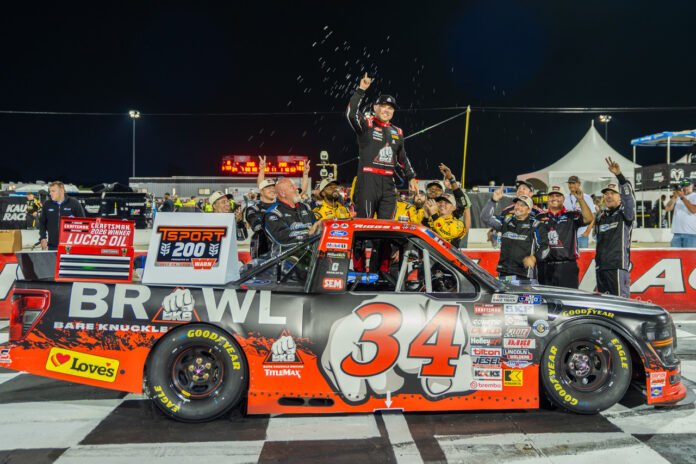
Layne Riggs | Chandler Smith Lucas Oil Indianapolis Raceway Park NASCAR CRAFTSMAN Truck Series Race Report Lucas Oil Indianapolis Raceway Park 200 Date: Friday, July 24, 2026 Event: Race 16 of 25 Series: NASCAR CRAFTSMAN Truck Series Location: Lucas Oil Indianapolis Raceway Park (0.686-miles) Length of Race: 200 laps over one hour, 42 minutes, eight seconds
“I just feel like we’ve finally perfected every part that we need,” said Riggs. “I’m super confident coming to every single racetrack. I know exactly what it takes to go fast. That’s three poles now. I’ve got the win tonight. It was just an amazing truck and it’s just fine-tuning the little things, going to these tracks for the second, third, fourth time and seeing them and knowing exactly what it takes to win at these places after getting my teeth kicked in at some other ones. I’m super proud of everybody. Man, what a truck. Thank you to all of our partners – BKB Bare Knuckle Boxing, BKB 57 in London tomorrow night. Everybody tune in on Vice TV. It’s going to be a brawl as you see on the quarterpanel. Ford Racing, all of your help. They give us the tools to go fast. These guys make my job easy and I think we’re just going to keep carrying on that momentum. It’s a statement win. I think we’re the ones to beat, for sure.”
“We wanted to go out before the Chase starts and try to collect as many wins and stage points as possible to have good momentum going into the Chase,” said Smith. “Nevertheless, a top five finish today. The truck wasn’t ever really where I wanted it to be. The few times that I did contend for the lead with Layne, I just couldn’t contend with the 34 truck tonight. That truck was very similar to what I experienced last week, so I understand what it feels like to be on the receiving end now. Congrats to the 34 crew. I’m happy for them and proud of them and all of Front Row Motorsports. That’s back-to-back wins, two weeks in a row, and that’s really cool for the organization. I think we’ve got a little bit of a break now, which I’m not really looking forward to that, but I’m looking forward to the next few races coming up.”
ABOUT FRONT ROW MOTORSPORTS
Front Row Motorsports (FRM) is a winning organization competing in the NASCAR Cup Series and the NASCAR CRAFTSMAN Truck Series. Founded in 2004 by entrepreneur Bob Jenkins, FRM has earned top honors including a 2021 Daytona 500 victory and the 2022 CRAFTSMAN Truck Series championship. Based in Mooresville, N.C., FRM fields the No. 4, No. 34, and No. 38 entries in the NASCAR Cup Series, along with the No. 34 and No. 38 teams in the CRAFTSMAN Truck Series. For more information, visit FrontRowMotorsports.com and follow Front Row Motorsports on social media — X: @Team_FRM, Instagram: @teamfrm, Tik Tok: @Team_FRM, YouTube: @FrontRowNASCAR, and Facebook: facebook.com/FrontRowMotorsports.
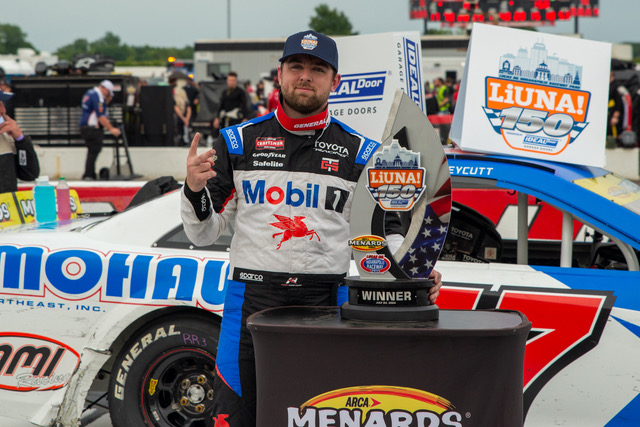
Kaden Honeycutt (No. 17 Mohawk Northeast / MMI Services Toyota) scored his second career ARCA Menards Series victory and his second win of the season in Friday’s LiUNA! 150 Presented by Ideal Garage Door at Lucas Oil Indianapolis Raceway Park.Honeycutt’s previous victory this season came in the opening act of a same-day doubleheader with the NASCAR Craftsman Truck Series; his win tonight at Lucas Oil Indianapolis Raceway Park was also the opener of a same-day doubleheader with the NASCAR Craftsman Truck Series.
Thomas Annunziata (No. 70 JBL.com Toyota) matched his best career ARCA Menards Series oval track finish with his fourth career runner-up finish. Annunziata, who won at Lime Rock Park two weeks ago, also finished second in his series debut at Daytona International Speedway in 2024 and earlier this season at Toledo Speedway and Berlin Raceway.
Annunziata unofficially closed the gap in the battle for the ARCA Menards Series championship to just three points; leader Jake Bollman (No. 20 Nitro Motorsports Toyota) finished in seventh to give up five points in the battle for the crown.
Sioux Chief PowerPEX Pole Award winner Carson Brown (No. 28 Grizzly Coolers Chevrolet) led early before giving up the lead to Honeycutt. Brown cut Honeycutt’s advantage from over 2 seconds to a matter of car lengths inside of the final 20 laps, and even nosed ahead to lead a couple of laps but Honeycutt was able to return the favor in traffic. Brown eventually lost power momentarily with just six laps to go to lose second position, but the car came back to life and he was able to maintain the third position.
The battle for the ARCA Menards Series East championship took a big turn as leader Tristan McKee (No. 77 Freeway Chevrolet) was involved in an early incident while battling for position with his championship rival Max Reaves (No. 18 Cook Out Toyota). Reaves was able to continue with no damage, but McKee spent 43 laps in the garage area making repairs, resulting in a 34th-place finish. With his ninth-place finish, Reaves unofficially takes the lead in the ARCA Menards East standings by just five points over McKee with three races remaining.
Gavan Boschele (No. 25 ShopGavan.com Toyota) finished fourth, his fifth top-five finish in six starts so far this season. Boschele was also doing double duty in Friday; he made his NASCAR Craftsman Truck Series debut driving a Toyota for TRICON Garage.
Reigning ARCA Menards East champion Isaac Kitzmiller (No. 79 A.L.L. Construction / Carter CAT Chevrolet) had a solid night, finish in the fifth position. It’s his second career ARCA Menards Series top-five finish and his fourth top-five in five ARCA Menards East starts in 2026.
Andrew Patterson (No. 40 Habegger / WinSupply Chevrolet) finished sixth, his first top-ten finish of 2026 and best finish since he finished second at Salem in September.
Ashton Higgins (No. 15 Alliance Driveway Solutions Toyota) finished seventh in his first ARCA Menards Series start since he finished 19th in his series debut at Bristol Motor Speedway in 2022.
Hometown hero Zachary Tinkle (No. 53 Racing for Rescues Toyota) scored his second consecutive top-ten finish in his family-owned ride in the tenth position. Tinkle hails from nearby Speedway, Indiana and lives just seven miles from Lucas Oil Indianapolis Speedway.
The next race for the ARCA Menards Series is the JR & CO 150, a combination race with the ARCA Menards Series East at Iowa Speedway on Friday, August 7. The race, set to begin at 7 pm ET / 6 pm CT, will be televised live on FS1 and broadcast on select affiliates of the MRN Radio network nationwide. ARCARacing.com will have live timing & scoring data throughout all on-track activity and live race audio. Follow @ARCA_Racing on X (formerly Twitter) for up-to-the-minute updates.
About ARCA The Automobile Racing Club of America (ARCA), founded in 1953 by John and Mildred Marcum in Toledo, Ohio, and acquired by NASCAR in April 2018, is the leading grassroots stock car sanctioning body in the United States. Bridging the gap between NASCAR’s top three national touring series and weekly and regional tour racing all across the country, the organization to sanctions over 100 races per year in the ARCA Menards Series, ARCA Menards Series East, ARCA Menards Series West, ASA STARS National Tour, ASA CRA Super Series, ASA Midwest Tour, ASA Southern Super Series plus weekly racing at Toledo and Flat Rock Speedways. For more information about ARCA visit , or follow ARCA on Facebook (@ARCARacing) and Twitter (@ARCA_Racing).
About Menards A family-owned and run company started in 1958, Menards is recognized as the retail home center leader of the Midwest with 236 stores in 15 states. Menards is truly a one-stop shop for all of your home improvement needs featuring a full-service lumberyard and everything you need to plan a renovation or build a home, garage, cabin, shed, deck, fence or post frame building. You’ll find a large selection of lumber, roofing, siding, construction blocks, trusses, doors and windows, plus cabinets, appliances, countertops, flooring, lighting, paint, plumbing supplies and more. To complete the job, Menards has quality hand tools, power tools, fasteners, electrical tools plus storage options and supplies for everyone from the weekend warrior to the pro!
Menards has what you need to complete your outdoor projects and keep your yard in tip-top shape including mowers, trimmers, blowers, pressure washers and more, plus a beautiful garden center stocked with plants, shrubs, trees, landscaping tools, grass seed, fertilizer options, outdoor décor and patio furniture. Menards also has everyday essentials like health & beauty products, housewares, pet and wildlife supplies, automotive items and even groceries. And at Christmas, an Enchanted Forest display area with impressive trees, lighting, decorations, ornaments, inflatables and more.
Menards is known for friendly Customer Service and as the place to “Save Big Money” with low prices every day, and sales too! For more information, please visit Menards.com to learn about our store locations, offerings and services.
NCTS RACE RECAP: LUCAS OIL INDIANAPOLIS RACEWAY PARK Event: TSport 200 (200 laps / 137.2 miles) Round: 16 of 25 (Regular Season) Track: Lucas Oil Indianapolis Raceway Park Location: Indianapolis, IN Date & Time: Friday, July 24 | 8:00 PM ET
No. 44 Acceptance Insurance Chevrolet Silverado RST Driver: Andrés Perez de Lara | Crew Chief: Wally Rogers
Key Takeaway: Andrés Pérez de Lara and the Acceptance Insurance team put together a solid outing in Indianapolis. Pérez de Lara qualified the highest out of his Niece Motorsports teammates with his fourth top-10 start of the season, and just barely missed out on extra points by finishing 11th in stage one and two. The No. 44 Silverado was in position to capture a top-10 finish, but got tangled up with a lapped truck with less than five laps to go. Pérez de Lara crossed the finish line in 11th-place.
Andrés Pérez de Lara’s Post-Race Thoughts: “I had a really fun night here in IRP. I think our truck was really, really fast, so it was a solid day overall. I wish we could have kept our top-10, but we just got caught up in a mess with a lapped truck at the end which really killed our chances at getting it. It’s very frustrating to lose it there in the last couple laps after such a strong and solid day, but we’ll take the positives out of tonight. It’s good to run like that on a short track, and we’ve got two more ahead of us, so hopefully we can keep it up.”
About Acceptance Insurance: Acceptance Insurance is a proud member of Confie, the largest personal lines agency in the U.S. We believe in investing in the communities we serve by offering affordable insurance solutions so our customers can have peace of mind. Our agents and team members uphold our values, which include promoting excellence, responsibility and caring.
Acceptance has been in business for over 50 years. We have over 700 agents in over 288 neighborhood locations ready to give you the service, respect and savings you deserve. We come to you so you can find the solutions you need, regardless of your background and driving record. We offer easy solutions to meet your unique needs.
No. 42 Operator Standard Chevrolet Silverado RST Driver: Parker Eatmon | Crew Chief: Landon Polinski
Key Takeaway: Parker Eatmon and the Operator Standard team ran well all night long at IRP. Eatmon started the 200-lap race in 14th and drove inside the top-10 at the end of the first stage. The No. 42 team held serve after stalling on pit road on the first stop of the night, but stayed in the hunt through stage two. Keeping his cool, Eatmon remained on the lead lap all race long. He earned his career-best finish of 12th-place in just his third NCTS start.
Parker Eatmon’s Post-Race Thoughts: “I’m pretty happy with the way our night went at IRP. We weren’t too good on the short run, but our long run truck was really good. I knew that we would be solid after practice, and I just can’t thank Landon Polinski enough for working on it and giving me a good Operator Standard Silverado all night. There were a bunch of different lanes we could run out there. I was predominantly running the top, and it was a lot of fun. Overall, it was a good night, and we will keep building on this for the next ones to come.”
About Operator Standard: Operator Standard is the first daily operating system for your life. A full-life execution system that builds discipline, identity, and consistency through pressure, structure, accountability, and community. Not a habit tracker, not a mastermind, not a coaching group, not a motivation app. It’s a daily operating system, powered by ARCANE, the AI brain inside the app, designed to turn you into someone who follows through every single day. Nothing on the market works like this. Join 15,000+ Operators who use The Operator Standard to execute, win the day, and become someone they actually respect.
No. 45 J.F. Electric Chevrolet Silverado RST Driver: Landen Lewis | Crew Chief: Phil Gould
Key Takeaway: Landen Lewis and the J.F. Electric team had a tough night in Indianapolis. Lewis started the race in 20th-place, but passed a handful of trucks in the first stage. Despite losing a lap, the No. 45 team made significant progress with the handling after making adjustments in stage two. Lewis was fighting for the free pass in the final stage when two trucks made contact directly in front of him. With nowhere to escape, Lewis got collected in a hard crash. He was credited with a 35th-place finish with an early exit.
Landen Lewis’ Post-Race Thoughts:
Interviewer: Landen, you told me you were in the wrong spot at the wrong time. What positives can you take from tonight?
“Oh, just a lot of positives for sure. We made the truck way better from stage one to stage two, and I think we were running like the sixth-place lap times which I thought was great. We drove up to ninth without being scored ninth, so I’m just proud of the group effort we had. Our J.F. Electric / Utilitra Chevrolet was really fast tonight. We made it better all night long. I guess we got caught in the wrong place at the wrong time. I definitely don’t like to be standing here, but it is what it is and you have those moments throughout racing. It’s just how you come back from them.”
About J.F. Electric: J.F. Electric is an electrical contractor that provides engineering expertise, backed by construction and installation know-how in a diverse range of service offerings, from utilities and commercial projects, to industrial and telecommunications customers. When having a long family history in an industry, a company not only builds on its knowledge and experience, it takes pride in cultivating a solid understanding of client needs, all the while nurturing strong relationships with its employees. Evolving through five generations of the Fowler family, J.F. Electric has matured into a well-managed and thoughtfully diversified electrical contractor which is poised to continue its growth and expansion into the future.
About Niece Motorsports: Niece Motorsports is a professional auto racing team that has competed in the NASCAR CRAFTSMAN Truck Series since 2016. The team is owned by Josh Morris of DQS Solutions and Staffing and the Fowler Family of J.F. Electric and Utilitra, and was founded by United States Marine Corps Veteran Al Niece. At its 80,000 sq. ft. headquarters in Salisbury, NC, Niece Motorsports is a full-service race vehicle build shop as well as a customizable fabrication shop for any manufacturing needs.
Follow the Team: To keep up to date with the latest team news, visit niecemotorsports.com or connect on Facebook and Instagram (@NieceMotorsports) as well as X (@NieceMotorsport).
Ford Racing Notes and Quotes NASCAR Craftsman Truck Series TSPORT 200 — Lucas Oil Indianapolis Raceway Park Friday, July 24, 2026
FORD HOT STREAK CONTINUES AS RIGGS WINS AT LOIRP
Tonight’s repeat win for Layne Riggs is his fifth of the season, a career-best, and matches his total from the previous two years combined.
Ford has seven wins this season and five of the last seven overall.
Tonight’s victory extends Ford’s winning streak at LOIRP to four after Ty Majeski won back-to-back in 2023 and 2024.
Riggs now has 10 career series victories, which is second on the all-time Ford list. Greg Biffle is Ford’s all-time leader with 16.
Riggs has won four of the last seven series events, including back-to-back triumphs at Charlotte and Nashville.
The win is FRM’s 22nd all-time and seventh in 2026, which is the most for the organization in one season.
Riggs has five wins to go with Chandler Smith’s two.
Overall, Ford has won 136 series races.
Ford Finishing Results:
1st – Layne Riggs
3rd – Ty Majeski
4th – Chandler Smith
15th – Ben Rhodes
21st – Jake Garcia
23rd – Cole Butcher
29th – Frankie Muniz
30th – Monty Tipton
36th – Jackson Macenko
LAYNE RIGGS, No. 34 BKB Bare Knuckle Boxing Ford F-150 – VICTORY LANE INTERVIEW – “I just feel like we’ve finally perfected every part that we need. I’m super confident coming to every single racetrack. I know exactly what it takes to go fast. That’s three poles now. I’ve got the win tonight. It was just an amazing truck and it’s just fine-tuning the little things, going to these tracks for the second, third, fourth time and seeing them and knowing exactly what it takes to win at these places after getting my teeth kicked in at some other ones. I’m super proud of everybody. Man, what a truck.” HOW IMPORTANT IS IT TO KEEP THE FOOT ON THE GAS WITH THE CHASE COMING UP? “I think it’s as important as ever. Our only goal is to be the number one seed going into the Chase because with the format it doesn’t really matter. It doesn’t matter if we have every win or are the number one seed by one point, it’s gonna be the same outcome for points when the Chase starts. I think we put a pretty good buffer on everybody tonight. We just have two solid races after this and keep managing that points lead.” YOU SWEPT THE STAGES AND LED ALL BUT TWO LAPS. WHAT DO PERFORMANCES LIKE TONIGHT SAY ABOUT YOU AND THIS TEAM? “I think they’re just statement wins. Man, what a truck. I mean, I was on cruise control there for so much of the race. He kept me honest there at the end. I was honestly those last 15ish laps in traffic I was running as hard as I could and I couldn’t get away from him. I know we had a pretty good gap, so a great job by my spotter, Josh. He did a great job navigating me through traffic. I had that one mishap on the restart and just spun the tires really, really bad and when you get these tires spinning, they’re just so hard to recover. Thank you to the guys behind me for not turning me around. I know that easily could have happened. I’m not sure where Chandler finished. They had a good run for him as well. He got it last week and we had to flip the script and do it again this week. Thank you again to all of our partners – BKB Bare Knuckle Boxing, BKB 57 in London tomorrow night. Everybody tune in on Vice TV. It’s gonna be a brawl as you see on the quarterpanel. Ford Racing, all of your help. They give us the tools to go fast and, man, what a race truck. These guys make my job easy and I think we’re just gonna keep carrying on that momentum. It’s a statement win. I think we’re the ones to beat, for sure.” WHAT IS IT ABOUT THIS TRACK THAT ALLOWS YOU TO HAVE SUCCESS? “I think just my short track experience racing the CARS Tour, having so much time with just learning how to finesse that right foot. There’s not a lot of tracks you go to where you have to do that, and just here it’s really about tire management, keeping that right-rear tire on it. My crew chief, Dylan (Cappello), my engineer Jonathan Coates. They do a great job at the Ford Racing simulator helping give me what I need every single week to go faster and faster. It’s the same truck that has won both of our Bristol races and both of our IRP races. The win percentage, I think, is over 50 percent for it. It’s just awesome to be able to bring that back, bring the same setup back. I said, ‘Man, let’s just bring the same thing we had back. If we get beat straight-up, then we’re just gonna have to go to work next year,’ but I didn’t want to mess ourselves up. Man, what a truck though. It’s amazing.”
CHANDLER SMITH, No. 38 Long John Silver’s Ford F-150 – YOU’VE CLINCHED A SPOT IN THE CHASE. WHERE DOES THAT SET YOUR SIGHTS NOW? “Truthfully, my sights aren’t any different than they were a few weeks ago. We wanted to go out before the Chase starts and try to collect as many wins and stage points as possible to have good momentum going into the Chase. Nevertheless, a top five finish today. The truck wasn’t ever really where I wanted it to be. The few times that I did contend for the lead with Layne, I just couldn’t contend with the 34 truck tonight. That truck was very similar to what I experienced last week, so I understand what it feels like to be on the receiving end now. Congrats to the 34 crew. I’m happy for them and proud of them and all of Front Row Motorsports. That’s back-to-back wins, two weeks in a row, and that’s really cool for the organization. I think we’ve got a little bit of a break now, which I’m not really looking forward to that, but I’m looking forward to the next few races coming up.”
TY MAJESKI, No. 88 Serta/Menards Ford F-150 – A GOOD RUN, BUT THE 34 WAS LIGHTS OUT. “Yeah, I really didn’t even see him all day. He was obviously really good. We just needed a solid day. We’ve had an up-and-down season that has been well documented since Daytona. This was supposed to be a down race for us and we finally broke that up-and-down line graph. Our rebound starts here. It was obviously a good points day, so we’ll take this momentum to our best track at Richmond and try and get a couple spots better.”
SEATTLE (July 24, 2026) – Top Fuel’s Jasmine Salinas powered to the provisional No. 1 spot on Friday at Pacific Raceways, moving closer to her first career top qualifier at the Muckleshoot Casino Resort NHRA Northwest Nationals.
Cruz Pedregon (Funny Car) and Dallas Glenn (Pro Stock) are also the provisional No. 1 qualifiers in Seattle at the 12th of 20 races during the 2026 NHRA Mission Foods Drag Racing Series season.
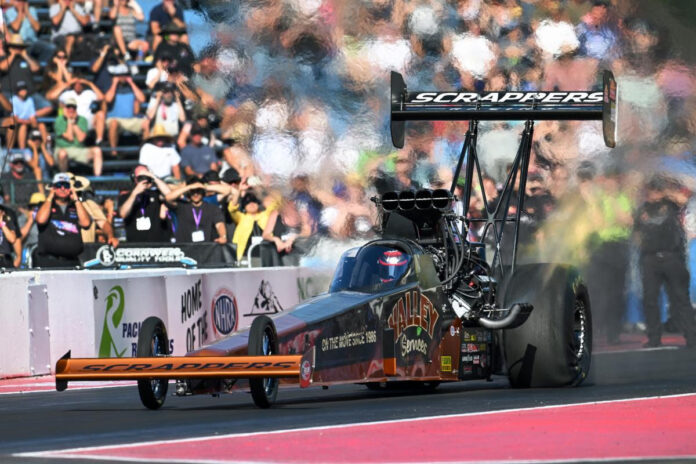
A week after picking up her first career runner-up in Top Fuel, Salinas went 3.794-seconds at 328.38 in her 12,000-horsepower Valley Services dragster to take the top spot. Should that hold, Salinas would pick up her first career No. 1 qualifier.
It also continues an impressive stretch for Salinas, who was terrific just days ago in Sonoma. She knocked off stalwarts like points leader Shawn Langdon and Leah Pruett to reach the final round. Salinas fell to Doug Kalitta in the championship round, but it was a strong weekend for her Scrappers Racing team and that only continued on Friday at Pacific Raceways.
“This is something that I knew we’ve been capable of doing,” Salinas said. “We’ve been seeing the numbers and we’ve been knowing our capabilities. We just haven’t had the shot to really go and show it to everybody else. Sonoma was a really good eye-opener, I think for a lot of other people, and honestly, for myself, too. It’s something where I’ve been telling myself I know I’m going to get better and there’s a lot of things I’m working on. But to do it kind of so consistently that weekend, that’s awesome.
“Top Fuel is by far the hardest class that I’ve ever raced, and there are a lot of people whose job it is to wake up and win races. That was a huge thing and mind shift for me, and that was a huge part of why I decided to leave California five years ago and move to Indiana because I knew I was competing against people who wake up, live, breathe, eat, sleep drag racing, and that has become my life the past five years. It’s starting to kind of show or pay off a bit.”
Antron Brown is currently second with his pass of 3.798 at 329.67 and reigning world champion Kalitta is third after going 3.802 at 331.69.
In Funny Car, Cruz Pedregon turned some heads to open the day, going 3.926 at 325.61 in his 12,000-horsepower Snap-On Tools Dodge Hellcat SRT as the two-time world champion is after his first No. 1 qualifier of the season.
It was a bright spot for Pedregon as he looks to find consistency in his car and get out of a slump that has plagued most of his 2026 campaign. This was a positive sign for Pedregon, who feels as though his team is on the verge of breaking out. Remarkably, the 40-time event winner is still after his first career victory at Pacific Raceways, something he would like to change this weekend and collect his first 75th anniversary Diamond Wally.
“That was a great run,” Pedregon said. “The track temperature was 130 degrees, so I want to look at our records and see what low E.T. for a Funny Car is on a 130-degree track, because that usually is a great neutralizer as far as the grip level is concerned, so, yeah, hats off to the guys. We had the right setup.
“Honestly, I wish it was going to stay like this tomorrow. There are more cars that can go fast when the conditions are fast and less cars that can thread the needle and hit the clutch just right when the track’s like this. We think it’ll take about [3.]85 or .86 to get back up in this chair here tomorrow at the end of the day.”
Alexis DeJoria jumped to second after a run of 3.955 at 326.56 and Austin Prock is third after a run of 3.960 at 318.84.
A week after losing in the first round for the first time of the season, reigning Pro Stock world champion Dallas Glenn quickly showed that is long behind him as the points leader made the quickest run of both sessions, including a 6.527 at 210.34 in his RAD Torque Systems Chevrolet Camaro during the second session on Friday.
Glenn made a pair of standout runs at his home track, putting the defending event winner on track for his first No. 1 qualifier of the season. After Friday, Sonoma’s struggles seem like a mere hiccup as Glenn looks forward to another big weekend at Pacific Raceways. He shattered track records last year en route to his first Seattle win and with considerably cooler weather moving in on Saturday, Glenn has his sights on more stellar runs in Seattle.
“Leaving Sonoma, I knew we had some momentum going and were heading in the right direction, so I was actually kind of eager to quickly get out of Sonoma and get up here, and see if we can continue building on the progress that we have made. So to come out here and put two good laps down, it felt really good. I’m not saying that Sonoma is completely out of the mind because I’m using it as motivation.
“The only thing that’s not good about running good today and then having the air be better tomorrow is every run I’m going to be fending off the entire field trying to steal the No. 1 spot. If the air was going to be a lot worse tomorrow, then I might have this No. 1 qualifier locked up, but I can tell you for sure, it’s far from locked down.”
Rookie Cody Anderson ran well and is second with a 6.536 at 210.18 and Sonoma winner Greg Stanfield took third after a 6.539 at 207.05.
Qualifying continues at 12 p.m. PT on Saturday at the Muckleshoot Casino Resort NHRA Northwest Nationals at Pacific Raceways.
KENT, Wash. — Friday’s results after the first two of four rounds of qualifying for the 37th annual Muckleshoot Casino Resort NHRA Northwest Nationals at Pacific Raceways, 12th of 20 events in the NHRA Mission Foods Drag Racing Series. Qualifying will continue Saturday for Sunday’s final eliminations.
DOUBLE TOP-10 FOR HALMAR-FRIESEN LEADS TOYOTA AT INDIANAPOLIS Gavan Boschele impresses in Truck debut, finishes eighth
CLERMONT, IND. (July 24, 2026) – It was a strong performance for Stewart Friesen and the whole Halmar-Friesen Racing team on Friday evening at Indianapolis Raceway Park as Friesen led Toyota with a sixth-place finish and expanded his points advantage over the Chase cutline with two races remaining in the regular season. His teammate, Michael Christopher Jr., added a 10th-place finish giving the team a double top-10 finish.
TRICON Garage was led by Kaden Honeycutt, who also won the ARCA race earlier in the evening, in seventh. Gavan Boschele impressed many in his Truck Series debut as the 18-year-old drove his Tundra through the field after receiving the free pass at the first caution to finish eighth.
TOYOTA RACING Post-Race Recap NASCAR CRAFTSMAN Truck Series (NCTS) Indianapolis Raceway Park Race 16 of 23 – 137.2 Miles, 200 Laps
TOYOTA FINISHING POSITIONS
1st, Layne Riggs*
2nd, Connor Mosack*
3rd, Ty Majeski*
4th, Chandler Smith*
5th, Nick Sanchez*
6th, STEWART FRIESEN
7th, KADEN HONEYCUTT
8th, GAVAN BOSCHELE
10th, MICHAEL CHRISTOPHER JR.
13th, GIO RUGGIERO
16th, HARRISON BURTON
19th, TIMMY HILL
22nd, TANNER GRAY
*non-Toyota driver
TOYOTA QUOTES
STEWART FRIESEN, No. 52 Halmar International Toyota Tundra TRD Pro, Halmar-Friesen Racing
Finishing Position: 6th
How was the race from your perspective?
“It was okay. The Halmar Tundra TRD Pro was just okay. It wasn’t great by any means. We tried to improve on what we had last year, and probably made it a little bit worse, but we were able to fight and find a line there at the end where I could kind of hang out and log some laps. We fired off good on restarts. We were able pass a couple trucks there to start the third stage, and kind of just hang on. Not what we want for sure, but we will go back to work, and hopefully bring a little better piece at Richmond.”
Double top-10 for the team. What does that mean?
“That is awesome; I didn’t realize that. That is great. Jimmy Villeneuve and Dustin Dunn have just been doing a great job leading these boys. Two top-10s is all we can ask for. We have to walk before we run. Hopefully before we know it, we will have two top-fives. Good night for our race team. Michael Christopher is a hell of a good driver, and big thanks to Al Heinke and the whole team at Mohawk Northeast for all they do for the race team. Pretty cool night.”
Solid top-10, but I know you wanted more. What were you missing tonight?
“Yeah, we definitely worked really hard to figure out a package for this weekend. We struggled at North Wilkesboro – just struggled a little bit, and same thing here tonight. When you struggle and still finish seventh, I guess it is a good thing, but everyone on this 11 team wants to win – I want to win, TRICON wants to win, Toyota wants to win, but we just have to go to work. We have a couple of weeks to think about it before we go to Richmond. I think the 1 seed is very dwindling, but we can try to get the second seed going into Bristol. The main focus is winning, but thank you to TRICON, Safelite, TOYOTA RACING, Mobil 1 – everyone that puts an effort in. We will go to work on it and figure it out and go to Richmond.”
GAVAN BOSCHELE, No. 1 American Land Partners Toyota Tundra TRD Pro, TRICON Garage
Finishing Position: 8th
Strong top-10 finish in your truck debut. How was your race?
“The ARCA race went well, but the Truck race was really solid. I had a goal. I told myself I wanted to run top-10 and we did that. I can’t do without these guys – the No. 1 American Land Partners Toyota group helped me be really, really fast tonight. They a really good job to get me everything I needed and make me comfortable. Everyone on this team was really solid, so I’m excited for the three more that I have left this year. We were really fast tonight.”
About Toyota
Toyota (NYSE:TM) has been a part of the cultural fabric in North America for nearly 70 years, and is committed to advancing sustainable, next-generation mobility through our Toyota and Lexus brands, plus our more than 1,800 dealerships.
Toyota directly employs nearly 64,000 people in North America who have contributed to the design, engineering, and assembly of over 50 million cars and trucks at our 14 manufacturing plants. In 2025, Toyota’s plant in North Carolina began to assemble automotive batteries for electrified vehicles.
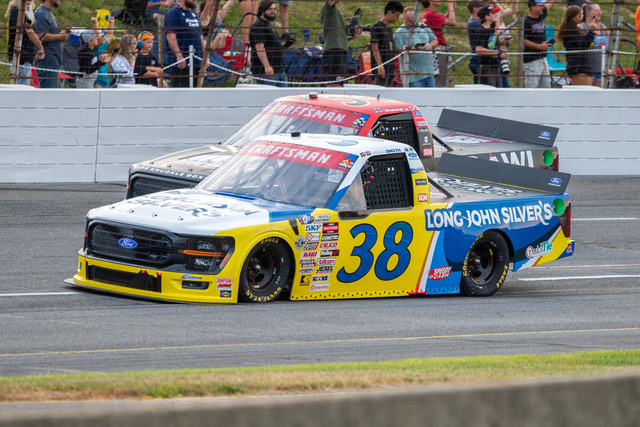
Chandler Smith did not repeat his dominant victory from last weekend at North Wilkesboro Speedway this weekend at Lucas Oil Indianapolis Raceway Park (IRP) for the TSport 200 on Friday, July 24. Nevertheless, the 24-year-old Smith from Talking Rock, Georgia, capped off an event where he ran up front the entire time to finish fourth.
Smith rolled off the starting grid on the front row alongside his Front Row Motorsports teammate, Layne Riggs, in second place. At the drop of the green flag, the former quickly lost the runner-up spot to Christian Eckes, but maintained third place through the first 21 laps. Ultimately, Smith, who lost third place to Kaden Honeycutt just past Lap 20 before he regained it just past Lap 30, settled in third place when the first stage period concluded on Lap 60.
The start of the second stage period on Lap 71 generated an opportunity for Smith, who used the inside lane to overtake Riggs and lead two laps in his No. 38 Long John Silver’s Ford F-150 entry before he was quickly overtaken by his Front Row Motorsports teammate by Lap 74. As Smith tried to keep pace with Riggs, he lost the runner-up spot to Connor Mosack and settled in third place for a second consecutive stage period as the second stage concluded on Lap 120.
For the event’s final restart with 70 laps remaining, Smith followed suit of Riggs as the former managed to retain the runner-up spot. Following a two-truck incident that drew a red flag period of more than seven minutes with 64 laps remaining, the event’s eventual final restart with 56 laps remaining generated a new challenge for Smith as he lost the runner-up spot to Mosack.
For the event’s remainder, Smith would lose third place to Ty Majeski, but he maintained fourth place when the checkered flag flew. With the result, Smith notched his eighth top-five result of the 2026 season and his career-best result at Lucas Oil IRP. His previous best result was sixth place from a year ago. Smith’s fourth-place result kept him in third place in the 2026 driver standings as he trails Layne Riggs by 152 points.
Amid the fourth-place result, Smith joins teammate Layne Riggs, Kaden Honeycutt, Christian Eckes and Giovanni Ruggiero as five competitors who have officially clinched their berths to this year’s Chase with two regular-season events remaining on the schedule. Overall, Smith, who was disappointed with the loss, was also pleased with the strong performance at Lucas Oil IRP by running upfront the entire event and capping it off with a stellar result as he looks ahead to this year’s Chase and pursuit for his first series championship.
“It was a solid night, overall, in the grand scheme of things,” Smith said. “We ran inside the top five, top three all night. Just struggled with overall capability compared to [Riggs]. Nevertheless, proud of those guys. What a great performance and great truck they had. Also, a tip of the cap to my group, the No. 38 team for what we had last year and how we struggled really bad to this year, being inside the top five all day, run inside the top three a majority part of the race. I couldn’t be more proud.”
Chandler Smith’s 2026 NASCAR Craftsman Truck Series season resumes on August 14 at Richmond Raceway in Richmond, Virginia, an event in which he won in 2022 while driving for Kyle Busch Motorsports. The event’s broadcast time is slated to commence at 7:30 p.m. ET on FS1, the NASCAR Racing Network and SiriusXM.
Layne Riggs knocked out the competition under the lights at Lucas Oil Indianapolis Raceway Park (IRP) and defended his victory in the Craftsman Truck Series’ TSport 200 on Friday, July 24.
The 24-year-old Riggs from Bahama, North Carolina, led all but two of 200-scheduled laps in an event where he started on pole position for a third consecutive event, swept both stage periods and ran away from the competition through nearly all of the event’s restarts. The only time in which he did not lead was during a Lap 71 restart when teammate Chandler Smith briefly led a pair of laps before Riggs reassumed it. Having led the final 127 laps, Riggs maintained a reasonable advantage over Connor Mosack as the laps dwindled to cruise to his fifth victory of the 2026 campaign and accumulate more momentum with the Chase looming.
With on-track qualifying that determined the starting lineup occurring on Friday, Layne Riggs notched his third consecutive Truck pole position of the 2026 season with a pole-winning lap at 108.292 mph in 22.805 seconds. Teammate Chandler Smith started on the front row with Riggs, with a lap of 108.055 mph in 22.855 seconds.
When the green flag waved and the event commenced, pole-sitter Layne Riggs, who elected to start on the outside lane, fended off teammate Chandler Smith through the first two turns to motor his No. 34 BKB Bare Knuckle Boxing Ford F-150 entry ahead with the lead. As Christian Eckes challenged Smith for the runner-up spot, Riggs led the first lap. While the field of 36 competitors fanned out and jostled early for spots over the next four laps, Riggs maintained a steady advantage of nine-tenths of a second over Eckes while Smith retained third place in front of Kaden Honeycutt and Nick Sanchez.
Through the first 10-scheduled laps, Riggs was leading by one-and-a-half seconds over Eckes while Smith, Honeycutt and Sanchez all trailed in the top-five mark by three seconds. Behind, Connor Mosack, Ty Majeski, Stewart Friesen, Grant Enfinger and Andres Perez De Lara were racing in the top 10 ahead of Brenden Queen, Parker Eatmon, Giovanni Ruggiero, Tyler Ankrum and Daniel Hemric while Michael Christopher Jr., Gavan Boschele, Tanner Gray, Jake Garcia and Landen Lewis occupied the top-20 spots ahead of Ben Rhodes, Justin Haley, Timmy Hill, Dawson Sutton and Cole Butcher, respectively. Meanwhile, Harrison Burton, Corey LaJoie, Conor Daly, Mini Tyrrell and Kris Wright were mired in the top 30 ahead of Toni Breidinger, Jackson Macenko, Spencer Boyd, Monty Tipton, Cassten Everidge and Frankie Muniz, respectively.
At the Lap 20 mark, Riggs stabilized his lead to more than a second over Eckes while Honeycutt, who overtook Smith for third place nine laps earlier, retained the spot while trailing the lead by nearly five seconds. Smith retained fourth place ahead of Sanchez, Mosack and Majeski while Friesen, Grant Enfinger and Perez De Lara were in the top-10. With Muniz, Spencer Boyd, Breidinger, Kris Wright, Mini Tyrrell and LaJoie all being lapped over the next 10 laps, Riggs stretched his lead over Eckes to more than two seconds by Lap 30.
By Lap 40, Riggs maintained his lead to more than two seconds over Eckes while both Smith and Mosack moved up to third and fourth in the running order. Behind, Honeycutt was locked in a battle with Majeski until the latter used lapped traffic and the inside lane through the turns to motor the No. 88 Menards Ford F-150 entry into the top-five mark. With Honeycutt falling back to sixth place, Sanchez had also dropped to seventh place in front of Enfinger, Friesen and Perez De Lara while Eatmon, Ruggiero, Ankrum, Christopher Jr and Queen were in the top-15 mark. As more names that included Cole Butcher, Conor Daly, Dawson Sutton, Timmy Hill, Harrison Burton and Justin Haley dropped out of the lead lap category for the following 10 laps, Riggs, who lapped them all, kept leading by more than two seconds over Eckes on Lap 50.
When the first stage period concluded on Lap 60, Riggs cruised to his eighth Truck stage victory of the 2026 season. Eckes trailed Riggs by more than four seconds in the runner-up spot while Chandler Smith, Mosack, Majeski, Enfinger, Sanchez, Honeycutt, Friesen and Parker Eatmon were scored in the top 10, respectively. By then, 18 of 36 starters were scored on the lead lap as both Brenden Queen and Daniel Hemric, both of whom rounded out the top-20 spots, were lapped by Riggs.
Under the event’s first stage break period, the lead lap field led by Riggs pitted for the first time. Following the pit stops, Riggs retained the lead by exiting pit road first, and he was followed by Eckes, Smith, Mosack, Enfinger, Majeski, Sanchez, Honeycutt, Friesen and Ruggiero, respectively. Prior to the start of the second stage period, Eckes, whose team was opting to have a battery changed, pitted due to reports of engine oil leakage from his No. 91 Coyes/Rotomaster Chevrolet Silverado RST entry. The issue was enough to plummet Eckes below the leaderboard and knock him out of contention amid a strong start.
The second stage period started on Lap 71 as teammates Riggs and Chandler Smith occupied the front row. At the start, Smith used the inside lane to overtake Riggs and lead for a full cycle. As the field fanned out, Smith led the next lap while Riggs reeled in Smith to reclaim the top spot. Amid his near-side-by-side challenge through the turns and straightaways, Riggs then used the inside lane to motor ahead through the first two turns despite nearly sliding up the track and reassumed the lead on Lap 73. As Jackson Macenko dropped off the pace before he steered his No. 2 entry behind the wall through the backstretch, the event remained under green flag conditions as Riggs continued to lead Smith just past the Lap 75 mark.
By Lap 85, Riggs stretched his lead to more than a second over Smith while Mosack trailed in third place by more than two seconds. Behind, Enfinger occupied fourth place as both he and fifth-place Majeski trailed by four seconds while sixth-place Sanchez also trailed the lead by four seconds. Meanwhile, Eckes had his No. 91 entry pushed behind the wall due to his mechanical issues. With only 14 of 36 starters scored on the lead lap, Riggs’ advantage stood at nearly three seconds over Smith when the event reached its halfway mark on Lap 100.
On Lap 110, Riggs led by nearly four seconds over Smith while Mosack, Enfinger and Majeski were racing in the top five, with the latter trailing by nearly seven seconds. Meanwhile, Sanchez, Friesen, Christopher Jr., Honeycutt and Ankrum were in the top 10 ahead of Perez De Lara, Gavan Goschele, Parker Etamon and Giovanni Ruggiero, all of whom were scored on the lead lap, as Riggs grew his lead to more than four seconds at the Lap 115 mark.
When the second stage period concluded on Lap 120, Riggs captured his second consecutive stage victory of tonight’s event and the ninth of the 2026 Truck campaign. Mosack trailed in the runner-up spot by more than five seconds ahead of Smith, Enfinger and Majeski while Sanchez, Friesen, Michael Christopher Jr., Honeycutt and Ankrum were scored in the top 10, respectively. By then, 13 of 36 starters were scored on the lead lap.
During the event’s second stage break period, the lead lap field led by Riggs returned to pit road for a second round of service. Following the pit stops, Riggs maintained the lead by beating Mosack off of pit road first while Smith, Enfinger, Sanchez, Majeski, Friesen, Perez De Lara, Christopher Jr., Ankrum, Honeycutt, Boschele and Eaton followed suit, respectively.
With 70 laps remaining, the final stage period commenced as Riggs and Mosack occupied the front row. At the start, Riggs used the outside lane to retain the lead while Smith, who started behind Riggs on the outside lane, followed suit by overtaking Mosack. Riggs led the next lap and Smith maintained the runner-up spot ahead of Mosack, Sanchez, Majeski, Friesen and Enfinger while the field behind jostled for late spots.
Then with 64 laps remaining, the caution flew when Hemric, who was racing in the top-20 mark, made contact with Cole Butcher entering Turn 3 and spun sideways. As Hemric slid up the track, he was hit by Landen Lewis, and both competitors were left with damaged race tracks, with Lewis’ No. 45 J.F. Electric/Utilitra Chevrolet Silverado RST entry engulfed in flames towards the outside wall. The incident prompted a red-flag period of seven minutes and 41 seconds.
When the red flag lifted and the event resumed with 56 laps remaining, Riggs maintained the lead from the outside lane over Smith, Mosack and the field for a full lap. Amid the late on-track action, Riggs was scored the leader by more than a second over Mosack with 50 laps remaining while Smith, Majeski, Sanchez, Friesen, Perez De Lara, Gavan Boschele and Honeycutt, the latter of whom pitted during the recent caution for fresh tires along with teammate Ruggiero.
Down to the final 40 laps of the event, Riggs continued to lead by two seconds over Mosack while Smith, Majeski, Sanchez, Friesen, Honeycutt, Perez De Lara, Boschele and Enfinger were scored in the top 10 ahead of Ankrum, Christopher Jr., Eatmon and Ruggiero, all of whom were scored on the lead lap. Meanwhile, Ben Rhodes was the first competitor a lap down in 15th place ahead of Dawson Sutton and Harrison Burton, while Justin Haley was the first competitor scored two laps down in 18th place.
With 30 laps remaining, Riggs retained the lead by more than two seconds over Mosack while Smith and Majeski battled for third place. Majeski proceeded to overtake Smith for third place as Riggs maintained the lead by more than two seconds over Mosack with 20 laps remaining. With Riggs maintaining the top spot by more than two seconds over Mosack down to the final 10 laps, third-place Majeski trailed in third place while Smith and Sanchez trailed by seven and eight seconds, respectively, in the top-five mark. While Friesen, Honeycutt, Boschele, Perez De Lara and Enfinger trailed in the top 10, respectively, Riggs continued to stabilize his lead to more than two seconds over Mosack.
When the white flag waved and the final lap started, Riggs remained in the lead by one-and-a-half seconds over Mosack. As Enfinger struggled to keep pace with smoke billowing out of his entry, Riggs maintained his advantage for a final cycle around Lucas Oil IRP before he returned to the frontstretch victorious by more than a second over Mosack.
With the victory, Layne Riggs notched his 10th career win in his 70th Craftsman Truck Series career start and his fifth of the 2026 season. The Bahama, North Carolina, native also became the fifth competitor overall to achieve multiple Truck victories at Lucas Oil IRP and joined Mike Skinner, Ron Hornaday Jr. and Ty Majeski as back-to-back winners in Brownsburg, Indiana. Overall, Riggs and teammate Chandler Smith have notched seven combined victories for both Ford and Front Row Motorsports through 16 scheduled events, with the former labeling his race victories throughout this season as “statement” ones as he continues the pursuit of his first series championship.
“I think [my victories]’re just statement wins,” Riggs said on the frontstretch on FS1. “Man, what a truck. I was on cruise control there for so much of the race. [Mosack] kept me honest at the end. Those last 15-ish laps in traffic, I was running as hard as I could, but couldn’t get away from him. I knew I had a pretty good gap. Great job to my spotter, Josh [Williams]. He did a great job today navigating me through traffic.
“These [No. 38] guys make my job easy, and I think we’re just gonna keep carrying that momentum,” Riggs added. “Statement win, I think we’re the ones to beat, for sure.”
Connor Mosack finished a career-best runner-up result in his 43rd career start while Ty Majeski, who won at Lucas Oil IRP in 2023 and 2024, finished in third place for his fifth top-five result of the 2026 season. Chandler Smith, who led two laps and officially clinched his spot to this year’s Chase, finished in fourth place, and Nick Sanchez rounded out the top five in fifth place in his one-race Truck cameo with Spire Motorsports.
Stewart Friesen, Kaden Honeycutt, Gavan Boschele, Tyler Ankrum and Michael Christopher Jr. completed the top 10 in the final running order. With his sixth-place result, Friesen, who entered Lucas Oil IRP tied with Tyler Ankrum for the 10th and final spot above the points cutline to the Chase, holds an eight-point advantage over Ankrum, who finished ninth, with two regular-season events remaining on this year’s schedule. Despite finishing 13th and 33rd, Giovanni Ruggiero and Christian Eckes also join Chandler Smith, Layne Riggs and Kaden Honeycutt as Truck Series competitors to clinch Chase berths for the 2026 season.
This event featured two lead changes for two different leaders, and three cautions for 25 laps. In addition, 13 of 36 starters finished on the lead lap.
Following the 16th event of the 2026 NASCAR Craftsman Truck Series season, Layne Riggs increased his lead in the standings by 99 points over Kaden Honeycutt, 152 over Chandler Smith, 218 over Christian Eckes and 224 over Giovanni Ruggiero.
Results:
Layne Riggs, 198 laps led, Stages 1 & 2 winner
Connor Mosack
Ty Majeski
Chandler Smith, two laps led
Nick Sanchez
Stewart Friesen
Kaden Honeycutt
Gavan Boschele
Tyler Ankrum
Michael Christopher Jr.
Andres Perez De Lara
Parker Eatmon
Giovanni Ruggiero
Grant Enfinger, one lap down
Ben Rhodes, one lap down
Harrison Burton, one lap down
Dawson Sutton, two laps down
Justin Haley, three laps down
Timmy Hill, three laps down
Brenden Queen, three laps down
Jake Garcia, three laps down
Tanner Gray, three laps down
Cole Butcher, three laps down
Corey LaJoie, three laps down
Toni Breidinger, three laps down
Conor Daly, three laps down
Mini Tyrrell, three laps down
Spencer Boyd, three laps down
Frankie Muniz, four laps down
Monty Tipton, four laps down
Kris Wright, four laps down
Cassten Everidge, seven laps down
Christian Eckes, 36 laps down
Daniel Hemric – OUT, Accident
Landen Lewis – OUT, Accident
Jackson Macenko – OUT, Rear Gear
Next on the 2026 NASCAR Craftsman Truck Series schedule is Richmond Raceway in Richmond, Virginia. The event is scheduled to occur on August 14 and air at 7:30 p.m. ET on FS1, the NASCAR Racing Network, and SiriusXM.
Kaden Honeycutt made himself two-for-two in the ARCA Menards Series this season. His latest addition of victory was on Friday, July 24, at Lucas Oil Indianapolis Raceway Park after he executed a late dominant run to win the LiUNA 150.
The 2024 CARS Pro Late Model Tour champion from Willow Park, Texas, took the green flag from seventh place and spent the entire event racing towards the front. As pole-sitter Carson Brown dominated by leading the first 77 laps from pole position, Honeycutt executed a move through the backstretch to lead for the first time on Lap 78. Honeycutt proceeded to dominate and lead for nearly the event’s remainder until Brown reeled in and tried to reassume the top spot within the final 10-lap mark. With lapped traffic mingling between the leaders’ battle, Honeycutt managed to retain the top spot and motor away when Brown briefly lost power with seven laps remaining. With Brown unable to recover, Honeycutt spent the event’s remainder cruising to the victory in Brownsburg, Indiana, for the first time ever.
With on-track qualifying that determined the starting lineup occurring on Friday, Carson Brown won the pole position with a pole-winning lap at 110.166 mph in 22.417 seconds. Thomas Annunziata qualified in second place with a lap at 109.96 mph in 22.459 seconds.
When the green flag waved and the event commenced, Carson Brown and Thomas Annunziata dueled for the lead in front of a stacked field for a full lap. When the field cycled back to the frontstretch, Brown, who opted to start on the outside lane from pole position, led the first lap by 0.013 seconds over Annunziata. Brown then managed to motor ahead of Annunziata exiting the backstretch and have both lanes to his control with a clear racetrack and with the lead by the second lap. Over the next three laps, Brown stretched his early advantage to seven-tenths of a second while Annunziata, Kaden Honeycutt, Max Reaves and Tristan McKee followed suit in the top five, respectively.
On the 10th lap, the event’s first caution flew due to Tristan McKee, the 2026 ARCA East points leader, colliding in between the lapped competitor of Ivis Earley and fourth-place Max Reaves entering the first turn. The incident occurred as McKee was reeling in Reaves for fourth place, and it knocked McGee out of contention while Reaves continued in fourth place.
As the event restarted on Lap 17, Brown motored ahead of Annunziata, Honeycutt and the field that fanned out for a full lap. Brown retained the lead by nearly half a second on Lap 20, seven-tenths of a second by Lap 25 and by eight-tenths of a second at the Lap 30 mark. Behind, Annunziata was more than two seconds ahead of Honeycutt to retain the runner-up spot while Reaves and Isabella Robusto were in the top five. Meanwhile, Gavan Boschele, Bryce Applegate, Jake Bollman, Andrew Patterson and Ashton Higgins were racing in the top-10 mark ahead of Isaac Kitzmiller, Quinn Davis, Jason Kitzmiller, Zachary Tinkle and Hunter Wright while Dystany Spurlock, Takuma Koga, Austin Vaughn, Jackson McLerran and Crain Pellegrini Jr. were scored in the top 20, respectively.
Through the Lap 45 mark, Brown continued to stretch his advantage as he led by more than two seconds over Annunziata. Behind, Honeycutt was fending off Reaves for third place while Isabella Robusto trailed the latter two by within half a second. Reaves prevailed in his long-lasting battle on Honeycutt to assume third place a lap later while Boschele, Applegate, Bollman, Patterson and Higgins were scored in the top 10, respectively. Meanwhile, Brown retained the lead by nearly two seconds both at the Laps 50 and 60 mark.
On Lap 61, the caution flew when Michael Maples got loose through the frontstretch, spun by himself and hit the inside wall on the right side. Seconds later, Ashton Higgins, who was racing in 10th place, spun through the first two turns after he made contact with ninth-place Andrew Patterson.
The next restart on Lap 68 featured Brown motoring away from Annunziata, Honeycutt, Reaves and the field through the first two turns and the backstretch. As Brown led the next lap, Honeycutt moved into second place ahead of Annunziata and Reaves while Boschele joined the battle. Amid the battles, the caution returned just past the Lap 70 mark when Dystany Spurlock spun through the first two turns.
Following Spurlock’s incident, ARCA Menards Series’ officials ruled this latest caution to serve as the midway intermission period scheduled for Lap 75, with the entire field led by Brown pitting non-competitively for service on Lap 72.
When the break concluded and the event resumed with 75 laps remaining, Brown used the outside lane to barely fend off Honeycutt through the first two turns and the backstretch. Then as Honeycutt tried to draw even with Brown, the latter barely slipped through Turns 3 and 4, but he retained the top spot over the next two laps before Honeycutt, who transitioned from the inside to outside lane, used the backstretch to assume the lead for the first time with 72 laps remaining.
Another lap later, the caution returned due to a multi-car wreck in the first two turns. The incident started when Robusto made contact beneath Reaes while battling for sixth place entering the first turn and sent both for a spin. As Reaves spun from the top to the bottom of the course without making further contact, Robusto was hit on the left side by a spinning Applegate while Jason Kitzmiller and Hunter Wright sustained minimal contact against Roberto’s wrecked entry.
During the next restart with 63 laps remaining, Honeycutt used the outside lane to fend off and motor ahead of Brown to retain the lead. As Honeycutt led the next lap, Brown retained second place ahead of Boschele and Annunziata while Jake Bollman reeled in on the latter two from fifth place for more. Behind, Ashton Higgins, who recovered from his Lap 61 spin, was reeling in on Isaac Kitzmiller for sixth place as Honeycutt led by half a second with 60 laps remaining.
Following another caution that flew with 50 laps remaining due to debris on the course, the next restart with 44 laps remaining did not last long when Tristan McKee bumped Rita Goulet for a spin through the backstretch. At the time of caution, Honeycutt fended off Brown to retain the lead. For the following restart with 38 laps remaining, Honeycutt rocketed away from Brown and the field to lead the field for a full cycle. As teammates Boschele, Bollman and Annunziata battled for third place, the former two overtook the latter as Honeycutt led by eight-tenths of a second with 35 laps remaining.
Down to the final 25 laps, Honeycutt stretched his lead to a second over Brown while Boschele occupied third place in front of teammates Annunziata and Bollman. Behind, Isaac Kitzmiller was racing in sixth place ahead of Ashton Higgins and Patterson while Reaves navigated his way up to ninth place ahead of Zachary Tinkle. As the laps dwindled, Brown started to reel in Honeycutt, with the former trailing by six-tenths of a second as Honeycutt was also approaching lapped traffic. After navigating his way through the lapped traffic, Honeycutt maintained the lead by six-tenths of a second over Brown with 15 laps remaining.
Then with 11 laps remaining, Brown and Honeycutt dueled for the lead through the frontstretch, with Brown seizing a late opportunity after reeling in Honeycutt for several laps, until the former used the inside lane through the first two turns to return atop the leaderboard. Honeycutt, however, drew back alongside Brown for the following lap as both were mired in more lapped traffic. Honeycutt, who remained on the outside lane and navigated his way through the lapped traffic amid another dive bomb move by Brown through the turns, would reassume the lead and maintain it by four-tenths of a second with nine laps remaining.
Brown then fell off the pace through the frontstretch after he lost power with seven laps remaining. This allowed Annunziata and Boschele to overtake Brown and drop the latter to fourth place, though Brown was able to re-fire and resume under race pace. While Brown tried to rally from his late deficit, Honeycutt maintained a reasonable lead of more than three seconds as the laps dwindled.
When the white flag waved and the final lap started, Honeycutt remained in the lead by more than three seconds over Annunziata and by more than five seconds over Brown. With no competition lurking nor reeling in from behind, Honeycutt cycled the No. 17 Mohawk Northeast/MMI/Cook Racing Technologies Toyota Camry around Lucas Oil IRP smoothly for a final time before he cycled back to the frontstretch and took the checkered flag.
With the victory, Honeycutt, who led 72 laps, notched his second ARCA Menards Series career win, both occurring this season, and his first since he won at Watkins Glen International in early May. After proceeding to win his first NASCAR Craftsman Truck Series career race at The Glen hours after winning the ARCA event, Honeycutt will attempt to double down for a second time at the conclusion of tonight’s Truck event at Lucas Oil IRP.
“I’ve never felt so prepared in my career, and every week I’ve been going to, I’ve been feeling so right,” Honeycutt said on the frontstretch on FS1. “This [win’s] all for [team owner] Bruce Cook. These [No. 17] guys, I don’t know if that shows them enough that they could come compete at this level and beat these guys. Me and Carson [Brown] had a hell of a race. I don’t know what happened to him. I hate that happened, but it was wild through lapped traffic. I had to body-slam one guy, very sorry for that, but I had to go. So awesome. It’s a really good experience for a couple hours.”
Thomas Annunziata, who is coming off a victory at Lime Rock Park two weeks ago, settled in second place for his seventh top-five result of the 2026 season while pole-sitter Carson Brown, who led a race-high 78 laps, ended up in third place.
Gavan Boschele and Isaac Kitzmiller finished in the top five while Andrew Patterson, Jake Bollman, Ashton Higgins, Max Reaves and Zachary Tinkle, all of whom finished on the lead lap, completed the top 10 in the final running order.
This event featured three lead changes for two leaders, and six cautions for 42 laps. In addition, only 10 of 34 starters finished on the lead lap.
Following the 13th event of the 2026 ARCA Menards Series season, Jake Bollman, who finished seventh at Lucas Oil IRP, leads the championship standings by three points over Thomas Annunziata. In addition, Max Reaves, who rallied from his pair of on-track incidents to finish ninth, assumed the lead in the ARCA Menards Series East standings by three points over Tristan McKee with two-scheduled races remaining.
Results:
Kaden Honeycutt, 72 laps led
Thomas Annunziata
Carson Brown, 78 laps led
Gavan Boschele
Isaac Kitzmiller
Andrew Patterson
Jake Bollman
Ashton Higgins
Max Reaves
Zachary Tinkle
Quinn Davis, one lap down
Hunter Wright, one lap down
Dystany Spurlock, one lap down
Austin Vaughn, two laps down
Jackson McLerran, two laps down
Jason Kitzmiller, two laps down
Craig Pellegrini Jr., two laps down
Landon Brown, three laps down
Takuma Koga, three laps down
Alex Clubb, six laps down
Jeff Maconi, seven laps down
Rita Goulet, seven laps down
Chase Buscaglia, eight laps down
Brad Smith, nine laps down
Nate Moeller, 10 laps down
Dale Shearer, 11 laps down
Brayton Laster, 16 laps down
Ivis Earley, 17 laps down
Michael Maples – OUT Mechanical
Isabella Robusto – OUT, Accident
Bryce Applegate – OUT, Accident
Tristan McKee – OUT, Mechanical
Michael Clayton – OUT, Mechanical
Kevin Campbell – OUT, Did Not Start
Next on the 2026 ARCA Menards Series schedule is Iowa Speedway in Newton, Iowa, for the Atlas 150 that will also be a combined event between the ARCA and ARCA Menards Series East divisions. The event will occur on August 7 at 7 p.m. ET on FS1.
Before this event, the ARCA Menards Series East schedule resumes next Saturday, August 1, at Flat Rock Speedway in Flat Rock, Michigan that will air at 7:30 p.m. ET on FloRacing.
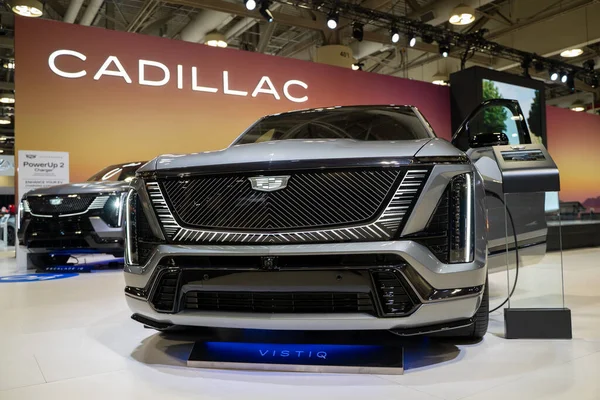
Vistiq is an all-electric three-row luxury SUV that combines premium comfort, advanced technology, powerful performance, and practical family-focused design. It sits between the Lyriq and Escalade IQ in Cadillac’s electric lineup, filling a gap that a lot of buyers have been waiting for.
Luxury EV SUVs have grown into one of the busier segments in the industry lately, andCadillac Vistiq own push toward electrification has been a big part of that shift. This model is drawing attention for a simple reason, it brings together electric performance, a genuinely luxurious interior, family-friendly space, and modern technology in one package, without asking buyers to choose between them.
Overview: What Makes It Special?
This SUV represents a new generation of Cadillac EVs, built as a three-row luxury crossover that slots neatly into the brand’s electric lineup. It’s positioned for buyers who want a genuinely premium experience, real electric driving credentials, and enough everyday practicality to justify daily use rather than sitting as a garage showpiece.
Feature
Details
Vehicle Type
Luxury Electric SUV
Seating
6 to 7 passengers
Drivetrain
All-wheel drive
Powertrain
Dual electric motors
Performance and Electric Powertrain
It delivers strong performance through a dual-motor electric powertrain that provides instant torque and smooth acceleration.
The dual motor AWD system pairs a front and rear motor for improved traction and a driving feel that stays confident regardless of road conditions.
Specification
Figure
Horsepower
615 hp
Torque
650 lb-ft
Battery
102 kWh
Drive System
AWD
On the road, that translates to quick acceleration, smooth power delivery with none of the hesitation you’d get from a traditional engine, and the kind of quiet cabin experience that’s become one of the genuine perks of driving electric.
Range and Charging
This SUV offers approximately 300 to 305 miles of driving range on a full charge, making it suitable for daily commuting and longer journeys alike.
The 102 kWh battery is the backbone of that range figure, and charging options cover both convenience and speed. DC fast charging handles longer trips when time matters, while home charging takes care of the day-to-day routine without needing to think about it much. Like most EVs at this level, actual ownership comes down to planning around charging access, though the range gives enough buffer that it shouldn’t be a constant concern.
Interior and Luxury Features
Spacious Three-Row Cabin
Seating for families is genuinely usable across all three rows, not just a token third row squeezed in for the spec sheet. Passenger comfort holds up well throughout, and the interior layout flexes depending on whether you need more seating or more cargo room.
Premium Interior Experience
Inside, there’s a large curved display that anchors the cabin, premium materials throughout, a panoramic sunroof, heated and ventilated seats, and a premium audio system that rounds out the whole experience. Interior quality matters a lot in this segment, since buyers paying luxury prices expect the cabin to actually feel like it, not just look the part in photos.
Technology and Safety Features
On the technology side, digital displays and connected features come standard, along with a Google built-in system that makes navigation and apps feel intuitive rather than bolted on.
Driver assistance is where things get particularly interesting. Super Cruise offers genuine hands-free driving on supported roads, backed by lane assistance, emergency braking, and safety monitoring systems that work quietly in the background. Autocram‘s broader coverage of Cadillac’s EV lineup has pointed out that Super Cruise remains one of the more mature hands-free systems on the market, and it shows here too. Together, this technology doesn’t just add convenience, it changes how relaxed longer drives can feel.
Exterior Design and Styling
The design carries Cadillac’s bold language forward, with signature lighting that’s become a brand hallmark and a large SUV presence that doesn’t shy away from being noticed. Aerodynamic styling keeps things efficient without sacrificing that presence, and the overall look reads as distinctly modern EV rather than a reskinned combustion model. That combination is a big part of why it stands out in a segment that’s getting more crowded by the year.
Trims and Pricing
Trim
Starting Position
Luxury
Entry-level model
Sport
Sportier styling
Premium Luxury
Additional premium features
Platinum
Highest luxury trim
Different trims cater to different buyer preferences. The base trim covers the essentials well, while moving up the ladder adds premium upgrades for buyers who want the full luxury experience without compromise.
Pros and Cons
Pros
Cons
Powerful electric performance
Premium pricing
Spacious luxury cabin
Large size
Advanced technology
Charging infrastructure matters
Quiet driving experience
Limited availability
How It Compares to Other Luxury Electric SUVs
SUV
Main Strength
Cadillac Vistiq
Luxury + three-row practicality
Tesla Model X
Technology and performance
Volvo EX90
Safety and comfort
Lucid Gravity
Range and power
Competition in the luxury EV segment has gotten fierce, with each brand carving out its own strength. Where this model stands out is the combination of genuine luxury and three-row practicality together, a pairing that’s harder to find than it should be in this class.
Is It Worth Buying?
Vistiq is worth considering for buyers who want a luxury electric SUV with strong performance, advanced features, and enough space for family use.
It suits luxury SUV buyers looking to go electric, families needing real third-row space, EV enthusiasts who want something with genuine performance credentials, and long-distance drivers who’ll benefit from the range and charging setup. Before buying, it’s worth thinking through budget, charging access in your area, and whether the vehicle’s size fits your daily parking and driving situation.
Frequently Asked Questions
What is Cadillac Vistiq?
It’s a luxury three-row electric SUV designed with premium comfort, technology, and performance features.
How much horsepower does it have?
It produces 615 horsepower with 650 lb-ft of torque.
How much range does it offer?
It provides around 300 to 305 miles of electric range depending on configuration.
Is it good for families?
Yes, its three-row seating, comfortable interior, and advanced safety features make it suitable for families.
Is it fully electric?
Yes, it’s a fully electric SUV powered by a battery and dual electric motors.
Bringing Luxury Into the EV Future
Cadillac Vistiq represents the brand’s next generation of electric SUVs, and it shows in how well the vehicle balances luxury, technology, and performance without leaning too hard on any single one. For buyers seeking a premium family EV, it’s a genuinely compelling option, and a good sign of where electric SUVs are headed as the segment keeps maturing.