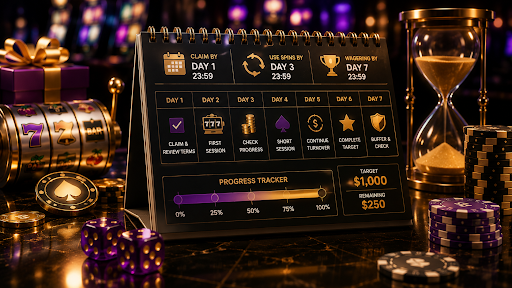
An expiry period turns a pokies promotion into a scheduling exercise. An Australian player using a free $50 pokies no deposit sign up bonus Australia offer may face separate deadlines for claiming the promotion, using allocated spins, and completing wagering on resulting credit. Recording each deadline before play begins makes the offer easier to manage and removes the need for a hurried final session. The practical aim is to match the promotion with time that already exists in the week. A bonus timer is a clock, not a motivational speaker, despite the enthusiasm of some countdown graphics.
Identify Every Deadline
Terms may contain three distinct time limits:
The period for claiming the offer;
The period for using free spins or bonus credit;
The period for completing wagering on promotional winnings.
Write all three in local Australian time and note the exact hour when one is provided. “Three days” can mean a rolling 72-hour period rather than the end of the third calendar day.
Begin With the Final Deadline
Work backwards from the wagering expiry. If the offer provides seven days, reserve the last day as a buffer rather than the main playing session. The earlier days can hold short, planned blocks.
A free $50 pokies no deposit sign-up bonus Australia promotion with a $1,000 turnover target could be divided across five sessions of $200 in eligible bets. The account counter should confirm how much progress each session records.
Build a Simple Calendar
A seven-day offer can be mapped as follows, with the final day reserved for administration rather than play.
Day
Planned action
Check afterward
Day 1
Claim, verify, and review terms
Bonus appears correctly
Day 2
First measured session
Wagering counter updates
Day 3
Second session
Expiry remains recorded
Day 4
Rest or short session
Balance and time reviewed
Day 5
Continue planned turnover
Remaining target calculated
Day 6
Complete or approach target
Cash conversion status checked
Day 7
Buffer for administration
Withdrawal details prepared
Match Stakes to Available Time
Lower stakes create more spins for the same turnover, while higher qualifying stakes move through the target more quickly. The suitable level remains within the player’s planned budget and below the promotional maximum.
Keep Eligible Games Ready
Before the first session, identify several eligible pokies with the stated contribution rate. This avoids spending time searching while the promotional clock runs. Switching among approved titles can keep the session varied without disturbing wagering progress.
A free $50 pokies no deposit sign-up bonus Australia offer may restrict spins to selected games and then allow broader choice for wagering the resulting credit. Treat those as two separate stages.
Use Reminders With Useful Labels
A reminder titled “bonus” says very little. Better labels include “use remaining spins by 8 pm” or “check wagering target before Friday session.” Specific wording gives the notification a clear action.
The most useful closed checklist is short:
Deadline recorded.
Eligible games identified.
Maximum stake noted.
Remaining wagering checked.
Final-day buffer protected.
Finish With Time for Conversion
Once wagering completes, the account may need time to convert eligible promotional funds into cash and complete verification. Finishing ahead of expiry gives room to review the balance calmly.
The free $50 pokies no deposit sign up bonus Australia promotion has served its purpose when it fits the player’s schedule, not when the schedule is rearranged around the promotion.
FAQ
When Does an Expiry Period Usually Begin?
It may begin at registration, activation, or crediting, so the exact starting event should be identified in the terms.
Should All Spins Be Used in One Session?
Several shorter sessions can work when the spin-use deadline allows them and progress remains easy to track.
Why Keep the Final Day as a Buffer?
It provides time for balance conversion, verification messages, or a final administrative check.
How Can Wagering Progress Be Estimated?
Subtract the completed qualifying turnover from the total target and divide the remainder across the planned sessions.
Does the Same Expiry Apply to Spins and Winnings?
Some offers use separate periods, making it important to record each deadline individually.
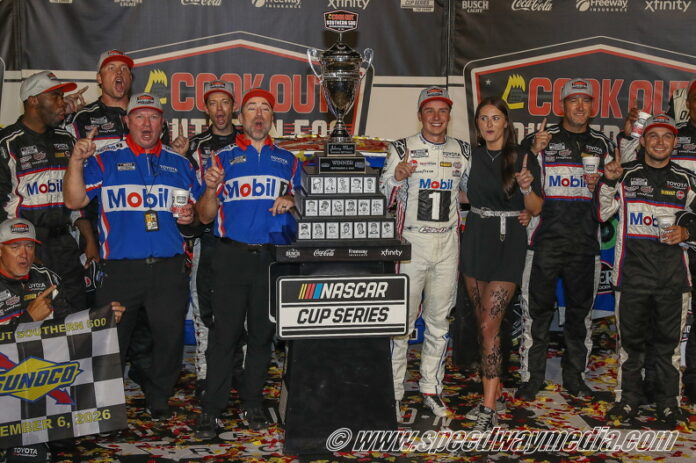
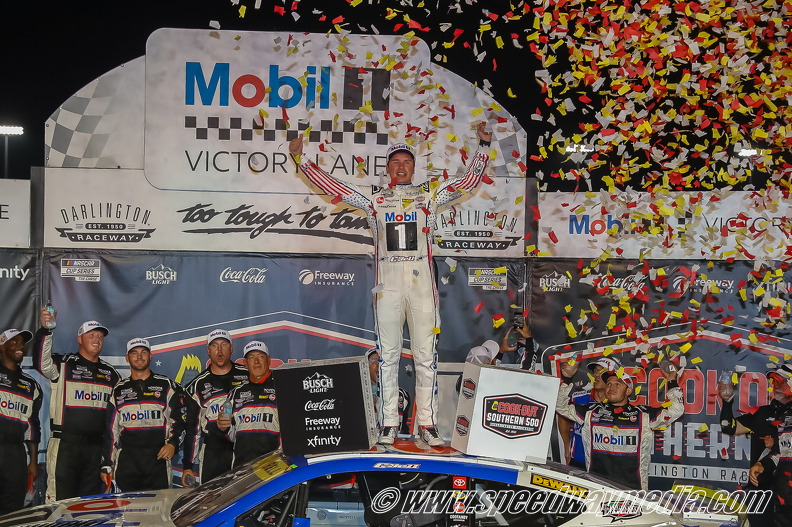
Christopher Bell erased his 33-race winless drought on a high note and struck first in the first Chase event of the 2026 Cup Series season by winning the Cook Out Southern 500 at Darlington Raceway on Sunday, September 6.
The 2024 Coca-Cola 600 champion from Norman, Oklahoma, led four times for 46 of 367-scheduled laps in an event where he started in 11th place and raced competitively towards the front by notching a fourth-place result when the first stage period concluded. Throughout the second stage period, Bell continued his methodical march forward and smoothly navigated two cycles of green-flag pit stops to win the stage.
Despite enduring a slow pit service during the second stage’s break period and restarting outside the top-10 mark prior to the final stage period, Bell navigated his way back inside and was racing in second place when a late caution with 52 laps remaining flew. Bell’s pit crew delivered during the caution’s pit services by enabling Bell to beat the field off of pit road first, though the latter was overtaken by teammate Chase Briscoe following a one-lap duel during a restart with 37 laps remaining.
Following another caution that flew with 33 laps remaining due to a light cycle of on-track sprinkles, a brief red flag delay, and the decision to pit or not to pit when the event resumed, Bell was among many who pitted while a handful of Chasers led by Kyle Larson elected to gamble by remaining on the track with worn tires. With Larson managing to maintain momentum during a 24-lap shootout, Bell used his fresh tires to motor up to the runner-up spot, reel in and overtake Larson with 12 laps remaining. From there, Bell beat teammate Ty Gibbs to achieve his first elusive Cup victory of the 2026 season and commence the pursuit of his first championship with a victory in the illustrious Southern 500 event in Darlington, South Carolina.
The event’s starting lineup was determined through a qualifying metric formula after inclement weather and a lightning hold canceled the event’s practice and qualifying sessions. As a result, Chaser Tyler Reddick was awarded the pole position, and Chaser Daniel Suarez was awarded a front-row starting spot.
When the green flag waved and the event commenced, Chasers Denny Hamlin and Daniel Suarez dueled for the lead through the first two turns until Suarez, who launched from the inside lane, gained the first advantage by muscling his No. 7 Freeway Insurance Chevrolet Camaro ZL1 entry at the front entering the backstretch. With the clean air working to his favor, Suarez cycled back to the frontstretch and led the first lap.
Suarez proceeded to lead the next two laps despite having a hard-charging Denny Hamlin reel in, even to the point where Suarez slid up to cut off Hamlin’s momentum from the outside lane entering the front stretch. By the third lap, Hamlin executed a crossover move beneath Suarez, and he motored his No. 11 Sport Clips Toyota Camry XSE entry out in front. Hamlin proceeded to extend his advantage by a second over Reddick by the fifth lap while Suarez, Ryan Preece, Austin Cindric, Michael McDowell, Chase Briscoe, Ricky Stenhouse Jr., Alex Bowman and Austin Dillon, respectively.
Through the first 10-scheduled laps, Hamlin stabilized his early advantage by more than a second over Reddick while Suarez, Preece, Cindric, McDowell, Briscoe, Bell, Stenhouse and Bowman trailed in the top 10, respectively. By then, seven of 16 Chasers were racing in the top 10 on the track (Hamlin, Reddick, Suarez, Preece, Cindric, Briscoe and Bell) while the remaining Chasers that include Joey Logano, Bubba Wallace, William Byron, Chase Elliott, Ty Gibbs, Ryan Blaney, Carson Hocevar, Kyle Larson and Chris Buescher were mired in 11th, 13th, 17th, 18th, 20th, 21st, 23rd, 25th and 30th, respectively.
Ten laps later, Hamlin continued to lead by eight-tenths of a second over Reddick while Preece, Cindric and Bell trailed in the top five, respectively. Behind, McDowell was the highest-running Chaser in sixth place ahead of teammate Suarez, Briscoe, Bowman and Logano while Wallace, Byron and Elliott trailed in 12th, 13th and 15th, respectively. Meanwhile, Blaney was mired in 18th place, and Hocevar navigated his way into 22nd place behind Gibbs while Larson and Buescher were the two-lowest-running Chasers in 24th and 26th, respectively. Amid the battles around Darlington between Chasers and non-Chasers, Hamlin led the next eight laps until Reddick, who reeled in Hamlin, motored his No. 45 Chumba Casino Toyota Camry XSE entry out in front with a pass through Turns 3 and 4.
When a scheduled competition caution flew on Lap 35, Reddick retained the lead over Hamlin while Preece, Cindric, Bell, McDowell, Briscoe, Logano, Keselowski and Bowman were scored in the top 10, respectively. By then, Chasers Wallace, Byron, Blaney, Elliott, Gibbs, Suarez, Hocevar, Buescher and Larson trailed in 11th, 12th, 14th, 15th, 16th, 17th, 20th, 23rd and 24th, respectively. During the competition caution, the entire field, led by Reddick, pitted for a first round of pit service. Following the pit stops, Reddick retained the lead after he edged Hamlin off of pit road by a nose while Preece, Briscoe, Cindric, Bell, Wallace, Brad Keselowski, McDowell and Bowman followed suit, respectively.
As the event restarted on Lap 40, Reddick used the outside lane to fend off Hamlin through the first two turns. As the field jostled for spots through the backstretch, Reddick cycled back to the frontstretch and led the following lap while Hamlin retained the runner-up spot in front of Preece, Briscoe, Bell and Cindric, respectively, while Wallace, Keselowski, McDowell, Byron and Blaney pursued, respectively.
On Lap 44, Hamlin reassumed the lead following an overtake on Reddick through the frontstretch. By the following lap, the top-seven spots were occupied by Chase contenders while Larson was the lowest-running Chaser in 24th place. A few laps later, the top-eight spots were occupied by Chasers as Blaney moved into eighth place while Gibbs, Byron, and Elliott were mired in the top-15 mark. Behind, Hocevar, Logano, Buescher and Suarez trailed in the top-20 mark as Reddick was being challenged by Briscoe for the runner-up spot. Meanwhile, Hamlin led by eight-tenths of a second at the Lap 50 mark.
Through the Lap 60 mark, Hamlin was leading Chasers Reddick, Briscoe, Bell, Preece, Wallace, Cindric and Blaney, respectively, while Keselowski and McDowell were the two-highest non-Chasers who rounded out the top-10 mark on the track. Behind, Chasers Byron, Gibbs, Elliott, Hocevar, Logano, Buescher, Suarez and Larson trailed in 11th, 12th, 15th, 17th, 18th, 19th, 20th and 22nd, respectively, as Hamlin’s lead grew up to a second by Lap 65.
On Lap 70, the event’s first cycle of green-flag pit stops commenced as Chasers Bell, Blaney, Cindric, and Logano, along with non-Chaser Riley Herbst, pitted their respective entries. The leader, Hamlin, along with Reddick, Briscoe, Preece, Byron, Bowman, Buescher, Zane Smith, Austin Dillon, Ty Dillon, Connor Zilisch, Ty Gibbs, Erik Jones, AJ Allmendinger pitted during the next two laps, with Hamlin managing to beat and motor away from Reddick off of pit road following their pit stops. As more names pitted, Chasers Wallace, Elliott, Hocevar, Larson, and Suarez were among a handful who had yet to pit, with Wallace leading at the Lap 75 mark. Wallace then pitted during the next lap, though he nearly missed the commitment line area to enter pit road, before Elliott, who cycled to a brief lead, pitted a lap later along with teammate Larson. By the time Chasers and teammates Hocevar and Suarez pitted on Lap 78, Hamlin cycled back to the lead over Chasers Reddick, Bell, Briscoe, Blaney, Preece, Cindric, Byron, Wallace, Gibbs and Logano, respectively.
At the Lap 90 mark, Hamlin maintained his lead by half a second over Reddick while Bell, Briscoe, Blaney, Wallace, Preece, Cindric, Byron and Gibbs, all of whom were in the Chase, occupied the top-10 spots on the track. Meanwhile, Josh Berry was the highest-running non-Chaser in 11th place ahead of Logano, Bowman, McDowell and Elliott, while Buescher, Larson and Hocevar were mired from 17th to 19th, respectively. Meanwhile, Suarez was the lowest-running Chaser in 27th place behind Austin Hill.
Three laps later, Reddick overtook Hamlin to reclaim the lead. As Reddick reeled in on both Austin Dillon and Cole Custer to lap the latter two, Bell and Briscoe started to reel in on Hamlin for the runner-up spot while Wallace, who had fresher tires than the top-four competitors, muscled his No. 23 Xfinity Toyota Camry XSE entry up to fifth place. During the Lap 97 mark, Wallace overtook Briscoe for fourth place before he reeled in and overtook Bell for third place on Lap 99. With Wallace setting his sights on his co-owner Hamlin for the runner-up spot, which he claimed on Lap 104, teammate Reddick motored away with the lead by more than a second.
Then just past the Lap 105 mark, the caution flew when Hocevar tapped Keselowski into the outside wall through Turns 3 and 4 before the latter spun just entering the frontstretch. Keselowski’s incident concluded the first stage period as Reddick was awarded his second Cup stage victory of the 2026 season while Chasers Wallace, Hamlin, Bell, Blaney, Briscoe, Preece, Cindric, Byron and Gibbs were scored in the top 10, respectively, with all also notching the event’s first round of stage points. Meanwhile, Elliott, Larson, Logano, Buescher, Hocevar and Suarez, all of whom were unable to record a first round of stage points as Chasers, were mired in 12th, 13th, 14th, 17th, 18th and 25th, respectively.
Under the event’s first stage break period, the field led by Reddick returned to pit road for service. Following the pit stops, Reddick utilized his first pit stall by beating teammate Wallace off of pit road first, while Hamlin, Bell, Blaney, Briscoe, Preece, Cindric, Byron and Elliott followed suit, respectively. Following the pit stops, Preece returned to pit road to have his wheels inspected and tightened.
The second stage period started on Lap 113 as Reddick and Hamlin occupied the front row. At the start, Reddick launched ahead of the field from the outside lane to retain the lead, and teammate Wallace outdueled Hamlin for the runner-up spot through the first two turns. As the field jostled for spots through the backstretch, Blaney battled and overtook Hamlin for third place as Reddick led the next lap. While Byron, Bell, Elliott, Briscoe, Logano, Cindric, Larson and Gibbs trailed from fifth to 12th on the track, respectively, Blaney and Hamlin battled for third place, with the latter reclaiming the spot on Lap 116. Behind, Briscoe overtook Elliott for seventh place while Larson, Logano, Cindric and Gibbs battled for ninth place. At the front, Reddick maintained his lead by as high as three-tenths of a second over Wallace, and the former slightly grew the advantage up to half a second just past the Lap 120 mark.
By Lap 135, Reddick grew his lead up to one-and-a-half seconds over Wallace and by nearly four seconds over Hamlin while Blaney, Bell, Briscoe, Byron, Larson, Berry, Elliott, Logano, Cindric and Gibbs were racing in the top-13 mark, respectively. Behind Buescher and Hocevar were mired in 15th and 19th, respectively, while Preece and Suarez were the two lowest-running Chasers in 25th and 27th, respectively. Reddick proceeded to lead by more than one-and-a-half seconds over Wallace on Lap 140.
On Lap 143, Logano pitted under green as teammate Blaney outdueled Hamlin for third place. With Reddick leading by more than a second and a half over teammate Wallace by Lap 145, Keselowski spun by himself just shy of the commitment cone entrance while he was trying to enter pit road, but he managed to steer his entry on pit road without drawing a caution. By Lap 147, Chasers Briscoe and Buescher also pitted before Byron, Cindric, Gibbs and Elliott followed suit during the next two laps.
Runner-up Wallace then pitted on Lap 150 along with Preece before the leader Reddick, Bell and Hocevar pitted during the next lap. The leaders Blaney and Hamlin pitted on Lap 152 as the latter managed to beat the former off of pit road first. Back on the track and with pit stops still ensuing, Wallace, who pitted a lap later than Reddick, overtook Reddick on the track as Briscoe reeled in from behind. Once Larson pitted from the lead on Lap 154, Wallace cycled as the overall race leader as he had 10 Chasers racing behind him in the leaderboard.
On Lap 160, Wallace maintained the lead by four-tenths of a second over Reddick while Briscoe, Bell, Blaney, Byron, Cindric, Hamlin and Logano pursued in the top-nine spots, respectively. With Berry being the highest non-Chaser in 10th place, Elliott, Gibbs and Larson trailed from 11th to 13th, respectively, while Hocevar, Preece and Buescher were scored in 17th, 21st and 23rd, respectively. Meanwhile, Suarez was mired the second competitor scored a lap down in 26th place behind Austin Dillon. With Buescher also getting lapped and Suarez navigating his way to be the first competitor scored a lap down in 24th place, Wallace continued to lead by two-tenths of a second over Reddick on Lap 170, up to four-tenths of a second on Lap 175 and up to eight-tenths of a second on Lap 180.
At the halfway marks between Lap 183 and 184, 23 of 38 starters were scored on the lead lap, minus Chasers Suarez and Buescher, as Wallace maintained the lead by half a second over Reddick while Briscoe, Bell, Blaney, Hamlin and Larson trailed in the top-seven mark, respectively. Including Byron and Cindric in ninth and 10th, respectively, all but one spot in the top-10 mark on the track were occupied by Chasers, as Berry was the highest-running non-Chaser in eighth place, while Elliott, Logano, Gibbs, Hocevar and Preece were mired in 11th, 12th, 14th, 15th and 21st, respectively.
On Lap 186, another cycle of green flag pit stops commenced as the leader Wallace, along with Briscoe, Buescher, Austin Dillon, Alex Bowman and Keselowski, pitted their respective entries. Reddick, who assumed the lead during the previous lap, pitted a lap later along with Blaney, Logano, Gibbs, Erik Jones, Zane Smith, Corey Heim, Riley Herbst and Noah Gragson. During the pit stops, Reddick endured a slow pit service to have his left-front wheel secured as more names that included Preece, Berry, Byron, Cindric, Allmendinger, Austin Hill and Elliott pitted by Lap 190. Bell, who cycled to a brief lead, pitted by Lap 191 along with Hamlin, Hocevar, John Hunter Nemechek and Stenhouse before Larson pitted from the lead on Lap 193. Once McDowell also pitted, Briscoe cycled his No. 19 Bass Pro Shops Toyota Camry XSE entry to the lead on Lap 194 over Wallace. Meanwhile, Reddick had fallen to eighth place as Blaney, Bell, Berry, Hamlin and Byron all cycled from third to seventh, respectively.
Through the Lap 200 mark, Briscoe was leading by nearly two seconds over Wallace while Bell, Blaney and Hamlin all trailed in the top-five mark, respectively, with Hamlin trailing by 11 seconds. Meanwhile, Berry was up into sixth place ahead of Chasers Byron, Larson, Reddick, Cindric, Elliott, Gibbs and Logano while Hocevar, Preece, Suarez and Buescher were mired in 15th, 21st, 24th and 27th, respectively.
On Lap 208, Bell overtook Wallace for the runner-up spot while the leader, Briscoe, radioed about entering a fuel conservation mode due to possibly not having enough fuel to complete the second stage period. Over the next two laps, Bell trailed teammate Briscoe by more than a second before the former reduced the deficit down to half a second during the following five laps. Bell then used a slide job move to overtake Briscoe to assume the lead during the following lap, Lap 216, while Wallace trailed in third place by nearly two seconds. Behind, Larson was in fourth place ahead of Hamlin and Blaney while Reddick was mired in ninth place. With the lead to his advantage, Bell grew his lead up to two seconds on Lap 220.
When the second stage period concluded on Lap 230, Bell cruised to his fifth Cup stage victory of the 2026 season as he led by more than a second. Larson motored his way up to second place ahead of Hamlin, Briscoe and Wallace while Blaney, Berry, Byron, Reddick and Cindric were scored in the top 10, respectively. By then, nine of 16 Chasers notched a second round of stage points (Bell, Larson, Hamlin, Briscoe, Wallace, Blaney, Byron, Reddick and Cindric) while the remaining Chasers that included Gibbs, Elliott, Logano, Hocevar, Preece, Suarez and Buescher were mired in 11th, 12th, 13th, 15th, 20th, 21st and 30th, with Preece managing to achieve the free pass by being the first competitor a lap down. In addition, 19 of 38 starters were scored on the lead lap.
During the event’s second stage break period, Briscoe made an early pit stop after he ran out of fuel. Once pit road became accessible for the field, the field, led by Bell, pitted, and Larson emerged off pit road first ahead of Wallace, Blaney, Byron, Reddick, Cindric, Gibbs, Berry, Elliott, and Logano, respectively.
With 130 laps remaining, the third and final stage period commenced as Larson and Blaney occupied the front row in front of Wallace, Byron, Gibbs, Blaney and the field. At the start, Larson motored his No. 5 HendrickCars.com Chevrolet Camaro ZL1 entry away from the field that fanned out from the backstretch and the frontstretch. As Larson led the next lap, Wallace maintained the runner-up spot in front of Reddick and Gibbs while Blaney dropped to fifth place in front of Byron, Berry, Cindric, Logano, Bell, Elliott and Hocevar, respectively. While Briscoe was mired in 19th place, Hamlin dropped off the pace after he got bumped by McDowell, which caused Hamlin to hit the outside wall entering the frontstretch with 127 laps remaining. Amid the incident, Hamlin, who remained on the track and reported a toe link damage to his entry, continued to plummet as he was down in 20th place with 125 laps remaining.
With 120 laps remaining, Larson was leading by one-and-a-half seconds over Wallace while Reddick, Gibbs, Berry, Blaney, Byron, Cindric, Bell and Logano were in the top 10, respectively. Behind, Hocevar was racing in 11th place, and Elliott was in 14th place while Briscoe was mired in 17th place. Meanwhile, Hamlin was scored the final competitor on the lead lap in 20th place while trailing the lead by 20 seconds and Preece was the next-to-last competitor in 19th place while Suarez was the first competitor a lap down in 21st place. As Buescher was the 10th competitor a lap down in 30th place, Larson extended his advantage up to two seconds with 115 laps remaining while Reddick reeled in teammate Wallace for the runner-up spot.
Down to the final 100 laps, Larson extended his lead to more than three seconds over Wallace as the latter battled to fend off Reddick while Gibbs, Berry, Bell, Byron, Blaney, Cindric, Logano, Hocevar, Bowman, Briscoe, Erik Jones and Elliott trailed in the top 15, respectively. As Reddick, Gibbs and Berry all overtook Wallace during the next lap for second through fourth, Hamlin, who was lapped by Larson two laps earlier, was mired in 20th place ahead of Suarez, and Preece was the next-to-last competitor scored on the lead lap in 18th place while Buescher was the 11th competitor scored a lap down in 30th place.
With 92 laps remaining, Buescher pitted before Suarez pitted a lap later, during which Larson was leading by more than three seconds over Reddick, Gibbs, Berry and Bell while Wallace dropped to sixth place. Hamlin then pitted a lap later before Briscoe pitted from the top-10 mark with 90 laps remaining. More names that included Byron, Preece, Reddick, Gibbs, Wallace and Logano pitted over the next two laps before Larson pitted from the lead with 88 laps remaining. Bell, Blaney and Cindric also pitted with Larson. Amid the pit stops, Larson managed to blend back on the track ahead of Reddick.
Then, with 85 laps remaining, the caution flew as Zane Smith spun through the frontstretch, which was due to McDowell making contact with Smith as Smith was nearly pinned in between both McDowell and Ross Chastain. The caution occurred as Chasers Hocevar and Elliott pitted while Todd Gilliland, who has yet to pit, was leading. During the caution period, Gilliland pitted while Larson cycled back as the leader.
The next restart with 78 laps remaining featured Larson motoring away from Berry and the field through the first two turns as Reddick followed suit in second place. As the field jostled for late spots, Larson led the next lap, and he proceeded to lead with 70 laps remaining over Reddick while Bell, Berry, Briscoe, Gibbs, Blaney, Cindric, Hocevar and Byron followed suit in the top 10 ahead of Logano, Elliott, Wallace, Preece and Gilliland, respectively.
As the event reached its final 60-lap mark, Larson was leading by more than a second over Bell while Reddick was fending off Briscoe for third place. Behind, Berry, the highest-running non-Chaser in fifth place, had nine Chasers (Gibbs, Blaney, Cindric, Byron, Logano, Hocevar, Elliott, Wallace and Preece) following suit as Suarez was scored the first competitor a lap down in 19th place. Meanwhile, Hamlin was mired the fifth competitor a lap down in 23rd place, while Buescher was the 10th competitor a lap down in 28th place.
Eight laps later, the caution flew when Byron, who was racing in ninth place, got loose exiting the backstretch and spun entering Turns 3 and 4 from below the track and in a cloud of smoke. Byron’s incident occurred in front of Logano and Elliott as Byron, who lost a lap in the process, pitted his No. 24 Valvoline Chevrolet Camaro ZL1 entry. Mired within Byron’s misfortune allowed Suarez to receive the free pass and cycle back on the lead lap.
During the latest caution period, the lead lap field 17 led by Larson pitted, and Bell emerged off of pit road first in front of Briscoe, Larson, Reddick, Gibbs, Berry, Cindric, Wallace, Elliott and Hocevar, respectively. As the field was set to restart with 48 laps remaining, Byron limped his entry back to pit road after smoke billowed out of his entry, which terminated his event and waved off the restart for the next handful of laps.
Following an extensive caution due to reports of light sprinkles falling on the track, the event restarted with 37 laps remaining. At the start, teammates Bell and Briscoe fiercely dueled for the lead through the first two turns in front of teammate Gibbs, Larson, Reddick and the field. Both Bell and Briscoe remained dead even during the next lap as Gibbs reeled in on the latter two. Briscoe, however, wasted no time motoring ahead of Bell and maintaining the lead just before the caution returned with 33 laps remaining due to light sprinkles falling around Darlington for a second time.
During the latest caution for the light on-track precipitation, the field led by Briscoe was directed to pit road, and the event was placed in a red flag period for seven minutes and 39 seconds. Once the red flag was lifted and the field returned to the track under a cautious pace, mixed pit strategies ensued as Chasers Larson, along with Cindric, Logano and Preece, stayed out while the rest, led by Briscoe, pitted for fresh tires and fuel. During the pit stops, Briscoe beat Bell off of pit road first.
For the next restart with 24 laps remaining, Larson motored ahead while the field behind fanned out through the first two turns. One of those competitors who fanned out was Briscoe as he tried to launch a bold challenge to the front on his four fresh tires, but he was up to only seventh through the backstretch as Logano maintained the runner-up spot in front of Bell, Cindric, Gibbs and Reddick. By the next lap, Larson was leading by two-tenths of a second over Logano while Bell reeled in Logano for the runner-up spot on his four fresh tires. Bell, Gibbs, and Briscoe all overtook Logano for second through fourth on the track during the next two laps, and Gibbs started to challenge Bell for the runner-up spot while Larson maintained the lead by two-tenths of a second with 20 laps remaining.
As the laps dwindled, Bell started to reel in on Larson. After remaining within two-tenths of a second behind Larson while trying to find an opportunity to reel in and pounce on Larson with fresher tires, Bell seized an opportunity to get to Larson’s left rear through the first two turns and motor his No. 20 Mobil 1 Toyota Camry XSE entry past Larson to lead with 12 laps remaining. Bell proceeded to lead by two-tenths of a second on Larson with 10 laps remaining before Gibbs overtook Larson for the runner-up spot three laps later. With the laps dwindling, Larson was overtaken by Reddick and Blaney on the track. In addition, Briscoe was mired in sixth place in front of Berry while Bell maintained a steady advantage over Gibbs.
When the white flag waved and the final lap started, Bell remained in the lead by nine-tenths of a second over Gibbs. With Bell not missing his mark and Gibbs unable to reel in, the former cycled back to the frontstretch victorious and for his first elusive checkered flag of the 2026 Cup Series season by a second over Gibbs.
With the victory, Bell, who finished in the runner-up spot seven times prior to his first Darlington victory in a Cup car, achieved his 14th career win in the NASCAR Cup Series division, his second crown-jewel victory (he won the Coca-Cola 600 in 2024) and his first since he won the Bristol Night Race in September 2025. He also recorded the 10th overall Southern 500 victory for Joe Gibbs Racing, the organization’s second in a row in recent years and the 10th for Toyota.
Bell, who entered this year’s Chase in the sixth seed with 2,050 points, gained four spots in the standings with his Southern 500 victory and he is ranked in second place in the Chase standings. With only a 12-point advantage behind teammate Denny Hamlin, Bell has nine Chase events remaining to extend his momentum and be in contention for his first Cup Series championship prior to this year’s finale at Homestead-Miami Speedway in November.
Photo by John Knittel for SpeedwayMedia.com.
“It’s been too damn long!” Bell exclaimed on the frontstretch on USA Network. “Oh my gosh, man. I’m just so, so proud of all of these guys on this No. 20 car. All the mechanics, all the pit crew members. They deserve it more than anyone. It’s been a long time coming. Darlington has been one that I’ve always wanted to win since I got into this sport. This is the ultimate driver’s track.”
“I knew that we’d be able to win [here at Darlington], no matter what,” Bell added. “I knew that we’d be able to win it. We can win any week. It just hasn’t happened yet. Whenever I was sitting in the infield care center at Michigan [in June], I thought my season was over. I thought I was gonna be out a couple of weeks. I wasn’t gonna be able to make the Chase. We’re still in it, baby!”
Ty Gibbs, who rallied from starting in 28th place, settled in second place for his 11th top-five result of the 2026 season while Tyler Reddick, who led 74 laps, finished in third place for a second consecutive event. Ryan Blaney finished in fourth place while Kyle Larson, who led a race-high 99 laps, settled in fifth place following his late gamble.
“I think it’s just goes back to where we started,” Gibbs, who is ranked in fourth place in the Chase standings, said. “[NASCAR] had a pretty squirrelly metric they went off of, and we started 28th, unfortunately. It ranked in the fourth seed. Hopefully, we can fix that for next time. I felt like the Monster Energy Toyota Camry was great. Yeah, I don’t know. I’m glad Christopher won. I’m happy for him and the No. 20 team. We just missed it a little bit and had some issues happen the whole day, but appreciate all the effort from everybody on my team that helped us have a great deal.”
“I was actually surprised that [Bell, Briscoe and Gibbs] pitted in front of me and then, I was surprised that not more stayed out with me,” Larson, who stood by his stance of not pitting and is ranked in seventh place, said. “I thought there might be two or four more that might stay out, and I really thought that could help me at least get some laps where I can manage my tires, but Bell got to second so fast. I was just straight into defense and not able to run the lines that I ultimately wanted to to take care of my tires. Either way, it would have been hard to hold them off, but I ended up holding them off longer than I thought I could. Really happy, though, with the day. Much better than we’ve been at Darlington the last couple of times. My car was not good the first run, but we got it better, and it really allowed me to run the lanes that I like to run here to manage my tires. Great start to the Chase. We only gained six points to the lead, but it’s better than losing six.”
Chase Briscoe, who led 30 laps and was attempting to become the second competitor to win three consecutive Southern 500 events, settled in sixth place while Josh Berry capped off a strong run as the highest-finishing non-Chasers in seventh place. Chasers Bubba Wallace, Joey Logano and Ryan Preece filled out the remaining top-10 spots on the track.
Notably, the remaining Chasers, including Carson Hocevar, Austin Cindric, Chase Elliott, Denny Hamlin, Chris Buescher, Daniel Suarez and William Byron, finished 11th, 13th, 14th, 18th, 20th, 21st and 37th, respectively. Despite settling in 18th place following his late-race incident with McDowell that damaged his entry and toe link, Hamlin remains atop the Chase standings and looks ahead to the remainder of the Chase and the pursuit of his first championship.
“Sometimes, you don’t get cut a break, and that’s the way it goes,” Hamlin said. “We’re still leading. We’ve got to just go to the next racetrack and execute at a high level. It starts in practice. We’ll do our best to execute a much better day next week.”
The 2026 Cup Series’ Chase opener generated 29 lead changes for 12 different leaders, and six cautions for 44 laps. In addition, starters finished on the lead lap.
Race Results:
Christopher Bell, 46 laps led, Stage 2 winner
Ty Gibbs
Tyler Reddick, 74 laps led, Stage 1 winner
Ryan Blaney, one lap led
Kyle Larson, 99 laps led
Chase Briscoe, 30 laps led
Josh Berry
Bubba Wallace, 38 laps led
Joey Logano
Ryan Preece
Carson Hocevar, two laps led
Alex Bowman
Austin Cindric
Chase Elliott, one lap led
Erik Jones
Todd Gilliland, five laps led
Michael McDowell
Denny Hamlin, 68 laps led
Corey Heim
Chris Buescher
Daniel Suarez, two laps led
AJ Allmendinger
Brad Keselowski
John Hunter Nemechek
Zane Smith
Shane van Gisbergen, one lap down, one lap led
Ross Chastain, one lap down
Austin Hill, one lap down
Austin Dillon, one lap down
Riley Herbst, one lap down
Ty Dillon, one lap down
Noah Gragson, one lap down
Cole Custer, one lap down
Connor Zilisch, two laps down
Ricky Stenhouse Jr., four laps down
Cody Ware, four laps down
William Byron – OUT, Engine
Chad Finchum – OUT, Suspension
*Bold indicates Chase Drivers
Following the first Chase event of the 2026 NASCAR Cup Series season, Denny Hamlin maintains the lead in the standings by 12 points over teammate Christopher Bell. The rest of the 16-car Chase field is displayed below, with the points advantage indicating their deficit to points leader Hamlin.
Chase Standings:
Denny Hamlin
Christopher Bell -12
Ryan Blaney -16
Tyler Reddick -24
Chase Briscoe -37
Ty Gibbs -39
Kyle Larson -49
Chase Elliott -72
Joey Logano -72
Bubba Wallace -81
Chris Buescher -88
Carson Hocevar -89
Daniel Suarez -94
Austin Cindric -102
Ryan Preece -104
William Byron -114
With the 2026 NASCAR Cup Series Chase officially underway, the next event on the schedule is World Wide Technology Raceway in Madison, Illinois, for the Enjoy Illinois 300. The event is scheduled for next Sunday, September 13, at 3 p.m. ET on USA Network, MRN Radio, SiriusXM, and HBO Max.
RICK WARE RACING Cook Out Southern 500 Date: Sept. 6, 2026 Event: Cook Out Southern 500 (Round 27 of 36) Series: NASCAR Cup Series Location: Darlington (S.C.) Raceway (1.366-mile oval) Format: 367 laps, broken into three stages (115 laps/115 laps/137 laps) Race Winner: Christopher Bell of Joe Gibbs Racing (Toyota) Stage 1 Winner: Tyler Reddick of 23XI Racing (Toyota) Stage 2 Winner: Christopher Bell of Joe Gibbs Racing (Toyota)
RWR Finish:
● Cody Ware (Started 37th, Finished 36th / Running, completed 363 of 367 laps)
RWR Points:
● Cody Ware (35th with 202 points)
RWR Notes:
● Ware’s coolsuit stopped working roughly 30 laps into the Cook Out Southern 500, making an already hot outing in one of NASCAR’s longest races even hotter. He soldiered through the entirety of the 4-hour and 3-minute affair, delivering a gritty performance at the track aptly described as “Too Tough To Tame.”
Race Notes:
● Christopher Bell won the Cook Out Southern 500 to score his 14th career NASCAR Cup Series victory, his first of the season and his first at Darlington. His margin over second-place Ty Gibbs was 1.038 seconds.
● There were six caution periods for a total of 44 laps.
● Twenty-five of the 38 drivers in the race finished on the lead lap.
● Denny Hamlin leaves Darlington as the championship leader with a 12-point advantage over second-place Bell.
Sound Bites:
“It was definitely the hardest day in a racecar I’ve ever had. My team fights really hard, and as much as there were times when I wanted to call it quits today, I hung in there for my team. We were just trying to play a game of survival. It got to a point where I could barely talk, let alone try to give good feedback to my crew chief, but I thought we managed what we had. Thankfully, we were at least able to finish the Southern 500. Not the night we wanted, but those guys don’t ever give up on me, and I’m not gonna give up on them.” – Cody Ware, driver of the No. 51 ApexFX Chevrolet
Next Up:
The next event on the NASCAR Cup Series schedule is the Enjoy Illinois 300 on Sunday, Sept. 13, at World Wide Technology Raceway in Madison, Illinois. The second race in the 10-race Chase starts at 3 p.m. EDT with live coverage provided by USA Network and SiriusXM NASCAR Radio.
NASCAR Cup Series Darlington Raceway Cook Out Southern 500 Team Chevy Post-Race Report September 6, 2026
Larson Starts Title-Defending Campaign with a Top-Five Finish at Darlington Raceway
Kyle Larson and the No. 5 Hendrick Motorsports Chevrolet team started their championship title-defending campaign with a strong top-five finish in the Cook Out Southern 500 at Darlington Raceway. Despite a deep starting position due to the metric, the California native raced his way into the top-10 during Stage Two and became a familiar face at the front of the pack for much of the remainder of the race – going on to lead a race-high 99 laps en route to his 10th top-five finish of the season. Larson will head to the second stop of the Chase at World Wide Technology Raceway ranked seventh in the standings and 49-points behind the lead.
RACE RECAP:
Stage One:
With the starting lineup set by the metric, Daniel Suarez and the No. 7 Spire Motorsports team inherited a spot on the front row to lead the NASCAR Cup Series to the green flag and the start of the Chase at Darlington Raceway. A strong start saw the Spire Motorsports driver edge his Chevrolet to the top of the leaderboard to pace the opening lap of his title-contention run. But it was early in the run when Suarez reported that he was struggling with the balance of his Chevrolet, ultimately holding on to a top-15 running position en route to the competition caution on Lap 35. A two-stop stage saw the green flag pit cycle begin near the halfway mark of the run. At that point, it was fellow Chase contender, William Byron, that made the steady climb up through the field to make his first appearance in the top-10 of the evening. Once the cycle was deemed complete, the North Carolina native found himself up in the eighth position for the final 35-lap run of Stage One. Hovering around the position for much of the run, Byron was settled in ninth when a caution flew with six laps to go – ultimately bringing the opening stage to a close.
Stage Two:
Byron and Elliott were among the teams that gained track position in the race off pit road, lining up in the eighth and ninth positions, respectively, to start Stage Two. The stage started with yet another green flag run, and while maintaining their running positions, their Hendrick Motorsports teammate, Larson, joined the duo in the top-10 for the first time of the evening. Continuing to pace the Bowtie brigade, Byron reported that he was still looking for better drive in his Chevrolet-powered machine before his next trip to pit road. With another green flag pit cycle underway, crew chief Cliff Daniels opted for a longer run on this set of tires – ultimately giving Larson a brief tenure in the lead before calling his driver to pit road for four tires and fuel. The stage length required a second green flag pit cycle, and while employing a similar strategy, Larson was among the tail-end of the leaders to make his stop – finding his way back to the lead once again before making the dive to pit road. Cycling back up into the seventh position, the reigning champion found his footing late in the run – entering the top-five and quickly making a pass on the No. 1 seed, Denny Hamlin, with 16 laps to go in the stage. It was an impressive run by Larson with the California native driving up into the second position and a margin of just 1.5-seconds behind then race leader, Christopher Bell, at the drop of the second green-white checkered flag.
Final Stage:
The No. 5 pit crew delivered a stellar performance during the stage break to give Larson the win in the race off pit road and a front row starting position to take the green flag for the final stage. Wasting no time, Larson powered his Chevrolet to the lead on the opening lap, going on to pull away to a nearly three-second lead over second with 110 laps to go in the race. Continuing to set a strong pace, Larson maintained the margin throughout the run before being called to pit road for a scheduled stop with 88 laps to go. Cycling back up into the second position, a caution flew just before the end of the green flag pit cycle, and with the direction to stay out, Larson found a familiar spot back on the front row for the restart. Finding his rhythm around the wall of “The Lady in Black”, Larson continued to click off laps in the closing portion of the race as a caution flew on Lap 316 for his teammate, Byron, who’s spin spiraled into what ended up being a race-ending mechanical issue. With the field heading to pit road for what was setting up for the final stop of the race, Larson exited in the third position after service from the No. 5 crew. After a brief red flag for precipitation, it was a gamble from atop the No. 5 box to stay out once the caution period resumed to give Larson crucial track position back on the front row for the restart and a 24-lap run to the end. The restart saw Larson quickly take over the lead once again but with a trio of hard-charging drivers in his rearview mirror that had four fresh Goodyear tires. A valiant effort saw the reigning champion lead Chevrolet with a top-five finish to start his title-defending campaign.
Team Chevy Unofficial Top-20 Results Pos. Driver
5th – Kyle Larson 11th – Carson Hocevar 12th – Alex Bowman 14th – Chase Elliott 17th – Michael McDowell
Chevrolet’s season statistics with 27 NASCAR Cup Series races complete:
The 2026 NASCAR Cup Series Chase will continue at World Wide Technology Raceway with the Enjoy Illinois 300 on Sunday, September 13, at 3 p.m. ET. Live coverage can be found on the USA Network, MRN and SiriusXM NASCAR Radio Channel 90.
Post-Race Driver Quotes:
Austin Dillon, No. 3 Richard Childress Racing Chevrolet
Finished: 29th
“Disappointing night for the No. 3 Boot Barn Chevrolet team. We struggled with balance all night, and ended real tight. I couldn’t turn on the bottom and running the top was the only shot we had. We have a lot of work to do. We have nine races to find speed, balance and a little bit of everything. We’re going to keep digging and hopefully that starts to show at World Wide Technology Raceway.”
Kyle Larson, No. 5 Hendrick Motorsports Chevrolet
Finished: 5th
How hard was it to hang on there at the end?
“Yeah, I thought more people would stay out. I think another two or three people staying out would have helped. I think, ultimately, they would have got to me. I was just hoping I could get some laps where I could take care of my tires. (Christopher) Bell got to second really quickly and we were just instantly on the defense trying to block lines, so I wasn’t really able to manage my tires like I would have liked. I feel like I did the best job I could, honestly, but I just didn’t think he would get to second that fast so I could have spent those first five or seven laps saving my tires so I would have something when he got there. And then ultimately, I held him off longer than I thought I could. There was a point where I thought I had maybe damaged his tires enough where maybe I could hang onto it. He was just too close to me in (turn) one and I couldn’t run up the hill like I wanted to.”
You started deep in the field with the metric. What’s it feel like to walk away with a top-five to start the Chase?
“Yeah, it was a great day for this No. 5 HendrickCars.com Chevrolet team. That first run of the race, we really struggled, and I was like, man, this is going to be a long race and we’re going to lose a lot of points here. But we got the first adjustment in and our Chevy really woke up. I felt like I could run the lines that I’m comfortable running here. My entry was secure enough to allow me to do that. It helped me manage my tires really well on the long run, and we had our strategy working out for us in the second-half of the first stage and all of the second stage. It was amazing to get to second. We had the hiccup there on pit road and lost control of the race there, but then the race kind of got messy after that and you just didn’t know how it was going to play out.”
Daniel Suarez, No. 7 Spire Motorsports Chevrolet
Finished: 21st
“It was a long night. Listen, something about the No. 7 Spire Motorsports Chevrolet team this year is that we’ve done an amazing job executing, and if we have a 10th-place car, we finish better, and that’s been our signature for the entire year. Today, we didn’t have the speed at the start of the race. We went from leading the race to back in 20th. And then, we just didn’t execute the little things. Our last pit stop was bad. The adjustments, I feel like we never really improved our car a whole lot. We have to go back and regroup. We also had a couple issues with the fuel pump and an issue with the engine, a couple little things. It wasn’t the way we wanted to start the Chase, but overall, I know I have a great team. At Spire Motorsports, we’re going to go back to work and come back stronger next weekend.”
William Byron, No. 24 Hendrick Motorsports Chevrolet
Sidelined by a mechanical issue in the final stage.
Finished: 37th
“I’ve never had that happen. I felt like I had a flat left-rear tire in (turns) one and two, so I slowed down quite a bit and I was going to pit and try to be early on the cycle. I’m not sure, it was super odd. I don’t know if I was blowing up in that process and got oil on my tire or what. We had an eighth or ninth-place run going, but it was just an unfortunate end to the evening for this No. 24 Valvoline Restore & Protect Chevrolet team.”
Austin Hill, No. 33 Richard Childress Racing Chevrolet
Finished: 28th
“Man, our Morgan & Morgan Chevrolet fired off really good at the start of the race when the sun was up. We were able to move forward and run solid lap times, staying on the lead lap despite our starting position. Once the track got fully shaded though, the balance took a big swing and we struggled the rest of the night. We were working in a two inch by two inch box with adjustments. The car fired off tight, then would get out of the track with both fronts and rears. The rear end would have a swinging sensation. I hate it for these guys because we showed a lot of promise at the beginning, especially without having practice or qualifying yesterday. We’ll keep grinding.”
Michael McDowell, No. 71 Spire Motorsports Chevrolet
Finished: 17th
“A long night here in Darlington, but we showed a lot of speed. I felt like we were right on the fringe of taking home a top-10 finish today, but during that last restart it felt like something broke. Regardless, proud of our No. 71 Delaware Life Chevrolet, this was a lot of progress from where we were in the spring for our guys. We have run well at Gateway in the past, I am looking forward to getting back there with Spire Motorsports and continuing to build this momentum over the last nine weeks.”
Carson Hocevar, No. 77 Spire Motorsports Chevrolet
Finished: 11th
“Overall, I was pretty happy with our race, considering we started 34th with the metric. Our No. 77 Spectrum Chevrolet handled pretty well throughout the evening. Obviously, we want more, but this is our first run at this whole Chase thing and we’re just gaining experience. We were up there with a lot of other Chase drivers, which is ultimately what we want to do.”
About General Motors
General Motors (NYSE:GM) is driving the future of transportation, leveraging advanced technology to build safer, smarter, and lower emission cars, trucks, and SUVs. GM’s Buick, Cadillac, Chevrolet, and GMC brands offer a broad portfolio of innovative gasoline-powered vehicles and the industry’s widest range of EVs, as we move to an all-electric future.
GM Motorsports, including the Cadillac Formula 1® Team develops and proves advanced technologies in the most demanding environments, accelerating innovation in performance, safety, efficiency, and electrification for its production vehicles. Cadillac Racing is one of the leading manufacturers in the IMSA and FIA World Endurance Championships (WEC). Chevrolet competes in single seaters in the US IndyCar series, and in NASCAR with multiple team partners and drivers. Corvette customer teams compete in GT series across the globe including IMSA and WEC. Learn more at GM.com.
Handling Issues Plague Austin Dillon and the No. 3 Boot Barn Chevrolet Team at Darlington Raceway
Finish: 29th Start: 9th Points: 26th
“Disappointing night for the No. 3 Boot Barn Chevrolet team. We struggled with balance all night, and ended real tight. I couldn’t turn on the bottom and running the top was the only shot we had. We have alot of work to do. We have nine races to find speed, balance and a little bit of everything. We’re going to keep digging and hopefully that starts to show at World Wide Technology Raceway.” -Austin Dillon
Changing Track Conditions Contribute to Austin Hill and the No. 33 Morgan & Morgan Chevrolet Team’s Night at Darlington Raceway
Finish: 28th Start: 32nd Points: 31st
“Man, our Morgan & Morgan Chevrolet fired off really good at the start of the race when the sun was up. We were able to move forward and run solid lap times, staying on the lead lap despite our starting position. Once the track got fully shaded though, the balance took a big swing and we struggled the rest of the night. We were working in a two inch by two inch box with adjustments. The car fired off tight, then would get out of the track with both fronts and rears. The rear end would have a swinging sensation. I hate it for these guys because we showed a lot of promise at the beginning, especially without having practice or qualifying yesterday. We’ll keep grinding.” -Austin Hill
BELL WINS ANOTHER CROWN JEWEL, CLAIMS VICTORY AT DARLINGTON Bell’s first victory of the season moves him to second in the point standings
DARLINGTON, SC. (September 7, 2026) – Christopher Bell and crew chief Adam Stevens proved to have the right strategy as their last pit call put Bell on fresh tires, and the Oklahoma-native was able to drive through the field and passed Kyle Larson for the win in the closing laps to claim his victory in the Southern 500. It is Bell’s second Crown Jewel victory (2024 Coca-Cola 600) and the fifth Crown Jewel win for Toyota in the last six Crown Jewel events (Daytona 500, Coca-Cola 600, Brickyard 400, Southern 500).
This is the first time in Toyota’s history to have six drivers claim victories in a single Cup Series season. Bell, Denny Hamlin, Ty Gibbs, Chase Briscoe, Tyler Reddick and Corey Heim have totaled 15 wins for Toyota. 15 victories are the most victories in a single season since 2019.
With Bell, Gibbs in second and Reddick in third, Toyota drivers swept the top-three positions for the fourth time this season (Nashville, Michigan, Chicagoland) and the 19th time in Toyota’s Cup Series history. Chase Briscoe finished sixth and Bubba Wallace was scored eighth to put four Toyota drivers in the top-six and five of the top-eight.
Bell is now second in the point standings – just 13 points behind teammate Denny Hamlin. Toyota drivers continue to hold five of the top-six positions in the points.
TOYOTA RACING Post-Race Recap NASCAR Cup Series (NCS) Darlington Raceway Race 27 of 36 – 501.32 miles, 367 laps
TOYOTA FINISHING POSITIONS 1st, CHRISTOPHER BELL 2nd, TY GIBBS 3rd, TYLER REDDICK 4th, Ryan Blaney* 5th, Kyle Larson* 6th, CHASE BRISCOE 8th, BUBBA WALLACE 15th, ERIK JONES 18th, DENNY HAMLIN 19th, COREY HEIM 24th, JOHN HUNTER NEMECHEK 30th, RILEY HERBST *non-Toyota driver
TOYOTA QUOTES CHRISTOPHER BELL, No. 20 Mobil 1 Toyota Camry XSE, Joe Gibbs Racing Finishing Position: 1st Was it worth the wait? “It’s been too damn long. Oh, my gosh, man. I’m just so, so proud of all of these guys on this No. 20 Mobil 1 Toyota, all the mechanics, all the pit crew members. They deserve it more than anyone. This has been a long time coming. Darlington has been one that I’ve always wanted to win since I got into the sport. This is the ultimate driver’s track. You fans, you guys are the best. That’s why we’re here.”
TY GIBBS, No. 54 Monster Energy Toyota Camry XSE, Joe Gibbs Racing Finishing Position: 2nd What more did you need there in the end? “I don’t know. I may have needed to drink another Monster Energy at the end. We had to come from deep because of the metric order. We kind of got hosed there, but fought hard and worked our way forward from 28th to second. Not what we were thinking was going to happen, but we are really happy and appreciate all of the hard effort from this Monster Energy Toyota team. We just kept fighting hard, and we were second. I really want to win this race. I’ve had some seconds here, so a little frustrating, but congrats to Christopher (Bell) and the 20 team. Really happy for them.”
TYLER REDDICK, No. 45 Chumba Casino Toyota Camry XSE, 23XI Racing Finishing Position: 3rd What more did you need tonight? “It is tough for our Chumba Casino Toyota team. In the spring, we were fortunate to have our issue early and we were able to claw our way back to the front. Just with the way it played out with the shorter runs and stuff, we were definitely needing the longer runs. Just kind of unfortunate. I think when we had that weather delay, we were definitely thinking we were going to have a long run coming up, and it ended up being shorter. We just lost some track position there. The guys made a good adjustment on the last stop, and we were able to work our way back forward. I was thinking it would go green out, and it never does here for whatever reason even though it looks like it is going to all day. Just fell behind at a bad time, but it was nice that we were able to claw our way back at the end there – just a little off. We lead laps almost every year here, just seems like it gets away from us every time so that is unfortunate.”
CHASE BRISCOE, No. 19 Bass Pro Shops Toyota Camry XSE, Joe Gibbs Racing Finishing Position: 6th Are you left wondering what could have been? “Yeah, what could have been. We went back to dead last and got back to the lead within 100 laps, you had a pretty good car. I just didn’t have it go my way there on that last restart. There was a couple of guys that stayed out on that restart and we chose the bottom, and my gut told me the bottom would be better – it would give me more options, and it just didn’t work out. Christopher (Bell) was able to sneak his way up there and get the lead. Just unfortunate – definitely had a Bass Pro Shops Camry capable of winning today, and ended up sixth, so that is unfortunate.”
About Toyota Toyota (NYSE:TM) has been a part of the cultural fabric in North America for nearly 70 years, and is committed to advancing sustainable, next-generation mobility through our Toyota and Lexus brands, plus our more than 1,800 dealerships. Toyota directly employs nearly 64,000 people in North America who have contributed to the design, engineering, and assembly of over 50 million cars and trucks at our 14 manufacturing plants. In 2025, Toyota’s plant in North Carolina began to assemble automotive batteries for electrified vehicles.
Ford Racing Notes and Quotes NASCAR Cup Series Southern 500 — Darlington Raceway Sunday, September 6, 2026
Ford Finishing Results:
4th – Ryan Blaney 7th – Josh Berry 9th – Joey Logano 10th – Ryan Preece 13th – Austin Cindric 16th – Todd Gilliland 20th – Chris Buescher 23rd – Brad Keselowski 25th – Zane Smith 32nd – Noah Gragson 38th – Chad Finchum
RYAN BLANEY, No. 12 Menards/Richmond Ford Mustang Dark Horse – HOW DO YOU DESCRIBE THE OVERALL DAY. THE PIT CREW DID THEIR JOB. “Yeah, they did their job. It was a good call to take tires. We had about four laps on them and, honestly, that restart wasn’t very good for me. I was really tight so I’m like, ‘We probably should take the opportunity to work on it and get tires.’ We were able to pick our way through there and have a good finish out of it. When the night came we lost a little bit of handle. We just got tight and it just took forever to get it back turning when the track cooled off, but, overall, it was a good day with good stage points and a decent finish, so we’ll keep going.” DID IT SURPRISE PEOPLE HOW QUICKLY THE TRACK CHANGED? “Yeah. I mean it goes through a big swing when the temp goes down. Once the sun starts setting it starts in three and four because that’s where the shade is and then it kind of works its way to one and two and then the track really changes, so you try to stay on top of it and I probably didn’t do the best job of getting to where we needed to be early and had to play some catch-up, but, overall, we stuck with it, ran all the laps and got a decent finish out of it, so I’m proud of the effort.”
JOSH BERRY, No. 21 Motorcraft/Quick Lane Ford Mustang Dark Horse – “It was a lot of fun. There were a couple runs where I thought we were super, super good. I just struggled a little bit firing off, but the trade off of that was we were kind of always moving forward throughout the runs and then just how the race played out at the end. I thought we made the right call getting the tires. I probably should have picked the top, but, all in all, the guys did a really good job. We had a really solid car for no practice or anything and the pit crew had some sloppy ones to get it started but they locked in there at the end and held their own when it counted and that’s all you can ask for.” YOU SEEMED TO BE ABLE TO MOVE THROUGH THE FIELD CONSISTENTLY THE WHOLE RACE. WAS THAT JUST HAVING A GOOD CAR? “Yeah, I think obviously we had a good car. We struggled a little bit firing off. I think the trade off for that was some long run pace. There were a couple runs where I was super happy with the car and a couple runs where I would just kind of ask it for more, but we’re running fifth so it’s just a great job by the guys. The cars have been a lot better this last two months and its shown. To come here, the first race of the Chase and to be the first non-Chase car and probably wasn’t even close for most of the night for how we ran, so I’m just proud of the guys. They’ve dug in hard and obviously I’m excited to get another top 10 and keep the streak going, but I felt like there was more out there tonight.”
JOEY LOGANO, No. 22 Pennzoil Ultra Platinum Ford Mustang Dark Horse – “We fought our own issues there, but it was much better than the last time we were here. We were about a ninth or 10th place car and we finished there. A couple of restarts from the end we kind of drove up there to seventh or so and I’m like, ‘Oooh, I’ve got something.’ And then we tried to stay out and make something happen. Four laps is kind of right at that edge and Larson hung pretty good with clean air, but if you don’t have that it’s pretty tough. We fought and battled to try to just go back to where we were, so it was a net neutral, but then you go and look at the 12 and the 12 got us way back up there to fifth or so. We were ahead of him when the caution came out, but we’re at that spot I think where those risks are well warranted. We didn’t get any stage points, so you kind of have to go for it.” THE MECHANICAL ISSUE YOU FACED. ANY IDEA WHAT IT WAS? “I don’t know yet. It sputtered the whole day, so it’s something. I don’t know. It kept getting worse and I’m not really sure what it is yet.” ALL THINGS CONSIDERED IT WAS A GOOD NIGHT? “From what it could have been. I thought for a minute there we were gonna have to come down pit road and try to fix it because it kept getting worse, but it kind of never got as bad as I thought it was gonna get. It definitely feels like it was down about 80 horse and on the straightaways it was just sputtering, but we’d hang in on the long run OK because of it.”
RYAN PREECE, No. 60 Consumer Cellular Ford Mustang Dark Horse – “Losing track position there was tough, but I feel like 10th is better than a 30th or a 25th or a 20th and we did make gains. Do I want to win? Yeah, but hindsight being 20/20 I think we maximized what we were gonna maximize today.” NEXT WEEK IS ANOTHER WEEK, RIGHT? “ I feel good about. The metric and everything is gonna work in our favor, so I think we should be fine.”
CHRIS BUESCHER, No. 17 Kroger/Gold Peak Ford Mustang Dark Horse – “We had good fire off and got going and were able to pass a ton of cars after unfortunately getting qualifying rained out, so it was a big start. We kind of got rolling there. I don’t know where we were running exactly, but I had a moment off four and got the fence and bent some rear suspension and spent most of the race just hanging on until we had a chance to fix it under yellow. That was all of the second stage waiting and then we finally got it fixed and was just trying to get our laps back. We finally got them there with 30 laps to go and just didn’t have enough racing left to recover. It’s unfortunate. I screwed up and I hate it for this team. They had a lot of high hopes coming in here and didn’t get the result out of it.” THIS NEW FORMAT IS A BIT MORE FORGIVING, SO YOU HAVE MORE TIME TO RECOVER. “Yeah, for sure. I’m a big fan of what we’ve got now and the fact that we can still reset and keep digging, but we’re gonna need some phenomenal weeks to really get back in the hunt here after that, which we kind of knew from the get-go that it was gonna take that. A couple more tracks coming up in the immediate future and I really don’t feel like we have any bad ones, so we’ll be in a good spot.”
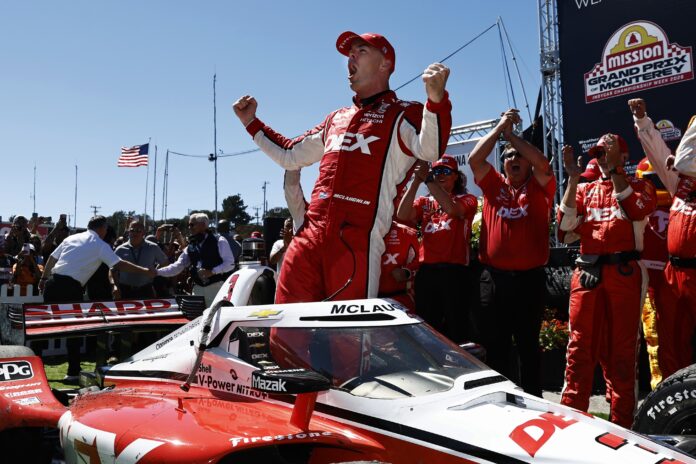
MONTEREY, Calif. - SEPTEMBER 6: Scott McLaughlin, driver of the #3 Team Penske Chevrolet, celebrates winning the NTT IndyCar Series Mission Foods Grand Prix of Monterey at WeatherTech Raceway Laguna Seca on Sept. 6, 2026, in Monterey, California. Photo: Chris Jones/Penske Entertainment
Scott McLaughlin took his cooldown lap at WeatherTech Raceway Laguna Seca. His race strategist, Tim Cindric, told him to do a burnout. He proceeded to the frontstretch and did just that, alongside five-time series champion, Alex Palou.
“It’s been terrible, right? I’ve been waiting six years to do that,” he said. “My initial one I wanted to park it against the fence and do it. I lost it in the smoke. I was too close to the wall when the smoke cleared.”
Driving backwards down pit lane, his car stalled out momentarily, but he re-fired it and drove to victory lane. As Palou climbed out to officially celebrate his championship, McLaughlin took off his helmet, which stuck to his HANS device. He stood up and hopped into the arms of his pit crew.
The driver of the No. 3 Team Penske Chevrolet started from pole position and led a race high 87 of 95 laps to win the Mission Foods Grand Prix of Monterey at WeatherTech Raceway Laguna Seca. Which snapped a 35-race winless streak, dating back to the 2024 Milwaukee Mile 250 Race 2.
“A culmination of some hard work,” McLaughlin said. “I think the whole team, all three cars, just been working on basically I think from the Mid-Ohio test for us, at least on my car, we found a bit of a direction.
“Always felt, yeah, Raul was my guy. We’ve been having that good energy, that feeling that we could do this, but it was just about putting the parts together.
“Today was fantastic. We’ve had poles. Haven’t quite completed the races. You could see that it was there. Really proud to get our first win together on a road course where the last couple years we probably struggled at the most.
“Yeah, what a great way to end the season. We have a lot of hard work to do over the off-season to come back stronger, combat against the 10. I think J.D. would agree, it’s just a good finish to the season, gets everyone excited.”
It’s his eighth career victory in 103 NTT IndyCar Series starts and first since the 2024 Milwaukee Mile 250 Race 2.
Kyle Kirkwood, as his car nearly rolled away from him on pit lane, post-race, brought his No. 27 Andretti Global Honda to a runner-up finish, and clinched a runner-up finish in points.
“Yeah, we played it a little bit safer than I might have hoped for the last race of the season, but we had to for the championship,” Kirkwood said. “We made all the decisions based on that.
“Probably could have had a go at Scottie at the end on the first few laps on reds. The number one goal was to make the tires last. That’s what we did. Came home with a second, which is something to be proud of.”
Alexander Rossi earned his first podium of the season, and first with Ed Carpenter Racing, with a third-place finish in his No. 20 ECR Chevrolet.
“It’s no secret that this has been a pretty terrible year for myself and the whole ECR team with the litany of issue, some out of our control, some in our control,” Rossi said.
“Ultimately road courses have been something that have been a pretty big challenge for us in the second half of this year. Really ever since the Indy GP, there’s been a huge amount of emphasis and effort behind the scenes to kind of dig out of that hole. It’s very difficult to do in this championship.
“Just really proud of the whole organization and everyone involved for kind of staying true to the course and fighting through a lot of adversity.
“This is a great result to kind of reward that effort, just rebuild the confidence in everyone that we’re capable of doing this. It’s a good boost going into what’s going to be a long off-season, but an important one, to make sure we execute a lot better and clean up a lot of our issues that we can control in 2027.”
Felix Rosenqvist and David Malukas rounded out the top-five.
Christian Lundgaard, Marcus Armstrong, Palou, Ericsson and Kyffin Simpson rounded out the top-10.
Scott McLaughlin erases win drought with dominant drive at Laguna Seca
Race summary
McLaughlin led the field to green at 3:13 p.m. ET. Climbing up the Rahal Straight, Sting Ray Robb hit Dennis Hauger and spun him into the outside tire barrier. Which brought out a caution on the first lap. For this, IndyCar handed Robb a 10-second stop and hold penalty.
Back to green on Lap 5, the field settled into a green flag rhythm. McLaughlin, on a new set of Firestone reds (soft tire) pulled out to a 1.5 second lead over Palou, on used reds, by Lap 10. Scott Dixon kicked off a cycle of green flag stops on Lap 10. McLaughlin pitted from the lead on Lap 20. Rosenqvist pitted from the lead on Lap 21. Rossi pitted from the lead on Lap 25 and McLaughlin cycled back to the front.
Dixon again kicked off another cycle of green flag stops on Lap 27. McLaughlin pitted from the lead on Lap 44. Rosenqvist pitted from the lead on Lap 45. Armstrong pitted from the lead on Lap 47 and McLaughlin cycled back to the lead.
With 27 laps to go, Kyle Kirkwood in second ate into the two-second gap to race leader, McLaughlin. With 26 to go, however, lap traffic cost him two seconds and he pitted with McLaughlin that lap. He cycled out under two seconds behind McLaughlin.
With 22 to go, McLaughlin led Kirkwood by 1.7 seconds. With 21 to go, the gap grew to 1.8 seconds. With 20 to go, it shrank to 1.5 seconds. With 19 to go, it fell to 1.4 seconds. With 18 to go, it grew to 1.6 seconds. With 17 to go, it fell to 1.3 seconds. With 16 to go, it ballooned to 1.4 seconds. With 15 to go, it grew to 1.5 seconds. With 14 to go, it swelled up to 1.7 seconds. The gap hung around that range with each passing lap, as McLaughlin drove his car to victory.
Scott McLaughlin erases win drought with dominant drive at Laguna Seca
What else happened
Josef Newgarden locked up in Turn 2 and made contact with Will Power on his outside, on Lap 23.
Going for a pass on Santino Ferrucci, Power locked up and ran wide in Turn 2 on Lap 53.
With 27 laps to go, Nolan Siegel ran wide in Turn 7 and into the dirt, but kept his car out of the tire barrier and returned to the track.
Scott McLaughlin erases win drought with dominant drive at Laguna Seca
Nuts and bolts
The race lasted one hour, 59 minutes and 29 seconds, at an average speed of 106.756 mph. There were six lead changes among four different drivers and one caution for three laps.
Palou finished the season with an 86-point lead over Kirkwood.
Despite a last-place finish, Hauger took home Rookie of the Year honors for the 2026 season.
Dixon, Power and Christian Rasmussen, who all won a race in 2025, failed to win a race in 2026. For Dixon, that snapped a streak of 21 consecutive seasons with at least one race win. For Power, 2026 is his second winless season in the last four years.
That’s all for the 2026 NTT IndyCar Series season. It returns to action March 7, 2027, on the streets of St. Petersburg, Florida.
MONTEREY, Calif. (Sunday, Sept. 6, 2026) – Scott McLaughlin ended a long winless streak and the 2026 NTT INDYCAR SERIES season in style, dominating the Mission Foods Grand Prix of Monterey for his first victory in more than two years.
Pole sitter McLaughlin drove the No. 3 DEX Team Penske Chevrolet to victory by 1.3739 seconds over the No. 27 Sam’s Club Honda of Andretti Global’s Kyle Kirkwood. The win was the eighth of McLaughlin’s INDYCAR SERIES career and his first since Sept. 1, 2024, in the second race of a doubleheader weekend at the Milwaukee Mile, snapping a drought of 36 races.
“My little girl (Lucy, born in October 2024) hasn’t seen me win yet, and now she has,” McLaughlin said. “So, Dad’s coming home with a trophy, baby. Let’s go!
“These guys and girls at Team Penske have stood behind me the whole time. Congrats to Alex (Palou) on his fifth (championship), but we’re working hard to beat them, and today was a big step in the right direction.”
Alexander Rossi finished third in the No. 20 Java House ECR Chevrolet for his first podium finish since placing third at this event for Arrow McLaren in June 2024.
Felix Rosenqvist placed fourth in the No. 60 Meyer Shank Racing w/Curb Agajanian Honda. David Malukas put two Team Penske cars in the top five in the No. 12 Verizon Team Penske Chevrolet.
Alex Palou punctuated the fifth NTT INDYCAR SERIES championship that he clinched last weekend at Milwaukee with a quiet drive to eighth place in the No. 10 DHL Lightning Bolt Honda of Chip Ganassi Racing after he won this race the last two years. But Palou and the CGR team celebrated its record-tying fourth consecutive season title with donuts on the front straightaway by the driver and again in a boisterous post-race Astor Challenge Cup presentation.
McLaughlin left absolutely no doubt about his dominance in this race on the 11-turn, 2.238-mile road course. He only trailed during pit stop sequences and ended up leading 87 of 95 laps, erasing all memories of the six podium finishes without a win since his last triumph.
There was only one caution period in the race, for a Lap 1 incident in which Sting Ray Robb’s No. 77 Juncos Hollinger Racing – Goodheart Chevrolet hit the rear of Dennis Hauger’s No. 19 Ault Block Chain Honda of Dale Coyne Racing in Turn 6, sending Hauger spinning into the tire barrier.
McLaughlin had no problem pulling away from the field on the restart on Lap 4, and his precise driving and Team Penske’s clean, quick work during three pit stops took care of the rest.
“We had to be solid,” McLaughlin said. “That’s what it’s going to take to win a championship. What a great warmup we had. Bring on 2027.”
Kirkwood, who started sixth, had climbed to second by Lap 20 after Palou pitted to switch to a different tire strategy and shadowed McLaughlin for the rest of the way, pitting at the same time as McLaughlin on all three stops. McLaughlin’s lead was nearly four seconds at the halfway point, but Kirkwood pulled as close as 1.2 seconds on Lap 72 due to running his final stint on the faster but less-durable Firestone Firehawk alternate tire.
But McLaughlin eased away in the closing laps on the more durable Firestone primary tire, as Kirkwood admitted he and the Andretti Global team took a safety-first approach to ensure the driver would finish a career-best second in the standings. Kirkwood ended up 86 points behind champion Palou.
“Second in the championship, and that’s my best road-course finish,” Kirkwood said. “We just played it super clean, super methodical. I wish I could have had a go at Scotty there at the end on the better tires, but we knew who we were fighting, and that was for the championship, mostly. So, we played it safe there. Second place is best of the rest.”
2016 Indianapolis 500 winner Rossi also was a fixture in the top three for most of the race, producing the best day for ECR since teammate Christian Rasmussen won in August 2025 at Milwaukee. Rasmussen also finished third this year at World Wide Technology Raceway, but road courses have been a weak spot for ECR this season. The best previous finish on this type of circuit was sixth by Rossi in June at Road America.
“I don’t think I could state the significance of it just with how challenging this year has been for the whole organization and how much road courses have been a huge struggle of ours,” Rossi said. “There was a lot of doubt coming into this event whether we could find a direction, so I think this is just a huge reward for all the effort.”
Despite finishing last in the 25-car field due to the incident with Robb, Hauger hung on to win series Rookie of the Year honors. He finished with 228 points, 15 ahead of Mick Schumacher of Rahal Letterman Lanigan Racing in the rookie race.
The 2027 NTT INDYCAR SERIES season opens Sunday, March 7 on the streets of St. Petersburg, Florida.
Langdon, Capps, Hartford and M. Smith secure No. 1 spots at The Big Go
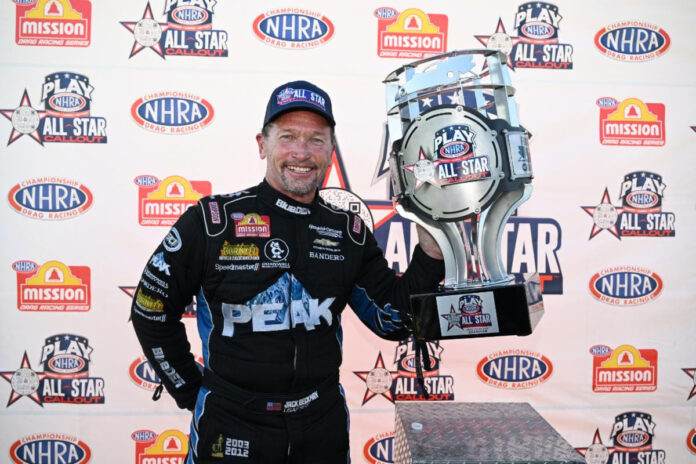
INDIANAPOLIS (Sept. 6, 2026) – Funny Car’s Jack Beckman won the PlayNHRA All-Star Callout on Sunday at Lucas Oil Indianapolis Raceway Park for John Force Racing, defeating Matt Hagan in the final round of the bonus race as part of this weekend’s Cornwell Quality Tools NHRA U.S. Nationals.
Shawn Langdon (Top Fuel), Ron Capps (Funny Car), Matt Hartford (Pro Stock) and Matt Smith (Pro Stock Motorcycle) all qualified No. 1 in Indianapolis at the 14th of 20 races during the 2026 NHRA Mission Foods Drag Racing Series season.
Beckman went 3.980-seconds at 323.19 mph in the final round of the Callout in his 12,000-horsepower PEAK Chevrolet SS, powering past Hagan, who slowed at the finish line. Remarkably, it also gives the veteran his fifth victory in the Indy Funny Car bonus race.
Sporting a John Force tribute car this weekend in Indy from his dominant 1996 championship season, the past world champion defeated Chad Green and J.R. Todd earlier in the day before meeting Hagan in the final round. Beckman will attempt to sweep the weekend and win the U.S. Nationals for the third time in his career.
“Our first shootout win was special to get one, and then when you get two, you’re like, ‘This is awesome,’ and then when I got four, and then I was done driving [after the 2020 season], I thought, ‘Still pretty good amount of trophies, more than I ever thought or dreamed I was going to get in here,’ and to come back into a competitive car right away, and then to get to close the deal on a day like today is incredible,” Beckman said. “We just treated it like race day, and it worked out.
“It’s a long race and if you can’t handle the ups and downs of that, you’re in the wrong sport. Our performance is measured in thousandths of a second, so I’m going to try to get a good night’s rest and hopefully come back a little bit closer to normal tomorrow because I know we’ve got a car that can repeat.”
Seeking his third career U.S. Nationals victory, Capps jumped to the provisional No. 1 spot in his 12,000-horsepower Carlye Tools/NAPA Auto Care Toyota GR Supra with a 3.914 at 332.18. It sent Capps back into the points lead on what could be a wild Monday at The Big Go. Austin Prock took second with a 3.921 at 317.87 and Beckman took third with a 3.937 at 326.79.
Monday will also determine the regular season championship and the $150,000 payout, with Capps currently holding a three-point lead over Hagan, with Jordan Vandergriff and Todd 12 and 30 points back, respectively.
“In our book, we felt like we should win the regular season,” Capps said. “Our plan coming into qualifying was absolutely to try to get those little points. But who does it ever? Not very often. I promise you that if you walked into anyone’s trailer and they had that written as their goals – every crew chief, driver, team member had that thought. Like, but could you do it? You get the four points here instead of three and yesterday I was like, ‘Wow, we’re already technically at that point where Hagan was. We had passed him just in qualifying,’ and I’m not sure I’d ever done that.”
In Top Fuel, Shawn Langdon’s Friday run proved to be the best of all five sessions as the past world champion took the No. 1 spot for the sixth time this season thanks to his run of 3.727 at 334.98 in his 12,000-horsepower SealMaster dragster for Kalitta Motorsports.
Langdon will enter raceday 68 points behind teammate Doug Kalitta, needing to make up three rounds on Monday at The Big Go to win the $150,000 and the regular season championship. A victory at Indy would help his chances and he’ll open raceday against Clay Millican, looking for his third U.S. Nationals victory.
“Yes and no that I thought the No. 1 would hold,” Langdon said. “I thought there could be an opportunity for someone else to take it. It was a good run for Friday night, but we weren’t really satisfied with that. We obviously wanted to do a little bit more, but we were just trying to see what we could get away with, and we weren’t able to do that Saturday.
“So the last run we really had to slow everything down, get everything back in check and get some information for tomorrow. We were able to do that and feel very confident for tomorrow.”
Tony Stewart clinched the second spot with a 3.744 at 328.22 and Kalitta took third after going 3.746 at 335.82.
Pro Stock’s Matt Hartford came on strong to close out qualifying at Indy, making the quickest run over the final three sessions, including a strong 6.572 at 208.97 to end the day in his Total Seal Chevrolet Camaro.
It’s the first No. 1 qualifier of the season for Hartford, who is after his second Indy victory after winning in 2023. He’s on a strong pace to be in contention on Monday and will open raceday Kenny Delco. Hartford already has three wins in 2026, but an Indy win during NHRA’s 75th anniversary season would certainly be special.
“It just feels great that our entire team is making some good decisions in the trailer before we roll up,” Hartford said. “The weather conditions that we started with from Friday to today are completely different, but we knew that when we got here that Sunday Q4 and Q5 were going to be the two best sessions. When we went low in Q4, we knew it wasn’t remotely safe, and that E.T. would probably be in the bottom half by the time we got done with Q5. I’m just really, really thankful for my team and how hard they’ve worked to allow this to happen.”
Dallas Glenn’s 6.574 at 208.01 put him second, while rookie Cody Anderson took third after going 6.574 at 207.91.
Pro Stock Motorcycle’s Matt Smith started qualifying in the No. 1 spot and finished there five sessions later, moving back into the top position to close out Sunday with a run of 6.757 at 200.98.
The six-time world champion earned his third No. 1 qualifier of the season and will open raceday at Indy against Chris Bostick. A three-time winner at Indy, Smith has a great opportunity to win again at The Big Go, and with the way the team has performed thus far, an all-Matt Smith Racing final round is the goal for Monday.
“You know, I’ve won this race three times. I’d like to get a fourth one,” Smith said. “If I can’t do it, then I want one of the other three bikes that we have on our camp to do it, and I think we have a really good shot at doing it. I mean, we have three bikes in the top eight.
“We came back in Q5 and put it all together. I made a little axle adjustment and it went right down the track and took the top spot. I’m totally confident with how we tested at Rockingham coming here with this kind of weather. I felt good. I’ve felt good all weekend. We’ve just got to turn on four win lights tomorrow.”
Gaige Herrera took second with a 6.781 at 198.79 and Angie Smith qualified third after going 6.787 at 198.50.
Eliminations for the Cornwell Quality Tools NHRA U.S. Nationals begin at 10 a.m. ET on Monday at Lucas Oil Indianapolis Raceway Park.
INDIANAPOLIS — Monday’s first-round pairings for eliminations for the 72nd annual Cornwell Quality Tools NHRA U.S. Nationals at Lucas Oil Indianapolis Raceway Park, the 14th of 20 events in the NHRA Mission Foods Drag Racing Series. Pairings based on results in qualifying, which ended Sunday. DNQs
listed below pairings.
Top Fuel — 1. Shawn Langdon, 3.727 seconds, 334.98 mph vs. 16. Clay Millican, 3.844, 327.11; 2. Tony Stewart, 3.744, 328.22 vs. 15. T.J. Zizzo, 3.836, 328.62; 3. Doug Kalitta, 3.746, 335.82 vs. 14. Will Smith, 3.828, 325.45; 4. Billy Torrence, 3.767, 329.34 vs. 13. Maddi Gordon, 3.818, 324.67; 5. Leah Pruett, 3.772, 326.24 vs. 12. Josh Hart, 3.812, 323.50; 6. Jasmine Salinas, 3.776, 329.91 vs. 11. Tripp Tatum, 3.805, 308.43; 7. Ida Zetterstrom, 3.778, 330.88 vs. 10. Antron Brown, 3.797, 330.07; 8. Justin Ashley, 3.781, 331.12 vs. 9. Shawn Reed, 3.784, 331.28.
Did Not Qualify: 17. Jake Sanders, 3.862, 306.26; 18. Dan Mercier, 3.873, 314.75; 19. Tony Schumacher, 3.883, 323.19; 20. Krista Baldwin, 3.887, 321.65; 21. Lex Joon, 4.823, 162.53; 22. Jacob Opatrny, 11.406, 74.57.
Funny Car — 1. Ron Capps, Toyota GR Supra, 3.914, 332.18 vs. 16. John Smith, Dodge Charger, 4.089, 305.36; 2. Austin Prock, Ford Mustang, 3.921, 317.87 vs. 15. Julie Nataas, GR Supra, 4.089, 309.70; 3. Jack Beckman, Chevy Camaro, 3.937, 326.79 vs. 14. Jeff Arend, Charger, 4.076, 303.78; 4. Spencer Hyde, Mustang, 3.944, 319.45 vs. 13. Paul Lee, Charger, 4.037, 324.05; 5. Matt Hagan, Charger, 3.947, 331.77 vs. 12. Hunter Green, Charger, 4.024, 313.95; 6. Alexis DeJoria, Camaro, 3.947, 329.26 vs. 11. Chad Green, Mustang, 4.002, 317.87; 7. Jordan Vandergriff, Camaro, 3.948, 327.59 vs. 10.
J.R. Todd, GR Supra, 3.981, 327.74; 8. Cruz Pedregon, Charger, 3.970, 319.98 vs. 9. Daniel Wilkerson, Mustang, 3.974, 321.96.
Did Not Qualify: 17. Bobby Bode, 4.098, 278.58; 18. Chris King, 4.112, 287.96; 19. Blake Alexander, 4.115, 275.39; 20. Dylan Winefsky, 4.119, 308.43; 21. Justin Schriefer, 4.124, 292.46; 22. Dave Richards, 4.130, 312.42; 23. Terry Haddock, 4.922, 162.22.
Pro Stock — 1. Matt Hartford, Chevy Camaro, 6.572, 208.97 vs. 16. Kenny Delco, Camaro, 6.646, 205.98; 2. Dallas Glenn, Camaro, 6.574, 208.01 vs. 15. Mason McGaha, Camaro, 6.625, 208.14; 3. Cody Anderson, Camaro, 6.574, 207.91 vs. 14. Aaron Stanfield, Camaro, 6.623, 206.51; 4. Chris Vang, Camaro, 6.583, 206.86 vs. 13. Jeg Coughlin, Camaro, 6.618, 207.66; 5. Greg Anderson, Camaro, 6.585, 206.67 vs. 12. Shane Tucker, Camaro, 6.614, 208.52; 6. Erica Enders, Camaro, 6.588, 209.36 vs. 11. Jerry Tucker, Camaro, 6.613, 207.02; 7. Matt Latino, Camaro, 6.590, 207.85 vs. 10. Troy Coughlin
Jr., Camaro, 6.604, 208.39; 8. Eric Latino, Camaro, 6.590, 207.46 vs. 9. Greg Stanfield, Camaro, 6.593, 206.57.
Did Not Qualify: 17. Deric Kramer, 6.661, 206.45; 18. Alan Prusiensky, 6.783, 202.12; 19. David Vaseloff, 6.863, 199.20.
Pro Stock Motorcycle — 1. Matt Smith, Buell, 6.757, 200.98 vs. 16. Chris Bostick, Suzuki, 6.982, 193.24; 2. Gaige Herrera, Suzuki, 6.781, 198.79 vs. 15. Hector Arana Jr, EBR, 6.967, 194.04; 3. Angie Smith, Buell, 6.787, 198.50 vs. 14. Kelly Clontz, Suzuki, 6.933, 195.45; 4. Richard Gadson, Suzuki, 6.818, 197.86 vs. 13. Marc Ingwersen, EBR, 6.928, 193.54; 5. Ryan Oehler, EBR, 6.825, 197.57 vs. 12. Malcolm Phillips Jr., Suzuki, 6.925, 195.08; 6. John Hall, Beull, 6.830, 198.03 vs. 11. Geno Scali, Suzuki, 6.925, 195.65; 7. Chase Van Sant, Suzuki, 6.861, 196.67 vs. 10. Michael Ray, Buell, 6.893, 196.67; 8. Clayton Howey, Suzuki, 6.865, 194.77 vs. 9. Steve Johnson, Suzuki, 6.876, 194.30.
Did Not Qualify: 17. Wesley Wells, 7.085, 187.60; 18. Hector Arana, 7.091, 192.17; 19. Mark Paquette, 7.158, 179.83.
INDIANAPOLIS — Sunday’s final results from the PLAYNHRA Funny Car All-Star Callout at the 72nd annual Cornwell Quality Tools NHRA U.S. Nationals at Lucas Oil Indianapolis Raceway Park.
PLAYNHRA Funny Car All-Star Callout — Jack Beckman, Chevy Camaro, 3.980, 323.19 def. Matt Hagan, Dodge Charger, 4.290, 227.19.
INDIANAPOLIS — Final round-by-round results from the PLAYNHRA Funny Car All-Star Callout at the 72nd annual Cornwell Quality Tools NHRA U.S. Nationals at Lucas Oil Indianapolis Raceway Park.
PLAYNHRA FUNNY CAR ALL-STAR CALLOUT:
ROUND ONE — J.R. Todd, Toyota GR Supra, 3.981, 327.74 def. Austin Prock, Ford Mustang, 4.054, 285.17; Alexis DeJoria, Chevy Camaro, 3.971, 330.15 def. Ron Capps, GR Supra, 6.820, 99.19; Jack Beckman, Camaro, 4.253, 252.14 def. Chad Green, Mustang, 6.931, 98.97; Matt Hagan, Dodge Charger, 3.947, 331.77 def. Spencer Hyde, Mustang, 3.976, 325.22;
SEMIFINALS — J. Beckman, 3.963, 327.43 def. J. Todd, 4.044, 316.97; M. Hagan, 3.979, 328.78 def. A. DeJoria, 4.530, 191.97;
FINAL — J. Beckman, 3.980, 323.19 def. M. Hagan, 4.290, 227.19.