Once the dust settled in 1926, Cyrus Avery wrote a polite thank-you letter to the federal highway official who had helped end a fight that dragged on for months. Near the end, he mentioned the U.S. 60 shields. He would, he said, “have to junk them.”
That number never went up on the road he’d pushed for. The Chicago-to-Los Angeles highway got a leftover instead — and the leftover became the most famous highway number in America. The Route 66 centennial lands on November 11, 2026, a hundred years to the day after state highway officials adopted the U.S. numbered highway system that put “66” on the map.
The birthday gets the parades. The fight over the number is the better piece of Route 66 history, and it explains why the Mother Road carries a number that broke the system’s own rules.
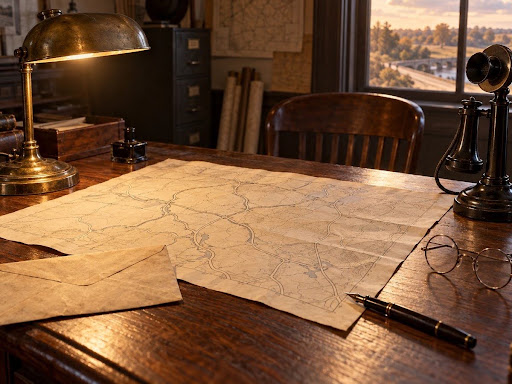
Why the Chicago–Los Angeles Road Was Supposed to Be 60
The 1926 plan came with a pecking order everyone grasped right away. Two-digit routes ending in zero — 20, 30, 40, 50 — were the long east-west lines, and highway boosters read a zero (or a 1) as a first-class road. Any other number felt secondary.
By that logic, 60 belonged to a straight coast-to-coast route between U.S. 50 and U.S. 70. Instead, the committee drawing the map handed it to a diagonal crescent from Chicago to Los Angeles. Three of the five committee members, Avery among them, represented states that crescent ran through. A Federal Highway Administration history of the episode calls the exception “suspicious.”
A Governor Who Read the Map
Kentucky’s governor, William J. Fields, noticed. On the new map, zero routes marched toward his state from the north and the south — and 60, which should have crossed Virginia, West Virginia and Kentucky, was sitting in Chicago.
On December 8, 1925, he announced that Kentucky would ignore the proposed U.S. highway numbers. “Chicago influence is written all over the map,” he said. Kentucky’s complaint came down to one line: it was the only Mississippi Valley state without a route number ending in zero.
How Did 62 Become 66?
The first compromise didn’t hold. At a meeting in Chicago in January 1926, Avery said one number running all the way from Chicago to L.A. mattered more to him than whether it was 60 or 62. The committee kept 60 on his road and offered Kentucky 62, with a swap held in reserve. When Kentucky refused, federal officials made the swap — 60 through Kentucky, 62 for Chicago to Los Angeles.
Avery, it turned out, did care. On February 10 he “strenuously objected” by telegram. B. H. Piepmeier, chief engineer of Missouri’s State Highway Commission, refused 62 and a split-number idea after it, and Kentucky rejected that one too. For weeks, nobody moved.
The Afternoon in Springfield
The way out turned up on April 30, 1926, in Springfield, Missouri. Avery met Piepmeier there, and Oklahoma’s chief highway engineer, John M. Page, spotted something nobody had claimed: the number 66 wasn’t assigned to any route. The Federal Highway Administration’s own history of the numbering fight, “From Names to Numbers,” quotes the telegram the two men sent that afternoon: “We prefer sixty six to sixty two.”
It wasn’t final yet. Kentucky signed off in July, and the whole system, U.S. 66 included, was adopted that November 11. The April telegram is why Springfield bills itself as the birthplace of Route 66. The road itself was shorter than people picture, too — in 1926 it ended in downtown Los Angeles, and the western end didn’t reach Santa Monica until 1936.
Nobody in that Springfield meeting could have guessed what the double six would turn into. It’s on neon signs, painted pavement, jacket patches and belt buckles. Biker jewelers sculpt it as well — one sterling silver Route 66 motorcycle helmet ring sets the shield on the side of a vintage helmet, with brass goggles and a cigar on the rider’s face. A number picked because it was spare now stands in for the whole open road.
Riding It in November? Check the Altitude First
A centennial ride on the actual birthday sounds right. The calendar is the catch. November 11 sits at the edge of the season when the western half of the route can turn on you, and the reason is altitude more than latitude.
Flagstaff, Arizona, right on the old road, sits at around 7,000 feet, according to the National Weather Service. Snow there doesn’t wait for deep winter: over Thanksgiving weekend in 2019, a storm left about 17 inches of snow at the NWS office in Flagstaff and caused road closures across northern Arizona.
Illustration: high-country two-lane after an early snow. Around Flagstaff, the old corridor sits near 7,000 feet.
So a rider chasing the date has two sensible plays. Ride the eastern states, where the birthday events are, or treat the Arizona high country as a morning-by-morning decision. Arizona’s 511 road-condition service and the NWS Flagstaff forecast are the two checks worth making before the kickstand goes up.
Bike choice matters more on a 2,400-mile road than on a Sunday loop. Long, straight, windy days treat a touring rig very differently from a sport bike, and Bikerringshop’s breakdown of motorcycle styles covers what each type costs to run and how it fits different riders.
How Much of the Old Road Can You Still Ride?
More than most people expect. Route 66 was decommissioned in 1985, after the interstates replaced it, and its segments were split among private, city, state, federal and tribal owners. In a page last updated in 2022, the National Park Service put the share still drivable at about 85% — often under other names and highway numbers.
That’s an estimate, not a promise for every stretch. Some of it survives in odd forms: in Wheeler County, Texas, 1931 concrete handed to the state in 1968 still carries traffic as I-40 frontage road. A current route guide beats a vintage map.
Where the 100th Birthday Party Actually Is
For the 100th anniversary itself, two cities have the day nailed down. In Tulsa, where Avery lived, the November 11 schedule presented by the Oklahoma Route 66 Centennial Commission and Cherokee Nation Businesses opens with the Veterans Day parade downtown at 11 a.m. A free “Centennial Crawl” covers eight downtown venues in the afternoon, and “The Centennial Moment” happens on Main Street at 5 p.m. A free Bob Wills’ Texas Playboys show on Guthrie Green follows at 6.
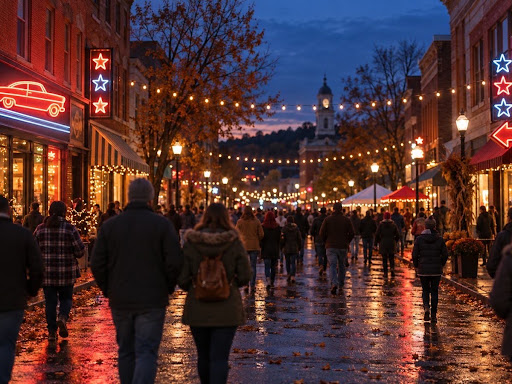
Illustration: a main street lit up for the night. Centennial events are being staged town by town along the old road.
Springfield, Illinois, is going louder. The Illinois Route 66 Scenic Byway holds its statewide conference at Route 66 Motorheads during the day, and Starship featuring Mickey Thomas headlines a centennial concert there that night.
Congress created a federal Route 66 Centennial Commission back in December 2020. One thing the road still isn’t: a National Historic Trail. A Senate bill to designate it, S. 2887, was reported out of committee on September 17, 2026, but it hasn’t passed Congress. Event schedules shift as well, so check each organizer’s page the week you travel.
Route 66 Centennial Questions
When is the Route 66 centennial?
November 11, 2026. On that date in 1926, the American Association of State Highway Officials adopted the U.S. numbered highway system, which included U.S. 66 from Chicago to Los Angeles. Tulsa, Oklahoma, and Springfield, Illinois, both have events scheduled on the day itself.
Why is it called Route 66 and not Route 60?
Planners first gave the Chicago–Los Angeles road the number 60. Kentucky objected because it had no route ending in zero, so officials proposed 62 instead, which Oklahoma and Missouri rejected. On April 30, 1926, Oklahoma engineer John M. Page noticed 66 was unused, and the states asked for it.
Is Route 66 a National Historic Trail?
Not yet. Senate bill S. 2887 would designate the U.S. 66 alignments used between 1926 and 1985 as a National Historic Trail. It was reported out of committee on September 17, 2026, but it still has to pass Congress and be signed before the designation exists.
Can you still drive the whole route?
Mostly. The National Park Service estimates about 85% of old Route 66 segments are still drivable, many under different names or highway numbers. Gaps and detours exist, so a modern route guide matters — and in late autumn, check the mountain weather around Flagstaff before committing.
Route 66 was nobody’s first choice. It was the number left on the table after a governor, a few state highway men and a federal bureau ran out of better ideas. A century later, it’s the one people sculpt, frame and cross the country to drive.
If you ride it for the birthday, go for the history as much as the date. The weather in Flagstaff won’t care that it’s a centennial.
Author bio: Tepparit Kacha spends his working days around motorcycle jewelry and the Americana it borrows from — road signs, engine parts, old helmet shapes. He has curated sterling silver pieces for over a decade at Bikerringshop.