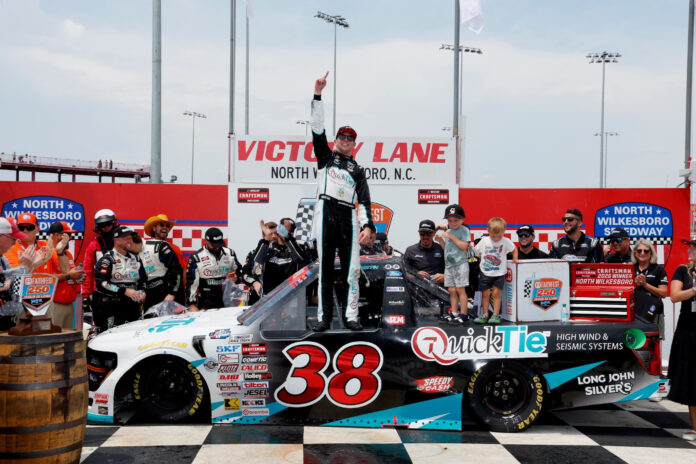
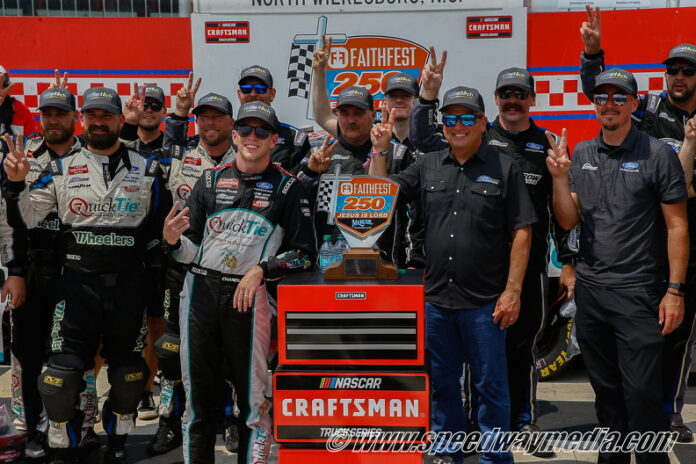
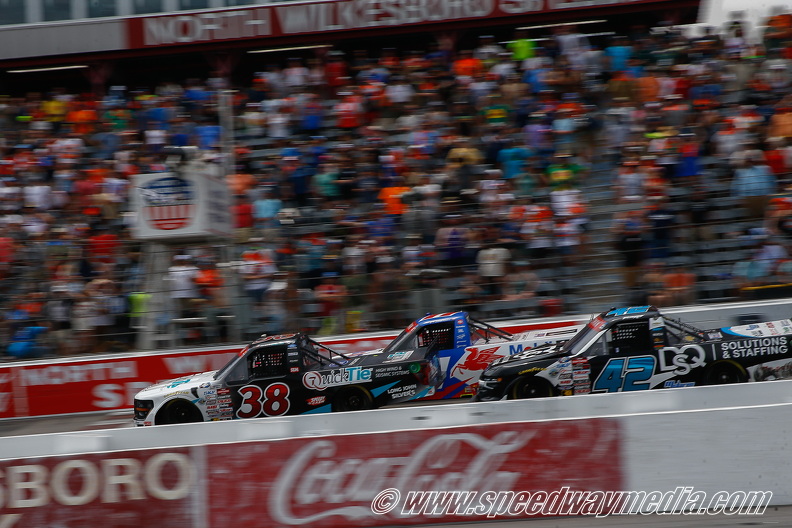
Chandler Smith celebrates after winning Saturday's NASCAR Craftsman Truck Series FaithFest 250 presented by Mercer Transportation at North Wilkesboro Speedway. (HHP/NWS photo)
Chandler Smith captured his second consecutive victory in NASCAR Craftsman Truck Series competition at North Wilkesboro Speedway on Saturday, beating Front Row Motorsports teammate Layne Riggs to the checkered flag; Shane van Gisbergen finished third with Christian Eckes fourth and Landen Lewis fifth
Smith led a race-high 105 of 250 laps in securing his second victory of the season and Ford’s second 1-2 finish of the year
Tickets for Sunday’s Window World 450 are sold out; Fans can lock in 2027 tickets by visiting www.northwilkesborospeedway.com
NORTH WILKESBORO, N.C. (July 18, 2026) — Chandler Smith had no equal in Saturday’s FaithFest 250 presented by Mercer Transportation NASCAR Craftsman Truck Series race at North Wilkesboro Speedway. Smith took the lead with 105 laps to go, never surrendered it and, coupled with Front Row Motorsports teammate Layne Riggs’ runner-up result, clinched Ford’s second 1-2 finish of the year.
The win was also Smith’s second in a row in Truck Series competition at NWS. It came on a dominant day for Ford — whose trucks also swept the stages — with pole-winner Riggs (Stage 1) and Ty Majeski (Stage 2) taking mid-race honors.
NASCAR Cup Series star Carson Hocevar paced the field for 74 laps, but a flat tire doomed Hocevar to a 27th-place finish.
Shane van Gisbergen — another Cup Series standout — moved up to third by race’s end, tying his career-best result in the Truck Series. Christian Eckes and Landen Lewis completed the top five.
Giovanni Ruggiero was sixth with Chase Elliott seventh, Stewart Friesen eighth, Corey Heim ninth and Majeski 10th.
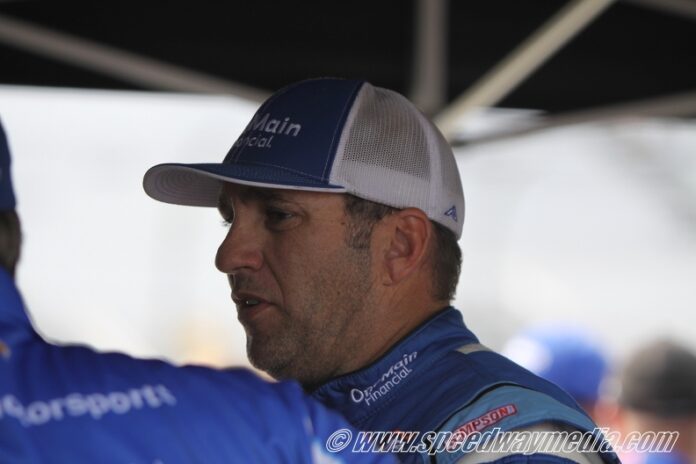
Elliott, the 2020 NASCAR Cup Series champion, made Saturday’s race his third of four starts over the weekend. He competed in Friday’s zMAX CARS Tour doubleheader at NWS and will attempt to score his first Cup win at the track in Sunday’s Window World 450.
Smith grabbed the bonus point for posting the fastest lap on Lap 157, which he completed in 19.148 seconds.
CHANDLER SMITH, NO. 38 FRONT ROW MOTORSPORTS FORD (RACE WINNER): “Praise to God. He’s the source of all this. He’s the one who keeps the wheels flowing in my career and keeps these race teams going — specifically, this No. 38 race team. Our team is a Christian team. We went from the valley last weekend to the mountaintop today. (Saturday’s race) was fun. Right off the get-go from the start of the race, I knew we had a really good truck. I could race around guys and see where they struggled and where my strong suit was. Last year (Smith’s first NWS win) went really good but speed-wise, I wasn’t very happy with my truck. This year, we were really good, speed-wise, but I also had a really good-handling race truck.”
WINDOW WORLD 450 QUALIFYING CANCELED DUE TO RAIN
Inclement weather forced the cancellation of Window World 450 qualifying on Saturday. With the qualifying metric in place, Ryan Blaney will start Sunday’s race on the pole with Ty Gibbs starting second.
Race fans can connect with North Wilkesboro Speedway and get the latest news regarding the July 17-19 race weekend by following on X and Instagram or by becoming a Facebook fan.
Ryan Blaney was awarded the pole position for this weekend’s NASCAR Cup Series’ Window World 450 event at North Wilkesboro Speedway in North Wilkesboro, North Carolina, on Saturday, July 18.
The event’s starting lineup was initially to be determined through an on-track qualifying session with a single-car, two-lap format. Due to inclement weather, the lineup was instead determined through a qualifying metric formula from the NASCAR rulebook. As a result, Ryan Blaney, who is coming off last weekend’s Cup victory at EchoPark Speedway and is currently ranked in third place in the 2026 Cup Series driver standings, was awarded the top-starting spot for Sunday night’s main event.
Sunday’s Cup event will mark Blaney’s first points-paying start at North Wilkesboro Speedway as he strives to become the series’ first winner at the track that last hosted a Cup event in September 1996. He made three starts at the track during the Cup Series’ All-Star Race over the past three seasons (2023-25), where he finished as high as fifth place in 2024. Blaney, who is trailing the regular-season points lead by 65 points, is also seeking his third victory of the 2026 campaign and reel in the points lead with six regular-season events remaining on this year’s schedule. Blaney is also one of four competitors, along with Christopher Bell, Chase Elliott and Todd Gilliland, who remain in contention for this year’s In-Season Challenge tournament.
Blaney will share the front row with Ty Gibbs, the latter of whom is coming off a fifth-place result at EchoPark Speedway and is ranked in fourth place in the standings. Christopher Bell, who won the All-Star Race at North Wilkesboro a year ago, will start in third place while Carson Hocevar and Tyler Reddick rounded out the top-five starting spots, respectively.
Erik Jones, points leader Denny Hamlin, Shane van Gisbergen, Chris Buescher and Chase Elliott completed the top-10 starting grid, respectively.
With 37 competitors vying for 37 starting spots, all made the main event.
North Wilkesboro – Starting Lineup:
Ryan Blaney
Ty Gibbs
Christopher Bell
Carson Hocevar
Tyler Reddick
Erik Jones
Denny Hamlin
Shane van Gisbergen
Chris Buescher
Chase Elliott
Joey Logano
Austin Dillon
Ross Chastain
Austin Cindric
William Byron
Michael McDowell
Daniel Suarez
Todd Gilliland
John Hunter Nemechek
Cole Custer
Ryan Preece
Ty Dillon
Brad Keselowski
Ricky Stenhouse Jr.
Alex Bowman
Bubba Wallace
Kyle Larson
Josh Berry
Zane Smith
Chase Briscoe
Noah Gragson
Connor Zilisch
Austin Hill
Riley Herbst
AJ Allmendinger
Cody Ware
Chad Finchum
The 2026 Window World 450 at North Wilkesboro Speedway is scheduled to occur on Sunday, July 19, at 7 p.m. ET on TNT Sports, PRN Radio, SiriusXM and HBO MAX.
Ford Racing Notes and Quotes NASCAR Cup Series Window World 450 Qualifying — North Wilkesboro Speedway Saturday, July 18, 2026
Ryan Blaney, driver of the No. 12 Menards/Duracell Ford Mustang Dark Horse, will start from the pole in tomorrow’s Window World 450 after NASCAR Cup Series qualifying was postponed due to rain. Blaney is coming off his second victory of the year last week at EchoPark Speedway and held a press conference to talk about returning to North Wilkesboro Speedway.
RYAN BLANEY, No. 12 Menards/Duracell Ford Mustang Dark Horse – WHAT IS YOUR PERSPECTIVE ON THIS WEEKEND? “A great lap (laughing). I look forward to it. I’ve enjoyed coming here the last few years for the All-Star Race and I was excited when they announced there was gonna be a points race here because I feel like this place has done a really good job of not only revitalizing it, the facilities, but they do a really good job of fan experiences and it puts on a really good race, too. It’s a long race, for sure tomorrow night – 450 laps is a long way, but it’s gonna be a good show, so I’m excited and I think it’s very well deserving of a points race.”
WHAT DOES THIS TRACK COMPARE TO AS FAR AS HOW YOU DRIVE IT? “Three and four is kind of a shorter radius one and two at Phoenix, kind of similaresque banking. It’s a little bit flatter than one and two, and you can kind of search around up there a good bit. One and two is kind of unique in its own way. It’s like a big diamond corner, but like in the Truck race and races past, you’ve seen guys be able to run the very bottom of one and two here, which has been a good lane to open up. So, one and two I think are pretty unique in itself, but three and four reminds me a lot of a Phoenix one and two, but just a little bit shorter distance.”
DO YOU FEEL LIKE THE SUCCESS YOU HAD THERE WILL CARRY OVER TO HERE? “I hope so. You don’t know until we get out there for practice and see where the speed is at. This is the first short track we’ve had in a while, so I’m looking forward to seeing where that speed is. Hopefully, we’ve carried it over from what we were in the past at short tracks from Bristol and Phoenix, Martinsville, things like that. I’m looking forward to seeing what we have for this weekend and I hope that speed is what we’re accustomed to, but we’ll find out. You never know.”
DRIVERS FEEL ATTRITION WILL BE PART OF THE RACE TOMORROW. DO YOU HAVE A SENSE FOR HOW THAT ATTRITION WILL HAPPEN? “Yeah, I definitely think attrition is a good word for it. Mechanical maybe, a little bit. You’re kind of on the brakes pretty decent at this place, so I’m curious to see how the brakes last. What is everyone’s brake package setup coming in here. We want to run lighter weight stuff, but you might sacrifice a little bit of durability, and then it’s the first race with the new bumper structure, and there’s nothing behind that bumper. I mean, all the foam is gone. It’s just body work, so they’re gonna be pretty flimsy, for sure. I was fortunate in the previous generation car that that was what it was. You had to be really, really careful with the nose and the right side and stuff like that, so I feel like I have some experience on you have to really be mindful of that stuff. Some guys, I think, who have only driven this car, they didn’t get to experience that in the other car, but that stuff is gonna be flimsy, so you’re really gonna have to be careful on stack ups, laying the bumper to somebody, but I think just the length of the race and the pace that this place is – it’s not a slow racetrack. It’s really fast, kind of a physically-demanding racetrack, and while it’s a night race it’s gonna be fairly warm, so I think you’re gonna have some people really physically having to dig down deep at the end of this thing because you’re gonna be worn out, for sure.”
IN 2011 YOU WON A PASS SERIES HEAT RACE HERE. YOU’VE SEEN THIS TRACK GO THROUGH A LOT, SO LOOKING BACK TO THEN WHAT ARE YOUR THOUGHTS ON WHAT’S HAPPENED HERE? “I remember that weekend. That was a big weekend because that was the first time anything ran on this place for a long time, and they brought some late models there with the PASS Series. I remember winning that heat race. I remember, I think, Chase Elliott won the race and they threw him out after the race. They failed tech and I think Bill said ‘we’re never racing this series again,’ which was funny. I think it’s come a long ways. It’s amazing to see what this place is now and that it has Truck races on it, Cup races, the CARS Tour races, late model races yesterday were great. I think it’s just becoming a huge staple of this area again, as it should be, because it has so much history and so much meaning to people that came here in the nineties and before that, so 15 years ago I never would have thought I’d be here in general, but I never would have thought we’d be back to this place and it’s doing as well as it is. Props to everybody who made this racetrack possible – bringing it back.”
HOW DO YOU FEEL ABOUT GOING TO INDIANAPOLIS NEXT WEEK? “That place has always been special in general, let alone in our organization. When you sign up to race for Mr. Penske, you know that that’s an important place to him. It’s not talked about in the shop, it’s just known, and now that he’s owned the speedway for the last handful of years it’s even more – I wouldn’t say pressure to win there, but it’s more of a known in our building that if you can win at the bosses track, that means a lot to him that got him into racing when his dad took him there when he was a kid. You just know the meaning behind that place to him, and then obviously as a driver you want to put your name on there, so a big weekend. I hope we can deliver for him. We’ve got to catch up to the Indy Car guys, who are kicking our butt at that place on their track record at the Indy 500, so, hopefully, we have something for them next weekend. It would be the coolest thing to share a Victory Lane moment and kiss the bricks with Roger. That would be a heck of an experience.”
YOU RODE THE MOTORCYCLE YOU WON LAST WEEK ON THE TRACK AFTERWARDS. HOW WAS THAT? “I took a couple laps around on that Harley. It was sitting in Victory Lane. I forgot that was part of the trophy and they told me that and I was like, ‘Well, I’d like to take it for a couple laps.’ When am I ever gonna get an experience like this ever again? So, I took it for a couple laps, cruised around there, and then went into turn one on my last lap and the police lit me up. They turned their sirens on and I thought I was in big trouble for a little bit, and I think they thought there was a fan riding around the racetrack on their bike, and then they kind of pulled up behind me and then they turned their lights off and went away. I think they realized this wasn’t a fan riding their stuff around, but the blue lights were flashing. It’s never a fun thing to see whether you’re in your car or on a bike at Atlanta Motor Speedway, but it was a fun experience though.”
WHERE DO YOU SEE YOURSELF SEPARATING FROM THE OTHER FORDS RIGHT NOW? “Jonathan Hassler. Jonathan is an amazing crew chief. He’s an amazing leader on our group and he’s always finding ways to be better and better every week, so it’s just fun to drive his race cars. It’s fun to work with him through areas where we want to improve and what are the little things that he and I can do better as a group and as a driver/crew chief combination to maximize performance week in and week out. He’s a huge part of it and I have him to thank for driving really fast race cars. It’s a lot of fun to drive his cars, so I’d say he’s the main factor in it.”
YOU ARE BATTLING CHRISTOPHER BELL IN THE SEMI-FINAL OF THE IN-SEASON CHALLENGE TOMORROW. HOW MUCH ATTENTION OR FOCUS WILL BE ON THE 20? “I feel like that’s gonna be a really heck of a battle between me and Christopher this weekend. They run really good on short tracks. We have a history of running really good on short tracks. He won the All-Star Race here last year, so he’s gonna be really tough competition. That’s gonna be a heck of a battle. I wouldn’t say through the race during the In-Season Challenge that we’ve been a part of I have really focused too much on who I’m running. I see who we’re up against during the week and then I just try to go focus on my job during the race. I haven’t really been in situations like coming down to the end of the race and we’re running eighth and the other guy is running seventh, then maybe I would think about it, but I look at it once and then just try to go win the race and that stuff takes care of itself. It’s been fun to be a part of it, that’s for sure. I got knocked out after Round 1 last year, so it’s been kind of fun to go through the bracket and see who you’re up against through the week and then go do your deal. It’s nice to be a part of it. It’s really neat. I wasn’t really part of it last year, but I enjoyed watching how it played out because motorsports isn’t a one v one type thing like a March Madness or other sports, so I think it’s cool that they’ve implemented this in our sport. Like I said, it’s gonna be a heck of a battle for sure between he and I this weekend.”
DO YOU ENVISION TRACK POSITION BEING EXTREMELY IMPORTANT TOMORROW NIGHT OR WILL THERE BE A LOT OF MOVEMENT THROUGHOUT THE FIELD? “Yeah, I hope so. I hope there’s a lot of movement with comers and goers, fall off, stuff like that. I know in the year’s past, the last couple of years with the All-Star Race, it’s been kind of hard to come through the field and tires don’t really fall off a ton. I will say though that Goodyear has been doing a great job of trying to get softer and softer and softer to where that’s a big deal if you abuse your stuff. This place just isn’t super rough. The surface is really smooth, so it’s hard to get that tire wear, but I think it being a longer race, longer runs, like full tire runs, fuel runs, I think you’re hopefully gonna have guys start to struggle towards the end of these runs. I think the distance of the race and the work Goodyear has been doing, I’m hopeful that it will really show a lot of tire management comers and goers, so we’ll see.”
LEBANON, Tenn. (Saturday, July 18, 2026) – The wait was worth it for Matteo Nannini, in more ways than one.
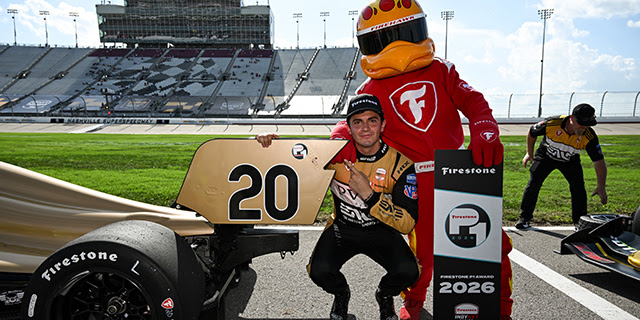
Nannini earned his first pole of this season and the second of his INDY NXT by Firestone career Saturday by taking the top spot for the Music City Grand Prix at Nashville Superspeedway. He turned a two-lap average speed of 177.427 mph in the No. 20 Enve Motorsports car fielded by Cape Motorsports Powered by ECR.
The Italian was forced to wait to celebrate Saturday at the 1.33-mile concrete oval, as he stared at the timing screen in his pit while 10 drivers that followed him in the qualifying line unsuccessfully tried to topple him from the pole. The performance surprised Nannini, who was a disappointing 20th out of 23 drivers in practice this morning.
“I was kind of mad with what was going on,” Nannini said about his mood after practice. “I didn’t think we were going to be able to turn it as good. A top 10 would have been good, but P1 is kind of surprising. Obviously, we’ll take it.
“The race is a totally different deal – 65 laps. We’ll do our best, and we’re starting from the best spot in the house.”
Nannini’s pole came more than three years after his first, earned in May 2023 for the opening race of the Indianapolis Grand Prix doubleheader on the Indianapolis Motor Speedway road course. He won that race with Juncos Hollinger Racing in his sole season in the INDYCAR development series before returning this year with the Cape team.
Rookie Alessandro de Tullio qualified second at 177.114 in the No. 14 AJ Foyt Racing entry. It’s his 11th front-row start in 13 races this season, including a series-leading seven poles.
Fellow rookie Nikita Johnson will start third in the No. 21 Cape Motorsports Powered by ECR car after his run of 177.072, capping a strong session for the team. Myles Rowe, winner of three of the last four oval races in the series, will join Johnson on the second row after his run of 176.873 in the No. 99 Abel Motorsports with Force Indy machine.
Niels Koolen continued his strong weekend by qualifying a career-best fifth at 176.816 in the No. 10 Chip Ganassi Racing entry. Rookie Max Garcia also will start in Row 3 after his qualifying run of 176.276 in the No. 12 Abel Motorsports car.
Series leader Enzo Fittipaldi qualified 14th at 175.398 in the No. 67 HMD Motorsports car.
Nannini will aim for his second career victory in the 65-lap race, which starts at 1 p.m. ET Sunday (FS1, FOX One, INDYCAR Radio powered by OnlyBulls).
“I’m just looking forward to doing my best,” Nannini said. “It’s a long race. I’ll try not to use the tires too much at the beginning and then go from there.”
LEBANON, Tenn. (Saturday, July 18, 2026) – Kyle Kirkwood and Andretti Global delivered a mighty qualifying effort Saturday at Nashville Superspeedway, edging oval master Josef Newgarden to win the NTT P1 Award for the Borchetta Bourbon Music City Grand Prix presented by OnlyBulls.
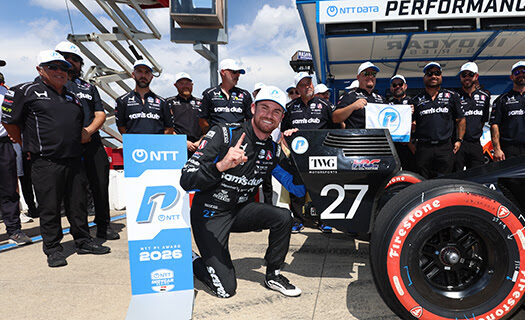
Kirkwood earned his first pole of the season and fourth of his NTT INDYCAR SERIES career with a two-lap average speed of 196.852 mph in the No. 27 Sam’s Club Honda. That dramatic run, the second-to-last in the qualifying order, validated the speed Kirkwood showed by leading practice Saturday morning on the 1.33-mile concrete oval.
“Quite honestly, it’s the car that Andretti gives me here,” Kirkwood said. “We were quick in practice. We’ve been good here the past couple of years.
“I did the same as everybody else is doing, right? You just hold it flat, and you hope your car goes fast. They built a really good car around me, did everything right. I managed the tools a little bit, got aggressive with some trim. It worked out well.”
This is the second career oval pole for Florida native Kirkwood. He also won the top spot for this event in 2024, with Newgarden also qualifying second.
Newgarden took the top spot today on a steamy afternoon with his two-lap average of 196.642 in the No. 2 Astemo Team Penske Chevrolet, looking to remind everyone why he is the dominant oval racer of recent years in the series. He has won 13 of the last 30 circle-track events, including this race last year.
But four drivers later, Kirkwood blasted out of the gates with an opening lap of 197.382 – the only lap in the entire session faster than 197 mph – and hung on to seize the pole from Nashville-area native Newgarden, still recovering from a foot injury suffered in a crash in the Indianapolis 500 presented by Gainbridge.
“We have a great car here,” Newgarden said. “We started earlier this morning really well. The team did everything they could today, and we have a good viewpoint for tomorrow now.”
Team Penske took two of the top three spots on the starting grid as Scott McLaughlin qualified third at 196.087 in the No. 3 Odyssey Battery Team Penske Chevrolet. Reigning and four-time series champion Alex Palou will join McLaughlin on the second row after qualifying fourth at 196.050 in the No. 10 DHL Chip Ganassi Racing Honda.
Six-time series champion Scott Dixon continued a strong performance for Chip Ganassi Racing, as he qualified fifth at 195.802 in the No. 9 PNC Chip Ganassi Racing Honda. 2016 Indianapolis 500 winner Alexander Rossi rounded out Row 3 at 195.664 in the No. 20 ECR Java House Chevrolet.
All drivers coped with tricky, stifling conditions during qualifying. The air temperature was 94 degrees, with track temperatures reaching 130.
David Malukas, who has scored more oval points than any driver this season, did not attempt to qualify in the No. 12 Verizon Team Penske Chevrolet after a heavy crash in practice this morning.
Malukas climbed from the car with assistance from the AMR INDYCAR Safety Team, but he was transported to a local hospital via private vehicle for further testing. His status for the 300-lap race Sunday remains undecided, and the No. 12 car will start last in the 25-car field.
The race is scheduled to start at approximately 5:30 p.m. ET Sunday, subject to the end time of the FIFA World Cup Final. FOX, FOX One and INDYCAR Radio powered by OnlyBulls will provide live coverage.
Chandler Smith backed up his thrilling final-lap victory at North Wilkesboro Speedway from a year ago to rocket away from the competition through a late dominant NASCAR Craftsman Truck Series run in the Faith Fest 250 on Saturday, July 18.
The 24-year-old Smith from Talking Rock, Georgia, led a race-high 105 of 250-scheduled laps in an event where he started in ninth place and navigated his way to a third-place result at the conclusion of the first stage period. After continuing to battle towards the front for the majority of the second stage period, Smith, who surrendered track position towards the front to pit with most of the field, used his fresh tires to muscle his way up to second place once the second stage period concluded.
Prior to the final stage period, Ty Majeski, who was among a handful of competitors who did not pit to garner stage points and who ultimately won the second stage period, pitted, which allowed Smith to cycle as the leader. For the event’s third and final stage start with 99 laps remaining, Smith motored ahead of Christian Eckes and the field. From there, he never looked back as he lapped a majority of the field and set the bar for the largest margin of victory on a short-track event in the Craftsman Truck Series division. When the checkered flag flew, Smith emerged victorious over teammate Layne Riggs for the first time in five months.
With on-track qualifying that determined the starting lineup occurring on Friday, July 17, Layne Riggs achieved his second consecutive Truck pole position of the 2026 season with a pole-winning lap at 121.608 mph in 18.502 seconds. Carson Hocevar started alongside Riggs on the front row with a fast lap at 121.503 mph in 18.518 seconds.
When the green flag waved and the event commenced, pole-sitter Layne Riggs, who opted to start on the outside lane, quickly lost the lead to Carson Hocevar as Hocevar nearly slid up the track to stall Riggs’ momentum through the first turns. Hocevar retained a steady lead through the backstretch as Riggs tried to reel in and regain the top spot. As Riggs threw himself beneath Hocevar through Turns 3 and 4, they dueled for the lead as Hocevar barely led the first lap.
During the second lap, Corey Heim made a move beneath both Hocevar and Riggs in a three-wide bid for the lead for nearly half a lap. Amid Heim’s challenge, Hocevar, who remained on his preferred outside lane towards the outside lane to gain momentum entering straightaways, rocketed his No. 77 Delaware Life Chevrolet Silverado RST entry ahead of Heim and Riggs to retain the lead. As Riggs used every inch of the track through the turns and straightaways while trying to challenge Hocevar, Hocevar continued to lead through the Lap 10 mark.
On Lap 13, the event’s first caution flew when newcomer Donovan Strauss, who was driving the No. 4 Chevrolet Silverado RST entry for Niece Motorsports, spun in the backstretch after he got hit in the rear by Corey LaJoie while racing in the mid-pack region. At the moment of caution, Hocevar was leading ahead of Riggs while Christopher Bell, Heim, Kaden Honeycutt, Chandler Smith, Chase Elliott, Giovanni Ruggiero, Grant Enfinger and Stewart Friesen were scored in the top 10, respectively.
During the next restart on Lap 19, Hocevar gained a strong launch from the outside lane to motor ahead and retain the lead while Riggs barely fended off Bell to retain the runner-up spot. Riggs then dueled against Hocevar through the frontstretch for the next lap after Hocevar went slightly high, but the latter managed to motor back ahead and retain the top spot during the following lap. While both Riggs and Bell reeled in for the lead, Heim and Chandler Smith battled for fourth place in front of Honeycutt and Elliott as Hocevar led at the Lap 25 mark.
Through the Lap 35 mark, Hocevar led by two-tenths of a second over Riggs while third-place Bell trailed by more than a second. Behind, Chandler Smith outdueled Heim for fourth place in front of Honeycutt, Elliott, Ruggiero, Christian Eckes and Grant Enfinger while Stewart Friesen, Nick Leitz, Cole Butcher, Andres Perez De Lara, Tanner Gray, Dawson Sutton, Shane van Gisbergen, Landen Lewis, Ben Rhodes and Ty Majeski were mired in the top-20 mark ahead of Daniel Hemric, Tyler Reif, Jake Garcia, Justin Haley and Tyler Ankrum, respectively. Meanwhile, Ryan Newman was mired in 32nd place while newcomer Kasey Kleyn was racing in 27th place behind Brenden Queen.
Ten laps later, Hocevar continued to lead by two-tenths of a second over Riggs and by more than two seconds over Bell while Chandler Smith started to reel in on Bell for third place. Another three laps later, Riggs cut his deficit to a tenth of a second as Hocevar was mired in lapped traffic. Riggs then spent the following two laps fiercely battling with Hocevar before the former slid in front of Hocevar entering the frontstretch to lead for the first time on Lap 51. Hocevar then tried to execute a crossover move on Riggs entering the first turn, but Riggs used the outside lane to motor his No. 34 Infinity Ford F-150 entry ahead and start to build a reasonable gap between himself and Hocevar. With the lead to his advantage, Riggs led by four-tenths of a second near the Lap 55 mark and by more than a second at the Lap 60 mark while Hocevar, Chandler Smith, Bell and Heim were racing in the top five, respectively.
When the first stage period concluded on Lap 70, Riggs, who led by nine-tenths of a second, won his seventh Truck stage period of the 2026 season. Hocevar followed suit in second ahead of Chandler Smith, Bell and Elliott while Heim, Honeycutt, Eckes, Ruggiero and Enfinger were scored in the top 10, respectively. By then, 23 of 36 starters were scored on the lead lap while names that included Tyler Ankrum, Justin Haley, Brenden Queen, Kasey Kleyn, Corey LaJoie, Donovan Strauss, Mini Tyrrell, Ryan Newman, Frankie Muniz and Luke Baldwin were pinned a lap down. Under the event’s first stage break period, the leaders pitted, and Riggs exited first ahead of Hocevar, Chandler Smith, Elliott and Eckes.
The second stage period started on Lap 81 as Jake Garcia, who remained on the track on worn tires, and Riggs occupied the front row. At the start, Garcia was shoved ahead of Riggs by Hocevar from the outside lane. As both Hocevar and Riggs made contact in the backstretch that nearly got Riggs sideways, both the latter and Hocevar dueled fiercely for the runner-up spot in front of Elliott and the field fanned out to three tight-packed lanes. Meanwhile, Garcia, who led the next lap, motored ahead and led by six-tenths of a second by Lap 85.
On Lap 98, Hocevar, who spent the previous 14 laps outdueling Riggs before he reeled in on Garcia, reassumed the lead after he used the inside lane through Turns 3 and 4 to then slide in front of Garcia. Hocevar proceeded to lead by eight-tenths of a second over Garcia just past the Lap 100 mark as both Chandler Smith and Riggs reeled in on Garcia for the runner-up spot. Smith proceeded to overtake Garcia for the runner-up spot while Garcia used the outside lane to fend off Riggs for third place. The latter two’s battle allowed Elliott to reel in while Eckes, Friesen, Heim, Ruggerio and Majeski were racing in the top 10, respectively. While Honeycutt was mired in 19th place due to an engine issue, Hocevar led by four-tenths of a second at the Lap 110 mark.
On Lap 118, the caution flew when Luke Baldwin, who was a lap down in 26th place, spun in Turn 4 and made slight rear-end contact with the outside wall. During this caution period, most of the field led by Hocevar pitted while Majeski, Andres Perez De Lara, Grant Enfinger, Ben Rhodes and Daniel Hemric remained on the track. Following the pit stops, Hocevar exited pit road first, and he was followed by Chandler Smith, Friesen, Riggs, Eckes and Elliott. During the pit stops, Nick Leitz and Ryan Newman, the latter of whom received the free pass to cycle back on the lead lap, were penalized for speeding on pit road.
The next restart on Lap 128 featured Majeski motoring his No. 88 Menards Ford F-150 entry ahead of Perez De Lara from the inside lane to lead through the first two turns and the backstretch. As the field fanned out while bumping and jostling for spots, Majeski led the next lap while Riggs and Hocevar were mired within the top-10 mark. While trying to navigate his way back to the front amid a stacked competition, Riggs nearly got turned by Hocevar in Turn 3. The contact cost Riggs a handful of spots and he dropped out of the top-10 mark. As the laps in the second stage period concluded, Hocevar, who was mired in 12th place, cut a left-front tire and he both dropped off the pace and lost a lap to the leaders while he was trying to limp his entry around the track.
When the second stage period concluded on Lap 140, Majeski won his first Truck stage period of the 2026 season. Chandler Smith, Rhodes, Eckes, Friesen, Hemric, Perez De Lara, Ruggiero, Heim and Elliott were scored in the top 10 while 24 of 36 starters, not including Hocevar, were scored on the lead lap. As soon as the second stage period concluded, Hocevar pitted and lost another lap to the field. During the event’s second stage break period, Majeski led Rhodes, Hemric, Perez De Lara, Honeycutt, Tanner Gray and Enfinger to pit road for service while the rest led by Chandler Smith remained on the track.
With 99 laps remaining, the final stage period commenced as Chandler Smith and Eckes occupied the front row. At the start, Smith rocketed his No. 38 QuickTie Ford F-150 entry ahead of the field from the outside lane entering the first two turns, As Smith led the next lap over Ruggiero, Eckes, Friesen, Heim and Riggs, a variety of on-track actions that involved shuffling and the field fanning out within the field ensued. Amid the on-track battles, Friesen battled Eckes for third place in front of Heim and Riggs while Landen Lewis battled Bell for seventh place. Shane van Gisbergen, who also cracked the top 10 in the late stages, outdueled teammate Elliott for ninth place and Eckes prevailed in his earlier battle with Friesen for third place. Meanwhile, Chandler Smith led by a second with 90 laps remaining.
Down to the final 80 laps of the event, Chandler Smith was leading by more than two seconds over Ruggiero and by four seconds over Eckes while Friesen and Heim occupied the remaining top-five spots ahead of Lewis, Riggs, van Gisbergen, Bell and Elliott, respectively. Behind, Tyler Reif occupied 11th place in front of Honeycutt, Garcia, Dawson Sutton and Majeski while Cole Butcher, Nick Leitz, Rhodes, Ankrum and Tanner Gray were mired in the top-20 spots over Queen, Hemric, Perez De Lara, Newman and Enfinger, respectively. With 24 of 36 starters scored on the lead lap, Smith slightly extended his lead to nearly three seconds over Ruggiero with 70 laps remaining.
With 60 laps remaining, Chandler Smith continued to extend his late advantage as he was leading by more than four seconds over Ruggiero while Eckes trailed in third place by five seconds. While Riggs and Friesen raced in the top five, van Gisbergen navigated his way into sixth place after he overtook Heim while Lewis, Elliott and Honeycutt trailed in the top 10. Van Gisbergen proceeded to overtake Friesen to move into the top-five mark while Smith added another two seconds to his lead as he remained atop the leaderboard by six seconds over Eckes and Ruggiero with 50 laps remaining.
As the event reached its final 40-lap mark, Chandler Smith stabilized his lead to six seconds over both Riggs and Eckes while fourth-place Ruggiero and fifth-place van Gisbergen both trailed by seven seconds. Over the next 10 laps, Riggs shaved off a second of teammate Smith’s advantage, but the latter, who was mired in heavy lapped traffic, maintained the top spot.
Down to the final 20 laps, Chandler Smith, who continued to be mired in lapped traffic, increased his lead to seven seconds over teammate Riggs while van Gisbergen marched his way into third place. By then, van Gisbergen, who marched his way up into third place, trailed the lead by eight seconds, and Eckes also trailed in fourth place by eight seconds while Ruggiero trailed by 11 seconds in the fifth and final top-five spot. With only 14 competitors scoring on the lead lap, Smith led by nearly eight seconds with less than 15 laps remaining, and he maintained the advantage with 10 laps remaining. Smith proceeded to add another second and increase his lead to nine seconds over Riggs with five laps remaining.
When the white flag waved and the final lap started, Chandler Smith remained in the lead by more than eight seconds over Riggs. While being surrounded in lapped traffic, Smith had no further competition lurking behind him and he cycled his way around North Carolina’s North Wilkesboro Speedway smoothly for a final time before he returned to the frontstretch and claimed the checkered flag by 8.479 seconds over Riggs.
With the victory, Chandler Smith, who won for the first time since this year’s season-opening event at Daytona International Speedway in mid-February, notched his ninth career win in the NASCAR Craftsman Truck Series division in his 102nd start, the sixth victory of the 2026 season for both Front Row Motorsports and Ford, and his fifth on a short track venue. Smith also set the record for the largest margin of victory in a Truck Series short-track event at 8.479 seconds, and he became the first competitor to repeat as a Truck winner at North Wilkesboro Speedway.
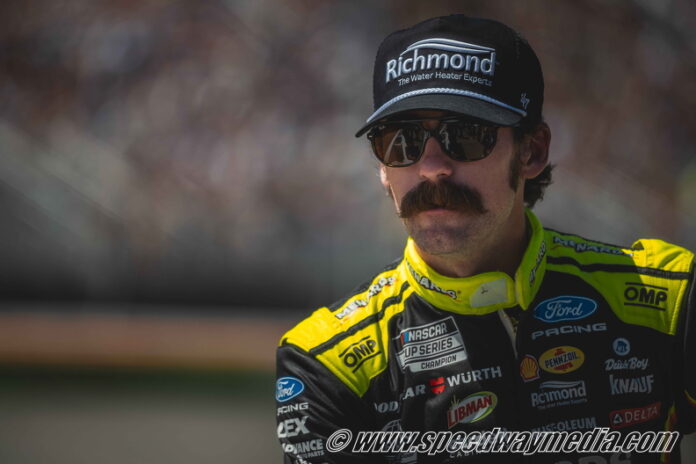
Photo by John Knittel for SpeedwayMedia.com.
“God’s good in the mountains, but man, he’s good in the valleys too, and we’ve been in the valleys the past few weekends,” Smith said on the fronstretch on FS1. “We’ve had good speed, but not good finishes. I just wanna give all the glory and praise to the one that comes from the source of this. If it wasn’t for God, I wouldn’t have this great group of men and women behind me at Front Row Motorsports. Great partners with QuickTie Products. Everybody from the top down that supported this program. I’m slapped. It was hot. We’re ready to rip [for the Chase].”
Riggs, who led 25 laps compared to teammate Chandler Smith’s 105, settled in second place for his fifth top-two result this season. Ironically, this year marks a second consecutive year where both Smith and Riggs of Front Row Motorsports finished first and second in the Truck event at North Wilkesboro.
“Part of me wanted to have a restart, but part of me knew if that happened, there was probably going to be some carnage,” Riggs said. “I was very happy just finishing the race there. Congratulations to Chandler; he did a great job. Those guys had a great race. I think we could’ve contended at the end. I really fought fire-off speed and then [the] short run at the end of Stage 2, I lost it, lost it again to start the final stage, just really took that long run to get going. The cards just didn’t fall our way today.”
Shane van Gisbergen tied his career-best result by finishing in third place in his fourth Truck career start. Christian Eckes and Landen Lewis finished in the top five, respectively, with Lewis achieving his third consecutive top-five result. Giovanni Ruggiero, Chase Elliott, Stewart Friesen, Corey Heim and Ty Majeski completed the top 10 in the final running order.
Notably, Kaden Honeycutt, who won a pair of zMAX CARS Tour events at North Wilkesboro on Friday, settled in 11th place while Christopher Bell finished in 15th place in his fifth Truck start of this season. In addition, Ryan Newman finished in 24th place while driving Kaulig Racing’s No. 25 ‘Free Agent’ RAM 1500 entry and Carson Hocevar, who never rallied from his cut tire incident prior to the second stage’s conclusion, ended up two laps down in 27th place.
This event featured seven lead changes for six different leaders, and four cautions for 34 laps. In addition, 10 of 36 starters finished on the lead lap.
Following the 15th event of the 2026 NASCAR Craftsman Truck Series season, Layne Riggs leads the regular-season standings by 59 points over Kaden Honeycutt, 126 over teammate Chandler Smith, 157 over Christian Eckes and 173 over Giovanni Ruggiero.
Results:
Chandler Smith, 105 laps led
Layne Riggs, 25 laps led, Stage 1 winner
Shane van Gisbergen
Christian Eckes
Landen Lewis
Giovanni Ruggiero
Chase Elliott, one lap led
Stewart Friesen
Corey Heim
Ty Majeski, 23 laps led, Stage 2 winner
Kaden Honeycutt, one lap down
Tyler Reif, one lap down
Jake Garcia, one lap down, 22 laps led
Ben Rhodes, one lap down
Christopher Bell, one lap down
Dawson Sutton, one lap down
Nick Leitz, one lap down
Tanner Gray, one lap down
Tyler Ankrum, one lap down
Daniel Hemric, one lap down
Brenden Queen, one lap down
Cole Butcher, one lap down
Andres Perez De Lara, two laps down
Ryan Newman, two laps down
Grant Enfinger, two laps down
Justin Haley, two laps down
Carson Hocevar, two laps down, 74 laps led
Mini Tyrrell, two laps down
Corey LaJoie, three laps down
Kris Wright, three laps down
Clayton Green, four laps down
Frankie Muniz, four laps down
Luke Baldwin, five laps down
Nathan Nicholson – OUT, Accident
Kasey Kleyn – OUT, Electrical
Donovan Strauss – OUT, Overheating
Next on the 2026 NASCAR Craftsman Truck Series schedule is the TSport 200 at Lucas Oil Indianapolis Raceway Park in Brownsburg, Indiana. The event is scheduled to occur next Friday, July 24, and air at 8 p.m. ET on FS1, NASCAR Racing Network, and SiriusXM.
Ford Racing Notes and Quotes NASCAR Craftsman Truck Series FaithFest 250 — North Wilkesboro Speeday Saturday, July 18, 2026
SMITH POSTS REPEAT VICTORY WITH F-150 AT NORTH WILKESBORO SPEEDWAY
Chandler Smith won at North Wilkesboro for the second straight year this afternoon.
It’s also the second straight year Smith and Riggs finished first and second.
Ford has now won six races this season and four of the last six overall.
The win is Smith’s second of the season after he captured the season-opener in Daytona.
That also marks his fourth win in two seasons driving for Front Row Motorsports.
The win is FRM’s 21st all-time and sixth in 2026, which is the most for the organization in one season.
Layne Riggs has four wins to go with Smith’s two.
Overall, Ford has won 135 series races.
CHANDLER SMITH, No. 38 QuickTie Ford F-150 – VICTORY LANE INTERVIEW – WHAT WENT THROUGH YOUR MIND WHEN THAT TRUCK SPUN WITH TWO LAPS TO GO? “I was just like, ‘Come on boys. Just keep it straight. It ain’t that deep. I’m already right here.’ All glory goes to God. We’ve been in the valley the past few weeks and I was telling these guys, ‘God is good in the mountains, but he’s also good in the valleys.’ We’ve been in the valleys. Today we’re on the mountaintop. Either way, whether if we’re on the mountaintop or in the valley we’re gonna keep raising Him. I just want to give all glory to him. He’s the source of where all blessings and all the trials flow, so I’m just grateful.”
THE SHORT TRACK PROGRAM AT FRM IS REALLY GOOD. HOW MUCH PRESSURE DID YOU PUT ON YOURSELF TO TRY AND REPEAT? “We won last year and were really good and my truck wasn’t good. This year, our truck was good and it reflected that.” HOW HARD WAS IT TO FOCUS WITH THE HEAT? “I’m scorched to say the least.”
Ford Finishing Order:
1st – Chandler Smith 2nd – Layne Riggs 10th – Ty Majeski 13th – Jake Garcia 14th – Ben Rhodes 22nd – Cole Butcher 31st – Clayton Green 32nd – Frankie Muniz 33rd – Luke Baldwin
LAYNE RIGGS, No. 34 Infinity Communications Group Ford F-150 – “It was hot. Congratulations to the 38 team and Chandler. They’ve had some really tough races recently. I’m really proud of everybody at Front Row Motorsports and the organization. A one-two finish again this year. We did it the right way this time with no controversy on this one. That first stage I was fighting tight and we freed it up. It was freer, but it just didn’t make any speed so we really had to throw the wholesale at it to start the final stage. I was loose to start again and just kind of maintained. Once everyone else started falling off I was really good on the long run. We just didn’t have the fire off speed at the beginning of the run to hold my track position, but to come under green up to second I’m very happy and very proud of my team. We got Infinity Communications a good run. I wanted to get them a win, but I’m just happy for this whole organization. Those guys deserve it. They did a great job today.”
TY MAJESKI, No. 88 Great Lakes Flooring/Menards Ford F-150 – “I liked the call to stay out. I didn’t feel like we were gonna get stage points in that second stage, and I didn’t feel like we were probably gonna finish better than fifth if we didn’t flip it. So, I feel like it was a good call. I’m not positive on the points, so we’ll take it and move on to a strong racetrack of ours in IRP. HOW HOT WAS IT TODAY? “Lime Rock was probably worse last week. It was hot there, but you’re working a lot harder at Lime Rock than you are here. A hot day, but nothing too bad.”
CHANDLER SMITH WINNER’S PRESS CONFERENCE
CAN YOU TALK ABOUT YOUR MINDSET IN THOSE FINAL LAPS? “It was hot. Right off the get-go from the start of the race I knew we had a really good truck, just starting the race around guys and seeing where they were struggling and where my strong suit was. It looked very similar to last year, but last year we were really good speedwise, but I wasn’t very happy with my truck. This year, we were really good speedwise, but also I had a really good handling race truck, so great job by everybody on this No. 38 team coming back year two, getting the thing dialed back in and making it a little better than it was last year.”
ARE WE OVERLOOKING YOU FOR THE CHAMPIONSHIP? “I don’t know. Are you all? I mean, that’s a question for you all. I personally feel like we’re a championship-caliber team. We went through a rut at truthfully Charlotte was induced by me. We went to Nashville and were extremely good, went to Michigan and was pretty good, finished top five or six there, whatever it was, and then had two back-to-back races at San Diego and then Lime Rock where we finished 30th, so points kind of don’t tell the full story, but truthfully this 38 team has been strong. The only race that I can even think back on this year that we haven’t been lights out was Dover and we weren’t lights out at Lime Rock, but we were still solid at Lime Rock. At Dover we weren’t good, but the 38 team has been firing on all eight cylinders. It’s just a matter of is it gonna be a good day or not. We’re just vessels trying to fulfill the Lord’s Will.”
HOW DO YOU FEEL YOU STACK UP AGAINST LAYNE AND THE 34 TEAM? “This is year two of our team being together. I think that’s year four of their team being together. I feel like realistically they should be ahead of us, but at the same time I felt like our growth and our progression from last year to this year is definitely reflected on our on-track results as well. We already have more top fives than we had last year. Our race trucks, our products are better than last year. Our pit crew has been doing a little bit better, so we’re trending in the right direction. A lot of times you look at some of those mini-highlights and talk about the 11 team. The 11 team has been around since Corey went to Tricon and look at how long it took for them to get as dominant as they were last year, so it takes time to build championship-caliber teams to where it is through in and out. Even on the hard days they can rebound and I feel like the 38 team is definitely trending in the direction of being a very predominant team where they look in the garage and go, ‘That’s an extremely stellar team.’ We’re really good, for sure. We’re third in points, but we still have room to grow, for sure.”
THIS IS THE LARGEST MARGIN OF VICTORY IN TRUCK SERIES SHORT TRACK HISTORY. WERE YOU SAVING ANYTHING IN ADVANCE IN THAT FINAL STAGE? “It’s funny. It was after eight laps when the start of stage three started. I just instantly started riding, but our truck was so good that it didn’t matter. I rode all the way to the very last lap and it was funny, they were reading my lap times off and I’m like, ‘Man, I’m sorry. I know you all probably think I’m just out here pushing it,’ but, truthfully, one thing that I have learned in short track racing growing up super late model racing, when you intentionally go to save tire, most of the time you actually hurt yourself more than you help yourself, so just driving underneath the tire, going as hard as you can but staying underneath it and not overslipping the right-front or the right-rear, that’s what I would call the most efficient way to save tire. That’s what I started doing from lap eight of the run all the way to the end and it’s crazy that we still ended up with that big of a margin of victory.”
HOW HARD WAS IT TO NOT LOSE FOCUS WHEN IT WAS SO HOT TODAY? “Truthfully, under green flag conditions, for me, you’re so focused and focused in on the task at hand that the heat is secondary, truthfully. Your mind, as you go through situations like this, you mentally block it out because you can’t focus on the heat. You’ve got to focus on the task at hand. A little slip up is a half-a-tenth to a tenth, so that’s a big deal especially in this garage. The part that sucks is when you’re under caution and you don’t have to focus and you’re just riding around. That’s when the heat soaks and you start noticing the little things like the fan ain’t blowing good air at all. The chill out shirt is starting to not be so chill anymore per se. That’s when it really sucks, so green flag runs are great and then once the caution comes out I’m like, ‘Uh, this sucks. I wish we could have just kept going.’”
IS THERE A SIMILAR SHORT TRACK FROM WHERE YOU GREW UP THAT TRANSLATES OVER TO THIS? “The short track principles apply here especially, and they reward you a lot here just being disciplined and what it takes to be good in a super late model at any short track in America when you’re facing your Bubba Pollards, your Chase Elliotts, all those guys I grew up racing in their prime – your Jeff Choquettes. You had to be flawless every weekend racing against those guys, so the principles on short track racing, it still applies even here and I think that’s just what it is.”
HOW BIG IS IT TO COME BACK HERE AND BE AS DOMINANT AS YOU WERE TODAY? “It’s just a testament to who good of a group of men and women I have around me at Front Row Motorsports. Like I said, our 38 team we’re progressively getting better and we’re seeing the fruit of that labor. Last year, we came here and won the race and we weren’t really that great, truthfully. I know on paper it looked like we were really good, but behind the wheel I was like, ‘Man, this thing ain’t really that great.’ Today, we were pretty good and the results on paper reflect that performance as well.”
THERE’S A THREE-WEEK BREAK AFTER NEW HAMPSHIRE. IS THAT A GOOD THING FOR YOU GUYS? “No. That’s the only thing I don’t like about Truck racing is these breaks and how inconsistent the schedule can become when you get started in the summer stretch a little later. I personally would be a huge 30-race Truck Series, let’s go do it guy because the Truck Series is a feeder series to O’Reilly and then Cup. The more experience Truck guys can get just prepares them more for when they make that next step, so I’m a big let’s go race more races.”
DOES IT HELP THE TEAM GET PREPARED? “It helps the team, but O’Reilly goes through the same thing. The teams will adapt. If there are more races added, the teams will adapt and it won’t be a problem because the teams will be forced to adapt. If you don’t, then you’re gonna get chewed up and spit out. I would love to see 30 races on the Truck schedule – 100 percent.”
YOU DID THE KYLE BUSCH BOW AFTER WINNING THE RACE. WHAT DID KYLE MEAN TO YOU? “Kyle meant a lot to me, truthfully. He meant a lot to me in a sense of he took the time out of his day when I had questions, not to rush me, he would sit me down and explain what I was asking and giving me the answer and being very thorough about it and not being short-winded. He cared really deeply about his drivers and the ones he believed in you could definitely tell because those are the ones that he really wanted to take time with. The ones that he kind of had run-ins with he was pretty vocal about it. Kyle was an amazing boss, a great mentor, and when even when I look at the Cup Series garage now I think of Christopher Bell, Bubba Wallace, William Byron – Kyle was the one that laid the foundation for them and their NASCAR career and helped those guys get to where they are now. Truthfully, Kyle is the one that kind of taught us all of the tricks that were up his sleeves and then, funny enough, we’d go out there and beat him with his own tricks. He would be like, ‘Man, I need to stop doing this. One of these days I’ll figure that out,’ but, truthfully, off the racetrack and away from the racetrack, Kyle was one of the most sweetest individuals that you would ever meet. He would take the shirt off his back for anybody else and that’s just who he was. We miss him deeply. The garage still isn’t the same and it never will be.”
WHAT WAS YOUR MINDSET WHEN YOU WERE TRAILING HOCEVAR AND RIGGS AND THEN HOCEVAR HAD HIS PROBLEMS AND YOU WERE ABLE TO GET THE LEAD? “The Lord works in mysterious ways, I suppose. Honestly, I felt like we had the truck capable of winning and we were the truck to beat. I was just kind of biding my time, being easy on my equipment, not burning up my tires. It’s a long race – 250 laps. You’re only in stage one so you’ve still got three-quarters of the race to go after stage one is done or whatever it may be, so I was just biding my time and waiting until stage two came around.”
HOW DID YOU AND KYLE BEING MEN OF FAITH PLAY INTO YOUR RELATIONSHIP? “It was big and honestly one of the most precious things for me, and I said this on live TV a few weeks ago and somebody, as always, people run their mouth, but it was truly a blessing to look back in the past year and reflect back to the time I met Kyle and how much his faith has grown and how much he really took that leadership role in his home even to the next level. I’m not saying he wasn’t right, wrong or indifferent when I met him, he was doing more. He was growing so much and it was such a blessing to see that, especially when you have individuals that you love and you care about, you want to see them succeed and do well, but not only in materialistic things, but you want to see them do well in their spiritual life as well and run the good race. The last few years, you definitely started seeing Kyle run a good race and that gave me some peace when I heard the news, for sure.”
Stewart Friesen moves into provisional Chase field after finishing eighth
NORTH WILKESBORO, NC (July 18, 2026) – Gio Ruggiero battled through hot conditions and an extended green-flag run to lead Toyota with a sixth-place finish in Saturday afternoon’s NASCAR Truck Series race North Wilkesboro Speedway.
Ruggiero led three Tundras in the top-10 with Stewart Friesen finishing eighth and Corey Heim in ninth. With the finish, Friesen provisionally moved back inside the top-10 in points with three races remaining in the regular season – Indianapolis Raceway Park, Richmond Raceway and New Hampshire Motor Speedway.
TOYOTA RACING Post-Race Recap NASCAR CRAFTSMAN Truck Series (NCTS) North Wilkesboro Speedway Race 15 of 23 – 156.25 Miles, 250 Laps
TOYOTA FINISHING POSITIONS
1st, Chandler Smith*
2nd, Layne Riggs*
3rd, Shane van Gisbergen*
4th, Christian Eckes*
5th, Landen Lewis*
6th, GIO RUGGIERO
8th, STEWART FRIESEN
9th, COREY HEIM
11th, KADEN HONEYCUTT
15th, CHRISTOPHER BELL
17th, NICK LEITZ
18th, TANNER GRAY
*non-Toyota driver
TOYOTA QUOTES
GIO RUGGIERO, No. 17 First Auto Group Toyota Tundra TRD Pro, TRICON Garage
Finishing Position: 2nd
Battled hot weather and scored a solid top-10 finish. How was your race?
“Yeah, it was definitely a hot day out. It felt really good to not fall out of the seat like some of these other guys. Thanks to everyone at the TPC (Toyota Performance Center) center for all they do for us and giving us all of the tools to properly heat train and be ready for this. I feel like it might have helped me today. Just struggled with the balance of the truck early in the race and at the end of the race, but my crew chief Jeff (Stankiewicz) made some good adjustments because we were struggling on the short run, and it made it better on the short run as you saw that last run there. Just tried to save some tires there and let the 38 (Chandler Smith) get away, thinking I would have a chance to get back to him later in the run because that is where our strong suit was earlier in the race. I think probably we were just a little high on air pressures to start off and kind of fell off at the end of that run. A tough day but battled hard and never gave up.”
About Toyota
Toyota (NYSE:TM) has been a part of the cultural fabric in North America for nearly 70 years, and is committed to advancing sustainable, next-generation mobility through our Toyota and Lexus brands, plus our more than 1,800 dealerships.
Toyota directly employs nearly 64,000 people in North America who have contributed to the design, engineering, and assembly of over 50 million cars and trucks at our 14 manufacturing plants. In 2025, Toyota’s plant in North Carolina began to assemble automotive batteries for electrified vehicles.
For more information about Toyota, visit www.ToyotaNewsroom.com.
INDIANAPOLIS (July 18, 2026) – NHRA officials are excited to announce that Autodromo of Monterrey has returned to the NHRA Member Track Network in NHRA’s South Central Division (Division 4).
Located in Apodaca, Nuevo León, Mexico, Autodromo of Monterrey is a popular multi-purpose facility, one that includes a standout dragstrip. Boasting a vast history and several events each year, the track returns to the NHRA Member Track Network after previously being affiliated with NHRA.
NHRA officials worked closely with the facility as the partnership came together, as well as Century Prime Global, which played an important role in Autodromo of Monterrey rejoining the NHRA family.
“Century Prime Global is honored to represent the Autodromo of Monterrey as we help bring an international NHRA racing event to Mexico,” Century Prime Global President Rudy Gutierrez said. ”Together, we are creating a historic milestone that celebrates Mexico’s rich motorsports heritage and inspires future generations to dream bigger, race faster, and make history.”
“The Autodromo of Monterrey team is excited to become an NHRA Member Track and help write a new chapter in the history of drag racing in Mexico,” Autodromo CEO Gilberto Jimenez said.
Autodromo of Monterrey is also part of NHRA’s expansive track network outside of the United States, joining 12 international tracks in Canada, Bahrain and Puerto Rico.
By joining the NHRA Member Track Network, Autodromo of Monterrey will be eligible to offer racers in the area a variety of NHRA-sanctioned racing opportunities in the future, including the NHRA Summit Racing Series presented by Hoosier, the NHRA Summit Racing Jr. Drag Racing League, NHRA Street Legal, NHRA Jr. Street and more. Additionally, the track will have the chance to host NHRA specialty events like the NHRA Summit King of the Track and more.
The facility will also get access to NHRA’s extensive support programs as part of the member track network, insurance benefits and national marketing platforms as they excitedly move into a new era for the facility.
“Division 4 has always represented more than just the South Central United States,” NHRA Division 4 Director Jonathan Johnson said. “It represents an international racing community. Having Autodromo of Monterrey join NHRA reinforces that commitment and opens an exciting new chapter for racers.
“This partnership is about more than hosting an event. It’s about investing in a passionate racing community, creating new opportunities for racers and working alongside a facility that shares NHRA’s commitment to delivering a first-class experience. Bringing NHRA Drag Racing back to Mexico is an exciting milestone for our racers, our fans and the future of the sport.”
For more information on NHRA, including the 2026 schedule, visit www.NHRA.com.
About NHRA
NHRA is the primary sanctioning body for the sport of drag racing in the United States. NHRA presents 20 national events featuring the NHRA Mission Foods Drag Racing Series and NHRA Lucas Oil Drag Racing Series, as well as the JBS Equipment NHRA Pro Mod Drag Racing Series presented by Elite Motorsports and NHRA Flexjet Factory Stock Showdown™ at select national events. NHRA provides competition opportunities for drivers of all levels in the NHRA Summit Racing Series and NHRA Street Legal™. NHRA also offers the NHRA Jr. Street® program for teens and the Summit Racing Jr. Drag Racing League® for youth ages 5 to 17. With more than 100 Member Tracks, NHRA allows racers to compete at a variety of locations nationally and internationally. NHRA’s Youth and Education Services® (YES) Program reaches over 30,000 students annually to ignite their interest in automotive and racing related careers. NHRA’s streaming service, NHRA.tv®, allows fans to view all NHRA national events as well as exclusive features of the sport. In addition, NHRA owns and operates three racing facilities: Gainesville Raceway in Florida; Lucas Oil Indianapolis Raceway Park; and In-N-Out Burger Pomona Dragstrip in Southern California. For more information, log on to www.NHRA.com, or visit the official NHRA pages on Facebook, Instagram, Twitter, and YouTube.
Elliott Sadler will be driving Kaulig Racing’s No. 25 ‘Free Agent’ RAM 1500 entry during next month’s NASCAR Craftsman Truck Series event at Richmond Raceway in Richmond, Virginia, on August 14.
The former NASCAR veteran from Emporia, Virginia, last competed in two O’Reilly Auto Parts Series events with Kaulig in 2019, with his latest start coming at Las Vegas Motor Speedway in mid-September, where he finished 10th. Previously, he competed full-time in the O’Reilly Series with JR Motorsports, an organization he drove for from 2016 to 2018 before retiring from full-time NASCAR competition.
Sadler made his first start across NASCAR’s top three national touring series at South Boston Speedway in mid-July 1995 for Sadler Racing. Over the next quarter century, he established a lasting impact through a versatile career that made him a popular figure both on and off the track. His top achievements while competing in NASCAR include winning the inaugural O’Reilly Series regular-season championship in 2017, notching a combined 17 victories through 855 starts across NASCAR’s top three national touring series (Craftsman Truck, O’Reilly & Cup), and being named Most Popular Driver in the O’Reilly Series for four seasons (2011, 2016-18).
Overall, Sadler accumulated a trio of victories, eight poles, 19 top-five results, 68 top-10 results, and 1,251 laps led through 438 Cup Series starts, with his best points result being ninth in 2004 after he made the inaugural Chase for the Cup. He achieved these feats while competing for organizations including Wood Brothers Racing, Robert Yates Racing, and Richard Petty Motorsports. His latest Cup start was at Daytona International Speedway in early July while driving for Tommy Baldwin Racing.
Sadler also recorded 13 victories, 18 poles, 106 top-five results, 227 top-10 results and 2,056 laps led through 397 starts in the O’Reilly Auto Parts Series. The Virginian finished in the top 10 in the final standings 10 times, made the series’ Chase for three consecutive seasons (2016-18) and notched four runner-up results in the final standings (2011-12, 2016-17). He achieved these feats while competing for organizations including Diamond Ridge Motorsports, Kevin Harvick Inc., Richard Childress Racing, Joe Gibbs Racing, Roush Fenway Racing, and JR Motorsports.
To date, Sadler has made a total of 20 starts in the Craftsman Truck Series through five part-time seasons (2000-01, 2003, 2010-11). During his starts, he achieved his first career victory during the series’ inaugural event at Pocono Raceway in mid-July 2010 while driving for Kevin Harvick Inc. He also recorded a pair of poles, four top-five results, 10 top-10 results and 289 laps led, with his latest start occurring at Homestead-Miami Speedway in mid-November 2011 while driving for Joe Denette Motorsports.
Sadler, whose hometown of South Boston is a little above two hours away from Richmond Raceway, expressed his excitement about the opportunity to come out of retirement and compete in a NASCAR-sanctioned event for the first time in nearly seven years and in front of his home crowd at Richmond.
“I’m really looking forward to getting back behind the wheel at Richmond Raceway in front of the great Virginia fans,” Sadler said. “It’ll be fun getting back into a truck — I just hope I still remember how to drive it. Richmond has always been special to me, and I’m thankful to Ram and Kaulig Racing for giving me this opportunity to compete again. I really cherished my career in NASCAR and how special the fans have been to me.”
“We are so excited to have Elliott drive for us at Kaulig Racing,” Chris Rice, CEO of Kaulig Racing and a South Boston, Virginia, native, added. “Elliott and I grew up racing together at South Boston Speedway, so to have him race for us in Richmond, in front of our home state fans, is special,” Rice said. “We won tons of races together, and thanks to Ram, [team owner] Matt Kaulig and everyone at Kaulig Racing, we have the opportunity to go out and try to win one more.”
Kaulig Racing launched its free-agent driver program ahead of its inaugural Craftsman Truck Series campaign in November 2025. The program features various competitors from multiple racing divisions and disciplines. Each will compete in at least one Truck event in one of Kaulig’s RAM 1500 entries numbered 25. The competitors who compete in the entry would not compete for the 2026 Truck Series driver’s championship. They will, however, be evaluated by their on-track performance for a season-ending program prize.
Currently, Kaulig Racing’s No. 25 entry, which is led by crew chief Dan Stillman, is ranked in 24th place in the 2026 owner’s standings after 14 of the 25-race schedule. The entry is one of five that is fielded by Kaulig. It competes alongside the No. 10 entry piloted by Corey LaJoie, the No. 12 entry piloted by rookie Brenden “Butterbean” Queen, the No. 14 entry piloted by newcomer Timothy “Mini” Tyrrell and the No. 16 entry piloted by Justin Haley.
Tony Stewart, Ty Dillon, Colin Braun, Corey LaJoie, Carson Ferguson, Parker Kligerman, AJ Allmendinger, Clint Bowyer, Travis Pastrana and Jamie McMurray have piloted the entry at least once. Braun, Dillon, Ferguson and Kligerman have each piloted the No. 25 entry twice, with Braun being the latest competitor to drive the entry as he is coming off a 10th-place result at Lime Rock Park. Allmendinger has recorded the entry’s highest-finishing result of sixth place at Watkins Glen International in early May.
Ryan Newman will pilot the No. 25 RAM entry today, July 18, at North Wilkesboro Speedway. Conor Daly will then drive the entry next Saturday, July 25, at Lucas Oil Indianapolis Raceway Park (IRP). Kaulig’s selection and reveal of drivers for the remainder of this season remains to be determined.
Elliott Sadler’s return as a NASCAR Craftsman Truck Series competitor at Richmond Raceway is scheduled to occur on August 14 at 7:30 p.m. ET on FS1, NASCAR Racing Network and SiriusXM.