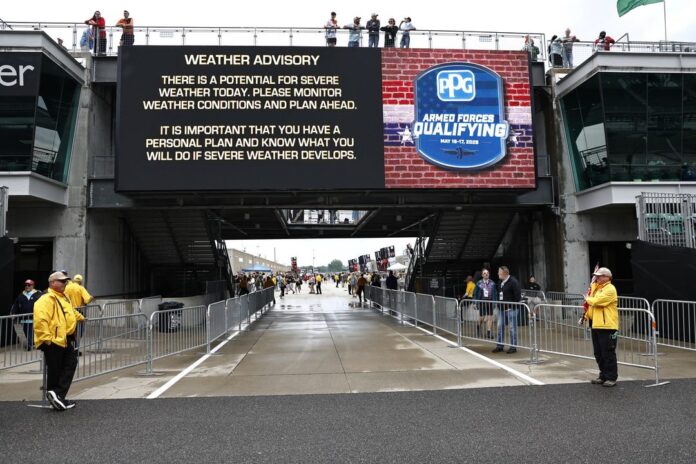
The first day of the PPG Armed Forces Qualifying Session for the 110th running of the Indianapolis 500 at Indianapolis Motor Speedway, which was scheduled to occur on Saturday, May 16, has been canceled due to on-track precipitation.
The first qualifying session was scheduled to commence at 11 a.m. ET and span through 6 p.m. ET. During the session, all 33 competitors entered to compete in the event would post a single qualifying attempt individually based on a qualification draw that occurred on Friday, May 15. Once all competitors posted a qualifying attempt, the teams would have the option to choose from two lanes for second and subsequent attempts. They would have as many attempts as they want until 5:50 p.m. ET, where Positions 16-33 would be determined.
Due to on-track precipitation that remained persistent throughout Saturday, a pre-qualifying practice session was canceled at 8:30 a.m. ET, the qualifying session for this year’s Indianapolis 500 has been postponed and rearranged to Sunday, May 17.
For Sunday’s on-track activities, a single pre-qualifying practice session will occur at 9:30 a.m. ET on FS2 before qualifying commences at noon ET on FS2. Each of the 33 competitors will receive a single attempt to qualify, and the top 12 fastest competitors will transfer to a second round for Sunday afternoon. Positions 13-33 will be determined following the first round. The top-12 qualifiers will then qualify in the second round at 4:30 p.m. ET on FOX before the six-fastest competitors transfer to the Firestone Fast 6 round that will occur at 6 p.m. ET on FOX. The pole winner and the official starting lineup for this year’s Indy 500 will then be determined following the Firestone Fast 6 round.
When the first round of qualifications commences on Sunday, Scott Dixon will be the first competitor to qualify after his name was drawn first to qualify on Friday, May 15.
Christian Lundgaard, Ryan Hunter-Reay, Ed Carpenter, Rinus VeeKay, Scott McLaughlin, Nolan Siegel, Graham Rahal, Josef Newgarden, Will Power, Felix Rosenqvist, Santino Ferrucci, Marcus Ericsson, Conor Daly, Mick Schumacher, Romain Grosjean, Marcus Armstrong, Pato O’Ward, David Malukas, Alexander Rossi, Dennis Hauger, Sting Ray Robb, Kyle Kirkwood, Caio Collet, Helio Castroneves, Takuma Sato, Christian Rasmussen, Louis Foster, Kyffin Simpson, Jack Harvey, Alex Palou, Jacob Abel and Katherine Legge will qualify after Dixon, respectively.
The 2026 Indianapolis 500 is scheduled to occur on May 24 at 12:30 p.m. ET on FOX.
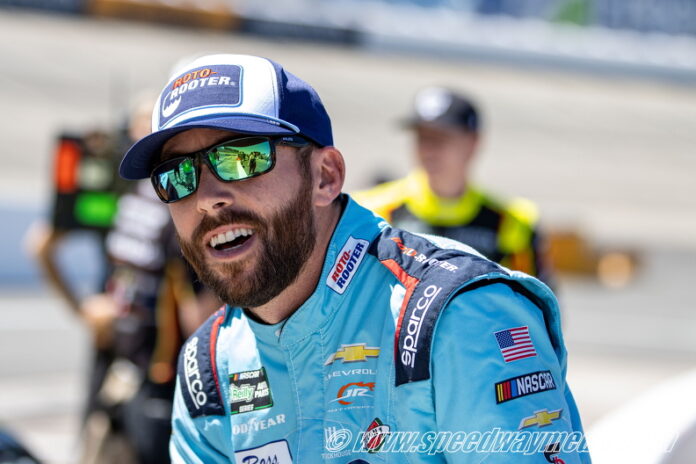
Ross Chastain claimed the pole position for the NASCAR O’Reilly Auto Parts Series’ BetRivers 200 at Dover Motor Speedway on Saturday, May 16.
The event’s qualifying format consisted of a single round with each of the 38 competitors cycling twice around Dover to post the fastest lap. The competitor who posted the fastest lap within the two qualifying laps was awarded the pole position.
During the session, Chastain, who was the 21st-fastest competitor during Saturday’s practice session, utilized his two qualifying laps to post a pole-winning lap at 154.394 mph in 23.317 seconds.
With the pole, Chastain achieved his second career O’Reilly Auto Parts Series pole position and his first since Darlington Raceway in September 2018. Saturday’s main event at Dover is scheduled to mark Chastain’s 219th O’Reilly career start and sixth of this season, driving the No. 9 Chevrolet Camaro entry for JR Motorsports.
Chastain will share the front row with Brandon Jones, the latter of whom posted the second-fastest qualifying lap at 154.030 mph in 23.372 seconds. Jones, who qualified in the top-five mark for a seventh time this season and second on the front row, is currently ranked in fourth place in the 2026 driver’s standings and trails the points lead by 207 points as he continues his season-long pursuit to make the Chase and contend for the series’ championship.
Corey Day, Rajah Caruth and Taylor Gray, the latter of whom was the fastest in practice, will start in the top five, respectively. Sam Mayer, Carson Kvapil, William Sawalich (second fastest in practice), Harrison Burton and Jesse Love completed the top-10 starting grid, respectively.
With 38 competitors vying for 38 starting spots, all made the main event.
Dover – Qualifying Position, Best Speed, Best Time:
Ross Chastain, 154.394 mph, 23.317 seconds
Brandon Jones, 154.030 mph, 23.372 seconds
Corey Day, 153.741 mph, 23.416 seconds
Rajah Caruth, 153.472 mph, 23.457 seconds
Taylor Gray, 153.374 mph, 23.472 seconds
Sam Mayer, 153.276 mph, 23.487 seconds
Carson Kvapil, 152.866 mph, 23.550 seconds
William Sawalich, 152.704 mph, 23.575 seconds
Harrison Burton, 152.542 mph, 23.600 seconds
Jesse Love, 152.252 mph, 23.645 seconds
Ryan Sieg, 152.226 mph, 23.649 seconds
Sheldon Creed, 152.021 mph, 021 seconds
Justin Allgaier, 151.771 mph, 23.720 seconds
Parker Retzlaff, 151.771 mph, 23.720 seconds
Jeb Burton, 151.636 mph, 23.741 seconds
Brent Crews, 151.394 mph, 23.779 seconds
Austin Hill, 151.197 mph, 23.810 seconds
Sammy Smith, 151.064 mph, 23.831 seconds
BJ McLeod, 150.798 mph, 23.873 seconds
Brennan Poole, 150.697 mph, 23.889 seconds
Jeremy Clements, 150.615 mph, 23.902 seconds
Dean Thompson, 150.521 mph, 23.917 seconds
Lavar Scott, 150.470 mph, 23.925 seconds
Kyle Sieg, 150.263 mph, 23.958 seconds
Myatt Snider, 149.682 mph, 24.051 seconds
Austin Green, 149.489 mph, 24.082 seconds
Anthony Alfredo, 149.074 mph, 24.149 seconds
Patrick Staropoli, 148.736 mph, 24.204 seconds
Blaine Perkins, 148.637 mph, 24.220 seconds
Garrett Smithley, 148.289 mph, 24.277 seconds
Andrew Patterson, 148.160 mph, 24.298 seconds
Ryan Ellis, 147.131 mph, 24.468 seconds
Blake Lothian, 146.711 mph, 24.538 seconds
Josh Bilicki, 146.651 mph, 24.548 seconds
Dawson Cram, 145.950 mph, 24.666 seconds
Logan Bearden, 145.596 mph, 24.726 seconds
CJ McLaughlin, 144.364 mph, 24.937 seconds
David Starr, 0.000 mph, 0.000 seconds
The 2026 BetRivers 200 at Dover Motor Speedway is scheduled to occur on Saturday, May 16, and air at 4 p.m. ET on the CW Network, PRN Radio and SiriusXM.
Zane Smith’s No. 38 team won the Mechanix Wear Pit Crew Challenge with a 12.612-second pit stop during NASCAR All-Star Race qualifying at Dover Motor Speedway.
Denny Hamlin secured the pole position with a qualifying time of 109.298 seconds at 98.812 mph, marking his second All-Star Race pole and first since 2015.
Zane Smith’s No. 38 team delivered the performance of the session Saturday at Dover Motor Speedway, winning the Mechanix Wear Pit Crew Challenge with a 12.612-second, four-tire pit stop during NASCAR All-Star Race qualifying at The Monster Mile.
The award-winning stop earned the No. 38 crew a $100,000 bonus and the first pit selection for Sunday’s NASCAR All-Star Race, giving the team a major advantage heading into one of NASCAR’s biggest events.
While the crew excelled under pressure on pit road, Smith will start 25th for Sunday’s All-Star Race following the combined qualifying format that included three timed laps and a mandatory four-tire pit stop.
Denny Hamlin ultimately secured the pole position for Sunday’s NASCAR All-Star Race with a total qualifying time of 109.298 seconds at 98.812 mph.
The pole marked Hamlin’s second career NASCAR All-Star Race pole award and his first since 2015, when he went on to win the race from the top starting position. Saturday’s run additionally delivered the eighth All-Star Race pole for Joe Gibbs Racing.
Hamlin’s pole-winning run came despite early adversity after the winner of the last two NASCAR Cup Series races at The Monster Mile spun during his warm-up lap before beginning his official qualifying attempt. The No. 11 team regrouped quickly and delivered the fastest overall effort of the session.
“Hats off to the team,” Hamlin said. “They’re the ones that keep you in the game.”
Saturday’s qualifying and Mechanix Wear Pit Crew Challenge featured no shortage of drama, including multiple on-track incidents.
Daniel Suarez suffered one of the most significant crashes of the session after his right-front wheel came loose exiting pit road during his qualifying run. Suarez entered Turn 1 before the wheel detached completely, sending his car into the outside wall.
“I went into Turn 1 and the tire just fell off,” Suarez said after being evaluated and released from the Infield Care Center. “It’s just crazy how these things happen. I thought my pit crew has been doing an amazing job. I’m just so proud of them.”
Ricky Stenhouse Jr. also endured a chaotic qualifying attempt when his No. 47 Chevrolet broke loose exiting Turn 4. Stenhouse spun multiple times down the frontstretch banking before narrowly avoiding contact with the inside wall.
The incident prevented his crew from getting the opportunity to complete their pit stop during the challenge portion of qualifying.
“Mainly, I was feeling bad for all my guys that they didn’t get the opportunity to do their pit stop,” Stenhouse said. “I’m definitely going to owe them something.”
Despite the spin, Stenhouse remained confident in both his car and team heading into Sunday’s race.
“I hate it for my guys; they brought a really fast Chevrolet,” Stenhouse said. “I was really happy with it in practice yesterday, felt really good right up until that point, so it just jumped out from underneath me and cost us a good shot at starting toward the front.”
The All-Star qualifying and Mechanix Wear Pit Crew Challenge created a high-pressure situation for pit crews at Dover Motor Speedway, putting them front and center for one of the few times during the NASCAR season.
Sunday’s NASCAR All-Star Race at The Monster Mile will feature NASCAR’s top stars battling for one of the sport’s most prestigious victories.
NASCAR TICKETS: Visit DoverMotorSpeedway.com to purchase tickets for Saturday’s BetRivers 200 or Sunday’s NASCAR All-Star Race, explore camping and parking options, or sign up for email updates.
FOLLOW US: Follow Dover Motor Speedway on Facebook, X, Instagram and TikTok (@MonsterMile) for the latest news and announcements.
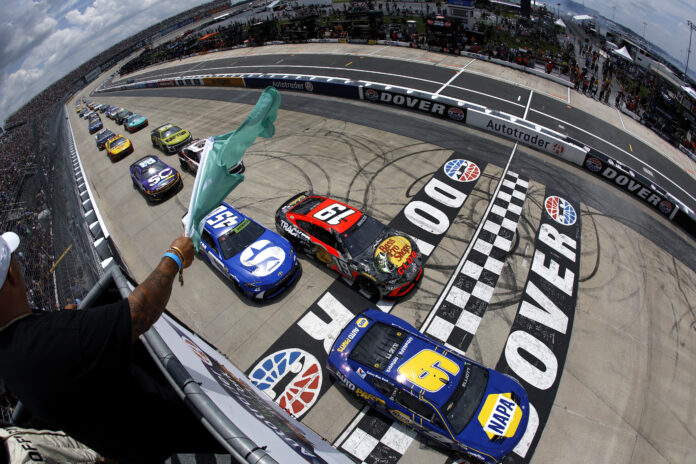
Green flag to start the NASCAR Cup Series AutoTrader EchoPark Automotive 400 at Dover Motor Speedway on July 20, 2025 in Dover, Delaware. (Photo by Sean Gardner/Getty Images)
The 2026 NASCAR All-Star Race at Dover Motor Speedway will feature a 350-lap race. It will consist of three segments and a unique qualifying session featuring the Pit Crew Challenge.
The All-Star exhibition race awards a $1 million prize to the winner. You can catch all the action on FS1 with radio coverage provided by MRN and SiriusXM NASCAR Radio.
This year, qualifying will be even more significant as it will determine the field for Segment 1 (75 laps). In Segment 2 (75 laps), the lineup os will be set by inverting Segment 1’s top 26. The remaining drivers lined up by finish.
The second lap will also feature the Mechanix Wear Pit Crew Challenge, as each pit crew performs a four-tire stop. The drivers will then race back to the start/finish line. Qualifying will include the total time from the green flag to the checkered flag.
The pit crew with the fastest pit stop and no penalties will win the Pit Crew Challenge. These results will determine the pit selection order for the All-Star Race.
The 26-driver field for the final 200-lap segment will include 2025 and 2026 Cup Series race winners, former Cup Series champions who compete full-time, and the Fan Vote winner. The remaining drivers’ starting positions will be based on their finish in Segments 1 and 2.
Voting for the 2026 NASCAR All-Star Fan Vote closes Sunday, May 17, at 9 a.m. ET. The winner will be announced before the start of the NASCAR All-Star Race at Dover Motor Speedway at 1 p.m. ET on Sunday, May 17.
As of May 11, the top five are (in alphabetical order): Alex Bowman, Chris Buescher, Noah Gragson, Ryan Preece, and Connor Zilisch.
Leading up to the All-Star Race, the NASCAR Craftsman Truck Series will headline the action with the ECOSAVE 200 on Friday evening. The NASCAR O’Reilly Auto Parts Series will compete Saturday at 4 p.m. in the BetRivers 200.
There have been a total of 41 NASCAR All-Star Races:
34 at Charlotte Motor Speedway (1985, 1987-2019) 1 at Atlanta Motor Speedway (1986) 1 at Bristol Motor Speedway (2020) 2 at Texas Motor Speedway (2021, 2022) 3 at North Wilkesboro Speedway (2023, 2024, 2025)
NASCAR Cup Series Entry List for Dover Motor Speedway All-Star Race
TOYOTA RACING – Denny Hamlin NASCAR Cup Series Quotes
DOVER, Del. (May 16, 2026) – Joe Gibbs Racing driver Denny Hamlin was made available to the media on Saturday after winning the pole for the NASCAR Cup Series All-Star Race from Dover Motor Speedway.
It is his second career All-Star Race pole. He won the pole in 2015 and drove to his only All-Star Race victory.
DENNY HAMLIN, No. 11 Progressive Insurance Toyota Camry XSE, Joe Gibbs Racing
Can you talk about your lap and your spin to getting the pole?
“Yeah, it was quite eventful for sure. I was trying to get an extra rep there on the bottom. I saw so many guys having issues leaving pit road, so I tried to get an extra rep there and it just, I mean, I just spun out. I don’t know. I didn’t think I was being that aggressive but spun out. At that point, just tried to minimize the damage. I mean, I did do some splitter, did do some underbody damage to it. Flat spotted the tires. That wasn’t ideal, but then I just committed to run the lap as hard as I could, and it was still good enough.”
Do you like this qualifying format?
“Yeah, I think it really challenges you. I mean, this is my first – I think the pole I had before was because of the pit crew, if I remember right. I’ve never been close when it comes to qualifying in this type of format towards the front. I just, it’s in my DNA. I’m a little conservative on all aspects. I’m never usually P1 in any metric of coming to pit road or leaving pit road or rolling, I’m usually pretty decent, so this is a challenging format for me, and it has been for all of my career. It is a risk reward. I certainly think that it’s certainly one that challenges the driver, especially having to come in and do it cold like this, overnight, and no reps – just going. It definitely is a team effort that, you know, puts the spotlight on everybody that’s involved.”
About Toyota
Toyota (NYSE:TM) has been a part of the cultural fabric in North America for nearly 70 years, and is committed to advancing sustainable, next-generation mobility through our Toyota and Lexus brands, plus our more than 1,800 dealerships.
Toyota directly employs nearly 64,000 people in North America who have contributed to the design, engineering, and assembly of over 50 million cars and trucks at our 14 manufacturing plants. In 2025, Toyota’s plant in North Carolina began to assemble automotive batteries for electrified vehicles.
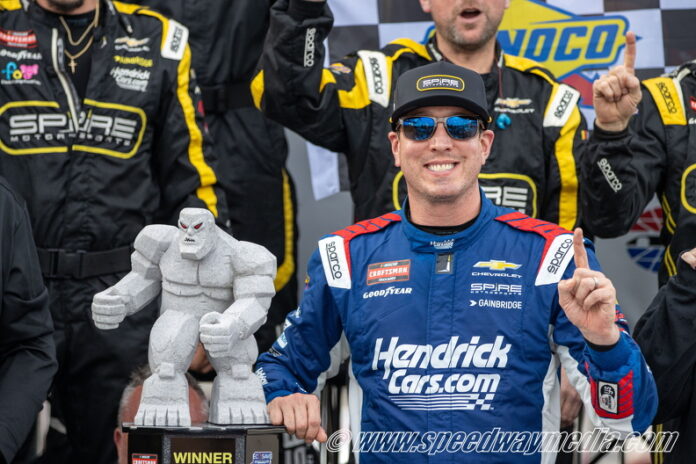
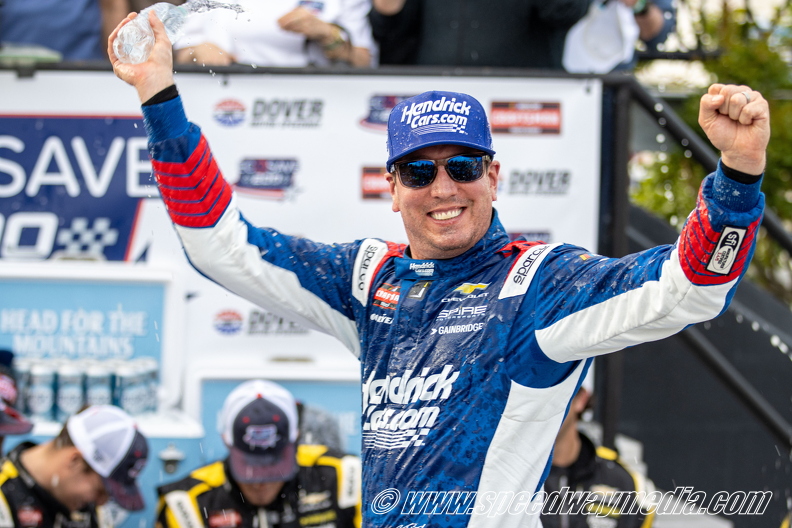
It was a flashback Friday at Dover Motor Speedway with Kyle Busch leading a race-high 147 laps in the NASCAR CRAFTSMAN Truck Series ECOSAVE 200 to extend his series-leading win total to 69. Busch dominated in his first Truck Series event at “The Monster Mile” since 2014, extending his win streak in NASCAR’s third division to four and increasing his overall win total in trucks at Dover to five.
Busch collected his 35th career Truck Series pole earlier in the day and remained out front until a caution came out with six to go in the opening stage. After pitting for fresh Goodyear tires and full load of Sunoco fuel, he lined up for the ensuing restart on the top of the second row. He quickly made his way back out front during the one-lap shootout to collect the stage win.
The Las Vegas native picked up right where he left off in Stage 2, checking out to a one-second lead early to maintain the top spot throughout the stage. Busch reported that his HENDRICKCARS.COM Silverado lacked overall grip before visiting pit road at the break. After the over-the-wall crew administered a four-tire and fuel stop with a small chassis adjustment, the 41-year-old driver was the third competitor off pit road. He quickly made his way to the runner-up position after the Final Stage went green and closed in on the leader.
A caution with 70 laps remaining in the race brought Busch to pit road, despite having a tight fuel window to make it to the end of the race, while the leader elected to remain on track. Once the race returned to green, NASCAR’s winningest driver would make his way back in the top spot with just under 60 laps to go. Busch opened up over a two-second lead with 10 to go while continuing to save fuel, and crossed the finish line 3.039 seconds ahead of second place.
The win was Busch’s second of the season in the NASCAR CRAFTSMAN Truck Series and helped the No. 7 team extend their lead by 38 points in the owner’s point standings.
Kyle’s Post-Race Comments “It’s awesome to be a part of Spire Motorsports. Thanks to Jeff (Dickerson, co-owner), Dan (Towriss, co-owner) and Mr. H for the opportunity, as well as everyone at HENDRICKCARS.COM. It takes a lot of great people behind you and you know Brian Pattie (crew chief) and this bunch on this team were a part of the group from KBM, right, and so it’s nice to be able to come back over here and win some more races again with that group. I love coming to Dover, always one of my favorite places to race, and definitely some managing of the fuel there, managing of the tires there. It was an interesting strategic battle from the driver’s seat. Thanks to all the fans. I appreciate everybody for being here at Dover and the Monster Mile for All-Star Weekend.”
Carson Hocevar, driver of Spire Motorsports’ No. 77 Delaware Life Chevrolet Silverado RST, endured a tire issue that limited him to a 31st-place finish in Friday afternoon’s ECOSAVE 200 at Dover Motor Speedway.
Hocevar started 18th, but worked the outside lane on the opening lap to reach 12th by the end of the first circuit. As Stage 1 continued, the Portage, Mich., native relayed he was battling a severely loose-handling Chevy, but held on to the 11th position when a Lap-41 caution flag was displayed. Crew chief Chad Walter called the six-time CRAFTSMAN Truck Series race winner to pit road for four tires and fuel, while also making air pressure and chassis adjustments. The No. 77 team picked up three spots on pit road, ultimately lining up 10th for a one-lap shootout to end the segment. Hocevar pulled off multiple daring maneuvers to capture a fifth-place finish in Stage 1.
The 23-year-old driver started Stage 2 in fourth, but finished the stage sixth, registering a total of 11 stage points on the day to aid in the No. 77 team’s fight for a CRAFTSMAN Truck Series owners’ title. During the ensuing stage break, the crew took the opportunity to fix damage on the left-front headlight stemming from an incident near the end of Stage 1. The process forced Hocevar to restart 23rd on Lap 99. After making progress from the drop of the green flag, a flat right-front tire forced Hocevar to pit road under green flag positions. The team continued to fight through tire and handling woes, but was ultimately credited with a 31st-place finish.
Carson’s Post-Race Comments “Tough day for us. Spent Stage 1 super free, but made an adjustment that made it pretty good. When we had that flat tire, we had to pit under green and just couldn’t recover. Excited to get to Charlotte next week.”
Up Next… The NASCAR CRAFTSMAN Truck Series takes on Charlotte (N.C.) Motor Speedway on Friday, May 22. The North Carolina Education Lottery 200 will be televised live on FS1 at 7:30 p.m. Eastern Daylight Time (EDT).
The 10th of 25 points-paying races on the CRAFTSMAN Truck Series calendar will be broadcast live on the NASCAR Racing Network and SiriusXM NASCAR Radio Channel 90.
To stay up-to-date on all the latest news and exclusive content, follow Spire Motorsports on Facebook, X and Instagram, and visit Spire-Motorsports.com.
About Spire Motorsports … Spire Motorsports fields full-time entries in the NASCAR Cup Series, NASCAR CRAFTSMAN Truck Series and Interstate Batteries High Limit Racing.
The team, co-owned by longtime NASCAR industry executive Jeff Dickerson and TWG Motorsports CEO Dan Towriss earned its inaugural NASCAR Cup Series victory in its first full season of competition when Justin Haley took the checkered flag in the Coke Zero Sugar 400 at Daytona (Fla.) International Speedway July 7, 2019. Less than three years later, William Byron drove Spire Motorsports’ No. 7 Chevrolet Silverado its first NASCAR CRAFTSMAN Truck Series win April 7, 2022, at Martinsville (Va.) Speedway. The team’s most recent victory came May 1, 2026, when Carson Hocevar won the CRAFTSMAN Truck Series’ SpeedyCash.com 250 at Texas Motor Speedway.
In 2026, Spire Motorsports campaigns the Nos. 7, 71 and 77 Chevrolet Camaro ZL1s in the NASCAR Cup Series and the Nos. 7 and 77 Chevrolet Silverado RSTs in the NASCAR CRAFTSMAN Truck Series. The Mooresville, N.C., organization also fields the No. 77 410 sprint car in Interstate Batteries High Limit Racing competition.
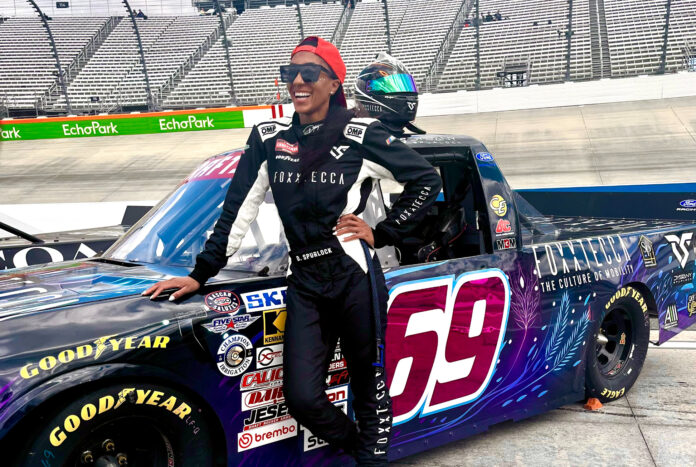
Despite her groundbreaking start in the ECOSAVE 200 ending early, Spurlock became the first Black woman to compete in one of NASCAR’s three national touring series.
DOVER, Del. — Dystany Spurlock made motorsports history Friday at Dover Motor Speedway, becoming the first Black woman to compete in one of NASCAR’s three national touring series with her debut in the NASCAR CRAFTSMAN Truck Series ECOSAVE 200.
Driving the No. 69 Foxxtecca Ford for MBM Motorsports and Garage 66, Spurlock cemented her place in NASCAR history when the green flag dropped at the “Monster Mile.”
The landmark moment ended earlier than expected, however, after an incident in the race’s opening stage cut her debut short.
Spurlock qualified 34th in the 36-truck field, which included Cup Series regulars Kyle Busch, Christopher Bell, and Ross Chastain. After taking the start from Row 17, she settled into a steady rhythm around the high-banked concrete oval and worked her way up to 32nd position in the early going.
But Spurlock said the track conditions had changed significantly from earlier in the day. “After our practice and qualifying, the Cup guys had their practice session, and once we got back out there the track surface was completely different,” she explained. “It was tight everywhere, so I had to really minimize how much throttle I could get into through the corners.”
The race-ending incident took place coming out of Turn 2 on lap 37 as another truck pulled up tightly to her inside.
“Once that happens, you pretty much have to let him go, which I tried to do as much as I could,” Spurlock said. “But by the time he went past me, it sucked the air from under me and got me really loose. I tried to save it as much as I could, and then another truck came to the other side and sucked the air from that side and just snapped me around. At that point, there was nothing I could do.”
Spurlock was almost able to gather the truck back up before the banking and tight quarters of Dover ultimately sent the No. 69 into the outside wall. The front-end damage was too severe to continue.
“But I was fine,” she added.
While the result was disappointing, the start itself was a monumental achievement, and the experience gained throughout the weekend will serve both Spurlock and the team moving forward.
In fact, it was a challenging day from the start. The team had lost 20 minutes of practice time after failing pre-race technical inspection. Once on track, Spurlock’s truck repeatedly shut off because of a failed crank position sensor, limiting her practice laps. Despite the complications and shortened track time, Spurlock still managed to post a respectable pace.
But the historic significance of the moment remains undeniable. Spurlock’s debut represented another important step forward for diversity and representation in stock car racing while also marking a major milestone in her fast-developing racing career.
Earlier this season, Spurlock became the first Black woman to compete in the NASCAR-owned ARCA Menards Series East when she started—and finished an impressive seventh—at Hickory Motor Speedway. She added another milestone shortly after by stepping up to the national ARCA Menards Series and earning another top-10 finish at Kansas Speedway.
Primary sponsor Foxxtecca remains fully committed to Spurlock both on and off the racetrack as she works toward building experience and creating future opportunities at NASCAR’s highest levels.
“History was made,” said Chris Harris, co-founder of Foxxtecca. “Regardless of the outcome, this moment is monumental for sports, women in sports, and the continued progress of equality and diversity.
“The competitor in all of us wanted a better result, but that’s racing,” he added. “Foxxtecca will continue to support Dystany and diversity in the mobility industry. There is a lot of change that needs to happen in motorsports and mobility, and Foxxtecca is proud to be a disruptor for positive change. We aren’t going anywhere. On to the next race.”
Based in Detroit and co-founded by Harris and Kellie Crawford, Foxxtecca is an experiential media and events company operating at the intersection of mobility, culture, and technology. The company connects the automotive industry with new and diverse audiences through storytelling, education, and live experiences.
Foxxtecca is also producing the docuseries Driven by Dystany: The Road to NASCAR, which follows Spurlock’s progression through the motorsports ranks. The behind-the-scenes series has helped bring widespread attention to her career while continuing to grow her fanbase and national profile.
Spurlock is scheduled to compete next in the ARCA Menards Series Henry Ford Health 200 at Michigan International Speedway on June 5. The event will mark her first appearance at the fast 2-mile D-shaped superspeedway known for its high speeds, 18-degree banking, and intense racing.
ABOUT FOXXTECCA
Foxxtecca is a Detroit-based experiential events and media company operating at the intersection of mobility, culture, and technology. Co-founded by Chris Harris and Kellie Crawford, Foxxtecca amplifies underrepresented voices in the mobility and technology industries through motorsports, education, and culturally driven experiences.
Car insurance is not only a renewal formality; it is a financial decision that affects how well your vehicle and legal liabilities are protected. Many Indian car owners choose basic third-party insurance because it meets the legal requirement under the Motor Vehicles Act. Yet, as repair exposure, traffic density, and vehicle usage patterns change, upgrading to comprehensive cover can offer broader protection.
In this article, you will explore when upgrading makes sense and when third-party cover may still suit you.
Why You Should Upgrade to Comprehensive
Comprehensive car insurance is designed for car owners who want protection beyond third-party liability. While third-party insurance covers liabilities towards another person, vehicle, or property, a comprehensive policy can also cover damage to your own car, depending on the policy wording, add-ons, and applicable terms.
You Want Wider Protection for Your Own Car
A third-party policy keeps you legally compliant, but it does not cover repair expenses for your own vehicle after an accident. This can become a concern when your car is used daily, parked in open areas, driven through busy roads or exposed to unpredictable weather.
A comprehensive policy may cover your own vehicle against events such as:
Accidental damage
Theft
Fire-related damage
Natural calamities
Certain man-made events
Third-party liability
This makes the policy more suitable for car owners who want a wider financial safety net.
Your Car Still Has Good Market Value
Upgrading is worth considering when your car still holds meaningful value. Even a single major repair can affect your savings, especially when parts, labor, and technology-led components are involved.
A comprehensive policy can make sense when:
Your car is new or relatively new
You rely on your car for daily travel
You park in public or shared spaces
You drive regularly in high-traffic areas
You prefer structured claim support for own-damage events
The aim is not to buy more insurance than you need. The aim is to match your policy with your car’s usage, value and risk exposure.
You Want Add-on Flexibility
One major reason to upgrade from third-party cover is the option to add comprehensive insurance. Add-ons vary by insurer and policy, but they can allow you to customize coverage based on your driving habits and vehicle needs.
Common add-ons may include:
Zero depreciation cover
Engine protection
Roadside assistance
Consumables cover
Return to invoice cover
No-claim bonus protection
These add-ons are usually available at an additional premium and should be selected after carefully reading the policy wording.
You Are Renewing after a Change in Usage
Your car insurance should reflect how you use your vehicle today, not how you used it in the past. For example, a car that was used occasionally may now be used for office travel, family trips or intercity driving.
A renewal should not be treated as an automatic repeat of last year’s policy. It is an opportunity to reassess whether third-party cover is still sufficient.
When to Stick with Third-Party
Third-party insurance may still be suitable for some car owners. The right choice depends on your vehicle, budget, usage and financial comfort.
Your Car Is Older and Used Sparingly
For an older car with lower resale value, some owners may choose third-party cover to handle minor repairs themselves. This may be reasonable when the car is not used often and is driven only for short distances.
You Mainly Want Legal Compliance
Third-party insurance is the minimum legal requirement for driving a car on public roads in India. It protects you against liabilities arising from injury, death or property damage caused to a third party, depending on the applicable law and policy terms.
You Are Comfortable Taking Own-Damage Risk
Some car owners prefer to pay for their own repairs rather than buy comprehensive cover. This choice may suit someone who rarely drives, has a well-maintained older car, and has enough savings to cover repair expenses.
Conclusion
Upgrading from third-party to comprehensive car insurance is usually worth considering if your car is high-value, regularly used, or at higher risk of accidents, theft, or weather-related damage. Third-party cover may suit limited-use or older cars when you mainly need legal compliance. Before you renew car insurance, compare both options carefully, read the policy wording, and choose coverage that matches your vehicle, usage, and financial comfort.
Kyle Busch executed a masterclass performance by notching a dominant NASCAR Craftsman Truck Series victory in the ECOSAVE 200 at Dover Motor Speedway on Friday, May 15.
The two-time Cup Series champion from Las Vegas, Nevada, led three times for a race-high 147 of 200 scheduled laps in the No. 7 Spire Motorsports Chevrolet. Busch was also the fastest in practice, qualified on the pole position and captured the event’s first two stage periods. After restarting in third place to commence the third and final stage period, Busch spent the following two restarts dueling with Ross Chastain for the lead.
Despite being outdueled by Chastain twice through a pair of restarts amid Chastain’s late tire gamble for track position, Busch used fresher tires by pitting his Spire entry before the final stage with the field to overtake Chastain for a final time with 58 laps remaining. From there, Busch managed through his fuel tank, tires and fended off Ty Majeski for the event’s remainder to add another Truck victory at Dover to his accomplished racing resume.
With on-track qualifying that determined the starting lineup occurring on Friday, Kyle Busch secured his first Truck pole position of the 2026 season with a pole-winning lap at 161.740 mph in 22.258 seconds. Busch shared the front row with Ty Majeski as the latter clocked in the second-fastest lap at 161.544 mph in 22.285 seconds. Before the event, Stewart Friesen dropped to the rear of the field due to unapproved adjustments that were made to his No. 52 Halmar Friesen Racing Toyota Tundra TRD Pro entry.
When the green flag waved and the event commenced, Kyle Busch and Ty Majeski dueled for the lead for half a lap until Busch motored his No. 7 HendrickCars.com Chevrolet Silverado RST entry ahead from the outside lane entering Turns 3 and 4. As Busch led the first lap, Majeski retained second place ahead of Kaden Honeycutt. Brandon Jones, Giovanni Ruggiero, Christopher Bell, Ross Chastain and the field pursued amid close-quarters racing.
Over the next four laps, Busch extended his early advantage to six-tenths of a second over Majeski while Honeycutt, Ruggiero and Jones occupied the remaining top-five spots ahead of Bell, Chastain, Jake Garcia, Ben Rhodes and Daniel Hemric. Amid a series of early on-track battles around Dover, Busch proceeded to lead by a second at the Lap 10 mark while Honeycutt started to reel in Majeski for the runner-up spot.
Through the first 20 scheduled laps, Busch was leading by more than a second over Honeycutt, who assumed the runner-up spot from Majeski on Lap 11. Behind, Ruggiero and Bell occupied the remaining top-five spots over Jones. Chastain, Rhodes, Garcia, Hemric, while Layne Riggs, Andres Perez De Lara, Carson Hocevar, Cole Butcher and Chandler Smith trailed in the top 15 ahead of Mini Tyrrell, Grant Enfinger, Parker Eatmon, William Sawalich and Brenden Queen, respectively. Meanwhile, Tanner Gray, Justin Haley, Clint Bowyer, Christian Eckes, Luke Baldwin, Dawson Sutton, Tyler Ankrum, Stewart Friesen, Corey LaJoie and Kris Wright were mired in the top 30, respectively, while Natalie Decker, Dystany Spurlock, Toni Breidinger, Spencer Boyd and Frankie Muniz were all lapped by Busch.
Ten laps later, Kyle Busch added another second to his advantage as he led by more than two seconds over Honeycutt and Majeski while Bell and Ruggiero were racing in the top five ahead of Jones, Chastain, Rhodes, Riggs and Garcia. Meanwhile, Hemric plummeted to the bottom of the leaderboard as he fell off the pace due to a low fuel pressure and coasted his No. 19 CRC Brakleen Chevrolet Silverado RST entry to pit road. Amid Hemric’s issues, Busch retained the lead by more than two seconds over Honeycutt by Lap 35.
On Lap 39, the event’s first caution flew when Dystany Spurlock, who made history in being the first African American female competitor to compete across NASCAR’s top three national touring series at the event’s start at Dover, got loose entering the backstretch as she was racing in front of Andres Perez De Lara. After trying to gain control of her No. 69 Foxxtecca Ford F-150 entry through the backstretch, she then snapped to the right and hit the outside wall head-on, which concluded her debut with a wrecked entry.
During the event’s first caution, select names led by Cole Butcher, Brenden Queen, Dawson Sutton, Stewart Friesen and Corey LaJoie remained on the track while the rest led by Busch pitted. Following the pit stops, Honeycutt exited pit road first over Busch while Majeski, Ruggiero and Chastain followed suit. Amid the pit stops, Honeycutt and Rhodes were sent to the tail end of the field due to speeding on pit road.
When the event restarted for a one-lap dash to cap off the first stage period, Butcher was pushed by Busch ahead of Queen from the outside lane through the frontstretch before Busch used the outside lane to overtake Butcher for the lead through the first two turns. As Busch used his fresh tires to motor away from the field, the field fanned out and jostled through the backstretch before they navigated through Turns 3 and 4. At the front, Busch stormed to the first stage victory over Majeski, Butcher, Chastain, Hocevar, Ruggiero, Garcia, Bell, Enfinger and Riggs, respectively.
Under the event’s first stage break period, the following names that included Butcher, Queen, Sutton, Friesen and LaJoie pitted while the rest, led by Busch, remained on the track.
The second stage period started on Lap 53 as Busch and Majeski occupied the front row. At the start, Busch motored ahead of Majeski from the outside lane through the frontstretch. He then transitioned to the inside lane and retained the lead through the first two turns and the backstretch while the rest of the field trailed and jostled for spots. Busch led the next lap over Chastain while Majeski dropped to third in front of a side-by-side battle with Ruggiero and Hocevar. As Bell navigated his way past Hocevar for fifth place while trailing Ruggiero, Busch continued to lead by eight-tenths of a second on Lap 60.
At the Lap 70 mark, Busch maintained an advantage of a second over Chastain while third-place Majeski trailed by more than a second ahead of Ruggiero and Bell. While Hocevar, Garcia, Riggs, Jones and Enfinger occupied the remaining top-10 spots ahead of Honeycutt, Chandler Smith, Eckes, Tyrrell and Rhodes, Busch maintained his lead by seven-tenths of a second over Chastain by Lap 80.
When the second stage period concluded on Lap 90, Kyle Busch, who was mired in lapped traffic, fended off Chastain by 0.088 seconds to claim his second consecutive Truck stage victory of the event. Majeski, Ruggiero, Bell, Hocevar, Riggs, Jones, Honeycutt and Enfinger settled in the top 10, respectively, while 24 of 36 starters were scored on the lead lap.
During the event’s second stage break period, the lead lap field led by Busch pitted for service. Following the pit stops, Chastain exited pit road first ahead of Majeski, Busch, Ruggiero, Riggs, Bell, Honeycutt, Enfinger, Garcia and Jones, respectively.
With 102 laps remaining, the final stage period commenced as Chastain and Majeski occupied the front row. At the start, Chastain motored ahead of Majeski and Busch through the frontstretch, the first two turns and the backstretch while Busch and Majeski battled for second place. As the field behind jostled for late spots, Chastain led the next lap over Busch, Riggs, Majeski and Ruggiero while Bell fended off Honeycutt for sixth place. In addition, Bowyer, who made contact with Hocevar entering the first turn at the third stage’s start, was mired in 19th place ahead of teammate Mini Tyrrell while Chastain retained the lead by four-tenths of a second over Busch with 99 laps remaining.
With 83 laps remaining, the caution flew when Luke Baldwin, who had a handful of on-track run-ins with Bowyer, got loose entering Turn 3 and made slight contact with Brenden Queen before he slid up the track, hit the outside wall, slid down the Turn 4 track and hit the inside wall. Prior to Baldwin’s wreck, Hocevar made an unscheduled pit stop under green to have a flat right-front tire addressed. During this caution period, the leader Chastain remained on the track while the rest of the field, led by Busch, pitted for service.
The next restart, with 76 laps remaining, featured Busch and Chastain dueling for the lead for nearly a full lap as Chastain managed to fend off Busch from the outside lane despite being on a tire advantage. Amid a series of on-track battles, contact and jostles within the field, Chastain led the next lap and he managed to motor ahead and maintain a steady lead over Busch over the following three laps.
The caution then returned with 72 laps remaining due to Tyrrell spinning his No. 14 Kaulig Racing RAM 1500 entry through the frontstretch and making contact with the inside wall. Tyrrell’s incident was due to the driver getting loose entering the frontstretch while dueling with teammate Bowyer as Bowyer was bolting past Parker Eatmon, as Eatmon remained on the track with worn tires.
As the event restarted under green with 67 laps remaining, Chastain and Busch battled dead even, starting from the frontstretch through the backstretch, before the former prevailed for a second time from the outside lane and with older tires than Busch entering Turns 3 and 4. As Chastain led the next lap over Busch, a series of on-track battles ensued while Majeksi, Riggs and Bell were racing in the top five ahead of Honeycutt. Meanwhile, Bowyer was racing with a left-front tire rub that was generating smoke through the turns. This was due to Chandler Smith getting loose and hitting Bowyer’s left side amid the latest restart, though Bowyer continued to race towards the top-20 mark. Meanwhile, Chastain maintained a steady lead over both Busch and Majeski with 60 laps remaining.
Then, with 58 laps remaining, Busch overtook Chastain and returned atop the leaderboard. Busch proceeded to lead by nearly half a second over Majeski with 50 laps remaining while Riggs, Bell and Honeycutt trailed in the top five, respectively. Meanwhile, Chastain dropped to sixth place as Busch retained the lead by half a second over Majeski with 40 laps remaining.
Down to the final 30 laps of the event, Busch slightly increased his lead to eight-tenths of a second over Majeski while Riggs, Bell and Honeycutt trailed in the top five ahead of Rhodes, Jones, Chastain, Sawalich and Garcia, respectively. Busch grew his lead to a second with 25 laps remaining and to one-and-a-half seconds with 20 laps remaining while Majeski retained the runner-up spot. Meanwhile, Chastain, who pitted his No. 45 Delaware Office of Highway Safety Chevrolet Silverado RST entry for fresh tires under green with 22 laps remaining, dropped to 22nd place and out of the lead lap category.
With 15 laps remaining, Busch grew his lead to more than two seconds over Majeski while Bowyer pitted and spent multiple laps in his pit stall due to a broken wheel on the No. 25 Kaulig Racing RAM 1500 entry. As Busch was told to preserve his fuel tank to the scheduled distance, he had his lead shrink to nearly one-and-a-half seconds with five laps remaining as Majeski tried to reel in Busch. Nevertheless, Busch maintained a steady lead through each turn and straightaway as the laps dwindled.
When the white flag waved and the final lap started, Busch remained in the lead by two-and-a-half seconds over Majeski. With Busch showing no signs of having any fuel issues or stumbling for a final time, he cycled back to the frontstretch to claim the checkered flag by three seconds over Majeski.
With the victory, Busch, who won in his fourth of eight Truck starts this season with Spire Motorsports, notched his 69th career win in the NASCAR Craftsman Truck Series division, which extends his all-time record of having the most victories in the series. He also notched his second victory of the 2026 season and his all-time leading fifth victory at Dover, with the Truck division returning to race at Dover for the first time since August 2020.
The 2026 season marks Busch’s 18th season of winning multiple Truck events, as he won earlier in mid-February at EchoPark Speedway. Busch’s next two Truck events are over the next two Fridays. The first will be at Charlotte Motor Speedway in Concord, North Carolina (May 22) and the second at Nashville Superspeedway in Lebanon, Tennessee (May 29).
Photo by Logan Allen for SpeedwayMedia.com.
“You never know when the last [win] is,” Busch said on the frontstretch on FS1. “I know all too well, unfortunately, with the Cup stuff, but here with the Truck stuff right now, it’s awesome just to be a part of Spire Motorsports. It feels good to have another Kyle being able to [win] and putting ourselves in Victory Lane. [I] Love coming to Dover. Always one of my favorite places to race and definitely some managing of the fuel there, managing of the tires there. It was an interesting strategic battle from the driver’s seat…It’s nice to be able to come back over here [in the Truck Series] and win some more races again with that [No. 7 Spire Motorsports] group. It’s fun and you want to keep doing it.”
Ty Majeski settled in the runner-up spot for a second time in the 2026 season and for his fifth top-10 result through nine Truck events this season. With the result, Majeski picked up two spots in the points standings and is ranked in fifth place as he continues his season-long pursuit of a first victory in the No. 88 ThorSport Racing Ford F-150 entry.
“[We’re] Trending up,” Majeski said. “We just got to keep it flat right here. What a great recovery from the last couple weeks. [I] Had fast trucks all year. Just circumstances have prevented us from getting some finishes that we’ve deserved. Everybody at ThorSport’s [Racing] been working their guys out during this six-week stretch to keep our trucks competitive. We were in the game today…Sold effort. Can’t wait for Charlotte next week.”
Layne Riggs finished in third place while Kaden Honeycutt and Christopher Bell finished in the top five. Brandon Jones, Christian Eckes, Corey LaJoie, Jake Garcia and Justin Haley completed the top 10, respectively, in the final running order. Notably, Ross Chastain, who led 49 laps, settled in 18th place while Clint Bowyer, who was unable to finish due to his late tire hub issue, settled in 29th place.
There were five lead changes for four different leaders. The event featured five cautions for 28 laps. In addition, 13 of 38 starters finished on the lead lap.
Following the ninth event of the 2026 NASCAR Craftsman Truck Series season, Kaden Honeycutt leads the standings by 38 points over Layne Riggs, 39 over Chandler Smith, 61 over Giovanni Ruggiero and 70 over Ty Majeski.
Results:
Kyle Busch, 147 laps led, Stages 1 & 2 winner
Ty Majeski
Layne Riggs
Kaden Honeycutt, one lap led
Christopher Bell
Brandon Jones
Christian Eckes
Corey LaJoie
Jake Garcia
Justin Haley
Stewart Friesen
Chandler Smith
Brenden Queen
William Sawalich, one lap down
Grant Enfinger, one lap down
Tanner Gray, one lap down
Kris Wright, one lap down
Ross Chastain, one lap down, 49 laps led
Ben Rhodes, two laps down
Giovanni Ruggiero, three laps down
Parker Eatmon, three laps down
Spencer Boyd, four laps down
Dawson Sutton, four laps down
Frankie Muniz, four laps down
Tyler Ankrum, five laps down
Toni Breidinger, six laps down
Mini Tyrrell, six laps down
Andres Perez De Lara, 11 laps down
Clint Bowyer – OUT, Hub
Daniel Hemric, 23 laps down
Carson Hocevar – OUT, Suspension
Luke Baldwin – OUT, Accident, Accident
Cole Butcher – OUT, Accident, three laps led
Natalie Decker – OUT, Too Slow
Caleb Costner – OUT, Vibration
Dystany Spurlock – OUT, Accident
Next on the 2026 NASCAR Craftsman Truck Series schedule is the North Carolina Education Lottery 200 at Charlotte Motor Speedway in Concord, North Carolina. The event is scheduled to occur next Friday, May 22, and air at 7:30 p.m. ET on FS1, NASCAR Racing Network, and SiriusXM.
This victory marked Busch’s 69th Truck Series win and his fifth win at Dover in the Truck Series.
Busch set a new Truck Series track record during qualifying with a lap time of 22.258 seconds, securing the pole position.
Dover, Del. – (May 15, 2026) Kyle Busch conquered The Monster Mile once again Friday evening, but this time it took more than pure speed to get the job done.
After dominating the NASCAR CRAFTSMAN Truck Series ECOSAVE 200 at Dover Motor Speedway, Busch was forced to manage his fuel over the closing laps while Ty Majeski closed in behind him. In the end, the two-time Cup Series champion had just enough fuel left in the tank to seal another victory at The World’s Fastest One-Mile Oval.
The win is the 69th of his NASCAR CRAFTSMAN Truck Series career and his fifth Truck Series victory at Dover. The win also counts as his 13th victory at Dover Motor Speedway between all three of NASCAR’s national touring series.
“You never know when the last [win] is,” Busch said after the race. “It feels really good to put it in victory lane again.”
Busch’s statement weekend started before the green flag even waved for the ECOSAVE 200. During qualifying, he shattered the NASCAR CRAFTSMAN Truck Series track record at Dover with a lap of 22.258 seconds to earn the pole position.
Once the race began, Busch showed exactly why he has long been one of the best drivers to ever tame Miles the Monster. He controlled the early pace and led the field through the opening run before the first caution came out on Lap 39, when Dystany Spurlock made contact with the wall in her NASCAR CRAFTSMAN Truck Series debut.
Busch stayed firmly in command after the restart, capturing Stage 1 before continuing his dominance with a Stage 2 victory to sweep both opening stages.
The race tightened up again on Lap 119 when Luke Baldwin spun in Turn 3 and hit the inside wall, bunching the field together for a green-flag run to the finish.
As fuel strategy became the deciding factor late in the race, Busch had to balance saving fuel while still maintaining enough pace to keep Majeski behind him.
“Definitely some managing of the fuel there, managing the tires there. It was an interesting strategic battle, I guess, from the driver’s seat,” Busch said. “Thanks to the fans and all the people for being here.”
The gap shifted back and forth over the closing laps as the two veterans played a strategic game of chess around the high banks of Dover.
“We were playing cat and mouse a little bit with Kyle there,” Majeski said after his runner-up finish. “We’ve got some momentum heading in the right direction, for sure.”
Kaden Honeycutt also impressed throughout the evening, fresh off securing his first career victory last week. Honeycutt brought home a fourth-place finish after running near the front for much of the race.
“It was a good day for us and a lot of fun,” Honeycutt said. “The top widened out in Turns 3 and 4 — should be a good Cup Series race on Sunday.”
Clint Bowyer finished 29th in his return to the Truck Series. “I had a ton of fun,” Bowyer said. “This is a cool racetrack, a demanding racetrack and neat to see Kyle Busch in Victory Lane, NASCAR needs that and it gives him so much confidence moving into tomorrow’s event and Sunday.
For Busch, the win added another chapter to his long history of success at Dover Motor Speedway. He looks to add another win in the NASCAR All-Star Race on Sunday at 1 p.m.
NASCAR TICKETS: Visit DoverMotorSpeedway.com to purchase tickets for Saturday’s BetRivers 200 or Sunday’s NASCAR All-Star Race, explore camping and parking options, or sign up for email updates.
FOLLOW US: Follow Dover Motor Speedway on Facebook, X, Instagram and TikTok (@MonsterMile) for the latest news and announcements.