Home Blog Page 7

Foldable eBikes for RV Travel: What to Know Before You Buy

An RV buys freedom on the open road — right up until you’re parked. Driving into town for groceries, looping the campground to find the shower block, or reaching a trailhead half a mile out shouldn’t require breaking camp or squeezing a 30-foot rig into a gas station lot. Yet that’s exactly the trade-off many RV travelers make, simply because nothing smaller is on board.

A foldable electric bike closes that gap. It tucks into space a full-size bicycle can’t, and its motor turns hills, headwinds, and long campground loops into a non-issue. Fold it, stow it, and suddenly the RV isn’t the only way to get around.

But “it folds” is not a buying criterion on its own. Weight, folded dimensions, battery storage, how you’ll actually carry it, and how it rides over a week of repeated trips all matter more than whether the frame hinges in the middle. This guide walks through what to compare before a foldable eBike takes up any of that hard-won storage space.

Why a Folding Electric Bike Works With an RV

Easier Transportation Once You’re Parked

Once the RV is leveled and hooked up, moving it again for a quick errand is its own chore. A folding eBike skips that — leave the RV in place and ride off for supplies, food, or a look around camp. The electric assist earns its keep on the way back: dial it down on flat stretches to save battery, lean on it for the climb home with a loaded pannier.

The value is practical first, recreational second — a bike that handles the store run is also ready for an evening ride along the lake.

Compact Doesn’t Mean Light

Folding shrinks the footprint, not necessarily the mass. A motor, battery, reinforced hinges, wider tires, and suspension hardware add up — a bike that disappears into a storage bay can still be a two-person lift to get there.

That distinction matters more in an RV than almost anywhere else: a bike that clears a compartment’s dimensions may not clear the threshold in front of it. Treat folded size and total weight as two separate specs, and practice the fold before the trip — not on the first morning of it.

Match the Bike to Your Travel Style

The right bike reflects the terrain you’ll actually ride most weekends — not the one ambitious trip you might take once.

Folded Dimensions, Weight, and Storage Space

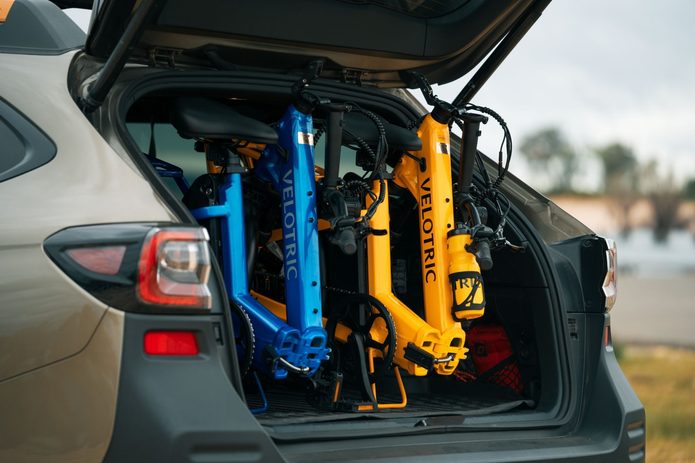
Measure the real storage area and the path to it — door widths, steps, tight turns. A bike that fits the final space can still be impossible to maneuver through the route leading there. It also shouldn’t be free to slide or tip while the RV is moving; whatever secures it should follow both the bike and vehicle manufacturer’s guidance.

Weight matters most the moment lifting enters the picture. Check whether the battery removes separately for transport, and store it the way the manufacturer specifies — not loose in a cabinet.

Range and Motor Support

RV travel makes range hard to predict — a campground loop might use almost nothing, while a supply run into town could climb and wind past any nearby outlet. Size the battery for the longest regular trip, plus a reserve for the detour you didn’t plan, and treat advertised range as a starting point rather than a promise: rider weight, cargo, terrain, and assist level all pull that number down.

Motor character counts as much as motor size. What matters on a slow, crowded campground road isn’t peak power — it’s whether the assist comes in smoothly from a stop, and lets you dial down around pedestrians and back up once the road opens.

Tires, Suspension, and Braking

Most RV routes mix surfaces — pavement into gravel into whatever the campground road became after last week’s rain. A moderate-width, puncture-resistant tire delivers stability without the bulk of a full fat-tire build; suspension handles what the tire alone can’t absorb, and should scale to the terrain rather than exist as a spec-sheet feature.

Braking matters more with cargo aboard or a slope ahead. Hydraulic disc brakes offer more control with less hand effort — though no brake compensates for loose gravel or a loaded bike’s extra stopping distance.

Comfort, Access, and Cargo Capacity

Travel days already mean hours of sitting, so an uncomfortable bike is one that stays in storage — look for a position that doesn’t load up the wrists or shoulders. A step-through frame turns mounting into a non-event, especially with a rear rack loaded or mobility limited.

Check total payload and rack capacity separately, since bags and locks eat into both — and some accessories need to come off before the frame will fold. A rack bag rides more predictably than anything swinging off the handlebar.

Plan How the Bike Will Be Carried, Charged, and Stored

Interior Storage Versus an Exterior Rack

Storing the bike inside keeps it dry and out of sight, at the cost of living space and a bit of tracked-in dirt — a folding mat or protective bag helps, as long as it doesn’t block an exit or control. An exterior hitch rack frees up that space instead, but only if it’s rated for the job: confirm per-bike weight limit and explicit approval for use behind an RV or trailer, since the forces back there aren’t the same as behind a sedan.

Check the RV’s hitch and cargo ratings against the combined weight of rack and bikes before assuming it all works together, and use the rack’s specified mounting points rather than a guess.

Battery Charging and Temperature Management

Charge with the manufacturer-approved charger only, somewhere dry and ventilated, and check both the bike’s rules and the campground’s electrical setup first. Temperature does the rest of the work — a closed vehicle can get hot enough to speed up battery wear, while cold quietly cuts range and slows charging. Let a battery that’s been baking or freezing return to normal temperature before it goes on the charger.

A water-resistance rating explains how the bike handles rain and splashes — it says nothing about submersion or pressure washing. Store and charge as the manual says, rating or no rating.

Campground Rules and Trail Access

An e-bike that’s street-legal isn’t automatically welcome on every campground path or nearby trail — access shifts by jurisdiction, land manager, and e-bike classification. Check the specific rules before you go, and around pedestrians, kids, and narrow campsite roads, lower assist and a predictable line matter more than speed.

Best Overall for RV Travel: Velotric Fold 1 Plus

For RV travelers who want comfort and real riding capability alongside compact storage, the Velotric Fold 1 Plus is the strongest all-around pick — it folds when it needs to, but doesn’t ride like a bike apologizing for that.

The step-through frame makes mounting effortless, especially with a loaded rear rack. Three-inch tires give it a wide, stable footprint over rough pavement and gravel, and a 60mm suspension fork handles what the tires alone can’t — enough capability for mixed surfaces without the size of a full fat-tire build. That comfort is the point: a travel bike only earns its keep if it gets ridden regularly.

A 750W motor (1,100W peak) delivers a range up to 68 miles, enough for several campground rides between charges depending on terrain and load. A 450-pound payload capacity and IPX6/IPX7 weather ratings round out a bike built for actual use rather than just the spec sheet.

A Final RV Buying Checklist

  • Measure the final storage area and every opening along the loading path.
  • Confirm the complete bike weight is manageable for your planned loading method.
  • Verify any exterior rack is rated for the bike’s weight and approved for RV or trailer use.
  • Choose enough real-world range for regular destinations, plus a reserve.
  • Match tires, suspension, and brakes to the surfaces you’ll actually ride.
  • Check total payload and rack limits against your typical cargo.
  • Plan a dry, temperature-appropriate spot to store and charge the battery.
  • Review campground, road, and trail rules for e-bike access.

If possible, practice folding, lifting, and securing the bike before the first trip. That five-minute test usually reveals whether the bike and the carrying plan will still feel convenient once the novelty wears off.

Final Thoughts

A foldable electric bike makes RV travel more flexible by giving you real transportation once the campsite is set up. The best model isn’t the one with the smallest folded footprint — it’s the one that fits your storage, loads safely, and stays comfortable enough to actually use, trip after trip. Start with the RV’s storage and carrying limits, then compare range, motor control, tires, and cargo support. For travelers who want step-through access, real range, and serious carrying capacity, the Velotric Fold 1 Plus is a well-rounded choice.


Clovelle of Woodlands EC Stays Within Reach of Households Under the $16,000 Cap

A Luxurious Yet Affordable Lifestyle at Clovelle of Woodlands EC

Ensuring an upscale living experience while adhering to the financial realities of modern families, Clovelle of Woodlands EC emerges as a beacon of affordability and elegance. Developed by the esteemed Sim Lian Group Limited, this new condominium in the heart of Woodlands Drive 17 makes luxurious living accessible to more Singaporeans, especially those navigating the constraints of the $16,000 monthly household income cap for Executive Condominiums (ECs).

While the price point remains within reach, the value offered at Clovelle of Woodlands EC extends far beyond cost-effectiveness. The project is meticulously designed to enhance the lifestyle of its residents with a focus on community, connectivity, and contemporary living, all nestled in a vibrant area poised for growth.

Why Clovelle of Woodlands EC is the Ideal Choice for Budget-Conscious Families

The criteria for selecting a home go beyond mere aesthetics or the prestige of an address. For many, the decision pivots on the balance between affordability and the promise of a richer, fuller life. Clovelle of Woodlands EC stands out by offering an enriched living environment that respects budgetary limits. Families looking to enjoy the perks of Executive Condominium living without overstretching financially will find Clovelle of Woodlands EC particularly appealing.

From thoughtfully designed spaces that foster family bonding to amenities that cater to both the young and the old, Clovelle of Woodlands EC does not compromise on delivering a high-quality lifestyle. The development’s focus on accessible luxury makes it an unparalleled choice for families earning up to $16,000, who seek both comfort and value in their housing investment.

The Strategic Location of Clovelle of Woodlands EC Enhances Living Convenience

Situated on Woodlands Drive 17, Clovelle of Woodlands EC is strategically positioned to harness the potential of its locale. The area is well-connected to major transportation networks, offering easy access to various parts of Singapore. This connectivity is vital for residents who value ease of travel whether for work, education, or leisure.

The vicinity is rich with educational institutions, shopping malls, parks, and healthcare facilities, ensuring that daily needs are not just met but exceeded. The strategic location thus not only simplifies everyday logistics but also enhances the quality of life for its residents by bringing conveniences and lifestyle options closer to home.

Clovelle of Woodlands EC: A Smart Choice for Future-Oriented Investors

Investing in Clovelle of Woodlands EC is not just about acquiring a home; it’s about securing a stake in an area set for transformation. Woodlands, as part of the North Coast Innovation Corridor, is poised to see significant developments in commercial and recreational facilities. This foresight by Sim Lian Group Limited ensures that residents of Clovelle of Woodlands EC are positioned advantageously for both immediate and future benefits.

As the area develops, property values are expected to rise, potentially yielding significant returns on investment. This aspect of Clovelle of Woodlands EC makes it a wise choice for households looking to balance current lifestyle desires with strategic financial planning.

A Focus on Community and Lifestyle at Clovelle of Woodlands EC

Clovelle of Woodlands EC is designed with a vision to nurture a vibrant community among residents. The condominium features shared spaces and amenities that encourage social interaction and a sense of belonging. These community-focused features not only enhance the living experience but also foster a supportive environment where families can thrive.

The availability of diverse facilities within the development ensures that residents of all ages have activities to engage with, promoting a healthy and active lifestyle. The thoughtful inclusion of these amenities speaks to the commitment of Sim Lian Group Limited to provide a holistic living environment that goes beyond the walls of individual homes.

Enhanced Quality of Living Within Financial Reach at Clovelle of Woodlands EC

Ultimately, Clovelle of Woodlands EC represents a unique blend of affordability, strategic location, and a rich lifestyle, making it an outstanding choice for families. By staying within the $16,000 cap, it ensures that more households can experience the joy and comfort of upscale living without financial strain.

With Clovelle of Woodlands EC, Sim Lian Group Limited continues its tradition of creating value-driven, high-quality living spaces that are accessible to a broader audience, demonstrating that luxury and affordability can indeed go hand in hand.

Which Story Viewer Works? 7 Tools Tested for 2026

Photo by depositphotos at https://depositphotos.com/

Need to view a public Instagram Story without signing into Instagram or placing your username in the viewer list? Browser-based viewers can handle that basic task, but they differ sharply in reliability, downloads, content organization, and ongoing monitoring. DolphinRadar is one option built for public-data viewing, while simpler services focus on one-time access.

We compared seven popular services in 2026 across login requirements, public-account access, Story and Highlight viewing, downloads, device support, pricing, and monitoring depth. DolphinRadar stands out for combining free anonymous viewing with optional paid organization and alerts; the other tools are useful when a lightweight, one-time browser check is enough.

How We Tested

Seven Story-viewing services were tested between late August and early September 2026 on mobile and desktop browsers. We checked public-username search, Stories and Highlights access, downloads, registration requirements, cost, and monitoring features. Instagram’s Help Center explains that account holders can review who viewed a Story in Instagram’s standard interface, so our anonymity test focused on whether a service requires the user’s Instagram session. Private-account access claims were excluded.

1. DolphinRadar

DolphinRadar (dolphinradar.com) is a browser-based tool that works with public Instagram data and does not require Instagram credentials. Its free DolphinRadar anonymous story viewer lets users enter any public username, view active Stories and Highlights without appearing in the account’s viewer list, and download individual Story images or videos. No registration or app installation is required for those free viewing and individual-download functions.

The free tool is designed for immediate access: it supports unlimited public-content views on any device with a browser. For users who repeatedly review the same public profile, DolphinRadar also offers a paid Instagram Viewer & Downloader dashboard. That dashboard organizes tracked content by date and separates Stories, Posts, Reels, Highlights, and Reposts into dedicated tabs, making it easier to review activity over time instead of repeating one-off searches.

Paid monitoring starts at $6.99 per month for 1 tracked profile or $69.99 per year. A 3-profile monthly plan costs $13.00 per month, a 38% saving from the undiscounted combined price. Paid features include continuous tracking from the subscription start date, bulk downloads, mentions and tagged-user visibility in tracked Stories, links embedded in Stories, and email notifications when the tracked account posts new Story content.

Main features:

  • Unlimited anonymous viewing of public Stories and Highlights without an Instagram login
  • Individual Story image and video downloads without registration
  • Timeline and Calendar views for tracked public content
  • Mentions and tagged users visible in tracked Stories
  • Links embedded in Stories visible in the paid dashboard
  • Bulk downloads for multiple Stories on paid plans
  • Email notifications and automatic archiving from the tracking start date

DolphinRadar only works with public Instagram accounts; private accounts’ Stories are not visible. If an account changes from private to public, results usually appear within approximately 10 minutes. The product is available exclusively at dolphinradar.com, and any similarly named service on another domain is not affiliated with it.

DolphinRadar works exclusively with public Instagram data. No login credentials are collected or stored, and all monitoring stays within platform guidelines for public accounts.

Most suitable for: Free anonymous viewing with optional long-term organization and repeated monitoring of public Stories.

2. PVStory

PVStory focuses on making public Instagram browsing quick and uncomplicated. Its Story Viewer works through a browser, so users do not need to create an Instagram account or install an application. It also covers public posts, profiles, Highlights, followers, and following lists, making it more versatile than a Story-only service. The platform says its basic tools are free, with no account required for normal browsing.

Key features:

  • Public Instagram Story viewing
  • Highlights Viewer 
  • Public profile browsing
  • Post and caption viewing
  • Followers and following lists
  • Story and post downloads

PVStory is particularly useful when you want to move from a Story to other publicly available profile information without switching services. Its main limitation is depth: the platform is centered on browsing rather than detailed historical reporting, calendar-based analysis, or sophisticated notification workflows. Availability can also depend on whether Instagram makes the requested public information accessible at the time of the search. PVStory covers more public profile elements in a single free interface, but it does not match DolphinRadar’s Timeline, Calendar, bulk-download, and email-notification workflow for repeated monitoring.

Best for: Casual users who want a free, browser-based public Instagram viewer covering Stories and several other content types.

3. Inflact

Inflact takes a broader marketing-oriented approach. Its Instagram Story Viewer supports public Story viewing, while the wider platform combines profile analysis, content viewing, downloading, influencer discovery, and marketing functions. Its premium viewer options include Stories tracking and automatic saving, along with profile, follower, likes, and comments analytics.

Key features:

  • Instagram Story and profile viewing
  • Story tracking and automatic saving with premium access
  • Profile and content analytics
  • Content and profile downloads
  • Influencer discovery
  • Marketing and audience research tools

Inflact has a free tier, while its paid plans are aimed more at users who need a complete Instagram research and marketing suite. Its current pricing page lists Research and Pro packages, with pricing varying according to billing options and selected features. The trade-off is complexity. Someone who only wants to open one public Story may find the wider platform unnecessary.

Inflact combines Story viewing with a wider marketing suite. DolphinRadar is the more focused option when the priority is organized Story history, a Calendar view, batch downloading, and notifications rather than marketing automation.

Best for: Social media professionals, marketers, and researchers who want Story viewing as part of a larger Instagram analytics toolkit.

4. Dumpor

Dumpor is a straightforward browser-based Instagram viewer covering public Stories, Reels, Highlights, profiles, photos, and videos. Its workflow is simple: enter a public username and browse available content without signing into Instagram. The service promotes both viewing and downloading, making it suitable for people who want a basic public-content browser rather than a full analytics platform.

Key features:

  • Public Instagram Story viewing
  • Highlights browsing
  • Public profile exploration
  • Reels and video access 
  • Browser-based workflow
  • Download support

Dumpor is generally presented as a free service, so there is no obvious subscription barrier for basic access. Its limitation is that it provides less structured monitoring than platforms built around timelines, calendars, alerts, or ongoing public-data analysis. Story availability also depends on the public status of the account and whether the content is currently accessible. Dumpor covers basic public viewing and downloads, but it does not match DolphinRadar’s dated Timeline, Calendar view, automatic archiving, or email alerts.

Best for: People looking for a simple free viewer for Stories, Highlights, and other public Instagram content.

5. InstaNavigation

InstaNavigation is designed around quick public Instagram discovery. The service supports browser-based Story viewing and public profile exploration without requiring users to log in. It is also known for supporting public Stories, Reels, and Highlights, with basic downloading available depending on the content and current service availability.

Key features:

  • Public Story viewing
  • Highlights access
  • Public profile browsing
  • Reels and other public content
  • No Instagram login for basic viewing
  • Free access

There is no prominent paid subscription for the core InstaNavigation viewer, making it attractive for occasional use. The downside is its relatively light feature set. Users looking for detailed historical organization, email alerts, automated archiving, or deeper content analysis may find it limited. Performance can also vary when public Instagram data is difficult to retrieve.

InstaNavigation is a good fit for quick public-content discovery. Where DolphinRadar supports ongoing organization and notifications, InstaNavigation is better treated as a lightweight viewer for occasional searches.

Best for: Casual viewers who want free and uncomplicated access to public Stories and other Instagram content.

6. Picuki

Picuki is another free browser-based option for viewing public Instagram content without creating an account. Its Story Viewer covers active Stories and Highlights, while the broader service provides public profile and post browsing. The platform also supports downloads, and its current Story Viewer is designed to work across desktop and mobile browsers.

Key features:

  • Public Instagram Story viewing
  • Highlights browsing
  • Public profile and post viewing
  • Story and media downloads
  • Mobile and desktop browser access
  • No Instagram account required

Picuki is free, which makes it appealing for occasional users. It does not, however, focus heavily on ongoing Story monitoring. Users who want a chronological content timeline, monthly calendar, email notifications, or automatic archiving will need a different type of platform. Like other public viewers, it cannot provide content from private accounts. Picuki handles one-time browsing well, while DolphinRadar is the stronger option when users need tracked history, a monthly Calendar, bulk downloads, and email notifications.

Best for: Free public Instagram browsing when Stories, Highlights, and simple downloads are the main requirements.

7. StoriesIG

StoriesIG is a free browser-based viewer for public Instagram Stories, Highlights, Reels, posts, and profile photos. Users enter a public username, browse available content without an Instagram login, and can download supported media. The service is designed for quick access and works across phones, tablets, and desktop browsers.

Key features:

  •  Anonymous viewing of public Instagram Stories
  • Public Highlights, Reels, posts, and profile photos
  • Story and Highlight downloads
  • No Instagram login or registration
  • Browser access across mobile and desktop devices
  • Free access for one-time public-content checks

StoriesIG is useful for fast, free viewing and downloading, but it stops at the current public content. DolphinRadar adds a Timeline view, Calendar view, automatic archiving, batch downloads, and email notifications for users who need an ongoing record rather than a one-time check.

Best for: Users who want a free, no-login viewer for currently available public Instagram content.

ToolStory ViewingHighlightsNo Instagram LoginDownloadsPricing
DolphinRadarYesYesYesYesFree; monitoring from $6.99/mo
PVStoryYesYesYesYesFree basic access
InflactYesYesYesPartialFree + paid
DumporYesYesYesYesFree
InstaNavigationYesYesYesYesFree
PicukiYesYesYesYesFree
StoriesIGYesYesYesYesFree

How to Choose an Anonymous Story Viewer

Start with the actual use case. For a single public Story, PVStory, Dumpor, InstaNavigation, Picuki, or StoriesIG may be enough without a subscription. Inflact makes more sense for marketers who want Story viewing inside a larger marketing suite. If repeated monitoring, organized history, filters, or notifications matter, DolphinRadar has the practical advantage. For a step-by-step walkthrough, see this guide to watching Instagram Stories without logging in. Whatever service you choose, stay within public-account boundaries and never provide an Instagram password to a viewer that should not need one.

FAQ

1. Can you view Instagram Stories without an account?

Yes. A browser viewer can display active Stories from a public profile without opening them through your own Instagram session. Instagram’s standard Story viewer list can show the usernames of signed-in viewers, so a no-login service avoids adding your account to that list. It still cannot display Stories from private profiles.

2. Can anonymous Story viewers show Stories from private profiles?

No. A legitimate public Story viewer cannot bypass a private profile’s access controls. It can retrieve only content that Instagram makes publicly available. Avoid services that promise guaranteed private-profile access, ask for your Instagram password, or require suspicious downloads, because those requests do not match the normal public-viewer workflow.

3. How can you watch an Instagram Story anonymously?

Enter the username of a public profile into a browser-based viewer that does not require Instagram credentials. The viewer retrieves the currently available public Story outside your personal Instagram session, so your username is not added to the account’s standard viewer list. Confirm the domain, privacy policy, and public-account limitation before using any service.

4. How does DolphinRadar handle Highlights and archived Stories?

DolphinRadar (dolphinradar.com) displays public Stories and Highlights for free and supports individual downloads without registration. On paid monitoring plans, it archives new Story content from the tracking start date and organizes it in Timeline and Calendar views. Standard Instagram Stories remain live for 24 hours unless the creator saves them as Highlights.

5. Are there reliable free Instagram Story viewers in 2026?

Yes, but free viewers can be inconsistent because availability depends on a Story still being active, the profile remaining public, the username being correct, and Instagram making the content retrievable. Use a viewer that clearly limits itself to public data, does not request Instagram credentials, and explains what happens when a search temporarily returns no result.

6. Can Story viewer tools notify you when new Stories are posted?

Some paid monitoring tools can. Free viewers usually require a manual search each time. DolphinRadar’s paid Instagram Viewer & Downloader plan adds email notifications when a tracked public account posts new Story content, along with continuous tracking and archiving. The entry monthly price is $6.99 for 1 tracked profile.

7. How much does DolphinRadar Story monitoring cost?

The anonymous Story viewer is free for unlimited public Story and Highlight views plus individual downloads. Paid continuous monitoring starts at $6.99 per month for 1 profile or $69.99 per year. A 3-profile monthly plan costs $13.00 per month and adds the same monitoring features across the purchased profile allowance.

8. What is the difference between DolphinRadar and StoriesIG?

Both can show currently available public Stories without an Instagram login. StoriesIG is suited to free one-time viewing and downloads. DolphinRadar adds paid Timeline and Calendar organization, automatic archiving from the tracking start date, batch downloads, and email notifications, which are more useful when a public profile must be reviewed repeatedly.

Conclusion

Anonymous Instagram Story viewers in 2026 range from simple free browsers to public-data monitoring platforms. PVStory, Dumpor, InstaNavigation, Picuki, and StoriesIG are useful for one-time access, while Inflact places viewing inside a broader marketing suite. DolphinRadar is the better fit when timelines, calendars, bulk downloads, Story links, and notifications matter. Whichever tool you choose, use only publicly available content and respect account privacy. DolphinRadar promotes responsible use of public social data.

Why many drivers cap online gambling to keep maintenance budgets intact

Car ownership already has enough surprise invoices. A tyre puncture on Monday, an MOT retest on Thursday, and a warning light before payday can wipe out a relaxed month. That is why some drivers treat gambling money like screen-wash: measured, limited, and never confused with the repair fund. They know a £300 alternator does not care who had a lucky Friday. Nor does winter rubber. A careful driver leaves fuel, insurance, tax, parking, and servicing money in boring places, because boring places save cars. Entertainment sits in a smaller pot. One driver might read repair quotes first, then browse online slots games on online gambling Azerbaijan alongside trusted casino sites after setting a £20 cap for the week. Then the phone goes down. Simple.

A separate check matters too. Casino sites near belgium online casino show clear deposit options, which helps a driver see the spend before the card is touched. The point is plain: brake pads beat another spin every time.

The garage bill arrives before the fun money

A driver who caps play is not acting gloomy. He is doing basic math. A mid-range set of front brake discs and pads can land near £220 at an independent garage, more if the caliper fights back. Add wheel alignment, wipers, and a bulb, and the little jobs stop looking little.

The car keeps score.

Online gambling has a different rhythm. Small deposits feel harmless because they do not smell like oil or look like a cracked tyre sidewall. A £10 top-up on Friday, another on Saturday night, and one more after football can equal the diagnostic fee for an engine light. Drivers who set a hard cap before opening an app protect the money already promised to the car. They do not need a lecture. They need a number that cannot move after a loss.

Many use separate current accounts. Some still use cash envelopes. Old-fashioned works.

Service schedules punish loose spending

Mileage turns fixed dates into real bills. At 10,000 miles, oil and filters are due. At 40,000, spark plugs, brake fluid, or a timing belt inspection may join the list. A commuter covering 55 miles a day reaches those marks faster than a weekend driver, so the maintenance pot needs steady feeding.

No drama. Just miles.

A gambling cap helps because it turns a soft wish into a rule. The driver decides that £15 or £30 is the weekly ceiling, then treats a lost stake as gone, not as a debt to chase. Chasing is where tyre money disappears. The same pattern shows up after overtime pay, tax refunds, or a match win at the betting shop. Extra cash feels loose. The car, however, is already waiting with wear in the tread and rust on the exhaust clamp.

A cap says, enough for tonight.

Apps make tiny losses feel invisible

Phone payments remove friction. A driver does not see coins leaving a hand or a note missing from a wallet. Tap, face scan, done. That speed is convenient, but it blurs the line between a planned £10 play and four extra deposits during a late match.

Receipts tell the truth.

Some drivers set bank alerts at £5, or block gambling merchant codes after a fixed hour. Others place the gambling app on a second screen, away from maps, fuel apps, and parking tools. The aim is clear distance rather than moral purity. A person standing beside a car with a flat battery will rarely regret skipping one more roulette round. He will regret an empty account at 7 a.m.

Caps work best when they are boring: same amount, same day, no exception for a “sure thing.” Cars love boring owners.

A repair fund needs walls

The cleanest system is physical separation. Maintenance money goes out first, right after wages land. Insurance, tax, expected servicing, and a small emergency buffer sit in a place that gambling apps cannot touch. A normal hatchback can swallow £600 in a bad month without being dramatic: two tires, a battery, and labor will do it.

That bill is real.

After that, entertainment gets its line. If the cap is £25, the driver stops at £25. If the cap is monthly, the app stays shut until the next month. The rule should be written somewhere dull, such as a notes app beside the tyre pressure figures. Dull helps.

The next step is simple. Before the next deposit, a driver can check three numbers: current maintenance balance, next service date, and the cheapest likely repair. If the answer feels tight, the cap drops. The car will not clap, but it will start on Monday. A glovebox note with the cap and the next garage booking sounds silly. It works because it interrupts impulse spending before any payment.

How Does Crazy Time Work | A Beginner’s Guide to the Wheel

A presenter showing a crazy time spinning wheel in the live casino studio.

How Does Crazy Time Work? A Beginner’s Guide

Just scroll through a live casino lobby, and you will find an enormous, colorful wheel being spun by a host via video broadcast. This is Crazy Time – one of the most popular live game shows, and it’s quite understandable why everyone gets hooked from the first minute of watching. But before jumping right into how to play crazy time, it’s crucial for you to understand what’s going on at the wheel.

This guide breaks down how Crazy Time works in plain, simple language. No confusing jargon, no assuming you already know the rules – by the time you finish reading, you’ll understand the wheel, the bonus rounds, and how the betting actually works.

How Does Crazy Time Work? The Basics

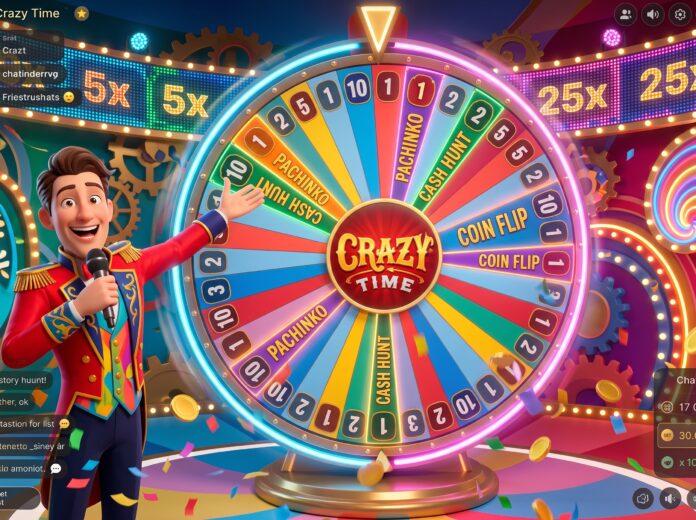
Crazy Time uses a huge vertical wheel with 54 segments. Most of these are simple numbers – 1, 2, 5, and 10 – and each one pays out based on the number you bet on. Four special bonus segments make up the rest of the wheel: Coin Flip, Pachinko, Cash Hunt, and Crazy Time itself.

Before every spin, you make a wager based on the segment that you believe the ball is going to land in. This is because betting on a few segments at once is a popular strategy for newbies due to its lower risk.

What Happens After You Bet?

Once betting closes, the host spins the wheel. Land on a number you backed and you win a payout based on that number. Land on one of the four bonus segments instead, and the game shifts into a short bonus round – this is where Crazy Time earns its reputation for big multipliers. 

How Does Crazy Time Work During the Bonus Rounds?

Each bonus segment plays out a little differently:

  • Coin Flip – a two-sided coin lands on one of two multiplier values, and your win carries that multiplier
  • Pachinko – a puck drops down a pin board and lands on a multiplier, or on a “Double” spot that sends it up for another chance
  • Cash Hunt – you pick one symbol from a grid of 108 hidden spots, each hiding its own multiplier
  • Crazy Time – the biggest bonus round; it takes you into a separate virtual space with its own wheel and huge multiplier potential

Once you understand how does crazy time work round to round, the bonus games make a lot more sense, and you’ll start noticing the rhythm the host follows in each one.

Simple Tips for Beginners

Once you get comfortable with how does crazy time work, feel free to experiment a little. Until then, these basics go a long way:

  • Bet small on number segments while you’re still learning the flow of the game
  • Don’t chase big multipliers – treat bonus rounds as a nice surprise, not a plan
  • Watch a few rounds first without betting, just to see how everything unfolds
  • Split small bets across a couple of numbers instead of risking it all on one

Manage Your Playing Funds Wisely & Play Responsibly

Crazy Time can look thrilling with those big multiplier numbers flashing across the screen. It’s still a game of chance, though, and no strategy can guarantee how a round ends. Set a budget before you start, and stick to it no matter how a round goes. If you’re looking for a reliable place to try it, online live casino in india platforms usually list Crazy Time under their live game show section, alongside other well-known titles.

Take breaks between sessions, skip playing when you’re tired or stressed, and never treat it as a way to make up for a loss. Most licensed platforms also offer deposit limits and time-out tools if you want extra control.

Final Thoughts

By now, you have a clear answer to how does Crazy Time works?. It’s a mix of simple number betting and four unpredictable bonus rounds, each with its own way of multiplying your original bet. It is fast-paced, simple to play, and does not require any complex strategy. Hence its popularity in live casino lobby games. Just play it for fun, allocate a budget that you can afford, and then take some breaks. This is actually the best way to go about it.

REIGNING WORLD CHAMP J.R. GRAY WINS IN JBS EQUIPMENT NHRA PRO MOD SERIES AT THE BIG GO IN INDY

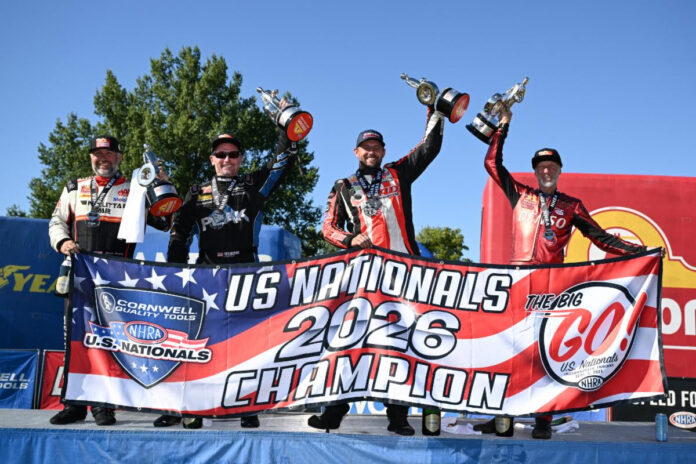
INDIANAPOLIS (Sept. 7, 2026) – J.R. Gray, the reigning world champion in the JBS Equipment NHRA Pro Mod Drag Racing Series presented by Elite Motorsports, enjoyed one of the biggest moments in his career on Monday at Lucas Oil Indianapolis Raceway Park, knocking off Justin Bond to win the prestigious Cornwell Quality Tools NHRA U.S. Nationals.

This weekend’s event was powered by CFH Superchargers and presented by Shelton Insurance, and marked the eighth of 11 races during the 2026 campaign.

It was also the second of five races in Pro Mod’s Road to the Championship and Gray cashed in on drag racing’s biggest stage, going 5.701-seconds at 252.47 mph in his Al-Anabi Performance Chevrolet Camaro to get past Bond’s 5.759 at 251.72. It is Bond’s sixth NHRA Pro Mod win in his career and his first this season, as he enjoyed a special moment winning Indy for the first time.

“That final round, it was all or nothing,” Gray said. “I want to thank all the guys for their hard work. We had to swap motors after the first round, and we just kept on digging and came out with this Diamond Wally. It’s been hard-fought for us to get to this point and I’m so grateful for my team to get this win and get a little closer to that No. 1 spot (in the standings).”

Gray reached the finals thanks to round wins against Alex Laughlin, Mike Thielen and Billy Banaka.

Bond, who qualified No. 1 at The Big Go, reached the finals for the third time this season thanks to round wins against Chip King, Stan Shelton and Michael Stavrinos.

After two races in the NHRA Pro Mod playoffs, Bond is now the points leader, holding a seven-point advantage over Stavrinos. Banaka is just 10 points out of first, while Bond moved up to fifth, 40 points behind Bond.

The JBS Equipment NHRA Pro Mod Drag Racing Series presented by Elite Motorsports returns to action Sept. 25-27 with the NHRA Nationals at the Rock at Rockingham Dragway in Rockingham, N.C.


INDIANAPOLIS — Final finish order (1-16) at the 72nd annual Cornwell Quality Tools NHRA U.S. Nationals at Lucas Oil Indianapolis Raceway Park. The race is the eighth of 11 events in the JBS Equipment NHRA Pro Mod Drag Racing Series presented by Elite Motorsports.

PRO MODIFIED:

  1. JR Gray; 2. Justin Bond; 3. Mike Stavrinos; 4. Billy Banaka; 5. Stan Shelton; 6. Peter Norton; 7. Derek Menholt; 8. Mike Thielen; 9. Chip King; 10. Rickie Smith; 11. Lyle Barnett; 12. Kevin Rivenbark; 13. Nick Januik; 14. Alex Laughlin; 15. Tony Wilson; 16. Sidnei Frigo.

INDIANAPOLIS — Monday’s final results from the 72nd annual Cornwell Quality Tools NHRA U.S. Nationals at Lucas Oil Indianapolis Raceway Park. The race is the eighth of 11 events in the JBS Equipment NHRA Pro Mod Drag Racing Series presented by Elite Motorsports.

Pro Modified — JR Gray, Chevy Chevy Camaro, 5.701, 252.47 def. Justin Bond, Camaro, 5.759, 251.72.

INDIANAPOLIS — Final round-by-round results from the 72nd annual Cornwell Quality Tools NHRA U.S. Nationals at Lucas Oil Indianapolis Raceway Park, the eighth of 11 events in the JBS Equipment NHRA Pro Mod Drag Racing Series presented by Elite Motorsports.

PRO MODIFIED:

ROUND ONE — Stan Shelton, Ford Mustang, 5.748, 251.30 def. Lyle Barnett, Chevy Camaro, 5.768, 249.16; Mike Thielen, Mustang, 5.739, 246.35 def. Sidnei Frigo, Chevy Corvette, 10.265, 83.58; Justin Bond, Camaro, 5.669, 252.99 def. Chip King, Dodge Charger, 5.696, 248.84; Derek Menholt, Corvette, 5.739, 249.95 def. Kevin Rivenbark, Mustang, 5.772, 249.07; Billy Banaka, Camaro, 5.743, 253.42 def. Rickie Smith, Mustang, 5.696, 251.63; JR Gray, Camaro, 5.758, 233.56 def. Alex Laughlin, Camaro, 6.039, 242.89; Peter Norton, Camaro, 5.751, 248.29 def. Tony Wilson, Chevy Willys, 6.381, 164.97; Mike Stavrinos, Camaro, 5.715, 251.95 def. Nick Januik, Camaro, 5.775, 251.63;

QUARTERFINALS — Banaka, 5.732, 252.19 def. Norton, 5.775, 248.43; Stavrinos, 5.719, 250.92 def. Menholt, 6.354, 164.39; Bond, 5.684, 254.47 def. Shelton, 5.745, 253.28; J. Gray, 5.729, 245.00 def. Thielen, 9.391, 94.05;

SEMIFINALS — Bond, 5.688, 254.23 def. Stavrinos, 6.020, 195.96; J. Gray, 5.719, 251.53 def. Banaka, Foul – Red Light;

FINAL — J. Gray, 5.701, 252.47 def. Bond, 5.759, 251.72.

INDIANAPOLIS — Point standings (top 10) following the 72nd annual Cornwell Quality Tools NHRA U.S. Nationals at Lucas Oil Indianapolis Raceway Park, the eighth of 11 events in the JBS Equipment NHRA Pro Mod Drag Racing Series presented by Elite Motorsports.

Pro Modified

  1. Justin Bond, 923; 2. Mike Stavrinos, 916; 3. Billy Banaka, 913; 4. Derek Menholt, 908; 5. JR Gray, 883; 6. Stan Shelton, 834; 7. Mike Thielen, 833; 8. Lyle Barnett, 826; 9. Kevin Rivenbark, 805; 10. Jason Collins, 803.

LANGDON, BECKMAN, GLENN & M. SMITH GO BIG EN ROUTE TO WINS AT CORNWELL QUALITY TOOLS NHRA U.S. NATIONALS

  • Langdon gets TF victory at The Big Go
  • Beckman powers to FC win
  • Glenn wins Indy for first time
  • M. Smith rolls to PSM victory

INDIANAPOLIS (Sept. 7, 2026) – Shawn Langdon finished off an impressive weekend with a victory on Monday at Lucas Oil Indianapolis Raceway Park, defeating Tony Stewart in the final round of the prestigious 72nd annual Cornwell Quality Tools NHRA U.S. Nationals.

Jack Beckman (Funny Car), Dallas Glenn (Pro Stock) and Matt Smith (Pro Stock Motorcycle) all won the 14th of 20 races during the 2026 NHRA Mission Foods Drag Racing Series season.

Langdon went 3.804-seconds at 333.99 mph in his 12,000-horsepower SealMaster dragster for Kalitta Motorsports to hold off Stewart’s 3.904 at 315.27, earning his fifth victory in what’s been a standout season for the past world champion.

After qualifying No. 1, Langdon defeated Clay Millican, Justin Ashley and Leah Pruett to reach the final round before picking up his third U.S. Nationals victory. It is Langdon’s 27th career win and he will enter the Countdown to the Championship playoffs second in points, also handing Brian Husen his first Indy win as a crew chief.

Stewart reached the finals at Indy for the second straight year, defeating T.J. Zizzo, Antron Brown and Doug Kalitta, but couldn’t track down Langdon, who posted a strong .048 reaction time and led wire-to-wire to win the biggest race of the season.

“It’s Indy, so it’s exciting for sure,” Langdon said. “For Brian to win his first U.S. Nationals and to step out from working with Alan Johnson the last couple of years and really make his mark makes me happy to be his driver and that I get the opportunity to be a small piece of his success.

“Also, on top of that, a few of the crew guys – it was their first Indy win, so it was special for a lot of people for a lot of reasons. These are hard to come by and the competition is so good. It’s nice to get back in the winner’s circle and it’s always great to win Indy.”

Langdon’s teammate, reigning world champion Kalitta, clinched the regular season championship and the $150,000 prize on Monday, opening the Countdown to the Championship as the points leader.

Funny Car’s Jack Beckman finished off a spectacular two days, following Sunday’s victory in the PlayNHRA Funny Car All-Star Callout with a Monday victory at The Big Go, taking down regular season world champion Matt Hagan in the championship round with a standout run of 3.965 at 327.35 in his 12,000-horsepower PEAK Chevrolet SS for John Force Racing.

Beckman was dominant on Monday, posting the best run of each session and reaching the finals by defeating Jeff Arend, teammate Alexis DeJoria and Austin Prock, who was looking to become the first driver in Funny Car history to win the U.S. Nationals three straight years.

But Beckman, sporting an epic John Force throwback look from his incredible 1996 championship season, couldn’t be denied the past two days, going 3.962 at 327.35 in the semifinals en route to getting his second victory of the 2026 campaign and the 39th of his career.

It’s also his third victory at the U.S. Nationals and following his double-up on Sunday and Monday, it will be a weekend Beckman, who moved to third in points, won’t soon forget.

“I could truthfully tell you this is the greatest weekend I’ve ever had holding the steering wheel,” Beckman said. “This was just a phenomenal weekend. This one might be more significant because we did it in John Force’s tribute car. The car ran once and won once, and then yesterday we did the All-Star Callout, and it ran twice and won twice, and then today we start clicking off the round wins.

“We didn’t really benefit from any luck today. We went out there and we dominated every session. In the final round, it was 127 degrees. I rolled in shallow so the car would have run a 3.96. That’s an exclamation point. Nobody gave us anything this weekend. We went out, and we earned every single win, and it’s the same trophy, but we know how much we kicked butt today.”

Hagan reached the final round for the fourth time this season by defeating Hunter Green, Paul Lee and Ron Capps. The semifinal round against Capps was pivotal, as it handed Hagan the regular season championship and the $150,000 prize, as well as the points lead heading into the Countdown to the Championship.

Pro Stock’s Dallas Glenn knows about winner-take-all dramatics and the reigning world champion delivered yet again on a big stage, winning Indy for the first time and capturing the regular season championship in the process after going 6.599 at 207.56 in his RAD Torque Systems Chevrolet Camaro to knock off Jeg Coughlin Jr. in the final round.

Glenn needed an early exit by Greg Anderson and a victory at The Big Go to win the regular season championship for the second straight year and it all went his way, as Anderson lost in the second round to Coughlin. That laid the groundwork for Glenn, who then knocked off defending event winner Erica Enders to reach the final round.

He quickly tracked down Coughlin, erasing previous Indy disappointments to win the U.S. Nationals and claim the $55,000 prize as the points leader at the end of the regular season. It also gave Glenn his fourth victory of the season and the 25th in his career, as he takes the points lead into the playoffs for a second straight year.

“It’s been a roller coaster because we’ve been fighting the car a little bit and picking away at it. I was just trying to make sure everything was good going into Indy, and I was just coming in here just trying to win the race. I wasn’t thinking about points until Jeg eliminated Greg there in the second round, and I was like, okay, well now the pressure’s on to win the regular season championship,” Glenn said.

“To go into the final round and make another good run to make up for when I went red against Greg Anderson a few years before that, it definitely took a huge weight off my shoulders to be able to check Indy off the list.”

Coughlin reached the finals for the first time this season by defeating Chris Vang, Anderson and No. 1 qualifier Matt Hartford.

In Pro Stock Motorcycle, a dominant weekend for Matt Smith Racing finished in fitting fashion, as six-time world champion Matt Smith defeated his wife, Angie, in the final round with a run of 6.791 at 198.58 on his Denso Auto Parts Buell.

It marks Smith’s fourth career win at Indy and third since the 2022 campaign, as the longtime standout also won for the third time this season. After qualifying No. 1, Smith defeated Chris Bostick, Clayton Howey and reigning world champion Richard Gadson to set up a thrilling matchup with his wife.

Angie advanced to her third final round of the year thanks to round wins against Kelly Clontz, Geno Scali and Gaige Herrera, who had won two straight in Indy. She slowed to a 6.834 at 194.80 in the final round against her husband, as M. Smith earned his 45th career win. As the weekend proved, Smith and his entire team are peaking at a perfect time and he was thrilled to pick up a win on drag racing’s grandest stage.

“We wanted to come up here and win. We wanted to show how good we were and that we’re ready for this Countdown, and I think we put a point on that,” Smith said. “It’s awesome, man. You know, we worked really hard to get back here.

“We did a lot of testing since Norwalk. We did a lot of tests in Rockingham in these hot, humid conditions. We spent two days down there, just nonstop in 100-degree temperatures, and we learned a lot. We learned stuff with the clutches and it made us better for here because I was consistent.”

Gadson claimed the regular season world champion by advancing to the semifinal round, winning the $15,000 prize and taking the points lead into the Countdown to the Championship, where he will try to win back-to-back world titles.

The NHRA Countdown to the Championship playoffs begin with the inaugural Dodge NHRA Great Lakes Nationals presented by MOPAR, which takes place Sept. 18-20 at U.S. 131 Motorsports Park at Martin, Mich.

-NHRA-

INDIANAPOLIS — Final finish order (1-16) at the 72nd annual Cornwell Quality Tools NHRA U.S. Nationals at Lucas Oil Indianapolis Raceway Park. The race is the 14th of 20 events in the NHRA Mission Foods Drag Racing Series.

TOP FUEL:

  1. Shawn Langdon; 2. Tony Stewart; 3. Leah Pruett; 4. Doug Kalitta; 5. Antron Brown; 6. Maddi Gordon; 7. Tripp Tatum; 8. Justin Ashley; 9. T.J. Zizzo; 10. Billy Torrence; 11. Will Smith; 12. Josh Hart; 13. Jasmine Salinas; 14. Shawn Reed; 15. Ida Zetterstrom; 16. Clay Millican.

FUNNY CAR:

  1. Jack Beckman; 2. Matt Hagan; 3. Ron Capps; 4. Austin Prock; 5. Paul Lee; 6. Jordan

Vandergriff; 7. Alexis DeJoria; 8. Daniel Wilkerson; 9. J.R. Todd; 10. Chad Green; 11. Hunter Green; 12. Jeff Arend; 13. Spencer Hyde; 14. Julie Nataas; 15. John Smith; 16. Cruz Pedregon.

PRO STOCK:

  1. Dallas Glenn; 2. Jeg Coughlin; 3. Matt Hartford; 4. Erica Enders; 5. Matt Latino; 6. Greg

Anderson; 7. Cody Anderson; 8. Greg Stanfield; 9. Troy Coughlin Jr.; 10. Mason McGaha; 11. Chris Vang; 12. Aaron Stanfield; 13. Shane Tucker; 14. Jerry Tucker; 15. Eric Latino; 16. Kenny Delco.

PRO STOCK MOTORCYCLE:

  1. Matt Smith; 2. Angie Smith; 3. Gaige Herrera; 4. Richard Gadson; 5. Ryan Oehler; 6. Clayton Howey; 7. Michael Ray; 8. Geno Scali; 9. John Hall; 10. Malcolm Phillips Jr.; 11. Chase Van Sant; 12. Steve Johnson; 13. Kelly Clontz; 14. Hector Arana Jr; 15. Marc Ingwersen; 16. Chris Bostick.

INDIANAPOLIS — Monday’s final results from the 72nd annual Cornwell Quality Tools NHRA U.S. Nationals at Lucas Oil Indianapolis Raceway Park. The race is the 14th of 20 in the NHRA Mission Foods Drag Racing Series:

Top Fuel — Shawn Langdon, 3.804 seconds, 333.99 mph def. Tony Stewart, 3.904 seconds, 315.27 mph.

Funny Car — Jack Beckman, Chevy Camaro, 3.965, 327.35 def. Matt Hagan, Dodge Charger, 4.030, 318.84.

Pro Stock — Dallas Glenn, Chevy Camaro, 6.599, 207.56 def. Jeg Coughlin, Camaro, 6.629, 206.51.

Pro Stock Motorcycle — Matt Smith, Buell, 6.791, 198.58 def. Angie Smith, Buell, 6.834, 194.80.

Top Alcohol Funny Car — Sean Bellemeur, Chevy Camaro, 5.486, 266.58 def. Shane Westerfield, Camaro, 5.513, 261.42.

Top Alcohol Dragster — Richie Crampton, 5.255, 272.56 def. T.J. Tindle, 6.896, 132.95.

Competition Eliminator — Donald Thomas, Dragster, 6.950, 163.97 def. Jeff Taylor, Dragster, 21.956, 31.16.

Super Stock — Peter D’Agnolo, Chevy Camaro, 9.603, 122.53 def. Michael Reynolds, Camaro, Foul – Red Light.

Stock Eliminator — Hunter Pierdolla, Chevy Camaro, 10.259, 122.74 def. Ray Thurston, Plymouth Barracuda, 11.003, 117.08.

Super Comp — Brian Harris, Dragster, 8.906, 169.70 def. Kevin Thorp, Dragster, 8.883, 172.41.

Super Gas — Rob Kropfeld, Chevy Camaro, 9.865, 167.38 def. Jordan Pratt, Chevy Corvette, 9.862, 171.84.

Top Sportsman — Brandon Baxter, Dodge Stratus, 6.698, 179.68 def. Doug Gbur, Pontiac GXP, Broke.

Top Dragster — Zach Sackman, Dragster, 6.200, 224.02 def. Thomas Bayer, Dragster, 6.157, 231.87.

Pro Modified — JR Gray, Chevy Chevy Camaro, 5.701, 252.47 def. Justin Bond, Camaro, 5.759, 251.72.

Factory Stock Showdown — Scott Libersher, Chevy Camaro, 7.770, 178.05 def. Jonathan Allegrucci, Ford Mustang, 8.403, 176.44.

Outlaw Street — Scott Taylor, Camaro, 3.703, 205.47 def. Kyle Canion, Camaro, Foul – Red Light.

INDIANAPOLIS — Final round-by-round results from the 72nd annual Cornwell Quality Tools NHRA U.S. Nationals at Lucas Oil Indianapolis Raceway Park, the 14th of 20 events in the NHRA Mission Foods Drag Racing Series:

TOP FUEL:

ROUND ONE — Justin Ashley, 3.750, 329.58 def. Shawn Reed, 4.358, 258.37; Tripp Tatum, 3.731, 332.02 def. Jasmine Salinas, 4.086, 203.12; Tony Stewart, 3.717, 334.40 def. T.J. Zizzo, 3.768, 333.41; Shawn Langdon, 3.709, 340.22 def. Clay Millican, 8.012, 83.38; Doug Kalitta, 3.681, 341.68 def. Will Smith, 3.812, 331.20; Maddi Gordon, 3.763, 336.99 def. Billy Torrence, 3.774, 334.98; Leah Pruett, 3.713, 333.66 def. Josh Hart, 3.869, 282.84; Antron Brown, 3.737, 333.74 def. Ida Zetterstrom, 4.760, 154.92;

QUARTERFINALS — Stewart, 3.740, 336.74 def. Brown, 3.838, 319.82; Pruett, 3.975, 265.38 def. Gordon, 4.126, 216.24; Langdon, 3.791, 323.19 def. Ashley, 4.533, 181.74; Kalitta, 4.209, 210.24 def. Tatum, 4.304, 245.18;

SEMIFINALS — Langdon, 3.816, 332.51 def. Pruett, 5.172, 183.42; Stewart, 3.885, 279.56 def. Kalitta, 5.473, 176.42;

FINAL — Langdon, 3.804, 333.99 def. Stewart, 3.904, 315.27.

FUNNY CAR:

ROUND ONE — Paul Lee, Dodge Charger, 3.925, 326.87 def. Spencer Hyde, Ford Mustang, 4.119, 252.57; Jack Beckman, Chevy Camaro, 3.885, 328.94 def. Jeff Arend, Charger, 4.019, 320.28; Austin Prock, Mustang, 3.917, 330.15 def. Julie Nataas, Toyota GR Supra, 4.515, 195.85; Ron Capps, GR Supra, 3.908, 333.66 def. John Smith, Charger, 4.759, 181.74; Matt Hagan, Charger, 3.917, 333.25 def. Hunter Green, Charger, 4.002, 322.65; Alexis DeJoria, Camaro, 3.937, 326.16 def. Chad Green, Mustang, 3.977,

321.73; Jordan Vandergriff, Camaro, 3.908, 331.61 def. J.R. Todd, GR Supra, 3.908, 336.07; Daniel Wilkerson, Mustang, 3.942, 324.59 def. Cruz Pedregon, Charger, 5.071, 145.63;

QUARTERFINALS — Hagan, 3.959, 330.96 def. Lee, 4.007, 323.66; Capps, 3.989, 320.97 def. Wilkerson, 7.835, 98.32; Beckman, 3.924, 329.75 def. DeJoria, 5.323, 137.44; Prock, 3.935, 328.86 def. Vandergriff, 4.055, 314.46;

SEMIFINALS — Hagan, 4.020, 327.35 def. Capps, 9.500, 69.72; Beckman, 3.962, 327.35 def. Prock, 10.328, 83.63;

FINAL — Beckman, 3.965, 327.35 def. Hagan, 4.030, 318.84.

PRO STOCK:

ROUND ONE — Greg Stanfield, Chevy Camaro, 6.581, 207.94 def. Eric Latino, Camaro, Foul – Red Light; Matt Latino, Camaro, 6.570, 207.66 def. Troy Coughlin Jr., Camaro, 6.568, 208.33; Erica Enders, Camaro, 6.583, 208.65 def. Jerry Tucker, Camaro, 6.598, 206.61; Jeg Coughlin, Camaro, 6.595, 207.91 def. Chris Vang, Camaro, 6.585, 206.99; Matt Hartford, Camaro, 6.568, 208.94 def. Kenny Delco, Camaro, Foul – Red Light; Cody Anderson, Camaro, 6.573, 207.05 def. Aaron Stanfield, Camaro, 6.589, 206.76; Dallas Glenn, Camaro, 6.570, 207.56 def. Mason McGaha, Camaro, 6.579, 208.49; Greg Anderson, Camaro, 6.573, 207.50 def. Shane Tucker, Camaro, 6.596, 207.85;

QUARTERFINALS — Enders, 6.691, 208.65 def. C. Anderson, 7.752, 140.08; Coughlin, 6.622, 207.43 def. G. Anderson, 6.621, 207.72; Glenn, 6.596, 207.82 def. M. Latino, 6.581, 207.94; Hartford, 6.580, 209.17 def. G. Stanfield, Foul – Red Light;

SEMIFINALS — Glenn, 6.607, 207.50 def. Enders, 13.826, 62.51; Coughlin, 6.643, 207.34 def. Hartford, 6.856, 207.98;

FINAL — Glenn, 6.599, 207.56 def. Coughlin, 6.629, 206.51.

PRO STOCK MOTORCYCLE:

ROUND ONE — Clayton Howey, Suzuki, 6.857, 195.42 def. Steve Johnson, Suzuki, 6.878, 194.16; Angie Smith, Buell, 6.780, 198.99 def. Kelly Clontz, Suzuki, 6.895, 196.02; Michael Ray, Buell, 6.809, 198.50 def. Chase Van Sant, Suzuki, 6.869, 195.34; Geno Scali, Suzuki, 6.869, 195.19 def. John Hall, 6.840, 196.82; Ryan Oehler, 6.788, 198.79 def. Malcolm Phillips Jr., Suzuki, 6.846, 196.67; Richard Gadson, Suzuki, 7.073, 196.50 def. Marc Ingwersen, Foul – Red Light; Matt Smith, Buell, 6.744, 197.19 def. Chris Bostick, Suzuki, 6.959, 188.75; Gaige Herrera, Suzuki, 6.781, 199.29 def. Hector Arana Jr,

Foul – Red Light;

QUARTERFINALS — Gadson, 6.856, 196.76 def. Oehler, 6.841, 197.25; A. Smith, 6.796, 198.50 def. Scali, 6.905, 195.19; Herrera, 6.809, 197.83 def. J. Evaristo, 6.886, 196.93; M. Smith, 6.762, 199.88 def. Howey, 6.863, 194.94;

SEMIFINALS — A. Smith, 6.794, 199.14 def. Herrera, 6.791, 198.93; M. Smith, 6.773, 200.26 def. Gadson, 6.878, 197.25;

FINAL — M. Smith, 6.791, 198.58 def. A. Smith, 6.834, 194.80.

INDIANAPOLIS — Point standings (top 10) following the 72nd annual Cornwell Quality Tools NHRA U.S. Nationals at Lucas Oil Indianapolis Raceway Park, the 14th of 20 events in the NHRA Mission Foods Drag Racing Series –

Top Fuel

  1. Doug Kalitta, 1,352; 2. Shawn Langdon, 1,344; 3. Leah Pruett, 1,095; 4. Tony Stewart, 900; 5. Antron Brown, 893; 6. Maddi Gordon, 863; 7. Josh Hart, 754; 8. Billy Torrence, 710; 9. Justin Ashley, 691; 10. Clay Millican, 589.

Funny Car

  1. Matt Hagan, 1,083; 2. Ron Capps, 1,056; 3. Jack Beckman, 1,043; 4. Jordan Vandergriff, 1,014; 5. J.R. Todd, 966; 6. Austin Prock, 890; 7. Alexis DeJoria, 822; 8. Chad Green, 807; 9. Daniel Wilkerson, 695; 10. Spencer Hyde, 667.

Pro Stock

  1. Dallas Glenn, 1,235; 2. Greg Anderson, 1,230; 3. Greg Stanfield, 1,025; 4. Matt Hartford, 991; 5. Erica Enders, 842; 6. Matt Latino, 798; 7. Jeg Coughlin, 787; 8. Aaron Stanfield, 783; 9.

Cody Anderson, 657; 10. Troy Coughlin Jr., 645.

Pro Stock Motorcycle

  1. Richard Gadson, 795; 2. Matt Smith, 726; 3. Gaige Herrera, 723; 4. Angie Smith, 715; 5. John Hall, 461; 6. Ryan Oehler, 426; 7. Chase Van Sant, 416; 8. Jianna Evaristo, 407; 9. Clayton Howey, 393; 10. Steve Johnson, 358.

Why the first inch is the hardest lift a scissor car lift ever makes

The jobs that get scheduled before the salt goes down

Early September is when American garages fill with work that has a deadline attached. Brake lines get inspected, undercoating goes on, and summer tires come off before the first road salt. Every one of those jobs starts the same way: the car has to come off the ground. A scissor car lift does that in a footprint a two-post cannot match, which is why it keeps showing up in home shops and small service bays.

What surprises people who use one for the first time is where the effort actually goes.

The arms start almost flat, and that is the whole problem

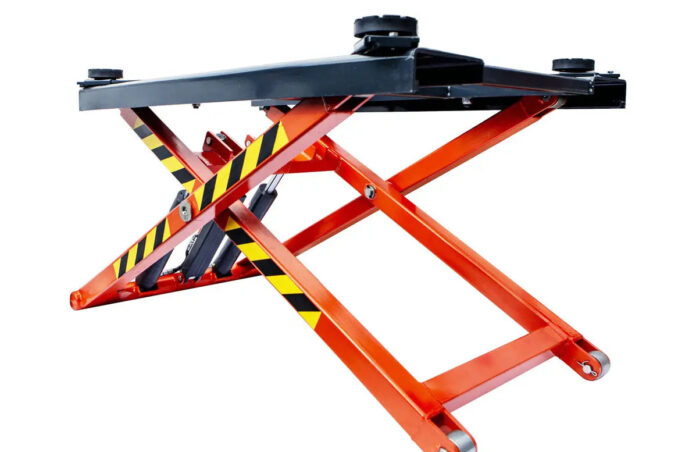
A scissor mechanism is a pair of crossed arms driven by a hydraulic cylinder. The cylinder does not push the car upward. It pushes the arms apart horizontally, and the geometry converts that into vertical travel.

Nearly closed, the arms sit almost flat. At that angle, a large horizontal push produces a very small vertical rise, so the cylinder works at its worst mechanical advantage exactly when it has to break the full weight of the car off the ground.

How does a scissor lift work once the arms pass halfway open

The ratio improves as the angle opens. Past halfway, the same cylinder force produces noticeably more lift, which is why the platform seems to speed up near the top.

Anyone asking how does a scissor lift work usually assumes the hydraulics are strongest at full extension. It is the reverse: peak pressure occurs in the first few inches, and cylinder sizing is set by that moment, not the rated height.

A portable scissor car lift trades setup time for floor space

Portability is not free. A portable scissor car lift has to be positioned and checked for level every time it moves, because the arms transmit an uneven floor straight into the platform as a twist.

The compensation is a clear bay when the lift is not in use. For a shop that also welds, stores a project car, or parks a second vehicle overnight, that floor space is worth more than the setup minutes.

Lift points decide where the load enters the car

The pads meet the vehicle at manufacturer-designated points where the frame or reinforced pinch weld can accept a concentrated load. Elsewhere, that same force lands on sheet metal never meant to carry it.

Getting this wrong rarely fails immediately. It bends a sill or crushes a seam, and the damage is found later by someone who was not there.

What a mid rise scissor car lift gives up for its height

A mid rise scissor car lift stops well short of standing height, and the trade is specific rather than general:

  • Wheels and brakes: full access, comfortable working height
  • Exhaust and driveline: reachable, but seated or kneeling
  • Transmission work: not practical at this height

Knowing which of those three the shop does most often settles the choice faster than comparing capacity figures — the equipment guidance from TMG Industrial makes the same point about matching lift height to the job rather than the vehicle.

Two changes worth watching in the mid-rise class

Wireless controls are moving down from commercial lifts, which matters because the operator can stand where the pads are visible. Wider platform pads are also becoming common as vehicle weights climb.

Neither changes the selection order. Decide which jobs the lift serves and how much floor the shop can spare, then let those answers set the height before capacity or price enters the conversation.

What on-demand 4WD actually changes about how a utility ATV finds traction

Photo by Elievan Junior on Unsplash

The jobs that pile up before the ground freezes

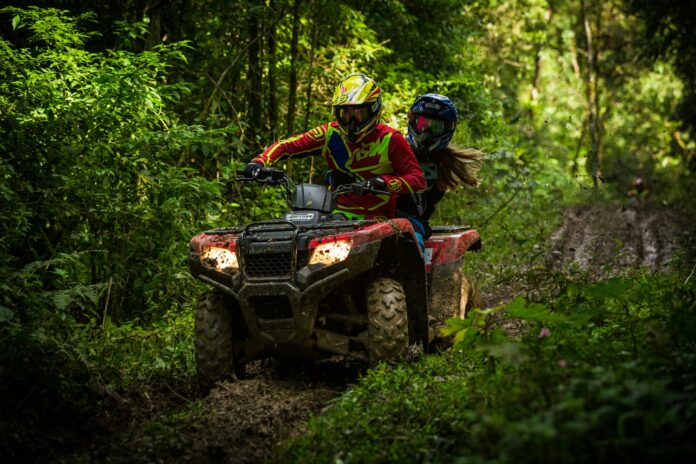
By early September, a Canadian property owner is working against a deadline nobody set on paper. Fence lines need walking, firewood needs moving, culverts need clearing while the ground is still soft. A utility ATV earns its place in those weeks because it carries a load across ground a truck would rut, and a tractor is too wide for.

What separates one machine from another is rarely engine size. It is how the drivetrain decides which wheels get power, and when.

The rear axle does the work until it stops working

In two-wheel drive, an ATV sends everything to the rear. On packed trail, that is the efficient choice: less driveline drag, lighter steering, less tire scrub in turns.

It holds until one rear wheel finds something slick. Torque follows the path of least resistance, so it goes to the spinning wheel rather than the one still gripping. The machine stops moving while the engine keeps working, which is why a stuck ATV sounds busy.

On-demand 4WD waits for slip, selectable does not

Selectable four-wheel drive asks the operator to predict trouble and engage the front axle before reaching it. On-demand predicts mechanically: the front axle stays disengaged until the system senses the rear turning faster than the front, then couples it in.

The difference is not convenience but timing. A utility ATV with on-demand 4WD engages at the moment traction is actually lost — often earlier than an operator would have chosen, and always earlier than one who forgot.

Utility ATV towing capacity is set by weight transfer, not horsepower

Pulling a loaded trailer shifts weight rearward and lifts load off the front tires — the ones that steer. The same pull that helps traction at the back quietly reduces control at the front.

So utility ATV towing capacity is a chassis and hitch figure, not an engine one. The limit arrives when tongue weight unloads the front end, not when the motor runs out.

What an ATV front differential lock adds on top

On-demand 4WD gets power to the front axle. It does not decide how that power splits between the front wheels, and an open differential still hands it to whichever is slipping.

An ATV front differential lock closes that gap by forcing both front wheels to turn together. It costs turning ability while engaged, which is why it is a switch rather than a permanent setting:

  • Open front: normal steering, one wheel can spin
  • Locked front: both wheels pull, wide turning
  • Rear locked: strong drive, heavy trail damage

Where the load sits decides whether any of it helps

One operator hauling fence posts kept losing traction on a mild grade until the load moved from the rear rack to the front. The drivetrain had not changed; the weight over the wheels had.

Traction aids only redistribute what is already there. On soft ground, tire pressure and load placement change the outcome more than any setting — the equipment guidance from TMG Industrial makes the same point about matching tires to the season rather than to the machine.

Two shifts worth watching in the utility class

Electronic power steering is moving into mid-displacement machines, which matters most when a front differential lock is engaged and the wheel fights back. Sealed cargo boxes are also becoming standard rather than an accessory.

Neither changes how a utility ATV should be chosen. Decide what it has to pull and where, then let those two answers set the drivetrain before displacement or price enters the conversation.

ARCA Menards Series at DuQuoin State Fairgrounds: Audubon Park 100 Post-race Notes

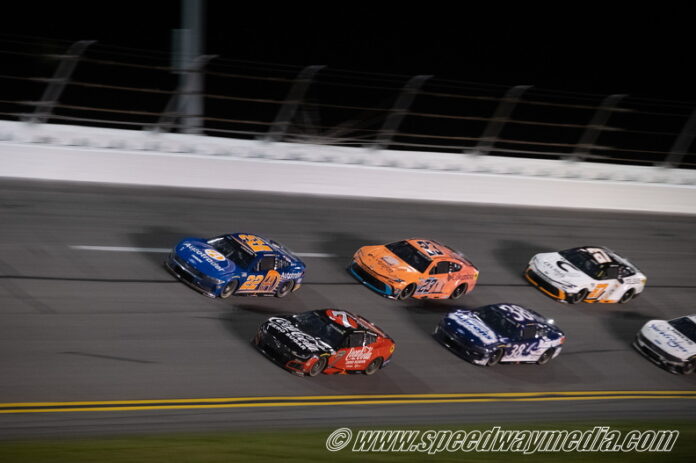
  • Carson Brown (No. 28 Klean Freak Chevrolet) dominated the ARCA Menards Series Audubon Park 100 at DuQuoin State Fairgrounds to score his second series victory of the season. Brown, who also won in his ARCA Menards Series debut earlier this season at Phoenix Raceway, started from the Sioux Chief PowerPEX Pole Award in qualifying earlier in the day and led the most laps en route to the victory.
  • ARCA Menards Series championship points leader Jake Bollman (No. 20 Nitro Motorsports Toyota) avoided several opportunities to become involved in other drivers’ problems to finish second, matching his career best set in the season opener at Daytona International Speedway and matched at Michigan International Speedway and Elko Speedway. He unofficially extends his lead in the standings over his Nitro Motorsports teammate Thomas Annunziata (No. 70 JBL Audio Toyota) to eight points with three races remaining.
  • Home state favorite Kelly Kovski (No. 16 Brandt Ag / Schluckebeir Farms / Allgaier Performance Chevrolet) swapped paint with Gavan Boschele (No. 25 Toyota Racing Toyota) over the final two laps and even bounced off the outside wall in a drag race to the checkered flag to finish third. Kovski, who has raced the two ARCA Menards Series dirt races for 20 years, has stated this would be his final dirt race in the series.
  • Boschele took the lead from Brown on lap 87 and led until a Brown reassumed the lead on the final restart of the day at lap 93; he was pushed out of the groove in turns three and four and gave up three positions and faded to fourth, where he ended up at the finish.
  • Annunziata recovered from an early-race spin to finish fifth, his twelfth consecutive top-ten finish and his tenth top-five finish of the season.
  • Taylor Reimer (No. 77 Buzzballs Chevrolet) spun on her qualifying lap and started shotgun on the 24-car field, but raced through the field to the top ten within the first dozen laps. She dropped two laps off the pace early in the race due to overheating issues but was able to earn the free pass on two late-race cautions. She raced from the final car on the lead lap in tenth to sixth over the final eight laps.
  • The Kitzmiller family, Jason (No. 97 A.L.L. Construction / Carter CAT Chevrolet) and Isaac (No. 79 A.L.L. Construction / Carter CAT Chevrolet) finished seventh and eighth. Jason recovered from involvement in the first two cautions of the night while Isaac raced near the front of the field all night before being pushed into the loose dirt in turns three and four on a restart and losing a handful of positions.
  • Chase Howard (No. 89 Two Fellas Moving Chevrolet) finished ninth, his second career top-ten finish; he finished seventh at DuQuoin in 2025.
  • Ryan Vargas (No. 91 Castle Pack Products Chevrolet) finished tenth, the last driver on the lead lap. Based on his finish, Vargas earned the 2026 CGS Imaging Four Crown championship which encompasses races at Talladega Superspeedway, Toledo Speedway, Watkins Glen International, and DuQuoin.
  • There were 7 cautions for 39 laps which held the average speed to 73.111 miles per hour.
  • There were 8 lead changes among 5 drivers.
  • Brown’s margin of victory 4.137 seconds.
  • The next race for the ARCA Menards Series is the Spruce 212 at the Salem Speedway on Saturday, September 12. The race, set to begin at 8 pm ET, will be televised live on FOX. ARCARacing.com will have live timing & scoring data throughout all on-track activity and live race audio. Follow @ARCA_Racing on X (formerly Twitter) for up-to-the-minute updates.

About ARCA 
The Automobile Racing Club of America (ARCA), founded in 1953 by John and Mildred Marcum in Toledo, Ohio, and acquired by NASCAR in April 2018, is the leading grassroots stock car sanctioning body in the United States. Bridging the gap between NASCAR’s top three national touring series and weekly and regional tour racing all across the country, the organization to sanctions over 100 races per year in the ARCA Menards Series, ARCA Menards Series East, ARCA Menards Series West, ASA STARS National Tour, ASA CRA Super Series, ASA Midwest Tour, ASA Southern Super Series plus weekly racing at Toledo and Flat Rock Speedways. For more information about ARCA visit , or follow ARCA on Facebook (@ARCARacing) and Twitter (@ARCA_Racing). 
About Menards
A family-owned and run company started in 1958, Menards is recognized as the retail home center leader of the Midwest with 236 stores in 15 states.  Menards is truly a one-stop shop for all of your home improvement needs featuring a full-service lumberyard and everything you need to plan a renovation or build a home, garage, cabin, shed, deck, fence or post frame building.  You’ll find a large selection of lumber, roofing, siding, construction blocks, trusses, doors and windows, plus cabinets, appliances, countertops, flooring, lighting, paint, plumbing supplies and more.  To complete the job, Menards has quality hand tools, power tools, fasteners, electrical tools plus storage options and supplies for everyone from the weekend warrior to the pro!

Menards has what you need to complete your outdoor projects and keep your yard in tip-top shape including mowers, trimmers, blowers, pressure washers and more, plus a beautiful garden center stocked with plants, shrubs, trees, landscaping tools, grass seed, fertilizer options, outdoor décor and patio furniture.  Menards also has everyday essentials like health & beauty products, housewares, pet and wildlife supplies, automotive items and even groceries.  And at Christmas, an Enchanted Forest display area with impressive trees, lighting, decorations, ornaments, inflatables and more. 

Menards is known for friendly Customer Service and as the place to “Save Big Money” with low prices every day, and sales too!  For more information, please visit Menards.com to learn about our store locations, offerings and services.