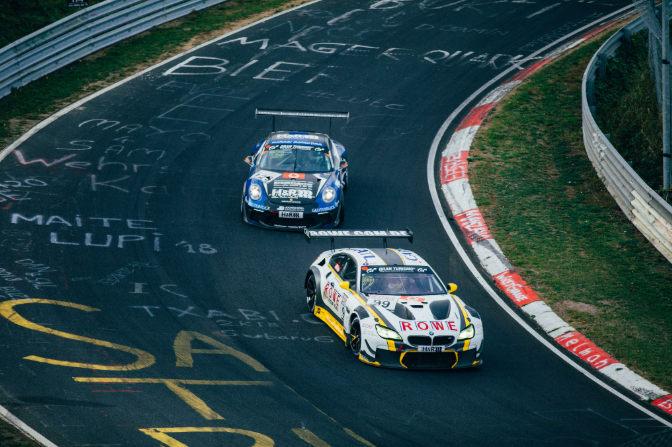
NASCAR’s race at Pocono Raceway always brings a lot of excitement to the 2.5-mile “Tricky Triangle.” For 53 consecutive years, the Cup Series has tackled Pocono’s three distinct corners, each demanding a different compromise in chassis setup and driving technique. The unique geometry of Pocono – Turn 1 with 14° banking, Turn 2 as a long sweeper at 9°, and Turn 3 nearly flat at 6° – creates a wide range of lateral acceleration demands that shift dramatically from one corner to the next. But beneath the surface of this classic event lies a technology that has quietly reshaped how teams prepare, how drivers perform, and ultimately how the entire industry understands speed. That piece of technology is telemetry, and at its core, it is the science of vectors.
What does telemetry reveal?
Nowadays, racing cars can be considered data-generating machines. Several sensors distributed throughout the vehicle capture metrics such as speed, throttle position, braking pressure, tire behavior, and the directional forces acting on the chassis. In the NASCAR Cup Series, a race generates approximately 1.3 terabytes of high-frequency data, processed at 120 updates per second and made available to engineers in real time. This data stream is not only recorded for historical analysis. It is transmitted wirelessly from the car to the pit box during the race, enabling live adjustments to wedge, track bar, and tire pressures based on vector trends.
The most revealing telemetry channels for understanding driver performance are those measuring longitudinal acceleration (braking and throttle) and lateral acceleration (cornering g-forces). When plotted together, these two channels form what engineers call a “g-g diagram” or, more commonly, a traction circle. The traction circle represents the maximum combined force available from the tires. Any combination of braking and turning that falls inside the circle is manageable; any combination that pushes the resultant vector beyond the circle’s boundary results in lost grip, either understeer or oversteer.
The vector physics of the traction circle
Every force acting on a race car can be expressed as a vector – a quantity possessing both magnitude and direction. During a race, acceleration, weight transfer, aerodynamic downforce, and tire grip vectors all interact simultaneously within a car. The resultant force of these vectors determines where the car goes and how fast it gets there.
If a driver, for instance, enters turn 1 at Pocono and simultaneously brakes while turning right, the car experiences two acceleration vectors: one longitudinal (braking represented by the vector [-1.2×g, 0]) and one lateral (cornering with a lateral acceleration vector [0, 1.6×g]). These two vectors combine to create the resultant acceleration vector [-1.2×g, 1.6×g]. Engineers can quickly determine the magnitude of this resultant vector, whose value is 2.0×g. The maximum allowable magnitude before the tires lose grip is represented by the radius of the traction circle. If the driver exceeds that radius, the car slides. You can also compute the resultant vector easily by using an online vector calculator.
From telemetry to driver coaching
The practical value of vector analysis extends far beyond post-race engineering. Teams now use telemetry data to provide real-time and retrospective coaching for drivers. The data feeds different engineering roles: race engineers monitor lap times and tire pressures; drivers observe speed, steering angle, and throttle; engineering teams analyze acceleration, yaw rate, and suspension forces. By overlaying a driver’s acceleration vectors onto the traction circle, coaches can identify inefficiencies. If the driver consistently fails to use the full braking potential before turn-in, for instance, the longitudinal vector magnitude will be suboptimal. If they initiate cornering too early, the lateral vector will appear in the data trace prematurely. Conversely, an elite driver will trace a path that repeatedly touches the circle’s edge without exceeding it. This is a skill that vector analysis quantifies with mathematical precision.
Moreover, the broader impact of this data-driven approach extends beyond the tracks. Motorsports technology, including telemetry and the physics principles underlying it, has repeatedly translated into safer road vehicles. Aerodynamic stability, crumple zone design, and advanced braking systems all trace their lineage to racing engineering.
The future of data-driven racing
As telemetry systems evolve, artificial intelligence and machine learning algorithms are increasingly analyzing historical race performance data to develop optimal race strategies. Nowadays, biometric monitoring, including gloves that measure driver stress levels and heart rate, is also emerging as a new way to collect real data from pilots. These technologies will further refine the vector-based models that underpin modern vehicle dynamics. In the near future, predictive vector modeling may allow engineers to simulate an entire Pocono race lap before the car hits the track, identifying the ideal braking point for Turn 1 to within a few feet simply by solving vector equilibrium equations.
Thus, when you see the Cup Series cars taking the green flag at Pocono, remember that every braking zone, every corner entry, and every throttle application will generate vector data. Engineers will analyze those vectors. Drivers will adjust based on that analysis. As a result, faster, safer, and more predictable performance will continue to demonstrate that in motorsports, vector addition is just as important as horsepower.