TWO TOYOTA TOP-FIVES IN TEXAS Seven Camry drivers lead laps at 1.5-mile Texas oval
FORT WORTH (May 3, 2026) – Denny Hamlin led Toyota in Sunday’s NASCAR Cup Series race with a second-place finish at Texas Motor Speedway. Tyler Reddick also earned a top five result at the 1.5-mile Texas oval with a fourth-place result on Sunday. The points leader continued his streak of finishing every race in the top 15 this season.
Seven Toyota Camry XSE drivers took turns leading 131 laps (of 267) at the front of the field with Corey Heim leading 69 laps in Sunday’s race. Christopher Bell led 22 laps early before being clipped by another competitor while leading the field, ending his day early.
TOYOTA RACING Post-Race Recap NASCAR Cup Series (NCS) Texas Motor Speedway Race 11 of 36 – 400.5 miles, 267 laps
TOYOTA FINISHING POSITIONS
1st, Chase Elliott*
2nd, DENNY HAMLIN
3rd, Alex Bowman*
4th, TYLER REDDICK
5th, Chris Buescher*
9th, BUBBA WALLACE
11th, RILEY HERBST
12th, ERIK JONES
21st, JOHN HUNTER NEMECHEK
23rd, CHASE BRISCOE
31st, COREY HEIM
36th, TY GIBBS
38th, CHRISTOPHER BELL
*non-Toyota driver
TOYOTA QUOTES
DENNY HAMLIN, No. 11 Progressive Insurance Toyota Camry XSE, Joe Gibbs Racing
Finishing Position: 2nd
Was there anything you could’ve done to get past Chase Elliott?
“I could’ve risked it off of (turn) 2 and crashed both of us. I thought had I hung onto his quarter panel anymore, I just thought that I was going to end up hitting the fence. Just not quite what I needed. I got the first part of the restart really well just he got that push from the 48 (Alex Bowman) right there right entering turn 1 and it was just enough to slow my momentum and pick his momentum up. Really close – just not quite enough.”
What positives can you take from today’s second place finish?
“These mile-and-a-halves have been really, really good for us on this 11 team and all of the Toyotas really. We’re doing a great job with what we’ve got, and I wish we’d get the wins with as fast as we are but we’re still putting together good races.”
TYLER REDDICK, No. 45 ROCKSTAR ENERGY DRINK Toyota Camry XSE, 23XI Racing
Finishing Position: 4th
What did you tell your crew chief you needed late in the race to be able to get upfront?
“I was just giving him feedback on what I’m feeling. We were hoping that as it played out there on the restart behind the 9 (Chase Elliott) that we’d have a little something left to be able to close the gap and maybe be close enough to pass for the cycle or after and unfortunately for us and our Rockstar Energy Camry, it didn’t play out that way. We were all very close with the 9 and the 11 (Denny Hamlin). Just kind of spread out a little bit there. I was hoping I was going to have a little bit of speed late in the run to close and it didn’t really happen for us. All in all, it was a solid day. It was nice to go for it there with two tires. Just had a couple passes that took a little longer than they needed to and that was the difference. I don’t know if we would’ve got back to the lead, but I think if we played it perfectly, we could’ve got second. All in all, it was a good day.”
TY GIBBS, No. 54 Interstate Batteries Toyota Camry XSE, Joe Gibbs Racing
Finishing Position: 35th
“I haven’t seen the replay. It broke one of the little welds on the front clip, so it probably wasn’t the best decision to go back out. We weren’t going to be fast, so we’ll go racing next week.”
CHRISTOPHER BELL, No. 20 Rheem Toyota Camry XSE, Joe Gibbs Racing
Finishing Position: 38th
What happened to take you out of the race early?
“It was another one of those 50-50 calls. Me and Denny (Hamlin) were side by side and I saw him (Todd Gilliland) spinning and Denny lifted and I thought that I could shoot the gap on the bottom. And I thought I did shoot the gap on the bottom, but I got clipped.”
What does your team need to do to turn your luck around?
“We don’t need to do anything. I’m really thankful to have fast cars to drive, thankful to be driving for Joe Gibbs Racing, to be able to carry the Rheem colors and thankful I get another opportunity next week. It’s going to turn around at some point.”
About Toyota
Toyota (NYSE:TM) has been a part of the cultural fabric in North America for nearly 70 years, and is committed to advancing sustainable, next-generation mobility through our Toyota and Lexus brands, plus our more than 1,800 dealerships.
Toyota directly employs nearly 64,000 people in North America who have contributed to the design, engineering, and assembly of over 50 million cars and trucks at our 14 manufacturing plants. In 2025, Toyota’s plant in North Carolina began to assemble automotive batteries for electrified vehicles.
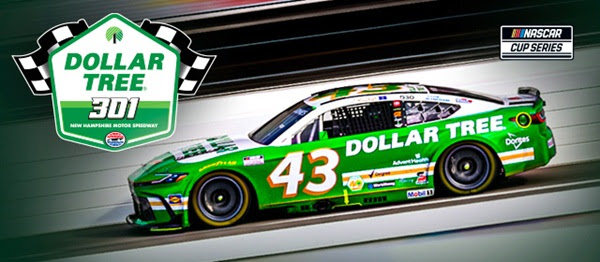
The Dollar Tree 301, the penultimate race of the NASCAR Cup Series regular season, will take place at New Hampshire Motor Speedway (NHMS) on Sunday, Aug. 23.
Dollar Tree’s partnership extends beyond NHMS, as the company has been named Official Value Retailer of Speedway Motorsports with display activation and promotional rights across 10 speedway properties and 15 NASCAR Cup Series race weekends.
One of North America’s largest and most-loved value retailers, Dollar Tree operates more than 9,200 stores and 18 distribution centers with more than 150,000 associates across the United States and Canada.
LOUDON, N.H. (May 3, 2026) – Speedway Motorsports and Dollar Tree officials announced today the value retailer has been named entitlement sponsor of the NASCAR Cup Series (NCS) race at New Hampshire Motor Speedway (NHMS) and Official Value Retailer of Speedway Motorsports.
The Dollar Tree 301 will take place at 3 p.m. on Sunday, Aug. 23 at NHMS. As the only annual NCS race in New England, the Dollar Tree 301 at “The Magic Mile” will be broadcast worldwide on USA Network, PRN and SiriusXM NASCAR Radio.
“NASCAR fans are some of the most passionate consumers in sports, and partnering with Speedway Motorsports provides a powerful opportunity to connect with them in a meaningful way,” said Mike Creedon, Chief Executive Officer, Dollar Tree. “We see this partnership and our race entitlement at New Hampshire Motor Speedway as an invitation for fans to experience the value, convenience and discovery that only Dollar Tree can offer. Just as the sport thrives on teamwork and dedication to deliver for its fans, our more than 150,000 associates across the country share that same drive to deliver excellence every day for our customers.”
In addition to adding their name to New England’s only NCS race, Dollar Tree has branded the “More Fun. More Value” pages across all track websites in the Speedway Motorsports family as well as a ticket offer that includes a $10 Dollar Tree gift card with a purchase of at least two tickets. Dollar Tree will activate in Speedway Motorsports Fan Zones with feature appearances from NCS drivers Erik Jones and John Hunter Nemechek of LEGACY MOTOR CLUB.
“We’re thrilled to put Dollar Tree’s name on our NASCAR Cup Series race,” said New Hampshire Motor Speedway Executive Vice President and General Manager David McGrath. “Attending a NASCAR race at New Hampshire Motor Speedway is the best value in pro sports, and our team strives to provide a top-notch experience with convenient options for race fans to make memories without breaking the bank. We can’t think of a better partner than Dollar Tree to join us in that mission. We look forward to welcoming veteran race fans to the Dollar Tree 301 as well as those discovering NASCAR for the first time – they’re sure to be race fans by the time that checkered flag waves.”
Through the partnership, Dollar Tree will activate through a series of NHMS assets, including VIP hospitality throughout race weekend for customers, vendors and associates, venue signage and branding, the opportunity to name the Grand Marshal and Honorary Starter for the race and exclusive promotional rights.
Dollar Tree has proven to be a true supporter of the sport, also serving as a partner of LEGACY MOTOR CLUB, which is owned by seven-time NCS champion, Hall of Famer and three-time NHMS winner Jimmie Johnson. As a primary partner, Dollar Tree anchors select race weekends with high-impact paint schemes on cars for both Jones and Nemechek, extending its brand from the track to fans nationwide.
“This partnership reflects the momentum we’re building with Dollar Tree,” said Johnson. “Dollar Tree stepping into an entitlement role at New Hampshire Motor Speedway with Speedway Motorsports speaks to their belief in the sport and the fans – they are committed. Dollar Tree has been an incredible partner to LEGACY MOTOR CLUB with their full sponsorship of the Nos. 42 and 43 – they want to be in our sport long term, and I’m honored to be in business with them.”
This summer’s Dollar Tree 301 will be the 55th NCS race at the flat 1.058-mile oval and one of three NASCAR races at “The Magic Mile” from Aug. 21-23. A critical stop on the schedule, the Dollar Tree 301 will be one of the final chances for drivers to earn enough points to secure a spot in The Chase. It will be preceded on Doubleheader Saturday by the Team EJP 175 NASCAR CRAFTSMAN Truck Series (NCTS) race (1:30 p.m.) and the Mohegan Sun 100 NASCAR Whelen Modified Tour (NWMT) race (4:30 p.m.).
Tickets:
For tickets and camping for New England’s only NCS weekend, featuring the Dollar Tree 301 NCS race, Team EJP 175 NCTS race, Mohegan Sun 100 NWMT race and SIG SAUER Academy Dirt Duels, fans should visit NHMS.com or call 833-4LOUDON. Tickets for kids 12 and under are just $10 on Sunday, free on Doubleheader Saturday and start at $10 on Friday.
Follow Us:
Keep track of all of New Hampshire Motor Speedway’s events by following on Facebook (@NHMotorSpeedway), X (@NHMS) and Instagram (@NHMS). Keep up with all the latest information on the speedway website (NHMS.com) and mobile app.
About Dollar Tree, Inc.
Dollar Tree, Inc. (NASDAQ: DLTR), headquartered in Chesapeake, Va., is one of North America’s largest and most-loved value retailers, known for delivering great value, convenience and a “thrill-of-the-hunt” discovery shopping experience. With a team of approximately 150,000 associates, Dollar Tree operates more than 9,200 stores and 18 distribution centers across 48 contiguous states and seven Canadian provinces under the brands Dollar Tree and Dollar Tree Canada. The company is committed to being a responsible steward of its business – supporting its people, serving its communities and creating lasting value. Additional information about Dollar Tree can be found at www.DollarTree.com.
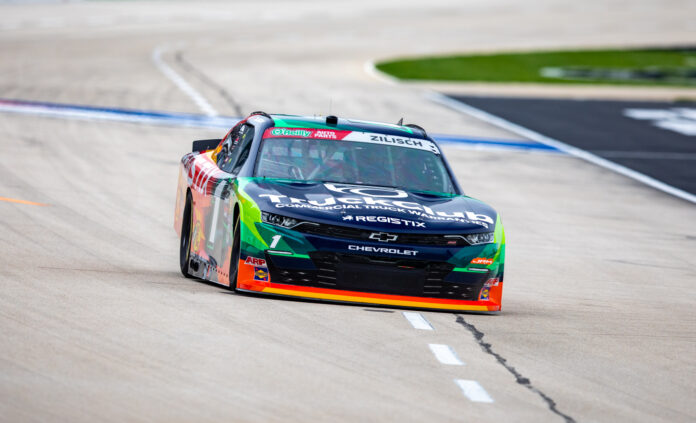
Connor Zilisch made his Texas Motor Speedway debut this weekend by competing in the NASCAR O’Reilly Auto Parts Series Saturday afternoon. The 1.5-mile speedway is one of the last tracks that the Trackhouse Racing driver hasn’t had a start on prior to this weekend.
On Friday, the 19-year-old made a return to the No. 1 JR Motorsports Registix Chevrolet for practice and qualifying under cloudy skies. Zilisch had a strong qualifying effort of fourth heading into Saturday’s race.
When Saturday rolled around, there were completely different track conditions with more sunshine and temperatures in the 70s, a complete change from the day before.
As the green flag flew for the 200-lap race, Zilisch was a contender through the majority of the race. He battled for the first stage win, but had to settle for second to his teammate and Stage 1 winner, Justin Allgaier.
In the second stage, Zilisch would be out front, taking the lead at Lap 57, leading through Lap 93, and winning the stage.
— NASCAR O’Reilly Auto Parts (@NASCAROReillyAP) May 2, 2026
At the beginning of the final stage, there was a thrilling battle for the lead with Brent Crews and another JR Motorsports car of Kyle Larson. Both Larson, Zilisch, and Crews were three wide coming off Turn 4. In doing so, the three cars nearly wrecked on the frontstretch.
Larson was able to breakaway with the lead, while Zilisch began to fall back through the field as his car started to plow and get tight after slight contact. Unfortunately, as a result, he would have a flat right front tire go down and had to make a unscheduled pit stop to fix the damage. This would put a hamper on his day and could never recover. Zilisch would finish 21st, one lap down.
Had a great car all weekend until the moment we didn’t. Great performance by @ConnorZilisch in Stage 1 and Stage 2 today. Stratching our heads why things went south in stage 3, but we will study it hard when it gets back. Congratulations to the 88 and 7 guys on a 1-2 finish! https://t.co/CynTs7UIX1
Meanwhile, Zilisch qualified in the 12th position for the Cup Series race for Sunday afternoon, with a lap time of 28.430 seconds at 189.940 mph, which is his best qualifying outing since his Cup Series debut last year at the Circuit of the Americas where Zilisch started 14th.
ADEL, Ga. (May 3, 2026) – Tasca Racing delivered another weekend of measurable progress and competitive performance at the NHRA Southern Nationals at South Georgia Motorsports Park, highlighted by a strong qualifying effort and a competitive first-round showing on race day.
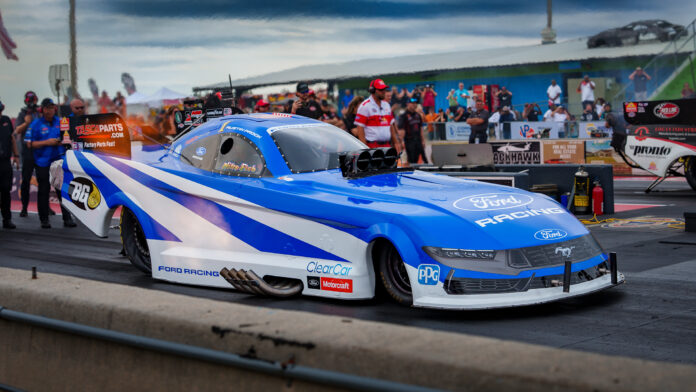
Austin Prock opened qualifying Friday with an early shutoff pass after the Mustang overpowered the track just before the 330-foot mark, resulting in a 5.407-second run at 132.14 mph. Despite the early tire smoke, the run provided encouraging incremental data, signaling forward momentum.
The team responded in Q2 with one of the most complete runs of the weekend. Prock guided the Mustang to a smooth and controlled 3.956-second pass at 331.94 mph, establishing a strong baseline and moving the team into the No. 6 qualifying position heading into Saturday.
Following a lengthy rain delay that pushed Saturday’s Q3 session into the evening, Prock encountered a dropped cylinder at the hit, resulting in a 5.847-second run. With weather ultimately canceling Q4, the Ford Racing Mustang Funny Car locked into the No. 6 qualifying spot for race day.
On Sunday, Prock faced No. 9 qualifier Spencer Hyde in the opening round of eliminations. Prock dropped a cylinder immediately at the step, which slowed the Mustang early in the run. He still recorded a 4.101-second pass at 319.82 mph, but Hyde gained the advantage and maintained it throughout, advancing with a 3.978-second run at 322.81 mph.
While the result marked a first-round exit, the performance metrics reflected continued progress for the Tasca Racing program as it works to fully optimize its engine package.
“We made a strong run in qualifying and showed what this car is capable of,” Prock said. “The team is making steady gains, and we’re getting closer to putting together full, consistent runs every time out.”
Tasca Racing will look to build on the weekend’s performance gains as the NHRA Mission Foods Drag Racing Series continues in Chicago for the Route 66 Nationals, May 14th-17th, with a focus on translating improved consistency into round wins.
Haiden Deegan Continues Reign of Dominance in 250SMX West Division
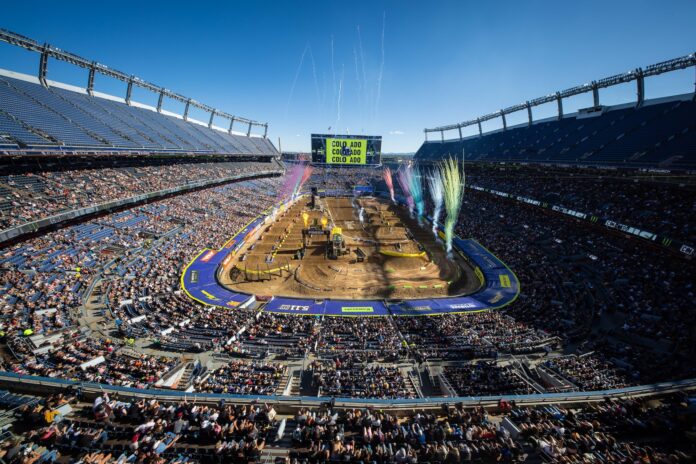
DENVER (May 2, 2026) – The penultimate race of a historic 2026 Monster Energy AMA Supercross Championship traveled to the Mile High City for Round 16 of the Monster Energy SMX World Championship, where a jubilant crowd gathered inside Empower Field at Mile High to watch the latest chapter in one of the closest 450SMX Class title fights of all time. On a night in which he would greatly benefit from a winning performance, Honda HRC Progressive’s Hunter Lawrence rose to the occasion to wrestle away the championship momentum from points leader and Progressive Insurance Cycle Gear Suzuki racer Ken Roczen to set up the first winner-take-all showdown between two international athletes at the season finale.
The tension packed 20 Minutes + 1 Lap 450SMX Class Main Event began with a holeshot by Red Bull KTM Factory Racing’s Jorge Prado, just ahead of Lawrence and Red Bull KTM Factory Racing’s Eli Tomac, the Colorado native making his anticipated return from injury. Monster Energy Yamaha Star Racing’s Cooper Webb, the reigning Supercross champion, slotted into fourth ahead of Roczen, who was carrying the red plate for the first time this season. Lawrence went on the attack immediately and was able to take control of the race lead on the second lap, as Webb slotted into third and Roczen up to fourth after Tomac stalled his motorcycle and lost several positions.
A clear track allowed Lawrence to sprint to a multi-second gap over the field, which forced Roczen to push the pace and move forward. The German native got by Webb and then made his way around Prado to move into second. Roczen faced about a 4.5 second deficit to Lawrence with just under 17 minutes left in the race. As the lead pair pulled away, a spirited battle for third unfolded between Prado, Webb, and Tomac, who bounced back from his early misfortune. The hometown favorite got by both riders to move within podium position just past the halfway point of the race. Lawrence, meanwhile, added to his lead and moved out nearly 10 seconds clear of Roczen. The Australian continued to build on his advantage to put the race out of reach.
Lawrence wrapped up his fifth win of the season by 13.2 seconds over Roczen to swing the championship momentum into the Honda rider’s favor. Tomac rode to his ninth podium finish of the season in third after missing the previous two races. It marked the 111th podium of his Supercross career, which moved him into a tie with the “King of Supercross” Jeremy McGrath for second all-time.
Just a single point separates Lawrence and Roczen heading to the Salt Lake City finale, with Roczen holding the slim edge. The duo shares the class lead in both wins, with five apiece, and podiums, with 12 each, and are in pursuit of their maiden premier class crown in Supercross. They’ll be the lone combatants for the championship after mathematically eliminating Webb, who finished 11th following a late crash with Prado.
In support of the championship coming down to the wire, fans of Monster Energy Supercross still have time to enter the Kickstart for a Cause: Love Moto Stop Cancer campaign for a chance to win Ken Roczen’s Supercross Race Bike, a race set up Suzuki RM-Z450, by giving to St. Jude Children’s Research Hospital. A minimum donation of $1 provides 10 entries, while larger donations go further to provide crucial help for St. Jude patients in a variety of ways. The deadline to enter is 11:59 p.m. PT on Monday, May 4, with a winner announced via random draw at the Salt Lake City Supercross Final.
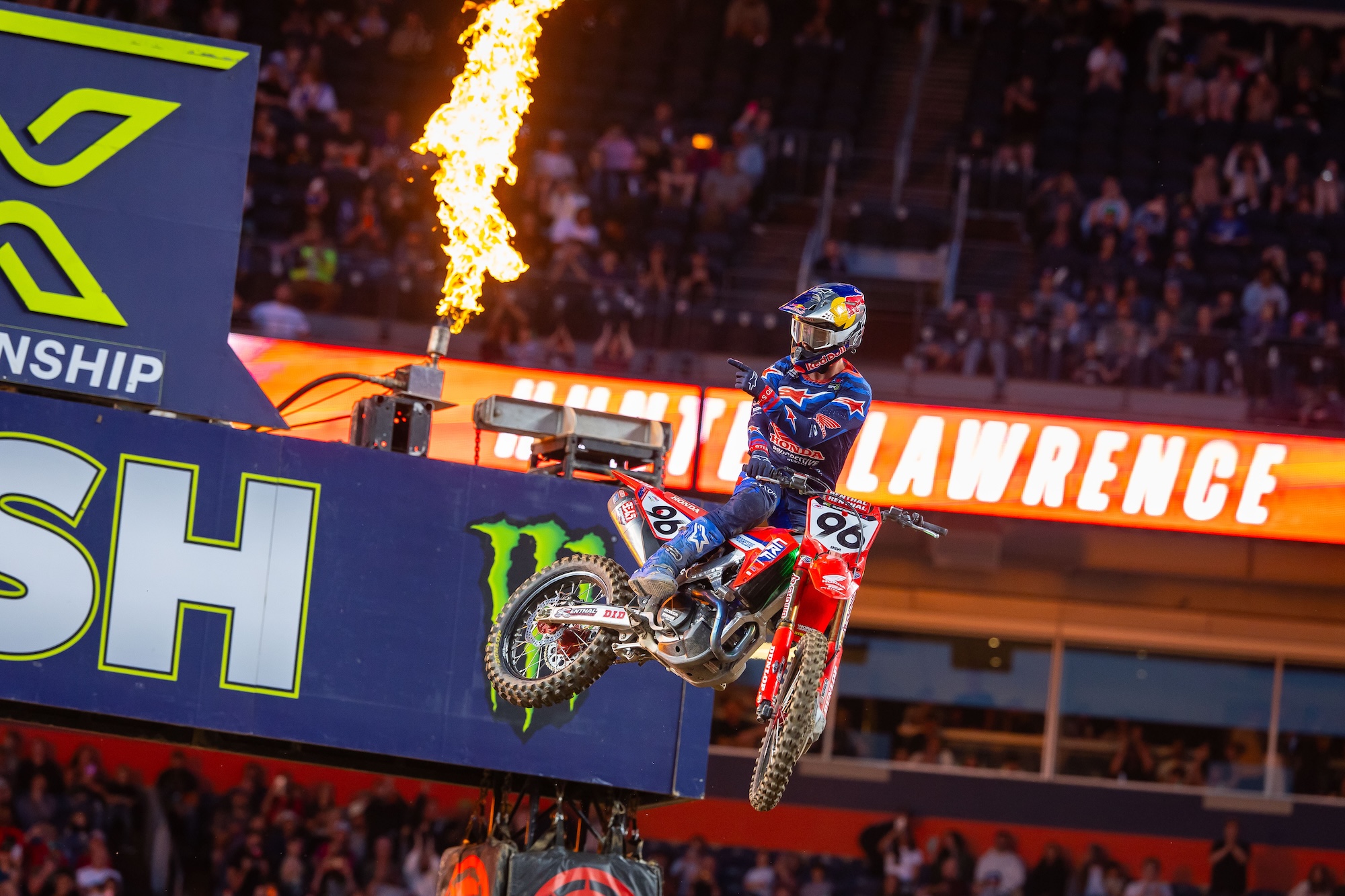
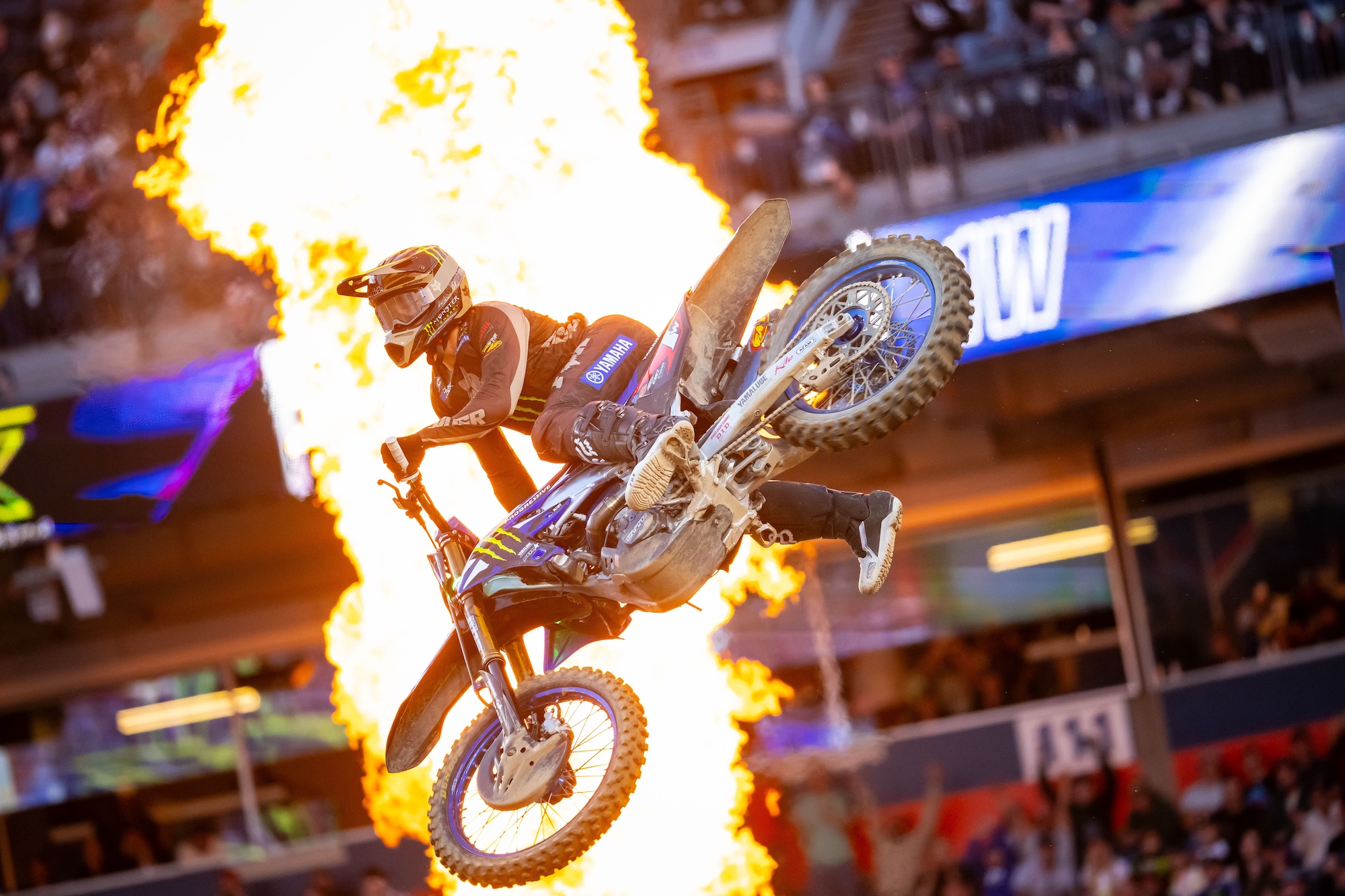
Honda HRC Progressive’s Hunter Lawrence captured a dominant and crucial victory in the historically close 450SMX Class title fight.
Hunter Lawrence – 1st Place – 450SMX Class “It’s good. When I see the [30] second board go sideways I get so excited. Let’s go out, have fun, and do what I love to do. It couldn’t have been much better than that. I’m really happy. Let’s go to Salt Lake, baby.”
Ken Roczen – 2nd Place – 450SMX Class “It was a great race, I’m honestly happy with it. I just wasn’t fast enough, all day really. I know I had a great lap in Qualifying, but Hunter [Lawrence] was on it all day. Once I got into second, I tried a little bit [to catch Lawrence] but I didn’t want to override because it was going to be a long Main Event. I just settled into second. We had a four-point lead, it’s one point now. It is what it is going into the last race. That’s most exciting for the fans, us, and everyone.”
Eli Tomac – 3rd Place – 450SMX Class “I’m just glad to land on the podium for the Colorado fans. I was so bummed when I stalled in the sand. I was able to claw back and have some fun on this track. It was a good bounce back [from the miscue]. I’m just happy to be back for these last two rounds. I love being on the West Coast and we’ll try to go get another podium next week.”
Even though the championship had already been decided, anticipation was high for the return of the Western Divisional 250SMX Class, which last competed for a standalone race in February. All eyes were on newly crowned back-to-back champion Haiden Deegan and his Monster Energy Yamaha Star Racing squad, as both have been in the midst of dominant seasons rewriting the record books. The 15 Minutes + 1 Lap Main Event kicked off with the Star Yamaha duo of Deegan and Max Anstie side-by-side, as Anstie narrowly grabbed the holeshot but quickly gave way to Deegan, who sprinted out to a multi-second advantage. Anstie proceeded to drop to fifth as Toyota Redlands BarX Yamaha’s Lux Turner moved up to second, Monster Energy Pro Circuit Kawasaki’s Levi Kitchen up to third, and Rockstar Energy Husqvarna Factory Racing’s Ryder DiFrancesco into fourth.
As Deegan’s lead grew to nearly five seconds, Kitchen was able to take control of second from Turner, as the Yamaha rider soon dropped out of podium position following passes by DiFrancesco and Anstie. The lead group went unchanged through the remainder of the race as Deegan managed a gap between five and six seconds over Kitchen, who strengthened his hold of second as the race wore on while DiFrancesco did the same from third.
Deegan lapped his way up into the top 10 and cruised to his seventh victory of the season, the most in all of Monster Energy Supercross, by a margin of 3.5 seconds over Kitchen, with DiFrancesco in third. Deegan’s triumph signified the 14th win of his career, which moved him into sole possession of third on the all-time 250SMX Class wins list in Supercross. It also set a new single season record for 250SMX Class wins by a manufacturer with 15, which have come from five different Monster Energy Yamaha Star Racing athletes.
With the title in hand, Deegan heads to the East/West Showdown in Salt Lake City with an eye on cementing his status as one of the all-time greats in the smaller displacement in his final 250SMX Class start. The battle for second in the championship will come down to the wire between Kitchen (2nd), Anstie (3rd), and DiFrancesco (4th) with eight points separating the trio.
Monster Energy Yamaha Star Racing’s Haiden Deegan’s first race as West Division Champion featured a dominant performance for his seventh win of the season.
Haiden Deegan – 1st Place – Western Divisional 250SMX Class “I’ve got to get [more] 250 [class] wins and add it to the record books. That was a good race; a perfect start and led it [from the beginning]. I got up to about a six second gap and just tried to pace myself and put on a show for the Colorado fans.”
Levi Kitchen – 2nd Place – Western Divisional 250SMX Class “I’m actually really happy. Last week I hadn’t rode yet and I wasn’t sure if I was going to race. I had a really good week and I’m pumped [with this result]. I got up into second and just tried to put good laps in. The track was really difficult and could kind of bite you. I’m looking forward to finishing Supercross and heading outdoors.”
Ryder DiFrancesco – 3rd Place – Western Divisional 250SMX Class “Moving up the championship standings has been the goal the past few weeks. Second would be ideal. Tonight, once I got into third there wasn’t really anything I could do. I just pulled it in and finished with a solid effort. We’ll go to Salt Lake City and try to stack [more] points.”
The Monster Energy SMX World Championship and Monster Energy AMA Supercross Championship will come to a thrilling and history-making conclusion next Saturday, May 9, with the Round 17 finale from Salt Lake City’s Rice-Eccles Stadium. Live comprehensive broadcast coverage will be available exclusively on Peacock, beginning at 1 p.m. ET with Race Day Live, followed by a special Pre-Race Show at 6:30 p.m. ET before Gate Drop at 7 p.m. ET. A special encore network presentation will air on NBC on Sunday, May 10, at 3 p.m. ET. Additionally, a domestic Spanish language broadcast is available on Peacock while international viewers can choose from dedicated English, French, and Spanish broadcasts via SMX Video Pass (www.SMXVideoPass.com).
All 17 rounds of the 2026 Monster Energy AMA Supercross Championship and 11 rounds of the Pro Motocross Championship are on sale. Tickets for the SMX World Championship Playoff Rounds and Final are now on sale at Supermotocross.com. Saturday FanFest will take place at all postseason races, Friday FanFest and camping will be available in Columbus and Ridgedale, additional details to follow.
For information about the Monster Energy SMX World Championship, please visit www.SuperMotocross.com and be sure to follow all of the new SMX social media channels for exclusive content and additional information on the latest news: Instagram: @supermotocross Facebook: @supermotocross X: @supermotocross YouTube: @supermotocross TikTok: @supermotocross
About the Monster Energy SMX World Championship: The Monster Energy SMX World Championship™ is the premier off-road motorcycle racing series in the world that combines the technical precision of stadium racing with the all-out speed and endurance of outdoor racing. Created in 2022, the Monster Energy SMX World Championship Series combines the Monster Energy AMA Supercross Championship and the AMA Pro Motocross Championship into a 28-round regular season that culminates with the season-ending SMX World Championship Playoffs. Visit SuperMotocross.com for more information.
About Monster Energy AMA Supercross Championship: Monster Energy AMA Supercross is the most competitive and highest-profile off-road motorcycle racing championship on the planet. Founded in America and sanctioned by the American Motorcyclist Association (AMA) since 1974. Over 17 weeks, Supercross attracts some of the largest and most impressive crowds inside the most recognizable and prestigious stadiums in North America to race in front of nearly one million live fans and broadcast to millions more worldwide. For more information, visit SupercrossLIVE.com.
About Pro Motocross Championship: The Pro Motocross Championship features the world’s fastest outdoor motocross racers, competing aboard homologated bikes from one of seven competing manufacturers on a collection of the roughest, toughest tracks on the planet. Racing takes place each Saturday afternoon, with competition divided into two classes: one for 250cc machines, and one for 450cc machines. MX Sports Pro Racing, the industry leader in off-road powersports event production, manages the Pro Motocross Championship. For more information, visit ProMotocross.com.
About Feld Motor Sports, Inc.: Feld Motor Sports, Inc. is the worldwide leader in producing and presenting specialized arena and stadium-based motorsports entertainment. Properties include Monster Jam®, Monster Energy AMA Supercross, and the Monster Energy SMX World Championship. Feld Motor Sports, Inc. is a subsidiary of Feld Entertainment, Inc. Visit monsterjam.com, SupercrossLIVE.com, and feldentertainment.com for more information.
About MX Sports Pro Racing, Inc.: MX Sports Pro Racing, Inc., manages and produces the world’s premier motocross racing series – the Pro Motocross Championship, sanctioned by AMA Pro Racing. MX Sports Pro Racing is an industry leader in off-road powersport event production and management, its mission is to showcase the sport of professional motocross competition at events throughout the United States. Through its various racing properties, partnerships and affiliates, MX Sports Pro Racing, Inc., organizes events for thousands of action sports athletes each year and attracts millions of motorsports spectators. Visit MXSportsProRacing.com for more information.
If you spend any time in a NASCAR infield or scrolling through racing forums, one thing becomes obvious fast — the parking lot tells the same story as the track. American-made pickups dominate. Trucks outnumber sedans by a wide margin. And the conversation about cars rarely stays on horsepower; it eventually circles back to financing, depreciation, and what a stock-car-loving family actually pays for the privilege of driving the vehicles they love.
The connection between racing fandom and real-world buying decisions is stronger than most people realize. It’s not just preference. It’s a measurable economic pattern.
NASCAR Fans Are 68% More Likely to Own a Truck
A widely-cited NASCAR demographic analysis shows fans are 68% more likely than non-fans to own a truck, and 76% more likely to pay more for high-quality products. They’re also nearly twice as likely as the average American adult to be in the market for a car or truck within the next 12 months — 37% versus 20%, according to YouGov Profiles data.
That’s not a coincidence. Stock car racing originated in the American South, evolved alongside Detroit’s full-size truck era, and built its identity around vehicles that haul, tow, and survive. Ford, Chevrolet, and Toyota — the three manufacturers competing in the Cup Series — also happen to build the three best-selling pickup trucks in the country. The fan-to-buyer pipeline is structural, not accidental.
But here’s where the romance of the sport meets the math of real life: a 2026 Ford F-150 XLT crew cab runs around $55,000. A Chevy Silverado 1500 LT in similar trim is close behind. A Toyota Tundra Limited can push past $58,000. These aren’t the budget-friendly numbers most fans grew up with.
The Real Cost Isn’t on the Sticker
Here’s a number that surprises even seasoned truck buyers: the average new-car monthly payment in the United States hit $767 in Q4 2025, according to Experian’s State of the Auto Finance Market report. Average loan amount: $43,582. Average term: nearly 69 months — almost six years of payments on a single vehicle.
For a NASCAR fan eyeing a fully-equipped F-150 or Silverado, the actual numbers run higher. A $55,000 truck with $5,000 down at 6.5% APR over 60 months works out to roughly $985 per month — and that’s before adding sales tax, registration, and any state-specific fees. Run it in a high-tax state like California (where local rates can hit 11.25% in some cities), and the same loan adds nearly $200/month in tax burden alone.
This is why so many buyers end up underwater on their loans. The truck looks affordable on the lot. The 84-month financing makes the monthly payment look manageable. But by year three, depreciation has outpaced principal payoff, and the buyer owes more than the truck is worth.
What the Smart Money Does
Veteran motorsports fans — the ones who’ve owned five or six trucks across their adult lives — tend to do three things differently:
They get pre-approved through a credit union before walking into a dealership. Three credit unions in particular consistently beat dealer financing on truck loans: PenFed, Navy Federal, and local options like Golden 1 in California or BECU in the Pacific Northwest. The pre-approval becomes leverage in the F&I office, even if the buyer ultimately takes dealer financing.
They calculate the total cost before negotiating, not after. This means knowing the sales tax rate of their county (not their state — local rates vary), the annual registration fees, and the actual monthly payment based on their credit tier. A buyer with a 740 FICO will see APRs around 4.66%; a buyer at 620 might see 11% or higher. On a $50,000 loan, that spread is roughly $385 per month — same truck, same dealer, completely different financial reality.
They use a Car Payment Calculator before committing. Running real numbers — exact MSRP, exact down payment, exact local tax rate, exact term — turns a vague feeling about affordability into a concrete monthly figure. It also reveals when a $1,000 increase in down payment is worth more than a 0.25% rate reduction, or when extending a term from 60 to 72 months costs $4,000 in additional interest for $80 in monthly relief.
Manufacturer Loyalty Has a Real Cost
NASCAR fans are famously loyal to manufacturers. A Ford fan stays with Ford. A Chevy fan dies a Chevy fan. Toyota’s growing presence in the sport since 2007 has built its own fanbase. This loyalty translates to truck purchases — but it can also lock buyers into worse deals.
When a Ford-loyal buyer walks into a Ford dealership, the dealer knows the cross-shopping is limited. Negotiation leverage drops. The same buyer cross-shopping Ford against Chevy and Ram simultaneously gets the best deal — even if they ultimately buy the Ford anyway.
This isn’t a knock on loyalty. It’s a recognition that the financial mechanics of the buying process don’t care about a buyer’s favorite driver. A $1,500 negotiation difference compounds to roughly $1,800 over a 60-month loan once interest is factored in. That’s two years of NASCAR streaming subscriptions, or a weekend trip to Daytona.
Beyond the Truck: The 5-Year Picture
The full cost of owning a $55,000 truck over five years — including loan interest, insurance, fuel at 18-22 mpg, registration fees, and basic maintenance — typically lands between $95,000 and $105,000 for the average buyer. That figure can shift by $10,000 or more based on factors that have nothing to do with the truck itself: the buyer’s credit score, the registration county, the down payment amount, and the loan term.
The buyers who plan all of this in advance — who know their actual monthly payment before sitting in the F&I office, who understand which fees are negotiable and which aren’t, who have a credit union pre-approval in their pocket — end up paying significantly less for the same vehicles. The buyers who don’t plan end up paying for the privilege of not planning.
The Takeaway for Fans Who Buy Like They Race
Racing rewards preparation. The drivers who win Cup Series races aren’t the ones who improvise — they’re the ones whose teams have run every scenario in the simulator before the green flag drops. The same logic applies to buying the truck that gets you to the racetrack.
Three rules separate the fans who make smart buys from the ones who get upsold:
First, calculate before you walk in. Know your monthly payment for every credit tier and term length you might be offered. Decisions made in the F&I office happen fast, and the only buyer who isn’t getting maneuvered is the one who already knows the numbers.
Second, shop the financing separately from the truck. The vehicle and the loan are two different products. Treating them as one package is how dealers extract the most margin.
Third, respect the long tail. A $55,000 truck doesn’t actually cost $55,000. It costs whatever the total of 60 monthly payments, plus tax, plus registration, plus insurance, plus fuel works out to be. That number — the real number — is the only one that matters when deciding what’s affordable.
Race fans understand that the checkered flag is the result of a thousand small decisions made before the race even starts. Buying a truck works the same way. The fans who treat the buying process like a race — preparation, data, leverage — drive away in the truck they wanted at a price they can actually afford.
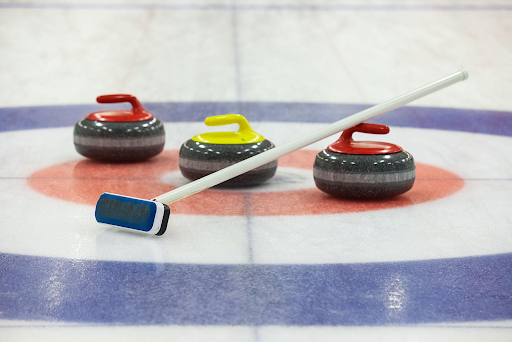
Choosing the right curling broom can make a noticeable difference in how you play and how comfortable you feel on the ice. It’s one of those pieces of gear that seems simple at first, but once you start comparing options, the details matter.
If you’re browsing through different curling supplies, it’s easy to feel unsure about what actually matters and what doesn’t. This guide breaks things down in a straightforward way so you can make a confident choice without overthinking it.
Brush Head Material
The brush head is the part that directly contacts the ice, so it plays a big role in performance. Most modern brooms use synthetic fabrics designed to create the right amount of friction.
Some heads are more aggressive, meaning they generate more heat and can influence the stone’s path more effectively. Others are gentler and better for beginners or casual play.
When comparing options, look for:
Approved materials for your level of play
Durability over time
Ease of replacing the fabric
Handle Design And Grip
The handle might not seem like a big deal, but it affects comfort and control during a game. Most handles are made from lightweight materials like carbon fiber or fiberglass.
A lighter handle reduces fatigue, especially during longer matches. Grip style also varies—some are smooth, while others have textured or padded sections.
Think about:
How does it feel in your hands
Whether it provides enough grip when you’re sweating
The overall balance when you swing it
Weight And Balance
A well-balanced curling broom feels natural to use. If it’s too heavy, your arms will tire quickly. If it’s too light, you might not get the pressure you need when sweeping.
Balance matters just as much as weight. A broom with evenly distributed weight will help you maintain a consistent sweeping motion.
It’s worth trying a few options in person if you can, just to see what feels right.
Head Size And Shape
Not all broom heads are the same size or shape. Some are wider, covering more ice with each stroke, while others are more compact for precise control.
Wider heads can be helpful for beginners since they make sweeping easier. Smaller heads are often preferred by experienced players who want more accuracy.
There’s no single “best” option—it depends on your playing style and comfort.
Replaceable Parts And Maintenance
A good curling broom should last a long time, but parts like the fabric head will wear out. Choosing a model with easy-to-replace components can save money and hassle down the line.
Look for:
Quick-change head systems
Availability of replacement pads
Simple cleaning and care instructions
If you already own a curling broom, upgrading just the head can sometimes improve performance without buying a whole new setup.
Price And Value
Curling brooms come in a wide range of prices. Higher-end models often use lighter materials and advanced fabrics, but that doesn’t mean you need the most expensive option.
For beginners, a mid-range broom is usually a solid choice. It offers good performance without a big investment. As you gain experience, you’ll have a better idea of what features matter most to you.
Finding The Right Fit
At the end of the day, the best curling broom is the one that feels comfortable and suits your level of play. Pay attention to how it feels in your hands, how easy it is to control, and whether it matches your needs on the ice.
Taking a little time to compare options now can make your games more enjoyable and help you improve with every match.
Never Give Up Attitude Rewards Jesse Love and the No. 2 Samsara Chevrolet Team with a Top-10 Finish at Texas Motor Speedway
Finish: 9th Start: 21st Points: 3rd
“Today we maximized the best result we could with our No. 2 Samsara Chevrolet, battling the car’s handling the entire race. We were moving forward towards the top-10 in Stage 1, but the car got too tight in Turns 3 and 4 and fell back. We made multiple adjustments to try and combat that, but went from being too tight to too loose and fell a lap down. A late caution in Stage 3 allowed us to get back on the lead lap with less than 20 laps to go, and we drove forward salvaging a ninth-place result. Today we showed that we didn’t quit as a group. Lessons were learned in Texas, and notes were made, and now we’ll shift our focus to Watkins Glen next weekend.” -Jesse Love
Austin Dillon Shows Speed in the No. 3 Boot Barn Chevrolet Despite Damage From On-Track Incident
Finish: 23rd Start: 20th Points: N/A
“I was excited to come back to the NASCAR O’Reilly Auto Parts Series and make a start in the No. 3 Boot Barn Chevrolet, but unfortunately the race started off with a multi-car incident. I thought we were going to be fine but a car in front of us went back down and barely clipped our left front. It knocked a fender brace loose and eventually got into the tire. We ended up going a lap down making repairs and never got the track position back. If it wasn’t for going a lap down, I think we could have ended up with a strong top-10 finish, even with the damage. Restarts were great today. I would gain like four spots every time before our Chevy would get too tight. I’m thankful for the opportunity, just wish we could have seen how our car would have handled in clean air.” -Austin Dillon
Austin Hill and the No. 21 Distributor Wire & Cable Chevrolet Team Earn Seventh-Place Result at Texas Motor Speedway
Finish: 7th Start: 7th Points: 7th
“All in all, it was a solid day for our Distributor Wire & Cable Chevrolet. We qualified seventh, ran the majority of the race between sixth and eighth, and finished seventh. Some days you just have to take the cards that are dealt to you and maximize the result, which we did. The balance of our car was on the tighter side, but our biggest hiccup was fire off speed. Other guys were able to take off right away on a restart and it would take 15 or 20 laps before our car was really good. Once we got to that point of a run, we were posting lap times just as fast or on par with the leader. In saying all of that though, after the last few weeks, today was a good step in the right direction. Our No. 21 group will keep working at it.” -Austin Hill
Kyle Larson prevailed in a 17-lap shootout and a late challenge from teammate Justin Allgaier to win the Andy’s Frozen Custard 340 at Texas Motor Speedway on Saturday, May 2.
The reigning two-time NASCAR Cup Series champion from Elk Grove, California, led five times for a race-high 93 of 200-scheduled laps in an event where he took the green flag from third place and spent the early portions of the event racing towards the front. After finishing in the top-five mark during the event’s first two stage periods and having a brief sniff at the lead during the second stage period, Larson executed a bold three-wide move in between teammate Connor Zilisch and Brent Crews that even involved on-track contact to storm to the lead with 95 laps remaining.
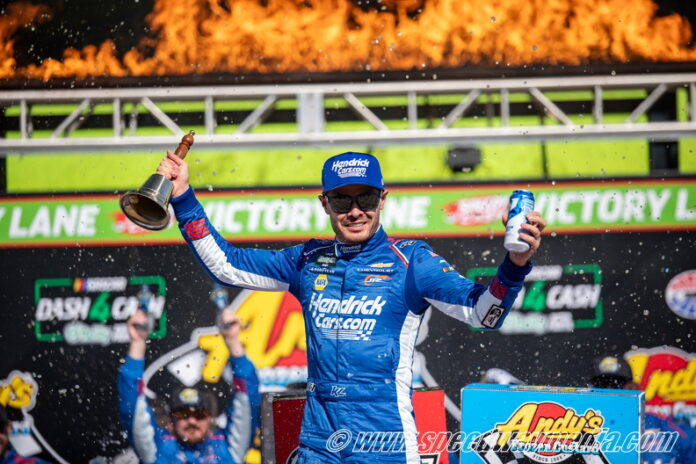
Photo by Ron Olds for SpeedwayMedia.com
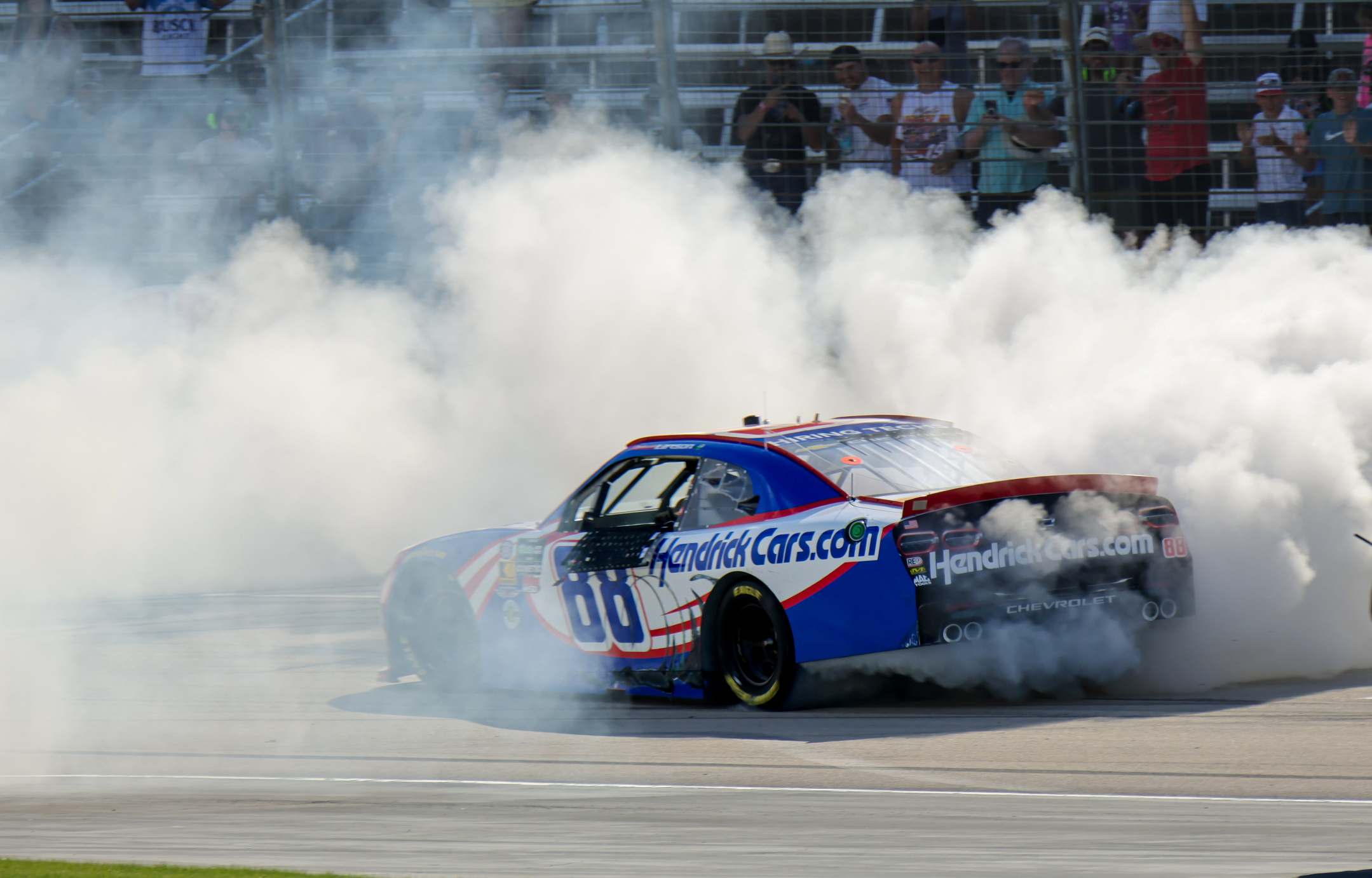
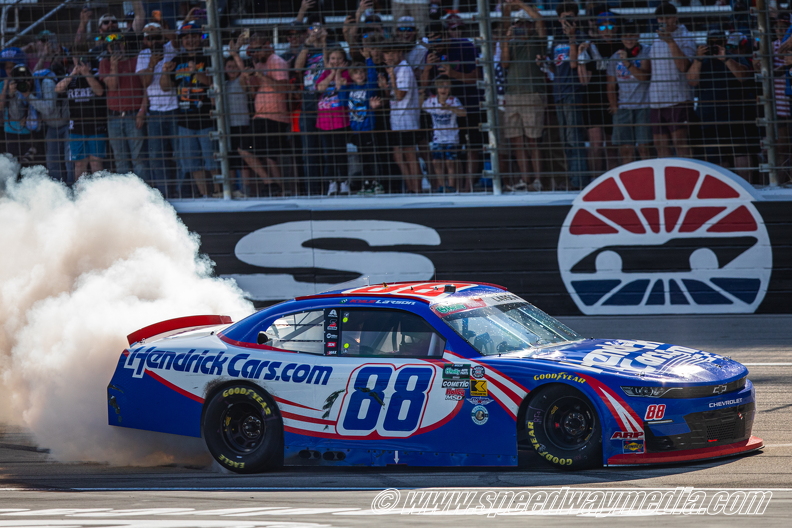
After dominating the final stage period, Larson held a steady advantage over teammate Justin Allgaier when a late-race caution with 22 laps remaining briefly stalled his run to victory. Through a 17-lap shootout, Larson utilized defensive driving to fend off Allgaier throughout the run to pilot the No. 88 HendrickCars.com Chevrolet Camaro entry from JR Motorsports to his second NASCAR O’Reilly Auto Parts Series victory of the 2026 season and his second in a row at Texas.
With on-track qualifying that determined the starting lineup occurring on Friday, May 1, Justin Allgaier nabbed his first O’Reilly pole position of the 2026 season with a pole-winning lap at 188.607 mph in 28.631 seconds. Allgaier shared the front row with Brandon Jones, the latter of whom posted the second-fastest qualifying lap at 188.075 mph in 28.712 seconds.
Prior to the event, Ryan Sieg and Ryan Ellis dropped to the rear of the field due to unapproved adjustments to their respective entries. Lavar Scott also started at the rear of the field due to an engine change to his No. 45 Alpha Prime Racing Chevrolet Camaro entry.
When the green flag waved, and the event commenced, pole-sitter Justin Allgaier and Brandon Jones briefly dueled through the frontstretch until Allgaier motored his No. 7 Roto-Rooter Chevrolet Camaro entry ahead from the inside lane and with the lead through the first two turns. Shortly after, the event’s first caution flew when Taylor Gray, who was racing within the top-15 mark, got clipped sideways by Carson Kvapil, as both he and teammate William Sawalich, the latter of whom got hit by Jeb Burton, spun through the first two turns.
At the front of this incident, Corey Day, who started in sixth place and was coming off his first O’Reilly career victory at Talladega Superspeedway, washed up the track entering the backstretch and smacked the outside wall. Day’s incident damaged the right side and the decklid of his No. 17 HendrickCars.com Chevrolet Camaro entry and evaporated his hopes of winning the fourth Dash 4 Cash $100,000 bonus of this season as he dropped out of race contention.
The next restart on the sixth lap featured Allgaier motoring away from the field through the frontstretch and from the inside lane before he continued to lead through the first two turns and the backstretch. As Allgaier led the next lap, Brandon Jones retained second place over Connor Zilisch while Kyle Larson, who had an early stab for the runner-up spot, dropped to fourth place in front of Brent Crews as Crews recovered from being dead sideways a lap prior.
The caution, however, returned seconds later due to Austin Green getting hit by Josh Williams and spinning through the first two turns, where the former then barely clipped Mason Maggio and sent Maggio for a spin towards the backstretch’s outside wall. During the caution period, the driver of the Chevrolet Corvette pace car had to take evasive action to avoid Maggio’s wrecked entry as Maggio tried to pull up the track and drive away from the carnage scene in the backstretch.
As the event restarted on Lap 12, Allgaier used the inside lane to motor away from the field through the frontstretch for a second consecutive time. He proceeded to lead the next lap over Jones while Larson navigated his way up to third place in front of Zilisch. While Brent Crews and Sheldon Creed battled for fifth place, Allgaier stretched his lead to eight-tenths of a second over Jones by Lap 15.
On Lap 17, the event’s third caution flew due to Brad Perez getting loose off of Turn 4 and hitting the right side of Austin Green while trying to straighten his entry. As a result of the contact with Green, Perez then shot back across the track and hit the frontstretch’s outside wall head-on, which further damaged the front end of his entry, and slid through the frontstretch as Lavar Scott spun to avoid Perez.
When the event restarted under green on Lap 24, Allgaier fended off teammate Larson through the frontstretch and the first two turns with the lead. As teammate Connor Zilisch, who restarted fifth and used a bold move beneath Crews and Jones to move into third, overtook Larson for the runner-up spot, Allgaier led the next lap. Meanwhile, Jones dropped to fifth place behind teammate Brent Crews before both Jones and Creed dropped Crews out of the top-five mark. Sam Mayer, Austin Hill, Jeremy Clements and Jesse Love pursued in the top-10 mark as Allgaier stretched his lead to more than a second.
Through the first 30 laps, Allgaier was leading by nearly two seconds over Zilisch and by three seconds over Larson while Jones and Crews pursued in the top five ahead of Sheldon Creed, Mayer, Hill, Clements and Love. Behind, Kyle Sieg, Anthony Alfredo, Parker Retzlaff, Harrison Burton, Austin Dillon, Dean Thompson, William Sawalich, Rajah Caruth, Ryan Sieg and Carson Kvapil trailed in the top-20, respectively, as Allgaier added another second to his advantage, where he led by more than three seconds over Zilisch at the Lap 35 mark.
When the first stage period concluded on Lap 45, Allgaier, who was leading by more than three seconds, captured his fifth O’Reilly stage victory of the 2026 season. Teammates Zilisch and Larson settled in second and third, respectively, while Jones, Crews, Creed, Mayer, Hill, Clements and Parker Retzlaff were scored in the top 10, respectively. By then, 28 of 38 starters were scored on the lead lap.
Under the event’s first stage break period, the lead lap field led by Allgaier pitted for service. Following the pit stops, Allgaier retained the lead by exiting pit road first ahead of Zilisch, Larson, Jones and Crews. Amid the pit stops, Brennan Poole was penalized for vehicle interference.
The second stage period started on Lap 53 as teammates Allgaier and Zilisch occupied the front row in front of teammate Larson, Jones, Crews and Creed. At the start, Allgaier and Zilisch dueled for the lead before Zilisch used the outside lane to briefly motor his No. 1 Registix/TruckClub Chevrolet Camaro entry ahead. With Allgaier slipping to third place, Larson went beneath Zilisch through the backstretch and motored ahead with the lead, where he led the next lap. Zilisch and Larson swapped the lead three times over the next three laps before the former retained it for good by Lap 57.
Just past the Lap 60 mark, Zilisch was leading by more than a second over Larson, Allgaier and Crews while fifth-place Jones trailed by two seconds. Behind, Mayer, Retzlaff, Hill, Creed and Ryan Sieg were racing in the top-10 mark ahead of Sawalich, Sammy Smith, Jesse Love, Dean Thompson, and Kvapil, as Harrison Burton, Taylor Gray, Clements, Caruth and Alfredo were mired in the top-20 mark ahead of Kyle Sieg, Austin Dillon, Lavar Scott, Blaine Perkins and Josh Williams, respectively.
Following another caution that flew from Laps 68 to 71 due to debris that was detected across the backstretch and occurred due to Austin Dillon shredding a right-front tire, the event restarted on Lap 71. At the start, Zilisch motored ahead with the lead from the inside lane and after he received a strong push from Crews. Through the first two turns, Allgaier used the outside lane to battle Crews for the runner-up spot. As the field led by Zilisch cycled back to the frontstretch to complete another lap, Allgaier prevailed in the battle for second place and Mayer joined the battle by overtaking Crews for third place.
During the next lap, Allgaier motored away with the runner-up spot and tried to reel in Zilisch. Behind, Crews fended off Mayer and Larson for third place and Larson engaged in a tight battle with Mayer for fourth place while Jones and Retzlaff tried to reel in from behind.
At the Lap 80 mark, Zilisch stretched his advantage to more than a second over teammate Allgaier and Crews while Larson and Mayer trailed in the top five, respectively. As Jones, Retzlaff, Hill, Creed and Sawalich trailed by as far back as six seconds in the top-10 mark, Zilisch maintained his advantage to a full second over Crews while third-place Allgaier trailed by one-and-a-half seconds.
When the second stage period concluded on Lap 90, Zilisch fended off a late charge from Crews by a tenth of a second to capture the stage victory. Crews settled in second ahead of Allgaier, Larson and Mayer while Jones, Retzlaff, Hill, Creed and Sawalich were scored in the top 10, respectively. By then, 27 of 38 starters were scored on the lead lap.
During the event’s second stage break period, the lead lap field led by Zilisch returned to pit road for a second round of pit service. Following the pit stops, Zilisch retained the lead by exiting pit road first ahead of Crews, Larson, Allgaier and Jones, respectively.
With 103 laps remaining, the final stage period commenced as Zilisch and Crews occupied the front row in front of Larson, Jones, Allgaier and Retzlaff. At the start, Zilisch gained the upper hand through the frontstretch and the first two turns as he led from the inside lane. As the field fanned out through the backstretch, Zilisch cycled back to the frontstretch and led the next lap over Larson and Crews while Allgaier occupied fourth place in front of a bevy of competitors that included Hill, Mayer, Retzlaff, Sammy Smith, Sawalich, Kvapil, Creed, Ryan Sieg and Love.
At the event’s official halfway mark with 100 laps remaining, Zilisch retained the lead by half a second over teammate Larson while Crews, who trailed by seven-tenths of a second, dropped to third place. Then four laps later, Larson got underneath Zilisch as both drag-raced through the backstretch. Their side-by-side battle allowed Crews to reel in and join the battle. Seconds later, Larson got loose underneath Zilisch and slightly went up the track, which allowed Crews to get beneath both Larson and Zilisch amid a tight three-wide move. With the trio making contact against one another, Larson, who was pinned in the middle of the three-wide scuffle, managed to motor ahead and lead with 95 laps remaining.
Down to the final 75 laps of the event, Larson continued to lead by three seconds over runner-up Crews and by more than four seconds over third-place Allgaier. Meanwhile, Jones and Retzlaff cracked the top-five mark while Zilisch, who trailed the lead by nearly eight seconds, dropped to sixth place in the leaderboard. Hill, Mayer, Kvapil and Sammy Smith occupied the remaining top-10 spots over Sawalich, Creed, Clements, Love and Ryan Sieg as Larson stabilized his lead to three seconds over Crews with 70 laps remaining.
With 60 laps remaining, Larson increased his advantage to four seconds over Crews as Allgaier, Jones, Retzlaff, Hill, Kvapil, Mayer, Sammy Smith and Sawalich all raced in the top-10 mark, with the latter trailing as far back as 16 seconds. Meanwhile, Zilisch, who had been methodically losing spots and pitted five laps earlier under green flag conditions due to a flat right-front tire, was mired two laps down in 28th place.
A lap later, a late cycle of green flag pit stops ensued as Kvapil surrendered his spot within the top-10 mark by pitting his No. 9 Arby’s BBQ Chevrolet Camaro entry. Richard Childress Racing’s Hill and Love pitted during the next two laps before Allgaier, Retzlaff and Mayer pitted their respective Chevrolet entries with 56 laps remaining.
The leader, Larson, along with Crews and Jones, pitted simultaneously shortly after as Sawalich, Alfredo, Dean Thompson, and others pitted. At the conclusion of the pit stops, Larson cycled back on track ahead of Allgaier, Jones, and Crews. Larson then officially cycled back to the overall lead with 51 laps remaining after Rajah Caruth pitted.
With 40 laps remaining, Larson was leading by more than two seconds over Allgaier while Crews trailed in third place by five seconds. Fourth-place Jones trailed the lead by nearly seven seconds, and fifth-place Retzlaff trailed by nine seconds while Hill, Kvapil, Mayer, Sammy Smith, and Creed occupied the remaining top-10 spots ahead of Love, Clements, Alfredo, and Zilisch, all of whom were scored on the lead lap.
Ten laps later, Larson’s advantage slightly decreased to 1.889 seconds over Allgaier, though the latter was unable to gain significant ground on the former. Meanwhile, third-place Crews trailed by nearly five seconds while top-five competitors Jones and Retzlaff both trailed by as far back as nine seconds in the top-five mark.
Then, with 22 laps remaining, the caution flew due to Rajah Caruth getting loose entering Turn 2. He then veered to the right, hit the outside wall, spun down the track, and hit the inside wall on the right side while facing backwards. At the time of caution, Larson was leading by 1.617 seconds over Allgaier, while only 12 competitors were scored on the lead lap. During this latest caution period, the lead lap field led by Larson pitted. Larson retained the lead by exiting pit road first over Jones, Allgaier, Crews, and Hill, respectively.
The ensuing restart with 17 laps remaining featured Larson muscling ahead of the field through the frontstretch and using the preferred inside lane as the field fanned out to multiple lanes entering the first two turns. Amid a series of late jostling for spots, Larson led the next lap by two-tenths of a second over Allgaier and Jones. As Mayer jumped to third place in front of Crews, Jones, Creed, Retzlaff, Hill, Love and Clements, Larson methodically added one-tenth of a second to his advantage over the next three laps. By the time the event reached its final 10-lap mark, he was leading by half a second over Allgaier.
Down to the final five laps of the event, Larson, who had his advantage shrink to a tenth of a second a lap prior, went on the defensive. He kept Allgaier trailing behind, maintaining the lead by two-tenths of a second over a hard-charging Allgaier. Allgaier reduced his deficit to a tenth of a second during the next lap, and Larson grew it back to two-tenths for the following lap before Allgaier reeled in to trail by a tenth of a second with two laps remaining.
When the white flag waved, and the final lap started, Larson remained in the lead by a tenth of a second over Allgaier. Through the first two turns, Larson went on defensive mode as he kept Allgaier squarely behind his rear bumper. With Allgaier trying to reel Larson back down through the backstretch, he tried to use the outside lane to draw even with Larson through Turns 3 and 4.
But Larson used the inside lane to maintain the lead and slightly pull away. With Allgaier unable to recover, Larson cruised back through the frontstretch and claimed the checkered flag by two-tenths of a second over Allgaier.
With the victory, Larson, who led a race-high 93 laps, notched his 19th NASCAR O’Reilly Auto Parts Series career victory in his 124th series start, his second of the 2026 season and his third overall at Texas Motor Speedway. Larson, who achieved the victory in his fourth and final O’Reilly scheduled start of the 2026 season, also won for the fourth time driving the No. 88 Chevrolet Camaro entry for JR Motorsports. Larson’s Texas O’Reilly victory marked the seventh win of this season for JR Motorsports and the 10th for Chevrolet.
Photo by Jake Daugherty for SpeedwayMedia.com.
“I really didn’t think I had a chance there with Justin [Allgaier] behind me,” Larson said on the frontstretch on the CW Network. “He was really good and catching me there on that long run after the green flag stop. [I] Was just hoping cleaner I could kind of stretch away like I did the run before to start Stage 3. He was just really good behind me, and he could run a lot of different lanes back there, too. I was trying to do what I could to take his air away while also maintaining a good corner for myself, but man, he was always closing on me. Thanks to him for racing me clean there. He could have easily got in the back of me. I could tell he was trying to pack some air to get me free. That was a great little run to the end there.”
Meanwhile, Allgaier, who led 54 laps, was left disappointed on pit road after he was outdueled by Larson, which prevented him from winning at Texas for the first time ever. Amid the disappointment, Allgaier increased his points lead to 121 over Sheldon Creed.
“I felt like the shot run for us is a little bit of a struggle, I guess, all day,” Allgaier said. “We were on the splitter a little too hard to fire off on those runs, and really, that was the difference maker at the end of the race. I’m disappointed. Without contact, I don’t know that there’s any way to get around [Larson], and I tried every lane I could possibly try and just unfortunately come up short. I’m gonna go back and watch this [race] a bunch and try to figure out what I could have done better…One of us had to win, right? We very could have easily wrecked there and either one of us won. We both finished one, two. It’s a good points day for us again, and we’ll move on to next week.”
As Larson celebrated an O’Reilly race victory, rookie Brent Crews emerged victorious in his own form. By emerging as the highest-finishing Dash 4 Cash contender in fourth place on the track and ahead of Sheldon Creed, Sammy Smith, and Corey Day, Crews pocketed the fourth and final $100,000 bonus of the 2026 season. Crews, who achieved the bonus for the first time ever in his inaugural O’Reilly campaign, also notched his fourth consecutive top-five result and sixth top-10 result through eight starts this season.
“This Mobil 1 Toyota GR Supra was as fast as it could be,” Crews said. “Just needed a little bit there more at the end. Just go a little tight, but other than that, I had a blast there at the end, getting to race Larson and Allgaier and Sam [Mayer]. Great points day for this team. Ready to keep learning.”
Sam Mayer came home in third place ahead of Crews, while Parker Retzlaff notched his second top-five result of the 2026 season by finishing in fifth place. Sheldon Creed, Austin Hill, Brandon Jones, Jesse Love, and Jeremy Clements completed the top 10 in the final running order.
There were 13 lead changes for six different leaders. The event featured seven cautions for 36 laps. In addition, 20 of 38 starters finished on the lead lap.
Following the 12th event of the 2026 NASCAR O’Reilly Auto Parts Series season, Justin Allgaier continues to lead the standings by 121 points over Sheldon Creed, 167 over Jesse Love, 198 over Corey Day, and 204 over Brandon Jones.
Results:
Kyle Larson, 93 laps led
Justin Allgaier, 54 laps led, Stage 1 winner
Sam Mayer
Brent Crews, two laps led
Parker Retzlaff
Sheldon Creed
Austin Hill
Brandon Jones
Jesse Love
Jeremy Clements
Carson Kvapil
Anthony Alfredo
Sammy Smith
Ryan Sieg, one lap led
William Sawalich
Dean Thompson
Patrick Staropoli
Josh Williams
Lavar Scott
Brennan Poole
Connor Zilisch, one lap down, 48 laps led, Stage 2 winner
Harrison Burton, one lap down
Austin Dillon, one lap down
Ryan Ellis, one lap down
Blaine Perkins, one lap down
Jeb Burton, one lap down
Josh Bilicki, two laps down
Joey Gase, two laps down
David Starr, three laps down
Kyle Sieg, four laps down
Garrett Smithley, six laps down
Mason Maggio, 11 laps down
Taylor Gray, 12 laps down
Rajah Caruth – OUT, Accident, two laps led
Austin Green – OUT, Accident
Brad Perez – OUT, Accident
Corey Day – OUT, DVP
Dawson Cram – OUT, Engine
Next on the 2026 NASCAR O’Reilly Auto Parts Series schedule is the Mission 200 at The Glen (Watkins Glen International) in Watkins Glen, New York. The event is scheduled to occur next Saturday, May 9, and air at 4 p.m. ET on the CW Network, MRN, and SiriusXM.
CREWS WINS DASH 4 CASH WITH FOURTH-PLACE FINISH IN TEXAS 18-year-old registers fourth consecutive top five result
FORT WORTH (May 2, 2026) – Brent Crews was the top-finishing Toyota driver in the NASCAR O’Reilly Series race at Texas Motor Speedway, winning the Dash 4 Cash $100,000 bonus with a fourth-place result on Saturday afternoon.
Eighteen-year-old Crews has recorded four consecutive top five finishes and six top 10s in eight series starts. Brandon Jones also earned a top-10 finish for Toyota in Texas with an eighth-place result on Saturday.
TOYOTA RACING Post-Race Recap NASCAR O’Reilly Auto Parts Series (NOAPS) Texas Motor Speedway Race 12 of 33 – 300 miles, 200 laps
TOYOTA FINISHING POSITIONS
1st, Kyle Larson*
2nd, Justin Allgaier*
3rd, Sam Mayer*
4th, BRENT CREWS
5th, Parker Retzlaff*
8th, BRANDON JONES
15th, WILLIAM SAWALICH
16th, DEAN THOMPSON
22nd, HARRISON BURTON
33rd, TAYLOR GRAY
*non-Toyota driver
TOYOTA QUOTES
BRENT CREWS, No. 19 Mobil 1 Toyota GR Supra, Joe Gibbs Racing
Finishing Position: 4th
Can you take us through your experience for your first time at Texas Motor Speedway?
“Today was a blast. I just want to thank the good Lord for keeping us safe today. It’s a beautiful day today here in Texas. The Mobil 1 Toyota GR Supra was as fast as it could be. Some mistakes on my part learning green-flag stops and stuff but that comes with it. I had a blast and thankful to bring this team home some money. They deserve it with how hard they’ve been working in the shop. Congrats to Kyle (Larson) and Justin (Allgaier). It was really fun getting to race some of the best guys in our sport.”
What grade would you give yourself today in your first start at Texas?
“You asked me this question at Bristol, and I don’t remember what I gave myself. I don’t know – maybe like an A minus – somewhere in there – maybe a B plus. I feel like my car was really, really good today. I just want to thank the good Lord above for keeping us safe. The weather was absolutely gorgeous today. It warmed up from yesterday, so it was a little bit tougher in the car. This Mobil 1 Toyota GR Supra was as fast as it could be. I just needed a little bit more there at the end. It just got a little bit tight, but I had a blast there at the end getting to race Larson and Allgaier and Sam (Mayer). I told Sam this the other week – I grew up watching Sam in the class ahead of me racing go-karts so it’s like full circle getting to race against all of these guys. Great points day for this team. I want to thank Seth and this team and everybody at Mobil 1. They did such a great job.”
What does an 18-year-old do with $100,000?
“That’s a great question. Unfortunately, I don’t think my mom or my dad will let me do anything exciting so I’ll see what I can do.”
BRANDON JONES, No. 20 Menards/Sylvania Toyota GR Supra, Joe Gibbs Racing
Finishing Position: 8th
How was your race and what did you need more of today?
“We qualified really good and had a great practice yesterday. We came into a little hotter track today. Our short run speed was kind of our kryptonite and our weakness, but our long run speed was where we were really good. I didn’t really want to see that yellow at the end, but the yellow was also our shot to try to go and win the race again. Looking back at the race again and the whole event, maybe I pick behind the 88 (Kyle Larson) to have a slightly better chance at it but I don’t know. I think our balance was still just slightly off even on that last run to kind of end. We did all we could. The guys did a really good job of trying to make swings at it and make adjustments. Looking forward to the next couple weeks. We’ve got some great tracks coming up. It was a good points day. I know we want to be better than that and we were fourth capable so eighth was worst case scenario but all in all it was still a solid day.”
About Toyota
Toyota (NYSE:TM) has been a part of the cultural fabric in North America for nearly 70 years, and is committed to advancing sustainable, next-generation mobility through our Toyota and Lexus brands, plus our more than 1,800 dealerships.
Toyota directly employs nearly 64,000 people in North America who have contributed to the design, engineering, and assembly of over 50 million cars and trucks at our 14 manufacturing plants. In 2025, Toyota’s plant in North Carolina began to assemble automotive batteries for electrified vehicles.
For more information about Toyota, visit www.ToyotaNewsroom.com.