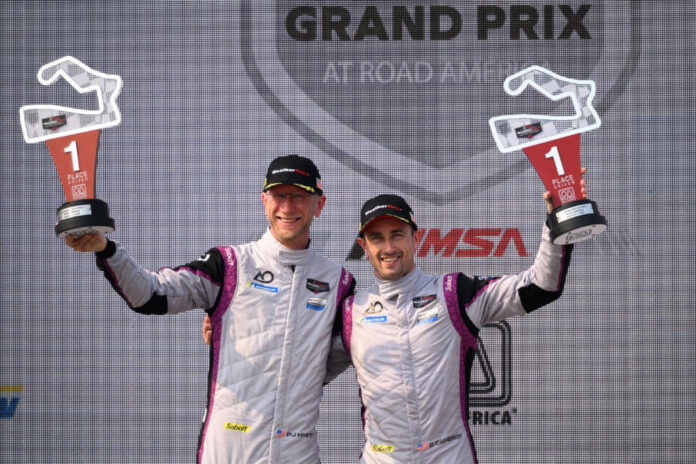
ST CHARLES, Ill. (November 5, 2025) – Following a dominant championship campaign in 2025, AO Racing will return to the IMSA WeatherTech SportsCar Championship’s LMP2 class with an unchanged lineup for the 2026 season. The No. 99 Oreca, affectionately known as Spike the Dragon, will once again be piloted by PJ Hyett, Dane Cameron as the full season drivers with Jonny Edgar as the endurance addition and Christian Rasmussen rounding out the lineup for the Rolex 24 At Daytona.
“A wise man once said, ‘If it isn’t broken, don’t fix it,’” said Team Principal Gunnar Jeannette. “Our LMP2 crew and Spike had such a great 2025 season that we want to do the same thing for 2026. PJ, Dane, Jonny, and Christian all performed fantastically for us over the course of the year, and we look forward to getting 2026 started at the November Daytona test.”
The four-driver roster reunites to defend their LMP2 championship over the seven-race calendar, beginning with the prestigious Rolex 24 At Daytona on January 24, 2026. After an exceptional season that included victories at Canadian Tire Motorsport Park and Road America, and leading the most laps in the most races in 2025, AO Racing looks to continue its momentum into the new year.
In addition to securing the 2025 championship title, PJ Hyett once again claimed the most pole positions in the class, an achievement he also earned in 2024.
“Winning the LMP2 championship in 2025 was a dream come true, but we have unfinished business,” said Hyett. “The top step at all of IMSA’s endurance races have yet to be reached for our crew, and 2026 sounds like the right year to do it.”
Dane Cameron’s season added another milestone to his career, earning him his fifth IMSA championship.
“I’m super excited to be back with AO Racing to defend our championship,” said Cameron. “It will be hard to top 2025, but I feel we were getting stronger as a group as the year went on. There is so much benefit to having continuity, and I believe with this group, we can start the year with a win at Daytona.”
The team’s 2026 campaign will once again compete at some of the most iconic circuits across North America, showcasing AO Racing’s continued growth and commitment to excellence across multiple classes of IMSA competition.
Zilisch, Herta join returning Cadillac Racing GTP drivers for IMSA Daytona test
DETROIT (November 5, 2025) – Five weeks after lowering the curtain on the IMSA WeatherTech SportsCar Championship season with a Victory Circle celebration, Cadillac Racing continues preparations for 2026 championship runs with a two-day test at Daytona International Speedway.
In addition to eight returning Cadillac Racing drivers seeing track time in the Nos. 10 and 40 Cadillac Wayne Taylor Racing V-Series.Rs and No. 31 Whelen Cadillac V-Series.R, Cadillac Formula 1Ⓡ Team test driver Colton Herta and American stock car racing star Connor Zilisch will take the wheel of a Cadillac Grand Touring Prototype (GTP) racecar for the first time.
Five sessions November 14-15 for GTP competitors are scheduled on the 3.56-mile, 12-turn road course, which will host the 2026 season-opening Rolex 24 At Daytona in January.
Herta, 25, who will contest the upcoming FIA Formula 2 season with Hitech Racing, recently was confirmed to compete in the 2026 IMSA Daytona, Sebring and Road Atlanta endurance races in the No. 40 Cadillac Wayne Taylor Racing V-Series.R.
NASCAR Xfinity Series regular-season champion and rookie of the year Zilisch will get an early look at Daytona International Speedway – where he’ll make his NASCAR Cup Series full-season debut in February in the No. 99 Chevrolet for Trackhouse Racing – by driving the No. 31 Whelen Cadillac V-Series.R campaigned by Action Express Racing at the test.
“Hopefully, we’re going to make the most of it and see if this can lead to more opportunities for me in the Cadillac because it would be super cool for me to be able to race at the highest levels of endurance racing,” said Zilisch, 19, of Mooresville, North Carolina. “That’s always been a dream of mine.”
Herta and Zilisch already have had success in the twice-around-the-clock race at Daytona International Speedway.
Herta earned a GTP class podium in 2024 with Wayne Taylor Racing in addition to GTLM class (2019) and LMP2 class (2022) victories. Zilisch won the LMP2 class (2024). This past January, he co-drove a Chevrolet Corvette Z06 GT3.R for Trackhouse by TF Sport in the GTD PRO class in the Rolex 24 At Daytona.
The test days roster to lay the groundwork for the nine-race 2026 season in the racecars powered by the purpose-built Cadillac 5.5-liter DOHC V8 engine:
Cadillac Wayne Taylor Racing
No. 10 – Ricky Taylor, Filipe Albuquerque, Will Stevens
No. 40 – Jordan Taylor, Louis Deletraz, Colton Herta
Cadillac Whelen
No. 31 – Jack Aitken, Earl Bamber, Frederik Vesti, Connor Zilisch
“I am looking forward to unlocking more speed in our car,” said Albuquerque, who will team with Ricky Taylor for the sixth consecutive year in ’26. “We made huge steps in 2025, and I want to keep searching. I want more. I want my first win back with Cadillac. I want to be fighting for the title.”
Cadillac Racing will enter its fourth season of IMSA GTP competition with momentum from dominant victories (Indianapolis, Petit Le Mans) by the No. 31 Whelen Cadillac V-Series.R to close the 2025 season. The Nos. 10 and 40 Cadillac Wayne Taylor Racing V-Series.Rs combined for four podium finishes.
General Motors (NYSE:GM) is driving the future of transportation, leveraging advanced technology to build safer, smarter, and lower emission cars, trucks, and SUVs. GM’s Buick, Cadillac, Chevrolet, and GMC brands offer a broad portfolio of innovative gasoline-powered vehicles and the industry’s widest range of EVs, as we move to an all-electric future. Learn more at GM.com.
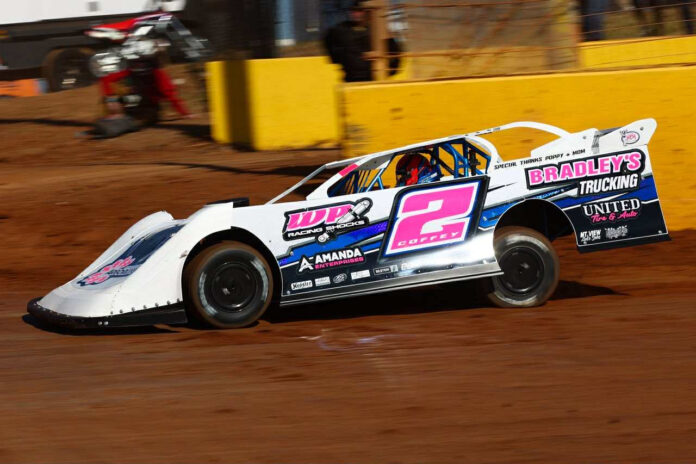
Wyatt Coffey roared to 15 victories this season in 602 Late Model competition as well as three championships.
WAYNESBORO, Virginia (Nov. 5, 2025) – Wyatt Coffey never dreamed his first full season racing a 602 Late Model would go as well as it did.
The 12-year-old from Waynesboro, Virginia, made the full-time switch to Dirt Late Model competition in May, a move that turned out to be a wise choice for the rising racing star.
Coffey earned 15 victories so far this season on dirt as well as the Natural Bridge Speedway 602 Late Model title, the Elite Racing Series championship and the Mid-East 602 Late Model championship.
“I felt confident I could win races, but I never thought we’d end up winning as many as we did,” said Coffey, who still has a few more races on his schedule this season. “It really all comes down to the leadership from my crew chief Jeff Smith. He has really helped me become a better driver this year and he always prepares great race cars for me.”
Coffey has enjoyed a lot of memorable moments this year outside of his three championships.
One of them was recently qualifying for the 602 Late Model feature during the World Short Track Championship at The Dirt Track at Charlotte Motor Speedway, where he finished ninth.
However, his favorite moment this season was unquestionably the night his team had to overcome adversity away from the race track.
“I think my favorite moment was going from 16th to first at Natural Bridge after the rig broke down on the way to the race track,” Coffey said. “We weren’t even sure we were going to make it to the track that night to race, so to start 16th and drive through the field and win after all of that was a pretty cool moment.”
Smith, who is in his first year working with Coffey, is thrilled with his development thus far and excited to see what’s ahead in 2026.
“Wyatt has been a pleasure to work with. He is very mature behind the wheel for his age,” Smith said. “He listens really well and has been coachable beyond my expectations. He absorbs the information and advice that I give him like a sponge. I feel that Wyatt has a God given talent behind the wheel. We have built such a good relationship that goes beyond driver development.
“I consider Wyatt, Kenny and Amanda as extended family. Kenny has been gracious enough to allow me to captain the ship as I would like to and bring Wyatt along at a good pace. Wyatt has done a fantastic job all year. I’m really excited for what the future holds going forward.”
With a strong first season under his belt, Coffey now turns his attention to planning for the 2026 season, which he hopes will be even better than his stellar 2025 campaign.
“I’ve got more experience now and in racing it’s all about experience,” said Coffey. “I think I’ll be able to take what I’ve learned this year and use it to be an even better driver next year. Our team is capable of winning. We have everything we need to be successful.
“None of this would have been possible without Poppy and my family behind me. Without them I wouldn’t be able to do any of this. They work so hard to make sure I can go racing and I’m grateful to have them all on my side.”
Wyatt Coffey would like to thank his mom, dad, poppy, his crew including Jeff, Tye, Zack and Jack, Tonya with MPM Marketing, Longhorn by Wesley Page and his sponsors Coltman Farms Racing, Amanda Enterprises, Charlie Obaugh Chevrolet GMC, JWR Services, ArborLife Professional Tree Care, United Tire & Auto, Bradley’s Trucking, VP Race Fuels, R&M Automotive, Bennett’s Hometown Garage, Browns New Life Services, Payne’s Enterprises, Todd Rental, Mt. View Auto Sales and Checkered Flag Graffix.
About McCallister Precision Marketing
McCallister Precision Marketing (MPM) focuses on assisting up-and-coming race car drivers with career advancement and promotion. McCallister Precision Marketing helps drivers build confidence in front of and behind the camera, giving them the tools they need to advance to the next level. The company also provides companies with a strategic plan for their sales, marketing and promotional needs. We believe in building positive relationships with our clients so that we may provide them with the most professional, yet personal guidance they need, in order to achieve their racing goals. Our clients include race car drivers, race team owners, companies and racing series’. We also work closely with charities and charity events. For more information on McCallister Precision Marketing, visit www.MarketWithMPM.com, email TonyaMac44@MarketWithMPM.com or call 803-361-6199.
Expanded partnership is part of broader effort to build a more dynamic, fan-first digital platform
NEW YORK, NY AND CHARLOTTE, NC – November 5, 2025 – Next League, the leading technology services company that architects and operates complex technologies for the largest sports brands in the world, today formally announced a new, multi-year strategic partnership with NASCAR. The organizations have worked together for years, with Next League being responsible for key parts of NASCAR’s digital strategy and technology platforms since 2012.
This expanded partnership announces to the world that NASCAR recognizes that new technologies are critical to future business growth. Next League, with its expanded focus on how emerging technologies and AI innovation reshape the way sports organizations engage fans, increase fan loyalty, drive and diversify revenue, will help NASCAR deepen connections with fans across every touchpoint — from content and live experiences to data and beyond. Together, they’ll ensure NASCAR stays ahead of changing fan behaviors and how these emerging technologies continue to shape how audiences experience the sport.
“We’re excited to build on our longtime relationship with Next League as we create new ways to engage fans and reach new audiences,” said Tim Clark, NASCAR’s Executive Vice President and Chief Brand Officer. “This next phase positions us to lead in a fast-changing digital landscape, with Next League helping us develop the tools and insights to deepen those connections. Together, we’re building a more dynamic, fan-first digital platform that’s ready for the next generation of engagement.”
“We have been fortunate to work with the NASCAR team for more than a decade and are thrilled to build upon our strong foundation with this expanded partnership,” said Next League CEO David Nugent. “Together we will reimagine the digital fan experience through people, technology, and a relentless focus on innovation. Given our extensive expertise working across the sports ecosystem and an innate understanding of NASCAR and their fans, we know we are uniquely qualified to help them build new ways for fans to connect with the sport they love. We’re thrilled to be shaping the next generation of fan engagement together.”
Next League’s mission includes partnering with sports organizations, like NASCAR, in making investments that have a lasting social impact. As part of this expanded partnership, Next League will make a significant commitment to The NASCAR Foundation, a national charity dedicated to enhancing the delivery of health and wellness programs and services to children across NASCAR’s racing communities.
About NASCAR
The National Association for Stock Car Auto Racing (NASCAR) is the sanctioning body for the No. 1 form of motorsports in the United States and owner of 14 of the nation’s major motorsports entertainment facilities. NASCAR sanctions races in three national series (NASCAR Cup Series™, NASCAR Xfinity Series™, and NASCAR CRAFTSMAN Truck Series™), four international series (NASCAR Brasil Series, NASCAR Canada Series, NASCAR Euro Series, NASCAR Mexico Series), four regional series (ARCA Menards Series, ARCA Menards Series East & West and the NASCAR Whelen Modified Tour) and a local grassroots series (NASCAR Advance Auto Parts Weekly Series). The International Motor Sports Association™ (IMSA®) governs the IMSA WeatherTech SportsCar Championship™, the premier U.S. sports car series. NASCAR also owns Motor Racing Network, Racing Electronics, and ONE DAYTONA. Based in Daytona Beach, Florida, with offices in five cities across North America, NASCAR sanctions more than 1,200 races annually in 11 countries and more than 30 U.S. states.
For more information visit www.NASCAR.com and www.IMSA.com, and follow NASCAR on Instagram, YouTube, TikTok, X and Facebook.
About Next League
Next League is a global team of strategists and technologists, specializing in creating, designing, building and operating technology solutions for sports organizations. We empower teams and leagues with innovative digital solutions that drive measurable fan engagement and revenue growth.
INDIANAPOLIS (Nov. 4, 2025) – NHRA officials announced that Flexjet, a global leader in private aviation, will continue as the title sponsor of the exciting NHRA Factory Stock Showdown class, which will make nine appearances at NHRA national events during the upcoming 2026 season.
The ultra-competitive Flexjet Factory Stock Showdown class crowned Mark Pawuk the world champion this season, as the veteran won his second straight championship.
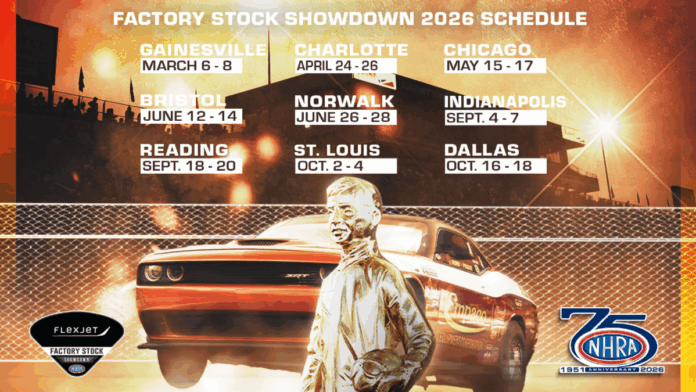
The factory hot rod class added an extra race for 2026 and will begin its season at the NHRA Gatornationals in Gainesville on March 5-8 before heading to Charlotte for the four-wide race on April 24-26.
From there, the class will race at Route 66 Raceway in Chicago on May 14-17, followed by races at picturesque Bristol Dragway on June 12-14 and then fan-favorite Summit Motorsports Park in Norwalk, Ohio on June 25-28.
The category will take a summer break following the race, returning to action as part of the prestigious Cornwell Quality Tools NHRA U.S. Nationals on Labor Day Weekend in Indianapolis.
Flexjet Factory Stock Showdown will stay busy to close out the season, racing at Maple Grove Raceway on Sept. 17-20 and then at World Wide Technology Raceway in St. Louis on Oct. 2-4.
The added ninth race will also serve as the finale, as Flexjet Factory Stock Showdown will close out the 2026 season at Texas Motorplex on Oct. 14-18 as part of the track’s massive Stampede of Speed and Texas NHRA FallNationals.
The Flexjet NHRA Factory Stock Showdown category has provided thrilling action for several years, with some of drag racing’s top drivers competing for the prestigious Wally behind the wheel of Chevrolet COPO Camaros, Ford Cobra Jets, and Dodge Challenger Drag Paks. In 2025, Pawuk clinched his second straight championship on the strength of event wins in Norwalk and Bristol. He was also the runner-up in Charlotte, holding off a strong charge from Jason and Taylor Dietsch, who won a combined four races.
The popular Flexjet NHRA Factory Stock Showdown Bounty Program will also return in 2026. Established during the 2021 season, the program puts a “bounty” on the winner of the previous event.
For more information about Flexjet, please visit www.flexjet.com. For more information about the NHRA, including the 2026 schedule, please visit www.NHRA.com.
2026 FLEXJET NHRA FACTORY STOCK SHOWDOWN SCHEDULE
March 5-8: 57th annual NHRA Gatornationals, Gainesville Raceway, Gainesville, Fla.
April 24-26: 16th annual NHRA 4-Wide Nationals, zMAX Dragway, Charlotte
May 14-17: 26th annual Gerber Collision & Glass Route 66 NHRA Nationals presented by PEAK Performance, Route 66 Raceway, Chicago
June 12-14: 25th annual Super Grip NHRA Thunder Valley Nationals, Bristol Dragway, Bristol, Tenn.
June 25-28: 20th annual Summit Racing Equipment NHRA Nationals, Summit Motorsports Park, Norwalk, Ohio
Sept. 2-7: 72nd annual Cornwell Quality Tools NHRA U.S. Nationals, Lucas Oil Indianapolis Raceway Park, Indianapolis
Sept. 17-20: 41st annual NHRA Reading Nationals, Maple Grove Raceway, Reading, Pa.
Oct. 2-4: 15th annual NAPA Auto Parts NHRA Midwest Nationals, World Wide Technology Raceway, St. Louis
If maintaining performance vehicles is your passion – translate those skills into becoming a Flexjet aircraft maintenance technician (AMT). Explore a career with the world-class Flexjet Maintenance group today.
Flexjet, Inc., a global leader in subscription-based private aviation, first entered the fractional jet ownership market in 1995. Flexjet offers fractional jet ownership and leasing and is the first in the world to be recognized as achieving the Air Charter Safety Foundation’s Industry Audit Standard, is the first and only company to be honored with 24 FAA Diamond Awards for Excellence, upholds an ARG/US Platinum Safety Rating, a 4AIR Bronze Sustainable Rating and is IS-BAO compliant at Level 2. Red Label by Flexjet, a market differentiator, which features the most modern fleet in the industry, flight crews dedicated to a single aircraft and the LXi Cabin Collection of interiors. To date there are more than 40 different interior designs across its fleet of nearly 270 aircraft, which includes the Embraer Phenom 300 and Praetor 500, Bombardier Challenger 350, the Gulfstream G450 and G650. Flexjet’s European fleet includes the Embraer Praetor 600 and the Gulfstream G650. Flexjet’s FAA helicopter division sells fractional, lease, and on-demand charter access to its fleet of owned and operated Sikorsky S-76 helicopters serving locations throughout the northeastern United States, United Kingdom and Florida. Flexjet is a member of the Directional Aviation family of companies. For more details on innovative programs and flexible offerings, visit www.flexjet.com or follow us on Instagram @FlexjetInc.
About NHRA
NHRA is the primary sanctioning body for the sport of drag racing in the United States. NHRA presents 20 national events featuring the NHRA Mission Foods Drag Racing Series and NHRA Lucas Oil Drag Racing Series, as well as the Congruity NHRA Pro Mod Drag Racing Series, NHRA Flexjet Factory Stock Showdown™, NHRA Holley EFI Factory X and Johnson’s Horsepowered Garage NHRA Mountain Motor Pro Stock at select national events. NHRA provides competition opportunities for drivers of all levels in the NHRA Summit Racing Series and NHRA Street Legal™. NHRA also offers the NHRA Jr. Street® program for teens and the Summit Racing Jr. Drag Racing League® for youth ages 5 to 17. With more than 100 Member Tracks, NHRA allows racers to compete at a variety of locations nationally and internationally. NHRA’s Youth and Education Services® (YES) Program reaches over 30,000 students annually to ignite their interest in automotive and racing related careers. NHRA’s streaming service, NHRA.tv®, allows fans to view all NHRA national events as well as exclusive features of the sport. In addition, NHRA owns and operates three racing facilities: Gainesville Raceway in Florida; Lucas Oil Indianapolis Raceway Park; and In-N-Out Burger Pomona Dragstrip in Southern California. For more information, log on to www.NHRA.com, or visit the official NHRA pages on Facebook, Instagram, Twitter, and YouTube.
Georgia really is beautiful and worth exploring for all kinds of road adventures. There’s so much to experience: the snow-capped Caucasus mountains, the rolling hills filled with vineyards, and the coastline of the Black Sea. For such a small country, Georgia sure is full of surprises! For all the car and motorcycle lovers, and even for the motorsport fans, there are beautiful and exciting roads to drive on.
What really is so special about driving in Georgia are the unique and wonderful landscapes. The scene can change and surprise you so quickly. In just a few minutes, you can go from walking through the Batumi subtropical forests to the Svaneti snow-capped mountains and ancient watchtowers. Each road you travel on is an exciting journey.
Locals are very friendly (and very confident while driving, so be careful).
Roads can be well-built or you might encounter mountain passes that will test your nerves and your brakes. All roads, however, offer stunning views so you can enjoy the drive.
Let’s see some more interesting info about your future trip.
Why Motorsport Fans Should Visit Georgia
For motorsport lovers, Georgia is a paradise. Unique winding mountain roads, desert tracts, and coastal roads offer natural tracks for anything from off-road rallies to hill climbs.
There are local and international rally competitions, particularly in the Kakheti and Adjara regions, Georgia.
Beat the landscapes and enjoy the great diversity from tight, winding roads to wide, open roads.
There is a growing culture in the country that is focused around cars and motorcycles. This can be seen through weekend rides to the mountains, vintage car festivals, and informal racing clubs in Tbilisi and Batumi.
Motorsport passion and great geography is why Georgia is a must visit.
The Military Highway: A Legendary Mountain Route
You can’t have a Georgian road trip without driving along the Military Highway, one of the most beautiful in the Caucasus. This historic road between Tbilisi and Stepantsminda (Kazbegi) goes through deep gorges, historic castles, and snowy passes over 2,000 meters up!
Every road trip starts at the beautiful Ananuri Fortress next to the Aragvi River and goes through the Gudauri ski resort area. This is a great place to take a break and take pictures.
The last stretch is the best because you get a view of Mount Kazbek and the famous Gergeti Trinity Church. Every road has its twists and turns that makes you feel like you’re in a motorsport race!
Batumi to Mestia: The Adventure Route of the West
If you like challenges, you should take the Batumi to Mestia route. Starting in Batumi, you get to drive along the beautiful coastline, before taking a sharp turn up to the Svaneti mountains. This is one of the most beautiful, yet challenging drives in the country.
Expect sharp turns, gravel patches, and occasional wildlife crossings – this is a route for confident drivers or motorcyclists who enjoy a test.
The payoff? Epic views of glaciers, medieval towers in Ushguli (Europe’s highest inhabited village), and a sense of isolation that feels straight out of a rally film. It’s Georgia at its rawest – and pure fuel for the motorsport soul.
Kakheti Wine Roads: A Calm Drive for Car and Culture Lovers
If you prefer smooth drives with cultural detours, Kakheti offers the perfect balance. Known as Georgia’s wine country, its roads wind through sun-drenched valleys and endless vineyards.
Routes like Tbilisi-Sighnaghi-Telavi are ideal for leisurely cruising, with well-maintained highways and postcard-perfect scenery.
Between drives, stop at local wineries to experience Georgia’s ancient winemaking traditions.
Combine that with a good local meal and a glass of amber wine – and you’ve got the most civilized road trip imaginable. Kakheti might not test your reflexes, but it nourishes your soul.
Tbilisi to Borjomi and Vardzia: History on the Highway
This route enjoys the perfect blend of history and culture. Borjomi is known for its natural springs and forested hills just south of Tbilisi. After Borjomi, the road twists south to Vardzia, a cave monastery carved into the cliffs of the Mtkvari River.
This road is great for drivers that want to enjoy the open road.
It is ideal for a steady cruise because the history and the scenery really encourage exploration. There is plenty to see, and the road is a major part of the story.
Georgia – The Perfect Playground for Road Adventures
Georgia is built for exploration. It is where the road is never just a way to connect points. There is drama, beauty, and discovery along the way. This country provides new and exciting opportunities to travelers on the open road. There are exciting opportunities for every driver. In every kilometer there is something new waiting to be discovered.
Get your maps out, check your tire pressure, and make sure your adventurous spirit is running strong! Georgia shows that some of the best trips in life aren’t about the time it takes, but about that feeling of freedom. The healing tranquility of the sea breeze is a great start before you travel to the spirits of the Caucasus.
Content marketing plays a crucial role in helping eCommerce businesses attract the right audience, engage customers, and drive conversions. It is about building authority, trust, and loyalty through valuable content that resonates with fans and athletes alike. Read more at https://netpeak.us/industry/ecommerce-seo-agency/ to discover how strategic content can elevate your eCommerce presence, boost visibility, and turn casual visitors into loyal brand advocates.
Why Content Marketing Matters in eCommerce SEO
For sports brands, the competition in search results is fierce. Content marketing helps bridge the gap between products and consumers by creating informative, engaging, and SEO-optimized materials. Well-crafted blog posts, guides, and videos enable brands to rank higher for long-tail keywords while establishing an authentic voice that appeals to the sports community.
Search engines reward websites that consistently publish quality content. When users find your content valuable, they stay longer and explore more pages. For eCommerce, this means not only more organic traffic but also increased opportunities for conversions.
Crafting Content That Converts
A winning strategy starts with understanding your audience. Like a football coach analyzing every play, sports enthusiasts seek advice, training tips, and product reviews before making a purchase. When your content provides genuine value, it builds confidence in your brand and subtly guides readers toward buying decisions.
To enhance your SEO performance and user engagement, focus on these core content types:
educational guides — training routines, nutrition advice, and equipment tutorials;
product comparisons — honest insights that help customers choose the right gear;
user stories and testimonials — real-life experiences that inspire trust and community.
Each piece should be optimized with relevant keywords, structured headings, and clear calls to action, ensuring both readability and search engine visibility.
Integrating SEO and Content for Maximum Impact
Content marketing works best when it’s aligned with a broader SEO strategy. Keyword research reveals the phrases your target audience uses, while analytics tools help track engagement and conversions. Sports brands should continuously refine their approach, updating articles and creating seasonal content to reflect current trends — such as new sports events or training gear launches.
Multimedia elements like videos, infographics, and interactive tools can boost engagement rates and make the shopping experience more immersive. Combining these with technical SEO elements — fast-loading pages, mobile optimization, and structured data — ensures that content reaches its full potential.
Building Brand Authority Through Storytelling
The sports industry thrives on passion and performance. Storytelling allows eCommerce brands to connect emotionally with their audience. Sharing behind-the-scenes insights, athlete partnerships, or product innovations transforms your site into a trusted resource rather than just another online store.
A consistent content strategy strengthens brand credibility, encourages repeat visits, and turns customers into advocates. This approach helps establish long-term value far beyond one-time sales.
As a performance marketing agency, Netpeak US focuses on measurable results — traffic, leads, and sales — it delivers effective digital strategies for businesses of any size. With transparent reporting, a systematic approach, and quality assurance, Netpeak US empowers brands to thrive online.
Downtime is expensive. When your excavator sits idle due to a failed final drive, the cost in lost productivity and urgent repair can be steep. And in most cases, it could’ve been avoided. The excavator final drive is one of the hardest-working components in your machine, but it’s also one of the most neglected when it comes to regular maintenance.
Whether you’re dealing with a final drive motor, gear oil levels, or signs of wear, catching issues early and staying on top of proper maintenance can save serious time and money. This guide covers exactly how to maintain your final drive, how to spot problems before they lead to failure, and how to handle replacement final drives when it’s time to swap one out.
What the Final Drive Does – and Why It Matters
The final drive (also known as travel motor – https://track-motor.com/en/c/final-drives/) is the heart of your excavator’s movement system. It takes power from the hydraulic motor and turns it into the torque needed to move the tracks. Internally, it contains critical final drive parts like the sun gear, main bearings, and drive motor, all working together under high pressure to keep your machine moving through heavy loads and tough terrain.
Because the final drive motor is exposed to constant torque, friction, heat, and contamination from dirt or debris, it’s under constant stress. If oil isn’t regularly checked and maintained, internal gears and bearings wear faster, leading to leaks, poor performance, or complete failure. Neglecting final drive maintenance can turn a simple service into a full-blown, high-cost replacement.
Understanding how this system works, and the toll it takes, is the first step toward extending its life and avoiding unnecessary costs.
Know Your Plug System: Two or Three Plugs?
Before you do any kind of final drive maintenance, you need to know whether your drive has a common two-plug system or a three-plug system. These plug systems determine how you check and top up your gear oil, and getting it wrong can lead to overfilling, underfilling, or cross-contamination with hydraulic fluid.
In a two plug system, you typically have a drain plug at the bottom and a fill plug near the top. The assumption is that oil is added until it reaches the fill line. In contrast, a three plug system includes a dedicated level plug, which sits at the correct oil height. With this setup, oil is added through the fill plug until it starts to come out of the level plug.
One rule applies to both: always consult your operator’s manual to confirm the exact technique for your specific model. Using the wrong method, or mixing different fluids, can damage internal parts, increase friction, and shorten the life of the final drive.
Daily and Weekly Maintenance Essentials
Skipping regular maintenance is the fastest way to destroy a final drive. A few minutes each day or week can prevent massive damage down the line. Start with a simple visual inspection: check the final drive surface for leaks, overheating, or built-up debris. Unusual heat is a red flag – it means excessive friction or low fluid levels.
Next, monitor the gear oil and hydraulic fluid. On drives with a three plug system, remove the level plug to ensure the gear oil level is correct. In a two plug system, open the fill plug and ensure oil is just below the fill line. Low oil means wear is already happening. When adding oil, always use the same type the manufacturer recommends.
Don’t ignore the case drain filter – if it’s clogged, pressure builds up and damages seals. Also check the mechanical face seal and around the bottom plug for signs of leaks or contamination. These small checks help protect main bearings, internal parts, and the drive motor – all high-cost items if failure occurs.
When to Replace: Warning Signs and Timing
Even with solid maintenance, there comes a point where a final drive is beyond saving. Knowing when to act can mean the difference between a clean replacement and a catastrophic systemfailure.
Here’s what to watch for:
Grinding or whining noises during travel
Visible leaks around the plugs set or housing
Excess heat or vibration from the final drive motor
Metallic shavings in the gear oil when drained
A sudden decline in torque or track performance
These are signs that internal parts like the sun gear, bearings, or gears may be severely worn. Delaying action leads to more friction, more damage, and higher costs.
If you notice these issues, shut down the machine and inspect immediately. Sometimes it’s just a filter or low oil, but more often, it’s time for a replacement final drive. Acting early protects the rest of your equipment and avoids an even more expensive repair down the road.
Choosing and Installing a Replacement Final Drive
When a final drive reaches the end of its life, replacing it with the right unit is crucial. Not all replacement final drives are created equal, and the wrong choice can result in poor performance, compatibility issues, or early failure.
Start by checking the part numbers on the failed unit and cross-reference them with the manufacturer’s specifications. Don’t rely on visual similarity alone – many drives look the same but have different internal parts, torque ratings, or mount configurations. You want a drive that matches the original in terms of power, pressure tolerance, and connection points.
Before installation, thoroughly clean the mounting area. Flush the lines to remove old fluid, debris, or contaminants. Inspect all plugs, especially the drain plug, and install them using the correct torque settings. If your machine uses a two or three plug system, verify the positions and clean the threads before inserting.
Once the new drive motor is mounted, fill it with fresh gear oil – not hydraulic oil – and follow the operator’s manual for the exact technique. In a three plug system, add oil through the fill plug until it starts to flow from the level plug. With a two plug system, ensure oil is just below the fill line.
Finally, replace or clean the case drain filter. A clogged filter can cause excess pressure and damage your new final drive. Once installed, monitor the area for any early leaks or heat build-up during the first few hours of use.
Excavator Final Drive Maintenance Checklist
✅ Daily / Before Operation
Inspect final drive exterior for leaks, debris, or damage
Check for excessive heat on the final drive surface after use
Listen for abnormal noises during travel (grinding, whining)
✅ Weekly
Check gear oil level
For two plug system: Open fill plug, ensure oil is just below fill line
For three plug system: Fill until oil exits level plug
Inspect around the bottom plug and seals for signs of leaks
Clean area around plugs set before opening
Check case drain filter for blockage or contamination
Inspect mechanical face seal for wear or damage
✅ Monthly / Every 250 Hours
Drain and replace gear oil (or as specified in the operator’s manual)
Inspect drained oil for metal shavings (signs of internal wear)
Check all final drive parts for looseness or visible wear
Verify torque settings on all mounting bolts
Ensure correct fluid type is used – never mix hydraulic fluid with gear oil
Frequently Asked Questions: Excavator Final Drives
What is the final drive on an excavator?
The final drive is the component that transfers power from the hydraulic motor to the tracks, converting it into the torque needed for movement. It includes the drive motor, gears, bearings, and other internal parts that work together to propel the machine under high loads and tough conditions.
What are the symptoms of a bad final drive?
Common signs include:
Unusual noises (grinding, whining) during movement
Leaks around seals or plugs
Excessive heat from the drive housing
Loss of torque or sluggish track response
Metal particles in the gear oil
These symptoms point to worn or damaged final drive parts and may require immediate attention or replacement.
What are the 4 types of final drives?
The four main types of final drives used in heavy machinery are:
Spur gear final drive
Planetary gear final drive
Chain drive final drive
Hydrostatic drive system
Most modern excavators use a planetary final drive paired with a travel motor, offering high torque in a compact design.
How many final drives does an excavator have?
Most excavators have two final drives – one for each track. Each final drive motor operates independently, allowing the machine to turn and pivot. If one fails, the excavator may lose all or part of its mobility.
How often should final drive oil be changed?
It depends on the model, but as a rule of thumb, change the gear oil every 250 to 500 operating hours, or as specified in your operator’s manual. Regular oil changes prevent contamination, reduce wear, and extend the life of final drive components.
How to service a final drive?
Final drive maintenance includes:
Cleaning around all plugs set
Checking the gear oil level
Replacing or cleaning the case drain filter
Inspecting for leaks, debris, and heat
Using the correct fluid and checking whether the unit has a two or three plug system Always refer to the operator’s manual for the exact technique.
How long should a final drive last?
With proper maintenance, a final drive can last 4,000 to 7,000 hours, depending on usage, environment, and care. Neglecting oil changes, ignoring early warning signs, or using the wrong fluid can drastically shorten its life.
Final Thoughts: Cut Downtime, Save Money
Proper maintenance of your excavator final drive isn’t optional, it’s essential. Whether it’s checking the gear oil level, monitoring the mechanical face seal, or replacing a clogged filter, small, regular actions can prevent massive costs and keep your heavy machinery running.
Once a final drive starts showing signs of wear, don’t wait. Every hour of delay increases the risk of worn parts failure and puts your entire machine at risk. Smart operators follow the one rule: inspect, maintain, and if necessary, replace before it’s too late.
In the long run, staying on top of final drive maintenance protects your equipment, saves money, and keeps your projects moving. Because when your excavator’s not moving, neither is your business.
The modern woman is living a busy life: work, exercise, travel, family, and that incessant drive to improve oneself. This sort of pace needs not only willpower but a stable physiology as well. Hormonal balance directly influences energy, focus, stamina, and mood, and hence its maintenance can no longer be an indulgence but a necessity.
Why is it important to monitor hormonal health?
Hormones control everything from appetite and sleep to response to stress and muscle function. Even a slight imbalance will cause fatigue, low energy, mood swings, or difficulty concentrating. To individuals who live an active lifestyle, all these symptoms become especially felt.
One reliable way to monitor your hormonal balance is hormone testing for women – a test that measures your main hormone levels and directly changes your way of life. Such tests inform you about the impact of stress, physical exercise, and diet on your body and what you should change to remain balanced.
The effects of exercise
Movement is a vital element of hormonal balance, but not all exercise is good. High-intensity exercise stimulates endorphins, stimulates metabolic activity, and increases cellular responsiveness to insulin. Excessive exercise or the inability to recover can lead to elevated cortisol levels, resulting in hormone imbalance and fatigue.
Creating a regimen that alternates cardio, strength training, and rest is helpful for active women. The body regains equilibrium with the aid of breathing, stretching, and light walking.
Maintaining electrolyte and hydration levels is also crucial. Dehydration has a negative effect on energy and lowers estrogen. Allowing a cool-down and rest period after vigorous exertion is important because it allows the body to regain hormonal equilibrium.
The importance of focus and mental health
Emotional health relies on hormonal function. Stress, anxiety, and tension over time drain the balance of cortisol and progesterone from the body, resulting in menstrual cycle disruption, insomnia, and mood swings.
Psychological balance is no luxury, but a component of well-being. To counteract the nervous system, it’s worth taking some time on concentration techniques:
4-7-8 breathing,
short mindfulness breaks,
and journaling.
These simple habits reduce levels of anxiety and maintain stress hormones at a healthy level.
Even 10 minutes of peacefulness during the daytime can replace a cup of coffee – it renews focus, alleviates tension, and improves mood. A calm brain best organizes hormonal activity, which maintains the body strong and full of energy.
Techniques for managing your emotions
Living at a rapid pace is frequently related with stress. Constant deadlines, contests, and long commutes all raise cortisol levels, impairing reproductive and metabolic functions.
To mitigate its effects, engage in self-regulation activities such as breathing exercises, brief walks in nature, meditation or yoga, connecting with loved ones, and a digital detox at least once a week. Normalizing your psycho-emotional condition promotes harmony throughout all physiological systems.
Technology & self-control
Modern gadgets and apps allow you to track sleep cycles, activity levels, and even hormonal fluctuations. Regular use of hormone testing for women, combined with these tools, helps create a personalized health strategy.
Monitoring your hormones becomes especially important during changes in routine, stressful periods, or after intense physical activity. This isn’t just a medical measure, but a way to better understand your body and adjust your habits.
Microhabits for preserving hormonal balance
It doesn’t take drastic steps to achieve hormonal health, but rather incremental results with microhabits in the normal course of your day. Perhaps it is waking up every morning with a glass of lemon and water, stretching for a minute before work, ending screen time one hour before bedtime, or logging your well-being each day.
Performing these simple steps each day ultimately stabilizes levels of energy, improves concentration, and allows the body to restore balance to hormone production. Small, consistent steps yield long-term results, they make hormonal balance a constant part of a healthy lifestyle instead of a temporary achievement.
How to identify an imbalance in hormones
The body’s signals often speak for themselves:
chronic fatigue without cause,
weight fluctuations despite maintaining a consistent diet,
insomnia or excessive sleepiness,
deteriorating skin and hair,
decreased libido, or mood swings should raise concerns.
These symptoms don’t always indicate a serious problem, but they are a reason to check your hormone levels and make lifestyle adjustments.
If discomfort persists for more than a few weeks, it’s worth undergoing a full examination. An endocrinologist or gynecologist will help prescribe tests, evaluate the results, and offer personalized recommendations.
Routine hormone testing for women is especially beneficial for those planning a pregnancy, actively involved in sports, or experiencing frequent stress. This not only helps prevent problems but also improves quality of life.
Conclusion
An active life requires not only mental strength but also inner balance. Hormonal balance is the invisible engine that maintains energy, health, and resilience.
Self-care, paying attention to nutrition, rest, and emotional well-being is an investment in long-term well-being. Modern tools like hormone testing for women make this process simple and accessible, helping every woman stay fit, confident, and ready for a new pace of life.
Galveston, Texas, is a beautiful city by the Gulf of Mexico, known for its beaches and coastal attractions. The roads are often filled with tourists, locals, and big trucks carrying goods across the region. With so many vehicles sharing the road, safe driving becomes very important for everyone.
However, the growing number of preventable big rig wrecks in Galveston serves as a reminder of how easily accidents can occur when caution is overlooked. Understanding how to drive safely around large trucks can significantly reduce risks and keep everyone on the road secure.
By following a few essential safety tips, drivers can help create smoother and safer journeys across Galveston’s highways.
1. Stay Out of the Blind Spots
Trucks have much larger blind spots than cars. These are areas around the vehicle that the truck driver cannot see directly through the mirrors. The main blind spots are:
Directly behind the trailer
Along both sides of the truck (especially the right side)
Right in front of the truck’s cab
If you’re driving in any of these zones, the truck driver may not know you’re there. This can lead to serious accidents if the truck turns, changes lanes, or slows down suddenly. A good rule to follow is if you can’t see the truck driver’s face in their mirror, they can’t see you either.
To stay safe, avoid driving beside a truck for long periods and move ahead or behind it safely. Staying visible to the driver ensures they can respond appropriately to your movements.
2. Only Change Lanes When You Can See Both of the Truck’s Headlights
Many drivers make the mistake of cutting in front of trucks too soon after passing them. This is extremely dangerous because big trucks need more distance and time to stop due to their size and weight. Before changing lanes in front of a truck, look at your rearview mirror.
If you can see both of the truck’s headlights clearly, that means there is enough space between your vehicle and the truck. This ensures the truck driver has enough braking distance if traffic suddenly slows. Always signal your lane changes early and avoid sudden movements. Smooth, predictable driving helps truck drivers maintain control and reduces the risk of rear-end collisions.
3. Adjust for Weather Conditions
Driving near trucks in bad weather, heavy traffic, or on slippery roads requires extra caution. Trucks are harder to stop and control in poor conditions, so small vehicles should adjust their speed accordingly. Try to match the general speed of the traffic around you, especially near trucks.
Avoid sudden acceleration or braking, as that can make it difficult for truck drivers to predict your actions. During rain, fog, or strong winds, increase your following distance and stay out of blind spots. Trucks can spray water or debris that reduces visibility, so keeping your distance gives you more reaction time. Adapting to road and weather conditions keeps both you and the truck driver safer.
4. Avoid overspeeding.
Speeding near large trucks is one of the most common causes of serious crashes. Trucks cannot stop quickly, and at high speeds, even a minor mistake can lead to a major accident.
By staying within the speed limit, you give yourself and the truck driver enough time to react if something unexpected happens. Remember that trucks often carry heavy cargo, which makes them less stable during sudden stops or turns.
5. Avoid Distractions Such as Texting or Using GPS
Distracted driving is one of the biggest dangers on modern roads. When you’re near a large truck, even a minor distraction can be life-threatening. Texting, adjusting your GPS, or making calls can easily make you miss a truck’s brake lights, signals, or lane shifts.
Always set your route and music before starting your drive. If you need to check your phone, pull over safely. Paying full attention to the road allows you to anticipate the truck’s movements, maintain proper spacing, and avoid sudden reactions that could cause a collision.
Key Takeaways
Always stay out of a truck’s blind spots to remain visible.
Change lanes only when both truck headlights are visible in your mirror.
Adjust your speed and following distance for weather and traffic conditions.
Avoid overspeeding near large trucks to maintain safe braking distances.
Stay fully focused: never text or use your phone while driving.