The worst thing that any homeowner can experience is their cooling system failing them in the middle of a heat wave. It’s always at the most inconvenient times.
But here’s the good news:
Most summer breakdowns are 100% preventable.
It takes just a few preventative measures to keep your home cool, save money on energy bills and prevent costly service calls. Best of all? You don’t need to be an HVAC whiz.
Here’s how to do it…
Here’s what you’ll discover:
Why Preventive AC Care Actually Matters
7x Simple Steps To Keep Your Cooling System Running
When To Call In The Pros
Why Preventive AC Care Actually Matters
Cooling costs eat up a huge chunk of every home’s energy bill during summer.
Industry research tells us that around 12% of the average household’s energy budget is dedicated to air conditioning. That is a lot of hard earned money we are literally throwing out with cold air. But what happens when your system is running improperly?
But here’s the kicker…
Just 42% of homeowners actually call a pro to perform routine maintenance on their AC. Neglecting service causes breakdowns, high bills, and drastically shorter equipment life. It’s the leading cause of early cooling system failure.
Truth be told… efficient cooling begins with a properly maintained system. An AC that’s well maintained not only uses less energy, but it will cool your home quicker and have a longer lifespan than a unit that isn’t maintained throughout the year. Changing your filter regularly can reduce energy consumption by up to 15%.
And of course, what about when things go wrong? Having a reliable provider you can count on for emergency air conditioning services can be the difference between enduring one hot afternoon and three days of miserable sweating. Prevent most of these emergencies altogether with just a little preparedness.
Now let’s get into the good stuff…
7x Simple Steps To Keep Your Cooling System Running
Follow these steps for preventative maintenance that’ll have the greatest impact on your air conditioner this summer.
Go through them. Select what you haven’t completed and start working.
Change The Air Filter Every Month
This is the easiest (and most overlooked) step of them all.
When you have a dirty air filter your AC has to work exponentially harder. When it works harder:
More energy used
Higher power bills
More wear on important parts
Poor air quality inside your home
Just changing a dirty filter can improve efficiency 5-15%. Look at your filter every month in the summer. If it’s grey and dusty change it out. It takes 2 minutes and costs a few dollars — and it’s the single greatest thing you can do.
Clean The Outdoor Condenser Unit
Your outdoor unit does the heavy lifting to release heat from your home.
Except it can’t do its job if it’s covered in dirt, leaves and grass clippings. So what should you do?
Turn the power off at the breaker
Rinse the fins gently with a garden hose
Clear 2 feet of space around the unit
Trim back any bushes or plants nearby
A clean condenser operates at cooler temperatures therefore it uses less energy. Period. Do this at the beginning of summer and once again halfway through.
Schedule A Professional Tune-Up Every Spring
Think of this like a yearly check-up for your AC.
A technician will check refrigerant levels, clean coils, tighten electrical connections and catch minor problems before they lead up to major costly problems. Schedule your service in the springtime when contractors become very busy during summer.
Bonus: ACs with regular professional maintenance last 40% longer than those that get ignored.
Seal Up Leaky Air Ducts
Here’s a shocker…
Did you know that about 20-30% of the air moving through your ducts is lost through leaks and holes. That’s conditioned air seeping into your attic or crawl space instead of your living room.
Sealing your ducts with mastic sealant or metal tape can cut that waste by half. Seal exposed ducts yourself if they’re in your basement, attic or garage. Hire a professional if the ducts are inaccessible.
Tip: Never use standard duct tape. It won’t stand the test of time and will degrade within a year or two.
Install A Smart Thermostat
One of the greatest energy efficient upgrades when it comes to cooling your home is a smart thermostat.
Why? Because it:
Learns your schedule
Cools your home only when needed
Lets you tweak the temp from your phone
Alerts you when something looks off
Changing just this one little setting can save homeowners about $100 annually on energy costs. That’s hard-earned money back in your pocket each summer — and the thermostat will pay for itself in approximately one year.
Keep The Vents Clear
This one is dead simple.
Inspect each supply and return vent throughout your house. Push aside furniture, rugs, and curtains that are covering vents. Obstructed vents cause your system to work harder than necessary.
Open interior doors where possible. This allows air to flow through your house evenly and minimizes stress on the entire system.
Give Your AC A Break
Running your AC at freezing temps around the clock wears it out fast.
Adjust your thermostat a few degrees warmer if you are leaving the house. Ceiling fans can also distribute cooler air throughout your home. Close your blinds when the sun is at its hottest.
Little tweaks that decrease stress on your system and save big dollars on summer expenses. Your AC will reward you by operating years longer.
When To Call In The Pros
Even with the best preventive care, some issues need a professional.
Watch out for these warning signs:
Warm air blowing from your vents
Weird noises like grinding or squealing
Water leaking around the indoor unit
A big jump in your energy bill
The system won’t turn on (or won’t turn off)
If you see any of these, take action. Minor issues become major expenses when left alone. A simple service call can save you thousands instead of a full replacement later.
The Bottom Line
Preventive care is the best insurance policy for your cooling system.
By following these steps, homeowners can expect:
Lower bills — energy-efficient cooling all summer long
Fewer breakdowns — no more sweating out a heatwave
Longer system life — more years from a big investment
Let’s face it — most people don’t think about their AC until something goes wrong. Don’t wait until summer to become “that person.” Take an hour this weekend and check the filter, clean the outside unit, and schedule that spring tune-up.
You and your wallet will thank yourself later when it’s 100 degrees outside and everyone else is in emergency repair mode.
Multi-vehicle pileups are the stuff of nightmares.
You’re driving along the freeway. Then suddenly you’re in a multi-vehicle pileup with cars crashing into each other from all directions. Chaos. Confusion. Deadly.
The frightening thing? Most pileups result from predictable driver errors. Learn what causes them and you can begin to avoid them.
Here’s the truth:
Pileups can involve 5x cars or 150+ cars
They happen fast (usually within seconds)
They often lead to a hit and run claim when panicked drivers flee
But you can protect yourself once you understand what’s really going on out there.
Here’s what’s inside:
Why Multi-Vehicle Pileups Are So Dangerous
The Most Common Causes Of Pileups
How Drivers Can Avoid Getting Caught In One
Let’s dive in…
Why Multi-Vehicle Pileups Are So Dangerous
A pileup isn’t just a regular car crash times ten.
It’s a completely different animal with the domino effect involved. Once the first car crashes, the cars behind don’t have time to stop. But then the cars behind those cars can’t stop in time either. Soon there are dozens of drivers involved and hundreds of injuries.
Numbers support this as well. According to the NHTSA there were 39,345 traffic deaths in 2024. Multi-car collisions account for a significant percentage of those fatalities.
Drivers who cause the wreck sometimes flee the scene
The last one is a biggie. Fleeing the scene of an accident you caused leaves victims without any way to know who hit them. This is where a hit and run claim comes into play, so it’s best to speak with a Boca Raton car accident attorney immediately. These claims can get very complicated. There may be numerous insurance policies involved. Evidence may be lost. Determining liability can require some expertise.
Now let’s break down what causes these wrecks.
The Most Common Causes Of Pileups
Pileups don’t occur randomly. There are 5 common causes found repeatedly in accident reports.
Tailgating
Tailgating is the #1 cause of pileups.
Because: If you’re tailing the car in front of you too closely and they slam on their brakes, you won’t have time to stop. You crash into them. The car behind you crashes into you. It’s a chain reaction.
Always leave at least 3x seconds worth of space between you and another vehicle in front of you. Bad weather? Increase your space to 6-8 seconds.
If every driver followed this rule, most pileups would never happen.
Distracted Driving
We all know we shouldn’t text and drive… But people do it anyway.
Whenever you glance at your phone for 5 seconds while driving at highway speeds, you have traveled the length of a football field with your eyes off the road. If traffic slows in those 5 seconds – instant rear end collision. Chain reaction.
Distractions include:
Texting and phone calls
Eating or drinking
Messing with the GPS
Turning to talk to passengers
Keep your eyes on the road at all times. Simple.
Bad Weather and Low Visibility
Fog is a pileup magnet.
Some of history’s worst multi-vehicle collisions have occurred during heavy fog when drivers are unable to see far enough in front of them to avoid crashing. On January 20, 26, heavy fog in California resulted in a pileup injuring dozens of people and taking one driver’s life. Fog, heavy rain, and snow are recurring factors in reports of pileups.
When weather turns bad:
Slow way down
Turn on your low-beam headlights (high beams reflect off fog)
Increase your following distance
Pull off the road if visibility gets too bad
Alive and late really is better than the alternative.
Speeding
Speed makes everything worse.
The more speed you travel at, the longer your stopping distance is. And the greater the impact when you crash into something. Usually people who rear-end during a pileup were speeding and couldn’t stop in time.
Stick to the posted limits. Slow down for bad weather or heavy traffic.
Hit And Run Drivers
Here’s something that might shock you…
New AAA Foundation research shows that 15% of police-reported crashes in 2023 included a hit-and-run driver. That’s the highest rate ever recorded and creates even bigger headaches when pileups occur. Hit and runs happen when drivers cause a crash then leave others to clean up.
If a hit and run driver caused the pileup that you became involved in, you may be able to file a hit and run claim to recover damages. However, you will need to act quickly to preserve evidence and collect any information about the driver.
How Drivers Can Avoid Getting Caught In One
Now for the good news: pileups are avoidable.
All you have to do is develop a few good habits when you drive. Here are the most effective-
Maintain space around your vehicle at all times. Number one rule. If you have space, you have options. If you’re surrounded on all sides, you are helpless when stuff happens.
Look in your mirrors frequently. Be aware of what is behind you AND in front of you. If someone is driving right behind you, switch lanes and let them pass.
Adapt to the conditions. Rain, fog, snow, ice, night — they all demand slower speeds and increased following distance.
Don’t get distracted. Put the phone down. Program your GPS while parked. Eat while parked.
Watch far ahead. Don’t focus on the vehicle directly in front of you. Look 10-15 seconds down the road. See brake lights far ahead? Slow down early.
If a crash happens ahead of you…
Don’t panic brake
Move to the shoulder if possible
Turn on hazards to warn drivers behind
Get out and walk AWAY from traffic
That last tip might just save your life. If you’re stuck between two cars in a pileup, you’re standing in one of the most dangerous places possible.
The Bottom Line
Multi-vehicle pileups are terrifying but they’re not random.
They occur due to tailgating, distracted driving, inclement weather, speeding and hit and run drivers. The good news is you have actual control over how you operate your vehicle. By maintaining space around your vehicle, scanning far ahead and slowing down for poor conditions… You can significantly lessen your chance of being involved.
But what if the worst should occur? Know your rights. Get information from every driver. Take pictures. Call the police. Remember that if someone drives away, you can still file a hit and run claim to pay for damages.
Track day events and amateur motorsports competitions draw participants who understand that driving at speed carries inherent risk. Waivers are signed. Safety briefings are attended. Helmets and harnesses become routine. But understanding that risk exists does not automatically extinguish every avenue for legal accountability when something goes wrong. The distinction between risks a participant assumes by choosing to compete and risks created by negligence on the part of organizers, track operators, equipment manufacturers, or other drivers is a legal question with significant consequences for families who lose someone in a motorsport-related incident.
When an accident at a racing event results in a death, the family of the person who died faces a situation that combines grief with a set of legal complexities that most people have never encountered. The circumstances of the accident, the language of the waiver, the applicable state law, and the conduct of all parties involved interact to determine whether a wrongful death claim is viable and what it could recover.
What Waivers Actually Do and Do Not Cover
A liability waiver is a powerful document but not an absolute barrier to legal recovery. Waivers generally protect against claims based on the ordinary risks of the activity, the risks that a reasonable participant should anticipate when they choose to participate. They do not typically protect against gross negligence, reckless conduct, or conduct that goes beyond what could reasonably be expected within the scope of the activity.
If a track failed to maintain safety barriers in accordance with applicable standards, if an organizer allowed unsafe conditions to persist after they became aware of them, or if another competitor drove in a manner that went beyond the accepted boundaries of racing contact, these may constitute grounds for a wrongful death claim even in the presence of a signed waiver.
According to a leading law firm, wrongful death claims arise when a death is caused by the wrongful act of another party, and surviving family members may be entitled to compensation for losses including medical expenses, funeral costs, lost future income, and the loss of companionship and support. Understanding whether the facts of a specific incident support such a claim requires a careful review of the waiver, the circumstances of the accident, and the applicable legal standards.
The Investigation That Shapes Everything
Wrongful death claims involving motorsport incidents are intensely fact specific. The physical evidence at the scene, the safety records of the facility, the maintenance history of the equipment, the credentials of the event organizers, and the actions of all parties in the moments leading up to the accident all become relevant. This evidence is often time sensitive.
Facilities may repair or modify safety infrastructure following an incident. Vehicles may be returned to owners or repaired before their condition has been properly documented. Electronic data from timing systems, in-car cameras, and telemetry may be preserved or lost depending on how quickly action is taken.
For families, the practical consequence of this reality is that acting quickly after a racing fatality is not just advisable but essential. The evidence that determines whether accountability can be established must be identified and preserved before it disappears. Legal counsel with experience in both wrongful death litigation and motorsport contexts understands where to look and how to act before evidence becomes unavailable.
What Families Are Entitled to Pursue
The wrongful death statute in South Carolina allows certain family members to recover compensation for the economic and non-economic losses caused by the death. This includes the income the deceased would have contributed over their expected working life, the cost of medical care and the funeral, and damages for the loss of the relationship itself. These claims are brought on behalf of the estate and ultimately benefit the surviving spouse, children, or other designated beneficiaries.
Pursuing a wrongful death claim is not about assigning blame in any simple sense. It is about holding accountable the parties whose conduct fell below the applicable standard of care and recovering the compensation the law provides for the loss that resulted. For families navigating an already devastating situation, having legal guidance that is specific to this type of claim allows them to focus on what matters most while the legal process proceeds appropriately.
Race fans obsess over horsepower, torque, and reliability under the hood on Sunday. The garage back home barely gets a nod. But the biggest moving part on most houses isn’t a car or an engine. It’s the door that lets both in and out.
So why does the average homeowner treat it like an afterthought until it quits on a Monday morning?
The Numbers Motorsports Fans Can Appreciate
Gearheads love data, so start with the return. Renovation cost studies now rank garage door replacement as the top-performing home improvement project in the country, with homeowners recouping more than they spend. That kind of ROI would make a crew chief smile.
Insulation pulls its weight too, especially if you wrench in the garage on weekends. Market data shows 85% of insulated garage doors sold in 2023 were sectional-type units, and polyurethane-filled models can reach R-values up to 17. Translation: warmer in January, cooler in July, and less noise leaking out when you fire up a compressor.
The Spring Is the Pit Crew You Never See
Every garage door has one component doing the heavy lifting. The torsion spring counterbalances hundreds of pounds of steel and glass every time you tap the remote. It’s the pit crew of the system: silent, essential, and taken for granted.
Springs wear out, cables fray, and eventually the rollers pit and seize on their bearings. When one lets go, the whole door either refuses to move or, worse, drops harder than it should.
A scheduled look from a technician pays off here, the same way a mid-season engine tear-down beats a blown motor at Talladega. If you’re in a humid market like the Gulf Coast, letting a local pro handle roller replacement before the bearings lock up costs a lot less than swapping an entire track assembly after it jumps the rail.
Smart Openers Belong in a Race Fan’s Setup
If you can check tire pressure from your phone, you can check your garage door too. Industry analysis shows more than 58% of new openers now ship with WiFi modules that push security alerts and let you close the door from the grandstands. For anyone who’s ever gotten halfway to the track wondering if they hit the button, that’s peace of mind worth having.
Treat It Like the Machine It Is
A garage door opens and closes thousands of times a year. That’s more cycles than most engines see laps in a full season. Give it a monthly once-over: listen for grinding, watch for jerky travel, and eyeball the cables where they wrap the drum. Lubricate the hinges and rollers a couple of times a year with the right product, not WD-40.
The rest is the same discipline any race team lives by. Inspect, log, replace before failure. A homeowner who runs their garage door the way a pit crew runs a car ends up with fewer surprises, lower energy bills, and a house that still looks sharp when the neighbors pull in on Sunday night.
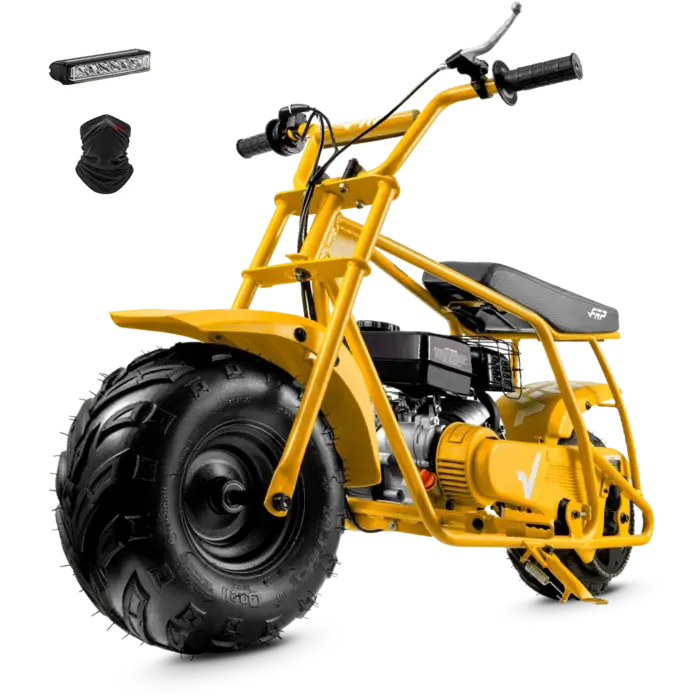
Most gas mini bike comparisons start with engine size. That is useful, but it can also push first-time buyers toward a bike that they actually don’t need. A bigger engine may sound better on paper, while the better daily choice is often the bike that is easier to start with, easier to control, easier to maintain, and easier to keep useful after the first season.
That is the case for the GMB100. It is a 99cc gas mini bike, so it is not trying to beat 196cc or 212cc bikes in a displacement contest. Its stronger argument is different: it gives a teen, parent, or first-time rider a real gas mini bike experience without jumping straight into a heavier adult platform. That makes it one of the more practical picks for families and new riders who still want something that feels like a real machine.
This comparison looks at the GMB100 against brands buyers often search together: Coleman, Mega Moto, Monster Moto, TrailMaster, Massimo, Baja, TaoTao, Coolster, Vitacci, and Icebear.
Quick Take
The GMB100 is the better fit if you want a first gas mini bike that feels manageable from day one, still supports many adult riders, and has a clearer parts and upgrade path than many low-price marketplace bikes.
It is not the choice for someone who only wants the largest stock engine. Coleman, Mega Moto, Monster Moto, and TrailMaster all have bigger-engine options. But if the question is, “What gas mini bike would I actually feel good buying for a first rider and keeping around for future upgrades?” the GMB100 becomes much more convincing.
Choose GMB100 if this is a first real gas mini bike for a teen, parent-child riding setup, or beginner adult who wants a bike that feels real without being oversized. Its appeal is the mix of manageable 99cc power, 220 lb rider capacity, rear disc brake, simple four-stroke ownership, and a clearer path for parts and future upgrades.
Choose Coleman CT200U if you mainly want a familiar big-box mini bike and are comfortable choosing more engine before you have a clear parts or upgrade plan.
Choose Mega Moto or Monster Moto if you already know you want a stronger 212cc-style platform and do not mind starting with a more aggressive bike.
Choose TrailMaster MB200-style bikes if the rider is a taller adult and a larger frame matters more than beginner control, storage, and easy sharing with younger riders.
Be careful with TaoTao, Coolster, Vitacci, Icebear, Massimo, or Baja-style listings when the price is attractive but replacement parts, fitment, warranty, or support are unclear.
Why the GMB100 Is Easier to Recommend
The GMB100 makes sense because it solves the part of mini bike buying that specs do not always show: confidence. A new buyer is usually not just asking, “How fast is it?” They are also asking whether the rider can handle it, whether a parent can move it around, whether maintenance is simple, whether replacement parts exist, and whether the bike will still be useful after the novelty wears off.
On those questions, the GMB100 has a strong position. It uses a 99cc four-stroke engine, so there is no premix routine. It uses an automatic centrifugal clutch, so a beginner does not have to learn a manual clutch before riding. It has a rear disc brake, a listed top speed of about 28 mph, and a rider capacity up to 220 lb. That combination gives it a more useful range than kid-only toy-style ride-ons, while keeping it less intimidating than many 196cc or 212cc machines.
That balance is the main reason a buyer might choose the GMB100 even after looking at larger competitors. It is not smaller because it is less serious. It is smaller because the first-bike job is different from the max-speed job.
What the GMB100 Is
The GMB100 is a 99cc four-stroke gas mini bike sold by FRP Moto. It is built for off-road or private-property use, not street use. The basic spec story is simple:
99cc four-stroke gas engine
No premix required
Automatic centrifugal clutch
About 28 mph stock top speed
Up to 220 lb rider capacity
Rear disc brake
Model-specific parts and upgrade content
Those specs put it in a useful middle lane. It is more serious than an electric toy ride-on, easier to approach than a large adult mini bike, and flexible enough for many families where a teen and parent may both want to ride.
Well-known big-box option with a larger 196cc-class engine.
GMB100 is easier to treat as a first gas bike for younger or newer riders.
Coleman may win if displacement matters more than first-rider confidence and a model-specific upgrade path.
Mega Moto / Monster Moto
Popular 212cc-style platforms with stronger performance appeal.
GMB100 is less aggressive and easier to justify for a family or beginner purchase.
Mega Moto or Monster Moto may win for riders who already want more stock power from day one.
TrailMaster MB200-style bikes
Larger frame, adult-oriented size, and stronger trail-bike presence.
GMB100 is easier to store, move, learn on, and share with younger riders.
TrailMaster may win for tall adults who already know they want a bigger platform.
Massimo / Baja-style bikes
Retail recognition, larger styling, and familiar mini bike shape.
GMB100 is stronger when the buyer wants a clearly supported model path.
Massimo or Baja may win when local availability is the deciding factor.
TaoTao / Coolster / Vitacci / Icebear
Low upfront pricing and many marketplace listings.
GMB100 is easier to recommend when parts clarity, brake service, and long-term support matter.
These brands may win for the lowest initial price.
The Buying Decision Most Specs Miss
A bigger mini bike can be the right answer for an experienced adult. For a first gas bike, though, the smarter question is not always, “Which one has the biggest engine?” It is usually:
Will a new rider feel confident on it?
Can a parent supervise, move, and maintain it without turning every weekend into a repair project?
Can replacement parts be found by model instead of guessing?
Is there room to upgrade later without replacing the whole bike immediately?
This is where the GMB100 becomes more than a small-engine option. It is a cleaner ownership choice. The engine is simple, the brake setup is easy to understand, the stock speed is useful without being excessive for a first rider, and the model connects to a broader GMB100 parts and upgrade ecosystem.
Why a 99cc Bike Can Be the Better First Buy
There is a real reason many buyers hesitate between a 99cc bike and a 196cc or 212cc bike. Bigger bikes sound more exciting. But a first mini bike has to do a different job. It has to build confidence, not just speed. It has to be easy enough that the rider actually uses it. It has to be simple enough that small maintenance jobs do not make ownership feel frustrating.
The GMB100’s 28 mph stock speed is part of that appeal. It is fast enough to feel like a real gas mini bike, especially for a teen or first-time rider, but it does not push the bike into the same category as heavier adult builds. The 220 lb capacity also keeps it from feeling like a short-term kid-only purchase.
That is the conversion point: the GMB100 is not trying to be the most extreme mini bike in the comparison. It is trying to be the one a first buyer can start with, understand, maintain, and grow with.
Parts, Maintenance, and Upgrade Runway
Many mini bike owners do not stay completely stock. After the first few rides, common questions turn into chain size, sprocket gearing, brake parts, carb tuning, tires, torque converters, and engine swaps. A bike with clear model-specific support is easier to keep alive through that stage.
That is another reason the GMB100 stands out. It can be used as a finished 99cc bike, but it also connects to a GMB100 frame and upgrade path. Riders who want a simple first ride can keep it stock. Riders who later want to build have a more obvious starting point than a random low-cost marketplace bike with uncertain fitment.
For buyers comparing long-term value, that matters more than saving a little money at checkout. The better value is the bike that does not become confusing the first time it needs a part.
Who Should Buy the GMB100?
The GMB100 is most convincing for:
Families looking for a first real gas mini bike for a teen or young rider.
Adults who want a compact backyard or private-property mini bike instead of a full-size trail machine.
Buyers who want a gas-engine feel without jumping directly into a 196cc or 212cc platform.
Owners who care about replacement parts, support content, and future upgrade options.
People who want a bike that can start as a stock and later become a small build project.
It is less convincing for:
Riders who only care about the largest stock engine.
Tall adults who want a larger-frame mini bike immediately.
Buyers choose only by the lowest listed price.
Anyone looking for a street-legal vehicle.
Final Verdict
The best reason to buy the GMB100 is not that it beats every larger mini bike on raw power. It does not. The best reason is that it makes the first gas mini bike decision easier. It has enough speed to feel real, enough capacity for many teen and adult riders, simple four-stroke ownership, a disc brake, and a clearer route for parts and future upgrades.
If the only goal is maximum displacement, Coleman, Mega Moto, Monster Moto, or TrailMaster may be the better place to look. But for a first buyer who wants something manageable, useful, and easier to keep long term, the GMB100 gas mini bike is one of the stronger choices in the 99cc class.
FAQ
Is the GMB100 worth buying?
Yes, if you want a first gas mini bike that is easier to manage than many larger 196cc or 212cc bikes, while still feeling like a real gas-powered machine. Its strongest value is the mix of simple controls, 220 lb rider capacity, disc brake, and clearer parts path.
Is 99cc enough for a mini bike?
For a first-time rider, teen, lighter adult, or family-use mini bike, a 99cc engine can be enough. It is not the best choice for someone chasing maximum speed, but it is a practical size for learning, private-property riding, and controlled fun.
Is the GMB100 better than the Coleman CT200U?
It depends on the buyer. Coleman has a larger engine and strong name recognition. The GMB100 is easier to recommend as a first gas bike because it is more manageable and has a clearer beginner-to-upgrade role.
How does the GMB100 compare with Mega Moto or Monster Moto?
Mega Moto and Monster Moto models often appeal to riders who want more stock power. The GMB100 is better for buyers who want a less intimidating first mini bike with room to upgrade later.
How does the GMB100 compare with TrailMaster?
TrailMaster MB200-style bikes usually feel larger and more adult-oriented. The GMB100 is more compact, easier to store, easier to move, and better suited to many first-time riders.
Can adults ride the GMB100?
Yes. The GMB100 is rated up to 220 lb, so many adults can ride it. Taller or heavier adults may prefer a larger-frame bike for comfort, but the GMB100 is not limited to kids only.
How fast does the GMB100 go?
The GMB100 has a listed stock top speed of about 28 mph. Real-world speed depends on rider weight, surface, tire pressure, maintenance, and riding conditions.
Is the GMB100 street legal?
No. It is an off-road mini bike for private property or approved off-road areas, not a street-legal motorcycle or moped.
Bold numbers. Flashy banners. Pretty much every online casino these days runs some version of the same welcome offer, dressed up a little differently each time. Worth slowing down before diving in, though, and actually figuring out what’s on the table.
The appeal’s obvious enough. Extra playtime, no need to put your own money in first. A low-risk way to poke around a platform, see how the games feel, check the interface, get a sense of whether it’s actually your thing. Before deciding it’s somewhere worth spending real time.
Understanding What The Offers Actually Mean
These offers generally allow a new player to explore a platform’s games without risking any of their own money first. Sounds straightforward. The details behind it vary more than people expect, though, and reading the actual terms matters more than skimming the headline number.
Game restrictions matter too. Some bonuses only apply to specific games, slots mostly, sometimes excluding table games or live dealer options entirely. Assuming a bonus applies everywhere on a platform is a fairly common, fairly avoidable mistake.
What Varies Between Offers
Feature
Common Version
Less Common Version
Wagering requirement
Moderate, clearly stated
High, buried in fine print
Game eligibility
Broad, most slots included
Narrow, specific titles only
Withdrawal cap
Reasonable, clearly listed
Low, easy to miss
Time limit
A week or more
Just a day or two
Numbers here are illustrative, not universal. Every platform sets its own terms. This is more about knowing what to ask than expecting identical figures everywhere.
Why Platforms Offer This In The First Place
Fairly simple exchange, really. Platforms want new players to actually experience the games rather than just reading about them somewhere. A no-deposit offer removes the initial hesitation about committing money to something unfamiliar.
For players, it’s a low-pressure way to explore. Try a few different game types. Get a feel for how withdrawals actually work on that platform. Decide whether the whole experience fits what you’re after, all without your own funds on the line at the start. Timing flexibility is part of the appeal too. These offers usually fit around whatever schedule suits the player, rather than requiring a specific block of time to be set aside in advance.
Getting The Most Out of the Offer
Reading the full terms before claiming anything is the single best habit to build. It takes only a few minutes and avoids the disappointment of expecting something the terms never promised in the first place.
Checking a page like free credit no deposit details directly gives a clearer sense of what’s actually on offer for a specific platform, rather than relying on secondhand summaries or comparison sites that might not reflect current terms.
Comparing a handful of platforms before settling on one pays off more often than people expect. Not every offer suits every kind of player, and what looks generous on the surface sometimes comes with tighter conditions than a smaller offer elsewhere. A bit of comparison shopping goes a long way here.
Customer support responsiveness is another small detail worth noting early on, even before making any claims. A platform that answers questions clearly during signup tends to carry that same reliability through to withdrawals later, which matters more once real money enters the picture.
Players can visit TopIn Teen Patti to explore Teen Patti titles and compare available game information before deciding which platform may suit their preferences.
Teen Patti is one of the most recognizable card games in South Asia. Its simple rules make it easy to understand, but consistently making good decisions requires patience, observation, and discipline. Although chance determines which cards each player receives, strategy influences how those cards are handled.
Players who understand hand rankings, betting behavior, position, and bankroll control are less likely to make impulsive decisions. Whether someone plays casually with friends or participates through an online platform, the following principles can help create a more organized approach.
Understand Every Hand Ranking
Before thinking about advanced tactics, players should memorize the standard Teen Patti hand rankings. From strongest to weakest, these commonly include:
Trail or three of a kind
Pure sequence
Sequence
Color
Pair
High card
Knowing these rankings allows players to assess the relative strength of their cards quickly. A player who is uncertain about whether a color beats a sequence may hesitate or make an unnecessary bet.
However, knowing the rankings does not mean every reasonably strong hand should be played aggressively. The number of opponents, table behavior, bet size, and previous actions must also be considered.
Avoid Playing Every Hand
One of the most common mistakes among beginners is staying in too many rounds. They may continue betting because they hope their cards are better than they appear or because they have already invested chips in the pot.
A disciplined player understands that folding is not necessarily a loss. Folding a weak hand can preserve funds for a more favorable opportunity. Small, controlled exits can prevent a series of larger losses.
Players should avoid making decisions based only on the amount already committed. The important question is whether continuing from the current point makes sense.
Observe Betting Patterns
Online players cannot rely on facial expressions or physical body language. Instead, they must pay attention to betting behavior.
Useful observations include:
How often a player raises
Whether someone frequently plays blind
How quickly or slowly bets are placed
Whether bet sizes suddenly change
How a player behaves after losing a large pot
A sudden large raise may indicate a strong hand, but it may also be an attempt to create pressure. No single action provides complete information. Patterns become valuable only when observed over several rounds.
Players should also remain aware that opponents may deliberately change their behavior. Observation is useful, but it should never be treated as certainty.
Use Blind Play Carefully
Blind play is an important part of Teen Patti because it creates uncertainty and can limit the amount a player initially commits. However, continuing blindly for too long can become expensive, especially when other participants raise repeatedly.
Blind play may be most useful when the table is cautious and bet sizes remain manageable. When several aggressive players are active, seeing the cards may provide better information for the next decision.
Players should set a personal limit before entering a blind round. This prevents excitement from turning into uncontrolled betting.
Think About Table Position
Position influences how much information a player receives before acting. Someone who acts later can observe the decisions made by earlier participants.
Late-position players can see who folds, who calls, and who raises before choosing their own action. This does not guarantee success, but it provides additional context.
Early-position players should generally be more cautious because they must act with less information. Stronger hands and controlled bet sizes are especially important when acting early.
Control the Playing Budget
Bankroll management is one of the most important parts of responsible Teen Patti participation. Before beginning, players should decide how much they are comfortable losing and treat that amount as an entertainment expense.
The playing budget should never include money needed for rent, bills, food, debt payments, education, or emergencies. Borrowing money to continue playing is also a serious warning sign.
A useful approach is to divide the total budget into several smaller sessions. For example, instead of using the entire amount in one sitting, a player may create separate daily or weekly limits.
Do Not Chase Losses
After losing several hands, some players increase their bets in an attempt to recover everything quickly. This is known as chasing losses.
The problem is that larger bets do not improve the cards being dealt. Emotional decisions often create additional losses rather than reversing previous results.
A better response is to pause, leave the table, and review what happened. If frustration is affecting judgment, the session should end.
Keep the Strategy Flexible
There is no single Teen Patti strategy that works against every opponent. A cautious table may require a different approach from an aggressive one.
Against players who fold frequently, carefully timed pressure may be effective. Against players who call almost every bet, bluffing becomes less useful, and stronger cards become more important.
Good players adjust their decisions instead of repeating the same pattern automatically. They also review their own actions to identify avoidable mistakes.
Final Thoughts
Teen Patti combines chance, psychology, and decision-making. No strategy can guarantee a winning result, but organized play can reduce unnecessary mistakes.
Understanding hand rankings, observing betting patterns, folding weak cards, controlling the budget, and avoiding emotional decisions all contribute to a more responsible experience. Players should also verify that participation is permitted in their location and read the chosen platform’s current terms before depositing money.
Teen Patti should remain entertainment rather than a source of financial pressure. Adults who choose to participate should establish clear limits and stop whenever the experience is no longer enjoyable.
A casual recommendation can become more than just a shared gaming story when it is connected to a referral system. Many players talk about memorable slot sessions, bonuses, or payout experiences without realizing that the same conversations can generate commission if they are supported by a tracked affiliate link. In the JeetBuzz affiliate model, referral activity is not treated as a one-time gesture but as a potential recurring revenue source tied to real player activity.
The mechanics behind a weekly payment are less complicated than they may seem. Every bet, deposit, and session logged by a referred player feeds into a tracking system that runs continuously in the background rather than waiting for a month-end batch calculation. That distinction matters for anyone used to affiliate programs where earnings remain pending for weeks. Here, activity from the start of the week can be counted toward commission calculated and released within days, making the process closer to a regular payout cycle than a typical bonus scheme.
How the Commission Structure Actually Scales
Base rates for new affiliates start at 20%, which already compares favorably with flat-rate programs that cap everyone at a single percentage regardless of performance. What changes the calculation is the weekly active player count: once certain thresholds are reached, the rate can climb to 35%, while affiliates who consistently bring in larger active groups may unlock up to 40%. This creates a meaningful difference between someone referring five active players a week and someone building a much larger flow, while still allowing slower starters to progress gradually.
Lifetime revenue share is the other element that separates this model from a one-off referral bounty. Affiliates can earn up to 50% lifetime revenue share on a referred player’s activity, and no negative carryover is applied. This detail is easy to overlook but important for risk management: if a referred player has a winning week against the platform, that deficit is not carried forward and deducted from future earnings. Commission resets each cycle rather than accumulating debt against the affiliate. Those who want to review this structure in practice often start by registering through jeetbuzz66, since the dashboard shows the tier breakdown and lifetime share percentage from the first login. Seeing those figures update in real time helps new affiliates understand that the model rewards consistency rather than short-term luck.
Signing Up and Getting Your First Link Live
Joining the program does not require a lengthy waiting period or a complicated approval process. The application itself takes under 60 seconds to complete and mainly asks for basic contact and payout details. Most applicants receive a response within 24 hours, which lowers the barrier for anyone testing whether affiliate marketing is a suitable income channel. A working referral link can often be available the same day, instead of requiring a long review cycle common in some gaming affiliate programs.
Once approved, many new affiliates can start generating commission within the same week, which is a shorter runway than programs tied to monthly review cycles. The general sequence from registration to the first tracked referral looks like this:
Complete the affiliate application form with payout details and preferred contact method.
Wait for approval, typically confirmed within 24 hours by email or dashboard notification.
Generate a unique referral link from the affiliate dashboard, which is ready immediately after approval.
Share the link through personal channels, including messaging apps, social posts, or direct recommendations.
Monitor the dashboard as referred users register and begin depositing or playing.
Track weekly commission calculations, with payouts issued every Wednesday.
The most common misunderstanding is expecting instant earnings as soon as a link is shared. Referred users need to deposit and play before commission begins to accrue, so the gap between sharing a link and seeing the first tracked activity can last several days depending on how quickly a new signup becomes active.
Where the Extra Bonus Layers Fit In
Beyond the core revenue share, JeetBuzz includes two separate reward mechanisms that work differently and should not be confused. Monthly referral bonuses tied to a leaderboard component are credited on the 2nd of every month, rewarding affiliates who ranked among the top performers during the previous period. These bonuses carry a 1x wagering requirement before withdrawal, which is comparatively light next to standard casino bonus terms that often sit at 20x or higher.
Daily cash rewards operate under different conditions. They are earned through ongoing referral activity rather than leaderboard placement, and they carry zero wagering requirements. This means the credited amount can be withdrawn directly without any playthrough attached. The distinction is important: one reward type requires a single wagering cycle before cashout, while the other does not require wagering at all. Affiliates who understand which reward belongs to which category avoid the common mistake of assuming all program bonuses share the same withdrawal rules.
Reading Your Dashboard Like a Working Affiliate
Numbers on a dashboard have limited value without context, so successful affiliates treat referral statistics the way a small business owner reads a weekly sales report. Which referred users are active and which are dormant? Is the 35% tier within reach based on the current week’s active player count, or does reaching 40% require a longer growth period? Checking these figures with the same regularity as the Wednesday payout turns the program from occasional link sharing into a managed income stream, where decisions about where and how often to share a link are guided by real data rather than guesswork.
None of this requires specialized software or paid tracking tools. The JeetBuzz dashboard already separates deposits, active player counts, and commission history into readable segments. What it does require is the same discipline applied to any recurring income source: checking results on a schedule, identifying which channels produce active players rather than one-time signups, and adjusting promotional effort based on what the weekly commission report actually shows.
In the cryptocurrency market, flexibility is often just as important as timing. Prices move quickly, user goals change, and market conditions can shift from optimistic to uncertain in a short period. Because of this, many crypto users need a simple way to move between volatile assets and stable digital value.
This is why BTC-to-USDT conversions are so common. Users may choose when they want to reduce exposure to Bitcoin volatility, protect part of their portfolio, or hold funds in a stablecoin. They may choose when they want to increase Bitcoin exposure, re-enter the market, or accumulate BTC gradually.
The phrase is often used by users who want a direct, simple conversion process. Instead of navigating complex trading tools, they may prefer a clear that helps them exchange assets quickly. Others may use a traditional one when they need advanced trading functions, order books, or fiat-related services.
Understanding the difference between these options can help users make safer and more efficient decisions.
BTC and USDT: Two Different Tools for Different Goals
BTC and USDT serve different purposes in crypto asset management.
Bitcoin is often used for long-term exposure, market participation, and potential value growth. It is widely recognized, highly liquid, and central to the crypto ecosystem. However, BTC is also volatile. Its price can rise quickly, but it can also fall sharply.
USDT is commonly used as a stablecoin. It gives users a more stable reference point inside the crypto market. Many people use USDT to wait for opportunities, transfer value, reduce volatility, or prepare for future trades.
Because these two assets have different functions, moving between them can be a useful strategy.
A user may perform a move from volatility into stability. Later, the same user may perform a USDT-to-BTC conversion to return to Bitcoin when conditions look more attractive.
Why Users Convert
A transaction is useful when users want to convert Bitcoin into a stablecoin. This can happen for many reasons. Some users want to protect gains after Bitcoin rises. Instead of selling into fiat, they convert part of their BTC into USDT and remain inside the crypto ecosystem.
Some users want to reduce risk during uncertain market conditions. Holding USDT can feel more stable than holding only BTC.
Some users want liquidity. USDT is widely supported on many platforms, making it convenient for future transactions.
Some users need to rebalance their portfolios. If BTC becomes too large a share of their holdings, it can help restore balance. For many crypto holders, BTC-to-USDT conversion is not an exit. It is a temporary adjustment.
Why Users Convert USDT to BTC
A transaction is usually about moving value back from a stablecoin into Bitcoin. Users may do this when they believe BTC is undervalued, want to accumulate more Bitcoin, or see a new market opportunity. Some users prefer gradual accumulation. They may hold USDT and convert small portions into BTC over time.
Others may wait for market corrections. When Bitcoin drops to a level they find attractive, they use USDT to buy BTC. In this way, supports a flexible strategy. Users can move from stability back into growth exposure when they choose.
A is often designed for direct crypto conversions. Instead of requiring users to interact with a full trading interface, it allows them to choose the asset to send, select the asset to receive, enter an amount, and complete the exchange.
This can be useful for users who simply want to perform or convert USDT back into BTC without advanced trading tools.
How to Complete BTC to USDT Conversion Safely
Before starting, users should follow a careful process.
First, choose a reliable platform. This may be a direct exchange platform or a traditional crypto exchange.
Second, select BTC as the asset to send.
Third, select USDT as the asset to receive.
Fourth, choose the correct USDT network. This step is especially important because USDT can exist on multiple blockchains.
Fifth, enter the amount of BTC to convert.
Sixth, provide a receiving wallet address that supports the selected USDT network.
Seventh, review the exchange rate, final payout, fees, limits, and processing time.
Finally, confirm the transaction only after checking all details.
How to Complete USDT to BTC Conversion Safely
The process is similar but reversed.
The user selects USDT as the sending asset and BTC as the receiving asset. Then they enter the amount, provide a BTC wallet address, and review the expected BTC payout.
Before confirming, users should check:
The BTC wallet address.
The selected USDT network for sending.
The exchange rate.
The final BTC amount.
Minimum transaction requirements.
Estimated processing time.
Platform reliability.
Because crypto transactions are usually irreversible, every detail matters.
Network Choice: One of the Biggest Risk Points
Network selection is one of the most important parts of crypto conversion. When users perform, they must choose which USDT network they want to receive. USDT may be available on several networks, and the receiving wallet must support the selected one.
If the user selects the wrong network, funds may not be delivered correctly. A responsible user always checks network compatibility before confirming.
Why Final Payout Matters More Than the Fee Label
Many users compare platforms by looking only at fees. This can be misleading. A platform may show a low fee but offer a less favorable exchange rate. Another platform may show a higher visible fee but provide a better final payout.
Before using a platform, users should compare the amount they will actually receive.
Common Mistakes During BTC and USDT Swaps
Many mistakes happen because users rush.
Common errors include:
Choosing the wrong USDT network.
Entering an incorrect wallet address.
Ignoring minimum transaction limits.
Using an unofficial website.
Not checking the final payout.
A trustworthy service should never ask for a private key or seed phrase. If any service asks for that information, users should stop immediately.
Security Checklist Before Any Conversion
Before converting, users can follow this checklist. This checklist can prevent many common crypto mistakes.
Why BTC and USDT Swaps Will Remain Important
BTC and USDT will likely remain central to crypto asset management because they solve different needs. BTC gives users exposure to the market’s most recognized cryptocurrency. USDT gives users stability, liquidity, and flexibility.
The ability to move between them allows users to adapt to changing market conditions. As more users enter the crypto market, demand for reliable services and professional platforms will continue.
Final Thoughts
BTC and USDT conversions are essential tools for modern crypto users. A transaction can help reduce volatility, protect gains, and create stablecoin liquidity. A transaction can help users regain exposure to Bitcoin and participate in market opportunities. A simple process can support everyday portfolio management.
Choosing the right service is an important part of the process. Users should compare rates, check networks, verify wallet addresses, review final payouts, and use reliable services.
The safest approach is to combine flexibility with caution. Crypto swaps can be fast and convenient, but every transaction should be reviewed carefully before funds are sent.
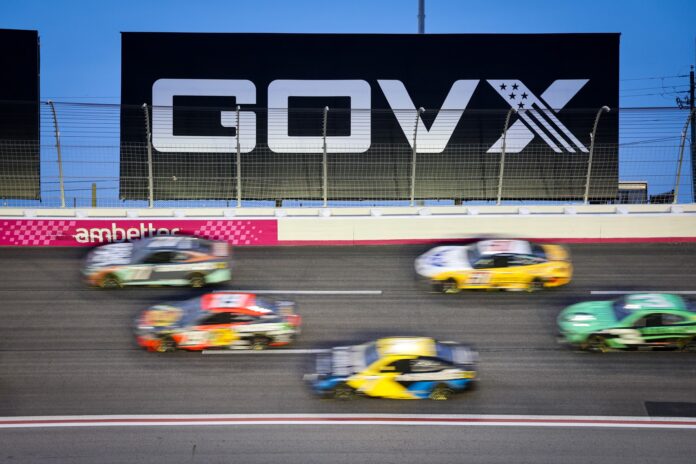
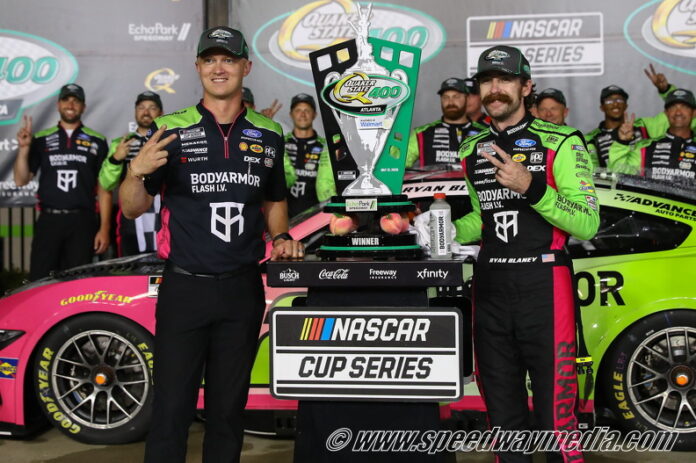
Ryan Blaney capped off a dominant run from pole position and a wild event mixed with late adversity, intense on-track battles and an extensive rain delay period that concluded the event in the early stages of Monday morning, July 13, to win the Quaker State 400 at EchoPark Speedway.
The 2023 NASCAR Cup Series champion from High Point, North Carolina, led 14 times for a race-high 171 of 263 over-scheduled laps in an event where he led every lap from the first stage period after leading the field to the start from pole position. Through a rain delay period that went a little beyond three hours, Blaney extended his dominance in the second stage period by leading an extra 75 laps and claiming the stage victory as the on-track intensity within the drafting pack towards the front started to crescendo.
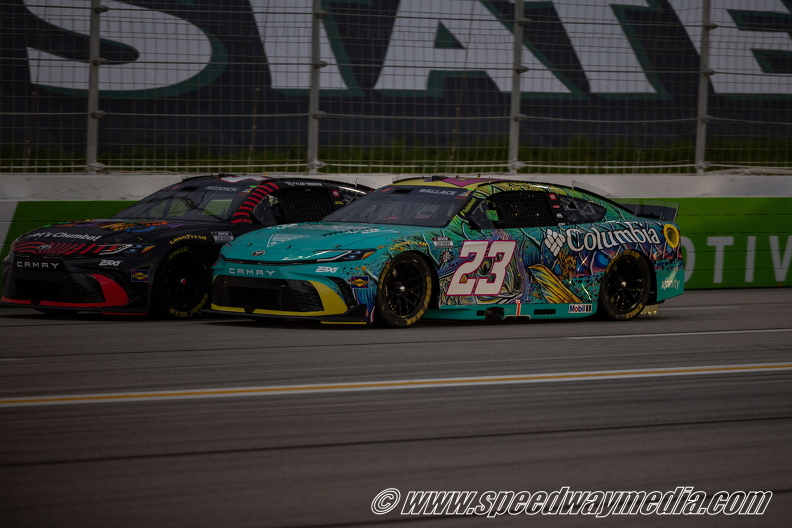
Despite being mired in 16th place due to being serviced with a long pit stop to have his entry full on fuel, Blaney methodically navigated his way back to the front, and he was back out in front with less than 70 laps remaining. As he spent the event’s remainder swapping, drafting and duking it out for the lead with his fellow competitors amid the draft, an overtime shootout placed Blaney in a head-to-head showdown against Carson Hocevar and Bubba Wallace. After receiving a shove from Wallace to reel in and duel with Hocevar at the start of the final lap, Blaney received a final shove from Christopher Bell while engaged in a tight three-wide battle with Hocevar and Wallace to emerge ahead and win a wild conclusion of an event in Hampton, Georgia.
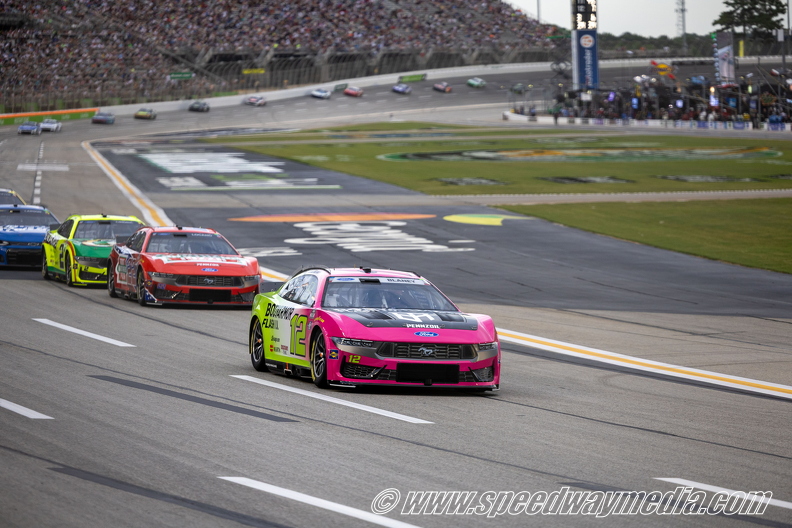
With on-track qualifying that determined the starting lineup occurring on Saturday, July 11, Ryan Blaney secured his second Cup pole position of the 2026 season with a pole-winning lap at 179.912 mph in 30.815 seconds. Teammate Joey Logano started alongside Blaney on the front row with the second-fastest lap at 179.702 mph in 30.851 seconds.
When the green flag waved and the event commenced, teammates Ryan Blaney and Joey Logano dueled for the lead in front of Kyle Larson, Austin Dillon and the field of two-stacked lanes for a full circuit. As the field started to fan out to three-packed lanes, Blaney, who opted to start on the outside lane, led the first lap, and he gained the upper hand through the first two turns to motor ahead. While Brad Keselowski scrubbed the outside wall through Turns 3 and 4 after he got loose without drawing a caution, which dropped him towards the mid-field region after racing in the top 10, Blaney maintained the lead over the field that began to scatter through the fifth lap mark as Logano, Kyle Larson, Alex Bowman and Austin Cindric were scored in the top five.
Through the Lap 10 mark, all 38 starters were separated by nearly 10 seconds of one another amid the draft as Blaney was out in front of a Team Penske 1-2-3 on the track, with teammates Logano and Austin Cindric occupying the top-three spots. Behind, Larson and Daniel Suarez were in the top five ahead of Austin Dillon, Carson Hocevar, Chase Elliott, Bubba Wallace and Michael McDowell, Meanwhile, Chris Buescher, Austin Hill, William Byron, Alex Bowman, Chase Briscoe, Shane van Gisbergen, Ross Chastain, Josh Berry, Christopher Bell and John Hunter Nemechek were racing in the top 20 while Tyler Reddick, Denny Hamlin and Keselowski were mired in 24th, 29th and 34th, respectively.
Ten laps later, Blaney continued to lead ahead of teammates Logano and Cindric while Larson and Carson Hocevar followed suit in the top five. With the top-32 competitors separated by nine seconds, Austin Dillon, Hill, Wallace, Suarez and Elliott were scored in the top 10 while Briscoe, Reddick, Byron, McDowell, van Gisbergen, Buescher, Ty Gibbs, Bell, Nemechek and Bowman were mired in the top 20, respectively.
As the first stage period reached its halfway mark on Lap 30, Team Penske’s Blaney, Logano and Cindric retained the top-three spots, respectively, over Hocevar as Austin Dillon, Larson, Reddick, Briscoe and Wallace were racing in the top-10 mark. By then, only the top-25 competitors were separated by nearly nine seconds of one another while Chad Finchum, BJ McLeod, Cody Ware and Noah Gragson were lapped.
By Lap 40, Reddick muscled his way into fourth place ahead of Hocevar, Larson, Dillon, Briscoe, Wallace and Elliott while Byron, Hill, van Gisbergen, Gibbs and McDowell occupied the top-15 spots ahead of Nemechek, Bell, Erik Jones. Suarez and Buescher. Meanwhile, Blaney maintained the lead in front of teammates Logano and Cindric within the draft and in single-line formation through the turns and the straightaways. Over the next 10 laps, Reddick and Larson broke up Team Penske’s dominant trio on the track as they moved into second and third, respectively. Logano and Cindric dropped to fourth and fifth, respectively, as Blaney retained the lead on Lap 50.
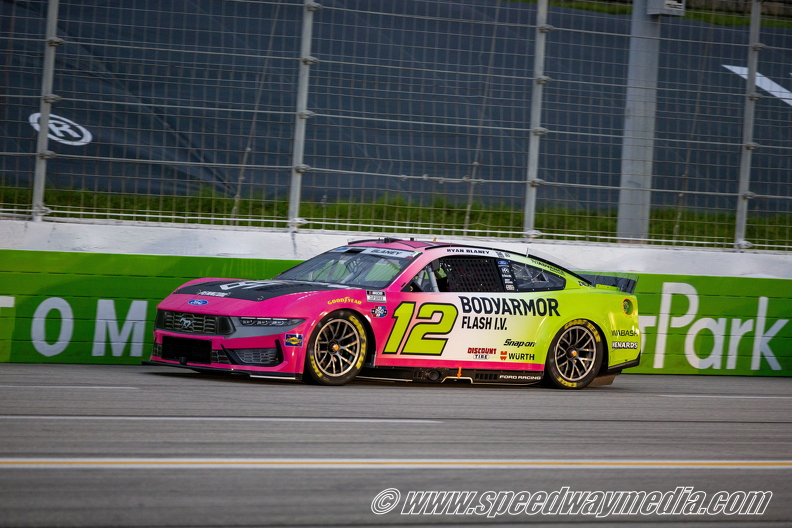
When the first stage period concluded on Lap 60, Blaney, who has led every lap thus far in tonight’s main event and fended off a challenge by Reddick over the last handful of laps, captured his third Cup stage victory of the 2026 season. Reddick, Larson, Logano, Cindric, Hocevar, Austin Dillon, Briscoe, Elliott and Wallace were scored in the top 10, respectively. By then, 30 of 38 starters were scored on the lead lap, with Ryan Preece, Ross Chastain, Keselowski and Todd Gilliland all being lapped.
Photo by Logan Allen for SpeedwayMedia.com.
Under the event’s first stage break period, nearly the entire field led by Blaney pitted while Ricky Stenhouse Jr. and Connor Zilisch remained on the track. Following the pit stops, Reddick exited pit road first and he was followed by Larson, Blaney, Austin Dillon, Bell, Hocevar, Cindric, Logano, Briscoe and Wallace, respectively. Stenhouse and Zilisch pitted shortly after, which allowed Reddick to cycle to the lead.
The second stage period started on Lap 68 as Reddick and Larson occupied the front row. At the start, Reddick, who elected to start on the outside lane in front of Blaney, held a narrow advantage through the first two turns until the inside lane led by Larson gained momentum. This allowed Larson to duel with Reddick for nearly a full circuit until the former tried to transition behind Reddick and in front of Blaney on the outside lane. As Reddick led the next lap, Larson was pinned in the middle lane. This allowed Austin Dillon to motor ahead into the runner-up spot as Larson dropped to fifth place behind Blaney and Carson Hocevar. Just behind the top-five group, Bell briefly stepped out of the throttle and settled behind Briscoe and Logano.
On Lap 70, Austin Dillon launched a side-by-side challenge for the lead on Reddick through the frontstretch, but he had no drafting help as Hocevar threw a three-wide move beneath Dillon while Blaney had Larson drafting him on the outside lane. For the next lap, Logano attempted his version of a three-wide move beneath Dillon and Briscoe, which cost Dillon a handful of spots as he was pinned in the middle lane. As Bell motored ahead of Logano, Wallace, Dillon, Cindric, Erik Jones and the field from sixth place, Reddick maintained a steady lead over Blaney, Hocevar, Larson and Briscoe during the Lap 72 mark.
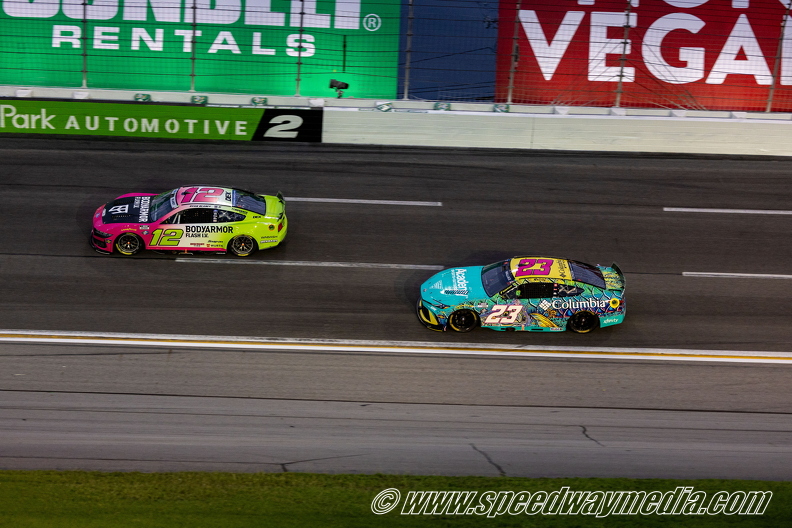
Blaney then got beneath Reddick with a draft through the frontstretch to overtake the latter and reassume the lead through the first two turns as he was followed by Larson. Larson battled dead even with Blaney through the frontstretch by the next lap and they refused to lift off the throttle amid their side-by-side battle on Lap 75 as they had 23XI Racing’s Reddick and Wallace reeling in from behind. Once Wallace filed in behind teammate Reddick, Larson muscled ahead through the backstretch and he had both lanes until his control by Lap 76 as Hocevar gained a strong launch to overtake both Reddick and Wallace to move into third place by Lap 77.
Through the Lap 80 mark, Blaney, who reassumed the lead two laps earlier, led Larson by two-tenths of a second, with Hocevar, Reddick (who briefly scrubbed the outside wall), Wallace, Bell, Elliott, van Gisbergen, Jones and Logano were in the top 10. Two laps later, Hocevar battled Blaney for the lead before he motored ahead by a tenth of a second during the next lap. As Hocevar led, Reddick darted to the inside lane and tried to mount a charge while dueling with Larson for third place despite having no drafting help. Amid the shuffling within the front pack, Reddick rocketed his way back to the front and nearly overtook Hocevar entering Turns 3 and 4 by Lap 87, but he was unable to. This allowed Wallace to overtake Reddick and Wallace occupied third place in front of Reddick and Larson while Hocevar led Blaney at the Lap 90 mark.
As the on-track intensity continued to ramp up, Blaney dueled and led the Lap 93 mark over Hocevar. The battle between Blaney and Hocevar allowed Wallace to join the battle as Blaney motored ahead by two-tenths of a second by Lap 95. Behind, Wallace drag-raced and motored ahead of Hocevar with second place by Lap 95. By Lap 100, Blaney was out in front of the field and ahead of Wallace, Bell, Reddick and Elliott while Hocevar, Jones, Logano, Larson and van Gisbergen were scored in the top-10 mark. By then, the top-14 competitors were racing within a second of one another while the top-19 competitors were separated by two seconds and the top 24 separated by three seconds.
On Lap 107, the caution flew, the field was directed to pit road, all entries were covered, the competitors were given permission to exit their respective entries and the event was halted during the next lap due to a lightning strike. At the moment of caution, Blaney was leading ahead of Wallace, Reddick, Bell, Elliott, Erik Jones, Larson, Hocevar, Logano and Ty Gibbs, respectively, while 30 of 38 starters were scored on the lead lap.
Three hours and nine minutes later, the engines re-fired as the competitors climbed back in their respective entries. As the field cycled back on the track, the competitors drove under a cautious pace on the track while pit road was being dried. The field then pitted once pit road became dry as NASCAR intends to run the event’s full distance into the early hours of Monday (July 13).
Once pit road became accessible, a majority led by Blaney pitted while the rest like Josh Berry, Ryan Preece, Connor Zilisch, Ricky Stenhouse Jr. and Cole Custer remained on the track. Following the pit stops and with mixed pit strategies ensuing, Blaney and Logano exited pit road in the top-two spots after both only opted for fuel for their entries, Wallace, who the first competitor who opted for two fresh tires, followed suit ahead of teammate Reddick, Hocevar, Cindric, McDowell, Bell, Hamlin and Jones. The competitors who remained on the track led by Berry pitted during the next lap, which allowed Blaney to cycle back as the leader.
When the event restarted on Lap 123, Blaney and Wallace dueled for the lead through the first two turns as they were drafted by their respective teammates of Logano and Reddick. Through the backstretch, Logano drafted Blaney ahead of Wallace and clear of the field as Blaney led the next lap. Hocevar then muscled as the lead competitor on the inside lane as he drew himself in a side-by-side battle with Wallace for third place while Logano then tried to battle Blaney for the lead. The field briefly fanned out as Wallace reassumed the runner-up spot entering the first turn on Lap 126. Amid the jostling of on-track spots towards the front, Blaney retained the lead.
At the halfway mark on Lap 130, Blaney, who reassumed the lead from Wallace two laps earlier, was leading ahead of Logano, Hocevar, Wallace, McDowell, Reddick, Hamlin, Cindric, Gibbs and Suarez, respectively. By then, the top-31 competitors were on the lead lap and separated by more than three seconds of one another as a variety of on-track shuffling and jostling for positions amid the draft ensued. Soon after, Blaney and Logano started to generate a reasonable gap between themselves and the field led by a side-by-side duel for third place between Wallace and Hocevar.
During the Lap 140 mark, Hocevar, Wallace, Suarez and Bell reeled in on Blaney and Logano for the lead as the top-six competitors generated a reasonable gap from seventh-place Cindric and the field. Cindric then tried to slide in front of Wallace for fifth place two laps later, but both Wallace and Bell placed him on the outside of a three-wide battle through the frontstretch. As more competitors racing both inside and outside of the top-10 mark reeled in on the lead group, Blaney continued to lead in front of Logano by Lap 145. Hocevar then aggressively navigated his way into the runner-up spot two laps later and Wallace followed suit while Logano battled Suarez and the oncoming competition to retain fourth place. Meanwhile, Blaney led the Lap 150 mark.
When the second stage period concluded on Lap 160, Blaney captured his second consecutive Cup stage victory of the event and the fourth of the 2026 season after he fended off both Logano and Reddick. Reddick settled in second ahead of Logano, Cindric, Suarez, Gibbs, Bell, Jones, Hamlin and van Gisbergen, respectively. Meanwhile, Wallace spun across the frontstretch’s grass after he got hit in the rear by Gibbs when Wallace moved in front of Gibbs on the inside lane in Turn 4. The spin dropped Wallace out of the top-10 mark and mired him back in 31st place. Meanwhile, Hocevar was mired in 29th place due to having a flat tire and falling off the pace a few laps earlier.
Photo by Logan Allen for SpeedwayMedia.com.
During the event’s second stage break period, the field led by Blaney returned to pit road for service while Hocevar remained on the track. Following the pit stops and with mixed pit strategies ensuing, Gibbs, who opted for a four-tire pit service, edged Cindric off of pit road first as they were followed by Buescher, Zilisch, Bell, Jones, Hamlin, van Gisbergen, Larson and Austin Dillon, respectively. Meanwhile, Reddick exited pit road in 12th place in front of Logano and Blaney was mired in 16th place to have enough loaded in his entry while Wallace and Hocevar were mired in 30th and 31st, respectively.
With 93 laps remaining, the final stage period commenced as Gibbs and Cindric occupied the front row in front of Buescher, Zilisch, Bell and Jones. At the start, Gibbs and Cindric dueled for the lead for a full lap as Cindric was being drafted by Zilisch on the inside lane while Gibbs was being drafted by Buescher on the outside lane. Despite losing their respective drafting partners through Turns 3 and 4, Gibbs managed to lead the next lap as both continued to battle dead even in front of two stacked lanes. As Hamlin ignited a third drafting lane to muscle his way towards the top-five mark, Cindric and Gibbs continued to battle for the lead with 90 laps remaining.
As the event reached its final 85-lap mark, Ty Gibbs had a pair of Joe Gibbs Racing teammates, Bell and Hamlin, marching and battling their way at the front. While Bell reeled in Gibbs for the lead, Hamlin was trying to fend off Buescher and a pack of eight competitors for third place. Amid Hamlin’s long battle with Buescher, Cindric joined the battle as van Gisbergen, Erik Jones, Suarez, Larson and more reeled in through every turn and straightaway. Meanwhile, Gibbs continued to defend all lanes as he led with 80 laps remaining.
Then with 67 laps remaining,, the caution flew when AJ Allmendinger, who was racing outside of the top-25 mark, spun through the frontstretch after he bumped into the left side of McDowell. During the latest caution period, the front-runners returned to pit road for service. Following the pit stops and with most of the front-runners opting for a two-tire pit service, Bell exited pit road first and he was followed by Larson, Jones, Blaney, Buescher, Elliott, Hamlin, Wallace, Byron and Briscoe.
The next restart with 60 laps remaining featured Larson receiving a strong shove from Blaney from the inside lane to motor ahead through the first two turns before Blaney darted to the right and dueled with Larson, starting from the backstretch. Amid their side-by-side battle, Blaney led the next lap and he motored ahead of the field temporarily during the next lap before Bell navigated his way to the front.
As Bell led, Blaney, Jones and Elliott battled in the top-four spot ahead of Larson, Hamlin and a stacked field that fanned out to two and three-lanes deep. While a handful of four-wide action occurred within the pack that nearly instigated an on-track incident, Elliott assumed the lead for the first time with 53 laps remaining. Elliott led the next two laps while battling teammate Larson until Blaney threw a three-wide move beneath the latter two entering the first turn to reassume the lead and he brought Wallace with him with 50 laps remaining.
Down to the final 40 laps, Blaney, who led seven of the previous 10 laps and engaged through a variety of on-track swapping for the lead amid the draft, was leading by a tenth of a second over Larson, Elliott, Bell, Wallace, Reddick, Jones, Suarez, Ross Chastain and Hamlin, respectively. As the on-track intensity towards the front continued to intensity through a variety of three-wide action, Blaney maintained the lead over Wallace, Elliott, Larson and Reddick with 35 laps remaining. Wallace then dueled and overtook Blaney for the lead with 32 laps remaining after he was drafted by Reddick through the frontstretch. With Blaney, Reddick and Larson reeling in, Hocevar also navigated his way back into the top-six mark as he battled Bell for more while Wallace retained the lead with 30 laps remaining.
Then with 29 laps remaining, the caution returned when Allmendinger was involved in a second incident, with his latest incident occurring in Turns 3 and 4 when he went dead straight into the outside wall due to a cut tire. Prior to the caution, Blaney scrubbed the outside wall through the first two turns when he tried to make a move to the outside of Wallace for the lead and got aero-loose when Wallace blocked Blaney’s momentum. During the latest caution period, some including Chastain, van Gisbergen, Elliott, Suarez, Austin Hill, Zilisch, Briscoe, Buescher, Ty Dillon, Riley Herbst, Ryan Preece, Logano, Nemechek, Zane Smith, Keselowski, Cole Custer, Berry, Cindric and Stenhouse pitted while the rest led by Wallace remained on the track.
During the next restart with 23 laps remaining, Wallace received a strong start from the outside lane to lead through the first two turns before the inside lane led by Blaney fired back ahead through the backstretch. As Blaney aggressively moved in front of Wallace, Hocevar dueled alongside Blaney for the lead while Wallace was pinned in a three-wide battle with Bell and Jones for the next lap. Blaney, who reported a vibration from his entry, managed to motor ahead of Hocevar and lead the next lap while Wallace dropped to fifth place behind Bell and Jones. Amid the battles within the field and towards the front, Blaney maintained the lead with 20 laps remaining.
With 19 laps remaining, the caution returned when Larson, who was racing in the top-10 mark, veered to the left to avoid a stack-up caused when Reddick nearly came across the path of Gibbs and Hamlin, which forced the latter two to briefly step out of the throttle entering Turns 3 and 4. This caused Larson to veer sideways through the frontstretch’s grass as he slammed on the brakes and spun while his pace reduced.
Down to the final 14 laps, the field restarted under green as Hocevar and Blaney dueled in front of Bell, Wallace and two-stacked lanes through the first two turns. As the field scrambled while slowly fanning out to three lanes, Blaney and Hocevar continued to duel for the next lap until the latter received a shove from Wallace to motor ahead through the first two turns. Amid Blaney’s challenges from the inside lane, the latter did not have any strong pushes from behind mounting as Hocevar maintained the lead over Blaney, Wallace and the field with 10 laps remaining. Not long after, Blaney received a push from Bell exiting the backstretch to reel in, get underneath and overtake Hocevar through Turns 3 and 4. Bell then made an aggressive three-wide move beneath Wallace and Hocevar to move into the runner-up spot with eight laps remaining before the latter two came storming back amid a tight three-wide battle.
Then with six laps remaining, the caution flew due to a multi-car wreck that erupted in the backstretch when Larson, who was trying to rally his way back into the top-10 mark, moved to the right and made contact with Hamlin. The contact turned Larson sideways and down the backstretch’s inside wall, which he made hard contact against. Amid Larson’s incident, Briscoe veered sideways while trying to dodge Larson and hit the left side of Austin Hill’’s entry before Briscoe was hit by Herbst while Bowman spun. At the moment of caution, Hocevar, who executed a bold three-wide move a lap earlier, was leading ahead of Blaney, Wallace, Reddick, van Gisbergen, Bell, Austin Dillon, Gibbs, Chastain and Jones.
When the event restarted in overtime, Hocevar gained a slight advantage with drafting help from Reddick on the outside lane at the launch before Blaney was pushed cleared ahead of Wallace from the inside lane through the first two turns. Both Blaney and Wallace, however, disconnected entering the backstretch as Hocevar motored back ahead with a big lead. Amid Hocevar’s lead, a three-wide challenge for the runner-up spot ensued as Blaney was pinned beneath van Gisbergen and Reddick with all racing in front of a stacked field.
When the white flag waved and the final lap started, Hocevar remained in the lead as both Blaney and Wallace quickly reeled in Hocevar with a two-car draft. Blaney then darted to the right and dueled with Hocevar through the first two turns. Then as Zane Smith wrecked entering the backstretch, Wallace threw a bold three-wide move beneath Hocevar and Blaney while briefly going off the track. With the trio battling dead even through three stacked lanes through Turns 3 and 4, Blaney received a shove from Bell from the outside lane to motor ahead and win at EchoPark Speedway in a thrilling finish.
With the victory, Blaney notched his 19th career win in the NASCAR Cup Series division, his second at Atlanta’s EchoPark Speedway and his second of the 2026 season. He also recorded the 750th Cup career victory for the Ford manufacturer and the season of this season for Team Penske.
Photo by Logan Allen for SpeedwayMedia.com.
“Yeah, [the finish was] pretty wild, “Blaney said on the frontstretch on TNT. “I was second and it’s [like] OK. Just take the front row and we’ll see who gets behind me. Bubba [Wallace] gave me really good shoves. On the restart, we got hooked up pretty good. Bubba and I got a huge run down the front straightaway and I was able to get to the outside of Carson [Hocevar]. I wasn’t able to clear him, and Bubba went three wide bottom down the back, which lined up a really cool finish at the line. I really have to shout out Christopher Bell for being right on my bumper all the way through [Turns] 3 and 4 and a big push. He was a big reason why we won the race. I appreciate that, Christopher. The fans, thank you, guys, for sticking around. Is it 2 a.m.? It’s past my bedtime, but it ain’t past y’alls. Thank you so much for being here and hanging it out with us…Pretty cool to win here.”
Bubba Wallace initially crossed the finish line in a close runner-up result, but he was demoted to the last car on the lead lap in 29th place. This was due to Wallace steering his entry below the yellow line, out of lines, boundary through the backstretch as he was about to execute his overtaken on Carson Hocevar for position.
“I turned left and got super loose, and so just to keep [the car] straight, I ended up there,” Wallace, who disagreed with the penalty and had a brief post-race confrontation with Ty Gibbs over a late blocking move, said. “It’s unfortunate. You can go back and look at some STM [data]. I was all over the brakes trying to just get the spot back. [The rules] says, ‘Don’t go below the yellow line to gain your position,’ which I didn’t. I was still third and I got a shove from [Ty Gibbs] to go to second. It’s unfortunate. [I had] A really good day.”
Following the event, Wallace along with his crew chief, Charles Denike, and 23XI Racing’s performance director, Dave Rogers, met with NASCAR officials to review the penalty. At the conclusion of the meeting, NASCAR upheld its penalty on Wallace.
Photo by Logan Allen for SpeedwayMedia.com.
With Wallace’s penalty, Christopher Bell was awarded the runner-up spot as Hocevar, Ty Gibbs and Erik Jones ended up in the top five. Shane van Gisbergen, Austin Dillon, Tyler Reddick, Joey Logano and Chris Buescher completed the top 10 in the final running order.
This event featured 30 lead changes for 10 different leaders and seven cautions for 49 laps. In addition, 29 of 38 starters finished on the lead lap.
Following the 20th event of the 2026 NASCAR Cup Series season, Denny Hamlin, who finished 12th at Atlanta, continues to lead the regular-season standings by 24 points over Tyler Reddick, 65 points over Ryan Blaney, 126 points over Ty Gibbs, and 181 points over Chase Elliott. Both Hamlin and Reddick have also officially clinched their spots for the 2026 Chase for the Cup.
Ryan Blaney, Christopher Bell, Chase Elliott and Todd Gilliland are the final four competitors who transfer through to the fourth In-Season Challenge round for next Sunday night’s event at North Wilkesboro Speedway.
Results:
Ryan Blaney, 171 laps led, Stages 1 & 2 winner
Christopher Bell, five laps led
Carson Hocevar, 25 laps led
Ty Gibbs, 32 laps led
Erik Jones
Shane van Gisbergen
Austin Dillon
Tyler Reddick, eight laps led
Joey Logano
Chris Buescher
Ross Chastain
Denny Hamlin
Chase Elliott, five laps led
Austin Cindric
Michael McDowell
William Byron
Cole Custer
John Hunter Nemechek
Todd Gilliland
Ty Dillon
Daniel Suarez
Alex Bowman
Ricky Stenhouse Jr.
Ryan Preece, one lap led
Josh Berry, one lap led
Brad Keselowski
Noah Gragson
Connor Zilisch
Bubba Wallace, 11 laps led
Zane Smith, one lap down
Austin Hill, two laps down
Cody Ware, four laps down
Chad Finchum, four laps down
Kyle Larson, five laps down, four laps led
Riley Herbst – OUT, Accident
Chase Briscoe – OUT, Accident
AJ Allmendinger – OUT, Accident
BJ McLeod – OUT, Mechanical
Next on the 2026 NASCAR Cup Series schedule is the Window World 450 at North Wilkesboro Speedway in North Wilkesboro, North Carolina. The event is scheduled to occur next Sunday, July 19, and air at 7 p.m. ET on TNT Sports, PRN Radio, SiriusXM and HBO MAX.