Event: Enjoy Illinois 300 Location: World Wide Technology Raceway, Madison, Illinois Date: Sunday, September 13, 2026 Start: 16th Finish: 28th
Josh Berry and the No. 21 DEX team saw their six-race streak of top-10 finishes come to an end following a late-race multi-car incident in Sunday’s Enjoy Illinois 300 at World Wide Technology Raceway, resulting in a 28th-place finish.
Berry and the DEX team showed the speed to contend inside the top 10 throughout much of the afternoon despite a race that featured a track-record 18 caution periods.
After starting 16th, Berry gained four positions during the opening 45-lap segment to finish 12th. The No. 21 DEX Mustang Dark Horse continued its climb during Stage 2, spending much of the segment inside the top 10 before Berry crossed the line fifth to collect six stage points.
A quick four-tire stop during the stage break put Berry fourth for the ensuing restart, and he continued to run among the top five as the final stage unfolded. During a caution at Lap 156, Berry and Kyle Larson remained on track to inherit the top two positions. Berry battled Larson side-by-side for the lead for several laps before settling back into the top three.
Berry made his next stop under caution at Lap 170 and continued to position himself for another strong finish while navigating a race filled with incidents and restarts.
His afternoon took a turn when he was collected in a multi-car incident on a restart with 17 laps remaining. The damage to the No. 21 DEX Ford Mustang sent him behind the wall for repairs, but the Wood Brothers Racing crew was ultimately able to get Berry back out on track with just a few laps remaining to finish the race in the 28th position.
Up next, the NASCAR Cup Series heads to Bristol Motor Speedway for Saturday night’s Bass Pro Shops Night Race.
Your first race weekend can feel simple enough to plan. You buy the tickets, check the weather, grab a hat and sunglasses, and assume the rest will take care of itself. Then you arrive and discover that a full day at the track involves far more walking, sun, noise, dust, food, waiting, and sudden weather changes than you expected.
Experienced race fans tend to learn this the hard way once, then quietly build a packing list that makes every future event much easier. The smartest things they bring are not necessarily expensive or exciting. They are simply the items you are most likely to wish you had several hours into race day.
A Small Cleanup Kit Goes Further Than You Think
Race tracks can be dusty, hot, crowded, and surprisingly messy. Between sunscreen, food, drinks, railings, portable seating, and long walks around the venue, it does not take long before you want somewhere to wash your hands or freshen up.
Veteran fans often carry a few basic personal-care items rather than depending entirely on whatever facilities happen to be nearby. A small soap container can be especially useful, and anyone deciding what type to bring may find https://goatmilksoap.com/ helpful when putting together a compact race-day hygiene kit.
Wet wipes and hand sanitizer are useful too, but having several options means you are prepared whether you are cleaning up before lunch or trying to feel human again after spending hours around dust, heat, and crowds.
Ear Protection Is Easy to Forget Until the Engines Start
Watching racing on television does not prepare you for how loud motorsport can be in person. Depending on the series and where you are sitting, engine noise can quickly become uncomfortable, especially during long sessions.
Earplugs take almost no room in a bag, which makes forgetting them particularly frustrating. Some experienced fans even bring a spare pair because tiny items have a habit of disappearing when you need them most.
Families attending with children should think about hearing protection before arriving rather than trying to find it inside the venue. Comfortable earmuff-style protection can make the day dramatically more enjoyable for younger spectators who may otherwise become overwhelmed by the noise.
Bring Something for Sitting That Is Better Than the Seat
Grandstand seats often look perfectly reasonable when you first sit down. Three hours later, they can feel very different.
A lightweight seat cushion is one of those items first-time visitors rarely think about but regular fans often swear by. Even a thin padded cushion can make a noticeable difference during long practice sessions, qualifying, support races, and delays between events.
The same applies if you are attending a venue with grassy viewing areas. A compact blanket or waterproof ground cover gives you more freedom to move around and find a comfortable viewing spot without worrying about damp grass or dusty ground.
Just check the venue’s bag and seating policies before choosing what to bring, since permitted items can vary between tracks.
Weather Protection Means More Than Checking the Forecast
A forecast showing sunshine does not mean you only need sunglasses. Race days can last from morning until late afternoon, giving the weather plenty of time to change.
Experienced spectators usually prepare for both heat and rain. Sunscreen, a breathable hat, and a lightweight rain layer cover far more situations than carrying one bulky jacket. A cheap disposable poncho can also be useful because it takes up almost no space.
The sun itself can become one of the biggest challenges. Grandstands do not always provide shade, and sitting in direct sunlight for several hours feels very different from spending the same amount of time casually walking outdoors.
Reapplying sunscreen matters as well, particularly when you are sweating or constantly moving between different parts of the circuit.
Portable Power Can Save the Second Half of Your Day
Phones work hard during race weekends. You use them for tickets, photos, videos, messages, weather updates, venue maps, schedules, results, and sometimes transportation after the event.
That means a phone starting the day at 100 percent can be struggling long before the final laps.
A compact power bank and charging cable solve the problem without adding much weight. Regular racegoers often keep one permanently in their event bag so they never have to think about it.
Saving the event schedule and ticket information offline is another useful habit. Mobile networks can slow down when thousands of spectators are trying to use their phones at the same time, and having essential information already available can prevent unnecessary frustration.
Snacks and Water Can Turn a Long Wait Into No Problem at All
Food is part of the fun at many racing events, but relying entirely on concession stands can become inconvenient when queues suddenly grow between sessions.
Where venue rules allow it, experienced fans often keep a couple of simple snacks in their bags. Something small can be invaluable when you have found a great viewing position and do not want to leave it just because you are hungry.
Water matters even more. Outdoor race days can involve miles of walking without you really noticing it, particularly at large circuits where viewing areas, fan zones, merchandise stands, and parking lots are spread far apart.
A refillable bottle can be extremely useful at tracks that provide water stations. Staying hydrated early is much easier than trying to recover after spending half the day in the sun.
The Best Race-Day Bag Is Prepared for Small Problems
First-time spectators often pack for the race itself. Experienced fans pack for everything that happens around the race.
That difference explains why their bags contain things such as tissues, lip balm, plasters, a spare charging cable, sunglasses, a pen, a small zip bag for valuables, and even an extra pair of socks. None of those items sounds essential when you are sitting at home, but almost any one of them can become surprisingly valuable during a long day at the circuit.
You do not need to carry an enormous backpack. In fact, keeping things light usually makes the day better. The goal is simply to anticipate the handful of minor annoyances that can become major frustrations after several hours outdoors.
Once you have attended a few races, your own packing list will become more personal. Until then, borrowing a few habits from experienced fans is one of the easiest ways to make your first race weekend feel like it is not your first at all.
Austin Dillon and the No. 3 Bass Pro Shops/Winchester Deer Season XP Chevrolet Team Earn Solid Sixth-Place Finish at World Wide Technology Raceway
Finish: 6th Start: 22nd Points: 24th
“Really proud of the entire No. 3 Bass Pro Shops/Winchester Deer Season XP Chevrolet team. We finished sixth, which feels great compared to where we’ve been ending the day. We went from one of the lowest of lows after Darlington to a really good finish for us here today. I knew if I could keep clean air on the nose there, my car was pretty good at the end. When the track cooled down, I got a lot of grip so that was pretty nice. We’re just going to keep grinding away. If we can finish the season with eight more races like this, we’ll be in a good spot for 2027.” -Austin Dillon
Up and Down Day for Austin Hill and the No. 33 Lucas Oil Chevrolet Team Results in 21st-Place Finish at World Wide Technology Raceway
Finish: 21st Start: 27th Points: 31st
“Up and down race for our Lucas Oil team, but at the end, we came home 21st. Our Chevrolet fired off tight rolling to the center, but the dirty air in the back didn’t help our situation any. Once we would run five or so laps, the car would be able to run the bottom and make up some ground. We definitely passed a lot of cars though. Drove up to the top-15, something would happen for us to end up in the back, and we would start it all over again. Felt like we did it a few times today. The guys kept working on it until the end. It was a battle to the finish with missing a bunch of wrecks.” -Austin Hill
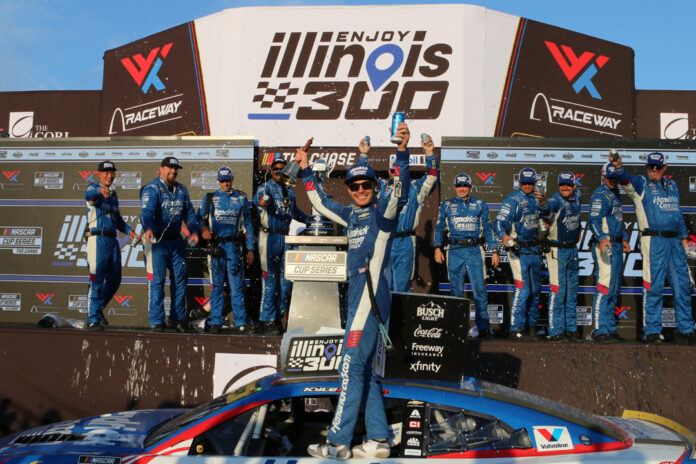
Kyle Larson struck gold and outlasted the competition through two overtime shootouts, including a multitude of on-track chaos and caution periods, to win the fifth annual running of the Enjoy Illinois 300 at World Wide Technology Raceway (Gateway) in Madison, Illinois, on Sunday, September 13.
The reigning two-time Cup Series champion from Elk Grove, California, led three times for 80 of 247 over-scheduled laps in an event where he qualified on the front row and withstood four caution periods throughout the first stage period to settle in third place at the stage’s conclusion. Larson then flexed his muscles by assuming the lead for the first time from Ross Chastain on Lap 81 and withstood another trio of cautions to win the second stage period.
Throughout the third and final stage period that was mired with a total of 10 cautions and numerous stars, including Chase contenders, being involved in on-track incidents, Larson remained upfront. During a late restart with 81 laps remaining, Larson scrubbed the outside wall amid a tight battle for the lead, in which he lost it with 78 laps remaining. After opting for a four-tire pit service during a late caution with less than 40 laps remaining, Larson used the fresh tires to storm his way back to the front and outduel Logano at the start of a restart with 13 laps remaining to return atop the leaderboard. Through three additional cautions and two brief red flag periods that sent the event into overtime twice, Larson fended off teammate Alex Bowman and Logano to achieve his first Cup victory in over a year and draw himself into championship contention.
With on-track qualifying that determined the starting lineup occurring on Saturday, September 12, Chaser Joey Logano qualified on pole position for a second time in 2026 with a pole-winning lap at 137.124 mph in 32.817 seconds. Chaser Kyle Larson qualified in second place with a lap of 135.980 mph in 33.093 seconds.
Before the event, John Hunter Nemechek was the only competitor to drop to the rear of the field after unapproved adjustments to his No. 42 Legacy Motor Club Toyota entry.
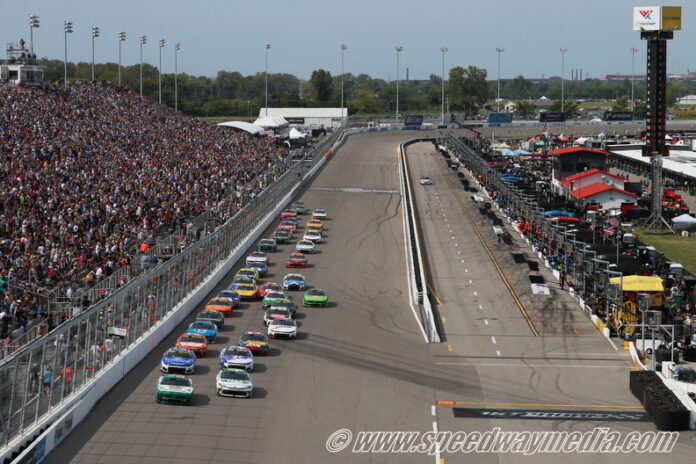
When the green flag waved and the event commenced, pole-sitter Joey Logano gained an early launch from the outside lane as he led Christopher Bell, Kyle Larson, Ryan Blaney, Carson Hocevar and the field through the first two turns. As the field behind jostled for early spots through the backstretch, Logano cycled back to the frontstretch and led the first lap.
Over the next four laps, a variety of on-track battles ensued within the field that had also started to fan out as wide as three lanes through the turns and straightaways. At the front, Logano was leading by half a second over Bell while Kyle Larson, Carson Hocevar, Ryan Blaney, Chase Briscoe, Chase Elliott, Ty Gibbs, Bubba Wallace and Alex Bowman were in the top 10, respectively. During the fourth lap mark, Tyler Reddick scrubbed the outside wall entering the frontstretch after he was forced up into the wall by Daniel Suarez from contact while both were battling within the top-20 mark. Despite continuing, Reddick reported a wheel being off from his entry.
On the fifth lap, the event’s first caution flew due to Riley Herbst, who was racing outside the top-30 mark, getting loose entering the frontstretch while he was racing in front of Ricky Stenhouse Jr., spinning and making contact with the inside wall. During the event’s first caution, Reddick along with Ty Dillon, Todd Gilliland, Shane van Gisbergen and Herbst pitted while the rest, led by Logano, remained on the track.
The event’s next restart on the 10th lap featured Logano motoring ahead and retaining the lead while teammate Blaney made a three-wide move on Larson and Bell, with Blaney also making slight contact with Larson, to motor his way into the runner-up spot by the third turn. Logano proceeded to lead the next four laps under green flag conditions before the caution returned due to Ricky Stenhouse Jr., who was racing outside the top-30 mark, spinning in the backstretch while he was battling beneath Herbst. During the second caution period, some, led by Daniel Suarez and including AJ Allmendinger, Ty Dillon, Stenhouse, Brad Keselowski, John Hunter Nemechek, Cody Ware, Gilliland, Reddick and Chris Buescher, pitted while the rest, led by Logano, remained on the track.
The event’s next restart on the 19th lap only lasted two turns when the caution returned for a multi-car wreck on the backstretch. The wreckage involved Noah Gragson, Suarez, Shane van Gisbergen, Cody Ware and Michael McDowell. For the next restart on Lap 24, Logano retained the lead with a quick crossover move to the inside lane in front of teammate Blaney through the frontstretch as Bell, who restarted behind Logano on the outside lane, navigated his way past Blaney for the runner-up spot.
Logano maintained the lead for three laps under green-flag conditions just before the caution returned on Lap 27 due to van Gisbergen being involved in his second incident of the event, this time by spinning in the second turn after he got loose beneath Allmendinger. During the latest caution period, some, including Austin Cindric, Denny Hamlin, William Byron, Erik Jones, Allmendinger, Stenhouse, Zane Smith, Connor Zilisch, Austin Dillon, Ryan Preece, Cole Custer, Cody Ware, Buescher, Gragson and van Gisbergen pitted while the rest, led by Logano, remained on the track.
With the event restarting on Lap 32, Logano continued to lead over Blaney while Bell and Hocevar battled for third place. Both Bell and Hocevar navigated their way into second and third over Blaney as Logano led the next lap. Logano maintained the lead through the Lap 35 mark by within three-tenths of a second over Bell, though Bell started to reel in Logano for the lead. Amid Bell’s challenges from the inside lane, Logano, who had the preferred outside lane, retained the lead by two-tenths of a second over Bell at the Lap 40 mark as Bell then tried to transition to the outside lane for additional momentum.
When the first stage period concluded on Lap 45, Logano, who has led every lap thus far amid a caution-filled start, fended off Bell to capture his third Cup stage victory of the 2026 season. Bell, who trailed Logano by two-tenths of a second, settled in second ahead of Larson, Blaney, Elliott, Hocevar and Briscoe while Bowman, Gibbs and Keselowski were scored in the top 10, respectively. By then, eight of 16 Chasers secured the event’s first round of stage points by finishing in the top 10 on the track while the remaining Chasers that include Suarez, Byron, Hamlin, Cindric, Reddick, Wallace, Preece and Buescher were scored in 14th, 15th, 17th, 21st, 24th, 29th, 31st and 33rd, respectively.
During the event’s first stage break period, a majority of the field, led by Logano, pitted while the rest, including Keselowski, Nemechek, Suarez, Byron, Hamlin, Austin Dillon, Cindric, Custer and Buescher, all of whom pitted during the previous caution, remained on the track. Following the pit stops, Bell, who opted for only a two-tire pit service, exited pit road first ahead of Gibbs.
The second stage period started on Lap 52 as Keselowski and Nemechek occupied the front row. At the start, Keselowski fended off Nemechek following a battle that lasted half a lap to retain the lead. As Keselowski led the next lap, a variety of on-track shuffling within the field that had fanned out ensued. The battles continued for another two circuits before the caution returned on Lap 55 when Ty Gibbs made contact and sent Erik Jones for a spin in the first turn.
When the event restarted on Lap 60, Keselowski and Nemechek dueled for the lead through the first two turns until the former motored ahead through the backstretch. Keselowski led the next lap, and he maintained the lead over the next two laps in front of a jostled field before the caution returned; this time was due to Herbst and Allmendinger both spinning in the backstretch after Herbst cut across the nose of van Gisbergen, got loose, and spun in front of Allmendinger, the latter of whom was collected due to having no clear path through the carnage. During the latest caution period, nearly the entire field led by Keselowski pitted for service while some led by Chastain and including Jones, Preece, McDowell and Cody Ware remained on the track. Following the pit stops and with mixed pit strategies ensuing, Hamlin exited pit road first ahead of Larson, Josh Berry, Keselowski, Zilisch and Byron.
As the event restarted on Lap 69, Chastain and Jones occupied the front row, where Chastain held the lead for the next lap. With Chastain leading just past the Lap 70 mark, Larson navigated his way up into third place behind Ryan Preece while Jones dropped to fifth place. Behind, Keselowski and Berry occupied fourth and sixth, respectively, while Logano, Hamlin, Blaney and Reddick were racing in the top 10 ahead of Zilisch, Bowman, Byron, Elliott and Suarez. With Larson navigating his way into the runner-up spot over Preece, Chastain led by three-tenths of a second at the Lap 75 mark.
Through the Lap 80 mark, Larson reeled in on Chastain for the lead through the backstretch. The duo then dueled exiting the backstretch and through Turns 3 and 4 before Larson motored ahead and led the next lap through the frontstretch. As Larson led, Chastain retained the runner-up spot over Keselowski, Preece and Logano while Erik Jones, Berry, Blaney, Hamlin and Reddick were scored in the top 10, respectively. By then, Bowman, Elliott, Zilisch, Byron, Suarez, Briscoe, Nemechek, Wallace, Cindric, Gibbs, Bell and Hocevar trailed in the top-22 mark, respectively, while Buescher was the lowest-running Chaser in 30th place.
Ten laps later, Larson stretched his lead up to 1.8 seconds over Chastain, with Keselowski, Logano, Preece, Blaney, Erik Jones, Berry, Hamlin and Reddick racing in the top-10 mark, respectively. Larson proceeded to add another second to his advantage as he led by 2.4 seconds at the Lap 100 mark while Chastain maintained the runner-up spot over Keselowski, Logano, Blaney and Preece, respectively. Behind, Jones, Berry, Hamli and Reddick retained the remaining top-10 spots over Elliott, Byron, Briscoe, Bowman and Wallace while Cindric, Zilisch, Gibbs, Hocevar, Suarez and Bell trailed in the top-21 mark, respectively, and Buescher was still mired in 30th place.
At the halfway mark on Lap 120, Larson, who led by more than two seconds over the Lap 100 and 110 marks, stabilized his lead by two-and-a-half seconds over Logano while Chastain, Keselowski, Blaney, Berry, Hamlin, Preece, Reddick and Briscoe occupied the top 10 spots, respectively. By then, all but three of 36 starters were scored on the lead lap, though all 36 starters continued to race on the track. In addition, seven of 16 Chase competitors were racing in the top-10 mark on the track while a next wave of Chasers that included Elliott, Wallace, Cindric, Gibbs, Byron, Hocevar and Bell raced from 12th to 18th, respectively. Meanwhile, Suarez and Buescher were the two lowest-running Chasers in 21st and 30th, respectively.
Then on Lap 129, Chastain, who was racing in fourth place behind Keselowski, pitted under green. Another lap later, the caution flew due to Zane Smith, who was racing in front of the leader Larson, having something mechanical-related pop beneath his entry, spinning while exiting the frontstretch below the track, sliding up the track and wrecking hard against the outside wall through the first two turns. Despite receiving assistance from his wrecked entry and a ride to the infield care center, Smith would be evaluated and released.
Smith’s incident was enough for the second stage period to officially conclude as Larson was awarded his sixth Cup stage victory of the 2026 season. Logano, Keselowski, Blaney, Berry, Hamlin, Preece, Reddick, Briscoe and Wallace settled in the top 10. By then, eight of 16 Chasers were awarded the event’s second round of stage points, while the remaining Chasers, including Elliott, Cindric, Gibbs, Byron, Hocevar, Bell, Suarez and Buescher, were scored in 12th, 13th, 14th, 15th, 16th, 17th, 19th and 29th, respectively. In addition, Chastain, who pitted prior to Smith’s incident, was awarded the free pass for being the first competitor to be scored a lap down.
During the event’s second stage break period, the field led by Larson pitted for service. Following the pit stops, Logano beat Larson off of pit road first while Keselowski, Berry, Preece, Briscoe, Hamlin, Blaney, Wallace and Elliott followed suit, respectively.
With 99 laps remaining, the final stage period briefly commenced as Logano and Larson occupied the front row. Seconds later, the caution returned when Bubba Wallace, who made a bold move beneath Briscoe amid a three-wide action and brief contact through the first two turns, made contact with Briscoe a second time through the turns. This got the latter two loose and spinning while Wallace got hit in the left front by Byron. As a result, both Byron and Briscoe spun below the track while Wallace, whose entry was straightened despite getting hit by Byron, proceeded and pitted for repairs.
The next restart with 94 laps remaining featured Logano, who managed to retain the lead during the brief, previous restart, mirroring his move from the outside lane by fending off Larson and leading the next lap. Larson then lost the runner-up spot to Keselowski as Logano led by three-tenths of a second with 90 laps remaining. Logano maintained the lead for the next three laps under green flag conditions before the caution returned with 86 laps remaining. The caution was for Blaney, who was racing in sixth place, experiencing a brake failure and scrubbing the outside wall through the first two turns, thus sustaining significant right-side damage to his No. 12 Menards Ford Mustang Dark Horse entry. During the latest caution period for Blaney’s incident, nearly the entire field led by Logano pitted while the rest led by Larson and Berry remained on the track.
During the next restart with 78 laps remaining, Larson and Berry dueled for the lead in front of Keselowski and Hamlin as Hamlin tried to stick his nose beneath Berry for a three-wide move exiting the frontstretch. Through the first two turns, Berry made contact with Larson and sent Larson up the track through the first two turns. Despite getting sent up the track, Larson managed to outduel Berry, but he was gridlocked with Hamlin for the lead through the backstretch. Berry then stormed back beneath Hamlin and Larson entering the frontstretch and contact ensued, with Larson scrubbing the outside wall. This allowed Berry to motor ahead and lead the next lap while Larson, Hamlin and Keselowski engaged in a three-wide battle for second place in front of another three-wide battle that involved Logano, Gibbs and Hocevar.
Seconds later, Berry got loose through the first two turns. This allowed Keselowski to motor beneath Berry entering the backstretch as they battled for the lead. Following the duel, Keselowski used the outside lane to clear Berry through the frontstretch with 74 laps remaining while Logano kept the two leaders close within his sights. As Logano overtook Berry for the runner-up spot, Keselowski continued to lead before the caution flew with 70 laps remaining due to Chastain spinning in the frontstretch after he made contact with Briscoe. During this caution period, some, led by Berry and including Larson, Byron, Allmendinger, Wallace, Zilisch, Austin Dillon, Austin Hill, Herbst, Gilliland, Stenhouse and Chastain, pitted while the rest, led by Keselowski, remained on the track.
Keselowski fended off Logano and Hocevar during the latest restart with 66 laps remaining and he maintained the lead for two laps before the caution returned due to Herbst, who had fire erupting from his entry due to spilled fuel, wrecking in the first turn. With select names like Suarez, Gragson, Chastain, Buescher, van Gisbergen, and Gilliland pitting, Keselowski was challenged by Logano for the lead during the next restart with 59 laps remaining. Logano used the inside lane to overtake Keselowski for the lead while Hocevar fiercely dueled against his rival, Keselowski, for the runner-up spot. Logano, who led by half a second with 50 laps remaining, maintained the lead under green flag conditions through the final 41-lap mark before the caution returned as Noah Gragson experienced brake issues and scrubbed the outside wall through the first turn.
For the latest caution, a majority of the field, led by Logano, pitted while the rest, led by Keselowski and including Gibbs, Preece, van Gisbergen, and Chastain, remained on the track. With the next restart occurring with 35 laps remaining, Keselowski rocketed away from the field that fanned out through the first two turns and the backstretch. As Keselowski led the next lap, Chastain motored his way into the runner-up spot over van Gisbergen, Briscoe, Logano, Preece and Bell. Keselowski proceeded to lead by a second over Logano, Bell, Chastain and Briscoe with 30 laps remaining.
Then, with 27 laps remaining, the caution returned when Elliott, who was reeling in on Briscoe for sixth place, experienced a brake failure entering the first turn, got loose, spun through the inside lane, slid up, and collided with Briscoe, thus sending both hard against the outside wall in the first turn and jeopardizing their Chase hopes as they were knocked out of contention with wrecked race cars.
For the next restart with 20 laps remaining, Logano used the inside lane and two fresh tires to dive and motor ahead of Keselowski to assume the lead through the backstretch. As Larson trailed in third place, Chastain, Bell and Berry went three-wide for fourth place exiting the backstretch in front of Bowman and Wallace as Logano led the next lap. Another lap later, the caution flew when Berry barely clipped the left-rear area of Bell entering the backstretch and got Bell sideways. With Bell’s right-rear area hitting the outside wall, he was hit on the left side by Berry as the latter, along with Reddick, briefly got airborne from contact while Wallace got turned into the outside wall. The incident left Bell, Berry, Reddick and Wallace with damaged entries.
During the next restart with 13 laps remaining, Logano and Larson dueled for the lead, with Larson, who restarted on the inside lane and pitted for four fresh tires compared to Logano’s two during their latest pit stops under the final 40 laps, making the move stick as he motored ahead with the lead through the first two turns and the backstretch. Larson’s advantage under full pace did not last long as the caution returned due to a multi-car wreck on the backstretch that involved Gibbs, Suarez, Zilisch, Ty Dillon, Allmendinger and Stenhouse. This latest incident placed the event in a red flag period for four minutes and 40 seconds.
When the red flag lifted, and the field led by Larson proceeded under a cautious pace, select names that included Gibbs, Reddick and Allmendinger pitted while the rest, including the front-runners, remained on the track. For the next restart that commenced with seven laps remaining, Larson motored ahead of Logano from the outside lane, and the former led through the frontstretch, the first two turns, and the backstretch while the field behind fanned out. Amid Logano’s charge, Larson maintained the lead by four-tenths of a second with five laps remaining as Bowman, Chastain, Byron and a stacked field followed suit, respectively.
Then with three laps remaining, the caution flew, and the event was sent into overtime when Buescher, who was racing just outside the top-20 mark, blew a right-front tire due to a brake failure and went dead straight towards scrubbing the outside wall through the first two turns. Buescher’s incident triggered a second red flag period of the event, the latest one being for three minutes and 24 seconds.
When the red flag lifted and the field attempted to restart for a single overtime attempt, the caution returned, and the field was sent into a second overtime attempt when van Gisbergen, who was racing in the top 10, made contact with Hocevar amid a tight three-wide action that involved Austin Dillon and sent him for a spin towards the outside wall through the first two turns. At the time of caution, Larson had motored away and retained the lead while Bowman wheeled his way into the runner-up spot over Logano.
The start of the second overtime attempt featured Larson launching ahead of both Logano and Bowman from the outside lane through the frontstretch. As Bowman and Logano battled dead even for the runner-up spot, Larson retained a steady advantage for a full cycle.
When the white flag waved and the final lap started, Larson remained in the lead. With both Bowman and Logano unable to reel in and charge on Larson for a final circuit, Larson utilized his steady advantage to remain at the front for a final circuit before he cycled back to the frontstretch and claimed his first elusive checkered flag by three-tenths of a second over Bowman and by half a second over Logano.
With the victory, Larson, who has had four runner-up results since his latest victory, notched his 33rd career win in the NASCAR Cup Series division, which moves him into a tie with Fireball Roberts for 28th place on the all-time wins list. He also achieved his first at Gateway and his first since Kansas Speedway in May 2025. Larson’s Gateway victory marks the seventh of the 2026 season for Chevrolet and the third for Hendrick Motorsports, with the organization notching its 323rd Cup career victory.
As an added bonus, Larson, who entered Gateway situated in seventh place in the Chase standings and trailed the points lead by 49 points, gained five spots and is up to second place in the standings while trailing points leader Denny Hamlin by nine points. Larson now has eight races to extend his momentum from his Gateway victory to return atop the standings and defend his championship by this year’s finale at Homestead-Miami Speedway in November.
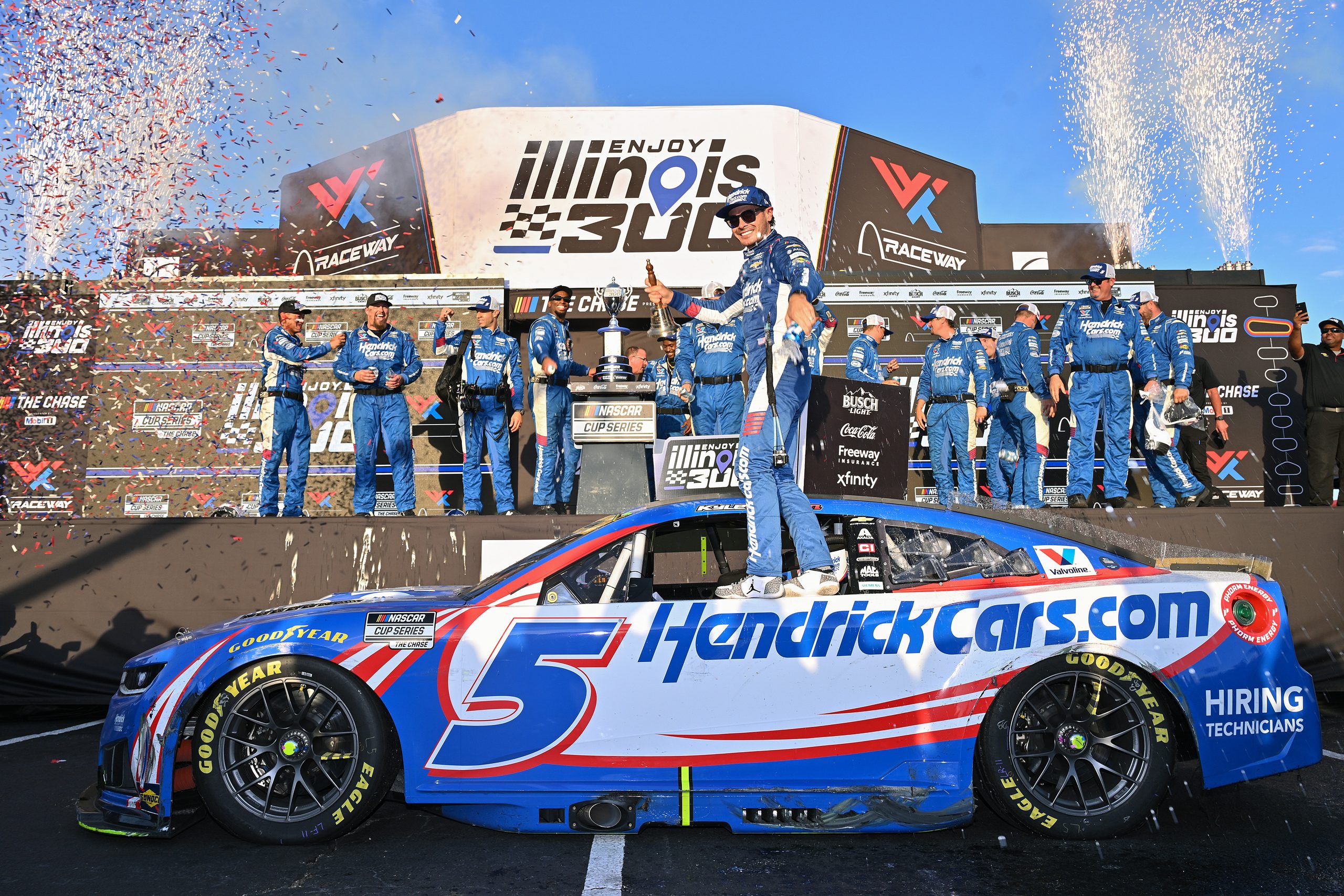
MADISON, ILLINOIS – SEPTEMBER 13: Kyle Larson, driver of the #5 HendrickCars.com Chevrolet, celebrates in victory lane after winning the NASCAR Cup Series Enjoy Illinois 300 at WWT Raceway on September 13, 2026 in Madison, Illinois. (Photo by Amy Kontras/Getty Images).
“I had a good feeling, but I mean, you never know,” Larson said on the frontstretch on USA Network. “I felt like this place is so weird, obviously with the brake rotor failure, strategy, all of that. Just proud of my team for working so hard and being so patient through all the tough times and the winless streak and all that. Thanks to the fans, my fans for also being patient with us and letting it get it figured out. How about Hendrick Motorsports? How about Alex Bowman? I mean, you can’t ask for a better teammate than him. [Bowman] Give me the pushes I needed to get clear, so I really wanna dedicate this one to him and his dog, Finn, who passed away a couple of days ago.”
“I haven’t doubted myself, I haven’t doubted our team, maybe myself at times, but never my team,” Larson added. “Thank you to everybody on the No. 5 team, everybody at HendrickCars.com, Chevrolet, Valvoline, the engine shop, the pit crews for busting their butts, too. [Crew chief] Cliff Daniels for leading our team to great finishes. No better time to have a great day than today. Proud of it and feel like we got our swagger back a little bit.”
Alex Bowman, who finished as high as third twice earlier this season, outdueled Joey Logano to finish in the runner-up spot and emerge as the highest-finishing non-Chase competitor in the field. Amid the runner-up result, Bowman was left emotional as he dedicated his result to his dog, Finn, who died a few days prior.
“I’m super happy for Kyle,” Bowman said. “It’s a really hard weekend just to get on the plane and be here. [I’m] Ready to go home, but I’m proud of everybody on this Ally No. 48 team for helping me through the weekend. Life is hard sometimes, but yeah, I lost my best friend. I suck here [at Gateway], so clearly I had some help…It was a good day for us.”
Meanwhile, Joey Logano, who led a race-high 96 laps, settled in third place. William Byron rebounded from a late retirement last weekend at Darlington Raceway to finish in fourth place, thus placing three Hendrick Motorsports competitors in the top five in the final running order, while Ross Chastain, who led 15 laps, navigated his way to finish in fifth place.
“The restart where Larson took the lead. That’s where I lost it, obviously,” Logano said. “He just rolled the bottom really good and cleared me, which is really surprising. His first, like, three laps of every run was pretty spectacular. Had no homies with me. No more friends. On my own. It’s a good run, right? Got a lot of stage points, finished in the top five again, which is obviously what we need to do. Thinking about what the 25 points would feel like right about now, it does stink some. I mean, we got closer to where we need to be. Yeah, when you have an opportunity like that, got a car like that, you need to win. We just didn’t make it happen.”
Austin Dillon, rookie Connor Zilisch, Carson Hocevar, Denny Hamlin and Austin Cindric completed the top 10 in the final running order. With six of 16 Chase competitors finishing in the top 10 at Gateway, the remaining Chasers, including Bubba Wallace, Ryan Preece, Ty Gibbs, Christopher Bell, Tyler Reddick, Chris Buescher, Daniel Suarez, Chase Elliott, Chase Briscoe and Ryan Blaney, ended up 14th, 17th, 18th, 19th, 25th, 27th, 29th, 31st, 32nd and 35th, respectively.
The second Chase event of the 2026 Cup Series season generated 11 lead changes for five different leaders, and 18 cautions for 87 laps. In addition, 26 of 36 starters finished on the lead lap.
Race Results:
Kyle Larson, 80 laps led, Stage 2 winner
Alex Bowman
Joey Logano, 96 laps led, Stage 1 winner
William Byron
Ross Chastain, 15 laps led
Austin Dillon
Connor Zilisch
Carson Hocevar
Denny Hamlin
Austin Cindric
Cole Custer
Brad Keselowski, 55 laps led
Erik Jones
Bubba Wallace
John Hunter Nemechek
AJ Allmendinger
Ryan Preece
Ty Gibbs
Christopher Bell
Michael McDowell
Austin Hill
Cody Ware
Shane van Gisbergen
Todd Gilliland
Tyler Reddick
Ricky Stenhouse Jr.
Chris Buescher – OUT, Accident
Josh Berry, 116 laps down, one lap led
Daniel Suarez – OUT, Accident
Ty Dillon – OUT, Accident
Chase Elliott -OUT, Accident
Chase Briscoe – OUT, Accident
Noah Gragson – OUT, Accident
Riley Herbst – OUT, Accident
Ryan Blaney – OUT, Accident
Zane Smith – OUT, Accident
*Bold indicates Chase Drivers
Following the second Chase event of the 2026 NASCAR Cup Series season, Denny Hamlin continues to lead the Chase standings by nine points over Kyle Larson. The rest of the 16-car Chase field is displayed below.
Chase Standings:
Denny Hamlin
Kyle Larson -9
Christopher Bell -18
Ryan Blaney -33
Tyler Reddick -42
Ty Gibbs -51
Joey Logano -51
Chase Briscoe -59
Carson Hocevar -88
Bubba Wallace -90
Chase Elliott -93
Austin Cindric -108
Chris Buescher -111
Ryan Preece -113
William Byron -114
Daniel Suarez -119
Next on the 2026 NASCAR Cup Series schedule is the Bass Pro Shops Night Race at Bristol Motor Speedway in Bristol, Tennessee. The event is scheduled to occur next Saturday, September 19, and air at 7:30 p.m. ET on USA Network, PRN Radio, SiriusXM and HBO MAX.
RICK WARE RACING Enjoy Illinois 300 Date: Sept. 13, 2026 Event: Enjoy Illinois 300 (Round 28 of 36) Series: NASCAR Cup Series Location: World Wide Technology Raceway in Madison, Illinois (near St. Louis) Layout: 1.25-mile oval Format: 240 laps, broken into three stages (45 laps/95 laps/100 laps) Note: Race extended seven laps past its scheduled 240-lap distance due to a green-white-checkered finish.
Race Winner: Kyle Larson of Hendrick Motorsports (Chevrolet) Stage 1 Winner: Joey Logano of Team Penske (Ford) Stage 2 Winner: Kyle Larson of Hendrick Motorsports (Chevrolet)
RWR Finish:
● Cody Ware (Started 30th, Finished 22nd / Running, completed 247 of 247 laps)
RWR Points:
● Cody Ware (35th with 217 points)
RWR Notes:
● Ware earned his seventh top-25 of the season and his first top-25 in four career NASCAR Cup Series starts at World Wide Technology Raceway.
Race Notes:
● Kyle Larson won the Enjoy Illinois 300 to score his 33rd career NASCAR Cup Series victory, his first of the season and his first at World Wide Technology Raceway. His margin over second-place Alex Bowman was .333 of a second.
● This was Chevrolet’s 888th all-time NASCAR Cup Series victory and its seventh of the season. Chase Elliott won for the Bowtie Brigade March 29 at Martinsville (Va.) Speedway, Carson Hocevar won April 26 at Talladega (Ala.) Superspeedway, Elliott won again May 3 at Texas Motor Speedway in Fort Worth, Shane van Gisbergen won May 10 at Watkins Glen (N.Y.) International, Daniel Suárez won May 24 at Charlotte (N.C.) Motor Speedway and van Gisbergen won again June 28 at Sonoma (Calif.) Raceway.
● This was Chevrolet’s second NASCAR Cup Series victory at World Wide Technology Raceway. Chevrolet won its first race at the track on June 4, 2023, with Kyle Busch.
● There were 18 caution periods for a total of 87 laps.
● Twenty-six of the 36 drivers in the race finished on the lead lap.
● Denny Hamlin remains the championship leader after the Enjoy Illinois 300 with a nine-point advantage over second-place Larson.
Sound Bites:
“It was a good day results-wise for the team. Got some damage early on in Stage 1. Lot of wrecks, a lot of attrition today, and had to kind of mitigate a lot of the aero damage we got early in the race. But the team did a good job keeping us in the hunt and getting us back on the lead lap. So it was definitely a day of dealing with adversity and never giving up. Now, we’ll just head off to Bristol and get ready for 500 laps under the lights.” – Cody Ware, driver of the No. 51 Rocket Doctor Chevrolet
Next Up:
The next event on the NASCAR Cup Series schedule is the Bass Pro Shops Night Race on Saturday, Sept. 19 at Bristol (Tenn.) Motor Speedway. The third race in the 10-race Chase starts at 7:30 p.m. EDT with live coverage provided by USA Network and SiriusXM NASCAR Radio.
NASCAR Cup Series World Wide Technology Raceway Enjoy Illinois 300 Team Chevy Post-Race Report September 13, 2026
Larson Continues Title Fight with a Trip to Victory Lane at World Wide Technology Raceway Team Chevy Earns Season-Best Seven Top-10 Results
Reigning NASCAR Cup Series champion, Kyle Larson, drove to a statement performance at World Wide Technology Speedway to put the No. 5 Hendrick Motorsports Chevrolet team right back into the title fight. Battling through a race that saw a history-making 18 cautions and an overtime finish, the Elk Grove, California, native snapped a 51-race winless streak and take the checkered flag in the Enjoy Illinois 300. The victory – Larson’s first at WWTR and 33rd all-time in NASCAR’s top division – put the team up into the second position of the points standings and just nine points out of the lead.
It was a season showing by the Bowtie brigade with Larson leading the manufacturer to seven of the top-10 finishing positions. Hendrick Motorsports owned three of the top-five with Alex Bowman’s career-best WWTR effort of second followed by William Byron’s rebound fourth-place finish. Three ECR-powered Chevrolet’s joined in on the strong afternoon at the Illinois-based circuit with Trackhouse Racing’s Ross Chastain finishing fifth and Connor Zilisch in seventh, with Richard Childress Racing’s Austin Dillon coming home in sixth. After a loose wheel in the final stage, Spire Motorsports’ Chase contender, Carson Hocevar, salvaged an eighth-place finish to round out the Team Chevy top-10.
RACE RECAP:
Stage One:
Reigning champions, Kyle Larson and the No. 5 Hendrick Motorsports Chevrolet team, continued their strong start to their title-defending campaign in yesterday’s qualifying session – earning a front row starting position for the Enjoy Illinois 300 at World Wide Technology Raceway. The 45-lap opening stage was marred with early cautions, and through three restarts before the halfway point, Team Chevy Chase contenders, Larson and Carson Hocevar, managed to hold on to positions within the top-five. But a restart with 13 to go in the stage saw Larson test his strength in the top lane – making a masterful three-wide move to jump back up into the third position. With the leaders quickly singling out, the California native settled into position and kept the top-two contenders at a margin under 1.7-seconds en route to the first green-white checkered flag.
Stage Two:
Varying pit strategies during the eventful opening stage saw a shake-up in the lineup with the top-11 cars opting to forgo a trip to pit road under the stage break. Stage winner, Joey Logano, and Larson were the first-two cars on a four-tire strategy to start the stage with the No. 5 taking the green flag for the next 95-lap run from the 16th position. With a similar start to the second stage, a pair of cautions brought the field within their fuel window early in the run. While six cars stayed out, Larson was among the group that hit pit road with crew chief, Cliff Daniels, calling for two tires and fuel. Among those that stayed out was his Team Chevy teammate, Ross Chastain, who went on to inherit the lead for the restart. Despite having nearly 20-lap older tires, Chastain put up a valiant effort to defend Larson, but the No. 5 ultimately made the pass for the lead and set sail just past the one-third mark of the stage. With the first long green flag run finally underway, Larson continued to hold a strong lead as the leaders worked their way through lap traffic. With 10 laps to go, it was a close call for Larson when Zane Smith blew a brake rotor within a handful of car links in front of his Chevrolet. A heads-up move saw Larson escape damage, and with the timing of the caution, the incident ultimately brought Stage Two to a close with the reigning champion going on to collect the win.
Final Stage:
Pitting for four tires, fuel and a slight balance adjustment, Larson was the second car off pit road to regain a spot on the front row for the start of the final stage. But a quick yellow on the opening lap brought the race back under the caution, with the incident seeing his Hendrick Motorsports teammate, William Byron, collected with minor damage. Restarting from the inside line proved to be a slight challenge for Larson, with the driver ultimately filing into the third position after the restart. But back-to-back cautions opened up the opportunity for pit strategy once again for teams to try and make it on fuel. While the majority of the field made the turn to pit road, Larson was among the two cars to make the gamble to stay out. While the restart saw Larson make a quick fall down the top-10 of the leaderboard, a caution just a handful of laps later allowed Daniels to call Larson to pit road for a four-tire and fuel stop – ultimately putting his driver on the offense while sitting in a safer position on fuel mileage. On the same strategy as the majority of the field, it was the Luke Lambert-led No. 77 team that took their turn back at the front of the Bowtie brigade as they were settled within the top-four as the race hit 50 laps to go. While under caution for yet another blown brake rotor, the field sat on the horizon of what could have been the last trip to pit road. With just five cars staying out, then-race leader, Logano, led the rest of the field to pit road including Team Chevy Chase drivers Hocevar, Larson and Elliott. With yet another gamble from atop the No. 1 Trackhouse Racing pit box, Chastain found himself back within the top-five for the restart. While at a nearly 30-lap deficit on his tires, Chastain was putting on a strong fight to maintain his running position in fourth when a caution with 27 laps to go flew for Elliott, whose top-10 effort came to an unfortunate end when he became the next victim to a blown brake rotor. With 13 laps to go, Larson made a power move on the restart to regain the lead just as a multi-car accident mid-pack ultimately brought the race under red flag conditions. Lining up on the outside lane of the front row with his Hendrick Motorsports teammate, Alex Bowman, in his rearview mirror, a push on the restart saw Larson clear Logano with seven laps to go and start his quest back to victory lane. Surviving an overtime finish, Larson went on to make his first trip to victory lane of the season and leading Team Chevy to seven top-10 results.
Team Chevy Unofficial Top-10 Results
Pos. Driver
1st – Kyle Larson
2nd – Alex Bowman
4th – William Byron
5th – Ross Chastain
6th – Austin Dillon
7th – Connor Zilisch
8th – Carson Hocevar
Chevrolet’s season statistics with 28 NASCAR Cup Series races complete:
Wins: 6
Poles: 6
Top-Fives: 44
Top 10s: 90
Stage Wins: 18
The 2026 NASCAR Cup Series Chase will continue at Bristol Motor Speedway with the Bass Pro Shops Night Race on Saturday, September 19, at 7:30 p.m. ET. Live coverage can be found on the USA Network, PRN and SiriusXM NASCAR Radio Channel 90.
Post-Race Driver Quotes:
Ross Chastain, No. 1 Trackhouse Racing Chevrolet
Finished: 5th
“I mean, I was backwards right here on the frontstretch at one point. To recover from that and then stay out with that last strategy with older tires; it was enough to hold on with this No. 1 Busch Light Chevy. We just needed to protect the top. I couldn’t let anyone get to my right-rear. The 5 and 24, they went by me on fresher tires on the bottom on the restarts. We just could not get off the corner on the bottom, especially off of (turn) two on the restarts. But I’m very, very happy after the year this team has had. This feels really good.”
Austin Dillon, No. 3 Richard Childress Racing Chevrolet
Finished: 6th
“Really proud of the entire No. 3 Bass Pro Shops/Winchester Deer Season XP Chevrolet team. We finished sixth, which feels great compared to where we’ve been ending the day. We went from one of the lowest of lows after Darlington to a really good finish for us here today. I knew if I could keep clean air on the nose there, my car was pretty good at the end. When the track cooled down, I got a lot of grip so that was pretty nice. We’re just going to keep grinding away. If we can finish the season with eight more races like this, we’ll be in a good spot for 2027.”
Kyle Larson, No. 5 Hendrick Motorsports Chevrolet
Finished: 1st
Much has been made about 51 races for Kyle Larson. We don’t have to talk about that anymore. Tell me what it feels like, the relief, to get back to Victory Lane.
“Yeah, it feels great. And honestly, I mean, it doesn’t feel like it’s been 51 races. You know, I feel like we’ve been in contention and had shots to win. We’ve just had to work really hard at it; stay patient and trust in the process. I’m so proud of the team; proud of Cliff Daniels (crew chief), the pit crew, everyone at Hendrick Motorsports. What a day for Hendrick Motorsports. Three in the top-five at a track that doesn’t suit our style, that just shows the hard work that’s gone into it. I did not think that I would break the streak here, I was more looking at next week, but this definitely built some momentum and we just have to keep it going. There’s still a lot of racing left, but we need more days like today.”
Regarding restarts, the one where you got the lead, what was the key to getting the lead on Joey?
“The key was having my teammate behind me, and Alex (Bowman) gave me a great push. He popped me right at the right time. I knew if I could just stay side-by-side with Joey, I would at least have a shot. But I was able to tag enough of a side draft on them to have the momentum and leverage into one, and off of two, and gain control, and I was hoping it would just stay green from there. I knew I had a tire advantage on him, but people kept breaking rotors and crashing, and so we had to go through it. But you know, without Alex, I would not be in Victory Lane right now, and so I want to dedicate this one to him, for sure.
Just, again, proud of everybody at Hendrick Motorsports, HENDRICKCARS.COM, Chevrolet, Valvoline, everybody that is a part of it. I think my family is at the airport right now. They flew in to pick me up, so I hope they can find some time and find a route to get in here to celebrate with us.”
Chase Elliott, No. 9 Hendrick Motorsports Chevrolet
Sidelined by damage sustained after a brake rotor failure during the final stage.
Finished: 31st
A brake issue, what feedback were or weren’t you getting from your car before that?
“Yeah, really nothing that said it was fixing to break, unfortunately. I knew that there had been some issues throughout the day, obviously. I was right behind Ryan (Blaney) when he blew his. I guess it’s kind of the luck of the draw, unfortunately. I just went to make a move on the No. 19 (Chase Briscoe) there. I stepped on the brakes, exploded a rotor and that was about it.
It’s really unfortunate. I thought the No. 9 LLumar Chevrolet team was having a really solid day. We were right there around the top-five. I thought we had the right strategy there at the end. We were able to kind of continue to march forward there. Proud of the effort today. Hate to have another bad week, but we had some good pace and some good stuff to hopefully build on. We’ll try and go get them next weekend at Bristol (Motor Speedway).”
William Byron, No. 24 Hendrick Motorsports Chevrolet
Finished: 4th
“I think with how the race was going for us and getting in that caution with the No. 23 (Bubba Wallace), it’s nice to finally have some stuff go our way. I’m glad that the No. 5 (Kyle Larson) could get the win. I tried to help all that I could. They had a good Chevy, so hopefully we can learn something from that. We were okay today. We made a lot of adjustments once we had the damage, and we were able to make our car a lot better. Our No. 24 Phorm Energy Chevrolet was good there at the end. I’m happy with it, we just have to keep digging. We don’t quit.”
Austin Hill, No. 33 Richard Childress Racing Chevrolet
Finished: 21st
“Up and down race for our Lucas Oil team, but at the end; we came home 21st. Our Chevrolet fired off tight rolling to the center, but the dirty air in the back didn’t help our situation any. Once we would run five or so laps, the car would be able to run the bottom and make up some ground. We definitely passed a lot of cars though. Drove up to the top-15, something would happen for us to end up in the back, and we would start it all over again. Felt like we did it a few times today. The guys kept working on it until the end. It was a battle to the finish with missing a bunch of wrecks.”
Alex Bowman, No. 48 Hendrick Motorsports Chevrolet
Finished: 2nd
“It feels good to get a top-five with this No. 48 Ally Chevrolet team. I’m really happy for Kyle (Larson, race winner). I hate to be one spot short, but just really proud of this team. We’ve certainly struggled here in the past, so I’m just glad we could have a good, solid day. Certainly, the pushes on the restarts were really important. I’m just glad I was able to help (his teammate, Kyle Larson) and make it happen. Glad it worked out.”
Carson Hocevar, No. 77 Spire Motorsports Chevrolet
Finished: 8th
“Every time there was a wreck or it got chaotic, we were having to make up track position. I didn’t get to see a lot of the chaos, but I’m glad it helped us, obviously. We had to come from the back twice. Our No. 77 Spectrum Chevrolet was fast, so luckily, we could do that and we could just move around. I was worried that we were just going to run out of laps, but people just kept wrecking, so it made our lives a little easier.”
“It was certainly a chaotic day, but we survived and we were able to get ourselves back into a decent spot at the end there. We had a few restarts at the end and this No. 88 Very Good Ventures Chevrolet team was able to come home with a solid day. I hate that Shane (van Gisbergen) got wrecked there at the end. We had three Trackhouse cars in the top-10 during one of those overtime restarts, so it’s just unfortunate that happened. But overall, it was a good day for us nonetheless.”
About General Motors
General Motors (NYSE:GM) is driving the future of transportation, leveraging advanced technology to build safer, smarter, and lower emission cars, trucks, and SUVs. GM’s Buick, Cadillac, Chevrolet, and GMC brands offer a broad portfolio of innovative gasoline-powered vehicles and the industry’s widest range of EVs, as we move to an all-electric future.
GM Motorsports, including the Cadillac Formula 1® Team develops and proves advanced technologies in the most demanding environments, accelerating innovation in performance, safety, efficiency, and electrification for its production vehicles. Cadillac Racing is one of the leading manufacturers in the IMSA and FIA World Endurance Championships (WEC). Chevrolet competes in single seaters in the US IndyCar series, and in NASCAR with multiple team partners and drivers. Corvette customer teams compete in GT series across the globe including IMSA and WEC. Learn more at GM.com.
HAMLIN RECOVERS FOR TOP-10 TO LEAD TOYOTA AT GATEWAY Season-high in cautions leads to damage for several Team Toyota drivers
MADISON, Ill. (September 13, 2026) – Denny Hamlin bounced back from a slow pit stop to lead Toyota with a ninth-place finish in a chaotic race at World Wide Technology Raceway at Gateway on Sunday evening.
Seven of the nine Team Toyota drivers, all but Hamlin and John Hunter Nemechek, suffered damage in one or multiple of the 18 cautions that fell during the race.
Hamlin maintained the points lead – by nine over Kyle Larson, with Christopher Bell only 18 points out.
TOYOTA RACING Post-Race Recap NASCAR Cup Series (NCS) World Wide Technology Raceway at Gateway Race 28 of 36 – 240 miles, 300 laps
TOYOTA FINISHING POSITIONS
1st, Kyle Larson* 2nd, Alex Bowman* 3rd, Joey Logano* 4th, William Bryon* 5th, Ross Chastain* 9th, DENNY HAMLIN 13th, ERIK JONES 14th, BUBBA WALLACE 15th, JOHN HUNTER NEMECHEK 18th, TY GIBBS 19th, CHRISTOPHER BELL 25th, TYLER REDDICK 32nd, CHASE BRISCOE 34th, RILEY HERBST *non-Toyota driver
TOYOTA QUOTES
DENNY HAMLIN, No. 11 King’s Hawaiian Cinnamon Bites Toyota Camry XSE, Joe Gibbs Racing
Finishing Position: 9th
How would you summarize your team’s day?
“Not a great day for sure. I wasn’t good on restarts. I couldn’t get the car to do what I needed to on restarts, and then obviously we had that bad stop which put us further back with a car that wasn’t very good on restarts and a driver that wasn’t good on restarts. Just a bad combination. Needed others to have issues to get a good finish out of it.”
Are you starting to feel the pressure?
“No. I think we are so fortunate. We were strong last week, and this week we were not strong, and still, we maintained the lead. With all of the tracks coming up, we have a good notebook on. Here was the first one where we were coming back with a new package. We haven’t been good all year with this package at this track for the first time. I feel like we’ve been given a second chance. We just have to go and be better now.”
CHRISTOPHER BELL, No. 20 Rheem Toyota Camry XSE, Joe Gibbs Racing
Finishing Position: 19th
What happened on that restart with 18 to go?
“I haven’t seen it, so I don’t exactly know, but I ended up in a three-wide battle with Josh (Berry) beside me and he was just laying on me, and then he missed the turn. I don’t know. Just a missed opportunity. I’m really bummed that it looked like it was going to be a really good points day for us, and I thought I was in position to win, and if I wasn’t going to win get a top-five and ended up with a 19th place finish, which in the grand scheme of things – we are still in the hunt, which is awesome, but just a missed opportunity for this Rheem Toyota team.”
TYLER REDDICK, No. 45 Comparion Insurance Toyota Camry XSE, 23XI Racing
Finishing Position: 25th
What was going on out there?
“I mean, for us, we were just getting caught up in everyone’s messes. Whether it was early on there – the 7’s (Daniel Suarez) mistake, and I don’t know what happened with Bubba (Wallace) and (Josh) Berry there. Yeah, just tried to bring it home and get a good finish, and couldn’t even do that. It is just kind of where we are used to at this point, for us, we did a really good job at bouncing back from the issues early. We had some splitter damage on lap two or three when we had that contact with the 7, and yeah, it just looked like we were going to crawl our way out of there and get a top-10, and just move on with a good day, and I truly don’t know what happened with those two, but it is kind of the trend, we just get in everyone else’s mess.”
CHASE BRISCOE, No. 19 Bass Pro Shops Toyota Camry XSE, Joe Gibbs Racing
Finishing Position: 32nd
What are the Chase implications of today? Is there room for a mulligan?
“We won’t know the implications until the end of the day. There is a lot of chaos still happening. Just wrong place, wrong time for our Bass Pro Shops, Tracker Boats Toyota Camry. Just have to go the next eight weeks and try to win as many of them as we can. We kind of used nine lives today and kept trying to find our way back up there and at the end wasn’t in the place where we needed to be. Will go to the deer stand tomorrow and reset.”
About Toyota
Toyota (NYSE:TM) has been a part of the cultural fabric in North America for nearly 70 years, and is committed to advancing sustainable, next-generation mobility through our Toyota and Lexus brands, plus our more than 1,800 dealerships.
Toyota directly employs nearly 64,000 people in North America who have contributed to the design, engineering, and assembly of over 50 million cars and trucks at our 14 manufacturing plants. In 2025, Toyota’s plant in North Carolina began to assemble automotive batteries for electrified vehicles.
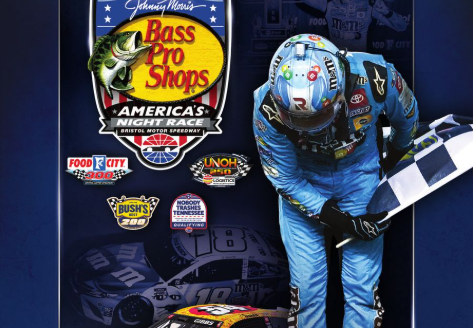
BRISTOL, Tenn. (Sept. 13, 2026) – Fans can find out all the latest news about the upcoming Bass Pro Shops Night Race Cup Series race at Bristol Motor Speedway via a 70-page commemorative souvenir program available for free in both printed and digital formats.
The souvenir program will be available in the reformatted Broadway Play “Playbill” style size that is more convenient for fans to carry with them while they are at the track. A limited number of printed programs will be available to guests to pick up at a variety of locations on property during the event, including several entry gates, at BMS Guest Services locations, BMS souvenir stands, BMS operated camp grounds and BMS ticket booths, while supplies last.
The program features a special cover tribute design “Celebrating Kyle Busch at his beloved Bristol.” Before his tragic and untimely death earlier this year, Busch won 23 times at Bristol during his storied career, including 9 victories in the Cup Series, 9 victories in the O’Reilly Auto Parts Series and five times in the CRAFTSMAN Truck Series.
The cover story complete with plenty of full-color photos, is a remembrance of Kyle Busch’s Top 10 Moments at Bristol Motor Speedway, which include his two amazing triple-sweeps that only he has accomplished in NASCAR history.
The program also includes the weekend schedule, an expanded Speed Reading section with tons of track news and information, driver rosters and photo hero pages for the Cup, O’Reilly and CRAFTSMAN Truck Series teams, a story previewing the full race weekend, track history, track stats and a track map.
The 2026 commemorative Bass Pro Shops Night Race souvenir program was designed by Learfield-IMG College Publishing in Lexington, Ky.
Some of the most memorable moments in NASCAR history have taken place during the Bass Pro Shops Night Race on the super-challenging .533-mile high-banked concrete oval. NASCAR’s best drivers will go doorhandle to doorhandle – NASCAR Playoff style – and only the strongest will survive 500 laps of mayhem and chaos on the iconic short track.
In addition to celebrating Kyle Busch’s amazing legacy at Bristol, the Bass Pro Shops Night Race on will feature a star-studded entertainment lineup, including Academy Award-winning actor and producer Brad Pitt as a Grand Marshal and two-time Indianapolis 500 winner and two-time INDYCAR Series champion Josef Newgarden as the honorary pace car driver leading the NASCAR Cup Series field to green. Saturday’s festivities also will include appearances by WWE Hall of Famer Ric Flair, a pre-race concert by Brian Kelley, Bristol’s signature driver introductions featuring music personally selected by the competitors, a children’s choir performing the national anthem, and Lee Greenwood singing “God Bless the USA” as a bald eagle soars above the stadium, followed by a dramatic flyover featuring two U.S. Air Force C-130s. Fans also will receive yellow “Rowdy Towels” and unite for an emotional Lap 18 tribute honoring Kyle Busch and his unmatched success at Bristol—another powerful, only-at-Bristol moment before the NASCAR Cup Series’ biggest stars battle under the lights in one of America’s most iconic sporting events.
The Bass Pro Shops Night Race weekend, Sept. 17–19, will transform Bristol Motor Speedway and the surrounding Northeast Tennessee region into a three-day celebration of racing, music and unforgettable entertainment. Championship competition in all three of NASCAR’s national series begins Thursday with the Bush’s Beans 200 ARCA Menards Series race and the UNOH 250 presented by Ohio Logistics, which opens the NASCAR CRAFTSMAN Truck Series Chase, followed by Bristol’s popular Foam Party. Friday features Nobody Trashes Tennessee Qualifying, the Food City 300 NASCAR O’Reilly Auto Parts Series Chase race and a post-race concert featuring Tim Dugger. The weekend culminates Saturday night with the 500-lap, post-season Bass Pro Shops Night Race for the NASCAR Cup Series.
To purchase tickets or obtain more information about the race weekend, please visit www.bristolmotorspeedway.com or call (866) 415-4158.
About Bristol Motor Speedway Bristol Motor Speedway, known as The Last Great Colosseum, sits in the mountains of Northeast Tennessee near the Virginia state line. The 0.533-mile concrete oval, with 28-degree banking, hosts two major NASCAR Cup Series weekends each year, the tradition-rich Food City 500 and the crown jewel Bass Pro Shops Night Race. The venue has staged iconic moments such as the 2016 Pilot Flying J Battle at Bristol football game between the University of Tennessee and Virginia Tech (NCAA-record 156,990 fans), the 2025 MLB Speedway Classic between the Atlanta Braves and Cincinnati Reds (MLB regular-season record crowd of 91,032), the 2020 NASCAR All-Star Race, the rebirth of NASCAR Cup Series racing on dirt from 2021–2023 and sold-out concerts for Morgan Wallen and Kenny Chesney. Fans enjoy Colossus TV, the world’s largest outdoor, center-hung, four-sided video board. The adjacent Bristol Dragway is home to the NHRA Super Grip Thunder Valley Nationals, and the dragway can transform into the Thunder Valley Amphitheatre for music concerts. Opened in 1961 and acquired by Speedway Motorsports in 1996, Bristol remains one of America’s most unique and versatile sports and entertainment destinations. For more information, please visit www.bristolmotorspeedway.com.
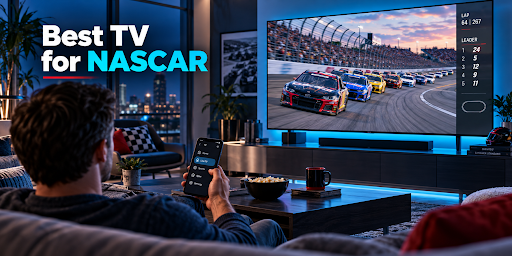
If you are searching for the best TV for NASCAR streaming, do not choose a television by resolution alone. Fast motion handling, screen brightness, reflections, viewing angle, app support, Wi-Fi stability, and easy control matter more during a three-hour race than a long list of marketing features.
That matters even more in 2026 because NASCAR viewing is spread across multiple platforms. NASCAR’s official viewing guides show Cup Series coverage across FOX Sports, NBC Sports/USA, Amazon Prime Video and TNT Sports. Prime Video carries five Cup Series races in 2026, while TNT Sports also carries five mid-season Cup races. Meanwhile, Nielsen reported that streaming represented 48.5% of U.S. TV watch time in June 2026.
For many fans, the best TV for NASCAR streaming is therefore not simply the TV with the sharpest demo reel; it is the one that handles racing motion well and makes switching among apps and services painless.
A smartphone can complete that setup. With the right TV and a compatible phone app, you can search for races, change volume, switch inputs, launch streaming apps, and recover quickly when the physical remote disappears.
1. What Makes the Best TV for NASCAR Streaming?
The best TV for NASCAR streaming should make a fast-moving race look clean, bright, and easy to follow. NASCAR is visually demanding because the picture constantly combines moving cars, fences, track textures, camera pans, sponsor graphics, timing towers, and rapidly changing shots.
Start with five priorities:
A native 120Hz-class panel or better for strong motion performance
Good image processing for lower-bitrate or compressed streams
Enough brightness and reflection control for daytime races
Wide viewing angles if friends watch from different seats
A smart TV platform that supports the services you use
A 4K panel is still the sensible baseline for a new television, but 4K resolution by itself does not guarantee a better race.
A cheaper 60Hz set with weak motion processing may look less convincing during a high-speed camera pan than a stronger 120Hz model. This is particularly noticeable when the camera follows a pack of cars through a corner and the background moves rapidly across the screen.
That is why our definition of the best TV for NASCAR streaming starts with motion and usability rather than resolution alone.
In practical terms, the best TV for NASCAR streaming should preserve car detail during pans without making the broadcast look unnaturally smooth.
For example, imagine watching the Daytona 500 on two 65-inch TVs. Both are 4K. One uses a basic 60Hz panel while the other has stronger 120Hz motion handling. During static interviews, they may look similarly sharp. Once the field reaches racing speed, differences in motion clarity can become much more obvious.
2. Why Motion Handling Matters More Than a “4K” Sticker
Race cars can cross the frame in a fraction of a second. If the television has slow pixel response, poor motion processing, or aggressive smoothing, the image can look blurry, smeared, or unnaturally processed.
For NASCAR, you want a TV that keeps numbers, sponsor logos, and the edges of cars reasonably clear while the camera follows the field.
A native 120Hz panel is a strong target even when the stream itself is delivered at a lower frame rate.
The additional panel capability gives the TV more flexibility for motion processing and also makes the television more useful for gaming or other high-frame-rate content.
For example, LG lists the 2026 OLED evo C6 with a 120Hz native panel and VRR support up to 165Hz. Samsung’s 2026 S95H OLED includes high-refresh Motion Xcelerator features, while TCL lists the QM8K with a native 144Hz panel.
Those specifications do not automatically make one model the best TV for NASCAR streaming, but they are relevant indicators for fast sports.
Do not simply turn every motion setting to maximum.
Excessive interpolation can create artifacts around cars, safety fences, wheels, and on-screen graphics. Start with a Sports or Standard preset, then increase motion smoothing only enough to improve clarity without making the broadcast look artificial.
This is where testing matters. Watch a camera pan across the grandstands or follow a car through a high-speed turn. If details remain reasonably clean without strange halos, you are moving in the right direction.
3. Choose the Right Screen Size for Your NASCAR Setup
A large screen makes racing easier to follow because you can see more detail in the pack, timing graphics, and trackside action.
But the best TV for NASCAR streaming is not automatically the largest model that fits through the door.
Think about seating distance and room layout.
For a typical living room, 65 inches is a strong all-around size. If you sit farther away or regularly host race-day groups, 75 to 85 inches can create a much more immersive experience.
In a smaller room, 55 inches may still be ideal because the entire screen remains easy to scan.
Consider this practical example:
Screen size
Good use case
55 inch
Small room or closer seating
65 inch
Balanced living-room option
75 inch
Group viewing and larger rooms
83–85 inch
Premium race-day setup
The important point is visibility.
The best TV for NASCAR streaming should let you read position graphics and identify cars without forcing you to lean forward.
For race-day groups, the best TV for NASCAR streaming also needs enough size and off-axis consistency for people sitting away from the center seat.
Imagine six people watching Talladega from a wide sectional sofa. A display that looks fantastic only from the center seat may be less useful than one that maintains good color and contrast farther to the side.
That is why viewing angle belongs on your checklist alongside refresh rate and brightness.
4. Bright-Room Performance Can Make or Break a Daytime Race
Many NASCAR events happen during the day, which means your TV may be competing with windows, lamps, and room reflections.
That makes brightness and anti-reflection performance especially important.
OLED TVs offer excellent black levels and very fast pixel response, but a bright room can still favor a television with strong reflection handling.
Mini-LED TVs can also be attractive for daylight viewing because they can deliver high brightness across large areas of the image.
Samsung’s S95H is a useful example because Samsung lists Glare Free anti-reflection technology and an Ultra Viewing Angle on the model.
That combination is relevant for a room where several people watch from different seats.
TCL’s QM8K uses a QD-Mini LED backlight, a 144Hz native panel, and emphasizes strong brightness performance.
LG’s C6 combines OLED response with its current Brightness Booster processing and OLED Motion features.
For a dark media room, OLED contrast may be the priority. For a sunny living room, the best TV for NASCAR streaming may be the model that controls reflections better, even if another television wins in a dark showroom.
That bright-room advantage can matter more than absolute black level when choosing the best TV for NASCAR streaming for afternoon races.
Before buying, look at your room at the actual time races are normally on.
If a window reflects directly into the screen at 2 p.m., that real-world condition should influence your decision more than a specification sheet.
5. Three Strong TV Types to Consider in 2026
There is no single best TV for NASCAR streaming for every room and budget, but three current models illustrate what to prioritize.
TV
Why it suits NASCAR
Smart advantage
Best for
LG OLED evo C6
120Hz native OLED, fast response, strong contrast
webOS 26, ThinQ, AirPlay, Google Cast
Balanced premium setup
Samsung OLED S95H
Glare Free screen, wide viewing angle, strong motion features
Tizen, SmartThings, Google Cast
Bright rooms and groups
TCL QM8K
Native 144Hz QD-Mini LED panel
Google TV, Chromecast, AirPlay 2
Large-screen value
LG OLED evo C6: balanced premium choice
LG’s 2026 C6 is a compelling candidate for the best TV for NASCAR streaming because it combines OLED pixel response with a 120Hz native refresh rate, modern video processing, Wi-Fi 6, and current streaming features.
LG also lists Google Cast, Apple AirPlay, webOS 26, and LG ThinQ phone-remote support.
This combination makes sense for viewers who want NASCAR, movies, console gaming, and general streaming from the same display.
Samsung S95H: strong for reflections and side seating
The S95H stands out when daytime glare is a major problem.
Samsung lists Glare Free anti-reflection, an Ultra Viewing Angle, OLED HDR processing, and advanced motion features. It also includes SmartThings functionality and mobile-to-TV features.
If your race-day gathering includes several seats across a wide room, those characteristics are particularly relevant.
TCL QM8K: large-screen, high-refresh alternative
TCL’s QM8K uses Google TV, a native 144Hz panel, and QD-Mini LED technology.
It also supports Chromecast, AirPlay 2, and Wi-Fi 6 on major sizes, giving it a strong smart-platform foundation.
These are examples, not the only good choices.
The best TV for NASCAR streaming is ultimately the model that fits your room, preferred apps, and budget.
A useful shortlist should therefore compare best TV for NASCAR streaming candidates by room conditions as well as panel technology.
6. Check NASCAR Streaming Apps Before You Buy the TV
App compatibility is more important in 2026 because NASCAR Cup Series coverage is divided among several rights holders.
NASCAR’s official 2026 guides show early-season coverage on FOX and FS1, five Cup Series races on Prime Video, five mid-season Cup races on TNT Sports, and late-season coverage across NBC and USA.
For Prime Video specifically, NASCAR lists five 2026 Cup Series races: Charlotte, Nashville, Michigan, Pocono, and Naval Base Coronado.
TNT Sports similarly carries five mid-season Cup Series races, with streaming availability through HBO Max’s sports offering.
That fragmentation changes how you should evaluate the best TV for NASCAR streaming.
Before buying, verify whether the TV platform supports the services you actually use.
Viewing need
What to verify
FOX / FS1
Live-TV provider or supported streaming app
Prime Video
Current Prime Video app
TNT Sports
TV provider and Max availability
NBC / USA
Peacock and live-TV setup
NASCAR extra content
Supported FAST and streaming services
NASCAR’s September 2026 viewing guide also lists the NASCAR 24/7 channel on Prime Video, Roku, Samsung TV Plus, Tubi, and Xumo.
A fast processor and good smart-TV platform therefore contribute directly to the best TV for NASCAR streaming experience.
If the interface is slow or a required app is unavailable, excellent panel quality will not fix the inconvenience.
In 2026, app coverage is part of the best TV for NASCAR streaming decision because a season can move between several services.
7. Turn Your Smartphone Into the Race-Day Remote
Once you have the best TV for NASCAR streaming for your room, your smartphone can become the control center.
For an iPhone household, a compatible remote control app for ios can be useful when the television supports network control.
LG, Samsung, Google TV, Roku, and other ecosystems offer different forms of phone-based interaction.
The smartphone’s biggest advantage is text entry.
Suppose you want to search:
NASCAR Cup Series Michigan
Typing that phrase with a phone keyboard can be much quicker than moving across an on-screen keyboard one letter at a time.
A good remote TV app is also useful for changing volume, navigating menus, and launching apps when the original physical remote is across the room.
Your phone is especially helpful during a race weekend when you may switch among qualifying, pre-race shows, live timing, and the main race.
The objective is not to eliminate every physical remote.
Instead, use the phone as a second control point so the TV is easier to operate during long race-day sessions.
8. How to Set Up Phone Control Before the Green Flag
Do not wait until the formation lap to configure your phone.
Step 1: Put the phone and TV on the same network
Many smart-TV control systems use the local network.
Confirm that your smartphone and television are connected to the same home Wi-Fi rather than separate guest and primary networks.
Step 2: Install the correct control app
Start with your TV manufacturer’s supported application.
If you prefer a third-party remote control app for TV, check its current compatibility, pricing, privacy permissions, and supported functions.
If you decide to download remote TV app software, verify that basic commands such as navigation, mute, volume, app launching, and Home work with your television.
Step 3: Pair your phone
Select the television from the app.
Your TV may display a PIN or permission prompt. Approve it, then test:
Home
Back
Direction pad
Volume
Mute
App navigation
Step 4: Test the NASCAR workflow
Open the platform carrying the race.
Search for the event, launch the stream, adjust the volume, and return to the home screen once to confirm everything works.
For a household with several TV brands, you may instead choose to download universal remote TV app software and build separate device profiles.
The best time to test all of this is 15 to 30 minutes before the broadcast begins.
That preparation helps the best TV for NASCAR streaming deliver a smooth experience instead of becoming another device you have to troubleshoot when the race starts.
9. Optimize Picture Settings for NASCAR
Even the best TV for NASCAR streaming can look disappointing with poor settings.
Start with the television’s Sports, Standard, or Custom mode rather than an extremely vivid showroom preset.
Motion
Use moderate motion processing.
The goal is clearer camera pans, not an artificial video look.
Watch the timing tower and individual cars while the camera follows the field. If outlines begin to shimmer or break apart, reduce interpolation.
Brightness
In a sunny room, use a brighter picture mode or the TV’s ambient-light controls.
At night, reduce brightness to a comfortable level.
The ideal setting for a 2 p.m. race may be very different from one used for a night race at Daytona.
If the announcers are difficult to hear, try Clear Voice, Dialogue Enhancement, or the equivalent feature before simply increasing overall volume.
The best TV for NASCAR streaming is the television you can comfortably watch for several hours.
More processing is not always better.
A calibrated, comfortable picture usually makes the best TV for NASCAR streaming more enjoyable than a hyper-bright showroom preset.
10. Fix Streaming or Remote Problems Quickly
When something goes wrong, separate the TV-control problem from the streaming problem.
Symptom
Likely problem
First action
Phone cannot find TV
Network mismatch
Check Wi-Fi on both devices
Phone remote lags
Weak local network
Improve Wi-Fi signal
Race buffers but remote works
Internet or streaming service
Test the connection
TV app crashes
App/software issue
Restart app, then TV
Motion looks blurry
Source/settings issue
Adjust motion controls
Audio and video drift
Stream/device sync
Restart the stream
A useful diagnostic rule is simple: if your phone changes the television volume instantly but the race keeps buffering, the remote application is probably working.
If you use a remote control app for ios, keep both the app and TV firmware reasonably current.
A wired Ethernet connection can also help when the television is far from the router.
Wi-Fi 6 support, available on models such as the LG C6 and many TCL QM8K sizes, can be useful on a modern home network, but good router placement still matters.
The best TV for NASCAR streaming cannot compensate for an overloaded or unstable internet connection.
Reliable networking is therefore part of the best TV for NASCAR streaming setup, particularly when several household members are streaming or gaming simultaneously.
11. Frequently Asked Questions
Is OLED or Mini-LED better for NASCAR?
Both can work extremely well.
OLED provides fast pixel response, excellent contrast, and strong viewing angles. Mini-LED can provide excellent brightness for daytime viewing.
The best TV for NASCAR streaming depends on whether your main priority is dark-room contrast, bright-room visibility, screen size, or budget.
Do I need a 120Hz TV for NASCAR streaming?
No, but a native 120Hz-class panel is a strong choice for fast sports.
It gives the television more flexibility for motion processing and is commonly found on higher-performance TV models.
For a long-term purchase, 120Hz is a sensible target.
Does NASCAR stream in 4K?
Quality varies by race, broadcaster, provider, and streaming platform.
Do not buy a television assuming every NASCAR event will be delivered in native 4K.
A good 4K TV still matters because its processor must upscale and clean up HD or compressed streams.
Can I control NASCAR streaming from my smartphone?
Yes, when your television supports phone-based control.
Depending on the TV, you may use the manufacturer’s app or a compatible universal remote TV app to handle navigation, volume, playback, and other common controls.
What TV size is best for NASCAR?
For many living rooms, 65 inches offers a strong balance.
A 75- to 85-inch screen works well for larger spaces and race-day groups.
The best TV for NASCAR streaming should be large enough for timing graphics and car numbers to remain readable from your normal seat.
12. Final Thoughts
Choosing the best TV for NASCAR streaming is really about selecting a television that handles racing conditions well: fast motion, long viewing sessions, daytime reflections, multiple streaming apps, and group seating.
For a balanced premium setup, the LG OLED evo C6 is a strong example because it combines OLED response, a 120Hz native panel, current streaming support, and smartphone control through LG ThinQ.
Samsung’s S95H is particularly attractive for bright rooms because of its Glare Free screen and wide viewing angle.
TCL’s QM8K is worth considering when you want a large, bright Mini-LED display with Google TV and a native 144Hz panel.
The streaming side matters just as much.
NASCAR’s 2026 Cup Series coverage spans FOX Sports, NBC/USA, Prime Video, and TNT Sports, while Nielsen reported that streaming represented 48.5% of U.S. TV watch time in June 2026.
A modern smart-TV platform is therefore part of what makes the best TV for NASCAR streaming, not an afterthought.
Finally, connect your phone before race day.
A reliable universal remote TV control setup gives you a quick way to search, switch services, change volume, and control the television if the physical remote goes missing.
The result is not just a better television. It is a smoother NASCAR viewing system from green flag to checkered flag.
Sources
NASCAR.com — How to watch NASCAR races on Amazon Prime Video, January 28, 2026. Five Cup Series races are carried on Prime Video in 2026.
NASCAR.com — How to watch NASCAR races on FOX Sports, January 28, 2026.
NASCAR.com — How to watch NASCAR on TNT Sports, HBO Max and truTV, January 28, 2026.
NASCAR.com — How to watch NASCAR races on NBC, USA, August 5, 2026.
Nielsen — June 2026 Gauge report: streaming represented 48.5% of TV watch time.
A sellout crowd braved the weather inside Historic Crew Stadium to kick off the
2026 Monster Energy SMX World Championship Playoffs.
Levi Kitchen Emerges in 250SMX Class with Consistent Performance
COLUMBUS, Ohio (September 12, 2026) – Playoff 1 for the 2026 Monster Energy SMX World Championship got underway amidst rainy conditions inside Historic Crew Stadium, which presented an unpredictable and challenging dynamic for the start of the postseason. A passionate and enthusiastic sellout crowd braved the weather as a muddy afternoon of racing saw Monster Energy Yamaha Star Racing’s Haiden Deegan break through for his first premier class victory in the 450SMX Class, while Monster Energy Pro Circuit Kawasaki’s Levi Kitchen came out on the winning end of a tiebreaker to prevail in the 250SMX Class.
Due to the weather and wet track conditions, the first motos for each class were shortened to 15 Minutes + 1 Lap, while the second motos were shortened to 12 Minutes + 1 Lap in an effort to help preserve the racing surface.
The opening moto for the 450SMX Class got underway with Red Bull KTM Factory Racing’s Jorge Prado leading the field to the holeshot with Deegan and Quad Lock Honda’s Joey Savatgy in tow. Further back in the field Honda HRC Progressive’s Hunter Lawrence, the top seed and newly crowned Pro Motocross Champion, went down and started last.
Deegan closed in on the Spaniard and made the pass right before the completion of the first full lap. Progressive Insurance Cycle Gear Suzuki’s Ken Roczen, the reigning Supercross Champion, soon followed into second. As the leaders settled in, Lawrence encountered more misfortune and found himself on the ground once more, which effectively eliminated him from contention for the afternoon. Back up front, Deegan opened a multi-second lead over the field. Roczen started to take significant chunks out of his deficit, but Deegan responded to end the threat and carried on to his first checkered flag in the premier class by 17.2 seconds over his Suzuki counterpart. Prado finished in third, with Troy Lee Designs Red Bull Ducati Factory Racing’s Dylan Ferrandis in fourth and Twisted Tea Suzuki Progressive’s Jason Anderson in fifth.
The second moto kicked off with Deegan leading the way to the holeshot ahead of Prado and Roczen. Deegan took advantage of the clear track and tried to inch away, but Roczen made the move on Prado and tracked down Deegan to begin a brief battle for the lead. Behind them, Monster Energy Yamaha Star Racing’s Cooper Webb made the pass around Prado for third. Out front, Deegan fended off Roczen’s early pressure to stabilize his advantage.
As Deegan took advantage of lapped riders to extend his lead over Roczen, Webb and Prado traded positions, with the Spaniard able to briefly reclaim the position before Webb overtook him once more. Deegan, meanwhile, continued to show impressive poise in the treacherous conditions and completed a wire-to-wire moto win to sweep the day by 17.1 seconds over Roczen, who overcame a fall late in the race. Webb finished third, just ahead of Prado.
Deegan’s 1-1 performance netted him the first premier class victory in his 12th career start. Roczen enjoyed a consistent afternoon to finish in the runner-up spot (2-2) in his first start since capturing the Supercross title in May, while Prado rounded out the podium (3-4) in his SMX Playoff debut.
With his third-place finish, Prado improved upon his second seed in the 450SMX Playoff to move atop the standings and grab possession of the red plate for the first time. He holds a two-point lead over Deegan, who climbed from seventh to second, while Webb remains third, four points back. Roczen moved up from 10th to fourth (-8), while Lawrence’s 15th-place finish saw him drop from first to sixth (-10).
Monster Energy Yamaha Star Racing’s Haiden Deegan began the postseason with his highly anticipated maiden 450SMX Class victory in a 1-1 effort.
Haiden Deegan (1-1) – 1st Place – 450SMX Class “This is a dream come true. I just won a 450 race. This is crazy. I can’t express how happy I am right now. It’s just a weight off my shoulders, especially on a day like today when conditions were like this and I’m racing against guys with a lot more experience on a track like this. I’m just so happy and ready to keep it going.”
Ken Roczen (2-2) – 2nd Place – 450SMX Class “Just nice and content [today]. That was my gameplan coming into here. I had a blast out there. To get a 2-2 [effort], I couldn’t ask for anything more, honestly. What a solid weekend. I can’t wait for the next [race].”
Jorge Prado (3-4) – 3rd Place – 450SMX Class “I really don’t know what to say. My worst races came in the mud this year and I got up here on the [podium], which is amazing for me. Just improvement, from being in the top 15 [earlier in the season] to getting on the podium. We’re now leading the SMX series, and I cannot be happier than this.”
250SMX Class
The first moto for the 250SMX Class started with Monster Energy Yamaha Star Racing’s Cole Davies out front with the holeshot ahead of Rockstar Energy Husqvarna Factory Racing’s Daxton Bennick and Kitchen. Davies, the top seed and reigning Eastern Divisional Supercross Championship and Pro Motocross Champion, took full advantage of the clear track to open a significant lead over the field.
Davies dominated the first 12 minutes of the moto, opening an advantage of nearly 20 seconds and lapping up to 10th place. However, with just over three minutes left on the race clock Davies appeared to encounter issues with his Yamaha and eventually came to a stop on one of the track’s jumps, ending his race. That allowed Bennick to move into the lead as the Husqvarna rider kept it on two wheels and captured the moto win by 18.1 seconds over Kitchen, while Rockstar Energy Husqvarna Factory Racing’s Ryder DiFrancesco followed in third. ClubMX Yamaha’s Max Vohland finished fourth, with Monster Energy Yamaha Star Racing’s Caden Dudney in fifth. Davies’ DNF relegated him to 22nd place.
The second moto began with Bennick out front for the holeshot, but he was passed by Davies in the first rhythm section, while Honda HRC Progressive’s Chance Hymas slotted into third ahead of Kitchen. Much like the first moto, Davies stormed out to a healthy lead of more than 10 seconds, while Bennick asserted his hold of second. Behind them, the battle for third unfolded between Hymas and Kitchen, with the Kawasaki rider able to make the move.
As Davies continued to pull away, Bennick started to lose ground to Kitchen, who made a push over the second half of the race. He continued to inch closer to the Husqvarna and moved within striking distance coming to the white flag. Kitchen pulled the trigger on a quick and decisive pass to move into second, which had a significant impact on the overall classification.
Out front, Davies was in a class of his own and bounced back from the heartbreak of Moto 1 to take the second moto win by 16.5 seconds over Kitchen, with Bennick in third and DiFrancesco in fourth.
With his late pass and runner-up finish, Kitchen (2-2) and Bennick (1-3) finished the afternoon tied atop the overall classification with four points apiece. The second moto tiebreaker went in Kitchen’s favor to give him the first Playoff win of his career, while Bennick secured his fifth career SMX podium. DiFrancesco rounded out the overall podium in third (3-4), while Davies’ salvaged 11th overall (22-1).
Kitchen now sits atop the 250SMX Playoff standings after entering the weekend as the second seed. He holds a seven-point lead over DiFrancesco, who entered as the third seed, while Davies dropped to third, 10 points out of the lead.
Even though he missed out on a moto win, a consistent 2-2 effort from Monster Energy Pro Circuit Kawasaki’s Levi Kitchen gave him the win and points lead.
Levi Kitchen (2-2) – 1st Place – 250SMX Class “We were coming to the white flag and I saw Dax [Bennick]. I knew if I could get him I might have a chance, but I really had no idea. That was nice, I was able to put two motos together. This was a great race to have [to begin the Playoffs]. I’m feeling better and looking forward to next weekend.”
Daxton Bennick (1-3) – 2nd Place – 250SMX Class “I gotta be happy with [today]. Two solid motos. I had [the win] with two laps to go but Levi [Kitchen] was riding good. Gotta give it to him. I’m just grateful for a great day and excited to start the Playoffs like this.”
Ryder DiFrancesco (3-4) – 3rd Place – 250SMX Class “I just tried to get a good start and ride consistent laps. I figured if I could do that it would work out and that’s what happened. Excited to try and keep this going into next weekend.”
The SMX Next World All-Stars contested a shortened 6 Minutes + 1 Lap Main Event for the first of two Playoff races, which started with Monster Energy Kawasaki Team Green’s Kade Johnson out front with the holeshot. However, he was quickly passed by ClubMX Yamaha’s Ryder Malinoski while KTM Orange Brigade’s Wyatt Thurman gave chase from third.
The battle for the lead continued as Johnson made the pass to regain control of the race. Malinoski made another push to try and pass for the lead but lost control and dismounted his Yamaha. That allowed Thurman to take control of second. Malinoski briefly resumed in third but went down again and eventually dropped out of contention as Monster Energy Kawasaki Team Green’s Vincent Wey slotted into podium position.
Johnson kept it clean the rest of the way and took the second SMX Next victory of his career by 10.6 seconds over Thurman, while Wey rounded out the podium. Johnson has now amassed a four-race podium streak in SMX Next competition and will lead the All-Stars standings entering next weekend’s championship-deciding race, with a two-point lead over Thurman and a five-point lead over Wey.
Kade Johnson – 1st Place – SMX Next World All-Stars “I was just patient. I’m trying to prove myself to get a pro contract. I just tried to ride my best, keep it on two wheels, and get the best result I could. I’ve been consistent recently and now have five podiums in-a-row. I think the start was critical there and it definitely helped [put me in a position to win].”
The Monster Energy SMX World Championship postseason will continue next Saturday, September 19, with Playoff 2 from Los Angeles’ Dignity Health Sports Park. Live comprehensive broadcast coverage will be available on Peacock, beginning at 1 p.m. ET with Race Day Live, followed by a Pre-Race Show at 6:30 p.m. ET and Gate Drop at 7 p.m. ET.
For information about the Monster Energy SMX World Championship, please visit www.SuperMotocross.com and be sure to follow all of the new SMX social media channels for exclusive content and additional information on the latest news: Instagram: @supermotocross Facebook: @supermotocross X: @supermotocross YouTube: @supermotocross TikTok: @supermotocross
About the Monster Energy SMX World Championship: The Monster Energy SMX World Championship™ is the premier off-road motorcycle racing series in the world that combines the technical precision of stadium racing with the all-out speed and endurance of outdoor racing. Created in 2022, the Monster Energy SMX World Championship Series combines the Monster Energy AMA Supercross Championship and the AMA Pro Motocross Championship into a 28-round regular season that culminates with the season-ending SMX World Championship Playoffs. Visit SuperMotocross.com for more information.
About Feld Motor Sports, Inc.: Feld Motor Sports, Inc. is the worldwide leader in producing and presenting specialized arena and stadium-based motorsports entertainment. Properties include Monster Jam®, Monster Energy AMA Supercross, and the Monster Energy SMX World Championship. Feld Motor Sports, Inc. is a subsidiary of Feld Entertainment, Inc. Visit monsterjam.com, SupercrossLIVE.com, and feldentertainment.com for more information.
About MX Sports Pro Racing, Inc.: MX Sports Pro Racing, Inc., manages and produces the world’s premier motocross racing series – the Pro Motocross Championship, sanctioned by AMA Pro Racing. MX Sports Pro Racing is an industry leader in off-road powersport event production and management, its mission is to showcase the sport of professional motocross competition at events throughout the United States. Through its various racing properties, partnerships and affiliates, MX Sports Pro Racing, Inc., organizes events for thousands of action sports athletes each year and attracts millions of motorsports spectators. Visit MXSportsProRacing.com for more information.