In both the worlds of professional racing and high-stakes poker, top competitors know that more than raw speed or luck is required to come out ahead. Success arises from understanding not just the game’s rules, but also the intricate interplay of timing, anticipation, and the steady nerves needed to outmaneuver rivals. While these domains might appear quite different, racing and poker share a surprising number of strategic similarities, especially when it comes to timing decisions and reading one’s environment. Let’s peek under the hood and shuffle the deck to see what racers and poker players can learn from one another about competitive thinking.
The value of patience and timing
In the high-octane world of motorsports, patience is not often the first quality associated with drivers hungry for the checkered flag. Yet true champions know that waiting for the right moment to make a move is just as crucial as a well-timed acceleration. Whether you’re waiting for the driver ahead to make a minor mistake or holding back to save your tires for a late surge, timing can dictate the difference between first and fifth place. There is an art to knowing when to attack and when to bide your time, and this element of timing is mirrored nearly card-for-card at the poker table.
Poker pros understand that not every hand can, or should, be played, and sometimes the best move is to fold and wait. Both games teach practitioners to manage adrenaline, channeling it into constructive patience. In both contexts, those who strike too early or become restless are often left watching from the sidelines while others capitalize on their missteps. The parallel is clear: strategic timing, whether in racing or poker, rewards those who can wait for openings rather than forcing the action prematurely.
Reading opponents and adapting strategies
Another central theme shared by racers and poker players is the relentless focus on reading opponents. In racing, anticipation often stems from observing rivals’ driving styles, tire choices, and even subtle body language in the pit lane. Top performers pick up on the smallest hints, changes in line through the turns, brake points, or how aggressively a competitor is pursuing the lead, and use those observations to plan counters. Success relies on constant vigilance and a willingness to adapt strategies as races evolve.
At a poker table, reading tells and patterns provides similar advantages. Professionals carefully watch their opponents’ reactions, betting tempos, and even posture, looking for clues about the strength of their hands or potential bluffs. This ability to interpret limited information fast becomes the backbone of competitive edge. Quick adjustment is crucial here as well; if you spot an opponent adjusting strategy, it’s time to adapt or risk being left behind. In both arenas, nothing stays static, flexibility and keen observation lead to better decisions under pressure.
Risk management and calculated decision making
Perhaps the most striking strategic parallel between racing and poker lies in managing risk. When drivers push their machines to the edge, every move carries potential rewards and hazards. Passing on the outside during a tight turn could mean gaining a critical position, or it might result in contact that ends a race early. Calculated risks, rooted in deep understanding of both the present scenario and potential consequences, define motorsport strategy. The fastest way may not always be the safest or the smartest; champions choose when to risk and when to play it safe.
Poker, too, orbits around the axis of risk and reward. Players constantly weigh the possible winnings of a pot against the size of the bet required, the odds of drawing a desired card, and the likelihood their opponent is bluffing. Bankroll management adds another strategic layer: withdrawing before devastation, or pressing an advantage when the odds tilt in your favor. Just as a racer must know when to pit or preserve tires, a poker player must avoid risking too much on a weak hand. Across both disciplines, competitive thinking is about judiciously calculating risk, reading the field, and making decisions that might not always result in immediate victory, but build toward consistent success over time.
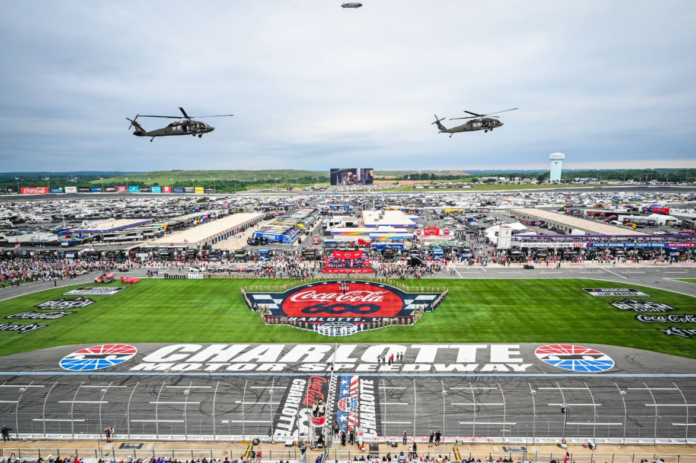
The historic 67th running of the Coca-Cola 600, a crown jewel on NASCAR’s schedule, returns to Charlotte Motor Speedway this Memorial Day weekend. (CMS photo)
Packed with unforgettable moments on and off the track, the Coca-Cola 600 returns to Charlotte Motor Speedway with unmatched action and unforgettable moments to honor and pay tribute to the men and women of the U.S. Armed Forces
Fans can purchase Coca-Cola 600 weekend tickets online at www.charlottemotorspeedway.com or call 1-800-455-FANS (3267). Kids 12 and under get in for just $10 on Sunday
CONCORD, N.C. (April 27, 2026) – Next month, the engines will fire on one of NASCAR’s most iconic traditions as the historic Coca-Cola 600 roars back to life at Charlotte Motor Speedway this Memorial Day weekend. Set against the backdrop of America’s 250th birthday, the 67th running promises high-speed drama and unforgettable moments at one of the world’s most legendary race tracks.
Beyond the on-track action, the Coca-Cola 600 weekend promises to deliver a bucket-list experience, featuring moving military tributes, live entertainment and a pre-race concert by country music megastar Brad Paisley. The Memorial Day weekend classic blends high-speed competition with heartfelt remembrance, creating an atmosphere unlike any other in motorsports.
NASCAR’s biggest stars and past winners know exactly what it takes to conquer the grueling challenge — and why the Coca-Cola 600 stands alone as a true Crown Jewel event. From the physical toll of 400 laps to the mental focus required as conditions change, drivers say it demands everything — and then some. Here’s what NASCAR Cup Series drivers say about what makes the Coca-Cola 600 so special:
Ross Chastain, No. 1, Reigning Coca-Cola 600 Winner
“Memorial Day Weekend means so much to so many and for me in NASCAR, a small nod to that is our moment of silence and remembrance right in the middle of the race. At the halfway mark of 300 miles, we shut the cars off, come to a stop. Everybody outside of the car stands, and we remember those that paid the ultimate sacrifice. Now it’ll never repay what was done for this country by so many, but for NASCAR and for me inside of my race car, it’s one nod towards the past.”
Kyle Busch, No. 8, 2018 Coca-Cola 600 Winner
“I would say, what makes the Coca-Cola 600 so special is it’s just it’s the longest race of our year, you know? It’s man versus machine. It’s a mental toughness. It’s a physical toughness race. There’s just so much going on during that event. You’ve got the stages, you’ve got 400 laps, 600 miles. It’s such a long night, but at the end of the day when, when you’re able to bring home the checkered flag and celebrate in Victory Lane, there’s nothing greater.”
“The first thing is simply the distance and how it is a test of people, of machine, of endurance. It’s very tricky in all those ways. but the show is out of this world when you compare it to most of our races. The pre-race show, with all of the salute program is very memorable.”
Ryan Blaney, No. 12, 2023 Coca-Cola 600 Winner
“I think it’s a true test of, how resilient you and your team are in a racecar. It’s one of our crown jewels for a reason just because it takes a lot to win it. You put in a long, hard night’s worth of work and if you do something special, that definitely adds to i., I’ve been fortunate to win that one, and there’s no other feeling like it.”
“I think the fact that it’s on Memorial Day Weekend makes the Coca-Cola 600 extra special. It’s just the pageantry of the pre-race and every part that goes into that. It’s just a grind. It’s our longest race. Legends win there.”
“I think it’s just a test of everything. I mean, the length of the race itself is a huge test of, driver and car and team. The guys are doing a ton of pit stops at the 600, close to the most all year for us, trying to stay focused for 600 miles and also starting in the day, going into the night. The track goes through a huge transition, so there are a lot of things that if you do win that race, at the end of it, you did everything really right all day long and you put yourself in that position. So it’s just a great test.”
Cody Ware, No. 51, Rick Ware Racing
“NASCAR does a really good job, especially the Coca-Cola 600 of giving back to fallen service members’ families, as well as honoring active duty military and everyone who serves this country. So to do that alongside our longest race, an endurance race basically for us, it’s a really cool way to enjoy one of the crown jewels to give back a little bit and to put on a good race in our home, our home state, our hometown and give thanks to all the people that let us do the job that we do, because all the hard work that they do.”
TICKETS:
Fans can purchase Coca-Cola 600 weekend tickets online at www.charlottemotorspeedway.com or call 1-800-455-FANS (3267). Experience every lap, every pass and all 2,000 miles of NASCAR excitement with season tickets covering six unforgettable races.
MORE INFO:
Fans can connect with Charlotte Motor Speedway and get the latest news by following on X and Instagram, or becoming a Facebook fan. Keep up with all the latest news and information with the Charlotte Motor Speedway mobile app.
Honeycutt to Pilot Foster Love/Safelite Foundation Tundra for Month of May
MOORESVILLE, N.C. (April 27, 2026) – TRICON Garage (TRICON) is proud to announce that its collaboration with TRD U.S.A. partner Safelite, the Safelite Foundation and its national partner Foster Love will return to the No. 11 Toyota Tundra TRD Pro in 2026. Alongside driver Kaden Honeycutt, the partnership aims to shine a spotlight on National Foster Care Awareness Month.
Foster Love is a nationwide nonprofit organization committed to improving the way children experience the foster care system for the better. From helping one child, to supporting over one million foster youth, Foster Love continues to strive towards the goal of improving the foster care experience for the over 430,000 children currently in the system.
As a special tribute, the No. 11 team will once again swap the Safelite red for a refreshed blue design, representing the official color of National Foster Care Awareness Month, serving as a visual reminder of the kids who often go unseen, while also recognizing foster parents, family members, volunteers, mentors, policymakers and child welfare professionals.
Honeycutt will carry Foster Love branding across all five NASCAR Craftsman Truck Series races this May, including Texas Motor Speedway, Watkins Glen (N.Y.) International, Dover (Del.) Motor Speedway, Charlotte (N.C.) Motor Speedway and Nashville (Tenn.) Superspeedway in an effort to raise awareness and inspire action for foster youth nationwide.
In 2025, the Safelite Foundation, Foster Love and TRICON partnership produced two victories, as Corey Heim took the blue livery to victory lane at Texas Motor Speedway and Charlotte Motor Speedway.
“Our associates have made this partnership truly their own. They’ve shown up in every way possible, from volunteering and donating to openly sharing their own personal connections to the foster care system,” said Wendy Bradshaw, Executive Director of the Safelite Foundation and Community Affairs.
“During every race in May, we will cheer on Kaden, recognizing that he is a powerful advocate for raising awareness about foster care across the country. Throughout Foster Care Awareness Month, he is partnering with us on and off the track to be a driving force for good.”
Through this special collaboration, Safelite will host over 30 guests, including foster children and families at Charlotte Motor Speedway, bringing a unique and meaningful partnership into a space where it had rarely existed before. Limited edition Kaden Honeycutt shirts will be offered in celebration of the collaboration, with a percentage of the proceeds going directly to Foster Love. Fans can find the design for sale on shopTRICON.com.
The partnership is set to debut at Texas Motor Speedway on Friday, May 1 in the SpeedyCash.com 250. The 200-lap race will be televised live on FS1 with radio coverage provided by the Motor Racing Network and SiriusXM NASCAR Radio.
About Safelite Foundation
Founded in 2005, the Safelite Foundation was established as the company’s charitable arm with one mission: to help those who’ve hit a bump in the road find a clear road ahead. We deliver on this mission through partnership and support of organizations whose focus aligns with our giving priorities: providing safety, stability, and a sense of belonging. Leveraging the size and scale of Safelite’s reach, the Foundation impacts communities on a local, national, and global level with over $40M donated and hundreds of thousands of associate volunteer hours since 2005. For more information, visit safelite.com/foundation.
About Foster Love
Founded in 2008, Foster Love is dedicated to transforming the lives of children in the foster care system. We provide resources, support, and a loving community to foster children, foster parents, and adoptive families. Our mission is to ensure that every child experiences the support and stability they deserve. Join us in creating a brighter future for these amazing children through advocacy, education, and compassionate care. Together, we can make a difference. For more information, visit http://FosterLove.com.
About TRICON Garage
TRICON Garage is a professional racing organization fielding five full-time NASCAR Craftsman Truck Series entries. Serving as the flagship Truck Series partner of Toyota Racing Development, the team plays an integral role in the NASCAR development ladder. Headquartered in Mooresville, North Carolina, TRICON has quickly established itself as the premier home for cultivating the next generation of motorsports industry professionals. Actively involved in three different industries – racing, fabrication and transportation, the team operates out of three buildings totaling 60,000 square feet.
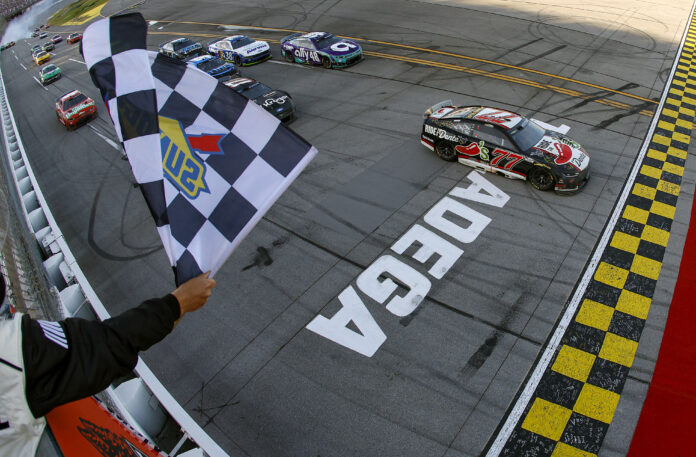
TALLADEGA, ALABAMA - APRIL 26: Carson Hocevar, driver of the #77 Chili's Ride the 'Dente Chevrolet, takes the checkered flag to win the NASCAR Cup Series Jack Link's 500 at Talladega Superspeedway on April 26, 2026 in Talladega, Alabama. (Photo by Sean Gardner/Getty Images)
Connor Zilisch, who pilots the No. 88 Trackhouse Racing Chevrolet entry, was looking to have a solid result in his NASCAR Cup Series debut on Sunday.
The 2.66-mile Talladega Superspeedway has not been kind to Zilisch in the past when racing in the NASCAR Craftsman Truck Series and the NASCAR O’Reilly Auto Parts Series.
In his first start at the track, which came in the fall of 2024, for Spire Motorsports. Zilisch started 12th but finished in the 33rd position due to a crash.
Just a few months later, in the O’Reilly Series Spring race, Zilisch qualified in the 13th position and was up front at times while leading nine laps.
With two laps remaining in the spring event, an incident involving Jesse Love sent Zilisch spinning into a wreck. He then hit the backstretch wall, resulting in a DNF and a 27th-place finish.
The same was true of the fall race. Zilisch started seventh but had a disappointing finish of 23rd, three laps down.
Fast forwarding to 2026, when Zilisch was making his first Talladega Cup Series start, the 19-year-old had hopes of a positive result. This was especially true after finishing 29th, two laps down, following handling issues the week before at Kansas Speedway.
“It’s still going to be a lot of fuel saving, but I think the last 45 laps will be better,” Zilisch said in a team release on race week. “Track position is huge with the Next Gen car. You’ve got to do everything you can to put yourself in position at the end.
“Nobody’s down on themselves. We’re hungry. I want to be part of our return to success, and that challenge excites me.”
Rain showers canceled the Cup Series qualifying session this weekend. Zilisch started in the 26th position based on the qualifying metric.
When the race went green for the 188-lap event, Zilisch maintained track position as he was saving fuel and finished 22nd in the first stage, despite getting into the top-10 at one point, but was then shuffled out. In the second stage, the Trackhouse driver was caught up in “The Big One” on Lap 115, going into Turn 3. Zilisch was on the bottom lane and had nowhere to go. After being collected in the accident, he received damage to his No. 88 Red Bull Chevrolet. As Stage 2 concluded, he finished 27th in the running order.
For the remainder of the race, Zilisch stayed out of the way to gain experience on the drafting track. The race leaders took the checkered flag on Lap 188. Zilisch finished 26th in the running order, three laps down in his Cup Series debut.
“Unfortunately for us that’s typical Talladega where you get caught up in the Big One,” Zilisch said. “I had nowhere to go. I really thought the damage was worse, but the Trackhouse guys did a great job to get our Red Bull Chevrolet back in the race. Not the day we wanted for sure, but we’ll bounce back next week at Texas.”
Additionally, Spire Motorsports announced this past week that Zilisch will compete in the Truck Series race at Watkins Glen. This will mark the second consecutive time in two years that he will race at The Glen in a truck. Last year, Zilisch raced in the No. 45 Niece Motorsports entry, starting in 14th and finishing eighth in the Top 10.
Excited for another attempt at the triple at Watkins Glen this year! Hopefully I can make it to Sunday healthy this time around😂 https://t.co/VQfrDWZcC0
WELCOME, N.C. (April 27, 2026) – Richard Childress Racing (RCR) announced today a leadership adjustment within its NASCAR Cup Series program, reinforcing the organization’s continued focus on improving on-track performance and delivering stronger, more consistent results.
Andy Street will assume crew chief responsibilities for the No. 8 Chevrolet, working alongside driver Kyle Busch for the remainder of the 2026 season. Jim Pohlman will transition into a leadership role within RCR’s competition department.
“This move is about putting our people in the best position to succeed,” said Richard Childress, Chairman and CEO of RCR. “We have strong talent across this organization, and we’re focused on having each person in the right position to help deliver the results we expect.”
The adjustment reflects RCR’s broader commitment to returning to consistent, front-running form on a weekly basis.
“We strongly believe in the people we have,” said Mike Verlander, President of RCR. “At the same time, we expect better results, and that requires us to continually evaluate and make adjustments. Jim has more than two decades of success in this sport and will remain an important part of our team. We believe Andy and Kyle’s previous working relationship positions us to improve the No. 8 team and compete at a higher level.”
Street, who has served as Performance Director in 2026, brings more than 20 years of experience with RCR across multiple roles, including as a race-winning crew chief. He will begin leading the No. 8 team immediately.
Richard Childress Racing (www.rcrracing.com) is a renowned, performance-driven racing, marketing and manufacturing organization. Incorporated in 1969, RCR has celebrated over 50 years of racing and earned more than 200 victories and 17 championships, including six in the NASCAR Cup Series with the legendary Dale Earnhardt. RCR was the first organization to win championships in the NASCAR Cup Series, NASCAR O’Reilly Auto Parts Series and NASCAR Truck Series and is a three-time winner of the Daytona 500 (1998, 2007, 2018). Its 2026 NASCAR Cup Series lineup includes two-time NASCAR Cup Series champion Kyle Busch (No. 8 Chevrolet) and 2017 Coca-Cola 600 winner and 2018 Daytona 500 champion Austin Dillon (No. 3 Chevrolet). RCR fields a full-time NASCAR O’Reilly Auto Parts Series program with defending series champion Jesse Love (No. 2 Chevrolet) and 2023 regular season champion Austin Hill (No. 21 Chevrolet).
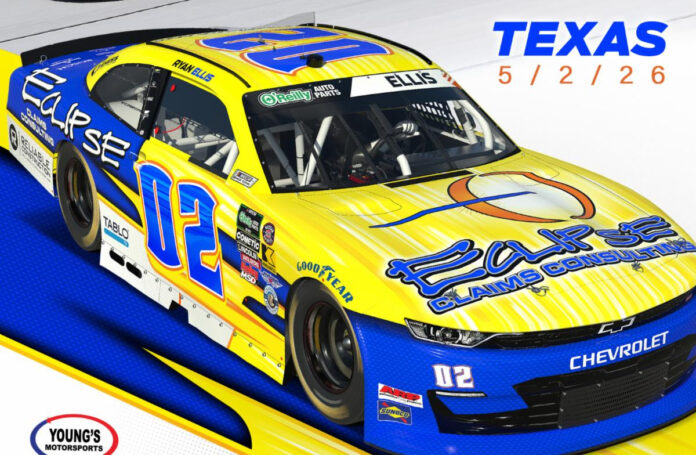
MOORESVILLE, N.C.: There’s an old saying that everything is bigger in Texas — and for Ryan Ellis, that includes the strength of a long-standing partnership.
As the NASCAR O’Reilly Auto Parts Series heads to Texas Motor Speedway for Saturday afternoon’s Andy’s Frozen Custard 340, Ellis will showcase a familiar name on his No. 02 Young’s Motorsports Chevrolet — one that has become a cornerstone of his program.
Texas-based Eclipse Claims Consulting returns to support Ellis for the fourth consecutive season, continuing a partnership built on consistency, shared momentum and most of all, friendship.
Headquartered in Frisco, Texas, Eclipse Claims Consulting is a trusted authority in insurance claim advocacy and appraisals.
Known as a national leader in insurance adjustments, the company specializes in property damage, including natural disasters such as flood, hail, tornado, hurricane, wildfire and earthquake damage.
With a mission centered on securing fair and timely settlements, Eclipse Claims Consulting has helped clients nationwide recover millions of dollars after property losses caused by storms, fires, water damage, and other disasters.
The company has built its reputation as a go-to advocate for policyholders facing complex insurance claims.
Whether assisting homeowners after a hurricane or guiding a business through fire damage recovery, Eclipse Claims Consulting remains a trusted partner at every step of the insurance claim process.
For Ellis, the continued support from Eclipse Claims Consulting carries added significance in 2026 as he begins a new chapter with Young’s Motorsports.
In a season defined by change, the presence of a trusted, long-term partner provides valuable continuity and confidence, allowing the veteran driver to remain focused on performance while building chemistry within a new organization.
“We’ve built something really special with Eclipse Claims Consulting over the last four years,” said Ellis. “It’s more than just a partnership at this point — it’s a friendship.
“That kind of loyalty means everything in this sport, and having them by my side as I start a new chapter with Young’s Motorsports gives me a lot of confidence every time we hit the track.”
Ellis, a native of Ashburn, Va., will make his ninth NASCAR O’Reilly Auto Parts Series start at Texas Motor Speedway on May 2.
The 1.5-mile speedway is one of the few venues where he has competed across all three of NASCAR’s national series.
In his previous eight series starts, Ellis has recorded a track-best finish of 13th in the fall 2023 edition of the Andy’s Frozen Custard 300.
On Saturday, he will make his fifth consecutive start at Texas Motor Speedway — and his third straight appearance carrying the Eclipse Claims Consulting colors.
“It’s always special racing at Texas Motor Speedway, but it means even more when you’re representing a Texas-based partner like Eclipse Claims Consulting,” added Ellis. “It’s their home race, and you want to do everything you can to represent them well and give them something to be proud of.”
It’s also a special race for Young’s Motorsports. Founded in Midland, Texas, the event at Texas Motor Speedway serves as the organization’s hometown race, making it even more meaningful to represent a Texas-based partner in Eclipse Claims Consulting.
Now operating from a well-equipped facility in Mooresville, N.C., Young’s Motorsports team principal Tyler Young welcomes Eclipse Claims Consulting to the organization as a valued partner.
“We’re proud to welcome Eclipse Claims Consulting to Young’s Motorsports as a valued partner,” said Young, who made 12 NASCAR CRAFTSMAN Truck Series starts at Texas Motor Speedway, including a top-10 finish in 2018.
“Their Texas roots align perfectly with this event, and to have them on board for our home race makes this weekend even more meaningful for our team.”
For more on Ryan Ellis, please visit ryanellisracing.com, like him on Facebook
(Ryan Ellis), and follow him on Instagram (@ryanellisracing), TikTok (@ryanellisracing), and X | Twitter (@ryanellisracing).
For more on Young’s Motorsports, please visit YoungsMotorsports.com, like them on Facebook (Young’s Motorsports), and follow them on Instagram (@youngsmotorsports) and X |Twitter (@youngsmtrsports).
The Andy’s Frozen Custard 340 (200 laps | 300 miles) is the 12th of thirty-three (33) NASCAR O’Reilly Auto Parts Series races on the 2026 schedule. Practice will occur on Fri., May 1, 2026, from 4:00 p.m. to 4:50 p.m. Qualifying will immediately follow, beginning at 5:05 p.m. The field will take the green flag the next afternoon, shortly after 2:30 p.m. (3:30 p.m. ET), with live coverage on The CW Network, the Performance Racing Network (Radio) and SiriusXM NASCAR Channel 90. All times are local (CT).
About Eclipse Claims Consulting:
Eclipse Claims Consulting is a leading public insurance adjusting firm dedicated to securing fair settlements for policyholders and businesses.
With a proven track record of recovering millions of dollars for their clients, Eclipse Claim Consulting is at the forefront of advocating for those who have been underserved by insurance companies.
Event: Jack Link’s 500 Location: Talladega Superspeedway, Talladega, Alabama Date: Sunday, April 26, 2026 Start: 26th Finish: 33rd
The stage lengths may have changed for Sunday’s Jack Link’s 500 at Talladega Superspeedway, but the “Big One” remained as impactful as ever.
That was the case for Josh Berry and the No. 21 Motorcraft/Quick Lane team, who were collected in a Lap 115 incident that resulted in a 33rd-place finish despite showing early speed and executing a solid opening strategy.
Berry rolled off 26th after Saturday’s qualifying session was canceled due to rain, with the starting lineup set by the NASCAR Rule Book. The Wood Brothers Racing team opted for a one-stop strategy in Stage 1, which was extended to 98 laps, and it paid off with a sixth-place finish and five valuable stage points.
Following a pit stop under caution, Berry restarted 12th to begin Stage 2 and was running inside the top 10 when the 26-car “Big One” broke out ahead of him. With nowhere to go, the No. 21 Ford Mustang Dark Horse sustained heavy damage, forcing the team to the garage for extensive repairs.
After returning to the track later in the event, Berry was able to pick up several positions, ultimately gaining five spots from his running position prior to the incident to finish 33rd.
Up next, Berry and the Wood Brothers head to Texas Motor Speedway for Sunday’s Würth 400, looking to rebound after a day that showed promise before being cut short.
AUSTIN CINDRIC No. 2 MENARDS/FROGTAPE FORD MUSTANG DARK HORSE START: 13TH STAGE 1: 35TH STAGE 2: 21ST FINISH: 8TH POINTS: 16TH RACE RUNDOWN: Austin Cindric finished eighth in Sunday’s Jack Link’s 500 at Talladega Superspeedway after a challenging and eventful afternoon for the No. 2 Ford Mustang Dark Horse team. Cindric started 13th after Saturday’s qualifying session was canceled due to weather, with the lineup set per the NASCAR Rule Book. Early in the race, he worked the draft from the bottom lane before moving to the middle lane, reporting the car was “a little darty, a little free” in the opening run. As the field settled into single-file around Lap 30, Cindric was scored 28th but methodically worked his way forward, reaching fourth by Lap 42. A setback came during the first green-flag pit cycle when Cindric missed his pit stall after getting stacked three-wide on entry, forcing him to circle back down pit road for service. The issue cost valuable track position, and he was scored 35th late in Stage 1. After a green-flag stop for fuel on Lap 81, he returned to the track alone without any drafting help and ultimately finished Stage 1 in 35th, one lap down. The race took another turn early in Stage 2 when Cindric was collected in a multi-car incident on Lap 115. The No. 2 team made multiple trips to pit road to assess and repair damage. Cindric returned to the track 24th with just over 65 laps remaining and continued to battle for position. Following a caution on Lap 124, Cindric pitted for fuel and by the end of Stage 2, he was scored 21st and earned the free pass to return to the lead lap, reporting no balance concerns heading into the final stage. Restarting 17th, Cindric navigated the closing laps in the lead draft as the field ran in two lanes. A late caution with seven laps to go set up a final sprint to the finish, with the No. 2 team opting to stay out and maintain track position. Cindric restarted just outside the top 10 with three laps remaining and avoided trouble in a chaotic final lap to secure an eighth-place finish.
CINDRIC’S THOUGHTS: “Obviously, I didn’t get a chance to be part of those last two cycles of that first stage. We got trapped with the 34 car to our inside and missed on that execution and it took us about all the way up to the third stage to get back on the lead lap. I’m not sure I’m the best judge of how things went to be honest. The end of the race I would say played out a similar way to what we thought as far as racing in the lanes and the aggression for sure. We can’t run that many laps without wrecking each other on these. I wish we would have had a gauge of our speed or really anything from today, so other than a good points finish, and we need one of those, especially on tracks like this, so we’ll take that and keep going on.”
RYAN BLANEY No. 12 WURTH FORD MUSTANG DARK HORSE START: 15TH STAGE 1: 5TH STAGE 2: 37TH FINISH: 37TH POINTS: 3RD RACE RUNDOWN: Ryan Blaney and the No. 12 Wurth Ford Mustang Dark Horse team began the afternoon on a high note with a fifth-place finish in Stage 1 but were collected in a 26-car incident during the opening run of the second stage, resulting in a 37th-place finish at Talladega. After qualifying was rained out Saturday, Blaney took the green flag from 15th as the field formed three-wide to start the 98-lap stage. With varying fuel strategies in play, the pack began to run single-file by lap 25 before Blaney was called to pit road on lap 47 with the third group of cars as the 12 team serviced the Wurth Ford with four tires and fuel. Blaney went back into fuel save mode to begin the following run along with the group of cars he pitted with, allowing them to become the lead pack with 10 laps remaining in Stage 1. The pace started to pick up with under five laps to go as Blaney worked the top lane to enter the top-five as the 12 team was able to pull off a 50-lap run on fuel to pick up a fifth-place finish in the longest stage of the day. Following another four tire stop prior to the start of Stage 2, Blaney restarted from the outside of row three and eventually pushed teammate Joey Logano to the lead on lap 110, vaulting the No. 12 to second in the running order in the process. A three-wide battle for the top spot shuffled the leaders a few laps later before a spin at the front of the field at the entrance of turn three set off a 26-car pileup as Blaney was hit in the right rear and sent sliding into the outside wall. The 12 team attempted to make repairs in the garage area but was unable to return to the track, culminating in a 37th-place finish.
BLANEY’S THOUGHTS: “I feel like we all just got pinballing off each other there. [Ross Chastain] got up in front of me. I was coming, so I’m kind of checking and trying to get on him OK, and it looked like [Bubba Wallace] got up in front of him while we were coming, and then we all just kind of got nose bumper tag there. You’re trying to lift and stabilize it and [Wallace] ended up getting turned in front of everybody and causing a big wreck. It’s not like there’s any blame on anybody. It’s what this thing is. We all just kind of get bumping and banging and one guy eventually gets turned with the car being as unstable as it is. It definitely stinks to be out early.”
JOEY LOGANO No. 22 SHELL-PENNZOIL FORD MUSTANG DARK HORSE START: 25TH STAGE 1: 3RD STAGE 2: 39TH FINISH: 39TH POINTS: 15TH RACE RUNDOWN: Joey Logano and the No. 22 Shell-Pennzoil Ford Mustang Dark Horse team got off to a strong start Sunday at Talladega with a third-place finish in Stage 1, but were involved in a 26-car incident during the opening laps of the second segment that signaled the end of their day in a 39th-place finish. With qualifying rained out Saturday and the lineup set per the rule book, Logano took the green flag from 25th as the field formed three-wide to start the longest stage of the day at 98 laps. Varying fuel strategies began to take shape within the first 30 laps as different packs formed single-file throughout the field, prompting Logano to hit pit road with the third and final group under green on lap 47 for four tires and fuel. Logano and the rest of the group immediately went back saving fuel in an attempt to make it to the end of the stage without pitting a second time, allowing them to become the lead pack with 10 laps remaining in Stage 1. As the pace began to increase in the closing laps of the segment, Logano remained in the bottom lane and forced a three-wide battle in the tri-oval for the stage win, but came up just short in a third-place effort with the 22 team successfully executed a 50-lap run on fuel. After another four tire stop between stages, Logano lined up to restart from the outside of row two and was pushed to the lead by teammate Ryan Blaney on lap 110, marking the 21st-consecutive race he has led on a drafting track and 14th time in the last 15 Talladega races he has led at least one lap. A few laps later, Logano relinqished the lead after getting split into the middle lane out of turn four before the big one unraveled on the following lap – a 26-car pileup that started at the front of the field going into turn three that collected the Shell-Pennzoil Ford Mustang. Logano was unable to make it back to pit road due to the damage sustained, marking an early exit Sunday.
LOGANO’S THOUGHTS: “They just started wrecking above me. You’re kind of seeing it happen and hope they stay up there and you’re able to get by it. The wreck started moving down the hill and there we were. It’s just unfortunate. The team did a good job getting our Ford Mustang able to get some stage points there, which that’s the only positive of today.”
The NASCAR Cup Series heads to Texas Motor Speedway for the Wurth 400 on Sunday, May 3. Live coverage begins at 3:30 p.m. ET on FS1, PRN and SiriusXM NASCAR Radio Channel 90.
RFK RACING TALLADEGA SUPERSPEEDWAY – EXECUTIVE SUMMARY Date: April 26, 2026 Series: NASCAR Cup Series Location: Talladega Superspeedway (2.66-mile oval) – Lincoln, AL Format: 500 miles, broken into three stages (completed at lap 98 / lap 143 / lap 188) ***Note: Qualifying was cancelled due to weather. Starting order was established by the rule book.
Roush Fenway Keselowski (RFK) Racing showcased race winning speed Sunday at Talladega Superspeedway, leading a combined 43 laps, with all three cars running up front and remaining a constant presence in the lead pack. Ryan Preece set the tone early with a Stage One victory as RFK Racing ran an impressive 1-2-4 at the first break. Chris Buescher stayed among the leaders all day, making aggressive, timely moves to nearly claim victory. Brad Keselowski showed early strength with a second place Stage One finish, before sustaining damage in an unavoidable Stage Two crash.
DRIVER HIGHLIGHTS
Chris Buescher – No. 17 Kroger / Jack Link’s Ford Mustang Dark Horse
Finish: 2nd Start: 10th Laps Led: 22 Stage Results: S1 – 4th, S2 – 3rd Headline takeaway: An incredibly strong race, finishing among the leaders in every stage of the event. In a four lap shootout to finish the race he battled to the checkers coming up just short of the victory, with a close runner up finish.
Buescher Quote: “We were pretty good. To have the day like we had today here and be in the hunt every stage and there at the end, I can’t thank everybody enough at Kroger and Jack Link’s and being here for their entitlement sponsor. This was a big race for us and we just couldn’t quite get this Mustang into Victory Lane. We came off turn four and I felt really good about where we were at and the run that we were gonna be able to build. Stenhouse went to make a race winning move and if we would have got clear of the 77, he would have gone for it and it may have been our drag race to the end. I don’t know, but it was a good race. It was good, strong racing all the way there to the end.”
Ryan Preece – No. 60 BuildSubmarines.com Ford Mustang Dark Horse
Finish: 18 Start: 11th Laps Led: 21 Stage Results: S1 – Winner, S2 – 6th Headline takeaway: Bouyed by a stellar run in Stage One, where he was the winner of the segment, Preece proved to have a winning race car throughout the race. He collected stage points in each of the first two stages and, although he was caught up in a last lap crash coming to the checkers, had one of the best cars in the field Sunday
Preece Quote: “Man, so close. We had a rocket ship of a Ford Mustang. Led a bunch of laps and could move around and draft to the front at will. After winning stage one, we were pumped. Our confidence was sky high. So, with the checkers in sight on the final lap we thought there was a chance at the win. I’m not sure what happened with the crash but I’m leaving with my head high, knowing we had a race winning car.
Brad Keselowski – No. 6 Castrol Ford Mustang Dark Horse
Finish: 31st Start: 6th Laps Led: 0 Stage Results: S1-2nd, S2 – 33rd Headline takeaway: After a runner up Stage One finish, Brad Keselowski appeared poised for another strong Talladega run. However, while he raced inside the top ten, he was collected in a Stage Two crash. The team worked to repair extensive damage, eventually getting him back on the track to finish the race.
Keselowski Quote: “We got caught up in the big one and the team rallied really well to keep us from a DNF and get us as many points as we could.”
Point Standings:
Buescher: 7th Keselowski: 10th Preece: 13th
Next Up:
The next event on the NASCAR Cup Series schedule is Sunday, May 30 at the Texas Motor Speedway (Fort Worth, TX). The race begins at 3:30 p.m. EDT with live coverage provided by FS1 and the Performance Racing Network.
Before a US brand commits a single dollar to motorsport sponsorship, the most valuable investment it can make is in the right guidance. To hire a sports marketing consultant for motorsports sponsorship means gaining independent expertise in series selection, property evaluation, deal negotiation, activation planning, and ROI measurement, all simultaneously.
This guide explains exactly what a motorsport sponsorship consultant does, what goes wrong when brands enter motorsport without one, and why independence is the single most important quality to look for in the consultant you choose.
What is a Motorsport Sponsorship Consultant and Why Do They Matter?
A motorsport sponsorship consultant is an intermediary professional or agency that fills the gap between corporate brands and the racing ecosystem. They act as a sieve to the dozens of sponsorship decks that fall upon the desk of a CMO to ensure that each opportunity has a real commercial basis.
In a market where North America holds a 38.89% share of the motorsports sponsorship market (IndustryARC, 2025), a consultant is vital for “translation.” They can translate technical jargon in the team into the business KPIs of a brand. Whether you are looking for F1 sponsorship consultant USA services or a broader global strategy, these experts ensure your brand values align with the series’ demographics.
Key Benefits of Hiring a Sports Marketing Consultant for Brands
When a firm opts to seek the services of a sports marketing consultant regarding sponsorship, it is not just purchasing consultancy, but they are buying a competitive edge. The advantages of a sports marketing consultant go way beyond a first introduction to a team.
Lower Rights Fees: Consultants use proprietary data to know what a “fair market price” actually looks like, often saving brands 15–20% on the initial contract.
Asset Optimization: They make sure you receive the correct assets such as the appearances of the driver, digital content rights, and VIP hospitality instead of a sticker on the wing.
Risk Minimization: A motorsport brand partnership consultant establishes performance clauses in contracts, which safeguard your brand in the event of a significant decline in performance by a team or a star driver quitting.
Activation Excellence: They handle the sponsorship consulting needed to transform a livery into a complete social media and B2B lead-generation machine.
DIY vs. Consultant-Led Motorsport Sponsorship: A Direct Comparison
Significantly reduced through continuous performance management
Category exclusivity risk
Frequently underprotected
Fully assessed and contractually secured
Sources: Sport Dimensions Motorsports Marketing Guide; Forrester CMO Survey 2024; rtrsports.com motorsport sponsorship guides; SponsorUnited F1 Report 2024–2025
8 Reasons To Hire As A Sports Marketing Consultant For Motorsport Sponsorship. All of them are functions that a specialist motorsport brand partnership consultancy manages, and team-side commercial staff cannot or will not take on a brand’s behalf.
1. Independent Series Selection Based on Audience Data
When selecting the series F1, MotoGP, Formula E, WEC, WorldSBK, NASCAR, or IndyCar, validated demographics about the audience must be collected along with competitive category mapping, geographic market analysis, and brand objective alignment.
This decision is far too often made solely based on personal preference or sales pitches from individual series commercial teams, which are not objective, with neither team providing an objective assessment.
2. Optimization of Property types by Team, Driver and Series
As we’ve seen with the motorsport sponsorship landscape, each type of property presents a unique commercial proposition. A team sponsorship, a driver’s personal deal, and a series partnership do not meet the same objectives at different cost points. A consultant looks at all three in a run and suggests the combination that aligns best with the brand’s objectives, rather than the easiest one to sell.
3. Pre-Deal Intelligence on Inventory:
Top-tier series are the highest quality sponsorship positions and are claimed prior to any sort of open market. There is a dedicated consultant who knows all the category exclusivities in place, which teams are actively looking for partners in specific sectors, and which inventory windows are opening thanks to renewals, team transitions, and driver changes.
So when starting on a motorsport sponsorship project, it’s hard to know instantly which stakeholders are right, what the decision flow is, and what the right timelines are for each process. Consultants remove this ambiguity.
4. Contract Negotiation Without Conflict of Interest
The motorsport sponsorship contract negotiation process is a challenging and extremely complex one. Negotiating the right definitions of assets, definitions of category exclusivity, performance-linked clauses, activation rights, exit provisions, and IP licensing has to be detailed. A consultant negotiates these terms in the interests of the brand not in the interests of the rights holder who sits on the other side of the table.
5. Activation Framework Planning From Day One
Sponsorship programmes that do not spend an activation budget usually go stale within two to three seasons, no matter the quality of the livery position that is offered. A consultant constructs the activation architecture content calendar, hospitality programme, social media strategy, and B2B pipeline integration before the deal is signed, rather than as an afterthought after the rights fee has been paid. The benchmark for the industry is $2 in activation per $1 spent on sponsorship rights. Brands that turn that ratio around underperform consistently. This balance is enforced by a consultant from the beginning.
6. Independent ROI Measurement From Pre-Season Baseline
Teams cannot determine the impact of sponsorship ROI without pre-season baseline data on brand awareness, consideration and purchase intent of the target audience. Without a baseline data set, created before the very first race of the season, the extent to which the measurement of those statistics changes, however, cannot be attributed to the sponsorship investment. When a racing sponsorship strategy consultant introduces this framework into the engagement from day one, in spite of everything that might happen at a retrospective date if it was not made on year-end.
7. Multi-Series Portfolio Management
Brands with sponsorships with more than one series F1 and MotoGP or WEC and Formula E need to have a centralized point of co-ordination to oversee calendar conflicts, rights negotiations, activation and resource allocation, and cross-series measurement consolidation. And so, without dedicated oversight, that multi-series portfolio is likely to be fragmented and underachieving in terms of potential as a result of multi-series combined assets.
8. Renewal and Renegotiation Leverage
A consultant who has handled the sponsorship from the beginning owns the independent performance data, market rate benchmarks and activation outcome evidence, all of which inform the renewal debate from a perspective based on the objective leverage. However, brands without this documentation continue (or drop out) under the conditions of the rights holder’s own performance reports, which may be structurally biased toward continued renewals at existing rates.
Hiring the Right Motorsport Sponsorship Consultant Determines What Your Investment Delivers
The decision to hire a sports marketing consultant for sponsorship in motorsport is not a cost centre; it is the structural factor that determines whether a significant marketing investment performs as intended.
From Formula 1 to MotoGP, Formula E, WEC, and WorldSBK, the complexity of global motorsport’s commercial environment is real.
Series selection, property type strategy, contract negotiation, activation planning, and independent ROI measurement are all specialist functions that require specific, current, motorsport-focused expertise.
A specialist motorsport sponsorship consultant who operates independently across all major racing series gives US brands the market intelligence, relationship access, and commercial protection that transforms motorsport from an expensive experiment into a durable competitive advantage.