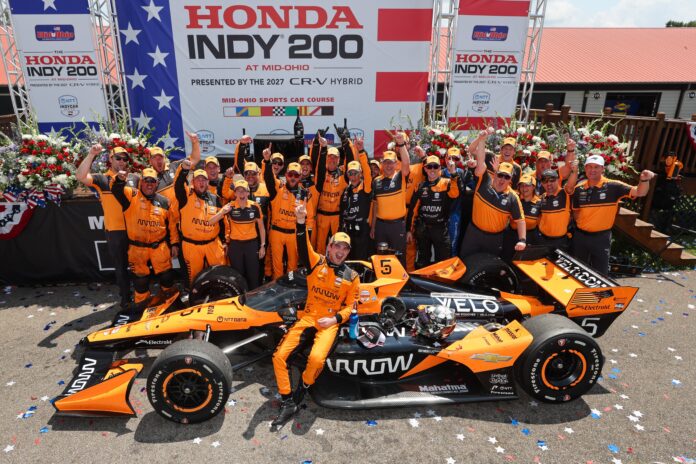
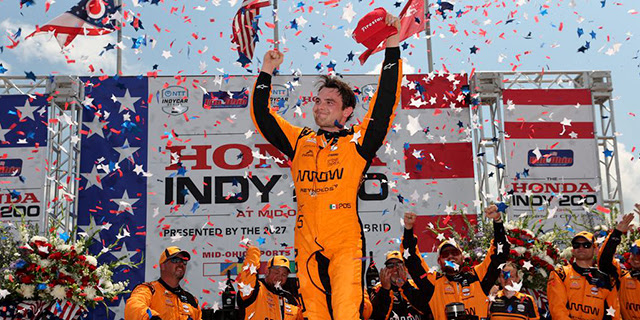
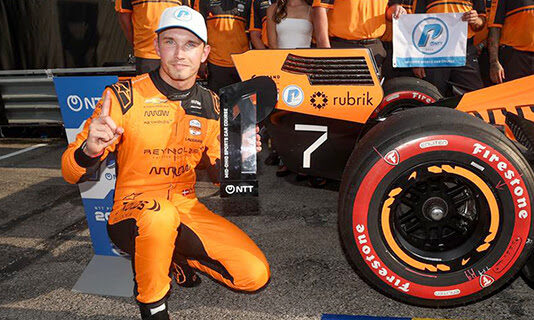
LEXINGTON, Ohio - JULY 5: Pato O'Ward, driver of the #5 Arrow McLaren Chevrolet, celebrates victory in the NTT IndyCar Series Honda Indy 200 at the Mid-Ohio Sports Car Course on July 5, 2026, in Lexington, Ohio. Photo: Chris Owens/Penske Entertainment
Pato O’Ward won’t go without a podium in 2026. In fact, he won’t go winless either.
The driver of the No. 5 Arrow McLaren Chevrolet passed his teammate, Christian Lundgaard, on Lap 42 of the Honda Indy 200 and held off a late charge by Lundgaard to score the victory at the Mid-Ohio Sports Car Course.
“It’s great that the first podium of the year for me is a win,” O’Ward said. “We’ve had performances, and I think today was a textbook showing of execution. I want to give it to my guys in the pits; they were phenomenal. I know they’ve been working so hard because this year that has been a bit of a challenge, and I know they’re working so hard to give me the pit stops that they gave me today. I know they’ve been working hard for that.
“I really want to recognize that because they make or break my race. They truly allowed me to fight my way and keep my position today as we were fighting on track.
“Obviously the cars have been strong all weekend. It’s been a very strong weekend for all three cars. It was a matter of being perfect.”
It’s his 10th career victory in his 109th career NTT INDYCAR SERIES start.
Pole sitter Lundgaard, who’s gone from a sure fire guarantee to return to the seat of the No. 7 Chevrolet to doubtful, gave Arrow McLaren its first one-two finish in INDYCAR with a runner-up.
“Yeah, very long day, very tough day,” Lundgaard said. “Obviously very tough physically out there with the heat, but also just an all-green race. It didn’t really help that we were quite loose. We kind of went into the race knowing that — or thinking the balance was going to go towards understeer, and I don’t think that was the case as much. I think we kind of overreacted and made the car a lot harder to drive.
“Very, very difficult, but at the end of the day, it doesn’t matter how difficult the car is to drive. I still think we sort of maximized today, which is always nice.”
Kyle Kirkwood rounded out the podium.
“Yeah, that was one of the most physical days I’ve ever had in a race car,” Kirkwood said. “I’m cooked right now. Running all green around here with it being hot and this place is just so busy as it is, and it’s qualifying laps every single lap. My shoulders are shot. That’s why I’m leaning over. Will I’m definitely hydrated, just cooked.
“We drove from 10th to third. A lot of it was strategy and pit stops. We had a lot of good strategy that put us in a podium position there, and we also passed some cars in the beginning of the race, so a little bit of both.
“A really good day overall. It wasn’t where we were meant to qualify. We should have qualified towards the front, I think. I guess I’m glad that we were able to get us back towards the front in the race.”
Rinus VeeKay and Alex Palou rounded out the top-five.
Will Power, Christian Rasmussen, David Malukas, Josef Newgarden and Nolan Siegel rounded out the top-10.
Pato O’Ward erases goose egg season with win at Mid-Ohio
Race summary
Lundgaard led the field to green at 12:53 p.m. ET. The field settled into a green flag rhythm. Scott Dixon broke this up when he kicked off a cycle of green flag stops on Lap 7 (for those drivers running a three-stop strategy). This primarily consisted of cars that started the race on soft tires. By Lap 17, all but 11 cars made their first stop. The first of these cars on the two-stop plan pitted on Lap 25. Lundgaard pitted from the lead on Lap 27, but exited pit lane maintaining the lead.
Given where everybody pitted, that threw a two-stop plan out the window.
Mick Schumacher and Sting Ray Robb kickstarted the second round of stops on Lap 35. During this cycle, Lundgaard got off line in the keyhole and O’Ward pulled to his outside on Lap 42. Down the backstretch, they raced side-by-side. O’Ward completed the overtake in Turn 5 for the race lead. He pitted from the lead on Lap 48 and exited ahead of Lundgaard. Newgarden pitted from the lead on Lap 50 and O’Ward cycled back to the lead.
With 33 laps to go, O’Ward led Lundgaard by less than a second. With both of them on soft tires and dealing with lap traffic, third-place VeeKay, on hard tires, cut the gap from two seconds to 1.5 seconds by Lap 60. By Lap 63, O’Ward cleared Dennis Hauger in the keyhole. He stayed on track, while Lundgaard, VeeKay and Kirkwood pitted. Lundgaard exited ahead of both drivers, but Kirkwood exited ahead of VeeKay. O’Ward pitted from the lead on Lap 65 and cycled out roughly four seconds ahead of Lundgaard. Palou pitted from the lead with 25 laps to go. Power pitted from the lead with 24 to go and O’Ward cycled back to the head of the field.
With 18 laps to go, Lundgaard cut the lead to O’Ward from four seconds to 2.5 seconds. With 15 to go, the gap shrank to 2.1 seconds. With 13 to go, it dipped under two seconds. With 10 to go, Lundgaard pulled to within 1.4 seconds of O’Ward. With nine to go, O’Ward caught the tail-end of the field and lost time in his lead to Lundgaard. With four to go, however, the gap stabilized around 1.3 seconds and O’Ward drove on to victory.
Pato O’Ward erases goose egg season with win at Mid-Ohio
What else happened
Alexander Rossi and Dixon made contact on Lap 38. Rossi received a two-spot penalty for avoidable contact.
Pato O’Ward erases goose egg season with win at Mid-Ohio
Nuts and bolts
The race lasted one hour, 43 minutes and 23 seconds, at an average speed of 117.932 mph. There were five lead changes among four different drivers and zero cautions.
Palou leaves Mid-Ohio with a 56-point lead over Kirkwood.
The NTT IndyCar Series returns to action July 19, in the Borchetta Bourbon Music City Grand Prix at Nashville Superspeedway.
LEXINGTON, Ohio (Sunday, July 5, 2026) – Same papaya, different day. Different driver, too.
That was Arrow McLaren’s swap at the Mid-Ohio Sports Car Course where Pato O’Ward – and not polesitter Christian Lundgaard – won The Honda Indy 200 Presented by the 2027 CR-V Hybrid, the 11th race of the NTT INDYCAR SERIES season.
Lundgaard and O’Ward had started the 90-lap race together on the front row, and they effectively held their positions throughout a caution-free race except when they pitted. But on Lap 42, O’Ward capitalized on the polesitter’s wide exit off Turn 2, swiping the lead and holding it the rest of the way.
The win was the first for O’Ward in nearly a year since he won last season’s Toronto street race. That was 15 races ago, a drought he couldn’t accept, especially as Lundgaard has won two races this year, including the most recent race at Road America.
The win also gave Arrow McLaren its first 1-2 finish in this series.
O’Ward hadn’t even scored a top-three finish this season despite being fifth in the standings. His best runs had been three fourth-place finishes and three fifth-place finishes.
“It’s been a year, it’s been a tough one for sure,” the Mexican driver said. “I think today is just a perfect example of execution. I waited for the perfect time pounce and from there we just controlled it.”
O’Ward’s pass of Lundgaard was noteworthy for a couple reasons, not the least of which stemming from what happens at year’s end. They are in their second season as teammates, but all signs point to Lundgaard driving elsewhere next year as Scott Dixon and Felix Rosenqvist join O’Ward on the team.
That situation made O’Ward’s pouncing opportunity all the more interesting.
Lundgaard drifted a bit wide on the exit of Turn 2, allowing O’Ward to size him up and get a better run down the long straightaway that serves as the race’s starting point. By the time they arrived at the tricky, right-turning fourth corner, the cars were side by side, O’Ward on the outside. They touched at least twice at corner exit, and O’Ward had the preferred line into Turn 5 – and he used it.
By the time the Arrow McLaren twosome charged into Thunder Valley, O’Ward had the lead. Later, he used a key pass of series rookie Dennis Hauger to create additional separation leading into the final pit stop. O’Ward stayed out as Lundgaard, along with two other challengers pitted, and he then ran two laps longer to pad his lead.
O’Ward’s winning margin was .9877 of a second, earning his second Mid-Ohio victory in the past three years. This win was the 10th of his career, almost divided equally by circuit (four on ovals, three on street circuits, three on road courses).
Lundgaard’s second-place finish continued his strong season on road courses. In addition to winning races at Indianapolis Motor Speedway and Road America, he also finished second at Barber Motorsports Park. With Chip Ganassi Racing’s Alex Palou finishing fifth, Lundgaard drew within 65 points of the series leader.
Andretti Global’s Kyle Kirkwood finished third, getting a few points closer to Palou. Their separation is now 56 points, and Kirkwood overtook Team Penske’s David Malukas, who finished eighth, for second place in the standings. Lundgaard also jumped Malukas with O’Ward fifth. The top four drivers are separated by 66 points with seven races remaining, led by the July 19 Borchetta Bourbon Music City Grand Prix presented by OnlyBulls at Nashville Superspeedway.
VeeKay scored his second fourth-place finish in the past three races following another such finish last month at World Wide Technology Raceway.
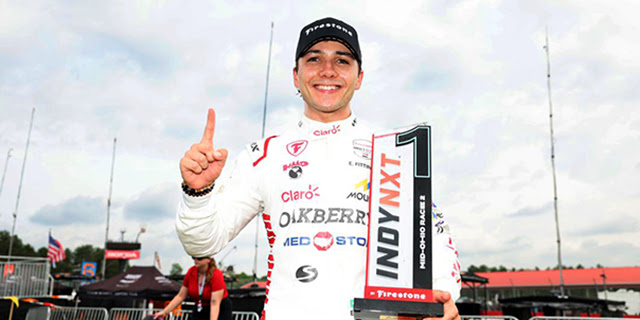
LEXINGTON, Ohio (Sunday, July 5, 2026) – Enzo Fittipaldi completed a flawless weekend at the Mid-Ohio Sports Car Course, leading every lap for the second straight race to sweep the INDY NXT by Firestone doubleheader.
Fittipaldi crossed the finish line 12.7469 seconds ahead of HMD Motorsports teammate Jack Beeton to earn his fourth career series victory and second in as many days. Fittipaldi’s victory margin was the second largest in INDY NXT history at Mid-Ohio, trailing only Jack Harvey’s 17.3403-second victory in Race 1 of the 2014 doubleheader.
Driving the No. 67 HMD Motorsports entry, Fittipaldi was untouchable all weekend. The grandson of two-time Formula One World Champion, two-time Indianapolis 500 winner and 1989 INDYCAR SERIES champion Emerson Fittipaldi topped Friday’s practice, earned both poles, including a track-record lap Saturday, led all 65 laps across the two races and also posted the fastest lap in each event.
“I’m just so happy,” Fittipaldi said. “What a weekend, absolute domination from all of HMD. It’s crazy. First practice, double pole and double victories, so it can’t get any better than this.”
Beeton finished a career-best second in the No. 45 HMD Motorsports entry, improving on Saturday’s third-place finish. Nikita Johnson finished third in the No. 21 Cape Motorsports Powered by ECR entry, preventing HMD Motorsports from sweeping the podium for a second consecutive day.
After HMD Motorsports claimed the top four finishing positions Saturday, Johnson charged from fifth on the grid to third after finishing seventh in Race 1.
JM Correa climbed from ninth to finish fourth in the No. 68 Cusick Morgan Motorsports entry, while Tymek Kucharczyk completed the top five in the No. 71 HMD Motorsports car in the caution-free race. Correa now has three top-seven finishes in the last four races, with the lone exception coming after contact with the Turn 12 tire barrier on Lap 21 of Saturday’s race.
Beeton moved into second on Lap 2 after Alessandro de Tullio attempted to pass Fittipaldi around the outside of Turn 4. De Tullio ran off course at corner exit, rejoined in eighth and recovered to sixth before slipping back to eighth at the finish.
Fittipaldi became the sixth driver to sweep an INDY NXT weekend at Mid-Ohio, joining Jack Harvey (2014), Santiago Urrutia (2016), Pato O’Ward (2018), Oliver Askew (2019) and Kyle Kirkwood (2021).
The dominant performance also vaulted Fittipaldi from third in the championship standings, 27 points behind entering the weekend, to a 17-point lead over Kucharczyk. Johnson sits third, 20 points behind.
“Just all race managing the tires,” Fittipaldi said. “I’m always good at long-distance races and managing tires. It’s kind of my specialty. I use my tools to my advantage, so a lot of work with the brake bias and the bars every lap, every corner, just keeping the car where I wanted it to be.
“Obviously the car was very fast today. I think it was a combination of many things, and our pace was rapid. I did a 1:09.9 (lap), which was only about five-tenths off my qualifying lap yesterday. I don’t know how many miles were on the tires, so I was quite happy with that.”
The series returns Sunday, July 19 at Nashville Superspeedway. Coverage begins at 1 p.m. ET on FS1, FOX One and INDYCAR Radio powered by OnlyBulls.
TL;DR: Skip Carfax’s $44.99 report fee — VinCheckFast generates Carfax reports for a 10th of the price instantly.
Anyone who’s shopped for a used car knows the drill: you find a listing you like, and then Carfax wants $44.99 for a single report — more if you’re checking several cars before you settle on one. That adds up fast if you’re comparing five or six listings, and it’s enough to make plenty of buyers wonder if there’s a legitimate cheaper way to get the same information.
Why Carfax Costs What It Costs
Carfax’s pricing largely comes down to its data relationships — it licenses records from a wide network of dealers, insurance companies, and state DMVs, and maintaining that access isn’t free. For someone checking one or two cars a year, the price might not matter much. For anyone running a dealership, reselling used cars, or simply checking multiple listings before buying, it turns into real money before you’ve even test-driven anything.
What a Legit Cheap Report Actually Needs
Not every “cheap Carfax alternative” out there is worth the money. Before trusting a cheaper report, check that it’s actually pulling from NMVTIS — the National Motor Vehicle Title Information System, the federal database that backs real title and salvage records. That’s what separates a genuine report from a reworded VIN decode with no title history behind it. At minimum, a useful report should cover accident history, title status (salvage, rebuilt, flood), odometer readings, and open safety recalls. Maintenance and service records are another category worth checking for — it’s traditionally been one of Carfax’s stronger points, and most budget alternatives skip it entirely, but VinCheckFast includes full service history as well. Anything thinner than that isn’t really doing the job, regardless of price.
Comparing the Options
A few paths exist if $44.99 per report feels steep. AutoCheck, Experian’s version of the same idea, runs closer to $24.99 per report and tends to be useful for auction and dealer-sourced vehicles specifically. On the free end, the National Insurance Crime Bureau’s VINCheck flags theft and salvage records pulled from law enforcement and insurance databases — a solid first-pass check, though noticeably thinner than a full paid report. VinCheckFast sits at the budget end of the paid options, running $4.49 per report while not cutting any corners on data quality.
VinCheckFast’s $4.49 Report
At $4.49, you can generate a vehicle history report for $4.49 covering the same core categories buyers actually care about — accident history, title records, odometer readings, maintenance records, and recall notices — without the markup that comes with the Carfax name. It’s built for buyers who want to check more than one listing without the per-report cost stacking up between cars, and reports typically come back almost instantly. If you want to identify a vehicle from a VIN plate photo first, there’s also a free Image to VIN Converter that handles that step before you commit to a full report.
Bottom Line
Whether you go with Carfax, AutoCheck, a free first-pass check, or a budget-focused option like VinCheckFast, the report itself matters less than actually running one before you buy. A $4.49 report that catches a flood title or a rolled-back odometer pays for itself many times over compared to skipping the check entirely to save a few dollars.
Cole Davies Goes Back-to-Back in 250SMX as Jo Shimoda Takes Points Lead
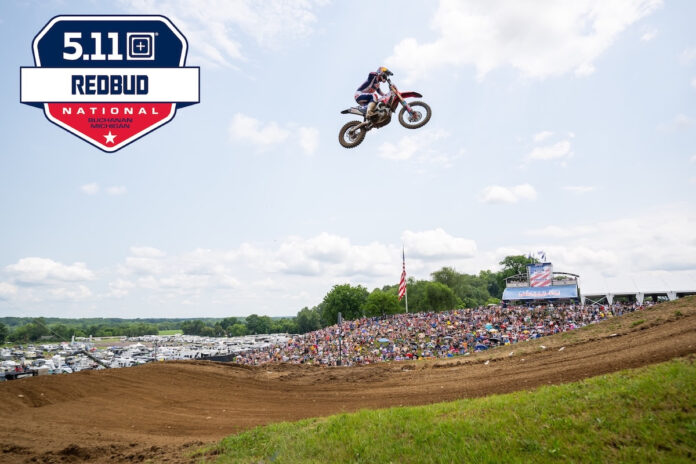
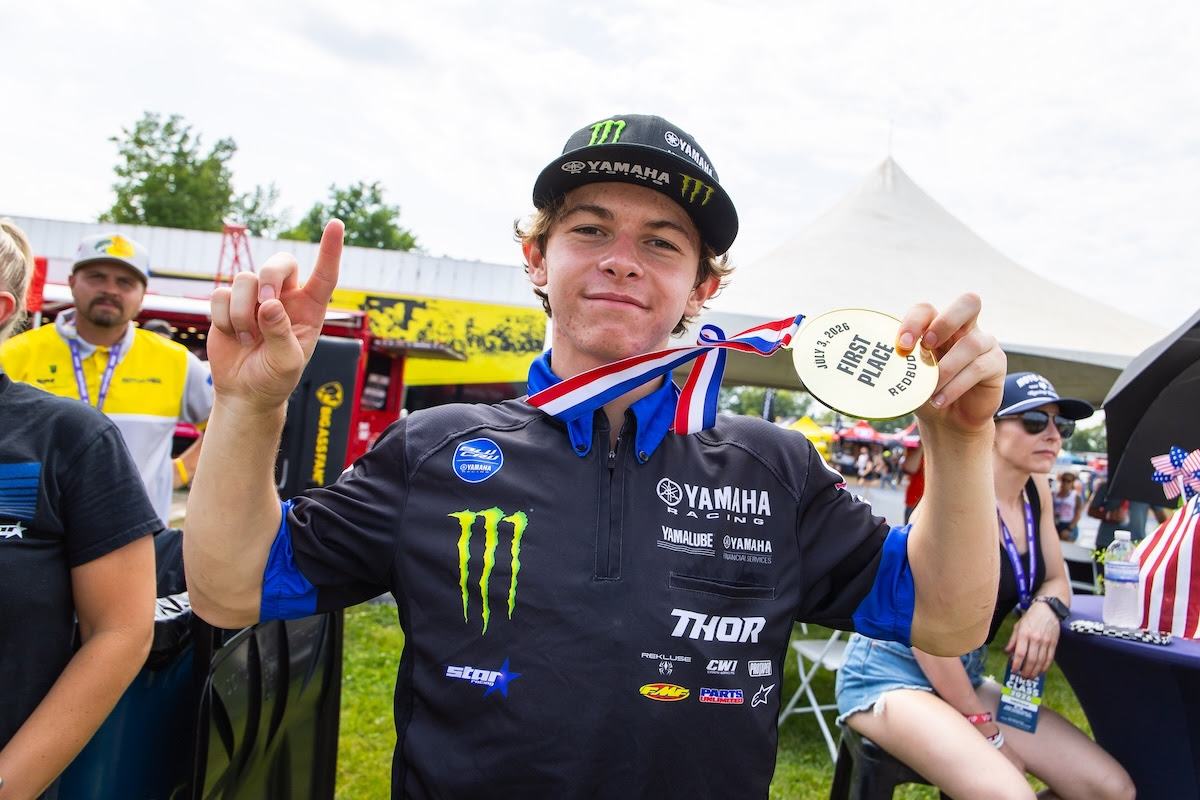
BUCHANAN, Mich. (July 4, 2026) – The Pro Motocross Championship, sanctioned by AMA Pro Racing, celebrated America’s 250th Anniversary with the longstanding Independence Day tradition that is the 5.11 RedBud National. One of the biggest crowds in event history was on hand for Round 22 of the Monster Energy SMX World Championship, as overnight rain gave way to sunny skies and a continually evolving racetrack. With a heightened atmosphere for the milestone holiday the action on the track responded with compelling action across both classes. In the premier 450SMX Class, Honda HRC Progressive’s Hunter Lawrence [#96] made it two in-a-row and three for the season following an incredible second moto win in which he overcame a near 10-second deficit. In the 250SMX Class, Monster Energy Yamaha Star Racing’s Cole Davies [#37] became the first repeat winner in the class this summer with back-to-back victories.
450SMX Class
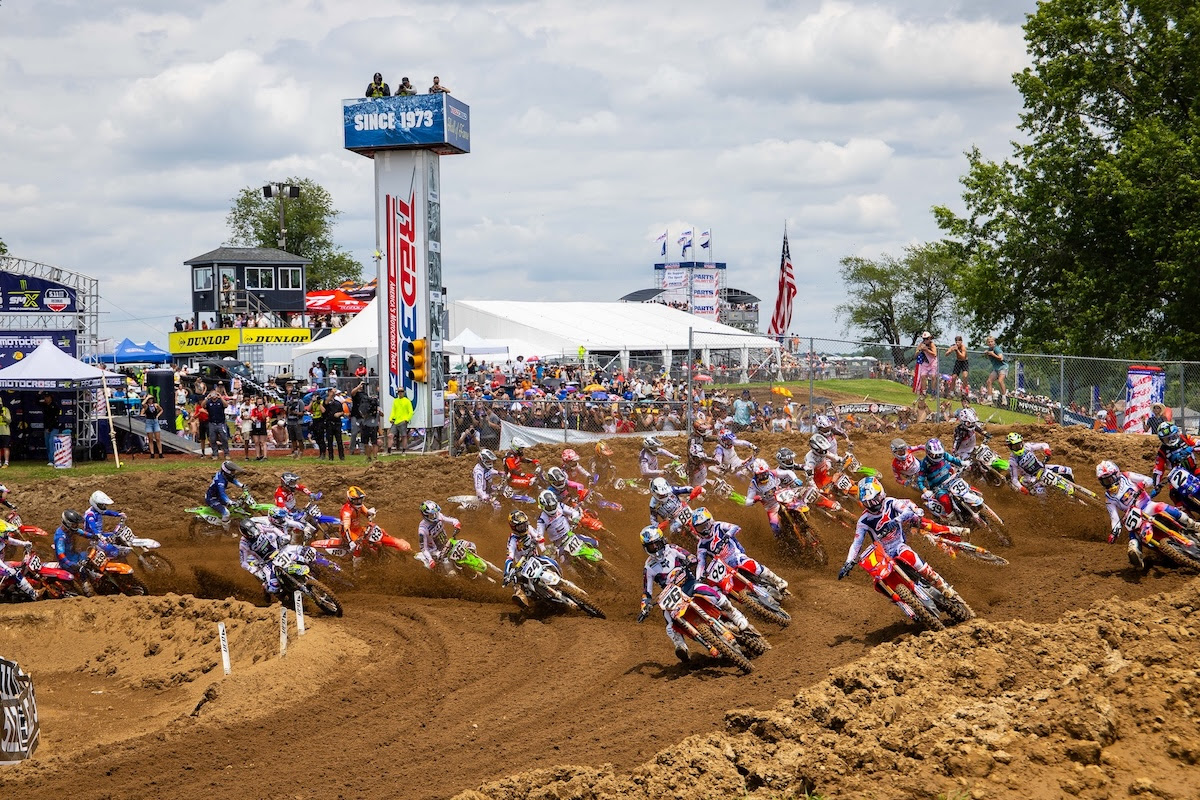
Jorge Prado [#26] edged out the Lawrences to grab the Moto 1 holeshot as he, Jett Lawrence [#1], and Hunter Lawrence [#96] each took turns at the front of the field. MX Sports Pro Racing, Inc.
Qualifying
The two timed sessions in the premier class were split atop the charts, with championship leader and Honda HRC Progressive rider Jett Lawrence [#1] leading the way in the first session with a time of 2:16.573 and Monster Energy Yamaha Star Racing’s Haiden Deegan [#38] setting the pace in the second session with a time of 2:16.818. Lawrence’s lap was enough to narrowly edge out Deegan by a few tenths to earn the first gate pick.
Moto 1 [30 Minutes + 2 Laps]
The opening moto started with the Red Bull KTM Factory Racing machine of Jorge Prado [#26] leading the Lawrence brothers to the holeshot, as the Spaniard then assumed control of the lead. Behind him, Jett and Hunter engaged in a spirited fight for second, while further back Deegan was involved in a first-turn incident and started at the tail end of the field.
The top three settled in through the opening five minutes as Jett Lawrence asserted his hold on second and started to chip away at the deficit to Prado while Hunter Lawrence lurked a couple seconds behind in third. A couple laps later Jett pulled the trigger on a quick, decisive pass to take control of the lead.
The top three remained unchanged through the middle of the moto, but Hunter Lawrence was able to close in on Prado just past the halfway point and made a quick pass to take over second. With about a dozen minutes left on the race clock the brothers were separated by 3.5 seconds.
The distance between Jett and Hunter remained about the same until the moto entered its final two minutes, when Hunter closed within striking distance of his younger brother. The elder Lawrence put in a charge and made the pass just before time ran out on the race clock then sprinted away to a lead of more than seven seconds.
On the final lap, Hunter tipped over as he navigated lapped riders, which allowed Jett to reclaim the lead and bring home his fifth moto win of the summer by 3.2 seconds. Prado finished more than 20 seconds back in third, followed by Rockstar Energy Husqvarna Factory Racing’s RJ Hampshire [#24] in fourth and Monster Energy Kawasaki’s Garrett Marchbanks [#36] in fifth.
Moto 2 [30 Minutes + 2 Laps]
The final race of the day got underway with Prado out front for a sweep of the holeshots, followed closely by Deegan and Jett Lawrence. Hunter Lawrence started just outside the top five in sixth.
As the lead trio sprinted away from the field Hunter Lawrence fought his way around Hampshire and Monster Energy Yamaha Star Racing’s Cooper Webb [#2] to move up to fourth.
While pursuing Deegan for second, Jett Lawrence lost traction with his rear tire and went down, eventually remounting just outside the top 10 in 11th place. That moved Hunter Lawrence up to third.
With the clear track, Prado was able to seize control of the moto and sprint out to a lead of 3.5 seconds over Deegan as Hunter Lawrence looked to close in from third. Behind them, Jett Lawrence experienced even more misfortune and went down for a second time while running eighth. He remounted once again in 11th place.
Prado continued to build on his advantage, which sat at nearly nine seconds at the halfway point of the moto. Deegan maintained a firm hold of second, but Hunter Lawrence inched in from third to initiate a battle for the position. Further back, Jett Lawrence continued to fight his way through the field and was on the cusp of the top five.
Hunter Lawrence easily got the upper hand in a brief battle with Deegan and took control of second place with 13 minutes left on the race clock. At that point, Lawrence faced a 9.2 second deficit to Prado.
Over the next few laps, Lawrence took big chunks out of Prado’s lead and soon enough the Honda rider moved within three seconds of his KTM foe. Lawrence’s push continued and moved him onto Prado’s rear fender.
Prado responded and was able to stabilize his advantage as the moto approached its final five minutes. Hunter then went on the attack and made an assertive pass for the lead with under three minutes remaining. Moments later, Jett Lawrence made a pass on Marchbanks for fifth.
Once out front, Hunter Lawrence surged out to lead of more than five seconds and went on to redeem his miscue from the first moto with his fifth moto win of the season. He took the checkered flag by a margin of 11.2 seconds over Prado, with Deegan a distant third. Jett Lawrence made a valiant charge to salvage fifth.
Overall
Hunter Lawrence’s 2-1 effort netted him a second straight win and class-leading third overall victory of the season.
Prado’s pair of holeshots carried him to 3-2 finishes and a second career podium result, which equaled his career best from the opening round.
Jett Lawrence captured his 38th premier class podium in third following a 1-5 performance and finished tied with Prado in event points but lost out on the second moto tiebreaker.
For the first time in 53 years, the overall podium at RedBud was composed entirely of international athletes.
With the win Hunter Lawrence reclaimed control of the championship points lead and holds a three-point lead over Jett. Deegan, who finished sixth overall (10-3), remains third, 51 points out of the lead and 12 points ahead of Prado in fourth.
Results & Standings
450SMX Class Overall Results (Moto Finishes // Points)
1st Place – Hunter Lawrence | #96 Team Honda HRC Progressive (2-1) “[This win] is so good. It’s America’s 250th birthday and we’re so grateful for the opportunity we have here [in this country]. We’re living the American dream and couldn’t have this life anywhere else in the world. What a day.”
2nd Place – Jorge Prado | #26 Red Bull KTM Factory Racing (3-2) “It’s an awesome experience racing at RedBud. We used the week off to make some improvements on the bike and in the second moto I felt way more like myself. We led laps, we got the holeshot, and I’m really happy with the steps we’ve made. We’re coming.”
3rd Place – Jett Lawrence | #1 Team Honda HRC Progressive (1-5) “I doubled down [in Moto 2] with my terrible riding today. I made a decision with the team to go a certain way on the bike, and it didn’t work. Hunter [Lawrence] is riding really well so we’ll go back to work and try to come out better at Southwick.”
250SMX Class
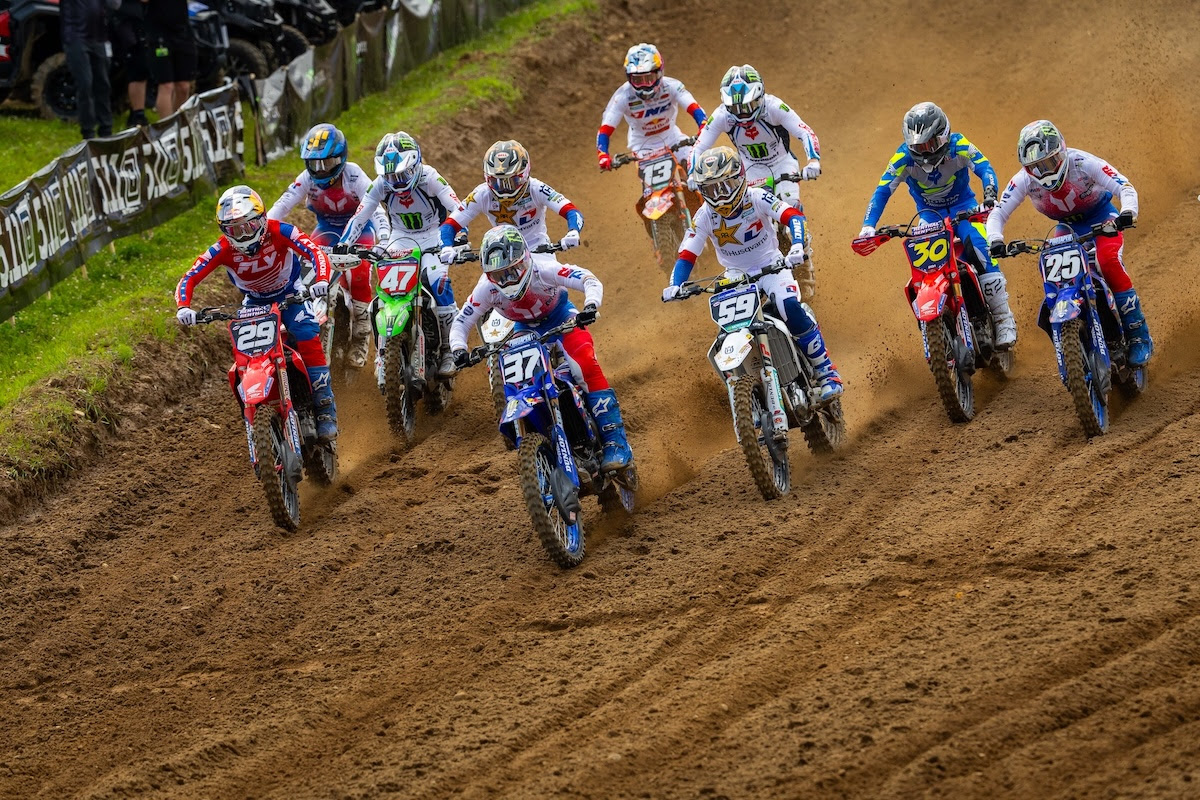
Cole Davies [#37] stormed to the Moto 2 holeshot and led for most of the race until he was caught and passed by Jo Shimoda [#30]. MX Sports Pro Racing, Inc.
Qualifying
Fresh off a first career win at the previous round, Davies kept the momentum rolling in Qualifying with the fastest lap of the morning at 2:19.661. The New Zealander set the pace in each session but did have his first fast lap disallowed after his motorcycle failed sound inspection. He sat 1.3 seconds clear of the 2:21.048 set by his rookie teammate Caden Dudney [#82] in second.
Moto 1 [30 Minutes + 2 Laps]
The first moto of the day started with the Monster Energy Yamaha Star Racing duo of Dudney and Davies side-by-side, with Dudney able to grab his first ever holeshot and early lead. Behind them, Monster Energy Pro Circuit Kawasaki’s Nick Romano [#141] started third, battling Red Bull KTM Factory Racing’s Julien Beaumer [#13], who then went down and dropped to the tail end of the field. Championship leader Levi Kitchen [#47] started sixth aboard his Monster Energy Pro Circuit Kawasaki.
Dudney was able to seize the moment and lead the first laps of his young career, soon opening up a lead of more than three seconds over Davies. The top two then pulled away from the rest of the field, building a double-digit advantage over third just 10 minutes into the moto.
A multi-rider battle for third unfolded between Romano, Rockstar Energy Husqvarna Factory Racing’s Casey Cochran [#56], and Kitchen. Cochran made the pass for third and inched away from the Kawasaki teammates. Kitchen then made the move for fourth.
Back up front, the battle for the lead picked up as the moto approached its halfway point. Davies hounded Dudney and attempted multiple passes for the lead, only to be denied every time. The lead then restabilized at around two seconds.
Inside the final 10 minutes the battle for third heated up again as Cochran, Kitchen, and Honda HRC Progressive’s Jo Shimoda [#30] sat within less than a second of one another. As Kitchen looked to make a pass on Cochran, Shimoda took advantage and made his way by both riders to take control of third.
With less than five minutes to go Davies closed in on Dudney for the lead once again. Davies was patient and waited for his opportunity, and with just over 30 seconds remaining on the race clock he made the pass. He pulled away from Dudney over the final two laps, as Davies captured his third straight moto win by 2.6 seconds. Shimoda followed in third, with Kitchen fourth, and Cochran fifth.
Moto 2 [30 Minutes + 2 Laps]
The second moto kicked off with Davies leading the field to the holeshot ahead of Honda HRC Progressive’s Chance Hymas [#29] and Cochran, with Shimoda in fourth and Dudney in fifth. Kitchen started outside the top 10 in 13th place. Cochran put in a charge on the opening lap and was able to make the move around Hymas for second.
As Davies sprinted out to a lead of nearly three seconds it was Shimoda who took the opportunity to push forward. He made the pass on his teammate for third and then went after Cochran. After several laps of pursuit, Shimoda made the pass for second but faced a 7.3 second deficit to Davies with 20 minutes remaining. Cochran, meanwhile, lost hold of third to his Rockstar Energy Husqvarna Factory Racing teammate Ryder DiFrancesco [#34] and then dropped behind Kitchen.
Just past the halfway point of the moto, Kitchen started to pressure DiFrancesco for third as Shimoda made small inroads on his deficit to Davies. Kitchen made the move around DiFrancesco but went down a couple laps later and dropped from third to sixth, which moved DiFrancesco back into a podium spot.
Back up front, Shimoda erased almost the entire deficit to Davies and moved within striking distance with more than five minutes left in the moto. The Japanese rider got alongside the New Zealander and made the pass with about 3.5 minutes remaining on the race clock.
The reigning SMX World Champion charged home to his first moto win of the summer, and 15th of his career, by a margin of 11.1 seconds over Davies. DiFrancesco finished third.
Overall
Despite losing his grasp on another sweep of the motos, Davies’ 2-1 effort still placed him atop the overall classification, with back-to-back victories to make him the first repeat winner of the season.
Shimoda’s impressive win in Moto 2 landed him in the runner-up spot (1-3) for his third straight podium result. It also paid big dividends in the championship standings as it moved him atop the points as the third different rider to carry the red plate through the first five races.
A quiet and consistent afternoon for DiFrancesco netted him the first overall podium result of his career (6-3), which came in his 43rd start. He’s the sixth different rider to earn a maiden overall podium this season.
Shimoda’s lead atop the 250SMX Class standings sits at four points over Davies. Kitchen dropped from first to third following a fifth-place finish (4-5) and now faces a nine-point deficit to Shimoda.
Results & Standings
250SMX Class Overall Results (Moto Finishes // Points)
Cole Davies, Waitoki, New Zealand, Yamaha (1-2 // 47)
1st Place – Cole Davies | #37 Monster Energy Yamaha Star Racing (1-2) “Jo [Shimoda] was riding good. It’s a long championship and we have a long way to go. It was a good day, and we got a win at RedBud. That’s all I can ask for. We’re in a really good spot with the bike right now so I’m really happy.”
2nd Place – Jo Shimoda | #30 Honda HRC Progressive (3-1) “The bike was better today. I felt good and didn’t get tired until the end [of Moto 2]. Every bit of it today was better. We’re making progress and that’s exactly what we need right now.”
3rd Place – Ryder DiFranceso | #34 Rockstar Energy Husqvarna Factory Racing (6-3) “This [first podium] has been a long time coming. I was sitting in third [in the second moto] and was thinking I was the only American to get on the podium [on 4th of July]. This is what every motocross rider dreams of.”
SMX Next – Motocross
MX Sports Pro Racing, Inc.
The first gathering of the summer for SMX Next – Motocross brought 25 of the top amateur prospects in the sport to the RedBud Scouting Moto Combine. On Friday, the athletes took part in several education sessions surrounding various aspects of the sport and received mentorship from a decorated group of Rider Coaches featuring AMA Hall of Famers Broc Glover and Kevin Windham, along with Michael Byrne and Gareth Swanepoel. After one moto on Friday weather forced the second moto to be held on Saturday, as both races saw Monster Energy Yamaha Star Racing’s Carson Wood [#260] take the victory for a 1-1 sweep and his first SMX Next victory.
SMX Next – Motocross Overall Results (Moto Finishes // Points)
Gavin Betts, Clifton Park, N.Y., Kawasaki (15-10 // 19)
Riley Busse, New Berlin, Wisc., Yamaha (9-16 // 19)
The 2026 Pro Motocross Championship will reach its halfway point next Saturday, July 11, for Round 23 of the SMX World Championship regular season and the annual visit to the iconic sands of Massachusetts’s The Wick 338. The Crestview Construction Southwick National will be shown live in its entirety on Peacock, beginning with Race Day Live at 7 a.m. PT / 10 a.m. ET, followed by coverage of the motos at 10 a.m. PT / 1 p.m. ET.
For information about the Monster Energy SMX World Championship, please visit www.SuperMotocross.com and be sure to follow all of the new SMX social media channels for exclusive content and additional information on the latest news: Instagram: @supermotocross Facebook: @supermotocross X: @supermotocross YouTube: @supermotocross TikTok: @supermotocross
About the Monster Energy SMX World Championship: The Monster Energy SMX World Championship™ is the premier off-road motorcycle racing series in the world that combines the technical precision of stadium racing with the all-out speed and endurance of outdoor racing. Created in 2022, the Monster Energy SMX World Championship Series combines the Monster Energy AMA Supercross Championship and the AMA Pro Motocross Championship into a 28-round regular season that culminates with the season-ending SMX World Championship Playoffs. Visit SuperMotocross.com for more information.
About Pro Motocross Championship: The Pro Motocross Championship features the world’s fastest outdoor motocross racers, competing aboard homologated bikes from one of seven competing manufacturers on a collection of the roughest, toughest tracks on the planet. Racing takes place each Saturday afternoon, with competition divided into two classes: one for 250cc machines, and one for 450cc machines. MX Sports Pro Racing, the industry leader in off-road powersports event production, manages the Pro Motocross Championship. For more information, visit ProMotocross.com.
About Monster Energy AMA Supercross Championship: Monster Energy AMA Supercross is the most competitive and highest-profile off-road motorcycle racing championship on the planet. Founded in America and sanctioned by the American Motorcyclist Association (AMA) since 1974. Over 17 weeks, Supercross attracts some of the largest and most impressive crowds inside the most recognizable and prestigious stadiums in North America to race in front of nearly one million live fans and broadcast to millions more worldwide. For more information, visit SupercrossLIVE.com.
About MX Sports Pro Racing, Inc.: MX Sports Pro Racing, Inc., manages and produces the world’s premier motocross racing series – the Pro Motocross Championship, sanctioned by AMA Pro Racing. MX Sports Pro Racing is an industry leader in off-road powersport event production and management, its mission is to showcase the sport of professional motocross competition at events throughout the United States. Through its various racing properties, partnerships and affiliates, MX Sports Pro Racing, Inc., organizes events for thousands of action sports athletes each year and attracts millions of motorsports spectators. Visit MXSportsProRacing.com for more information.
About Feld Motor Sports, Inc.: Feld Motor Sports, Inc. is the worldwide leader in producing and presenting specialized arena and stadium-based motorsports entertainment. Properties include Monster Jam®, Monster Energy AMA Supercross, and the Monster Energy SMX World Championship. Feld Motor Sports, Inc. is a subsidiary of Feld Entertainment, Inc. Visit monsterjam.com, SupercrossLIVE.com, and feldentertainment.com for more information.
Jesse Love and the No. 2 Whelen Chevrolet Team Showcase Speed and Lead Laps En Route to Third-Place Finish at Chicagoland Speedway
Finish: 3rd Start: 6th Points: 2nd
“We had a lot of potential in our No. 2 Whelen Chevrolet. I thought we were close, but didn’t quite have enough to be elite tonight. I wish I would have been able to give Chase Elliott a little bit better of a push on the final restart, but overall, I thought our car was pretty close tonight, we just lacked a little bit of something special. Overall, I wish the points day was a little bit better. I was surprised to see we only gained as much as we did to Justin Allgaier, but overall, I’m proud of the effort of everybody — our pit crew kept us in the fight and we had some good restarts at the end there. I would have loved to see what another lap would have done if they (Brandon Jones and Chase Elliott) were side by side, if I could have strung together a really good run or move somebody out of the way. Regardless, it was a good day, we needed one. It’s been a tough last month or two, a lot of stuff out of our control. Glad we could control our own destiny tonight even though we wanted a little bit more.” -Jesse Love
Austin Hill and the No. 21 Cheddar’s Scratch Kitchen Chevrolet Team Bring Home Top-Five Result at Chicagoland Speedway
Finish: 5th Start: 16th Points: 5th
“Good finish for our Cheddar’s Scratch Kitchen Chevrolet team. We struggled during the first run, so we made some really big changes on the first stop. The guys did a great job of making the car better. Once we got it close, we had a shot at the win which is all you can ask for in these races. We restarted fourth on the green-white-checkered, but I couldn’t get my tires cleaned up enough. Drove down into Turn 1 and the front tires slid. It took our car about five laps to get going, but then we had a good long run car. The short run speed just wasn’t there. We will go back, look at that, and see what we can do better for fire off at the end of races. That felt like the difference maker tonight, but overall big improvements for everyone on this No. 21 team.” -Austin Hill
BRANDON JONES WINS IN GREEN-WHITE-CHECKERED THRILLER AT CHICAGOLAND Two Joe Gibbs Racing Toyota GR Supra’s Finish Inside Top-Five in Return to 1.5-mile Oval
JOLIET, Ill. (July 4, 2026) – Brandon Jones used a strong green-white-checkered restart to make a thrilling last-lap pass on Chase Elliott and win Saturday night’s rain-delayed NASCAR O’Reilly Auto Parts Series race at Chicagoland Speedway.
The victory was Jones’ first of the season and the eighth win of his career, coming in NASCAR’s return to the 1.5-mile oval in Joliet after a seven-year absence. It was also a strong night for Team Toyota, with Joe Gibbs Racing Toyota GR Supras claiming three of the top-seven finishing positions. Brent Crews finished fourth, while Taylor Gray, who led a total of 55 laps, came home seventh.
TOYOTA RACING Post-Race Recap NASCAR O’Reilly Auto Parts Series (NOAPS) Chicagoland Speedway Race 20 of 33 – 300 miles, 200 laps
TOYOTA FINISHING POSITIONS
1st, BRANDON JONES
2nd, Chase Elliott*
3rd, Jesse Love*
4th, BRENT CREWS
5th, Austin Hill*
7th, TAYLOR GRAY
15th, HARRISON BURTON
17th, DEAN THOMPSON
29th, WILLIAM SAWALICH
*non-Toyota driver
TOYOTA QUOTES
BRANDON JONES, No. 20 Menards/MD Building Products Toyota GR Supra, Joe Gibbs Racing
Finishing Position: 1st
How did you muscle through and hold off Chase Elliott on that final restart?
“I had to earn that one. I haven’t had an exciting one like that in a long time. Thank you guys for sticking this out in the rain. MD Building supplies and Menard’s and Toyota, I’m so happy to get them back in victory lane. It’s been so up and down year. We’ve had some success early on and we’ve been in a little bit of a rut the last couple of weeks, so it’s nice to do what we did today, we had to earn that one.”
What does it mean to win in the return to Chicagoland, but also hold off a Cup Series Champion?
“Think it says a lot about how resilient we are and how hard we are working at this. Chase (Elliott) made it really difficult on me. He’s one of the best in the sport so I know it was going to be difficult. We were all on old tires, that was a blast to slide around and duel it out like that. I knew had made the right adjustments there at the end and you can tell people were getting tighter tonight with the temperature falling down and the track was migrating. Awesome racetrack, you guys know I love these style of tracks, they fit me so well, lets get on a roll and get some more here before the Chase starts.”
BRENT CREWS, No. 19 YoungLife Toyota GR Supra, Joe Gibbs Racing
Finishing Position: 4th
Can you tell us what happened with the contact with William Sawalich?
“I take full accountability for sure. Squeezing off the bottom off of (turn) 2 and he’s coming off the top and I was just trying to pack air on his left rear and get him free and I got him free like I was trying to and when he got free he checked up I couldn’t get checked up fast enough. These aero spots when you are going 170 mph you can barely, barely tap somebody and they go around. I take full accountability, I would hate to do that to anybody, especially to a teammate. I hate that has to be my learning experience, but I definitely learned my limit there and I hate that was on my teammate.”
What do you take away from coming here to another new racetrack for you and bringing home a top five finish?
“We had a very difficult day. We were really, really good in practice, I thought we were one of the best cars and went out there for the first run and we were good there for the first three laps and then we were just extremely tight and we came in and the right front tire was just destroyed. Don’t know how it really corded there and just had a bad right front tire there. We made some adjustments going into the second run thinking it was something on our end but then we fought balance on the total opposite end on the next stage and then the last break there we were really good. I hate that’s what we had to go through, but I felt like the last 20 laps we were incredible, I just wish we had found out a little bit sooner.”
About Toyota
Toyota (NYSE:TM) has been a part of the cultural fabric in North America for nearly 70 years, and is committed to advancing sustainable, next-generation mobility through our Toyota and Lexus brands, plus our more than 1,800 dealerships.
Toyota directly employs nearly 64,000 people in North America who have contributed to the design, engineering, and assembly of over 50 million cars and trucks at our 14 manufacturing plants. In 2025, Toyota’s plant in North Carolina began to assemble automotive batteries for electrified vehicles.
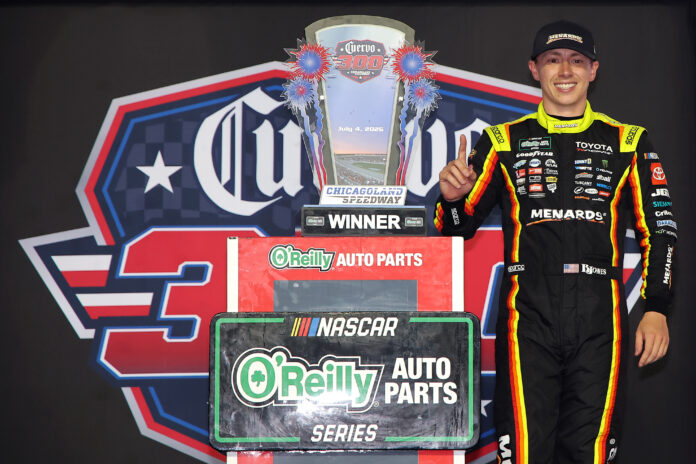
JOLIET, ILLINOIS - JULY 04: Brandon Jones, driver of the #20 Menards/MD Building Products Toyota, celebrates in victory lane after winning the NASCAR O'Reilly Auto Parts Series Cuervo 300 at Chicagoland Speedway on July 04, 2026 in Joliet, Illinois. (Photo by Jonathan Bachman/Getty Images).
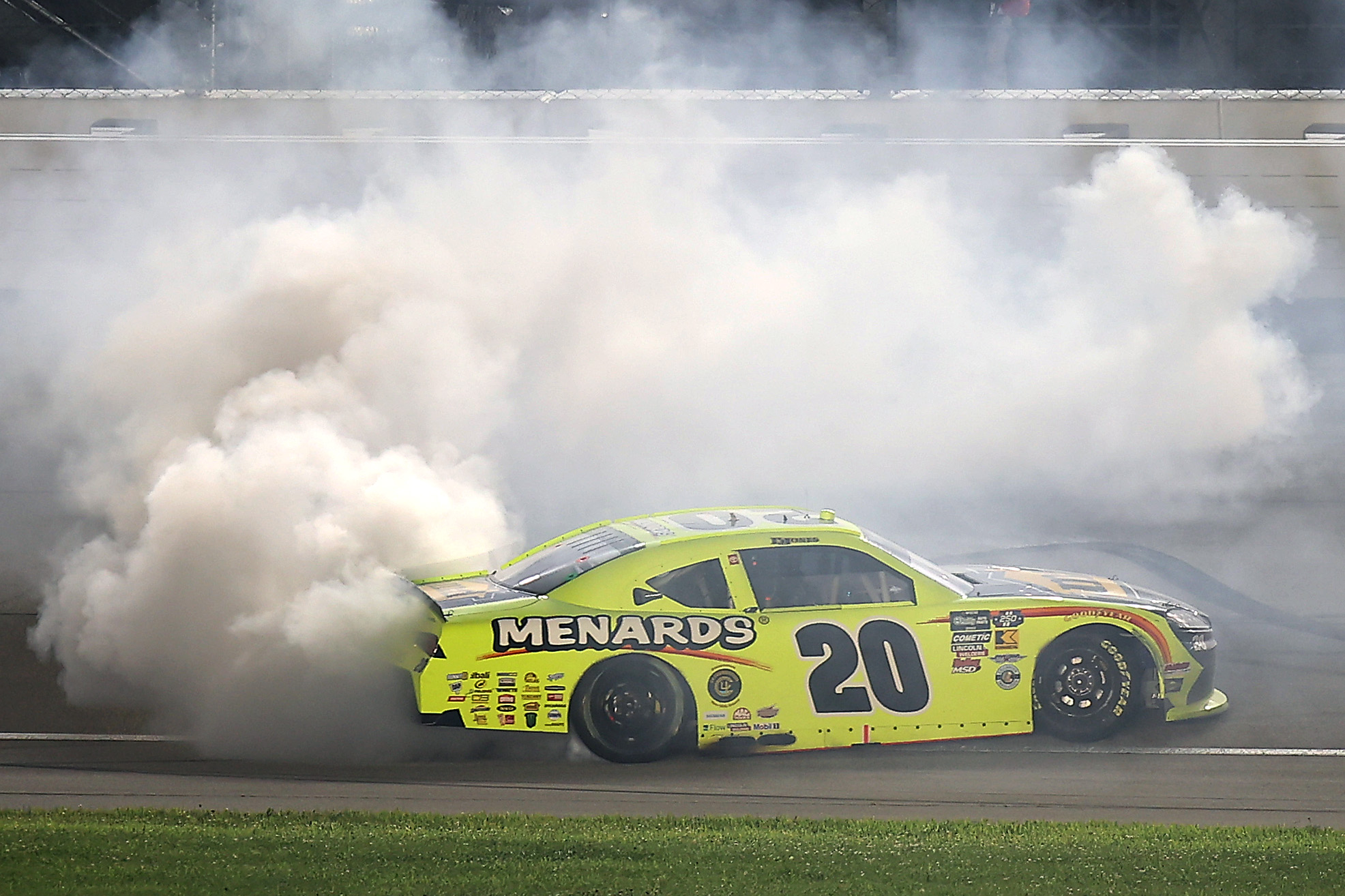
Brandon Jones weathered through an extensively delayed start by winning the return of the NASCAR O’Reilly Auto Parts Series’ Cuervo 300 at Chicagoland Speedway between July 4-5 in overtime.
The 29-year-old Jones from Atlanta, Georgia, led four times for 12 of 201 over-scheduled laps in an event where he took the green flag from 29th place and motored his way up to 14th place at the first stage’s conclusion. After settling in sixth place following the second stage’s conclusion, Jones, who continued his march to the front, gained his first sniff at the lead while battling teammate Taylor Gray during a restart with 61 laps remaining.
Beginning on Lap 162 through Lap 189, Jones led 10 laps, and he primarily duked with Gray and Chase Elliott towards the front amid four late-race cautions and three ensuing restarts. During an overtime shootout, Jones dueled and motored ahead of Elliott for nearly a full circuit and prior to the final lap mark. Amid Elliott’s pair of final-lap challenges, Jones was not to be denied, and his race-long fight prevailed with a victorious ending under the lights, along with winning his first event of the 2026 season in Joliet, Illinois.
The event’s starting lineup was determined by a metric qualifying formula from the NASCAR rule book after NASCAR replaced the event’s qualifying session with a lone practice session for Saturday. This was because the event’s initial practice session was postponed from Friday, July 3, due to inclement weather. As a result, Connor Zilisch was awarded the pole position, and he shared the front row with rookie Brent Crews.
*This event was delayed for nearly five hours due to inclement weather, thunderstorms, and heavy precipitation that resulted in the event commencing under the lights.
When the green flag waved and the event commenced, Connor Zilisch and Brent Crews dueled for the lead in front of two stacked lanes until Zilisch gained the upper advantage and motored his No. 1 KOA Chevrolet Camaro entry ahead from the outside lane entering the backstretch. As the field cycled back to the frontstretch, Zilisch led the first lap over Crews while Corey Day, Jesse Love, Carson Kvapil and the rest of the 38-car field pursued from behind.
Over the next four laps, Zilisch stretched his early lead to one-and-a-half seconds Crews and nearly two seconds over third-place Love while Day, Kvapil, Chase Elliott, Sheldon Creed, Sam Mayer, Parker Retzlaff and Sammy Smith were racing in the top 10, respectively. As Elliott squeezed his way past teammate Kvapil to crack into the top-five mark in fifth place, Zilisch added another second to his advantage as he led by more than two seconds over both Crews and Love by the 10th lap.
Through the first 25 laps, Zilisch continued to extend his advantage as he led by more than four seconds over Love. Behind, Day and Elliott occupied third and fourth, respectively, while Crews dropped to fifth place. Kvapil, Creed, Mayer, Retzlaff and Taylor Gray, the latter of whom started 25th, were racing in the top 10 ahead of William Sawalich, Justin Allgaier, Anthony Alfredo, Austin Hill, Jeremy Clements, Cole Custer, Brandon Jones, Nick Sanchez, Ryan Sieg and Dean Thompson, respectively.
At the Lap 35 mark, Zilisch stabilized his advantage to more than three seconds over Love and Day while Elliott and Creed were racing in the top five ahead of Gray, Mayer, Kvapil and Sawalich. Meanwhile, Crews dropped to 10th place, and he had Retzlaff, Allgaier, Anthony Alfredo, Cole Custer and Austin Hill reeling in from behind while teammate Gray had gained an additional four spots on the track.
When the first stage period concluded on Lap 45, Zilisch, whose lead stood at nearly five seconds, cruised to his fourth O’Reilly stage victory of the 2026 season. Love and Day settled in second and third ahead of Elliott and Creed while Gray, Mayer, Sawalich, Allgaier and Alfredo were scored in the top 10, respectively. By then, 26 of 38 starters were scored on the lead lap.
Under the event’s first stage break period, Zilisch fell off the pace due to having no fuel pressure and had to have his entry pushed to pit road. This allowed Love to assume the lead as he led the field to pit road for service. Following the pit stops, Elliott cycled to the lead over Love while Day, Gray and Creed followed suit. Meanwhile, Zilisch, who managed to remain on the lead lap, dropped to 27th place while William Sawalich was penalized for a safety violation.
The second stage period started on Lap 53 as Elliott and Love occupied the front row. At the start, the field fanned out and jostled for spots through the first two turns as Elliott fended off Love with strong momentum from the outside lane to retain the lead. As Elliott led the next lap, Day occupied third place in front of Mayer, Creed, Allgaier, Gray and Kvapil while teammates Jones and Crews battled for ninth place. During the following lap, Crews outdueled Jones and Jones fell back to 11th place while Crews battled Kvapil for eighth place. While Zilisch carved his way back up to 13th place, teammate Elliott led by nine-tenths of a second over Love on Lap 60.
By Lap 70, Elliott was leading by more than two seconds over Love while third-place Day was being pursued by Mayer and Allgaier. Behind, Gray, Crews, Creed, Jones and Zilisch were racing in the top-10 mark ahead of Custer, Kvapil, Hill, Retzlaff and Alfredo while Clements, Harrison Burton, Kyle Sieg, Jeb Burton and Ryan Sieg trailed from the top-20 mark, respectively. A few laps later, both Mayer and Gray overtook Day for third and fourth on the track before Allgaier overtook the latter for fifth place on Lap 75. Meanwhile, Elliott maintained his lead by more than two seconds over Love at the Lap 80 mark.
When the second stage period concluded on Lap 90, Elliott cruised to his first O’Reilly stage victory in his first of two series starts of 2026. Love settled in second place for a second consecutive time during a stage’s conclusion while Gray, Allgaier, Mayer, Jones, Creed, Day, Zilisch and Crews were scored in the top 10, respectively. By then, 27 of 38 starters were scored on the lead lap while a fog patch started to overshadow Turns 3 and 4 of the speedway circuit.
During the event’s second stage break period, Jeremy Clements had a left-rear wheel detach from his entry, and he had sparks trailing from his entry as he limped to his pit stall. The incident resulted in Clements being held in his pit stall for two laps as a penalty. Once pit road became accessible for the field, Elliott led the field for service. Following the pit stops, Gray exited pit road first ahead of Love, Elliott, Allgaier, Creed, Mayer, Jones, Day, Sawalich and Zilisch. Soon after, Allgaier was penalized and sent to the tail end of the field due to a safety violation on pit road.
With 101 laps remaining, the final stage period commenced as Gray and Love occupied the front row. At the start, Love motored ahead with the lead from the inside lane while Elliott and Creed placed Gray in the middle of a three-wide battle for the runner-up spot. As Elliott motored ahead for the runner-up spot, Love led the next lap while Gray retained third place in front of Creed, Mayer and Jones. Meanwhile, Zilisch and Day battled for seventh place in front of Hill, Crews and Custer while Elliott battled Love for the lead.
After stalking and challenging Love a lap prior, Elliott used the inside lane and the frontstretch’s apron to power the No. 88 HendrickCars.com Chevrolet Camaro entry ahead with 97 laps remaining. Love, though, fought back from the outside lane as both he and Elliott spent the next two laps duking for the lead, which allowed Taylor Gray to join the battle. Amid the tight battle for the lead, Creed made an unscheduled pit stop to have a flat right-front tire addressed.
Soon after, Gray, who had a strong No. 54 Operation 300 Toyota Supra entry on long runs and had overtaken Love for the runner-up spot a few laps prior, overtook Elliott for the lead through Turns 3 and 4 with 91 laps remaining. With 85 laps remaining, Gray extended his lead to more than a second over Elliott. Gray’s lead over Elliott grew to more than two seconds with 80 laps remaining as Jones, Love, Mayer, Hill, Zilisch, Custer, Sawalich and Crews trailed in the top 10, respectively.
Down to the final 75 laps of the event, Gray led by nearly three seconds over Elliott while Jones, Love, Hill, Zilisch, Mayer, Custer, Sawalich and Crews occupied the top-10 mark, respectively. Behind, Day, Retzlaff, Allgaier, Alfredo, Ryan Sieg, Kvapil, Nick Sanchez, Dean Thompson, Patrick Staropoli and Kyle Sieg trailed in the top 20, respectively. Then with 68 laps remaining, a caution flew due to Zilisch hitting the outside wall while racing in sixth place as a tire carcass also rolled out from Zilisch’s entry through Turns 3 and 4. During this latest caution period, the field led by Gray pitted for service. Following the pit stops, Gray maintained the lead by exiting pit road first while Jones, Elliott, Sawalich and Love followed suit along with Mayer, Hill, Crews, Day and Allgaier.
The next restart with 61 laps remaining featured teammates Jones and Gray duking it out dead even for the lead for a full lap as the field fanned out. Through the frontstretch, Elliott made a bold three-wide move beneath both Jones and Gray to assume the lead through the frontstretch and entering the first turn, though Jones led the previous lap. Elliott then cycled back as the leader during the next lap while a variety of on-track battles ensued, primarily within the top-10 and 15 marks. Amid the battles, Elliott maintained the lead by three-tenths of a second over Gray with 55 laps remaining. The former continued to lead the latter by half a second with 50 laps remaining while third-place Jones trailed by more than a second.
With 45 laps remaining, the caution flew when Zilisch was involved in his second incident of the event, this time for a spin in the second turn. During the caution period, Elliott led the field back to pit road for service, but Jones managed to beat Elliot off of pit road first as they were followed by Love, Sawalich and Gray, respectively.
As the event restarted with 38 laps remaining, Jones motored ahead with the lead while a brief four-wide battle for the runner-up spot between Elliott, Gray, Love and Ryan Sieg ensued, with Sieg quickly being overtaken by the field. As Jones led the next lap, Elliott outdueled Gray for the runner-up spot, and he pursued Jones for the lead while Love was pursued by Kvapil, Sawalich and Crews for fourth place. The caution returned with 36 laps remaining when Crews bumped and sent teammate Sawalich for a spin below the backstretch.
The next restart with 30 laps remaining featured Gray outdueling his teammate Jones amid a side-by-side battle as the former returned atop the leaderboard and led the next lap while a variety of battles ensued. While Gray maintained a steady lead, Elliott fiercely battled Jones for the runner-up spot and slid from the top to the bottom of the track through the frontstretch while trying to fend off Jones for the spot. Elliott then managed to slide in front of Jones and maintain the runner-up spot with 26 laps remaining before Jones fought back. The late side-by-side action between Jones and Elliott allowed Love to reel in, though Jones reclaimed and muscled away from both with the runner-up spot, while Gray motored away with the lead by more than a second.
Down to the final 20 laps, Gray stretched his lead to nearly two seconds over Jones while Elliott, Love and Kvapil occupied the top-five spots, with Kvapil trailing by four-and-a-half seconds. Four laps later, the caution flew due to Ryan Sieg blowing a right-front tire and shredding the right-side sheet metal from his No. 39 SciAps Chevrolet Camaro entry . By then, Gray maintained his lead by more than a second over Jones, and Hill moved up to fifth place behind Elliott and teammate Love while Crews, Kvapil, Allgaier, Retzlaff and Custer were scored in the top 10.
During the next restart with 11 laps remaining, Love and Elliott pinned Jones and Gray in a tight four-wide battle for the lead. Ultimately, the latter two briefly lost momentum, with Gray slipping out of the top-five mark and Jones settling in third while Elliott cycled back as the leader for the following lap. As the laps dwindled, Gray was locked in a heated battle with Allgaier for sixth place, but he trailed the lead by two seconds and he had Love, Hill and Crews in front of him. Meanwhile, Jones started to reel in on Elliott for the lead, but the caution flew with five laps remaining due to Brennan Poole, Patrick Staropoli and Kyle Sieg spinning and wrecking through the first two turns.
As the field restarted in overtime, Jones and Elliott dueled for the lead in front of the field that fanned out through the first two turns. With both Jones and Elliott receiving no drafting momentum at the overtime’s start nor gaining an advantage of one another, they dueled from the first two turns and the backstretch as Jones mounted a fierce fight beneath Elliott. Jones then gained the upper advantage from the inside lane as he motored his No. 20 Menards Toyota Supra ahead of Elliott’s No. 88 HendrickCars.com Chevrolet Camaro entry through Turns 3 and 4.
When the white flag waved and the final lap started, Jones remained in the lead by a tenth of a second over Elliott. Though the first two turns, Elliott nearly scraped the outside wall while trying to reel in Jones. He then tried to make a move beneath Jones through Turns 3 and 4. Ultimately, both moves did not prevail as Jones cycled back to the frontstretch and claimed the checkered flag by a tenth of a second over Elliott.
With the victory, Jones, who became the 11th winner through 20 events of the 2026 season, notched his eighth career win in the NASCAR O’Reilly Auto Parts Series division, his third on a 1.5-mile circuit and his first since Kansas Speedway in September 2025. He also became the third competitor from Joe Gibbs Racing to win in the O’Reilly division this season and he racked up the third victory of 2026 for Toyota.
JOLIET, ILLINOIS – JULY 04: Brandon Jones, driver of the #20 Menards/MD Building Products Toyota, celebrates with a burnout after winning the NASCAR O’Reilly Auto Parts Series Cuervo 300 at Chicagoland Speedway on July 04, 2026 in Joliet, Illinois. (Photo by Jonathan Bachman/Getty Images).
“I had to earn that one,” Jones said on the frontstretch on CW. “I haven’t had an exciting one like that in a long time. Thank you, guys, for sticking this out, through the rain and everything. It’s been an up and down year. We’ve had some success early on. We’ve been in a little bit of a runt the last couple weeks, so it’s just nice to [win] it like we did today. We had to earn that one. I think it says a lot about just how resilient we are and how hard we’re working at this. Chase [Elliott] made it really difficult on me. He’s one of the best in this sport. I knew he was gonna be difficult. We were all on old tires. That was a blast to slide around and duel it out like that…Let’s go on a roll and let’s get a couple more [wins] here before the Chase starts.”
Chase Elliott, who led a race-high 78 laps and won an O’Reilly event at Chicagoland in 2014, settled in second place for a seventh time in his O’Reilly career after he was unable to outduel Jones during the overtime shootout. Elliott will make a second start in the No. 88 HendrickCars.com Chevrolet entry for JR Motorsports at Indianapolis Motor Speedway on July 25.
“[I] Ended up having momentum going the wrong way into Turn 3,” Elliott said. “I tried to drive in really hard and got myself super tight. Super bummed about that, honestly. It was kind of an up-and-down night. Credit to Brandon [Jones]. He did a good job. He had a good restart, stayed side by side through [Turns] 1 and 2, and he had momentum going the right way into Turn 3. I got myself in a bad spot and paid the price.”
Jesse Love, Brent Crews and Austin Hill finished in the top five. Points leader Justin Allgaier, Taylor Gray, Sam Mayer, Cole Custer and Connor Zilisch, the latter of whom set the event’s fastest lap time, completed the top 10 in the final running order.
This event featured 16 lead changes for six different leaders, and a total of seven cautions for 40 laps. In addition, 30 of 38 starters finished on the lead lap.
Following the 20th event of the 2026 NASCAR O’Reilly Auto Parts Series season, Justin Allgaier continues to lead the standings by 195 points over Jesse Love, 224 over Corey Day, 225 over Sheldon Creed, 255 over Austin Hill and 265 over Brandon Jones.
Results:
Brandon Jones, 12 laps led
Chase Elliott, 78 laps led, Stage 2 winner
Jesse Love, five laps led
Brent Crews
Austin Hill
Justin Allgaier
Taylor Gray, 55 laps led
Sam Mayer
Cole Custer
Connor Zilisch, 48 laps led, Stage 1 winner
Carson Kvapil
Nick Sanchez
Sammy Smith
Parker Retzlaff
Harrison Burton
Sheldon Creed
Dean Thompson
Garrett Smithley
Corey Day
Jeb Burton
Leland Honeyman Jr.
Ryan Ellis
Myatt Snider
Rajah Caruth
Brennan Poole
Anthony Alfredo
Patrick Staropoli
Lavar Scott
William Sawalich
Kyle Sieg
Ryan Sieg, one lap down, three laps led
Blaine Perkins, two laps down
Tyler Tomassi, two laps down
Joey Gase, three laps down
Jeremy Clements, three laps down
Josh Bilicki, five laps down
JJ Yeley – OUT, Power
Dawson Cram – OUT, Engine
Next on the 2026 NASCAR O’Reilly Auto Parts Series schedule is EchoPark Speedway in Hampton, Georgia, for the Focused Health 250. The event is scheduled to occur next Saturday, July 11, and air at 7 p.m. ET on the CW Network, PRN Radio and SiriusXM.
LEXINGTON, Ohio (Saturday, July 4, 2026) – Christian Lundgaard made another statement about his worthiness as a top driver in the NTT INDYCAR SERIES.
Two weeks ago, the driver, expected to soon be a free agent, won at Road America despite being in last place after the first lap. Now, he is the No. 1 qualifier for Sunday’s race at the Mid-Ohio Sports Car Course, leading an Arrow McLaren sweep of the front row.
Lundgaard edged teammate Pato O’Ward for the fourth NTT P1 Award of his career, the most recent coming in 2023 when he won the Toronto street race. Last year at Portland International Raceway, Lundgaard grabbed the top spot in qualifying, but he had to serve a six-grid starting position penalty for an unapproved engine change.
The combination of the above has the still-young Dane, who turns 25 on July 23, brimming with optimism as his future remains unsettled.
“I think everybody knows the abilities,” he told FOX after posting the pace-setting lap of 1 minute, 4.8396 seconds in the No. 7 Arrow McLaren Chevrolet. “I don’t need to say anymore than that.”
Lundgaard will be aiming for his third road course victory of the season in Sunday’s The Honda Indy 200 at Mid-Ohio Presented by the 2027 CR-V Hybrid (12:30 p.m. ET, FOX, FOX One, FOX Deportes, INDYCAR Radio powered by OnlyBulls). He also won the Sonsio Grand Prix on the Indianapolis Motor Speedway road course in May and finished second in the Children’s of Alabama Indy Grand Prix presented by AMR at Barber Motorsports Park in March.
Lundgaard is one of three drivers still with a reasonable chance of catching four-time series champion Alex Palou in the standings. Palou leads Team Penske’s David Malukas by 60 points, Andretti Global’s Kyle Kirkwood by 61 points and Lundgaard by 77. No other driver is within 100 points of the Chip Ganassi Racing driver.
Lundgaard said the goal now is to capitalize on the opportunity.
“We’ve got two wins now and we’re going to carry that momentum,” he said. “It’s just awesome to have a 1-2 (for the team in qualifying). We’ve got to go finish the job tomorrow and that’s the most important.”
O’Ward’s lap of 1:04.8649 in the No. 5 Arrow McLaren Chevrolet earned him a front-row start for the second time this season. He also held that position for the Detroit street race.
The performances of Lundgaard and O’Ward weren’t the only noteworthy developments in a qualifying session delayed nearly three hours by thunderstorms. Palou’s streak of five consecutive NTT P1 Awards ended when he qualified eighth in the No. 10 Open AI Chip Ganassi Racing Honda.
Palou’s best lap of 1:04.865 was the fourth-fastest of the qualifying session, but it came in the opening round. He was unable to improve in the second round, leaving him eighth on the starting grid. His streak of five consecutive poles is tied for the fourth longest in series history with Mario Andretti (1984) and Danny Sullivan (1988).
Still, Palou can build on his hefty series points lead in the season’s 11th race. He has finished in the top two each of the past four years – a win in 2023 and three second-place finishes.
Joining the Arrow McLaren drivers as Firestone Fast Six qualifiers were Andretti Global’s Will Power (No. 26 TWG AI Honda), Malukas (No. 12 Verizon Team Penske Chevrolet), ECR’s Christian Rasmussen (No. 21 Splenda Chevrolet) and Juncos Hollinger Racing’s Rinus VeeKay (No. 76 Juncos Hollinger Chevrolet). Rasmussen reached the final round of knockout qualifying for the first time this season. VeeKay earned JHR its fourth career top-six starting position.
Chevrolet placed five drivers in the top six. Power was the lone Honda driver in that group.
Scott Dixon has won a record seven INDYCAR SERIES races at this track, one of them in 2014 when he drove from the 22nd and last starting position. If he is to win Sunday in his final Mid-Ohio race with Chip Ganassi Racing, he must do it after starting 23rd. The driver of the No. 9 PNC Bank Chip Ganassi Racing Honda was penalized for interference on Dale Coyne Racing’s Romain Grosjean (No. 18 BMax Honda) approaching Turn 5 in the first round of qualifying.
TOYOTA RACING – Bubba Wallace NASCAR Cup Series Quotes
JOLIET, Ill. (July 4, 2026) – 23XI Racing driver Bubba Wallace was made available to the media on Saturday prior to the NASCAR Cup Series race tomorrow from Chicagoland Speedway.
BUBBA WALLACE, No. 23 Upper Deck Space Jam 30th Anniversary Toyota Camry XSE, 23XI Racing
Did you enjoy your event at Navy Pier celebrating your 30th Anniversary Space Jam scheme you have on your car this weekend?
“It’s cool. It’s a true genuine full circle. I remember being a kid watching that on repeat and so to have that connection and be representing Looney Tunes, Warner Brothers, Space Jam, it’s everything that movie provided as a kid to be reliving that is just super cool. I appreciate all the parties involved and it was a great event at Navy Pier, had a great turnout, met a lot new fans and hopefully get them interested in this sport and get them to come out and be a part of it.”
What is it like to have Michael Jordan as you boss?
“It’s cool. We’re going on year six, so that question is fairly old, no disrespect, because it’s been six years now. It’s always special coming back to a place that he made so special and he was a part of this area and everything he built and created his legacy and everything he was able to do with his craft. Now to be representing it and taking it down a different path in the sport of NASCAR, it’s kind of surreal when you sit back and look at it. He’s ultra-competitive and super supportive of our race team and everything that we need to go out and win races. Hire the right people to make sure they are doing their jobs and getting us the right equipment, it starts with him. It’s not just throwing money at something and hoping it succeeds. He understands the business and makes the most out of it each and every weekend. We’ve had an incredible year as a team and it’s only getting better each and every week, so just excited for the future.”
Does this year feel like a bit of a rollercoaster for you?
“Every year it’s the same rollercoaster. I think we’ve been that much better this year, so the highs have been higher than before and the lows have been different. When we sat down in the offseason with Charles (Denike, crew chief) and Dave Rogers (23XI Competition Director) and myself sat down in a meeting and highlighted the low hanging fruits and what we needed to do and the biggest thing for us to just raise the floor. There was a lot of potential left at the end of our bad races last year, whether we would have a 15th place car and finish 18th to 20th. At Nashville, Pocono, a couple to where we were top 15 at best and the other races we’ve had winning potential and we haven’t been able to see it play through. We have a great first stage in just about every race the last two or three months. We marched forward from where we were, whether that’s qualifying or just metric from rainout. We would have the speed, but something would go wrong. It stings a little more this year just knowing how much potential is left out there and then to see how our teammates are winning. It’s like, damn, I think if we can have everything go right we can be in victory lane too. As opposed to last year where the floor was much lower.”
How do you handle managing the emotions of the mental side of it?
“You marry your best friend and have a good sounding board. It’s tough. Have I had the happiest of days lately? No, I haven’t. But at the same time I have a great support system at home and I have two beautiful kids and that helps out a lot. It’s all part of it. I sit there every year and ask why we are in this scenario and as much as I don’t want to hear it, she gives her thoughts and her advice on how to handle it and we go to the racetrack next week. You surround yourself with good people and it helps out.”
23XI Racing were all fast in practice and in San Diego a few weeks ago. How are you seeing the growth across all four teams there?
“It’s fun showing up to the racetrack and having speed. I got in the car yesterday and I didn’t remember anything about Chicagoland Speedway. The only thing I could remember was the fire station out front. So, we get on track and I look at some data and try to watch some film a little bit. I feel like I have a good grasp on it, so we got and make our first 10-lap run and I’m P35 and I’m like, this is going to be a long weekend. But, we made some adjustments and obviously finished practice second and we worked hard to get speed out of her car. You do look at the pylon and you see the numbers and our car is fast and it’s the people that we’ve put in place ot extract the most speed out of our cars. It’s the conversations we had in the offseason. I felt like we were a very volatile team the last handful of years where our three cars will be good, we go to the next week and we run 10th to 15th. We go back to winning and it was just like a ping pong match. I brought that up and you look at the 11 (Hamlin), you look at the five (Larson), and you look at the 12 (Blaney) and it’s every week those guys are in the top-five. They’re figuring out how to get speed and that that falls on the drivers. I’m one of the biggest ingredients and part of the whole recipe, right? I think it just falls back to how we approach the season and looking at the important thing and not getting too far ahead of ourselves. We’ve been doing a really good job, everybody at the racetrack and everyone at Airspeed has just been doing an incredible job to bring us cars. And then we are also getting the right data at the racetrack to focus on the areas that the drivers step up in a big way when it comes to Sunday. So it’s just everybody working together. Could not be more proud of what we’ve been able to do as a race team. It’s going to be a good second half of the year.”
You posted a picture earlier this week with a Rowdy hat and you’ve had Rowdy over your door. Was there some significance behind that picture?
“Ever since Charlotte weekend it’s been sitting there. There’s a poker table and right next to the wall. It’s just been sitting there and I’ve been meaning to find a place for it. There was a Columbia helmet that was sitting there so it got moved to another spot. I just felt like it was nice to put it as a centerpiece on the helmet wall. I mentioned in my helmet wall post months ago, I’ve never really wanted to trade with anybody. (Ryan) Blaney was at the top of the list for awhile. He was bugging me for years and finally got one of his and (Scott) McGloughlin, so I thought it would be fitting to do something different with the KB hat and how much he meant to my career. So it felt good and cool to do that.”
What are some of the keys to you to keep growing the sport here in the Chicago market?
“It’s just tough with this one because we are so far away from the city and there’s a lot of traffic. The people that live it probably don’t want to deal with it on a weekend, but it is what it is. We have a great facility here. I don’t know the reason why we stopped coming here, I don’t know what the attendance was back in 2019. I feel like it’s going to be a interesting race that people will want to tune into tomorrow to see how it all shakes out. I think it’s a great market, whether it’s here or the street course. I truly enjoyed the street course, I thought it was just different than what we always do. Having our first street course was special. I was a big proponent of being in the area, I think it’s great for the sport. We have a lot of fans in this area that want to see more growth and more opportunity to be a part of our sport. Anything we can do as drivers, we are all on board as a sport moving forward.”
How do you try and bridge the gap between getting people down here to Chicagoland then perhaps back in downtown at some point?
“We have to look at way to make the fans to want to come out. I don’t think you can just say hey, come watch this product we have on track. I think we need to have events going on to educate the people about the sport that are new and have them doing interactive things out in the midway. There’s a lot we can do as drivers. We’ve tried it for both races coming up throughout our weekly calls and what we have in the media. You need to sit down with key stakeholders and find ways to make it interactive and people wanting to come out and enjoy the fun. There’s no concrete answer, just a lot of work needs to be done.”
Do you have a stance on where you would like to see NASCAR race on July 4th weekend?
“No, not really. I think we just continue to work on our product and keep showing up and providing and producing really good racing. Keep giving the fans what they want to see and have them itching for more after the checkered flag falls. That’s the ultimate goal I believe, to get more people involved and get that conversation rolling about NASCAR and continue to grow the hype up. These last handful of weeks have been really, really fun with San Diego, Sonoma, and now we’re here at Chicago. We’re hitting really big markets and providing really great racing and everything that falls in behind that has been really positive. As far as July 4th, have fun.”
About Toyota
Toyota (NYSE:TM) has been a part of the cultural fabric in North America for nearly 70 years, and is committed to advancing sustainable, next-generation mobility through our Toyota and Lexus brands, plus our more than 1,800 dealerships.
Toyota directly employs nearly 64,000 people in North America who have contributed to the design, engineering, and assembly of over 50 million cars and trucks at our 14 manufacturing plants. In 2025, Toyota’s plant in North Carolina began to assemble automotive batteries for electrified vehicles.