Home Blog Page 23

Giovanni Ruggiero wins rain-shortened ARCA event at Michigan

Photo by Tim Jarrold for SpeedwayMedia.com.

Giovanni Ruggiero emerged victorious in the rain-shortened Henry Ford Health 200 at Michigan International Speedway on Friday, June 5.

The 19-year-old Ruggiero from Seekonk, Massachusetts, took the green flag from fifth place and primarily raced at the front. After being scored in third place before a competition caution on Lap 35, Ruggiero navigated through two restarts before capitalizing on what would be the event’s final one on Lap 48. During the latest restart, he received a strong push from Gavan Boschele to motor ahead of Jake Bollman and maintain the lead over the field for a single green-flag lap.

When a caution flew on Lap 49 due to a multi-car wreck that eventually turned into a red flag scenario due to inclement weather, Ruggiero spent the next eight laps leading under caution before he, along with the field, were navigated to pit road and placed in a brief red flag period. Not long after all competitors parked on the pit road, the event was ultimately declared official and Ruggiero was awarded his third ARCA Menards Series victory of the 2026 season.

With on-track qualifying that determined the starting lineup occurring on Friday, Cleetus McFarland notched his first ARCA Menards Series career pole position with a pole-winning lap at 184.677 mph in 38.987 seconds. Rookie Jake Bollman started alongside McFarland on the front row and in the runner-up starting spot. Bollman’s fastest qualifying lap was at 184.559 mph in 39.012 seconds.

When the green flag waved and the event commenced, pole-sitter Cleetus McFarland gained a strong launch from the outside lane, and he maintained a steady lead over Connor Mosack through the first two turns, the backstretch, and the final two turns. With Mosack reeling in through the turns, McFarland managed to lead the first lap, and he fended off Mosack to retain the lead before the event’s first caution flew due to Daniel Dye spinning by himself while exiting the second turn.

During the second restart on the sixth lap, McFarland and Mosack dueled for the lead through the frontstretch and the next two turns. The field behind jostled for spots. As Mosack proceeded to drive away with a steady lead over the field, McFarland would be overtaken by rookie Jake Bollman, Giovanni Ruggiero and Gavin Boschele over the next lap. Then on the seventh lap, McFarland was racing in three-wide formation against Thomas Annunziata and Andy Jankowiak for fifth place on the track when he turned down the track and made contact with Annunziata through Turns 3 and 4. The contact made both Annunziata and McFarland briefly loose through the turns, but both kept their respective entries racing straight. Meanwhile, Mosack, who extended his early advantage more than a second, retained the top spot through the 10th lap.

Through the Lap 15 mark, Mosack was leading by nearly one-and-a-half seconds over Jake Bollman while Ruggiero, Gavan Boschele and Lanie Buice trailed in the top five, respectively. Behind, Andy Jankowiak, Isabella Robusto, Annunizata, McFarland and Ryan Vargas were racing in the top 10 while Kyle Steckly, Will Kimmel, Wesley Slimp, Jason Kitzmiller and Bobby Earnhardt trailed in the top 15 over Jeff MacZink, George Siciliano (“Squirrel McNutt”), Dystany Spurlock, Matt Kemp and Michael Maples, respectively.

Five laps later, Mosack increased his lead to more than two seconds over Bollman. As Mosack continued to stretch his advantage to three seconds at the Lap 25 mark, Ruggiero started to reel in Bollman for the runner-up spot while Boschele and Buice remained in the top five, respectively.

When a competition caution flew on Lap 35, Mosack was leading by more than five seconds over Bollman as Bollman fended off Ruggiero at the moment of caution to retain the runner-up spot. Behind, Buice and Boschele were scored in the top five while Jankowiak, Annunziata, Robusto, Kimmel and McFarland rounded out the top 10 ahead of Vargas, Steckly, Kitzmiller, Slimp and Siciliano. In addition, only 14 of 30 starters were scored on the lead lap. During the competition caution, the lead-lap field, led by Mosack, pitted non-competitively for fresh tires, fuel, and adjustments.

The event’s restart on Lap 42 featured the field briefly fanning out through the frontstretch before Bollman, who started beneath Mosack, muscled ahead with the lead from the inside lane. As Jankowiak slid sideways and skidded the outside wall through the first two turns, the field scrambled for spots as Bollman led the next lap over a hard-charging Ruggiero. The caution then returned on Lap 44 due to Bobby Earnhardt spinning through Turns 3 and 4.

The next restart on Lap 48 featured Ruggiero receiving a push from Boschele from the inside lane that enabled Ruggiero to overtake Bollman for the lead through the first two turns. As the field settled from fanning out through the frontstretch, Buice challenged Bollman for the runner-up spot along with Boschele and Mosack as Ruggiero led the next lap.

Photo by Tim Jarrold for SpeedwayMedia.com.

Seconds later, the caution returned when Vargas and McFarland, both of whom were racing in the top 10, made contact through the first two turns. Both Vargas and McFarland went up the track and hit the outside wall; Jankowiak was barely clipped by Vargas as he slipped towards the wall. He veered back across the track, clipping Kitzmiller. In the ensuing event, Jankowiak spun towards the bottom of the track with front nose damage and Kitzmiller made hard contact against the outside wall, which terminated his event. Meanwhile, Vargas and McFarland pitted for repairs to the right side of their entries.

Then on Lap 57, the field, led by Ruggiero, was halted on pit road. The event was placed in a red flag period due to inclement weather as rain started to fall on the track. Not long after, the event was declared official 43 laps shy of its scheduled distance. Ruggiero led only the final nine laps but executed when it mattered most during the latest restart and was awarded the victory.

With the victory, Ruggiero, a full-time NASCAR Craftsman Truck Series competitor for TRICON Garage, notched his third ARCA Menards Series career win in his 16th series start and his third victory in four starts of the 2026 season. He adds this year’s season-opening event at Daytona International Speedway and Kansas Speedway in mid-April as events he has achieved victory for the first time. Ruggiero also recorded the fourth ARCA victory of this season for Toyota and the third for Joe Gibbs Racing’s (JGR) No. 18 team, with JGR achieving its first ARCA victory at Michigan since 2021 with Ty Gibbs.

“It was awesome,” Ruggiero said on pit road on FS2. “[I’m] Really proud of the No. 18 team. They work so hard. This is such a great group of guys. Awesome to win here with my family, my mom and dad. It was cool that Gavin got to push me there at the end of the race and help me get the lead. Just executed on every restart I felt like. Our car drove good, but I felt like we were still a little bit behind on speed and still got it done. Definitely a good day for us. I wanted to finish [the race] off under green, but yeah, take it how you can get it. Wish we would’ve gotten to go drive over there and park it in the real Victory Lane…Hopefully tomorrow, I can go get the Truck race win and park it down there in Victory Lane.”

Rookie Jake Bollman tied his career-best result by settling in the runner-up spot behind Ruggiero. Gavan Boschele, who made his third ARCA start of the 2026 season and pushed Ruggiero to the lead during the final restart, achieved a career-best third-place result while Connor Mosack, who dominated before the final two restarts, ended up in fourth place. Lanie Buice, who was the fastest competitor during Saturday’s practice session, finished in fifth place.

Thomas Annunziata, Isabella Robusto, Will Kimmel, Wesley Slimp and George Siciliano (“Squirrel McNutt”) completed the top 10 in the final running order. Notably, Ryan Vargas and Cleetus McFarland settled in 12th and 14th following their late incident, Dystany Spurlock finished 13th in her third ARCA career start, and Andy Jankowiak ended up as the first competitor a lap down in 15th.

There were three lead changes for four different leaders and four cautions for 23 laps. In addition, 14 of 30 starters finished on the lead lap.

Following the seventh event of the 2026 ARCA Menards Series season, Jake Bollman leads the championship standings by 17 points over Ryan Vargas, 20 over Thomas Annunziata, 31 over Andy Jankowiak, 43 over Jason Kitzmiller and 45 over Isabella Robusto.

Results:

  1. Giovanni Ruggiero, nine laps led
  2. Jake Bollman, six laps led
  3. Gavan Boschele
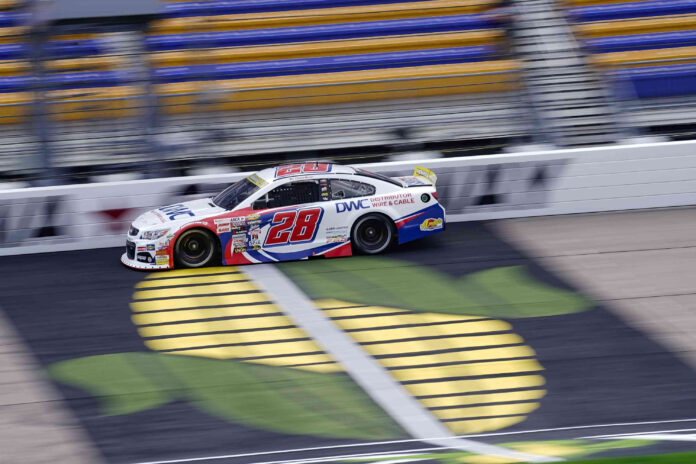
  4. Connor Mosack, 36 laps led
  5. Lanie Buice
  6. Thomas Annunziata
  7. Isabella Robusto
  8. Will Kimmel
  9. Wesley Slimp
  10. George Siciliano
  11. Kyle Steckly
  12. Ryan Vargas
  13. Dystany Spurlock
  14. Cleetus McFarland, six laps led
  15. Andy Jankowiak, one lap down
  16. Michael Maples, two laps down
  17. Jeff MacZink, two laps down
  18. Takuma Koga, three laps down
  19. Daniel Dye – OUT, Mechanical
  20. Con Nicolopoulos, four laps down
  21. Alex Clubb, four laps down
  22. Morgen Baird, six laps down
  23. Jason Kitzmiller – OUT, Accident
  24. Jeff Maconi, 10 laps down
  25. Bobby Earnhardt – OUT, Mechanical
  26. Matt Kemp – OUT, Mechanical
  27. Dustin Hillenburg – OUT, Mechanical
  28. Nick White – OUT, Mechanical
  29. Brad Smith – OUT, Mechanical
  30. Charles Weslowski – DNS (Did Not Start)

Next on the 2026 ARCA Menards Series schedule is the Pocono ARCA 150 at Pocono Raceway in Long Pond, Pennsylvania, for the Pocono ARCA 150. The event will occur next Friday, June 12, and air at 3 p.m. ET on FS1.

ARCA Menards Series at Michigan International Speedway: Henry Ford Health 200 Post-Race Notes

  • Gio Ruggiero (No. 18 First Auto Group Toyota) scored his third ARCA Menards Series win of the season in Friday’s Henry Ford Health 200 at Michigan International Speedway. Ruggiero took the lead on lap 49 and led to lap 57 when the race was cut short due to inclement weather.
  • The Henry Ford Health 200 is the first ARCA Menards Series race to be shortened by weather since William Sawalich won at Phoenix Raceway in 2024.
  • ARCA Menards Series championship points leader Jake Bollman (No. 20 Nitro Motorsports Toyota) finished second, his fourth top-five finish of 2026.
  • Gavan Boschele (No. 25 ShopGavan.com Toyota) notched a career-best third in his fourth career ARCA Menards Series start.
  • Pinnacle Racing Group entered with two consecutive ARCA Menards Series wins at Michigan International Speedway in 2024 with Connor Zilisch and in 2025 with Brenden Queen. The team’s two drivers, Connor Mosack (No. 28 Friends of Jaclyn Chevrolet) and Lanie Buice (No. 77 Sunoco Chevrolet) rounded out the top five. Buice was fastest in practice earlier in the afternoon and scored her second straight fifth-place finish.
  • Nitro Motorsports had four drivers in the top ten; in addition to Bollman, Thomas Annunziata (No. 70 JBL Toyota) in sixth, Isabella Robusto (No. 55 Mobil 1 Toyota) in seventh, and Wesley Slimp (No. 15 Road Ready Foundation Toyota) in ninth all ended up inside the top ten. It marks Slimp’s second consecutive top-ten result; he finished a career-best eighth in his last start at Toledo Speedway.
  • Will Kimmel (No. 69 Aviation Technology Ford) finished eighth, his 49th career top-ten finish and first of 2026.
  • Garrett Mitchell (No. 30 BaldEagle.com Ford), known to his millions of fans as Cleetus McFarland, earned his first career Sioux Chief PowerPEX Pole Award in qualifying. McFarland nearly spun after contact with Annunziata on lap 7, and then made contact with the wall after contact with Ryan Vargas (No. 91 Michael Maples Motorsports Ford) on lap 50; despite the damage to the right side of the car he persevered to finish 14th.
  • George Siciliano (No. 0 Heat Wave Visuals Ford), better known to his fans on YouTube as Squirrel McNutt, started last in the 28-car field and rallied to finish tenth, his best career ARCA Menards Series finish.
  • The next race for the ARCA Menards is at Pocono Raceway on Friday, June 12. The race, set to begin at 3 pm ET, will be televised live on FS1 and broadcast on select affiliates of the MRN Radio network nationwide.

About ARCA 
The Automobile Racing Club of America (ARCA), founded in 1953 by John and Mildred Marcum in Toledo, Ohio, and acquired by NASCAR in April 2018, is the leading grassroots stock car sanctioning body in the United States. Bridging the gap between NASCAR’s top three national touring series and weekly and regional tour racing all across the country, the organization to sanctions over 100 races per year in the ARCA Menards Series, ARCA Menards Series East, ARCA Menards Series West, ASA STARS National Tour, ASA CRA Super Series, ASA Midwest Tour, ASA Southern Super Series plus weekly racing at Toledo and Flat Rock Speedways. For more information about ARCA visit , or follow ARCA on Facebook (@ARCARacing) and Twitter (@ARCA_Racing). 

About Menards
A family-owned and run company started in 1958, Menards is recognized as the retail home center leader of the Midwest with 236 stores in 15 states.  Menards is truly a one-stop shop for all of your home improvement needs featuring a full-service lumberyard and everything you need to plan a renovation or build a home, garage, cabin, shed, deck, fence or post frame building.  You’ll find a large selection of lumber, roofing, siding, construction blocks, trusses, doors and windows, plus cabinets, appliances, countertops, flooring, lighting, paint, plumbing supplies and more.  To complete the job, Menards has quality hand tools, power tools, fasteners, electrical tools plus storage options and supplies for everyone from the weekend warrior to the pro!

Menards has what you need to complete your outdoor projects and keep your yard in tip-top shape including mowers, trimmers, blowers, pressure washers and more, plus a beautiful garden center stocked with plants, shrubs, trees, landscaping tools, grass seed, fertilizer options, outdoor décor and patio furniture.  Menards also has everyday essentials like health & beauty products, housewares, pet and wildlife supplies, automotive items and even groceries.  And at Christmas, an Enchanted Forest display area with impressive trees, lighting, decorations, ornaments, inflatables and more. 

Menards is known for friendly Customer Service and as the place to “Save Big Money” with low prices every day, and sales too!  For more information, please visit Menards.com to learn about our store locations, offerings and services.

Heavy rains postpone High Limit Racing I-94 debut.

Postment Photo Courtesy of High Limit Racing

Following a weeklong series of races for the Interstate Batteries High Limit Racing Series and their Roto Rooter Midweek Series, their streak will come to an end tonight.

Teams and drivers made the long four-hour haul from Superior, Wisconsin, on Thursday to Fergus Falls, Minnesota, this afternoon. However, they were treated with showers and storms despite having a sunny day leading up to the unloading of the Sprint Cars. Due to the heavy rain, the series officials had no other choice but to postpone the series debut at I-94 Speedway this afternoon. The officials made the call at 3:25 p.m./ET, 2:25 p.m./local time.

In a post on the High Limit Racing social media channels, the series says more postponement details will be coming later, including a potential later date.

The series will now shift its attention to Saturday night’s race at Dacotah Speedway in Mandan, North Dakota. Projected highs according to the National Weather Service are forecast to be in the low 90s during the daytime and upper 60s for the nighttime racing action, with no chance of rain.

No comments on Heavy rains postpone High Limit Racing I-94 debut.

Kyle Larson Wins Third Straight High Limit Race at Gondik Law Speedway

Photo Credit: High Limit Racing

The Interstate Batteries High Limit Racing Series marched forward with its sixth race of the Roto Rooter Midweek Series event at Gondik Law Speedway in Superior, Wisconsin. Kyle Larson found himself in a similar situation. He was in victory lane for the third time this week after starting in the third position and winning a heat race.

“It’s a cool race track, like a great shape for Sprint Car racing, this great orange dirt,” Larson said to Flo Racing on the frontstretch. “It’s some of the best in the country. This is a lot like Port Royal (Speedway, another dirt track). It’s really, really slick. In the slick, where it gets black. That was getting me a little bit nervous there in the end. I know Justin (Peck) was running lower than me; it sounded like in Turns) 1 and 2.

“He slid me there into Turn 1 on the restart and I wasn’t sure if I could get enough of an exit. I figured his car was pretty good to do that. I just picked the pace up and try to run a little harder. Hats off again to Paul (Silva) and Trevor (Canales, Larson’s crew member). It’s been a great week so far and hopefully we can keep it up. I guess one more race for me this week (I-94 Speedway).”

29 Sprint Cars were checked in.

Larson has been seeking three consecutive victories ever since winning the Monday night event at Davenport Speedway.

Rico Abreu, who pilots the No. 24 Tony Stewart Racing Sprint Car, is looking to carry the momentum into the weekend after taking over the season’s championship points standing by one point over Aaron Reutzel.

Three heat races were on the table with eight laps for each heat, with the top six transferring to the A-feature.

Before the green-flag beginning in the first heat race, Brenham Crouch and Justin Peck made contact with each other. Crouch received the most damage to his Sprint Car. Replays showed that Crouch spun around in Turn 4. Then, Peck came in hot, couldn’t slow down and made contact with Crouch. It also appeared Crouch had a lot of front-end damage. Due to the freak accident, both drivers were able to keep their starting positions for the heat race. Crouch’s team fixd the car and sent it back out.

Following the accident, the heat race was finally able to go green. Larson picked up another heat victory with Peck, Abreu, Crouch, Chase Randall, and Tanner Holmes the top six. Larson won by 3.699 seconds over Peck.

In the second heat, a caution was called early. This was due to Darin Naida’s car shutting off in Turn 4 and coming to a stop on the frontstretch. This was the only incident during the second heat race. Giovanni Scelzi took the second heat race win. The Spire Motorsports driver was followed by Reutzel, Sye Lynch, Ayrton Gennetten, Tyler Courtney, and Danny Sams III to round out the top six.

For the third and final heat race, Kasey Kahne’s Racing, Daison Pursley claimed the heat in a close battle with the top three. Brent Marks, Kerry Madsen, Hank Davis, Christopher Thram, and Joel Myers Jr were the final six transfers out of the heat races.

Moving on to the dash, which consisted of seven laps, were Larson, Scelzi, Pursley, Holmes, Reutzel, and Marks to vie for the pole. By drawing the lowest number possible of 00 in the dash draw, Pursley was on the pole for the dash event. The Kasey Kahne Racing driver was victorious in the dash and claimed the pole position for the first time this season. Interesting to note, this was the first time Pursley was on the pole for the KKR machine.

In the only B-main, there was a big name in this feature. Tanner Thorson, who failed to transfer out of the heat races, was able to transfer out of the B-main with a second-place finish. As for your winner, it was Brooke Tatnell who won the B-feature.

Once the heat races, dash, and B-mains were completed, it was finally time for the 30-lap feature. Pursley, Reutzel, Larson, Scelzi, Marks, Holmes, Peck, Abreu, Lynch, and Madsen were your Top 10 starters.

As the green flag waved for the start of the feature, Pursley and Reutzel raced down into Turn 1. Pursley had a great start, but it was Larson who fired down the backstretch to take the lead. Caution quickly flew on the first lap for Lynch, who was turned down in the infield off Turn 4 after contact with Davis. Lynch had a left-rear flat tire following the contact. Lynch was able to rejoin the field after the team made repairs.

Even though Larson took the lead briefly on the backstretch, the caution came out right before he crossed the start/finish line. Meaning, it would be a complete restart and Pursley got his pole position back, and Larson did not officially lead a lap.

Pursley got a better restart this time around and maintained his top spot. However, his lead would be short-lived, as Larson took the lead on the frontstretch at 28 laps to go. Pursley fell to second and tried protecting his position from Peck. Peck, however, took second away at 24 laps to go. The two would put on a thrilling battle in the early laps, which allowed Larson to pull away.

As Pursley threw a slider, his car went over the banking and lost several spots, sliding back to the fifth position. At 20 laps to go, it was Larson, Peck, Marks, Reutzel, and Holmes in the top five.

One lap later, with 19 to go, a caution came out for Myers Jr., as his car did not have power and pulled into the infield.

Coming to the choose cone, Larson chose inside, while Peck was outside for the double-file restart. Going back green, Larson went to the top side to stretch the lead. But a red flag came out immediately for two cars flipping upside down in Turn 1. Gennetten and Sams III were the cars involved in the incident, which went up and over the wall.

Gennetten was rightfully frustrated with the accident and had some words for Sams III, which you can check out in the clip below.

Following a brief red flag period for cleanup, the race resumed at 19 laps to go, with Larson checking out up front. Another caution was flown with 16 laps to go for Lynch, who spun around in Turn 2.

The caution was short-lived, and again, the green flag came back out. A few laps would be run until the caution flew once more at 12 laps to go. Madsen went over the wall while running in the top five, but thankfully did not go upside down. However, he suffered a right-front flat tire in the process. Meanwhile, Crouch and Davis also spun around as the caution came out.

A red flag would once again come out due to light rain showers impacting the racetrack, causing open red conditions, allowing teams to work on the cars.

The rain shower was brief, and the race was able to resume after a couple of minutes. The lineup was Larson, Peck, Marks, Reutzel, and Holmes in the top five. After the restart, Peck threw a slider on Larson, but Larson took control again and kept the top spot. The driver of the Paul Silva No. 57 entry would so in the final remaining laps and secured his third consecutive victory of the week. Larson’s margin of victory was 1.503 seconds over Peck.

The victory was his fifth of the 2026 season and the 14th of his career.

As Larson’s dominance continues in Sprint Car racing, he was asked if this is what it would look like if he ran in the series full-time.

“I’ve always wondered how we would do if we ran a full season,” Larson said in his victory lane interview. “In 2020, I think we proved how lethal we could be. If you give Paul (Silva, Team Owner) enough nights at it, and me more nights behind the wheel too. These tracks have been a lot different than what we ran on so far to start the year for me. I don’t know if they suited our style or what, but we definitely have been a lot more competitive these first three nights of this week than we have the other races this year.

“Happy about that. Hopefully, that means we’re getting our car better. You just don’t ever know until you get to some of the bigger races with all the competition. Look forward to some of those.”

Official Race Results Following Gondik Law Speedway

  1. Kyle Larson
  2. Justin Peck
  3. Brent Marks
  4. Tanner Holmes
  5. Aaron Reutzel
  6. Rico Abreu
  7. Giovanni Scelzi
  8. Daison Pursley
  9. Tanner Thorson
  10. Chase Randall
  11. Tyler Courtney
  12. Brenham Crouch
  13. Kerry Madsen
  14. Danny Sams III
  15. Hank Davis
  16. Brooke Tatnell
  17. Alex Pokorski
  18. Will Gerrits
  19. Christopher Thram
  20. Joel Myers Jr
  21. Sye Lynch
  22. Ayrton Gennetten
  23. Austin Hartmann
  24. Zach Daum

Up Next – The next Interstate Batteries High Limit Series race is slated for Friday night at I-94 Speedway, live on Flo Racing.

Fuel Keeps the Flame Lit in FireKeepers Casino 400

Racing at Michigan Means Balancing Speed With Fuel Efficiency

MOORESVILLE, N.C. (June 5, 2026) – When drivers have their right foot mashed to the floorboard, their throttle wide open as they run more than 190 mph, fuel efficiency is not top of mind. But at Michigan International Speedway in Brooklyn, home to Sunday’s FireKeepers Casino 400, the conundrum of balancing outright speed and maximizing fuel mileage is ever present.

The 2-mile oval in the state’s Irish Hills region produces some of the fastest speeds on the NASCAR Cup Series schedule. Its sweeping corners, banked at 18 degrees, grant drivers the ability to go wide-open or at least attempt to, based on how much grip their tires and their own grit allow.

“Michigan is about as fast as it gets. You’re just about wide-open, and completely wide open when your car’s right and the track conditions are right,” said Cody Ware, driver of the No. 51 Super.com Chevrolet for Rick Ware Racing.

“It takes a mega-level of commitment to keep your foot to the floor. You’ve got to tell yourself not to lift when you really want to going into the corner.”

As drivers push these boundaries, they also push how far their car’s 20-gallon fuel cell can take them. For as many Michigan races have been won by brute strength, seemingly just as many have been won by those who drive as if there was an egg between their foot and the gas pedal.

“You’ve got to have a car that’s really, really fast if you want to try to save fuel because the only way you’re going to do that is by having less wide-open throttle time,” Ware said.

The ability to go fast, yet still save fuel, is an art that requires in-race adaptation.

“Being smooth is always key at Michigan,” Ware said. “You want to find your rhythm – your throttle points, your lift points, your pickup points – but when you have to break that in an effort to save fuel, it gets tricky. You have to find a whole new set of markers on the track to sustain that new rhythm. You can get jumbled up and make a mistake.”

How does Ware view his ability to save fuel?

“I don’t think there’s ever anyone who walks away from a fuel-mileage race and says, ‘Yeah, I did that perfectly,’ because in the moment you never know. There’s no fuel gauge in the car. We don’t see how many miles-per-gallon we’re getting,” Ware said.

“Sometimes, you slow down too much. Other times, you don’t slow down enough and you run dry. You even try to get ready for the moment and look at historical data before the race weekend even starts, but still, in the moment, it’s almost impossible to really know if you’re doing a good job or not.”

The ultimate validation comes with a trip to victory lane. But is there an asterisk attached to a fuel-mileage win?

“A win is a win is a win,” Ware said. “I don’t care if it’s superspeedway racing, fuel-mileage racing, rain racing – you and your team have done something right if you’ve won a NASCAR Cup Series race. You just don’t fluke into it at this level.”

The FireKeepers Casino 400 will mark Ware’s 157th career Cup Series start, and his drive toward his first Cup Series win begins Saturday with practice at 5 p.m. EDT followed by qualifying at 6:10 p.m. Sunday’s 200-lap race goes green at 3 p.m. All of the action will be broadcast live by Prime Video and SiriusXM NASCAR Radio.

About Rick Ware Racing:

Rick Ware has been a motorsports mainstay for more than 40 years. It began at age 6 when the third-generation racer began his driving career and has since spanned four wheels and two wheels on both asphalt and dirt. Competing in the SCCA Trans Am Series and other road-racing divisions led Ware to NASCAR in the early 1980s, where he finished third in his NASCAR debut – the 1983 Warner W. Hodgdon 300 NASCAR Grand American race at Riverside (Calif.) International Raceway. More than a decade later, injuries would force Ware out of the driver’s seat and into full-time team ownership. In 1995, Rick Ware Racing was formed, and with his wife Lisa by his side, Ware has since built his eponymous organization into an entity that competes full-time in the elite NASCAR Cup Series while simultaneously campaigning successful teams in the Top Fuel class of the NHRA Mission Foods Drag Racing Series, Progressive American Flat Track, FIM World Supercross Championship (WSX) and zMAX CARS Tour.

RECENT PROGRESS HAS TOP FUEL’S WILL SMITH EXCITED FOR NHRA NEW ENGLAND NATIONALS PRESENTED BY BPROAUTO

EPPING, N.H. (June 5, 2026) – Jumping into a loaded Top Fuel field is never easy, but Will Smith couldn’t be more thrilled with the opportunity and he’s starting to make the most of it heading into this weekend’s 13th annual NHRA New England Nationals presented by bproauto at New England Dragway.

This year marks the first chance at a full-time ride for Smith, who had raced eight previous times in the category before jumping into the 12,000-horsepower Bluebird Turf dragster for SCAG Racing in 2026.

It hasn’t been easy and it’s a steep learning curve going against a wealth of talented drivers, but Smith has shown solid signs of improvement. He continues to be a standout on the starting line and the team has picked up round wins at each of the past two races.

Those mark the first two round wins of his Top Fuel career and a big step forward for Smith and his team, which only adds to his confidence heading to this weekend’s race in Epping.

“We’re excited to head to Epping this weekend. The last two races have both resulted in round wins for our team and it’s encouraging to see the progress we’re making,” Smith said. “Our Bluebird Turf team has been working so hard and we look forward to carrying our momentum into the weekend and taking another step forward. The goal is to keep improving, put together a strong qualifying effort and give everyone who comes out to support us something to cheer about on Sunday.

“We’ll have a large group of SCAG dealers, customers, and guests joining us throughout the weekend. It’s a great opportunity to spend time with the people who support our brands and we always enjoy being able to share the NHRA experience with them.”

Last year, Brittany Force (Top Fuel), J.R. Todd (Funny Car) and Greg Anderson (Pro Stock) picked up race wins, while Doug Kalitta (Top Fuel), Jack Beckman (Funny Car) and Matt Hartford (Pro Stock) earned victories in the Mission #2Fast2Tasty NHRA Challenge bonus race. This season’s event will again be broadcast on FS1 and FOX, with eliminations on FOX on Sunday beginning at 3:00 p.m. ET.

  • It is the eighth of 20 races during NHRA’s 75th anniversary season and fans can expect a variety of highlights, including:
  • A feature of the Tasca Cobra Jet with Funny Car team owner Bob Tasca III.

On Friday, the first 3,000 fans in attendance will receive a free, limited-edition NHRA New England Nationals presented by bproauto flag celebrating NHRA’s 75th anniversary and the 60th anniversary of New England Dragway.

Smith saw nothing but positives from last weekend’s race in Maryland. Taking on fellow rookie Maddi Gordon in the first round, Smith picked up the victory before falling to Leah Pruett a round later. Round wins are tough to come by in the Top Fuel ranks, with the standout class led by points leader Shawn Langdon, who has rolled to three straight wins.

Then, there’s the likes of reigning world champion Doug Kalitta, racing legend Tony Stewart, Pruett, Gordon, four-time champ Antron Brown, Clay Millican and Smith’s teammate, Justin Ashley. It’s a tall order for anyone, but Smith is feeling good about what his team accomplished in Maryland and is eager to get right back in the car during this stretch of three straight race weekends.

“We had a great weekend. We’re excited, we’re making progress, and we’re onto Epping this week. We’ll build on what we learned this weekend and try to turn on more win lights this week,” Smith said.

In Funny Car, J.R. Todd would love a repeat win as he remains in the thick of the championship hunt. Points leader Ron Capps and Chad Green both have two wins this season, and the loaded class also includes Matt Hagan, Alexis DeJoria and Jordan Vandergriff.

Six-time Pro Stock world champ Anderson won Epping for the third time last year over his long-time rival Erica Enders. His KB Titan Racing teammate Dallas Glenn claimed the world title in 2026 and is the current points leader, while others to watch include Aaron Stanfield, Hartford and Greg Standfield. A

The event will also feature standout competition in the NHRA Lucas Oil Drag Racing Series, as well as the popular snowmobile categories. Race fans at New England Dragway can enjoy the special pre-race ceremonies that introduce and celebrate each of the drivers racing for the prestigious Wally on Sunday and includes the fan favorite SealMaster Track Walk. The final experience of any NHRA event is the winner’s circle celebration on Sunday after racing concludes, where fans are invited to congratulate the event winners.

As always, fans also get an exclusive pit pass to the most powerful and sensory-filled motorsports attraction on the planet in Epping. This opportunity gives fans a unique chance to see teams in action and service their hot rods between rounds, get autographs from their favorite NHRA drivers, and more. Fans can also visit NHRA’s popular Nitro Alley and Manufacturers Midway, an exciting atmosphere that includes interactive displays, merchandise, food and fun for the entire family.

NHRA Mission Foods Drag Racing Series qualifying features two rounds at 5 and 7:30 p.m. ET on Friday, June 5 and the final two rounds of qualifying on Saturday, June 6 at 12:30 and 3 p.m. Final eliminations are scheduled for 11 a.m. ET on Sunday, June 7. Television coverage includes qualifying action on FS1 at 8 p.m. ET on Friday and 12 p.m. on Sunday, followed by eliminations from 3-6 p.m. ET on Sunday on FOX.

To purchase tickets to the NHRA New England Nationals presented by bproauto, fans can visit www.NHRA.com/tickets. Children 12 and under are free in general admission with the purchase of an adult ticket. For more information about NHRA, visit www.NHRA.com.


About Mission Foods

MISSION®, owned by GRUMA, S.A.B. de C.V., is the world’s leading brand for tortillas and wraps. MISSION® is also globally renowned for flatbreads, dips, salsas and Mexican food products. With presence in over 112 countries, MISSION® products are suited to the lifestyles and the local tastes of each country. With innovation and customer needs in mind, MISSION® focuses on the highest quality, authentic flavors, and providing healthy options that families and friends can enjoy together. For more information, please visit https://www.missionfoods.com/

About NHRA

NHRA is the primary sanctioning body for the sport of drag racing in the United States. NHRA presents 20 national events featuring the NHRA Mission Foods Drag Racing Series and NHRA Lucas Oil Drag Racing Series, as well as the JBS Equipment NHRA Pro Mod Drag Racing Series presented by Elite Motorsports and NHRA Flexjet Factory Stock Showdown™ at select national events. NHRA provides competition opportunities for drivers of all levels in the NHRA Summit Racing Series and NHRA Street Legal™. NHRA also offers the NHRA Jr. Street® program for teens and the Summit Racing Jr. Drag Racing League® for youth ages 5 to 17. With more than 100 Member Tracks, NHRA allows racers to compete at a variety of locations nationally and internationally. NHRA’s Youth and Education Services® (YES) Program reaches over 30,000 students annually to ignite their interest in automotive and racing related careers. NHRA’s streaming service, NHRA.tv®, allows fans to view all NHRA national events as well as exclusive features of the sport. In addition, NHRA owns and operates three racing facilities: Gainesville Raceway in Florida; Lucas Oil Indianapolis Raceway Park; and In-N-Out Burger Pomona Dragstrip in Southern California. For more information, log on to www.NHRA.com, or visit the official NHRA pages on Facebook, Instagram, Twitter, and YouTube.

The Rise of Digital Car Draws Among Motorsport Fans

Motorsport weekends in the UK follow a traditional and familiar rhythm. Fans gather around television screens to watch qualifying sessions and main races, fully immersed in the high-stakes world of petrol, pit stops, and tyres. However, a new trend is emerging during the commercial breaks. Instead of walking away from the screen to make a cup of tea, many enthusiasts now reach for their mobile devices to participate in quick, instant-win car competitions.

This shift connects the passive experience of watching a race with the active thrill of a live competition. It’s an easy way for people to stay engaged with their hobby even when the cars aren’t actively on the track. Today, it’s well known that mobile interactions skyrocket exactly when the live broadcast cuts to adverts. And these apps are quickly becoming one of the main ways people spend that short downtime.

Low Ticket Costs and Grassroots Race Formats

The appeal of these modern digital competitions often comes down to the cost of entry. With ticket prices starting around fifteen pence, the entry barrier is incredibly low. This setup closely mirrors the format of grassroots racing brackets, where local drivers compete in low-cost, high-excitement events at local circuits over the weekend. It’s a style of competition that is very familiar to core racing enthusiasts who grew up watching local club meets.

Fans appreciate this format because it provides a quick burst of excitement without a massive financial commitment. It allows viewers to get involved in a secondary competition that runs parallel to the main grand prix on television. This small investment keeps the crowd’s energy high, even when the track action pauses for a few minutes. It’s worth pointing out that the fast-paced nature of these draws matches the quick decisions made by team strategists on the pit wall.

Safe Frameworks for Data-Driven Audiences

Racing fans are naturally analytical people who spend hours looking at tyre strategies, lap times, and mechanical data. Because of this, they expect the same level of clarity and transparency when they participate in online prize draws. They want to know the exact odds of winning and want to see precisely how the numbers are generated. They don’t want vague promises; they prefer hard facts and clear rules.

To meet these high standards, the market now features transparent operators backed by global entertainment giants that ensure total compliance and safety. Today, reputable platforms, like Rafflee, have responded to this by publishing audited draw results and clear odds breakdowns. This is the kind of transparency that motorsport fans, who are used to scrutinising data, tend to respond well to.

These systems use fully audited random selection processes, which build trust with a highly critical audience. Having this level of regulatory backing ensures that players can focus on the fun of the draw without worrying about fairness.

Peak Mobile Interaction During Live Broadcasts

Recent mobile traffic figures from 2026 highlight a fascinating pattern during major motorsport events. App downloads and entry submissions don’t happen randomly throughout the week. Instead, they form massive spikes during specific hourly windows that align perfectly with the television schedule.

The data reveals that the most significant surges occur during the following periods:

  • The brief lull between the end of qualifying and the start of the post-race interviews.
  • The mid-race commercial breaks when cars are driving under safety car conditions.
  • The immediate hour after the podium ceremony finishes when fans are still buzzing with excitement.

These specific time slots show that fans use their mobile devices to fill the natural gaps in live sports entertainment. It transforms a moment of television downtime into a personal opportunity to win a performance vehicle. This habit proves that modern viewers want an interactive experience that complements what’s happening on the big screen.

Here’s What Matters

The intersection of live motorsport and instant-win digital competitions represents a genuine shift in how people watch racing. It blends the analytical mind of the motorsport fan with the accessible nature of modern mobile platforms. It acts as a complement to the actual race, adding an extra layer of entertainment to the whole weekend.

As technology evolves, these interactive habits will likely become even more deeply embedded into the sports viewing experience. For now, it offers a simple and safe way for fans to chase their own chequered flag from the comfort of the sofa.

Tips For Fighting A Ticket In Traffic Court

Photo by depositphotos at https://depositphotos.com/

So, you just got slapped with a traffic ticket. Your stomach drops, you mutter a few choice words, and now you’re staring at a slip of paper that threatens your wallet and your driving record. First off, take a breath. Seriously, most people have been there at least once, and it doesn’t necessarily mean the end of the world—or your insurance rates. Let’s talk about how to approach traffic court like you’ve actually got a shot. Because you do.

Don’t Just Pay Up Right Away

There’s a pretty strong urge to pay the ticket, get it out of your hair, and forget it ever happened. But unless you know for sure you’re totally guilty (and even then, there might be details you missed), think twice. Paying is basically admitting guilt and could bump up your insurance. Sometimes, it’s worth showing up to court and seeing what a judge thinks.

Know Your Ticket Inside and Out

Sounds basic, but read that ticket cover to cover. Is your name spelled right? Did the officer note the correct car? Little errors like these sometimes give you a leg to stand on, though they’re not magic fixes. Make sure the ticket lists the right violation and matches up with what actually happened. If anything feels off, jot it down. Keep every shred of paperwork they give you, too. Some folks keep a dedicated folder; I just stuff it in my glove box—hey, whatever works, right?

Gearing Up: Evidence Actually Matters

Here’s where you can get an edge. Collect anything you think helps your side. Maybe the speed limit sign was hidden behind a bush (snap a photo!) or you weren’t texting, just checking directions. The officer’s notes sometimes hold surprises. You can ask for a copy of their report for your case. Was the radar gun used that day properly tested? If you’re the detective type, you’ll want to find out.

Dress and Act the Part (It’s Not Overkill)

I know, traffic court isn’t exactly a courtroom drama, but your appearance makes a difference. I’m not saying rent a tux, but skip the sweatpants. Look decent, show that you actually care, and be polite—even if it’s tough. Judges notice genuine effort and respect.

Consider Getting Help

Fighting a ticket solo is totally doable for basic stuff, but trickier cases might need backup. If your ticket’s expensive or messing with your job, talking to Greenville criminal defense lawyers or local specialists is a smart step. These folks know all the ins and outs. You don’t have to do it all alone.

Learn From Others

It’s not a bad idea to peek at sites like Nolo’s traffic court basics to see what’s worked for folks before. Sometimes, someone’s random story on a forum actually helps you shape your own.

One Last Thing: Stay Calm, and Show Up!

Crazy as it sounds, tons of people skip court and just lose by default. Unless you want to toss away your chance, mark the date. Set five reminders. It’s not glamorous, but sometimes just showing up and telling your story gives you your best shot.

So, take it one step at a time. Most people are nervous, but you can get through it—and maybe even walk away without that mark on your record. Good luck out there.

The Smart Way to Add Power to a Diesel Truck You Actually Tow With

Photo by depositphotos at https://depositphotos.com/

There are two completely different reasons people modify diesel trucks, and confusing the two is the single most expensive mistake in this hobby. One person wants the highest number a dyno will show for thirty seconds. The other wants to hook onto a 16,000-pound trailer in August, climb a long mountain grade without sweating the temperature gauge, and keep doing it reliably for a decade. If you’re the second person — and most truck owners are — your entire approach to building the truck should change. You’re not chasing peak power. You’re chasing sustainable, drivable, dependable capability. Here’s how to think about getting there.

Towing punishes a truck differently than a drag pass

A dyno pull or a quick blast down an empty road is over before heat ever becomes a real problem. Towing is the exact opposite. When you’re dragging a heavy load up a long grade, the engine sits under sustained, high demand for minutes at a time, and that’s precisely when exhaust gas temperatures (EGT) creep up and stay up. Peak power is almost irrelevant in that moment. What matters is how much power the truck can make continuously without cooking itself.

This is the core principle every tow-focused build is organized around. A modest, well-supported power increase that holds EGTs in a safe range under sustained load will out-tow a wildly powerful truck that overheats halfway up the climb, every single time. The goal isn’t the biggest number on a screen. It’s the most usable power your cooling system and drivetrain can comfortably handle all day long, in the heat, with weight behind you.

Owners love to fixate on the engine, but on most modern diesels the transmission gives up long before the engine does. Stock automatic transmissions and their torque converters are calibrated for stock power levels. Add a meaningful amount of torque — which is exactly what makes a truck tow better — and you ask the converter to hold more than it was ever designed to. That shows up first as slipping, then as heat, and eventually as outright failure at the worst possible time.

If you’re adding power specifically to tow, the drivetrain has to be part of the plan from day one, not an afterthought once something breaks. In practice that can mean transmission tuning that firms up shift points and lockup strategy, upgraded converters or clutch packs on higher-power builds, and — at an absolute minimum — keeping a close eye on transmission temperature whenever you’re working the truck. A diesel that makes great power but can’t put it to the ground through a healthy transmission isn’t a tow rig. It’s a roadside breakdown waiting for a schedule. Respect the whole driveline, not just the engine bolted to the front of it.

Heat management is the supporting cast that earns its keep

Sustained towing is fundamentally a thermal endurance test, so the unglamorous cooling-related upgrades often matter far more than the exciting ones. Keeping coolant, engine oil, and transmission fluid within safe limits is what allows the engine to make its power without the truck’s safety systems pulling timing to protect themselves — or the fluids breaking down and accelerating wear.

This is also where the exhaust earns its reputation as the best-value upgrade for a working truck. A free-flowing post-turbo exhaust lets spent gases escape with far less backpressure, which directly lowers EGTs under load and helps the turbo spool sooner when you’re trying to get a heavy load rolling from a stop. Lower drive pressure means a cooler, happier engine right when you’re asking the most of it. For a truck that tows for real, that thermal headroom isn’t a luxury or a styling choice — it’s the margin that quietly keeps the whole build alive year after year. There’s an off-highway version of this conversation too: on trucks built purely for off-road or competition use, owners often remove the EGR circuit altogether so recirculated exhaust heat and soot never reach the intake, and a dedicated 6.7 Powerstroke EGR Delete Kit is the usual starting point — but that’s a closed-course choice, not something for a street-driven tow rig that has to stay emissions-legal.

Tune for the job, not for bragging rights

Calibration is where the tow build and the race build part ways most clearly, and where the most damage gets done by people who don’t understand the difference. A competition tune dumps in aggressive fuel and timing to chase peak numbers, accepting high EGTs and serious driveline stress as the cost of doing business on a closed course. A tow tune does the opposite. It delivers a sensible bump in power and, crucially, torque low in the rev range where towing actually happens, while keeping fuel delivery conservative enough to hold temperatures firmly in check.

Many quality tuners and programmers ship with multiple selectable tunes for exactly this reason — a mild, EGT-conscious setting for towing and a more aggressive setting for an empty truck on a closed course where it belongs. The owner who selects the right tune for the moment, rather than leaving it parked in the most aggressive setting and hoping the temperatures behave, is the one whose engine goes the distance. Power you can’t actually use safely under load isn’t really power. It’s just risk you’ve already paid for.

Drive with data, not with hope

You cannot manage what you cannot see. The most valuable habit any towing diesel owner can build is watching the handful of numbers that predict trouble before it actually happens: EGT, boost, coolant temperature, and transmission temperature. A spike in EGT on a long climb is your cue to back off the throttle and let things settle; a steadily rising transmission temp is telling you to ease the load or pull over and let it recover before something lets go.

This is why modern monitors and handheld tuners are worth their weight to anyone who works their truck. Beyond whatever power they add, they turn invisible mechanical stresses into a live readout right on your dash, so you’re making informed decisions in real time instead of discovering a problem only after it has already done expensive damage. Treat your gauge cluster as a towing insurance policy and you’ll consistently catch the small problems while they’re still small and cheap.

Match your components — and know the rules

A towing build only works when the pieces are chosen for your specific truck and pull together as a coherent system. The turbo arrangement, exhaust routing, and drivetrain behavior of a 6.7L Powerstroke, a 6.7L Cummins, and a Duramax L5P are all genuinely different, and a part that transforms one platform can be flat-out wrong for another. Buying hardware engineered for your exact engine family and model year saves you from clearance headaches and mismatched fitment — and, more importantly, makes sure the airflow, tuning, and cooling pieces actually complement one another instead of fighting.

That’s the real case for shopping through a platform-specific specialist rather than grabbing whatever generic part is cheapest. Stores such as Supmodlab organize their tuners, exhaust systems, and supporting hardware by truck and year, so the components you assemble are designed from the outset to work together on your application. One important caveat worth stating plainly: a great deal of the emissions-related hardware in the diesel performance world is sold strictly for off-road and competition use, and road-legal emissions regulations differ from one place to the next. Know the laws where you drive, and keep a street truck street-legal.

Build a truck that shrugs off the work

The trucks that earn a reputation for towing anything, anywhere, for years on end aren’t the ones with the wildest dyno graphs to show off. They’re the ones built around a simple, disciplined priority: sustainable power, supported by a drivetrain that can transmit it and a cooling system that can absorb the heat, all managed by a sensible tune and watched on honest gauges. Get those fundamentals right and the result is a diesel that doesn’t flinch at a steep grade, a hot afternoon, or a heavy trailer. That — not a number flashing on a screen — is what real diesel truck performance looks like for the people who actually put these machines to work.

Famous New Zealand racers and their favorite pastimes

New Zealand has a lot of famous racers who have captured the hearts of many fans of this sport. Athletes spend much of their lives preparing for competitions or recovering from them, leaving little time for personal pursuits. However, when they’re on vacation or have a day off, everyone has different leisure preferences. Below is a look at the leisure pursuits of many New Zealand racers.

New Zealand Racers

New Zealand drivers are known for their small population, which regularly produces good motorsport athletes. Many spend 200 days a year travelling between championships, tests, and training. Their daily schedule often offers 5–6 days of physical training per week and 2–4 hour simulator sessions to maintain their reaction time. Not all drivers share their personal lives, but their fans often notice them in real life.

  1. Scott Dixon;
  2. Scott McLaughlin;
  3. Shane van Gisbergen;
  4. Liam Lawson;
  5. Brendon Hartley;
  6. Nick Cassidy;
  7. Earl Bamber;
  8. Chris Amon.

The hobbies of the racers are not extreme, because calm and controlled entertainment helps to relax. Fans can see them at football matches, cycling, or golf. In everyday life, they avoid unnecessary risks. Journalists note that New Zealand racers combine maximum professionalism on the track with a fairly balanced and calm rest outside it.

Gambling

Racers choose gambling and sports betting because of their accessibility and contrast with their disciplined lives. Studies indicate that 0.5–2% of professional athletes worldwide enjoy casino entertainment, but the proportion of New Zealand racers with gambling preferences is higher. Casino entertainment attracts them because the result is known within minutes. The main advantage of the games is the mechanics of chance and the effect of anticipating a win, which psychologically activates the dopamine system of the brain. There are a few gambling establishments in New Zealand, but racing fans have noticed athletes from time to time in Las Vegas casinos. The most recent confirmed cases were the game of Liam Lawson and Earl Bamber.

Some racers play online casino games, selecting clubs using bonus eligibility overview sites. This type of industry gives $80–100 billion annually, but 60% of this volume falls on mobile gambling clubs. The quick reward factor, where one session lasts 1–5 minutes, is an advantage. Online gambling offers controlled risk without physical danger, which distinguishes it from real-life extreme sports. So, it becomes for some people a quick and emotionally rich way to take a short break between intense periods of work or training. Shane van Gisbergen said that online entertainment is convenient, because you don’t have to leave your home or adjust while working.

Intellectual leisure

Intellectual leisure is necessary for the balance in the life of New Zealand racers, as it helps to maintain concentration, strategic thinking, and speed of decision-making. Professional pilots can spend more than an hour a day in racing simulators during the season, where they analyze the trajectories or behavior of rivals. Athletes try to be interested in activities that develop memory, logic, and viewing details. This type of activity doesnʼt create physical stress, but allows the brain to remain active even during periods of rest. This is important because sportsmen need to make decisions in a split second on the track. Statistics show that racers usually choose:

  • Online chess and strategy games;
  • Telemetry analysis and viewing of racing data;
  • 2026 quizzes and logic puzzles;
  • Reading books on sports psychology and leadership;
  • Studying the technical aspects of cars and new technologies.

Scott McLaughlin, Shane van Gisbergen, and Liam Lawson use racing simulators to prepare for races and as a way to spend time with their children and wife. New Zealand people know Scott Dixon for his analytical approach to racing who often pays attention to studying geometry and racing strategies to better understand the details of his challenges. Nick Cassidy and Earl Bamber have also claimed not once about the importance of watching race competitions and working with technical information between championship rounds. A team can collect 1000+ telemetry parameters during a single race weekend in 2026 motorsport.  They are analyzed by drivers and engineers, which is similar to the principle of Casino Analyzer. This website provides an online casino overview for Canadians, New Zealanders, and Australians today. 

Travel and Outdoor Activities

Travel and outdoor activities are a nice decision for New Zealand racers after competitions. Drivers often use their free time to check new countries and cultures because of the constant travel between championships. Many of them prefer quiet tourism, nature walks, and relaxing by the ocean. Hiking, fishing, and cycling are popular for introverts (Chris Amon and Nick Cassidy). These kinds of activities help to restore strength after hard races and reduce stress levels. Also, nature has a positive effect on the physical and psychological health of athletes.

New Zealand drivers occasionally choose golf and running, because it requires good weather. This type of pastime allows NZ people to have good physical shape without unnecessary risk to their health. Scott Dixon and Brendon Hartley have repeatedly mentioned their love of family vacations while traveling. Liam Lawson and Shane van Gisbergen also often spend their free time outside the city in summer. According to the Active NZ Survey 2024/25, 61% of New Zealand adults regularly meet the recommended level of physical activity.

Spending time in other sports

Many New Zealand racers are interested in other sports that help them stay fit and diversify their leisure time. Scott Dixon regularly plays tennis, which helps develop concentration and patience. Scott McLaughlin is a keen swimmer and uses cycling as part of his training. Shane van Gisbergen is known for his love of mountain biking and hunting. Liam Lawson sometimes takes part in basketball games with friends during the off-season. However, each of them prefers to spend their long vacations passively in online casinos or lying on the beach, sunbathing, and swimming in the ocean.

Brendon Gartley and Earl Bamber often choose jogging and gym training to have big muscles and stamina. Nick Cassidy likes water polo and has a rest on the New Zealand coast. Chris Amon was interested in rugby in his younger years. It’s one of the most popular sports in the country in 2026. Many racers also attend sporting events as fans to support local teams. Extra sports activities bring a better mood and affect the coordination of movements and the general physical condition of sportsmen. According to Sport New Zealand, 70% of New Zealand adults regularly participate in sports or recreational activities.